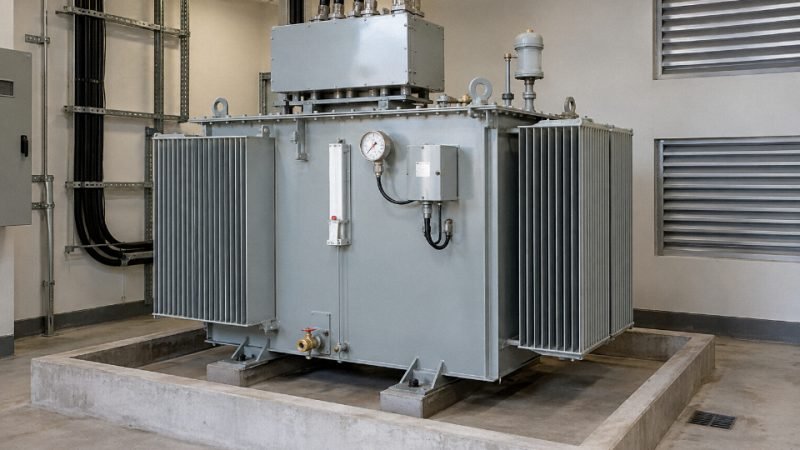
A transformer liquid fire can turn an electrical fault into a prolonged plant shutdown, with damage extending beyond the transformer itself. Lost production, equipment replacement, and installation constraints can outweigh the initial fluid cost. Where fire risk drives the specification, transformer-grade silicone fluid is one option worth evaluating—but only within a compatible, approved transformer design.
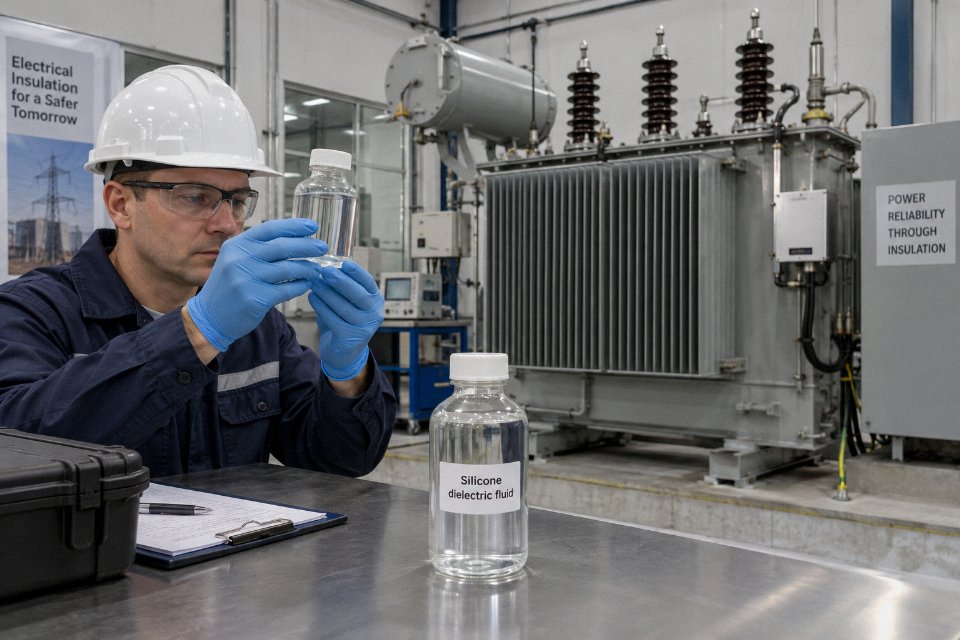
Silicone oil is used in transformers to provide electrical insulation and carry heat away from windings while offering high fire resistance. Many transformer-grade silicone fluids have fire points around 350 °C, supporting their use where fire consequences are severe. Actual suitability depends on the fluid specification, transformer cooling design, and installation requirements.
The catch is that a high fire point does not guarantee better cooling, lower operating temperatures, or approval for an existing transformer. Silicone fluid’s viscosity and compatibility can change the engineering decision. The useful comparison is not simply which liquid is hardest to ignite, but which fluid-and-transformer combination meets the plant’s thermal, safety, and maintenance requirements without creating a costly retrofit problem.
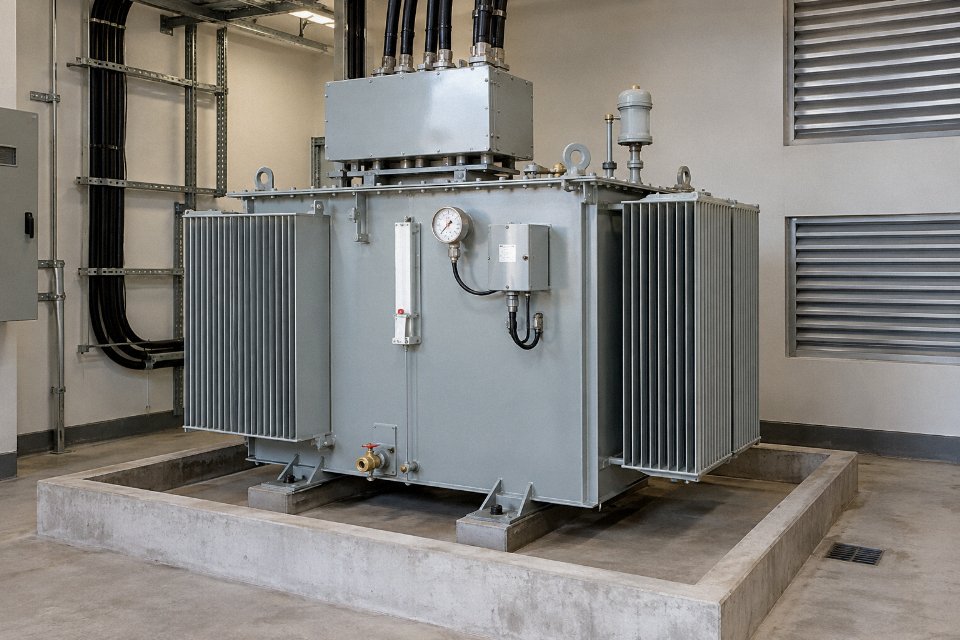
How does silicone fluid insulate and cool a transformer?
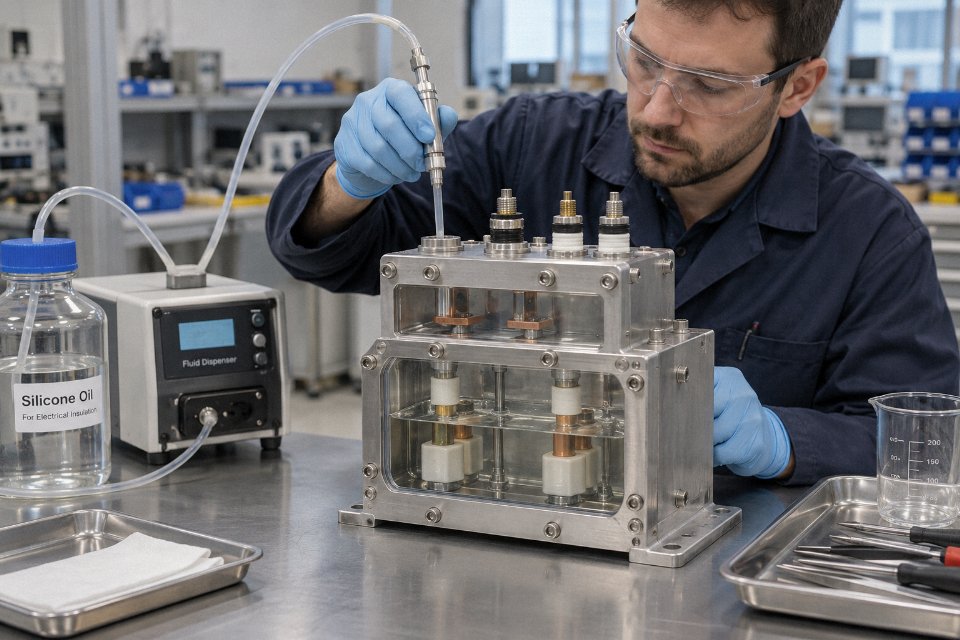
Transformer-grade silicone fluid provides electrical insulation across liquid-filled clearances and transports winding losses to cooling surfaces. Its dielectric performance depends on fluid cleanliness and electric-field geometry; its cooling performance depends on temperature-dependent properties and the transformer’s circulation paths. Neither function can be assessed from the fluid’s thermal stability or a single breakdown-voltage result alone.
Start with the correct grade of silicone fluid
Transformer silicone fluid is typically based on polydimethylsiloxane, or PDMS, manufactured, conditioned, and quality-controlled for electrical insulating service. The formulation, purification, moisture control, and release testing matter—not simply the presence of silicone in the product description.
These product categories are not interchangeable:
- Transformer-grade insulating fluid: supplied against defined electrical, physical, and chemical acceptance requirements, with batch documentation.
- General-purpose silicone oil: may have the same nominal viscosity but lack the required controls on moisture, ionic contamination, volatile content, or dielectric performance.
- Silicone emulsions: contain a dispersed silicone phase, usually in water with emulsifiers; they are not substitutes for transformer insulating liquid.
- Silicone-containing additives: serve functions such as foam control in other formulations; they do not establish the host liquid’s suitability for transformer service.
For procurement, specify the approved fluid grade and applicable acceptance requirements. “PDMS, 50 cSt” on a purchase order leaves too much unresolved.
Liquid insulation and solid insulation do different jobs
The liquid occupies clearances between energized components and grounded structures, including winding-to-tank spaces and regions around leads. It also penetrates accessible pores in solid insulation during properly controlled processing. Paper, pressboard, and other qualified solids provide barriers, conductor wrapping, and mechanical separation; the liquid does not replace them.
Local electric-field concentration matters. A sharp lead connection, displaced barrier, or trapped bubble can create electrical stress that a clean laboratory fluid sample does not reproduce.
Three measurements help assess different aspects of fluid condition:
- Dielectric breakdown strength measures resistance to breakdown under a specified electrode arrangement and voltage procedure. Electrode geometry, gap, sample handling, temperature, and the test method affect the result. Moisture, conductive particles, and bubbles can sharply reduce measured strength.
- Dissipation factor indicates dielectric energy loss under alternating voltage. An increase can indicate polar or ionic contamination, but interpretation requires the specified temperature and frequency. A satisfactory breakdown result does not guarantee a satisfactory dissipation factor.
- Volume resistivity describes resistance to leakage-current flow through the liquid under defined conditions. It is sensitive to temperature and contamination and is not another name for breakdown voltage.
Moisture requires particular care: dissolved water, free water, and water held in cellulose behave differently. Fluid moisture expressed in parts per million is therefore incomplete without temperature and fluid-specific saturation behavior. Gas bubbles can introduce weak dielectric regions, while particles can concentrate fields or form conductive paths.
Use the supplier’s specified methods and acceptance limits, and compare trends using consistent sampling procedures. A damp sample bottle can turn a useful condition check into an expensive false alarm.
Heat removal depends on the complete circulation path
Heat conducts through conductor insulation and adjacent materials into the fluid. Fluid moving along winding surfaces absorbs that heat and carries it toward tank walls or radiators; heat then passes through metal surfaces and leaves by air convection and radiation, or through another designed cooling arrangement.
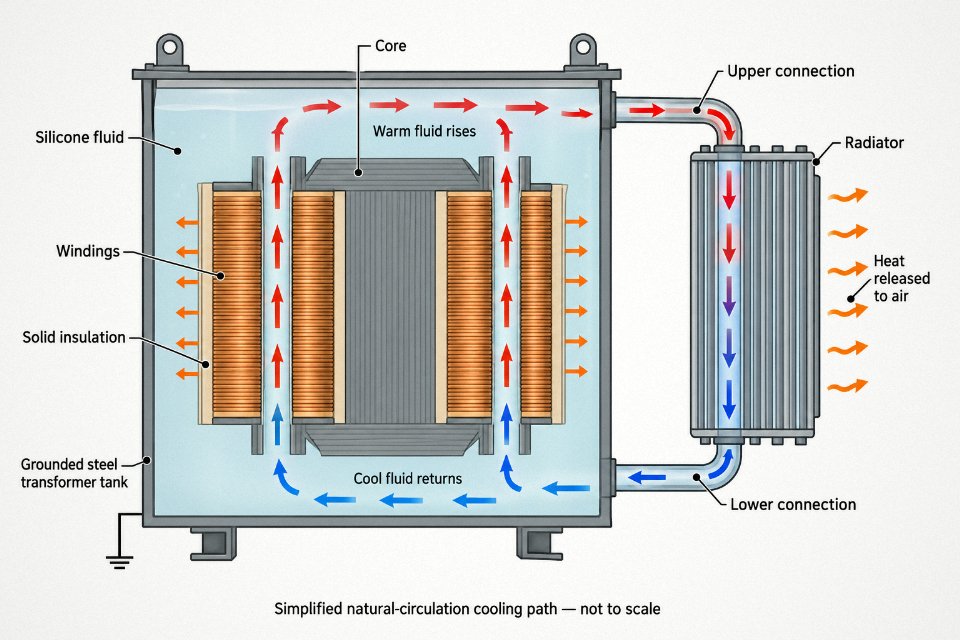
In natural circulation, warmer, less-dense fluid rises while cooler fluid returns through the available passages. Pumps drive circulation in forced-liquid systems. Fans increase air-side heat rejection, but they do not necessarily correct restricted oil ducts or poor internal flow distribution.
The relevant properties work together:
- Viscosity controls resistance to flow. Higher viscosity increases hydraulic losses and can restrict circulation, particularly through narrow winding ducts.
- Density and thermal expansion determine the buoyancy driving natural circulation. Expansion also affects required accommodation space and liquid-level changes.
- Specific heat determines how much energy a given mass flow can carry for a given temperature rise.
- Thermal conductivity affects heat transfer through the liquid, including near winding surfaces. It cannot, by itself, predict cooling performance.
- Cooling geometry determines flow resistance and distribution. Duct dimensions, radiator elevation, headers, and bypass paths influence whether fluid reaches the hottest conductors.
Larger passages can reduce flow resistance, but they consume space otherwise available for active materials or insulation. Forced circulation can improve heat transport, at the cost of pump power, maintenance, and dependence on auxiliary equipment. A cooler bulk-fluid reading does not prove that winding hot spots are acceptable.
Temperature and component limits govern usable loading
A nominal kinematic viscosity of 50 mm²/s at 25 °C is a common transformer-grade silicone-fluid benchmark, not a universal specification. The viscosity-temperature curve is more useful: cold-start circulation and established hot-operation circulation occur at very different viscosities. Compare candidate fluids at identical temperatures using current supplier data.
Operating conditions change the cooling problem:
- Cold starts: increased viscosity can delay effective natural circulation. Check cold-energization and loading instructions for the actual transformer.
- Load increases: winding losses rise before the full fluid inventory and cooling surfaces reach a new thermal condition. Short-term hot spots can precede an obvious tank-temperature change.
- High ambient temperatures: reduced temperature difference to the surroundings limits heat rejection, even with clean radiators.
- Cooling configuration: blocked fins, failed fans, pump condition, and internal flow design can outweigh modest differences in fluid properties.
Silicone fluid does not automatically permit more loading than mineral oil. That conclusion requires transformer-specific thermal design evidence or testing.
A thermally stable liquid also does not raise the rating of cellulose, seals, bushings, or the complete assembly. Retain the manufacturer’s approved loading and temperature limits unless the complete insulation and cooling system has been qualified for different service conditions.
How does silicone fluid change transformer fire risk?
Silicone fluid reduces the likelihood that released transformer liquid will sustain a fire, compared with conventional mineral oil, but it does not prevent an electrical fault or make the transformer fireproof. Its principal safety advantage is a high fire point; the installation must still manage fault energy, pressure, liquid release, and exposure to nearby fires.
Three temperatures that mean different things
These properties describe different ignition conditions, not interchangeable safety ratings:
- Flash point: The lowest temperature, under a specified test method, at which vapor above the liquid ignites momentarily when an ignition source is applied. A flash does not establish sustained burning.
- Fire point: The lowest temperature, under a specified test method, at which the liquid produces enough vapor to sustain combustion for the test’s prescribed duration after ignition. This is the relevant benchmark for many less-flammable liquid classifications.
- Autoignition temperature: The temperature at which ignition occurs without an applied flame or spark under specified test conditions. It is neither a permissible operating temperature nor a reliable prediction of behavior during an internal arc.
Many transformer-grade silicone fluids have fire points around 350 °C. Treat that as an indicative benchmark, not a purchase specification: confirm the selected product’s current data, test method, and acceptance documentation. None of these temperatures predicts when a faulted transformer will rupture.
What “less-flammable” actually establishes
A fire point above 300 °C is associated with less-flammable insulating-liquid classifications in relevant installation frameworks. The applicable framework may impose other conditions, so a supplier’s fire-point result is not, by itself, proof of eligibility for every installation.
The mechanism is straightforward: sustained liquid burning requires sufficient heat to keep generating combustible vapor. A higher fire point raises that threshold under the prescribed test conditions, reducing the opportunity for a released pool to become a continuing fire source.
Less-flammable does not mean noncombustible, and a fluid classification does not make the assembled transformer fireproof. Sufficient external heating, fault-generated gases, or burning materials around the transformer can still create a serious fire event. The benefit concerns one part of the hazard, not every route to ignition or fire spread.
Credible fault and fire sequences
The protection review needs to cover more than a pool-fire scenario:
- Internal arcing: An insulation failure can create intense localized heating and decompose fluid and solid insulation, generating gases. Bulk liquid temperature may remain far below its fire point while a destructive fault develops.
- Rapid pressure rise: Gas generation can raise tank pressure faster than normal cooling or expansion arrangements can accommodate. A pressure-relief device has a defined capacity and response; it cannot be assumed to contain every possible fault.
- Tank rupture and fluid release: A severe event can eject hot liquid, gases, and burning insulation. Released liquid may enter cable trenches or reach adjacent equipment, extending the affected area even without sustained pool burning.
- External fire exposure: A nearby fire can heat the tank, damage bushings and seals, and eventually compromise containment. High-fire-point fluid does not turn the tank into a fire-rated enclosure.
These sequences explain why a favorable fluid test cannot substitute for transformer-level fault protection.
Protection remains an equipment-and-site responsibility
A high fire point does not prevent electrical faults, remove pressure-relief requirements, or replace protective coordination and containment. The design review should address:
- Fault clearing: Coordinate primary and backup protection with the transformer’s withstand capabilities and the available fault current.
- Pressure management: Verify pressure-relief provisions against the manufacturer’s design; do not assume an existing tank becomes suitable merely by changing fluid.
- Released-liquid control: Confirm containment capacity, drainage routing, and protection of nearby occupied areas and equipment under applicable requirements.
Who approves changes to the installation?
Three separate acceptance questions must stay separate:
- Fluid classification: Does the actual product meet the required property and classification criteria?
- Complete equipment acceptance: Does the transformer’s listing, certification, or other accepted documentation cover that fluid and configuration?
- Site acceptance: Does the installation satisfy applicable codes, insurer requirements, and the authority having jurisdiction?
The transformer manufacturer establishes equipment suitability; the insurer may impose property-protection conditions beyond code minimums. The authority having jurisdiction determines acceptance under the applicable local framework.
Approved conditions may permit different separation distances, barriers, or suppression arrangements, potentially offsetting a higher fluid purchase cost. Those concessions are conditional—not benefits procurement can claim from the word “silicone” on a quotation. Confirm them before fixing the layout or removing fire-protection scope.
How does silicone compare with other transformer fluids?
Use the following matrix to shortlist fluid families, not approve a purchase. The comparison basis is transformer-grade silicone fluid nominally rated at 50 mm²/s at 25 °C, inhibited transformer mineral oil, transformer-grade natural ester, and transformer-grade synthetic ester. These are grade categories, not interchangeable product specifications: final bids need named products, current datasheets, and OEM acceptance.
| Selection factor | Silicone fluid | Mineral oil | Natural ester | Synthetic ester |
|---|---|---|---|---|
| Fire performance | Many grades have fire points around 350 °C; verify classification | Conventional grades generally have substantially lower fire points | Transformer grades commonly qualify as less-flammable liquids; verify product | Transformer grades commonly qualify as less-flammable liquids; verify product |
| Cooling and cold start | More viscous than conventional mineral oil at typical operating temperatures; assess full temperature curve | Often favorable viscosity and established cooling designs | Generally more viscous than mineral oil; low-temperature behavior needs particular attention | Generally more viscous than mineral oil; cold-temperature capability varies by formulation |
| Moisture behavior | Low water solubility relative to esters | Low water solubility relative to esters | Higher water solubility changes water partitioning with paper | Higher water solubility changes water partitioning with paper |
| Oxidation and thermal durability | Good fluid stability, subject to service conditions | Inhibitor condition and oxidation products require monitoring | Oxygen exposure can accelerate oxidation and viscosity growth | Typically good oxidation stability; verify grade and operating limits |
| Environmental profile | Do not treat as readily biodegradable | Generally not selected for ready biodegradability | Many grades demonstrate ready biodegradability | Many grades demonstrate ready biodegradability; confirm exact product |
| Equipment and service ecosystem | More specialized; regional support matters | Usually the broadest conventional OEM and service base | Established offerings, but design coverage varies | Established offerings, but design coverage varies |
Property rankings are not transformer performance guarantees. Require viscosity, density, specific heat, and thermal conductivity at identical temperatures and comparable test methods; a viscosity quoted at 25 °C cannot be ranked directly against one quoted at 40 °C.
Fire performance and available transformer designs
A high-fire-point fluid offers little procurement advantage if no suitable approved transformer is available for the required duty. Compare complete OEM offerings, including their installation conditions, rather than selecting a liquid first and assuming the enclosure and protection requirements will follow.
Silicone, natural ester, and synthetic ester can all be candidates where less-flammable liquids are required. Their actual products, test methods, equipment listings, and local acceptance still need verification. Mineral oil may remain economical where the site can accommodate its fire-protection requirements without expensive building changes.
The practical choice is often between approved transformer packages, not between four drums of liquid.
Cooling, cold starts, and hot-spot control
Lower viscosity usually reduces hydraulic resistance, but viscosity alone does not determine cooling. Density affects buoyancy-driven circulation; specific heat affects the temperature rise associated with transporting heat; thermal conductivity contributes to local heat transfer. Winding ducts and radiator geometry determine how those properties translate into hot-spot temperature.
Check three operating conditions separately:
- Normal loaded operation: Obtain guaranteed losses and temperature rises for the actual fluid-filled design.
- Minimum-temperature start: Review viscosity-temperature curves, pour-point data, and any crystallization restrictions. Pour point alone does not prove adequate circulation.
- Pumped operation: Verify pump starting torque, available flow, pressure drop, and operating limits using the selected fluid.
A higher-viscosity liquid may require different cooling passages, more radiator surface, or revised pumping. That can buy fire performance at the expense of footprint and capital cost. The conclusion can reverse in an optimized transformer: a purpose-designed ester or silicone unit should not be judged by predictions from an unchanged mineral-oil cooling circuit.
Moisture: the same ppm is not the same condition
Esters can hold substantially more dissolved water than mineral oil or silicone fluid. Consequently, identical water concentrations in ppm can represent very different relative saturation levels and different water distribution between liquid and cellulose.
At suitable conditions, ester fluid can accept moisture from paper, potentially reducing cellulose moisture. That process depends on temperature, initial paper condition, liquid volume, and time; a fluid change is not an instant drying treatment.
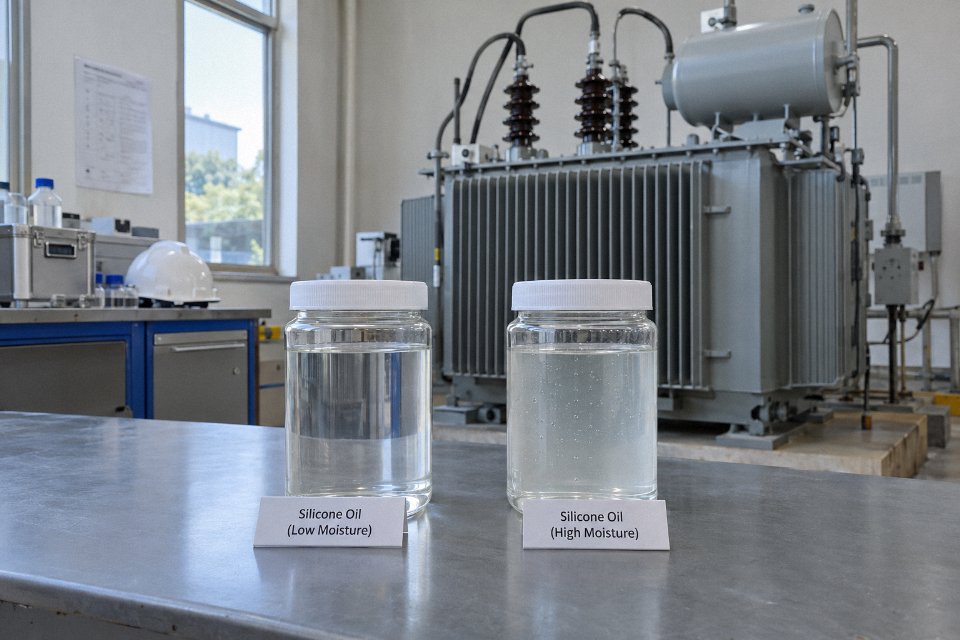
Interpret laboratory results using:
- Fluid-specific water-solubility data at the sampling temperature.
- Relative saturation alongside absolute water concentration.
- Loading history and estimated cellulose moisture.
- Breakdown-voltage testing and inspection for free water where indicated.
A cold sample and a hot sample from the same transformer can tell different stories. Applying mineral-oil ppm alarm limits indiscriminately to ester fluid can trigger unnecessary intervention—or obscure the actual insulation condition.
Fluid durability is not insulation-system life
Silicone’s thermal and oxidation stability can be valuable, but durable liquid does not make paper, seals, or connections immune to aging. Cellulose deterioration still depends strongly on temperature, moisture, and oxygen exposure.
Natural esters generally need controlled oxygen exposure; sealed arrangements are commonly used because oxidation can increase viscosity and impair cooling. Mineral-oil maintenance must account for inhibitor depletion where applicable and oxidation products. Synthetic esters also require product-specific aging and condition-monitoring criteria.
For every family, ask the OEM to identify the permitted insulation system and loading limits. A higher allowable temperature requires a validated combination of fluid, solid insulation, and transformer design—not merely a more heat-resistant liquid.
Environmental obligations and service practicality
Biodegradability is a legitimate reason to favor a qualifying ester, particularly near sensitive land or water. It does not eliminate spill containment, cleanup, or reporting obligations. Silicone should not be described as readily biodegradable, and high fire resistance is not evidence of low environmental impact.
Before accepting any fluid, check:
- Environmental documentation: Product-specific biodegradation and ecotoxicity evidence, plus site acceptance.
- Material compatibility: Gaskets, coatings, adhesives, cable interfaces, bushings, and tap-changer requirements.
- Service support: Qualified laboratories, drying and filtration equipment, trained contractors, and emergency replacement stock.
- End-of-life handling: Local waste classification, contamination history, transport requirements, and available disposal routes.
Retrofits deserve particular caution. Residual mineral oil can change the replacement fluid’s properties and potentially its fire classification; retained liquid in paper makes complete removal difficult. Obtain an OEM-approved conversion procedure, residual-fluid acceptance criteria, and confirmation that the modified equipment retains the necessary approvals.
Lifecycle cost and situations favoring alternatives
Compare costs over the same loading profile and service period:
- Fluid purchase, transport, and strategic spare inventory.
- Transformer price, cooling equipment, and footprint.
- Required installation protection and containment.
- Guaranteed losses valued against the plant’s electricity cost.
- Testing, maintenance, outage exposure, and end-of-life handling.
Treat avoided fire-protection expenditure or longer service life as project assumptions until documented. Mineral oil often wins cost-led conventional installations; qualifying esters deserve preference where ready biodegradability is a priority. Another fluid family may also be the better purchase simply because the local OEM and service network can support it reliably. Silicone earns its place where its properties solve a defined installation problem without creating an unsupported equipment or maintenance arrangement.
Which installations justify silicone-filled transformers?
Silicone-filled transformers are most defensible where a liquid-filled design is appropriate and the consequences of fire, restricted access, or equipment loss justify the additional purchase cost. The strongest candidates are consequence-sensitive installations, but suitability still depends on an approved transformer package, demonstrated thermal performance, and acceptance of the complete installation—not the fluid alone.
- Indoor and building-integrated installations
Basements, service floors, hospitals, commercial buildings, and production buildings warrant consideration where transformers sit near occupied areas or essential services. Evaluate the transformer room as a system: compartmentation, drainage, ventilation, replacement access, and emergency response. Silicone fluid does not automatically eliminate fire-rated construction or containment requirements. A transformer that fits through the doorway but cannot be removed without demolishing a wall is a procurement problem worth resolving before award. - Underground infrastructure, tunnels, and transport facilities
Restricted evacuation routes and difficult firefighting access increase the consequences of an electrical fault. Review smoke migration, ventilation shutdown logic, liquid escape paths, and access for isolation and recovery. A less-flammable fluid can support the fire strategy, but it does not make an internal arc harmless. Transport-owner specifications and the authority responsible for fire acceptance may narrow the available equipment choices substantially. Industrial plants and critical facilities
The investment can be justified where one transformer failure could damage adjacent switchgear, stop a continuous process, or interrupt essential services. Compare lifecycle costs using the plant’s outage exposure, replacement lead time, and restoration arrangements—not purchase price alone. The economic case weakens where equipment is well separated and readily replaceable. Redundancy, protection coordination, and a workable spare-transformer strategy remain necessary; fluid selection cannot compensate for their absence.Outdoor, urban, and space-constrained sites
Urban substations and crowded plant yards may benefit where fire exposure to neighboring assets constrains the layout. However, reduced setbacks must be supported by applicable requirements and the accepted equipment arrangement; they are not an automatic entitlement. Check containment obligations, flood exposure, corrosion protection, and approved supplier availability. Where generous separation already exists, mineral-oil equipment may remain the more economical choice.Cold climates, high ambient temperatures, and variable loads
Require manufacturer-supported loading and thermal data for the actual fluid, cooling arrangement, and site conditions. Higher cold-start viscosity can restrict circulation; high ambient temperature reduces the temperature difference available for heat rejection. Specify minimum starting temperature, maximum ambient, load cycles, and overload duration. Maintaining acceptable winding temperatures may require a larger cooling package, sacrificing footprint or initial cost.New builds versus existing-equipment conversion
New equipment allows the manufacturer to coordinate winding ducts, radiators, seals, and protection around the selected fluid. Conversion is a separate engineering project, not a drain-and-refill purchase. Proceed only with written OEM approval and site acceptance of the proposed conversion. The scope must address residual-fluid effects, material compatibility, cooling capability, cleaning and drying procedures, and commissioning tests; approval of the original transformer does not automatically cover its converted condition.
How should silicone-filled transformers be maintained and retrofilled?
Maintain silicone-filled transformers against OEM-approved baselines and silicone-specific test criteria, not a copied mineral-oil schedule. Treat retrofilling as an engineered conversion: acceptable fluid chemistry alone does not establish adequate cooling, material compatibility, or installation acceptance. Those checks must be closed before the transformer returns to service.
Establish commissioning and operating baselines
Use the OEM maintenance plan to record:
- Fluid condition: product identification, batch documentation, initial laboratory results, fill level, and sampling location.
- Operating condition: load, ambient temperature, available winding and fluid temperatures, and cooling-system operation. Compare later temperatures at comparable loads and ambient conditions; a hotter afternoon is not automatically deterioration.
- Equipment condition: leak inspection, pressure or preservation-system condition, and protective-device settings and functional checks under approved procedures.
Investigate trends alongside maintenance history. A temperature increase after cooler servicing, for example, warrants checking valve positions and fan operation before blaming the fluid.
Sample correctly and interpret each test separately
Take representative samples from designated points using the laboratory’s silicone-fluid sampling instructions. Flush stagnant valve contents as specified, use clean approved containers, and prevent atmospheric moisture and particles entering the sample. Gas-analysis containers and handling differ from routine condition-test bottles; agree the sampling kit with the laboratory beforehand.
Each test answers a different question:
- Dielectric breakdown: assesses resistance to electrical failure under the specified test conditions; water and particles can depress the result. It does not certify the entire insulation system.
- Water content: quantifies moisture in the sampled fluid. Interpretation needs temperature and fluid-specific moisture behavior; one fluid sample does not establish paper-insulation dryness.
- Dissipation factor: measures dielectric losses and can flag contamination or deterioration, but test temperature and method matter.
- Acidity: tracks acidic constituents or changes in condition; use the OEM’s applicable method and limits.
- Other specified tests: may include viscosity, particles, resistivity, or fluid identification, depending on equipment history and suspected contamination.
Do not import mineral-oil acceptance limits without validation. Dissolved gas analysis also needs silicone-specific interpretation: gas generation and diagnostic relationships differ from mineral-oil systems. Use a laboratory experienced with silicone-filled equipment, establish an initial gas baseline, and assess trends against loading, faults, and service interventions rather than applying mineral-oil diagnostic ratios uncritically.
Control compatibility, treatment, and topping-up
Check compatibility by component, not merely by transformer model:
- Seals and gaskets: verify material suitability and condition; changed swelling behavior can expose previously tight joints.
- Internal coatings: confirm resistance to the replacement fluid and approved cleaning agents.
- Solid insulation: assess existing moisture, ageing, and fluid impregnation; changing liquid does not restore damaged paper.
- Bushings: confirm construction, sealing arrangements, and any separate internal fluid.
- Tap changers: obtain compartment-specific approval, including switching-duty requirements.
- Auxiliary circuits: verify pumps, coolers, hoses, valves, and instruments, including trapped volumes and dead legs.
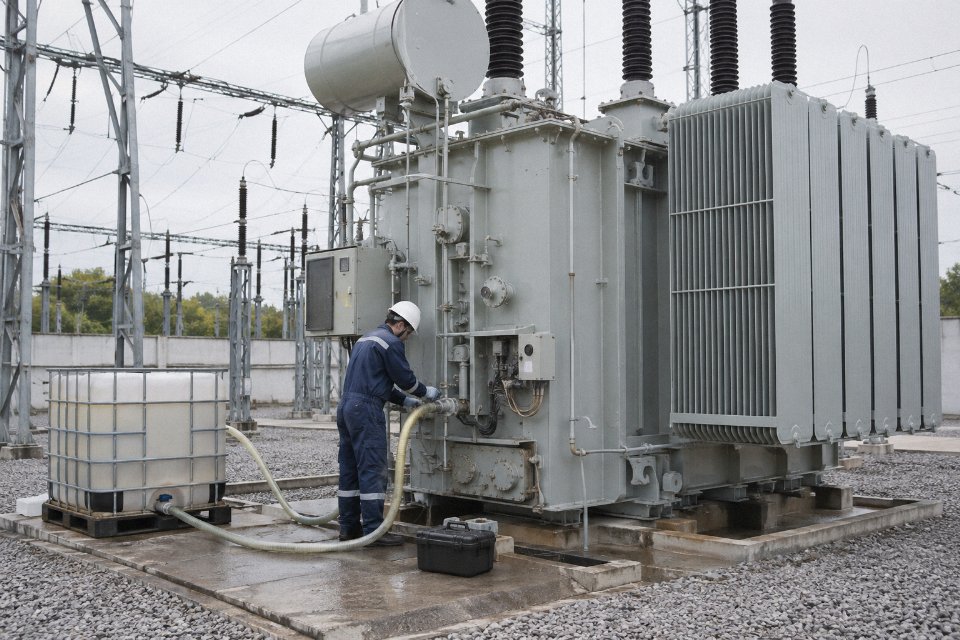
Use dedicated transfer equipment or equipment whose cleaning has been validated. A shared hose left uncapped beside the maintenance bench can defeat an otherwise careful filling job.
Topping-up requires positively identified, compatible fluid and manufacturer-approved procedures. Filtration removes selected particles; dehydration addresses moisture. Neither automatically removes dissolved contamination or repairs aged insulation. Treatment equipment, filter media, temperatures, and vacuum conditions must suit the fluid and transformer construction; excessive vacuum can damage equipment not designed for it.
Apply formal retrofill gates
A retrofill needs a documented hold-point sequence, with responsibility assigned for each approval. Residual liquid in paper, coolers, and inaccessible spaces can change fire performance and other properties, so a clean-looking drain sample is not proof of an acceptable conversion.
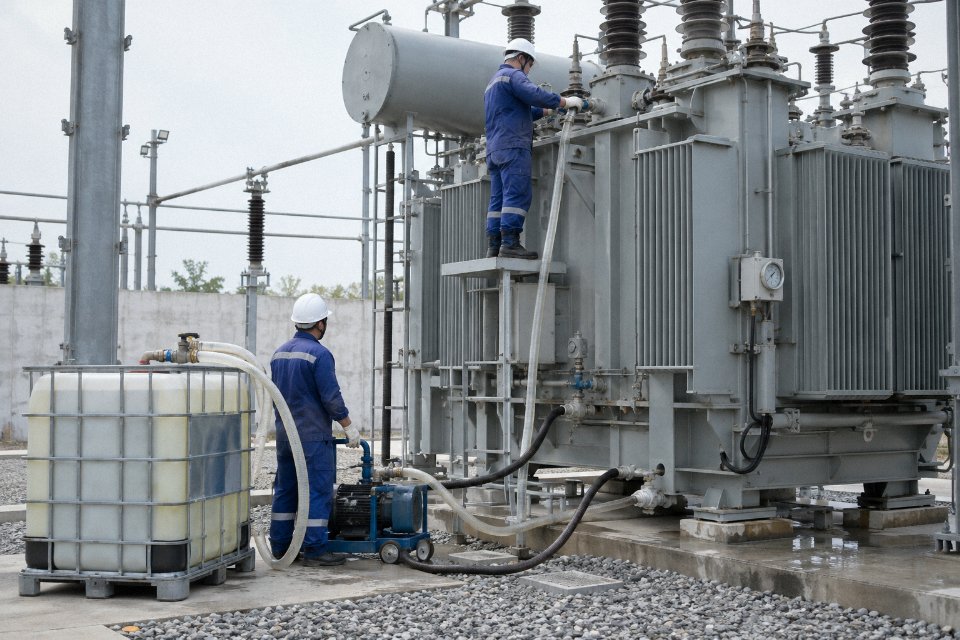
- Identify the existing contents. Verify records and test where necessary. Investigate regulated legacy contamination, including possible PCB contamination where relevant, before arranging handling and disposal.
- Obtain engineering approval. Secure OEM authorization, review cooling performance at the required duty, validate materials, and confirm site acceptance with the relevant owner, insurer, and authority.
- Define residual-content acceptance. Set a project-specific limit, sampling method, and verification plan tied to required properties and approvals. There is no universal mixing allowance.
- Execute the approved conversion. Isolate safely, drain and clean as specified, manage retained liquid, then fill and remove air using approved procedures.
- Release and monitor. Complete leak and electrical checks, revise labels and maintenance records, and establish new fluid baselines. After energization, monitor temperatures, loading, fluid level, leaks, and condition-test trends at the agreed intervals.
What should buyers verify before ordering silicone fluid?
Buyers should qualify the exact transformer-fluid grade, its batch acceptance criteria, and the supplier’s ability to deliver it consistently—not simply purchase “silicone oil.” The purchase specification should connect OEM acceptance, documented test methods, clean delivery, and contractual remedies so receiving inspection can make an unambiguous accept-or-reject decision.
Define the material and acceptance criteria
- Identify the intended grade and duty. Specify unused transformer-grade silicone insulating fluid, the supplier’s product designation, and whether it is for factory filling, topping up, or an approved retrofill. State the required viscosity and reference temperature; nominal 50 mm²/s at 25 °C is common, not universal. Obtain documented OEM acceptance for the intended transformer and application.
Reference the appropriate fluid standard. Where applicable, require conformity to the current applicable edition of IEC 60836 or ASTM D4652, identifying the edition in the purchase order. Ask the supplier to identify exceptions explicitly. Fluid-specification compliance does not establish approval of the assembled transformer, its cooling performance, or its installation.
Set measurable contractual limits. Use the selected standard, OEM requirements, and project specification to define:
- Kinematic viscosity, including test temperature and permitted tolerance.
- Dielectric breakdown voltage and dielectric loss characteristics, with the specified test conditions.
- Maximum moisture content and the sampling method.
- Minimum fire point and the applicable test method.
- Cleanliness requirements, including limits on particles or foreign-fluid contamination where required.
- Applicable environmental or regulatory declarations, identifying the destination jurisdiction and required evidence.
A dielectric result without its method and electrode configuration is not a usable acceptance criterion. Likewise, an attractive typical value on a data sheet is not a guaranteed delivery limit.
Audit batch control and delivery capability
- Check how quality is demonstrated. Request the technical data sheet, safety data sheet, controlled product specification, and a representative certificate of analysis before qualification. Require a batch-specific certificate for delivery, showing results against agreed limits and identifying test methods. Establish which tests are performed on every batch, which are periodic, and which are subcontracted.
Verify traceability and contamination control. Require traceability from production batch through filling and shipment, retained-sample arrangements, and written notification before changes to formulation, manufacturing site, or critical processing. Check container cleanliness, closure seals, storage conditions, and the supplier-supported usable storage period. A conforming bulk batch can become unacceptable through a dirty transfer hose or unsuitable reused drum; agree where delivery sampling occurs and who controls it.
Review commercial resilience, not just unit price. Confirm available shipment sizes, minimum orders, production and transit lead times, export documentation, and technical-support responsibilities. Smaller sealed packages can reduce handling exposure but increase packaging cost and waste. Agree who pays for investigation, replacement, return freight, and disposal if material fails the contractual acceptance tests—and whether replacement stock is actually available.
Documents that separate a qualified offer from a broad claim
Before releasing the order, the procurement file should contain:
- The exact grade specification, standards declaration, and documented OEM acceptance.
- Current technical and safety data sheets, plus an acceptable sample certificate of analysis.
- Agreed batch testing, traceability, packaging, storage, and change-control requirements.
- Written delivery commitments and nonconformance remedies.
SiliconChemicals’ China-based integrated organosilicon supply chain and stated customer footprint across more than 30 countries and regions are relevant supplier-screening considerations. They do not substitute for grade-specific evidence: verify the offered fluid’s manufacturing source, testing capability, conformity documentation, and support for the proposed transformer application before approval.
Frequently asked questions
Is silicone transformer fluid nonflammable?
No. Transformer-grade silicone fluid is generally described as less-flammable, not incapable of burning. Many products have fire points around 350 °C, but sustained heating or an electrical fault can still create a fire hazard. Fire point is not flash point or autoignition temperature; verify the actual product data and installation requirements.
Can ordinary silicone oil be used in a transformer?
Not simply because its viscosity matches. A general-purpose silicone oil may lack controlled moisture content or verified dielectric performance. Transformer-grade fluid needs documented electrical-quality specifications and cleanliness controls. Obtain the transformer OEM’s acceptance of the exact grade; a nominal 50 mm²/s viscosity at 25 °C alone proves very little.
Can silicone fluid replace mineral oil directly?
No. Conversion requires an engineered, approved retrofill procedure, not a routine drain-and-fill. Mineral oil remains in winding insulation and trapped spaces after draining. The procedure must address residual-fluid limits and material compatibility, with cooling performance and the equipment’s approval status checked before release. A successful fill does not establish a successful conversion.
Can silicone transformer fluid be mixed with mineral oil or esters?
Avoid mixing unless the specific combination has been evaluated and approved. An acceptable dielectric test on a fresh blend does not prove acceptable fire performance or long-term behavior. For retrofills, establish allowable residual contamination with the OEM and fluid supplier. Use dedicated transfer equipment, or a validated cleaning procedure, to prevent accidental cross-contamination.
Does silicone fluid make a transformer run cooler or last longer?
Neither outcome follows automatically. Fluid thermal stability is useful, but winding hot-spot temperature depends on the transformer’s cooling design and actual loading. Higher flow resistance can reduce natural circulation in equipment designed for another fluid. Cellulose insulation still ages with heat and moisture, even when the silicone fluid remains serviceable.
Is silicone fluid environmentally preferable to ester fluid?
Not as a general rule. High fire resistance does not establish ready biodegradability; many ester products have a stronger biodegradability profile than conventional silicone transformer fluids. Compare product-specific environmental data against the site’s spill pathway and containment arrangements. Near a watercourse, environmental acceptance may outweigh advantages that matter most inside a building.
How long does silicone transformer fluid last?
There is no defensible universal replacement interval. Assess condition using representative samples and fluid-specific interpretation of test trends, rather than calendar age alone. An abnormal result may indicate moisture ingress or an internal fault—not exhausted fluid. Confirm the cause before replacing a serviceable charge and leaving the underlying equipment problem unresolved.
Which silicone fluid specification should your project approve?
Approve transformer-grade silicone fluid when its fire-risk profile and operating characteristics fit an approved transformer design and justify the total installed and lifecycle cost. A high fire point alone is not sufficient: the specification must connect the delivered fluid grade to verified cooling performance, material compatibility, and the installation’s acceptance requirements.
Close three approval gates
- Transformer compatibility and thermal performance. Obtain documented acceptance for the proposed grade from the transformer manufacturer. Confirm that the cooling arrangement can meet temperature-rise limits across the specified ambient and loading range. Viscosity affects circulation and heat removal; a fluid substitution can therefore change winding temperatures even when dielectric test results are satisfactory.
- Site and fire-safety acceptance. Confirm acceptance with the responsible engineer and relevant authority, insurer, or owner’s fire-safety reviewer, as applicable. Check the actual fluid’s fire-test documentation against the equipment listing and installation requirements. A less-flammable fluid does not automatically remove containment, separation, or fire-protection obligations.
- Documented fluid-grade conformity. Identify the exact product, governing specification, agreed property limits, and test methods. Require batch traceability, a certificate of analysis, and agreed packaging and cleanliness controls. “Silicone oil” is a chemical-family description, not an adequate purchase specification.
For a conversion, obtain OEM and site approval before purchasing fluid or changing the fill. The additional engineering and outage work may outweigh the fluid’s benefits; supplier advice cannot establish that an existing transformer is suitable for retrofilling.
Send an inquiry that supports a usable quotation
Provide:
- Equipment: transformer rating, voltage class, manufacturer, model, and available design documentation.
- Project status: new build or retrofill; for existing equipment, identify the current fluid and any known contamination or service issues.
- Operating conditions: ambient temperature range, expected loading, and cooling arrangement.
- Installation: indoor or outdoor location, site constraints, applicable standards, and approval requirements.
- Supply requirements: required volume, allowance for filling or flushing where approved, delivery location, and delivery schedule.
Send SiliconChemicals your specification and operating conditions to request a grade review, supporting documentation, confirmation of sample availability, and a project quotation. Make any order conditional on closing the three approval gates. Supplier recommendations support the selection process; they do not replace the transformer manufacturer’s approval or the responsible engineer’s final specification.