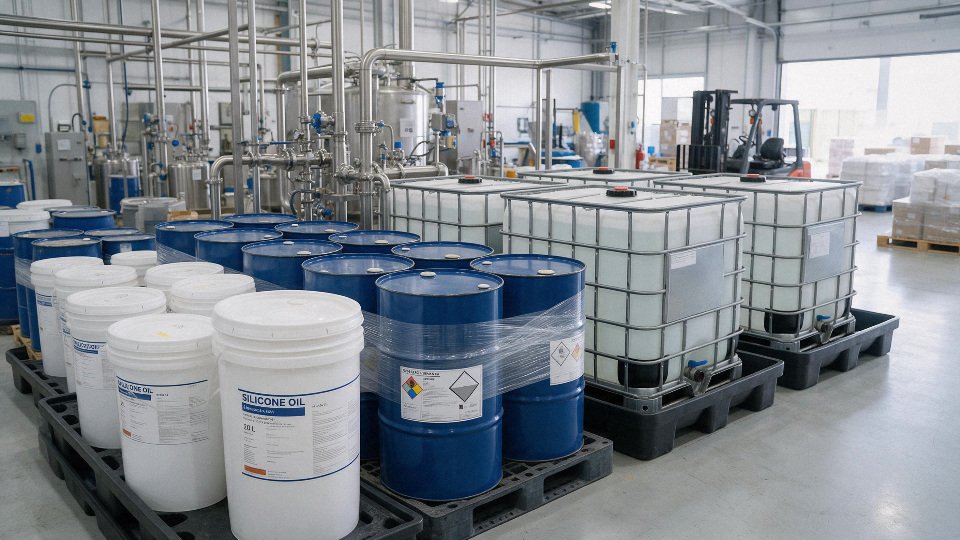
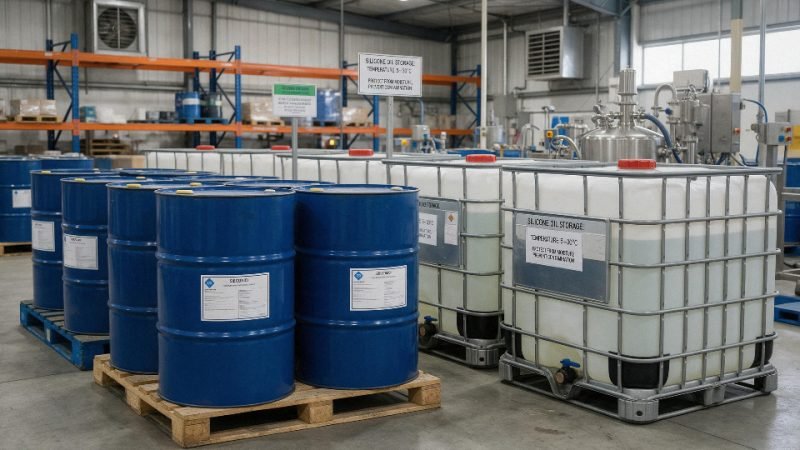
Silicone oil usually looks forgiving in storage right up to the day it is not: drums sweat after a cold night, bung areas pull in moisture, labels fade, and a once-clean fluid picks up haze, dirt, or viscosity drift before anyone notices. That turns into line instability, reject batches, cleaning time, and arguments over whether the issue came from the process or the material. The fix is not complicated, but it does require disciplined storage conditions, tighter container handling, and shelf-life control instead of treating silicone oil like an inert commodity.
Store most standard silicone oils indoors at about 5-30°C, keep containers tightly sealed, dry, and protected from condensation, and use supplier-specific shelf-life and packaging guidance before setting warehouse rules. Unopened shelf life is often around 12-24 months, but it depends on viscosity, additives, grade, and container type.
What catches buyers and plant teams off guard is that the storage rule is not just “keep it cool and out of the sun.” A low-viscosity dimethyl fluid, a modified silicone with reactive functionality, and material packed in pails versus IBCs do not age or handle the same way, especially once containers are opened, partially used, or moved between climates.
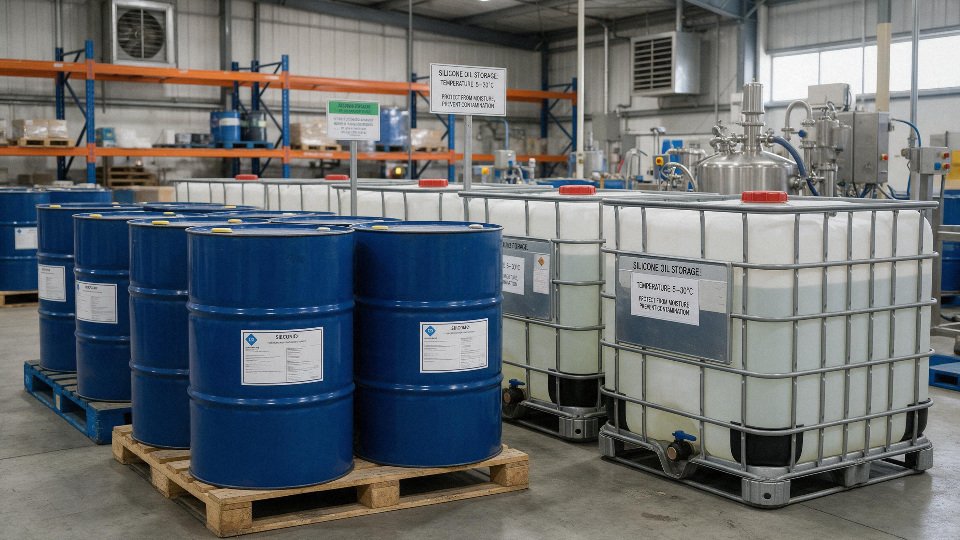
Silicone oil stability factors
For most standard silicone oils, storage performance is governed less by calendar time than by heat history, moisture ingress, air exposure, and contamination picked up between filling and use. Plain PDMS fluids are usually quite stable in a closed, clean package, but the storage rules get stricter fast once the product contains reactive groups, catalysts, inhibitors, or specialty performance additives.
A lot of warehouse trouble gets blamed on “old material” when the fluid itself was not the first thing to fail. In practice, the actual trigger is often a dented drum with a bad bung seal, a half-used tote breathing humid air for three months, or a transfer hose that still had last week’s release agent in it.
Temperature affects more than shelf life
Silicone oil does not usually “spoil” from a brief temperature excursion the way some water-based chemistries do, but temperature still changes how the product behaves and how the package behaves around it.
The first effect is viscosity. As temperature rises, silicone oil thins; as temperature drops, it thickens. That sounds obvious, but on the plant floor it drives several secondary problems:
- Cold material may not feed consistently through narrow lines, metering pumps, or drum unloaders
- Flowmeters can misread if they were set up around a warmer viscosity band
- High-viscosity grades can trap air more easily during pumping when cold
- Operators may overcompensate with heat, then create a different problem at the next stage
If you have ever tried to unload a high-viscosity drum after a cold weekend, you already know the issue is not just “it pours slower.” The pump sees more suction resistance, seals work harder, and dosing repeatability can drift.
Heat creates the opposite set of issues. Warmer fluid is easier to move, but liquid expansion and vapor-space pressure matter, especially in tightly sealed drums, pails, and IBCs. Repeated hot-cold cycling is often worse than steady storage at a moderate condition because the package expands and contracts with each cycle. That movement can:
- Pull humid air into partially filled containers
- Stress liners, caps, and gasketed closures
- Increase the chance of weeping around threads or bungs
- Promote internal condensation when the package cools
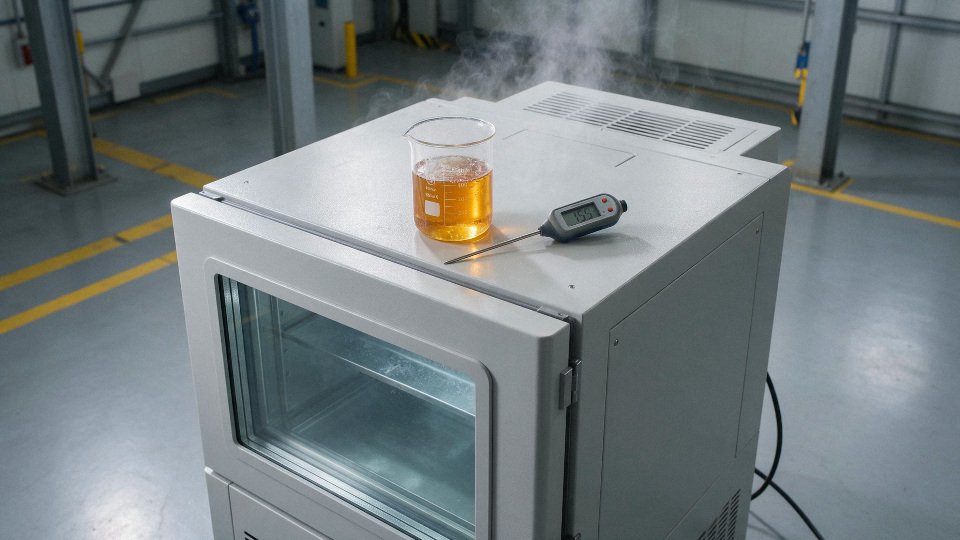
This is one of those mechanisms buyers miss when they focus only on a nominal storage range like 5-30°C. A drum kept indoors at 28°C all month is usually in better shape than a drum moved daily between a hot loading area and a cool warehouse. The preferred choice flips if temporary warming is needed just to restore pumpability before use; controlled, uniform warming is often acceptable, while uncontrolled cycling is what tends to create moisture and sealing problems. Check the supplier’s current documentation before applying heat blankets, warming rooms, or recirculation loops, because not every additive package tolerates them equally.
Moisture and condensation: how water actually gets in
Silicone oils are often discussed as if they simply “resist water,” which leads some users to underestimate moisture risk. Water may not dissolve readily into every silicone fluid to the same degree, but moisture can still enter the package, sit as separate droplets, react with sensitive components, or interfere downstream in coating, release, defoaming, or compounding processes.
The common entry paths are usually mundane:
- Poorly tightened bungs or caps
- Damaged liners, foil seals, or tamper closures
- Humid air exchange in partially used containers
- Condensation caused by temperature swings
- Wet funnel, lance, hose, or pump surfaces
- Outdoor staging under tarps where day-night cycling drives sweating
Indoor humidity control often matters more for the container than for the bulk fluid itself. Keeping the storage area dry and protected from condensation, with warehouse relative humidity often maintained below roughly 70%, reduces the chance that closures, labels, pallet tops, and dispensing hardware become moisture sources.
Partially full containers are a particular weak point. Every time they are opened, the headspace is replaced with ambient air. If that air is humid and the container later cools, moisture can condense on the internal walls or under the closure and then fall back into the product. In my experience, this is a bigger problem in plants with warm daytime unloading docks and cool night storage, or during monsoon and shoulder seasons when nobody notices the condensation until there is haze, micro-gel, or erratic application performance.
Oxidation and air exposure are product-dependent
Plain dimethyl silicone fluids are generally less oxidation-sensitive than many hydrocarbon oils under ordinary warehouse conditions. That does not mean all silicone oils should be treated the same.
Products that may be more storage-sensitive include those containing:
- Reactive functional groups
- Crosslinking components
- Catalysts
- Inhibitors
- Emulsifier systems
- Anti-foam performance packages
- Slip, leveling, or release additives blended for a specific end use
Air exposure can shift these formulations even when the base silicone backbone is relatively stable. The mechanism depends on the chemistry: oxygen may slowly affect additives, moisture from exchanged air may consume reactive species, and volatile components may drift out of a loosely closed package. The result is not always dramatic bulk degradation. More often it shows up as slower cure, changed wetting behavior, haze, altered foam control, or batch-to-batch inconsistency that operators call “ageing.”
Many silicone oil failures blamed on storage age are actually caused by contamination, packaging interaction, or mishandled transfers rather than intrinsic fluid breakdown.True
This is consistent with common industrial failure analysis experience. Root cause often traces to opened-container handling, ingress, residue carryover, or closure failure rather than spontaneous degradation of a clean, unopened standard silicone fluid stored within supplier guidance.
That claim has a limit. If the product is highly specialized, catalyst-bearing, inhibitor-balanced, or explicitly shelf-life controlled by the supplier, intrinsic chemical change may very well be the governing factor. For those materials, rely on the current technical data sheet, certificate, and storage instructions rather than general behavior of commodity PDMS.
Contamination is the storage risk that shows up later
A silicone oil can look clear and still be unusable for the target process. Fine contamination often does not announce itself until the fluid hits a precision operation: a coating line, a compounding batch, a mold-release station, or a dosing skid with tight clearances.
Typical contamination sources include:
- Dust from open warehouse handling
- Metal fines from worn pumps or unfiltered transfer equipment
- Residues from previous products in shared hoses or totes
- Dirty funnels, dip tubes, or drum pumps
- Incompatible gasket or seal materials shedding particles or extractables
- Opened containers left partially full for long periods
The mechanism matters here. Some contaminants are inert particles that create filter loading, surface defects, or wear. Others are chemically active enough to interfere with the silicone oil or the downstream formulation. A little carryover from the wrong additive package can ruin release consistency or coating appearance long before anyone sees obvious sludge.
The trade-off is practical: shared transfer equipment saves capital and floor space, but dedicated clean hoses, verified line clearing, and capped fittings save scrap and complaint cost. In high-value applications, the economics usually favor cleaner handling. In low-spec bulk use, the threshold may be looser, but you still need a clear contamination boundary.
Light exposure and weathering: usually a packaging issue first
For many silicone oils, ordinary indoor light is not the main storage threat. UV and outdoor exposure tend to matter more because they heat the package, degrade labels, embrittle some plastics, and accelerate closure and gasket ageing. So the fluid may be chemically acceptable while the package becomes less trustworthy.
Outdoor storage raises a stack of linked risks:
- Solar heating during the day and cooling at night
- Condensation under lids and closures
- Weathered pallets and secondary packaging
- Faded labels and lost lot traceability
- Water accumulation around closures or dispensing points
That is why weather protection is not just housekeeping. Once traceability is compromised or a closure starts leaking after sun exposure, the storage problem has moved from chemistry into quality control and procurement risk.
Recommended storage conditions
For most standard silicone oils, the safest default is indoor storage at roughly 5-30°C in a dry, clean, shaded, well-ventilated area, with product-specific limits taken from the supplier data sheet or SDS. That beats a colder but unstable room, because temperature swings, condensation, poor housekeeping, and bad container handling usually damage stored product faster than a steady moderate temperature does.
A lot of warehouse problems come from treating silicone oil like an inert liquid that can sit anywhere. It is generally stable, yes, but storage failures are usually practical rather than dramatic: water ingress through a loose bung, dust contamination during decanting, a sun-heated drum breathing moist air overnight, or an IBC parked against a steam line because someone wanted easier access for pumping.
Environmental conditions that actually protect the product
The preferred environment is straightforward, but the details matter:
- Store indoors rather than outdoors
- Protect from rain, washdown splash, roof leaks, and direct weather exposure.
- Avoid uncovered yard storage unless the packaging and supplier explicitly allow it and the site has controls for UV, water pooling, and temperature extremes.
- Keep the area cool rather than warm
- A typical benchmark is 5-30°C for many standard silicone oils.
- Lower can be acceptable for some grades, but freezing conditions may create handling problems, temporary viscosity rise, phase issues in modified grades, or packaging stress.
- Higher temperatures accelerate oxidation risk in some formulated products, increase container breathing, and make seal performance less reliable over time.
- Keep it dry
- Indoor relative humidity is often maintained below about 70% RH, but the practical target is simpler: no condensation on containers, floors, or roof steel.
- If the room sweats in the morning when doors open, fix that before arguing about exact humidity numbers.
- Keep it clean
- Store away from grinding dust, powders, carbon black, fibers, and any open-process contamination source.
- Silicone oil is not especially fragile, but once a low-level contaminant gets into a partially used container, you may not see the problem until coating defects, foam behavior, dielectric performance, or surface issues show up downstream.
- Keep it ventilated
- Normal warehouse ventilation is usually enough.
- The goal is to avoid stagnant hot zones and moisture accumulation, not to blow ambient dust across open bungs.
Stable indoor conditions are usually better than the coldest possible storage room for silicone oil.True
For most standard grades, repeated warming and cooling drives container breathing, condensation risk, and awkward handling. A steady moderate warehouse condition usually preserves product better than a colder room with frequent thermal cycling, unless the supplier specifies refrigerated storage.
Temperature guidance: follow the product sheet, but manage fluctuation first
If no tighter product-specific instruction is given, 5-30°C is a practical benchmark for most standard silicone oils. That is not a universal legal limit, and it should not override the current supplier documentation for a specialty grade, emulsion, filled formulation, or additive package.
What matters on the plant floor is not just the average temperature, but the pattern:
- Stable temperature reduces container breathing
- As drums and IBCs warm, headspace expands and pushes vapor out.
- As they cool, they pull ambient air back in.
- If that ambient air is humid, you have a water-ingress path even with packaging that looks intact.
- Stable temperature reduces condensation
- This is most obvious when containers are moved from a cold warehouse into a warm staging area.
- Moisture condenses on the outside first, then operators wipe fittings with whatever rag is handy, then open the container. That is a classic contamination route.
- Stable temperature keeps handling predictable
- Silicone oil viscosity shifts with temperature. Cold product pumps slowly, but overheated product can create a different headache: fast transfer, more splashing, and more exposure during connection changes.
So the operating rule is simple: do not chase the lowest temperature if the cost is wide day-night swings or repeated movement between hot and cold zones. A steady indoor room away from loading-bay drafts, skylight hotspots, and heaters is usually the better choice.
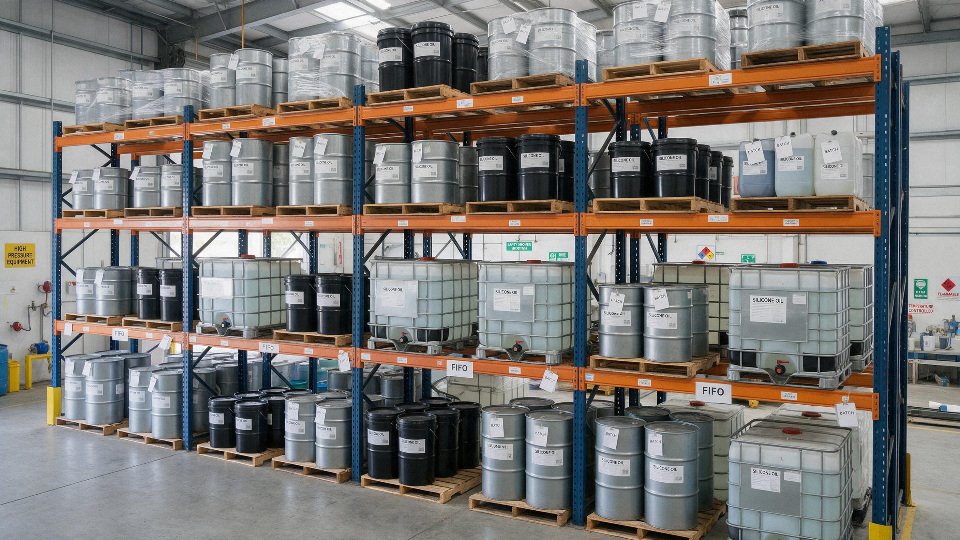
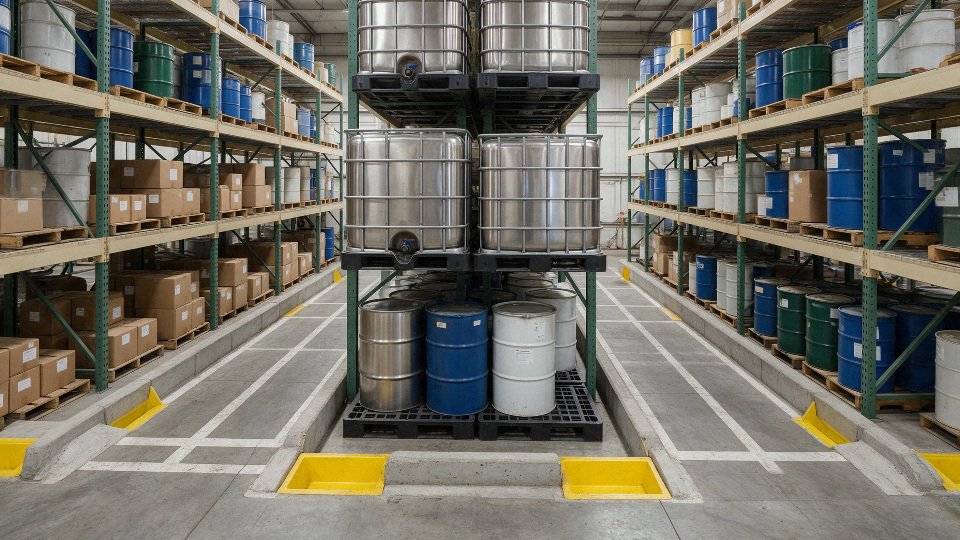
Pallet layout, drum orientation, IBC placement, and containment
Warehouse layout affects storage life more than many buyers expect. Packaging survives best when it is physically stable, accessible for inspection, and not sitting in the wrong microclimate.
Drums and pails
- Store on sound pallets or racking designed for the load
- No broken deck boards, bent steel, or unsupported pallet corners.
- Keep containers off bare concrete where possible
- Concrete can contribute to localized temperature differences and external corrosion on steel drums if moisture accumulates.
- Protect closures
- Bung caps, plugs, and lid seals should not be exposed to impact from forks or pallet jacks.
- If drums are frequently moved, use drum top protectors or position them so fittings are less exposed.
- Watch drum orientation
- Orientation depends on drum type and closure design. In practice, many sites keep tight-head drums upright for easier inspection and leak control.
- If a supplier specifies horizontal storage for a particular closure arrangement to keep gaskets wetted, follow that instruction rather than a warehouse habit.
- Do not overstack
- Steel drums may tolerate more than plastic pails, but stacking limits depend on packaging specification, fill weight, storage time, and temperature.
- If the package certificate or supplier instruction is unavailable, stay conservative.
IBCs
- Place on level ground with full base support
- Uneven support can stress the bottle and valve area over time.
- Keep valve protection intact
- Most IBC damage starts low, not high. A cracked outlet valve housing can turn a minor handling error into a spill.
- Avoid long-term placement in direct sun or near radiant heat
- The cage may look fine while the inner bottle expands, contracts, and ages faster than expected.
- Single-stack unless the packaging rating and your racking system clearly allow otherwise
- Too many plants assume all IBCs are stackable under all conditions. They are not.
Secondary containment and segregation
- Use spill containment sized for the largest credible release under site rules
- The exact capacity requirement depends on local regulation and site policy; verify before setup.
- Segregate from incompatible or nuisance materials
- Keep away from strong oxidizers, aggressive acids or bases if the product and packaging are sensitive, and chemicals with strong persistent odors.
- Odor cross-contamination is often dismissed until a customer notices it in a downstream application.
- Avoid shared storage with open dusty raw materials
- The contamination mechanism is simple: forklift traffic lifts dust, dust settles on closures, closures are opened, and the product is compromised.
Packaging-specific handling after receipt and during partial use
The best warehouse conditions can still be undone at the first opening. Different package formats need slightly different discipline.
Drums
- Inspect bungs, gasket condition, dents at the chime, and any sign of vacuum loss or seepage.
- Re-close immediately after sampling or transfer.
- Use the correct bung wrench and closure torque recommended by the packaging or supplier documentation; over-tightening can distort seals, and under-tightening invites moisture ingress.
- If product is only partly used, minimize headspace exposure time and return the drum to storage promptly.
Pails
- Check lid seating all the way around after each use.
- Avoid repeated prying and re-closing if the pail will be opened often; decant into a smaller controlled-use container instead.
- Keep pails away from high-traffic aisles where lids get knocked loose.
IBCs
- Keep the top cap and discharge valve closed except during active transfer.
- If the IBC will be used over an extended period, review whether air ingress during each drawdown is acceptable for that grade.
- For moisture-sensitive or higher-value specialty products, nitrogen blanketing may be appropriate, but only if the supplier confirms compatibility and the site can control blanket quality and pressure properly.
Bulk tanks
- Use dedicated tanks or validated cleaning procedures between products.
- Fit desiccant breathers or inert-gas systems where justified by product sensitivity and storage duration.
- Sample from controlled points, not improvised top openings.
- Verify that seals, gaskets, hoses, and pump materials are compatible with the product and cleaning regime.
Headspace management deserves more attention than it usually gets. As a container empties, the air volume above the liquid grows, and every temperature swing increases the amount of moisture-laden air that can move in and out. That does not make every half-full drum unusable, but it does mean partially used inventory should be consumed earlier than untouched stock where practical.
The heating trade-off: flow improves, storage risk can rise
If the product is too viscous to pump comfortably, modest controlled warming can help. The mistake is turning that handling aid into a casual storage condition.
Here is the trade-off:
- What you gain from heating
- Lower viscosity
- Faster unloading and transfer
- Less cavitation risk on undersized pumps
- Better line priming in cold weather
- What you give up if heating is excessive or poorly controlled
- Faster aging in some grades or additive packages
- More container breathing and moisture uptake
- Greater contamination risk because operators open, vent, and handle the package more
- Potential shift in additive balance or phase behavior in specialty formulations if held hot too long
The preferred practice is to heat only as much as needed for transfer, for as short a time as needed, using controlled equipment such as drum warmers, warming cabinets, or tank systems with verified temperature control. Steam tracing, open flame heaters, and improvised hot-air setups create uneven heating and local hotspots; they solve today’s pumping problem and can create next month’s quality complaint.
This is also where the section’s main guidance stops being enough: if you are storing modified silicone fluids, emulsions, formulated release agents, or any grade with a supplier-specified upper exposure limit, do not apply generic heating rules. Use the current product documentation and, if the process window is tight, confirm by a short storage or reheating trial before you scale the handling method across a warehouse.
Packaging and container compatibility
For most standard silicone oils, the safest storage container is usually the original sealed package from a qualified supplier, not the largest or most expensive vessel on site. Container selection should be driven by chemical compatibility, cleanliness, moisture control, and transfer discipline; a stainless tank with residual mineral oil or detergent film is a bigger quality risk than a clean, unopened drum.
Silicone oils are generally less aggressive than many solvents, but that does not make every package or contact material equally suitable. The practical question is not only whether the fluid attacks the container wall. It is whether the full storage and handling system can avoid leaching, moisture pickup, particulate ingress, and cross-mixing with whatever passed through the line last week.
Common storage package materials and where each fits
| Package or container | Usually suitable for standard silicone oils | Main advantages | Main watchpoints |
|---|---|---|---|
| Carbon steel drums | Often yes | Robust, common, low cost, good for unopened storage | Interior cleanliness, rust risk if moisture is present, possible contamination from reused drums |
| Lined steel containers | Often yes, sometimes preferred | Better barrier between product and steel surface | Liner integrity, liner compatibility with specific additives, damage during handling |
| HDPE pails or jerrycans | Common for small to medium packs | Light, corrosion-resistant, convenient for controlled dispensing | Permeation over long storage periods, deformation in hot warehouses, cap seal quality |
| IBCs | Common for intermediate volumes | Good logistics efficiency, easier decanting than drums | Must confirm previous contents if reused, valve cleanliness, gasket compatibility |
| Stainless steel tanks | Good when dedicated and validated | Durable, cleanable, suitable for bulk management | Not automatically clean, dead legs and weld areas can trap residues, high consequence if contaminated |
| Dedicated bulk systems | Best for high-throughput stable applications | Lowest handling labor, lower spill risk, consistent supply to process | Requires disciplined segregation, validated cleaning or no-clean dedication, vent and blanketing design |
A few practical distinctions matter here.
Carbon steel drums are often entirely acceptable for standard industrial silicone oils if they are new, internally clean, dry, and properly sealed. They are common because they travel well and protect the product from casual mishandling. Where plants get into trouble is assuming any steel drum is fine. Reconditioned drums, drums stored outdoors before filling, or drums with dent-damaged closures can turn into contamination sources.
Lined steel containers can reduce direct metal contact, which helps for some formulated products or longer storage periods. The limitation is the liner itself: if it is scratched, poorly bonded, or not verified for that product family, the theoretical benefit disappears.
HDPE packaging is widely used and generally works well, especially for smaller quantities. The trade-off is mechanical and environmental rather than purely chemical. In hot warehouses, stacked pails can creep or distort, and over long periods some low-level vapor transmission can be higher than in all-metal packs. That may not matter for a commodity fluid turned in a few months; it matters more for high-purity or tightly specified specialty grades.
Stainless steel tanks and dedicated bulk systems become attractive once handling frequency, labor, and throughput justify them. The mechanism is simple: fewer package openings and fewer manual transfers usually mean lower contamination risk and lower labor cost. The trade-off flips if the tank is shared, hard to inspect, or cleaned inconsistently. In practice, one hidden heel of an old transfer loop can contaminate a lot more product than a single dirty drum because the batch volume is larger.
Seals, gaskets, and small contact parts cause a surprising share of complaints
Seal compatibility is easy to overlook because the container body gets most of the attention. Yet the bung gasket, pump diaphragm, valve seat, sight-glass seal, flexible hose liner, and camlock gasket are often where swelling, softening, extractables, or odor pickup begin.
Typical points to verify with the supplier of both the silicone fluid and the sealing material:
- Elastomer type used in:
- Drum bungs
- IBC outlet valves
- Pump seals
- Hose end gaskets
- Tank manway gaskets
- Whether the seal has:
- Swelling history in silicone fluids
- Plasticizer extraction risk
- Compression-set issues at the site temperature range
- Cleanliness or purity certification if the application is regulated
- Whether there are any additives in the silicone fluid that change compatibility from the base fluid expectation
Silicone fluids can interact with some elastomers in a way that does not look dramatic at first. A gasket may not crack or dissolve; it just swells slightly, loses shape, and starts shedding trace material or leaking air. That is enough to compromise a clean process. If a seal looks glossy-soft, enlarged, sticky, or unusually compressed during PM checks, replace it and review the material spec rather than tightening it harder.
A visibly intact gasket can still be the source of silicone oil contamination.True
Swelling, extractables, and compression-set can occur before obvious cracking or leakage appears, especially in valves, pump seals, and hose connections.
Transfer equipment should be clean, dedicated, and labeled like a process-critical utility
Cross-contamination usually enters during transfer, not quiet storage. A tote may arrive clean and leave the warehouse compromised because the same pump was used yesterday for mineral oil, a solvent blend, or a surfactant wash.
Use a disciplined transfer setup:
- Dedicate pumps, hoses, wands, and fittings to silicone service where practical.
- Label equipment by product family or grade, not just by area.
- Cap hose ends and fittings immediately after use.
- Keep transfer tools off the floor and out of open washdown zones.
- Avoid “universal” pumps unless they are on a validated cleaning program.
- Record the last product transferred through shared equipment if dedication is impossible.
- Inspect low points, valves, and hose liners for retained residue.
The commercial path is straightforward. One small cross-mix can trigger off-spec viscosity, surface defects, poor wetting behavior, foam changes, or downstream cure interference, depending on the application. The cost is not just lost liquid; it can be customer complaints, blocked production, and a warehouse full of suspect lots waiting on lab review.
When inert gas blanketing helps, and when it is unnecessary
Inert gas blanketing is not a blanket rule for all silicone oils. Standard silicone fluids in well-sealed original packaging often do not need it. The case becomes stronger for specialty fluids that are moisture-sensitive, air-sensitive, very high purity, or repeatedly drawn from partially filled tanks where headspace conditions change a lot.
Blanketing can help by:
- Reducing moisture ingress
- Limiting oxygen exposure for sensitive formulations
- Lowering condensation risk in tanks that breathe with day-night temperature swings
- Protecting high-value material during repeated withdrawals
It is not a substitute for a dirty tank, a leaking manway, or poor hose discipline. If the vessel is not dry and validated clean, nitrogen just preserves the problem.
High-purity and regulated applications need tighter controls than general industrial storage
Food, personal care, electronics, and pharmaceutical-related uses usually require a stricter standard of packaging control than general industrial lubricant or process-fluid service. The fluid may be the same broad product class, but the storage expectation is not.
For these applications, check for:
- Documented container cleanliness
- Lot segregation and traceability
- Tamper-evident closure condition
- Controlled transfer records
- Cleaning validation for tanks and lines if bulk handled
- Suitability of contact materials for the intended regulatory or purity framework
- Sampling practices that avoid introducing fibers, dust, or metal fines
Boundary condition: this section’s general guidance stops being sufficient once the silicone fluid is a specialty reactive, ultra-pure, or regulated grade with supplier-specific packaging rules. At that point, the current product documentation and the actual contact-material list from your tanks, pumps, hoses, and seals need to be checked line by line, because category-level assumptions are not enough.
Contamination pathways
Most silicone oil storage failures are contamination failures, not base-fluid instability. In practice, the highest-risk moments are receiving, sampling, repacking, and line-side top-up, because that is when the package gets opened, the hose gets connected, the wrong drum pump appears, or a half-empty container sits through a cold night and breathes damp air.
A clean, unopened drum in a controlled warehouse usually gives very little trouble. The trouble starts once the product sees ambient air, shared transfer equipment, or improvised handling habits. That is why prevention has to be procedural as much as environmental.
Water contamination
Water is one of the most common and most underestimated storage contaminants. Not every silicone oil reacts the same way to trace moisture, but water ingress can still change appearance, interfere with downstream blending or coating performance, and make filtration and heating behavior less predictable.
Typical entry routes are straightforward:
- Humid air entering through loosened bungs or poorly closed lids
- Partially filled containers “breathing” with day-night temperature swings
- Condensation forming on the inside wall of cool containers brought into warm air
- Tanks, IBCs, or transfer lines not fully dried after washing
- Wash-water trapped in valves, low points, pumps, or flexible hoses
- Outdoor staging during unloading in rain or heavy fog
The mechanism is simple. A headspace full of humid air becomes a water source when the container wall drops below the dew point; that moisture can collect as droplets and eventually fall into the product. In a half-used drum, this happens far more easily than in a full, sealed one. Plants near coastal areas, paper mills, textile finishing shops, or any building with frequent door opening in summer tend to see this more often.
Prevention is mostly discipline:
- Keep closures tight immediately after use; do not leave bungs cracked open “for the next operator.”
- Minimize headspace by using smaller containers once a large drum is partially consumed, if the product and quality system allow it.
- Dry tanks, lines, pumps, and sample devices fully after cleaning before charging silicone oil.
- Let cold incoming containers equilibrate before opening them in warm, humid rooms.
- Protect receiving and decanting areas from weather and direct condensation exposure.
- If dryness matters to the application, define an incoming and in-use moisture check rather than assuming storage alone is acceptable.
The conclusion changes once you move from neat silicone oil into water-containing formulations, emulsions, or products with hydrolysis-sensitive additives. In those systems, a small amount of extra water may do more than create haze; it may shift emulsion stability, pH behavior, or additive performance, and that needs product-specific limits from the supplier.
Particulate contamination
Dust, rust, fibers, and wear debris cause more downstream trouble than many buyers expect, especially where silicone oil is used in release, lubrication, defoaming, cosmetics intermediates, or any process with tight visual or filtration requirements. A few grams of debris in a tote may not sound dramatic at receiving, but at the applicator head or metering valve it turns into rejects, plugged strainers, or pump seal wear.
Common particulate sources include:
- Warehouse dust from open storage or frequent forklift traffic
- Damaged drum lids, cracked caps, or torn liners
- Rust flakes from old steel containers or corroded fittings
- Wood splinters, cardboard fibers, and pallet debris during handling
- Pump, seal, hose, and coupling wear particles
- Dirty funnels, ladles, or sampling thieves
- Cloth rags that shed lint during wipe-downs
The trade-off here is obvious on the plant floor: aggressive filtration improves cleanliness, but fine filtration can slow transfer, increase differential pressure, and create handling delays on higher-viscosity oils. The right point depends on the oil viscosity, cleanliness requirement, and whether the product is headed to a bulk blend tank or a small precision application line.
What usually works best is layered control:
- Inspect incoming packaging for dents, punctures, rust, and closure integrity
- Keep drums and totes off dirty floors and away from active cutting, grinding, or powder areas
- Assign dedicated, capped transfer equipment
- Use clean, covered sampling tools and closed sampling points where possible
- Filter during transfer only if the filter media and housing are suitable for the viscosity and product compatibility
- Replace damaged pumps, hose liners, and seals before they start shedding material into product

Chemical cross-contamination
Chemical cross-contamination is often the most expensive failure mode because it is not always visible. Silicone oil contaminated with mineral oil, ester, solvent, surfactant, catalyst residue, acid, alkali, release agent, or leftover batch material may still look clear in the drum and only show itself after blending, curing, coating, foaming, or customer use.
The highest-risk sources are routine shared assets:
- Drum pumps moved between product families
- Repacked containers with unknown prior contents
- Shared hoses, manifolds, and tote filling stations
- Bulk tanks or day tanks with incomplete line clearance
- Sampling devices used across incompatible products
- Return material added back into good stock without segregation
Most chemical contamination events happen during handling rather than passive storage.True
Opening containers, sharing transfer equipment, and repacking create direct contact opportunities; a sealed package in stable indoor storage usually has far fewer contamination routes.
The mechanism depends on the contaminant. Solvents can alter viscosity and flash behavior. Surfactants may change surface performance or foam behavior. Acids, alkalis, and certain catalysts can attack additives or interfere with downstream cure systems. Previous production residues are especially awkward because the contaminant may be present at low level but still matter a lot in release, coating, electronics, or personal care applications.
Prevention needs segregation, not just housekeeping:
- Dedicate pumps, hoses, and couplings by product family where practical.
- Use clear line-clearance and cleaning validation rules for shared systems.
- Ban unverified repacking into containers with uncertain prior service history.
- Hold and identify returns separately from prime stock.
- Train operators that “looks clean” is not a release criterion.
Microbiological concerns
For neat, water-free silicone oils, microbiological growth is usually not the primary storage concern. The risk profile changes for silicone emulsions, water-dilutable systems, or formulations that contain enough water and nutrients to support microbial activity.
Where that applies, watch for:
- Odor change
- Gas generation or swollen packaging
- Phase separation beyond normal product behavior
- Viscosity drift
- Surface films or visible growth
Those products need their own preservation strategy, opening-life limits, and hygiene controls. Do not copy the storage logic of neat silicone fluids onto aqueous silicone formulations and assume the same result.
Labeling and traceability failures
A surprising number of “contamination” complaints are actually identification failures. The material in the drum may be chemically fine, but if the wrong grade is sampled, an expired lot is issued, or a repacked product loses its original batch identity, the result on the line is no better.
Control points worth enforcing are basic but non-negotiable:
- Verify product name, grade, batch, and receipt condition at receiving
- Keep original labels readable and attached
- Apply internal labels immediately after partial use or repacking
- Record lot-to-line issuance for traceability
- Separate similar-looking grades and obsolete stock physically
- Use FIFO or FEFO only if the product’s shelf-life basis is actually defined in your system
In plants that handle several viscosities or modified silicone grades, one swapped drum can waste a shift. If your storage system is otherwise sound but contamination complaints keep appearing, start by auditing these touchpoints: receiving, sampling, repacking, and point-of-use handling. That is where the leaks usually are.
Inspection and monitoring
A workable silicone oil storage program is mostly disciplined inspection, decent records, and a short list of non-negotiable escalation triggers. You do not need a lab test on every drum to stay in control; you need to catch damaged packaging, identity errors, abnormal appearance, and aging exceptions before material is pumped into a line or shipped to a customer.
For most standard grades, trend-based monitoring beats blanket testing. Silicone oil is usually storage-stable if packaging stays intact and the warehouse stays inside the intended temperature and moisture envelope, so the better practice is to inspect every receipt, monitor warehouse condition routinely, and reserve testing for material that is old, damaged, exposed, repackaged, or otherwise outside normal control.
Receiving inspection: what to check before stock is accepted
The receiving dock is where a lot of preventable trouble should stop. Once a leaking drum is racked or a wrong batch is booked into inventory, the correction cost goes up fast and traceability gets messy.
Use a receiving checklist that covers at least these items:
- Package condition
- Dents, punctures, crushed chimes, cracked pails, torn liners, or deformed IBC frames
- Wet outer surfaces, oily residue, stained cartons, or absorbent pads showing seepage
- UV or weather exposure signs if goods arrived uncovered or sat outside in transit
- Seal integrity
- Bung caps, tamper-evident seals, foil liners, valve caps, and discharge fittings intact
- No evidence of prior opening, tool marks, improvised tape repair, or substituted closures
- Label accuracy
- Product name and grade match the purchase order
- Net weight or volume is stated clearly
- Hazard and handling labels are present where required
- No handwritten relabeling unless controlled by your own internal procedure
- Traceability data
- Batch or lot number legible
- Manufacturing date visible
- Shelf-life or retest date, if supplied by the manufacturer
- Supplier certificate or COA matches the physical lot received
- Transit damage or exposure
- Water marks on pallets or packaging
- Rusting around steel closures
- Frozen residue, heat distortion, or pressure-related deformation suggesting extreme transport conditions
If any one of these checks fails, the lot should not go straight into available inventory. Put it in a controlled hold area, log the exception, and decide whether the issue is identity, package integrity, or likely product exposure. Those are not the same problem, and they do not carry the same risk.
Warehouse monitoring: routine checks that actually prevent surprises
A weekly walk-through is often enough for stable, unopened standard stock; higher-risk materials, hot climates, or older inventory may justify more frequent checks. What matters is consistency and trend visibility, not just a clipboard signature.
Monitor these items in storage:
- Temperature trend
- Record area temperature, not just a one-time spot check
- Look for repeated excursions outside the intended storage range, especially near doors, roof edges, steam lines, or sun-facing walls
- Seasonal drift matters; summer mezzanines and winter loading-bay lanes are common problem spots
- Visible contamination
- Dust buildup around partially used containers
- Dirty pump heads, uncapped transfer hoses, or open funnels left nearby
- Water drips from overheads, condensation, or floor washdown splash risk
- Container shape changes
- Drum bulging can indicate heat exposure, internal pressure, or filling/closure issues
- Drum vacuuming or paneling-in may point to temperature swing, closure restriction, or product withdrawal without vent management
- Either condition deserves review before handling; severe distortion can compromise seal integrity
- Pallet and stacking condition
- Broken boards, leaning loads, banding failure, damaged stretch wrap, or unstable double stacking
- Contact with wet floors or standing water
- Forklift impact damage at the lower drum ring or IBC valve area
- Closure security
- Bung tightness, valve cap presence, no weeping at threads or gaskets
- For opened containers, verify reseal condition and whether headspace protection or controlled-use labeling is required by your procedure
- FIFO or FEFO status
- Make sure the oldest suitable stock is positioned for use first
- If your supplier assigns a retest or recommended-use date, FEFO usually makes more sense than simple FIFO
The mechanism here is straightforward: storage damage usually starts outside the fluid before it shows up inside the fluid. A loose bung admits moisture or dirt; a collapsed drum hints at repeated temperature cycling; a wet pallet often tells you more than a single viscosity number taken later. Catch the packaging signal early and you avoid consuming labor and lab budget on material that should never have been released in the first place.
Pre-use checks: what operators or QC should review before release to production
Before a drum, pail, or tote is connected to the process, verify that the material still looks like the material you intended to use. This is especially important for partially used stock, old inventory, and any lot moved between sites.
Check the following:
- Visual appearance
- Clear and uniform where that is the expected product appearance
- No unexpected haze, cloudiness, skinning, or suspended matter
- Phase separation
- Any layer split, top film, bottom sludge, or non-uniform draw-off
- Separation is a stop sign unless the supplier documentation specifically allows remixing and defines how
- Odor change
- A noticeable change from normal can indicate contamination, degradation, or cross-fill error
- Odor alone is not a release test, but it is a valid reason to hold material
- Viscosity shift
- If the oil pours or pumps very differently from normal, investigate
- Cold material can appear falsely high in viscosity, so allow it to equilibrate before judging
- Sediment or particulate
- Check bottom samples where practical, not just a surface dip
- Fine sediment may come from contamination, packaging corrosion, or long-settled foreign matter
- Water suspicion where applicable
- Milky appearance, haze after warming, popping on heated contact, or visible droplets in samples
- In humid plants, this comes up more often after frequent opening and reclosing of containers
The trade-off is simple: opening containers repeatedly for inspection increases handling exposure, but skipping pre-use checks lets abnormal lots go directly into production. In practice, unopened stock in good condition can often be managed with external inspection and document control, while opened, aged, or suspect stock deserves a direct product check.
Sampling and testing: when inspection is not enough
Testing should be risk-based. For higher-risk material, long-stored inventory, damaged packaging, repackaged stock, or customer-critical applications, sample and test against the product specification or agreed release criteria.
Common test options include:
- Viscosity: useful for confirming product identity and detecting some aging or contamination effects
- Moisture or water content: relevant where water pickup affects downstream processing or customer quality
- Acid value: applicable for grades where hydrolytic change or contaminant acidity is a concern
- Appearance: controlled visual check against approved standard
- Density: can help flag misidentification or contamination
- Customer-specific release tests: whatever the application actually depends on, such as dielectric behavior, volatility, or process performance metrics
Do not generalize one test panel to every silicone oil. The right test set depends on the chemistry, viscosity grade, additives, end use, and customer specification. If the stock has been reheated after cold storage, held beyond the usual shelf-life benchmark, or transferred into new packaging, ask the supplier or manufacturer what retest items are meaningful for that grade instead of guessing.
Hold, quarantine, and escalation rules
A stock-control system works only if people know what forces a hold. At minimum, quarantine material under these conditions:
- Missing or conflicting product identity
- Broken seal or evidence of prior opening
- Leakage, heavy denting near closures, or weather exposure in transit
- Appearance change, haze, separation, odor shift, or visible sediment
- Aged stock beyond the supplier’s stated shelf-life or internal retest interval
- Repackaged material without controlled traceability
- Material exposed to abnormal heat, freezing, or repeated uncontrolled temperature cycling
Release should require documented review by the responsible quality or technical authority, and in some cases confirmation from the manufacturer. That is especially true for:
– Aged stock
– Damaged containers
– Material reheated to restore flow
– Partially used containers returned to storage
– Any stock intended for customer-facing or specification-critical applications
Routine trend monitoring and exception-based testing are usually more effective than laboratory testing every lot of standard silicone oil.True
For stable standard grades in intact packaging, most storage failures first appear as packaging, identity, or appearance exceptions. A risk-based system catches those issues earlier and at lower cost, while reserving laboratory effort for lots with actual exposure, age, or damage risk.
This conclusion stops holding once the product is unusually sensitive, the customer specification is tight, or the plant has poor storage discipline. In those cases, broader incoming or pre-use testing may be justified because the process risk is higher than the normal stability advantage of the material.
Shelf life and stock rotation
For most standard silicone oils, an unopened shelf life of roughly 12 to 24 months is a practical planning benchmark, not a guarantee that the material becomes unusable on day 366 or day 731. What matters on the plant floor is whether the oil still meets the specifications that affect your process, and that depends as much on formulation, packaging condition, storage history, and opening control as it does on the date printed on the drum.
A lot of buyers blur three different concepts, and that is where avoidable scrap starts.
- Stated shelf life: the supplier’s declared period for unopened product stored under specified conditions. This is the commercial and quality-control reference point.
- Actual usable life: the period during which the material still performs acceptably in the intended application. This can be shorter or longer than the stated shelf life, but you cannot assume either without evidence.
- Requalification after shelf life: a controlled decision to inspect and test aged stock before use instead of writing it off automatically.
That distinction matters because silicone oil often remains physically serviceable past the nominal date, yet a specialty grade with tight release limits may still be unsuitable for a critical process if one key parameter has drifted. In practice, a heat-transfer fluid, release coating intermediate, and cosmetic-grade silicone fluid should not all be treated the same way just because they share a viscosity label.
What most strongly affects shelf-life confidence
The biggest mistake is to reduce shelf-life risk to viscosity alone. Higher-viscosity silicone oils do not automatically store longer; formulation sensitivity and handling history usually matter more.
Product chemistry and additives
Plain polydimethylsiloxane fluids are often quite storage-stable when kept sealed and clean. The picture changes once the product contains:
- reactive functional groups
- emulsifiers or modifiers
- catalysts
- inhibitors
- anti-foam packages
- specialty additives for wetting, release, or surface effects
Each of those can introduce a different failure path: slow hydrolysis, phase instability, additive dropout, viscosity drift, haze, or performance loss without obvious visual change. That is why two silicone oils with similar appearance can have very different storage windows.
Packaging condition
A new, well-sealed drum stored indoors is one thing. A dented pail with a loose bung, rust around the closure, or a tote that has seen repeated decanting is another.
Shelf-life confidence drops when you see:
- damaged seals or tamper evidence
- container deformation that may have stressed closures
- corrosion around metal fittings
- residue at bungs, lids, or valves
- faded or missing batch/date labels
- evidence of prior opening or top-up
Once package integrity is questionable, the supplier shelf-life statement becomes less useful because the actual storage environment inside that container is no longer controlled.
Temperature and opening history
Even when a warehouse stays broadly within the common 5-30°C range, repeated heat swings and condensation events can age product faster than a stable room at the same average temperature. Breathing through imperfect seals, especially in part-used containers, can pull in moisture or airborne contamination. One drum opened once under clean conditions and resealed properly is not the same risk as the same drum being cracked open every few days with a funnel hanging nearby.
A silicone oil that looks clear after its nominal shelf life is safe to release without testing.False
Appearance helps, but it is not enough. Critical properties such as viscosity, volatile content, acidity, moisture, or application-specific performance can drift without obvious visual change.
FIFO by default, FEFO when the product or system justifies it
For most industrial silicone oils, FIFO should be the default stock-rotation rule because it is simple, enforceable, and usually enough to prevent avoidable aging. If receipt date is controlled well and product dating is clear, FIFO keeps old stock from hiding behind fresh receipts.
Use FEFO, first-expired-first-out, when one or more of these conditions apply:
- the supplier assigns a clear expiry or retest date
- the product is a specialty or modified grade with tighter storage sensitivity
- the material goes into regulated or customer-audited applications
- you hold mixed batches with materially different remaining shelf life
- your warehouse routinely carries more than a few months of stock
The trade-off is administrative effort. FEFO needs cleaner labeling, better ERP discipline, and someone who will actually quarantine short-dated stock instead of pushing it to the back row.
How to handle aged inventory without gambling on production
Do not release over-age silicone oil straight into a live process because “it was expensive” or “it usually runs fine.” Use a simple gate:
- Verify identity and traceability
- batch number
- product grade
- manufacture or fill date
- storage history if available
- Inspect the container
- seal condition
- leaks, rust, dents, valve condition
- signs of water ingress or contamination
- Check the material
- clarity or haze
- sediment, gel, skin, or phase separation
- odor change if relevant to the grade
- Sample correctly
- use clean, compatible tools
- avoid pulling only from contaminated top layers or drain dead-legs
- Test against critical specifications
- viscosity
- appearance
- moisture or volatile content where relevant
- any application-critical property tied to product performance
- Obtain supplier guidance before release
- especially for specialty grades, regulated applications, or borderline test results
If the process is sensitive, a small production trial or lab simulation is often cheaper than a full batch upset.

Inventory strategy: buying economics versus storage exposure
Large lot purchases can improve unit price, freight efficiency, and supply continuity. They also increase the amount of material exposed to aging, handling damage, relabeling errors, contamination during partial use, and plain working-capital drag.
The preferred strategy flips when annual consumption is low or erratic. In that case, the “cheap” bulk buy often becomes expensive once you factor in:
- retesting costs
- warehouse space
- write-offs from expired or suspect stock
- extra labor to manage partial containers
- production risk from using old material to avoid disposal
If usage is steady and the product is robust, larger lots may still make sense. If usage is intermittent, the safer commercial move is usually to buy closer to actual consumption and preserve freshness margin rather than chase the lowest nominal price per kilogram.
Handling during use
Most silicone oil storage losses happen after the drum is opened, not while it sits sealed in a decent warehouse. If handling at the point of use is loose, the plant will see the usual sequence: contamination first, then off-spec appearance or performance, then scrap, customer complaints, or a mystery maintenance problem that gets blamed on the raw material.
A lot of plants do the warehouse side reasonably well, then undo it on the floor with a shared funnel, an unflushed transfer hose, or an open pail left beside a mixer. That is the boundary to keep in mind here: these controls matter most once product leaves sealed supplier packaging and starts moving through people, pumps, day tanks, and heated lines.
Opening, sampling, and dispensing without contaminating the oil
Once a container is opened, every contact point becomes a contamination risk. The practical rule is simple: open briefly, withdraw cleanly, close immediately, and never let “temporary” tools become permanent habits.
Use this sequence:
- Clean the container top before opening
- Wipe dust, pallet debris, and condensation from the lid, bung area, or cap.
- Pay attention to drum rims and IBC valve outlets; they often collect dirt in storage and transport.
- If the outside is wet, dry it first so moisture does not enter during opening.
- Use clean sampling tools that are dedicated to the product family
- Stainless steel or verified compatible sampling devices are typical choices.
- Do not dip shop rags, improvised cups, or tools used for other oils, solvents, release agents, or additives.
- If the material is quality-critical, take samples from a controlled sampling point rather than repeatedly opening the main container.
- Prefer dedicated pumps and hoses
- A pump that has seen mineral oil, plasticizer, surfactant, or solvent service can carry enough residue to create a problem, even if it “looks clean.”
- Dedicate by product grade or at least by chemistry family and viscosity range where cross-contact risk has been reviewed.
- Keep transfer hoses capped when not in use. Open hose ends sitting on a bench collect dust faster than most operators think.
- Filter during transfer where the application justifies it
- Inline filtration can catch particulates introduced during handling or from fittings and hoses.
- The correct filter rating depends on the end use, viscosity, and allowable pressure drop; it is not responsible to give one universal micron number for all silicone oils.
- Verify that the filtration setup does not shed fibers, compatible elastomer fragments, or bypass under pressure.
- Reseal immediately after withdrawal
- Tighten bungs, caps, or lids fully.
- Do not leave drums “open for the next shift.”
- In humid plants, even a short open period can increase condensation risk, especially when warm product cools overnight.
How should viscous silicone oil be warmed safely?
For high-viscosity grades, controlled indirect heating is usually the right approach; open-flame, steam lance, and improvised hot-plate methods are not. The goal is to reduce viscosity enough for pumping without creating local hot spots that can alter the product, damage packaging, or create a safety issue.
In practice, safe warming means:
- Use indirect heat
- Drum warming cabinets, heating blankets designed for the package, jacketed tanks, or controlled warm rooms are common options.
- The heating method should give even heat distribution, not one narrow contact point.
- Stay within supplier guidance
- Some silicone oils tolerate moderate warming well; others, especially modified grades or products with additives, can be more temperature-sensitive.
- If no product-specific limit is given, the operator should not guess. Check current supplier documentation before setting a heating temperature.
- Avoid local overheating
- The mechanism is straightforward: viscosity drops first where the product is hottest, which increases local movement and can fool the operator into thinking the whole drum is ready. Meanwhile, the hot boundary layer near a heater band or plate may see far higher temperature than the bulk.
- That is where discoloration, additive separation, packaging stress, or subtle property drift can begin.
- Do not improvise
- No torches, no direct electric immersion unless the product and equipment are specifically approved for it, no placing drums next to process ovens “just for an hour.”
- I have seen more than one drum damaged by a forklift driver parking it too close to a curing line to “help it flow.”
The trade-off is familiar: more heat gives faster pumping and shorter downtime, but it also narrows your quality margin. The preferred choice flips only when the process has validated a specific heating window and the equipment can hold it uniformly.
Managing partial containers and line-side use
Partial containers need tighter discipline than full sealed ones because oxygen exposure, moisture entry, and identification errors all rise once headspace appears.
Control them this way:
- Minimize headspace where practical
- Use appropriately sized containers for repacking or day-use quantities rather than leaving a nearly empty large drum repeatedly opened.
- If your site uses inert gas blanketing, apply it only where the product and procedure support it; do not assume every silicone oil requires it.
- Label the new status clearly
- Mark opened date, current net quantity or estimated remainder, operator or department, and next review or use-by date.
- “Opened” written in marker with no date is not enough for quality control.
- Reduce repeated opening cycles
- Plan withdrawals by batch or shift.
- A clean closed transfer setup to a controlled day tank is usually better than ten lid openings in two days.
- Set line-side storage limits
- Keep only the amount needed for short-term production.
- Protect it from dust, washdown splash, roof leaks, condensation near doors, and nearby chemical handling.
- Keep away from incompatible chemicals and from areas where powder handling, grinding, or abrasive finishing creates airborne debris.
- Housekeeping and spill prevention
- Use drip trays, secondary containment where required by site rules, and stable stands for pails and small tanks.
- Clean spills promptly; silicone oils make floors dangerously slippery even in small amounts.
Repackaging and day-tank control
Repackaging is where traceability often gets broken. If silicone oil must be transferred to a smaller container or day tank, treat that as a controlled operation, not a convenience task.
Requirements should include:
- Clean, validated receiving containers
- The container must be suitable for the product and confirmed free of prior residues, cleaning-agent remnants, water, and particulates.
- “New” does not always mean clean enough for a sensitive application.
- Material compatibility review
- Container body, gaskets, valves, sight tubes, and transfer seals all matter, not just the main vessel.
- Complete relabeling
- Product name or internal code
- Original batch or lot number
- Repack date
- Net quantity
- Storage or handling precautions
- Expiry or review date where applicable
- Retention of original traceability
- The repacked unit must link back to the supplier batch and receiving record.
- If a defect appears later, that linkage is what lets you contain the problem instead of quarantining half the warehouse.
A clean warehouse program alone is enough to protect silicone oil quality.False
Most handling-related failures start after opening: shared funnels, contaminated hoses, poorly controlled warming, and unlabeled partial containers can compromise product even when bulk storage conditions are otherwise acceptable.
Frequently asked questions
Can unopened silicone oil drums be stored outdoors?
Usually not as a normal practice. An unopened drum may survive short outdoor holding if the bung seals stay intact and the product is protected from sun, rain, and large day-night temperature swings, but outdoor storage raises the odds of condensation, label loss, rust at closures, and water ingress during opening.
If outdoor staging cannot be avoided:
- Keep drums off bare ground on pallets or racking
- Store under cover, out of direct sunlight
- Orient drums so water cannot pool around bungs or lid seams
- Protect from freezing conditions and summer overheating
- Inspect closures before moving the drum indoors for opening
A drum that looks fine from ten meters away can still pull moisture into the bung area after repeated thermal cycling. In practice, the problem often starts when an operator opens a cold drum on a humid day and the first contamination event happens right there.
What happens if silicone oil gets very cold, freezes, or becomes hard to pump?
Many silicone oils do not “freeze” like water, but viscosity can rise sharply in cold weather, especially for higher-viscosity grades or formulated products with additives. The main risk is not always permanent chemical damage; it is poor transfer, air entrainment, dosing error, and operator-driven contamination when people start improvising with open lids and aggressive heating.
Use controlled warming only:
- Move the container into a temperate indoor area and allow the whole mass to equalize
- Use approved drum heaters, warming cabinets, or jacketed systems within supplier guidance
- Avoid direct flame, uncontrolled steam lances, or hotspot-prone electric pads
- Do not judge temperature by drum surface alone; the center of the drum lags badly
- Recheck appearance and pumpability before use
If phase separation, haze, or sediment remains after controlled warming, do not assume it will “mix out” in process.
**Should silicone oil containers be nitrogen blanketed?****
Not always. Nitrogen blanketing makes sense when the product is moisture-sensitive, oxidation-sensitive because of additives, stored warm for long periods, or repeatedly drawn from a larger vessel; for many standard silicone oils in well-sealed containers, it is helpful but not automatically necessary.
The trade-off is simple: blanketing can reduce moisture ingress and headspace contamination, but a badly maintained nitrogen setup can introduce its own problems through dirty gas lines, wrong regulators, or overpressure on light packaging. Verify whether the specific grade actually benefits before adding hardware and procedures.
How long can an opened drum be kept before use?
- Use as soon as practical; shorter is always safer
- Set an internal limit based on product sensitivity, cleanliness controls, and opening frequency
- Reseal immediately after each draw
- Record first-opened date, user, and any abnormal observations
- If the drum is opened often, decant into smaller clean containers rather than repeatedly exposing one large drum
There is no universal safe number of days that applies across all viscosities, additive packages, and plant conditions. The estimate depends on headspace, ambient humidity, transfer method, and how clean the dispensing practice really is, not how clean the SOP reads.
Can silicone oil still be used after the shelf-life date?
Sometimes yes, but only after a controlled evaluation. Shelf life is an administrative and technical boundary, not a guarantee of failure on day one after expiry; still, using aged stock without review is a procurement shortcut that can turn into scrap, customer complaints, or unstable processing.
Check at minimum:
- Container integrity and storage history
- Appearance: clarity, haze, sediment, discoloration
- Viscosity or another release-critical property if relevant
- Moisture-sensitive performance, if applicable to the grade
- Small-scale trial before release to production
Expired silicone oil is automatically unusable.False
Some aged material remains fit for use if storage history is good and the product passes the right checks. Suitability must be verified against the grade, application risk, and current test results.
Is stainless steel always better than HDPE or lined steel?
No. Stainless steel is often a strong choice for bulk systems and repeat-use process equipment, but “better” depends on product grade, cleanliness requirement, cost, and whether the system is actually maintained to stainless standards.
A scratched, dirty stainless tote with dead legs is worse than a clean, sealed HDPE container used correctly. Lined steel can also be acceptable where the lining is compatible and intact. The weak point is often not the shell material but the gasket, hose, pump seal, or old transfer line someone forgot to replace.
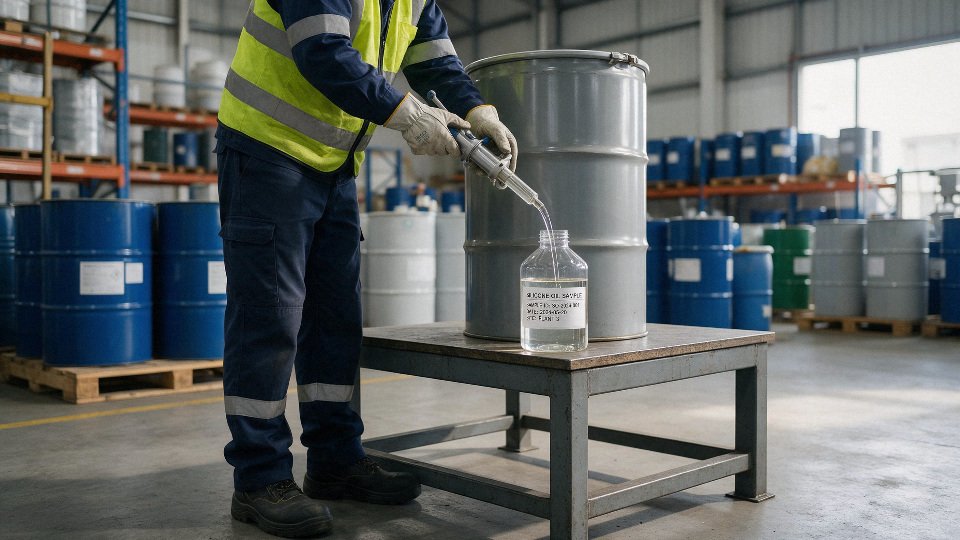
How should silicone oil be sampled without contaminating it?
- Sample only with clean, dedicated tools or a closed sampler
- Wipe the closure area before opening
- Purge or discard the first small amount if the port may hold residue
- Use clean, dry, correctly labeled sample bottles with compatible caps
- Minimize open time; close the container immediately after sampling
- Never return a retained sample to the original container
What should you do if the oil looks cloudy, has sediment, or may contain water?
Quarantine it first and stop routine use. Cloudiness can come from moisture, low-temperature haze, additive separation, or contamination from previous transfers, and those causes do not have the same risk or remedy.
Follow a short triage sequence:
- Check recent storage temperature history
- Warm the material in a controlled way if cold exposure is plausible
- Reinspect for clarity after full temperature equilibration
- Compare with a retained reference or approved sample if available
- Escalate for testing before release if haze, droplets, or sediment remain
If free water is visible, or if there is any doubt about contamination source, do not blend it into good stock to “average it out.” That is a familiar warehouse habit, and it usually just spreads the problem.
Your storage verification checklist
If your silicone oil is correctly identified, kept sealed in sound packaging, stored indoors in a dry temperature-controlled area, and issued under traceable stock rotation, your setup is usually acceptable for standard industrial grades. The decision gets tighter once you have opened containers, specialty modified fluids, long dwell time in stock, or an end use that is quality-critical, regulated, or difficult to rework after failure.
Use this as a practical go or no-go screen on the warehouse floor and in purchasing review.
- Confirm exact product identity
- Match product name, grade, viscosity or specification code, batch number, and supplier label.
- Separate similar-looking materials. In practice, the mistake I see most often is a standard dimethyl silicone oil stored beside a modified fluid and treated as interchangeable.
- If labels are damaged, missing, or handwritten over, stop use until identity is re-established.
- Verify supplier storage guidance is on file
- Check that the current TDS, SDS, shelf-life statement, and any product-specific storage note are available to operations and procurement.
- Do not rely on old purchasing habits. A packaging change, additive package change, or revised shelf-life statement can alter what is acceptable.
- Check temperature control against the product requirement
- For many standard silicone oils, a storage benchmark around 5-30°C is typical unless the supplier states otherwise.
- Review actual warehouse highs and lows, not just thermostat settings. Near roller doors, roof edges, steam lines, or uninsulated walls, local conditions can drift well outside the average.
- If temperature excursions are frequent or unknown, the issue moves from routine correction to supplier review.
- Confirm the location is dry and protected from condensation
- Store indoors, off the floor if possible, with containers protected from rain ingress, washdown splash, and roof leaks.
- A warehouse may look dry and still produce condensation on drums during seasonal swings. That matters because moisture often enters during opening, pumping, or drum cooling cycles.
- Indoor RH is often kept below 70%, but condensation risk matters more than a single humidity reading.
- Inspect packaging integrity
- Check drum bungs, pail lids, IBC valves, tamper seals, dents at closure points, staining, and residue around openings.
- Any swollen, cracked, corroded, or repeatedly opened package should be segregated for review rather than quietly returned to stock.
- Verify transfer cleanliness
- Dedicate pumps, hoses, funnels, and couplings where practical.
- If tools are shared, confirm cleaning method, drying method, and identification. Dirty transfer tools can undo otherwise good storage in one shift.
- Confirm stock rotation and traceability
- Use batch-level FIFO or FEFO, with receipt date, opening date, and remaining quantity recorded.
- Opened containers need visible status marking. Without that, shelf-life control becomes guesswork.
What you can correct now vs what needs escalation
Usually correct internally right away
– Relabeling and segregating stock
– Moving material into a dry indoor zone
– Tightening closure and housekeeping discipline
– Replacing dirty transfer tools
– Rebuilding FIFO records
– Training operators not to return exposed material to clean stock
Usually needs testing, repacking review, or manufacturer confirmation
– Unknown storage history
– Long exposure outside recommended temperature range
– Open containers held for extended periods
– Damaged packaging with possible ingress
– Specialty modified silicone fluids
– Material intended for electronics, medical, food-contact, coating-defect-sensitive, or other tightly controlled end uses
Simple risk ranking
| Storage situation | Typical risk level | Why it shifts |
|---|---|---|
| Standard silicone oil, unopened, within storage guidance | Low | Broadly stable if identity and packaging are controlled |
| Standard silicone oil, opened but cleanly handled | Medium | Contamination risk rises faster than chemical breakdown risk |
| Long-stored stock near or beyond stated shelf life | Medium to high | Usability depends on grade, packaging, history, and test results |
| Specialty modified fluids | Medium to high | Additives or reactive groups can narrow storage tolerance |
| Regulated or defect-sensitive end use | High | Small storage errors can become customer-facing failures |
The boundary here is simple: this checklist is enough to screen storage fitness, but it does not replace supplier-specific limits or a reinspection decision when product history is uncertain.
Before a large purchase, verify these documents with the supplier:
– TDS
– SDS
– Shelf-life statement
– Package specification
– Container and transfer-material compatibility guidance
– Reinspection or retest recommendations for aged stock
If you want the storage protocol checked against your actual use, send the product grade, package size, expected storage temperature range, and application or end use. SiliconChemicals can review the storage conditions against the supplied product documentation and help confirm the suitable packaging option for purchase.