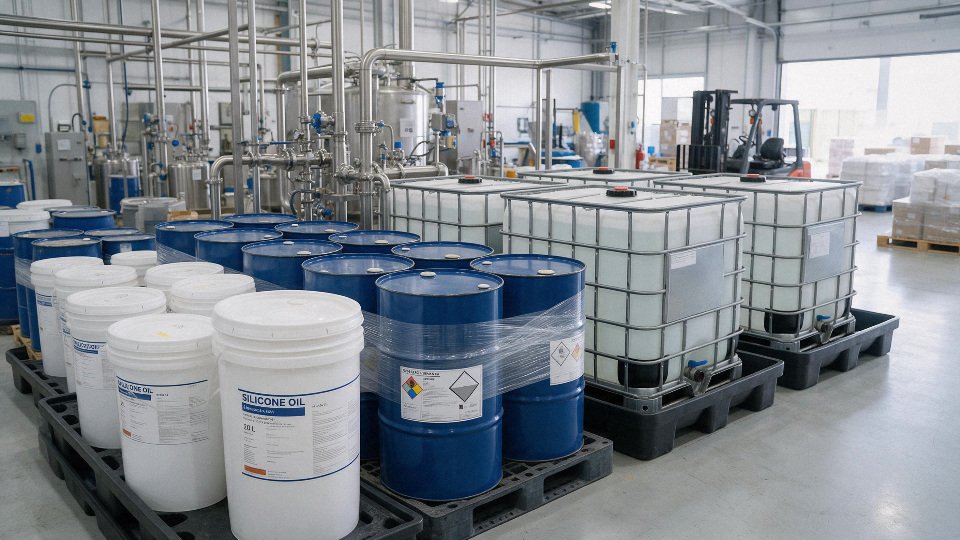
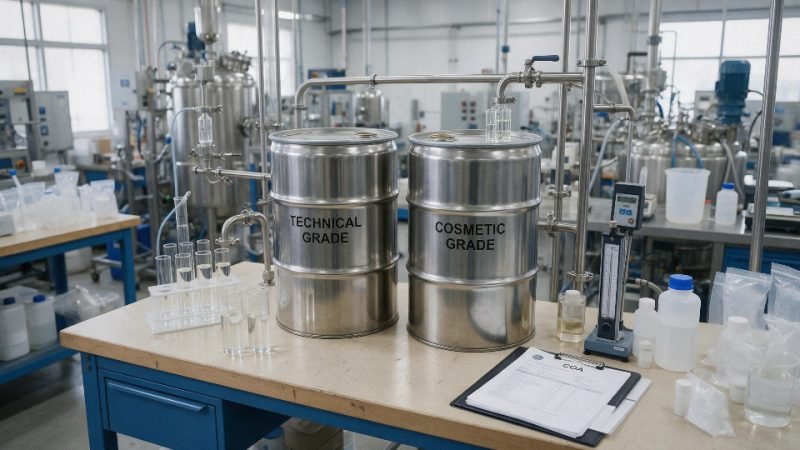
Buy the wrong silicone oil grade and the problem usually shows up downstream, not at receiving. A fluid that looks acceptable in a drum can still bring odor, residue, impurity carryover, or batch-to-batch variation into a personal care formula, while an over-specified cosmetic grade can quietly inflate cost in an industrial release, lubrication, or processing application that never needed that level of control. The practical question is not whether both are polydimethylsiloxane-based fluids, but which grade has the right purity, consistency, and documentation for the product, process, and market risk you actually carry.
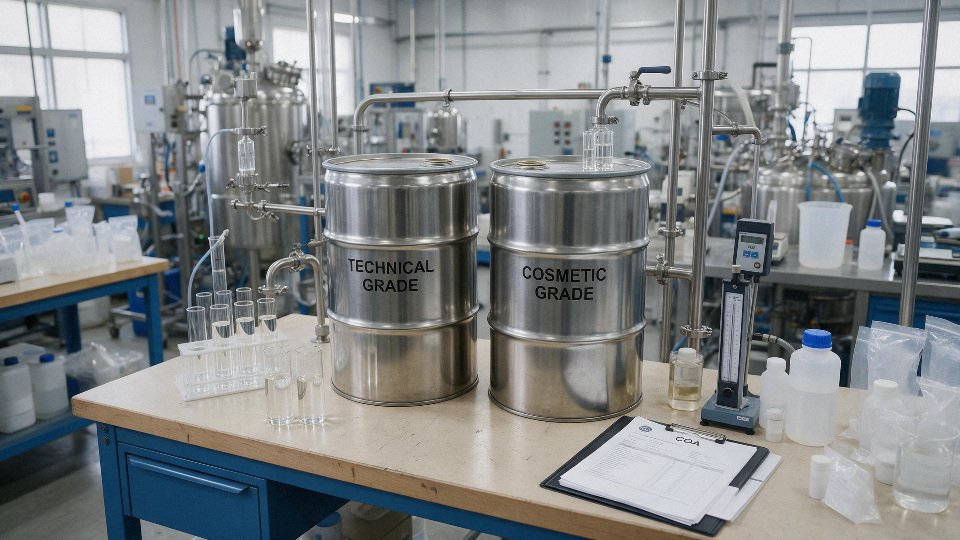
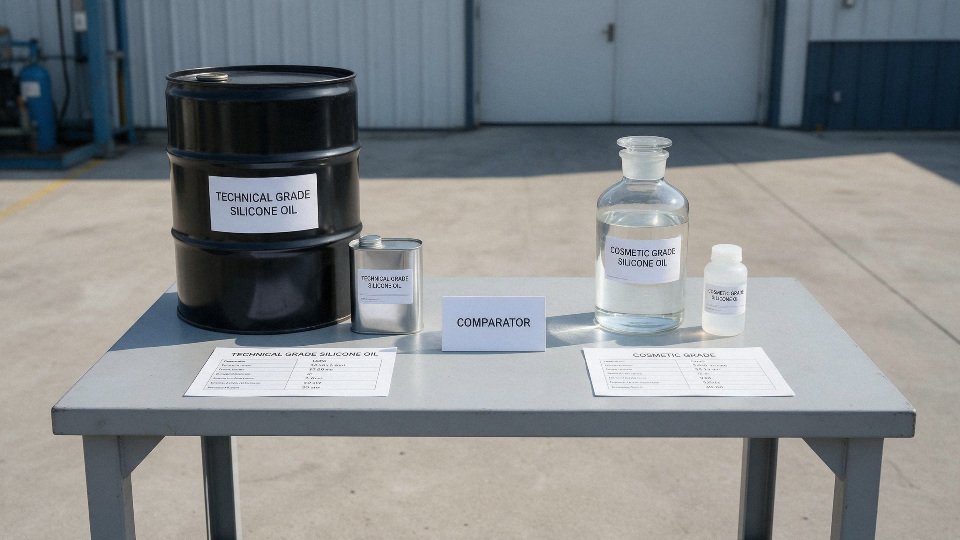
Technical grade and cosmetic grade silicone oil differ mainly in purification level, impurity control, odor and residue profile, batch consistency, and intended end use. Technical grade is usually selected for industrial performance and cost efficiency, while cosmetic grade is produced and controlled more tightly for personal care and skin-contact formulations where sensory properties, appearance, and regulatory support matter.
The confusing part is that viscosity alone will not tell you the grade. Both can sit anywhere from roughly 5 to 1,000,000 cSt at 25°C, and both may be called “silicone oil” on a quotation. The separation happens in the less glamorous details buyers often discover too late: volatile matter, acidity, color, odor, impurity limits, and how consistently those numbers are held from batch to batch.
Chemistry and product forms
At the molecular level, technical grade and cosmetic grade silicone oil often come from the same siloxane family; the difference is usually not the backbone, but how tightly the product is purified, controlled, documented, and released for the intended exposure route. A buyer should separate “what molecule is this?” from “what level of residuals, odor, volatility profile, and paperwork is acceptable for where it will be used?”
The core chemistry is the siloxane backbone, built around repeating Si-O units with organic side groups, most commonly methyl groups in standard dimethyl silicone fluids. That Si-O backbone is unusually flexible and stable compared with many carbon-chain fluids, which is why silicone oils are known for a combination that is hard to get from mineral oils or many organics:
- Low surface tension, so they wet and spread easily
- Good lubricity and slip
- Water repellency
- Useful thermal stability over a broad operating range
- Low change in feel across temperature compared with many hydrocarbon oils
That said, “thermal stability” and “low surface tension” are category traits, not blanket guarantees. Actual performance still depends on chain length, molecular weight distribution, end groups, residual low boilers, and any functional modification. A fluid that behaves perfectly well as a mold-release carrier or textile softener intermediate may still be a poor fit for personal care if odor, trace residues, or batch-to-batch sensory consistency are not tightly controlled.
Linear silicone oils versus modified silicone fluids
Most buyers first encounter silicone oil as a linear fluid, typically dimethyl silicone oil, specified mainly by viscosity at 25°C. These are the straightforward workhorse products used in lubricants, defoamers, release systems, dielectric applications, and as base fluids in many formulations.
Then there are modified silicone fluids, where the siloxane chain carries other functional groups or aromatic substitution to change performance:
- Amino-modified silicones
Used where substantivity or surface affinity matters, especially in textile finishing or hair-conditioning systems. The amino functionality improves adhesion to certain substrates, but it can also affect odor, color stability, and compatibility. - Phenyl-modified silicones
Chosen for better low-temperature behavior, refractive properties, or specific thermal performance. In some applications they give a different gloss or optical feel than standard dimethyl fluids. Polyether-modified silicones
Built for improved emulsifiability or wetting. These often show up in surfactant-like roles, agricultural adjuvants, coatings, and some personal-care systems where compatibility with water phases matters.Alkyl-modified silicones
Used to shift compatibility, spread, or organic solubility behavior.Reactive-functional grades
Hydroxyl-, alkoxy-, epoxy-, or other reactive end groups are selected when the fluid needs to crosslink, anchor, or become part of a cured network.
The practical mistake is assuming these product families map cleanly onto “industrial” versus “cosmetic.” They do not. The same modified chemistry may exist in an industrial version and a personal-care suitable version, with the dividing line set by impurity profile, residual monomers, catalyst traces, odor, documentation package, and release discipline.
Cosmetic grade silicone oil is always a different molecule from technical grade silicone oil.False
Often the base siloxane family is the same. What changes is the production control, impurity limits, volatile profile, documentation, and release criteria required for the intended end use.
Viscosity is a product descriptor, not a grade designation
In the market, viscosity is one of the first commercial identifiers buyers see. Silicone oils are sold across a very wide range, roughly 5 to 1,000,000 cSt at 25°C, depending on polymer chain length and formulation intent.
A few practical patterns matter:
- Lower-viscosity fluids usually spread faster, feel lighter, and are easier to pump, meter, or blend.
- Mid-range fluids often balance film formation, slip, and handling.
- High-viscosity grades give more persistent film, damping, and body, but they can be harder to disperse and may trap air during mixing.
Here is where purchasing teams get tripped up: the same nominal viscosity can be available in both technical and cosmetic release standards. A 100 cSt dimethyl silicone fluid is not “cosmetic” or “technical” just because it is 100 cSt. It becomes one or the other based on how it was manufactured, polished, filtered if applicable, tested, documented, and released. Two drums can carry the same viscosity and still have very different suitability for skin-contact, hair-care, or leave-on applications.
That distinction matters in production. If your line is making a release agent, a small difference in odor or trace low-boiling content may be tolerable. In a personal-care emulsion, the same difference can show up immediately as scent interference, instability, residue perception, or a failed internal qualification.
Volatile and non-volatile silicone fluids behave differently in use
Volatility changes how the fluid feels, how long it stays on the surface, and what the customer perceives after application.
Volatile silicone fluids are chosen when fast spread and light after-feel matter. They help carry actives, improve initial glide, and then evaporate, leaving limited residue if the cut is well controlled. In cosmetics, that supports dry feel, quick leveling, and reduced heaviness. In industrial systems, volatile fractions may be used where temporary wetting, faster flash-off, or short-lived lubrication is useful.
Non-volatile silicone fluids stay behind and form the residual film. That residual film is what gives lasting slip, gloss, water repellency, dielectric behavior, or surface protection. In a polish, coating, or release treatment, that can be exactly what you want. In a skin or hair product, residual film has to be tuned carefully; too much persistence can feel greasy, attract dust, or interfere with the target sensory profile.
The mechanism is straightforward: lower-boiling fractions leave the surface first, which changes concentration and film build over time. That affects gloss, drag, combability, rub-out feel, and even package behavior if evaporation shifts viscosity during storage. The preferred choice flips with the application. Fast evaporation is useful for light sensory finishers and some quick-dry processes, but it works against you where long dwell time, durable lubrication, or stable closed-system performance is required.
Why apparently identical silicone oil can pass one market and fail another
The main polymer may look the same on paper, but side components often decide grade suitability. Common industrial QC indicators include:
- Viscosity tolerance
- Volatile matter
- Acidity
- Color
- Odor
- Impurity limits
Those are not cosmetic details in the casual sense; they drive use acceptance. Residual catalysts, unstripped low-boiling fractions, processing aids, trace gels, and contamination from transfer equipment can all shift performance. In an industrial blending plant, a slight odor or a broader volatile profile may have no commercial consequence. In cosmetic use, the same lot may be rejected because odor is noticeable, residue is inconsistent, or supporting documentation is not adequate for the customer’s internal review.
One plant-floor example: if a line alternates between functional silicone intermediates and a supposedly clean dimethyl fluid, hose dead legs, pump seals, or poorly managed tote returns can introduce trace carryover. That may never show up in a rough industrial use, but it can become a problem in a leave-on formulation or any application where sensory cleanliness matters. The chemistry did not fundamentally change; the control environment did.
So the useful mental model is this: silicone oil chemistry defines the performance family, while grade control defines where that family can safely and commercially go. That rule stops holding only when the modification itself is prohibited or unsuitable for the target formulation; otherwise, the buying decision usually comes down to impurity profile, consistency, and the documentation burden the end market will demand.
Purity and contamination profile
The practical separation between technical grade and cosmetic grade silicone oil shows up first in what the supplier controls, filters, limits, and documents around the base fluid. Cosmetic grade is usually defined by tighter impurity control, lower odor and residue, cleaner appearance, and cleaner handling; technical grade is often perfectly serviceable for industrial duty while carrying impurity levels or sensory variation that would be unacceptable in personal care.
That difference is not academic. In a mold release line, slight haze or a faint process odor may never be noticed. In a transparent face serum, a hair oil in a clear PET bottle, or a fragrance-light skin primer, the same trace issue can trigger customer complaints, line holds, or a full batch rejection.
What impurities are typically controlled more tightly in cosmetic grade?
The main categories are similar across suppliers, but the acceptable limits and the consistency expectations are not. Common industrial QC indicators include viscosity tolerance, volatile matter, acidity, color, odor, and impurity limits. Cosmetic-grade material usually pushes those controls further because the end use is directly on skin or hair, and because appearance and sensory performance are part of the product itself, not just a process aid.
In practice, buyers should look at impurity control in at least these categories:
- Residual cyclics and other low-molecular-weight siloxanes
- These can remain from equilibrium polymerization or incomplete stripping.
- They affect evaporation profile, odor, residue, and sometimes packaging behavior.
- Cosmetic buyers usually expect tighter control and better batch-to-batch consistency here, especially for leave-on systems.
- Unreacted intermediates or side products
- Depending on the fluid type and production route, small amounts of reactive or partially reacted species may remain.
- In industrial use, low traces may not matter if the fluid is used in closed systems, release films, or mechanical lubrication.
- In personal care, those same traces can create odor drift, clarity issues, or formulation instability.
- Catalyst residues
- Acidic or metallic catalyst remnants are a recurring concern if post-reaction cleanup is not tightly controlled.
- These residues can shift acidity, contribute to color formation over time, or interfere with downstream formulation components.
- Metal ions
- Usually present at very low levels, but even trace metals can matter in sensitive emulsions or clear systems.
- They may catalyze oxidation of fragrance or botanical additives elsewhere in the formula, even if the silicone itself is chemically stable.
- Acidity
- Elevated acidity is a warning sign. It can indicate residual catalyst, degradation, or incomplete neutralization and polishing.
- In plant terms, this is one of those parameters that sounds minor until it starts showing up as drift in odor, package interaction, or formulation stability.
- Moisture
- Silicone oils are not water-based, but moisture still matters.
- Water contamination can affect filling behavior, create haze, or complicate blending with moisture-sensitive ingredients or packaging operations.
- Color bodies
- Very slight yellowing may be irrelevant in industrial antifoams or process fluids.
- In clear or lightly tinted cosmetic products, even a small shift can be visible in the final pack.
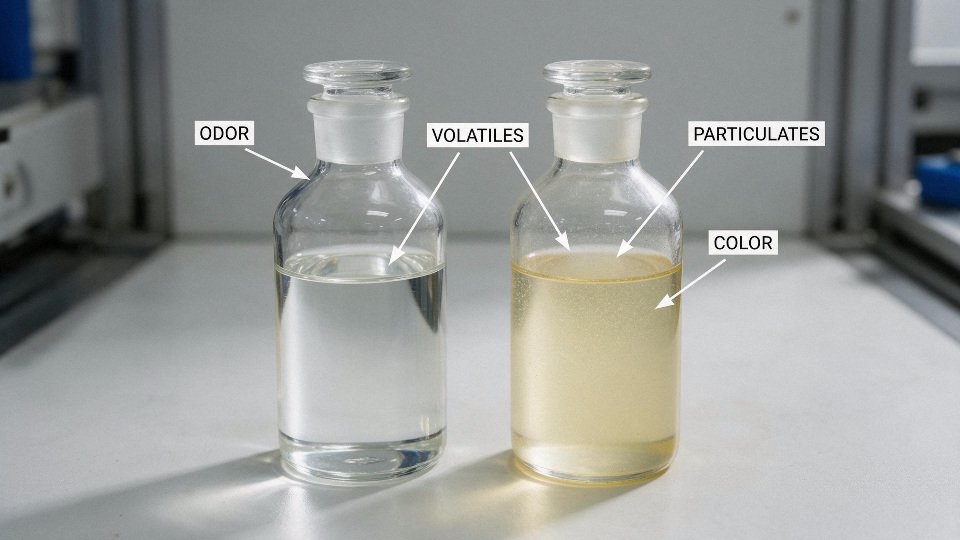
- Suspended particulates
- These can come from filtration gaps, tank cleanliness, transfer hoses, worn seals, or filling environment.
- In cosmetic applications, particulate cleanliness is often where “good enough” industrial handling stops being good enough.
The mechanism is straightforward: trace impurities that do little to bulk viscosity can still alter sensory perception, visual quality, evaporation behavior, or long-term stability. That is why two silicone oils with the same nominal viscosity, say 100 cSt at 25°C, can behave very differently in a finished cosmetic.
Why odor matters more than many buyers expect
A faint off-note that is harmless in an industrial fluid can be commercially fatal in personal care. Odor is one of the fastest rejection triggers because users detect it immediately, and brand owners often treat unexplained odor as a contamination event until proven otherwise.
Sources of odor typically include:
- residual low-molecular-weight species
- trace process volatiles
- incomplete stripping
- catalyst or neutralization residues
- contamination from storage tanks, liners, drums, gaskets, or transfer hoses
Leave-on products are the hardest case. The silicone is not just a processing aid; it sits on skin or hair, often under low fragrance loading. In that setting, a small odor issue that disappears in a hot industrial process can remain obvious in the finished pack.
There is a commercial trap here. A technical-grade fluid may pass all the buyer’s basic numerical checks and still fail on odor once blended into a low-fragrance formula. That is why sensory review, retained samples, and often a simple warm-storage sniff check are worth doing before approving a bulk lot for personal care. No spec sheet replaces that.
Low odor cannot be inferred reliably from viscosity or appearance alone.True
Two silicone oils with similar viscosity and clear appearance can still differ materially in residual volatiles or trace contamination that affects odor, especially after blending or warm storage.
Color and clarity: acceptable in one plant, rejected in another
Slight haze, a faint straw tint, or occasional visual variation may be tolerated in technical applications where the fluid is hidden in the process or applied to non-visible surfaces. The tolerance changes completely in transparent serums, hair oils, skin primers, or any pack where the customer can hold the product up to light.
Typical appearance-related concerns include:
- Haze
- Often linked to moisture, fine particulates, contamination, or incompatibility with traces of other materials.
- In a clear cosmetic package, haze reads as poor quality immediately.
- Tint
- Light yellowing may come from trace oxidation products, catalyst residues, or process history.
- A little tint in a release coating tank might never matter; in a prestige cosmetic, it often does.
- Clarity drift over time
- A freshly filled drum can look fine and still develop visible change during storage if the impurity profile is unstable.
- This is where retained sample comparison helps. Plant buyers who skip it usually regret it later.
The trade-off is simple: tighter polishing, filtration, and handling cost money. For industrial users who need thermal behavior, lubrication, or release performance, paying for optical cleanliness they do not need is wasted cost. For cosmetic users, not paying for it can be much more expensive once product returns, complaint handling, or brand damage enters the picture.
Volatile residue and low-molecular-weight fractions
This is one of the most consequential differences, and one of the easiest to underestimate during purchasing. Low-molecular-weight fractions, including residual cyclics and other volatiles, can change:
- evaporation rate
- sensory slip and dry-down
- odor release
- package headspace behavior
- weight loss during storage
- compatibility with liners, valves, elastomers, and some plastics
- compliance review requirements in certain markets or customer systems
A supplier may offer silicone oils anywhere from roughly 5 to 1,000,000 cSt at 25°C, but viscosity alone does not tell you how cleanly the fluid has been stripped or how tightly low-end fractions are controlled. Two fluids in the same nominal viscosity band can have different volatility behavior because of differences in molecular-weight distribution and finishing.
For cosmetic use, buyers usually want a tightly controlled low-odor, low-residue profile with good batch consistency. That matters not only for feel, but for filling and pack stability. If the low-molecular-weight tail is too broad, you can see more odor in the headspace, more change after heat exposure, or unexpected interaction with pump components and seals. The risk rises in aerosols, roll-ons, and packs with small orifices, where valve behavior and residue pattern are more sensitive.
The boundary here is important: not every personal care formula needs the same volatility control, and not every technical grade fluid is “dirty.” Some industrially sold fluids are extremely functional and consistent for their intended duty. The issue is fitness for the specific contamination tolerance of the end use, not a universal ranking of one grade as always better.
Microbiological relevance and cleanliness of handling
Silicone oil itself is typically not a microbial growth medium. That point gets confused often. The concern in cosmetic-grade supply is less about microbes growing in the silicone fluid and more about preventing downstream contamination introduced during storage, transfer, repacking, or filling.
So the differentiator is usually handling discipline:
- cleaner tanks and transfer lines
- controlled filling environment
- cleaner packaging components
- reduced risk of incidental water ingress
- better lot segregation and traceability
This matters once the silicone enters a cosmetic plant and is blended with water phases, botanicals, proteins, fragrances, or other ingredients that are more microbiologically vulnerable. If the incoming oil arrives in poorly controlled packaging, with dirty closures or particulate contamination, it can become the vehicle that introduces trouble into an otherwise well-managed process.
Particulate cleanliness, filtration, and filling environment
Particulate control is where experienced buyers ask sharper questions. A technical grade fluid may perform perfectly in heat transfer, textile lubrication, or release coating with standard bulk handling. Put that same fluid into a cosmetic emulsion, a fine pump dispenser, a roll-on package, or an aerosol valve system, and particulate tolerance drops fast.
Ask about:
- final filtration level and where it occurs in the process
- whether filtration is nominal or absolute
- tank and line cleaning practice between products
- packaging cleanliness controls
- closure and liner cleanliness
- whether repacking occurs and under what conditions
A small amount of particulate can create several failure paths:
- visible specks in clear formulations
- pump or valve inconsistency
- nozzle blockage
- scratch complaints in products expected to feel silky
- apparent instability that is actually contamination
The counter-intuitive part is worth stating plainly: a highly functional technical fluid can outperform a cosmetically suitable material in heat transfer, release, or mechanical process service while being completely wrong for personal care. That is not because it is universally lower quality. It is because the acceptable contamination profile is application-specific. If the product will be seen, smelled, worn, or sprayed through fine packaging hardware, purity and cleanliness stop being side notes and become part of the product design.
Manufacturing and quality control
The practical split between technical and cosmetic grade silicone oil is created on the plant floor, not in the product name. Two drums can contain the same nominal silicone fluid and viscosity class, yet one is suitable for low-risk industrial use while the other is released for cosmetic applications only because the raw materials, line control, stripping, filtration, documentation, and batch-release discipline were run to a tighter standard.
At a high level, silicone fluid manufacture is familiar across the industry: polymerization or equilibration to build the target molecular distribution, removal or neutralization of catalyst residues, stripping to reduce low boilers and odor-active volatiles, filtration, viscosity adjustment or blending, then filling. The sequence is straightforward on paper. The difference shows up in how aggressively each stage is controlled, what the line also handles, and what evidence the supplier keeps when something drifts.
Typical production flow, and where it starts to diverge
A simplified manufacturing route for many silicone oils looks like this:
- Raw material charging
- Cyclic siloxanes, chain stoppers, catalysts, and any process aids are charged
- Vessel cleanliness and line-clearance checks happen here, or should
- Polymerization or equilibration
- Reaction is run to reach the target viscosity or molecular weight distribution
- Temperature profile, catalyst type, and residence time affect both viscosity and volatile carryover
- Catalyst neutralization or deactivation
- Residual catalyst is neutralized, quenched, or otherwise rendered inactive
- Poor removal can leave acidity, instability, odor, or downstream color drift
- Stripping / devolatilization / deodorization
- Vacuum and heat remove unreacted cyclics, low-boiling fractions, and some odor-causing species
- This is one of the biggest grade-separation steps
- Settling, polishing, or filtration
- Insolubles, gels, neutralization salts, and particulates are reduced
- Filtration media choice matters more than many buyers assume
- Blending / viscosity correction
- Batches may be blended to hit release viscosity and other physical properties
- Lot-to-lot consistency is often won or lost here
- Filling and packaging
- Final transfer through hoses, pumps, filters, and filling heads into drums, pails, IBCs, or smaller packs
- Packaging hygiene and line segregation become critical at this last step
The chemistry may be similar across grades, but cosmetic-grade control usually tightens at five points: feedstock selection, catalyst-removal efficiency, stripping intensity, final filtration cleanliness, and packaging segregation or validation.
Manufacturing controls that usually separate cosmetic from technical grade
Raw materials and incoming control
Technical-grade silicone oil can be perfectly acceptable for mold release, polishes, defoamers, or process lubrication with standard industrial incoming checks. Cosmetic-grade production usually asks more from the start:
- Narrower acceptance windows on raw material purity
- Better control of odor and color in feedstocks
- Tighter review of supplier changes
- Lower tolerance for process-aid residues that are harmless in industrial service but unwelcome in personal-care formulations
This matters because contamination introduced early is expensive to remove later. A trace odor issue in a chain stopper or a slightly dirty transfer tote can follow the whole batch. You can sometimes strip out low boilers; you cannot strip out every contamination risk once it is dissolved into the bulk fluid.
Catalyst removal and neutralization discipline
Residual catalyst or neutralization byproducts can affect:
- Acid value
- Color stability
- Odor
- Long-term storage behavior
- Compatibility with sensitive formulations
The mechanism is simple enough: if catalyst residue remains, even at low levels, it can continue to influence the fluid or react with minor impurities. That can show up as slow property drift, a faint off-odor, or instability in a finished formulation. In technical use, the customer may never notice. In a leave-on personal-care product, they probably will.
Stripping and deodorization
A supplier can make a silicone oil that looks clear and still fails the nose test. Vacuum stripping intensity, temperature, residence time, and condenser performance affect how much low-boiling material stays behind. More aggressive stripping usually improves odor and lowers volatile carryover, but it has trade-offs:
- Lower throughput
- Higher energy use
- More demanding vacuum maintenance
- Possible yield loss if the cut is too aggressive
- Risk of shifting the viscosity profile if process control is sloppy
That last point gets missed. If operators chase odor reduction too hard without watching the whole process window, they can move the fluid off target or create avoidable batch-to-batch variation.
Quality systems: not just test data, but how the batch is governed
A cosmetic buyer is not only buying a liquid; they are buying confidence that the same controls will hold on the next lot. In practice, that means the supplier’s quality system has to be more disciplined than a basic industrial release system.
Key expectations usually include:
- Complete batch records
- Raw material lot numbers
- Process parameters
- Operator signoffs
- Hold points and rework notes
- Change control
- Formal review before changing raw material source, catalyst, filter media, packaging, cleaning method, or process setpoint
- Notification rules where applicable
- Retain samples
- Preserved under defined conditions for later complaint investigation or trend review
- Deviation handling
- What happened
- How it was investigated
- Why the batch was accepted, downgraded, reworked, or rejected
- Specification review and periodic tightening
- Especially where market expectations evolve faster than legacy internal specs
- Traceability
- From packaged lot back to bulk batch and raw materials, and ideally forward to shipment records
In industrial markets, some of this may be lighter-touch and still commercially acceptable. For cosmetic applications, weak traceability is a procurement risk even when the lab numbers look fine.
Release testing: what is commonly checked
Typical release testing for silicone oils often includes the following:
| Test item | Why it matters | Notes |
|---|---|---|
| Viscosity at 25°C | Confirms grade and handling behavior | Core identity check across nearly all fluid types |
| Refractive index | Supports identity and consistency | Useful as a quick comparative screen |
| Specific gravity | Checks batch consistency | Can indicate blend drift or contamination |
| Volatile matter | Flags low-boiling carryover | Especially relevant where low odor and low residue matter |
| Acid value | Indicates residual acidic species or poor neutralization | Important for stability and cleanliness expectations |
| Color | Simple indicator of process cleanliness or degradation | Usually not sufficient alone |
| Flash point | Safety and handling reference | Must be verified by actual test method and product type |
| Impurity screening where relevant | Looks for residues or foreign matter | Scope depends on application risk and supplier capability |
These are common industry controls, not a universal template. The exact panel depends on fluid type, viscosity range, end use, and the supplier’s validated methods. A 5 cSt fluid and a 1,000,000 cSt gum-like material do not behave the same in either processing or testing.
A cosmetic-grade claim is not established by viscosity and appearance alone.True
Viscosity, clarity, and basic physical constants can confirm the product matches a nominal silicone fluid type, but they do not prove low-odor performance, contamination control, packaging cleanliness, or traceable cosmetic-grade release discipline.
Cross-contamination is the issue buyers underestimate most
The risk climbs sharply when one site makes multiple product families on shared infrastructure, for example:
- Industrial silicone fluids
- Reactive siloxane intermediates
- Textile softeners or auxiliaries
- Antifoams
- Personal-care ingredients
Shared reactors are not automatically disqualifying. Shared transfer lines, pumps, flexible hoses, day tanks, filters, and filling heads are where trouble often starts. One poorly controlled campaign changeover can introduce odor, trace residues, particulates, or incompatible carryover. In my experience, filling is the weak spot more often than synthesis. Plants spend money on reactors and vacuum systems, then use a tired hose set and a general-purpose drum station for everything from textile additive to personal-care fluid.
Controls that reduce this risk include:
- Dedicated or clearly segregated storage and transfer equipment
- Validated cleaning procedures
- Line-clearance checklists before charging and before filling
- Filter change documentation
- Packaging material approval and cleanliness checks
- Environmental controls in the packing area where required
The section’s main conclusion stops holding if the supplier operates a truly dedicated, validated industrial line to a cosmetic-level system; in that case, “industrial site” does not automatically mean unsuitable. The point is not site label but control evidence.
Why documentation quality matters as much as the lab result
For cosmetic buyers, paperwork is not bureaucracy; it is part of the product. A clean COA attached to a loosely controlled batch is a weak offering. Useful documentation usually includes:
- Consistent COA format with actual results, not vague pass/fail shorthand
- Accurate SDS aligned with the shipped material
- Residual solvent declarations where relevant
- Allergen or statement-of-composition support where applicable to the buyer’s regulatory review
- Clear lot coding and shelf-life statement
- Compliance support files appropriate to the market and intended use
A common misunderstanding in sourcing is the phrase “usable in cosmetics.” That may mean the chemistry is familiar to cosmetic formulators, or that the supplier has sold similar material into low-risk applications before. It does not mean the batch was manufactured, packed, documented, and released under a cosmetic-grade control system. Buyers should ask a blunt question: was this lot made on a process and release path specifically governed for cosmetic-grade supply, and can the supplier document that path from raw material to packaged lot? If the answer gets fuzzy, treat the product as technical grade until proven otherwise.
Performance in end uses
The grade choice is driven less by the silicone oil’s headline chemistry than by what the customer will see, touch, smell, or be exposed to. For enclosed industrial systems, technical grade is often the economically correct choice; for leave-on or visible personal-care products, cosmetic grade is usually the minimum defensible starting point because sensory defects and trace contamination become commercial failures, not just QC deviations.
That split sounds obvious on paper, but plants get it wrong in both directions. I have seen buyers pay for cosmetic-grade material in a closed hydraulic or dielectric application where nobody downstream could detect the difference and no extra qualification benefit was gained. I have also seen industrial-grade material trialed in appearance-sensitive consumer products because the viscosity matched, only for odor, clarity, residue, or batch-to-batch feel to create rework and customer complaints that cost far more than the material saving.
Where technical grade silicone oil is usually selected
Technical grade silicone oils cover a wide range of industrial jobs, and the priority is normally functional performance inside a process, machine, or formulation rather than direct sensory acceptance by an end user.
Major application groups include:
- Lubricants
- Light-duty lubrication
- Instrument and mechanism lubrication
- Specialty greases and compounded lubricants
- Release agents
- Mold release for rubber, plastics, and composites
- Release coatings for processing lines
- Defoamers and foam-control additives
- Process antifoams
- Tank-side foam suppression
- Additives for water-based and solvent-based systems
- Textile finishing
- Softening
- Slip improvement
- Sewability and hand modification
- Polish formulations
- Automotive appearance products
- Furniture and household polishes
- Metal-care products
- Dielectric and insulating fluids
- Electrical insulation
- Heat-transfer roles where silicone properties are needed
- Additives for coatings and inks
- Slip and leveling
- Surface defect control
- Flow modification
- Plastic processing
- Internal and external lubrication
- Anti-block and release support
- Surface feel modification
- Industrial maintenance products
- Protective sprays
- Mechanical maintenance fluids
- Water-repellent or anti-stick service products
The performance screen in these markets is practical and pretty unforgiving:
- Thermal stability matters when the oil sees heated platens, drying ovens, hot molds, or electrical load.
- Foam control matters when entrained air causes pump cavitation, overflow, coating defects, or fill inconsistency.
- Slip and release efficiency matter when line speed, demolding time, or part ejection force affect output.
- Dielectric behavior matters when the fluid is part of insulation duty, not just a mechanical lubricant.
- Line compatibility matters when the oil has to work with seals, hoses, dosing pumps, mixing vessels, filters, and cleaning routines already on site.
The mechanism is straightforward but worth stating. In an industrial line, one parameter rarely acts alone. Viscosity, for example, affects how the silicone oil meters through a gear pump, how uniformly it wets a mold or substrate, how much carryover reaches the next process stage, and how easily operators can clean buildup at shift end. A lower-viscosity fluid may improve spread and release consistency, but it can also migrate farther than intended, contaminate paint or bonding stations, or increase consumption. A higher-viscosity fluid may stay put better and give durable lubrication, but it can feed poorly in cold weather or through long small-bore tubing. Anyone who has fought a winter startup with thick silicone through tired pneumatic pumps knows this is not a lab-only issue.
That is where technical grade often wins on economics. If the system is enclosed, the user never contacts the fluid, and performance acceptance is based on machine output rather than odor or skin feel, tighter cosmetic-style controls may not return any usable value. The boundary is simple: once the product becomes visible on a sold surface, touchable by the consumer, or hard to separate from the finished article, the logic changes quickly.
Where cosmetic grade silicone oil is usually selected
Cosmetic grade silicone oils are chosen where the silicone becomes part of the consumer experience or sits inside a formulation with a higher documentation and consistency burden.
Major application groups include:
- Skin care
- Lotions
- Creams
- Serums
- Primers
- Hair serums and leave-in products
- Shine products
- Frizz control
- Heat-protection styling systems
- Conditioners
- Rinse-off and leave-on conditioning systems
- Detangling and combability improvement
- Color cosmetics
- Foundations
- Primers
- Lip products
- Mascaras and other texture-sensitive systems
- Sun care
- Spreadability and film-forming support
- Sensory balance in higher-solids formulas
- Antiperspirants and deodorants
- Glide
- Dry feel
- Aesthetic finish
- Cleansing products
- Facial cleansers
- Specialty wash-off systems
- Mildness and after-feel adjustment
- Hybrid dermocosmetic formulations
- Cosmetic products positioned close to treatment categories
- Sensitive-skin or higher-scrutiny applications
Here the priority set shifts:
- Skin feel has to be consistent across batches.
- Spreadability affects dose perception and user acceptance.
- Gloss or soft-focus appearance may be part of the product promise.
- Non-greasiness matters as much as lubrication.
- Volatility profile changes dry-down time, residue, and sensory after-feel.
- Formulation elegance includes clarity, texture, and how the product breaks on skin or hair.
- Odor neutrality is critical because even slight off-notes can interfere with fragrance design or create immediate rejection.
- Packaging aesthetics matter because haze, separation, sweating, residue rings, or incompatibility with applicators become shelf problems, not just formulation problems.
The trade-off here is rarely between “works” and “doesn’t work.” It is usually between acceptable function and commercially acceptable presentation. A silicone oil that gives decent slip but leaves a faint odor, slight haze, or variable after-feel may still perform chemically, yet fail in a prestige serum, a transparent primer, or a fragranced leave-on. That is why cosmetic buyers care about batch consistency beyond simple viscosity. They are protecting the whole sensory system: fragrance, texture, visual clarity, pump behavior, and consumer repeat purchase.
A silicone oil that performs well as an industrial slip or release additive may still be unsuitable for personal-care use because sensory profile and documentation requirements are different acceptance gates.True
Matching viscosity or base chemistry does not guarantee suitability across end uses. Cosmetic applications typically require tighter control of odor, residue profile, organoleptic consistency, and supporting documentation tied to the intended use.
Where the lines blur
Some products sit in the overlap zone:
- Topical device products
- Beauty tools and applicator systems
- Hybrid consumer-industrial products
- Professional salon or treatment products with quasi-technical positioning
- Maintenance or care products sold into consumer channels where residue and touch still matter
In these cases, the stricter downstream use usually controls the grade decision. If a silicone oil may contact skin indirectly, remain on a beauty tool surface, influence a visible finish, or become part of a product sold on appearance and feel, buyers usually move toward the tighter grade expectation. Procurement teams sometimes resist that because the process side says, correctly, that the oil only provides slip or lubrication. The missing point is that in hybrid products, user perception is part of performance.
That said, do not turn cosmetic grade into a universal “higher is always safer” label. Food-contact, pharmaceutical, and medical uses may require another layer of qualification entirely, sometimes driven by specific regulatory frameworks, extractables concerns, biocompatibility expectations, or supplier documentation packages. Cosmetic grade does not automatically satisfy those pathways, and technical grade certainly does not. The grade language tells you something useful, but not enough to approve those higher-risk uses without a separate review against the applicable standard, product dossier, and supplier support.
Cost of over-specifying and under-specifying
The commercial mistake on industrial jobs is over-specification. If the silicone oil runs in a fully enclosed system, never reaches the operator except during maintenance, and has no consumer-facing appearance requirement, paying for tighter odor or sensory control can become pure cost loading. You may also narrow your supplier base unnecessarily and increase lead-time risk for no production benefit.
The bigger strategic mistake is under-specification in personal-care-facing products. Hidden defects do not always show up on day one.
Typical failure paths include:
- Batch rejection at filling
- Appearance drift
- Odor mismatch
- texture inconsistency
- Packaging complaints
- haze
- separation
- valve or pump behavior changes
- Consumer dissatisfaction
- greasy feel
- poor dry-down
- unwanted residue
- Brand and compliance exposure
- documentation gaps
- harder investigations during complaints or audits
In practice, the right grade decision comes from four checks done together, not in sequence:
- Exposure pathway
- Enclosed industrial system, incidental contact, rinse-off contact, or leave-on contact
- Performance acceptance criteria
- Machine output, release rate, foam suppression, sensory feel, visual clarity, odor neutrality
- Documentation burden
- Basic industrial QC release, customer specification package, personal-care support, or regulated-use qualification
- Cost of failure
- Downtime and scrap on the plant side versus complaint, recall, or brand damage on the market side
If those four point in different directions, the strictest practical downstream requirement should usually win. That is not conservatism for its own sake; it is just cheaper than discovering too late that a material was “chemically similar” but commercially wrong.
Regulatory and documentation demands
For buying decisions, the grade claim is only as credible as the paper behind it. If a supplier cannot back “cosmetic grade” or “technical grade” with a controlled document set, treat the claim as marketing language, not a procurement fact. In practice, the difference shows up less in the drum label and more in what the supplier can issue consistently for every lot, every region, and every audit cycle.
A usable documentation package usually starts with a small core set, and buyers should ask for it early rather than after formulation work has started:
- Product specification
- Defines the release limits or target ranges
- Often includes viscosity, volatile matter, acidity, color, odor, and impurity limits
- Should be version-controlled and dated
- Certificate of Analysis (COA)
- Confirms lot-specific test results against the specification
- Needs lot number traceability and clear pass/fail status
- For sensitive applications, check whether the reported values are actual results or only “conforms”
- Safety Data Sheet (SDS)
- Oriented to transport, storage, workplace handling, and hazard communication
- Necessary, but not enough on its own to support a cosmetic-grade claim
- Manufacturing or quality statement
- May describe production controls, line segregation, change-control practices, and batch release procedures
- Useful when a brand owner or contract manufacturer is assessing contamination risk
That distinction matters because cosmetic-market buyers usually need more than industrial safety documentation. They may ask for support on:
- Ingredient identification
- INCI-aligned naming or equivalent product identification used in personal-care documentation
- Consistent naming across specification, COA, SDS, and commercial invoice
- Composition disclosure at the appropriate level
- Not every supplier will provide a full formula disclosure, and many cannot for proprietary reasons
- But the buyer still needs enough composition transparency to support regulatory filing, customer declarations, or restricted-substance review
- Impurity and residual concern statements
- Buyers may request declarations on residual volatiles, catalyst-related residues, solvent presence, odor-causing trace materials, or other substances of concern depending on the market and product type
- Region-specific regulatory communication
- What is adequate for one country may be incomplete for another
- Importers and brand owners often need statements tailored to the destination market rather than one generic “global compliance” letter
An SDS alone is sufficient proof that a silicone oil is suitable for cosmetic use.False
An SDS is mainly a hazard communication document for transport and workplace handling. Cosmetic acceptance typically requires additional identity, impurity, and market-specific documentation beyond the SDS.
The frameworks buyers ask about vary, and this is where weak suppliers start speaking in broad adjectives instead of document names. Common requests include:
- REACH-related information
- Registration status, exemption basis, or supply-chain communication relevant to the substance and region
- Buyers should verify the exact legal role of the supplier and importer rather than assume one statement covers every shipment route
- Chemical inventory status
- Confirmation relevant to the target country or region
- Particularly important when the same silicone oil is sold into multiple export markets
- Residual or restricted-substance declarations
- Requested by personal-care brands, toll manufacturers, and contract packers to support their own internal restricted substance lists
- Animal-origin, allergen, or contamination-related statements
- Sometimes required by downstream customers even when not explicitly mandated by the base chemical regulation
Technical-grade silicone oils can still come with solid compliance files, but the file is usually built for a different risk profile. It tends to focus on:
- workplace exposure and handling;
- transport classification;
- storage and shelf-life communication;
- industrial substance management;
- standard QC release against industrial performance parameters.
That is not poor practice. It is just aimed at an industrial user who cares about process performance, maintenance impact, and plant safety more than consumer-exposure review. The problem starts when a technical-grade file is stretched into a cosmetic-use justification without the supporting impurity, identity, and market-access documents.
The mechanism here is straightforward: documentation quality affects whether the material can move through customer qualification without delay. Missing identity alignment, inconsistent impurity declarations, or lot-to-lot paperwork changes create holds in brand QA, customs review, toll manufacturing intake, and internal regulatory signoff. A plant can have the right fluid in the tank and still miss launch dates because the paper trail is not stable.
Documentation consistency across lots matters more than many first-time buyers expect:
- Multinational brand owners need audit-ready files that match across sites and years.
- Contract manufacturers need incoming material records that stand up during customer audits.
- Importers need the same product description, grade status, and supporting declarations to remain consistent across customs documents, SDSs, and commercial paperwork.
- Procurement teams need change notification discipline so they are not blindsided by a revised specification after commercial approval.
The trade-off is cost and administrative load. Cosmetic-grade support usually requires tighter document control, more supplier responsiveness, and sometimes additional declarations that industrial buyers never ask for. That added burden is justified when the material enters personal-care supply chains, but it may be unnecessary overhead for a closed industrial process with no consumer contact. The conclusion stops holding, though, when the “industrial” use still feeds a customer audit chain with retail exposure expectations; at that point, the cheaper file often becomes the more expensive mistake.
Watch for vague phrases that have no release logic behind them:
- “high purity”
- “premium quality”
- “skin safe”
- “suitable for cosmetics”
- “export grade”
Unless those statements are tied to a formal grade designation, defined test parameters, lot-traceable COAs, and controlled declarations, they do not reduce buyer risk.
Selection and substitution risks
Treating technical grade and cosmetic grade silicone oil as interchangeable is where avoidable cost starts. In personal care, a direct swap from technical to cosmetic-sensitive use can show up fast as odor, haze, sensory drift, or documentation gaps; in industrial service, swapping the other way often means you paid for controls and paperwork that never changed line performance.
The mistake usually starts with one simplifying assumption: same chemistry, same viscosity, same use. That is not how these materials behave once they meet a formulation, a package, a customer panel, or an auditor. The risk sits in the control system around the oil just as much as in the oil itself.
Direct substitution risk in personal care and other exposure-sensitive uses
A technical grade silicone oil can look acceptable on a basic incoming check and still fail where the customer actually experiences it. Personal care, skin-contact coatings, wipe-on products, and appearance-critical emulsions are the obvious danger zones.
Common failure modes include:
- Off-odor
- Even a mild process odor that seems harmless in a drum sample can become obvious in a leave-on product or a fragrance-light formula.
- Odor issues are often intermittent rather than catastrophic, which makes them expensive. You do not always get a clean reject; you get complaint rates, retailer pressure, and batch-to-batch brand inconsistency.
- Visible haze or clarity loss
- Slight differences in impurity profile, volatile residue, or compatibility with the rest of the formulation can turn a clear system slightly opalescent.
- This matters most in serums, clear oils, and transparent packaging where every visual defect is exposed under store lighting.
- Poor sensory profile
- Two silicone oils at the same nominal viscosity can spread differently, leave a different afterfeel, or change dry-down.
- That shift can come from volatile balance, trace low-molecular fractions, or interaction with esters, surfactants, fragrances, and actives. Customers usually describe it as greasy, draggy, heavy, or less silky; they do not care which raw material parameter caused it.
- Emulsion instability
- In emulsified systems, small changes in raw material purity or interfacial behavior can move the required emulsifier balance.
- You may see delayed separation, viscosity drift over storage, or more sensitivity to heat-cool cycling. A bench sample may pass for a week and still fail after transport or warehouse exposure.
- Package incompatibility
- Trace components that were irrelevant in industrial use can affect seals, liners, pump parts, or label adhesion.
- In practice, this often appears as a packaging complaint first and a raw material investigation second.
- Regulatory or customer-document challenge
- A formulation may work physically, but if the grade lacks the expected support package, the launch stalls anyway.
- That is not a lab problem; that is a procurement and market-access problem.
The mechanism is straightforward: in exposure-sensitive products, tighter control of odor, appearance, volatiles, and impurity profile affects both perceived quality and formulation stability through interfacial behavior, residue profile, and compatibility with other low-dose ingredients. Small differences that are invisible in a bulk industrial process become amplified when the product is applied thinly on skin, hair, or a visible surface.
A higher purity or more tightly controlled grade is not automatically the lower-risk choice in every application.True
Risk depends on the application's exposure pathway, compliance burden, sensory sensitivity, and the actual failure mode. Paying for tighter controls adds value only when those controls affect the use case.
Reverse substitution risk in industrial service
If the application is closed-system lubrication, release, defoaming, textile processing, or another industrial duty with limited exposure sensitivity, cosmetic grade may be the wrong commercial choice even when it performs perfectly well.
Typical reverse-substitution costs:
- Unnecessary raw material cost
- You pay for tighter cleanliness, organoleptic control, segregated handling, and documentation depth that may not improve the process result.
- Longer lead times
- More controlled grades often move through narrower production windows, stricter release testing, and tighter scheduling.
- Restricted supplier pool
- Fewer qualified sources can increase supply risk, especially when demand spikes or regional logistics tighten.
- Higher change-control burden
- Once a plant or purchasing team standardizes on a premium grade, changing back later can trigger requalification work, customer review, and internal resistance.
The trade-off is simple: cosmetic-grade controls can reduce risk in sensitive uses, but in many industrial processes they only raise cost and procurement complexity. The preferred choice flips when the application is not consumer-facing, not highly regulated for contact, and not sensitive to odor, residue, or appearance.
Same viscosity does not mean same formulation behavior
This is where many purchasing substitutions go wrong. A 350 cSt silicone oil from Supplier A and a 350 cSt silicone oil from Supplier B may both sit inside viscosity tolerance at 25°C and still behave differently enough to matter.
Watch for changes in:
- Sensory feel
- Spread, slip, cushion, and afterfeel can drift even when viscosity matches.
- Emulsion behavior
- Required emulsifier level, droplet stability, and storage robustness may change.
- Antifoam performance
- In process systems, trace differences can alter foam knockdown speed, persistence, and dispersion behavior.
- Raw material interactions
- Fragrance, hydrocarbon carriers, esters, pigments, active ingredients, and surfactants can all respond differently to another supplier’s material.
- Appearance over time
- Freshly made product may pass while aged product shows haze, bleed, or phase shift.
A lot of buyers lean too hard on the COA here. Useful document, but limited tool.
Quality escapes usually start in incoming inspection
Most substitution failures are not caused by one dramatic specification miss. They slip through because the receiving check was designed for industrial utility, while the actual use needed sensory or formulation screening.
Common quality escape scenarios:
- Incoming inspection checks viscosity and color only
- That will miss odor, low-level haze, and compatibility issues.
- COA accepted without use-condition verification
- Supplier values may be correct and still incomplete for the application risk.
- No retained sample comparison
- Without side-by-side comparison against the last approved lot or supplier, subtle drift gets normalized.
- No application-screen test
- A simple bench emulsion, panel odor check, or package-contact screen often catches what basic QC does not.
- Odor and appearance not checked after dilution or formulation
- Some differences only emerge at use concentration, not in neat oil form.
Procurement traps that look like savings on paper
Price per kilogram is the easiest number to compare and often the least useful one. The expensive part of a bad substitution is rarely the drum price.
Include these cost elements before approving a switch:
- Reformulation labor and lab time
- Stability and compatibility retesting
- Regulatory or customer-document review
- Production trial losses
- Finished-goods rejection or hold
- Market launch delay
- Complaint handling and returns
- Supplier requalification effort
The lower-risk choice is not always the grade with the more premium label. It is the grade whose control discipline matches the product’s actual exposure, quality sensitivity, and documentation requirement. Once those three are defined clearly, the right substitution path usually becomes obvious, and if it does not, that is the point to run a side-by-side application trial rather than force a purchasing decision from the COA alone.
Supplier evaluation checklist
A credible silicone oil supplier can identify the product unambiguously, document how it is made and controlled, and support the grade claim with records that survive a customer audit. If the supplier stays vague on identity, impurity control, packaging discipline, or lot traceability, treat the grade label as marketing until proven otherwise.
Buying mistakes usually start with a product name that sounds familiar but is not specific enough to purchase against. “Silicone oil 1000 cSt” tells you very little if one supplier means dimethyl silicone fluid for general industrial use and another means a cosmetic-positioned fluid with tighter odor, color, and residue expectations. The first screen is product identity, and it needs to be exact.
1. Confirm exact product identity
Ask for the full commercial and technical identity, not just a sales name.
- Chemical description or INCI name where relevant
- Viscosity grade at 25°C
- Modification type, if any, such as amino-, phenyl-, polyether-, or alkyl-modified
- Volatile or non-volatile classification
- Intended end-use scope stated by the supplier
- Any stated restrictions on personal care, pharmaceutical, food-contact, or purely industrial use
The mechanism here is simple: a small identity mismatch at purchasing becomes a large downstream problem in formulation, labeling, or audit review. A polyether-modified fluid and a straight dimethyl fluid may sit in the same viscosity band but behave very differently in wetting, compatibility, foam profile, and residue. If the supplier cannot pin the product down in one page, you should not be qualifying it for long-term sourcing.
2. Request the core evidence set
Do not qualify from a brochure alone. Ask for the operating documents buyers and QA actually use.
- Current specification with test methods or method references
- Recent COA from a production lot
- SDS
- Typical properties sheet
- Statements on impurity-related controls, as available
- Packaging specification
- Shelf life
- Storage conditions
For silicone oils, common QC indicators often include viscosity tolerance, volatile matter, acidity, color, odor, and impurity limits. Cosmetic-positioned material should usually show tighter organoleptic control and better batch consistency evidence than a purely technical grade. If a supplier refuses to share a recent COA, that is not a small administrative issue; it usually means you cannot verify whether routine production actually matches the sales specification.
3. Ask how the product is manufactured and handled
This is where many “grade” claims either hold up or fall apart.
- Dedicated or shared production equipment
- Filtration level and where filtration occurs
- Catalyst removal or post-reaction cleanup approach
- Deodorization practice, if relevant
- Line-cleaning method and how cleaning effectiveness is verified
- Batch numbering and raw-material-to-finished-lot traceability
A shared line is not automatically disqualifying. In practice, it depends on what else runs through that line, how the cleanout is validated, and whether the plant can show traceable segregation. The trade-off is cost versus contamination risk: shared assets can be economical, but the preferred choice flips when the end use has low tolerance for odor, residue, or cross-contact.
A supplier can credibly call a silicone oil cosmetic grade without dedicated equipment.True
Dedicated equipment helps, but it is not the only acceptable control strategy. Shared systems can be suitable if segregation, cleaning validation, traceability, and release testing are strong enough for the intended use and customer audit standard.
4. Verify commercial reliability
A technically acceptable supplier still fails if they cannot ship consistently.
- Normal production capacity for the grade
- Typical lead time and what drives variation
- Lot-to-lot consistency controls
- Minimum order quantity
- Export experience to your market
- Contingency plan for raw-material disruption, maintenance shutdown, or freight delay
Here the boundary is straightforward: a supplier may be fine for development sampling and still be weak for production supply. A plant running one reactor campaign every few months is a different commercial risk from a supplier with regular output and buffer stock discipline.
5. Evaluate technical support quality
Useful suppliers answer the awkward questions directly.
- Formulation guidance within their product scope
- Compatibility data with common bases or additives
- Sample response time and sample identification quality
- Troubleshooting support when haze, odor, separation, or residue appears
- Clear explanation of use limitations
Watch how they handle uncertainty. Good technical support does not mean claiming universal compatibility. It means telling you what they know, what they estimate, and what needs bench testing.
6. Check packaging and logistics suitability
Packaging quality matters more than many buyers admit, especially once drums start sitting in a hot warehouse or crossing oceans.
- Drum, pail, or tote cleanliness standard
- Liner compatibility, if liners are used
- Tamper evidence
- Nitrogen blanketing where oxidation or moisture sensitivity makes it relevant
- Label clarity and lot traceability on each package
- Transport and storage conditions for sensitive grades
A clean product can be compromised by dirty packaging, poor seals, or vague relabeling at a trading warehouse. I have seen more than one “quality issue” turn out to be packaging discipline, not the fluid itself.
7. For global buyers, test audit and compliance responsiveness
- Ability to support region-specific compliance requests
- Turnaround time for customer questionnaires
- Audit readiness of quality and traceability records
- Willingness to clarify what is standard versus customer-specific documentation
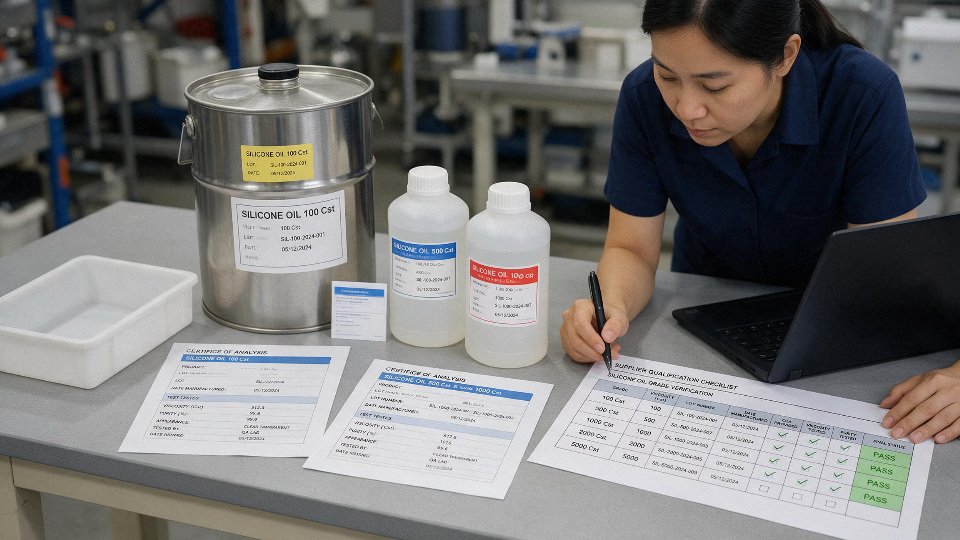
If a supplier looks good on paper, the next sensible step is a controlled sample review tied to your actual use case. Provide the target viscosity, modification type, whether you need volatile or non-volatile material, end-use scope, packaging preference, and any impurity or sensory limits that matter in your plant.
Frequently asked questions
Can technical grade silicone oil be used in cosmetics if the viscosity is the same?
No. Matching viscosity only tells you the fluid has similar flow behavior at 25°C; it does not confirm impurity profile, odor, volatile residue behavior, batch consistency, or the documentation needed for cosmetic approval. In a personal-care formula, those non-viscosity factors are usually what create the actual risk.
A 350 cSt technical grade and a 350 cSt cosmetic grade may look identical on a simple COA line item, but they are not interchangeable unless the supplier can prove cosmetic suitability through its manufacturing controls and release package. The trouble shows up later: off-odor in bulk fill, haze after storage, unstable fragrance perception, or a customer complaint that is hard to trace because the incoming spec was too thin.
Same viscosity means the same grade suitability.False
Viscosity is only one property. Grade suitability depends on impurity control, sensory profile, volatile matter, documentation, and end-use risk management.
Is cosmetic grade always more pure than technical grade?
Usually yes in the parameters that matter for cosmetic use, but not in some vague universal sense of “better.” Cosmetic grade is typically controlled more tightly for odor, appearance, volatile residue profile, and batch-to-batch consistency, while a technical grade may be perfectly adequate, or even tightly controlled, for heat transfer, release, lubrication, or dielectric service.
The catch is that “pure” has to be tied to intended use. An industrial buyer might care more about viscosity tolerance over a wide range, oxidative stability in equipment, or compatibility with seals and pumps. A cosmetic formulator cares whether the fluid stays low-odor and low-residue and does not introduce trace contamination that affects skin-feel, fragrance, or finished-product acceptance.
Are dimethicone and silicone oil the same thing?
Sometimes in everyday trade language, yes; technically, not always. “Silicone oil” is a broad commercial term covering several silicone fluid types across a wide viscosity range, roughly 5 to 1,000,000 cSt at 25°C depending on chain length and modification. Dimethicone is one specific family within that broader silicone fluid space, commonly used in personal care.
That distinction matters in procurement. A buyer who asks for “silicone oil” without specifying INCI, viscosity, volatility expectations, and end use is inviting substitutions that may be chemically related but commercially wrong.
What tests best distinguish cosmetic suitability from general industrial quality?
Start with a tighter screening set rather than one magic test. In practice, these are the most useful checks:
- Viscosity at 25°C
- Confirms the nominal product grade.
- Necessary, but weak as a cosmetic discriminator on its own.
- Volatile matter or low-boiling fraction
- Helps identify residual light components that can affect odor, evaporation behavior, and residue profile.
- This often separates a merely functional industrial fluid from one suitable for sensory-critical use.
- Odor evaluation
- Not glamorous, but very important.
- A trained sensory check, backed where relevant by instrumental screening, catches issues a clear liquid can hide.
- Color and appearance
- Useful as a quick incoming gate.
- Not enough for release on cosmetic programs by itself.
- Acidity or acid value-related control
- Screens for trace process carryover or degradation signals that can affect formulation stability.
- Impurity-limit testing
- The exact panel depends on process route and market expectations.
- This requires supplier disclosure and risk-based agreement, not guesswork from the buyer.
- Batch consistency review
- Look at several lots, not one laboratory sample.
- Cosmetic suitability is as much a consistency question as a purity question.
Does colorless appearance guarantee cosmetic grade?
No. Plenty of non-cosmetic silicone fluids are water-clear, and plenty of poor lots still look clean in a sample bottle. Colorless appearance is a screening observation, not proof of suitability.
If a supplier leans too hard on “clear, colorless, transparent” as the selling point, ask what the volatile matter, odor control, impurity limits, and release criteria actually are. That answer tells you much more than the bottle does.
Can one supplier produce both grades safely?
Yes, if the plant has the controls to keep them separate where separation matters. Many competent producers run both industrial and cosmetic-oriented products, but safe dual production depends on line discipline, validated cleaning, storage segregation, controlled rework policy, packaging hygiene, and lot traceability.
This is where plant-floor details matter. Shared transfer hoses, reused drums, poorly identified IBC stations, or loose valve management can undo a good reactor process. On paper, the supplier may have both product lines; in practice, you need to know how they prevent cross-contact and how they release each grade.
How should incoming QC differ for technical and cosmetic applications?
Use a risk-based split.
- For technical applications
- Verify identity
- Confirm viscosity
- Check appearance/color
- Review basic COA items such as volatile matter or acidity where relevant to the process
- Run application-specific checks if the oil affects equipment reliability or downstream bonding, coating, or electrical behavior
- For cosmetic applications
- Everything above, plus tighter review of odor, batch consistency, impurity-related limits, and document completeness
- Keep retain samples by lot
- Require change-notification discipline from the supplier
- Qualify against a formulation trial, not just a bench certificate
If the material is going onto skin or into a prestige formulation, incoming QC should be tied to supplier qualification, not treated as a warehouse receiving exercise.
What documents should a buyer request before approving a new source?
For most approvals, request the following:
- Technical Data Sheet
- Certificate of Analysis for recent production lots
- Safety Data Sheet
- Product specification with test methods
- Statement of intended grade and end-use positioning
- Manufacturing and quality-control overview
- Information on line segregation or contamination-control practices
- Regulatory or market-specific support documents required by your sales region
- Change-control or notification policy
- Sample lot traceability details
For cosmetic programs, I would also ask for multiple-lot data, not a single showcase batch. A source looks very different when you compare three to five production lots side by side.
Your grade verification next step
Start with exposure, not product name. If the silicone oil stays inside an enclosed industrial system with no meaningful consumer contact, technical grade is often the right starting point; if it goes into rinse-off or leave-on personal care, cosmetic grade should usually be the default until proven otherwise. The choice gets stricter as human exposure, sensory expectations, and documentation burden increase.
A simple decision path works better than arguing from habit:
- Enclosed industrial system
- Examples: release systems, hydraulic damping, process fluids, textile or equipment-side lubrication where the material is not intended for direct consumer exposure.
- Usual starting point: technical grade
- Verify first:
- Viscosity at 25°C
- Volatile matter limit
- Acidity
- Color and odor
- Compatibility with seals, substrates, or downstream process steps
- Main risk if you overbuy: paying cosmetic-grade cost for no practical gain.
- Indirect consumer contact
- Examples: processing aids or components where incidental transfer is possible, or where the finished article has some consumer-facing sensitivity.
- Usual starting point: case-by-case
- Verify first:
- Actual contact pathway
- Residue potential on the finished part
- Customer specification language
- Documentation package required by your market
- This is where decisions often flip. A low-risk factory use can become a higher-risk sourcing requirement once the brand owner or downstream customer writes tighter impurity or documentation limits into the spec.
- Rinse-off personal care
- Examples: shampoos, body wash, cleansing products.
- Usual starting point: cosmetic grade
- Verify first:
- Odor profile
- Batch-to-batch appearance consistency
- Residue and sensory behavior in the finished formula
- Required cosmetic documentation for the target market
- Leave-on cosmetics
- Examples: serums, creams, hair oils, primers, skin-feel modifiers.
- Usual starting point: cosmetic grade, with tighter qualification
- Verify first:
- Sensory profile on skin or hair
- Low-odor, low-residue consistency
- Impurity control and release documentation
- Stability in the actual formulation over time and temperature
- Regulated higher-risk applications
- Examples: applications with medical, pharma-adjacent, or other controlled end-use implications.
- Usual starting point: do not assume either grade name is sufficient
- Verify first:
- Application-specific regulatory requirements
- Supplier’s exact compliance support
- Current documentation against the relevant market and use case
- Grade labels stop being useful here unless they are tied to the exact specification and supporting documents.
Before you buy, ask for a minimum verification package. If a supplier cannot work through these points cleanly, you are still in the marketing stage, not the qualification stage.
- Application description
- What the oil does in the process or formula
- Whether contact is enclosed, incidental, rinse-off, or leave-on
- Temperature range, shear conditions, and any downstream curing, coating, or packaging interaction
- Target viscosity
- State the nominal viscosity and acceptable tolerance at 25°C
- Silicone oils can span roughly 5 to 1,000,000 cSt, so “silicone oil” alone is not a usable buying description
- Required purity attributes
- Odor
- Color
- Volatile matter
- Acidity
- Impurity limits
- Any appearance or residue expectations that matter in your process or formulation
- Documentation list
- TDS
- SDS
- Certificate of analysis format
- Any cosmetic, export, or customer-specific declarations you actually need
- Sample testing plan
- Lab screening first
- Pilot or line-side trial second
- Retain samples from both the candidate and current material for comparison
- Acceptance criteria
- Define pass/fail before the trial starts
- Include process metrics for industrial use and sensory/stability metrics for cosmetic use
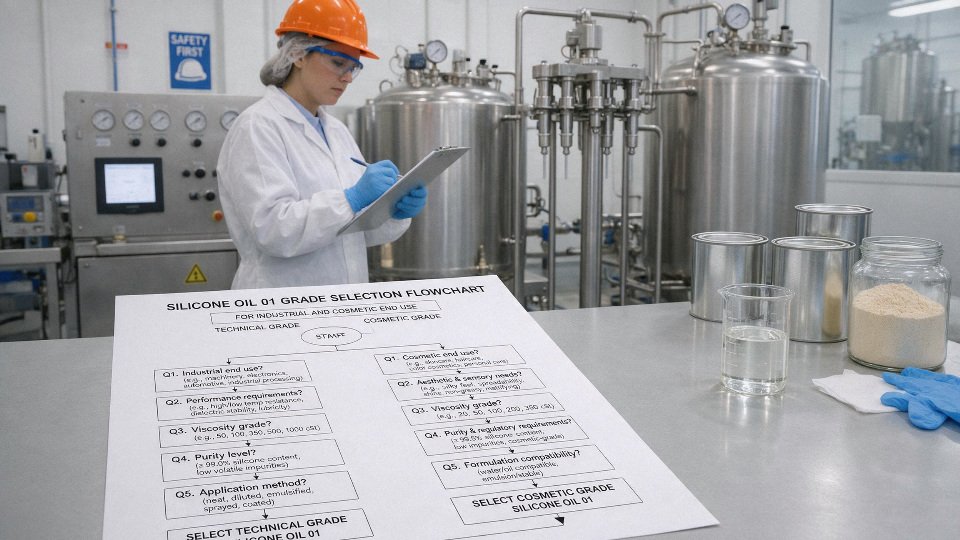
When switching grade or supplier, run a side-by-side pilot. For cosmetic use, check odor, clarity, skin feel, spread, residue, and finished-formula stability. For industrial use, check feed behavior, foaming tendency if relevant, coating or release consistency, seal compatibility, and whether operators start making “small adjustments” to keep the process stable; that last one is often the first sign the replacement is not truly equivalent.
Technical grade and cosmetic grade silicone oils should be purchased by verified end-use fit, not by grade name alone.True
The same base silicone chemistry can exist in multiple commercial grades, but suitability depends on purity control, documentation, sensory profile, and supplier quality practices tied to the actual application.
The safest commercial decision is to align the grade, written specification, and supplier quality system with the real use case rather than buying by label or by the cheapest drum. That holds unless your own customer specification already mandates a narrower route, in which case their document governs and your testing simply confirms fit.
If you are qualifying a new material, send substrate or formulation type, contaminant or function, approximate viscosity target, working or batch size, required finish or sensory outcome, target production rate, and clear product photos or retained samples where relevant, along with your current specification or certificate of analysis. SiliconChemicals can review the application, recommend a suitable silicone oil grade, provide sample lots for evaluation, and prepare the relevant technical and export documents supported for that product.