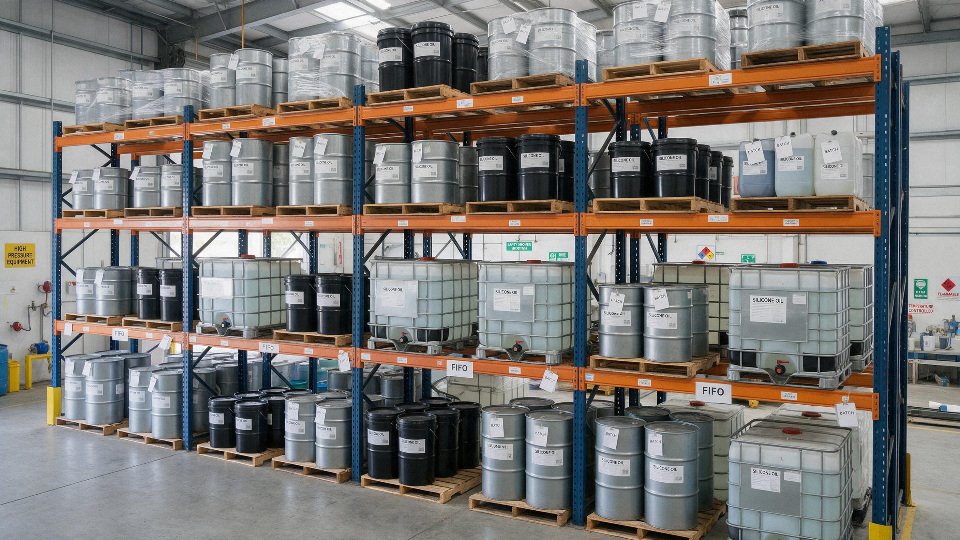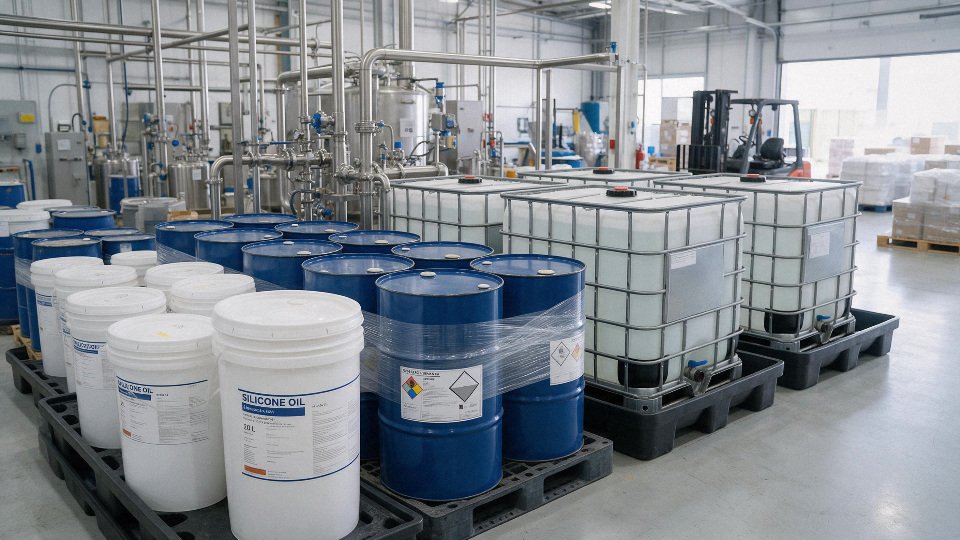

A drum of silicone oil can look fine on receipt and still cause trouble once it hits the line. If viscosity drifts, moisture is too high, volatiles are uncontrolled, or clarity is off, you see it in uneven coating weight, foam behavior, release inconsistency, heat-transfer instability, seal compatibility problems, or a finish that simply will not repeat shift to shift. That turns into rework, scrap, slower machine settings, customer complaints, and the kind of purchasing argument nobody wants after the material is already in the plant.
The main quality parameters that define silicone oil are viscosity, chemical composition, volatility, moisture, purity, refractive index, density, color and appearance, and application-specific functional performance. In practice, viscosity is usually the first screening number, but it is not enough on its own; the right acceptance standard depends on whether the oil is being used for lubrication, defoaming, release, personal care, textiles, or thermal service.
The useful part is that these parameters do not matter equally in every application, and some of them interact in ways buyers often miss. A low-viscosity dimethyl silicone fluid at about 0.65 cSt behaves like a very different product class from a heavy fluid above 1,000,000 cSt, even before you get into moisture limits, volatiles, or functional modification. That is where quality evaluation stops being a catalog exercise and starts becoming process engineering.

Core physical property indicators
A silicone oil’s baseline quality starts with a small set of physical properties that tell you what fluid you actually have, how consistently it was made, and how it will behave in tanks, lines, pumps, and the final application. For most buyers, viscosity, density, refractive index, appearance, low-temperature flow, flash point, and surface behavior are the first-line checks because they can expose grade mix-up, off-spec modification, contamination, or poor batch control before you get into more specialized testing.
These are not interchangeable. A drum can pass viscosity and still be wrong for the job if the refractive index, volatility, or haze says the chemistry shifted. On the plant floor, that is how you end up with a release agent that wets too aggressively, a damping fluid that drifts with temperature, or a defoamer that looks fine on paper but carries too much light fraction.
Kinematic viscosity and viscosity tolerance
Viscosity is usually the first number everyone asks for, and for good reason: it drives pumpability, metering, film build, damping behavior, residence time on a surface, and often the customer’s line settings. Silicone oils cover an unusually broad range, roughly from about 0.65 cSt to well above 1,000,000 cSt at 25 C, so viscosity is also the quickest way to place a product into a functional class.
What matters in procurement is not just the nominal viscosity, but the tolerance and the test condition behind it.
- Ask for the measurement temperature, typically 25 C for many commercial datasheets
- Confirm whether the value is kinematic viscosity in cSt or dynamic viscosity in mPa·s
- Check the allowed batch tolerance, especially if your dosing, atomization, or film thickness window is tight
- Verify whether the supplier is reporting a single-point certificate value or a typical catalog value
Temperature matters because viscosity is highly temperature-dependent. A 100 cSt silicone oil measured at 25 C is not comparable to one reported at 40 C unless you have the viscosity-temperature relationship. In practice, this causes more confusion than it should. I have seen maintenance teams reject acceptable material simply because one COA was built around 25 C and the incumbent supplier’s paperwork used 40 C.
Shear conditions matter less for many standard silicone oils than for strongly structured or filled fluids, because unmodified polydimethylsiloxane fluids are typically close to Newtonian over common test ranges. Still, once you move into very high viscosity grades, modified silicones, or products with trace gel content, apparent handling can change depending on how the sample was warmed, mixed, or drawn. If the lab and the receiving site do not condition the sample the same way, you can get false disputes.
The trade-off is straightforward: higher viscosity usually improves staying power, film persistence, and damping, but it costs you in pumping, dispensing speed, heat transfer, and sometimes low-temperature start-up. At some point the preferred choice flips. A fluid that works well as a release or lubrication film in a warm plant may become a headache in an unheated warehouse in winter if transfer lines are narrow or the tote discharge setup is marginal.
Higher viscosity silicone oil is always higher quality.False
High viscosity often reflects higher molecular weight, not inherently better purity, thermal stability, or application fit. A high-viscosity fluid can still be contaminated, off-ratio, hazy, or wrong for the process window.
Density or specific gravity
Density is often treated as a housekeeping number, but it is useful as a fast composition check. If viscosity tells you roughly how large the polymer chains are, density can help confirm whether the chemistry matches the expected backbone and modification level.
For standard dimethyl silicone oils, density sits in a fairly familiar band, but once phenyl groups or other modifications are introduced, density can shift enough to be diagnostic. That is why incoming inspection teams sometimes catch a grade substitution from density before they catch it anywhere else. If a batch claims to be equivalent to a straight dimethyl fluid but density is consistently high, you should ask whether the formulation includes phenyl content, another modifier, or residual volatile fractions that differ from the approved grade.
Density also helps with:
- Mass-to-volume conversion for dosing and inventory control
- Tank calibration and transfer accounting
- Batch-to-batch consistency checks
- Cross-checking against refractive index and viscosity when confirming identity
Its boundary is simple: density alone cannot prove purity. Two different silicone fluids can overlap enough in density to look acceptable, especially if you are dealing with broad commercial tolerances. It is a confirmation tool, not a stand-alone release criterion.
Refractive index
Refractive index is one of the most underrated identity checks in silicone oil purchasing. For many dimethyl silicone oils, a representative refractive index is about 1.396 to 1.404 at 25 C, and deviations from that expected range can flag chemistry changes, contamination, or the presence of phenyl-containing structures.
This is particularly useful when comparing:
- Straight dimethyl silicone fluids
- Phenyl-modified silicone fluids
- Mixed or custom-modified silicone oils
- Suspect batches showing unexpected clarity or performance changes
Phenyl-containing fluids generally show higher refractive index than standard dimethyl fluids. That is not a purity judgment by itself; it is a compositional signal. In practical buying terms, refractive index gives you a fast, inexpensive way to distinguish “same viscosity, different chemistry” situations that viscosity alone will miss.
Mechanistically, this matters because the molecular groups attached to the siloxane backbone change how light interacts with the fluid. Those same changes often correlate with shifts in thermal behavior, oxidation resistance, low-temperature performance, compatibility, and optical properties. So a refractive index shift is not just a lab curiosity; it may be the earliest sign that your process behavior will also shift.
Appearance: clarity, haze, color, particulates, gel
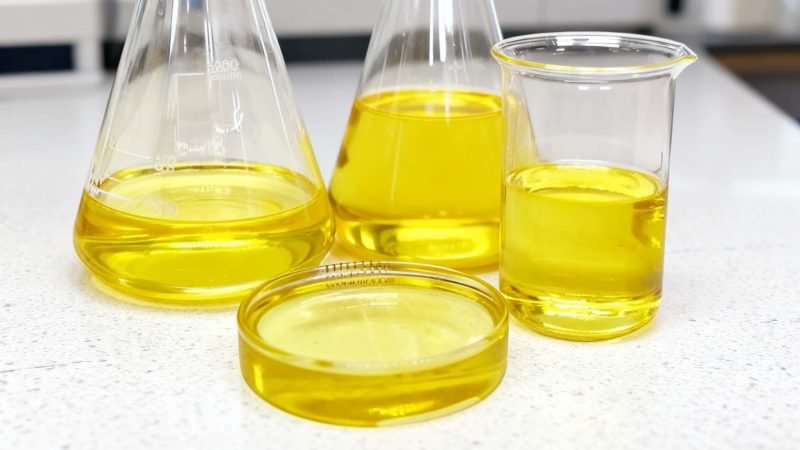
Appearance inspection is basic, but not trivial. A good silicone oil should match the expected visual standard for its grade: usually clear and free of visible suspended matter, though some modified products may have their own normal look.
Check for:
- Clarity: clear versus slightly turbid
- Haze: often an early warning of incompatibility, moisture effects, microgel, or contamination
- Color: water-white to slight tint depending on product type and age
- Visible particulates: dirt, rust fines, packaging debris, or process contamination
- Gel specks or stringiness: possible crosslinking, aging, or manufacturing upset
In plant use, small amounts of haze that seem cosmetic can become expensive. In coating, release, or textile finishing service, haze can signal poor uniformity and lead to streaks or unstable bath behavior. In precision lubrication or damping applications, particulates and gel are a filtration and reliability problem waiting to happen.
Pour point, cloud point, and low-temperature flow
If the fluid has to start, transfer, or meter in cold conditions, low-temperature behavior deserves more attention than it usually gets. Pour point gives a rough indication of the lowest temperature at which the oil will still flow under standardized test conditions. Cloud point, where relevant, can indicate the onset of phase-related visual change or loss of uniformity in some modified systems.
What buyers should verify:
- Minimum storage temperature
- Lowest ambient transfer temperature
- Whether drums, totes, or day tanks are heated
- Whether the fluid must pass through small metering lines, pumps, or spray nozzles at startup
A fluid can be technically pumpable in the lab and still fail operationally if the plant starts at 5 a.m., the tote sat near an outside wall all weekend, and the suction line is undersized. That is where low-temperature flow behavior becomes a maintenance issue, not just a spec sheet line.
Flash point and volatility-related handling properties
Flash point is a handling and risk-screening property, not a direct measure of service life. Higher flash point often points to lower light-end content and can be favorable for some high-temperature uses, but it does not automatically mean the fluid is the right thermal-grade material for continuous hot service.
You should look at flash point and volatility together when the silicone oil is used in:
- High-temperature baths
- Open-surface heating applications
- Textile or paper lines with hot rolls or ovens
- Processes subject to misting or evaporation losses
- Transport or storage situations where classification and handling matter
The mechanism is practical: more volatile fractions increase evaporative loss, odor, mist potential, and property drift during heat exposure. In service, that can thicken the remaining fluid, alter film behavior, and create housekeeping issues around vents and enclosures. The preferred grade changes once operating temperature and dwell time rise enough that evaporation is no longer a minor cost but a performance driver. Actual suitability still has to be checked against supplier data and, for critical duty, against a use test.
Surface tension and spreading behavior
Where wetting, release, defoaming, or lubrication performance matters, surface behavior can be as important as viscosity. Silicone oils generally have low surface tension relative to many hydrocarbon fluids, which is why they spread so readily and can alter interfacial behavior at very low addition rates.
That helps in some jobs and hurts in others.
- For release and slip, better spreading can improve coverage and reduce usage rate
- For defoaming, the right interfacial behavior helps destabilize foam films
- For lubrication, spreading can improve initial coverage on fine mechanisms or molds
- For coating systems, too much spreading can cause craters, fisheyes, or contamination of downstream paintable surfaces
The trade-off is that a fluid selected only for low surface tension may over-wet the substrate, migrate where you do not want it, or become difficult to clean before bonding or painting. That is where bench testing matters. Surface effects depend heavily on substrate material, contaminant load, line speed, and whether the oil is neat, diluted, or compounded into a formulation.
Purity and composition controls
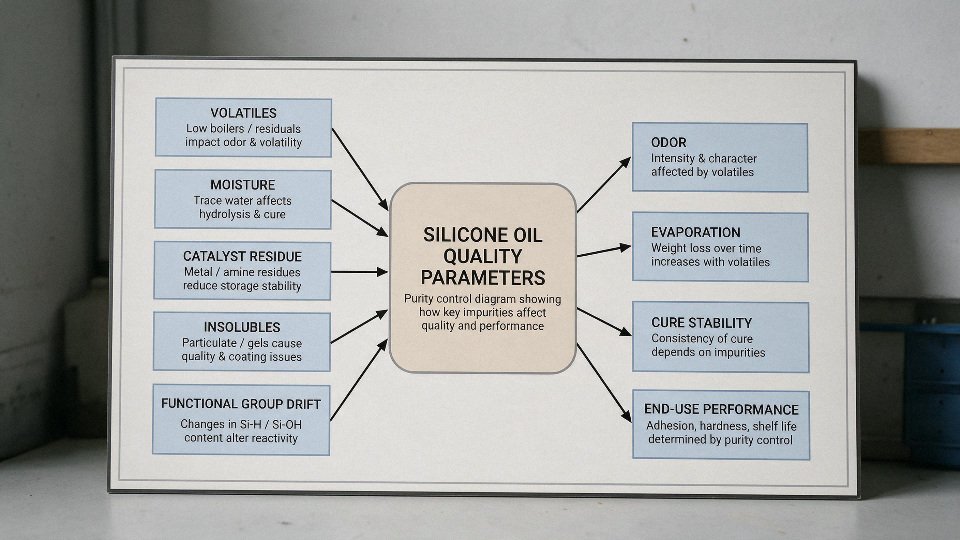
A silicone oil can hit the right viscosity and still be the wrong product. What separates a stable, low-risk fluid from one that smells, evaporates, destabilizes a formulation, or causes field complaints is usually not the headline physical property but the contamination profile, residual chemistry, and how tightly the composition is controlled lot to lot.
In plant terms, this is where manufacturing discipline shows up. A well-run line controls stripping, catalyst neutralization, washing, filtration, drying, and package cleanliness; a weak line may still produce a fluid that looks clear in a drum but behaves badly in storage, coating, electrical service, cosmetics-adjacent uses, or modified silicone reactions. For many sensitive applications, trace chemistry matters more than bulk viscosity.
Volatile content and low molecular weight siloxanes
Low-boiling fractions are one of the first things experienced buyers ask about, especially for heat-transfer, release, personal-contact-adjacent industrial uses, defoamers, and any application where odor or mass loss creates trouble. In silicone oils, these volatiles are often low molecular weight cyclics or short-chain linear siloxanes left from incomplete stripping or a process tuned too hard for yield.
What they affect:
- Odor
- Even when the base oil is nominally acceptable, residual low molecular weight material can create a sharper smell, especially when the fluid is heated or atomized.
- Evaporation loss
- Shorter chains leave first. That shifts viscosity over time, changes lubricity, and can increase deposits in enclosed systems.
- Fogging and migration
- In sealed electrical or automotive-adjacent assemblies, volatile fractions can condense on colder surfaces.
- Regulatory exposure
- Some cyclic siloxanes attract closer scrutiny in certain markets or end uses. The exact compliance relevance depends on destination country, end-use category, and current regulations, so it must be checked against current customer specifications and legal requirements rather than assumed from general industry practice.
The mechanism is straightforward: lower molecular weight species have higher vapor pressure, so they partition out of the bulk fluid faster during heating, vacuum service, thin-film exposure, or long storage with headspace cycling. If you are selecting oil only by nominal viscosity, you can miss this completely. Two 100 cSt fluids may behave very differently in a warm reservoir if one has been properly stripped and the other has not.
The trade-off is commercial as much as technical. Deeper stripping usually improves odor, volatility, and consistency, but it adds process time, energy, and sometimes yield loss. That cost is justified in sensitive applications; it may not be in a rough-use mold release where some volatility is tolerable. The conclusion stops holding when the application is fully open, frequently replenished, and insensitive to odor or mass loss; in that case, ultra-low volatile content may not return its premium.
Moisture content and hydrolyzable residues
For industrial grades, moisture is often controlled somewhere below roughly 100 to 500 ppm, but the acceptable level depends heavily on use. A textile softener intermediate, dielectric fluid, and reactive silicone additive do not tolerate water the same way.
Moisture and hydrolyzable residues matter because they can affect:
- Dielectric strength
- Water increases conductivity and can reduce electrical insulation performance.
- Storage stability
- In the presence of reactive end groups, catalyst residues, or hydrolyzable species, water drives side reactions.
- Appearance
- Haze, slight clouding, or interfacial instability can show up after drums see a few temperature cycles.
- Reactive formulations
- In hydroxyl-, alkoxy-, hydride-, epoxy-, or amino-functional systems, trace moisture can consume reactive sites or change cure behavior.
Hydrolyzable residues are often overlooked. A drum can test low in free water but still carry chemically unstable traces from upstream processing, neutralization, or incomplete finishing. Those residues may slowly generate acids or alcohols during storage, especially in warm warehouses or after repeated drum opening. In practice, this is why some buyers see “same viscosity, same appearance” but get very different shelf-life or cure response.
What to check with suppliers:
- Moisture test method and reporting basis
- Whether the material is standard industrial dry or specially dried
- Package type and headspace control
- Whether the product contains hydrolyzable functionality by design
- Storage recommendation after opening
Residual acidity, alkalinity, and catalyst traces
A neutral-looking silicone oil can still carry residual acid, base, or catalyst traces from polymerization and finishing. These are small numbers on paper, but they have outsized effects in compounding and high-temperature service.
Common risks include:
- Accelerated degradation
- Residual acidic or alkaline species can promote chain scission or rearrangement at elevated temperature.
- Corrosion or metal interaction
- Usually a secondary concern in pure silicone service, but it can matter in mixed-metal systems or sensitive instruments.
- Interference with downstream chemistry
- Residual catalyst traces can poison, accelerate, or skew later reactions in emulsification, modification, or formulation work.
- Color drift and odor development
- Side reactions often show up first as yellowing or a harsher smell after heat exposure.
This is one of those areas where a purchasing team should resist the temptation to accept “within spec” without asking which spec. Acid value, alkali content, or catalyst residue limits should be tied to the actual use case. A broad industrial lubricant may tolerate traces that would be unacceptable in a release coating additive or a reactive intermediate.
Average viscosity alone is not a reliable proxy for chemical neutrality or downstream formulation behavior.True
Viscosity mainly reflects bulk molecular size and flow behavior. Residual acids, bases, catalysts, and low-level contaminants can materially affect stability, cure response, odor, or electrical performance without changing viscosity enough to reveal the problem.
Insoluble matter, gel particles, ash, and inorganic residues
If you have ever seen a silicone line plug strainers for no obvious reason, this is usually where the story starts. Insolubles and gels are not just cosmetic defects; they are process cleanliness signals.
Key indicators include:
- Insoluble matter
- Suggests poor filtration, contamination during transfer, or unstable material forming particulates.
- Gel particles
- Often point to localized overreaction, crosslinking, or aged residue in process equipment.
- Ash
- Indicates inorganic contamination remaining after burning off organics; can reflect catalyst carryover, poor washing, or dirty handling.
- Filterability
- Not always listed as a formal parameter, but very relevant in metering, spraying, thin coating, and precision dosing.
Why it matters on the floor:
- Fine nozzles and metering pumps are less forgiving than a tote transfer line.
- Coating defects often come from a tiny number of particles, not from the bulk fluid.
- A “clear” drum can still contain enough subvisible contamination to create fish-eyes, streaks, or seal defects.
There is a trade-off here too. Ultra-fine filtration improves cleanliness, but if the process upstream is unstable, filtration only masks the symptom and may not hold through storage. Buyers should ask whether the supplier controls the source of gels or simply polishes the final product.
Residual monomers, solvents, and process aids
Residual non-silicone carryover is a classic hidden variable in purchased oils. Depending on manufacturing route, the fluid may contain traces of solvent, washing aid, antifoam additive, or unreacted intermediates.
Potential effects:
- Flash point shift
- Solvent traces can lower flash point materially in some systems.
- Migration
- Small molecules move faster into adjacent polymers, labels, elastomers, or coated surfaces.
- Compatibility drift
- A little residual solvent can temporarily improve clarity or blend behavior, then disappear in service and change the formulation.
- Odor and worker acceptance
- Operators usually notice this before the lab does.
This is especially important in closed plants with heated day tanks. A slight solvent carryover may look harmless on incoming inspection but create vapor complaints at the point of use. If flash point or VOC-related behavior matters, verify against current supplier test methods and your own incoming checks rather than assuming all silicone oils of the same grade behave alike.
Functional group content in modified silicone oils
For modified silicone oils, composition control shifts from “is it clean?” to “is the chemistry exactly where it should be?” Functional value is often more important than nominal viscosity.
Typical parameters include:
- Amino value
- Drives substantivity, softness, and interaction with surfaces; too high can increase yellowing, instability, or incompatibility.
- Epoxy content
- Affects reactivity, adhesion promotion, and cure participation.
- Hydroxyl content
- Critical for condensation or urethane-related formulations.
- Hydrogen content
- Governs crosslinking potential in Si-H systems and must be handled carefully for safety and process control.
- Polyether ratio or modification level
- Strongly affects water dispersibility, foam behavior, slip, and compatibility.
The mechanism here is direct: the functional group level determines how many reactive or surface-active sites are present per unit mass. If that drifts, the same addition level in a customer formulation produces different results. That is why a modified fluid can pass viscosity and appearance checks yet fail badly in softener, leveling, release, or reactive additive service.
Molecular weight distribution and chain-end structure
A narrow point that matters a lot: average viscosity does not describe the whole polymer population. Two fluids can share the same kinematic viscosity and refractive index yet differ in molecular weight distribution and terminal groups, which changes consistency in use.
What this influences:
- Shear and film behavior
- Migration and surface slip
- Volatility tail
- Emulsion make-up behavior
- Response in blending with resins, oils, or solvents
- Lot-to-lot consistency in customer formulations
Broad distributions often give wider performance scatter. Chain-end structure matters because silanol-terminated and fully end-capped materials do not age, react, or interact the same way. In reactive or high-purity applications, this difference can outweigh modest shifts in average viscosity.
Trace contaminants can decide pass or fail
The uncomfortable truth for buyers is that a technically acceptable silicone fluid on a generic data sheet can still fail a sensitive application because the failure driver sits below the usual headline properties. A few hundred ppm of water, a trace of residual base, a low level of cyclics, or a handful of gel particles can decide whether the fluid works cleanly or becomes a complaint.
That is why supplier qualification should include more than COA matching on viscosity. For any application sensitive to odor, heat loss, electrical properties, reactive cure, thin-film appearance, or long storage, ask for the contamination and composition controls behind the product, not just the product name.
Thermal and chemical stability
A silicone oil can look fine on a COA and still fail early if its thermal stability, oxidation resistance, volatility, and chemical compatibility do not match the actual duty cycle. For buyers, the practical question is not whether silicone oil is “heat resistant” in general, but whether a given grade will hold viscosity, stay clean, and avoid electrical or chemical breakdown for the residence time, atmosphere, and materials present in the system.
Heat, oxygen, metal surfaces, trace acids or alkalis, and even a careless top-up from the wrong drum all push degradation through different paths. Some are slow and predictable; some are abrupt. That is why stability has to be judged as a set of linked parameters, not one headline temperature number.
Thermal stability under continuous and peak temperature conditions
A useful thermal stability assessment looks at what changes after heating, not just the nominal service temperature on a datasheet. In practice, the most decision-relevant indicators are mass loss, viscosity drift, appearance change, odor development, and any increase in insolubles or gel after a defined time-temperature exposure.
For plant use, separate the duty into two conditions:
- Continuous exposure
- The oil sees a steady bulk temperature for days, weeks, or months.
- Failure usually shows up as gradual viscosity change, evaporation loss, oxidation products, or deposits on hot surfaces.
- Peak or excursion exposure
- The oil sees short temperature spikes during startup, heater overshoot, local hot spots, or poor circulation.
- Failure can be disproportionate because thin films at a hot wall degrade much faster than the bulk fluid in the tank.
That distinction matters. A fluid may tolerate a short bulk exposure at one temperature, yet still coke or volatilize badly where it sits as a thin film on a heat-transfer coil, pump seal face, or the upper shell of a lightly agitated vessel.
Mechanism matters here. As temperature rises, three things usually accelerate together:
- low-molecular fractions evaporate faster,
- oxidation reaction rates increase,
- chain rearrangement or scission becomes more likely, depending on fluid chemistry and contamination.
The result is not always a simple viscosity drop. In some systems, lighter fractions boil off first and the remaining fluid gets thicker. In others, chain breakdown dominates and viscosity falls. In oxidizing conditions, you may also see gel particles or skin formation even while the bulk viscosity change still looks moderate.
For procurement and qualification, ask for post-heating data under stated conditions, such as:
- percent mass loss after defined temperature/time exposure
- viscosity before and after heating
- color change
- insoluble residue or gel content
- odor or volatile by-product observations, if relevant to enclosed equipment
If the supplier cannot state the test condition, the number is hard to use. A 24-hour oven loss and a 168-hour circulating-air stability result are not interchangeable.
Oxidation resistance: where many “heat failures” actually start
In closed or inerted systems, silicone oils often last much longer than they do in open, aerated, metal-contact service. Oxygen availability, metal catalysis, and time at temperature usually govern oxidation more strongly than the nominal fluid family name alone.
The main accelerants are:
- Oxygen exposure
- Open baths, vented reservoirs, splash zones, and thin films degrade faster than sealed systems.
- Catalytic metal contact
- Copper, iron rust, and some metal salts can sharply accelerate oxidative breakdown.
- Freshly exposed metal from abrasion is often worse than a stable, passivated surface.
- Residence time
- A slow-turnover loop keeps the same fluid at temperature longer, so oxidative products accumulate.
- Contamination
- Process carryover, cleaning-agent residues, acids, alkalis, and moisture can all shift degradation behavior.
A common plant-floor mistake is blaming the oil when the real problem is system metallurgy or poor housekeeping. I have seen otherwise stable fluids darken quickly in equipment with rust fines, brazing residue, or copper-rich components at hot spots. The oil did not suddenly become “low quality”; the system became catalytic.
The trade-off is straightforward: a more oxidation-resistant grade may cost more upfront, but in long-life hot service it can reduce fluid change frequency, deposit cleaning, and heater fouling. That said, the preferred choice flips if the system is cool, closed, and frequently replaced anyway. In that case, paying for a premium stability package may not return anything.
Volatility and evaporation loss at elevated temperature
Low volatility is one of the clearest predictors of service life in hot, open systems. If a silicone oil loses too much of its lighter fractions, you get three problems at once:
- fluid level drops
- viscosity shifts
- vapors and condensed residues can foul nearby surfaces
This is especially relevant in textile finishing lines, release-coating stations, vacuum systems, open baths, and any process with heated air movement. A fluid that evaporates modestly in a sealed lab cup may disappear much faster in a plant with airflow, large wetted area, and repeated thermal cycling.
Volatility should be judged against:
- operating temperature
- exposed surface area
- air exchange rate
- residence time
- acceptable replenishment frequency
- sensitivity of the process to deposits or vapors
A high-viscosity fluid is not automatically low-volatility enough for every hot application, because formulation details and molecular weight distribution matter. Conversely, pushing viscosity up to suppress evaporation can hurt pumpability, heat transfer, or metering accuracy at startup temperatures.
For long hot service, evaporation loss is not just a consumption issue; it is often the first step toward deposit formation and process drift.
Electrical stability for insulation and electronic uses
For electrical and electronic applications, thermal resistance alone is not enough. The fluid also needs dielectric properties that remain reliable in service, especially under heat and moisture exposure.
The key parameters are:
| Parameter | What it indicates | Why it matters in service |
|---|---|---|
| Dielectric strength | Voltage the fluid can withstand before breakdown | Critical for insulation gaps, transformers, and filled assemblies |
| Volume resistivity | Resistance to electrical conduction through the fluid | Drops with ionic contamination, moisture, or degradation products |
| Dissipation factor | Dielectric losses under alternating electric field | Higher values mean more energy loss and often more heating |
These values are highly sensitive to contamination. A clean silicone oil can perform well electrically, then fail qualification after careless drum handling, moisture pickup, or cross-mixing with another fluid. Dust, ionic residues, and absorbed water can reduce electrical performance far faster than most non-electrical buyers expect.
A silicone oil with good thermal stability will automatically be suitable for electrical insulation.False
Electrical suitability depends on dielectric strength, volume resistivity, dissipation factor, cleanliness, and moisture control, not heat resistance alone. A thermally robust fluid can still fail electrically if contamination or water pickup is present.
If the application is insulation-critical, verify current test methods and limits against the equipment standard and the supplier’s current technical data. These are not values to generalize casually across all silicone oils.
Hydrolytic stability in humid or water-contact service
Unmodified dimethyl silicone oils are generally regarded as fairly resistant to water compared with many organic fluids, but that does not mean every silicone-based fluid behaves the same in humidity, washdown, or water-contact systems. Modified, reactive, or specialty-functional grades can be much more sensitive.
Watch hydrolytic stability closely when the fluid sees:
- high humidity with repeated heating and cooling
- direct water contact
- steam or condensate exposure
- alkaline or acidic cleaning cycles
- storage in partially filled containers with headspace moisture
The failure path is often indirect. Water itself may not visibly ruin the fluid at first, but moisture can support hydrolysis of reactive groups, shift acidity, reduce electrical properties, or combine with contaminants to create haze, phase instability, or corrosion-related problems elsewhere in the system.
Typical industrial moisture control is often below roughly 100 to 500 ppm depending on application, but the acceptable limit depends strongly on end use. Electrical filling, reactive processing, and some precision coating operations usually need tighter control than general mechanical lubrication or defoaming use.
The main conclusion stops holding once you move away from standard dimethyl-type fluids into modified chemistries. At that point, hydrolytic behavior has to be checked grade by grade.
Compatibility with materials and process chemistry
Compatibility failures are often slower and more expensive than obvious thermal failures. The oil may keep its nominal viscosity while quietly swelling seals, softening a plastic sight glass, fisheyeing a coating line, or reacting with a process additive.
Check compatibility against these categories:
- Elastomers
- Swelling, shrinkage, hardness change, seal leakage
- Plastics
- Stress cracking, softening, haze, dimensional change
- Coatings and adhesives
- Surface defects, poor wetting control, adhesion loss
- Process chemicals
- Phase separation, reaction, emulsion instability, contamination of downstream chemistry
- Metal surfaces
- Corrosion interaction is usually indirect, through contaminants or additives rather than the silicone backbone itself
In practice, seals and hoses get missed most often. A system may run fine in a short pilot trial, then leak after a few months because an elastomer slowly takes up the fluid and loses mechanical integrity. NBR, FKM, EPDM, PTFE-lined parts, and mixed elastomer kits do not respond the same way, so confirmation by material-specific testing is worth the trouble.
Deposit, sludge, or gel formation over long service intervals
Some fluids fail cleanly by evaporating or drifting in viscosity. Others leave varnish, sludge, or gel that creates the expensive part of the job: teardown and cleaning. Deposits usually form from oxidation products, contamination reactions, localized overheating, or incompatibility between mixed grades.
Watch for these warning signs:
- darkening near heaters or hot-wall zones
- tacky residue on vents or covers
- rising filter differential pressure
- sticky pump behavior after shutdown
- haze, suspended particles, or stringy gel in samples
- unexplained decline in heat-transfer efficiency
The missed angle here is worth stating plainly: a fluid with strong intrinsic heat resistance can still fail early because the package was contaminated, the wrong top-up grade was mixed in, or catalytic metal residues were left in the system after fabrication or maintenance. I have seen all three. One dirty transfer tote or one maintenance flush that was not fully drained can undo the benefit of buying a better oil grade.
So if a silicone oil degrades unexpectedly, do not stop at the fluid nameplate. Check the drum condition, transfer practice, moisture exposure, system metallurgy, and whether any mixed inventory or residual cleaning chemistry got into the loop. That is often where the answer sits.
Application-specific performance metrics
The right performance metrics depend on where the oil fails first in service, not on how impressive the certificate looks. A silicone oil that tests “clean” and “stable” in the lab can still be the wrong buy if the application actually lives or dies on foam-entry speed, seal swell, transfer residue, or oxidation deposits.
That is where a lot of purchasing mistakes start. Teams copy a generic COA checklist from a prior grade, lock in viscosity, moisture, and refractive index, then miss the one parameter that controls uptime in their line. For silicone oil, the useful test package is set by failure consequence and operating window: temperature range, contact materials, contamination sensitivity, residence time, and how the oil is applied or replenished.
Lubrication and damping uses
For lubrication, damping, dashpots, instrument fluids, and slow-speed mechanisms, viscosity alone is not enough. What matters is whether the oil holds the required resistance or film behavior across the actual temperature band, under the actual shear level, and in contact with the actual elastomers and plastics in the assembly.
Key metrics to ask for or verify:
- Viscosity stability across temperature
- A single viscosity at 25 C is only the starting point.
- Buyers usually need the viscosity-temperature behavior, often as viscosity at multiple temperatures or viscosity index-style behavior where relevant.
- In a damper, drift at hot or cold ends shows up as inconsistent motion, changed closing force, or instrument lag.
- Shear behavior
- Many silicone oils are effectively Newtonian in ordinary use, but not every formulated system behaves identically once additives, fillers, or emulsified forms enter the picture.
- If the oil sees tight clearances, recirculation, or repeated mechanical working, check whether apparent viscosity changes after shear exposure.
- Lubricity under boundary conditions
- Silicone oils often have excellent temperature range and oxidation resistance, but they are not automatically the best boundary lubricants versus hydrocarbon or ester systems in every metal-on-metal contact.
- If the mechanism runs with thin films, intermittent load, or start-stop contact, bench friction or wear testing against the actual material pair matters more than a generic statement like “good lubricity.”
- Low-temperature mobility
- This becomes critical in outdoor actuators, cold-room conveyors, meter mechanisms, and pneumatic accessories stored in winter conditions.
- Pour point can help, but startup torque or flow behavior at the actual minimum temperature is usually more decision-useful.
- Seal and plastic compatibility
- Check volume swell, hardening, extraction, and stress cracking against the actual seal family: silicone rubber, EPDM, NBR, FKM, PTFE-backed seals, polycarbonate windows, acetal gears.
- Compatibility can flip the preferred grade even when viscosity and purity look perfect.
- Evaporation loss
- In lightly loaded bearings, dampers with venting, and open lubricating points, volatility drives viscosity drift, residue, and refill frequency.
- Weight loss at elevated temperature is a useful screen, but the meaningful number depends on dwell time, exposed surface area, and air exchange.
The mechanism is straightforward: higher volatility strips out the lower-molecular-weight fraction first, which raises remaining viscosity, changes damping force, and can leave deposits on adjacent parts. On a plant floor, that becomes sticky motion, inconsistent cycle time, or a customer complaint that only shows up after six months in a hot enclosure.
The trade-off is familiar. Lower-viscosity grades improve cold mobility and wetting, but they usually sacrifice evaporation resistance and sometimes long-term damping stability. Higher-viscosity grades hold film and damping better, yet they can raise startup drag and become hard to meter cleanly. That balance changes once the system is sealed and the temperature band narrows; then volatility matters less and viscosity targeting becomes easier.
Release and mold applications
For release agents and mold-contact oils, spreading and transfer behavior usually matter more than headline viscosity. The practical question is whether the oil lays down a uniform, controllable film that releases the part cleanly without building residue on the mold, contaminating downstream painting, or drifting out of spec as the tool runs hotter.
Check these points:
- Spreading and wetting on the substrate or mold surface
- Stainless, plated steel, aluminum, rubber tooling, and composite molds do not all behave the same.
- Surface energy mismatch shows up as patchy coverage, fish-eyes, or local sticking.
- Transfer consistency
- Some applications want a persistent transfer film on the part; others want almost none.
- The wrong grade either under-releases and sticks, or over-transfers and causes downstream adhesion failures.
- Residue control
- Pay attention to nonvolatile residue, decomposition tendency, and any additive package.
- A clean mold-release program is not just about release force; it is also about how often the tool has to be stripped and cleaned.
- Thermal endurance on the mold
- Die and mold temperatures can push the oil into an oxidation or volatilization regime that was invisible in a room-temperature evaluation.
- Repeated thermal cycling often matters more than one high-temperature exposure.
- Surface defect risk
- If the molded part will be painted, printed, bonded, or metallized, test for crater formation, adhesion loss, and surface contamination after release.
A common buying error is selecting a release oil because it looks “safer” on purity metrics, while ignoring transfer consistency. If downstream coating is the cost driver, transfer residue should be screened with actual parts and the next process step, not assumed from viscosity grade alone.
Defoaming uses
In defoaming, the important metrics are dynamic. The oil must enter the foam lamella, destabilize it quickly, stay active long enough to control recurrence, and remain compatible enough with the liquid system to disperse without simply dissolving away.
Use these metrics:
- Entry time
- How fast the defoamer penetrates the foam film.
- Slow entry often means the product looks acceptable in a beaker but fails in a fast-moving tank or recirculating washer.
- Knockdown speed
- Immediate foam collapse after addition or dosing.
- This matters in overflow-limited systems, fillers, fermenters, and CIP tanks where a delay of seconds can already mean a mess.
- Persistence
- How long foam control lasts after the initial knockdown.
- Some grades hit hard and disappear; others are slower but more durable.
- Dispersion behavior
- Overly coarse dispersion can cause surface defects or oil spots.
- Over-compatibility can be just as bad, because the defoamer disperses so completely that it loses its ability to act at the foam interface.
- Compatibility with the foaming medium
- Water-based coatings, alkaline cleaners, sugar solutions, latex systems, fermentation broths, and solvent systems all behave differently.
- pH, surfactant package, temperature, and shear history all change defoamer performance.
The trade-off here is one buyers often miss: a defoamer that is highly persistent can also raise defect risk in coatings or printing systems because residual silicone stays active where you do not want it. In a wastewater equalization tank, that may be acceptable. In a high-gloss coating line, it is not.
Textile, personal care, and coating modification uses
For feel-modification uses, end-user perception and line behavior are tied together. Softness, slip, gloss, and hand feel are the obvious targets, but migration and emulsifiability usually decide whether the finish stays where you put it and whether it can be processed consistently.
Relevant metrics include:
- Softness and slip
- Usually judged by application testing, not a single universal instrument value.
- Fiber type, fabric construction, add-on level, and cure conditions all matter.
- Gloss and surface appearance
- In coatings or polishes, small compositional changes can alter leveling and reflected appearance.
- The same oil can improve slip but lower recoatability.
- Emulsifiability
- Critical if the silicone oil is supplied or used as an emulsion.
- Poor emulsion stability creates creaming, variable pickup, and blocked nozzles.
- Migration behavior
- Low-molecular-weight fractions or poorly anchored systems can migrate to the surface, transfer to adjacent materials, or interfere with adhesion and printing.
- This is especially relevant in textiles, personal care, and multilayer coating systems.
- Feel profile
- Dry, silky, greasy, cushioned, powdery, slick: these are commercial descriptors, but they correspond to film formation, volatility, and surface mobility.
- In practice, panel testing and side-by-side line trials are still the fastest way to avoid specification by adjectives.
The main boundary here is that lab physical properties stop being strongly predictive once formulation complexity takes over. In emulsions, blends, or amino-/polyether-modified systems, application trials are often more valuable than another decimal place on refractive index.
Electrical insulation uses
For dielectric service, the useful parameter set tightens fast. Dielectric strength, dissipation behavior, moisture sensitivity, gas evolution under stress, oxidation life, and cleanliness are the properties that affect failure risk.
Screen for:
- Dielectric strength and dielectric loss metrics
- Moisture sensitivity and water uptake control
- Gas evolution under electrical and thermal stress
- Oxidation life at operating temperature
- Particle and ionic cleanliness
Cleanliness is easy to underestimate. Fine particles, metal fines from packaging hardware, or ionic contamination can undercut electrical reliability long before bulk viscosity changes. If the equipment is sealed and high-value, packaging cleanliness and fill handling deserve the same attention as the fluid certificate.
For safety-critical electrical equipment, generic category assumptions are not enough. Current supplier data, equipment manuals, and application-specific qualification testing should govern acceptance.
A standard industrial silicone oil certificate is sufficient to qualify a fluid for all electrical insulation uses.False
Electrical service can require application-specific verification for dielectric performance, moisture control, cleanliness, oxidation stability, and compatibility with the equipment design.
Heat transfer and bath fluid uses
For heat-transfer duty, buyers often ask first about thermal conductivity. That is understandable, but it is rarely the sole decision maker. In many systems, oxidation stability, viscosity over the circulating temperature range, and fouling tendency have more impact on service life and heat-transfer consistency than a small difference in thermal conductivity.
Look at:
- Usable viscosity across startup and operating temperatures
- Oxidation stability in the presence of air
- Volatility at top operating temperature
- Heat capacity context
- Relevant, but should be judged with density, flow regime, and system design rather than as a standalone number.
- Fouling and deposit tendency
- Oxidation byproducts and thermally stressed residues can coat heaters, foul exchangers, and distort temperature control.
A cleaner-running fluid with slightly ordinary thermal conductivity often outperforms a fluid that transfers heat well on paper but oxidizes into deposits around the heater bundle.
Medical, food-contact, or high-purity process uses
In high-purity service, odor, extractables, cleanliness, and packaging discipline become operational metrics, not just quality-audit topics. A technically adequate oil can still be rejected if it carries trace odor into product, arrives in packaging that sheds particles, or lacks the specific supporting documentation the customer or regulator requires.
Review at minimum:
- Odor profile
- Extractables and leachables risk, where relevant
- Bioburden risk and handling controls
- Regulatory support documentation specific to the target market and use
- Packaging cleanliness and tamper integrity
This is one area where over-generalization causes expensive delays. “Food-grade” or “medical use” language means little without the exact regulatory basis, use conditions, and supporting documentation for the destination market.
The selection logic across all these applications is the same: start with the failure mode, then choose the smallest test set that actually predicts it. If you are buying silicone oil for a coating line, a transformer, a textile finish, and a mold-release station, one generic incoming checklist will either over-test three of them or miss the one parameter that matters on the fourth.
Test methods and acceptance limits
A workable acceptance system for silicone oil uses the right test for the right risk, then sets limits wide enough to reflect normal manufacturing variation but tight enough to protect the process. Most purchasing problems here are not caused by bad chemistry; they come from mixing up identification data, routine release data, and end-use validation data, then writing all three into one impossible specification.
For routine industrial grades, the usual control set covers viscosity, density, refractive index, moisture, volatile content, flash point, and acid value, with instrumental methods added when the application is sensitive to low boilers, contamination, residue, or trace chemistry. The exact limits should follow the grade and the failure mode you are trying to prevent, not a generic idea of “higher quality.”
Common test methods and what they actually tell you
The method name matters because two labs can test the same drum and get different numbers if they use different equipment, temperatures, or sample handling.
| Parameter | Common method type | What it indicates | What often skews the result |
|---|---|---|---|
| Kinematic viscosity | Capillary viscometer or calibrated rotational method at controlled temperature | Molecular weight range and handling behavior | Temperature drift, air bubbles, poor equilibration |
| Density / specific gravity | Digital density meter or pycnometer at fixed temperature | Product identity and composition consistency | Temperature error, entrained air |
| Refractive index | Abbe or digital refractometer at 25 C | Identity check, rough composition confirmation | Dirty prism, wrong temperature, residual solvent |
| Moisture | Karl Fischer titration | Water contamination risk | Wet sampling tools, ambient humidity pickup |
| Volatile content | Oven loss, vacuum loss, or TGA depending on specification | Low-boiler content and evaporation tendency | Time/temperature mismatch, pan loading |
| Flash point | Standard closed-cup method | Handling and storage safety indicator | Wrong method, contaminated sample |
| Acid value | Titration | Residual acidic species or degradation | Solvent system differences, endpoint interpretation |
For dimethyl silicone oils, refractive index is often a useful identity cross-check, with representative values around 1.396 to 1.404 at 25 C depending on grade and composition. It is not a substitute for compositional analysis, but it is a fast way to catch a wrong fill, off-grade blend, or contamination event before you pump the material into a day tank.
Viscosity deserves more discipline than it usually gets. Silicone oils span roughly 0.65 cSt to well above 1,000,000 cSt at 25 C, so the test setup must fit the grade. A low-viscosity fluid tested in a dirty viscometer tube can read high; a very high-viscosity grade tested before full temperature conditioning can read all over the place. In practice, if the lab pulls a cold drum sample in winter and runs it too soon, that number is not worth much.
Instrumental methods used when routine release data is not enough
Routine release testing does not always show why a lot behaves differently in service. That is where instrumental methods earn their keep.
Gas chromatography
GC is the usual choice when you need to profile low-boiling fractions, residual cyclics, solvent carryover, or unusual volatile contamination. It is especially useful for low-viscosity fluids and applications where evaporation, odor, foam behavior, or emissions matter. The trade-off is that method setup matters a lot: column choice, calibration standard, and sample dilution can all change the reported distribution.
Infrared spectroscopy
IR is fast for identity confirmation and for spotting obvious chemistry mismatches, such as the wrong silicone backbone, residual organic contamination, or certain functional groups in modified fluids. It is a screening tool more than a release test for most buyers. Good for “is this what we ordered?” Not enough, by itself, for “will this lot run my process without trouble?”
Karl Fischer titration
Karl Fischer is still the practical standard for moisture, especially when the process is moisture-sensitive. Industrial grades are often controlled somewhere below 100 to 500 ppm depending on use. The boundary is simple: if the downstream process can tolerate that water without haze, side reaction, corrosion, or electrical-performance drift, a looser limit is fine. If not, writing a generic low-ppm target just drives cost and arguments without improving the line.
Thermogravimetric analysis
TGA helps separate volatile loss behavior over temperature, which is more informative than a single oven-loss number when thermal exposure is part of the application. It is useful for comparing lots, but acceptance limits need care because heating rate, atmosphere, and sample mass affect the curve.
Particle evaluation
Where optical clarity, coating uniformity, precision dispensing, or fine metering hardware are involved, particle checks matter. This can range from a simple visual clarity check to microscopic analysis or instrument-based particle counting. The main failure path is straightforward: particles that do not matter in a bulk release agent can plug a fine needle, scratch a surface, or create defect points in a thin film.
Sample preparation errors cause more disputes than most buyers expect
A surprising share of “out-of-spec” findings are sampling problems.
- Condition the sample to the specified test temperature before measuring viscosity, density, or refractive index.
- Use dry, clean, silicone-compatible containers with tight caps.
- Avoid transferring with wet funnels, wash bottles, or reused syringes.
- Mix the source container enough to normalize the sample, but do not whip in air.
- Record the drum, tote, or tank location sampled; top-layer and bottom-layer grabs can differ if contamination occurred in storage.
- For moisture and volatile testing, minimize open exposure time. A bench-top beaker left open while the operator answers the phone is enough to spoil the result.
One unclean sampling bottle can invalidate moisture, acid value, and volatile-content results at the same time.True
Residual water, solvent, detergent, or prior product can shift several test results in different directions, making the lab report look like a chemistry problem when it is actually a sampling-control problem.
How to write acceptance limits without creating a procurement trap
Not all numbers on a datasheet belong in a purchase specification.
- Certificate value: the measured result for that batch or lot.
- Typical value: a representative value, often useful for design or comparison, but not always guaranteed.
- Guaranteed limit: the contractual pass/fail boundary.
- Application validation data: trial or qualification results showing the product worked in a specific process or end use.
Those four get mixed together all the time. A typical value is not automatically a release limit. If a supplier lists viscosity as a typical center value and you write that exact number into the PO with no tolerance, you have not made the product better; you have just made supply unstable.
Set limits by process sensitivity:
- For general lubrication, mold release, or heat-transfer duty, practical ranges usually matter more than laboratory-tight identity windows.
- For electrical, cosmetic-contact, optics-adjacent, or precision coating uses, moisture, volatiles, particles, and odor-related composition controls often need more attention than density alone.
- For automated dosing systems, viscosity tolerance may deserve a tighter band because pump calibration and shot weight drift with fluid resistance.
The preferred choice flips when the process is highly sensitive. A broad viscosity range may be commercially sensible for a bulk utility use, but that same range can be too loose for a metered coating head or a fine dispensing valve.
Incoming inspection: every lot or periodic audit?
Check every lot when any of these apply:
- The material directly affects critical product performance
- Changeover or contamination history is poor
- Lot-to-lot variation has caused downtime before
- The supplier, route, or packaging format is new
- The plant cannot economically quarantine and wait for replacement
Periodic audit testing is often enough when:
- The grade is mature and low risk in the application
- Supplier control is proven over time
- The process has some tolerance to normal variation
- A robust COA review and traceability system are already in place
A common arrangement is full identity and key property review on each lot, with deeper lab verification on a reduced frequency such as monthly, quarterly, or by supplier-change trigger. That usually gives better control per dollar than full-panel testing on every incoming drum.
What to do with an out-of-spec result
Use a written disposition sequence. Without one, plants either release bad material under pressure or reject good material because one lab run looked odd.
- Quarantine the lot immediately and block system use.
- Confirm sample identity against lot, container, and paperwork.
- Retest from the original retained sample if available.
- Pull a new controlled sample from the same lot using clean, documented technique.
- Compare against COA, historical trend, and test method tolerance.
- Escalate to supplier with batch traceability, raw data, and method details.
- Decide disposition: release, conditional release, regrade, return, or scrap.
- Preserve retained samples and records until the case is closed.
Retained samples are cheap insurance. So is lot traceability down to drum or tote number if the plant decants into internal containers. Once silicone oil is transferred into an unmarked day tank, root-cause work gets slow and political.

Supplier consistency factors
A silicone oil spec sheet is only as reliable as the supplier system behind it. If the manufacturer cannot control feedstocks, process drift, packaging cleanliness, and change management, the same nominal viscosity grade can behave differently from lot to lot in odor, volatiles, moisture, color, foaming, or shelf stability. That is usually where plant complaints start: not with a dramatic off-spec number, but with a “same product” that no longer runs the same on the line.
Raw material control starts before polymerization
Most repeatability problems can be traced back to upstream variation in siloxane intermediates, catalysts, end-blockers or modifiers, and even packaging hardware.
A capable supplier should have incoming controls on at least these material groups:
- Siloxane intermediates
- cyclics or linear siloxane feed purity
- low-boiling and high-boiling residue profile
- water content
- acidity or alkalinity carryover
- appearance and color
- Catalysts and neutralizing agents
- identity and concentration
- impurity profile that could leave ionic residue
- storage stability
- dosing accuracy in production
- Functional modifiers or specialty additives
- active content
- compatibility with the base silicone fluid
- residual solvent or reactive byproducts
- consistency between supply lots
- Packaging components
- drum lining compatibility
- gasket material
- IBC cleanliness
- valve and outlet contamination risk
- prior-use control for reconditioned containers, if any are used
The mechanism matters. A small shift in cyclic feed purity or water content does not just change a lab number; it changes the polymerization and equilibration path, which then changes molecular weight distribution. That can show up later as broader viscosity spread, higher volatiles after stripping, or more foam in a customer tank. On the plant floor, those are the annoying failures because they waste time before anyone agrees on the root cause.
Process capability is what turns good chemistry into repeatable product
A supplier making industrial volumes needs robust control across polymerization, equilibration, stripping, neutralization, filtration, and blending. One weak step can undo the others.
Key operations to evaluate:
- Polymerization or equilibration control
- reactor temperature uniformity
- agitation adequacy at different viscosities
- residence time control
- catalyst addition sequence
- endpoint determination
- Stripping and devolatilization
- vacuum stability
- condenser effectiveness
- time at temperature
- ability to remove low boilers without overheating the fluid
- Neutralization and cleanup
- complete quench of catalyst activity
- low residual salts or ionic contaminants
- separation efficiency before final polishing
- Filtration
- filter rating matched to product grade
- differential-pressure monitoring
- housing cleanliness and changeout discipline
- Blending and finishing
- tank homogeneity
- line clearance between products
- contamination prevention during grade changes
There is a trade-off here. Aggressive stripping usually improves volatile content and odor, but it can reduce throughput, increase energy use, and, if overdone, expose the fluid to unnecessary thermal history. The better supplier is not the one with the most severe process on paper; it is the one that can hit the target repeatedly without cooking the batch or bottling variation into inventory.
This conclusion starts to weaken for very small custom batches, where process capability may be limited more by campaign size than by chemistry. In that case, retained-sample comparison and pre-shipment approval become more important than broad historical averages.
Batch consistency, statistical control, and change management
A serious producer does not rely on final inspection alone. They trend process and quality data over time and treat drift before it becomes a customer complaint.
Look for evidence of:
- Statistical process control on critical parameters
- viscosity
- volatile content
- moisture, where relevant
- color
- refractive index for standard dimethyl grades
- Defined control limits narrower than sales specification
- Documented deviation handling
- Formal change management
- raw material source changes
- catalyst changes
- equipment modifications
- packaging changes
- test method revisions
A supplier can meet the same published specification while still delivering noticeably different plant performance from one lot to the next.True
Published sales specs are often wider than the internal process window needed for stable downstream performance. Lot-to-lot shifts inside that window can still affect odor, foam, dispensing behavior, or release performance.
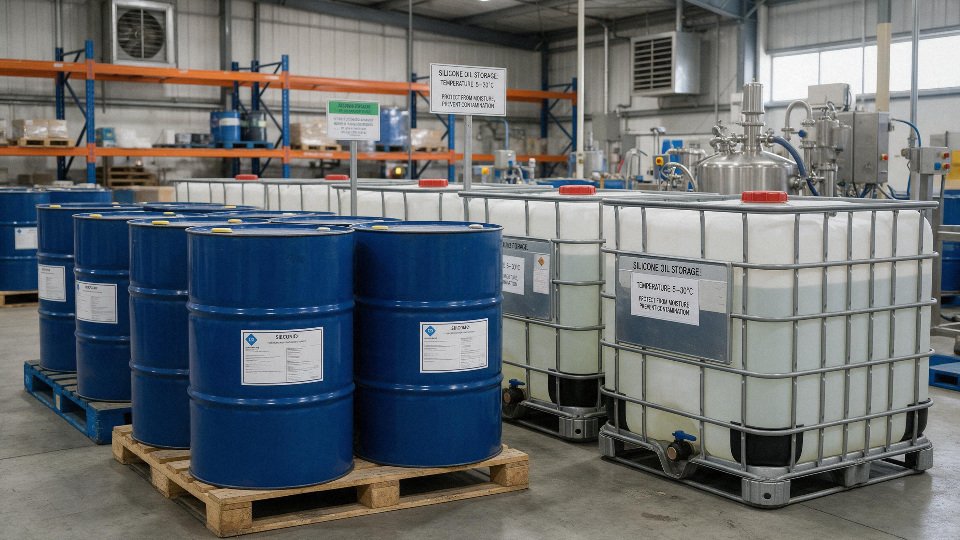
Packaging, moisture exclusion, and shipment cleanliness
For many silicone oils, shipping is where a clean product gets compromised. Not always, but often enough that buyers should ask.
Packaging control should cover:
- Drums
- dry and clean interior
- compatible lining or bare material selection
- sealed bungs
- protected filling area
- IBCs
- valve cleanliness
- tamper integrity
- outlet cap quality
- prior-use verification
- Bulk shipments
- dedicated or validated-clean tankers
- hose cleanliness
- moisture exclusion during loading and unloading
- documented transfer procedure
- Gas blanketing where needed
- nitrogen protection for moisture-sensitive or low-volatility-sensitive grades
- headspace management during storage and filling
Industrial-grade moisture targets are often below roughly 100 to 500 ppm depending on use, but that only holds if the packaging and transfer chain are under control. A supplier can produce dry material and still ship wet product if drums sit open too long in a humid filling bay. Anyone who has opened a poorly handled IBC in rainy season knows the difference.
Traceability, retained samples, and technical support
When there is a complaint, speed matters. You need to know what was made, from which raw materials, on which line, tested by which method, and packed in which container lot.
Minimum buyer-facing controls should include:
- lot coding tied to production records
- batch-specific certificate of analysis
- retained sample program with defined storage period
- complaint investigation workflow
- ability to compare current lot against historical retain samples
Technical service is part of consistency too. A supplier that can review substrate, contaminant, temperature, application method, and finish requirement will usually prevent misapplication before it becomes a nonconformance. That matters more than offering every possible grade.
Global procurement considerations
For international buying, the chemistry may be acceptable while the supply system is not. Lead-time stability, export packing quality, document accuracy, and regulatory response time often determine whether a source is usable for production planning.
Check these points before qualification:
- typical production lead time and seasonal variability
- export documentation accuracy and speed
- responsiveness to compliance questions and product data requests
- backup manufacturing or inventory strategy
- dual-sourcing feasibility for critical grades
- willingness to lock a master specification and notify changes in advance
If the material is business-critical, qualify the supplier, not just the sample. A drum that passes once is easy; delivering the same fluid, with the same paperwork and the same shipment condition, month after month, is the harder part.
Common quality failures
Most silicone oil quality failures show up first as plant symptoms, not lab numbers: a drum that thickens on the rack, smoke off a heated roll, fish-eyes in a coating line, or a defoamer that suddenly quits after a raw-material change. The useful question is not “did one spec pass,” but which parameter moved far enough to break the process window. In practice, the same symptom can come from more than one cause, so the fastest path is symptom-to-parameter mapping, then confirmation by retained sample and application test.
Unexpected viscosity drift during storage or service
A silicone oil that drifts in viscosity has usually changed chemically, absorbed contamination, or was never compositionally tight to begin with. Upward drift points toward condensation, oxidation, crosslinking, or mixed high-viscosity material; downward drift often means shear-sensitive additives, low-molecular contamination, or thermal cracking in severe service.
What operators usually notice:
- Pump amperage creeping up on recirculation systems
- Spray pattern narrowing or atomization quality changing
- Metering pumps losing calibration against stroke setting
- Heat-transfer or damping behavior shifting after a few weeks in service
Mechanistically, viscosity follows molecular size and distribution. If the fluid contains reactive residues, catalyst carryover, or incompatible contaminants, molecules can couple during storage or heat exposure and the oil thickens. The trade-off is familiar in buying: a tighter viscosity cut and better purification cost more, but they reduce line-side adjustment, reblending, and scrap. That conclusion stops holding if the service environment itself is abusive enough to destroy any standard dimethyl fluid; then the problem is not incoming quality alone, but fluid type selection.
High odor, smoke, or excessive evaporation at temperature
If a silicone oil smells sharp, smokes early, or loses mass too quickly under heat, suspect excess volatiles, low-boiling fractions, contamination, or the wrong base structure for the temperature. You do not need a full failure analysis to act on that; compare fresh retained sample, heated residue, and mass loss behavior under the actual operating profile.
Typical plant-floor signs include:
- Visible smoke on heated platens, release rolls, textile frames, or bath surfaces
- Odor complaints strongest at startup, after idle heat soak, or when a new drum is connected
- Unexpected top-up frequency in open systems
- Condensate deposits around vents, guards, or exhaust ducting
A lot of buyers focus on nominal viscosity and miss volatility. Two 100 cSt fluids can behave very differently at 180–250 C if one has broader low-end fractions. For high-temperature use, verify volatility-related data and the specific test basis rather than assuming “silicone” means low loss.
Haze, sediment, gel particles, or phase separation
Clear silicone oil should stay clear unless the chemistry, contamination level, or storage conditions say otherwise. Haze usually tracks moisture, incompatible blending, or fine insoluble matter; gel particles point to localized crosslinking or aged residue; phase separation often means mixed chemistries that were never truly compatible.
Watch for:
- Cloudiness after cold mornings, then partial clearing as drums warm
- Stringy material on suction strainers
- Fine gel specks that block nozzles or show up as surface nibs
- Distinct layers in tote samples after settling
In practice, phase issues often start with mixed batches or top-offs from “close enough” shop stock. A silicone antifoam carrier, a release fluid, and a dielectric fluid may all look similar in a translucent pail, but their additive packages and compatibility windows are not.
Reduced dielectric performance or moisture-related electrical faults
For electrical use, small amounts of moisture or ionic contamination can do outsized damage. Industrial silicone oils are often controlled somewhere below roughly 100 to 500 ppm moisture depending on duty, but the acceptable level is application-specific and must be tied to the equipment design, voltage stress, and handling exposure.
Common failure signs:
- Lower insulation resistance after filling or maintenance
- Partial discharge concerns that were absent with previous lots
- Flashover or tracking tendency worsening in humid weather
- More aggressive dehydration needed before commissioning
Moisture gets in through poor drum sealing, warm-cold breathing cycles, wet transfer hoses, or long open handling. Here the trade-off is operational: a cheap open-transfer setup saves a little in stores and maintenance, then burns it back in rework and field risk.
Poor defoaming efficiency, unstable foam control, or system incompatibility
A defoaming silicone oil can fail because the viscosity is wrong, the active content is inconsistent, the droplet dispersion is unstable, or the fluid is simply incompatible with the system chemistry. Too compatible, and it dissolves instead of working at the air-liquid interface; too incompatible, and you get deposits, floating oil, or downstream defects.
Operators usually report:
- Foam collapses briefly, then returns
- Dose rate keeps creeping upward lot by lot
- Good bench results but poor performance in the live tank
- Fouling on probes, sight glasses, or filter media
This one flips quickly with formulation changes. A paper, fermentation, wastewater, or coating system may each need a different silicone structure or carrier approach.
Insufficient release, uneven wetting, or surface defects
If release drops off or wetting becomes patchy, the fluid may have the wrong molecular architecture, contamination, poor spreading behavior, or unstable composition. Surface-controlled applications are unforgiving; tiny compositional shifts can show up as skipped areas, drag marks, orange-peel texture, or inconsistent transfer.
Seal swelling, coating craters, fish-eyes, or substrate compatibility failures
These symptoms usually mean incompatibility rather than simple “bad quality” in the abstract. The oil may be perfectly on-spec for another use and still be wrong for your elastomer, paint system, adhesive, or plastic substrate.
Use this symptom-to-cause check first:
- Seal swelling or softening
- probable issues: wrong silicone structure, solvent or low-boiling contamination, additive incompatibility
- Coating craters or fish-eyes
- probable issues: silicone contamination in the wrong part of the plant, excessive mobility, mixed batches, carryover from release or defoam systems
- Poor wetting or uneven film
- probable issues: viscosity mismatch, contamination, wrong surface-tension profile, moisture-related instability
- Loss of release performance
- probable issues: wrong molecular weight distribution, depleted active component, thermal degradation, contamination from process residues
A single visible symptom can identify the exact silicone oil defect without further testing.False
Symptoms are useful for narrowing causes, but several different parameter failures can produce similar plant behavior. Confirm with retained-sample comparison, targeted lab tests, and if the use is critical, an application trial under actual operating conditions.
Frequently asked questions
Is viscosity the most important quality parameter for silicone oil?
No. Viscosity is the fastest way to identify a silicone oil grade and predict handling, but it does not tell you whether the fluid is clean, stable, low in volatiles, chemically correct, or suitable for your process. Buyers who approve on viscosity alone are the ones who later argue over odor, evaporation loss, foam behavior, electrical failure, or deposits on heated parts.
In practice, viscosity is the entry filter. After that, the right priority depends on duty:
– Heat transfer or high-temperature exposure: volatile content, flash point, oxidation stability
– Electrical insulation: moisture, dielectric properties, ionic contamination if relevant
– Release, lubrication, or defoaming: surface behavior, compatibility, volatility, composition
– Cosmetic or sensitive-contact use: odor, color, low volatiles, purity profile
Two drums can both read 100 cSt at 25 C and still behave very differently in service.
How do volatile content and flash point differ?
They are related, but they are not the same test and not the same risk signal. Volatile content tells you how much low-boiling material can evaporate from the oil under defined conditions; flash point tells you the temperature at which vapors above the liquid can ignite under a standardized test.
A few practical distinctions:
– High volatile content usually points to more light fractions or residual low-molecular-weight siloxanes.
– Lower flash point often follows from those same light fractions, but not in a perfectly linear way.
– Process consequence of volatiles: weight loss, odor, fogging, deposit formation, viscosity drift
– Process consequence of low flash point: storage, heating, and safety limitations
If a buyer only asks for flash point, they can still end up with a fluid that passes safety screening but loses too much mass in service.
What moisture level is acceptable for electrical or sensitive applications?
For many industrial silicone oils, moisture is often controlled below roughly 100 to 500 ppm, but the acceptable limit depends heavily on voltage stress, sealing quality, operating temperature, and whether the fluid contacts moisture-sensitive materials or catalysts. Electrical and other sensitive uses usually need the tighter end of that range, sometimes lower, and that should be agreed against the actual application rather than copied from a generic data sheet.
Check these points before setting the limit:
– Open or closed system
– Ambient humidity during filling
– Drying method for tanks and lines
– Whether paper, powder, catalyst, or hygroscopic materials contact the oil
– Dielectric performance requirement
– Sampling method, because bad sampling can add moisture after production
If the application is high-voltage or failure-critical, verify the moisture limit against the equipment design and run a dry-handling protocol at site. The number on the lab report is only part of the picture.
How can I verify whether a silicone oil is pure PDMS or modified?
You verify it from composition data, not from viscosity alone. A pure dimethyl silicone oil and a modified silicone fluid can overlap in viscosity, color, and even some routine handling properties.
Common verification routes:
– Product identity statement from the supplier: pure PDMS, phenyl-modified, amino-modified, polyether-modified, fluorinated, and so on
– Refractive index: dimethyl silicone oils are often around 1.396 to 1.404 at 25 C; meaningful deviation may indicate a different structure, though this is not proof by itself
– Infrared spectroscopy or other compositional analysis
– Volatile profile or GC-based composition work, where applicable
– Functional-group specification for modified grades
If the chemistry matters to downstream cure, wetting, or compatibility, ask for explicit structural classification rather than trying to infer it from one physical property.
Why do two suppliers with the same viscosity offer different performance?
Because matching one property does not mean the molecular distribution, cleanliness, stabilizing controls, or residual low-boiling fraction are the same. In plant terms, one fluid may stay clean on a hot platen while another leaves haze, shifts viscosity faster, or picks up odor after a few weeks in a vented tank.
Typical causes of the difference:
– Different molecular weight distribution
– Different volatile content
– Different moisture level
– Residual catalyst, acid, alkali, or other trace impurities
– Different additive package or modified chemistry
– Packaging and filling discipline, especially for moisture-sensitive uses
This is where low-price substitutions usually get expensive: not on day one, but through scrap, cleaning labor, and arguments over whether the oil or the machine caused the issue.
How long can silicone oil be stored before quality changes?
Unopened silicone oil often stores well for long periods under proper conditions, but there is no single safe shelf-life number that fits every grade. Stability depends on the chemistry, package integrity, exposure to air and moisture, storage temperature, and whether the product is pure silicone oil or a modified formulation.
Good storage practice:
– Keep containers sealed and clean
– Avoid repeated opening in humid areas
– Store away from excessive heat and direct sun
– Use lined, compatible containers and clean transfer equipment
– Re-check critical properties after extended storage, especially moisture, appearance, viscosity, and volatiles where relevant
Once a drum is half-used and breathing shop air through a loose bung, the practical storage clock changes a lot.
What tests should be on a certificate of analysis for routine industrial purchasing?
For routine buying, the certificate should cover the properties that confirm identity and release quality for that grade. The exact list depends on the application, but most buyers should expect at least:
– Viscosity at stated temperature
– Appearance and color, if relevant
– Moisture, where process-sensitive
– Volatile content or another agreed purity indicator, where relevant
– Refractive index or density, if used for identity control
– Flash point, if safety screening matters
– Lot number and test method reference
A good certificate is not the same as a complete qualification package. If the duty is critical, ask separately for stability data, dielectric properties, or application-specific test results.
When should a buyer request custom specifications or application trials?
Request them when failure cost is materially higher than the cost of qualification, or when your process is sensitive enough that standard commercial limits do not protect you. That usually includes electrical insulation, high-temperature recirculation, optical or low-residue applications, catalyst-sensitive systems, regulated end uses, or any line where contamination creates scrap that is hard to detect until late.
Use custom specifications or trials when:
1. A standard grade passed on paper but failed in service
2. Two approved suppliers are not performing the same
3. Your process has narrow temperature, cleanliness, or residue limits
4. The oil contacts seals, coatings, elastomers, adhesives, or catalysts with known compatibility risk
5. You need a plant-specific acceptance window rather than a broad commercial range
A short lab screen is often enough to eliminate the wrong chemistry. If the process is expensive to interrupt, move quickly to a controlled line trial with retained samples from both the approved and candidate lots.
Your specification verification checklist
A silicone oil specification is ready to buy only when it matches three things at once: the actual duty in your process, the supplier’s demonstrated control capability, and the cost of getting the wrong batch. Most purchasing mistakes happen because the spec is copied from a legacy document or competitor datasheet without checking which parameters are truly release-critical and which are just descriptive.
If you are qualifying a new grade or changing supplier, work through the checklist in this order.
1. Define the duty conditions before you touch the datasheet
Start with the service envelope, not the product code.
- Temperature range
- Normal operating temperature
- Short-term peaks and upset conditions
- Fill, storage, and winter-start temperatures if the oil must pump or wet surfaces at low temperature
- Contact media
- Air, oxygen-rich atmosphere, water, steam, acids, alkalis, solvents, process gases, elastomers, plastics, metals
- Any chance of contact with catalysts, fine metal particles, or reactive residues from upstream processing
- Residence time
- One-pass process aid, sealed long-life fill, open bath, recirculating system, or intermittent use
- Expected time under heat or electrical stress before replacement
- Electrical duty
- Dielectric use or incidental electrical exposure
- Voltage class, field intensity, and whether moisture pickup during service is plausible
- Cleanliness sensitivity
- Cosmetic-grade surface contact, release coating, textile lubrication, defoaming, electronics, vacuum service, or general industrial lubrication
- Tolerance for odor, haze, gels, volatiles, trace particles, and extractables
This first step changes the whole spec. A fluid that is acceptable as a mold-release carrier may be unsuitable in a sealed electrical application, even if the viscosity matches perfectly. The mechanism is simple enough: the same trace moisture or volatile fraction that causes little trouble in an open, noncritical process can drive dielectric instability, foaming, mass loss, or deposit formation once the oil is heated, enclosed, or exposed to electrical stress.
2. Split release parameters from comparison data
Do not make every datasheet item a certificate-of-analysis requirement. That creates noise, arguments at goods receipt, and sometimes impossible supplier commitments.
Put parameters into two buckets:
- Mandatory release parameters
- Identity-critical property such as kinematic viscosity at the stated temperature
- Appearance or clarity if visual cleanliness matters
- Moisture limit where hydrolytic, electrical, or process sensitivity exists
- Volatile content, acid value, or specific impurity controls when the application justifies them
- Packaging integrity and labeling requirements
- Nice-to-have comparison data
- Refractive index for identity cross-checking
- Density for handling calculations
- Typical thermal data used for engineering reference, not lot release
- Supplier internal control data that help trend consistency but are not practical receiving tests
The trade-off is straightforward. Tightening every number may look safe on paper, but it narrows the supplier’s practical operating window, raises cost, and can reject batches that would perform perfectly well. That logic stops holding if the application is highly regulated, safety-critical, or expensive to fail; then broader lot-release testing is justified.
3. Match the parameter set to the silicone oil type and use case
Avoid a generic template that treats all silicone oils as interchangeable.
- For dimethyl silicone oils, viscosity, moisture, volatiles, appearance, and identity checks such as refractive index are common starting points.
- For modified silicone fluids, compatibility, specific functional-group control, or emulsion-related behavior may matter more than a dimethyl-style comparison sheet.
- For electrical or long-life sealed uses, low moisture and stable composition deserve much tighter attention than in short-residence processing.
- For process aids and lubricity uses, contamination tolerance, pumpability, and consistency between batches often matter more than building out an oversized test panel.
If the application is unusual, ask which parameter actually predicts failure in service. In plants, that answer is often not the one purchasing starts with.
4. Write the purchase specification so receiving, QA, and the supplier read it the same way
Include the commercial and technical basics in one controlled document.
- Numerical acceptance limits
- State target and allowable range
- Tie the range to test temperature where relevant, especially for viscosity
- Test methods
- Identify the agreed method or supplier method cross-referenced to a recognized standard where applicable
- If methods differ, define which governs release and how disputes are resolved
- Packaging requirements
- Drum, pail, IBC, tanker, lined container, nitrogen protection if needed
- Cleanliness of packaging and resealability if partial-use storage is expected
- Traceability
- Batch number format
- Manufacturing date or retest date
- Certificate of analysis per lot
- Retention of production records for an agreed period
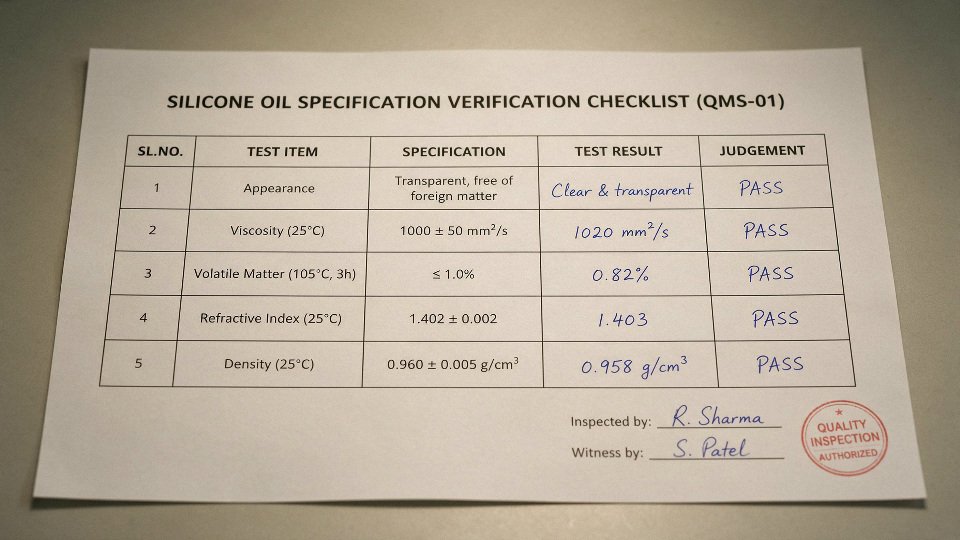
A short table in the internal spec usually helps:
| Item | Requirement | Why it matters |
|---|---|---|
| Viscosity at defined temperature | Acceptance range | Confirms grade identity and handling behavior |
| Moisture | Application-based limit | Controls electrical, hydrolytic, and stability risk |
| Appearance/clarity | Clear, free from visible particles if required | Screens contamination and gross instability |
| Packaging | Agreed container and sealing standard | Prevents pickup of moisture and dirt after filling |
| Traceability | Lot COA and batch identification | Supports investigation if field issues appear |
5. Ask for supplier control evidence before committing volume
This is where many approvals are too soft.
Request:
- Retained sample policy
- How long each lot sample is kept
- Whether it can be re-tested during a complaint investigation
- Batch consistency evidence
- Recent multi-batch data for key parameters
- Not just one “typical value” sheet
- Change-notification commitment
- Raw material source change
- Process change
- Test method change
- Packaging change
- Manufacturing site change
A supplier can responsibly promise the same datasheet values forever without a formal change-control commitment.False
Batch capability can be stable for years, but without a documented change-notification process, the buyer has little protection against shifts in raw materials, process conditions, test methods, or packaging that still look 'within spec' but alter application performance.
6. Run a small-scale validation plan before full conversion
For critical applications, do not move straight from lab approval to full plant use.
- Check one or more recent lots, not only a single qualification sample
- Run a bench or pilot test under representative temperature, contact media, and residence time
- Inspect for the failure mode that matters most: foaming, deposit, dielectric drift, wetting change, odor, haze, or compatibility issue
- Review handling behavior in your actual pumps, seals, hoses, and storage practice
A modest trial usually costs less than a week of line disruption caused by a spec that looked complete but missed the real service condition.
7. Prepare the technical inquiry or quotation request
When you send an inquiry to SiliconChemicals for grade recommendation and specification alignment, include:
- Substrate or system material
- Intended application
- Required viscosity range or current grade reference
- Operating and peak temperature
- Contact media and exposure time
- Electrical duty, if any
- Cleanliness or appearance sensitivity
- Packaging preference
- Annual demand and shipment size
- Any mandatory release tests and target limits
- Photos, process notes, or sample context if the application is failure-sensitive
That gives enough ground to recommend a suitable silicone oil grade, align the specification to the actual duty, and confirm whether the requested controls are practical at supply scale before you issue the order.