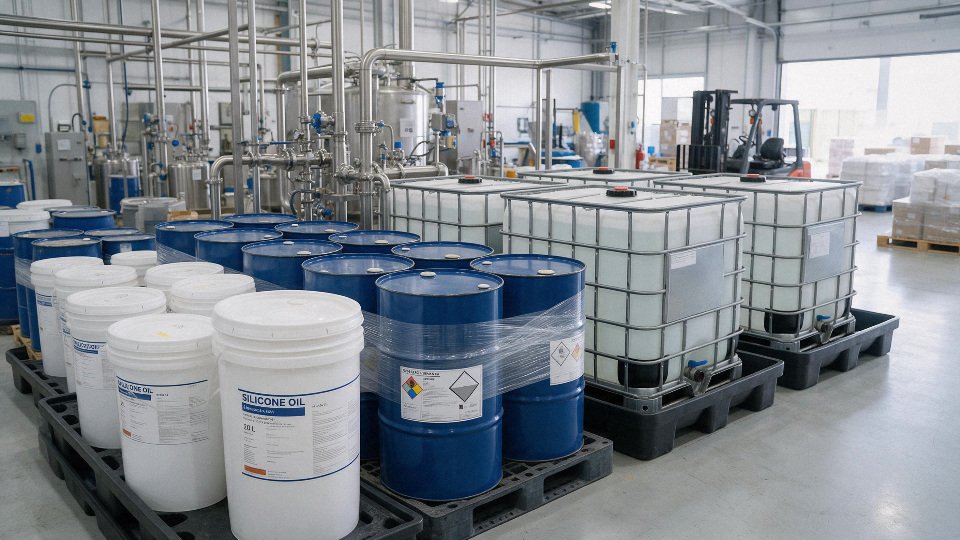
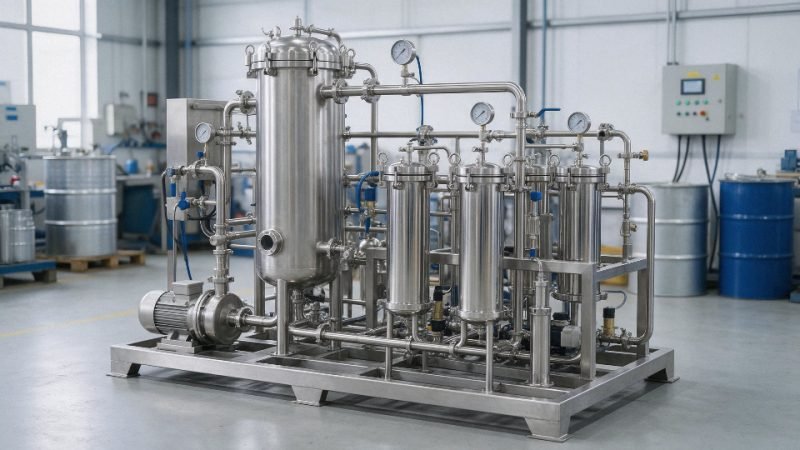
Silicone oil that looks usable can still carry the exact contaminants that cause trouble later: fines from handling, trace moisture, low-boiling volatiles, catalyst residues, and oxidation by-products. On the plant floor, those show up as haze, unstable viscosity, foaming, poor dielectric behavior, weak release performance, or deposits in downstream equipment. The cost is rarely just the fluid itself; it lands as rejected batches, rework time, filter change-outs, slower line speeds, warranty risk, and sometimes a customer complaint that is much more expensive than the oil.
Silicone oil is purified by matching the contaminant to the right separation step: filtration for suspended solids, drying for moisture, vacuum stripping for volatile fractions, and, where needed, adsorption or chemical treatment for color bodies, catalyst traces, or polar impurities. In practice, the correct sequence depends on viscosity, end-use sensitivity, and what contamination is actually present, not what the drum label says.
That sounds straightforward until you get into grade-to-grade differences. A fluid that only needs particle control for a general industrial lubricant is a different job from a premium fluid that must dry below roughly 50-200 ppm moisture, or from a product where volatile carryover matters more than particles. The useful question is not whether silicone oil can be purified, but which impurities are worth removing, how far, and what that choice does to yield, processing time, and total cost.
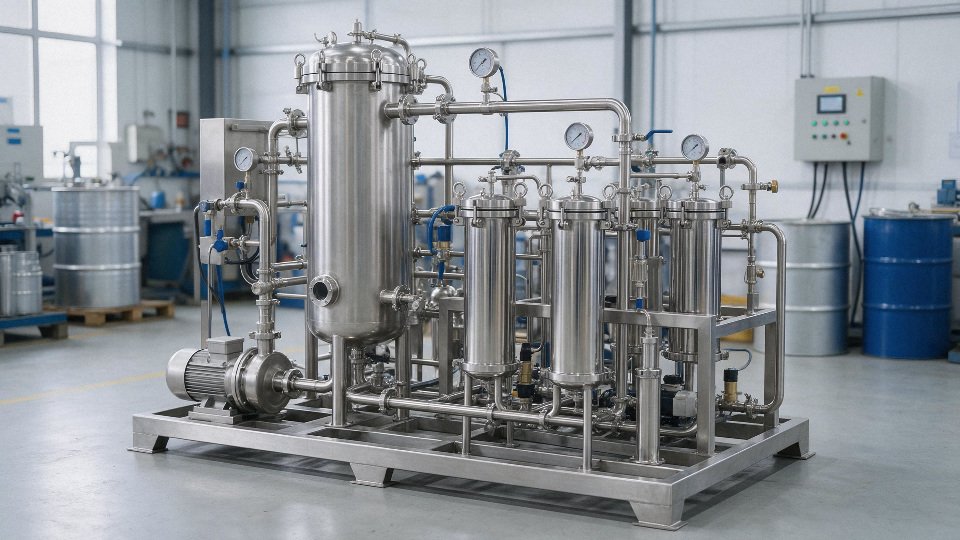
Contaminant profile
Silicone oil rarely fails because of one dramatic impurity; it usually fails because the impurity profile does not match the end use. The contaminants that matter most are not always the ones present at the highest concentration. A few tens of ppm of moisture, ionic residue, or catalyst carryover can create more field risk than a much larger amount of benign high-boiling material.
From a plant and purchasing standpoint, the useful way to classify impurities is by how they behave in service and in downstream processing. Some leave the product early as fog or odor. Some stay in the fluid and shift viscosity, cure response, dielectric behavior, or storage stability. Some are visible on day one; others only show up after a heater cycle, a vacuum step, or six months in a drum through a humid summer.
Low-boiling volatiles: residual cyclics and short-chain siloxanes
Low boilers usually show up as residual cyclic siloxanes, short-chain linear siloxanes, or other volatile organics carried through synthesis and finishing. They are a recurring issue in fluids that need low odor, low evaporation loss, low fogging, or tighter market acceptance in consumer-facing and enclosed-environment applications.
What they do in practice:
- Increase odor, especially when the fluid is first heated or spread into a thin film
- Raise evaporative loss in high-temperature service
- Contribute to fogging on nearby surfaces, lenses, housings, or interior trim
- Shift flash behavior and vapor load in closed systems
- Create compliance or customer-approval risk where residual cyclic content is restricted or closely monitored
The mechanism is straightforward. Low-molecular-weight species have higher vapor pressure, so they leave the bulk fluid first during heating, shearing, or exposure in thin layers. That changes both emissions and the composition of what remains. In a thermal fluid, lubricant, or release coating, the immediate complaint may be odor or condensate. A few production cycles later, the complaint turns into viscosity drift because the light end has boiled off and the remaining fluid is effectively heavier.
The trade-off is that aggressive removal of low boilers by vacuum stripping improves volatility performance, but if the cut is too hard you can lose yield and sometimes pull out components that contribute to target flow or spreadability in a formulated product. The preferred setting flips when the application is highly sensitive to emissions, fogging, or residual cyclic content; then lower volatile content usually outranks marginal yield loss.
High-boiling fractions and molecular weight tailing
A silicone oil can meet a nominal viscosity spec and still behave poorly because its molecular weight distribution is too broad. High-boiling fractions, overbuilt oligomers, or a heavy tail in the distribution are common reasons.
Typical effects include:
- Poor viscosity consistency from batch to batch
- Slower leveling or flow-out in coatings and release systems
- More residue after thermal exposure
- Higher tendency toward deposit formation in heated service
- Broader response to temperature, shear, or mixing history
This is where buyers sometimes get caught. A single viscosity number at one test temperature does not tell you whether the fluid is narrowly controlled or hiding a broad distribution. In service, the heavy end resists flow and can age differently from the bulk. In a metered dispensing system, that may show up as sluggish starts on cold mornings and over-delivery once the line warms up. In a heat-transfer or lubrication duty, it can mean more residue and less predictable aging.
A narrow distribution generally gives more consistent processing. A broader one may still be acceptable in lower-spec industrial uses, especially where cost pressure is high and the process is forgiving. That conclusion stops holding when the fluid is used in precision coating, controlled dispensing, optical surfaces, or any application where thermal aging residue matters.
Water and hydrolyzable impurities
Moisture is one of the most underestimated silicone oil contaminants because fresh product can still look clear while carrying enough water to cause trouble later. For moisture-sensitive applications, dried premium fluids are often targeted below roughly 50-200 ppm, but the acceptable level depends on chemistry, packaging, storage time, and what the customer does next.
Problem pathways include:
- Haze formation during storage or temperature cycling
- Hydrolysis of sensitive siloxane or silane-containing species
- Gas formation in systems where reactive groups decompose or side reactions occur
- Viscosity drift over time
- Poor compatibility with moisture-sensitive additives, fillers, or cure packages
Hydrolyzable impurities make this worse. Residual alkoxy-, chloro-, or other reactive silicon species may remain quiet in a dry drum, then react once exposed to ambient humidity at blending or filling. In practice, the complaint may not come back as “water contamination.” It comes back as haze, pressure in the package, strange cure behavior, or a customer saying the fluid “went unstable after opening.”
Season matters here. Product packed acceptably in a dry winter plant can pick up moisture quickly during summer transfer, especially if drums sit open, nitrogen blanketing is inconsistent, or operators pull samples with wet glassware. It is not glamorous process control, but it is one of the first things that separates a stable premium fluid from one that becomes a troubleshooting project.
Acidic or basic residues
Acidic and basic residues often come from catalysts, neutralization chemistry, washing inefficiency, or side reactions in synthesis. They may be present at low concentration and still have an outsized effect.
Common consequences:
- Accelerated thermal or storage degradation
- Viscosity increase or decrease over time, depending on the system
- Interference with platinum-, tin-, peroxide-, or moisture-cure systems downstream
- Reduced stability of additive packages such as antioxidants, dyes, or surface modifiers
A trace acidic residue can catalyze rearrangement or cleavage reactions. A basic residue can do the same in a different direction and can be just as disruptive to a downstream formulator trying to control cure speed. If a customer is making RTV, antifoam, release coating, or silicone-modified resin systems, catalyst carryover is not a small housekeeping issue; it can dominate whether the formulation stays within pot life and cure window.
Trace acidic, basic, or catalytic residues can matter more than visible particles in downstream silicone formulations.True
This is consistent with established process chemistry. Small amounts of reactive residues can alter cure kinetics, polymer stability, and additive compatibility even when the bulk fluid appears visually clean. The exact sensitivity depends on the downstream chemistry and must be verified by compatibility or aging testing.
Inorganic salts, alkali traces, chlorides, and metal ions
These contaminants are often introduced by raw materials, catalyst systems, neutralization salts, water washing, corrosion in process equipment, or poor transfer hygiene. They matter most in electrical, high-purity, catalyst-sensitive, and ash-sensitive uses.
Watch for these effects:
- Lower dielectric performance or inconsistent electrical behavior
- Ash residue after heating or burn-off
- Corrosion in process equipment or packaged systems
- Poisoning of downstream catalysts
- Deposits on hot surfaces or in precision assemblies
Chlorides deserve specific attention. Even low levels can become a corrosion problem in the wrong environment, especially with moisture present and elevated temperature. Alkali and metal ions are also frequent hidden causes of instability in formulations that otherwise look fine on the COA. If the oil is going anywhere near electronics, insulation systems, or catalytic downstream chemistry, ionic cleanliness should not be treated as optional.
Particulates, gels, silica fines, and filterable insolubles
This is the impurity class most people notice first because it is visible, but visible does not mean simple. The source may be filter breakthrough, reactor fouling, degraded seals, carbonized residues from overheating, silica carryover, or gel formation from side reactions.
Typical damage patterns:
- Cosmetic defects in coatings, inks, polishes, and consumer products
- Nozzle blockage in spray, jet, or metering equipment
- Scratches, fisheyes, or seed defects on finished surfaces
- Shorter service life in pumps, valves, and close-clearance equipment
- Unstable filtration cost because fines load filters faster than expected
The mechanism depends on particle type. Hard particles abrade and plug. Soft gels deform, pass coarse filtration, then lodge in fine passages downstream. Silica fines can stay suspended long enough to make the product look clean in a drum sample, then settle in totes or lines and create trouble at startup. That is why a particle-removal target can reasonably range from around 25 microns down to below 1 micron depending on the end use; there is no honest universal filtration number.
Color bodies, odor-causing organics, and entrained gases
For industrial intermediate use, slight color may be acceptable. For personal care, household, medical-adjacent, optical, and consumer-facing products, it often is not. Color bodies usually come from thermal history, oxidation, side reactions, trace metals, or residual organics. Odor-causing species often overlap with low boilers but can also include oxidation byproducts and trace process organics with very low odor thresholds.
Entrained gases and foam-promoting contaminants deserve the same attention:
- Poor filling accuracy in drums, cartridges, and small packages
- Foam in blending and circulation
- Reduced dielectric strength where gas bubbles persist
- Erratic lubrication film behavior
- Pump cavitation or unstable metering in recirculating systems
Foam problems are not always caused by the silicone oil itself. A trace surfactant, cleaning agent residue, or process contamination can make an otherwise acceptable fluid impossible to deaerate quickly on the line. In my experience, this is one of those plant-floor issues that gets blamed on viscosity first because that is the easy number to point at.
What matters for buying and purification strategy is priority, not just detection. If the end use is electrical, ionic traces and gas content move to the front. If it is coating or optical, particles, haze, and low-boiling residue become dominant. If it is a cure-sensitive formulation, moisture and catalytic residues can outweigh everything else even when they are barely measurable without the right method.
Purification process sequence
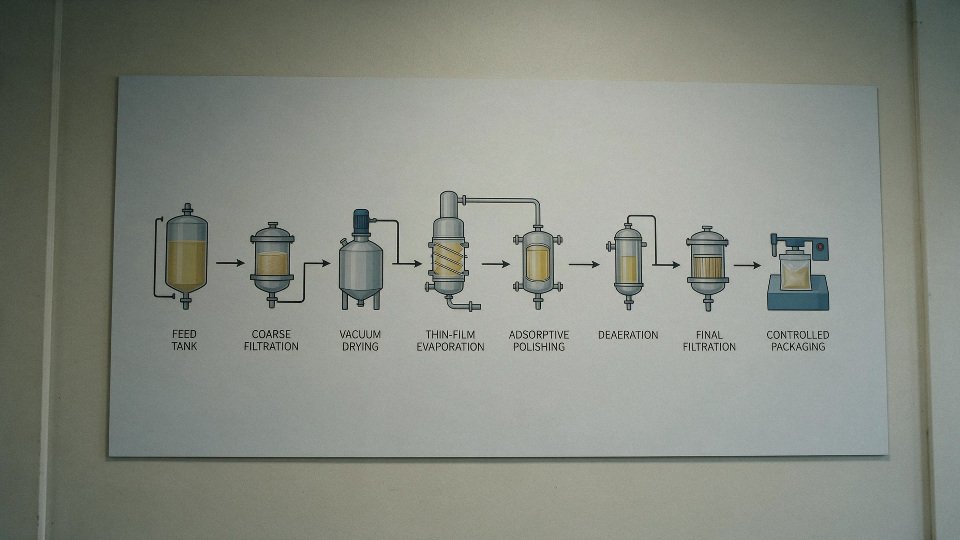
Silicone oil is usually purified in a staged train, not with one “stronger” treatment step. The right sequence starts with feed characterization, then removes solids, water, volatiles, reactive residues, trace color or odor bodies, and entrained gas in an order that prevents one step from overloading or undoing the next. Sequence control matters because the same operation that improves one property can easily damage another if it is applied too early, too hot, or too aggressively.
A plant that gets this right is not just chasing cleaner appearance. It is protecting viscosity, dielectric behavior, odor, evaporation loss, dispensing stability, and lot-to-lot consistency while keeping yield and operating cost under control. In practice, the process train is built around the fluid’s viscosity grade, contamination history, and final use. A bulk industrial release coating fluid is not purified like a precision damping fluid or an electrical-grade silicone fluid.
Feed characterization before treatment
Before anyone opens a filter housing or pulls vacuum, the feed needs to be profiled well enough to choose the train.
At minimum, the production or quality team should confirm:
- Viscosity grade and temperature-viscosity behavior
- This sets pumpability, heater sizing, residence time, and how easily fine solids or water can be removed.
- High-viscosity oils hold bubbles and moisture longer and often need slower transfer, more head pressure, and more residence time under vacuum.
- Volatility profile
- You need to know whether the concern is residual cyclics, low-boiling linear siloxanes, solvent carryover, or decomposition fragments.
- This determines whether simple vacuum drying is enough or whether true stripping or thin-film evaporation is required.
- Catalyst history and reaction route
- Acidic, basic, metal-containing, or peroxide-related residues lead to different downstream risks.
- If the fluid came from equilibration, end-blocking, modification, or a rework stream, the likely impurity pattern changes quite a bit.
- Impurity load and physical form
- Are solids soft gel particles, hard silica fines, carbon, rust, filter media carryover, or resin fragments?
- Is the water dissolved, emulsified, or free phase?
- Does the fluid already show haze, odor, foam, or abnormal color?
- Intended specification
- Required particle level, moisture target, color, odor, cyclic content, electrical properties, and packaging condition.
- Typical filtered particle removal targets can range from about 25 microns down to below 1 micron, depending on end use.
- Premium moisture-sensitive grades are often dried to below roughly 50–200 ppm, but the acceptable value depends on the customer’s process and test method.
The mechanism here is straightforward but often overlooked: feed characterization prevents you from using energy, adsorbent capacity, and filtration stages on the wrong problem. If odor is actually driven by low-boiling siloxanes, carbon treatment alone will disappoint. If haze is caused by microbubbles instead of solids, tightening the filter train can make throughput worse without fixing appearance.
The main boundary on this conclusion is mixed or poorly traceable rework. Once streams with different histories are blended, lab screening becomes more important than assumptions based on nominal grade.
Gross solids removal
The first physical cleanup step is usually aimed at the large and damaging solids: resin fragments, silica carryover, carbon particles, corrosion debris, gasket crumbs, and whatever came in from transfer lines, totes, or rework handling.
Common options are:
- Settling or hold tanks
- Useful for dense coarse contamination and for decanting obvious free water.
- Cheap and gentle, but slow and limited on fine material.
- Bag filtration
- Good as a first-pass dirt catcher.
- Practical where contamination load is variable and operators need quick changeout.
- Not the best final control method for critical grades.
- Cartridge filtration
- Better defined cut performance than most bags.
- Common after a bag prefilter to protect the finer stage.
- Depth media
- Helpful when solids loading is high or particle shape is irregular.
- Can hold more contaminant before pressure rise, which matters on sticky or partially gelled streams.
A lot of filtration trouble starts here from underestimating solids load. If you send a dirty silicone stream straight to a tight polishing cartridge, you will blind the media early, drive up differential pressure, shear the fluid harder through bypass-prone housings, and lose time on changeouts. I have seen operators blame the cartridge spec when the real problem was skipping a cheap coarse stage.
Fine particulate control
For high-clarity, coating, dispensing, optical, or sensitive downstream processing uses, gross cleanup is not enough. Fine particulates have to be reduced in stages.
A typical approach is:
- Step down in pore size
- Example logic: coarse prefilter, then intermediate cartridge, then final polishing filter.
- Exact ratings depend on the incoming load and release spec; there is no single correct universal sequence.
- Use polishing filters only after the fluid is physically stable
- If the stream still contains water droplets, foam, or unstable soft gels, fine filters plug unpredictably.
- Protect membrane-compatible or very fine final systems
- Where submicron cleanliness matters, upstream depth filtration and good transfer hygiene are worth more than simply specifying a tighter final element.
The trade-off is throughput versus cleanliness. Tighter media improves particle control, but pressure drop rises, changeout frequency increases, and viscous oils may need more heating to maintain flow. That heating can help filtration by lowering viscosity, yet it can also raise volatility loss or accelerate oxidation if the system is not closed well.
Fine filtration should remove particles, not become a substitute for fixing unstable chemistry upstream. If particles are still forming after neutralization or after the fluid cools in storage, the filter is only masking a process problem.
Water removal
Silicone oil can carry moisture as free water, emulsified droplets, or dissolved moisture. The right removal method depends heavily on viscosity and target dryness.
The main industrial choices are:
- Vacuum dehydration
- Often the workhorse method.
- Representative conditions for vacuum operations are commonly in the 1–50 mbar range, with temperature selected by viscosity grade and volatility profile.
- Better on lower-viscosity fluids or after the fluid has been warmed enough to release moisture.
- Thermal drying
- Useful as support, not always sufficient by itself for tight moisture targets.
- Needs restraint; excessive temperature can push off desired fractions or stress the polymer.
- Dry gas sparging
- Nitrogen is typical.
- Helps strip moisture and some light volatiles, especially in moderate-viscosity fluids.
- Less effective when the oil is very viscous or the mass transfer area is poor.
- Adsorption drying
- Can be used when low moisture targets are needed and thermal exposure must be limited.
- Media compatibility and fine carryover control matter.
The mechanism is mass transfer: moisture must migrate from the bulk fluid to a low-partial-pressure environment or to a sorbent surface. Viscosity is a major limiter because it slows diffusion and bubble release. That is why a 1,000 cSt fluid and a 50 cSt fluid cannot be treated as the same drying job even if both start at the same ppm water.
Volatile removal
Residual cyclics, low-boiling siloxanes, odor-causing light fractions, and evaporation-loss contributors are usually handled by vacuum stripping or, where separation demands are tighter, thin-film evaporation.
Use vacuum stripping when:
- The volatile fraction is modest
- The fluid is not too viscous for good turnover
- The thermal history can tolerate the residence time needed
Move toward thin-film evaporation when:
- The fluid is viscous enough that bulk stripping becomes inefficient
- Low-boiling removal has to be tighter
- Residence time at temperature needs to be minimized
This is one of the places where aggressive treatment can backfire. Higher temperature and deeper vacuum generally improve volatile removal, but they also raise the risk of:
– Viscosity drift from thermal stress
– Loss of useful low-level stabilizing components
– Foaming and entrainment
– Increased load on condensers and vacuum system oil
– Lower yield if too much acceptable fraction is stripped with the unwanted lights
The preferred choice flips when the fluid becomes heat-sensitive or the value of recovered yield is high. In those cases, a gentler but better controlled evaporative design is often worth the extra capital.
Neutralization or scavenging of reactive residues
If the upstream chemistry leaves acidic or basic residues, or catalyst-derived contamination that can keep reacting in storage, purification has to address stability, not just appearance.
Typical objectives are to:
- Stop post-reaction viscosity drift
- Reduce corrosion or package compatibility risk
- Prevent haze, gel formation, or color growth during storage
- Lower ionic or polar contamination where the application is sensitive
Depending on the system, this may involve neutralization, scavenging, washing in some process routes, or adsorption onto selected media. This step has to be controlled carefully because over-treatment creates salts, precipitates, or fines that then become another filtration problem. It is one of those jobs that looks simple on paper and turns messy in the skid if dosage and mixing are sloppy.
Adsorptive polishing
Adsorptive polishing is used for trace cleanup that filtration and vacuum work will not solve: color bodies, odor residues, trace polar species, and some metal-related contaminants.
Common media include:
- Activated clay
- Bleaching earth
- Activated carbon
- Alumina
- Specialty adsorbents selected for a known impurity class
Media choice is not interchangeable. Activated carbon is often strong on odor and some organics, but it can be too non-selective for certain products and can introduce fines if handling is poor. Clay or earth can improve color but may not solve the same odor problem. Alumina may help with particular polar contaminants or residual acidity depending on the chemistry.
The trade-off is purification strength versus product loss and contamination risk. Stronger adsorption can improve appearance and odor, but it can also strip desirable minor components, lower yield through holdup, and create a demanding post-filtering step to remove fines. If the customer does not value water-clear appearance or ultra-low odor, this step can become cost without return.
Deaeration and foam control
For dielectric, optical, metering, and precision dispensing applications, entrained gas is not a cosmetic issue. It affects fill weight repeatability, dielectric integrity, apparent haze, compressibility, and the customer’s own processing stability.
Deaeration is usually done by:
1. Vacuum hold with controlled agitation
2. Thin-layer or falling-film exposure
3. Warm recirculation under low-pressure conditions
4. Careful transfer design to avoid re-entrainment after degassing
Plant-floor detail matters here. A beautifully deaerated batch can be ruined by a leaky pump seal, a badly arranged return line splashing into the tank, or a tote fill lance that vortices air into the fluid. Foam control starts with mechanical design before anyone reaches for an additive.
Final polishing, blending, and homogenization
Once major contaminants are removed, the batch is usually brought through final polishing filtration and then blended or homogenized as needed to tighten lot uniformity.
This stage typically covers:
- Final filter pass
- Set to the actual customer cleanliness requirement, not simply the finest filter available.
- Blend correction
- Used to bring viscosity or other critical release properties into a tighter band.
- Homogenization
- Ensures the lot is uniform before testing and packaging.
- Gentle circulation is usually better than high-shear mixing unless the system specifically needs stronger turnover.
This is also where operators learn whether upstream purification was truly stable. If haze returns after cooling, if pressure rises quickly in final filtration, or if viscosity shifts after hold time, something earlier in the train still needs work.
Packaging under controlled conditions
Purified silicone oil can be recontaminated surprisingly fast during transfer and filling. Controlled packaging is part of purification, not an afterthought.
Key controls are:
- Clean transfer lines and dedicated hoses where possible
- Appropriate final in-line filtration at fill
- Dry, clean containers with verified closure integrity
- Minimized atmospheric exposure for moisture-sensitive grades
- Nitrogen blanketing or dry handling where justified
- Clear segregation from incompatible products and rework areas
Aggressive purification always improves silicone oil quality.False
Overheating can cause thermal cracking or viscosity drift, excessive stripping can remove acceptable fractions, and strong adsorbents can remove useful stabilizing components or introduce fines. Purification has to be matched to the product specification, not maximized indiscriminately.
That counter-intuitive point is worth holding onto. The best purification sequence is not the most severe one; it is the one that reaches the required specification with the least damage, least yield loss, and least chance of creating a new contamination problem on the way to the drum or tote.
Core purification technologies
No single purification method is “best” for silicone oil across all grades. In plant practice, the right choice depends on what you are trying to remove, how heat-sensitive and viscous the fluid is, what residuals the customer actually limits, and how much yield loss and line complexity the business can tolerate.
A common buying mistake is to start with the most sophisticated unit operation on the brochure instead of the contaminant profile. If the problem is insoluble gel and rust fines, a disciplined filtration train will outperform an expensive evaporator on cost, uptime, and contamination control. If the problem is residual cyclics or other low boilers, filtration will do almost nothing and vacuum-based separation has to carry the load.
Mechanical filtration
Mechanical filtration is the workhorse for insoluble contamination: gel specks, catalyst fines, carbonized particles, corrosion products, packaging debris, and dust picked up during transfer. It is usually the lowest-cost, most scalable purification step in the line, and for many standard silicone oils it is the last critical polishing stage before filling.
What matters is not just nominal pore size on the datasheet. It is the whole filtration train:
- Upstream solids load
- Heavy solids or occasional agglomerates call for bag filters, baskets, or coarse cartridges first.
- Sending a dirty batch straight to a fine membrane or sub-micron cartridge just blinds the element and drives differential pressure up fast.
- Staged pore reduction
- A typical practical sequence might move from coarse protection to intermediate cleanup to final polish.
- End targets commonly range from about 25 microns down to below 1 micron, depending on the customer’s cleanliness requirement and how particle-sensitive the downstream use is.
- Pressure drop and viscosity
- Silicone oil viscosity swings the whole design. A low-viscosity fluid may tolerate tight cartridges at moderate flow; a high-viscosity grade may need heating, larger filter area, slower circulation, or all three.
- As viscosity rises, pressure drop rises and effective throughput falls. Operators often try to “push through” by increasing pump pressure, which can channel media, damage seals, or collapse poorly selected elements.
- Filter media compatibility
- Media, seal elastomers, adhesives, and housing internals all need compatibility review with the specific silicone fluid and cleaning chemicals.
- In practice, this is where small mistakes show up: cartridge glue softening, gasket swelling, or extractables appearing in an otherwise clean product.
The mechanism is straightforward: particles larger than the effective pore structure are retained, but the commercial result depends on how stable the filtration condition stays over time. Once differential pressure climbs, flow becomes uneven and changeout frequency starts dictating labor cost and contamination risk. Every housing opened for a cartridge swap is another opportunity for airborne dirt, wet compressed air, or a careless rag fiber to enter the product.
The trade-off is simple. Finer filtration improves visual cleanliness and particle control, but raises pressure drop, filter spend, batch time, and sometimes product hold-up loss. That preference flips when the contaminant is dissolved, volatile, or molecular-scale; then tighter filtration just burns money without improving purity.
Vacuum stripping and devolatilization
For low-boiling impurities, residual cyclics, entrained solvents, and other volatiles, vacuum stripping is usually the main industrial tool. Representative operating windows are often around 1-50 mbar, with temperature set by viscosity grade, volatility profile, and allowable thermal history rather than by any universal number.
Its performance depends on four linked variables:
- Vacuum depth
- Lower absolute pressure increases driving force for volatile removal.
- In an ordinary plant, actual performance depends as much on leak tightness and condenser design as on the vacuum pump nameplate.
- Temperature
- Higher temperature lowers viscosity and raises vapor pressure of removable species, improving mass transfer.
- Push too high and you risk color formation, further condensation reactions, or viscosity drift in sensitive fluids.
- Residence time
- The fluid has to stay under stripping conditions long enough for volatiles to leave.
- Too short, and residuals remain; too long, and thermal exposure starts to hurt yield or appearance.
- Viscosity
- High-viscosity silicone oils resist bubble disengagement and surface renewal, so devolatilization becomes slower.
- That is one reason the same skid can perform well on one grade and disappoint badly on another.
Deeper vacuum always guarantees cleaner silicone oil.False
Vacuum depth helps only if the volatile species can diffuse to the liquid surface and the system can condense and remove them. In high-viscosity or poorly distributed flow, mass transfer and residence time often become the limiting factors before pump vacuum does.
The limit of vacuum stripping is important: it is strong on volatile impurities, weak on nonvolatile salts, particulates, and many dissolved heavy residues. Plants sometimes expect one vacuum pass to fix odor, color, solids, and catalyst carryover all at once. It rarely works that way.
Thin-film and wiped-film evaporation
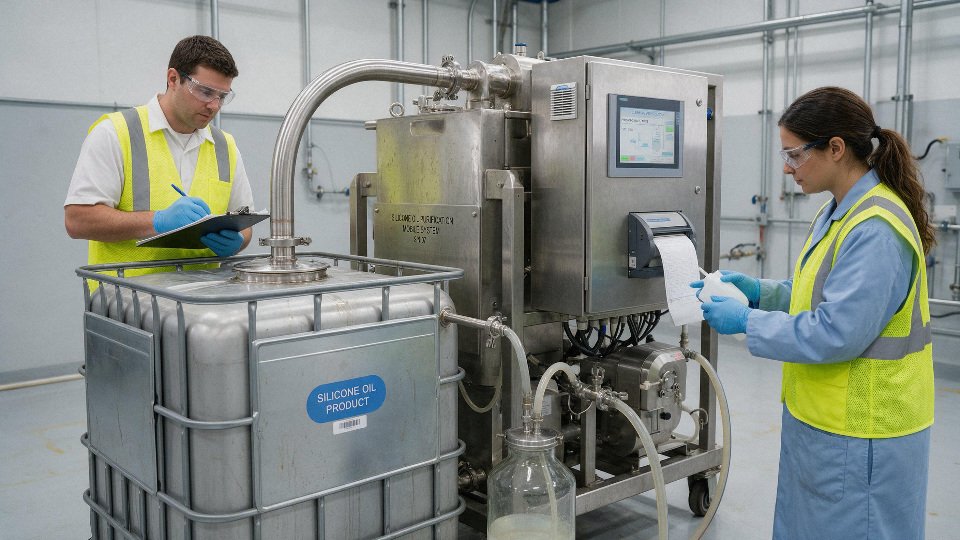
When the fluid is viscous, heat-sensitive, or both, thin-film and wiped-film evaporators are often the better answer than a basic vacuum kettle. They spread the liquid into a thin layer over a heated surface, renewing that film continuously so volatiles escape quickly under vacuum with much shorter residence time than in a bulk vessel.
That changes the mechanism in a useful way:
- Film thickness drops
- Surface area rises
- Diffusion path shortens
- Volatile removal improves at lower thermal exposure per unit mass treated
This is why these systems are preferred for difficult devolatilization duties, especially where residual cyclics or solvent traces must be cut without cooking the product. They also handle high-viscosity grades better than many tank-based systems, though “handle” does not mean “unlimited.” Feed distribution, rotor condition, fouling tendency, and actual viscosity at operating temperature still set the boundary.
The sacrifice is capital cost and operating discipline. Wiped-film systems are less forgiving of feed surges, solids carryover, and poor cleaning habits. If upstream pretreatment is weak, fouling and rotor wear can turn a premium separation tool into a maintenance problem.
Adsorption systems
Adsorption is useful when the targets are trace polar species, odor bodies, color precursors, some catalyst residues, or decomposition traces that physical separation alone does not adequately remove. Common system formats include stirred contact tanks with subsequent filtration and fixed beds, though the right arrangement depends heavily on solids load and product family.
Success depends on three things more than buyers expect:
- Media selection
- Different adsorbents favor different impurity classes.
- A media that improves color may do little for a specific ionic or polar residue.
- Contact quality and time
- Too little residence time leaves adsorption capacity underused.
- Too much can mean unnecessary hold time, excess media use, or pickup of fines.
- Post-treatment cleanup
- Spent fines or fragmented media must be removed afterward.
- If not, the “purification” step simply trades dissolved contamination for particulate contamination.
Adsorption is rarely the cheapest core step per ton processed, and it is not magic. It works best as a targeted polishing method after the bulk contaminant load has already been reduced.
Drying technologies
If the specification is moisture-sensitive, drying deserves its own engineering decision. Premium fluid targets after drying often fall below roughly 50-200 ppm, but the achievable level depends on initial water content, system tightness, fluid viscosity, temperature, and the measurement method.
Common options:
| Drying method | Best fit | Main strengths | Main limits |
|---|---|---|---|
| Heated vacuum tank | General batch drying | Simple, flexible, combines heating and vacuum | Slow on viscous grades, performance drops with leaks |
| Molecular sieve system | Low-moisture polishing or recirculation loops | Strong moisture affinity, can reach low residual water | Media management, pressure drop, contamination control |
| Dry inert gas sparging | Moderate moisture reduction, gentle treatment | Lower thermal stress, simple retrofit in some tanks | Gas consumption, lower efficiency at very low moisture targets |
The trade-off is capital versus operating cost versus final moisture target. A heated vacuum vessel is flexible and familiar to most plants. Molecular sieves can be very effective but need disciplined regeneration or replacement. Dry gas sparging is attractive for moderate cleanup, though it is usually not the first choice when the specification is extremely tight.
Centrifugation and settling
For bulk contamination, free water, gross phase separation, or heavy solids, settling tanks and centrifuges are often the smartest first step. They are pretreatment methods, not final purification tools, but they can protect every downstream unit from overload.
In practice, this matters more than many line designs admit. If a batch comes in with free water or a heavy sludge fraction, trying to solve that inside fine filtration or a wiped-film unit wastes production time and creates avoidable cleanup work.
Chemical neutralization and scavengers
Some process residues cannot be removed adequately by physical means alone, especially reactive or dissolved catalyst-related species. In those cases, chemical neutralization or scavenger addition can be justified, but only with tight dosage control and a clear downstream removal plan.
The risk is obvious to anyone who has cleaned out a bad batch: you may remove one impurity by creating another. Overdosing can leave salts, haze, insolubles, or trace residues that then require settling, adsorption, and filtration to clean up. This route is sometimes necessary, but it is not a shortcut.
Batch versus continuous purification lines
Batch systems win on flexibility. They are easier for multi-grade campaigns, easier to isolate when troubleshooting, and often better for traceability when customers buy by lot and require retained samples tied to a discrete production record.
Continuous lines win on throughput and consistency when the feed is stable and the product slate is narrow. They usually reduce labor per ton, but changeovers become more painful. In mixed-product plants, cross-contamination risk at transitions can erase a lot of the theoretical efficiency unless flushing, line clearance, and segregation are handled properly.
A plant making several viscosity grades and specialty variants will often accept lower nominal throughput to keep campaign control. A plant running long campaigns of a narrow product family may justify continuous purification. Neither choice is automatically more “advanced” in the way that matters to customers.
The misconception worth killing is that the most advanced technology always gives the cleanest commercial result. In many plants, a well-sequenced chain of simpler steps, such as settling, staged filtration, vacuum drying or stripping, then final polish filtration, gives better yield, lower fouling, fewer changeover errors, and more stable quality than one expensive unit asked to do everything. The technology should fit the impurity, the grade, and the operating discipline the plant can actually maintain on a Tuesday night shift, not just the specification sheet.
Quality control metrics
A purified silicone oil is only as good as the test package used to release it. For non-critical bulk use, a clear appearance and in-spec viscosity may be enough; for electronics, precision coating, dielectric service, or low-odor consumer-facing applications, that same fluid can still fail in the field because the wrong impurity was left unmeasured or the right test was run the wrong way.
The practical point is simple: buyers should not ask only for “purity,” and suppliers should not offer only a generic certificate. The useful question is which properties correlate to the customer’s actual failure mode, then whether the test method, sampling method, and reporting limit are tight enough to detect that risk before shipment.
Appearance checks: useful screen, weak release criterion
Appearance is still the first gate on most plant floors because it is fast and cheap. Operators will typically look at clarity, haze, color, and visible particles in a clear bottle, glass tube, or sight glass, sometimes against a black-and-white background.
What appearance checks can catch:
- Gross contamination from carbon fines, rust, gasket debris, filter media shedding, or packaging dirt
- Water haze or emulsion formation
- Yellowing or darkening linked to oxidation, overheating, or raw material carryover
- Batch-to-batch inconsistency obvious enough to trigger hold or rework
What appearance checks miss:
- Fine particles below visual detection
- Dissolved ionic residues
- Low-level moisture
- Trace volatiles affecting odor or fogging
- Molecular-weight shift that changes long-term viscosity stability
- Low concentrations of catalyst residue that later drive degradation
That is why visual acceptance alone is inadequate for critical applications. A drum can look water-clear and still be wrong for an optical coating line or a dielectric fluid fill operation. In practice, appearance is best treated as a screening test and a handling-control indicator, not proof of fitness.
Viscosity and viscosity stability: the main process consistency signal
For most silicone oils, viscosity is the first serious release parameter because it reflects molecular distribution closely enough to expose many upstream process problems. If stripping is too hard, if low boilers are removed unevenly, if blending is off, or if thermal history has shifted the polymer distribution, viscosity usually moves before customers see a field complaint.
Typical control practice includes:
- Kinematic or dynamic viscosity at a defined temperature
- Comparison to product grade target and tolerance band
- Recheck after thermal exposure or short storage hold where stability is critical
Why it matters mechanically:
- Lower-than-target viscosity often points to excess low molecular weight fraction, incomplete polymer build, or over-dilution
- Higher-than-target viscosity can indicate heavier fraction carryover, overreaction, crosslinking onset, or blend error
- Drift over time suggests instability, contamination, or residual reactive species
The trade-off is that viscosity is powerful but not specific. It tells you something changed; it does not by itself tell you whether the cause was moisture, catalyst residue, poor devolatilization, or simple blending error. On a good day, viscosity is your process-control anchor. On a bad day, it is only the symptom.
For tight customer programs, ask how viscosity is measured: temperature control, spindle or capillary method, shear conditions, and equilibration time all matter. High-viscosity fluids especially can give noisy or misleading results if the sample is not fully temperature-conditioned.
Moisture: small number, large consequence
Moisture is one of those metrics that gets ignored until it causes expensive trouble. For moisture-sensitive or dielectric applications, dried premium fluids are often controlled to below roughly 50–200 ppm, but the acceptable limit depends on end use, packaging exposure, and how long the fluid will sit after opening.
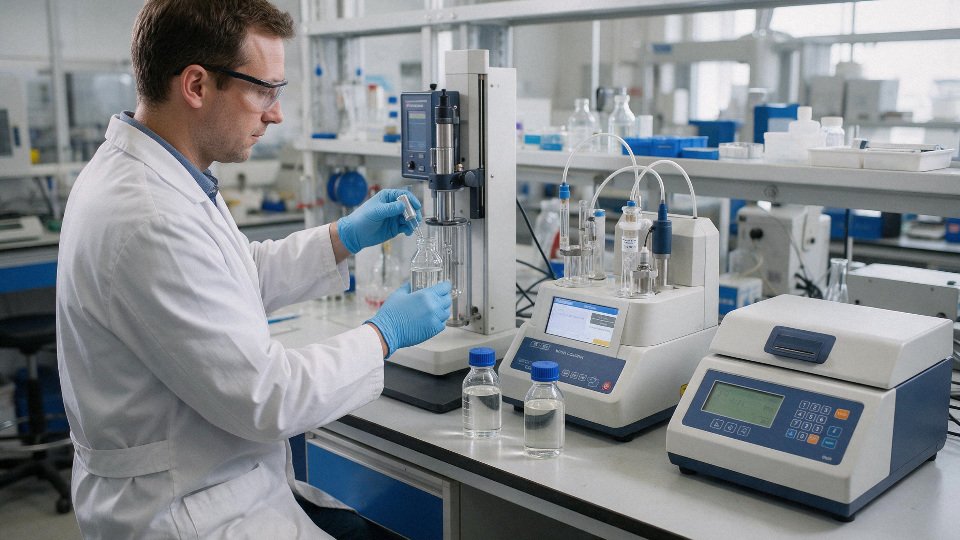
Karl Fischer titration is the common method because it can resolve low water levels far better than visual checks. Equivalent methods may be used, but they need comparable sensitivity and validation on the specific fluid grade.
Where moisture matters most:
- Dielectric fluids and electrical insulation systems
- Moisture-sensitive formulations using reactive silanes or crosslinkers
- Precision coating where water can affect wetting or cure
- Any sealed application where trace water can contribute to corrosion, gas formation, or property drift
A recurring plant-floor problem is sample handling, not drying performance. If a lab tech pulls a hot sample into a damp bottle, leaves headspace open, or tests after prolonged exposure to ambient humidity, the reported water may reflect handling error more than batch condition. This is one place where method discipline is inseparable from product truth.
Volatiles, loss on heating, and cyclic profiling
Low-odor, low-fogging, and low-emission requirements usually live or die on the volatile fraction. Suitable analytical methods can include loss on heating, vacuum loss, gas chromatography for cyclic siloxane profiling, or other validated volatility measurements appropriate to the grade.
These tests help answer different questions:
- Loss on heating: how much mass is lost under a defined thermal condition
- Volatile content: broad measure of low-boiling fraction remaining after purification
- Cyclic siloxane profile: which light species are present and in what approximate proportion
- Odor-linked risk: whether the residual volatile package is likely to be noticed in enclosed use
The mechanism matters. Residual low boilers can migrate out during heating, create odor, raise fogging on nearby surfaces, shift viscosity slightly over storage, and in some applications trigger customer concern even when the fluid technically still functions. A fluid may pass basic viscosity and appearance checks yet still fail a low-fogging interior or enclosed-device requirement.
This conclusion stops holding if the application is open-system, non-cosmetic, and insensitive to trace emissions; in those cases, an expensive volatile profile may add little purchasing value beyond confirming process consistency.
Residue and contamination chemistry: when catalyst carryover is the hidden risk
Where catalyst residues or inorganic contamination are concerns, the useful QC package extends beyond standard physical properties.
Common checks include:
- Acid value
- Alkalinity
- Ionic residue
- Ash
- Conductivity-related indicators, where applicable and methodologically valid
These are not interchangeable. Acid value can point to acidic contaminants or degradation products. Alkalinity can indicate caustic residue or basic catalyst carryover. Ash is a blunt but useful sign of inorganic residue after ignition. Ionic residue and conductivity-related metrics matter where trace ions can affect dielectric behavior, corrosion risk, or sensitive downstream processes.
In practice, these tests are often most valuable after process changes, raw-material source changes, or cleaning interventions. A line that was flushed with the wrong water quality, a worn seal that sheds material, or a catalyst neutralization step that drifts can all show up here before a customer sees instability.
Cleanliness metrics for precision uses
For precision coating, electronics, and optical applications, particle count or gravimetric insolubles usually matters more than whether the fluid merely “looks clean.” Depending on end use, filtration targets may range from around 25 microns down to below 1 micron, but the release test should match the actual contamination sensitivity of the application rather than a generic filtration headline.
Useful cleanliness tests include:
- Particle count by defined size bands
- Gravimetric insolubles
- Membrane patch inspection
- Application-specific cleanliness methods agreed with the customer
The trade-off is cost versus relevance. Tight particle counting adds control and confidence, but if the customer is pumping a medium-viscosity fluid through a non-critical lubrication point, that effort may be wasted. On the other hand, for a thin-film coating head or optical substrate, one oversized particle can create streaks, defects, or line stoppage.
Supporting fingerprint and safety checks
Flash point, density, refractive index, and surface tension are usually supporting checks rather than primary release gates, but they are useful for confirming identity, batch consistency, and basic handling safety.
- Flash point helps verify safe storage and transport classification boundaries, subject to the current test method and applicable regulations
- Density can flag blending error or composition drift
- Refractive index is often a sensitive identity check for consistent grades
- Surface tension can reveal contamination that affects wetting and spreading
None of these should be overinterpreted. A correct density does not prove low ionic contamination, and a good refractive index does not prove low volatiles.
Stability, odor, documentation, and what serious buyers should require
Some problems only appear after the fluid sits, heats, or cycles. Thermal stability testing, storage trials, and controlled odor evaluation can expose latent instability that fresh-batch QC misses. This matters for fluids that will see elevated service temperature, long warehouse residence, or customer repackaging.
Serious industrial buyers usually expect at least:
- Lot traceability back to raw materials and production date
- Retain samples stored for complaint investigation
- A certificate of analysis with method references, units, specification limits, and actual results
- Change control notice for raw material, process, equipment, or test-method changes that may affect performance
A silicone oil can pass every listed QC item and still fail in service if the supplier and buyer did not align the test method with the actual failure mode.True
This is a standard quality-engineering issue. Pass/fail depends not only on measured values but also on whether the selected method is sensitive to the contaminant or property that drives field failure, and whether sampling and handling preserved the true condition of the batch.
That is the part many purchasing teams learn late. Absolute numbers matter, but method alignment matters just as much: the same moisture result from poor sampling is not trustworthy, the same particle count from a different size threshold is not comparable, and the same volatile number from a different heating protocol may predict customer behavior very differently. If the application is sensitive, the supplier should be able to explain not just the result, but why that result is the right proxy for your actual process risk.
Application-specific purity needs
The right purification level for silicone oil is set by failure mode, not by how premium the grade sounds on a data sheet. A buyer paying for ultra-low particles, moisture, and volatiles in a construction defoamer usually wastes money; the same impurity levels in a dielectric fluid or precision dispensing oil can trigger field failures, scrap, or unstable process behavior.
That distinction matters because each extra purification step has a cost path behind it: slower filtration, tighter tank hygiene, longer vacuum residence time, more rejects at final QC, and often lower effective plant throughput. Purity should be specified against the actual use environment, the downstream sensitivity, and the consequence of failure. Once those three are clear, the purification target usually becomes much easier to defend in procurement.
Electrical and dielectric fluids
For electrical service, the critical purity drivers are moisture, ionic contamination, dissolved gas, and anything that shifts dielectric behavior under heat and voltage. Premium dielectric fluids commonly target low residual moisture after drying, often below roughly 50-200 ppm depending on the application sensitivity, handling exposure after drying, and the customer’s test method. Gas content also matters because entrained or dissolved volatiles can change breakdown behavior, especially if the fluid is used in sealed or thermally cycled equipment.
The mechanism is straightforward but unforgiving:
- Water lowers insulation reliability and can accelerate electrical discharge problems
- Ionic residues raise conductivity and can destabilize dielectric loss behavior
- Fine particles create local field concentration points
- Residual low boilers or dissolved gases can expand, outgas, or shift performance under heat
In practice, the purification train is only half the job. A fluid can leave the dryer in good shape and pick up moisture again through poor drum handling, a wet nitrogen line, or a tank vent that was fine in summer and condenses in winter. Plants miss that all the time.
What buyers should ask for:
- Moisture limit and test method
- Particle cleanliness target and size basis
- Whether degassing or vacuum stripping was used
- Conductivity, dielectric loss, or breakdown-related test data where relevant
- Packaging controls that preserve the achieved dryness and cleanliness
The boundary here is simple: if the oil is not serving an electrical insulation function, chasing dielectric-style dryness and gas control may not pay back.
Personal care and consumer formulations
For personal care, purity is judged less by dielectric metrics and more by sensory consistency and formulation behavior. Odor, color, volatile profile, skin feel, and documentation discipline usually matter more than pushing particles to the lowest technically possible level.
The common risk is assuming “clear and colorless” equals finished-grade suitability. It does not. A silicone fluid can look clean and still carry trace volatiles that create odor drift, a narrow but problematic light fraction that changes evaporation feel, or low-level residues that interfere with fragrance and active compatibility.
Priority checks usually include:
- Odor neutrality across batches
- Tight color control
- Stable viscosity and volatile distribution
- Low visible insolubles or haze
- Regulatory and compositional documentation matched to the target market
The trade-off is cost versus consistency. Deeper stripping and tighter finishing improve batch-to-batch feel and odor stability, but they can add cycle time and reduce yield if the volatility window is narrow. That premium is justified in leave-on or sensory-sensitive products; it is less justified in basic industrial emulsions sold into non-cosmetic channels.
Release coatings and paper treatment
Release applications are sensitive in a different way: the silicone oil must behave predictably around catalysts, crosslinkers, and coating equipment. Low gel content, controlled molecular distribution, and good flow uniformity matter because coat weight, cure response, and release performance all move when the fluid population is too broad or contaminated with reactive residues.
Watch these risk points:
- Gel particles that seed coating defects or streaks
- Residual catalyst poisons that slow or randomize cure
- Broad molecular distribution that changes rheology on-machine
- Insolubles that plug screens, pumps, or slot dies
A fluid that is “clean enough” for bulk lubrication may be a headache on a paper line running tight coat-weight control. On fast coaters, even small amounts of gel or haze can show up as lines, skips, or release inconsistency downstream.
Lubrication and heat transfer uses
For lubrication and heat-transfer service, the practical target is stable operation under temperature, shear, and time. That usually means low abrasive particles, controlled low-volatility content, and good oxidative cleanliness rather than extreme cosmetic-grade finishing.
Key requirements:
- Minimal hard particle contamination to reduce wear
- Low enough volatility for the operating temperature range
- Good thermal stability over the expected residence time
- Low residue tendency after prolonged heat exposure
Here the trade-off often flips. If the system runs hot and sealed, lower volatility and strong thermal housekeeping are worth paying for. If it is a moderate-temperature, consumable industrial lubricant, ultra-deep purification may not change service life enough to matter.
Textile, leather, and agricultural formulations
In formulation-driven sectors, the silicone oil does not work alone; it has to emulsify, dilute, blend, and stay compatible with surfactants or carriers. Low insolubles and reliable downstream behavior matter more than premium claims about unrelated purity metrics.
Typical concerns are:
- Emulsion instability from incompatible trace residues
- Haze or phase separation after dilution
- Filter plugging in formulation or spray systems
- Variable wetting, hand feel, or spreading performance
This is where sample validation beats theory. A fluid may meet its own certificate and still misbehave in a customer’s emulsifier package or tank-water quality.
Optical, precision dispensing, and specialty electronics applications
These are the applications where cleanliness gets expensive for a reason. Clarity, sub-visible particle control, low outgassing, and package cleanliness can dominate because the oil is used in tight gaps, fine needles, optical paths, or sealed assemblies.
Buyers in this group should scrutinize:
- Particle cleanliness target tied to dispensing gap or optical tolerance
- Outgassing risk under vacuum or heat
- Container cleanliness and filling environment
- Haze, clarity, and visible particulate inspection standard
The same silicone oil purity target is appropriate across all high-value applications.False
High-value end uses fail for different reasons. Electronics may prioritize outgassing and particle control, while personal care often prioritizes odor, volatility profile, and documentation. The purification target has to follow the actual failure mechanism.
Construction, defoaming, and general industrial uses
For broad industrial use, fit-for-purpose purification usually wins. These applications often need reasonable filtration, acceptable color and stability, and low enough insolubles to avoid processing trouble, but not the full premium package required for dielectric, optical, or specialty electronics service.
A disciplined buyer will define:
- What failure actually hurts the process
- Which impurity classes create that failure
- What level is sufficient rather than maximal
- Whether the supplier can hold that level consistently at commercial scale
That last point is the one many teams skip. Grade labels are marketing shorthand; they are not a substitute for use-specific specifications. If the oil is going into a paper release line, a skin-contact formula, a transformer-type dielectric service, or a sprayable agricultural formulation, the correct purification target comes from that duty, the line conditions, and the downstream tolerance stack, not from the prestige attached to the word “premium.”
Production and sourcing risks
Most purification failures are not caused by the headline technology; they come from variability and discipline gaps around it. If you are buying purified silicone oil, the practical risk is less “does the supplier own filters and vacuum equipment?” and more “can they control feed variability, prevent cross-contamination, and prove lot stability with representative data?”
Raw material variability is the first place consistency starts to move. Silicone oil made from different upstream siloxane streams can arrive with different cyclic content, residual low boilers, catalyst traces, moisture load, or particulate burden. That shifts the purification load immediately:
- Higher volatile content usually means longer or deeper stripping, which can cut throughput and sometimes reduce yield.
- Higher solids or gel precursors increase filter loading, shorten media life, and raise the chance of pressure spikes or bypass events.
- Variable moisture pushes drying time and can upset adsorbent performance.
- Trace catalyst or reactive impurities can change what happens under heat, especially in longer residence systems.
That matters commercially because a supplier may quote one grade as if purification duty were fixed. In practice, the same nominal viscosity oil can behave differently batch to batch if upstream control is loose. One lot strips cleanly with stable color; the next needs more heat history to hit volatility targets, and now viscosity or odor starts to drift. The conclusion here holds only if the supplier is running a stable, characterized feedstock system. If they are buying opportunistically from multiple upstream sources, lot-to-lot variation is much harder to suppress.
Cross-contamination is the next big blind spot, especially in campaign plants. Shared reactors, day tanks, transfer hoses, filter housings, tote filling lines, and even the “clean” sample valve can carry enough residue to matter in premium fluid applications. Common pathways include:
- Residual higher-viscosity silicone left in hose walls or pump dead legs
- Carryover from amino-, epoxy-, phenyl-, or other modified silicone campaigns
- Packaging line contamination from drums, IBC wands, or reused caps
- Cleaning solvent residues that were not fully removed before refill
- Maintenance interventions introducing grease, gasket fragments, or shop dust
A few kilograms of carryover in a large tank may be irrelevant for some industrial release agents. It is not irrelevant for electronics, cosmetic, or process-sensitive uses where odor, haze, moisture, or compatibility matter. In my experience, buyers often ask about the final COA but not the line-clearance method. That is backward. If a supplier cannot explain segregation, flush criteria, and campaign sequencing, the COA alone is not enough.
Process control inside purification can also create defects the raw material did not originally have. Overheating, excessive residence time, and unstable vacuum are the usual culprits. Under vacuum stripping, the temperature has to be chosen against viscosity grade and volatility profile; too low and the volatiles stay in, too high and you start paying in color, odor, or molecular change. Poor vacuum control, say drifting outside the intended 1-50 mbar band for the product and stage, can force operators to compensate with more heat and more time. That is where you see:
- Viscosity drift from chain scission or rearrangement in sensitive systems
- Darkening or yellow tint formation
- Burnt or sharp odor notes
- Lower oxidation stability later in the customer’s process
The trade-off is straightforward: harder stripping can improve volatile removal, but it can also damage the fluid if the chemistry is not tolerant of the thermal history. The preferred setting flips when the application is highly sensitive to residual low boilers versus highly sensitive to color or viscosity stability.
Adsorbents are another risk area buyers tend to underestimate. Clay, silica, alumina, carbon, or proprietary blends can be useful, but only if handled well. Improper media storage, wet media charging, poor preconditioning, or rushed filtration after treatment can introduce secondary contamination instead of removing it. Watch for:
- Media fines passing downstream and showing up as haze or sediment
- Residual dust from inadequate post-treatment filtration
- Moisture pickup from improperly sealed adsorbent bags or bins
- Inconsistent contact time causing uneven cleanup from lot to lot
A plant that stores adsorbent in a humid warehouse with torn liners will struggle to produce low-moisture premium fluid, no matter how good the dryer looks on paper.
Drying failures often happen after the drying step, not during it. Silicone oil that leaves purification below roughly 50-200 ppm moisture for a moisture-sensitive application can easily reabsorb water through open transfer, unblanketed tanks, poorly sealed manways, or slow drum filling in humid weather. Summer conditions make this worse. So do long holds in intermediate tanks with too much headspace. Closed transfer, dry inert blanketing where justified, and fast sealed packaging are often more important than squeezing another few ppm out of the dryer.
Analytical weakness is where unstable lots escape into the market. The problem is not always missing tests; often it is bad sampling or weak release logic. A top sample from a settled tote can miss fines at the bottom. A single retained sample taken before final packaging may not represent what actually shipped if the line was contaminated later. Buyers should press on:
- Where the sample is taken: reactor, polish tank, package line, or retained package
- Whether samples are composite or single-point
- Which properties are release-critical versus informational only
- What happens when a value trends toward a spec edge but still passes
A passing COA does not guarantee lot stability if sampling is non-representative or release limits are too broad for the application.True
Lab results are only as reliable as the sampling point, test method fit, and release criteria. A lot can meet broad supplier specs and still fail in a moisture-sensitive or appearance-sensitive customer process.
Documentation becomes a hard commercial issue in regulated or export markets. Customers may need restricted-substance support, compositional transparency at least by impurity class, traceability to raw material source, and evidence of consistency over time rather than one-off pass results. A supplier who cannot provide controlled revision history, lot traceability, change notification discipline, and basic corrective action records will create delays even if the product itself is usable.
Useful supplier risk indicators are usually visible before a full audit:
| Indicator | What it often suggests | Buyer implication |
|---|---|---|
| Very broad viscosity, color, or moisture specs | Weak process capability or broad feed variability | Expect higher lot review burden |
| Noticeable lot-to-lot odor or color shift | Thermal history variation, residual volatiles, or contamination | Request retained sample comparison |
| No clear explanation of purification sequence | Trading or outsourced processing with limited control | Verify actual manufacturing responsibility |
| No CAPA or deviation process | Recurring issues handled informally | Higher recurrence risk after complaints |
| Prices far below market without a technical explanation | Lower purification depth, off-grade blending, or reduced QC intensity | Check if application can truly tolerate it |
Low-price offers are not automatically bad buying. They are rational when the application’s impurity tolerance is genuinely wide, the finish requirements are forgiving, and the process can absorb some lot variation without scrap or maintenance penalty. Once the fluid goes into high-value coating, electronics, personal care, or any process where odor, moisture, appearance, or consistency drive yield, the hidden cost of a cheap unstable lot is usually much higher than the invoice delta.
Frequently asked questions
Can silicone oil be purified after storage contamination, or must it be replaced?
Usually yes, if the contamination is limited to particles, free water, light volatiles, or a known cross-contaminant that has not chemically degraded the fluid. Replacement becomes the safer choice when the oil has oxidized, gelled, picked up reactive chemistry, or mixed with another fluid that cannot be separated economically.
A practical screen looks like this:
- Identify the contaminant source
- Breather moisture ingress
- Dirty transfer hoses or tote residues
- Rust, gasket fragments, drum liner debris
- Wrong-fluid top-up
- Thermal degradation during storage near heat
- Check whether the base fluid is still chemically intact
- Viscosity drift
- Color change
- Acid value, if relevant to the grade
- Odor shift
- Increased insolubles or haze
- Match recovery method to contamination
- Particles: staged filtration
- Water: vacuum drying or stripping
- Light volatiles: vacuum stripping
- Adsorbable trace color/odor bodies: cautious carbon or clay treatment
If the fluid has developed irreversible polymer breakdown products or crosslinked material, purification often turns into good money after bad.
What is the best method to remove residual cyclic siloxanes from silicone oil?
For most industrial grades, vacuum stripping is the primary method. The useful operating window is often about 1-50 mbar, with temperature set by the fluid viscosity and the volatility profile of the residual cyclics; too cold and removal is slow, too hot and you risk darkening, oxidation, or shifting viscosity.
The mechanism is straightforward: lower pressure reduces the partial pressure needed for volatile cyclics to leave the bulk fluid. Thin-film or wiped-film style equipment usually outperforms a deep kettle on mass transfer, especially with higher-viscosity oils. If the cyclic level target is tight, buyers should ask whether the supplier is quoting a general low-volatility claim or a measured result tied to a defined test method.
How dry should silicone oil be for dielectric or moisture-sensitive applications?
For premium moisture-sensitive service, a common target after drying is below roughly 50-200 ppm water, but the right limit depends on voltage stress, downstream reactivity, storage exposure, and how the customer measures moisture. A number without a method is not enough; Karl Fischer practice, sampling method, and container condition all matter.
If the oil is filled hot into damp packaging, the certificate can look fine while the delivered drum does not.
Does finer filtration improve all silicone oil applications?
No. Finer filtration helps when particles drive wear, dielectric failure, optical defects, or coating defects, but it does not solve dissolved volatiles, moisture, or odor issues. Typical targets range from 25 microns down to below 1 micron depending on end use.
There is a trade-off:
- Gain: lower particle count, cleaner appearance, less downstream defect risk
- Sacrifice: slower throughput, higher differential pressure, more filter cost, more risk of shear or handling losses in viscous grades
On a drum-filling line for a general-purpose release or lubricant fluid, ultra-fine filtration can be unnecessary cost. For electronics, optics, or precision fluid service, it can be worth it.
Can activated carbon or clay change silicone oil properties?
Yes. They can remove trace color bodies, odor-forming impurities, and some polar contaminants, but they can also strip desirable additives or shift appearance and stability if the treatment is not controlled.
Watch these points:
- Contact time too long can over-treat the fluid
- Fine adsorbent carryover creates its own particle problem
- Different carbons and clays behave very differently; one plant’s result does not generalize
- Post-treatment polishing filtration is usually required
Activated carbon always improves silicone oil quality without side effects.False
Carbon can help with trace impurities, but it may also remove functional additives, leave fines if filtration is poor, or alter odor/color unpredictably. It needs lab confirmation on the actual grade.
How do buyers verify low volatility and low odor claims?
Ask for the test basis, not just the adjective. “Low volatility” should be tied to a defined loss-on-heating, thermogravimetric, GC-based volatile content, or another specified method; “low odor” is harder because sensory claims are subjective unless supported by controlled panel methods or correlated volatile analysis.
Minimum buyer checks:
- Test method and conditions
- Lot-specific COA, not a brochure value
- Whether the result reflects post-packaging product
- Retained sample availability for dispute resolution
Is batch purification acceptable, or is continuous processing better?
Both are acceptable if the controls fit the product and volume. Batch systems are common for specialty grades, smaller campaigns, and products needing flexible residence time; continuous systems usually win on throughput consistency and lower lot-to-lot variation once the process is stable.
The preference flips with operating reality:
- Batch is often better when grades change frequently or the plant runs many viscosities
- Continuous is often better when one family of products runs steadily and the contamination load is predictable
A badly controlled continuous line can drift for hours before anyone catches it. A sloppy batch operation can vary drum to drum. The equipment type matters less than the control discipline.
What documents should a serious supplier provide with purified silicone oil?
At minimum, buyers should expect:
- Certificate of analysis
- Viscosity
- Moisture, if relevant
- Appearance/color
- Volatile content or other agreed purity indicators
- Particle-related result if specified
- Technical data sheet
- Typical properties
- Recommended handling and storage
- Application limits
- Safety document
- Current SDS compliant with the destination market requirement
- Traceability information
- Batch number
- Manufacturing date or release date
- Packaging identification
- For tighter programs, on request
- Test methods
- Retained sample policy
- Statement of filtration or drying practice
- Change-control or specification-change notification policy
- Regulatory or composition declarations where applicable
Your purification specification check
The right specification usually starts narrower than buyers expect. If you begin with end use, likely failure mode, and any regulatory or customer audit exposure, you can avoid paying for purification steps that do not reduce your actual risk while still tightening the parameters that matter. Asking for “highest purity” without that context often creates cost, lead-time, and approval trouble without improving field performance.
A release coating line, a dielectric fluid, a textile softener intermediate, and a moisture-sensitive additive package do not fail the same way. In practice, the purchasing spec should be built backward from what goes wrong in the plant or at the customer:
- Performance failure
- Cure inhibition in silicone elastomer or coating systems
- Foam instability or carryover in process baths
- Dielectric weakness in electrical use
- Haze, fish-eyes, or surface defects in coatings
- Processing failure
- Viscosity drift affecting pumpability, metering, or coating weight
- Excess volatiles causing odor, weight loss, or flash-off during heating
- Particles plugging nozzles, filters, or precision applicators
- Commercial and compliance exposure
- Customer complaint over color, odor, or lot variation
- Audit failure because traceability or change control is weak
- Packaging contamination introduced after the fluid itself was purified
Once that is clear, define the critical-to-quality items. Not every silicone oil needs all of them, but the list should be explicit rather than assumed:
- Viscosity window
State nominal viscosity, test temperature, and allowable range. A broad range may be harmless in bulk defoamer service and unacceptable in precision dosing or coating. - Moisture limit
For moisture-sensitive applications, targets are often below roughly 50–200 ppm after drying, but the right number depends on downstream chemistry and storage exposure. - Volatile content
- Low boilers affecting odor, evaporation loss, or closed-cup behavior
- Residual cyclics or light fractions where customer specifications require control
- Particle cleanliness
Typical filtered removal targets range from about 25 microns down to below 1 micron depending on the end use. Fine filtration matters most where there are tight clearances, optical surfaces, or thin films. - Color and odor
- Often dismissed until the first complaint
- Especially relevant in personal care intermediates, coatings, and indoor-use products
- Ionic residue or ash-related indicators
Useful when catalyst residue, corrosion risk, or electrical behavior matters. - Packaging cleanliness
Drum, tote, liner, cap, and filling environment can undo a good polishing step.
The test method has to sit next to the target, or the same number will be interpreted three different ways. A practical buyer-side checklist looks like this:
| CTQ item | What to specify | Verification point |
|---|---|---|
| Viscosity | Test temperature, method, acceptance range | COA plus incoming check |
| Moisture | Method and max ppm | Freshly packed lot, not aged retain |
| Volatiles | Method, temperature/time basis, max loss | COA and application validation |
| Particle cleanliness | Filter rating or particle count basis | Clarify whether nominal or absolute filtration is claimed |
| Color | Method and acceptance limit | Compare against retained approval sample |
| Odor | Sensory or customer-defined threshold | Validate on heated-use condition if relevant |
| Ionic residue | Test basis and limit | Needed only where performance risk justifies it |
| Packaging cleanliness | Container standard and closure requirements | Inspect first delivery physically |
A particle filtration claim is not meaningful unless the supplier states the filter rating basis and where in the process the filtration occurs.True
Nominal and absolute ratings are not interchangeable, and downstream transfer or filling can reintroduce contamination after a polishing filter.
Ask for a short process summary before placing the scale order. It does not need to expose proprietary know-how, but it should tell you whether purification relies on settling, filtration, adsorption, vacuum stripping, drying, or combinations of these, and how the material is protected afterward. The weak point is often not the polishing technology itself; it is transfer through an old hose set, a vented hold tank, or a poorly controlled filling station.
Also verify supplier controls that only become visible after a problem:
- Sample retention period for each lot
- Lot numbering and batch traceability to production date
- Certificate of analysis format and whether it matches your release criteria
- Change-notification commitment for raw material source, purification route, test method, or packaging change
- Deviation handling and complaint response path
Do not approve a grade on generic lab values alone if the application has a known failure mode. Run the validation that matches the use:
- Cure compatibility in your actual silicone system
- Foam behavior under your shear and temperature conditions
- Dielectric testing under your operating conditions
- Coating, wetting, slip, or release performance on the actual substrate
The preferred choice flips here: a broader commercial grade may be perfectly acceptable when the application is forgiving and the process has filtration and drying downstream; it stops being the right choice when the oil goes directly into a sensitive formulation or precision application with no cleanup step left.
When changing supplier, grade, or purification route, use a pilot lot or first article approval. Include packaging inspection, incoming QC, line trial performance, and retain-sample signoff before releasing full annual volume.
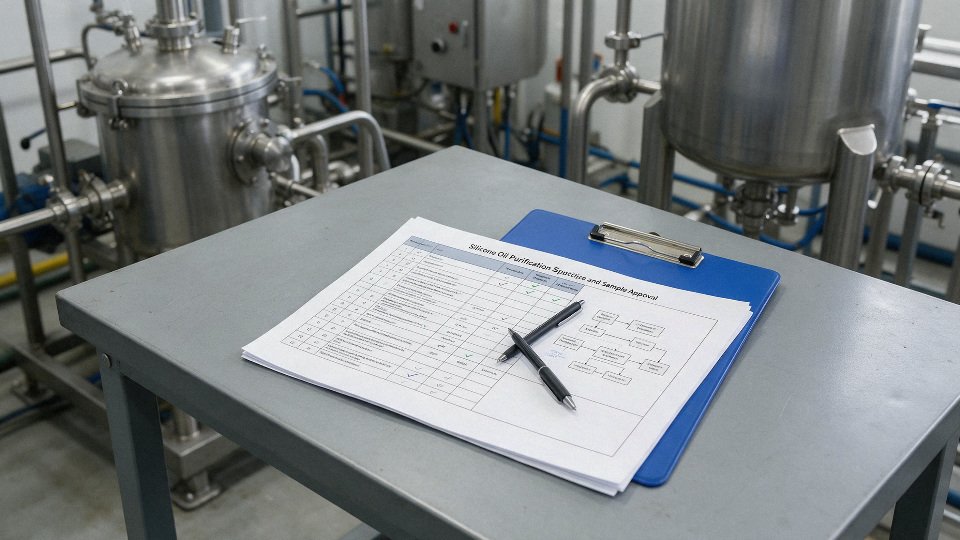
If you are qualifying silicone oil for a new or replacement source, send SiliconChemicals the application, substrate or formulation context, contaminant sensitivities, target viscosity, moisture or volatile limits, particle cleanliness expectation, required finish or performance result, packaging preference, and annual volume. With that information, SiliconChemicals can recommend an appropriate purification grade and supply model, then align samples and documentation to the specification you actually need.