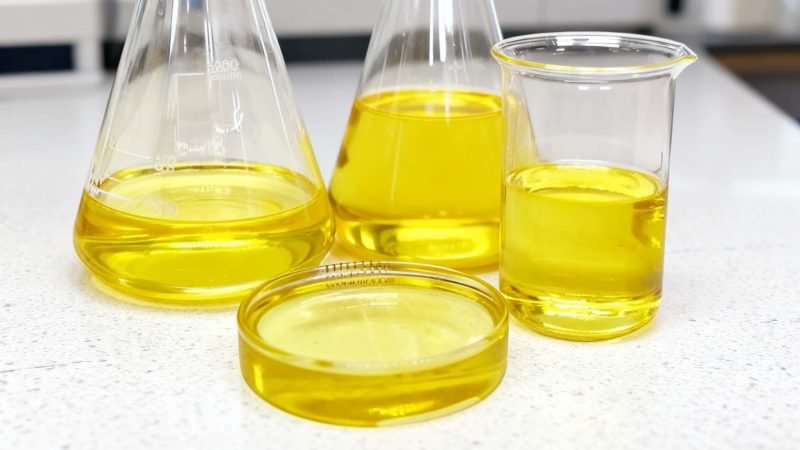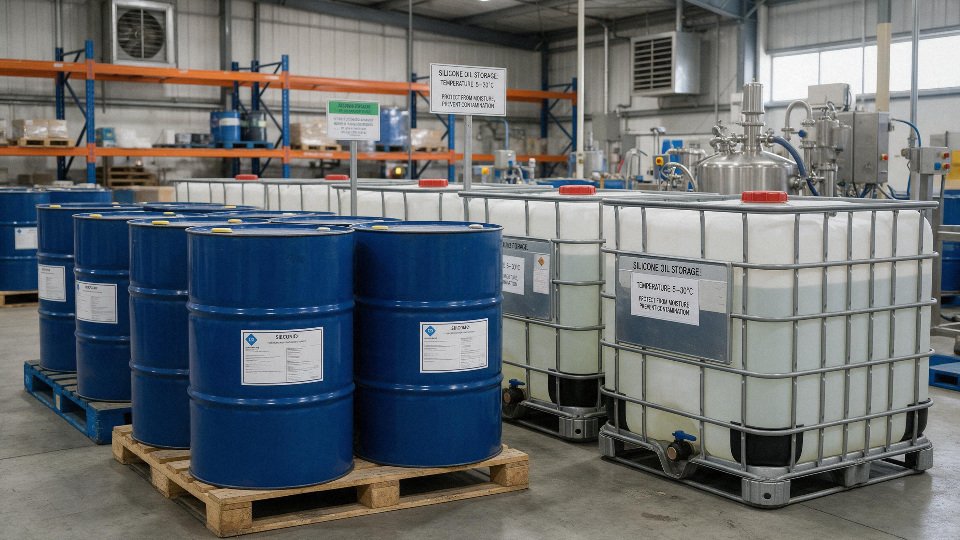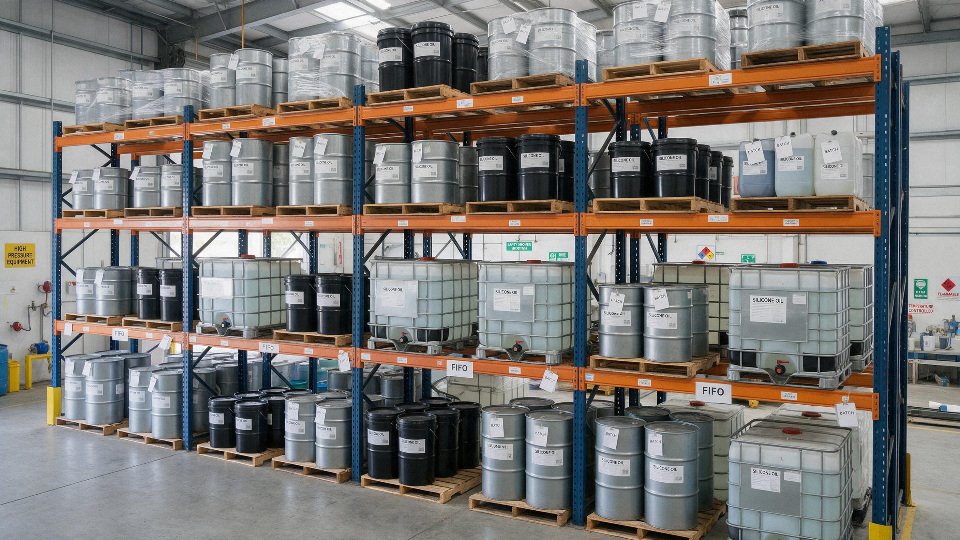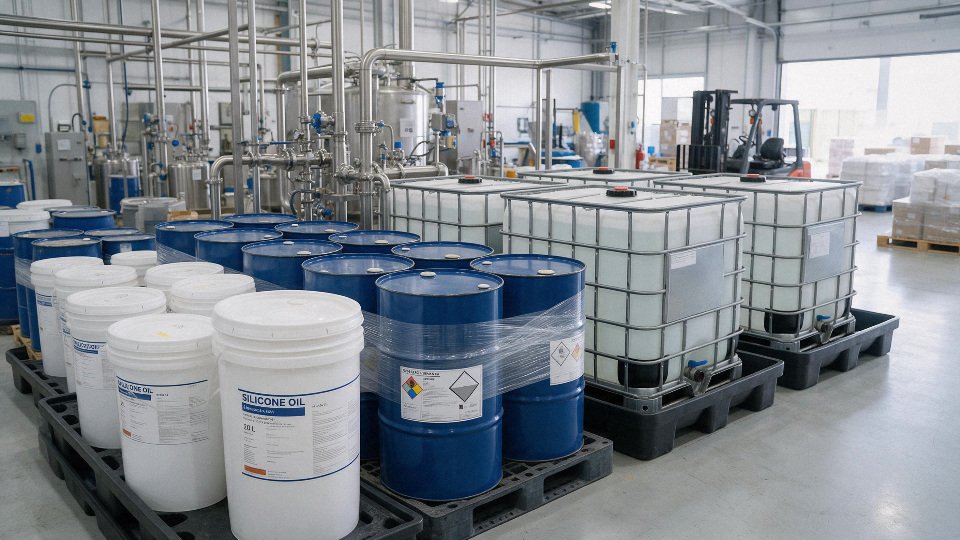
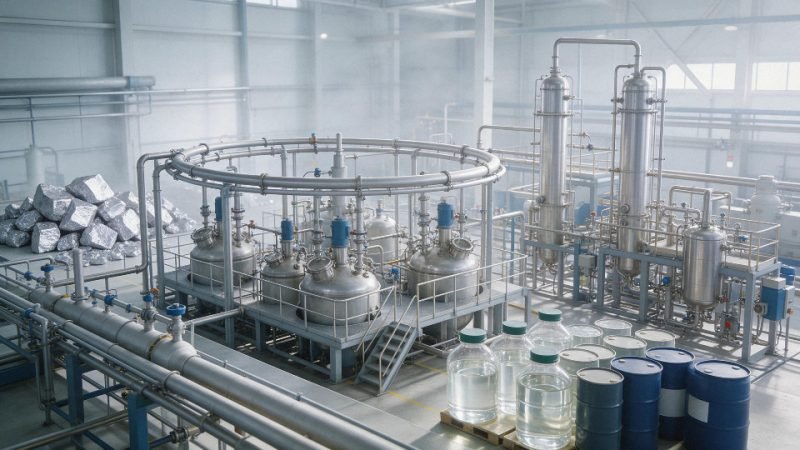
Buyers get into trouble with silicone oil when they treat it like a simple petroleum fluid and ask only for viscosity. That shortcut hides the upstream chemistry that actually drives purity, volatility, odor, residual chloride risk, and how consistently the fluid will behave in compounding, release, lubrication, defoaming, or personal-care use. The cost shows up later as off-spec batches, extra incoming inspection, line fouling, customer complaints, or paying a premium for a grade that was never necessary. The practical fix is to understand which raw materials build silicone oil, what each one contributes, and where the process starts to split between commodity fluid and tighter-spec industrial or specialty grades.
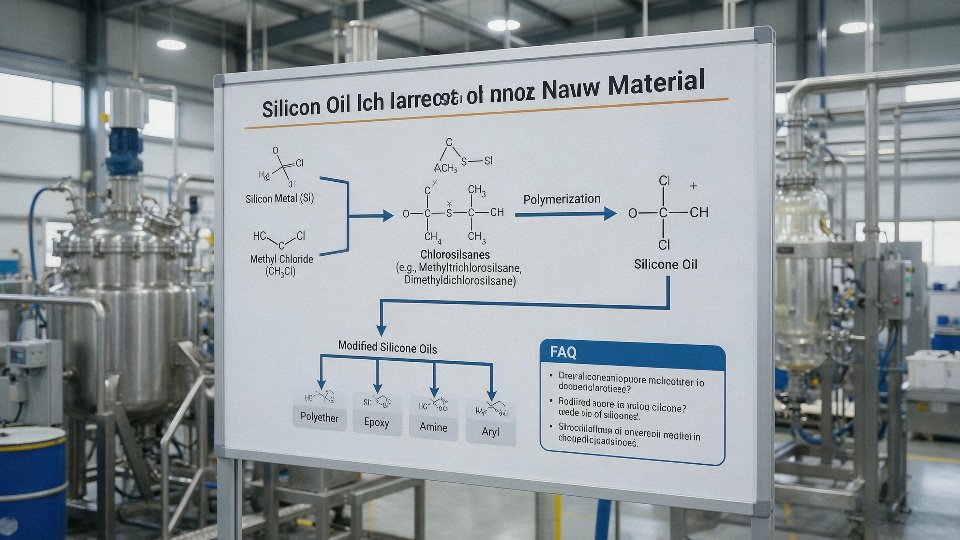
Silicone oil is made primarily from silicon metal and methyl chloride, which react to form methyl chlorosilanes, then hydrolyze and condense into siloxane intermediates that are finished into silicone fluids. Depending on the product, the raw-material picture also includes catalysts, water, neutralizing and washing agents, and end-blocking or modifying materials that set viscosity, functionality, and final performance.
That sounds straightforward on paper, but the interesting part is where the same basic chemistry starts producing very different commercial outcomes. A low-viscosity fluid around 0.65 cSt and a heavy PDMS above 100000 cSt may share the same family tree, yet the feed choices, chlorosilane balance, cleanup burden, and finishing route are not commercially equivalent, and neither is the buying risk.
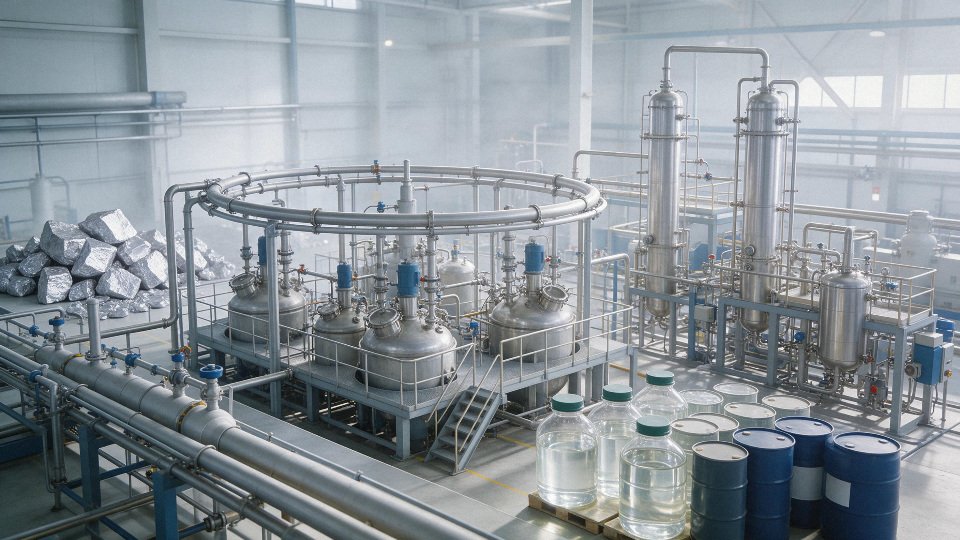
Silicon sources and carbon inputs
Silicone oil starts with two foundational raw-material families: a silicon source, almost always silicon metal, and a carbon-bearing organification source, usually methyl chloride. If either side is weak, unstable, or impurity-heavy, the problem shows up much later as poorer direct synthesis selectivity, wider chlorosilane slates, more cleanup load, and less predictable finished-fluid quality.
The important point for buyers is that “silicone oil raw material” does not begin at a drum of intermediate siloxane. It begins upstream in metallurgical silicon, chloromethane chemistry, and the integration around them. That is why two suppliers selling nominally similar PDMS fluid can have very different cost stability and batch consistency.
Silicon metal: the primary silicon source
For mainstream silicone oil production, the core silicon input is silicon metal made by carbothermic reduction of quartz in electric arc furnaces. This is standard organosilicon industry practice: quartz provides SiO2, carbon reductants strip off oxygen at high temperature, and the resulting metallurgical silicon is processed into the direct synthesis route that produces methylchlorosilanes.
In procurement language, silicon metal is not a generic commodity once it crosses into organosilicon use. The downstream direct process is sensitive to:
- Silicon purity
- Particle size distribution
- Metal impurity profile, especially elements that influence catalyst behavior and chlorosilane selectivity
- Consistency lot to lot, not just average assay
A plant can often tolerate small variation for a short period, but not indefinitely. In the direct synthesis reactor, silicon surface condition and impurity chemistry affect how readily methyl chloride reacts and what chlorosilanes are formed. If the silicon is too coarse, too fine, oxidized, or carries an unfavorable impurity balance, conversion and selectivity drift. That usually means more trimethylchlorosilane or heavier by-products than planned, lower dimethyldichlorosilane yield, and more downstream separation burden.
That mechanism matters because dimethyldichlorosilane is the main precursor to PDMS-type silicone oil. If upstream silicon quality pushes the monomer slate away from the target, the plant can still make saleable fluid, but yield, distillation load, and unit cost usually move the wrong way.
What sits behind silicon metal: quartz, carbon reductants, and power
Silicon metal itself depends on three big upstream inputs:
- Quartz
- Carbon reductants, typically coal, coke, charcoal, or blends chosen by furnace practice
- Electricity, in large continuous loads
Quartz quality affects furnace stability and silicon purity. Carbon reductant choice affects reaction behavior, impurity carryover, and often cost. Electricity is the one many buyers underestimate. Silicon metal production is power-intensive enough that regional power pricing, curtailment risk, seasonal hydropower swings, and energy policy can all feed through into organosilicon cost.
So while silicone oil buyers often watch monomer demand, not all pricing pressure starts there. In some periods, the bigger drivers are:
- power cost at silicon furnaces
- availability and price of coal or coke
- quartz mining and transport constraints
- environmental operating restrictions on energy-intensive industry
If you buy regularly, this explains a pattern people see on the market: silicone fluid prices can firm up even when downstream demand is only moderate, because the constraint is upstream silicon economics rather than finished-product pull.
Silicone oil raw-material pricing is influenced not only by silicone demand but also by electricity, carbon reductants, and chlor-alkali economics.True
This follows from the upstream chain: silicon metal depends heavily on furnace power and reductants, while methyl chloride and chlorine-related intermediates depend on chlor-alkali and integrated chlorination economics.
Methyl chloride: the main carbon input for organosilicon chemistry
On the carbon side, methyl chloride is the dominant feed used to convert silicon metal into methylchlorosilanes. In practical terms, this is the organifying reagent that turns elemental silicon into commercially useful organosilicon intermediates.
At plant level, methyl chloride is commonly produced from:
- Methanol and hydrogen chloride
- In some cases, chlorination-related integrated routes, depending on site configuration and legacy process design
The exact route matters less to most buyers than availability, purity, and integration. The direct process is sensitive to methyl chloride quality; contaminants can interfere with catalyst performance, corrosion behavior, and product distribution. A site with stable in-house chloromethane production usually has a better shot at holding chlorosilane consistency than a producer relying heavily on purchased spot material.
The typical direct process feed ratio of methyl chloride to silicon is about 1.2:1 to 1.8:1 by weight, depending on catalyst system and the target chlorosilane slate. That is a useful commercial anchor, but not a universal design number. Different reactor practice, recycle efficiency, and product objectives shift the ratio, so it should not be treated as a plant-independent benchmark.
Methanol matters beyond chloromethane
Methanol is strategic in this industry for two reasons.
First, it is the main upstream feed for methyl chloride production at many integrated sites. If methanol cost or supply tightens, chloromethane economics tighten with it, and chlorosilane cost follows.
Second, methanol also matters in downstream organosilicon chemistry beyond basic monomer manufacture. It is relevant to:
- Methoxy-functional silanes
- Certain capping chemistries
- Some equilibration-related finishing routes, depending on the product family and plant practice
That does not mean every silicone oil line consumes methanol directly in the same way. It means methanol has strategic leverage across the broader organosilicon chain, so producers with secure sourcing or backward integration are usually better buffered.
Hydrogen, chlorine, and HCl loops at integrated sites
A less visible advantage sits in the acid and chlorination loops. Integrated organosilicon sites often connect hydrogen, chlorine, hydrogen chloride, chloromethane, and chlorosilane operations so they can recycle intermediates and reduce outside purchases.
In broad terms:
- Chlorine and hydrogen support chlorination-related chemistry and upstream intermediate production
- Hydrogen chloride is both a feed and a recoverable stream in integrated systems
- During downstream hydrolysis of dimethyldichlorosilane, hydrochloric acid is generated as a co-product, while crude siloxane intermediates still need washing, neutralization, and devolatilization before finishing
That loop is commercially important. If a producer can internally consume or reconvert HCl, manage chlor-alkali dependence, and balance chloromethane production with monomer demand, raw-material cost is usually less exposed to outside market swings. The conclusion stops holding, though, when the site is integrated on paper but constrained in practice by power limits, chlor-alkali outages, or weak internal balancing between units. Plenty of “integrated” plants still hit bottlenecks.
Why procurement teams should care about integration level
For technical buyers, three upstream checks explain a lot about supplier reliability:
- What silicon metal grade do they use, and how tightly do they control it?
- Is methyl chloride produced in-house, secured under long-term supply, or bought opportunistically?
- How integrated is the site across chlorine, HCl, methanol, and chlorosilane operations?
A trader or toll blender may offer acceptable product for non-critical applications, especially where viscosity tolerance is wide and long-term batch matching is not severe. The trade-off is that they usually have less control over monomer consistency and less insulation from feedstock swings. For buyers running coating, personal care, release, textile, or precision process applications where fluid behavior must stay narrow from lot to lot, upstream integration is not a brochure detail; it is part of quality assurance.
Chlorosilane monomer families
Most silicone oils are not built directly from “silicone” as a generic feedstock; they are built from a chlorosilane slate, and the composition of that slate sets the structure of the finished fluid long before final blending or polishing. For standard PDMS oils, dimethyldichlorosilane is the workhorse precursor, but end-blockers, branching monomers, phenyl monomers, hydride monomers, and reactive silanes are what separate a basic commodity fluid from a fluid that actually fits the application.
The practical starting point is the direct process, often called the Müller-Rochow route. Silicon metal reacts with methyl chloride in the presence of copper-based catalysts to produce a mixed chlorosilane stream. In commercial operation, the methyl chloride to silicon mass ratio is typically about 1.2:1 to 1.8:1, depending on catalyst package, reactor behavior, recycle practice, and the target chlorosilane distribution the producer is trying to hold.
That point matters because the direct process does not produce a single neat monomer. It produces a family of compounds that then have to be separated, recycled, or deliberately carried forward. If the target is standard dimethyl silicone oil, the producer wants a strong yield of dimethyldichlorosilane. If the target is a specialty fluid with controlled end groups or later crosslinking capability, the whole upstream slate shifts.
The core chlorosilanes and what they do in the fluid
The most useful way to think about chlorosilanes is by the structural job each one does after hydrolysis and condensation.
| Chlorosilane | Main structural role in silicone oil | Typical consequence in finished fluid |
|---|---|---|
| Dimethyldichlorosilane | Builds linear dimethyl siloxane units | Standard PDMS backbone, broad viscosity range |
| Trimethylchlorosilane | End-blocks chains, stops chain growth | Controls molecular weight, lowers viscosity at fixed conversion |
| Methyltrichlorosilane | Introduces trifunctional branching sites | Raises branch content, can push toward resin or gel if overused |
| Methylphenyldichlorosilane | Adds methyl/phenyl substituted units | Better low-temperature behavior, refractive index shift, heat stability effects |
| Diphenyldichlorosilane | Adds higher phenyl content | Stronger optical and thermal modifications, higher cost |
| Methylhydrogendichlorosilane | Introduces Si-H functionality | Reactive fluids for hydrophobing, release, and addition-cure systems |
| Vinyl-containing chlorosilanes | Introduces unsaturation/reactive sites | Enables later crosslinking, grafting, or addition reaction |
| Alkoxysilanes / alkoxy-terminated intermediates | Alternative reactive feedstocks in some routes | Lower chloride burden, different handling and downstream compatibility |
Dimethyldichlorosilane: the main precursor for standard silicone oil
If you are buying conventional dimethyl silicone oil, dimethyldichlorosilane is usually the monomer doing most of the heavy lifting. After hydrolysis, it forms silanol-bearing intermediates that condense into linear dimethylsiloxane chains. Those chains can then be equilibrated, end-blocked, stripped, and finished into fluids spanning roughly 0.65 cSt for very low molecular weight materials to well above 100000 cSt for high molecular weight PDMS grades, depending on process route and degree of polymer growth.
Hydrolysis is not a cosmetic step. Dimethyldichlorosilane hydrolysis generates hydrochloric acid co-product and crude siloxane intermediates that require washing, neutralization, and devolatilization before finishing. Poor control here shows up later as acidity, haze, odor, unstable viscosity, corrosion complaints from customers, or all four at once.
Trimethylchlorosilane: small monomer, big effect on viscosity control
Trimethylchlorosilane is the classic chain stopper. It caps reactive silanol ends and limits further condensation, which is one of the cleanest ways to control molecular weight and end-group concentration.
This is where many buyers underestimate the chemistry. A small change in end-blocker ratio can shift the finished product from a manageable medium-viscosity fluid to something too light, too volatile, or too broad in distribution for the application. In antifoam carriers and general-purpose lubricating fluids, a broad target window may be acceptable. In personal care, electronics, or release coating systems, it usually is not.
Monomer ratio control is one of the main hidden levers behind finished viscosity, volatility, and consistency lot to lot. Plants that treat end-blocker addition as a broad operating range rather than a tight recipe often pay for it later in rework, off-spec blending, and customer complaints about evaporation loss.
Methyltrichlorosilane: where linear fluid starts turning into network character
Methyltrichlorosilane brings in trifunctional sites. In small controlled amounts, that can be useful for introducing limited branching, modifying flow behavior, or giving the fluid some resin-like character. In excess, it is one of the fastest ways to create instability: gel specks, broad molecular weight distribution, filtration load, or outright loss of fluid character.
The trade-off is straightforward. A bit of branching can improve body, film persistence, or specific surface effects. Too much branching sacrifices clarity, processability, and storage stability. The preferred choice flips when the product is intended to act more like a silicone resin intermediate than a true fluid.
Specialty monomers for property shifts
Phenyl-containing monomers
Phenyl substitution is used when standard dimethyl silicone oil is not enough. Methylphenyldichlorosilane and diphenyldichlorosilane are the common examples.
Their value usually shows up in three places:
- Improved low-temperature performance in certain formulations
- Refractive index adjustment for optical or cosmetic applications
- Better thermal stability in applications where plain PDMS starts to look weak
The mechanism is not mysterious: replacing some methyl groups with phenyl groups changes chain packing, intermolecular interactions, and thermal behavior. That can help maintain useful fluidity at lower temperature or improve behavior under heat, but it also raises raw material cost and can complicate compatibility with some organic components. In practice, buyers should not assume “phenyl-modified” means universally superior; it means the formulator paid for a different balance of properties.
Hydrogen-containing monomers
Methylhydrogendichlorosilane introduces Si-H groups into the siloxane structure. Those groups are reactive, which is exactly why these monomers matter.
You see Si-H functional fluids in:
- Water-repellent and hydrophobing treatments
- Release coatings
- Addition-cure silicone systems
- Surface modification packages
The gain is reactivity. The sacrifice is storage sensitivity, tighter impurity control requirements, and more care during downstream formulation. Trace catalyst poisons, residual acidity, or uncontrolled side reactions matter much more once Si-H is in the backbone or side chain.
Vinyl and other reactive monomers
When the silicone oil must later crosslink, graft, or bond into an organic system, vinyl-containing monomers and related reactive silanes come into play. These are used to create functional fluids that can participate in addition curing, radical grafting, or other post-polymerization chemistry.
For procurement, the point is simple: these are not interchangeable with inert PDMS building blocks. The reactive group level, placement, and residual impurity profile all affect later cure behavior. A fluid that looks fine on a standard viscosity and appearance certificate may still underperform badly in the customer’s cure line if reactive-site distribution is inconsistent.
Crude chlorosilane quality can be acceptable for commodity silicone oil but still cause serious problems in high-spec fluids.True
Commodity products often tolerate wider monomer distribution and impurity variation. High-spec fluids, especially low-volatility, reactive, optical, or tightly filtered grades, are more sensitive to trace branching precursors, residual low boilers, and side products that broaden molecular weight distribution or create odor and gel particles.
Alkoxysilanes and alkoxy-terminated intermediates
Not every silicone oil route relies purely on chlorosilanes all the way through. Alkoxysilanes and alkoxy-terminated intermediates are used in some specialty processes where chloride sensitivity, handling preference, or downstream compatibility pushes the producer away from a fully chloride-centered route.
Typical reasons include:
- Reducing chloride-related corrosion or residue concerns
- Simplifying handling in certain smaller-scale or specialty operations
- Improving compatibility with moisture-curing or sol-gel type downstream systems
- Building specific terminal groups more conveniently than with chlorosilane-only processing
That said, they are not a universal replacement. Chlorosilane routes remain dominant for large-scale silicone fluid production because they are deeply established industrially and can be very efficient at scale. The boundary here is process intent: for bulk PDMS production, chlorosilanes still dominate; for niche functional fluids, alkoxy-based chemistry can make more sense.
Why buyers should care about monomer ratio control
A purchasing team often gets offered “equivalent” silicone oil based on viscosity alone. That is a risky shortcut. Two fluids with the same nominal viscosity can behave differently because their monomer histories were different.
What monomer ratio control governs in practice:
- Viscosity build: more chain stopper generally limits polymer growth; less chain stopper allows higher molecular weight
- End-group concentration: affects stability, compatibility, and downstream reactivity
- Branch content: too much trifunctional input broadens the structure and can create gel risk
- Volatility profile: excess low molecular species or poor stripping leaves odor and evaporation issues
- Reactive functionality: hydride, vinyl, phenyl, or alkoxy content determines whether the fluid is inert or chemically active
A plant-floor version of this problem is easy to recognize. The drums all test “close enough” on kinematic viscosity, but one lot foams differently, another leaves a faint acidic smell after heating, and another blinds out a fine filter halfway through a batch. Those are often not packaging or storage issues. They trace back to monomer composition, hydrolysis cleanup, equilibrium control, and devolatilization discipline.
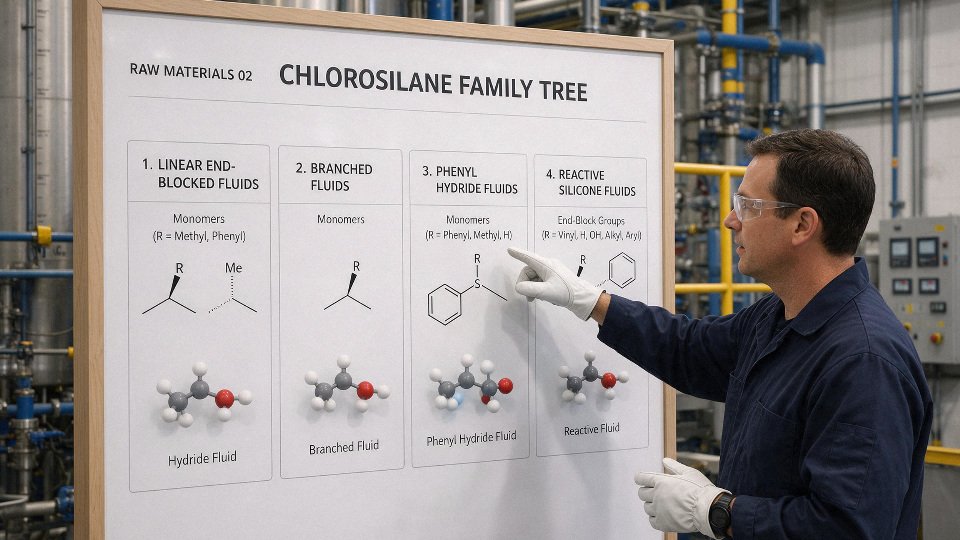
For commodity fluids, a somewhat broader crude chlorosilane composition may be commercially workable if downstream purification is adequate and the application is forgiving. For high-spec uses, especially optical, reactive, low-odor, or very low-volatility grades, crude composition drift is often the hidden root cause behind gel particles, broad molecular weight distribution, and persistent odor complaints. If a buyer needs tight performance, the right question is not just “what viscosity?” but “which monomer family, what functionality level, and how tightly is the upstream chlorosilane slate controlled?”
Polymerization and conversion inputs
The monomer is only half the story. Finished silicone oil quality is set just as much by the conversion inputs and cleanup discipline as by the chlorosilane starting slate. Two plants can start with the same dimethyldichlorosilane-rich feed and still ship fluids with different color, odor, low-volatility content, dielectric behavior, and storage stability because the hydrolysis, equilibration, neutralization, and devolatilization steps were run differently.
That matters in procurement. If you are buying for defoamer, textile, release, personal care, electrical insulation, or medical-adjacent use, the question is not only “which monomer?” but also “which catalyst system, which end-blocker, how was it neutralized, and how hard was it stripped?”
Hydrolysis inputs: water quality, acid handling, and reaction control
Hydrolysis of chlorosilanes is the first major conversion step in the classic route to silicone oil, and it is not a gentle one. Water is a raw material here, not just a utility. The reaction of chlorosilanes with water is strongly exothermic, produces hydrochloric acid co-product, and generates crude siloxane intermediates that then need washing, neutralization, and devolatilization before they are fit for finishing.
A plant usually manages this stage with a combination of:
- Reaction water
- Diluted acid handling media or controlled aqueous phase composition
- Wash water
- Phase-separation and emulsion-breaking aids, where needed
- Materials of construction that can tolerate acid, chloride, and heat
The practical issue is rate control. Dump chlorosilane into too little water, or add too fast, and you get sharp temperature rise, local overreaction, heavy HCl evolution, and stable emulsions that are miserable to break. Go too slow or too dilute and throughput collapses, reactor occupancy rises, and downstream washing volume gets expensive.
In most plants, controlled addition is the whole game:
- Set the water-to-feed ratio based on chlorosilane composition and reactor heat-removal capacity.
- Control feed addition rate to keep temperature inside the design window.
- Manage agitation carefully; too little mixing causes localized hot spots, too much can create fine emulsions that extend settling time.
- Vent and scrub HCl properly; this is a co-product stream and a corrosion/safety issue, not a side note.
- Allow adequate phase disengagement time before washing or transfer.
Wash water quality is more important than some buyers assume. High hardness, iron pickup, or dissolved solids can leave traces that later show up as haze, catalyst interference, or ash. For standard industrial grades, ordinary treated plant water may be acceptable if it is consistent and the downstream cleanup is robust. For tighter grades, suppliers often move toward softened, demineralized, or otherwise controlled water quality to reduce ionic contamination and color formation.
Using poor-quality wash water can affect finished silicone oil clarity and ionic cleanliness even when the monomer source is unchanged.True
Residual salts, hardness ions, and trace metals can carry through hydrolysis and washing, then interact with catalysts or remain as contamination if purification is not rigorous. The effect size depends on grade target and finishing discipline.
Condensation and equilibration: where fluid structure is actually set
Once hydrolysis generates silanol-containing intermediates and crude siloxane species, the process moves into condensation and equilibration. This is where the manufacturer converts a messy hydrolysate into a usable linear or lightly branched siloxane fluid.
The mechanism is straightforward but commercially decisive:
- Condensation links silanol groups, forming siloxane bonds and releasing water or related by-products.
- Equilibration redistributes siloxane chain lengths toward the target molecular-weight range.
- End-blocking limits further chain growth and fixes viscosity.
If you want low- to medium-viscosity polydimethylsiloxane fluid, the producer is usually trying to push the system toward a controlled distribution of mostly linear chains with trimethylsiloxy end groups. If you tolerate or want slight branching, that comes from monomer composition and from how aggressively the system is equilibrated.
Catalyst choice matters because it changes both reaction path and impurity risk.
Common catalytic systems include:
- Sulfuric acid
- Hydrochloric acid
- Acidic clays
- Potassium hydroxide
- Tetramethylammonium hydroxide
- Other controlled catalytic systems selected for specific product grades and downstream purification needs
Acid catalysts can be effective for certain rearrangement and condensation steps, but they bring corrosion burden and must be removed thoroughly. Base catalysts, especially alkali systems such as KOH, are widely used for equilibration because they are efficient at redistributing siloxane chains. The trade-off is that residual base, even at low levels, can keep reacting in storage or under heat, shifting viscosity or generating more volatiles if neutralization is incomplete. Tetramethylammonium hydroxide and related specialty systems are often chosen when tighter control or cleaner removal is needed, though the right choice depends on product family and plant know-how.
The usual conclusion that “base gives better control” stops holding if the supplier cannot reliably quench and remove catalyst residues. In that case, a slower but cleaner catalytic route may produce the more stable commercial fluid.
End-blockers and chain terminators: how viscosity is set on purpose
Viscosity is not set by luck. It is set by the ratio between cyclic or hydrolyzed siloxane building blocks and chain-stopping species.
The most common end-blockers and chain terminators include:
- Hexamethyldisiloxane (MM)
- Trimethylsilanol derivatives
- Trimethylchlorosilane-derived species
These materials cap reactive chain ends and limit molecular growth. Increase end-blocker relative to reactive siloxane units and viscosity drops; reduce it and viscosity climbs, sometimes sharply. That relationship is one reason commercial silicone oil can span from roughly 0.65 cSt for very low molecular weight fluids to above 100000 cSt for high molecular weight PDMS, though any exact target depends on the full monomer and process recipe.
There is a trade-off here that procurement teams see later as consistency complaints. Tight viscosity control usually requires tight feed purity, accurate metering, stable catalyst activity, and disciplined stripping. If the end-blocker assay drifts, or if reactive residuals remain after finishing, one batch can land on spec while another shows broader viscosity spread or higher volatiles.
Neutralizers, adsorbents, and purification aids
After condensation or equilibration, the reaction mixture still contains things you do not want in the finished oil: catalyst residues, salts, color bodies, trace chlorides, residual acidity or alkalinity, and low-boiling fractions.
Typical cleanup inputs include:
- Sodium bicarbonate
- Caustic, where the chemistry calls for it
- Bleaching earth
- Activated carbon
- Filter aids
- Drying agents
Each has a different role.
- Neutralizers stop the reaction and convert residual catalyst into removable species.
- Bleaching earth and activated carbon help reduce color, odor bodies, and some trace organic impurities.
- Filter aids improve solids removal and protect final filtration efficiency.
- Drying agents reduce residual moisture that can hurt dielectric performance, storage stability, or downstream blending.
A common plant-floor mistake is to treat neutralization as a simple pH correction. It is not. Underdosing leaves residual catalyst; overdosing can create excess salts, more filtration load, and in some cases new contamination. That is why well-run plants verify not just pH, but ash, ionic residue, chloride, moisture, and sometimes conductivity or dielectric indicators depending on end use.
Solvent-free production still relies on utilities that behave like process inputs
Many mainstream silicone oils are made without a conventional organic solvent, especially standard PDMS fluids. Even so, the process still depends on practical conversion inputs that buyers should not ignore:
- Vacuum
- Steam
- Nitrogen
- Heat transfer fluids or thermal oil systems
These are not background utilities in the economic sense. Vacuum level affects how effectively low boilers, moisture, and residual cyclics are removed. Nitrogen quality and flow practice affect oxidation risk, moisture pickup, and sometimes foam control during stripping. Heat-transfer stability affects temperature uniformity and therefore reaction control, especially in viscous batches.
A supplier with weak vacuum capability may still make acceptable general-purpose oil, but struggle on low-volatility or electronics-oriented grades. That gap rarely shows up in the basic product name.
Devolatilization and filtration are finishing stages that define market suitability
For commodity use, a silicone oil that “looks clear” may pass. For tighter applications, that is nowhere near enough. Devolatilization and filtration are the stages that often separate a standard industrial fluid from a fluid suitable for personal care, electronics, or other impurity-sensitive service.
Finishing usually includes:
- Vacuum stripping or thin-film devolatilization to remove low molecular weight siloxanes, residual end-blockers, moisture, and trace volatiles
- Thermal hold under controlled conditions to drive off remaining light fractions without over-cracking the product
- Fine filtration to remove catalyst residues, adsorbent fines, gels, or haze-causing particles
- Dry storage and packaging control to prevent recontamination
The mechanism is direct. Lower residual volatiles improve flash characteristics, reduce odor and fogging tendency, and help viscosity stability. Better solids and ionic cleanup improve clarity, dielectric loss behavior, and acceptance in sensitive formulations. Push stripping too hard, though, and you sacrifice yield, extend cycle time, and in some systems risk shifting the molecular-weight distribution.
That is why two suppliers using nominally the same monomers can ship meaningfully different silicone oil. One may run a basic catalytic equilibration, quick neutralization, and modest strip that is perfectly serviceable for release agents or general lubricity. Another may run tighter catalyst control, cleaner end-blocking chemistry, better adsorbent polishing, and deeper devolatilization to hit lower odor, lower haze, lower ionic residue, or tighter volatility limits. On paper both products may read as “PDMS 100 cSt.” In service, they are not always interchangeable.
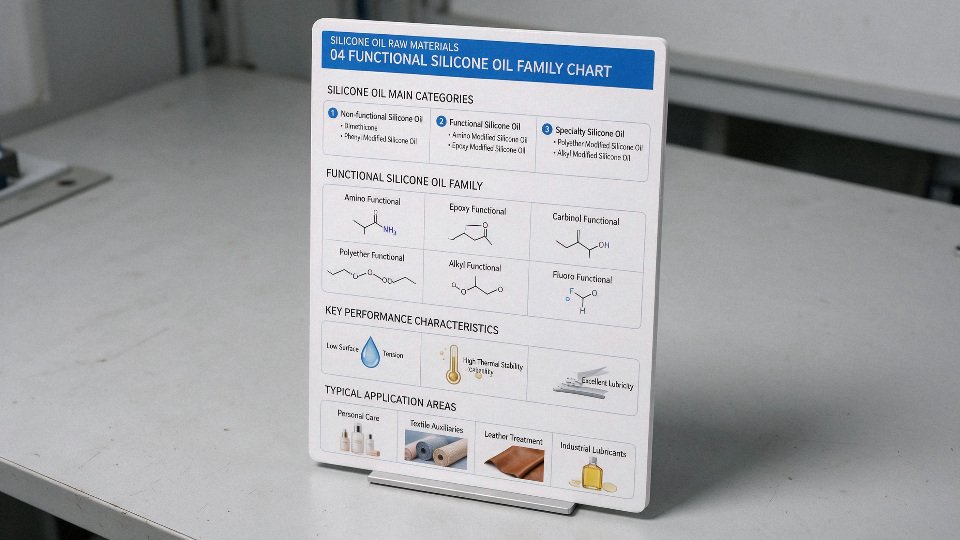
Modified silicone oil ingredients
Specialty silicone oils are usually built by changing the molecule, not by dosing a standard dimethyl fluid with a clever additive package after the fact. If a supplier is offering amino, polyether, phenyl, hydrogen, fluorinated, or epoxy-functional silicone oil at near-commodity pricing, the first question should be what reactive intermediates actually went into the backbone and side groups, because that is where the performance and the cost sit.
Standard polydimethylsiloxane starts from a fairly broad industrial monomer base. Modified fluids do not. They depend on narrower organofunctional silanes, hydrosiloxane intermediates, specialty alcohols or olefins, tighter side-reaction control, and often smaller production campaigns with more cleaning between grades. That matters in procurement: specialty performance is usually purchased through monomer and intermediate complexity, not through simple blending.
Amino silicone oils
Amino-functional silicone oils are commonly made from aminoalkyl-functional silanes or from graft routes that attach aminoalkyl groups onto a siloxane chain. Typical building blocks include aminoethylaminopropyl or aminopropyl silane types, selected according to the desired amine content, reactivity, and compatibility with the target emulsion or solvent system.
These materials are used heavily in textile finishing, personal care intermediates, and some surface-treatment formulations because the amino group changes how the fluid interacts with polar substrates:
- It increases affinity to fibers, especially cellulosic and synthetic textile blends
- It improves soft hand and lubricity by helping the fluid anchor rather than just sit on the surface
- It can improve durability through stronger interaction with the substrate
- It often raises the risk of yellowing or shade shift, especially on white or pale fabrics under heat
That last point gets missed by buyers who only compare softness data. The same amino functionality that improves deposition can also drive color issues during drying, curing, or storage, depending on amine type, residual catalyst, oxidation history, and the finish package around it. In practice, mills often discover the difference between two “similar” amino silicones only after tenter-frame exposure or after a few weeks in warehouse storage.
Storage stability is another practical concern:
- Higher amine content can increase viscosity drift or emulsion instability
- Residual low-boiling amines or unreacted silane can push odor and package pressure issues
- Acid-neutralized amino emulsions may hold differently from nonionic systems over seasonal temperature swings
Polyether silicone oils
Polyether-modified silicone oils are usually produced by reacting hydrosiloxanes containing Si-H groups with allyl polyethers through platinum-catalyzed hydrosilylation. The main ingredients are not just “silicone plus surfactant”; they are a designed combination of hydrosiloxane backbone, allyl-terminated EO/PO polyether, catalyst, and often carefully controlled inhibitor levels.
The performance comes from a split personality in the molecule:
- The siloxane segment lowers surface tension and improves spreading
- The polyether segment gives water compatibility or controlled dispersibility
- The EO/PO balance shifts wetting, foam control, cloud point, and compatibility with coating or cleaning systems
This is one of the clearer examples of mechanism driving buying decisions. A longer or more hydrophilic polyether side chain generally improves water compatibility and dynamic wetting, but it can also reduce defoaming strength or increase sensitivity to high-shear foam systems. A more silicone-rich structure may knock down foam better, yet separate more easily in aqueous concentrates.
Common raw materials and intermediates include:
- Allyl polyethers with selected ethylene oxide / propylene oxide ratios
- Hydride-functional siloxanes
- Epoxy intermediates in some hybrid routes
- Platinum catalysts for addition reaction
- Inhibitors and purification aids to control premature reaction and remove residues
The conclusion here holds only if the hydrosilylation is well controlled. Poor platinum management, excess unsaturation impurities, or weak stripping of residual volatiles can leave odor, haze, unstable viscosity, or residual Si-H that causes downstream surprises in water-based formulations.
Phenyl silicone oils
Phenyl-modified silicone oils are built from phenyl chlorosilanes or phenyl alkoxysilanes introduced into the siloxane structure. They are chosen where straight dimethyl fluids run out of room on temperature range, optical properties, or radiation stability.
Phenyl substitution is used to improve or shift:
- Low-temperature fluidity in certain formulations
- Lubricity under thermal stress
- Refractive index for optical or specialty cosmetic uses
- Resistance to some forms of radiation degradation compared with standard dimethyl fluids
The trade-off is that phenyl chemistry generally costs more and may complicate processing or compatibility. Not every “phenyl silicone oil” behaves the same way; the effect depends on phenyl content, distribution along the chain, and whether the structure is mostly linear fluid or part of a broader mixed-functional system.
Hydrogen silicone oils
Hydrogen silicone oils contain Si-H functionality, typically introduced through hydrogensiloxane monomers and chain-building intermediates. These are not end-use fluids in the same sense as inert dimethyl oils; many are reactive intermediates or key formulation components.
They are used in:
- Release coatings
- Water repellents for mineral substrates and textiles
- Addition-cure systems as crosslinkers
- Surface treatment where later reaction is required
Procurement teams should treat hydrogen silicone oils as functionality-sensitive materials, not as viscosity-only products. Residual Si-H level, molecular distribution, inhibitor compatibility, and side-reactivity with moisture, alcohols, bases, or catalyst residues all matter. Two products with similar appearance and viscosity can behave very differently in cure speed, storage life, and final release performance.
Fluorosilicone oils
Fluorosilicone oils combine siloxane backbones with fluorinated organic intermediates to improve resistance to fuels, oils, and aggressive solvents. The usual commercial reason to pay for them is simple: standard silicone oils have broad chemical resistance, but they are not universally resistant to hydrocarbon swell or fuel exposure.
The raw-material burden is heavier here:
- Fluorinated intermediates are costlier and less interchangeable
- Supply chains are narrower and more region-dependent
- Purification demands are stricter because trace byproducts can hurt performance badly
- Regulatory review can be more involved depending on fluorinated species and destination market
That sourcing complexity is why fluorosilicones often show long lead-time swings compared with dimethyl grades. A low-price quote without clear intermediate pedigree is not much comfort if the batch fails fuel-immersion testing.
Modified silicone oil performance usually depends on built-in organofunctional intermediates rather than simple additive blending.True
This is consistent with established organosilicon manufacturing practice. Functional groups such as amino, polyether, phenyl, Si-H, epoxy, or fluorinated segments are typically introduced through reactive silanes, siloxane intermediates, or controlled grafting/addition chemistry during manufacture.
Epoxy, mercapto, carbinol, alkyl, aryl, and other functional grades
Beyond the main families, many specialty silicone oils are built from targeted organofunctional silanes such as:
- Epoxy silanes for reactive coatings, adhesion promotion, and resin modification
- Mercapto silanes for coupling, cure participation, or metal-surface interaction
- Carbinol-functional siloxanes for polyurethane compatibility and reactive blending
- Long-chain alkyl silanes for slip, hydrophobe balance, and organic compatibility
- Aryl-functional silanes for thermal or optical property adjustment
These products often come from smaller-batch production with higher-purity intermediates, tighter contamination control, and more analytical release work. That alone can move cost far more than viscosity does. In a plant setting, the economics are familiar: more line cleaning, more dedicated storage, more careful catalyst handling, lower campaign volume.
So when comparing offers, ask for the chemistry route, not just the datasheet headline. If the application needs durable substrate affinity, fuel resistance, controlled reactivity, or a specific wetting profile, the raw-material set behind the silicone oil matters more than a low initial price ever will.
Impurities and quality risks
A silicone oil can look perfectly clear, hit the ordered viscosity, and still fail badly in service because the problem sits in trace contaminants, not in the main polymer backbone. For buyers, the practical question is not “is it silicone oil?” but “which residual species are still in it, at what level, and do those residues matter in my application?” The answer changes sharply between a low-cost process fluid and a release-coating, electronics, personal care, or dielectric grade.
The mechanism is straightforward. Small residual species move first, concentrate at interfaces, attack metals, interfere with catalysts, or leave the system by evaporation long before the bulk PDMS chain shows any obvious defect. That is why two batches with similar viscosity and appearance can behave very differently on odor, foaming, cure response, shelf life, or corrosion tendency.
Residual chloride and acid traces
Residual chloride is one of the most common and most underestimated risks in silicone oil made through chlorosilane hydrolysis routes. Hydrolysis of dimethyldichlorosilane generates hydrochloric acid co-product and crude siloxane intermediates that must be washed, neutralized, and devolatilized; if any of those steps are marginal, chloride-bearing residues can carry through into the finished oil.
What buyers usually recognize downstream is not “chloride contamination” on paper. They see symptoms:
- Corrosion in storage drums, pumps, dosing skids, or downstream customer equipment
- Sharp or irritating odor
- Instability during heated service
- Compatibility problems with additives, pigments, or metal-containing formulations
- Trouble in reactive systems where acid traces shift catalyst behavior
In practice, this tends to show up first in carbon steel handling systems, poor shelf stability in partially filled drums, or odd complaints from customers blending the oil into more complex formulations. Stainless helps, but it does not solve the chemistry.
The main trade-off here is cost and throughput versus wash quality and finishing depth. Aggressive washing and neutralization reduce corrosion and instability risk, but they add water handling, salt load, drying duty, and sometimes yield loss. That trade usually favors deeper cleanup for higher-value grades and gets pushed harder on commodity fluid lines.
Low boilers and cyclic siloxanes
If stripping is incomplete, devolatilization is too mild, or equilibration control is broad, low molecular weight material stays in the oil. That can include short-chain linear siloxanes and cyclic siloxanes. Commercial silicone oil viscosity can range from about 0.65 cSt for low molecular weight fluids to more than 100000 cSt for high molecular weight polydimethylsiloxanes, so simply saying “low viscosity” does not tell you whether a batch contains too much volatile fraction; you need the profile.
The failure modes are familiar:
- Lower flash point than expected
- Higher evaporation loss at service temperature
- Fogging or condensate deposition on hot surfaces
- Weight loss in open systems
- Odor complaints in enclosed applications
- Regulatory or customer-acceptance issues in markets that screen certain cyclics more tightly
This matters a lot in textile finishing, mold release near painted surfaces, cabin-interior adjacent uses, cosmetics, and any heated lubrication point. A broad cyclic tail may not hurt a basic antifoam carrier much, but it can be a deal-breaker in personal care or in enclosed electronics assembly areas.
A silicone oil can meet viscosity specification and still fail volatility or fogging requirements because low boilers and cyclics contribute little to bulk viscosity at low concentration.True
This is consistent with standard polymer-fluid behavior: a small volatile fraction may not materially shift viscosity but can dominate evaporation, odor, fogging, and flash-point performance.
Metal residues
Metals enter from several places:
- Silicon metal feed impurities
- Catalyst systems
- Reactor internals and wear surfaces
- Transfer pumps and valves
- Filter media or poorly maintained housings
- Storage and packaging contact surfaces
These residues are rarely visible unless contamination is severe. Their impact depends on the application:
- In dielectric fluids, ionic or metal contamination can hurt electrical performance and long-term stability
- In clear or water-white grades, they can push color upward
- In platinum-cure environments, some metal species can contribute to cure interference
- In long-term thermal service, trace metals can catalyze degradation or promote deposit formation
I have seen plants chase “mysterious color drift” for weeks when the actual issue was a worn metal component upstream of final filtration. On paper, the batch looked close enough. In a clear premium grade, it was not.
The conclusion here stops holding if the product is intentionally pigmented, heavily filled, or used in a rough process environment where optical and electrical properties are irrelevant. Then metal traces may be commercially acceptable even if they would be rejected in electronics or personal care supply.
Moisture and hydrolyzable impurities
Moisture sounds basic, but it is still a frequent source of field complaints. Free water, dissolved moisture, and hydrolyzable residues shorten shelf life and can disrupt downstream chemistry, especially in reactive silicone systems.
Watch for these effects:
- Viscosity drift during storage
- Gas formation or pressure in sealed containers where reactive residues are present
- Poor performance in moisture-sensitive formulations
- Unstable behavior in release coatings, RTV systems, or other cure-sensitive blends
- Haze after temperature cycling
Moisture control is not just a dryer issue. It often comes from tank blanketing habits, drum filling in humid weather, wet transfer lines after cleaning, or a desiccant unit that everyone assumes is still working.
Gel particles, haze, and insolubles
These defects usually come from over-condensation, branch imbalance, contamination, or weak final filtration. Buyers tend to describe them as “fish-eyes,” haze, sediment, filter plugging, or random coating defects.
The practical causes include:
- Local overreaction during equilibration or finishing
- Functional monomer imbalance creating unintended branching
- Cross-contamination between product families
- Poor housekeeping around transfer and packaging
- Inadequate polish filtration for the target grade
For precision coating, cosmetics, and fine lubrication, this is one of the fastest ways to lose customer confidence. In bulk process applications, the same material might still run without trouble. That gap matters during supplier qualification.
Organic residuals and color bodies
Unreacted functional intermediates, residual solvents, side products, and carbonaceous color bodies become much more important as the end use gets cleaner, more sensitive, or more regulated. Cosmetics, electronics, optical applications, and precision lubrication are the obvious cases.
Typical warning signs include:
- Off-odor despite acceptable appearance
- Yellowing on heat aging
- Surface contamination or transfer
- Unexpected extractables
- Poor compatibility with downstream additives or substrates
A dark drum pump seal, overheated kettle zone, or overused carbon treatment step can leave a signature here. The product may still be saleable into industrial channels, just not into the grade family the buyer thinks they are getting.
Why impurity limits must match the application
Different product classes tolerate very different impurity profiles:
| Product type | Usually most sensitive to | Often less sensitive to |
|---|---|---|
| Commodity antifoam carrier fluid | Gel, gross acidity, severe volatiles | Fine color shift, ultra-low ionic content |
| Transformer or dielectric fluid | Moisture, ionic species, metals, stability | Mild odor |
| Personal care ingredient | Cyclic profile, odor, color, residual organics | Minor trace metals that do not affect safety or appearance, subject to specification |
| Reactive release-coating polymer | Moisture, catalyst poisons, acid, cure inhibitors, gel | Slight cosmetic color drift if performance is unaffected |
That is why broad statements like “industrial grade” are not enough. The preferred cleanup level flips once the fluid moves from process utility into electrical, personal care, or cure-critical use.
Why certificate values are not enough
A standard COA often covers viscosity, appearance, maybe volatile content, maybe acid value. That is useful, but it does not reliably expose performance-critical impurities.
Buyers with failure-sensitive applications usually need one or more targeted screens:
- Ionic chloride or total ionic content
- Moisture by suitable low-level method
- Volatile or cyclic profile by chromatographic method
- Metal screen for critical grades
- Odor panel or retained-odor check after heating
- Foam tendency and air release
- Cure compatibility with the buyer’s actual catalyst and substrate
- Haze, particle count, or filtration residue
If the application is sensitive, ask for both routine release data and the specific impurity screen that matches your failure mode. A silicone oil that is acceptable for drum lubrication or basic antifoam duty may still be the wrong material for platinum-cure release coating, transformer service, or personal care filling, even though the certificate looks clean enough at first glance.
Supply chain and cost drivers
For most standard silicone oils, the biggest cost drivers sit upstream, not in the final blending tank: silicon metal, methyl chloride or methanol-derived inputs, chlorine-chain economics, energy, and yield loss through hydrolysis and finishing. Buyers usually get the best combination of cost control and consistency from producers that own or tightly control chlorosilane capacity, because the expensive mistakes in silicone oil are usually made before the oil looks finished.
A practical way to think about cost is to separate chemistry cost from conversion cost and delivered-quality cost. On paper, two suppliers can quote similar viscosity and flash point, yet one is carrying stronger control over monomer purity, devolatilization, packaging cleanliness, and lot-to-lot repeatability. In plant use, that difference shows up as foam, odor, volatile carryover, seal swell, coating defects, or customer complaints that are far more expensive than the initial price delta.
Where the money actually goes
The major cost buckets are usually these:
- Silicon metal
- A foundational cost in direct-process chemistry.
- Sensitive to ore quality, reductant cost, furnace operating rate, and especially electricity price.
- Not all silicon metal behaves the same in chlorosilane production; impurities can affect catalyst performance and chlorosilane slate.
- Methyl chloride or methanol-derived organic input
- Methyl chloride is a direct feed in many routes to chlorosilanes.
- Typical methyl chloride to silicon mass ratio is about 1.2:1 to 1.8:1, depending on catalyst system and target chlorosilane distribution.
- If a producer buys methyl chloride externally instead of making or securing it upstream, they are exposed to both price and availability swings.
- Chlor-alkali chain inputs
- Chlorine and caustic economics matter even if the buyer never sees them on a datasheet.
- Hydrolysis of dimethyldichlorosilane generates hydrochloric acid co-product and crude siloxane intermediates that then need washing, neutralization, and devolatilization.
- The availability and internal reuse of HCl or chlorine-related streams can materially change manufacturing cost.
- Energy
- Power is critical in silicon metal production.
- Steam, thermal oil, chilling, vacuum generation, and solvent recovery all matter downstream in hydrolysis and stripping.
- High-viscosity silicone oils often need more residence time and tougher devolatilization, so energy intensity can climb with product grade.
- Catalysts and process auxiliaries
- Copper-based direct-process catalyst systems, acid or base equilibration catalysts, neutralizing agents, adsorbents, and filtration media.
- Usually not the biggest line item, but poor catalyst control is an expensive source of off-spec viscosity and volatile residue.
- Environmental treatment
- Acidic wash streams, chlorinated residues, VOC management, spent media, and wastewater treatment.
- This is one of the least visible but most plant-specific costs. Tight environmental enforcement can change delivered pricing very quickly.
- Labor and maintenance
- Less dominant than upstream feedstock and energy, but still relevant in finishing, packaging, quality control, and equipment uptime.
- In practice, a plant with weak maintenance discipline burns money through contamination events and unstable batch quality.
- Packaging and freight
- Drums, IBCs, isotanks, liners, seals, palletization, export handling, and inland freight to port.
- For lower-value standard fluids, freight can decide who is truly competitive.
Why integrated producers usually outperform non-integrated suppliers
If a producer controls silicon-to-chlorosilane-to-fluid conversion, they usually control three things better: cost, lead time, and root-cause visibility. A blender or trader may still be useful for local stocking or mixed cargo consolidation, but they rarely have the same leverage when monomer supply tightens or when a batch issue needs tracing back to hydrolysis, equilibration, or stripping conditions.
The mechanism matters here. Monomer purity affects polymer growth behavior, volatile profile, and the amount of washing and devolatilization needed to hit a stable finished fluid. If the upstream chlorosilane stream is inconsistent, the downstream finisher can sometimes polish the product enough for a basic COA, but not always enough for demanding uses like release coatings, personal care intermediates, defoamers, or electronics-adjacent applications.
The trade-off is commercial, not just technical:
- Integrated producer
- Better control over cost swings
- Faster response to spec adjustments
- Better chance of consistent lot history
- Often stronger troubleshooting support
- Non-integrated blender/distributor
- Can be convenient for small volumes or local inventory
- May offer flexible packaging or mixed products
- But often has less control over raw-material origin and process history
That conclusion weakens when the requirement is simple, low-risk, and low volume. For a non-critical utility fluid, a competent distributor may be perfectly adequate. Once the fluid affects downstream product performance, though, upstream process control starts to matter a lot more than brochure language.
An integrated chlorosilane-to-silicone producer usually has a cost and consistency advantage over a non-integrated blender.True
This is consistent with standard chemical manufacturing economics: integration reduces purchased-intermediate margin, improves scheduling control, and gives better traceability on impurity and process variation. The exact advantage varies by product grade, location, and market cycle.
Why China’s organosilicon clusters matter
China’s major organosilicon clusters concentrate the full chain in one geography: silicon metal access, chlorosilane production, silicone fluid finishing, packaging supply, export logistics, and operators who have run the same chemistry at scale for years. For global buyers, that concentration often means shorter procurement cycles, more grade availability, and better odds of finding a supplier that can move from commodity PDMS into modified fluids without changing company or region.
There is also a less glamorous advantage: support infrastructure. You need clean drum suppliers, reliable valve and gasket sourcing, vacuum equipment service, acid-resistant piping, and labs that know how to test volatiles and functionality properly. Clusters tend to have that ecosystem. Plants outside those hubs can still be excellent, but they often carry higher conversion cost or longer recovery time when something upstream goes tight.
What moves pricing up or down
Buyers tracking only silicone oil spot quotes usually miss the earlier signals. The common triggers are:
- Electricity tariffs and power restrictions
- Especially important for silicon metal production.
- Silicon metal operating rates
- Furnace shutdowns or reduced output tighten the whole chain.
- Methanol and methyl chloride market movement
- Affects organics cost in chlorosilane manufacture.
- Chlorine and chlor-alkali economics
- Can swing sharply with regional industrial demand.
- Environmental inspections or permitting pressure
- Often raises cost through reduced run rates, higher treatment cost, or delayed shipments.
- Global silicone demand cycle
- Construction, personal care, textile, electronics, and industrial manufacturing all influence demand differently.
- When demand rises fast, even standard grades can get long lead times.
Packaging and transport are not small details
Clean packaging and transfer discipline can materially affect delivered quality, especially for lower-viscosity fluids, functional silicone oils, and products going into coating or formulation systems. A dirty IBC valve, reused drum with residual surfactant, or wet transfer hose can undo a lot of careful production work.
Buyers should check these points:
- Packaging type
- Drums for manageable lots
- IBCs for intermediate-volume handling
- Isotanks for bulk, stable grades with good unloading control
- Container cleanliness standard
- New vs reconditioned packaging
- Dedicated vs shared service
- Nitrogen blanketing
- Especially relevant for moisture-sensitive or functionally modified fluids
- Transfer system cleanliness
- Hoses, pumps, seals, and fittings should be compatible and clean
- In practice, camlock history matters more than people admit
- Lot segregation and labeling
- Prevents cross-grade contamination, especially between virgin and reprocessed material
How buyers should balance cost against specification risk
The cheapest offer is often coming from one of three places: looser viscosity control, higher volatile residue, or less certain raw-material provenance. That does not automatically make it unusable. It does mean the buyer should align the sourcing strategy with the consequence of failure.
A workable screening approach is:
- Classify the application by consequence
- Utility/process aid
- Formulation ingredient
- Surface-critical or customer-facing application
- Regulated or tightly validated use
- Separate virgin, reprocessed, and custom-modified material
- Virgin fluid is usually the safest baseline for consistency.
- Reprocessed material may be viable for low-risk applications, but only with clear disclosure and fit-for-use testing.
- Custom-modified blends need tighter scrutiny because functional stability can drift if upstream control is weak.
- Ask for process-relevant quality indicators, not just a generic COA
- Viscosity range and test method
- Volatile content or stripping adequacy, if relevant
- Appearance, odor, acid/alkali residue where applicable
- Functional group stability for modified oils
- Check packaging and shipment method before approving
- A good product can arrive in bad condition.
- Run a use-condition trial
- Especially if changing source, viscosity band, or product type
The counter-intuitive part is simple: a lower-cost monomer route or a discounted finished fluid is not the lowest total cost if poor devolatilization causes foam, unstable functionality shortens shelf life, or viscosity drift forces rework. That is where procurement savings turn into production loss. For buyers comparing supply options across China and other hubs, the right comparison is not price per kilogram alone; it is price per accepted batch, per stable production run, and per complaint avoided.
Material verification checklist
A credible silicone oil supplier should be able to show not just a product name and COA, but a traceable link from chemistry class to process controls to use-case testing. If they cannot clearly state what structural type the fluid is, how it was made, what impurity controls are in place, and which properties are actually held lot to lot, you are buying on label only.
In practice, this checklist matters most when the oil is not just a bulk additive. If the fluid affects cure, slip, release, dielectric performance, textile hand, or long-term lubrication, weak material verification shows up later as foam instability, coating defects, odor, drift in viscosity, or inconsistent line behavior.
1. Confirm the silicone oil type and structural description
Do not stop at “silicone oil” or even “PDMS” if performance depends on chemistry.
Ask the supplier to state:
- The product class:
- Dimethyl silicone oil
- Phenyl-modified silicone oil
- Amino silicone oil
- Polyether-modified silicone oil
- Hydrogen silicone fluid
- Fluorosilicone fluid
- Another modified silicone class
- The structural description, in practical terms:
- Linear or branched
- Approximate functional group content
- End-blocking type, if relevant
- Whether the product is a neat fluid, blend, emulsion concentrate, or formulated package
- The intended performance mechanism:
- Lubricity
- Dielectric insulation
- Water repellency
- Reactive crosslinking
- Softening
- Defoaming
- Release modification
That last point sounds basic, but it exposes weak suppliers quickly. A seller who cannot connect structure to function usually does not control the chemistry deeply.
2. Verify the monomer route and the supplier’s real manufacturing position
The same nominal viscosity can come from very different supply routes. A manufacturer integrated into chlorosilanes generally has better visibility over monomer purity and chlorosilane slate; a company that only buys intermediates may still be good, but you need more documentation; a blender of finished fluids should not be represented as a polymer producer.
Check these points:
- Whether the supplier is:
- Integrated upstream into chlorosilanes
- Buying chlorosilane or siloxane intermediates externally
- Purchasing finished silicone fluids and blending or repacking
- Which monomer family is used for the base fluid or modified fluid
- Whether hydrolysis, washing, neutralization, devolatilization, and finishing are done in-house or outsourced
Whether different grades share the same production line and what changeover controls exist
A supplier that blends or repacks silicone oil can still be commercially acceptable, but only if they disclose that role clearly and provide impurity and consistency controls appropriate to a blending operation.True
The risk is not blending itself; the risk is buying from a party whose actual process capability is unclear. Different supply-chain positions support different levels of traceability and process control.
3. Match test items to the application instead of using a generic COA
A one-page COA with viscosity and color is rarely enough for industrial approval. The right test package depends on what failure looks like in your process.
Request, as applicable:
| Use concern | Test items worth confirming |
|---|---|
| General fluid identity | Viscosity, refractive index, color |
| Low-volatility or residue-sensitive use | Volatile content, cyclic profile, flash point |
| Corrosion or cure interference risk | Acid value, chloride content, moisture |
| Reactive silicone use | Si-H value, amino value, functional content |
| Cold-process or surfactant behavior | Cloud point |
| Electrical use | Dielectric properties |
| Optical or appearance-sensitive use | Color, haze if relevant, refractive index |
The mechanism is straightforward: residual acid, chloride, moisture, and low-boiling cyclics do not just sit harmlessly in the drum. They can interfere with catalyst systems, shift foam behavior, raise odor, attack sensitive metals, or move viscosity and flash point outside the safe operating window. For many applications, impurity control matters as much as nominal viscosity.
The trade-off is cost and lead time. A broad test slate improves confidence, but not every receiving lot needs every test if the supplier has demonstrated stable process capability and your application is tolerant. That logic stops holding for reactive, regulated, or high-consequence uses; there, reduced testing is usually a false economy.
4. Review batch-control documents, not just finished-product results
Ask for evidence that the process is controlled before the final drum is filled.
Look for:
- Raw-material approval standards for monomers, modifiers, solvents, and process aids
- Catalyst management records, including how catalyst carryover is prevented
- Neutralization records after hydrolysis or equilibration-related steps
- Filtration limits, filter rating, and change frequency
- Retention sample practice and storage period
- Batch numbering traceability back to key feedstocks
- Out-of-spec handling and rework rules
A plant that keeps retention samples and can trace a complaint back to a specific monomer lot is operating at a different level than one that only rechecks viscosity after blending.
5. Check declarations, packaging, and transport controls
For regulated or sensitive end uses, get current declarations for the specific grade, not a generic corporate statement.
Verify:
- Residual cyclic declarations, where relevant
- Restricted-substance declarations aligned to your market
- Safety documentation and current SDS
- Any cosmetic, food-contact, or other application-specific alignment the supplier explicitly supports
- Package type, internal cleanliness, and compatibility with the fluid
- Shelf life, storage temperature range, and resealing guidance
- Moisture and contamination protection during filling, storage, and transit
Amino, Si-H, and some specialty fluids are less forgiving in storage than standard dimethyl oils. A drum left half-open in a humid warehouse, or a reused tote with poor cleaning history, can undo careful manufacturing.
6. Require pilot or line validation for performance-critical uses
Do not approve solely on bench data when the silicone oil changes process behavior.
Use pilot-scale or production-use validation for:
– Coating cure and surface defects
– Textile softness and yellowing tendency
– Foam control persistence
– Release force consistency
– Lubrication film behavior and residue
If the supplier is serious, they should be willing to align sample evaluation with your actual substrate, process temperature, shear exposure, and application rate. That is where a compliant-looking material either proves stable or starts causing the kind of intermittent problem maintenance and quality teams hate chasing.
Frequently asked questions
Is silicone oil made from petroleum oil?
No. Standard silicone oil is not refined petroleum oil; it is typically a silicone polymer built from silicon-based intermediates, most often chlorosilanes derived upstream from silicon metal and methyl chloride. Petroleum can still sit in the chain indirectly, because methanol, hydrocarbons, or process energy may come from fossil sources, but the fluid itself is not a mineral oil in the usual plant-floor sense.
Silicone oil is basically a highly refined petroleum lubricant.False
Commercial silicone oil is generally an organosilicon polymer, commonly based on siloxane backbones such as PDMS, not a hydrocarbon mineral oil.
What is the main raw material for standard silicone oil?
For standard dimethyl silicone oil, the key immediate raw material is usually dimethyldichlorosilane. That monomer is hydrolyzed and condensed into siloxane structures, then processed into fluids spanning roughly 0.65 cSt to well over 100000 cSt depending on molecular weight and finishing route.
In purchasing terms, that means you are not really buying “oil” in the upstream sense; you are buying the result of a chlorosilane program, hydrolysis control, and polymer finishing discipline.
Why is dimethyldichlorosilane so important?
Because it gives the backbone most buyers actually want: a predominantly linear dimethylsiloxane chain with predictable fluid behavior, thermal stability, and broad viscosity range. If a producer’s dimethyldichlorosilane quality or availability moves, the entire standard silicone oil slate usually moves with it.
A small shift in monomer purity changes more than assay. It can alter end-group balance, cyclic content, residual acidity after hydrolysis, and the amount of cleanup needed before the product behaves like a stable fluid instead of a nuisance in storage or in a dosing skid.
Can silicone oil be made from alkoxysilanes instead of chlorosilanes?
Yes, in some cases, but that is not the usual bulk route for mainstream silicone oil. Alkoxysilanes can be used for certain specialty fluids or downstream modification chemistry, yet chlorosilane routes remain the dominant industrial path where cost, scale, and broad viscosity coverage matter.
The trade-off is straightforward:
– Chlorosilane route: usually stronger on scale economics and standard PDMS production
– Alkoxysilane route: can simplify some handling choices or specialty synthesis paths
– Boundary: if the target product is a large-volume commodity dimethyl fluid, alkoxysilanes are usually not the cost-leading answer
Any supplier claiming a universal alkoxysilane advantage should be asked for the exact product family, not the slogan.
What raw materials are added for amino or polyether silicone oils?
For amino-modified silicone oils, producers typically introduce amino-functional silanes or amino-bearing intermediates that graft or copolymerize onto the siloxane structure. For polyether-modified silicone oils, the added raw materials usually include polyether chains or reactive polyether intermediates attached through suitable silicon-functional groups.
Typical additive-side raw material families include:
– Aminoalkyl silanes
– Epoxy-functional silanes used in subsequent conversion schemes
– Hydride-functional siloxanes for addition reactions
– Allyl-terminated or otherwise reactive polyethers
– Catalysts specific to the modification route
In practice, these modifications improve wetting, softness, emulsifiability, slip, or substrate interaction, but they also introduce more raw-material variability than plain dimethyl fluid. Storage stability, color, odor, and batch-to-batch consistency usually get harder, not easier.
Do all silicone oils contain the same impurities?
No. Impurity profiles differ by monomer route, catalyst system, washing quality, neutralization effectiveness, and how aggressively the producer removes volatiles. Two products can share a viscosity grade and still behave differently in foaming, odor, dielectric performance, or residue after heating.
Common impurity classes buyers should watch:
– Residual chlorosilanes
– Hydrochloric acid or chloride residues from hydrolysis
– Low boilers and cyclic siloxanes
– Water
– Catalyst residues
– Neutralization salts or trace metals
– Functional by-products in modified fluids
That is why a cosmetic-grade expectation, an electronics expectation, and a release-agent expectation should never be treated as interchangeable.
How do raw materials affect viscosity and volatility?
The raw materials set the starting chemistry that determines chain structure, and chain structure drives both viscosity and volatility. Cleaner dimethyl monomer streams and tighter polymer control usually support narrower viscosity distribution; higher low-molecular-weight content usually raises volatility and flash-loss risk.
The mechanism is simple enough on the plant side:
– More short chains and cyclics → lower viscosity, higher evaporation tendency
– Longer linear chains → higher viscosity, lower volatility
– More branching or functional substitution → different viscosity behavior than straight PDMS at the same nominal grade
A drum that tests “about right” on viscosity can still cause trouble in hot service if volatile fractions were not stripped properly.
Why do silicone oil prices change so much?
Silicone oil pricing often moves sharply because several upstream materials and conversion steps are exposed at once: silicon metal, methyl chloride, energy, environmental compliance cost, and chlorosilane operating rates. Typical direct methyl chloride to silicon mass ratio is about 1.2:1 to 1.8:1, depending on catalyst system and target chlorosilane slate, so changes in either feedstock ripple through quickly.
Other price movers matter too:
– Plant turnarounds or unplanned outages
– Shifts in demand for related silicone products competing for the same intermediates
– Export freight and container conditions
– Currency movement
– Required purity and devolatilization depth for the grade
Buyers sometimes assume viscosity alone explains price. Usually it does not.
What should buyers ask a silicone oil supplier before ordering?
- What is the primary monomer route: chlorosilane-based, alkoxysilane-based, or a mixed route?
- Is the product standard dimethyl, or does it contain functional modification?
- What are the typical impurity controls: volatiles, acidity, chloride, water, catalyst residue?
- How is hydrolysis cleanup handled: washing, neutralization, devolatilization?
- What viscosity tolerance is controlled at shipment, and at what test temperature?
- Are there application-specific limits for odor, color, cyclics, or electrical properties?
- Is the material produced in-house from upstream intermediates or toll/manually blended?
- What lot documents are available: COA, SDS, regulatory statements, retained sample policy?
Clear answers here usually tell you more than a glossy brochure.
Is integrated production in China an advantage for global buyers?
Often yes, especially for buyers who need steady access to mainstream organosilicon intermediates and commercially competitive pricing. China’s organosilicon clusters can offer shorter upstream coordination between silicon metal, chlorosilanes, siloxanes, and finished fluids, which helps on cost and sometimes on lead time.
The advantage is not automatic. It holds when the supplier also has disciplined quality control, export documentation competence, and a stable raw-material position; it weakens if the producer is only trading around shortages or cannot show credible control of the upstream chain.
Your supplier verification step
A silicone oil purchase should be approved against the supplier’s actual chemistry route, not just a datasheet line for “PDMS” or a target viscosity. Two fluids with the same nominal viscosity can behave very differently if the monomer slate, catalyst history, stripping depth, and impurity control are different, and that difference usually shows up later as foam instability, odor, cure interference, dielectric drift, haze, or batch-to-batch variation your operators have to fight.
The practical sequence is straightforward, and it saves time if you do it in order rather than arguing over price too early:
- Define the application demand
- Substrate or contact system
- Temperature range
- Shear exposure
- Regulatory or end-use sensitivity
- Required finish, lubricity, slip, release, dielectric, antifoam, or water-repellency performance
- Failure mode that matters most: residue, volatility loss, compatibility, odor, gel, separation, or contamination
- Identify the silicone oil family
- Standard dimethyl fluid
- Hydroxy-terminated fluid
- Reactive amino, epoxy, vinyl, hydride, or polyether-modified fluid
- Emulsion-ready intermediate or finished compound
- Convert performance needs into test specifications
- Viscosity at the relevant temperature, not just one standard point
- Volatile content or low-boiler fraction
- Acid value, chloride, water, or ionic residue where sensitive
- Color, odor, haze, refractive behavior, or dielectric properties if the use demands it
- Compatibility or application simulation testing on the actual substrate or formulation
- Validate the supplier’s upstream capability
- Ask which chlorosilane route and monomer family are used
- Confirm whether hydrolysis, washing, neutralization, devolatilization, and finishing are done in-house or outsourced
- Check whether modification chemistry is built internally or toll-processed
- Verify lot traceability back to key raw materials and critical process stages
That last step is where weak suppliers get exposed. A trader can often quote viscosity and appearance; they usually cannot explain why one batch has slightly higher residual acidity, why a reactive fluid needs tighter moisture control, or what changed in the stripping profile when low-boiler content drifts. In practice, that process knowledge is what protects your line.
You should lean toward an integrated manufacturer when the demand is steady, annual consumption is meaningful, or the application punishes inconsistency. That includes custom modification work, long qualification cycles, sensitive end uses, and any sourcing program where global supply disruption is a serious business risk. Vertical control does not guarantee quality, but it usually gives you better visibility into monomers, catalyst handling, purification discipline, and change management.
Insist on a deeper technical review for:
– Reactive silicone fluids
– Electronics-related uses
– Personal care grades
– Release coatings
– Textile finishing
– Defoaming in harsh alkaline, surfactant-rich, or high-temperature systems
– Export programs with tight compliance screening or customer-specific restricted-substance review
A supplier who cannot clearly connect raw-material route to finished-oil test control is a higher qualification risk for sensitive applications.True
This follows standard process-quality logic: where upstream chemistry and purification are poorly understood or weakly controlled, downstream consistency and contamination risk are harder to manage, especially for reactive or high-purity uses.
If you want a technically matched recommendation, send the target application, current specification sheet, expected annual volume, and any known failure symptoms. Useful supporting inputs are substrate material, contaminant or contact chemistry, approximate layer thickness if applicable, required finish, target production rate, and clear product or process photos; from there, a suitable silicone oil grade and likely raw-material route can be reviewed against the application.