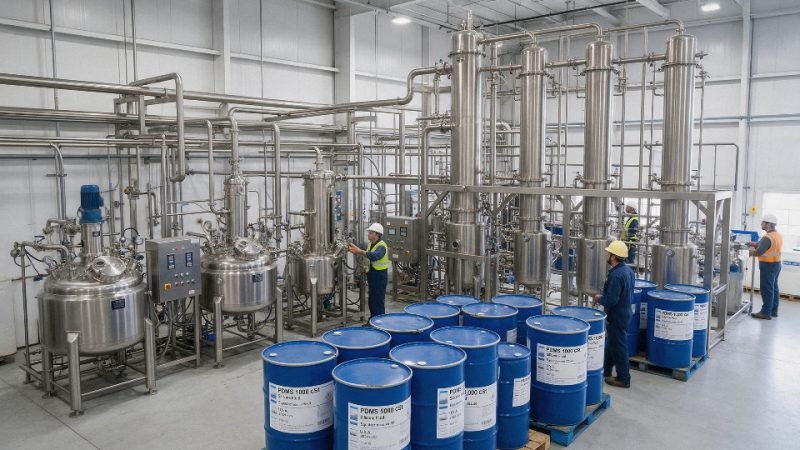
Bad silicone oil sourcing usually shows up after the drums are opened: viscosity drifts lot to lot, volatiles flash off in the process, or a fluid that looked fine on paper starts foaming, migrating, or losing lubricity in service. On the plant floor that turns into unstable dosing, coating defects, seal compatibility headaches, and cleanup nobody budgeted for. The money leak is rarely just product price; it sits in scrap, rework, downtime, and the cost of qualifying a second supplier when the first one cannot explain how the fluid was actually made.
Silicone oil is typically made by hydrolyzing chlorosilanes to form siloxane intermediates, then condensing and equilibrating them into silicone polymers such as PDMS, followed by viscosity adjustment, volatile removal, and quality control. The exact route depends on the target viscosity, end-group design, purity requirement, and how tightly the buyer needs consistency on residual volatiles and performance.
That broad sequence sounds simple until you look at what moves the result. A fluid at roughly 0.65 cSt behaves like a different product family from one above 1,000,000 cSt, and small changes in feed purity, water addition, catalyst handling, stripping, or end-capping can decide whether the material runs cleanly in your process or becomes a recurring complaint.
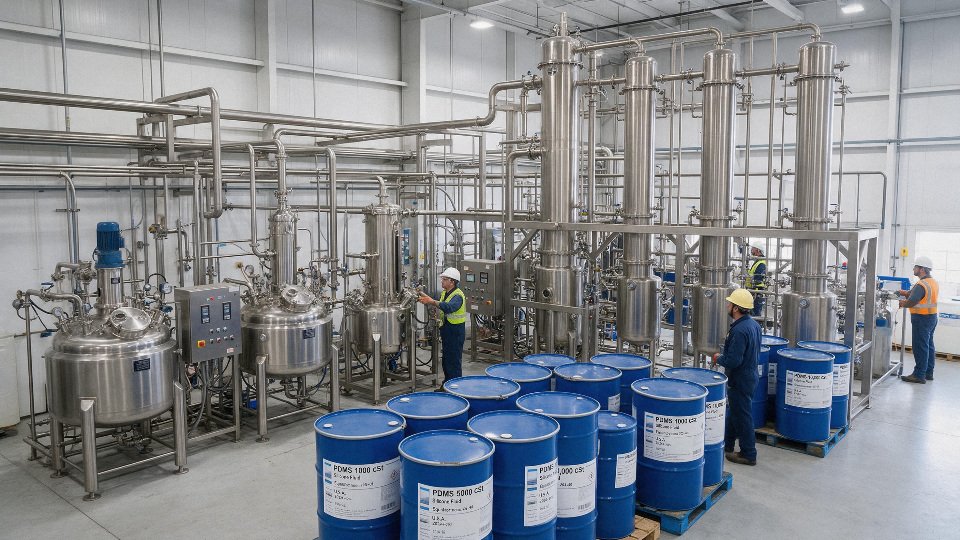
Silicone oil chemistry
Silicone oil behaves differently from mineral oil because its backbone is built on Si–O–Si siloxane bonds, not carbon–carbon chains. That one structural change is why silicone fluids usually keep flow over a wider temperature span, wet surfaces differently, resist oxidation better in many service conditions, and can be tuned from very mobile fluids to extremely high viscosities by controlled polymer chemistry rather than crude-oil refining.
At plant level, this matters because the manufacturing route is not a cosmetic detail. The backbone, end groups, residual cyclics, and any side-group modification all change how the fluid strips volatiles, reacts in downstream use, passes dielectric or odor requirements, and ages in a hot line, mixing tank, cosmetic base, or textile bath.
Why the siloxane backbone behaves unlike hydrocarbon oil
The core structural feature is the repeating siloxane linkage:
- Si–O–Si in the main chain
- Organic groups, usually methyl, attached to silicon
- A bond geometry and rotational freedom that gives the chain unusual flexibility
That flexibility shows up in several practical properties:
- Low glass-transition behavior and easy chain movement, which is one reason many silicone fluids stay fluid at temperatures where some hydrocarbon oils thicken sharply
- Low surface tension, which helps spreading, wetting, release, and defoaming
- Good thermal stability across a useful operating range, especially compared with many organic fluids of similar viscosity
- Better oxidation resistance than many hydrocarbon oils in air, though the actual limit still depends on temperature, contaminants, catalysts, and residence time
The mechanism is worth understanding. A hydrocarbon oil relies on a carbon-chain framework, and oxidation often attacks C–H and C–C environments that generate sludge, acids, or varnish as temperature rises. Siloxane fluids still degrade if pushed hard enough, especially in the presence of strong acids, bases, metal salts, or high heat with poor housekeeping, but the Si–O framework and methyl shielding usually make the fluid less prone to the same oxidation pattern seen in many mineral oils. In practice, a clean sealed system and a hot open bath are two different worlds.
That said, this advantage has a boundary. Silicone oil is not universally “better” under every lubricating duty. Where you need high load-carrying film strength on metal-to-metal contacts, compatibility with certain seals, or low cost for one-pass use, hydrocarbon or synthetic organic fluids may still be the better fit.
The structural units buyers should recognize
For most industrial buyers, four structural ideas explain most silicone-fluid behavior.
D units: the main repeat unit in common silicone fluids
The most common fluid backbone is built from D units, shorthand for difunctional siloxane units of the form:
- (CH3)2SiO
String enough D units together and you get linear polydimethylsiloxane, or PDMS, the workhorse silicone oil family.
M units: end-blockers that stop the chain
M units are monofunctional siloxane end groups, commonly trimethylsiloxy:
- (CH3)3SiO1/2
These cap the chain ends and control molecular architecture. In production terms, the amount and type of end-blocker strongly influence achievable viscosity and reactivity. More end-blocking relative to chain-building units means shorter average chain length and lower viscosity.
Cyclic siloxanes: intermediates and residual volatiles
Commercial silicone fluids are often made through routes involving cyclic siloxanes such as:
- D3
- D4
- D5
These rings can act as intermediates or equilibrating species in polymer manufacture. They also matter commercially because residual cyclic content affects odor, volatility, regulatory treatment in some markets, and finished-product specification. Typical industrial grades may target residual volatile siloxanes below roughly 0.5 to 3.0 wt%, but the right limit depends on the application and customer spec, not a universal rule.
Functional side groups: where “plain silicone oil” becomes an engineered fluid
Once you move beyond methyl-only PDMS, side-group modification changes performance fast. Common examples include:
- Vinyl
- Si–H containing groups
- Amino
- Epoxy
- Phenyl
- Polyether
These are not minor tweaks. They shift compatibility, refractive behavior, reactivity, lubricity, emulsifiability, softness, and cure response, and they often change how the material must be stored and handled on site.
Why PDMS dominates the market
Linear PDMS is the standard commercial silicone oil because it gives the widest useful balance of manufacturability, cost, stability, and tunable viscosity. Typical grades run from about 0.65 cSt to well above 1,000,000 cSt at 25 C, but that span should never be treated as one performance family in use; a 1 cSt fluid and a very high viscosity gum-like fluid behave like different materials in dosing, pumping, stripping, and application.
The viscosity mechanism is simple enough: longer average chain length increases molecular entanglement and internal friction, so viscosity rises. But the plant-floor consequence is not simple. As viscosity climbs:
- Pump selection changes
- Transfer line pressure drop rises
- Degassing gets slower
- Heat transfer worsens
- Filtration becomes more difficult
- Batch uniformity takes longer to stabilize
A buyer asking only for “silicone oil” without the target viscosity, viscosity tolerance, and volatile limit is usually inviting trouble later.
Silicone oil is basically a petroleum product refined to a higher purity.False
Commercial silicone oils are generally produced through organosilicon chemistry based on silicon-containing intermediates and controlled siloxane polymerization or equilibration, not by simple petroleum refining. Hydrocarbon feedstocks may contribute methyl or other organic groups upstream, but the finished fluid is not a refined mineral oil.
What terminal groups and modifications actually do
Terminal groups are often where application fit is won or lost.
- Trimethylsiloxy end-capped PDMS
Non-reactive, broadly used, stable, and common in lubricants, release formulations, dielectric fluids, and general-purpose process aids. - Hydroxyl-terminated silicone fluids
More reactive and useful as intermediates for further condensation or crosslinking. They can also be more sensitive to moisture history and storage conditions. Vinyl-terminated fluids
Chosen where addition-cure systems are needed, especially in elastomer and specialty formulation work.Hydrogen-functional fluids
Used in hydrosilylation chemistry and reactive water-repellent or release systems. These need tighter contamination control because catalyst poisons or side reactions can wreck consistency.Amino-modified silicones
Common in textile softening, hair-care conditioning, and surface substantivity. They improve affinity to certain substrates, but overuse can shift feel, yellowing tendency, or bath stability.Epoxy-modified silicones
Used where adhesion, reactivity, or coating compatibility matters.Phenyl-modified silicones
Useful when low-temperature behavior, refractive index, or certain thermal/electrical properties need adjustment beyond standard dimethyl fluids.Polyether-modified silicones
These bring organic compatibility and self-emulsifying behavior, which is why they show up in wetting agents, foam control, agricultural adjuvants, and waterborne systems.
The trade-off is straightforward: pure dimethyl systems are often the cleanest from a stability and cost standpoint, while functional modifications buy performance in one direction by sacrificing simplicity somewhere else, often in hydrolytic stability, compatibility, formulation latitude, or price.
How chemistry maps to end use
The chemistry only matters if it changes performance at the point of use.
- Dielectric fluids need controlled purity, low ionic contamination, and stable viscosity behavior.
- Release agents benefit from low surface tension and easy film formation.
- Foam control agents rely on insolubility balance, spreading behavior, and often a modified fluid or compound, not just any PDMS.
- Lubrication and slip depend on viscosity, substrate affinity, and whether the contact is light-duty boundary slip or true load-bearing lubrication.
- Cosmetic feel is driven by volatility, spread, residue, and compatibility with oils, waxes, and emulsifiers.
- Textile hand depends heavily on amino or other modified silicones, emulsion quality, pickup control, and cure history on the fabric.
A fluid that works well as a transformer or damping oil may be a poor choice for textile finishing; a softener that gives excellent hand may be wrong for a clean dielectric application. The chemistry gives you the menu, but the process window and contamination tolerance decide what is actually purchasable and repeatable.
Raw materials and feedstocks
Most silicone oil quality is decided upstream, before the polymer kettle is even charged. If the silicon metal, chlorosilane cut, and finishing auxiliaries are clean and well controlled, the downstream PDMS process is usually straightforward; if they are not, you spend the rest of production stripping odor, chasing color, and trying to stabilize a fluid that was compromised at monomer stage.
At plant level, the feedstock chain runs in a fairly consistent order:
- Metallurgical silicon
Usually produced in electric furnaces and then size-classified for direct synthesis. Purity matters, but not just headline Si %. Trace Fe, Al, Ca, and phosphorus can shift direct-process behavior and impurity carryover. Methyl chloride
The main methylating agent in the direct process. Water, oxygenates, and other contaminants need tight control because they interfere with reactor selectivity and can increase corrosion or by-product formation.Copper-based direct-process catalyst system
Commonly copper or copper compounds, often with promoters. This catalyst package largely determines how much dimethyldichlorosilane you get versus less useful fractions.Water
Used for hydrolysis of chlorosilanes. Quality matters more than people sometimes assume; dissolved salts can raise ionic contamination and complicate washing.Neutralizing agents and wash chemicals
Used to remove residual HCl and acidic species after hydrolysis and before finishing. Choice depends on the plant’s process design and waste-treatment setup.Condensation or equilibration catalysts
Acidic or basic catalysts are used later to build or redistribute siloxane chains to target viscosity. These are not interchangeable from a quality standpoint; catalyst residues can affect color, stability, and electrical properties.End-blockers
Most commonly trimethyl-functional materials that cap chain ends and control molecular weight. If end-blocker purity drifts, viscosity control drifts with it.Optional modification monomers
Phenyl, amino, epoxy, polyether, fluoro, or other functional silanes/siloxanes for specialty fluids. These push the process away from commodity PDMS and make feedstock purity even more critical.
The direct process: where PDMS economics are set
Industrial PDMS does not start from finished silicone polymer. It starts with the direct reaction of silicon metal and methyl chloride over a copper-based catalyst system, producing a mixed chlorosilane stream. The principal target is dimethyldichlorosilane, often abbreviated DMDCS or Me2SiCl2, because that difunctional monomer is the workhorse precursor for linear polydimethylsiloxane fluids.
The mechanism matters commercially. A higher selectivity to DMDCS means:
- more of the chlorosilane stream can be converted efficiently into linear PDMS
- less separation burden per usable ton of monomer
- lower by-product handling cost
- more stable batch economics when raw-material prices move
That selectivity is influenced by several upstream variables:
- Silicon particle size and surface condition
- Catalyst composition and promoter package
- Reactor temperature profile
- Methyl chloride purity and feed rate
- Residence time and fluidization behavior, where applicable
In practice, direct-process units are temperamental. Small shifts in silicon lot chemistry or catalyst aging can change product distribution enough to be felt downstream in monomer inventory balance and cost per ton of silicone fluid.
Why chlorosilane distribution matters
Not all chlorosilanes are equally useful for silicone oil manufacture, and the distribution is not just an accounting detail. It drives polymer architecture.
| Chlorosilane fraction | Main role in downstream processing | Why buyers should care |
|---|---|---|
| Dimethyldichlorosilane | Main precursor for linear PDMS chains | Dominant driver of commodity silicone oil yield and cost |
| Trimethylchlorosilane | End-blocking source | Controls chain termination, viscosity window, volatility profile |
| Methyltrichlorosilane | T-functionality, branching/crosslink tendency | Too much can increase branching, haze, gel risk, or instability if not intended |
| Other methylchlorosilanes and heavies | Secondary use, recycle, disposal, or specialty conversion | Affect plant economics and purification load |
A plant making standard silicone oils wants strong control of the ratio between DMDCS and the other fractions. More DMDCS is generally better for linear-fluid production, but a controlled amount of trimethylchlorosilane is also valuable because it supplies end-blocking functionality. The trouble fraction is often methyltrichlorosilane when it is not planned for: its trifunctionality can introduce branching during hydrolysis-condensation, which shifts viscosity behavior and can hurt clarity or storage stability.
This is where the conclusion has a boundary. If you are making specialty resins or deliberately branched fluids, some fractions that are undesirable for straight PDMS become useful. For standard industrial silicone oils, though, uncontrolled multifunctional content is usually a cost and quality problem, not a feature.
Impurity control: the part buyers notice late
A silicone oil can meet viscosity and still fail in use because of upstream contamination. The usual trouble paths are easy to recognize on the plant floor:
- Metallic impurities from silicon or equipment
Can contribute to color formation, catalyst side reactions, and poorer oxidative stability. Residual HCl or hydrolyzable chloride
Pushes acid number up, causes odor, corrodes drums or downstream dosing hardware, and can destabilize formulated products.Water and salts
Raise ionic contamination, which matters in electronics, personal care intermediates, and some release or dielectric applications.Low-boiling siloxanes and solvent residues
Show up as odor, flash-off complaints, weight loss, or spec failures on volatiles. Industrial grades often target residual volatile siloxanes below roughly 0.5 to 3.0 wt%, but the right limit depends on the application and the customer specification.Unremoved catalyst residues
Can continue to drive side reactions during storage, especially at elevated warehouse temperatures.
There is a clear mechanism here: impurity enters at monomer or auxiliary stage, survives hydrolysis and equilibration, then shows up later as yellowing, odor, unstable viscosity, or poor dielectric performance. Once the polymer is made, removing those last traces is much more expensive than preventing them upstream.
Alternative hydrolyzable routes
Not every silicone fluid route has to run through chlorosilanes. Alkoxy silanes and related hydrolyzable intermediates are used where lower-corrosion handling, different regulatory preferences, or specialty-functional fluid design justify the extra raw-material cost. They can simplify acid-management issues because they hydrolyze to alcohols rather than HCl, but that benefit is traded against feedstock cost, solvent management, and sometimes slower or more selective processing requirements.
For commodity PDMS, chlorosilane routes remain the industrial backbone because they are hard to beat on scale and cost. For specialty modified fluids, alkoxy routes can make sense when the process window or functional-group compatibility favors them.
Why integrated supply matters more than brochures suggest
A producer that controls the chain from chlorosilane manufacture into siloxane intermediates and finished fluids usually has an advantage in three areas:
- Purity control
Better visibility into monomer composition, chloride level, volatile profile, and lot-to-lot drift Cost position
Less exposure to trader margin at each intermediate step and fewer losses from off-spec monomer balancingConsistency
More stable raw-material genealogy, which matters when customers are trying to hold viscosity, odor, color, and aging behavior inside a narrow process window
A toll blender or non-integrated trader can still supply acceptable silicone oil, especially for less demanding uses. The trade-off is that they are often buying monomer quality rather than controlling it, so batch consistency depends on supplier discipline they do not fully own.
Integrated producers can better control monomer purity and batch consistency than companies that only blend or redistribute finished silicone fluids.True
This is a defensible supply-chain principle, not a guarantee of absolute quality. Vertical integration gives tighter control over chlorosilane distribution, purification, and trace-contaminant handling, which usually improves consistency if the producer's process discipline is sound.
Core manufacturing route
Standard silicone oil, usually PDMS-based fluid, is made by converting chlorosilanes into hydrolyzed siloxane intermediates, then controlling polymer growth with end-blockers, catalysts, and finishing steps until the product lands inside a usable viscosity and purity window. The chemistry is not especially exotic; the hard part is managing corrosive hydrolysis, stopping unwanted continued reaction, and stripping out the light fractions and residues that quietly ruin stability, odor, appearance, or downstream performance.
The route below describes the mainstream industrial path for linear dimethyl silicone fluids. There are plant-specific variations, and some producers start from purified cyclics while others integrate from chlorosilane hydrolysis. But if you are buying, specifying, or troubleshooting standard silicone oil, these are the operations that usually determine whether the fluid behaves cleanly in storage and predictably in use.
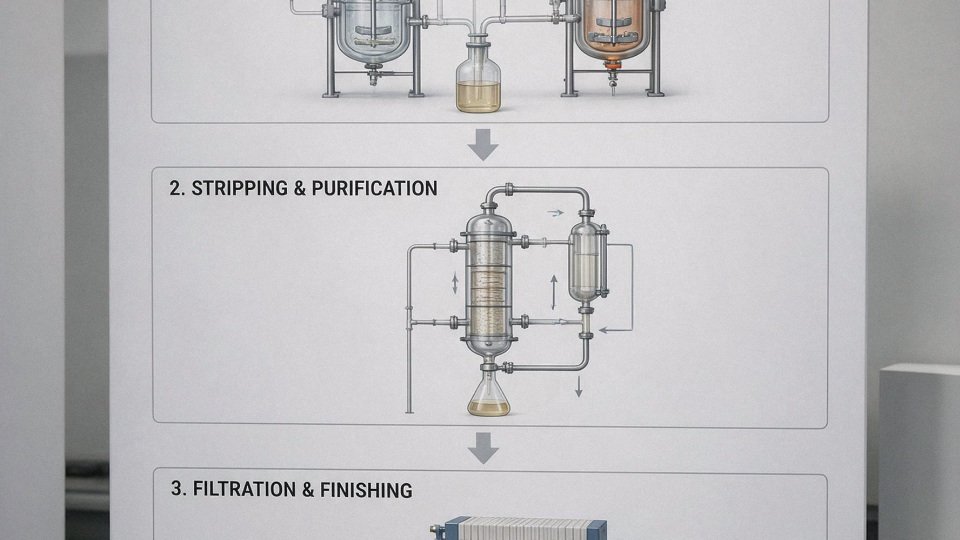
1. Hydrolysis: turning chlorosilanes into reactive silanols and crude siloxanes
The usual starting point is dimethyldichlorosilane, often with controlled amounts of other chlorosilanes depending on the target structure and end-group strategy. Water reacts with the Si-Cl bonds to form silanols, which then begin condensing almost immediately into low-molecular-weight siloxanes and cyclics, while hydrochloric acid is generated as a byproduct.
This sounds simple on paper. On the plant floor, it is the first place where a batch can get away from you.
- Reaction control matters because hydrolysis is fast and strongly exothermic.
- Poor addition practice gives local overheating, acid-rich pockets, and unstable emulsions.
- Those conditions can shift the siloxane distribution, increase corrosion load, and create washing problems downstream.
Typical hydrolysis-condensation temperatures in industrial practice range from controlled near-ambient addition up to roughly 150 C in later stages, depending on route design and finishing sequence. The critical point is that the first contact between chlorosilane and water must be controlled tightly. Whether the plant adds chlorosilane into water, water into chlorosilane, or uses a mixed solvent or acid phase system, the objective is the same: avoid local concentration spikes that generate excessive heat and poor phase behavior.
In practice, equipment details matter more than people admit in brochures:
- Feed nozzle placement
- Agitation intensity and baffle design
- Heat-removal capacity
- Corrosion-resistant metallurgy
- Vent scrubbing for HCl
- Reliable dosing control rather than operator “feel”
A small hydrolysis vessel can look fine during commissioning, then misbehave in summer when cooling water is warmer and the feed tank sits in the sun. That is not rare.
The output from hydrolysis is not a finished oil. It is a crude mix containing:
- Silanols
- Low-molecular-weight linear siloxanes
- Cyclic siloxanes
- Dissolved or entrained hydrochloric acid
- Water
- Salts and ionic residues after later treatment
- Sometimes haze-forming impurities from poor separations
2. Condensation, phase separation, washing, and neutralization
Once hydrolysis begins, silanols condense to siloxane bonds. Some of this happens spontaneously during and after hydrolysis; some routes push the conversion under controlled thermal conditions. The plant now has two jobs at once: build the desired siloxane intermediates and get corrosive residues out before they damage equipment or contaminate the finished fluid.
The first practical hurdle is separation. The crude reaction mixture often forms organic and aqueous phases, sometimes with stubborn emulsions if agitation, temperature, or phase ratios were poorly handled upstream. Separation and washing are not glamorous operations, but they strongly affect final quality.
Typical clean-up steps include:
- Phase disengagement
- Separate the siloxane-rich organic phase from the aqueous acid phase.
- Residence time, temperature, and demulsification behavior determine how cleanly this happens.
- Water washing
- Remove dissolved HCl and water-soluble residues.
- Multiple washes may be required if the initial acid load is high.
- Neutralization
- Use an appropriate neutralizing agent to reduce residual acidity.
- The exact chemistry varies by process; over-neutralization can introduce its own contamination.
- Salt and residue removal
- After neutralization, residual salts or fine solids must be separated.
- If they remain, they can plug filters, seed haze, or carry ionic contamination into the finishing stage.
The mechanism here is straightforward but commercially important: trace acid or base left in the fluid can continue to rearrange siloxanes after the reactor says the batch is finished. That causes viscosity drift, gas generation in some packages, higher volatiles, or even gel-like defects over storage time. Buyers often treat neutralization and cleanup as routine housekeeping. It is not. It is one of the points where a low-priced fluid later becomes a customer complaint.
There is a trade-off. Aggressive washing and neutralization improve cleanliness and reduce corrosive carryover, but they also increase cycle time, wastewater load, yield loss, and sometimes emulsion risk. Plants chasing every last kilogram of yield can leave too much behind in the name of throughput. Plants over-washing can create avoidable handling cost and still not solve the problem if the upstream hydrolysis was sloppy. The preferred operating point flips when the end use is sensitive, such as cosmetics-adjacent processing aids, release coatings, electrical fluids, or any application where odor, ionic contamination, and storage stability matter.
3. Setting chain length with end-blockers
If you let dimethyl siloxane units keep condensing without control, molecular weight rises and the viscosity window becomes difficult to hit consistently. Industrial producers limit polymer length by using chain stoppers, typically trimethylsiloxy end-blocking species or related end-capping components.
The idea is simple: a non-reactive or less-reactive terminal group caps the chain ends so the average polymer length lands where the grade requires. That is how producers make broad families of fluids, from very low viscosity grades around 0.65 cSt up to very high viscosity materials above 1,000,000 cSt at 25 C, though the manufacturing and handling methods change significantly as viscosity climbs.
What matters to the buyer is not just the nominal viscosity grade but how tightly the supplier controls the population around that target. Two silicone oils can both be sold as, say, a mid-range viscosity fluid, yet behave differently because one has:
- More broad molecular weight distribution
- Higher residual cyclic content
- Different end-group chemistry
- More catalyst residue or moisture
- Poorer stripping of low boilers
That shows up in evaporation loss, foam behavior, lubrication feel, dielectric behavior, migration, or consistency in compounding.
4. Equilibration or ring-opening polymerization: building the target molecular weight distribution
Most commercial linear silicone fluids are then produced or adjusted through equilibration chemistry, commonly using cyclic siloxanes and end-blockers in the presence of an acid or base catalyst. In broad terms, the catalyst allows siloxane bonds to break and reform until the system approaches an equilibrium distribution, after which the formulation and operating conditions determine the average chain length and the amount of residual cyclic material.
Some routes are described as ring-opening polymerization of cyclics; others are better thought of as equilibration among cyclic and linear species. In purchasing discussions, those terms are sometimes used loosely. The important question is not the label but how the producer controls:
- Catalyst type and concentration
- Reaction temperature
- Residence time
- End-blocker ratio
- Water content
- Feed purity
- Stripping strategy after reaction
Acid and base catalysts each have their place. Exact supplier practice is often proprietary, and performance cannot be generalized responsibly across all plants. What can be said safely is that catalyst choice affects reaction rate, side reactions, color tendency, cleanup difficulty, and the residual tendency of the fluid to keep changing if catalyst is not fully quenched and removed.
A practical trade-off sits here too. Faster catalyst systems and hotter operating windows can improve throughput and reduce reactor occupancy. They can also make the process less forgiving, especially if feed purity drifts or quenching is delayed. For commodity industrial grades, a producer may accept a broader molecular weight distribution to keep costs down. For tighter applications, the plant usually pays for more controlled reaction and more finishing.
This section’s main conclusion stops holding if the product is not a standard linear PDMS fluid. Amino-, phenyl-, polyether-, or reactive-functional silicone oils may use modified routes, additional functionalization steps, or different purification priorities.
5. Quenching and removing the catalyst
Once the target viscosity range or equilibrium state is reached, the catalyst has to be stopped decisively. If not, the batch may keep rearranging in storage, especially when exposed to heat, moisture, or contamination from drums, transfer lines, or customer tanks.
That is why good producers do more than “cool and ship.” They usually include some combination of:
- Catalyst quench
- Chemically deactivate the catalyst at the right point in the process.
- Neutralization
- Reduce residual acidity or alkalinity to a specified low level.
- Phase or solids removal
- Remove neutralization byproducts, salts, or adsorbent fines.
- Verification
- Check that the fluid is not still chemically active enough to drift in viscosity or generate gel over time.
A common field complaint is silicone oil that arrives on-spec in viscosity, then thickens, hazes, or develops sediment later. Sometimes that is contamination from the user’s tank. Sometimes it traces back to incomplete catalyst removal.
A silicone oil can meet viscosity on the day of packing and still be a poor-quality batch if catalyst residues or unstable end groups remain.True
Viscosity is only a point-in-time measurement. Storage stability depends on residual catalytic activity, volatile content, moisture, ionic contamination, and end-group control.
6. Vacuum stripping and devolatilization
Residual light materials are then removed by vacuum stripping or devolatilization. This stage usually targets:
- Cyclic siloxanes
- Unreacted low-molecular-weight linear species
- Moisture
- Odor-causing trace volatiles
- Sometimes solvent, depending on the route
For many industrial grades, residual volatile siloxane limits are often specified below about 0.5 to 3.0 wt%, depending on end use and supplier standard. There is no honest universal number for “good” because the acceptable level depends on flash-off tolerance, regulatory exposure, odor limits, process temperature, and whether the fluid will be used in a closed system, textile bath, personal-contact article, mold release, or defoamer formulation.
The mechanism is direct: lower pressure and controlled temperature let the lighter fractions leave the bulk fluid. But there is a trade-off. Harder stripping usually lowers residual volatiles and odor, improving stability and sometimes customer acceptance. It also costs yield, energy, and cycle time. Push it too far on a poorly designed system and you may darken the product, entrain product into the condenser, or create throughput bottlenecks. This is one reason the cheapest supplier quote can hide a lot; stripping efficiency affects both compliance comfort and how much saleable product comes out of the reactor.
7. Filtration, polishing, and optional adsorption finishing
After devolatilization, the oil is usually polished before packing. Depending on grade and customer sensitivity, this may include:
- Cartridge or depth filtration for particulates
- Fine polishing filtration for haze-causing solids
- Adsorption treatment for color bodies or trace ionic residues
- Drying to control residual moisture
- Clean transfer through dedicated lines and pack-out systems
If the product is destined for a forgiving mechanical use, a basic clean filtration train may be enough. If it is heading into electronics-adjacent processing, premium release coatings, or applications where clarity matters, the finishing standard is usually tighter.
A table helps separate what each step is actually doing.
| Finishing step | Main target | If poorly done |
|---|---|---|
| Vacuum stripping | Cyclics, light ends, moisture, odor | Higher volatility, odor, regulatory exposure concerns, unstable behavior at temperature |
| Neutralization/quench | Residual catalyst activity | Viscosity drift, gel formation, storage instability |
| Filtration | Particles, salt fines, haze | Sediment, blocked customer equipment, poor appearance |
| Adsorption polishing | Color, trace ionic or polar residues | Off-color product, electrical or coating performance issues in sensitive uses |
| Dry pack-out | Moisture control | Hydrolytic issues in reactive systems, handling variability |
High viscosity does not automatically mean high quality
A thick silicone oil is not necessarily a well-made silicone oil. High viscosity alone proves very little unless you also know the molecular weight distribution, residual volatiles, end-group profile, cleanliness, and storage stability.
In purchasing reviews, this is one of the most common misunderstandings. Buyers often assume a high-cSt product must be “more polymerized” and therefore superior. Sometimes it is just broader in distribution, less cleanly stripped, or still chemically active. A well-controlled medium-viscosity fluid can be the better product if the application depends on low volatility, clarity, dielectric cleanliness, or batch-to-batch consistency.
If you are comparing suppliers, ask for the things that reveal process discipline rather than just the front-label viscosity grade:
- Volatile content and test method
- Appearance and haze standard
- Acid or alkali residue limits, if relevant
- Moisture level, where application-sensitive
- Viscosity tolerance and batch consistency
- Storage stability data or retention samples
- Packaging cleanliness and drum or tote compatibility
That is where the manufacturing route stops being chemistry trivia and starts showing up as scrap, odor complaints, customer returns, or a line that behaves differently from one lot to the next.
Process control and equipment
A silicone oil plant lives or dies on three things: corrosion control in the front end, stable polymerization control in the middle, and clean finishing at the back end. If those three blocks are matched properly, you get consistent viscosity, lower volatile carryover, and fewer off-spec batches; if they are not, the chemistry may still work, but the plant becomes expensive and temperamental.
The major equipment train is fairly standard across PDMS production, even though details vary by capacity, feed route, and product slate:
- Hydrolysis reactor
- Handles chlorosilane or hydrolyzable silane addition into water or controlled aqueous phase
- Needs strong heat removal and controlled mixing because hydrolysis is fast and exothermic
- Condenser system
- Recovers condensables from reactor vapors
- Reduces solvent or siloxane loss and protects downstream scrubbers
- Acid gas scrubber or HCl recovery unit
- Treats hydrogen chloride released during hydrolysis
- Often one of the most critical environmental and safety systems in the whole plant
- Neutralization and washing vessels
- Remove acid residues, salts, and hydrolysis byproducts from crude siloxane phase
- Usually include decanting or phase-separation steps
- Equilibration reactor
- Carries out acid- or base-catalyzed redistribution/polymer growth to target molecular weight
- Endblocking and viscosity adjustment are controlled here
- Stripping system
- Typically vacuum stripping or thin-film style finishing, depending on scale and viscosity range
- Removes low boilers, residual cyclics, moisture, and other volatiles
- Filtration skid
- Final particulate and gel control before storage or packaging
- Storage tanks
- Segregated by viscosity grade, status, and release condition
- Blanketing may be needed for moisture-sensitive intermediates
- Packaging lines
- Drums, pails, IBCs, tank loading, and sometimes small-pack filling for specialty grades
The control variables that matter most are not exotic. They are the usual suspects, but in silicone service they interact in ways that can punish sloppy operation fast.
What operators and process engineers watch most closely
- Temperature profile
- Hydrolysis temperature affects reaction rate, vapor load, emulsion behavior, and corrosion severity
- Equilibration temperature shifts redistribution rate and can broaden product distribution if pushed too hard
- Typical hydrolysis-condensation processing can range from controlled addition near ambient up to roughly 150 C before final finishing and stripping, but the right number depends on feed composition and reactor design
- Feed rate
- Too fast in hydrolysis and you spike HCl release, overload condensers, and create local overreaction
- Too slow and you lose throughput with no quality gain
- Water ratio
- Controls hydrolysis completeness, acid concentration, phase behavior, and downstream washing load
- This is one of the common causes of stubborn emulsions
- Agitation
- Insufficient mixing creates hot spots and incomplete contacting
- Excess shear can worsen emulsion carryover during washing and make separation painfully slow
- Catalyst concentration
- In equilibration, small changes can move reaction time a lot
- Overcatalysis can increase side reactions, color, or post-package drift if neutralization is weak
- Residence time
- Short residence risks incomplete equilibration or stripping
- Long residence can increase thermal history and broaden distribution
- Vacuum level
- Directly affects stripping efficiency for low boilers and cyclic siloxanes
- A vacuum system that looks adequate on paper can fall short once foaming starts
- Endpoint testing
- The batch is not done because the timer says so; it is done when viscosity, volatile level, chloride, and appearance are within spec
That last point sounds obvious, but in practice it is where commercial discipline shows up. A plant can hit nameplate and still lose margin if every second batch needs re-strip, reblend, or hold-for-lab.
Materials of construction are not a purchasing afterthought
The front end of silicone oil production is corrosive enough that cheap material choices usually come back as leaks, contamination, or unplanned shutdowns.
- Glass-lined steel
- Common choice for hydrolysis and acidic stages
- Good corrosion resistance, but vulnerable to mechanical damage and thermal shock if operation is rough
- Specialty stainless steels
- Used where chloride service, wash chemistry, and temperature permit
- Exact grade selection must be verified against the actual acid concentration, temperature, chloride load, and clean-in-place chemistry; this is not something to generalize safely across all plants
- Lined piping and corrosion-resistant internals
- PTFE-lined or similar systems are often used in acid gas and acidic liquid service
- Valve trim, pump seals, dip pipes, and sampling points need the same level of attention as the vessel shell
One weak spool piece or a poor gasket choice can contaminate a whole batch train. Older plants often show this first at low points, sample loops, or around scrubber recirculation lines.
Acid gas handling is a core design block, not a utility detail
Hydrolysis of chlorosilanes produces hydrogen chloride, and the gas-handling design has to be sized for upset conditions, not just average load. If the scrubber or recovery system is undersized, operators will see pressure instability, fuming, condenser overload, and eventually quality excursions upstream because the reactor is no longer operating in the intended window.
Plants generally use one of these approaches:
- Hydrochloric acid recovery
- Viable where acid reuse or sale has value and concentration control is practical
- Can improve overall economics, but only if downstream users can accept the recovered acid quality
- Caustic or water scrubbing
- Simpler in many installations
- Generates a secondary waste stream that has to be managed properly
The preferred choice flips with site infrastructure. If you have a nearby acid consumer, stable load, and environmental permitting support, recovery can make sense. If your production mix swings hard and acid concentration is inconsistent, robust scrubbing is often easier to keep stable.
Analytics are what turn chemistry into a repeatable product
Inline instruments help, but silicone oil still depends heavily on disciplined lab release testing.
Typical control checks include:
- Viscosity
- Primary commercial property for many grades
- Typical PDMS grades run from about 0.65 cSt to above 1,000,000 cSt at 25 C, so the measurement method has to match the grade range
- Refractive index
- Useful as a quick consistency check and sometimes for blend confirmation
- Chloride
- Indicates washing and neutralization effectiveness
- Moisture
- Important for stability and packaging quality
- Volatile content
- Industrial grades often specify residual volatile siloxanes below roughly 0.5 to 3.0 wt%, depending on application and contract specification
- GC profile of cyclics
- Tracks low-boiling siloxanes and confirms stripping performance
- Appearance and haze
- Practical release check that often catches contamination before numbers do
Residual volatile siloxane limits cannot be stated as one universal number for all silicone oils.True
Typical industrial specifications often fall below about 0.5 to 3.0 wt%, but the acceptable limit depends on product grade, application, regulatory exposure, and buyer specification.
Scale-up is where good pilot chemistry gets humbled
A recipe that behaves nicely in a small reactor can become awkward at production scale for a few predictable reasons:
- Heat removal gets harder
- Larger vessels reduce surface-area-to-volume ratio
- Local temperature excursions can widen molecular weight distribution
- Emulsion breakup slows down
- What settled in 20 minutes in the lab may take hours in a large wash tank
- Demulsifier strategy, mixing intensity, and temperature all matter
- Foam becomes a throughput limit
- Especially during stripping and vacuum finishing
- Foam can carry product into condensers and foul vacuum systems
- Viscosity tolerance narrows commercially as batch size increases
- A small catalyst or endblocker error spreads over more material, and correction options get slower
In practice, narrow viscosity control is less about one perfect reactor and more about a stable system: repeatable feed assay, calibrated dosing, clean phase separation, and a stripping step that behaves the same way in July humidity as it does in dry winter air. If a buyer needs tight volatile and viscosity tolerances together, that should be discussed during application review, because the finishing window can get narrow on some grades.
Modified silicone oil routes
Standard PDMS covers a lot of ground, but most application-specific silicone oils are made by changing the siloxane backbone, the chain ends, or both. Those modifications are what shift a fluid from being a generic lubricant or dielectric into a textile softener intermediate, a release additive, a hydrosilylation crosslinker, a waterborne wetting agent, or a high-index specialty fluid.
The practical point for buyers is simple: two materials can sit in the same viscosity range and still behave very differently in cure response, substrate affinity, volatility, emulsion stability, or low-temperature flow because the route used to introduce functionality is different. In plant terms, that route usually falls into one of three buckets: controlled copolymerization of different siloxane units, end-blocking with functional chain stoppers, or post-functionalization of a preformed silicone fluid.
Phenyl-modified silicone oils
Phenyl modification is usually chosen when straight methyl silicone fluid is not giving enough low-temperature performance, thermal durability, radiation resistance, or optical properties. The effect is not universal, though; the benefit depends strongly on phenyl content, distribution along the chain, and whether the product is a true methylphenyl siloxane copolymer or just a blend.
A few common drivers:
- Low-temperature flexibility and pour behavior
- Certain phenyl-containing structures disrupt regular chain packing differently than standard PDMS.
- In practice, some phenyl-modified fluids stay usable at temperatures where comparable methyl fluids become too sluggish for damping, instrumentation, or specialty lubrication.
- Higher refractive index
- This matters in optical coupling, LED-related formulations, specialty polishes, and some personal care systems.
- The gain is tied to aromatic content, but increasing phenyl too far can shift cost and compatibility in the wrong direction.
- Thermal and radiation resistance
- Phenyl groups can improve performance in applications exposed to elevated heat or radiation compared with purely methyl-substituted fluids.
- Exact limits are product-specific and need supplier data; this is not something to infer from chemistry alone.
Production-wise, phenyl modification is commonly introduced by using phenyl-containing siloxane intermediates during equilibration or condensation, rather than trying to graft phenyl onto a finished PDMS in a late-stage step. That gives better compositional uniformity. The mechanism matters: if phenyl units are built into the chain during polymer growth, the resulting fluid usually has more predictable viscosity-temperature behavior and volatility than a simple physical blend of methyl and phenyl silicone fluids.
The trade-off is cost and process complexity. Phenyl-bearing intermediates are more expensive, and the product slate is narrower. Also, once phenyl content rises, compatibility with some organic phases improves while compatibility with certain existing formulations can get worse. The usual conclusion that “phenyl is better at temperature extremes” stops holding if the application is mainly cost-driven and only needs standard PDMS stability.
Hydrogen silicone oils
Hydrogen silicone oils contain Si-H functionality, typically through methylhydrogen siloxane units built into the polymer. They are less often the final-use fluid by themselves than a reactive intermediate or treatment component.
Typical uses include:
- Water-repellent treatments for powders, minerals, glass, masonry, and textiles
- Release coatings and release additives
- Crosslinking components in addition-cure silicone systems
- Reactive intermediates for further modification through hydrosilylation
From a manufacturing standpoint, the challenge is not just making the target viscosity. It is controlling the active hydrogen content, its distribution along the chain, and residual catalyst or impurity levels that can trigger unwanted side reactions. A hydrogen fluid with the right cSt but the wrong Si-H content is the wrong product.
Operationally, these fluids are sensitive to moisture, alkali contamination, and certain metal residues. In the plant, poor drying discipline, a dirty transfer tote, or the wrong pump seal material can create gas evolution or gradual instability. Buyers sometimes focus only on viscosity and miss the parameter that actually drives performance: hydrogen content, usually specified as a weight percent or equivalent reactive value.
There is also a practical safety and handling boundary here. Hydrogen-functional silicones can react in ways standard PDMS will not, so storage, packaging cleanliness, inhibitor strategy, and compatibility with downstream formulation ingredients need confirmation against the product-specific technical data and process conditions.
Vinyl-terminated and vinyl-functional fluids
Vinyl-functional silicone fluids are the workhorses of platinum-cure and other addition-reaction silicone systems. In many cases, the fluid is not purchased for its standalone properties at all, but for what it will do in a downstream cure package.
Two main forms matter:
- Vinyl-terminated fluids
- Used as base polymers in addition-cure elastomers, gels, encapsulants, and specialty formulations
- Reactive mainly at the chain ends, which supports controlled network formation
- Pendant vinyl-functional fluids
- Vinyl groups appear along the chain, not just at the ends
- Used when higher crosslink density or specific reactivity patterns are wanted
These are usually made by controlled end-blocking or copolymerization using vinyl-containing siloxane units. What matters commercially is vinyl content accuracy and lot-to-lot consistency. If the vinyl level drifts, cure speed, crosslink density, hardness, elongation, and extractables can all move at once. In a plant that means line adjustments, longer qualification, and occasionally a very expensive blame game between polymer supplier and compounder.
A low-viscosity vinyl fluid may also carry different stripping and volatile-control requirements than a high-viscosity one. The broad PDMS range of about 0.65 cSt to more than 1,000,000 cSt at 25 C still applies as a category reference, but reactive specialty fluids are usually specified by a tighter package: viscosity, vinyl content, volatile siloxanes, and catalyst poison profile.
Amino silicone oils
Amino silicone oils are chosen when the product needs stronger affinity to polar surfaces than unmodified PDMS can provide. Textile softeners and hair-conditioning systems are classic examples because amino groups improve substantivity to fibers and keratin surfaces.
The route is often post-functionalization or copolymerization with aminoalkyl-functional siloxane units. What changes on the plant floor is not only chemistry but finishing:
- Amine value or nitrogen content must be controlled, not just viscosity
- Color and odor become more commercially visible than with commodity silicone oils
- Emulsification behavior becomes critical because many amino silicones are sold or used as emulsions rather than neat fluids
This is where buyers get caught. A fluid that looks fine in bulk can still fail in a textile or personal care process because emulsion compatibility is poor. Amino functionality tends to interact strongly with emulsifiers, pH, salts, and other formulation ingredients. A cationic amino silicone emulsion may perform well on fabric and still break in a hard-water plant or in a formulation with the wrong nonionic package.
The mechanism is straightforward: amino groups increase surface interaction, but that same polarity changes how the silicone sits at the oil-water interface and how it responds to pH. Better deposition is often gained at the cost of narrower formulation tolerance. If the end use involves broad pH swings, electrolytes, or long ambient storage, bench emulsion stability testing matters more than a generic neat-fluid certificate.
Polyether-modified silicone oils
Polyether-modified silicones are made to bridge the gap between silicone surface activity and organic or aqueous compatibility. They are common in wetting agents, defoamers, agricultural adjuvants, polyurethane additives, and water-based coatings systems.
The reason they behave so differently from PDMS is that the polyether segment changes the balance between silicone’s low surface tension and the formulation’s continuous phase. Depending on polyether type and level, the product can become:
- Self-dispersible in water
- More compatible with polar organic systems
- More effective as a substrate wetting additive
- Less prone to the classic incompatibility problems of straight silicone oil
In-reactor introduction of polyether-functional siloxane units is one route; hydrosilylation onto a hydrogen silicone intermediate is another common route. That second path is widely used because it gives flexible design options, but the downstream purification burden can be higher if unreacted species or catalyst residues must be minimized.
The trade-off is one every coatings and agrochemical formulator knows: as water compatibility rises, some of the hallmark silicone slip, defoaming profile, or hydrophobicity can drop or shift. There is no single “best” polyether silicone. The preferred structure flips depending on whether the job is fast substrate wetting, controlled foam knockdown, recoatability, or tank-mix compatibility.
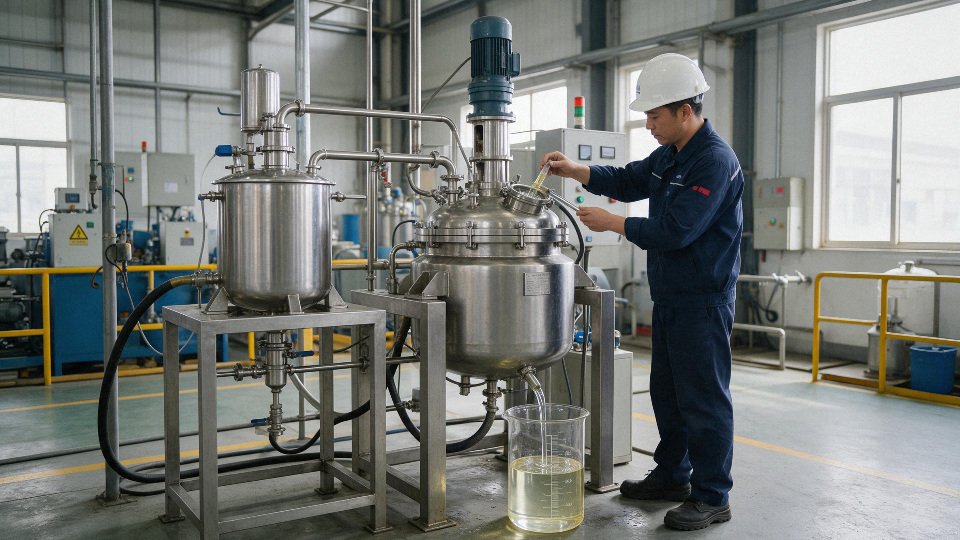
Epoxy, carbinol, fluorinated, alkyl, and other specialty modifications
These families are usually narrower in volume but high in value because they solve specific interface or reactivity problems.
- Epoxy-functional silicones
- Used in coatings, adhesion-promoting systems, and reactive additives
- Chosen where subsequent cure or substrate bonding is needed
- Carbinol-functional silicones
- Hydroxyl-bearing materials used in urethane systems, coatings additives, and further derivatization
- Sensitive to water, catalyst choice, and side reactions in downstream chemistry
- Fluorinated silicones
- Selected for very low surface energy, chemical resistance, or demanding release and anti-smudge roles
- Usually expensive, with tighter application justification required
- Alkyl-modified silicones
- Used to tune compatibility with hydrocarbon media, lubricity, antifoam behavior, or feel
- Often a practical middle ground when unmodified silicone is too incompatible and fluorinated chemistry is too costly
Other niche routes include aralkyl, mercapto, phosphate, or quaternary-functional materials, each aimed at a narrow performance gap. At this level, selection is rarely about broad category rules; it is about whether the functional group survives the customer’s process and whether side effects such as odor, color, corrosion tendency, or cure interference are acceptable.
Copolymerization, post-functionalization, or blending?
For specialty silicone oils, the manufacturing route is part of the specification, even when the data sheet does not say so outright.
| Route | Typical strength | Typical weakness | Best fit |
|---|---|---|---|
| In-reactor copolymerization | More uniform functional distribution, better consistency | Higher process complexity, less flexible small-batch customization | Core commercial grades with repeat demand |
| Post-functionalization | Flexible design, useful for targeted functionality | Can leave residual reactants, broader impurity profile if not well finished | Tailored reactive specialties |
| Physical blending | Lowest cost, fast to supply | Weaker uniformity, performance drift in demanding applications | Non-reactive property adjustment, cost-sensitive uses |
A blend can be perfectly acceptable if the application only needs a viscosity window or a broad property shift. It is usually the wrong choice when the product is expected to cure reproducibly, emulsify predictably, or deliver tightly controlled surface behavior. That is where structured copolymer or functionalized products earn their price.
All modified silicone oils can be evaluated mainly by viscosity.False
Viscosity is only one screening parameter. Functional group content, distribution, residual volatiles, catalyst residues, emulsion behavior, and application-specific compatibility often matter more than viscosity for specialty silicone oils.
In procurement terms, the safest buying approach is to ask not only for viscosity and appearance, but also for the functional parameter that actually drives the use case: phenyl content, Si-H content, vinyl content, amine value, polyether type, hydroxyl value, epoxy equivalent, or fluorine content, depending on the chemistry. Without that, two drums can look interchangeable on paper and behave very differently once they hit the line.
Quality metrics and testing
A silicone oil batch is only “made correctly” if its measured properties line up with the intended molecular structure, residual impurity profile, and end-use behavior. For buyers, the practical check is not one number but a cluster: viscosity tells you polymer length, volatiles tell you how well the finishing was done, and appearance plus trace residues often reveal whether the process was actually under control or just barely passed release.
The exact test slate depends on whether you are buying a general-purpose PDMS fluid, an electrical grade, a cosmetic/intermediate grade, or a modified silicone for textile, release, or defoaming service. A plant making bulk industrial grades may release on a compact certificate; a customer running tight coating, electronics, or compounding processes usually needs a broader control plan and evidence of batch-to-batch stability.
Core physical properties
These are the first-line release checks because they are fast, cheap, and strongly tied to manufacturability.
- Viscosity
- Usually the primary grade-defining property for PDMS fluids.
- Typical commercial grades span from about 0.65 cSt to above 1,000,000 cSt at 25 C, but the acceptable tolerance depends heavily on grade and use.
- Measured with capillary or rotational methods, selected to fit the viscosity range.
- A drift upward often points to extra condensation or poor endpoint control; a drift downward can indicate over-cutting with low-viscosity fraction, excess cyclics, or incomplete polymer growth.
- Specific gravity
- Useful as a quick identity and consistency check.
- Not specific enough to replace full analysis, but it can catch dilution, wrong-grade blending, or unusual impurity load.
- In practice, some buyers ignore it until a receiving issue shows up; then it suddenly becomes valuable.
- Refractive index
- Another fast identity marker, especially helpful for detecting composition shifts in modified fluids or contamination by non-silicone material.
- It is often paired with viscosity because the two together are harder to fake than either alone.
- Flash point
- Important where the oil is heated, sprayed, or stored in quantity.
- Strongly influenced by residual low-boiling siloxanes and any solvent carryover.
- If flash point drops unexpectedly, I would first look at stripping performance and volatile control before blaming the raw materials.
- Pour point
- Relevant for dosing, pumping, and cold-weather handling.
- Not every buyer needs it, but plants in unheated warehouses or winter export lanes definitely should care.
- Very high-viscosity fluids can become a handling problem long before they fail any formal low-temperature spec.
- Appearance
- Clear, bright, and free of visible particles is the usual expectation for standard silicone oil unless the product is intentionally modified or filled.
- Haze is not a cosmetic issue only; it may signal moisture, microgel, salt carryover, poor filtration, or compatibility problems.
Chemical and purity metrics
This is where the manufacturing route shows up more clearly. Two products can have similar viscosity and density but behave very differently if one carries residual cyclics, water, chloride, or catalyst residue.
- Volatile content
- Common industrial limits are often below about 0.5 to 3.0 wt%, depending on specification and grade.
- Controlled by stripping efficiency, vacuum quality, residence time, and how aggressively the batch is finished.
- Lower volatiles usually improve flash point, reduce fogging and weight loss, and help electrical and coating applications. The trade-off is cost and processing time; deeper stripping means more energy, more cycle time, and sometimes lower yield if the cut is too aggressive.
- Cyclic siloxanes
- Typically measured by GC.
- Important where emissions, odor, migration, extractables, or regulatory review matter.
- Not all “volatile content” is equal; a batch with the same total volatile level can have a different cyclic profile, which matters in sensitive uses.
- Moisture
- Usually checked by Karl Fischer.
- A small amount of water may not matter in a mold-release drum sitting in a maintenance room. It matters a lot in hydrolysis-sensitive formulations, electrical fluids, and any process where moisture drives side reactions, haze, or storage instability.
- Chloride
- Residual chloride often traces back to incomplete washing, poor phase separation, or chlorosilane-derived contamination.
- High chloride can promote corrosion, catalyst poisoning, odor issues, and downstream instability.
- Acid or alkali residue
- Leftover catalyst or neutralization imbalance can keep the fluid reacting in the drum.
- That is one mechanism behind viscosity drift during storage: residual acidity or alkalinity continues condensation or rearrangement, especially if the batch was finished hot and packed before true stabilization.
- Hydroxyl value
- Critical for hydroxy-terminated fluids, reactive intermediates, and crosslinkable systems.
- Usually determined by titration or equivalent chemical analysis.
- Too high or too low shifts cure behavior, compatibility, and final network structure.
- Functional group content
- For amino-, epoxy-, phenyl-, vinyl-, hydrogen-, polyether-, or other modified silicones, active group level often matters more than viscosity alone.
- Confirmed by titration, FTIR, NMR where available, or a combination of methods depending on the chemistry.
- This is where buyers get into trouble if they purchase “equivalent” material by viscosity only.
Performance tests must match the application
A broad certificate does not replace use-related performance testing. The right test is the one that predicts whether the oil will behave in your line, not just whether it matches a generic PDMS profile.
Examples:
- Dielectric strength / electrical behavior
- Relevant for electrical insulation uses.
- Sensitive to moisture, ionic contamination, particulates, and volatile profile.
- Surface tension and spreading coefficient
- Important in coatings, wetting agents, agricultural adjuvants, and release systems.
- A structurally correct product can still fail here if functional group level is off or if the molecular weight distribution shifted.
- Lubrication behavior
- Friction, film persistence, and material compatibility matter more than viscosity alone.
- Some buyers learn this the hard way when a fluid with the “right cSt” still causes stick-slip or elastomer swelling.
- Foam control efficiency
- Usually tested in the customer’s medium or a representative lab system.
- Defoamer performance is especially formulation-dependent; bench confirmation is better than trusting a generic data sheet.
- Fabric hand
- For textile softeners and finishing silicones, panel feel, smoothness, drape, and yellowing tendency are often decisive.
- Instrumental data helps, but application trials still carry a lot of weight here.
The main boundary: a release specification can confirm manufacturing quality, but it does not fully predict field performance when the downstream system is complex, highly polar, heavily surfactant-loaded, or cure-sensitive. In those cases, application screening is not optional.
Analytical methods and what they actually tell you
| Method | What it checks | Typical use |
|---|---|---|
| GC | Cyclic siloxanes, volatile profile | Residual low boilers, emissions-sensitive grades |
| FTIR | Siloxane backbone, functional groups | Structure confirmation, modified silicone screening |
| Karl Fischer | Water content | Moisture-sensitive grades |
| Titration | Hydroxyl, amino, epoxy, acid/alkali residue | Reactive or functional fluids |
| ICP | Trace metals | Electrical, catalyst-sensitive, or high-purity uses |
| Visual/Color test | Clarity, haze, color drift | Fast release and storage monitoring |
No single method is enough. FTIR will confirm that you broadly made the right chemistry, but it will not replace GC for cyclics or Karl Fischer for water. ICP is not needed on every drum, though where platinum-cure poisoning, dielectric performance, or trace contamination matter, it becomes worth the cost.
Batch consistency, retention, and defect signals
Industrial buyers care less about one good batch than about the next fifty matching it closely enough that they do not have to re-tune their process every month.
Good supply discipline usually includes:
- Defined release limits, not just typical values.
- Retention samples held long enough to investigate later complaints or drift.
- Lot traceability back to raw materials, reactor campaign, and finishing conditions.
- Change control for catalyst source, stripping regime, feedstock route, or filtration setup.
- Requalification triggers when a meaningful process or raw-material change occurs.
Common defect signals and what they often imply:
- Haze
- Moisture, salts, poor filtration, microgel, or phase incompatibility.
- Unusual odor
- High volatiles, residual low boilers, contamination, or incomplete neutralization.
- Color drift
- Thermal history, oxidation, catalyst residue, metal contamination, or degradation in storage.
- Viscosity instability
- Residual catalyst, incomplete neutralization, wrong endblocking, moisture-driven side reactions, or bad blending control.
- Gel particles
- Local overreaction, hot spots, contamination, aging in dead legs, or poor tank cleaning between campaigns.
- Poor compatibility
- Wrong molecular architecture, off-spec functional content, broad molecular weight distribution, or hidden contamination by solvent/surfactant/non-silicone material.
A silicone oil certificate that reports only viscosity and appearance is rarely enough for critical industrial use.True
Those two checks are useful but cannot confirm volatile level, moisture, chloride, active group content, or trace contamination, all of which can affect downstream performance and storage stability.
Safety and environmental controls
Silicone oil production is manageable in a well-run plant, but the risk profile is much closer to corrosive inorganic-chemical service than many buyers assume from the finished fluid’s mild appearance. The main hazard sits upstream: chlorosilanes react with moisture, release hydrochloric acid, heat up fast during hydrolysis, and can turn a small handling error into a corrosion, exposure, or containment problem very quickly.
Chlorosilane service is where non-specialists usually underestimate the process. Methylchlorosilanes and related intermediates are not just “flammable liquid feedstocks” in the ordinary solvent sense. They are moisture-sensitive reactive chemicals, and the mechanism matters: once water gets in, hydrolysis starts immediately, HCl is generated, localized temperature rises, and any weak point in seals, vents, or transfer connections sees a much harsher environment than the piping spec sheet alone suggests. In practice, that means gasket selection, valve packing, vent routing, and nitrogen blanketing discipline are not housekeeping details; they are core safety controls.
The ugly failures are usually simple ones:
- Wet transfer lines or poorly dried receivers before charging
- Incorrect hose material on unloading points
- Corrosion at sample points, sight glasses, or small-bore drains
- Loss of cooling or poor addition-rate control during hydrolysis
- Operators breaking containment for “quick” maintenance on acid-exposed equipment
A plant making standard PDMS generally controls hydrolysis from ambient, with carefully metered addition, then may run later condensation and finishing stages up toward roughly 150 C depending on route and stripping conditions. The exotherm risk is concentrated early. If feed addition outruns heat removal or mixing, you do not just get off-spec polymer distribution; you can get acid carryover, foaming, overpressure, and much heavier load on downstream scrubbing and separation.
Good process safety here is not one device; it is layered control. The basic stack usually includes:
- Closed transfer and storage
- Dry, inerted tanks and lines
- Hard-piped unloading where possible instead of repeated hose handling
- Materials of construction verified for chlorosilane and HCl exposure, not guessed from hydrocarbon service habits
- Reaction control
- Metered addition tied to temperature and, in better systems, reactor pressure or off-gas behavior
- Reliable agitation to avoid localized water-rich zones
- Cooling capacity sized for upset, not just average production rate
- Containment and ventilation
- Local exhaust at charging, sampling, and drum-filling points
- Segregated, corrosion-resistant vent collection
- Secondary containment designed for acidic reactive spills, not only oil retention
- Emergency response design
- Defined quench or feed-cutoff logic for runaway tendency
- Scrubber capacity that can handle abnormal HCl release, not only normal vent load
- Remote isolation and clear operator escape routes
- Operator protection
- Acid-gas respiratory planning where required by risk assessment
- Face, hand, and body protection matched to splash and vapor exposure
- Washdown, eyewash, and decontamination arrangements located where incidents actually happen
The trade-off is straightforward: tighter containment, better scrubbing, and more conservative hydrolysis control increase capex and often slow peak throughput, but they sharply reduce corrosion-driven downtime, permit risk, and batch variability. That conclusion starts to weaken only if the producer uses a fundamentally different route with less chlorosilane handling exposure; for conventional upstream-integrated silicone production, these controls are not optional overhead.
Wastewater is another place where casual observers miss the difficulty. Hydrolysis and washing generate acidic liquors containing dissolved salts after neutralization, suspended oil, and often fine silicone emulsions that do not separate cleanly without thought. The treatment train usually needs several functions, not one tank and a pH meter:
- Acid neutralization to bring low-pH streams into the treatable range
- Salt load management, because neutralizing HCl produces chloride salts that can become a discharge or disposal issue
- Oil-water separation using gravity, coalescence, dissolved air flotation, or equivalent measures depending on emulsion stability
- Sludge handling for precipitates and oily residues
- Equalization so batch discharges do not shock the downstream biological or contracted treatment system
If a supplier is vague about wash-liquor handling, ask harder questions. Many plants can neutralize acid on paper; far fewer manage chloride load, emulsified silicone carryover, and disposal cost consistently.
Air emissions need the same practical view. HCl from hydrolysis vents is usually handled first with wet scrubbing. VOCs and low-boiling siloxanes are different: a caustic scrubber that works for acid gas does very little for condensable organics or cyclic siloxanes. Plants typically combine controls depending on stream composition and concentration:
| Emission type | Typical source | Usual primary control | Notes |
|---|---|---|---|
| HCl / acid mist | Hydrolysis, venting, upset events | Wet scrubber | Needs corrosion-resistant construction and monitored liquor chemistry |
| Condensable siloxanes | Finishing, stripping, tank breathing | Condenser | Performance depends heavily on temperature and vapor load |
| Dilute VOC / residual low boilers | Vacuum systems, polishing vents | Adsorption or thermal oxidation | Choice depends on concentration, flow rate, and local permit structure |
Product stewardship now reaches beyond plant boundaries. Volatile cyclic siloxanes have drawn regulatory attention in some regions and applications, especially where persistence, exposure route, or consumer-use release matters. That does not mean every silicone oil is restricted; it means the specification has to match the destination market, intended use, and current regulatory position. A residual volatile limit acceptable for one industrial application may be unsuitable for another market or customer audit standard. Industrial grades often target residual volatile siloxanes below roughly 0.5 to 3.0 wt%, but the right limit depends on end use and region, not a universal “good” number.
A very low silicone oil price can indicate environmental and supply-chain risk, not just manufacturing efficiency.True
In integrated silicone production, robust scrubbing, wastewater treatment, corrosion-resistant equipment, and stable upstream chlorosilane sourcing all cost money. A supplier can be cost-competitive for legitimate reasons, but if pricing is far below the market without a clear process or scale explanation, buyers should check compliance systems, volatile control capability, and feedstock stability before treating the offer as low total cost.
That buyer point matters. In my experience, the cheapest quote is often cheapest because someone is pushing corrosion maintenance out into the future, vent losses into the atmosphere, or waste burden onto a weak local treatment arrangement. You may still get acceptable drums for a while. The risk shows up later as inconsistent volatility, shipment delays after inspections, sudden spec drift when upstream raw materials tighten, or a supplier that cannot support audits when your customer starts asking harder questions.
Application-driven grade differences
The same “silicone oil” label covers materially different products in practice. What buyers receive is shaped by how far the producer pushes polymerization, how aggressively volatiles are stripped, whether chain ends are left reactive, and how cleanly the product is finished and packed. Application fit is usually decided less by the generic chemistry name than by viscosity band, end-group chemistry, residual volatiles, and documentation discipline.
Low-viscosity fluids: where volatility and purity start to matter
Low-viscosity PDMS fluids, roughly from under 1 cSt up through the low tens of cSt depending on the market, are common in personal care carriers, release systems, defoamers, and some dielectric uses. They spread easily, wet surfaces fast, and are simple to meter through small pumps and dosing skids. The catch is that lighter fractions are the first place where residual cyclics and other volatiles become commercially visible, whether that shows up as odor, weight loss, flash-off behavior, or tighter regulatory review.
A buyer looking at low-viscosity grades should usually separate four issues:
- Volatile content
- Residual volatile siloxanes for industrial grades are often specified below about 0.5 to 3.0 wt%, but the acceptable level depends heavily on use.
- Personal care and enclosed electrical applications often push this lower, because evaporative loss, fogging, and formulation stability matter more than they do in a simple mold-release blend.
- Purity profile
- Trace acidity, chloride carryover, and haze matter more at low viscosity because there is less “body” to hide them.
- In defoamer concentrates, small impurity differences can shift compatibility enough to either improve knockdown or ruin persistence.
- Dielectric consistency
- For electrical use, viscosity alone is not the buying decision. Moisture, ionic contamination, and lot-to-lot cleanliness affect breakdown behavior and aging.
- Those limits are not safely generalized across all suppliers; they need confirmation against the current data sheet and, for critical service, qualification testing.
- Packaging cleanliness
- A clean fluid filled into a reused or poorly cleaned drum is no longer a clean fluid. This sounds obvious, but it is a common source of avoidable complaints.
The mechanism here is straightforward: lower molecular weight material has higher vapor pressure and usually greater mobility, so any residual light ends leave faster and any trace contamination shows up sooner in odor, surface appearance, or electrical performance. The usual trade-off is easy handling versus volatile control. Buyers who only optimize for pumpability or price per kilogram can end up paying later in emissions, rework, or customer approval delays.
Medium-viscosity grades: the practical middle ground
Medium-viscosity fluids are where a lot of industrial volume sits: lubrication, damping, polishes, textile finishing, and general-purpose process use. They are often chosen because they balance flow, film formation, and handling without becoming difficult to transfer.
In plant terms, these grades tend to win because they are forgiving:
- They form a more persistent lubricating or gloss film than very light fluids.
- They are still easy to drum, tote, filter, and meter without steam tracing or heavy-duty gear pumps.
- They often emulsify or blend more predictably than very high-viscosity grades.
That balance comes from chain length. As viscosity rises, the fluid stays on the substrate longer and resists squeeze-out better, but it also spreads more slowly and can leave a heavier feel or attract dust in some finishing applications. In textile finishing, for example, the preferred grade can flip depending on whether the line needs slip and sewability, soft hand, or minimum yellowing during later heat exposure. A polish formulator may accept a heavier film; a high-speed wiping line may not.
High-viscosity and ultra-high-viscosity grades: performance with handling penalties
Once you move into very high and ultra-high viscosity PDMS, extending up toward and beyond hundreds of thousands of cSt, the product starts behaving less like a free-flowing liquid and more like a difficult process material. These grades are used in antifoam compounds, specialty lubricants, and as intermediates for silicone compounds because they deliver persistence, body, and strong surface activity when properly dispersed.
What changes on the plant floor:
- Transfer becomes harder. Drum emptying may need follower plates, heated rooms, wider suction lines, or positive-displacement pumps.
- Mixing time increases. Poor dispersion is a routine cause of inconsistent antifoam performance.
- Filtration and finishing become slower. Fine polishing filtration that is easy on a 10 cSt fluid can become painfully slow at very high viscosity.
The trade-off is clear enough: higher viscosity usually improves film durability and defoaming persistence, but it raises handling cost and process time. That conclusion stops holding if the product is only an intermediate and will be cut, compounded, or emulsified later; in that case, buying the highest viscosity available may create more processing pain than downstream benefit.
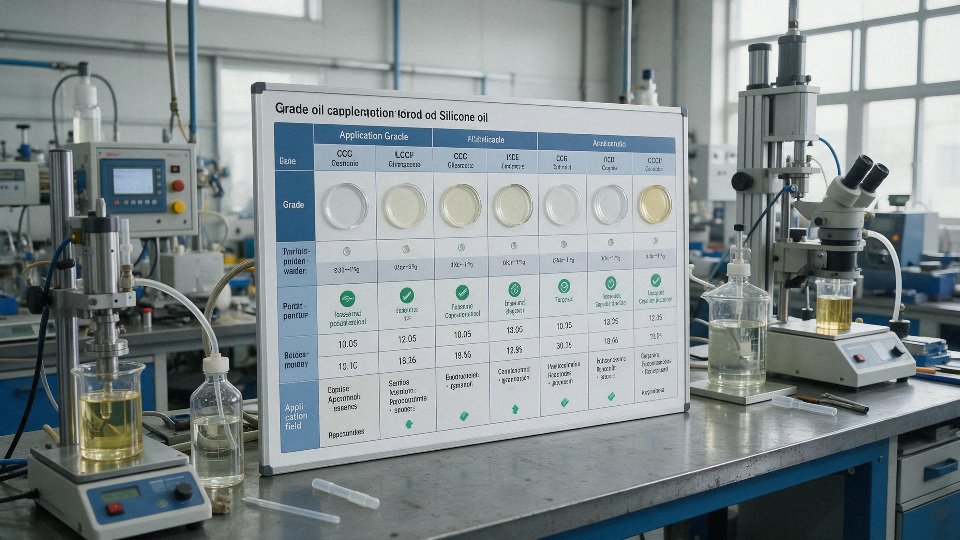
Hydroxyl-terminated fluids: bought for what they can become
Hydroxyl-terminated silicone fluids are not selected just as finished oils. They are often purchased as reactive intermediates for emulsions, room-temperature vulcanizing systems, sealants, rubbers, and silicone resins. End-group content matters because it controls how readily the fluid can further condense, crosslink, or anchor into a downstream network.
Procurement teams sometimes miss this and compare only viscosity. That is risky. Two fluids with similar viscosity can behave very differently in a sealant or emulsion process if hydroxyl value, residual moisture, catalyst residue, or volatile content differ. In practice, if the buyer intends further reaction, end-group specification and reactivity consistency usually belong above cosmetic appearance on the approval sheet.
Reactive functional fluids: selected by downstream chemistry first
Amino, epoxy, polyether, alkyl, phenyl, and other modified silicone fluids are usually chosen by compatibility and reaction path before viscosity is finalized. Viscosity still matters for handling and application method, but the first filter is chemical function: what the fluid must bond to, repel, disperse into, or co-react with.
Typical buying logic looks like this:
- Define the substrate or formulation system.
- Identify the needed function: slip, wetting, softness, release, water repellency, anchorage, foam control, or compatibility.
- Screen the functional group family that can deliver that effect.
- Then set viscosity, solids, solvent status, and package size around the process.
That order matters because a beautifully controlled viscosity grade with the wrong functional group is just the wrong material.
Specialty grade classes: documentation and cleanliness often separate them more than the backbone chemistry
Food-contact, cosmetic, electronic, and general industrial grades may all be based on similar silicone backbones, but buyers should expect different support packages and different cleanliness expectations.
| Grade class | What buyers usually check first | Typical supplier burden |
|---|---|---|
| Industrial | Viscosity, appearance, basic COA, packaging size | Broadest tolerance, practical documentation |
| Cosmetic / personal care | Volatiles, odor, sensory profile, impurity review, regulatory support | Tighter batch control and supporting statements |
| Food-contact related | Composition disclosure, compliance statements, packaging hygiene | Application-specific documentation and traceability |
| Electronic | Ionic cleanliness, moisture control, dielectric-related consistency, clean filling | Highest cleanliness discipline and tighter handling control |
A cosmetic or electronic grade cannot be assumed from viscosity alone.True
Those grade labels usually depend on impurity control, residual volatiles, documentation package, traceability, and packaging cleanliness, not just nominal cSt.
If you are comparing offers across suppliers, ask for the same three things every time: the actual viscosity grade basis at 25 C, the volatile or residual low-boiler specification if relevant, and the grade-specific compliance or cleanliness documentation. Without that, quotes that look equivalent on paper often are not equivalent once they reach the line.
Frequently asked questions
Is silicone oil synthetic or natural?
Silicone oil is synthetic. Its backbone contains silicon and oxygen, but the material is manufactured through chemical processing of silicon-derived intermediates rather than extracted as a natural oil from petroleum, plants, or minerals.
That distinction matters in purchasing. A silicone fluid may originate upstream from quartz or silica sources, but the finished oil is built through high-temperature reduction, chlorosilane chemistry, hydrolysis, condensation, equilibration, and finishing steps. In other words, the feedstock starts in mineral form; the product itself is an engineered polymer.
Is silicone oil made from sand?
Only indirectly. Industrial silicone oil can trace back to silica-bearing raw materials such as quartz, but nobody is melting common sand and bottling silicone oil in one step.
The practical chain is longer:
- Silica or quartz is reduced to elemental silicon.
- Silicon reacts to form organochlorosilanes or related intermediates.
- Those intermediates are hydrolyzed and condensed into siloxane structures.
- Polymer growth and finishing produce the target silicone oil.
So if a supplier says the product is “made from sand,” treat that as a simplified origin story, not a process description.
What is the difference between silicone oil and PDMS?
PDMS is the most common type of silicone oil, but the two terms are not perfectly interchangeable. In many industrial conversations, “silicone oil” means a polydimethylsiloxane fluid; in a stricter technical sense, silicone oil is the broader family, and PDMS is one member of it.
That broader family also includes modified fluids such as:
- Phenyl-modified silicone oils
- Amino-modified silicone oils
- Polyether-modified silicone oils
- Reactive or functional siloxanes with specific side groups
If your application is release, heat transfer, lubrication, textile finishing, or personal care blending, the difference matters because side-group chemistry changes compatibility, volatility, surface behavior, and regulatory profile.
Why do some grades have stronger odor than others?
The usual cause is higher residual volatile content, especially low-molecular siloxanes, along with traces from incomplete stripping or storage contamination. A stronger odor does not automatically mean the oil is off-spec, but it often signals a lighter fraction profile or less aggressive finishing.
Common contributors include:
- Residual cyclic siloxanes after polymerization or equilibration
- Low-boiling linear siloxanes not fully stripped
- Trace catalyst residues or neutralization byproducts
- Packaging contamination from reused drums, liners, or transfer hoses
In practice, very low-viscosity fluids tend to show odor more readily because volatile fractions represent a larger share of what the nose picks up first. Odor should be checked against the actual specification, not by impression alone.
How is viscosity adjusted during manufacture?
Manufacturers control viscosity mainly through polymer chain length and end-group balance, then fine-tune through blending or stripping. For PDMS, typical commercial grades can range from about 0.65 cSt to well above 1,000,000 cSt at 25 C, but that spread is not achieved by one simple “thickening” step.
The usual levers are:
- Chain-growth control
Equilibration conditions, catalyst choice, residence time, and end-blocker ratio determine average molecular size. End-capping strategy
Chain stoppers limit molecular growth; less stopper generally means higher viscosity, all else equal.Post-reaction blending
Nearby viscosity cuts may be blended to hit a commercial target, provided volatility and other specs still hold.Finishing and stripping
Removing low boilers can raise the apparent viscosity slightly and tighten consistency.
Very high viscosities stop behaving like easy-flowing fluids in plant equipment. Pump selection, heat transfer, filtration rate, and filling accuracy all become harder, so the preferred route can shift from direct synthesis to controlled blending or staged finishing.
Can silicone oil be made water-soluble?
Standard PDMS is not water-soluble. It is hydrophobic by structure, so if a buyer needs water dispersibility or water solubility, the product normally has to be chemically modified or formulated.
Common approaches are:
- Polyether modification to create water-dispersible or, in some systems, water-soluble behavior
- Emulsification with surfactants to make a silicone emulsion rather than a true soluble oil
- Functional copolymer design for specific bath stability, wetting, or textile hand requirements
Buyers should not use “water-soluble silicone oil” loosely. In many quotations, it actually means a self-emulsifying or easily dispersible modified silicone, which is not the same thing in storage stability or use behavior.
Why are residual cyclics important in some markets?
Residual cyclic siloxanes matter where emissions, extractables, odor, formulation stability, or regulatory scrutiny are tight. Typical industrial grades may carry residual volatile siloxanes below roughly 0.5 to 3.0 wt%, depending on the product and specification, but some applications require tighter control than that.
The issue is most sensitive in:
- Personal care and consumer-facing formulations
- Medical or skin-contact uses
- Closed-space applications where odor matters
- Processes with heating, where light fractions can volatilize
- Export markets with specific substance-review requirements
All silicone oil grades can be treated as equivalent if they share the same nominal viscosity.False
Nominal viscosity alone does not capture residual cyclic content, volatility, odor, end-group chemistry, color, catalyst residue, or application-specific compliance requirements.
What documents should an industrial buyer request before ordering?
- Technical data sheet with test methods and typical values
- Certificate of analysis for the delivered batch
- Safety data sheet for the destination market
- Regulatory or compliance declarations relevant to the end use and country of sale
- Statement of residual volatile or cyclic content if that affects the application
- Packaging specification, shelf-life, and storage conditions
- If critical: retained-sample policy, change-notification policy, and quality system information
If the fluid is going into a regulated or performance-sensitive product, ask one more question early: which properties are guaranteed lot-to-lot, and which are only reported as typical. That usually exposes the difference between a true controlled production grade and a commodity fluid sold on viscosity alone.
What to verify before sourcing
Start with the chemistry, not the trade name. If you do not lock down whether you need straight PDMS, a hydroxyl-terminated fluid, hydrogen silicone fluid, amino-modified, polyether-modified, phenyl, vinyl, or another functional oil, every later comparison on price, viscosity, or lead time gets distorted. A 350 cSt PDMS and a 350 cSt amino fluid can behave completely differently in wetting, reactivity, volatility, and compatibility.
Use this buyer-side checklist before you ask for a quote:
- Define the required chemistry
- Standard PDMS for general lubrication, release, dielectric, or process use
- Hydroxyl silicone fluid where downstream curing, compounding, or further reaction matters
- Hydrogen silicone fluid when Si-H reactivity is required
- Amino silicone oil for textile, softening, or surface conditioning functions
- Polyether-modified silicone for wetting, defoaming, or compatibility with waterborne systems
- Phenyl silicone fluid for better low-temperature behavior or heat resistance in certain ranges
- Vinyl silicone fluid where addition cure or reactive blending is involved
- Any custom copolymer or modified structure if your process needs a narrow surface-tension, slip, or compatibility profile
A lot of sourcing trouble starts when a buyer specifies only viscosity. That is rarely enough. Functional group type and end-group control often decide whether the oil stays stable in storage, reacts when it should, or causes foam, fisheyes, separation, or cure inhibition.
- Specify the performance window that actually matters
- Viscosity and acceptable tolerance at 25 C
- Residual volatile siloxane limit, if odor, flash loss, or downstream emissions matter
- Active content or dilution basis
- Color and clarity
- Odor expectation
- Compatibility with solvent, resin, elastomer, or aqueous system
- Thermal stability requirement
- Destination-market regulatory fit
Typical PDMS grades span roughly 0.65 cSt to well above 1,000,000 cSt at 25 C, so asking for “silicone oil” without a usable range is not a specification. Residual volatile content for industrial grades is often controlled below about 0.5 to 3.0 wt%, but the right limit depends on your application, packaging exposure, and any downstream heating step.
- Verify upstream integration or monomer control
- Ask whether the supplier controls chlorosilane or siloxane intermediate sourcing directly
- Ask how they manage batch-to-batch consistency when feedstock shifts
- Confirm whether lead time depends on external monomer procurement
- Check whether price stability is tied to upstream silicon and monomer exposure
This point is commercial as much as technical. Suppliers with stronger monomer control usually manage consistency and delivery better, especially when the market tightens or a high-purity intermediate goes short.
- Request technical evidence beyond the short datasheet
- Typical values, not just specification limits
- A sample COA format
- Test methods used for viscosity, volatiles, color, active content, and key functional properties
- Retained-sample policy and traceability by batch
- Shelf-life basis and storage recommendations
A short TDS alone is enough to qualify a silicone oil supplier.False
A TDS is only a marketing-level summary. For process risk control, buyers usually need typical values, COA format, test methods, and batch traceability details.
- Check execution capability, not just chemistry
- Packaging cleanliness and package options
- Export documentation experience
- Responsiveness on SDS, COA, packing list, and customs-facing paperwork
- Ability to adjust viscosity or modification level if your process sits between standard grades
- Sample handling discipline
In practice, poor packaging hygiene causes as many complaints as off-spec viscosity, especially on clear fluids shipped into cosmetics, electronics, coatings, or precision processing.
- Prepare the RFQ package
- Substrate or application
- Contaminant or functional target, if relevant
- Approximate layer thickness or use level
- Working area or process scale
- Required finish or appearance
- Target production rate or dosage rate
- Current product benchmark, if any
- Annual volume
- Destination market
- Approval timeline
- Clear part photos or representative samples where useful

If you send the chemistry required, target specification, annual demand, destination market, and approval timing up front, SiliconChemicals can review the application, recommend a technically matched silicone oil grade within its silanes, siloxanes, silicone polymers, and specialty modified silicone materials portfolio, and issue a quotation against the confirmed requirements.