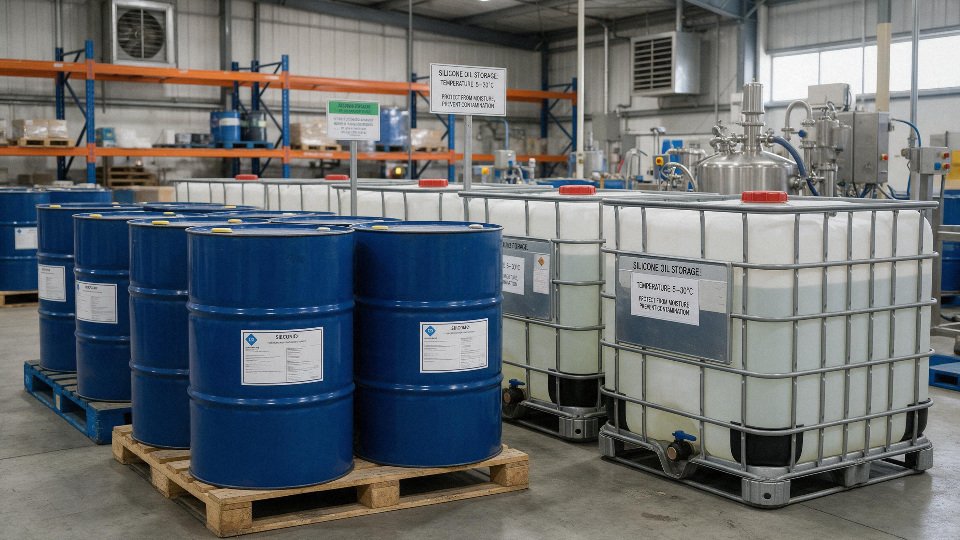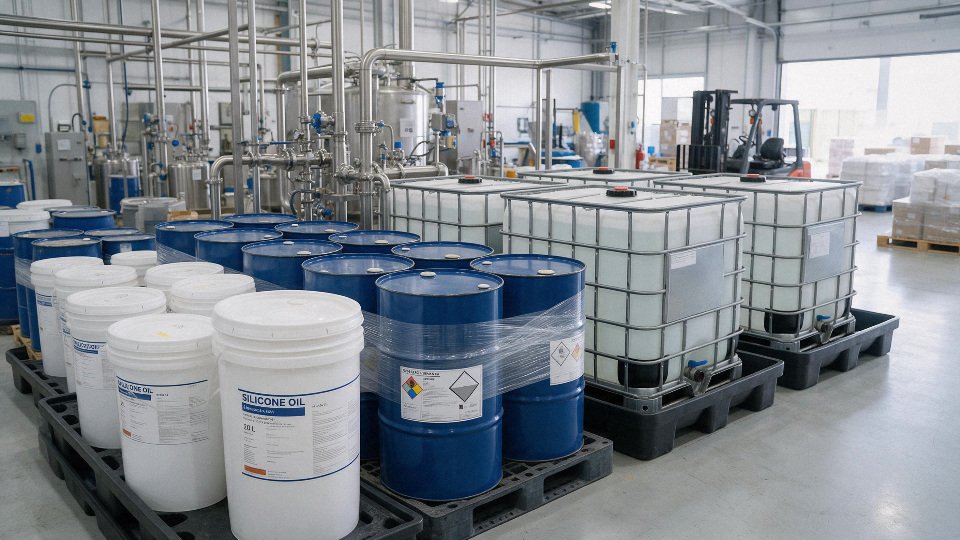
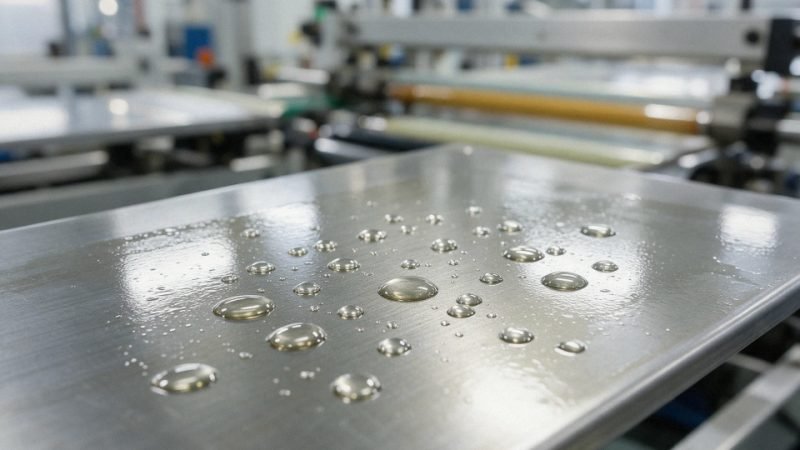
Water wetting where you expected release, lubrication, or moisture protection usually means one of two costly problems on the plant floor: the wrong silicone fluid was specified, or the surface chemistry around it was misunderstood. That shows up as fisheyes in coating lines, unstable defoaming, poor mold release consistency, or parts that still pick up moisture after treatment. Once operators start chasing it with dosage changes and extra cleaning, the cost is not the drum price of silicone oil; it is scrap, line interruptions, and a purchasing cycle built around fixing a selection mistake after the fact.
Yes. Standard dimethyl silicone oil is generally hydrophobic, and PDMS-rich surfaces typically show water contact angles around 95-110 degrees. Its low surface tension, often about 20-21 mN/m at 25 degrees C for many dimethyl grades, helps it spread on many substrates, but hydrophobic behavior in service still depends on viscosity, surface condition, contamination, formulation, and whether the silicone stays at the interface.
That headline answer is true often enough to be useful, but not cleanly enough to buy on without checking the application. A 10 cSt fluid and a 100000 cSt fluid can both be hydrophobic and still behave very differently in a coating bath, on a textile line, or across a release film, especially once heat, surfactants, shear, and mixed contamination get involved.
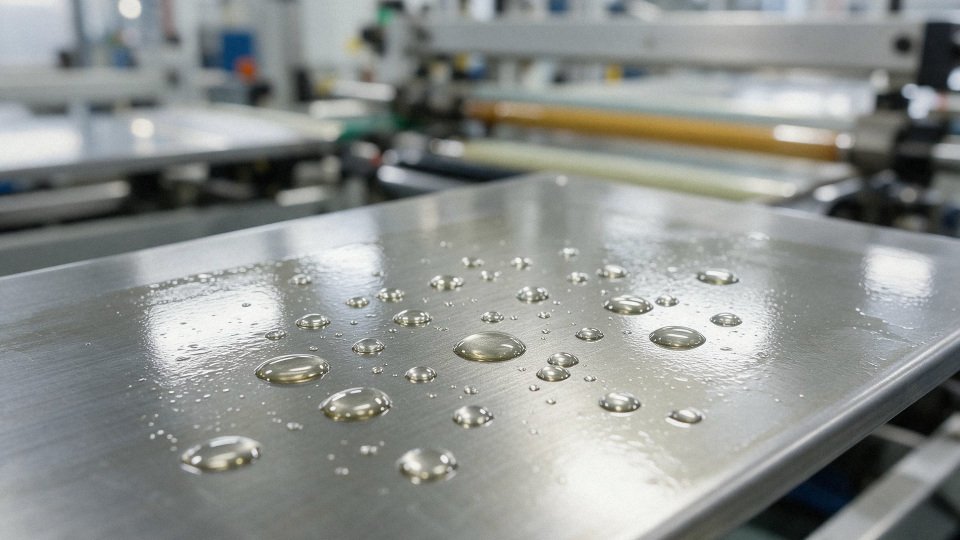
Why silicone oil repels water
Common dimethyl silicone oils repel water because their molecular surface is dominated by non-polar methyl groups, not water-friendly polar sites. That gives them low affinity for water, low surface energy, and little ability to participate in the hydrogen-bond network that makes water cling to itself and to polar materials.
At the molecule level, the starting point is the siloxane chain: repeating Si–O–Si units with methyl groups attached to the silicon in standard polydimethylsiloxane, or PDMS-type, fluids. The Si–O backbone is flexible, but it is not what water “sees” first at the interface. What faces outward most of the time are the methyl groups, and those are weakly interacting, non-polar hydrocarbon-like moieties.
That matters because water is a very particular liquid. It has strong internal cohesion from hydrogen bonding, and it prefers surfaces that can offer polar interaction, hydrogen bonding, or at least a reasonably high surface energy. A methyl-rich silicone oil surface offers none of that in any meaningful amount. So instead of spreading into or mixing with the silicone phase, water tends to stay gathered as droplets or separate as a distinct phase.
You can think of it in plant terms like this: if a fluid line, vessel wall, or coated roll has a PDMS-rich surface, water usually does not “grab” it the way it grabs stainless with oxide contamination, glass, paper fiber, or a polar resin. On a PDMS-rich surface, typical water contact angles are often around 95-110°, depending on formulation, surface condition, contamination, roughness, and how much true PDMS is actually presented at the topmost surface. That is why silicone contamination in a paint or adhesive line is such a headache. A tiny amount at the interface can change wetting behavior very quickly.
The siloxane backbone helps, but the methyl shell does most of the work
The siloxane backbone gives silicone oils a combination that is unusual in industrial fluids: high bond flexibility, low glass-transition behavior, and easy molecular reorientation at the interface. But hydrophobicity, in the strict interfacial sense, is driven mainly by the methyl-substituted exterior of common dimethyl silicone oils.
A few practical implications follow from that structure:
- Water sees a low-energy organic surface, not a polar polymer network.
- The fluid offers very limited specific interaction with water molecules.
- The interface can reorganize quickly, so the fluid keeps presenting low-energy groups outward.
- Even when the oil spreads on a solid, it does not suddenly become water-compatible.
That last point gets misunderstood in buying and troubleshooting discussions. People see silicone oil wetting a metal die, a plastic mold insert, or a gasket face and assume it must also mix with water or be “less hydrophobic.” It does not work that way.
A liquid can spread very well on many solid surfaces and still remain immiscible with water.True
Wetting on a solid is controlled by interfacial energies between liquid, solid, and air. Miscibility with water is controlled by liquid-liquid molecular compatibility. These are related only loosely, not directly.
Low surface tension explains spreading, not water solubility
Many dimethyl silicone oils sit around 20-21 mN/m surface tension at 25 °C, though exact values depend on molecular weight, test method, purity, and modification. That is low enough that they will spread readily over many higher-energy substrates. In practice, that is why silicone oils can creep into fine clearances, cover tooling surfaces, and produce strong release or slip effects at very low add-on levels.
But low surface tension is not the same thing as water solubility.
Water has a much higher surface tension and a strong internal hydrogen-bonding network. A silicone oil can wet a steel panel or polymer film effectively because the solid-liquid-air energy balance favors spreading. Water miscibility is a different question: whether the silicone fluid and water can form a stable single phase based on molecular interactions. Standard dimethyl silicone oils generally cannot, because they lack the polarity and hydrogen-bonding capability needed to be compatible with water.
That distinction shows up every day in processing:
- A silicone defoamer can spread rapidly across an aqueous foam lamella, yet remain as a separate hydrophobic phase.
- A silicone release fluid can coat a surface uniformly, while rinse water still beads up or sheets irregularly over it.
- A silicone lubricant may migrate across a part face, but wash water will not dissolve it off without surfactants, alkaline cleaners, solvent assistance, heat, or mechanical action.
The trade-off is useful but not universal. Low surface tension is excellent for coverage, release, and boundary lubrication, but it also means contamination sensitivity. If your downstream process depends on printing, painting, adhesive bonding, or overmolding, the same interfacial behavior that makes silicone oils attractive can become a rejection source. The preference flips once the line needs high surface energy rather than low.
Why water and silicone oil interact weakly
Water is stabilized by strong water-water attraction. Polar liquids, alcohols for example, can at least participate partly through dipole interactions or hydrogen bonding. Standard PDMS fluids do not offer much of either.
They have:
- No meaningful hydrogen-bond donation
- Very limited hydrogen-bond acceptance compared with strongly polar organics
- Low polarity overall at the interface
- Weak cohesive interaction with water relative to water’s own self-attraction
So when water meets silicone oil, the water molecules generally prefer each other. The system reduces energy by minimizing contact area, which is why you see phase separation and droplet formation rather than easy mixing.
There is a practical boundary here. This explanation holds well for conventional dimethyl silicone oils. Once you start introducing polyether modification, silanol functionality, phenyl substitution, reactive end groups, emulsifier packages, or other additives, water behavior can shift a lot. Some modified silicones are intentionally made more dispersible, more emulsifiable, or more surface-active in aqueous systems. You cannot safely generalize the hydrophobicity of all “silicone oils” from neat PDMS alone.
Chain flexibility affects interface behavior, lubricity, and release
Silicone oils are not just low-energy; they are also unusually mobile at the molecular level. The Si–O backbone has a high degree of rotational freedom compared with many carbon-chain polymers. That flexibility lets the fluid reorganize quickly at interfaces and maintain a surface rich in methyl groups.
Mechanistically, that affects performance through a few paths:
- Interfacial renewal: if the surface is disturbed, the fluid can reorient and restore a low-energy outer layer.
- Lubricity: flexible chains slide with relatively low resistance, helping reduce friction in light-load or boundary-contact situations.
- Release behavior: the fluid forms a weakly adhering interfacial film, reducing sticking of tacky compounds, elastomers, or molded parts.
- Migration tendency: the same mobility can allow transfer onto adjacent surfaces, which is useful in some systems and a contamination issue in others.
Viscosity changes the operational picture, but not in a simple “higher is more hydrophobic” way. Industrial PDMS grades may range roughly from 10 to 100000 cSt at 25 °C. Lower-viscosity fluids usually spread and migrate faster; higher-viscosity grades stay in place better and may give longer residence on a surface. The chemistry of hydrophobicity is broadly similar across these grades, while film persistence, transfer, and handling change a lot. Procurement teams often focus on viscosity because it is easy to specify, but application success usually depends on the combination of viscosity, substrate, contamination tolerance, and whether the silicone must stay put or deliberately transfer.
End groups, substitutions, and additives can change the answer
Standard dimethyl silicone oil is the reference case, not the whole category. Hydrophobic behavior can move up or down depending on molecular design and formulation details such as:
- End groups: trimethylsiloxy-capped fluids are typically more hydrophobic than fluids with more reactive or polar end groups such as silanols.
- Side-group substitution: replacing some methyl groups with phenyl, amino, epoxy, polyether, fluoro, or long alkyl groups changes polarity, compatibility, refractive properties, and interfacial behavior.
- Additives and packages: emulsifiers, surfactants, antistats, fillers, or performance modifiers can dominate the surface response in a formulated product.
- Aging and contamination: oxidation, absorbed process chemicals, dust, metal soap residues, or cleaning-agent carryover can make a nominally hydrophobic surface behave inconsistently.
That is why a purchasing spec that says only “silicone oil” is not much of a spec. If hydrophobicity, release, water separation, or surface contamination risk matters, you need the actual chemistry family, end-capping, viscosity grade, and any modification package on the datasheet.
Hydrophobicity versus related properties
A silicone oil can be strongly hydrophobic and still be the wrong choice for waterproofing, vapor control, electrical insulation stability, foam control, or durability. Buyers get into trouble when “water beads nicely” gets treated as a proxy for whole-system performance; on the plant floor, those are separate questions, and they fail for different reasons.
A useful reference point is that many dimethyl silicone oils have low surface tension, roughly 20–21 mN/m at 25 degrees C, and PDMS-rich surfaces often show water contact angles around 95–110 degrees. That tells you the surface tends to repel liquid water. It does not tell you whether the coating stays put, seals a pore structure, survives washing, or behaves properly in a circulating process fluid.
Hydrophobicity is not the same as waterproofing
A hydrophobic surface discourages wetting. Waterproofing requires the whole barrier system to stop water entry under the actual service conditions.
In practice, four things decide whether a silicone-oil-based treatment behaves as a waterproofing layer:
- Film continuity
- A discontinuous deposit can still give attractive beading because the topmost exposed areas are low-energy.
- Water will still penetrate through pinholes, uncoated fiber junctions, edge defects, or thin spots.
- This is common on rough castings, porous mineral substrates, and woven textiles where capillary paths remain open.
- Adhesion to the substrate
- If the fluid or deposited layer does not anchor well, water may initially bead but the treatment migrates, wipes off, or gets displaced under pressure.
- On metals, glass, and high-energy mineral surfaces, the difference between simple fluid laydown and a bonded treatment matters a lot.
- Procurement often misses this when comparing a straight PDMS fluid against a reactive or resin-modified system.
- Migration behavior
- Low-viscosity silicone oils, especially in the lower end of the common industrial range of roughly 10 to 100000 cSt, can move into adjacent layers, seams, or packaging materials depending on formulation and temperature.
- Migration may help surface renewal in some release applications, but it hurts waterproofing consistency when the active material leaves the zone where you need it.
- Mechanical durability
- Flexing, abrasion, laundering, pressure washing, and repeated handling break the simple link between initial hydrophobicity and long-term water resistance.
- A fabric finish that beads water in the lab can lose performance quickly if the silicone is only physically deposited rather than fixed.
The mechanism is straightforward: hydrophobicity changes wetting at the exposed surface, while waterproofing depends on whether a continuous, attached, mechanically stable barrier remains where water pressure and capillary suction are trying to drive penetration. If the service condition includes flex, rubbing, wash cycles, or hydrostatic pressure, surface beading alone is a weak predictor of field performance.
Hydrophobicity is not the same as water vapor permeability
A surface can repel liquid water and still allow water vapor to pass. That distinction matters in breathable coatings, textile finishing, and skin-contact systems.
Think of it this way:
| Property | What it describes | Typical purchasing mistake |
|---|---|---|
| Hydrophobicity | Resistance to wetting by liquid water at the surface | Assuming high contact angle means low moisture transmission |
| Water vapor permeability | Rate at which water vapor diffuses through a film or structure | Assuming a silicone-treated coating will automatically act as a vapor barrier |
Silicone-based materials are often chosen precisely because they can combine water repellency with meaningful vapor transmission, but that outcome depends on polymer structure, film thickness, crosslink density, fillers, and substrate porosity. A thin silicone finish on a fabric may keep rain droplets from spreading while the garment still “breathes.” In contrast, a thicker sealed film or a multi-layer laminate may sharply reduce vapor passage.
In personal care, the same confusion shows up differently. A hydrophobic silicone fluid can improve spread, slip, and water resistance on skin or hair, yet the finished formula’s occlusivity and moisture management depend on the entire composition, not just the silicone phase.
So if the requirement is “repels splash water but still releases sweat vapor,” ask for moisture vapor transmission data on the finished system, not just silicone type.
Hydrophobicity is not the same as dielectric performance
Silicone fluids are often selected for both water repellency and electrical uses, but those are separate selection criteria. A fluid that repels water may still be unsuitable for electrical service if its dielectric strength, dissipation behavior, contamination tolerance, oxidation stability, or compatibility with seals and insulation systems does not match the duty.
This is where commercial shortcuts cause expensive rework. Someone sees “hydrophobic silicone fluid” and assumes transformer, sensor, ignition, or electronic potting suitability. That is not a safe inference. Electrical performance depends on:
- Fluid purity and ionic contamination
- Moisture content in the fluid and in the assembled system
- Temperature range and oxidation exposure
- Additive package and formulation stability
- Compatibility with elastomers, plastics, varnishes, and cable materials
- The actual electrical design margin
A hydrophobic fluid may help resist moisture pickup at the surface, but dielectric failure usually comes through contamination, aging, trapped voids, or system-level moisture ingress. The preferred choice flips once the application is electrically critical; then validated dielectric data and aging behavior outrank simple water-repellent behavior.
Hydrophobicity is not the same as defoaming or air release
Low surface tension makes silicone fluids relevant in foam control, but hydrophobicity alone does not tell you how well a product will break foam or release entrained air from a process fluid.
Separate the three ideas:
- Hydrophobicity: resists wetting by water
- Defoaming action: collapses existing foam films
- Air release behavior: allows dispersed air bubbles to separate from bulk liquid
A silicone oil can be hydrophobic and still be a poor defoamer in a given system if it is too compatible, poorly dispersed, overdosed, or lacking the right carrier and particle structure. In waterborne coatings and fermentation systems, for example, defoamers work through controlled incompatibility. Too compatible, and they stay dissolved without rupturing foam lamellae. Too incompatible, and they create surface defects or craters.
Air release is different again. In hydraulic or circulating fluids, bubble disengagement depends on viscosity, density difference, contamination level, surfactants in the system, and agitation conditions. A hydrophobic additive does not automatically improve deaeration.
Hydrophobicity is not the same as chemical inertness
Silicone oil is often chemically stable enough for demanding use, but “repels water” should not be translated into “chemically untouchable.”
A silicone oil that is highly hydrophobic is automatically resistant to all aggressive chemicals.False
Hydrophobicity describes interaction with water at a surface. Chemical resistance depends on the fluid structure, impurities, temperature, oxygen exposure, and contact with strong acids, strong bases, oxidizers, catalysts, or reactive contaminants.
In plant service, the weak points are usually not ordinary water exposure but these conditions:
- Strong acids or strong bases
- Oxidizing environments at elevated temperature
- Metal salts or catalyst residues
- Process contamination from amines, solvents, or reactive cleaners
- Long residence time under heat and air
That matters in heated baths, release systems near curing ovens, and recirculating fluid loops. A silicone oil may still perform well, but you need compatibility review under the actual chemical and temperature profile.
Why good water beading can still fail in service
The counter-intuitive case is common: a silicone-treated surface beads water beautifully on day one, then shows poor wash durability, rub-off, or transfer contamination.
Typical root causes are:
- Insufficient fixation to the substrate
- The treatment is sitting on the surface, not bonded into it.
- Over-application
- Excess free silicone gives dramatic beading but poor durability and a greasy transfer risk.
- Wrong viscosity for the use
- Too mobile, and the silicone migrates or prints off onto adjacent parts.
- Too viscous, and coverage may be patchy without proper application energy.
- Poor cure or incompatible formulation
- Common on coated fabrics, release papers, and secondary finishing lines where line speed outruns cure.
- Mechanical wear
- Repeated handling, folding, abrasion, or washing removes the active layer faster than expected.
A shop-floor sign of this failure mode is when incoming inspection likes the beading test, but downstream operators complain about paint defects, bonding failure, slippery handling, or contamination on packaging and rollers. That is not a contradiction. The surface can remain hydrophobic while shedding mobile silicone to places where it causes trouble.
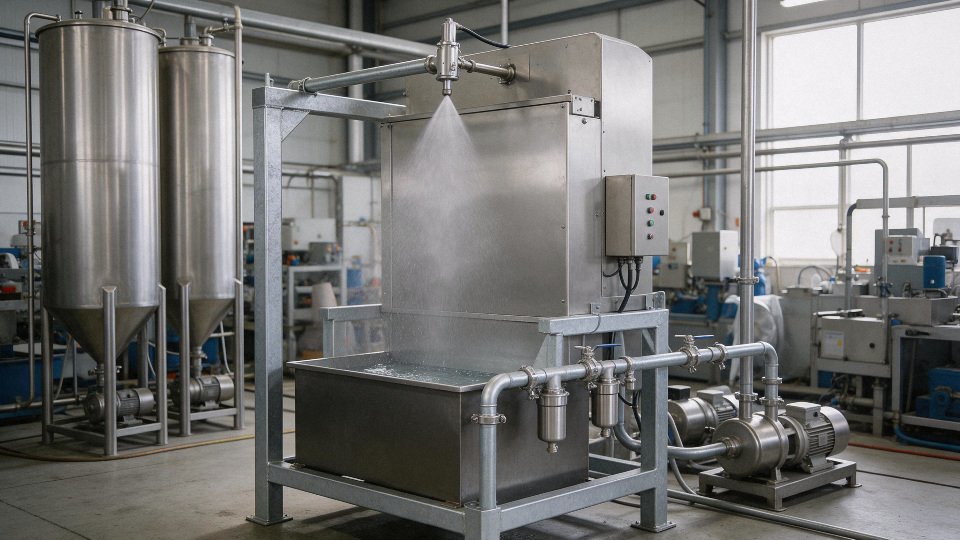
Grades and structural differences
Not all silicone oils behave the same around water, substrates, or formulations. Dimethyl fluids are the default hydrophobic benchmark, but phenyl, amino, polyether, and reactive modifications can shift compatibility, spreading, anchoring, and even whether the product should still be treated as a free oil at all. That matters because buyers often specify “silicone oil” as if it were one thing, then discover the wrong grade either will not stay on the part, will not emulsify cleanly, or gives the wrong surface feel and durability.
The useful way to sort them is by structure first, viscosity second. Viscosity changes handling, film persistence, and migration rate; structural modification changes how the fluid interacts with water, surfactants, polar binders, fibers, plastics, and cured surfaces.
Standard dimethyl silicone oils
Dimethyl silicone oils, typically PDMS-based, are the reference point for hydrophobic behavior in this family. They usually combine low surface tension with poor water miscibility, broad viscosity availability, and fairly predictable release, lubrication, and water-repellent performance. If a plant spec simply says “silicone oil” without more detail, this is often what the buyer actually means, though that shorthand causes plenty of mistakes.
Typical industrial grades run from roughly 10 cSt up to 100,000 cSt at 25°C, sometimes higher depending on supplier range. That spread is not just a handling issue.
- Lower-viscosity dimethyl fluids:
- Wet out surfaces quickly
- Spread easily into thin films
- Migrate more readily
- Can evaporate or redistribute faster, depending on molecular weight distribution and temperature
- Higher-viscosity dimethyl fluids:
- Stay in place longer
- Build a heavier lubricating or release film
- Resist sling-off better
- Are harder to pump, meter, and emulsify
The mechanism is straightforward. The methyl-rich siloxane backbone gives the fluid a low-energy, nonpolar surface character, so water beads rather than spreads. At the same time, increasing chain length raises viscosity, which slows film movement and wash-off. That is why two dimethyl fluids can both be hydrophobic but behave very differently on a vertical metal panel, textile line, or rubber mold.
A common shop-floor mistake is assuming the most hydrophobic-looking beading fluid is automatically the best process choice. In practice, a 50 cSt fluid may give excellent initial coverage but leave less durable holdout than a 1,000 cSt or 5,000 cSt grade; the heavier grade, though, may attract dust, transfer to downstream parts, or create fisheye issues in any later painting step. The preferred grade flips when cleanliness and downstream coating compatibility matter more than simple water beading.
Methyl phenyl silicone fluids
Methyl phenyl silicone fluids sit a little off the standard PDMS path. Replacing part of the methyl functionality with phenyl groups often changes low-temperature flow, thermal behavior, optical properties such as refractive index, and compatibility with certain organic materials. They are still silicone fluids, but they should not be treated as drop-in equivalents for standard dimethyl oil.
In use, buyers usually consider this class when one of these conditions applies:
- The application sees wider temperature swings
- Optical or refractive behavior matters
- Compatibility with specific resins, oils, or elastomers is not adequate with dimethyl fluid alone
- The fluid must retain more stable behavior under elevated heat exposure than a basic grade comfortably allows
Phenyl substitution alters intermolecular interactions and changes the balance of flexibility, solvency, and optical response. That can improve performance in specialty antifoams, damping fluids, heat-transfer-adjacent formulations, or optical systems, but the same change can also alter substrate wetting and package-material compatibility. A seal, tubing compound, or plastic reservoir that tolerates a dimethyl fluid may behave differently with a phenyl-modified one; that always needs checking against the actual material set, not category assumptions.
This is one of those areas where generic “better temperature resistance” claims are too loose to buy against. The useful procurement question is: better than which dimethyl grade, at what temperature band, for how long, in contact with what substrate and atmosphere?
Amino-modified silicone oils
Amino-modified silicone oils are chosen less for pure hydrophobicity and more for affinity. Their amino functionality can increase substantivity to certain substrates, especially where the process benefits from a silicone that does not just sit on the surface but shows stronger interaction with fibers, pigments, fillers, or slightly polar surfaces.
That change is valuable in applications such as:
- Textile softening and hand modification
- Surface treatment where retained slip matters
- Some polish and care formulations
- Specialty release or conditioning systems
The trade-off is that amino modification changes surface interaction and emulsification behavior. These products may emulsify differently than plain dimethyl oils, may interact more strongly with anionic components, and can shift feel, gloss, or residue characteristics in ways operators notice quickly. In a textile line, for example, the fluid may stay on the fiber better, but bath stability can become touchier if water quality drifts or if the emulsifier package is not matched well. Hard water, pH drift, and a tank that sits over a long weekend can expose that weakness fast.
So the gain is persistence and substrate attachment; the sacrifice is a narrower formulation window in some systems. If the process only needs short-lived water beading on a nonpolar surface, amino modification is often unnecessary complexity.
Polyether-modified silicone oils
Polyether-modified silicone oils often move in the opposite direction: they introduce hydrophilic character on purpose. That can make the fluid self-emulsifying or at least much easier to disperse in water, and it can improve spreading over substrates where plain silicone would dewet, crawl, or separate from the rest of the formulation.
This class is common when the actual process need is not maximum water repellency but controlled surface activity:
- Agricultural adjuvants
- Waterborne coatings and additives
- Personal care and household formulations
- Defoamer systems that must balance entry, spread, and compatibility
- Wetting or leveling packages
The mechanism matters here. Polyether segments interact more favorably with water and other polar components, which reduces the clean hydrophobic separation seen in a dimethyl oil. That usually improves formulation stability and application uniformity, but it can reduce the “pure” water-repellent behavior buyers expect from silicone if they are judging only by the word silicone.
A silicone fluid can be easier to disperse in water yet be less effective as a durable water-repellent finish than a standard dimethyl silicone oil.True
Polyether modification increases hydrophilicity and formulation compatibility. That often improves spreading or self-emulsification but can reduce the surface's final water-beading character compared with a more hydrophobic PDMS-rich fluid.
The boundary is simple: if the end use is a standalone hydrophobic film, polyether modification is often the wrong starting point. If the end use is a waterborne formulation that must stay stable in the tote and apply evenly at line speed, it may be exactly the right one.
Reactive silicone fluids and functional end-capped systems
Reactive silicone fluids and functional end-capped systems need to be evaluated as precursors, not just as lubricants or free oils. Once the fluid can bond, crosslink, or anchor to a substrate or network, the performance question changes from “how hydrophobic is this liquid?” to “what surface remains after cure or reaction, and how durable is it under service conditions?”
Typical functional routes include systems designed to:
- Crosslink into a silicone network
- React with moisture or catalysts
- Anchor onto mineral, glass, metal, or polymer surfaces
- Become part of a coating, finish, or release film rather than remain mobile oil
That distinction is commercially important. A free dimethyl oil may give strong initial beading but can wipe off, migrate, or be extracted. A reactive system may show less dramatic immediate behavior in the uncured state yet deliver far better retained hydrophobicity after heat, abrasion, or washing because the silicone phase is no longer free to move.
The trade-off is process complexity. Cure conditions, catalyst sensitivity, pot life, substrate preparation, and storage stability all become part of the buying decision. If the plant cannot control moisture, mix ratio, or cure schedule, a simpler nonreactive oil may outperform the “higher-spec” reactive grade simply because it is harder to misuse.
Silicone emulsions versus neat oils
A silicone emulsion is not evidence that the silicone phase stopped being hydrophobic. The apparent water compatibility comes from the emulsion structure: silicone droplets are dispersed in water with surfactants or emulsifying systems, so the package can be diluted, pumped, and applied in a water-based process even though the silicone itself remains intrinsically water-repellent.
That distinction affects troubleshooting and purchasing:
- Emulsion stability depends on surfactant system, shear history, pH, electrolytes, freeze-thaw exposure, and storage conditions
- Final hydrophobic performance depends on droplet size, deposition efficiency, substrate affinity, drying conditions, and how much surfactant remains at the surface
- Foam, residue, recoatability, and bath life are often emulsion-system issues, not silicone-backbone issues
A neat oil and an emulsion made from that oil should never be assumed to perform identically on the line. The emulsion may be easier and safer to apply in a water-based operation, but the surfactant package can blunt water beading, change appearance, or interfere with downstream adhesion if the system is not matched to the substrate and drying conditions.
If you are selecting across these classes, start with the end-state you actually need: free lubricating film, durable bonded repellency, waterborne processability, substrate retention, or compatibility with a complex formulation. That choice narrows the chemistry faster than viscosity alone ever will, and it usually prevents the expensive mistake of buying “more hydrophobic” material when the line really needed “more anchor,” “more stable emulsion,” or simply “less trouble in the mix tank.”
How hydrophobicity is measured
Hydrophobicity is not something you verify from a product data sheet alone. In practice, you confirm it through a small set of measurements that answer different questions: how water sits on a treated surface, how the fluid behaves around water during mixing or contamination, how much moisture it actually takes up, and whether that behavior survives handling, heat, washing, and time.
A silicone oil can show strong initial water beading and still fail the application if the film migrates, washes off, picks up contamination, or forms a stable emulsion where the process needed clean phase separation. The useful test set depends on whether you are buying a bulk process fluid, a release or lubrication aid, or a hydrophobic treatment that must stay on the substrate.
Contact angle on treated surfaces
For most buyers, contact angle is the first number they see, and it is useful if the test is done properly. On PDMS-rich surfaces, a typical water contact angle is often around 95-110°, but that figure only means something if you know the substrate, the application method, the curing or drying state, and the test timing.
Use these three measurements together:
- Static contact angle
- A water droplet is placed on the surface and measured at rest.
- This is the common screening number.
- It tells you whether the surface is generally wettable by water or not.
- It does not tell you much about droplet mobility, contamination sensitivity, or coating uniformity by itself.
- Advancing contact angle
- Measured while the droplet volume is increased.
- It reflects how the water front behaves on fresh surface area.
- This is useful when you want to know whether the treated surface resists initial wetting under changing liquid load.
- Receding contact angle
- Measured while the droplet volume is reduced.
- It shows how strongly water remains pinned as the liquid retreats.
- This matters in drying, anti-fouling, and self-cleaning discussions because droplets that pin and smear can leave residues even when the static angle looks good.
The gap between advancing and receding angle is the hysteresis. High hysteresis usually points to surface heterogeneity, roughness effects, contamination, partial coverage, or mobile low-molecular-weight species. On the plant floor, this is where people get fooled: two surfaces can both show a nice bead, but one drains cleanly while the other hangs onto moisture and picks up dirt.
If the substrate is rough, porous, textured, or fibrous, interpret contact angle cautiously. Surface roughness can amplify apparent hydrophobicity or mask poor chemical uniformity. A blasted metal panel, a filled rubber sheet, and a polished PET film will not give equally transferable numbers even with the same silicone treatment.
Water uptake and solubility checks
Silicone oils are generally very low in water solubility, but “low” is not the same as “irrelevant.” In moisture-sensitive blending, electrical insulation, optics, defoaming, or precision coating, trace water can still create defects, haze, microfoam, hydrolysis side reactions, or inconsistent viscosity.
Useful checks include:
- Equilibrium water content
- Measure water picked up after controlled exposure to humid air or direct water contact.
- Karl Fischer titration is often used when the expected moisture level is low and the process is sensitive enough to care.
- Water solubility or water uptake trend
- Compare grades rather than expecting one universal value for all silicone oils.
- Structure, additives, end groups, and temperature all shift the result.
- Dry-down and reabsorption behavior
- A fluid that dries easily after moisture ingress is easier to manage than one that retains dispersed trace water.
The mechanism matters here. As viscosity rises, water separation may become slower simply because droplets settle and coalesce more slowly, not because the chemistry became less hydrophobic. That distinction matters in storage tanks and day bins. A high-viscosity grade can look “wetter” in practice because entrained moisture stays suspended longer.
Very low water solubility means water contamination can be ignored.False
Even when bulk solubility is low, trace moisture can still affect foaming, dielectric behavior, optics, coating quality, hydrolysis-sensitive systems, and batch consistency. The process sensitivity sets the real acceptance limit.
Surface tension and interfacial tension data
Many dimethyl silicone oils sit around 20-21 mN/m surface tension at 25 °C. That low surface tension helps explain spreading behavior and is one reason these fluids are useful in release, lubrication, and wetting-modification roles. But surface tension is not the same thing as hydrophobicity after application.
Interfacial tension against water is also worth checking when you are comparing fluids for demulsification, antifoam performance, or contamination behavior. Lower or higher values can influence droplet breakup, coalescence, and how stubborn an emulsion becomes under shear.
Use these numbers for:
- screening candidate fluids within a family
- understanding spreading tendency on low-energy surfaces
- anticipating mixing and separation behavior
- spotting off-spec supply if the result shifts unexpectedly
Do not use them as a substitute for end-use testing. A fluid can have attractive tension data and still perform badly because the substrate carries surfactant residue, the coating method leaves patchy coverage, or the process exposes the film to alkaline washdown that strips it.
Phase separation and emulsion stability
If the application involves mixing, pumping, accidental water ingress, or repeated agitation, run a simple emulsion and separation check. This matters in reactors, metalworking fluid systems, textile finishing, mold-release circuits, and bulk storage where operators are opening lids in humid weather and dragging in wash water from hoses and tote couplings.
A practical test program usually includes:
- Controlled mixing with water at defined shear
- Stirring speed and time should be recorded.
- A hand-shaken jar test is fine for rough comparison but weak for supplier qualification.
- Observation after standing
- Note phase clarity, interface sharpness, and time to visible separation.
- Watch for rag layers or persistent haze.
- Repeat after contamination exposure
- Add trace surfactant, process residue, salts, or fines if those are realistic in service.
- A silicone oil that separates cleanly in clean water may emulsify badly once detergent carryover is present.
- Check after temperature cycling
- Cooling and reheating can change viscosity and separation behavior.
- Winter storage often exposes problems that did not show in the lab at room temperature.
The trade-off is straightforward: a fluid that disperses very easily may help one application, such as certain specialty formulations, but become a headache if your operation needs clean phase break and easy water removal. The preferred choice flips once contamination control and reclaimability become more important than temporary dispersion.
Durability when persistent hydrophobicity is the real question
If silicone oil is applied to a surface rather than used only as a bulk fluid, initial contact angle is only the start. You need to know whether the hydrophobic effect remains after service exposure.
Typical durability checks include:
- wash or detergent cycles
- abrasion or rub resistance
- heat aging at the expected service temperature
- UV exposure where outdoor or lamp exposure matters
- solvent wipe resistance if downstream cleaning is likely
- repeated wet-dry cycling
Measure contact angle before and after these exposures, and inspect for visual patchiness, transfer, or residue buildup. A thin mobile silicone layer can test beautifully on day one, then lose consistency after handling or migrate into adjacent zones where it creates paintability or bonding trouble. That boundary matters: the usual “silicone is hydrophobic” conclusion stops being enough when the process needs fixed, durable surface chemistry rather than a temporary low-energy film.
Common test pitfalls
Most bad hydrophobicity decisions come from poor test control, not from the concept being difficult.
Watch for these failure points:
- Contaminated substrates
- Finger oils, mold-release residue, cleaner film, and dust distort contact angle badly.
- Surfactant carryover
- A trace from washing, formulation, or upstream processing can collapse water beading and alter emulsion behavior.
- Uncontrolled roughness
- Roughness changes apparent angle and hysteresis; compare like with like.
- Inconsistent film thickness or cure state
- Wiped, sprayed, dipped, and baked samples often behave differently even with the same chemistry.
- Single-drop visual judgment
- One photo of water beading is not a performance qualification.
- It says almost nothing about durability, uniformity, or process contamination tolerance.
- No time component
- Measure right away and after aging. Some surfaces reorganize; some films migrate; some lose effect after a few hours or a wash.
If procurement is qualifying suppliers, insist on a test method tied to the application, not just a brochure claim. The right comparison is usually not “which sample beads water once,” but “which sample still behaves acceptably after our substrate prep, our line speed, our wash chemistry, and our storage conditions.”
Application relevance
Hydrophobicity is commercially useful only when it improves the operating result you actually care about: cleaner release, a more persistent lubricating film, better moisture protection, lower foam, or a specific hand feel. The same water-repelling behavior that solves one plant problem can create the next one by interfering with paint, print, adhesive wet-out, sealing, or cleanliness standards, so the value of silicone oil is always application-specific rather than automatic.
Release agents and mold-release systems
In mold release, hydrophobicity helps because a low-surface-energy silicone film resists wetting and reduces adhesion between part and tool. That usually means easier demolding, lower ejection force, and less sticking on humid days, but it also raises the risk of transfer to the part surface, which is where downstream trouble starts.
A few plant-floor patterns matter here:
- Good fit applications
- Rubber molding where release consistency matters more than secondary bonding
- Some thermoset and composite processes with stubborn tool sticking
- Die and mold surfaces exposed to intermittent moisture or condensate
- High-risk applications
- Parts that will be painted, printed, hot-stamped, or adhesive-bonded
- Medical or electronics components with strict contamination limits
- Assemblies where even trace silicone can cause fisheyes or seal failure
The mechanism is straightforward. Dimethyl silicone oils have low surface tension, often around 20-21 mN/m at 25 degrees C, so they spread readily over many mold surfaces and create a boundary layer that lowers release force. If the oil is too mobile for the process, that same spreadability lets it migrate onto the molded part, onto conveyors, and eventually onto downstream fixtures. Anyone who has chased a random paint fisheye issue across a line knows how expensive a “good” release agent can become.
The trade-off is usually release reliability versus downstream surface cleanliness. Lower-viscosity grades tend to spread faster and give easy initial coverage, but they can transfer more readily and require tighter application control. Higher-viscosity grades may stay put better, though they can be harder to meter uniformly, especially with basic spray equipment and inconsistent nozzle maintenance.
What flips the preferred choice is the next operation. If the part goes straight to packaging, a silicone-rich release system may be perfectly sensible. If it goes to plasma treatment, priming, painting, or structural bonding, the right answer may be a much lower-transfer system, a reactive release chemistry, or no silicone oil at all.
Lubrication and specialty fluids
For boundary lubrication and specialty fluid service, hydrophobicity is valuable when water ingress is a real operating problem. Silicone oil does not mix readily with water, so it can maintain lubrication in damp environments, resist wash-off better than water-soluble fluids, and help protect surfaces from intermittent moisture exposure.
Typical benefits show up in:
- Light-duty mechanisms exposed to humidity
- Instruments or controls where a stable, non-water-based fluid is preferred
- Specialty damping or cushioning fluids
- Release/lube hybrid uses on slow-moving components
Hydrophobicity helps film persistence because water does not readily displace the silicone layer from many surfaces. In practice, that can reduce stick-slip after shutdown and improve restart behavior on equipment that sees condensation. It is one reason silicone fluids are often considered for awkward environments where mineral oils pick up moisture or where a clean-feeling, water-resistant film is wanted.
But water exclusion is not the same as system cleanliness. In some plants, especially food-adjacent or electronics assembly areas, hydrophobic oils can hold onto dust, fines, or airborne debris if the film remains exposed. A wet, tacky contamination layer is not the only problem; a dry-looking silicone film can also become a dirt magnet depending on viscosity, application amount, and ambient dust load.
Watch these boundaries:
- Useful
- Moisture-prone, low-to-moderate load conditions
- Applications where dielectric behavior or chemical inertness matters
- Less suitable
- High-load extreme-pressure duty unless the formulation is specifically engineered for it
- Systems that require easy alkaline wash-off
- Cleanrooms or optical assembly areas unless contamination control has been validated
Hydrophobicity alone makes silicone oil a superior lubricant in all machinery.False
Hydrophobicity improves moisture resistance and film persistence in some services, but load capacity, compatibility with seals and plastics, volatility, oxidation behavior, washability, and contamination tolerance still determine whether it is the right lubricant.
Textile and leather finishing
In textiles and leather, silicone oil is often chosen first for feel, not for waterproofing. It can deliver softness, slip, sewability, and a smoother hand, while hydrophobicity may contribute some water repellency, but softening and true durable water-repellent performance are not the same treatment.
That distinction matters in production:
- Softening-focused use
- Improved hand feel
- Lower fiber-to-fiber friction
- Better sewability and drape
- Water-repellent-focused use
- Resistance to surface wetting
- Reduced water pick-up
- Often requires a more engineered finish system, not just neat silicone oil
The mechanism runs through surface deposition. A silicone-rich layer lowers the surface energy of the fiber or leather surface, so water beads more easily. At the same time, that layer reduces friction, which is why operators often notice smoother passage through guides, needles, or folding equipment. On a sewing line, that can be useful. On the other hand, too much free silicone at the surface can affect printability, shade uniformity, or later coating adhesion.
Durability is the main trade-off. A simple deposited oil can improve initial water beading and hand feel, but repeated laundering, abrasion, or flexing may remove or redistribute it. If the buyer needs durable repellency, the formulation architecture matters more than the word “hydrophobic.” Emulsion stability, fixation chemistry, substrate type, cure conditions, and the presence of other resins all change the result.
For leather, over-application can also create an artificial slickness that looks good in a sample room but causes stack slippage, handling complaints, or inconsistent topcoat anchorage in production.
Personal care and cosmetics
In personal care, hydrophobicity translates into sensorial and wear properties rather than simple water beading. Silicone oils can improve spreadability, reduce tack, leave a smooth after-feel, and support water resistance in skin, hair, and color cosmetic systems, but the outcome depends heavily on volatility, emulsifier package, and the rest of the formula.
A practical way to think about it:
| Formulation goal | How hydrophobic silicone behavior helps | What can go wrong |
|---|---|---|
| Smooth sensory profile | Low surface tension improves spreading and slip | Too much can feel overly occlusive or interfere with pigment hold |
| Water resistance | Hydrophobic film slows wash-off | Can reduce removability or change cleansing behavior |
| Elegant dry-down | Volatile carriers can deposit less volatile silicone uniformly | Poor balance can cause streaking, separation, or unstable emulsion behavior |
| Hair conditioning | Surface lubrication improves combing and gloss | Excess deposition can weigh hair down or build up over time |
The trade-off here is usually wear resistance versus ease of removal and formulation stability. A more hydrophobic deposited phase can improve long wear, but if the emulsion architecture is weak or the emulsifier choice is wrong, you may get phase separation, poor sensory consistency, or a product that behaves differently across temperature swings in storage and transport.
This is one area where lab screening matters. The same nominal silicone type can behave very differently depending on emulsion droplet size, surfactant system, volatile co-fluid level, and the polarity of the rest of the formula.
Electrical and electronic applications
In electrical use, hydrophobicity matters because moisture on surfaces can reduce insulation reliability, promote leakage paths, and accelerate contamination-related failure. Silicone oil or silicone-based compounds can help by excluding water from critical interfaces and maintaining stable dielectric conditions under humid exposure.
Typical use cases include:
- Moisture-resistant surface protection
- Potting or insulating systems where silicone is part of the formulation
- Connector, terminal, or assembly protection in wet or condensation-prone service
The useful mechanism is not just “water beads up.” A hydrophobic silicone phase can limit continuous moisture films on surfaces, which reduces the chance of conductive tracking under certain conditions. It can also help keep assemblies functional where thermal cycling drives condensation in and out of housings.
The limitation is contamination control. Free silicone migrating onto contacts, optics, test points, or bonding areas can be a bigger problem than ambient humidity. In assembly plants, uncontrolled silicone contamination shows up in ways people do not always connect immediately: test probe contact issues, coating adhesion defects, poor label bonding, or residue on rework surfaces. For electronics, verify compatibility with the exact assembly process, cleaning chemistry, and reliability requirement rather than assuming “silicone = safe.”
Polishes, coatings, and surface treatments
For polishes and surface treatments, hydrophobicity is one reason silicone oils improve gloss, slip, and anti-blocking. They can make surfaces feel smoother, shed water better, and resist sticking in stacked or rolled materials.
Common gains include:
- Enhanced water beading on treated surfaces
- Lower friction and better slip
- Reduced blocking in some film, paper, and coated-surface applications
- Improved perceived gloss or surface richness
The trade-off is familiar: surface performance versus recoating or adhesion later. A low-energy silicone-rich surface may polish beautifully and handle well, then become difficult to repaint, laminate, print, or bond. On a coating line, that often means the formulation has to be tuned to use the minimum amount that achieves slip or anti-blocking without poisoning the next process.
This is where buyers get burned by overgeneralizing. A small silicone addition can be enough to change surface behavior dramatically, but the threshold depends on the resin system, cure, substrate porosity, and whether the silicone is free, modified, or more tightly associated with the coating matrix.
Process defoaming and antifoaming
Hydrophobicity supports foam control because an antifoam phase needs poor compatibility with the foaming medium to destabilize foam films. Silicone oils often help rupture lamellae and promote bubble coalescence, which is why they appear so often in antifoam technology.
Still, hydrophobicity by itself does not determine antifoam performance. Efficiency depends on a longer list:
- Continuous phase chemistry
- Viscosity of the silicone phase
- Presence and type of hydrophobic particles, if any
- Droplet size distribution
- Surfactant package in the foaming system
- Temperature and shear profile
- Method and point of addition
A silicone oil that is “very hydrophobic” can still perform poorly if it disperses badly, gets deactivated by surfactants, or cannot survive the shear environment long enough to reach the foam interface effectively. In wastewater, coatings, fermentation, cleaners, and process baths, the preferred antifoam often changes with formulation details that look minor on paper but are decisive in operation.
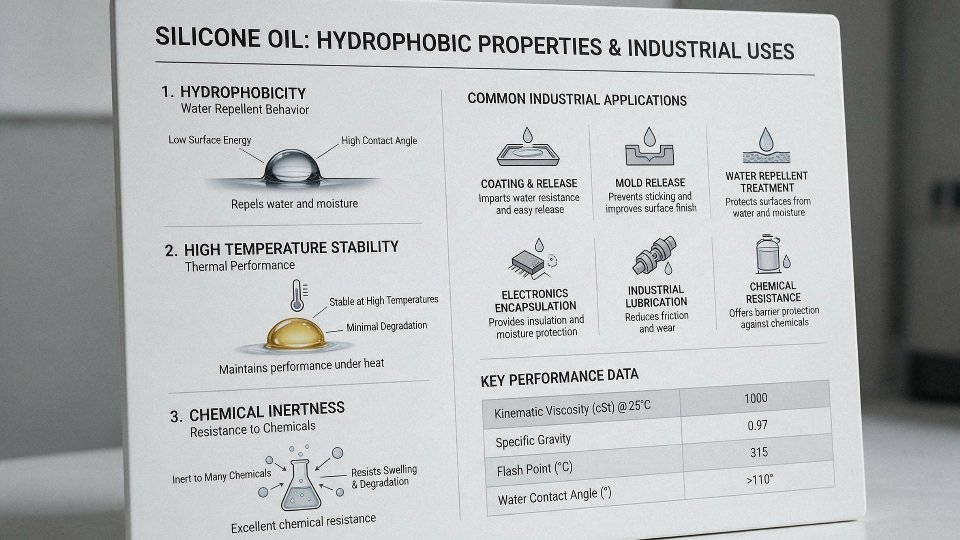
Limits and failure conditions
Silicone oil is hydrophobic, but that does not mean its water repellency is durable, process-stable, or harmless to downstream operations under all plant conditions. The usual failure is not that the chemistry suddenly stops being hydrophobic; it is that contamination, substrate effects, fluid mobility, or process exposure change where the silicone sits, how long it stays there, and whether that hydrophobic layer is still useful.
A lot of field trouble starts with overgeneralizing a clean-lab observation. A drop beads nicely on a freshly treated coupon, the buyer signs off, and six weeks later the parts either lose repellency in service or start causing bonding and paint defects in another department. Those are different failure modes, and they need different controls.
Surfactants and formulation imbalance can override apparent hydrophobicity
A hydrophobic silicone phase can still disperse into water if surfactants, emulsifiers, wetting agents, or certain formulation packages are present at the wrong level. In practice, that is common in textile finishing, release systems, personal care intermediates, waterborne polishes, and mixed housekeeping environments where the treated surface later sees detergent carryover.
The mechanism is straightforward:
- Surfactants lower interfacial tension between silicone and water.
- That makes droplet breakup easier during mixing, pumping, spray application, or wash exposure.
- Smaller droplets stay dispersed longer and can redistribute instead of forming a persistent hydrophobic film.
- On the substrate, excess surfactant can orient polar groups toward the surface or retain water, which weakens durable beading.
You see this on the floor as one of three symptoms:
- The silicone concentrate turns unexpectedly hazy, milky, or too easy to rinse
- Treated parts bead water at first but lose performance quickly after a wash or humidity cycle
- Different batches of the “same” formula give different feel, gloss, or water-drop behavior because the emulsion balance moved
The trade-off is easy to miss. A more easily emulsified system is often simpler to dilute, pump, and apply uniformly, especially on complex geometry or high-speed lines. What you gain in handling and initial coverage, you may sacrifice in long-term repellency, water resistance, or phase stability. The preferred choice flips if the process needs water dilution and rapid spreading more than permanent water exclusion.
If a supplier claims a silicone system is both strongly hydrophobic and freely water-dispersible, that can be true in a formulated sense, but only because the formulation is doing a lot of work. Verify whether the hydrophobic effect survives rinsing, drying, aging, and actual substrate contact time, not just initial appearance.
Very low-viscosity fluids may not stay where you need them
Low-viscosity PDMS grades can wet quickly and spread beautifully, but persistence is often the weak point. Depending on molecular weight, temperature, airflow, and substrate, very mobile fluids may migrate, volatilize to some degree, transfer by handling, or slowly drain away from edges and high spots.
That matters most in applications such as:
- Water-repellent wipe-on treatments
- Mold release where repeated cycles matter
- Lubricious surface films exposed to touch or packaging contact
- Open systems with heat, ventilation, or long dwell times
- Vertical or porous parts where gravity and capillary movement redistribute the fluid
The mechanism runs through mobility. Lower viscosity means lower resistance to flow under gravity, pressure, shear, or surface-energy gradients. The same property that helps a fluid cover a part quickly also makes it easier for that film to thin out, move into pores, contaminate adjacent surfaces, or get picked up on gloves, rollers, and stacked parts.
A common buying mistake is treating viscosity as only a handling variable. It is also a retention variable. If the job requires months of water repellency, repeated washdown resistance, or low transfer to neighboring components, a very low-viscosity silicone fluid may be the wrong tool even if the first-pass beading looks excellent.
This conclusion stops holding once the silicone is chemically anchored, crosslinked, or otherwise fixed in a cured network. In that case, bulk fluid mobility matters less than cure quality and substrate bonding.
Substrate chemistry often dominates the visible result
Silicone oil behavior on stainless steel is not a reliable predictor for paper, concrete, painted aluminum, glass fiber composite, or oxidized polymer. Surface energy, cleanliness, porosity, roughness, and chemical functionality can easily dominate whether you get stable beading or a patchy, short-lived result.
Problem substrates usually fall into these groups:
- Highly polar surfaces: glass, oxidized metals, mineral fillers, some ceramics
- Porous surfaces: wood, paper, textiles, sintered materials, cast mineral surfaces
- Dirty surfaces: residual cutting fluid, mold release, detergent film, dust, hand oils
- Rough or microtextured surfaces: blasted metal, etched surfaces, worn coatings, fiber-rich laminates
Why this matters:
- On porous materials, silicone may wick below the top surface instead of remaining as an effective outer barrier.
- On dirty parts, the silicone may wet the contamination layer rather than the substrate itself, so the hydrophobic effect disappears once the contamination shifts or washes off.
- On rough surfaces, you can get very high local contact angles in one area and complete wet-out in another. The inspection photo looks good, the line yield does not.
A simple bead test can mislead here. The drop is reading the local topography and contamination state of that exact spot, not the long-term uniformity of the whole part.
Mechanical, wash, solvent, and shear exposure can remove or redistribute the silicone phase
A silicone film that survives static bench testing may still fail in production or service because the layer is physically mobile. Washing, abrasion, wiping, high-pressure spray, roller nip loading, ultrasonic cleaning, or recirculating pumps can strip it, thin it, or push it into the wrong place.
Watch these exposure modes:
- Repeated detergent cleaning
- Solvent wipe-downs before printing or bonding
- Friction from guides, conveyors, nesting trays, or packaging
- High-shear mixing in compounded systems
- Spray recirculation and pump shear in application units
The practical consequence is inconsistent coverage. One section of the part remains hydrophobic, another becomes starved, and a third gets excess silicone that later causes contamination defects. Maintenance teams often first notice this as “random” print rejection or erratic adhesive wetting, not as a silicone problem.
Chemical environment limits are easy to underestimate
Silicone fluids are chemically robust in many applications, but they are not immune to aggressive environments. Strong acids, strong bases, oxidizing systems, and catalytic impurities can degrade or alter the fluid, especially with heat and time.
Potential trouble sources include:
- Concentrated alkaline wash chemicals
- Strong mineral acids
- Peroxides and other oxidants
- Metal salts or catalyst residues from upstream processing
- Contaminants introduced from drums, transfer pumps, or reused totes
Silicone oil remains hydrophobic under all chemical conditions.False
Hydrophobicity alone does not guarantee chemical stability. Service life depends on fluid structure, concentration, temperature, residence time, impurities, and the specific acid, base, or oxidant present. Those limits must be checked against supplier data and, for critical use, confirmed by exposure testing.
What usually changes first is not dramatic visual decomposition. More often you get viscosity drift, changed spreading behavior, haze, deposit formation, or reduced retention on the surface. By the time operators can see a clear defect, the process margin is already gone.
The most misunderstood failure: good beading, bad downstream adhesion
A surface can repel water beautifully and still be a production problem. Silicone transfer is notorious for causing poor adhesion, fisheyes, print skips, craters, coating dewetting, seal failures, and bonding variability on parts that otherwise “look finished.”
This happens because the requirement changed. For water repellency, a low-energy surface is helpful. For painting, printing, laminating, or adhesive bonding, that same low-energy contamination layer blocks wetting and intimate contact.
Typical downstream failures include:
- Ink pullback or incomplete print coverage
- Adhesive bond variability, especially at edges
- Paint craters or fisheyes
- Overcoat delamination
- Sealant wetting failure on localized silicone transfer spots
In mixed-use plants, this is where departments work against each other. One team applies silicone to solve release, slip, or water ingress; another team later tries to bond or coat the same part. If there is any chance of downstream adhesion, treat silicone use as a controlled contamination risk, not just a performance additive. That means defining keep-off areas, cleaning validation, and compatibility trials on actual parts, not just panels.
Selection criteria for buyers
A silicone oil should be bought as a fit-for-duty fluid, not as a generic “hydrophobic additive.” The right selection comes from matching chemistry, viscosity, volatility, compatibility, and supply risk to the actual process window; if you buy on hydrophobicity alone, you can still end up with migration, fish-eyes, unstable emulsions, seal swell, or a line that becomes hard to dose consistently in winter.
Match chemistry type to the application objective
Start with the job the fluid must do, because “silicone oil” covers materials that behave very differently in a plant.
- Pure water repellency
- Dimethyl silicone fluids are the usual starting point where low surface tension and hydrophobic surface character are the main target.
- Best fit for simple water-shedding films, surface treatment aids, and base hydrophobicity in nonpolar systems.
- They are often a poor fit if you also need strong anchorage to polar substrates without a reactive binder system.
- Softening and hand modification
- Textile, leather, paper, and soft-touch coatings often need more than water repellency.
- Amino-, polyether-, or other modified silicones may be chosen when feel, lubricity, or substrate interaction matters more than maximum hydrophobicity.
- The trade-off is that some functional modifications improve affinity or emulsifiability while reducing the clean hydrophobic behavior you would expect from straight PDMS-rich fluids.
- Slip and release
- For mold release, web handling, anti-block, or friction reduction, low surface energy helps, but transfer behavior matters just as much.
- A fluid that releases well in one cycle can contaminate downstream printing, bonding, or painting if it migrates too freely.
- Foam control
- Antifoam service is its own category. The best performer is usually not a neat silicone oil chosen only by viscosity.
- Foam control depends on entry into the foam lamella, spreading, and destabilization of the bubble film. That mechanism is strongly influenced by formulation architecture, often including hydrophobic particles or a carrier system.
- Buyers who specify only “silicone oil, hydrophobic” for foam control usually create unnecessary troubleshooting later.
- Dielectric use
- Electrical service brings tighter requirements for purity, moisture, volatile profile, oxidation resistance, and compatibility with insulation materials.
- Hydrophobicity helps with moisture resistance, but it does not replace dielectric testing against the actual equipment duty cycle.
- Formulation compatibility
- If the silicone oil must stay blended in a resin, emulsion, ink, polish, or compound, compatibility can outrank raw hydrophobicity.
- In practice, a slightly less hydrophobic modified silicone that stays stable in the system often outperforms a highly hydrophobic fluid that bleeds, separates, or causes craters.
The preferred chemistry flips once downstream interactions dominate the application. If the film only needs to repel water, a simple dimethyl fluid is often enough; if the treated surface must also print, bond, emulsify, or remain optically clean, a modified structure may be the safer commercial choice.
Choose viscosity for how the fluid behaves on the line
Higher viscosity does not automatically mean better water repellency, better durability, or lower consumption. It usually means lower mobility, thicker residual films, slower leveling, harder pumping, and more sensitivity to dispensing hardware.
Use viscosity as an operating-control variable:
- Lower viscosity grades
- Easier to meter, atomize, dilute, and wet out
- Better for thin-film coverage and fast spreading
- Higher risk of migration, transfer, misting, and evaporation loss if the grade is also more volatile
- Can create inconsistent add-on if the substrate is porous or the residence time is long
- Mid-range grades
- Often the practical sweet spot for coating additives and general surface treatment
- Balance coverage, persistence, and manageable pumping with standard gear or diaphragm systems
- Usually easier to dose accurately than very heavy grades when the plant does not have heated lines
- Higher viscosity grades
- Better film persistence and lower mobility on the substrate
- Reduced tendency to creep into unwanted areas
- Harder to handle in cold conditions; tote unloading and drum transfer can become the hidden cost
- Over-application is common because operators chase poor spreading by raising dosage
Common industrial PDMS grades span roughly 10 to 100000 cSt at 25 degrees C, but that range is too broad to specify responsibly without process details. Ask what matters on your line:
- How is it dosed: dropwise, pump-fed, sprayed, gravure, pad, internal additive?
- What temperature does it see in storage and at point of use?
- Must it stay where placed, or spread across a surface?
- Is migration into adjacent layers acceptable?
- What finish level is required after application?
Review operating-environment constraints before release to purchasing
A fluid that looks fine on a data sheet can become the wrong choice once the process reaches actual temperature, ventilation, ignition-control, and compliance conditions.
Check these items early:
- Volatility
- Important for open baths, heated ovens, vacuum service, and low-odor products
- Higher volatile content can reduce retained film, change viscosity over time, and create emissions issues
- Flash point
- Must be checked against the current supplier documentation and plant safety review
- Especially relevant near dryers, calenders, heated molds, and enclosed mixing systems
- Thermal stability
- Depends on atmosphere, residence time, contamination, and catalytic residues in the system
- Do not generalize one supplier’s thermal claim across all silicone oils
- Regulatory and customer-specific profile
- Food-contact adjacency, electronics cleanliness, cosmetic restrictions, VOC expectations, and restricted-substance declarations all need product-specific confirmation
A hydrophobic silicone oil is automatically suitable for any high-temperature process.False
Hydrophobicity says little about long-term volatility, oxidation behavior, flash point, residue formation, or regulatory suitability at process temperature. Those must be verified grade by grade against supplier data and the actual duty cycle.
Assess compatibility before scaling up
Most field complaints blamed on “bad silicone” are really compatibility failures.
Review compatibility with:
- Carriers and solvents
- Hydrocarbon, ester, alcohol, and waterborne systems behave differently
- A stable lab blend can still split after a week in a warehouse or after one freeze-thaw cycle
- Resins and binders
- Acrylics, polyurethanes, epoxies, alkyds, and silicones each have different tolerance
- Poor compatibility shows up as haze, craters, poor recoating, gloss change, or phase separation
- Elastomers and seals
- Verify with the actual gasket, hose, pump stator, and valve-seat materials
- A plant that runs fine with PTFE-lined transfer equipment may struggle once someone swaps in a different elastomer during maintenance
- Pigments, fillers, and process additives
- Surface-active packages interact; dispersants, defoamers, wetting agents, waxes, and fillers can either help or destabilize the system
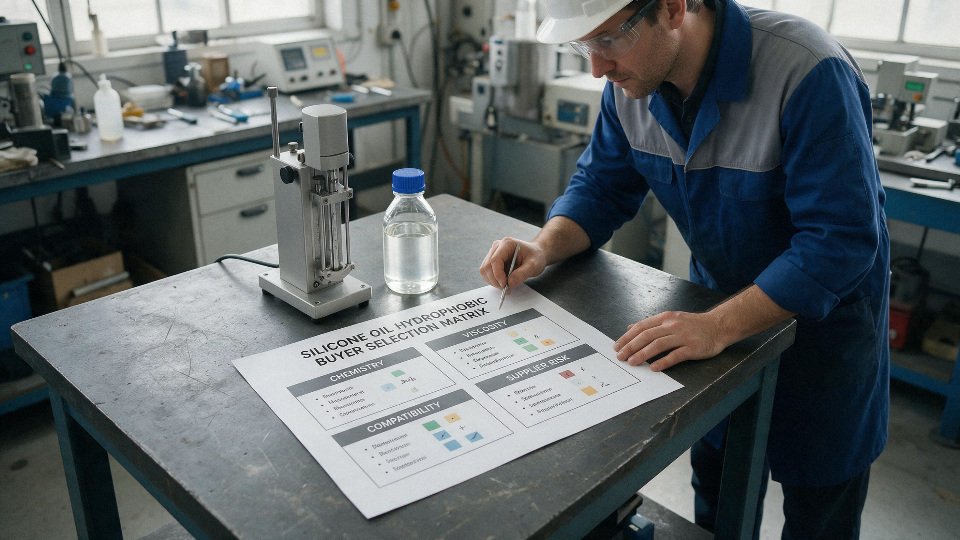
Specify measurable acceptance criteria
Do not issue a purchase spec that says only “silicone oil, hydrophobic, clear.” Put numbers and test methods around the risk.
Typical acceptance items include:
- Viscosity at 25 degrees C, with tolerance
- Appearance and clarity
- Volatile content or low-boiler limit
- Water separation or emulsion stability behavior, depending on intended use
- Contact angle range, if surface hydrophobicity is a true performance requirement
- Moisture content, where relevant
- Impurity limits critical to the application, such as ionic contamination, catalyst residues, particulates, or odor threshold
- Packaging condition and cleanliness
If a contact angle requirement is used, define the substrate, surface prep, application method, cure or dwell time, and test timing. Without that, the number is not procurement-grade.
Evaluate supplier capability as seriously as product data
For repeat industrial buying, supplier quality often decides total cost more than the nominal fluid price.
Check for:
- Batch-to-batch consistency and retained-sample practice
- Technical support that can review your formulation or line conditions
- Complete documentation: TDS, SDS, COA format, restricted-substance statements as needed
- Packaging options suited to your consumption rate: pails, drums, IBCs, bulk
- Export execution, lead-time stability, and damage control on international shipments
- Long-term feedstock security and integration in organosilicon manufacturing
An integrated producer can usually manage raw-material continuity and grade consistency better than a trader assembling supply from changing sources, though that still needs verification through actual supply history and documentation discipline. For a buyer, that matters most when the silicone oil is qualified into a formulation that is expensive to revalidate once a grade drifts.
Frequently asked questions
Is all silicone oil hydrophobic?
No. Most standard dimethyl silicone oils are clearly hydrophobic, but not every fluid sold under the broad label “silicone oil” behaves the same way. Once you move into modified silicones, the water affinity can shift a lot, especially if the molecule carries polyether, hydroxyl, amino, or other polar functionality.
In buying terms, “silicone oil” is too broad to approve a material for water-repellent service. You need the actual chemistry family, not just the generic name.
All silicone oils repel water to the same degree.False
Hydrophobicity depends strongly on structure. PDMS-rich fluids are usually strongly water-repellent, while modified silicone fluids can show partial water compatibility or even self-emulsifying behavior.
Can silicone oil mix with water?
Usually not as a true solution. Standard dimethyl silicone oil and water are generally immiscible, so if you stir them together, you get phase separation unless an emulsifier, high shear, or a specific modified silicone chemistry is involved.
What matters on the plant floor is the time scale and the mixing conditions:
- Without surfactant: the two phases separate, often fairly quickly in a beaker, slower in a tank with fine dispersion
- With agitation: you can create a temporary dispersion, but it is not the same as molecular mixing
- With emulsifiers: you can make stable silicone-in-water or water-in-silicone systems
- With modified silicone fluids: some grades show partial compatibility or designed emulsification behavior
A common mistake is to see a milky mixture after pumping or recirculation and assume the silicone oil is water-soluble. Often it is just mechanically dispersed and will break later in storage, in a tote, or in the customer’s line.
Does higher viscosity mean better water repellency?
Not by itself. Higher viscosity changes film persistence, migration, drainage behavior, and carryover, but it does not automatically mean the underlying surface chemistry is more hydrophobic.
The mechanism is practical: a higher-viscosity PDMS fluid tends to stay in place longer and resist squeeze-out or runoff better, so the treated surface may keep its water-repellent effect longer under low-shear conditions. The trade-off is that very high viscosity can be harder to spread uniformly, harder to meter, and more likely to cause contamination issues on rollers, fixtures, or downstream bonding surfaces.
In other words:
- Low viscosity: easier wetting, easier application, more migration, faster loss in some uses
- High viscosity: better residence in some cases, but more drag, residue, and cleanup burden
- Preferred choice flips when the process needs a thin, even transient film rather than a persistent oily layer
If the substrate is porous, rough, or heated, viscosity alone becomes an even weaker predictor. Then absorption, evaporation of carriers, and cure or anchoring chemistry matter more.
Are silicone emulsions still hydrophobic?
Yes, after deposition they often are, but the emulsion itself is not the same thing as a neat hydrophobic oil. In a silicone emulsion, the hydrophobic silicone phase is dispersed in water with surfactants or emulsifying chemistry, which means the as-supplied product has an intentional relationship with water.
That distinction matters in production:
- In the drum: the product is water-based and processable
- During drying: water leaves, particles coalesce or deposit
- On the substrate: the remaining silicone-rich layer can deliver water repellency
Performance depends on solids content, emulsion particle size, surfactant package, substrate absorption, drying conditions, and whether the system leaves hydrophilic residues. A poor emulsion can test nicely on a dry lab panel and disappoint on a dusty line, humid substrate, or fast oven schedule.
Can silicone oil damage adhesion or paintability?
Yes. Silicone contamination is one of the quickest ways to create adhesion trouble, fisheyes, craters, and coating defects, especially in painting, printing, laminating, and bonding lines.
Typical failure paths include:
- Surface energy reduction: the silicone migrates to the interface and makes it difficult for inks, paints, or adhesives to wet the surface
- Transfer contamination: overspray, mist, wiping cloths, gloves, or shared conveyors spread tiny amounts farther than operators think
- Persistent residue: even a thin film can survive basic solvent wiping
In practice, this is where buyers get burned. A fluid chosen for release, lubrication, or moisture shedding in one station can quietly damage yield in the next station. If downstream adhesion matters, run compatibility trials on the exact substrate, coating, and cleaning sequence.
Is silicone oil safe for electrical moisture protection?
Sometimes, but not as a blanket answer. Silicone oils are used in some electrical and moisture-barrier applications because they are water-repellent and often stable over a broad temperature range, but suitability depends on dielectric properties, purity, volatility, oxidation behavior, material compatibility, and the specific equipment design.
Check these before approving use:
- Electrical grade requirements from the equipment maker
- Compatibility with seals, plastics, varnishes, and cable jackets
- Operating temperature and oxidation exposure
- Risk of migration into contacts or surfaces where insulation tracking, arcing, or sensor drift would be unacceptable
- Current regulatory and safety documentation for the exact grade
For critical electrical service, the supplier data sheet alone is not enough. You need confirmation against the actual application standard and equipment manual.
How is silicone oil different from mineral oil in water resistance?
Silicone oil is usually more hydrophobic at the surface and has much lower surface tension than typical mineral oils, so it tends to spread differently and form water-shedding films more easily. Many dimethyl silicone oils sit around 20–21 mN/m at 25 degrees C, which is one reason they wet many substrates that mineral oils do not wet as readily.
That said, “better water resistance” is not universal. Mineral oils can outperform in some lubrication or sealing duties because additive packages, viscosity behavior, solvency, or cost structure fit the duty better. The choice flips if the application cares more about lubricity under load, additive response, or hydrocarbon compatibility than simple water beading.
Which modified silicone oils are less hydrophobic?
The main group is polyether-modified silicone oils. These are intentionally made more water-compatible for uses such as wetting, leveling, emulsification, defoaming balance, or softening systems where pure PDMS would separate too aggressively.
Other silicone fluids that can be less hydrophobic, depending on structure and substitution level, include:
- Hydroxyl-functional silicones
- Amino-modified silicones
- Carboxyl- or other polar-functional silicones
- Some reactive or self-emulsifying silicone intermediates
The boundary is simple: once enough polar functionality is introduced, the material stops behaving like a straightforward water-repellent PDMS fluid and starts behaving like a tuned specialty additive. That can be exactly what the formulator wants, but it should not be specified as if it were a standard hydrophobic silicone oil.
What to verify before ordering
Start by locking down the job the material actually has to do. A silicone oil that is hydrophobic as a bulk fluid is not automatically the right choice for durable water repellency on a surface, and neither of those is the same as controlled behavior inside an emulsion system. That distinction saves a lot of wasted sample rounds.
Use this sequence before you ask for pricing:
- Define the functional target
- Intrinsic hydrophobicity of the fluid itself: relevant where the oil must resist water pickup, separate from water, or maintain lubrication and dielectric behavior in wet conditions.
- Durable water repellency on a substrate: relevant for textiles, paper, mineral surfaces, rubber, plastics, and release-treated parts. Here, permanence depends on deposition, anchoring, cure or fixation, and wear resistance, not just the oil’s native water aversion.
- Controlled water compatibility in an emulsion or formulation: relevant for defoamers, textile auxiliaries, personal care intermediates, release systems, and process additives. In that case, some degree of emulsifiability or modification may be desirable, even though it reduces “pure” hydrophobic behavior.
- Request exact grade-level identification
- Product name and internal grade code
- Chemical type: dimethyl silicone oil, phenyl-modified, amino-modified, polyether-modified, reactive functional grade, or other defined structure
- Nominal viscosity at 25 °C, with tolerance range
- Typical property data, not just brochure language:
- viscosity
- appearance
- volatile content, if relevant
- refractive index, density, flash point, or pour point where application-dependent
- any stated surface-tension data for the supplied grade
- Application-specific evidence: water repellency test, spreading behavior, compatibility notes, emulsion stability data, or substrate trial results if the supplier has them
A common purchasing mistake is accepting “silicone oil” as if it were a complete specification. In practice, a 100 cSt dimethyl fluid, a 1000 cSt amino-modified fluid, and a polyether-modified silicone can behave like three different product families once they hit the line.
- Set a short qualification plan
- Substrate material and surface condition
- Contaminant load: oils, dust, release agents, moisture, salts, surfactant residue
- Trial dosage or add-on level
- Method of application: dip, spray, wipe, meter-mix, bath addition, or inline dosing
- Process conditions: temperature, shear, dilution water quality, drying or cure conditions
- Aging checks: heat, humidity, wash, abrasion, storage stability, or migration
- Downstream compatibility:
- adhesion
- printability
- coating acceptance
- paint defects such as fisheyes or cratering
The mechanism matters here. Lower-surface-tension silicone materials can improve wetting and water beading, but that same mobility can transfer to adjacent areas and create adhesion trouble later. The preferred grade flips once the downstream process is paint, lamination, or bonding rather than simple lubrication or release.
- Clear the commercial and supply details
- MOQ
- standard lead time and whether it changes by viscosity grade
- packaging options: drums, pails, IBCs, bulk
- sample policy and sample size
- COA, SDS, TDS availability
- lot-to-lot consistency controls
- whether repeat orders are locked to the same manufacturing site or specification window
- Use the trial result to narrow the shortlist
- Keep the grade that meets the functional target under your process conditions
- Drop grades that pass a bench test but fail on aging, contamination tolerance, or downstream compatibility
- Move only shortlisted grades into technical review and quotation
If you are ready to evaluate a grade, send the supplier the substrate material, contaminant type, approximate layer thickness or dosage target, working area, required finish, target line rate, and clear part photos or representative samples. SiliconChemicals can then review the application, recommend suitable silicone oil or modified silicone grades from its product range, and arrange sample evaluation and quotation against your defined use case.