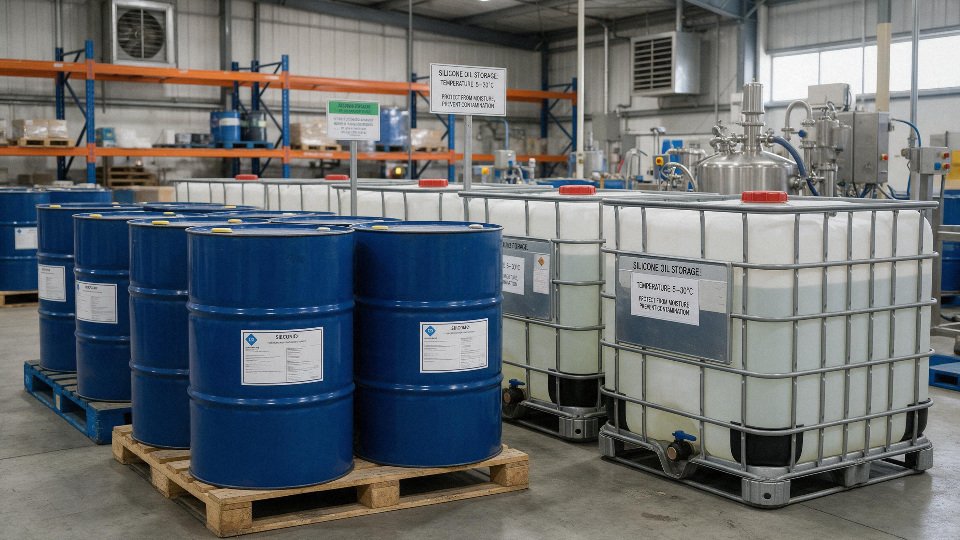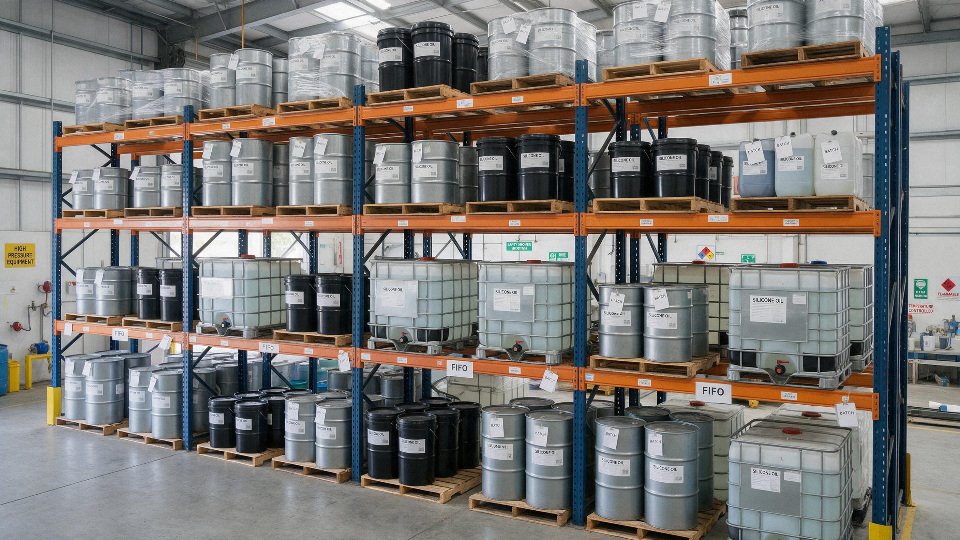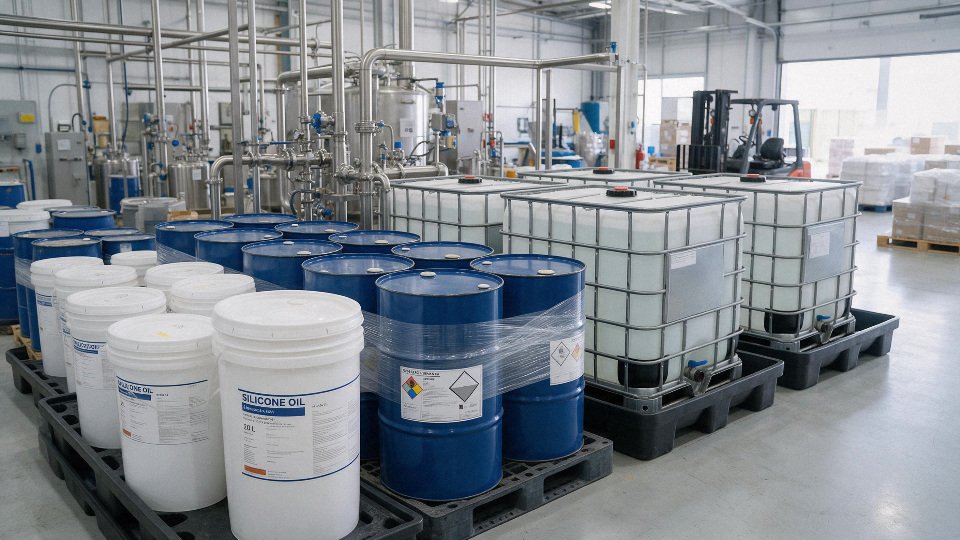
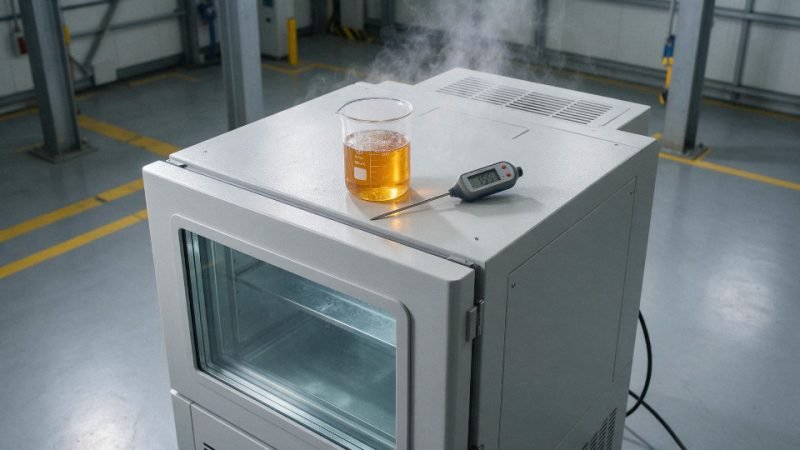
A drum of silicone oil left in an unheated warehouse or arriving after winter transit can look “frozen” when the line needs to run, and that creates the kind of confusion that burns shift time. Pumps lose suction, metering drifts, filters load up, and operators start asking whether the material is off-spec or just too cold. That uncertainty is expensive: delayed batches, wasted labor, avoidable expedited freight, and sometimes a perfectly usable lot rejected because nobody separated low-temperature thickening from actual loss of flow.
Silicone oil can freeze in the practical sense of losing flow at low temperature, but the temperature where that happens varies widely by chemistry and viscosity. Common silicone oils often show pour points around -30 C to below -70 C, and long before that they may thicken several-fold or by orders of magnitude, which is usually the more important plant-floor problem.
The part that catches buyers and production teams is that “freeze” is not a single yes-or-no event for this product family. A fluid can still be chemically fine yet be too viscous to pump, dose, or drain on schedule, and that distinction drives how you set storage limits, choose packaging, and write winter shipping instructions.
Silicone oil behavior
Silicone oil usually stays mobile at temperatures where many hydrocarbon fluids have already become waxy or non-pumpable, because its molecular chain is unusually flexible and the molecules do not pull strongly on each other. That said, “silicone oil” is a family, not one fluid: low-temperature behavior can stay excellent, get noticeably worse, or fail by haze, phase instability, or simple loss of pumpability depending on backbone modification, viscosity grade, and how uniform the formulation really is.
The starting point is the Si-O backbone. In a typical polydimethylsiloxane fluid, the chain is built from repeating silicon-oxygen units with methyl groups hanging off the side. That matters for two reasons:
- The Si-O bond geometry gives the chain high rotational freedom.
- The methyl side groups keep intermolecular attraction relatively low.
In practical terms, the molecules do not pack together as tightly as many organic fluids do, and they need less thermal energy to keep moving past each other. That is why many silicone oils show very low glass transition behavior and can remain fluid over a broad temperature window. You see this on the plant floor as a drum that still pours, or at least can be decanted, after a cold night when an ISO-grade mineral oil next to it is already struggling.
That does not mean the fluid is “unchanged.” As temperature drops, viscosity still rises, often by several times and sometimes by orders of magnitude before anything that looks like true freezing appears. The mechanism is straightforward: lower thermal motion reduces chain mobility, internal friction goes up, and the fluid resists flow more strongly. A transfer pump that was comfortably sized at room temperature may suddenly cavitate, stall, or trip overload in winter even though the material has not technically solidified.
Why chemistry changes the low-temperature result
Dimethyl silicone fluids are the baseline most buyers have in mind, and many of them are very good at low temperature. Once you move into modified silicone oils, the answer becomes conditional.
- Phenyl-modified and methyl-phenyl silicone fluids can improve low-temperature behavior in some formulations because phenyl substitution can disrupt regular packing and suppress crystallization tendencies. They are also selected for certain thermal or dielectric applications. But the improvement is not universal; it depends on phenyl content, molecular architecture, and the rest of the formulation.
- Amino-modified silicone oils are usually chosen for reactivity, substrate affinity, textile hand, or lubrication effects, not primarily for cold-flow performance. Their polarity and formulation package can shift low-temperature behavior in either direction, and phase stability becomes a bigger concern if the product is not a simple neat fluid.
- Other specialty modifications such as epoxy, polyether, fluoro, or alkyl-functional types have to be treated case by case. Once you introduce stronger intermolecular interactions, side-chain incompatibility, or mixed-phase structures, the low-temperature picture stops being predictable from “silicone” alone.
All silicone oils remain fluid at very low temperature because silicone does not freeze like water.False
Many silicone oils have low pour points, but low-temperature behavior depends on polymer structure, viscosity grade, additives, and formulation uniformity. Some grades thicken severely, haze, separate, or lose pumpability well before any simple 'freeze' description is useful.
In procurement terms, this is where data sheet shorthand causes trouble. Two products may both be called silicone oil, but one is a neat dimethyl fluid and the other is a modified specialty fluid intended for wetting or release. Buying by generic name alone is how plants end up with winter transfer problems or unstable coating baths.
Why viscosity grade matters even within the same chemistry
A 50 cSt dimethyl silicone fluid and a 5,000 cSt dimethyl silicone fluid may share the same broad chemistry, but they do not behave the same way in cold service. The higher nominal centistoke product has higher average molecular weight, more chain entanglement, and less margin before “still liquid” turns into “not practically movable.”
That trade-off is familiar in lubrication and process design:
- Lower-viscosity grades usually offer better cold start flow, easier metering, and faster line recovery.
- Higher-viscosity grades may provide better film persistence, damping, carryover control, or release behavior at operating temperature.
The preferred choice flips when room-temperature function matters more than winter handling. A release coating line, for example, may need a heavier fluid for application behavior or surface effect, but then the storage tank, trace heating, suction line diameter, and pump type need to be chosen around the cold-start viscosity rise. Ignore that, and operators start “helping” with drum warmers, improvised steam hoses, or solvent dilution that was never validated.
Thickening is not always the same thing as freezing
Some silicone fluids stay optically clear while becoming dramatically thicker. That is mostly amorphous stiffening: molecular motion slows, viscosity climbs, but the material does not form a well-defined crystalline structure. You can still have a single-phase fluid, just one that no longer moves through a filter or gear pump at the required rate.
Others develop haze, cloudiness, or separated phases, which points to a different problem. That can come from:
- crystallizable fractions within the fluid
- a broader molecular weight distribution
- incompatible modifiers or additives
- waxy or high-melting minor components
- poor formulation stability during repeated cold cycling
This distinction matters in troubleshooting. A clear but sluggish fluid suggests you are dealing mainly with viscosity management. A hazy or layered drum raises a bigger quality question: even if you rewarm it, do the phases fully recover, and does the product return to its original performance? Sometimes yes, sometimes not. That has to be confirmed product by product, especially for formulated blends rather than neat silicone polymers.
Low-temperature fluidity does not guarantee performance under load
A silicone oil can remain pourable and still stop doing the job you bought it for. That is one of the most common misunderstandings.
- Lubrication: higher low-temperature viscosity can starve contact zones, delay film formation, and increase startup torque.
- Heat transfer: if viscosity rises too far, circulation drops, Reynolds number shifts, and heat transfer efficiency falls even before the fluid stops moving.
- Dielectric service: electrical performance may depend on moisture, dissolved gases, and formulation stability, not just whether the fluid is liquid.
- Antifoam use: a cold antifoam may disperse poorly, spread differently, or respond too slowly in the process.
- Release and wetting applications: surface migration and coating uniformity can change sharply as viscosity climbs.
So the main conclusion holds only up to the point where your application is limited by function rather than mere fluidity. If the fluid has to pump through a long 1-inch line, atomize through a nozzle, wet a substrate evenly, or lubricate a loaded startup, the right low-temperature question is not “Will it freeze?” but “At the coldest actual plant condition, will it still perform at the required rate and recovery time?”
Temperatures that matter
A silicone oil does not have one universal “freeze temperature,” and using that phrase in a specification usually causes trouble later. The numbers that actually matter are pour point, cloud point, crystallization behavior, low-temperature viscosity, and the temperatures the fluid will see in storage, startup, and circulation; each tells you something different about whether the oil will still move, recover, and perform.
Pour point is the number most buyers ask for because it is the easiest practical benchmark for bulk movement. If a drum sits in a cold warehouse or a tote arrives after winter transit, pour point is a first check on whether the oil can still flow out under the test conditions. That is useful, but only up to a point.
Pour point: the common benchmark, not the whole answer
Pour point is typically reported as the lowest temperature at which the oil still shows movement under a defined cooling and observation method. For common silicone oils, you will often see roughly -30 C down to below -70 C, depending on polymer structure, viscosity grade, and formulation. That range is broad because low-temperature behavior is not the same across all siloxane fluids.
Why plants rely on pour point anyway is simple:
- It gives a quick screening number for storage and transport risk.
- It is widely recognized by purchasing, logistics, and QA teams.
- It helps compare broadly similar products, if the test method is the same.
- It can flag obvious mismatches between climate exposure and fluid selection.
Where it misleads people is in day-to-day operation. A fluid can pass a pour point criterion and still be too thick to:
– feed a metering pump consistently,
– return through a small-bore line,
– respond fast enough in a hydraulic or damping circuit,
– wet a substrate uniformly,
– purge trapped air from a narrow manifold.
That mechanism matters. As temperature drops, molecular mobility falls and viscosity rises, often by several-fold and sometimes by orders of magnitude before the material reaches anything that looks like solidification. The oil may still “pour” in a lab jar during a test tilt, yet behave like cold syrup in a 6 mm impulse line or starve a gear pump with marginal suction conditions. If the application depends on controlled flow rather than simple drainage, low-temperature viscosity is usually more decision-critical than pour point.
Cloud point, crystallization onset, glass transition, and apparent solidification are different events
These terms get mixed together in datasheets, sales conversations, and sometimes even internal specs. They should not be treated as interchangeable.
Cloud point
Cloud point is the temperature where the fluid first becomes visibly hazy as some components or structures begin to separate or crystallize. In practice, this can be the first warning that optical clarity or phase uniformity is being lost.
For a heat-transfer, lubricant, or release application, cloud point may or may not matter. For these cases it matters more:
- optical or transparent systems,
- precision coating where uniform wetting is critical,
- very small orifice flow paths,
- formulations that must remain single-phase.
A cloudy fluid is not automatically unusable, but it tells you the system is moving out of its fully uniform state.
Crystallization onset
Crystallization onset is the temperature where ordered solid domains start forming. This can happen before the oil appears fully immobile. Once crystals start forming, flow resistance can jump quickly, and restart behavior becomes less predictable.
In a plant, this is where operators often say “it hasn’t frozen solid, but it’s gone bad in the lines.” What they are usually seeing is partial crystallization or wax-like structure development causing drag, filter loading, or erratic pump behavior.
Glass transition region
Glass transition is a different phenomenon. It is associated with loss of segmental mobility in the polymer-rich fluid as temperature falls into a range where the material becomes progressively glassy rather than crystalline.
That distinction is technical but useful. A fluid can become mechanically sluggish without forming obvious crystals. If your application depends on damping response, elastohydrodynamic behavior, or rapid pressure transmission, this transition region can affect performance well before anyone on the floor would describe the material as frozen.
Apparent solidification
Apparent solidification is the plant-floor term: the oil looks or behaves solid enough that the system stops functioning. It may not be a true thermodynamic freezing point at all. It can result from:
– very high viscosity,
– partial crystallization,
– gel-like structure under low shear,
– cold-soaked stagnant zones in valves or dead legs,
– additive or blend phase separation.
This is why one operator says a fluid “froze” at -25 C while the lab says the pour point is much lower. They may both be right within their own definitions.
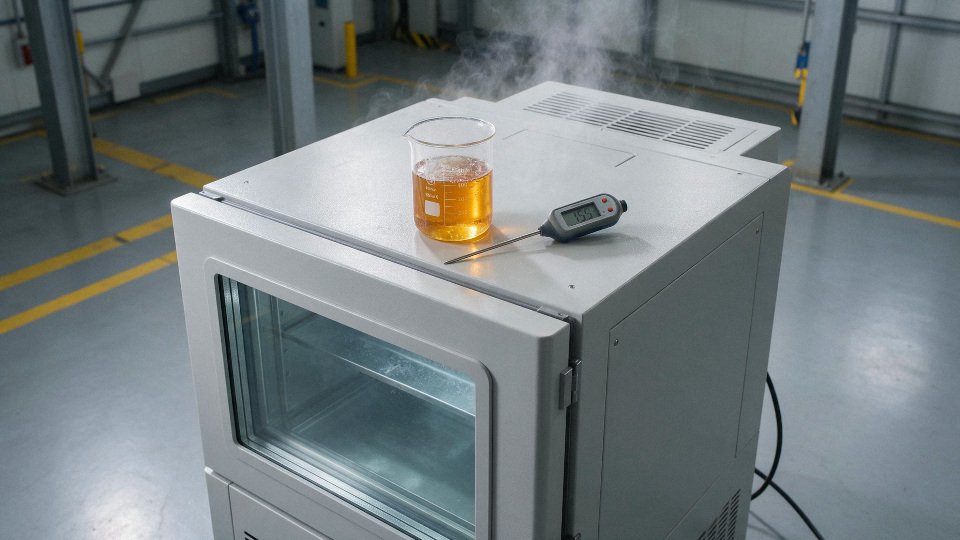
Low-temperature viscosity curves decide whether the oil is actually usable
A single catalog number cannot tell you whether a silicone oil will function in your equipment at low temperature. You need the viscosity-temperature curve, or at least enough data points to estimate viscosity at the coldest operating condition.
The practical questions are application-specific:
| Application | What fails first at low temperature | What to check |
|---|---|---|
| Metering pump feed | Suction starvation, slip change, unstable output | Viscosity at startup temperature, NPSH margin, line size |
| Hydraulic or damping response | Slow response, delayed actuation, force drift | Viscosity curve and response requirement |
| Capillary or fine-nozzle flow | Flow collapse, pressure spike, poor atomization | Viscosity at line temperature, nozzle diameter |
| Bulk transfer from drum/tank | Long unloading time, cavitation, heater dependency | Pour point plus viscosity at storage temperature |
| Coating/wetting | Uneven film, poor leveling, trapped air | Viscosity and phase clarity at use temperature |
The trade-off is straightforward. A lower-viscosity grade usually improves cold flow and startup, but it may sacrifice film strength, residence on the substrate, damping performance, or volatility profile, depending on the chemistry and use case. The “best” low-temperature fluid stops being the best if your process also needs high-temperature stability, load carrying, or a specific coating build.
Test methods and reporting details can move the number
Two low-temperature values on two datasheets may look contradictory when the chemistry is actually similar. Often the difference is in the test and sample history, not just in the oil.
The main variables worth checking are:
- Test method standard
- ASTM or equivalent methods may differ in cooling steps, observation rules, endpoint definition, and sample handling.
- A number reported without the method is less useful than it looks.
- Cooling rate
- Fast cooling can suppress or delay structure formation in some fluids.
- Slow cooling may allow crystallization or phase separation to appear earlier.
- Sample thermal history
- A freshly manufactured sample, a long-stored drum, and a repeatedly cycled field sample may not behave identically.
- Prior heating can erase some structure; prior cold soak can promote it.
- Container geometry and sample size
- A small lab jar cools differently from a 200 L drum or an IBC.
- In practice, large packages develop temperature gradients and cold spots.
- Observation endpoint
- “Still flows when tilted” is not the same as “suitable for pump suction.”
- Buyers sometimes compare unlike endpoints without realizing it.
A product-specific low-temperature handling review is more reliable than selecting by pour point alone.True
Pour point indicates movement under a defined test, but field performance also depends on viscosity at startup temperature, package size, line geometry, residence time, and recovery after cold soak. Those conditions are not captured by one catalog figure.
The operational hierarchy matters more than one catalog figure
The number that matters in procurement is rarely the lowest outdoor temperature on the weather app. The fluid sees a sequence of temperatures, and weak points usually show up at the coldest stagnant location, not in the warmest part of the process.
Check these in order:
- Minimum ambient temperature
- Warehouse, yard storage, truck route, port exposure.
- This screens shipping and storage survivability.
- Startup temperature
- The system’s first few minutes are often the hardest condition.
- A line that runs fine once warm may not prime cold.
- Line temperature
- Trace-heated tank and unheated branch line is a common mismatch.
- One cold valve body can dominate the whole restart problem.
- Residence time
- Short exposure to cold and overnight soaking are not equivalent.
- The longer the fluid sits, the more time it has to build structure or separate.
- Warm-up recovery
- Some fluids recover cleanly after reheating; others need time, mixing, or recirculation.
- Recovery time matters in batch operations and shift starts.
That hierarchy is where many specification mistakes happen. A buyer approves a low pour point fluid for winter service, but the actual line has long dead legs, a small diaphragm pump, and no jacket on the inlet manifold. The data sheet was not wrong; the decision frame was.
Thermal cycling can expose problems a one-time cold test misses
Repeated cold-soak and warm-up cycles are worth checking when the oil will face seasonal storage, stop-start operation, or intermittent outdoor service. A single pour point test may show acceptable movement, yet cycling can reveal:
– slow phase separation,
– crystal memory effects,
– haze that does not clear quickly,
– viscosity drift after reheating,
– deposits in strainers or small clearances.
This is the boundary on most low-temperature conclusions: they hold best for stable, single-phase products under controlled cooling and one-way exposure. If the fluid will be cycled, blended, contaminated in service, or held stagnant in mixed-temperature piping, lab pour point alone stops being a reliable predictor.
Before shipment into low-temperature service, the safer path is to confirm the product-specific handling window against the expected ambient minimum, startup condition, and recovery requirement, using the supplier’s stated test method and, where the application is sensitive, a cold-soak trial on the actual package size or a representative bench setup.
Grade-by-grade differences
No single answer covers “silicone oil” in the cold, because low-temperature usability changes a lot by polymer family, viscosity grade, and what else is in the package. Pure low-viscosity dimethyl fluids often stay workable far below the point where water-based or heavily modified products fail, but once you move into phenyl-modified, reactive, emulsified, or compounded systems, the controlling failure mode may no longer be the silicone backbone at all.
The practical buying mistake is assuming that a good low-temperature reputation for one silicone fluid transfers to the whole category. It does not. On a plant floor, what matters is whether the material will still pump, meter, spread, separate cleanly, or recover after cold soak in your actual system geometry, not whether the chemistry sounds “silicone enough.”
Dimethyl silicone oil: the baseline most buyers start from
For general industrial service, dimethyl silicone oil is the usual reference point because it combines broad availability, predictable behavior, and generally strong low-temperature fluidity. In the common families, it is often the safest starting choice for cold service, but the usable limit still shifts with viscosity grade and any formulation changes.
Dimethyl fluids cover a wide span, from very mobile low-centistoke products to heavy, slow-draining grades. That matters because the first low-temperature problem is usually not chemical instability. It is simple loss of mobility.
A few operating points that matter in practice:
- Low-viscosity dimethyl fluids are usually the most tolerant of cold starts.
- They drain from tanks more easily
- They respond faster after outdoor storage
- They are less likely to starve small metering pumps at startup
- Mid- to high-viscosity dimethyl fluids can become functionally unusable long before any true solid-like state appears.
- Drum emptying slows sharply
- Suction lines see higher pressure drop
- Air-operated diaphragm pumps may still move them, but with poor repeatability
- Small gear pumps and fine nozzles are where trouble shows first
- Very high viscosity grades may remain chemically intact yet behave like a semi-gel in transfer equipment that was sized for room-temperature flow.
The mechanism is straightforward: as temperature drops, chain motion decreases and viscosity rises several-fold, sometimes much more, before anything resembling “freezing” occurs. In a tote-fed process that may only mean slower turnover. In a dosing skid with 3/8-inch tubing, long suction runs, and a pump mounted a little too high above the day tank, the same viscosity rise turns into cavitation, rate drift, and bad batching.
The trade-off is cost and function. Dimethyl fluids are usually the economical baseline and often good enough. That conclusion stops holding when your process needs both very low-temperature mobility and a specific thermal, optical, or compatibility performance that dimethyl alone cannot deliver.
Phenyl silicone oil: better low-temperature fluidity in the right applications
Where cold fluidity and thermal stability both matter, phenyl-containing silicone fluids are often selected over straight dimethyl grades. They are common in more demanding heat-transfer, aerospace, instrumentation, and specialty fluid applications where the operating window runs wide in both directions.
Phenyl substitution changes how the fluid packs and moves at low temperature. In many systems, that improves fluidity retention and depresses the point where mobility collapses. At the same time, these fluids are often chosen because they can balance low-temperature behavior with good high-temperature performance better than many standard dimethyl grades.
That said, buyers should separate “often better” from “always better.”
- Phenyl content level matters
- Base viscosity still matters
- Product purity and formulation matter
- Application duty matters
A heat-transfer loop, for example, asks different things of the fluid than an aircraft instrument damper or a low-temperature seal lubrication point. In a circulating loop, bulk viscosity, pumpability, and long-term oxidative stability all matter. In an instrument fluid, density shift, damping consistency, and material compatibility may matter more than raw pour behavior.
Phenyl silicone oils are always the best choice for cold environments.False
Phenyl-modified fluids often offer better low-temperature fluidity and a useful thermal balance, but the right choice still depends on viscosity grade, formulation, compatibility, and the actual duty cycle. Some dimethyl fluids outperform a poorly matched phenyl grade in transfer and metering service.
The trade-off is usually commercial and application-specific: phenyl fluids can be the better engineering answer, but they are not the automatic procurement answer for every cold plant. If the process is just bulk lubrication or simple release application at moderate low temperature, a standard dimethyl grade may do the job at lower cost and with easier sourcing.
High-viscosity silicone fluids and silicone gums: stable chemistry, poor cold handling
Once you get into high-viscosity fluids and especially silicone gums, cold-weather transfer becomes a handling problem first and a chemistry problem second. These materials may stay chemically stable, but they lose practical mobility early enough that unheated pumping, metering, and drum unloading become unreliable.
Typical trouble spots include:
- Unheated tote or drum discharge
- Material bridges or drains slowly from the sidewalls
- Operators start improvising with warm rooms, drum bands, or overnight staging
- Narrow transfer lines
- Pressure loss rises fast
- Startup lag becomes inconsistent from shift to shift
- Metering systems
- Shot size drifts because the pump was calibrated warm
- Air entrainment becomes harder to clear
- Mixing
- High-viscosity material may not wet into the blend at the expected rate
- Batch time stretches, and operators compensate with excess heat or shear
In practice, this is where procurement and maintenance need to talk before purchase. A fluid that looks acceptable on a data sheet may be completely wrong for an outdoor day tank in winter if the line set, suction lift, and pump type were never sized for cold viscosity. If the process cannot tolerate heat tracing, jacketed vessels, recirculation, or longer recovery time, these grades are usually poor choices.
Modified silicone oils: side groups change the cold response fast
Amino, epoxy, polyether, alkyl, fluoro, and other reactive or specialty-modified silicone oils should be treated as separate products, not as ordinary silicone fluids with one extra feature. Their side groups can change low-temperature flow, compatibility, moisture response, phase behavior, and even the dominant failure mode.
The most common buyer traps are:
- Assuming the base silicone backbone controls everything
- In many modified fluids, side-group effects are strong enough to override the baseline low-temperature advantage
- Ignoring compatibility-driven haze or separation
- A fluid may remain liquid but lose uniformity in a blend, bath, or finish formulation
- Overlooking moisture sensitivity
- Some reactive grades can change during storage or handling if containers are not well managed
- Generalizing from one modification type to another
- Polyether-modified and amino-modified systems can behave very differently in the same cold room
This category needs product-specific verification. There is no responsible universal low-temperature number for “modified silicone oil” because performance depends on substitution chemistry, molecular weight, formulation, and the rest of the system.
Emulsions, compounded fluids, and antifoam formulations: the weak link is often not the silicone phase
In emulsions and formulated products, cold failure usually shows up before the silicone phase itself reaches its limit. Water can freeze. Emulsions can break. Fillers can settle. Additives can separate. Antifoam products can lose effectiveness even if the silicone portion remains chemically fine.
The main failure modes to check are:
- Water phase freezing
- Common with silicone emulsions stored below 0 C unless specifically designed for cold handling
- Emulsion breakage
- Freeze-thaw can permanently change droplet structure
- Re-mixing may not restore original performance
- Settling or separation
- Silica, fillers, waxes, or hydrophobic actives may stratify after cold soak
- Solvent-driven viscosity or flammability changes
- In compounded products, the carrier can become the limiting factor
- Antifoam performance loss
- A product may still pour but disperse poorly in use, which is what the operator actually notices
Blended products versus pure silicone fluids
If a supplier gives a low-temperature claim, first ask whether it applies to the pure silicone base fluid or the as-sold product. That distinction matters more than many buyers expect.
Use this check:
| Product type | What usually controls low-temperature behavior |
|---|---|
| Pure silicone fluid | Polymer type, molecular structure, viscosity grade |
| Silicone blend with additives | Additive compatibility, separation tendency, final viscosity |
| Silicone in solvent | Solvent pour behavior, volatility, safety limits, phase stability |
| Emulsion or waterborne product | Water phase freezing, emulsion stability, freeze-thaw recovery |
| Antifoam compound | Carrier fluid, dispersed solids, redispersibility, use-point performance |
A base polymer may have an excellent low-temperature profile, while the commercial product built around it does not. That is why shipment below expected winter ambient should be verified against the actual product’s handling instructions, recovery time, and test method, not against the reputation of silicone oils as a class.
Failure modes in cold service
Most cold-service failures with silicone oil are not a clean “it froze” event. They show up first as loss of mobility, poor control, phase instability, or application drift long before the fluid becomes anything like a hard solid, and the practical damage is usually downtime, bad dosing accuracy, or off-spec product rather than a visibly frozen tank.
That distinction matters on the plant floor because operators tend to diagnose by what they can see: a sluggish pump, a hazy tote, a level reading that does not match the discharge weight. In practice, low temperature changes several things at once, and the failure you notice is often one step downstream from the fluid property that actually moved.
Loss of pumpability in tanks, drums, lines, and dosing hardware
The most common failure mode is simple: the oil gets too viscous for the equipment that has to move it. A drum pump that handled the product comfortably at room temperature may cavitate, trip on overload, or just deliver half the expected rate after a cold night, even though the oil is still technically pourable.
The mechanism is straightforward but often underestimated:
- As temperature drops, viscosity rises sharply.
- Higher viscosity increases suction losses, line pressure drop, and valve cracking resistance.
- Net positive suction head margin shrinks, especially with small suction hoses, fine strainers, or long pickup lances.
- Metering accuracy drifts because stroke fill, check-valve seating, and response time all change.
You see this in several places:
- Bulk tanks and totes: transfer pumps struggle at startup, recirculation loops run under target flow, and tank heating that looked adequate on paper cannot re-warm the boundary layer fast enough.
- Drums: follower plates stop sealing well, pump tubes pull channels instead of full flow, and operators end up over-pressurizing air-driven systems to force discharge.
- Small-bore lines: 1/4 in. and 3/8 in. dosing lines are especially sensitive; what was a manageable pressure drop at 25 C can become a control headache in the cold.
- Needle valves and dosing valves: opening force and response lag increase, so shot size and timing wander.
The trade-off is familiar: a lower-viscosity grade usually improves cold pumpability, but it may sacrifice film thickness, damping behavior, lubricity window, or high-temperature retention depending on the application. The conclusion stops holding if the system is intentionally heat-traced and tightly temperature-controlled at every restriction point; then the fluid grade may be acceptable and the problem is really thermal uniformity, not viscosity alone.
Phase separation, haze, sediment, and wax-like appearance in formulated products
If the product is a neat silicone fluid, low temperature usually shows up as thickening. If it is a formulation, things get messier. Haze, cloudiness, soft precipitate, pigment settling, and separation of antifoam actives or modifiers are all possible, especially where the package includes fillers, incompatible organic components, or a deliberately unstable dispersion.
Typical cold-triggered appearance changes include:
- Haze or cloud point behavior: often from reduced compatibility between silicone and organic modifiers as temperature drops
- Wax-like or gel-like structure: not necessarily true crystallization of the base fluid; it can be additive-rich domains or structured fillers
- Sediment release: fillers or pigments that stayed suspended at warmer temperature drop out once viscosity and density balance shift
- Layering after storage: active component concentration may be non-uniform from top to bottom of a tote or drum
This is where buyers get burned by assuming all “silicone oil” behaves the same. Antifoams, release agents, textile finishes, polishes, and specialty blends may contain emulsifiers, silica, waxes, hydrocarbons, solvents, or performance additives that set the low-temperature limit more than the silicone itself.
A clear-looking silicone fluid at 25 C can become hazy or separate after cold storage even if the base silicone oil has a very low pour point.True
In formulated products, the low-temperature behavior is often controlled by additive compatibility, dispersed solids, or secondary carriers rather than the silicone backbone alone. Product-specific testing matters.
Delayed startup and poor control response in operating systems
In hydraulic, damping, instrument, and heat-transfer duties, the fluid may still circulate but the system no longer behaves as designed. The failure is functional rather than visual: slower actuator response, delayed pressure build, unstable control loops, or uneven heat delivery.
A few recurring plant-floor symptoms:
- Hydraulic or motion systems: cold-start torque spikes, sluggish cylinders, overshoot after warmup, relief valves chattering
- Damping and instrument systems: response becomes slow or non-linear, so calibration done warm does not hold cold
- Heat-transfer loops: pump amperage rises, flow drops, and localized overheating appears because the loop is moving less mass than expected
- Metering skids: pulse dampeners and check valves stop behaving consistently, so operators chase a “bad pump” that is really a temperature problem
The mechanism is not just higher viscosity in isolation. It changes Reynolds regime, increases line losses, alters valve dynamics, and can change leakage rates across close-clearance parts. In small metering systems, a 5-second response delay can be enough to throw batch sequencing off, especially if the PLC logic assumes warm-fluid behavior.
Container handling and inventory errors
Cold product often creates handling issues that look like warehouse or accounting mistakes. Drums do not drain fully, totes retain a surprising heel, and level indicators become misleading because thick fluid clings to walls and bridges over low points.
Watch for these practical problems:
- Incomplete drum or tote discharge: residue on sidewalls and bottom corners can be much higher than the normal warm-weather expectation.
- False inventory confidence: sight glasses and dip measurements can suggest more recoverable product than can actually be pumped out.
- Slow equalization after transfer: operators think a container is empty, then product creeps down from the walls later.
- Handling damage risk: impatient crews may overheat, over-pressurize, or physically manipulate containers in ways that create safety and quality problems.
In winter operations, this is not trivial. A few percent extra heel across repeated drums can distort usage calculations and trigger unnecessary urgent purchases.
Application-quality defects after cold exposure
Sometimes the product transfers fine after warming, but the application still performs poorly because the cold history changed dispersion state, deaeration behavior, or coating dynamics. That shows up later on the line.
Common quality effects include:
- Poor wetting and spreading: colder, thicker fluid does not level the same way on substrate surfaces
- Slower bubble release: entrained air remains longer, especially after pumping or mixing
- Film non-uniformity: streaks, orange-peel-like texture, or uneven laydown where viscosity stayed non-uniform
- Reduced foam control performance: antifoam droplets may not redisperse correctly after separation or cold storage
- Delayed recovery after warming: the product is back above its minimum handling temperature, but internal uniformity has not fully returned
This matters most in dosing, coating, defoaming, and precision application work. A tote that “looks normal again” after sitting in a warm room may still need mixing, recirculation, or a defined recovery time before it is process-ready.
Not every cold failure is the silicone grade
A fair number of apparent low-temperature failures are contamination problems wearing a cold-weather disguise. Moisture ingress, residual cleaning solvent, process carryover, mixed-product remnants in transfer lines, and dirty containers can all create haze, separation, gels, or abnormal viscosity rise.
The usual suspects are:
- Moisture contamination: can create cloudiness or interact with certain additives and residues
- Solvent carryover: shifts compatibility and can drive separation as temperature falls
- Mixed-product residue: a few liters left in a tote line from the previous campaign is enough to destabilize some blends
- Particulate contamination: settled fines become obvious only when viscosity rises and flow slows
- Oxidized or aged residue in hoses and valves: cold conditions expose restrictions that were masked at warmer temperature
If the same grade suddenly “fails cold” in one plant but not another, check housekeeping before blaming the supplier. The next useful verification is usually simple: compare a retained clean sample, a line-end sample, and a container-bottom sample after the same cold exposure. That will tell you quickly whether the issue is intrinsic low-temperature behavior or something the process introduced.
Storage and transport control
If silicone oil will see winter warehousing or cold freight, control it as a handling-viscosity problem first and a freeze problem second. Most grades do not suddenly turn into a hard solid at one neat temperature; they thicken, may lose clarity, and can become unpumpable long before any textbook “freezing” condition matters, so storage limits have to be tied to package size, time at temperature, and how fast you need the material back in service.
A drum sitting three days in an unheated yard behaves very differently from the same product in a heated tank farm or a tote that can rest indoors for 24 hours before use. The practical target is not just “keep above pour point.” It is “keep warm enough that transfer, inspection, and use can happen without forcing the product, overheating it, or guessing whether phase changes have reversed.”
Set storage bands from the actual handling requirement
Start with the product data sheet and then tighten it for your operation. The useful storage band depends on four things:
- Product-specific low-temperature behavior
- Pour point or low-temperature fluidity range
- Whether the product is a straight silicone fluid, modified silicone, emulsion, blend, or filled formulation
- Expected viscosity increase as temperature drops
- Package size
- Small pails recover temperature fairly quickly
- 200 L drums recover slowly
- IBCs and bulk tanks can hold a cold core for a long time even after the outer wall feels warm
- Residence time
- Overnight exposure is one issue
- One to three weeks in a cold warehouse or port stack is another
- Use condition on receipt
- If the material can sit and equilibrate before use, you have margin
- If the receiving plant must unload and meter it immediately, the minimum acceptable storage temperature is usually much higher
In practice, many teams set an internal storage minimum comfortably above the published pour point because pumping and metering failures show up earlier. A product with a very low pour point can still be a bad candidate for immediate winter unloading if its viscosity climbs by an order of magnitude near the route minimum. If the supplier has not provided low-temperature handling guidance for that exact grade, get it before the season starts.
Pour point alone is enough to define winter handling risk.False
Pour point indicates the temperature where flow nearly ceases under a test method, but transferability, filterability, metering accuracy, and recovery after cold soak depend on viscosity rise, package geometry, dwell time, and whether phase separation or crystallization can occur in that formulation.
Package and vessel controls: drum, IBC, tote, and bulk tank
Drums and small packages
Drums lose heat quickly through the shell and top head, especially in moving air near a dock door. Headspace matters more than people expect: more air space often means faster thermal cycling and more condensation risk on repeated warm-cold swings.
Use:
– Indoor storage away from exterior walls and loading bays
– Drum warming blankets or band heaters with temperature control, not improvised high-wattage spot heating
– Drum rollers or slow turning only if the product and package are suitable and sealed properly
Avoid:
– Direct flame, steam lance contact, or welding-blanket improvisations
– Standing a drum on one hot plate or a single high-output base heater, which can create a hot boundary layer while the center stays cold
IBCs and totes
IBCs have large surface area and thin walls, so they cool fast, but they also hold enough volume that the center can remain stratified during rewarming. Forklift movement after partial warming can make the tote look uniform when it is not.
Check:
– Bottom outlet viscosity before assuming the whole tote is ready
– Valve and gasket compatibility if heat tracing or warm-room staging is used
– Whether the cage and bottle design allows approved heating jackets
Bulk tanks
Bulk tanks need a different mindset. Heat loss is driven by shell area, insulation quality, wind exposure, and dead zones inside the tank. A tank can show acceptable temperature at one probe and still have heavy cold material near nozzles or along untraced lines.
Design and operating points:
– Insulate shell, roof, and vulnerable nozzles
– Heat-trace transfer lines, valves, pumps, and short spool pieces, not just the tank
– Place temperature sensors where they represent the withdrawal zone, not only the top layer
– Use gentle recirculation if the product tolerates it and shear is not an issue
Recirculation is not a cure-all. High-viscosity or cold-thickened silicone fluids can cavitate pumps, overload motors, or bypass flow through the easiest warm path while leaving a cold heel in the tank. If a tank routinely needs recirculation to stay operable, the heating design is probably undersized or poorly distributed.
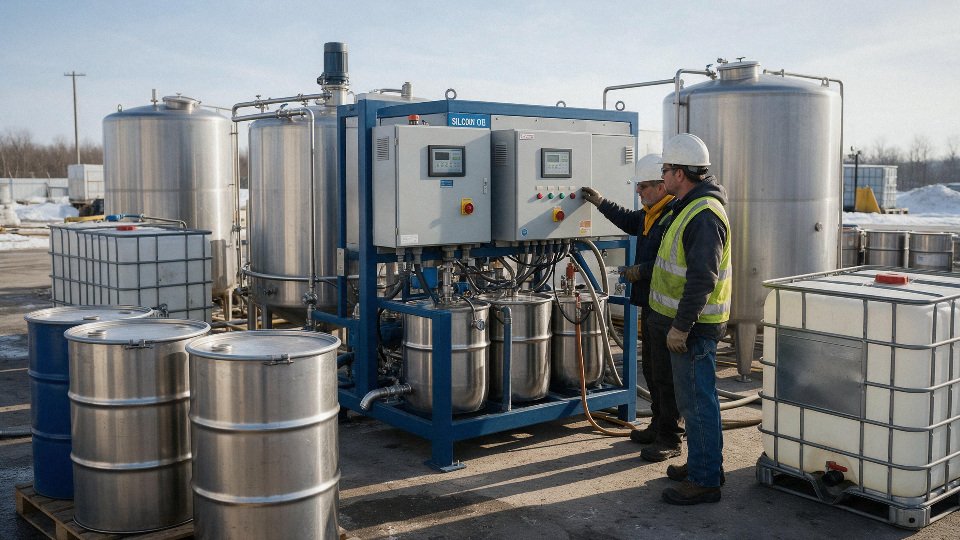
Plan winter transport before booking the shipment
Route planning matters as much as warehouse temperature. A shipment may survive the factory dispatch condition and still fail at a rail yard, border crossing, or port stack.
Review these points before shipment:
– Lowest expected ambient on the full route, not just origin and destination
– Port dwell time and customs delay risk
– Container type and whether the load will sit exposed on deck, in yard storage, or in inland transfer
– Package mass and thermal inertia
– Requirement for immediate unloading on arrival
Heated containers or protective thermal packaging are justified when:
– Route minimum is near or below the product’s verified handling limit
– Customs or transshipment delays are common
– The consignee cannot warm and hold material before use
– The cargo is high-value enough that one rejected load costs more than the protective measure
This is where procurement sometimes underestimates risk. Saving freight on a standard container can be wiped out by demurrage, unloading failure, off-spec investigation, and production delay at destination.
Warm the product evenly, not aggressively
The safe objective is controlled temperature recovery through the full package cross-section. Fast, localized heating is what creates trouble: oxidation risk at hot spots, additive separation in some formulations, misleading viscosity readings, and occasionally container damage.
Preferred methods:
– Condition in a warm room with enough time for the core to recover
– Use thermostatically controlled drum heaters or warming cabinets
– For bulk systems, use properly designed heat tracing and insulated lines
– Apply moderate recirculation only after the product is warm enough for the pump’s viscosity window
Watch for these mistakes:
– Heating only the discharge valve area to “get it moving”
– Using steam tracing hot enough to create shell hot spots
– Assuming a clear sample from the top means the whole package has recovered
– Charging partially warmed material into a critical dosing or hydraulic system
The mechanism is straightforward: as temperature rises at the wall first, viscosity near the wall falls first, so flow begins there while the core stays thick. That gives a false sense of recovery. In metered systems, the result is erratic feed rate, trapped cold slugs, and sometimes filter differential pressure spikes after startup.
Inspect on receipt and set hold-release rules
For critical use, incoming winter loads should not go straight into production without a quick structured check.
Use a receiving checklist:
1. Verify lot number, product code, and traceability documents.
2. Record package condition and any evidence of prolonged cold exposure.
3. Inspect appearance:
– clarity or haze
– phase separation
– sediment or gel-like zones
– skinning or unusual surface structure
4. Check whether the material flows normally at the receiving temperature.
5. If the application is sensitive, compare viscosity against the expected range at a defined test temperature after equilibration.
6. Hold the lot if appearance or flow is abnormal until recovery steps are completed and acceptance criteria are met.
Hold-release criteria should be stricter for electronics, coating, release, or closed-system fluid applications than for less critical uses. If the grade normally appears slightly hazy, the benchmark has to be that grade’s normal condition, not a generic “clear liquid” rule.
Recovery after cold exposure
Do not declare a product damaged the moment it arrives thick, cloudy, or reluctant to pour. Some silicone oils and related formulations recover fully once brought back to a controlled temperature and allowed to equilibrate.
Recovery protocol:
1. Move the material to a controlled warm area.
2. Allow enough soak time for the package size; large drums and IBCs may need much longer than the outside temperature suggests.
3. Reinspect appearance after the full package has equilibrated.
4. If the product is approved for it, use gentle homogenization or slow mixing.
5. Recheck viscosity or other release tests at the specified temperature.
6. Escalate to supplier review only if abnormal appearance or properties persist after verified recovery.
The boundary here is formulation-specific: straight silicone fluids often recover cleanly, while emulsions, filled systems, or specialty modified products may not fully reverse a cold-induced separation without controlled remixing, and some should not be remixed blindly at all. Before shipping into sub-zero conditions, confirm the grade’s low-temperature handling method, recovery time, and acceptance test with the supplier rather than leaving that decision to the warehouse on a Friday night.
Selection and specification
A silicone oil should be selected around the coldest temperature at which the system must still start, circulate, wet, damp, insulate, or release properly, not around the most impressive pour point on a sales sheet. In practice, buyers get into trouble when they specify only a low-temperature headline value and skip the viscosity-at-temperature requirement, the hardware geometry, and the recovery behavior after cold soak.
Start with the duty, not the chemistry name. Two plants can both say they need “low-temperature silicone oil” and mean completely different things. One may need a bulk tank to remain pumpable after sitting outdoors overnight at -20 C. Another needs a small damper to deliver the same response time at -40 C after a six-hour cold soak. Those are different selection problems.
Define the service envelope before asking for a quote
Use a short operating definition that forces the commercial discussion onto measurable ground:
- Minimum startup temperature
- The lowest actual equipment or ambient temperature at which the oil must function immediately.
- This matters more than average winter ambient. Outdoor skids, truck unloading points, unheated mezzanines, and remote instrument housings often run colder than the official site temperature.
- If startup follows a cold soak, state the soak duration. Viscosity after 30 minutes in a cold room and after 24 hours outside are not always equivalent from a handling standpoint.
- Continuous operating range
- State the normal low end, normal high end, and any short-duration excursions.
- A fluid selected only for cold flow can become a poor choice if it spends most of its life hot and oxidizing. That trade-off shows up later as drift, deposits, volatility loss, or shortened service life.
- Required viscosity at service temperature
- This is usually the controlling parameter.
- Pumpability, metering accuracy, film thickness, damping coefficient, bubble release, and spray pattern all depend on viscosity at the actual service temperature, not just on room-temperature viscosity.
- Ask for the viscosity-temperature curve or enough measured points to judge the curve shape. A product that is acceptable at 25 C can become several times thicker, or much more, as temperature falls.
- Equipment geometry
- Include pipe size, hose length, orifice size, valve type, pump type, filter rating, and reservoir layout where relevant.
- A silicone oil that will gravity-feed through a short 1 in line may not pass a fine metering valve or a small suction strainer at the same temperature.
- Dead legs, narrow clearances, long suction runs, and cheap quick-connects are where “it looked fine in the drum” turns into a startup delay.
- Response-time needs
- For dampers, controls, dispensing, and coating, say how fast the system must react after cold exposure.
- If the process cannot wait for self-warming, that needs to be written into the requirement. Some oils are technically still fluid but too sluggish for the intended cycle time.
That last point is where many specifications break. Pour point tells you roughly where bulk flow stops under a defined test method. It does not tell you whether a dosing pump will prime, whether a dashpot will return on time, or whether a release coating line will level properly at the line speed you need.
Request the data set that actually predicts field behavior
Do not accept a single-page datasheet with one viscosity number and a pour point if low-temperature service matters. Ask for the following, and ask whether values are typical, specification limits, or development data.
| Data item | Why it matters in cold service | What to verify |
|---|---|---|
| Viscosity-temperature curve | Predicts pumpability, metering, damping, wetting | Measured points across your expected temperature range |
| Pour point | Flags approximate low-end mobility limit | Test method used and whether it is batch-spec or typical |
| Appearance after cold soak | Catches haze, phase separation, wax-like behavior, gel structure, crystallization tendencies in some formulations | Soak temperature, soak time, and recovery observation |
| Density | Affects level measurement, mass balance, and some dosing calculations | Temperature basis |
| Volatility / weight loss | Relevant if the fluid also sees elevated temperatures | Test conditions and duration |
| Dielectric properties | Needed for electrical insulation uses | Temperature dependence if available |
| Lubricity / friction behavior | Needed for lubrication and damping uses | Application-specific test basis |
| Compatibility data | Seals, plastics, coatings, elastomers, adhesives, and process chemicals | Exact material pairings, not generic statements |
If the supplier cannot provide a full viscosity-temperature profile, ask for measured viscosity at your key temperatures, for example 25 C, 0 C, -20 C, and the lowest expected startup condition. That is still far better than buying on nominal viscosity grade alone.
The lowest pour point should always be the main buying criterion for silicone oil used in cold climates.False
A very low pour point helps only if the fluid still meets viscosity, compatibility, oxidation stability, and functional performance requirements at both low and normal operating temperatures. Many applications fail because the oil remains technically fluid but becomes too viscous, too volatile, or less compatible with materials in the system.
Match the chemistry to the use case
The right silicone oil family depends on what the oil is supposed to do besides surviving the cold.
Heat transfer
Cold-start circulation and hot-end stability pull in opposite directions. You need low enough viscosity at startup to avoid cavitation and poor circulation, but you also need acceptable volatility and oxidation behavior at operating temperature. If the loop runs hot for long periods, the “best cold number” may not be the best lifecycle choice.
Damping and instrumentation
Here, low-temperature viscosity control usually matters more than headline pour point. Damping torque, return speed, and signal lag can drift badly if the fluid thickens too much. Ask for application-relevant viscosity points and, if possible, a small functional trial in the actual damper or actuator geometry.
Dielectric insulation
Cold flow is only one part of the requirement. Dielectric performance, moisture sensitivity in the overall system, seal compatibility, and long-term cleanliness matter just as much. Verify current supplier documentation for electrical properties rather than assuming all silicone oils behave the same.
Release agents, textile treatment, and process aids
These uses often involve emulsions, blends, or modified silicones rather than a neat polydimethylsiloxane fluid. Low-temperature issues can include separation, haze, unstable spray behavior, or poor substrate wetting after recovery. In these cases, appearance after cold soak and re-homogenization behavior can be more valuable than the neat-fluid pour point.
Antifoam and specialty formulations
Antifoams are a common trap. The active silicone component may tolerate low temperature well, but the finished formulation can still separate or lose dispersibility. For these products, the procurement spec should require a cold-soak appearance check and a post-recovery performance check in the actual process medium if foaming control is critical.
Personal care intermediates and specialty modified silicones
These are highly formulation-dependent. Low-temperature behavior can change with molecular structure, solvent content, or functional modification. Do not generalize from standard silicone fluid data; request product-specific handling limits and stability observations.
The boundary here is simple: once the product is a formulated system rather than a neat base fluid, category-level assumptions get weak fast. At that point, sample evaluation under your own storage and use conditions is worth the time.
Write packaging and logistics requirements into the purchase order
If winter exposure is a realistic risk, the procurement document should say so explicitly.
Include items such as:
- Permitted transport temperature window
- State the expected ambient minimum during shipment and storage.
- Heated shipment requirement, if needed
- Only where justified by the product and route. Not every shipment needs it, but some do.
- Maximum outdoor dwell time
- Particularly for drums, totes, and containers waiting at customs yards, loading docks, or contractor laydown areas.
- Approved package size and material
- Smaller packages warm and recover faster; large totes hold cold much longer. That affects receiving plans.
- Arrival acceptance checks
- Appearance, sample draw condition, pumpability or pourability at receiving temperature, and any agreed recovery period before rejection.
- Be careful here: a cold, temporary viscosity increase is not the same as irreversible damage. The acceptance test should distinguish between the two.
- Required supplier pre-shipment confirmation
- Product-specific low-temperature handling guidance, recovery time, and test method, especially when shipping below the expected ambient minimum.
A practical note from the floor: if a tote arrives half-slushy-looking and the receiving crew has no agreed hold-and-recover procedure, someone will either reject good product or force bad product into the process. Both happen.
Assess supplier capability beyond the datasheet
A decent datasheet is necessary; it is not enough. For low-temperature performance, supplier execution matters because small formulation shifts or broad batch variation can show up first in cold handling.
Check these points:
- Batch-to-batch consistency
- Ask what properties are controlled routinely and what tolerance band is realistic.
- Analytical support
- Can the supplier help interpret cold-soak behavior, viscosity drift, or appearance changes, or do they only resend the standard TDS?
- Custom low-temperature optimization
- Useful when a standard grade almost fits but misses on startup viscosity, compatibility, or process response.
- Documented export and winter-shipping experience
- Especially if your route includes long sea transit, inland storage, or customs delays in cold regions.
- Problem-response discipline
- Ask how nonconformance, retained samples, and shipment-condition disputes are handled.
The commercial mistake I see often is choosing the product with the lowest advertised pour point and the lowest price per kilogram, then discovering it complicates seals, raises hot-end losses, or misses the process window at normal temperature. A better specification balances cold mobility with the full duty cycle, the hardware, and the cost of being wrong: startup delays, scrap, heater retrofits, and emergency requalification usually cost more than the initial fluid delta.
Application-specific tradeoffs
A silicone oil that looks excellent on a low-temperature data sheet can still be the wrong choice once you account for pumping, signal stability, electrical cleanliness, substrate wetting, or formulation behavior after a cold soak. Cold performance has to be judged in the actual duty: moving heat, transmitting motion, insulating live parts, laying down a uniform film, or surviving a freeze-thaw cycle inside a water-based product.
Heat-transfer systems
For heat-transfer loops, low pour point matters, but startup viscosity often matters more in practice. A fluid can remain technically pourable well below ambient and still be so viscous at startup that centrifugal pumps lose NPSH margin, suction strainers load up, and relief valves chatter before the loop warms through.
A few decision points usually separate workable systems from winter headaches:
- Startup viscosity versus pump type
- Centrifugal pumps are the first place cold viscosity shows up.
- As viscosity rises, internal losses increase, flow falls off, and available NPSH shrinks because suction-side pressure drop climbs.
- Positive displacement pumps tolerate cold startup better, but they can push a partially mobilized fluid hard enough to expose weak gaskets, small-bore tubing, or bypass settings that were never checked for cold oil.
- Venting and gas release
- Cold, viscous silicone fluids release entrained air more slowly.
- That shows up as sluggish venting at high points, erratic level readings, and a pump that sounds cavitated even when the tank level looks fine.
- Long horizontal runs and dead legs make this worse. Plants often blame the pump first; the actual issue is air staying suspended because the fluid is thick and circulation is still weak.
- Oxidation control versus low-temperature fluidity
- Lower-viscosity grades usually help cold startup, but that choice can tighten the thermal margin at the hot end depending on the fluid family and operating temperature.
- In closed or semi-closed heat-transfer service, oxidation control still depends on bulk temperature, film temperature at heater surfaces, air ingress, and residence time in hot zones.
- If the system runs near the upper limit of a given silicone fluid, choosing a thinner grade only for winter startup may trade one problem for another: easier morning circulation, but shorter fluid life, more volatile loss, or varnish-like deposits in hot sections.
The preferred choice flips when minimum ambient is severe but operating temperature is modest. In that case, a lower-viscosity silicone fluid often wins because startup reliability dominates. If the loop runs hot for long periods, the cold-side gain has to be balanced against oxidation stability, vent design, insulation, heat tracing, and startup procedure rather than solved by viscosity alone.
Damping and instrument fluids
In damping service, the issue is not “does it freeze?” but “does it still transmit the intended resistance consistently after a cold soak?” Silicone oils are widely used because they can keep damping behavior usable over a broad temperature range, but cold viscosity rise still changes torque, response time, and repeatability.
What engineers should check:
- Torque consistency
- In dashpots, rotary dampers, and gauges, higher low-temperature viscosity increases resisting force.
- That can improve overshoot control in one condition and make the device feel sticky or slow in another.
- Signal lag
- Instruments filled or damped with silicone fluid can show delayed pointer or sensor response after cold exposure.
- In control loops, that delay can look like process instability when the actual cause is a temperature-shifted damping medium.
- Repeatability after cycling
- A fluid may recover flow after warming, yet still show temporary drift if bubbles, micro-phase separation, or seal drag were introduced during the cold period.
- Bench testing should include cold soak, actuation at temperature, and recovery after return to room temperature, not just a single low-temperature viscosity number.
A low pour point by itself is enough to predict good damping performance in cold instruments.False
Damping depends on viscosity-temperature behavior, air release, device geometry, seal friction, and response tolerance. Pour point only indicates one aspect of low-temperature mobility.
Dielectric and electrical uses
For dielectric duty, silicone oil is often chosen because it can combine thermal stability, electrical insulation, and workable low-temperature flow. The weak point is usually not the base fluid turning solid. It is moisture, contamination, or handling damage introduced when the system is cold.
Key considerations:
- Insulation reliability
- Electrical performance depends on cleanliness, moisture level, dissolved gases, and system design, not just fluid identity.
- In transformers, sensors, and filled housings, colder conditions can slow bubble release and make filling or topping up less reliable.
- Moisture control
- Condensation during cold storage and warm-room transfer is a practical failure path.
- Drums opened below dew point conditions can pull in moisture, especially if headspace management is poor.
- Low-temperature handling
- Filling small cavities, narrow passages, or potted assemblies gets harder as viscosity rises.
- Voids that might self-heal at warmer temperatures can persist long enough to affect dielectric performance or sensor accuracy.
For electrical assemblies, the conclusion stops holding if the process controls are poor. Even an otherwise suitable silicone insulating fluid will underperform if drying, degassing, and fill procedures are not matched to cold handling conditions.
Release, lubrication, and process-aid uses
On cold substrates, silicone oil performance often shifts from bulk flow to surface behavior. A release or lubricating fluid may still pour, yet fail to wet uniformly, spread too slowly, or transfer unevenly because the substrate is cold, condensed, roughened by frost, or carrying residual process soil.
Common plant-floor effects include:
- Film non-uniformity on chilled molds, rolls, or packaging webs
- Poor wetting on low-energy or contaminated surfaces
- Excess carryover when viscosity rises and metering systems do not compensate
- Contamination sensitivity where downstream painting, printing, bonding, or coating is intolerant to even trace silicone transfer
This is where buyers get caught. A heavier film may seem helpful in winter because operators can “see it working,” but the cost often shows up later as fisheyes, adhesion loss, or product cleaning trouble downstream.
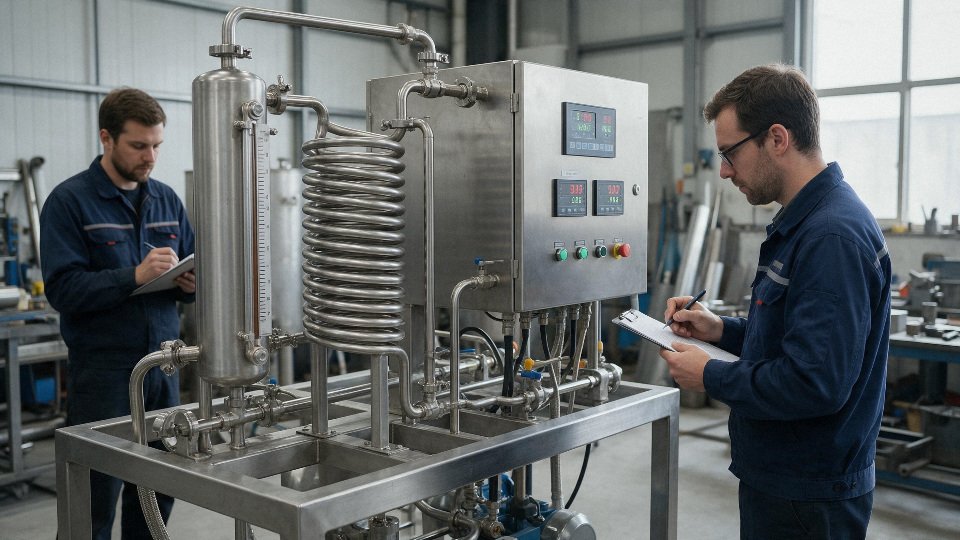
Antifoam and formulation uses
In antifoams and formulated systems, low-temperature behavior is usually governed by the whole package, not the silicone active alone. A silicone antifoam can retain its own fluidity at low temperature while the water-based emulsion carrying it breaks, creams, or loses active release after freeze-thaw exposure.
Checks that matter most:
- Emulsion stability after cold storage
- Active silicone release from the carrier
- Particle or droplet size shift after freeze-thaw
- Recovery after remixing
- Dose-response versus fresh material
Once a water-based system freezes, no universal recovery rule applies. Some products can be restored by controlled thawing and agitation; others lose defoaming efficiency permanently. That has to be verified on the specific formulation and packaging size before winter shipment.
Personal care, textile, and specialty modified silicone intermediates
For these uses, the low-temperature question is often less about pumpability and more about whether the intended sensory or surface effect comes back the same way after cold exposure. Modified silicones, blends, and formulated intermediates may recover apparent flow after warming but still show changed hand feel, gloss, spread, slip, or compatibility.
Typical concerns include:
- delayed clarity recovery
- temporary haze or phase shift
- changed deposition on fiber or fabric
- altered emulsion behavior in finishing baths
- sensory drift in personal care bases even when viscosity seems back to normal
That gap between rheological recovery and performance recovery catches people off guard. If the application is appearance-sensitive or touch-sensitive, the right acceptance test is the finished-use effect after cold exposure, not just whether the material pours again.
Frequently asked questions
Can silicone oil freeze solid in a freezer or winter outdoor storage?
Yes, some silicone oils can lose flow badly enough to look “frozen” in a freezer or outdoor winter storage, but that does not mean every grade turns into a hard solid like water. In practice, most common silicone oils first become much thicker, then may show waxy, gel-like, or non-pourable behavior as temperature drops; the exact point depends on polymer type, viscosity grade, additives, and how long the product stays cold.
A few plant-floor cautions matter here:
- A drum left overnight at subzero temperature may be non-pumpable in the morning even if the product’s nominal pour point is lower.
- Bulk containers cool unevenly; the wall area can stiffen first while the core still moves.
- Outdoor storage performance also depends on dwell time, not just the night’s lowest air temperature.
At what temperature does 100 cSt, 350 cSt, or 1000 cSt silicone oil stop flowing?
There is no single responsible number by viscosity grade alone. A 100 cSt dimethyl silicone oil usually stays mobile at lower temperatures than a 1000 cSt version, but actual no-flow behavior depends on chemistry, pour point test method, thermal history, and whether you mean “will pour from a bottle,” “can be pumped through a line,” or “can maintain design flow through a seal circuit.”
Use these as decision rules instead of false universal temperatures:
- 100 cSt: often remains usable deeper into subzero service than higher-viscosity grades, but still may show a several-fold viscosity increase well before pour point.
- 350 cSt: commonly workable in moderate cold storage, but transfer rates can fall off sharply as temperature approaches the product’s low-temperature limit.
- 1000 cSt: most likely to become operationally non-pourable first, especially in narrow suction lines, drum pumps, and unheated tote discharge setups.
If you need an estimate, the supplier needs:
– Product chemistry or exact grade
– Expected minimum temperature
– Container size
– Whether the concern is pouring, pumping, metering, or startup torque
Does silicone oil recover fully after warming, or can cold exposure permanently damage it?
Pure silicone oil often recovers after warming if the issue was only reversible viscosity rise. The exception is when cold exposure causes phase separation in a compounded product, moisture-related contamination, additive dropout, or handling damage such as aggressive reheating that creates local overheating.
Check recovery this way:
- Warm the material gradually to the supplier’s recommended handling range.
- Mix gently if the product data allows it.
- Inspect for persistent haze, sediment, separated layers, or gel particles.
- Recheck viscosity, appearance, and any application-critical property before release to production.
Any silicone oil that thickens in the cold is permanently damaged.False
For many neat silicone oils, low-temperature thickening is reversible after controlled warming. Permanent damage risk rises with emulsions, compounded fluids, contamination, or phase instability, not from viscosity increase alone.
Is phenyl silicone oil better than dimethyl silicone oil for low-temperature service?
Often yes, but not automatically. Phenyl-modified silicone fluids are commonly selected when a broader temperature window is needed, especially where low-temperature fluidity must coexist with high-temperature stability; still, the preferred choice flips if cost, compatibility, dielectric behavior, oxidation profile, or application-specific approvals matter more than cold performance alone.
You still need to verify:
– Exact phenyl content
– Target viscosity
– Compatibility with elastomers and system materials
– Product-specific low-temperature test data
Can silicone oil be used below -40 C in pumps, seals, or heat-transfer systems?
Sometimes, but below -40 C the question becomes equipment-specific very quickly. The oil may still be technically fluid while the system is already in trouble from suction losses, sluggish seal response, cavitation, heater control lag, or startup overload.
Before approving service below -40 C, verify:
- Minimum startup temperature versus continuous operating temperature
- Line size and suction geometry
- Pump type and available NPSH margin
- Seal clearances and response time
- Heat-transfer loop circulation requirements
- Recovery time after cold soak
How should cloudy or thickened silicone oil be tested before use?
- Bring a retained sample and the affected batch to a controlled warm temperature.
- Hold long enough for full thermal equalization; large drums take time.
- Visually inspect for:
- haze
- phase separation
- sediment
- stringy gel or insoluble matter
- Measure viscosity against the product specification.
- If relevant, check density, refractive appearance, dielectric properties, or application-specific performance.
- If the product is for critical service, run a bench trial before releasing the lot.
What is the difference between pour point and usable operating temperature?
Pour point is a lab indicator of the lowest temperature at which the fluid still shows movement under a defined test condition. Usable operating temperature is the lower limit at which the fluid still performs the job in your actual system, which may be much higher because pumps, valves, metering heads, film formation, and response time all fail before the lab pour point is reached.
Do silicone emulsions and antifoams tolerate freeze-thaw cycles the same way as pure silicone oil?
No. Emulsions and many antifoam products are usually much less tolerant of freeze-thaw exposure than neat silicone oil because the water phase, surfactant balance, and dispersed droplet structure can break irreversibly. Always verify freeze-thaw stability, recovery procedure, and shipment limits from the specific product documentation before winter transport or outdoor storage.
Verify your low-temperature fit
A silicone oil is a workable low-temperature choice only if it stays pumpable, measurable, and recoverable inside your actual startup and transport conditions, not just on a catalog pour-point line. For critical service, the decision should be based on a short verification package: product data, application details, and at least one condition-specific cold test that matches how the fluid is really handled.
Start with a plain checklist. If one of these items is unknown, the low-temperature decision is still soft.
- Lowest expected ambient temperature
Include warehouse, outdoor pipe rack, truck transit, port dwell, and unheated shutdown periods. The coldest hour often matters more than the average winter temperature. Actual startup temperature
This is the temperature at which the pump, valve, metering skid, or coated part first sees the fluid. A tank may be at 5 C while a suction leg near an exterior wall is still below 0 C.Target viscosity window
Define the acceptable operating range for your equipment, not just the nominal viscosity grade. Gear pumps, needle valves, spray nozzles, and dosing heads all tolerate viscosity rise differently.Equipment type
Note pump type, line diameter, filter mesh, seal material, reservoir geometry, and whether there is tracing or jacket heat. In practice, a short diaphragm-pump transfer line can survive cold thickening that would stall a long suction run on a small gear pump.Package size
A 200 L drum, 1000 L IBC, and small pail do not cool and recover the same way. Large packages hold cold longer, and warming time becomes part of the operating risk.Transport route
Include winter lanes, border delays, sea freight exposure, and whether the shipment sits on the trailer over a weekend. The route can matter as much as the product.
Catalog data comes next, but it needs to be read against process risk. A published pour point may tell you the fluid does not fully lose flow under one test method; it does not tell you whether your line will prime after a 36-hour cold soak. Dwell time, dead legs, long small-bore tubing, intermittent operation, and coarse versus fine filtration all shift the result. The same is true if the product is not a neat silicone fluid. Blends and emulsions can introduce phase stability or freeze-thaw issues that do not show up in a simple base-fluid comparison.
Use lab validation when failure would mean downtime, scrap, or a safety issue. The useful set is usually straightforward:
- Cold soak test at the expected minimum and at the startup temperature
- Viscosity-temperature measurement across the actual operating range
- Freeze-thaw cycling for blends or emulsions
- Compatibility screening with seals, hoses, coatings, and container liners
- Field simulation using the real pump, line length, or dispensing setup if the margin is tight
Ask the supplier for the documents that support a purchase decision, not just a sales grade name:
- TDS with the relevant low-temperature properties and test methods
- COA for the supplied batch
- Batch consistency information if your process is viscosity-sensitive
- Recommended warming method and recovery handling
- Storage guidance for winter conditions and post-cold equilibration time
A low pour point by itself does not prove cold-start suitability in a specific plant system.True
Cold-start performance depends on viscosity rise, soak time, package size, line geometry, pump type, and formulation type. Those factors must be checked against the actual application.
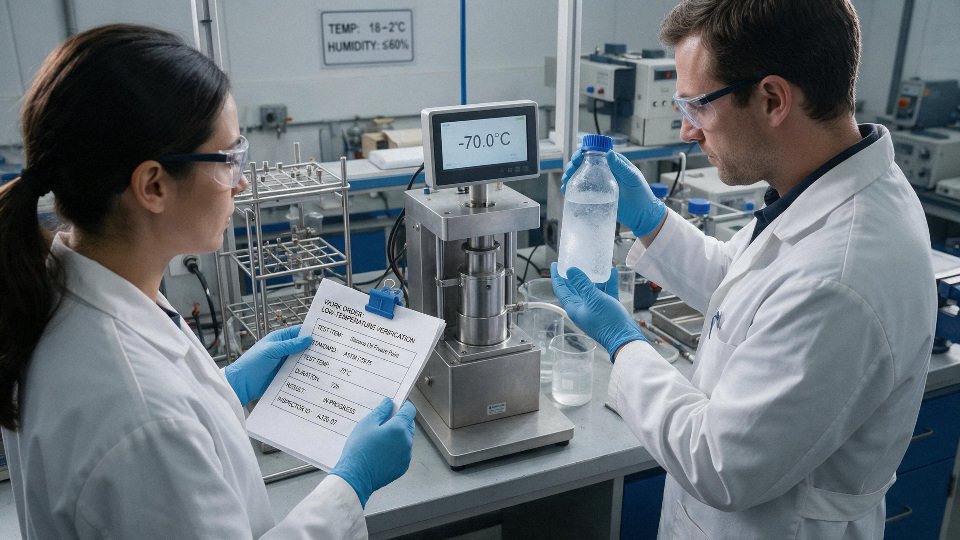
For critical low-temperature applications, send SiliconChemicals your service temperatures, viscosity targets, substrate or process details, equipment type, package size, and transport conditions. With that information, they can support product matching, review the specification against your operating window, and recommend samples for confirmation testing.