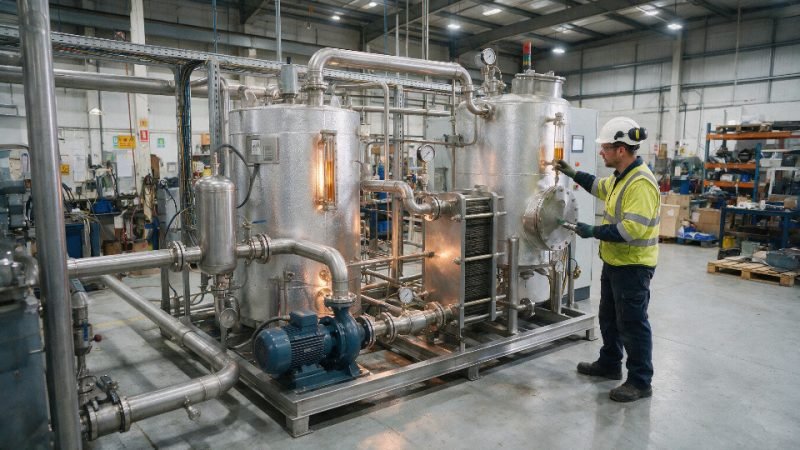
Silicone oil usually stays fluid and useful well past the point where many mineral oils are already smoking, but heat still changes it. Push the temperature too far, hold it there too long, or expose it to the wrong atmosphere and you start seeing viscosity drift, volatilization losses, deposits, odor, seal issues, and in some systems unstable heat-transfer performance. That turns into scrap, unplanned cleaning, shortened fluid life, and arguments between production, maintenance, and purchasing about whether the fluid was wrong, the heater was oversized, or the process was simply being run outside its window.
When silicone oil is heated, it generally maintains stable viscosity and oxidation resistance better than many conventional oils, but above its practical continuous-use range it can gradually oxidize, volatilize, or degrade. For many PDMS silicone oils, continuous operation is often around 150-200 C in air, sometimes higher under inert conditions, while flash point, often above 250 C, should not be treated as the safe operating limit.
The useful question is not whether silicone oil can take heat, but what kind of heat exposure it is seeing in your plant. A bulk tank at 180 C, a heater skin running much hotter than the setpoint, and a thin film on a vented roll coater do not age the fluid in the same way, even if the same grade is on the purchase order.
Molecular changes under heat
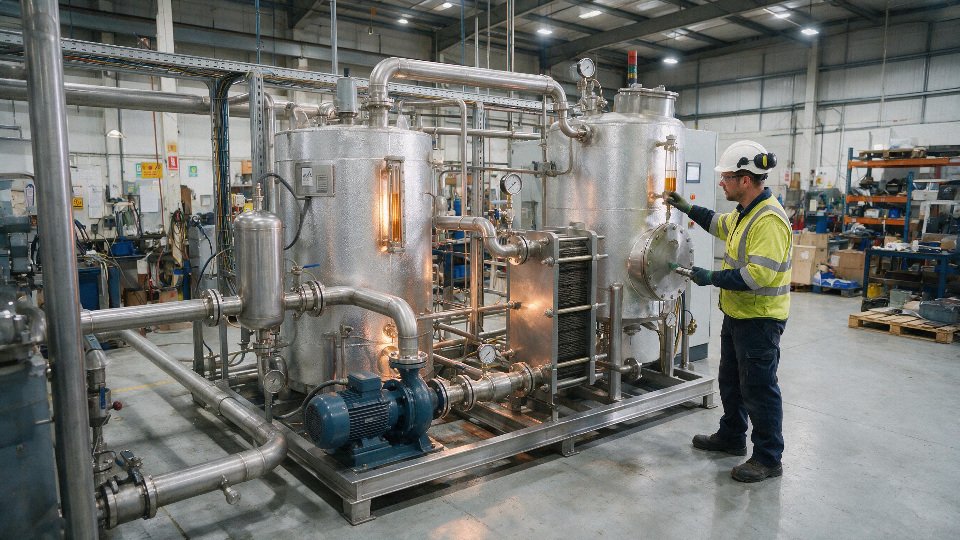
Silicone oil changes under heat in two layers at once: its physical behavior shifts immediately, while its chemistry usually changes more slowly and only becomes obvious after enough temperature, oxygen exposure, residence time, or contamination. That is why a PDMS fluid can look perfectly usable in the first hours of service, yet weeks later show viscosity drift, volatility loss, varnish, gel particles, or pressure-control instability.
At the molecular level, most industrial silicone oils are built on a siloxane backbone, repeating Si-O-Si linkages with organic side groups, commonly methyl in PDMS grades. That structure is the reason silicone fluids do not behave like mineral oils or many synthetic hydrocarbons when heated.
Why the Si-O backbone behaves differently
The Si-O bond has a different geometry and bonding character from a C-C backbone in ordinary organic oils. In practice, that gives silicone oil a chain that is highly flexible in motion, with relatively low intermolecular attraction compared with many hydrocarbon fluids. The result is familiar on the plant floor: silicone oils often stay fluid across a wide temperature range, show a gentler viscosity-temperature curve than many alternatives, and keep moving in systems that would turn sluggish or waxy with hydrocarbon oils.
That does not mean the bond is “unbreakable.” It means the fluid resists thermal thickening, sludge formation, and outright cracking better than many organic fluids under comparable conditions, especially in clean systems and moderate oxygen exposure. Once you add hot air, long residence time, copper salts, acidic insulation debris, caustic wash carryover, or a badly chosen gasket compound, the advantage narrows fast.
A useful way to think about it is this:
- Backbone flexibility helps the fluid remain mobile as temperature changes.
- Low cohesive forces help explain low surface tension and distinct wetting behavior.
- Thermal stability is relative, not absolute; degradation kinetics are slower, not absent.
- Contamination sensitivity matters because catalytic surfaces or residues can shift the failure mechanism from slow oxidation to much faster depolymerization or gel formation.
A high flash point means silicone oil can be operated safely near that temperature for long periods.False
Flash point indicates vapor ignition behavior under a test method, not long-term thermal durability. Silicone oil can lose low molecular weight fractions, oxidize, or depolymerize at temperatures well below its flash point, depending on air exposure, residence time, and contamination.
What happens first: viscosity drops, mobility rises
As temperature rises, the first change is usually physical rather than chemical: viscosity falls. For silicone oils sold across grades from roughly 10 to 100,000 cSt at 25 C, the exact drop depends on molecular weight and formulation, but the direction is the same. Molecules move faster, internal friction decreases, and the fluid offers less resistance to shear.
That has several operating consequences:
- Pumps see less viscous drag, so cold-start load and pressure drop may improve.
- Seals may leak more easily if the system relied on higher viscosity to limit seepage.
- Damping falls, which matters in dashpots, instrument dampers, and some motion-control devices.
- Spray, mist, or carryover can increase in agitated or splashing systems because the fluid is thinner.
- Heat transfer changes because circulation may improve while film behavior at the heated wall also changes.
Wetting can shift too. Silicone oils already have low surface tension, and heating generally makes spreading easier. In coating or release applications that can be useful. In a closed thermal system, it can be a nuisance: the hot fluid creeps into threads, terminal boxes, porous insulation edges, and level gauge connections that stayed cleaner at lower temperature. Anyone who has chased a slow hot-oil leak around a sight glass knows this is not a theoretical point.
The trade-off is straightforward. Higher temperature often improves flow and startup response, but the same viscosity loss can reduce film thickness, lower damping, worsen leakage, and make metering less predictable. The preferred operating point flips when the process values mobility less than retention of hydraulic behavior or tight sealing.
Expansion, density change, and what that does to the system
Heating silicone oil also causes thermal expansion and a corresponding drop in density. The exact coefficient depends on the grade and temperature range, so it should be taken from the supplier’s current data for design work, not guessed from another PDMS product. Still, the practical pattern is consistent enough to plan around.
As the fluid warms:
- Tank and reservoir fill level rises
- Headspace shrinks
- Static head at the pump suction changes
- Overflow risk increases in poorly vented systems
- Level instruments can mislead operators if not temperature-compensated
- Expansion vessel sizing becomes critical in closed loops
This catches buyers more often than it should. A system filled “comfortably” at ambient can become badly overfilled once the oil reaches operating temperature. Then you see vent discharge, foaming into the headspace, or fluid pushed into places it should never go, like rupture-disc cavities or breather lines.
Pump behavior can shift as well. Lower density slightly changes mass flow at a given volumetric flow rate, and lower viscosity changes suction and internal leakage characteristics. Usually the bigger practical issue is not horsepower; it is control stability. A metering or recirculation loop that was trimmed at room temperature may overshoot once the oil thins out and the level swings from expansion.
This conclusion stops holding if the system is very small and lightly filled, or if expansion volume and control logic were already designed conservatively. In those cases, the density change is just a normal design input, not a chronic operating problem.
Why high-flash-point silicone oil can still lose mass
A common misunderstanding is that if a silicone oil has a flash point above 250 C, evaporation below that temperature must be negligible. In service, that is often wrong. Flash point is not a measure of long-term volatility loss.
Most commercial silicone oils contain a molecular weight distribution, not one perfectly uniform chain length. The lower molecular weight fraction is more volatile, and at elevated temperature those lighter species can evaporate from open surfaces, vented reservoirs, thin films, or systems with high air exchange. You may see:
- gradual mass loss in open baths
- viscosity increase in the remaining fluid as lighter fractions leave
- condensate on cool covers, ducting, or exhaust surfaces
- odor complaints or haze near hot open equipment
- drift in process consistency over long runs
Mechanistically, the fluid does not need to ignite to lose material. It only needs enough vapor pressure, enough exposed surface area, enough residence time, and somewhere for the vapor to go. A shallow hot tray, wiped film, or high-speed roll coater can lose measurable material where a sealed jacketed loop using the same fluid does not.
Oxidation in air: slower than many oils, still real
In air, prolonged heating can trigger oxidative degradation. The pathway is not always identical from one formulation or contamination condition to another, but in practice several changes are common:
- Chain scission reduces molecular integrity.
- Silanol formation can occur as oxidation and bond cleavage progress.
- Acidic oxidation by-products may appear in some systems, depending on chemistry and contaminants.
- Volatile fragments can be generated and lost.
- Deposits, varnish, or gel may form over time, especially at hot spots.
The mechanism matters because the failure seldom starts uniformly throughout the whole tank. It often starts at the hottest surface, in the thinnest film, or where air contact is strongest. A heater sheath, top layer near a vent, dead-leg bypass around an instrument tee, or residue on a hot wall can degrade first. Those early products then circulate and seed further issues: sticky valves, fouled level probes, darkening, filter loading, or soft gel specks that operators mistake for outside contamination.
Depolymerization and cyclic formation at higher temperature
At higher temperatures, another path becomes important: depolymerization. Instead of only oxidizing, the siloxane chains can rearrange or break into smaller cyclic siloxanes. This tends to accelerate when catalytic influences are present, especially:
- acidic surfaces or residues
- strong alkalis
- certain metal salts or process contaminants
- poorly neutralized cleaning chemicals
- degraded elastomers, sealants, or insulation materials that introduce reactive species
This is one of those plant-floor problems that gets missed during procurement. The fluid is blamed, but the trigger is actually the system. A clean stainless loop and a contaminated carbon-steel vessel with alkaline carryover can give very different life from the same silicone oil at the same nominal temperature.
Once cyclics and lower molecular weight species increase, volatility rises and fluid properties drift. In severe cases, you can see simultaneous symptoms that confuse maintenance teams: some material is evaporating away while the bulk fluid elsewhere is forming gel or deposits. That is not contradictory. It is two degradation pathways happening in parallel in different parts of the system.
So when silicone oil is described as thermally stable, read that as “degrades more slowly than many alternatives under the same conditions,” not “immune to heat.” The variables that usually decide service life are temperature profile, oxygen access, residence time at peak temperature, exposed surface area, and whether the system is chemically clean enough to avoid catalytic breakdown.
Property shifts with temperature
Silicone oil usually keeps its viscosity more stable with temperature than mineral oil or many organic fluids, but that does not mean its other properties stay put. As temperature rises, operators should expect a moving target across volatility, foam behavior, dielectric performance, and oxidation byproducts; the practical question is not whether the fluid changes, but which change becomes process-limiting first in your duty.
Viscosity shift: stable relative to many fluids, but still operationally significant
A relatively high viscosity index means silicone oil thins less sharply with temperature than many hydrocarbon oils. That helps where process consistency matters, but it does not eliminate the need to size pumps, clearances, damping curves, and film thickness for the hottest part of the cycle rather than the ambient startup condition.
In practice, the viscosity-temperature profile affects several different jobs:
- Process control fluids
- In thermostatic baths, metering loops, and temperature-control skids, a flatter viscosity curve helps keep circulation behavior more predictable across a wide temperature band.
- Pump differential pressure still drops as the oil heats, so valve settings that look fine at 25 C may overcirculate at 140 C.
- Damping and dashpot service
- Silicone oil is often chosen because damping force changes less dramatically with temperature.
- The trade-off is that if the grade is selected too low, the device can become underdamped at the top end anyway; if selected too high, cold-start response can be sluggish or delayed.
- Lubrication and release interfaces
- Lower viscosity at elevated temperature reduces drag, but it also reduces film thickness.
- Where the oil is expected to maintain separation between moving surfaces, the limiting condition is often the hottest local contact, not the sump average temperature.
The mechanism is straightforward: as temperature rises, molecular mobility increases and internal resistance to flow falls. Silicone oils resist that drop better than many alternatives because of their molecular structure, but they still thin. In a lightly loaded instrument this is a benefit. In a loaded sliding contact, the same change can move the surface from full-film toward mixed lubrication.
The boundary on that advantage is important: a high viscosity index helps most where the duty is dominated by flow consistency or damping stability. It helps much less if the main failure mode is evaporation, oxidation, contamination, or boundary wear.
Volatility, vapor pressure, and evaporation loss
Evaporation loss matters far earlier than ignition in many plants. At elevated temperature, lighter fractions in the molecular weight distribution contribute disproportionately to vapor loss, so two silicone oils with similar nominal viscosity can behave differently in an open bath, vented reservoir, or thin-film application.
What typically drives loss rate:
- Temperature
- Vapor pressure rises strongly with temperature.
- A fluid that looks stable at 120 C may show noticeable mass loss at 180 C, especially in open systems.
- Molecular weight distribution
- Lower-viscosity grades generally contain more low-molecular-weight components and tend to show higher volatility.
- Broader distributions can increase early evaporation because the light end leaves first.
- Exposure geometry
- Thin films, wiped surfaces, and splash zones lose more than a sealed bulk reservoir.
- Agitation and airflow across the surface make a visible difference.
- Atmosphere
- Dry inert conditions usually reduce oxidative aging, but they do not eliminate physical evaporation.
- In air, evaporation and oxidation often proceed together and are easy to confuse in the field.
For buyers, this is where nominal viscosity grade alone is not enough. If evaporation loss is critical, ask for the supplier’s volatility data under defined conditions, not just a cSt number at 25 C.
Flash point, fire point, and autoignition: useful safety data, poor service-temperature guides
Many silicone oils have flash points above 250 C, depending on grade, but that figure is often misused on purchase specs and operating permits. Flash point is not a recommended continuous-use temperature. It only indicates the approximate temperature at which vapors can ignite momentarily under the test method.
The distinctions matter:
| Property | What it indicates | What it does not tell you |
|---|---|---|
| Flash point | Vapor can ignite briefly in the test setup | Long-term thermal stability or safe continuous operation |
| Fire point | Sustained burning becomes possible | Oxidation rate, residue formation, or equipment compatibility |
| Autoignition temperature | Self-ignition without external flame under defined conditions | Practical operating margin in a plant with hot spots and contamination |
Two plant-floor cautions come up often:
- A heater skin temperature can run well above bulk oil temperature, especially with scale, poor circulation, or partially exposed elements.
- Contamination changes risk. Solvents, carbonaceous residue, or process carryover can lower the effective safety margin.
So if the fluid runs in a heated vessel, oven circuit, or thermal loop, verify the actual heater surface temperature, not just the controller setpoint.
Heat transfer limits: usable, but not a top-tier heat-transfer fluid in every duty
Silicone oil can work as a heat transfer medium, particularly where chemical inertness or wide service range matters, but its thermal conductivity and specific heat are not automatically ideal for compact, high-flux duties. You often need higher flow or more exchange area to move the same heat compared with some dedicated heat-transfer fluids.
That has a direct commercial path:
- Lower thermal conductivity reduces how quickly heat moves through the fluid layer.
- Modest specific heat means each kilogram of fluid carries only so much energy per degree of temperature rise.
- To compensate, the system may need:
- more circulation,
- larger heat exchanger area,
- tighter control of fouling,
- lower allowable heater watt density.
This is one of those cases where a fluid can be thermally stable enough yet still be a weak choice for transfer efficiency. The preferred choice flips if your main priority is dielectric safety, material compatibility, or broad operating range rather than maximum heat-transfer coefficient.
Surface tension, spreading, and defoaming behavior at higher temperature
As temperature rises, surface tension generally falls, and silicone oil tends to spread more easily over liquid surfaces. In foam-control service, that can improve initial knockdown because the oil enters the foam lamella more readily and destabilizes it.
But the trade-off shows up quickly:
- Gain
- Faster spreading
- Better immediate foam rupture in some aqueous and nonaqueous systems
- Lower resistance to distribution across the surface
- Loss
- Higher volatility for lower-viscosity grades
- Reduced persistence on hot surfaces
- Greater risk of over-dosing side effects such as surface defects, fisheyes, or coating interference
In hot process tanks, operators sometimes compensate for declining persistence by feeding more antifoam. That can solve the symptom while creating downstream contamination problems. If foam control fades with temperature, first check whether the issue is evaporation, incompatibility, or thermal degradation before increasing dosage.
Dielectric drift under prolonged heat
In electrical and electronic service, silicone oil is valued for dielectric behavior, but prolonged heat exposure can shift performance gradually rather than catastrophically. The main issue is not usually a sudden collapse in a clean system; it is slow change caused by oxidation products, moisture ingress, ionic contamination, or suspended residue.
Watch for:
- rising dissipation factor,
- reduced dielectric strength,
- increased acidity or polar byproducts,
- discoloration that tracks oxidative aging,
- deposits on insulation surfaces or connectors.
The mechanism is indirect. Heat itself alters the fluid less dramatically than heat plus oxygen, trace metals, moisture, and contamination. A drum left open near a humid washdown area will age differently from the same grade in a sealed dry system.
Color, odor, and residue: early warning signs operators should not ignore
Aging silicone oil often announces itself before lab data arrives. Color darkening, burnt or sharp odor, haze, gum, varnish, or silica-like residue can all indicate that the fluid has spent too much time at temperature, seen local overheating, or picked up contaminants.
A practical inspection routine should include:
- Color trend
- Compare against retained fresh sample, not memory.
- Odor check
- A new odor often appears before viscosity shift becomes obvious.
- Residue on hot zones
- Inspect heaters, sight glasses, vent lines, and pump seals.
- Mass loss or refill frequency
- Rising top-up demand often points to volatility or leakage.
- Function drift
- Slower damping, weaker foam control, hotter bearings, unstable electrical readings.
These are not precise diagnostics by themselves. Still, they are often the first usable plant signal that the fluid is no longer operating inside its comfortable window and needs lab confirmation, root-cause review, or a grade change.
Atmosphere and contamination effects
The same silicone oil can run for a long time in one system and fail early in another because the atmosphere, cleanliness, and metallurgy often control the damage path more than the nominal bulk temperature does. In practice, oxidation in air, volatilization in vacuum, and catalyzed rearrangement from trace contaminants are the three plant-floor drivers that decide whether the fluid stays stable, smokes, thickens, or loses viscosity.
Atmosphere changes what “heated silicone oil” actually means. A PDMS fluid sitting quietly in a sealed, clean vessel is not under the same stress as that same fluid splashing through an open heated bath with air entrainment, pump shear, and old residues on the walls.
How air, nitrogen, vacuum, and closed systems change the outcome
| System condition | Main risk under heat | Typical effect on fluid behavior | What usually controls service life |
|---|---|---|---|
| Open to air | Oxidation plus loss of light fractions | Odor, haze, smoke, viscosity drift, deposits | Oxygen exposure, surface area, turnover rate, hot spots |
| Nitrogen blanketed | Lower oxidation, some volatilization still possible | Better color and odor stability, longer life | Purge quality, leak tightness, contaminant load |
| Vacuum | Strong volatilization/outgassing, less oxidation | Weight loss, foaming, pressure loading downstream | Vapor pressure of low-boiling components, residence time, condenser efficiency |
| Closed system | Lower evaporation losses, pressure can build | Apparent stability can hide contamination until symptoms escalate | Seal integrity, trapped air, internal residues, local overheating |
In air, silicone oil usually ages by a mixed mechanism: oxygen attacks vulnerable chain ends or impurities while heat drives off lighter fractions. The first symptom is often not catastrophic decomposition. It may be a faint smoke plume over a reservoir, a burnt odor near the vent, or a gradual shift in viscosity. Operators sometimes assume “the oil is burning,” but many times what they are actually seeing first is low-boiling material leaving the system, not wholesale base-fluid failure.
Nitrogen helps because it cuts the oxidation side of the problem. That does not make the system immune. If the blanket is poorly controlled, or the tank breathes during heat-up and cooldown, enough oxygen can still enter to matter over time. The gain is usually longer fluid life and cleaner surfaces, especially in systems with large headspace or intermittent operation.
Vacuum changes the failure picture completely. Oxidation drops, but volatilization can jump. Any low-molecular-weight siloxanes, residual solvent, cleaning-agent traces, or process carryover can flash off much earlier than people expect. That can show up as chamber haze, pump loading, condensate accumulation, or pressure instability. It is one reason a fluid that “looked fine” in an atmospheric beaker test behaves badly in a vacuum line.
Closed systems often get credited with protecting the fluid, and they can, but only if they are actually clean and tight. A closed loop with trapped air, poor venting, and hot stagnant zones can age oil faster than a well-managed open system. Once volatile contamination is trapped, pressure rise becomes part of the problem rather than a side effect.
Why small amounts of contamination cause disproportionate trouble
Silicone fluids are generally chemically tolerant, but they are not indifferent to contaminants. Some species do not just dilute the oil; they catalyze siloxane rearrangement, chain scission, or crosslinking.
Common high-impact contaminants include:
- Water
- Small amounts may be tolerated at moderate conditions.
- At elevated temperature, especially with catalytic species present, water can support hydrolysis/condensation pathways.
- The practical symptom is inconsistent viscosity behavior rather than one clean trend.
- Acids
- Acid residues from cleaning, process chemistry, or degraded upstream materials can accelerate siloxane rearrangement.
- Depending on the chemistry, the oil may either lose viscosity from chain cleavage or gain viscosity from condensation-type reactions.
- Alkalis
- Caustic contamination is a known problem in plants that share transfer lines or totes.
- Even trace basic residue can push redistribution reactions that alter viscosity grade and increase volatiles.
- Metal salts
- Salts from process carryover, corrosion products, or water contamination can behave as catalytic impurities.
- These tend to create erratic aging patterns that are hard to diagnose from bulk temperature alone.
- Reactive process chemicals
- Amines, peroxides, strong oxidants, chlorinated residues, and certain curing or crosslinking agents can all destabilize silicone fluids.
- The exact effect depends on concentration and temperature; this is where lab compatibility screening is worth the time.
The mechanism matters because it changes the symptom. Oxidation alone often shows up as deposits and odor over time. Catalytic rearrangement can change viscosity surprisingly fast with much less visible residue. That distinction matters for maintenance decisions: one case points toward atmosphere control, the other toward contamination tracing.
Metals and surfaces are not passive
Copper, iron, aluminum, and coated internals can all influence stability, especially when the surface is not truly clean. Bare metal is one issue; oxidized metal, machining residue, flux residue, or an old conversion coating is another.
A few shop-floor patterns show up repeatedly:
- Copper and copper alloys
- Heat-transfer hardware, brazed joints, and brass fittings can introduce catalytic effects if surfaces are active or contaminated.
- The problem is often worse where there is both heat and oxygen.
- Iron and steel
- Rust, mill scale, and corrosion fines can seed deposit formation and create localized degradation sites.
- A blackened reservoir wall is sometimes as much a contamination history issue as a fluid issue.
- Aluminum
- Usually manageable, but not automatically benign.
- Freshly machined aluminum, alkaline-cleaned surfaces, or residues from fabrication can change fluid behavior.
- Coated surfaces
- Paints, liners, release coatings, and sealants may extract into hot silicone oil or decompose at contact points.
- If a new skid starts smoking after commissioning, I would check coating compatibility before blaming the oil grade.
Flash point alone is not a valid predictor of safe continuous operating temperature for silicone oil in contaminated systems.True
Flash point is a fire-test property of a specific fluid under defined conditions. Early smoke, odor, volatility, pressure rise, or viscosity change in service often come from oxidation, low-boiling contamination, catalytic degradation, or local hot spots at temperatures well below the flash point.
Hidden contamination sources buyers and operators miss
These are the usual offenders when a system “mysteriously” destabilizes after startup or fluid change:
- Residual previous fluid
- Hydrocarbon heat-transfer oil, glycol, ester, or process oil left in low points can create mixed volatility and smoke.
- Cleaning agents
- Solvent traces, alkaline wash residues, and acidic descalers are frequent root causes after maintenance.
- Elastomer extractables
- Some seals, hoses, and bladders release plasticizers, curing byproducts, or additives into hot fluid.
- The issue is often worst in the first thermal cycle.
- Process carryover
- Monomers, resins, fines, catalyst residues, and reaction byproducts entering through a vented or shared system can shift behavior quickly.
- Packaging and transfer contamination
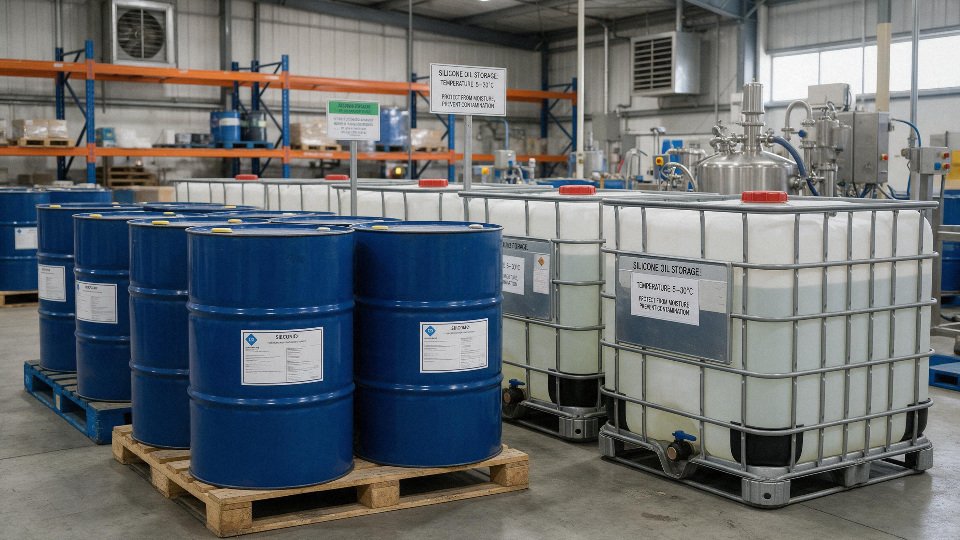
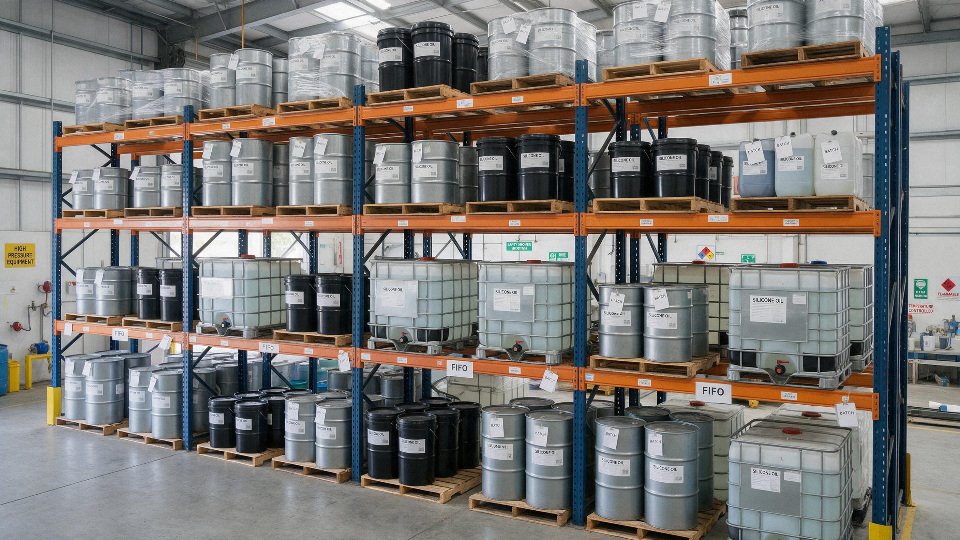
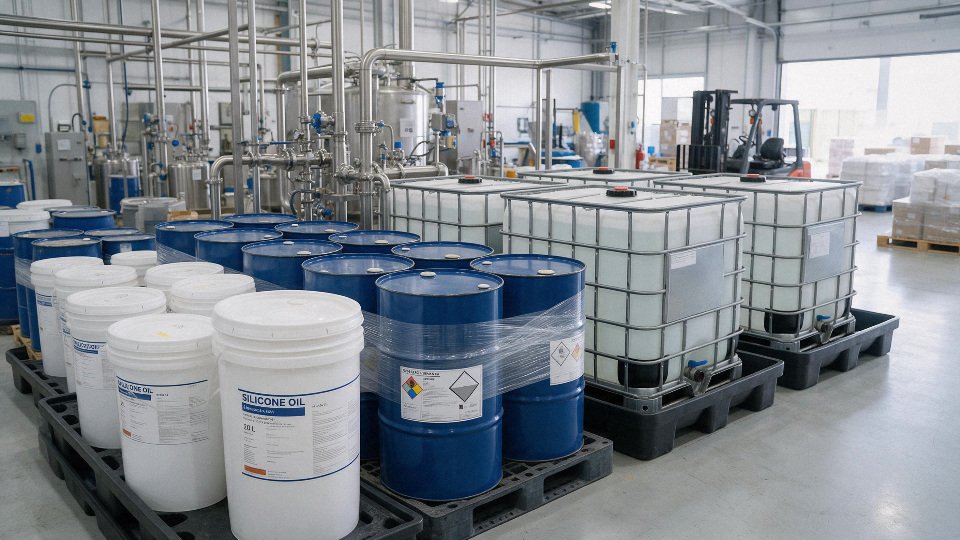
- Dirty drums, reused IBCs, transfer pumps with old product trapped behind seals, and unflushed hoses are classic procurement-to-operations handoff failures.
Why smoke, odor, or pressure rise may not mean the base fluid is failing
Trace low-boiling contamination has an outsized operational signature. A few tenths of a percent of residual solvent, cleaner, or low-molecular siloxane can produce visible smoke, odor, vacuum instability, or pressure rise long before the main silicone fluid has chemically broken down. That is why early troubleshooting should include headspace sampling, residue review, and contamination history, not just a temperature check.
Many reported “silicone oil thermal failures” are not single-cause events. They are usually stacked failures: a bit of oxygen ingress through a tired seal, some residual caustic from cleaning, a copper-containing hot zone, and one heater surface running hotter than the bulk sensor by an unknown margin. Once those mechanisms overlap, bulk fluid temperature stops being a reliable explanation by itself, and the fix is usually system-level, not just a new drum of oil.
Failure modes at high heat
At high temperature, silicone oil usually does not “fail” in one dramatic step; it drifts out of spec through a handful of recognizable modes. The practical ones are evaporation loss, oxidation-driven thickening, heat-driven chain scission, residue formation on hot surfaces, gas-handling problems in circulation loops, elastomer seal trouble, and contamination of the product or surrounding process by degraded fractions.
The pattern matters because the symptoms can point in opposite directions. One hot loop comes back thicker and sticky from oxidation in air; another comes back thinner and more volatile because the polymer chains have broken down or because lighter fractions have boiled off. If maintenance teams treat both as “old oil,” they often pick the wrong corrective action.
Evaporation loss in open or vented systems
Open tanks, vented reservoirs, wipe-coating pans, and any hot surface with a lot of exposed area will gradually lose the lower-molecular-weight fraction first. That pushes three things at once: total mass drops, vapor emissions rise, and the remaining fluid can drift in viscosity because the composition is no longer what was charged.
In practice, the rate is not a single catalog number. It depends on:
- Fluid grade and molecular-weight distribution
- Bulk temperature versus localized heater-sheath temperature
- Exposed surface area
- Air exchange rate or vent draw
- Residence time at temperature
- Whether contamination has created additional volatile byproducts
The mechanism is simple enough: as temperature rises, vapor pressure rises sharply, and the lighter fraction escapes first. In a closed or well-condensed system, some of that can be recovered; in an open process, it is just gone. Buyers sometimes focus on flash point here, which is the wrong control point. A fluid can have a flash point above 250 C and still lose mass steadily at much lower operating temperatures if it sits hot in air for long periods.
Typical symptoms are:
- Falling tank level without visible leaks
- More condensate or oily film around vents
- Changing coat weight or release performance
- Damping or lubricity becoming less consistent over a shift
- Odor or visible haze near hot open equipment
The trade-off is obvious but often ignored: open-system simplicity and lower capital cost usually mean higher fluid consumption and more process variability. Once the duty involves long hot holds or quality-sensitive deposition, that cost balance often flips toward enclosure, vapor capture, or a heavier grade.
Oxidative thickening and gel formation
If the oil sees air, hot metal surfaces, and long residence time, oxidation can dominate. The result is usually rising viscosity, darker fluid, tacky deposits, and in severe cases gel particles or stringy material that plugs filters and small orifices.
This failure mode is common in:
- Heat-transfer loops with poor expansion tank design
- Open kettles held hot between batches
- Slow-moving recirculation systems with dead legs
- Systems where copper, iron oxides, or other residues catalyze degradation
Oxygen attack creates new functional groups and can promote crosslinking between chains. Once that starts, viscosity increases nonlinearly; the last 10% of useful life often disappears faster than operators expect. Thickened oil also sheds heat worse at the boundary layer and circulates less effectively, so the fluid runs even hotter locally. That positive feedback is why a loop that looked acceptable for months can foul up quickly after one period of overheating.
If the hot fluid is exposed to air for long periods, oxidation usually becomes the dominant life-limiting mechanism before bulk ignition risk is even close.
Chain scission: the fluid gets thinner, not thicker
The opposite failure mode is thermal chain scission. Instead of building larger structures, the polymer backbone breaks into shorter chains. The oil then trends to lower viscosity, higher volatility, and poorer damping or lubricating consistency.
This is especially relevant when:
- Local heater surface temperatures run well above bulk temperature
- The system has hot spots from scale, poor flow, or partial dry-out
- The oil spends time in near-inert or oxygen-limited zones
- Mechanical shear and heat act together in tight clearances
People miss this because “degraded oil” is often assumed to be thicker. With chain scission, the shop-floor signs look different:
- The fluid feels noticeably lighter
- Consumption rises because more low-boiling material is generated
- Splashing, misting, or vapor carryover increases
- A damper or dashpot loses resistance at the same nominal temperature
- Wear can increase because the film no longer holds as intended
The boundary on this conclusion is important: not every low-viscosity sample has suffered chain scission. It may simply have been diluted, contaminated, or fractionated by preferential evaporation. You need used-oil analysis, process history, and sometimes residue inspection to separate those causes.
Sludge, varnish, and silica-like residue on hot surfaces
Once degraded fractions form, they rarely stay evenly dissolved forever. Hot heaters, piping elbows, vessel walls, and low-flow pockets collect varnish, carbonaceous residue, and in some cases silica-like deposits from advanced degradation.
That deposit layer causes trouble through a direct heat-transfer path:
- A thin foulant film increases thermal resistance.
- Heater sheath temperature rises to deliver the same duty.
- Hotter metal accelerates fluid degradation right at the wall.
- More degradation creates more deposit.
That loop is expensive. You lose temperature control, response time gets sloppy, and energy use climbs. The maintenance crew then sees overheating alarms or burned heater bundles and blames the element, when the fluid and cleanliness history were the upstream cause.
Foaming, microbubble retention, and cavitation trouble
Silicone oils are often chosen partly because they handle temperature better than mineral oils, but a hot recirculating loop can still develop gas-management problems. Entrained air, volatile breakdown products, and suction-side design issues can create persistent foam or fine bubbles that do not release quickly enough before the pump.
Watch for these operating signs:
- Noisy pumps, especially after startup or load changes
- Erratic flowmeter readings
- Reduced heat-transfer stability
- Visible foam in the reservoir or sight glass
- Pressure fluctuation on the suction side
- Pitting or vibration consistent with cavitation
The mechanism is a combination of lower viscosity at temperature, easier gas entrainment, and reduced pressure margin at the pump inlet. Once bubbles survive into the pump, local collapse damages surfaces and adds more instability to the system.
Seal and gasket failure as the fluid changes
Seals fail at high heat for two different reasons, and they get mixed up all the time.
- The elastomer itself is incompatible with the hot silicone fluid
- The fluid has degraded, and its changed composition now interacts differently with the seal
Depending on material pairings and temperature, seals may:
- Swell and soften
- Shrink and harden after volatile extraction
- Crack from heat aging
- Start leaking only after the oil has been in service for some time
A system that was dry during commissioning can begin seeping months later because the fluid is no longer the same fluid in compositional terms. Seal material choice has to be checked against the actual service temperature and the specific silicone grade, not just “silicone oil” as a generic label. Current supplier compatibility data and the equipment manual matter here.
Downstream product contamination
In process industries, the fluid can fail the product before it fails the machine. Degraded silicone fractions can transfer, condense, or plate out onto the downstream product or onto process surfaces that contact the product.
The risk shows up differently by industry:
- Textile: spotting, uneven hand feel, or finishing inconsistency
- Cosmetics and personal care: odor shift, appearance change, instability, or regulatory review needs depending on formulation
- Release coating and converting: coat defects, fish-eyes, slip variability, or cure interference
- Electronics: surface contamination, wetting problems, bonding or coating defects
- Polymer processing: haze, flow defects, paintability issues, or surface-energy variation
A higher flash point means the silicone oil is safe for continuous operation at similarly high temperature.False
Flash point indicates ignition behavior under specified test conditions, not long-term thermal stability. Continuous-use temperature depends on oxidation rate, volatility, residence time, contamination, heater surface temperature, and system design.
Once contamination reaches this stage, changing fluid alone may not solve the problem. You often also need to clean ducting, vents, heaters, rolls, or condensation surfaces that have been collecting degraded carryover, otherwise the process keeps re-contaminating itself after the refill.
Application-specific implications
Heated silicone oil does not mean one thing across plants. In a jacketed reactor, the main issue is oxidation and circulation stability; in a damping unit, it is viscosity loss and leakage behavior; on a hot coating line, it is transfer, deposits, and downstream defects. The same PDMS base chemistry can behave acceptably in one service and fail expensively in another because the operating stress is different.
Heat transfer systems
For many standard PDMS silicone oils, continuous service around 150-200 C in air is often workable, but that is not the same as saying every heat-transfer loop is safe at those temperatures. The outcome depends on residence time at peak temperature, oxygen exposure in the expansion space, contamination, and whether the fluid is actually circulating cleanly rather than sitting in hot dead legs.
In plant service, the practical checks are not exotic:
- Bulk fluid temperature versus localized film temperature at heater surfaces
- Pump suction conditions, especially after overnight cooldown
- Expansion tank layout and venting
- Darkening, viscosity drift, and low-boiling buildup
- Filter loading and sludge in low-flow sections
The mechanism that matters most is simple. As oil heats, viscosity falls, which helps circulation and lowers pump load. But if the fluid sees hot metal surfaces with poor flow, local overheating accelerates oxidation and chain rearrangement, which then creates volatiles, gels, or deposits depending on the exact system conditions. A loop that looks fine on average temperature can still cook fluid in the heater bundle.
Expansion tank design gets ignored more often than it should. In practice, an open or poorly protected headspace gives oxygen a steady chance to attack hot fluid vapors and the upper fluid layer. Better systems keep the expansion volume cooler than the main loop and limit air contact. On some plants that means a properly sized remote tank with a nitrogen blanket; on smaller skids it may just mean getting the tank location and return routing right so the hottest fluid is not splashing directly into an oxidizing headspace.
Maintenance interval is not a catalog number. It depends on:
- Peak and average operating temperature
- Hours at temperature per day
- Whether the system cycles frequently
- Copper, iron, catalyst, or process contamination
- How often the fluid is sampled and whether top-up oil matches the in-service grade
If a buyer asks for a universal drain interval, that answer is guesswork. You need trend data: viscosity at 25 C, acid number if relevant to the program, volatiles, appearance, and system cleanliness. Once fouling starts, heat transfer drops, heater skin temperature rises, and fluid degradation speeds up. That spiral gets expensive quickly.
Lubrication and damping
In lubrication and damping service, heated silicone oil usually keeps moving long after a mineral oil would gum up, but the trade-off is lower film strength under heavy load and limited shear resistance in some duty cycles. That makes it useful for instruments, dashpots, slow mechanisms, and specialty lubrication points, but a poor substitute for a true extreme-pressure lubricant.
The key operating effect is viscosity drop with temperature. In a damper, that means lower resistance and drift in force response. In a lightly loaded lubricated mechanism, it may still be acceptable because silicone oil has good thermal stability and stays fluid over a wide range. In a loaded sliding contact, though, reduced viscosity can thin the lubricating film to the point that wear rises sharply.
Watch for these practical failure paths:
- Seal leakage increasing as viscosity falls at operating temperature
- Migration into adjacent components
- Thin oil films on gears or slides losing separation under load
- Slow residue formation after repeated heating cycles, especially where dust adheres
- Silicone contamination of nearby paint, adhesive, or printing operations
That last one causes arguments between departments because the lube tech sees a stable oil while production sees fish-eyes on coated parts. Both can be right.
Dielectric and transformer-type uses
Silicone oils used for dielectric duty are judged less by flash point than by insulation reliability over time. Heating raises concern not just about bulk breakdown performance, but about gas generation, moisture handling, oxidation byproducts, and whether the fluid remains clean enough for its electrical role.
For technical buyers, the critical checks are:
- Dielectric strength trend, not one incoming test result
- Dissolved gas or gas generation behavior under thermal stress
- Moisture content control during filling and service
- Compatibility with paper, elastomers, varnishes, and metals in the assembly
- Aging indicators defined by the equipment supplier or fluid specification
A high flash point means silicone oil is automatically suitable for transformer or dielectric service.False
Flash point relates to ignition behavior under test conditions, not long-term dielectric stability, gas generation, material compatibility, or aging performance in energized equipment. Those must be verified against the fluid grade and equipment design.
The conclusion here has a hard boundary: general-purpose silicone oil is not automatically a transformer fluid. If the application is electrically critical, verify against the equipment manual and the supplier’s current dielectric-grade documentation.
Release agents and process aids
In heated mold release or process-aid use, the issue is not whether silicone oil survives heat in the abstract. It is whether it transfers in a controlled way, stays where it is supposed to stay, and does not interfere with curing, bonding, printing, or coating.
The common shop-floor symptoms are familiar:
- Over-transfer causing slippery parts or packaging issues
- Under-transfer leading to sticking and scrap
- Volatility or misting around hot tooling
- Surface defects such as craters, poor ink wetting, or paint rejection
- Build-up on molds, vents, sensors, or oven interiors
A lighter, lower-viscosity silicone oil may spread better and release cleanly at first. The trade-off is greater migration and a higher chance of downstream contamination. A heavier grade may stay put better but can leave more residue or uneven transfer if application control is poor. On curing lines, compatibility has to be checked against the specific resin system and cure schedule, not assumed from general silicone chemistry.
Personal care and specialty formulations
Formulators usually separate processing heat from consumer-use heat for a reason. A silicone fluid may tolerate elevated batch temperatures during manufacturing, yet the commercial question is whether heat changes sensory feel, odor profile, volatility, or impurity profile enough to alter the finished product.
The points that matter most are:
- Sensory shift after heating, especially slip, spread, and after-feel
- Loss of lighter fractions during heated mixing or deaeration
- Odor change from trace impurities rather than the main polymer
- Color stability in clear or lightly tinted systems
- Interaction with actives, emulsifiers, and packaging components
In practice, specialty formulations are often limited by impurity control long before the base silicone reaches a dramatic thermal failure point.
Textile, paper, and coating operations
On heated rolls and drying sections, silicone oil-related performance is judged by line cleanliness and product consistency. If deposits build on rolls, tenter frames, ducts, or exhaust paths, the cost shows up as streaks, width variation, odor complaints, cleaning downtime, and unstable release performance.
Typical trouble spots include:
- Hot-roll deposits from transferred oil and degraded residues
- Uneven application causing gloss or friction variation
- Exhaust loading from volatilized fractions or mist
- Cross-contamination into print, adhesive, or coating stations
- Seasonal variation as line temperature and ventilation balance shift
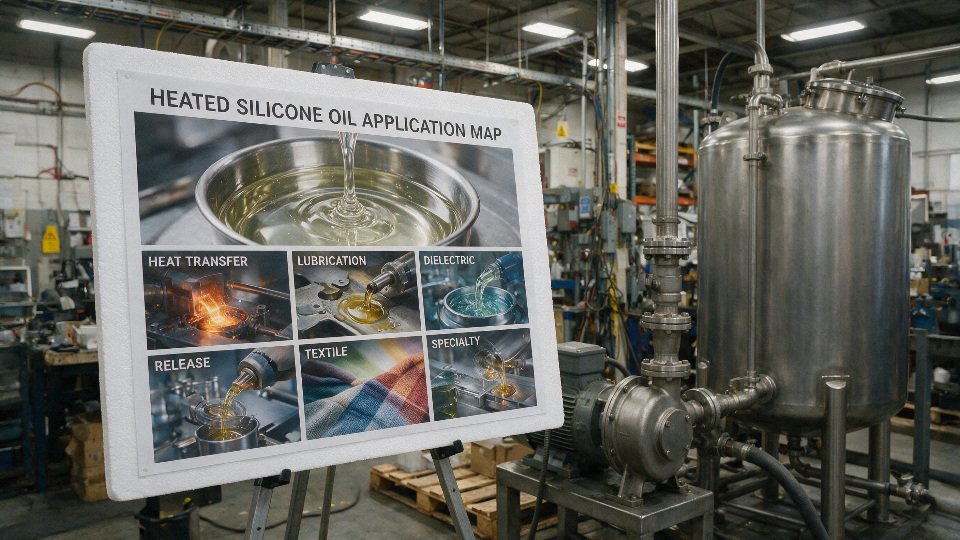
A line can run acceptably in winter and start marking product in summer simply because exhaust capture and roll surface temperature move a little. That is a process-control problem, not just a fluid-selection problem.
Vacuum diffusion pump and specialty high-temperature grades
These fluids are engineered for a narrower purpose and should not be replaced casually with general-purpose silicone oil. Diffusion pump fluids and other specialty high-temperature grades are selected for vapor-pressure behavior, thermal stability under specific conditions, purity, and residue characteristics that ordinary PDMS grades are not designed to meet.
Do not substitute based on viscosity alone. Before changing grades, verify:
- Required vapor-pressure performance at operating temperature
- Backstreaming limits
- Residue and decomposition tolerance
- System cleaning requirements before refill
- OEM approval or documented application fit
A cheap substitution can look harmless at receiving and still damage vacuum performance or contaminate the process chamber weeks later.
Testing and monitoring methods
A usable thermal-stability judgment needs a profile, not a single headline number. For buying and for maintenance, the combination that matters is weight loss, viscosity drift, and residue tendency over time under your actual temperature and atmosphere, because any one of those can stay acceptable while another one is already moving out of bounds.
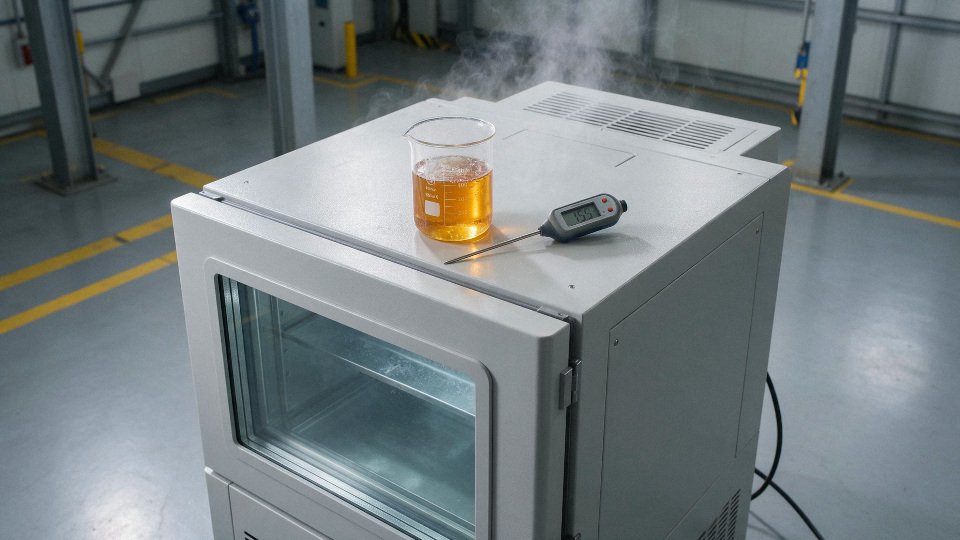
Laboratory screening is where you separate “survives heat on paper” from “will stay clean and predictable in service.” Flash point, for example, tells you something about ignition risk under a defined test method, but very little about long-term evaporation, deposit formation, or viscosity change at operating temperature.
Laboratory screening methods
- Thermogravimetric analysis, or TGA
- Tracks weight loss as temperature rises, usually in air and/or inert gas.
- Useful for seeing whether the fluid starts losing volatiles early, and whether the loss pattern is gradual or has a step change.
- The mechanism matters: early weight loss often points to low-boiling fractions or contamination; later loss may reflect backbone breakdown or oxidation-related decomposition.
- A buyer should ask for the test atmosphere, heating rate, sample mass, and endpoint. Change any of those and the curve moves.
- Differential scanning calorimetry, or DSC
- Measures heat flow associated with transitions or oxidative events.
- More valuable for comparative screening than for pretending to predict exact plant life.
- In practice, DSC can flag whether one grade shows earlier exothermic behavior in air than another, which is a warning sign for oxidative sensitivity.
- Oven aging
- Often the most commercially useful simple test.
- Hold the fluid at a defined temperature for a fixed time in an open and/or sealed container, then measure viscosity change, mass loss, color shift, and residue.
- This is closer to what plants actually care about. A fluid that loses only a little mass but leaves sticky residue on the beaker wall may create more trouble than one that evaporates a bit faster but stays clean.
- Volatility testing
- Can be done by controlled heating with mass-loss measurement.
- Especially relevant where the system is vented, thin-film exposure is high, or carryover onto hot parts is a concern.
- The trade-off is straightforward: lower volatility usually improves retention and cleanliness, but higher-viscosity grades used to achieve that may increase pump load, startup drag, and heat-transfer penalties.
A high flash point by itself is enough to qualify a silicone oil for high-temperature service.False
Flash point is not a life prediction tool. Thermal suitability depends on volatility over time, viscosity stability, residue formation, oxidation behavior, and the actual system design and atmosphere.
Core routine checks
Once the fluid is in service, routine checks should stay simple enough that the plant will actually do them.
- Kinematic viscosity at 25 C or 40 C
- Usually the first trending parameter.
- Falling viscosity can suggest volatile loss pattern changes, contamination with lower-viscosity material, or chain scission in some cases.
- Rising viscosity can indicate oxidation, crosslinking tendency, contamination, or insoluble buildup.
- Acid number, where relevant
- Not always the lead indicator for every silicone fluid, but useful in systems where oxidation byproducts matter or contamination history justifies it.
- Color
- A crude tool, but a darkening trend can support other evidence of thermal stress or contamination.
- Odor
- Operators often catch a problem here before the lab does. A sharper, burnt, or unusual odor is not a specification, but it is a legitimate trigger to sample.
- Residue
- Check evaporative residue or insolubles if deposits are a concern.
- This is often the missed quality issue in coating, heat-transfer, and release applications.
- Flash point trend
- More useful as a change indicator than as an approval criterion.
- A drop can suggest contamination by lighter materials or accumulation of low-boiling fragments.
Advanced diagnostics
When routine trends start moving, deeper analysis pays for itself quickly.
- GC-MS
- Best for identifying low-boiling siloxanes or contaminant species.
- Very useful when you suspect volatilization losses, process contamination, or off-odor complaints.
- FTIR
- Good for tracking oxidation signatures and comparing used fluid against virgin reference material.
- It will not solve every failure by itself, but it can show whether the chemistry is shifting, not just the appearance.
- Particle count or insoluble analysis
- Important in closed loops, precision equipment, or any application where deposits foul valves, narrow passages, nozzles, or heat-transfer surfaces.
- In my experience, this is underused until a plate exchanger starts losing performance or a fine metering valve gets sticky.
Building an in-service monitoring plan
The sampling interval should be set by operating severity, not by calendar habit alone.
- Higher temperature
- Shorter interval
- Longer residence time at temperature
- Shorter interval
- Open or vented system
- More focus on volatility, contamination ingress, and residue
- Closed, inerted system
- Usually slower degradation, but still monitor for contamination and viscosity drift
- High product criticality
- More frequent testing and tighter action limits
A practical split many plants use is:
- Mild duty: periodic viscosity and appearance checks
- Moderate duty: viscosity, color, odor, residue, and occasional flash point trend
- Severe or critical duty: scheduled viscosity, residue/insolubles, volatility-related checks, and confirmatory GC-MS or FTIR when trends change
The boundary here is simple: if the system sees contamination, hot spots, air ingress, or intermittent overheating, even a “mild” nominal bulk temperature can behave like severe service.
Sampling discipline
Bad samples create fake problems and hide real ones.
- Sample from a representative circulating point, not dead legs or tank tops
- If the system is hot, use a method that avoids flashing off light fractions during collection
- Use clean, compatible containers with tight closure
- Avoid dirty funnels, reused bottles, or open-bench transfers
- Label temperature, operating hours, and sampling location every time
- Keep a virgin reference fluid from the same grade for comparison
If a supplier is helping qualify a grade, send the operating temperature range, whether the system is open or closed, residence time, and a virgin sample reference along with the used sample. Without that context, even a very good lab report is only half-decoded.
Selection and operating criteria
A workable spec starts with the temperatures the fluid actually sees, not the number printed in the brochure. For heated service, define the normal bulk oil temperature, the local peak film temperature at heaters or hot metal surfaces, the startup and shutdown cycle pattern, and the service-life target; if you miss any one of those, you can buy the “right” silicone oil and still get early viscosity drift, volatilization, or deposits.
A lot of purchase specs fail here because they ask only for “usable to 200 C” or “high-temperature silicone oil.” That is too loose for engineering. A circulating bath, a damping device, and a heat-transfer loop can all run the same nominal bulk temperature and still impose very different thermal stress.
Define the duty before you define the grade
Use a short duty statement that procurement, maintenance, and the supplier can all work from:
- Continuous bulk temperature
- The stabilized temperature of the oil mass in the reservoir, bath, or loop.
- This is the number most operators know, but it is not the hottest condition.
- Peak film or wall temperature
- The oil temperature right at the heater sheath, hot platen surface, or localized boundary layer.
- This often drives oxidation, cracking, and deposit formation first. In electric-heater systems, a clean heater can run acceptably while a scaled or partially fouled one creates a local overtemperature zone the instrument never sees.
- Thermal cycling pattern
- Daily shutdowns, weekend idle periods, rapid heat-up, and overshoot events matter.
- Repeated cycling can pull in air and moisture through tank breathers and seals, then accelerate degradation during the next hot run.
- Required service life
- A few weeks in a batch process is a different decision from two years in a lightly attended thermal loop.
- If long drain intervals matter, ask for data tied to time at temperature, not just one flash point or one initial viscosity.
- Atmosphere and equipment geometry
- Open bath, vented reservoir, nitrogen-blanketed tank, thin-film exposure, dead legs, and low-flow heater sections all change the result.
- The usual continuous-use range cited for many PDMS fluids in air, roughly 150–200 C, stops being a reliable guide when local film temperatures run well above bulk or when air exposure is unusually high.
Match viscosity grade to the job, not to habit
For many industrial silicone oils, viscosity grades span roughly 10 to 100,000 cSt at 25 C. That sounds like a simple menu; in practice, grade choice is one of the main operating levers because it affects flow, damping, evaporation tendency, and heat transfer at the same time.
| Selection factor | Lower viscosity grades | Higher viscosity grades |
|---|---|---|
| Pumpability and cold start | Easier startup, lower torque, better flow through small lines | Harder startup, more suction stress, greater risk in winter or unheated plants |
| Heat transfer response | Better circulation and boundary-layer refresh | Slower circulation, thicker films, poorer local heat removal |
| Damping/lubricity feel | Lighter damping, faster movement | Stronger damping, slower movement |
| Volatilization tendency | Usually higher at a given temperature | Usually lower, but not immunity to high-temperature loss |
| Contamination sensitivity | May flush particles more easily through filters | Can trap fines and sludge in slow zones |
The mechanism is straightforward: lower-viscosity fluids circulate more easily and remove heat from hot surfaces faster, which can reduce local overheating. The trade-off is that lighter fractions or lower-molecular-weight distributions generally show higher volatility at temperature, so fluid loss, vapor carryover, and viscosity shift can become the limiting issue. Higher-viscosity oils reduce that loss in many cases, but they also increase startup load, worsen heat transfer in marginal designs, and can leave hot spots hotter.
The counter-intuitive part is this: the highest-viscosity silicone oil is not automatically the best high-temperature choice. If the system has small lines, weak circulation, outdoor winter starts, or heater-sheath hot spots, a very heavy grade can shorten service life by creating the exact local overheating that degrades the oil.
When standard PDMS is enough, and when it is not
For a lot of heated-service applications, standard PDMS fluids are the practical first choice because they are widely available, come in many viscosity grades, and handle moderate continuous heat reasonably well when the system is clean and well-designed.
Move to specialty chemistries, often phenyl-modified siloxanes or other high-temperature siloxane variants, when one or more of these conditions applies:
- Sustained temperatures push beyond the comfortable continuous range of standard PDMS in air
- Oxidative stability at elevated temperature is the life-limiting issue
- Low-temperature fluidity and high-temperature stability must both be balanced in the same application
- The process is highly sensitive to volatilization, residue, or optical/electrical property drift
Do not assume all “high-temperature silicone fluids” are interchangeable. Phenyl content, molecular architecture, additive package, and volatile profile all affect performance, and supplier-specific data matters here more than category labels.
Purity and packaging are not minor details in sensitive service
If the silicone oil is near electronics, optics, catalyst-bearing systems, specialty coatings, or product-contact surfaces, purity has to be specified up front.
Ask about:
- Low-volatiles content
- Important where fogging, condensate, outgassing, or weight loss matters.
- Metal ion limits
- Relevant for catalyst-sensitive or electronic applications; if the supplier cannot define what is measured and by what method, the number is not very useful.
- Particulate cleanliness
- Especially for precision dispensing, thin films, and small-orifice systems.
- Packaging cleanliness
- New fluid filled into dirty drums or reused pails causes more trouble than many buyers expect.
- In practice, I would rather see a supplier discuss drum lining, filling controls, and seal integrity than just say “industrial grade” and move on.
A high flash point means the silicone oil is suitable for long-term operation at nearly the same temperature.False
Flash point is a fire-safety indicator under defined test conditions, not a continuous operating limit. Long-term service temperature depends on oxidation rate, volatilization, local film temperature, air exposure, and system design.
Check compatibility beyond the fluid itself
Compatibility work should cover the whole wetted path and anything the vapor can reach:
- Seals and gaskets: FKM, VMQ, EPDM, PTFE, and others can behave very differently depending on temperature and formulation.
- Hoses and liners: watch for swelling, hardening, permeation, or extractables.
- Coatings and paint systems: some soften or lose adhesion if exposed to hot silicone contamination.
- Catalysts and reactive surfaces: trace contamination can poison some downstream chemistries.
- Product-contact materials: especially where transfer, staining, or surface defects are unacceptable.
If compatibility is critical, bench immersion alone is not enough; use temperature, time, and mechanical stress conditions close to the application.
Ask suppliers for data that survives engineering review
Brochure values are a screen, not a release decision. Before approval, request:
- Thermal aging data
- Viscosity change, mass loss, acid number if relevant, residue/deposit tendency, and test conditions.
- Batch consistency evidence
- Not just one typical value; look for manufacturing control and realistic variation.
- COA items tied to your risk
- Viscosity, appearance, volatile content if offered, moisture if relevant, and any agreed purity markers.
- Application-specific technical support
- Will the supplier review your duty profile, materials list, and operating window, or only send a datasheet?
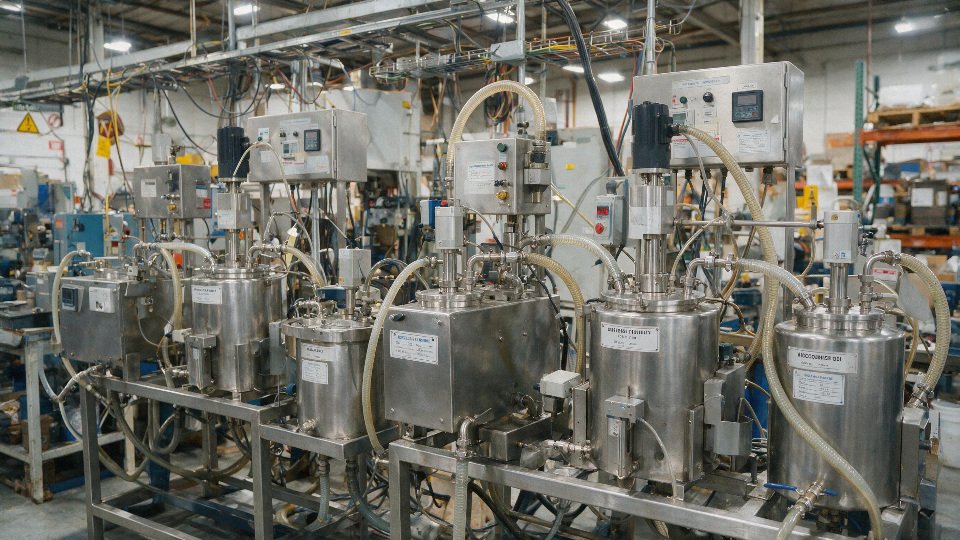
If the service is expensive to interrupt, give the supplier your actual operating profile and ask them to comment on grade fit, likely failure mode, and what still needs plant or lab validation. That is usually where a serious supplier separates from a trader.
Frequently asked questions
At what temperature does silicone oil start to break down?
There is no single breakdown temperature. Many PDMS silicone oils are used continuously around 150-200 C in air, but the point where measurable degradation starts depends on oxygen exposure, residence time, metal contamination, surface area, and whether the system has hot spots above the bulk oil temperature.
In practice, decomposition can begin slowly before the oil looks obviously damaged. A plant may run for months at one condition and fail quickly at another simply because the heater sheath is running much hotter than the tank reading. If you need a responsible estimate, you need at least:
– Bulk operating temperature
– Local film or heater surface temperature
– Air vs inert atmosphere
– Cycle duration or continuous residence time
– Contact metals, seals, and contamination load
Does heated silicone oil evaporate?
Yes, heated silicone oil can lose mass by evaporation, but usually much less aggressively than many mineral oils at the same temperature. The lighter fractions or lower-molecular-weight components leave first, so an oil may slowly lose volume and shift viscosity even without obvious burning.
This gets missed in open reservoirs and vented systems. If you are seeing steady top-up demand, oily condensate around vents, or deposits downstream of breather lines, evaporation is part of the picture. The rate is strongly grade-dependent; low-viscosity oils generally show higher volatility than heavier grades.
Can silicone oil catch fire?
Yes. Silicone oil is not nonflammable, and buyers should not confuse a high flash point with immunity to ignition. Many grades have flash points above 250 C, but that number is grade-specific and does not define safe continuous operation.
A few practical points matter:
– Fine mist ignites more easily than a calm liquid surface
– Oil on insulation, lagging, or dusty hot equipment behaves differently from oil in a clean closed loop
– Autoignition behavior must be verified from current supplier data, not assumed from a generic silicone category
A silicone oil flash point tells you the vapor can ignite under test conditions; it does not mean the oil should be operated continuously near that temperature.True
Flash point is a fire-property test point, not a durability limit. Thermal life usually becomes unacceptable well below flash point, especially in air.
Why does silicone oil smoke on a hot surface?
Smoke usually means one of three things: the local surface is much hotter than the measured bulk temperature, volatile fractions are evaporating, or the oil has already started degrading and is generating low-molecular-weight by-products.
On a hot plate, heater block, or leaking flange, the oil film is thin and oxygen access is high. That combination drives visible smoking earlier than you would expect from the tank or bath reading. If smoke appears suddenly after stable service, check for:
– Failed temperature control or sensor drift
– Carbonized deposits on heaters creating local overheating
– Contamination from process carryover
– A recent oil top-up with the wrong viscosity or mixed chemistry
Does silicone oil become thicker or thinner when heated?
It becomes thinner while hot. Like most fluids, silicone oil viscosity drops as temperature rises, which is one reason it pumps easily once warmed up and why heat transfer starts to stabilize after circulation is established.
What confuses people is what happens after repeated overheating. Fresh oil thins with temperature in a predictable way, but aged oil may come back either slightly thicker, from oxidation and polymer growth, or thinner, from chain scission and formation of lighter molecules. You need a before-and-after viscosity check at a defined temperature, usually 25 C or 40 C, to know which direction your system has gone.
Is silicone oil safe for open heating systems?
Open systems are the harder service. Silicone oil can be used in vented or loosely open equipment, but oxygen exposure and evaporation make the operating window narrower than in a sealed or inerted loop.
Use caution if your process has:
– Large free surface area
– Splashing, misting, or recirculation through air
– Electric heaters with high watt density
– Product contamination returning to the oil tank
For sustained high-temperature service, closed circulation is usually the more forgiving design.
How long can silicone oil run at high temperature?
Service life ranges from very short to several years, and no honest supplier should promise a universal number without duty details. The same nominal oil can last far longer in a clean, inert, well-controlled closed loop than in an open kettle with frequent air exposure and occasional overheating.
The useful inputs for life estimation are:
– Actual temperature profile, including peaks
– Atmosphere
– Top-up rate
– Contaminant load
– Viscosity drift, acid number if relevant, and volatile loss trend
– Deposit formation history on heaters and strainers
Can degraded silicone oil be restored or filtered back to original performance?
Usually not to original performance. Filtration can remove particles, gel fragments, and some insoluble contamination, but it will not reverse chemical changes in the oil backbone or rebuild the original molecular distribution.
That is the practical line:
– If the issue is dirt or wear particles, filtration may recover usability
– If the issue is oxidation, chain scission, volatility loss, or composition shift, replacement is usually the right answer
In some plants, blending with fresh oil is used as a temporary operating measure. It may restore fill level or partially adjust viscosity, but it does not erase degradation history.
What is the difference between flash point and maximum use temperature?
Flash point is a fire test property. Maximum use temperature is a service-life judgment based on how long the oil can operate before volatility, oxidation, deposits, viscosity shift, or other failure modes become unacceptable.
Those two numbers can sit far apart. A silicone oil may have a high flash point and still age too fast for practical use if you run it near that level in air, especially with hot spots.
How should spent or degraded silicone oil be handled?
Handle it as an industrial waste stream under your local regulations and the current safety documentation for that specific product and contamination history. Once used, the disposal route may be driven less by the silicone oil itself than by what it has picked up from the process.
At minimum:
– Segregate used oil by product type and contamination source
– Do not mix unknown used fluids into a general waste-oil tote
– Keep records of operating history if off-site disposal or analysis is required
– Verify disposal, transport, and any potential recovery route against the local legal framework and the supplier SDS
Your grade verification checklist
For heated service, the correct silicone oil is the grade that stays stable in your actual process window, with your atmosphere, hardware, contaminants, and run length. A high flash point can be useful context, but it does not prove long-term thermal suitability, and a low unit price disappears quickly if the oil thickens, volatilizes, or deposits on heaters and seals.
Start with the application facts that materially change the answer. If any of these are vague at purchase stage, the supplier can only give a provisional recommendation.
- Temperature range
- Normal operating temperature
- Peak temperature and duration
- Heat-up and cool-down frequency
- Any local hot spots at heaters, pump heads, or thin-film zones
A bulk fluid at 180 C can still fail early if sheath temperatures or stagnant pockets run much higher.
- Atmosphere
- Air, nitrogen blanket, vacuum, closed loop, vented tank
- Moisture exposure
- Presence of oxygen during shutdowns or maintenance
This matters because oxidation behavior and volatilization change sharply with atmosphere.
- Residence time
- Continuous circulation or static hold
- Batch dwell time at temperature
- Expected service life before changeout
Short exposure at a high peak can be less severe than weeks of steady heating a bit below that peak.
- System type
- Open bath, jacketed vessel, heat-transfer loop, dosing system, reactor, release coating line
- Pump type, filter arrangement, venting, agitation, dead legs
In practice, dead zones and low-flow branches often age oil faster than the main loop.
- Metallurgy and elastomers
- Carbon steel, stainless, aluminum, copper alloys
- Seal, hose, gasket, and coating materials
Compatibility is usually manageable, but it still needs checking against the full wet-end stack.
- Contamination risks
- Catalysts, acids, alkalis, amines, metal fines, water, cleaning residues, process carryover
- Cross-contamination from previous fluids
A trace contaminant can shift the failure mode from gradual evaporation loss to rapid viscosity drift or gel formation.
- Regulatory and documentation needs
- Food-contact, electronics, cosmetics, REACH, RoHS, internal OEM approvals
- COA, SDS, technical data sheet, lot traceability, change-control expectations
Verification sequence
- Define the thermal duty
- Put actual temperatures, cycle profile, atmosphere, and expected life on one page.
- Shortlist the chemistry
- For many heating duties, PDMS is the starting point, but the preferred grade still depends on viscosity, volatility tolerance, and environment.
- Request relevant test data
- Ask for the specific data tied to your duty, not just a brochure value.
- Typical useful items:
- Viscosity grade at 25 C
- Indicative continuous-use range
- Flash point, with method if available
- Volatile content or mass-loss data if available
- Compatibility notes and any application limits
- Run a compatibility review
- Check metals, seals, coatings, and likely contaminants.
- Verify against current supplier documentation and your equipment manual where limits are equipment-specific.
- Conduct a pilot or sample aging test
- Heat the candidate fluid under representative conditions.
- Track viscosity change, mass loss, appearance, odor, deposits, and any seal effects.
- Set a monitoring plan
- Define what you will watch in service:
- Viscosity trend
- Fluid loss
- Color or haze
- Residue on hot surfaces
- Filter loading
- Changeout trigger
- Define what you will watch in service:
The best silicone oil for heated duty cannot be chosen responsibly from flash point alone.True
Flash point indicates ignition behavior under a defined test method; it does not by itself predict oxidation rate, volatility under continuous heat, contaminant sensitivity, or compatibility with the actual system.
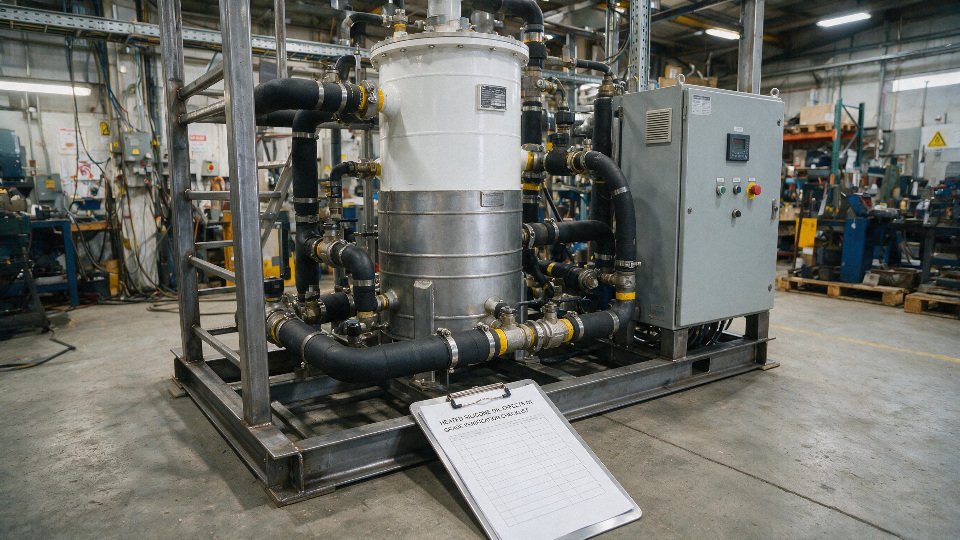
If you are qualifying a grade for heated service, send the operating temperature range, atmosphere, approximate residence time, system type, metallurgy, contamination risks, required documentation, and target performance such as viscosity stability, cleanliness, or service life. With that, SiliconChemicals can review the application, recommend a fit-for-purpose silicone oil grade, provide the relevant documentation set, and arrange a sample plan for validation under your conditions.