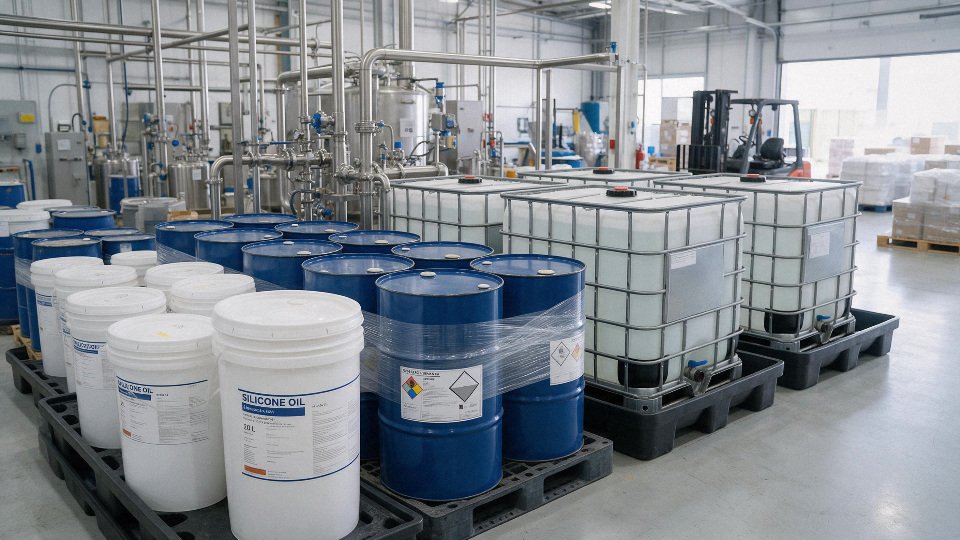
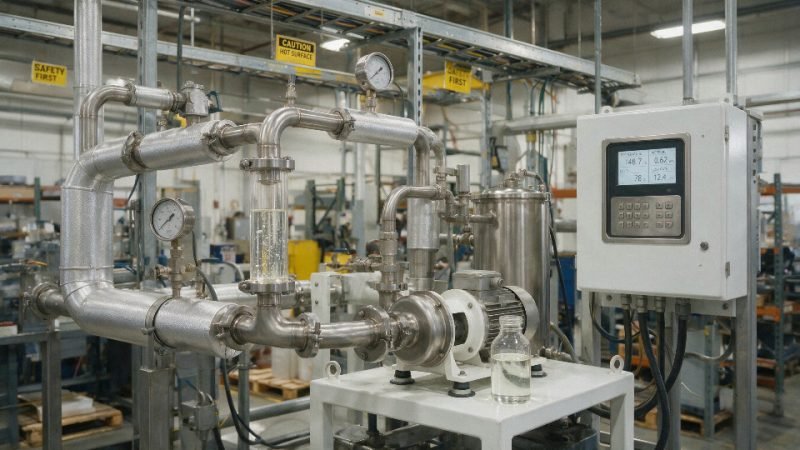
Silicone oil usually looks stable right up to the point a process starts drifting: viscosity creeps, dielectric performance falls off, seals get soft, or a heated bath starts leaving residue where it used to run clean. On a plant floor, that turns into inconsistent heat transfer, electrical insulation risk, off-spec surface results, and maintenance teams chasing a problem that does not look like a fluid problem at first. The cost is rarely the drum price alone; it shows up as scrap, line stoppage, fluid changeouts, fouled hardware, and buying the wrong grade because “silicone oil is stable” got treated as a blanket truth.
Yes, silicone oil is chemically stable compared with many mineral and organic fluids, but its stability is conditional, not absolute. Standard dimethyl silicone oil often performs well from about -50 to 200 C in continuous service, yet oxidation, contamination, moisture, catalysts, air exposure, and contact-material compatibility still determine whether it stays usable in your process.
That distinction is where most selection mistakes happen. A sealed thermal-aging result, a clean dielectric-strength figure, and actual plant service are not the same thing, and the gap between them is exactly what decides whether silicone oil behaves like a long-life utility fluid or an expensive troubleshooting exercise.
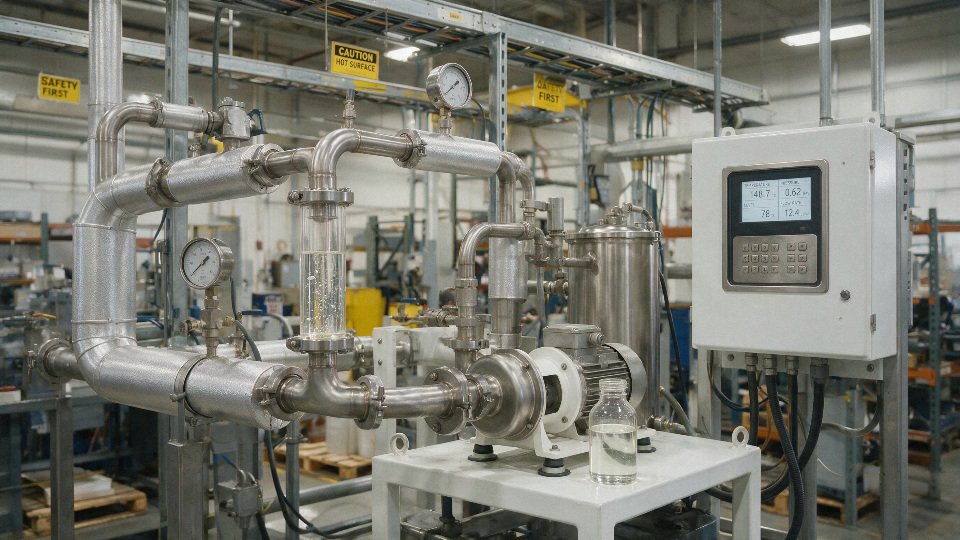
Why silicone oil resists change
Silicone oil resists change largely because its main chain is built on siloxane bonds, not the carbon-carbon backbone you see in mineral oils and many synthetic organics. That difference gives it an unusual mix of thermal tolerance, chain flexibility, low intermolecular attraction, and resistance to many common degradation routes, though the advantage narrows quickly if the fluid is contaminated, poorly selected, or exposed to catalytic residues.
The first thing to understand is that “silicone oil” is a family, not a single fluid with one stability profile. A straight dimethyl silicone fluid used as a heat-transfer or release medium behaves differently from a phenyl-modified insulating fluid, and very differently again from an amino-functional textile softener or reactive specialty grade. Buyers get into trouble when they carry performance assumptions from one subtype into another.
The siloxane backbone is the main reason
At the molecular level, most silicone oils are built around repeating Si-O-Si units. That bond structure matters in three practical ways:
- The chain is flexible
- The Si-O bond geometry allows easy bond rotation.
- That gives the molecule high mobility over a broad temperature range.
- In service, this shows up as good low-temperature flow and relatively smooth viscosity response compared with many hydrocarbon fluids.
- Intermolecular forces are relatively weak
- Dimethyl-substituted chains do not pack tightly.
- Lower cohesion helps explain low pour behavior, easy spreading, and low surface tension.
- In a metering pump, level sensor pocket, or narrow oil passage, that usually means fewer cold-start flow surprises.
- The backbone tolerates heat better than many organic fluids
- Standard dimethyl silicone oils are often used continuously around roughly -50 to 200 C, depending on residence time, oxygen exposure, contamination, and grade.
- In sealed or carefully controlled systems, specialty grades can go higher, but that is not a blanket rule for all products sold as silicone oil.
That broad operating window is not just a lab curiosity. In plant service, it reduces the number of process upsets caused by seasonal temperature swings, intermittent heating, or overnight shutdowns. A dosing system that sees 10 C in the morning and 70 C by afternoon is easier to tune when the fluid does not thicken aggressively at the low end and thin excessively at the high end.
Why side groups matter as much as the backbone
The siloxane chain gives the platform. The organic side groups decide a lot of the actual service behavior.
Methyl groups: the common baseline
Most standard silicone oils are polydimethylsiloxane-type fluids, with methyl groups attached to silicon. Methyl substitution contributes to:
- Low-temperature mobility
- Methyl groups are small and do not lock the chain up.
- That helps maintain fluidity at low temperature.
- Low surface tension and good spreading
- Useful in release, defoaming, wetting modification, and lubrication of lightly loaded interfaces.
- Less helpful where fluid migration must be tightly controlled.
- Moderate oxidation resistance for many industrial duties
- Good, but not unlimited.
- In open hot systems with air entrainment, oxidation and volatilization still need checking.
- Low polarity
- Often compatible with nonpolar surfaces and some elastomers.
- Often poor with highly polar systems unless specifically modified.
Phenyl groups: when heat and low-temperature performance both matter
Replacing some methyl groups with phenyl groups changes the picture:
- Improves stability in some high-temperature or radiation-exposed applications
- Can improve low-temperature characteristics in certain formulations
- Often changes refractive index, solvency, and electrical behavior
This is why phenyl-modified silicone fluids show up in some electrical and specialty thermal applications. They are not simply “better silicone oil”; they are a different compromise. You often gain thermal or dielectric performance, but cost, material compatibility, and availability can shift against you.
Amino and other functional groups: more performance, less inertness
Functional silicone oils such as amino-, epoxy-, hydroxyl-, carboxyl-, or polyether-modified grades are designed to interact with substrates, emulsify, react, or anchor more strongly. That functional behavior is useful, but it usually reduces the simple “chemically inert” picture people associate with silicone fluids.
- Amino-modified fluids may bond better to fibers or surfaces.
- Polyether-modified silicones may disperse in water or improve wetting.
- Reactive or polar groups can increase substrate affinity and process value.
The trade-off is straightforward: the more a silicone fluid is designed to do chemically, the less universal its stability and compatibility assumptions become. In procurement terms, the SDS name “silicone oil” is nowhere near enough to qualify a replacement.
Why viscosity behavior is often easier to control
One reason silicone oils are favored in temperature-variable equipment is that their viscosity usually changes less sharply with temperature than many hydrocarbon oils of comparable nominal viscosity. That matters in several pieces of equipment:
- Metering pumps and dosing valves
- Dashpots and dampers
- Heat-transfer loops
- Textile or paper coating applicators
- Lightly loaded gear or bearing arrangements where flow consistency matters more than extreme-film behavior
Mechanistically, the flexible siloxane chain and weak intermolecular attraction reduce the extent to which the fluid “locks up” as temperature falls or loses body abruptly as temperature rises. You still get viscosity change, of course. No fluid escapes that. But the slope is often easier to manage.
That affects equipment protection through a simple path:
- More predictable viscosity
- More stable film formation or flow rate
- Less drift in pump slip, spray pattern, damping force, or coating weight
- Fewer adjustments by operators
- Lower risk of running a system too lean at high temperature or too sluggish at low temperature
In sealed thermal aging tests, an acceptable kinematic viscosity change after exposure is often somewhere in the rough range of 5% to 15%, depending on grade, temperature, and test duration. That figure is useful as a purchasing discussion point, not as a universal acceptance limit. If your process has a narrow damping tolerance or coating window, a 10% shift may already be too much.
Low surface tension and chain mobility help, but they also create problems
Silicone oils spread easily because they have low surface tension and highly mobile chains. That is exactly why they work so well in release, anti-foam, lubrication of delicate interfaces, and surface modification. The fluid gets where bulkier, higher-energy liquids often do not.
In practice, the same traits can create side effects:
- Migration
- The fluid can creep onto nearby surfaces, especially under heat.
- In painting, printing, bonding, and clean-surface assembly, even trace transfer can cause defects.
- Seal interaction
- Some elastomers tolerate silicone oils well; some swell, soften, or lose sealing force.
- Compatibility depends on both the fluid chemistry and the seal compound, not just the polymer family on a datasheet.
- Difficult housekeeping
- Once silicone contamination reaches a coating line or adhesive preparation area, operators may spend days chasing fisheyes and wet-out defects.
This is where plant-floor experience matters. A fluid can be thermally stable and still be the wrong choice if the surrounding process is sensitive to transfer contamination.
Intrinsic stability is not the same as stability in service
A silicone oil may be intrinsically stable and still appear to “go bad” because something in the system is catalyzing change. This is one of the most common misreads in troubleshooting.
Trace contaminants that can accelerate rearrangement, cleavage, gel formation, or viscosity drift include:
- Residual strong acids from upstream cleaning or processing
- Alkali carryover from wash steps
- Metal salts or catalyst residues
- Moisture, especially in combination with reactive impurities
- Fine metal wear debris at elevated temperature
The mechanism is not always dramatic oxidation. Sometimes the backbone is being catalytically rearranged or cleaved, which can lower viscosity, generate volatiles, or in some systems drive crosslinking and sludge. A buyer sees “silicone oil failed early” when the root cause was actually contamination control, poor line flushing, or the wrong gasket adhesive.
Silicone oil can be chemically stable in bulk storage but degrade quickly in a dirty or catalytic system.True
That distinction is well supported by siloxane chemistry and by common industrial failure analysis. Trace acids, bases, metal residues, and moisture can shift the apparent stability of the fluid far more than buyers expect from the product name alone.
The main boundary on all of these advantages is simple: they hold best for the right grade in a reasonably clean system with known materials of construction. Once the fluid is exposed to catalytic contamination, aggressive reagents, poorly matched elastomers, or open high-temperature aerated service, “silicone oil” stops being a sufficient specification and becomes a test program.
Where stability can fail
Silicone oil usually loses its stability advantage by exposure pattern, not by age alone. The main failure triggers are sustained high temperature, oxygen access, catalytic contamination, water combined with off-neutral chemistry, and localized electrical or thermal stress; in plant service, those often arrive together rather than one at a time.
A useful way to think about it is this: the bulk fluid may still look acceptable while the oil at one hot bearing shoulder, heater sheath, seal lip, or energized edge has already started to change. Most expensive silicone-oil failures start as local chemistry in a bad zone, then show up later as viscosity drift, deposits, gas generation, dielectric loss, seal problems, or shortened service life across the system.
Thermal stress at elevated temperature
Standard dimethyl silicone oil is widely used continuously around about -50 to 200 C, and specialty grades can go higher under controlled conditions. That does not mean every system running at 180 to 220 C is safe by default. The practical question is whether the oil sees that temperature uniformly, in a sealed or vented condition, with what dwell time, and in contact with which surfaces.
Once thermal stress becomes significant, several things can happen at the same time:
- Low-molecular fractions can volatilize first
- Bulk viscosity can drift upward or downward
- Cyclic siloxanes can form through rearrangement or chain scission pathways
- Under severe or prolonged overheating, residue, varnish, or gel-like material can develop
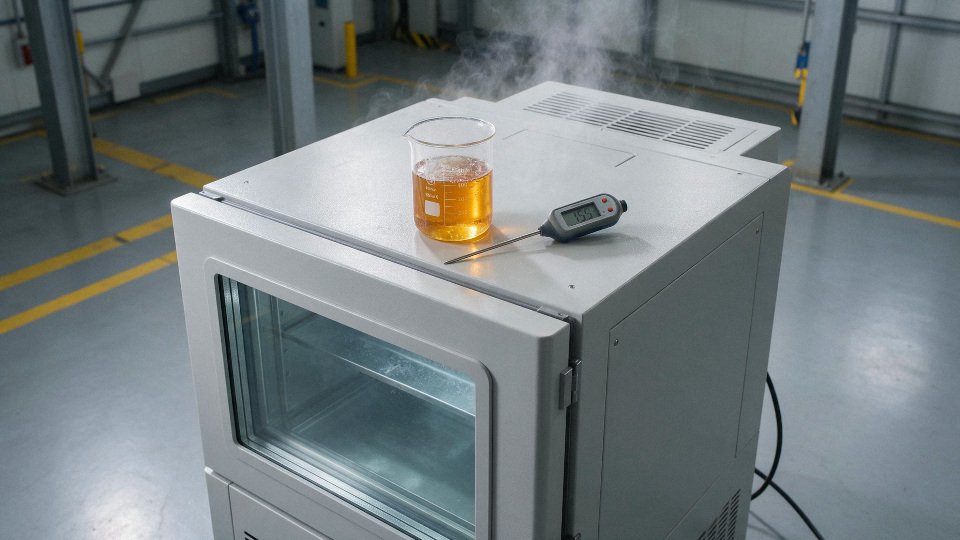
The mechanism matters. In a vented or partially open system, lighter fractions leave first, so the remaining fluid can show an apparent viscosity increase even before deeper degradation is obvious. In a sealed high-temperature test, the fluid may instead hold mass better, and viscosity change after aging is often judged against a range like roughly 5% to 15%, depending on grade, temperature, and test duration. That kind of number is useful for lab comparison, but it is not a field guarantee. A plant kettle with poor circulation and a scorched heater band does not age like a sealed bottle in an oven.
The trade-off is straightforward: silicone oil’s thermal tolerance is one of its strengths, but the same low surface tension and broad fluidity that make it useful can also allow migration into hotter micro-zones where conventional bulk temperature readings miss the problem. I have seen systems report a perfectly acceptable sump temperature while a thermowell near an electric element was running tens of degrees hotter. That is enough to flip the chemistry from slow aging to deposit formation.
Watch for these signs under heat stress:
- Gradual viscosity increase in open or vented systems from loss of volatiles
- Unexpected viscosity decrease where chain scission dominates
- Rising odor or vent emissions
- Haze, insolubles, or sticky residue on hot metal surfaces
- Foaming changes after long hot service
- Gel specks in filters or sight glasses
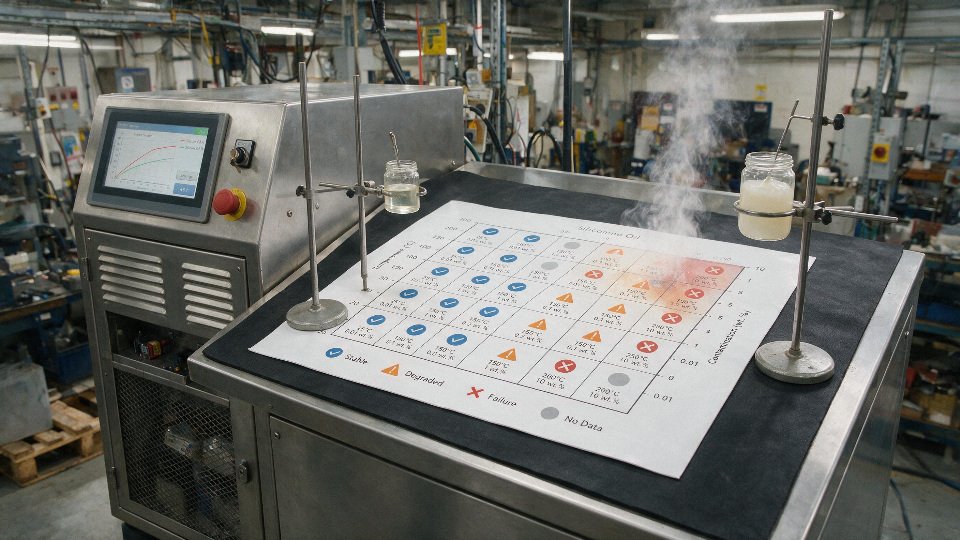
The main conclusion here stops holding if the system truly is well-sealed, temperature-controlled, and chemically clean. Under those conditions, silicone oil can remain serviceable for long periods. Once oxygen, catalysts, and hot spots enter the picture, service life can shorten very quickly.
Oxidative degradation in air
Compared with many hydrocarbon-based fluids, silicone oil is usually slower to oxidize. That said, “oxidation-resistant” is not the same thing as oxidation-proof. Long exposure to air at elevated temperature will still drive change, and the rate can accelerate sharply in the presence of catalytic surfaces or trace contaminants.
Typical oxidation-related effects include:
- Viscosity drift
- Formation of volatile byproducts
- Increase in acidity or reactive species
- Surface deposits or lacquer-like films
- Changes in dielectric behavior in insulating service
The path is usually oxygen diffusion into hot fluid, followed by radical or surface-catalyzed reactions. Air entrainment makes it worse because it raises the interfacial area. So does a design with a hot, splashing return line into a vented reservoir. In practice, a quiet, blanketed tank ages more gently than a system that constantly shears and aerates the oil.
A common trigger is metal contamination. Copper, iron fines, rust, and certain metal soaps can catalyze degradation out of proportion to their concentration. The same is true of residues left after maintenance: anti-seize compounds, dirty funnels, rag lint carrying detergent, old gasket fragments. Buyers often focus on the virgin fluid specification and ignore what the fluid will touch in month six.
Hydrolysis and condensation effects
Silicone oil generally handles incidental water better than many fluids, but water is not harmless in every chemistry. Neutral, low-water systems are one thing; wet emulsions, washdown environments, condensate-prone vents, and poorly neutralized process streams are another.
Hydrolysis risk rises when water is combined with:
- Acidic conditions
- Alkaline conditions
- Residual catalyst
- Elevated temperature
- Large interfacial area, as in emulsions or fine dispersion
Under those conditions, siloxane bonds can cleave or rearrange. Depending on the formulation and environment, that can lead to lower molecular weight species, broader molecular weight distribution, or secondary condensation reactions that increase viscosity and eventually create gel or insoluble material.
This is one place where plant history matters. If a reactor has seen acidic cleaning, caustic wash, then an incomplete rinse, the next silicone-oil campaign may fail for reasons that look mysterious until someone reviews the cleaning log. The fluid did not become unstable on its own; the reactor chemistry changed the boundary conditions.
Catalytic attack from process carryover
A lot of avoidable failures sit in this category. Silicone oils can be sensitive to catalytic attack from trace carryover, even where the contaminant level is too low to show up in routine incoming inspection.
The usual suspects are:
- Strong acids and bases
- Metal soaps
- Chlorides
- Organometallic residues
- Residual polymerization or equilibration catalysts
- Cleaning-agent remnants from lines, totes, pumps, or mix vessels
If silicone oil fails prematurely, the root cause is usually the oil quality itself.False
Premature failure is often system-induced: trace catalysts, incompatible elastomers, poor venting, local overheating, moisture ingress, or contaminated transfer equipment can degrade otherwise suitable silicone oil. Root-cause work should start with the whole fluid path, not the COA alone.
Mechanistically, these materials either promote bond cleavage, accelerate rearrangement, or create surface conditions that favor oxidation and deposit formation. The commercial problem is that the contamination may come from upstream chemistry the fluid buyer does not control directly. A toll processor may have used the same pump for another product. A maintenance team may flush with a chlorinated cleaner because it was on the shelf. A drum may be clean enough for water-based product but not for a high-purity silicone application.
If you are buying for a process with tight stability demands, procurement language should specify not only the fluid grade but also transfer cleanliness, compatible contact materials, and whether reused containers or shared lines are acceptable. Otherwise, the purchase order protects the wrong point in the process.
Radiation, electrical stress, and corona environments
In specialized applications, the limiting factor is not thermal chemistry alone but radical generation under radiation or electrical stress. High-energy radiation can break polymer chains or generate reactive intermediates. Electrical discharge and corona can do something similar at localized high-field regions, especially where there is entrained gas, moisture, or contamination.
In insulating service, clean and dry silicone fluids may show dielectric strength around roughly 10 to 20 kV/mm, but that value is highly condition-dependent. Moisture, particles, dissolved gases, and decomposition products can reduce performance significantly. A fluid that is chemically acceptable for heat transfer may be unsuitable for electrical insulation if handling and dryness are poor.
Field symptoms in these environments include:
- Increasing gas content
- Partial discharge issues
- Dielectric breakdown reduction
- Local darkening or residue near energized edges
- Odor changes after fault events
Anyone specifying silicone oil for electrical duty needs to verify current equipment limits, fluid grade suitability, and testing protocol against the supplier documentation and the equipment manual. This is not a category where broad fluid-family statements are enough.
Contamination-driven instability
Contamination is the most common multiplier because it can trigger several pathways at once. One load of dirty top-up fluid can bring in moisture, particles, incompatible additives, and catalytic residue together.
The main contamination classes worth separating are:
| Contaminant type | Typical source | Likely effect on stability |
|---|---|---|
| Particles and metal fines | Wear debris, dirty drums, fabrication residue | Catalytic oxidation, dielectric loss, filter loading, deposit nucleation |
| Process chemicals | Upstream carryover, incomplete cleanout | Hydrolysis, catalytic rearrangement, viscosity drift |
| Incompatible additives | Shared transfer equipment, mistaken top-up fluid | Haze, phase issues, foam change, seal interaction |
| Polymer residues | Tank heel, old batch remnants | Gel specks, broad viscosity spread, solids formation |
| Elastomer extractables | Seal swelling, hose liner attack | Color, odor, dielectric shift, deposit precursors |
| Absorbed gases and moisture | Poor storage, vented tanks, humid plant air | Oxidation acceleration, discharge problems, test variability |
The trade-off here is that broad compatibility and easy handling make silicone oils operationally convenient, but that convenience can encourage sloppy refill habits. Open pails, mixed transfer pumps, and “close enough” hose compatibility are exactly how stable fluids get blamed for unstable service.
Many apparent fluid failures are actually system failures
Often the fluid is only where the problem becomes visible. The root cause sits in system design, maintenance practice, or material selection:
- Incompatible seals can swell, shrink, leach, or harden, contaminating the oil and creating leaks
- Poor vent design can pull in humid air or allow loss of lighter fractions
- Dead legs and hot spots can overheat a small portion of the fluid repeatedly
- Refill practices can introduce the wrong viscosity, dirty containers, or wet transfer hoses
- Undersized filtration can let degradation products circulate until they seed more deposits
That distinction matters commercially. Replacing the oil without fixing the vent, heater geometry, seal material, or refill procedure only resets the clock for the next failure. In practice, if the same unit kills fresh silicone oil twice, stop arguing about brand and start mapping temperatures, contact materials, contamination points, and maintenance steps.
Operating conditions that matter
Silicone oil stays chemically stable or drifts out of spec based less on its label and more on how the plant actually runs it. The variables that usually decide service life are peak temperature exposure, oxygen and moisture access, what the fluid touches, and how cleanly the system is operated and maintained.
A drum spec sheet will not tell you whether a heater manifold has a 30 C local overshoot, whether a maintenance tech topped up from an open pail, or whether a copper alloy fitting is sitting in the hottest leg of the loop. Those details are where stable service is won or lost.
Temperature profile
Bulk temperature matters, but local temperature usually matters more. Standard dimethyl silicone oil is commonly used continuously from about -50 to 200 C, and specialty grades can go higher under controlled conditions, but that range only holds if the fluid actually sees those conditions uniformly and without repeated abuse.
What to check on the plant side:
- Bulk operating temperature
- Use the true stabilized fluid temperature, not just heater setpoint or jacket temperature.
- In a recirculating system, compare supply, return, and heater outlet values. A 15 to 25 C spread can hide a much hotter film temperature at the element.
- Local hot spots
- Electric immersion heaters, dead legs, poorly mixed reservoirs, and low-flow heat-transfer loops are common trouble points.
- Thin fluid films on hot metal degrade faster than the same oil in well-mixed bulk volume because oxygen transfer and thermal stress both increase at the interface.
- Startup overshoot
- Many systems are rougher on the fluid during the first 10 to 30 minutes than during steady production.
- PID tuning, contactor-based heaters, and low initial circulation can drive short peaks well above nominal operating temperature.
- Thermal cycling
- Daily heat-up and cool-down draws in air and moisture through vents and seals.
- Repeated expansion and contraction also works contamination loose from gaskets, tank walls, and old residue.
- Residence time at peak
- A loop that touches 190 C briefly is not the same as a sump that sits there for days.
- Degradation is time-at-temperature dependent. Two plants can run the same grade at the same nominal temperature and get very different life because one only hits peak during batches while the other holds peak continuously.
The mechanism is straightforward: higher temperature speeds oxidation and side reactions, lowers viscosity, and can worsen volatilization of lighter fractions. If the fluid is in a vented system, those changes can shift viscosity and dielectric behavior over time; in sealed tests, acceptable viscosity change after thermal aging is often within roughly 5% to 15%, but plant exposure is usually less controlled than a lab oven.
The trade-off is familiar. Running hotter can improve heat transfer rate or process throughput, but it narrows the margin against oxidation, seal stress, and viscosity drift. That conclusion stops holding if the system is tightly sealed, well-instrumented, and designed to avoid film overheating; then a higher-grade fluid may remain stable at conditions that would quickly age a poorly designed open system.
Atmosphere and enclosure design
An open bath is the hardest environment for long fluid life. A sealed loop or well-blanketed reservoir usually gives silicone oil a much better chance because oxygen pickup, moisture ingress, and airborne contamination are all lower.
Key enclosure factors:
- Open bath vs sealed loop
- Open tanks constantly exchange air.
- Sealed loops limit oxygen availability and reduce evaporation losses.
- Oxygen availability
- Oxidation needs oxygen. Reduce headspace turnover and you usually reduce oxidation rate.
- Large, partially filled tanks breathe more with each thermal cycle.
- Inert gas blanketing
- Nitrogen blanketing can help in high-temperature service, especially where long residence time at peak cannot be avoided.
- It only works if flow, pressure control, and vent arrangement are sensible. A token nitrogen line on a leaky tank is mostly theatre.
- Venting quality
- Bad vents pull in humid air, dirt, or washdown mist.
- Desiccant breathers are often worth the small cost in variable-humidity plants.
- Moisture ingress pathways
- Tank manways left cracked open
- Condensation in cool shutdown periods
- Wet compressed air used around open fill points
- Hose ends stored uncapped on the floor
- Drum pumps shared with water-based materials
Silicone oil stability depends strongly on whether the system is open or sealed.True
Oxygen access, airborne contaminants, and moisture ingress are all much easier in open systems. Those factors do not always degrade the fluid immediately, but they materially change long-term aging behavior.
Contact materials and process contamination
Compatibility is not just a handbook exercise. The fluid may be stable on its own, then become troublesome because of what it dissolves, extracts, or reacts around.
Materials and interfaces worth checking:
| Contact item | Typical concern | What to verify |
|---|---|---|
| Carbon steel / stainless steel | Usually acceptable if clean | Rust, scale, fabrication debris, and old oil residue |
| Copper / brass / bronze | Can promote degradation in some hot systems | Alloy location, temperature, exposure time |
| Aluminum | Often acceptable, but surface condition matters | Corrosion products, machining residue |
| Coatings / tank linings | Softening, blistering, extractables | Supplier compatibility and service temperature |
| Elastomers | Swell, shrinkage, hardening, leachables | Seal material grade, not just generic polymer family |
| Plastics | Stress cracking or plasticizer extraction | Long-term exposure and actual process temperature |
| Adhesives / potting compounds | Chemical attack, softener migration | Cure state and thermal class |
| Process residues | Acidic, basic, metallic, or solvent contamination | Cleaning validation before fill |
Copper deserves special attention in hotter circuits. In practice, a small copper-containing component in a cool bypass may be harmless, while the same alloy in the hottest recirculating leg can shorten fluid life noticeably. Residual cleaners, catalyst traces, metal fines, and char from previous fluids are just as important; many “fluid failures” start as bad changeover discipline.
Mechanical conditions
Shear alone does not usually destroy silicone oil under ordinary pumping conditions, but mechanical design still affects stability indirectly through air handling and contamination control.
Check these points:
- Pump type
- Centrifugal pumps are common and usually fine if suction conditions are good.
- Gear or other positive displacement pumps can create high local stress if oversized, run dry, or bypass excessively.
- Cavitation
- Cavitation introduces localized extremes and a lot of entrained gas.
- Once the loop starts foaming or micro-aerating, oxidation-related issues accelerate.
- Aeration
- Splash filling, high-return turbulence, and poor tank baffling keep air in the fluid.
- Entrained air also hurts level measurement, heat transfer consistency, and dielectric performance.
- Filtration regime
- Filtration does not reverse chemical aging, but it does remove wear debris, char, and particles that can seed further trouble.
- Filter media and adhesives must themselves be compatible with the fluid and temperature.
A common plant mistake is chasing “bad fluid” when the actual problem is a suction leak on a pump skid, a loose threaded fitting, or a return line dumping above liquid level.
Electrical and environmental conditions
For transformer, damping, and electronic applications, chemical stability is only part of the service picture. Clean, dry silicone insulating fluids may show dielectric strength around 10 to 20 kV/mm, but that figure is highly sensitive to moisture and contamination, so it cannot be treated as a fixed property once the fluid is in use.
Pay attention to:
- Humidity exposure
- High ambient humidity, poor seals, and repeated opening of housings all increase moisture risk.
- Dielectric stress
- Corona, partial discharge, and high-field defects can degrade both fluid and adjacent materials.
- Verify against the equipment design, not a generic fluid brochure.
- Contaminants
- Fibers, metal fines, carbonized residue, flux residues, and salt contamination all matter.
- In electronics service, cleanliness class should be defined by the device requirement or supplier documentation.
- Surface cleanliness
- A chemically stable fluid can still fail electrically if the assembly is dirty.
Maintenance discipline
A well-run system can keep silicone oil serviceable for a long time; a sloppy one can spoil fresh material in a shift.
Use a practical control list:
- Top-up with the correct grade only
- Match viscosity, chemistry, and intended service.
- “Close enough” substitutions are how mixed-fluid problems start.
- Control mixed-fluid events
- Shared hoses, transfer pumps, and intermediate totes are regular contamination sources.
- Labeling matters, but dedicated equipment matters more.
- Keep containers clean and sealed
- Open drums collect dust, moisture, and whatever is in the air that week.
- Use clean, capped transfer tools.
- Manage shelf life and storage condition
- First-in, first-out is basic, but also keep drums out of direct sun and temperature extremes.
- Storage guidance should follow the current supplier documentation for the specific grade.
- Set a reuse policy after thermal service
- Do not assume drained fluid is reusable because it still looks clear.
- Reuse decisions should be based on relevant testing for the application: viscosity, moisture, particle load, acid indicators where applicable, and dielectric properties for electrical service.
- Sample from the right location
- A tank top sample and a low-point circulating sample can tell two different stories.
If the operating picture is still unclear, the next useful step is not guessing from a data sheet. It is mapping the actual service conditions: temperature profile, enclosure type, contact materials, contamination risks, and maintenance habits. That is usually enough to tell whether standard silicone oil is comfortably inside its stability window or already running on borrowed margin.
Grades and stability tradeoffs
No single silicone oil family is “most stable” in every plant. Dimethyl fluids are the benchmark for broad thermal and dielectric stability, but once the job involves difficult wetting, metal contact, alkaline washdown, radiation, tight volatile limits, or deliberate surface interaction, the preferred grade can shift fast.
The practical mistake is buying off one headline property. A datasheet may show excellent heat resistance or a nice viscosity number at 25 C, but your process usually fails somewhere else first: evaporation from a thin film, loss of dielectric strength from moisture pickup, swelling of a seal, poor adhesion over a release-rich surface, or viscosity drift after repeated contact with process contaminants.
Standard dimethyl silicone oils
Dimethyl silicone oils, usually polydimethylsiloxane-based fluids, are the default industrial choice because they balance cost, availability, thermal stability, oxidation resistance, water repellency, and electrical insulation better than most specialty grades. For many heat-transfer, release, damping, polishing, and insulating duties, they are the sensible starting point.
What they do well is familiar to most engineers:
- Broad usable temperature range for standard grades, often around -50 to 200 C in continuous service depending on residence time, oxygen exposure, and contamination
- Good viscosity-temperature behavior compared with many mineral and organic fluids
- Useful dielectric performance when clean and dry
- Low surface tension, which helps spreading in some applications
- Generally low chemical reactivity in neutral, clean systems
The limitations matter just as much, and they are not edge cases.
- Solvency is modest. Dimethyl fluids do not dissolve or carry every additive, residue, or contaminant well. That sounds minor until a plant expects one fluid to lubricate, flush, and keep surfaces clean at the same time.
- Boundary lubrication is not their strongest point. In full-film conditions they can perform acceptably, but in slow-speed, high-load, metal-to-metal contact they may not protect as well as the buyer expects from a “slippery” fluid. The low surface energy that helps release performance does not automatically translate into strong boundary film formation.
- Compatibility can be awkward with some elastomers, plastics, coatings, and downstream bonding or painting steps. In practice, this shows up as fisheyes, seal swell complaints, or a production line that cannot get adhesive wet-out after even light silicone transfer.
That last point is where purchasing and production often collide. The dimethyl grade may be chemically stable in storage and at temperature, yet still be the wrong commercial choice because trace migration causes much larger losses downstream than fluid replacement ever would.
Phenyl-modified silicone oils
If the service gets colder, more electrically demanding, or exposed to radiation, phenyl-modified silicone oils often move ahead of standard dimethyl grades. They commonly offer better low-temperature fluidity and, in some formulations, improved resistance in radiation-heavy environments, while certain dielectric and thermal behaviors can also improve depending on composition.
Why the shift happens is worth understanding. Replacing part of the methyl substitution with phenyl groups changes intermolecular behavior and chain mobility. That can improve low-temperature performance and, in some applications, reduce the tendency of the fluid to lose function under radiation exposure. But you do not get those gains for free.
Typical tradeoffs include:
- Higher cost, sometimes materially higher in large-volume systems
- Different viscosity-temperature profile than the buyer may expect from a standard dimethyl reference
- Potentially different compatibility with plastics, resins, and process materials
- More application-specific value; if the process does not need the phenyl-related advantages, the premium may never pay back
A common misstep is specifying a phenyl-modified fluid just because the line runs hot. If the actual issue is open-system oxidation, contamination from alkaline cleaning carryover, or copper-catalyzed degradation in an electrical assembly, the phenyl upgrade may not solve the dominant failure mechanism. You pay more and still have drift.
A more thermally robust silicone fluid on paper is not automatically the longest-lasting fluid in service.True
Service life depends on the full exposure set: oxygen, moisture, metal contact, contaminants, cleaning chemistry, film thickness, and volatility limits can dominate over the base fluid's nominal thermal rating.
Reactive and functional silicone fluids
Amino-, epoxy-, hydroxyl-, and alkyl-modified silicone fluids are chosen less for inertness and more for interaction. They can wet a surface better, anchor to a substrate, improve slip, change feel, support emulsification, or participate in curing or surface treatment. That is exactly why their stability window is usually narrower.
Once you add functionality, you create more possible reaction paths:
- Amino-functional fluids can improve affinity to substrates and lubricity in some textile, fiber, or surface-treatment uses, but they may show color stability issues, odor concerns, or greater sensitivity in oxidizing or high-heat conditions.
- Epoxy-functional fluids can offer useful adhesion or reactivity in coatings and modification systems, but they are not the right choice if the process requires long idle storage in a wet or chemically aggressive environment.
- Hydroxyl-functional fluids are valuable intermediates and reactive building blocks, yet the same reactive end groups that make them useful can make them less forgiving in the presence of moisture, catalysts, or unintended crosslinking conditions.
- Alkyl-modified fluids may improve compatibility with hydrocarbons, organics, or certain substrates, but that modification can shift volatility, oxidation behavior, or low-temperature properties away from the clean benchmark expected of dimethyl fluids.
This is one of those sections where the boundary matters: the “functional grade gives better process performance” conclusion stops holding if the process environment attacks the functional group faster than the group delivers value. In a closed, controlled formulation step, a reactive fluid may be ideal. In a hot, wet, intermittently contaminated production line, that same chemistry can become the weak link.
High viscosity versus low viscosity
Viscosity grade changes stability in ways buyers often misread. Higher-viscosity silicone oils usually show lower volatility, less migration, and better persistence on surfaces. Low-viscosity grades spread and handle easily, but they are more likely to evaporate, creep, or be displaced from the working zone.
That creates a practical tradeoff:
| Grade tendency | What improves | What gets harder |
|---|---|---|
| Low viscosity | Pumping, metering, wetting, fast leveling, low-temperature flow | Volatile loss, migration, thin-film persistence, damping retention |
| High viscosity | Damping, film retention, lower evaporation tendency, reduced migration | Dispensing, start-up in cold conditions, air release, cleaning, fine metering |
The mechanism is straightforward. Lower molecular weight fractions are easier to move and easier to lose. In a sealed aging test, a low-viscosity fluid may appear chemically sound with modest viscosity change, yet in open or thin-film service the plant experiences “aging” that is partly just selective evaporation. The fluid left behind gets thicker, damping changes, and operators call it degradation. Sometimes it is true chemical change; sometimes it is compositional shift from volatilization.
In practice, this matters in dashpots, textile application rolls, mold-release transfer films, and insulation systems with warm surfaces and long residence times. If volatile content is tightly controlled by the customer or by the process itself, the right question is not just nominal viscosity. Ask for volatility behavior under your film thickness, temperature, and airflow conditions.
Pure fluid versus compounded formulation
Compounded silicone formulations can outperform pure base fluids in the application while being less predictable over long service intervals. Antifoams, stabilizers, fillers, emulsifiers, wetting aids, or performance additives may solve a production problem immediately, but every extra component creates another compatibility and drift variable.
Common benefits of compounding:
- Faster foam knockdown
- Better application-specific wetting
- Improved release or slip
- Better handling in emulsions or dispersions
- Targeted stabilization for a known stress
Common risks introduced by compounding:
- Additive separation during storage
- Haze, sediment, or filter plugging
- Interaction with seals, hoses, or tank liners
- More variable dielectric behavior than a clean base fluid
- Surface contamination that disrupts painting, printing, bonding, or plating
- Harder root-cause analysis when performance drifts
A buyer comparing quotes should separate the base-fluid family from the delivered formulation. Two products both described loosely as “silicone oil” may behave very differently because one is essentially neat fluid and the other is a tuned package for a narrow task.
The counter-intuitive selection point
The grade with the highest apparent heat resistance is often not the best plant choice. If the line includes water ingress, alkaline cleaner carryover, copper or other catalytic metal contact, or strict limits on volatiles and surface transfer, a less exotic fluid with better compatibility and contamination tolerance may hold performance longer and cost less over the year.
That is why selection should be tied to the exposure sequence, not just the duty label. A buyer should map:
- Base fluid family
- Functional modification, if any
- Viscosity grade and volatility requirement
- Open versus sealed service
- Contact materials: metals, elastomers, plastics, coatings
- Water, cleaner, or process-chemical exposure
- Whether the product is pure fluid or a compounded package
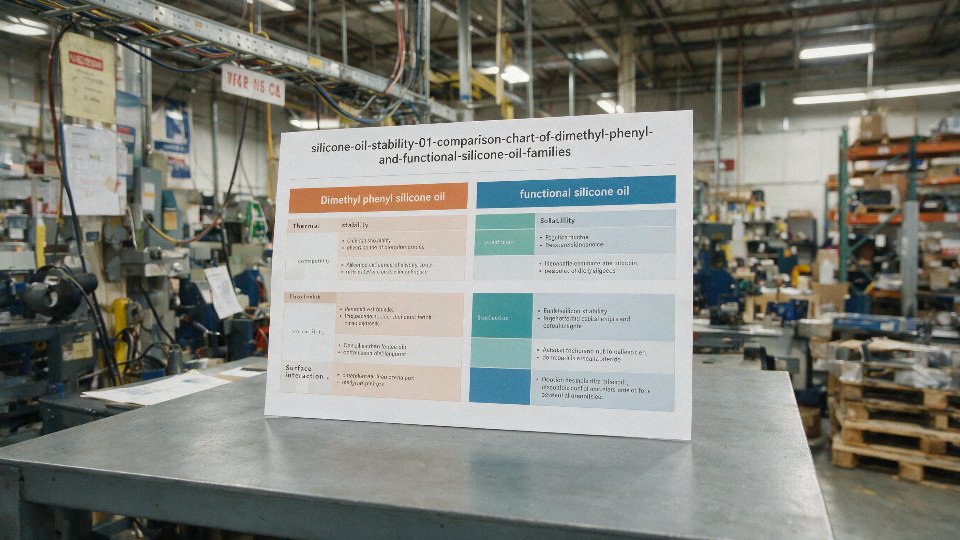
If you are comparing grades for a live application, the useful inputs are the substrate, contaminant or co-chemicals present, approximate film or bath thickness, operating temperature profile, contact metals, and whether the system is sealed or vented. With that, a supplier can usually narrow the field quickly and identify where lab screening or a small plant trial is worth doing before you lock in a purchasing spec.
How stability is measured
No single test proves silicone oil is “chemically stable” in a way that matters for procurement or process design. Credible evaluation comes from a test set that matches the actual failure mode: sealed thermal exposure for closed systems, open aging for hot air contact, compatibility work for wetted materials, and field trending to confirm what the lab missed.
A lot of bad buying decisions start with one attractive number on a data sheet. A low viscosity shift after thermal aging may look excellent, but if the test was sealed, dry, and oxygen-starved, it tells you very little about an oil running hot in a vented bath, on a tenter frame, or in a poorly sealed gearbox reservoir with seasonal moisture ingress.
Thermal aging tests: sealed and open are not interchangeable
Sealed aging and open aging answer different questions.
- Sealed thermal aging is used to evaluate intrinsic thermal and oxidative resistance with limited oxygen exchange.
- Open thermal aging is used where the fluid sees air continuously, and often where evaporation, surface oxidation, and contamination matter as much as bulk chemistry.
In practice, both are useful. The mistake is treating one as a substitute for the other.
Sealed-system aging
Typical sealed protocols place a known mass or volume of silicone oil in a closed vessel, then hold it at a fixed temperature for a defined period before comparing key properties against the fresh sample. For standard dimethyl silicone oil, buyers often see tests run in the broad range that corresponds to its usual continuous service window, with specialty grades pushed higher under controlled conditions. Reported kinematic viscosity change after thermal aging in sealed tests is often within about 5% to 15%, but that range depends heavily on grade, temperature, duration, headspace, moisture, and whether catalytic metals were present.
Why it matters:
- It isolates the oil’s resistance to chain scission or condensation-type changes under controlled heat history.
- It reduces the noise introduced by evaporation and random shop contamination.
- It is useful for dielectric fluids, sealed hydraulic or damping applications, and closed heat-transfer loops where oxygen access is genuinely limited.
What buyers should verify before comparing suppliers:
- Test temperature and dwell time
- Vessel type and fill ratio
- Headspace gas composition, if controlled
- Presence or absence of metal coupons
- Sample mass and exposed surface area
- Whether moisture was controlled before testing
- Exact before/after analytical method
If those do not match, the comparison is weak. A “better” result may simply reflect a less severe protocol.
Open-system aging
Open aging usually exposes the oil to elevated temperature with air contact, often in a shallow vessel that increases surface area. This is closer to service in open baths, textile heating media, mold-release carryover zones, or any operation where the fluid is hot and vented.
Mechanistically, this test stresses two things at once:
- Oxidation at the air-oil interface
- Volatilization of low molecular fractions
That combination can flip rankings. An oil that looks very stable in a sealed bottle may lose more mass, darken faster, or form more deposits in open air because the stress mode is different. This is one reason accelerated testing can distort supplier ranking if the laboratory setup does not resemble service.
A sealed thermal aging result cannot be used by itself to rank silicone oils for high-temperature open-air service.True
Open-air service introduces oxygen replenishment, volatilization, and surface-driven degradation that sealed tests suppress. The ranking may change once mass loss and deposit formation are allowed to develop.
What the main outputs actually tell you
A useful stability report should include more than one property. Each output points to a different degradation path.
| Output | What it indicates | What can confuse it |
|---|---|---|
| Viscosity change | Polymer chain growth, chain scission, contamination, volatile loss | Small contamination can move viscosity before chemistry has materially degraded |
| Acid number | Oxidative byproducts or contamination with acidic species | Some systems show low acid rise even while volatiles or deposits increase |
| Volatile content | Loss of low-boilers, cyclics, or cracked fractions | Sampling and open handling can skew results |
| Weight loss | Evaporation and thermal decomposition under open aging | Surface area and airflow change results dramatically |
| Color shift | Oxidation, contamination, metal interaction | Color alone is not a rejection criterion |
| Flash point change | Build-up or loss of lighter fractions | Requires careful standardized method control |
| Dielectric properties | Suitability for insulating duty, contamination sensitivity | Moisture and particles can dominate over base-fluid chemistry |
| Insoluble formation | Sludge, gel, coke precursors, deposit risk | Filtration method and cutoff affect reported result |
Two practical points matter here.
First, viscosity is important but not sufficient. A fluid can stay near target viscosity while still losing flash point, building volatiles, or developing insolubles that foul small passages and heater surfaces.
Second, dielectric measurements are only meaningful on clean, dry samples handled properly. Representative dielectric strength for clean, dry silicone insulating fluids is often around 10 to 20 kV/mm, but moisture and fine contamination can pull that down fast enough to make a sound fluid look bad.
Instrumental methods that separate guesswork from evidence
Basic before/after property testing is useful. When drift appears, instrumental analysis usually tells you why.
- FTIR: good for identifying oxidation-related functional changes and broad chemical shifts. It is often the quickest way to confirm that the fluid chemistry is moving, not just picking up dirt.
- GC or GC-MS: used to characterize volatile fractions, cyclics, and decomposition products. This matters when odor, flash point drift, or unexpected mass loss shows up.
- TGA: tracks mass loss as temperature rises. Useful for screening volatility and thermal residue behavior, but the heating rate and atmosphere strongly affect the curve.
- DSC: helps identify thermal transitions and oxidation-related events. More informative for comparative development work than for standalone procurement decisions.
- Karl Fischer: essential where moisture affects dielectric performance, hydrolytic side reactions, or repeatability. In plants near the coast, this catches more trouble than many teams expect.
Compatibility testing is part of stability testing
A silicone oil can be chemically stable on its own and still fail the application because something in the system attacks it, extracts from it, or is attacked by it.
Test against the actual contact set where possible:
- Metals and alloys in heaters, pumps, tanks, and fittings
- Elastomers in seals, O-rings, hoses, and valve seats
- Plastics in sight glasses, manifolds, and electrical insulation parts
- Coatings, paints, adhesives, and potting materials
- Process chemicals such as amines, cleaners, catalysts, metalworking residues, and additives from upstream steps
Run compatibility trials at realistic temperature and dwell time. A room-temperature immersion check is not enough for a seal that sits compressed at elevated temperature for months. In my experience, this is where buyers get burned by “chemically inert” assumptions. The oil may be fine; the fluorocarbon seal, acrylic window, or cured coating may not be.
Field monitoring: trend first, judge later
In service, trend data beats a single pass/fail number. The absolute limit matters, but the rate and direction of change usually tell you more about whether you have normal aging, contamination, or a process upset.
A practical field program includes:
- Consistent sampling points
- Same location, same operating state, similar time after circulation
- Routine property checks
- Viscosity, appearance, color, moisture, and application-specific electrical properties where relevant
- Cleanliness inspection
- Particles, insolubles, filter debris, and tank-bottom residue
- Operating context
- Temperature history, air exposure, heater condition, seal failures, top-up events, maintenance work
- Escalation analysis
- Use FTIR, GC/GC-MS, or metals analysis when a drift trend starts rather than waiting for failure
When properties move, root cause matters more than blame. Viscosity increase with insolubles may point to oxidation or contamination from process carryover. Viscosity drop with flash point decline often suggests light-end contamination or thermal cracking. Dielectric deterioration with otherwise stable viscosity often turns out to be moisture or particle ingress, not bulk fluid failure.
The main boundary on all of this is simple: accelerated testing is essential, but it is only trustworthy when the stress mode matches service. For a sealed dielectric system, sealed aging plus moisture and dielectric monitoring may be exactly the right evidence set. For hot, vented, open-air duty, open aging, weight loss, volatile analysis, and deposit tendency usually deserve more weight than a neat sealed-bottle viscosity result.
Industrial uses and limits
Silicone oil is genuinely superior where the job rewards thermal breadth, chemical inertness, low residue, or stable rheology over time. It becomes only adequate, or the wrong choice, when the duty shifts toward severe boundary lubrication, strong chemical attack, open high-temperature oxidation, or formulations where migration and surface effects create downstream defects.
In practice, buyers get into trouble by treating “chemically stable” as “universally suitable.” The right comparison is not silicone oil versus failure; it is silicone oil versus the specific failure mode that actually matters in your process: varnish, sludge, evaporation, dielectric loss, seal attack, paint cratering, poor wetting, or load-related wear.
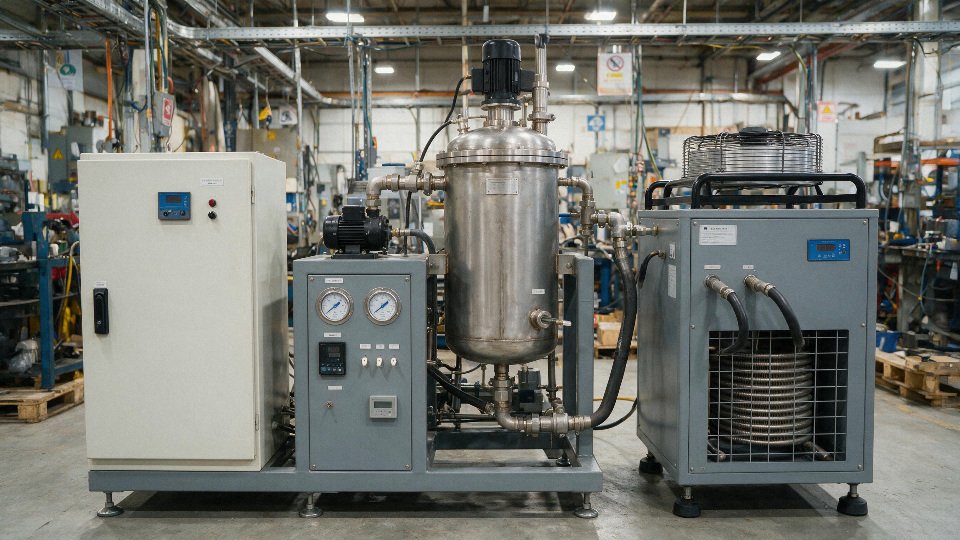
Heat transfer systems, thermal baths, and process temperature control
For closed or well-managed temperature-control loops, silicone oil is often one of the cleaner-working fluid options, especially when startup cold flow and elevated-temperature stability both matter. Standard dimethyl silicone oils are commonly used across roughly -50 to 200 C continuous service, with some specialty grades pushed higher under controlled conditions, but open systems at the hot end need a harder engineering review than many data sheets suggest.
The mechanism is straightforward. Stable viscosity across a broad temperature band helps maintain predictable pump behavior, film formation on heated surfaces, and heat-transfer consistency. That matters in jacketed reactors, lab baths, roll temperature control, and small process units where a mineral oil that thickens too much cold or oxidizes too early hot starts creating maintenance work fast.
Where the choice starts to flip:
- Closed loop or nitrogen-blanketed system: silicone oil usually holds its value well.
- Open bath near the top of the temperature range: volatility, oxidative thickening, and deposit risk become more important.
- Poor vent design or frequent air ingress: fluid life can shorten sharply.
- Hot spots at heaters: local film temperatures, not bulk temperature, often determine degradation rate.
A common plant-floor issue is undersized circulation or a fouled heater sheath. Bulk fluid may look within range, but the wall temperature runs far higher. That drives chain scission or oxidation locally, then you start seeing odor, light fractions, or viscosity drift. If the application lives on heater cleanliness and tight temperature control, silicone oil usually performs well; if it lives on uncontrolled hot spots, the chemistry alone will not save the system.
Electrical insulation, transformers, capacitors, and damping devices
In insulating-fluid and damping duties, silicone oil is valued less for headline dielectric numbers than for retention of performance under heat and time. Clean, dry silicone insulating fluids often show dielectric strength around 10 to 20 kV/mm, but moisture and contamination can pull that down quickly enough to matter.
That moisture sensitivity is where some buyers overgeneralize. Silicone fluids tend to form less sludge than many hydrocarbon systems under comparable thermal stress, which helps keep narrow passages, paper systems, and internal surfaces cleaner. But dielectric reliability still depends on housekeeping:
- Dry filling and sealed handling
- Clean tanks, hoses, and breathers
- Control of particulate ingress
- Verification after maintenance, not just at commissioning
For damping devices, instrument dashpots, and motion-control elements, viscosity stability matters as much as insulation behavior. A fluid that drifts too far with age changes response time, needle settling, or actuator smoothness. Sealed aging tests often accept viscosity change in roughly the 5% to 15% range, depending on grade, temperature, and duration, but that does not automatically predict field life if the assembly breathes, sheds wear particles, or sees incompatible elastomers.
Lubrication, damping, and precision mechanisms
Silicone oil works well in light-load lubrication, damping, and low-shear precision applications where inertness and viscosity retention matter more than extreme pressure performance. That is why you keep seeing it in instruments, textile components, automotive trim or damping parts, plastics-processing auxiliaries, and small mechanisms that must stay smooth without gumming up.
The trade-off is simple and important:
- Gain: stable viscosity, oxidation resistance, broad temperature usability, low residue
- Sacrifice: load-carrying ability in metal-to-metal severe contact, unless the system is specifically formulated around that limitation
If the duty is boundary lubrication with shock loading, gear tooth stress, or heavily loaded sliding contact, silicone oil is often not the best standalone answer. In my experience, this is one of the most expensive misunderstandings because the fluid looks elegant on paper, then the wear scars show up in service.
Release, defoaming, personal care, and specialty formulations
In release and defoaming, silicone oil is useful because surface activity and chemical inertness can survive process conditions that ruin less stable additives. That said, the same low-surface-energy behavior that makes it effective can create contamination problems downstream.
Typical decision points include:
- Release systems: excellent slip and release, but migration can interfere with painting, printing, bonding, or secondary coating.
- Defoaming: very effective at low dosage in many systems, but overfeed can create surface defects or fisheyes.
- Personal care and specialty formulations: oxidative and sensory stability may be good, but regulatory status, purity profile, volatile content, and market-specific compliance must be checked grade by grade.
Silicone oil's chemical stability alone does not guarantee formulation stability or regulatory suitability.True
In formulated products, performance also depends on emulsifiers, carriers, functional additives, contamination control, and the applicable cosmetic, food-contact, electrical, or industrial regulations for the target market.
Modified silicone fluids in construction, coatings, and process aids
Modified silicone fluids can solve substrate-wetting or compatibility problems that straight dimethyl fluids cannot. Polyether-, alkyl-, aryl-, amino-, epoxy-, or other functional modifications often improve affinity to coatings, mineral substrates, fibers, or polymers.
The catch is that the long-term stability now depends heavily on that functional chemistry, not just the siloxane backbone. Hydrolysis sensitivity, yellowing tendency, reactivity with formulation components, and storage stability can change a lot from one modified fluid to another. Two products that both get sold as “silicone oil” may behave very differently in alkaline cementitious systems, moisture-cure coatings, or high-shear waterborne formulations.
Where silicone oil may not be the right fluid
Silicone oil is usually a poor fit, or at least a high-risk fit, in these conditions:
- Strong acid or strong base exposure: especially where contamination is continuous rather than incidental
- Oxygen-rich, high-temperature open systems: oxidation and volatilization risk rise sharply at the hot end
- Aggressive solvent contamination: swelling, dilution, extraction, or property drift can dominate the service outcome
- Extreme-load lubrication: heavily loaded gears, cams, or metal sliding contacts often need EP/AW performance silicone oil does not inherently provide
- Processes highly sensitive to surface contamination: paint shops, adhesive lines, and some electronics assembly areas may reject even trace silicone carryover
That boundary matters more than the generic stability claim. If your duty is mainly heat, time, and cleanliness, silicone oil is often a strong candidate. If your duty is chemistry, oxygen exposure, solvent attack, or load, the safer procurement path is to define the exact exposure profile and verify by compatibility and service testing before you lock the fluid in.
Storage and handling controls
Good silicone oil is often lost in storage and transfer, not in service. If you keep it clean, dry, correctly segregated, and away from needless heat, silicone oil usually stays within its intended stability window for long periods; if you let moisture, shop dirt, the wrong hose, or a half-clean tote into the loop, complaints start looking like “chemical instability” when the root cause is handling. Most avoidable failures I see are contamination-driven, with oxidation and viscosity drift accelerated by poor startup practice rather than by the fluid itself.
Container and warehouse practices
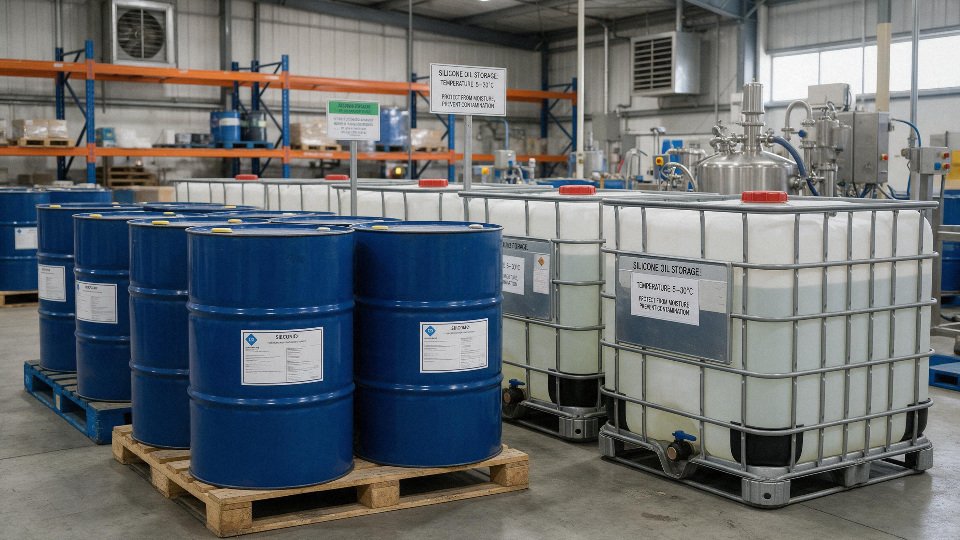
Start with packaging discipline. Drums, IBCs, and bulk tanks should stay sealed until use, and opened containers should be reclosed promptly with clean caps or blind fittings, not rags and tape. Silicone oil is generally less reactive than many organic fluids, but that does not make it immune to water pickup, airborne fines, or residues from a shared warehouse pump.
A workable warehouse routine usually includes:
- Clean, dry storage
- Keep containers under cover, off bare concrete if possible.
- Protect bungs, vents, and camlock caps from washdown spray and condensation.
- Store partly used containers upright; horizontal storage with a poor bung seal is an invitation for moisture ingress.
- Temperature control
- Avoid repeated heating and cooling cycles, which can pull humid air into partially filled containers.
- Do not store next to steam lines, rooftop doors, or sun-exposed walls unless the package is insulated or shaded.
- Direct sunlight matters less because silicone oil “hates light” in the abstract and more because package temperature rises, seals age faster, and breathing increases.
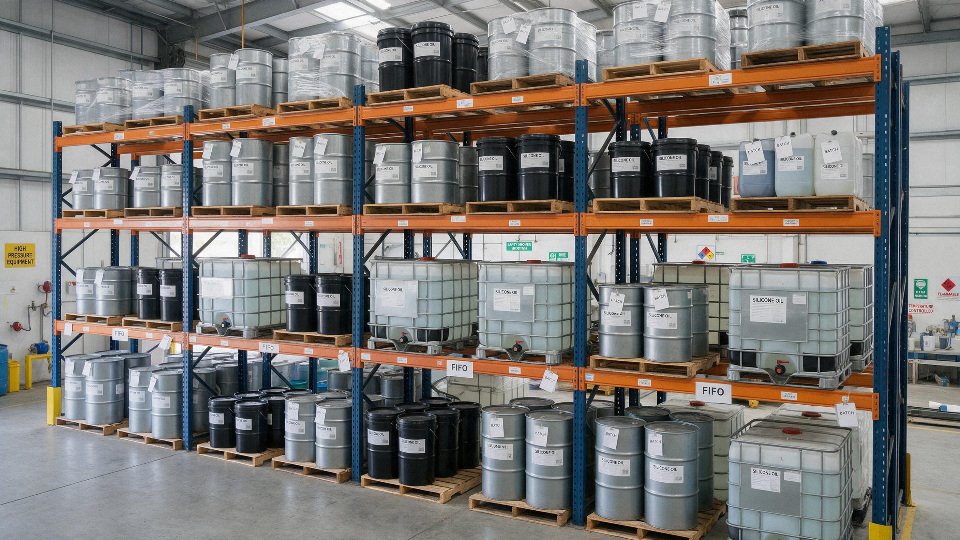
- FIFO control
- Use first-in-first-out by batch and receipt date.
- Do not let slow-moving specialty viscosities sit forgotten until labels fade and no one can verify what is inside.
- Moisture protection
- For insulating or other sensitive applications, dry storage conditions are not optional. Dielectric performance for clean, dry silicone fluids can drop sharply when moisture or particulates get in, so verify storage and handling against the current supplier guidance and your internal cleanliness standard.
Transfer discipline
Transfer is where mixed-grade incidents happen. Shared pumps, borrowed hoses, and an unfiltered top-up cart create more trouble than most buyers expect.
Use these controls:
- Dedicated pumps and lines where practical
- Separate by product family, and in tighter operations by viscosity band or end use.
- A line that carried mineral oil, solvent cleaner, or release-agent blend last week is not “close enough” unless it has been validated clean.
- Filtered filling
- Fit transfer points with appropriate filtration based on the application’s cleanliness requirement.
- The right filter rating depends on viscosity, flow rate, and end use; there is no honest universal micron number for every silicone oil system.
- Contamination prevention
- Closed transfer beats open pouring every time.
- Clean sample thieves, funnels, quick-connects, and portable carts before use, and tag them for silicone service only.
- Nitrogen blanketing where justified
- Usually justified for hot bulk tanks, moisture-sensitive service, or long residence times with headspace breathing.
- Not every day tank needs nitrogen. The benefit flips when the system is small, turnover is fast, and the added blanketing hardware is more likely to be mismanaged than useful.
- Clear segregation by grade and viscosity
- Mark tanks, lines, pumps, and fill ports with product name, viscosity, and intended application.
- Similar-looking clear fluids are notorious for mix-ups on second shift.
Material compatibility checks
Most standard silicone oils work well with common metals and many elastomers, but “many” is not the same as “all.” Before first fill, and again whenever maintenance substitutes parts, verify compatibility for:
- Tanks and hard piping
- Carbon steel, stainless steel, and aluminum are often acceptable, depending on service conditions and contamination tolerance.
- Gaskets and seals
- Check the actual elastomer grade, not just “rubber” on the spare-parts list.
- Swelling, softening, or extractables from the wrong gasket can show up as leaks, haze, or downstream deposits.
- Hoses and valve seats
- Flexible hose liners, valve-seat polymers, and sight-glass seals are common weak points during changeouts.
- Sampling devices
- Cheap sample bottles, dirty syringes, or reactive liners can ruin a diagnostic sample before the lab sees it.
The mechanism is simple: incompatible soft parts can leach low-molecular species into the oil or degrade physically, and once that debris circulates through a hot system, you no longer know whether a viscosity shift came from thermal aging or from the hardware.
Startup and shutdown procedures
A stable fluid can still be damaged by unstable operation. Fast heat-up, dead legs, poor circulation at the heater face, and cleaner carryover create local conditions far harsher than the bulk temperature suggests.
Control the sequence:
- Startup
- Confirm the correct grade before charging.
- Establish circulation before full heat input.
- Ramp temperature in steps where the system has known hot spots or thick-wall vessels.
- Check for blocked strainers, stuck control valves, and bypasses left shut after maintenance.
- Normal shutdown
- Reduce heat before stopping circulation where the system design allows.
- Avoid leaving fluid stagnant against a hot surface.
- Maintenance or extended stoppage
- Isolate silicone oil from wash chemicals, solvent flushes, descalers, and process residues.
- If a line has been cleaned, verify dryness and cleaner removal before refill. Residual cleaner contamination is one of those embarrassing failures that looks mysterious until someone opens the work order.
This guidance stops holding if the process itself introduces reactive contaminants continuously; in that case, storage discipline helps, but the dominant fix is process isolation or fluid selection.
Housekeeping and documentation
The plants that solve silicone oil issues fastest are usually not the ones with the fanciest lab. They are the ones that can tell you exactly which batch went where, what changed after the last shutdown, and whether the complaint started after a hose replacement or a supplier switch.
Maintain at least:
- Batch traceability
- Link received batch, storage vessel, transfer date, and consuming line or customer shipment.
- Certificate review
- Check the supplier certificate against the ordered grade and your critical acceptance points.
- Review exceptions, not just the existence of paperwork.
- Retained samples
- Keep sealed retains from receipt and, where justified, from first-fill or shipment lots for later comparison.
- Trend logs
- Record recurring indicators such as viscosity checks, appearance, dielectric behavior where relevant, odor changes, deposit formation, filter loading, or customer complaint patterns.
Most silicone oil stability complaints originate from handling contamination rather than intrinsic fluid breakdown.False
This is a common plant-level pattern, not a universal fact. The split depends on application severity, process contamination, temperature exposure, residence time, and maintenance discipline. Use your own failure history and lab data before treating handling as the dominant cause.
Frequently asked questions
Is silicone oil more chemically stable than mineral oil?
Usually yes, especially against heat, oxygen, and viscosity drift over a broad temperature range. That advantage is why silicone oil is often chosen for heat transfer, damping, dielectric service, and release applications where mineral oil thickens, oxidizes, or forms sludge sooner.
The comparison still depends on the failure mode.
- At elevated temperature: silicone oil generally resists oxidation and deposit formation better than many mineral oils.
- At low temperature: silicone oil usually keeps flow better, while mineral oils can wax or become too viscous.
- Under severe contamination: both can fail, just in different ways. Mineral oils tend to oxidize and varnish; silicone oils are more vulnerable to certain acids, alkalis, and catalytic contaminants.
- Under boundary lubrication: silicone oil is not automatically the better choice. Chemical stability does not equal better load-carrying performance.
If the plant problem is sludge, carbon, or viscosity rise in hot service, silicone oil often wins. If the problem is heavy-load lubrication or compatibility with an existing additive package, the answer may flip.
Can silicone oil oxidize at high temperature?
Yes. Silicone oil is not oxidation-proof; it is simply more resistant than many conventional fluids under comparable conditions. In open hot systems with air exposure, metal contact, and long residence time, oxidation and thermal degradation can still occur.
What operators usually see first is not a dramatic chemical reaction but a gradual shift:
- viscosity increase or, in some cases, viscosity loss
- volatile formation and higher evaporation loss
- deposits on heaters, hot plates, or vent lines
- odor change
- darker appearance, though color alone is not a reliable acceptance criterion
The mechanism matters. Heat and oxygen together can attack the polymer structure, and hot metal surfaces can accelerate the process. A fluid that looks acceptable in a sealed lab aging test may age much faster in a poorly vented expansion tank with localized hot spots. That is why the typical continuous service range often quoted for standard dimethyl silicone oil, about -50 to 200 C, must be read together with system design, air exposure, and contamination control.
Does silicone oil react with water?
In most neutral, low-contamination conditions, silicone oil does not react rapidly with water. It is hydrophobic and generally separates rather than dissolves, which is one reason it is useful in moisture-prone environments.
That said, water is still a practical problem.
- In insulating service: moisture can sharply reduce dielectric performance. Clean, dry silicone insulating fluids may show dielectric strength around 10 to 20 kV/mm, but water and particulates can pull that down fast.
- In hot systems: repeated water ingress can promote hydrolysis indirectly if acids, alkalis, or reactive fillers are present.
- In process equipment: water contamination complicates sampling, filtration, and startup. Anyone who has heard a hot loop spit and hammer after a wet fill remembers it.
So the right answer is: usually no direct concern in neutral storage, but do not treat water contamination as harmless.
Can acids or alkalis damage silicone oil?
Yes, and alkalis are often the bigger practical concern. Strong acids and especially strong bases can catalyze siloxane bond cleavage or rearrangement, which leads to viscosity change, volatile formation, or gel-like byproducts depending on the system.
Watch these exposure routes:
- caustic wash residues left in tanks or transfer lines
- alkaline cleaning agents not fully rinsed out
- acidic process carryover
- reactive mineral fillers or catalysts in compounded systems
- dirty drums, reused IBCs, or wrong hose sets at filling stations
A silicone oil that is stable in a clean drum can fail quickly after one bad transfer through a line that previously carried caustic. Procurement people sometimes miss this because the incoming COA looks fine; the damage happens after receipt.
How long can silicone oil last in service?
There is no honest universal service-life number. It can be months, several years, or much longer, depending on temperature, air exposure, contamination, residence time, and what failure criterion matters in that application.
Use these inputs to estimate service life realistically:
- normal and peak operating temperature
- sealed or open system
- oxygen exposure rate
- moisture ingress
- contact metals and elastomers
- allowable viscosity shift
- acceptable deposit level
- electrical, thermal, or surface-performance requirement
In controlled sealed aging tests, viscosity change after thermal aging is often accepted within roughly 5% to 15%, depending on grade, temperature, and duration. Field life is usually governed by the dirtiest part of the system, not the neat lab result.
Does viscosity grade affect stability?
Yes, but not in a simple “higher viscosity is more stable” way. Viscosity grade affects volatility, flow behavior, heat transfer, film retention, and how degradation shows up during service.
Typical patterns:
- Lower-viscosity grades
- better low-temperature flow
- often lower pumping losses
- usually more prone to evaporation loss at high temperature
- Higher-viscosity grades
- better film retention and lower volatility
- harder cold start and slower deaeration
- contamination can be harder to detect until performance drifts
So viscosity choice is partly a stability decision and partly an operating-envelope decision.
Can different silicone oils be mixed safely?
Only if compatibility has been confirmed for the exact grades. “Silicone oil” covers plain dimethyl fluids, phenyl-modified grades, amino- or polyether-modified products, and fluids with very different additive or end-group chemistry.
Do not assume mixability based on appearance or viscosity alone. Before mixing, verify:
- chemistry family and modification type
- viscosity grade
- additive package
- intended end use
- electrical, thermal, or surface-property requirements
- supplier guidance or a bench compatibility test
Any two silicone oils can be mixed without affecting stability.False
Some blends remain physically uniform but still lose performance, drift in viscosity, foam differently, or fail compliance requirements. Compatibility needs grade-specific confirmation.
What tests should I request from a supplier before purchase?
Ask for the tests that match your failure risk, not a generic broad panel.
For most industrial buying, request:
- kinematic viscosity at the stated test temperature
- appearance and color
- moisture content, especially for dielectric or high-temperature use
- acid number, where relevant
- volatile content or evaporation loss, if the fluid will see heat
- density and flash point, if those affect handling or design
- dielectric strength and volume resistivity for electrical service
- thermal aging data for the grade, with the test conditions clearly stated
- lot COA and product specification limits
- compatibility or application guidance for elastomers, plastics, coatings, or process chemistry in your system
If the supplier offers sample evaluation against your actual substrate, contaminant, or operating temperature, that usually tells you more than a glossy data sheet.
Is silicone oil suitable for food, medical, or electronic applications by default, or only in specific compliant grades?
Only in specific compliant grades. Base chemistry alone does not make a fluid acceptable for regulated or sensitive applications.
Check for the exact requirement that applies:
- Food-related use: applicable food-contact status must be documented for the intended use and geography.
- Medical or pharmaceutical use: biocompatibility, purity, and manufacturing controls must be confirmed grade by grade.
- Electronics: cleanliness, ionic contamination, dielectric properties, volatility, and outgassing limits may matter as much as basic chemical stability.
A standard industrial grade may be chemically stable and still be the wrong purchase if it lacks the right compliance file, cleanliness control, or application-specific test data.
Verify your service conditions
If your process stays inside the fluid’s thermal, chemical, and maintenance envelope, silicone oil is often a very forgiving choice; if one or two conditions sit outside that envelope, it can become an expensive troubleshooting exercise. The right decision is usually clear once you check the service window systematically instead of buying on viscosity and price alone.
Use this as a go or no-go screen before trial or purchase:
- Operating temperature range
- Record normal, minimum, maximum, and upset temperatures, not just the nominal setpoint.
- Separate bulk fluid temperature from hot-surface or film temperature. A heater skin, pump seal face, or transformer hotspot can run far above the sump average.
- Standard dimethyl silicone oil is commonly workable in continuous service at roughly -50 to 200 C, but that does not mean every grade is equally suitable at the top end. Verify actual aging data at your duty point.
- Oxygen exposure
- Note whether the system is sealed, vented, sparged, or repeatedly opened for maintenance.
- Oxidative stress rises fast in thin films, high-surface-area circulation loops, and tanks with warm headspace breathing. In practice, a vented kettle and a sealed heat-transfer loop are not the same service, even at the same temperature.
- Moisture level
- Identify where water can enter: humid storage, washdown areas, leaking jackets, wet compressed air, or hygroscopic residues in the process.
- For electrical duty, this point gets stricter. Clean, dry silicone insulating fluids may show dielectric strength in the 10 to 20 kV/mm range, but moisture and particulates can drag that down quickly.
- Contact materials
- List all wetted materials: carbon steel, stainless, aluminum, copper alloys, elastomers, sealants, hose liners, coatings, adhesives, and any plastic sight glasses or level indicators.
- Small items cause plenty of grief here. A gasket compound, thread sealant, or cheap hose inner tube can be the first thing that fails.
- Electrical duty
- Clarify whether the oil is serving mainly as a heat-transfer medium, lubricant, damping fluid, release aid, or dielectric fluid.
- Electrical applications need tighter control of dryness, cleanliness, and field stress. Ask for application-specific data, not just a general TDS.
- Contamination risks
- Check for metal fines, catalyst residues, acids, alkalis, solvent carryover, carbonized deposits, and process dust.
- The mechanism matters: contamination does not just “dirty” the fluid; it can accelerate oxidation, shift viscosity, foul surfaces, and distort test results.
- Maintenance practice
- Confirm filtration, tank cleaning interval, sampling discipline, drum handling, desiccant breathers, and whether make-up fluid is controlled by batch.
- A stable fluid in a poorly controlled plant will still give unstable service life.
- Required lifetime
- Define what success means: weeks in a temporary process aid, one campaign, one year between changeouts, or multi-year service.
- Also define the failure point: viscosity drift, dielectric loss, odor, deposit formation, flash-off, color change, or product contamination.
The minimum supplier data package should include:
- Technical data sheet with viscosity grade and test methods
- Typical test values, not only specification limits
- Thermal aging data, with test conditions stated
- Volatility or weight-loss data at relevant temperature
- Compatibility guidance for metals, elastomers, and plastics
- Regulatory or compliance statements relevant to your market
- Batch consistency information, COA format, and change-control practice
A short note on aging data: sealed-test viscosity change after thermal aging is often accepted in the ballpark of 5% to 15%, depending on grade, temperature, and duration. That is useful for screening, but it is not a universal pass/fail rule for every application. A vented, contaminated, intermittently overheated plant system can age very differently from a sealed lab test.
Follow a structured qualification path:
- Bench compatibility test
- Soak actual seals, hoses, coatings, and wetted small parts at temperature.
- Check swelling, embrittlement, extractables, softening, and mass change.
- Pilot trial under worst-case conditions
- Run the hottest practical cycle, longest residence time, and highest oxygen exposure you expect in service.
- Include startup and shutdown if those are the dirty parts of the process.
- In-service sampling plan
- Set sample points, timing, container cleanliness, and retention samples before startup.
- Trend viscosity, appearance, moisture if relevant, and any application-specific property.
- Acceptance criteria
- Define allowed viscosity drift, dielectric drop, volatility loss, deposit level, or contamination threshold before the trial starts.
Choose standard dimethyl silicone oil when the service is mainly thermal or mechanical, temperatures are inside a proven range, contamination is controlled, and broad compatibility is acceptable. Move to a modified grade when you need a property the standard fluid does not give cleanly, such as altered low-temperature flow, improved solvency, changed surface behavior, or a different electrical profile; just remember that improving one property can narrow another operating limit. Consider a non-silicone fluid when the process involves aggressive chemistry, severe contamination, incompatible contact materials, or economics that do not support silicone’s premium once fluid life is normalized against losses and maintenance.
If you want to screen suitability before a trial, send the service temperature range, substrate or wetted contact materials, target viscosity, and application type. With that, a supplier can usually narrow the grade shortlist and suggest a sensible validation plan before you commit plant time or purchase volume.