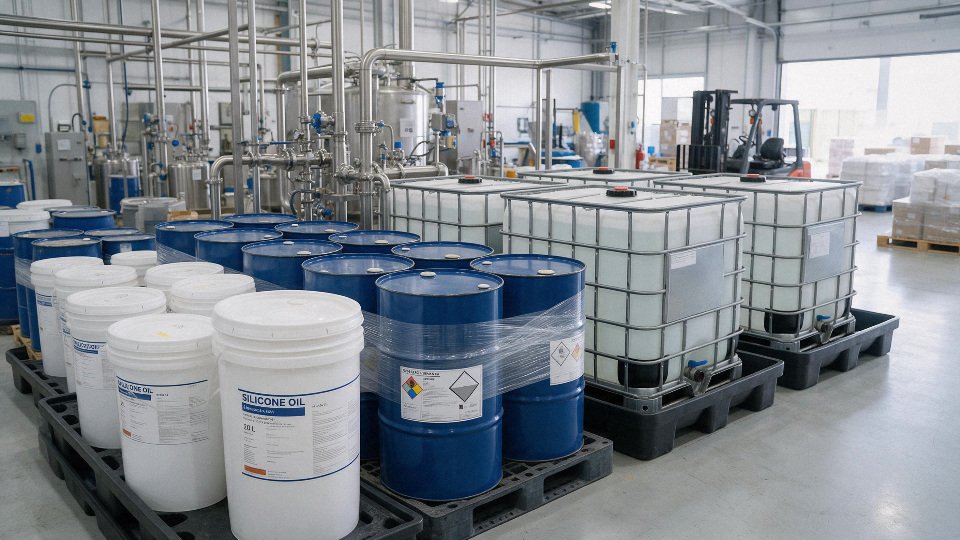
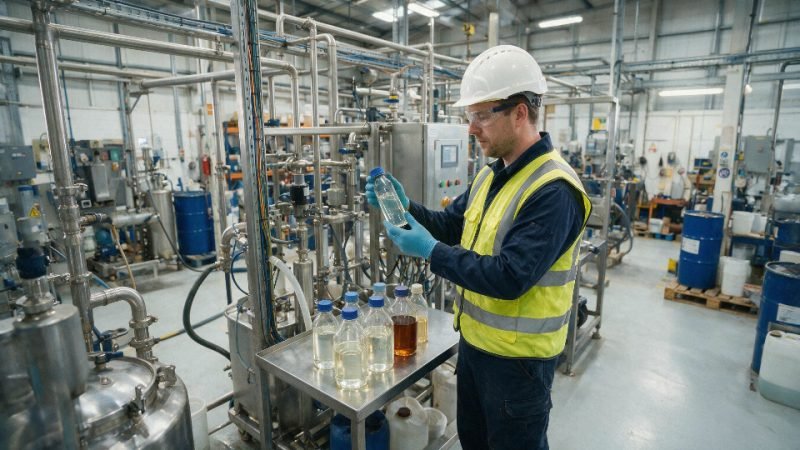
Silicone oil usually does not “flash react” with alkali the way an acid-base neutralization does, but in alkaline service it can slowly break down, lose viscosity, and generate silanol-rich fragments. On a plant floor, that shows up as drift in release performance, unstable lubrication, fouling, seal swell complaints, or a fluid that no longer behaves like the one purchasing approved. The cost is rarely the drum itself; it is line stoppage, rejected parts, cleanup labor, and buying the wrong replacement chemistry twice before someone traces the problem back to pH, temperature, and residence time.
Silicone oil can react with alkali, but the answer depends on the silicone type, alkali strength, temperature, water content, and exposure time. Standard PDMS fluids are generally stable in neutral service and often tolerate mild alkaline contact for limited periods, while strong alkali, heat, and long residence time can drive siloxane bond cleavage, viscosity loss, and silanol formation.
That conditional answer is where most purchasing mistakes happen. A fluid can look fine in a bench jar test and still fail in a hot recirculating wash loop, a caustic-cleaned dosing skid, or a vented process where water and base sit together for days. The practical question is not just whether alkali attacks silicone oil, but when the chemistry crosses from acceptable exposure into a reliability problem you can measure.
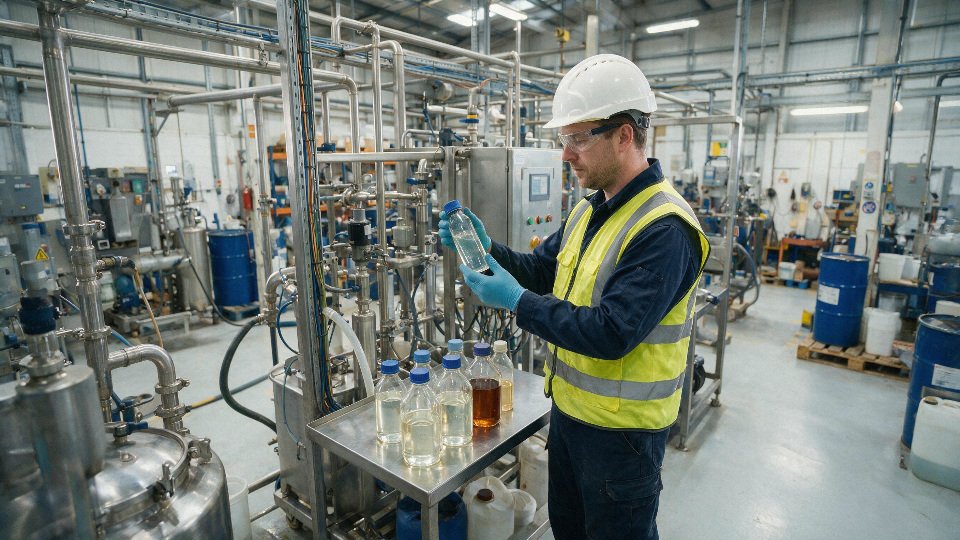
Reaction chemistry and mechanisms
Silicone oil does react with alkali, but not in the simple “acid plus base” sense many buyers expect. The practical risk is alkali-catalyzed rearrangement, hydrolysis, and molecular-weight change of the siloxane structure, and that risk stays low in dry, mild service but rises fast once you add water, heat, residence time, and enough base strength.
The reason this catches people out is that silicone oils are often sold and specified as inert fluids. That description is directionally true against many oxidants, weathering conditions, and moderate process chemicals, yet it stops holding once the fluid sits in alkaline, especially aqueous, service long enough for the siloxane chemistry to move.
Why the Si-O-Si backbone behaves differently from hydrocarbon oils
A standard silicone oil such as PDMS is built around a siloxane backbone: Si-O-Si, with organic groups, usually methyl, attached to silicon. That backbone is not the same as a hydrocarbon chain. Mineral oils and many synthetic hydrocarbon oils are dominated by C-C and C-H frameworks; they can oxidize, crack, or sludge under the wrong conditions, but they do not undergo the same base-catalyzed siloxane equilibration chemistry.
The Si-O bond is quite strong, but the siloxane linkage is also unusually flexible and chemically distinctive. In alkaline conditions, especially with water present, the network can be opened and redistributed through ionic mechanisms. So the issue is not that alkali simply “dissolves” silicone oil. The issue is that alkali can catalyze a shift in the molecular architecture itself:
- chain scission into lower-molecular-weight species
- redistribution among chain lengths
- ring formation from linear chains
- ring opening under some conditions
- silanol formation and later condensation
- viscosity drift in either direction, depending on the fluid type and the surrounding chemistry
That last point matters on the plant floor. A buyer may assume degradation always means lower viscosity. In practice, some systems thin out, some temporarily thicken, and some become erratic because cleavage and re-condensation are happening together.
Base-catalyzed siloxane equilibration and chain scission
Under alkaline conditions, the key mechanistic step is nucleophilic attack at silicon. Hydroxide or another basic/nucleophilic species can attack the silicon atom in a siloxane bond, because silicon is susceptible to nucleophilic substitution in ways carbon in a hydrocarbon backbone is not.
A simplified pathway looks like this:
- A base generates or stabilizes a reactive silanolate species.
- That silanolate attacks another silicon center in a Si-O-Si linkage.
- The bond rearranges, cleaves, or redistributes.
- New chain ends, cyclic species, or different molecular-weight fractions are formed.
The intermediate usually discussed in industry is the silanolate. Once silanolate ends are present, they can continue attacking siloxane bonds elsewhere in the fluid. That is why even modest initial activation can turn into broader redistribution if conditions stay favorable.
This is the mechanism behind base-catalyzed equilibration. Instead of one clean reaction giving one clean product, you often get a moving distribution of species:
- shorter linear siloxanes
- longer linear siloxanes from redistribution
- cyclic siloxanes formed by back-biting or intramolecular rearrangement
- silanol-bearing species if hydrolysis is active
If you are trying to predict field behavior, think in terms of residence time and catalyst availability, not just chemical compatibility tables. A quick splash at room temperature may do nothing measurable. A recirculating alkaline wash loop at elevated temperature is a different problem.
Water changes the problem from “possible” to “active”
Dry alkaline systems often look stable enough in service, at least over short periods. Once water is present, the risk usually moves from theoretical to operational. Water supports hydrolysis, ion mobility, and formation of reactive silanol and silanolate species, so aqueous alkali is usually far more aggressive to silicone oil than dry alkaline contact.
That is why two plants can report opposite experiences with what sounds like the same chemical exposure. One may have a mostly dry formulation with low free water and brief contact time; the other may have a heated caustic wash, emulsion system, or open tank pulling in moisture every shift.
Mechanistically, water contributes in two ways:
- It enables hydrolytic cleavage of siloxane linkages or end groups under alkaline catalysis.
- It provides the medium in which hydroxide and other ions remain available to keep redistribution going.
In practice, aqueous NaOH, KOH, amines at high pH, alkaline cleaners, or detergent packages with builders can all create conditions where silicone fluid that looked stable in storage starts changing in process. Agitation makes this worse because it increases interfacial contact in emulsified or dispersed systems. Heat pushes it further by increasing reaction rate and often improving phase contact.
If the silicone oil is sitting as a neat, dry bulk fluid with brief alkaline contact, visible change may be negligible; if it is emulsified in hot alkaline water, the same chemistry can become measurable over one production hold or CIP cycle.
Terminal groups matter more than many specs acknowledge
Not all silicone oils present the same reactive ends. End groups influence both how degradation starts and what viscosity drift looks like afterward.
Trimethylsiloxy-terminated fluids
Trimethylsiloxy-terminated PDMS fluids are capped with relatively nonreactive end groups. These fluids are generally more resistant to end-group-driven condensation because they do not carry terminal Si-OH functionality. In alkaline service, they can still undergo backbone redistribution and scission, but the starting end-group chemistry is less eager to self-condense.
That usually translates into better apparent stability in mild exposure, especially where water is limited.
Hydroxyl-terminated fluids
Hydroxyl-terminated silicone fluids are more reactive. Terminal silanol groups can be deprotonated under alkaline conditions, producing silanolate species that are directly involved in condensation and redistribution reactions. These fluids can show stronger viscosity drift because the chemistry can move in both directions:
- chain extension or branching by condensation
- chain cleavage and redistribution to lower-molecular-weight fractions
- stronger sensitivity to catalyst residues and metal contamination
In production, hydroxyl-terminated grades can surprise people. A fluid may first show viscosity increase in storage or mixing, then later thin out after longer alkaline exposure because the distribution has shifted again. If the product is part of an emulsion, textile finish, release coating intermediate, or silicone-modified formulation, end-group selection is not a side detail; it is often the difference between acceptable shelf life and a warranty issue.
Linear fluids, cyclic siloxanes, and crosslinked networks do not fail the same way
The same alkaline environment does not affect every silicone form in the same pattern.
| Silicone form | Typical alkaline response | What may form |
|---|---|---|
| Linear PDMS fluid | Redistribution, chain scission, viscosity shift | Lower-MW linear species, cyclic siloxanes, silanols |
| Cyclic siloxanes | Ring opening or participation in equilibration, depending on conditions | Linear species, redistributed cyclic/linear mixtures |
| Crosslinked silicone network | Surface attack, bond cleavage, softening, embrittlement, swelling changes, loss of properties rather than simple viscosity change | Smaller extractable siloxanes, altered network fragments |
Linear fluids are the easiest case to visualize because viscosity tracks molecular weight reasonably well. As alkali drives redistribution, the fluid can move toward lower average chain length and lower viscosity. But if condensation is also active, especially in silanol-rich systems, that relationship can temporarily blur.
Cyclic siloxanes are part of the same equilibrium family. They are not automatically “stable by shape.” Under catalytic conditions, rings can open and re-enter the redistribution pool. Conversely, linear chains can cyclize. That is one reason composition drift can be hard to interpret from a single QC number.
Crosslinked elastomeric or resin-like silicone systems are different again. They do not simply become a lower-viscosity oil. Instead, alkaline attack may reduce mechanical integrity, alter swell behavior, generate extractables, or break down the surface first. For seals, coatings, and molded parts, the failure mode is often property loss before obvious mass loss.
Why mild exposure may show nothing, then elevated service shows a problem
A common misunderstanding in maintenance and purchasing is to treat “no visible change” as proof of compatibility. Silicone oil under mild ambient alkaline exposure may show little to no immediate evidence of reaction because early-stage redistribution does not always produce obvious color, odor, or phase change. The fluid may still look clear and pour normally.
Raise any combination of the following, and measurable degradation becomes much more likely:
- temperature
- pH / alkali concentration
- residence time
- water content
- mixing intensity
- interfacial area in emulsions or dispersions
- catalytic contamination from metals or residues
The mechanism is straightforward: higher temperature accelerates nucleophilic substitution and equilibration kinetics; agitation increases contact between aqueous alkali and silicone phase; longer hold time lets a small catalytic effect accumulate into a meaningful molecular-weight shift. In batch systems, the fluid may pass a same-day visual check and still fail viscosity or volatile-content targets after a weekend hold.
The boundary on this conclusion is simple: if the system is dry, cool, briefly exposed, and the silicone fluid is well capped and uncontaminated, alkaline attack may remain too slow to matter commercially. Once the process becomes hot, wet, and recirculating, you should assume the chemistry is active until testing proves otherwise.
Formulation contaminants and plant conditions can change the rate by a lot
Published compatibility statements usually describe a neat fluid under controlled conditions. Plant systems are messier. The effective pathway and rate of degradation can change because of side ingredients and contamination that never appear on the purchase order summary.
Watch these modifiers closely:
- Fillers
Silica, mineral fillers, and treated powders can carry adsorbed water, residual alkali, or catalytic surface sites. - Emulsifiers and surfactants
These increase contact between silicone and aqueous alkali. A fluid that survives as a separate phase may degrade much faster once emulsified. Residual catalysts
Tin, amine, alkali, or other catalyst residues from upstream synthesis or formulation can shift the reaction path.Metal ions
Iron, aluminum, sodium, potassium, and trace metal contamination from vessels, poor rinsing, or utility water can alter stability. The exact effect depends on species and concentration, so this usually needs lab verification rather than assumption.Cleaning chemical carryover
Caustic CIP residues left in tote lines, mixers, or transfer hoses are a routine source of unexplained viscosity drift.Moisture pickup
Humid weather, vented tanks, washed drums, and half-sealed IBCs all matter more than the specification sheet suggests.
Silicone oil is chemically inert to alkali under all normal industrial conditions.False
Silicone oils are often broadly chemical-resistant, but alkaline stability is conditional. Water, temperature, residence time, end-group chemistry, contaminants, and catalytic residues can all make alkali-catalyzed siloxane redistribution or hydrolysis commercially significant.
If you are trying to judge whether alkaline exposure is a paperwork issue or a true degradation risk, the missing inputs are usually not exotic. You need the fluid type, end groups, whether the system is dry or aqueous, actual pH range, temperature profile, hold time, and whether the silicone is a neat phase or an emulsion. Without those, any universal compatibility answer is guesswork.
Which silicone oils are vulnerable
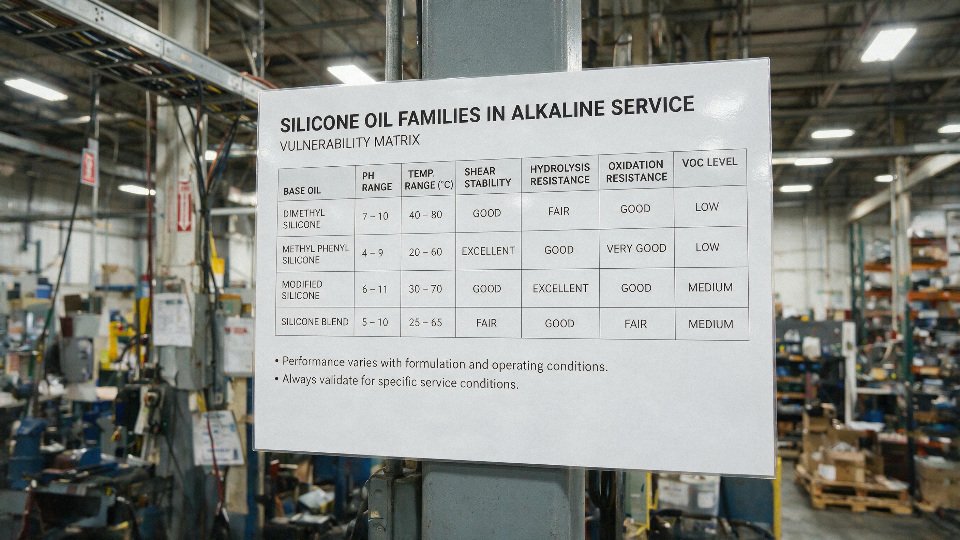
No silicone oil family is “alkali-proof” in the absolute sense, but their practical risk is not the same. For screening purposes, buyers should expect unmodified PDMS to be the baseline, hydroxyl-terminated grades to be more sensitive in wet alkaline service, emulsions to fail functionally earlier than neat fluids, and modified silicones to depend as much on side-chain chemistry as on the siloxane backbone itself.
The useful distinction on a plant floor is not just fluid versus gum or low versus high viscosity. It is molecular architecture, end-group activity, formulation format, water content, and how long the material actually sits in alkaline contact at temperature. A drum sample can look fine after a short bench check and still drift badly in a recirculating bath, especially if the line runs hot and sees air ingress.
PDMS fluids
Polydimethylsiloxane, the standard dimethyl silicone oil, is the reference point because it is the most common industrial silicone fluid and often the one people mean by “silicone oil.” In neutral service it is usually very stable, which is why it shows up in defoamers, release systems, lubricants, dielectric fluids, and processing aids across textile, chemical, and general manufacturing plants.
Under alkaline hydrolytic conditions, though, PDMS is only conditionally stable. The siloxane backbone can undergo cleavage and rearrangement in the presence of hydroxide, especially when water, heat, and residence time line up. What operators often first notice is not dramatic decomposition but a drift in viscosity, changes in flow, and sometimes silanol formation or redistribution effects before obvious bulk failure.
In practice, vulnerability rises with these conditions:
- Higher pH, particularly strong alkali rather than mildly alkaline washdown or incidental contamination
- Higher temperature, because hydrolysis and equilibration both accelerate
- Longer exposure time, especially in batch hold tanks or recirculating systems
- More water present, since many alkaline attack pathways are far more relevant in wet service than in dry contact
- Greater interfacial area, such as thin films, emulsified systems, or coated surfaces
The trade-off is straightforward: PDMS is often the lowest-cost, easiest-to-source silicone fluid family, but that commercial convenience can mislead buyers into using it in alkaline systems where the true issue is exposure profile, not nominal fluid type. The baseline holds reasonably well for brief, cool, mildly alkaline contact; it stops holding once the service becomes hot, wet, and strongly alkaline.
Hydroxyl-terminated silicone oils
Hydroxyl-terminated silicone oils are typically more exposed in alkaline systems than comparable end-blocked PDMS fluids. Those terminal silanol groups are chemically active, and in moisture-containing alkaline formulations they can participate in condensation, equilibration, and molecular-weight redistribution that changes the product long before anyone sends out a full analytical panel.
That matters in sealant intermediates, reactive silicone blends, and some specialty processing fluids. A buyer may order on viscosity and assume two 1,000 cSt silicone fluids are operationally similar; one may be relatively steady, while the hydroxyl-functional version shifts because the ends are participating in chemistry. On the floor, the first complaint is often batch inconsistency: one lot thickens, the next loses body, and the operator blames mixing time or raw-material temperature.
Watch these variables closely:
- Moisture in tanks, lines, or packaging headspace
- Alkaline catalysts or alkaline contaminants from cleaning residues
- Hold time between blending and use
- Metal surfaces that may carry residual basic species from previous campaigns
Hydroxyl-terminated silicone oils are always unsuitable for alkaline formulations.False
They are not automatically disqualified. Suitability depends on pH, water content, temperature, catalyst package, and required storage or service life. They are simply more sensitive than fully end-blocked fluids under comparable wet alkaline conditions.
Amino-modified silicone oils
Amino-modified silicone oils need a more careful screen than many buyers give them. Their risk is not only the siloxane backbone under alkali; the amino functionality itself can change behavior inside the formulation through altered compatibility, ionic interactions, emulsion balance, and deposition performance.
This shows up a lot in textile finishing, softeners, and surface-treatment packages. A product may remain visibly fluid, but its application performance drops because the amino-modified phase no longer deposits, disperses, or stabilizes the same way. In other words, the functional failure can arrive before clean evidence of backbone scission is obvious.
Typical concerns include:
- Changes in amine state and formulation balance at elevated pH
- Destabilization with anionic ingredients
- Loss of softness, slip, or substrate affinity after alkaline aging
- Simultaneous backbone degradation in hot, wet, high-pH service
Epoxy-, polyether-, and other organically modified silicone fluids
These cannot be judged as one category. The siloxane portion still carries the familiar alkaline sensitivity, but the side chains may become the shorter pole in the tent depending on the chemistry.
A few practical distinctions matter:
- Epoxy-modified silicones can face side-chain reactivity or compatibility changes in alkaline media, sometimes affecting cure behavior, adhesion, or storage stability.
- Polyether-modified silicones are often selected for wetting, defoaming, or emulsification, but their hydrophilic side chains increase interaction with aqueous alkaline systems. That can improve dispersion while also exposing the fluid more thoroughly to the aqueous phase.
- Other specialty organic modifications may bring their own alkaline liabilities that are separate from the siloxane chain, so supplier-specific review is necessary.
The mechanism point here is worth stating plainly: a side chain that improves water compatibility can increase contact between the silicone molecule and the alkaline aqueous phase, which may accelerate observed instability even if the backbone chemistry itself has not changed category.
Phenyl-modified silicone oils
Phenyl substitution often improves thermal behavior and low-temperature performance relative to straight dimethyl systems, and that is useful in heat-transfer, dielectric, and specialty lubrication contexts. It does not remove the basic fact that the siloxane backbone remains susceptible to strong alkali.
That distinction gets blurred in procurement because phenyl fluids are perceived as “higher performance” and therefore broadly tougher. They may indeed outperform PDMS in some thermal and oxidative conditions, but alkaline resistance should not be assumed from that reputation alone. If the service issue is hot caustic contact, phenyl content is not a reliable shortcut to safety.
Silicone emulsions and microemulsions
Silicone emulsions and microemulsions often show trouble earlier than neat fluids because colloidal stability can fail before backbone degradation becomes analytically obvious. In production, that is what operators actually care about first: creaming, phase separation, particle growth, viscosity jump, loss of dilution stability, and poor application uniformity.
Common failure routes in alkaline systems include:
- Emulsifier degradation or loss of balance
- Charge disruption in the dispersed system
- Electrolyte effects from alkaline builders or salts
- Coalescence at elevated temperature
- Local high-pH pockets from poor make-up or dosing practice
A lab may report only modest chemical change in the silicone phase while the line has already lost a saleable emulsion. That is why emulsion format should be treated as its own risk class, not just “PDMS plus water.”
High-viscosity gums and silicone polymers
High-viscosity gums and polymeric silicone materials can appear more resistant simply because change is slower to observe. Lower mobility can delay bulk viscosity drift or make sampling less representative, but localized alkaline attack at interfaces still matters, especially on wetted surfaces, in thin edge films, or where caustic residues sit after cleaning.
Typical problem locations are easy to miss:
- Tank walls above the main liquid line
- Mixer shafts and seals
- Filter housings and dead legs
- Coated rolls, molds, or transfer surfaces
- Partially cured or partially solvated polymer zones
A thick material can mask early-stage damage. By the time the bulk sample shows a clear shift, the application defect may already be scrap, adhesion loss, gel specks, or difficult cleanout.
The common buyer mistake
The most common screening mistake is choosing by viscosity grade alone. Two silicone oils with similar viscosity can behave very differently in alkaline service because end groups, organic modification, emulsion package, and water affinity often matter more than the centistoke number on the data sheet.
Before approving a material, buyers should ask for these details:
- Base silicone family: PDMS, phenyl, amino, polyether, epoxy, or other modification
- End-group type: trimethylsilyl, hydroxyl, alkoxy, reactive functional end groups
- Delivery form: neat fluid, solution, emulsion, microemulsion, gum
- Expected pH range and whether exposure is continuous or intermittent
- Water content and operating temperature
- Required stability definition: viscosity retention, appearance, emulsion stability, functional performance, or all of them
If the alkaline service is anything beyond brief incidental contact, screening by family name is not enough. The next sensible step is a short exposure test on the actual formulation or process liquor, because the failure mode may come from emulsion collapse, side-chain incompatibility, or end-group chemistry before anyone sees classic backbone degradation.
When degradation becomes significant
Silicone oil degradation under alkali becomes a plant problem when three things line up: enough basicity, enough contact, and enough temperature or mixing to keep the phases talking to each other. In practice, the trouble point is usually not “any alkali present,” but “alkali present at an active interface for long enough that viscosity, silanol content, or end-use performance starts drifting before anyone notices visually.”
A drum of PDMS sitting dry and closed near a mildly alkaline material is one thing. A hot CIP return loop, an amine-rich emulsion under shear, or a recirculating blend tank with carryover caustic is something else entirely. That is where theoretical sensitivity turns into scrap, unstable foam control, coating defects, or a customer complaint that shows up two weeks later instead of on the day of manufacture.
Alkali type and concentration do not create the same risk
Not all alkaline systems attack silicone oil in the same way or at the same practical rate. Buyers sometimes reduce the question to pH alone, but that misses what actually matters on the floor: base strength, solubility, water phase availability, and how well that alkali gets distributed onto or into the silicone phase.
- Sodium hydroxide and potassium hydroxide
- Usually the highest-risk common plant alkalis for PDMS degradation when water is present.
- Strong bases, fully dissociated in water, and very effective at driving siloxane bond cleavage at accessible interfaces.
- KOH and NaOH are often similar in practical effect unless concentration, temperature, or formulation details push one system into better phase contact than the other.
- CIP solutions, alkaline wash tanks, and caustic-contaminated transfer lines are the usual problem points.
- Ammonia
- Often less aggressive than strong caustics at the same nominal alkalinity, especially at lower temperature.
- Risk rises in aqueous systems with prolonged contact, elevated heat, or where ammonia is part of a formulation that keeps silicone well dispersed.
- Volatility complicates things; the bulk pH today may not match the condition after venting or heating.
- Amines
- Wide category, so broad claims are risky.
- Some amines act mainly as mild bases; others also improve wetting, solubilization, or interfacial contact, which can make a moderate chemical risk into a practical processing problem.
- In coatings and release formulations, amines can create delayed instability rather than immediate visible breakdown.
- Silicates, carbonates, and alkaline builders
- Often less aggressive than NaOH or KOH on a pure base-strength basis.
- They still matter because they can hold the aqueous phase alkaline for long periods, shift interfacial behavior, or leave alkaline residues after cleaning.
- Builders in detergents or cleaners may not look severe on paper, yet repeated exposure can still move viscosity or performance over time.
A weaker alkali can still create serious silicone oil degradation if it improves dispersion or keeps the oil in alkaline water for long enough.True
Practical degradation depends on contact efficiency, water phase behavior, temperature, and exposure time, not only nominal base strength or pH.
The boundary here is simple: if the silicone remains essentially isolated from the alkaline phase, even a strong alkali may do little in the short term. Once you disperse the oil finely or hold it at a water-rich interface, the ranking above starts to matter much more.
Temperature is often the factor that turns “stable enough” into “not acceptable”
A silicone oil that behaves acceptably at room temperature can become unreliable once the system runs hot. Reaction rates for base-catalyzed siloxane cleavage typically climb fast with temperature, so hot blending, heated recirculation, and alkaline cleaning loops deserve more scrutiny than warehouse storage.
The benchmark logic is straightforward even if exact limits depend on grade and formulation:
| Service condition | Typical practical concern level |
|---|---|
| Neutral to near-neutral storage at moderate temperature | Usually low concern for standard PDMS if contamination is controlled |
| Mild alkaline exposure at ambient temperature | Often manageable for short contact, but requires verification if emulsified or repeatedly exposed |
| Mild to moderate alkaline exposure at elevated temperature | Frequently where measurable viscosity drift starts to show up |
| Strong alkaline exposure, especially under continuous heat | High risk; property loss can become process-relevant quickly |
Heat changes more than chemistry. It also lowers viscosity, improves mixing, and often increases mass transfer at the oil-water boundary. That means a hot wash step may expose more fresh silicone surface to alkali than a cold soak of much longer duration. In a high-shear reactor, that effect compounds: lower viscosity lets you create finer droplets, and finer droplets create more interfacial area, which gives the alkali more attack points.
CIP systems are a classic trap. Operators focus on cleaning efficiency, not on what a 1 hour hot caustic cycle, repeated several times a week, does to residual silicone defoamer, pump lubricant carryover, or silicone-based process aids left in dead legs and valve cavities.
Water activity and phase structure matter as much as bulk chemistry
Neat silicone oil without meaningful water contact is generally a different situation from silicone oil dispersed into an alkaline aqueous system. The degradation pathway needs practical access, and water-rich interfaces usually provide it.
The main cases are not interchangeable:
- Neat oil with trace alkaline contamination
- Often slower, sometimes hard to detect early.
- Damage may stay localized unless mixing redistributes the contamination.
- Oil-water interface
- Common in partially separated tanks, wash systems, and contaminated packaging.
- Localized reaction at the interface can generate silanol groups and shift viscosity before the whole batch looks different.
- Emulsion droplets
- Much higher contact area.
- Small droplet size usually accelerates measurable change because more silicone molecules sit near the reactive boundary.
- Fully formulated alkaline systems
- Highest uncertainty.
- Surfactants, builders, co-solvents, salts, and amines can either intensify or partially mask degradation.
- You need application testing here; category-level assumptions are not enough.
Residence time is cumulative, not just continuous
Repeated short exposures can add up to the same practical damage as one long exposure, especially when each cycle refreshes the interface or reheats the system. That matters in recirculating lines, tote-to-tank transfer systems, and plants that run frequent alkaline cleanouts between batches.
Watch for these cumulative patterns:
- Short CIP cycles with incomplete rinsing
- Residual alkali remains in low points, pump heads, spray balls, or sample valves.
- The next silicone-containing batch sees a fresh, localized compatibility hit.
- Recirculation through alkaline-contaminated equipment
- Each pass may be mild.
- After enough residence time, viscosity or functional performance drifts beyond spec.
- Intermittent batch holds at elevated temperature
- “Only 20 minutes at a time” sounds harmless until it happens ten times per week.
This is why single-exposure bench screening can underpredict field problems. If the plant process includes recirculation, reheating, or repeat cleanup, the test design should reflect that.
Shear and interfacial area accelerate what the lab jar test may miss
High agitation does not change the chemistry by itself; it changes the contact pattern. More shear means smaller droplets, thinner films, and faster renewal of the reactive interface. On the floor, rotor-stator mixers, high-speed dispersers, inline homogenizers, and some centrifugal pumps can all make an alkaline compatibility issue appear sooner.
The trade-off is obvious enough: better dispersion and faster blending on one side, faster property loss on the other. A formulation that survives a slow paddle mixer trial may fail under production shear because the production equipment creates a much finer emulsion.
Contaminants and equipment residues complicate the pathway
The batch is rarely pure silicone plus pure alkali plus pure water. There are usually residues, catalysts, salts, and worn hardware in the system.
Common complicating factors include:
- Metal hydroxides or metal contamination
- Can shift alkalinity, create local catalytic effects, or alter emulsion stability.
- Residual catalyst from upstream silicone processing
- May change how quickly chain scission or redistribution shows up.
- Salts and dissolved solids
- Can change phase behavior, droplet stability, and extraction between phases.
- Process impurities
- Low molecular weight siloxanes, solvents, or additives can mask early warning signs.
Packaging and transfer hardware create their own hidden failures:
- Drum or tote liners with alkaline residue from prior use or cleaning
- Seals and gaskets that trap wash solution
- Pump housings and hose assemblies with poor rinse-out
- Carbon steel sections shedding corrosion products into an already marginal formulation
A batch can leave the mixer looking fine and still be on the way to failure. Visual clarity is not proof of chemical stability. Molecular-weight change can develop quietly, then show up later as lower viscosity, poorer foam control persistence, changed wetting, coating defects, or storage instability after shipping. That delayed behavior is exactly why alkaline compatibility should be checked with time, temperature, and process-history conditions that match the plant, not just with a same-day appearance check.
Process impacts and failure symptoms
Most alkaline damage to silicone oil shows up first as a process-control problem, not a dramatic visible “reaction.” The early signs are usually viscosity drift, unstable emulsions, inconsistent application performance, and analytical results that stop matching the product’s normal fingerprint. If the exposure is strong enough or long enough, those soft warnings turn into scrap, bath instability, release problems, filter plugging, and awkward customer complaints about odor, finish, or surface defects.
Viscosity drift is usually the first measurable warning
In plain PDMS systems, alkali-driven chain scission typically pulls viscosity downward because the average chain length drops. That part is straightforward. What catches people out is that the measured change is not always a clean, steady decline.
A few patterns show up in practice:
- Gradual viscosity loss
- Common in bulk fluids exposed to alkaline wash water, caustic residues, or high-pH process carryover
- Usually indicates net depolymerization and lower molecular weight
- Erratic or non-linear viscosity
- Seen when chain scission and limited re-condensation are happening together
- Can also appear when sampling temperature, water content, or emulsion state is not controlled tightly
- Apparent viscosity increase in emulsions or compounded systems
- Often not true molecular build-up
- More often caused by particle growth, partial gel formation, surfactant upset, or water-phase changes
- Batch-to-batch spread widening before the mean shifts
- One of the most useful early indicators in production
- The average may still pass spec while process reproducibility is already deteriorating
The mechanism matters here. Alkali changes the polymer first, but the plant feels it through pumpability, atomization, metering, coating pickup, and drain behavior. A release coating line may start laying down less uniformly; a textile bath may wet differently; a defoamer may disperse too fast or too slowly. Once viscosity drift starts affecting dosing consistency, the quality problem is already larger than the lab number.
Functional performance drops before total failure
The exact symptom depends on why the silicone oil was there in the first place. A lubricant, release aid, defoamer, dielectric fluid, and textile softener do not fail in the same way, even if the underlying chemistry is similar.
Common application losses include:
- Lubricity loss
- Higher friction
- More stick-slip
- Noisier running surfaces
- Faster wear in lightly loaded contact points
- Slip and release reduction
- Higher release force
- Patchy demolding
- Transfer to the wrong surface
- More buildup on tooling
- Gloss and surface feel changes
- Lower gloss or irregular sheen
- Harsh or uneven hand feel on treated fabrics
- Reduced flow or leveling contribution in coating systems
- Defoaming inefficiency
- Slower foam knockdown
- Shorter foam-control duration
- Foam returning after circulation or recirculation
- Worse performance after dilution
- Dielectric property drift
- Relevant in electrical fluids or specialty formulations
- Moisture uptake, low-boiling fractions, or polar silanol formation can alter insulation behavior
- This needs confirmation against the current application standard and product data; it should not be guessed from viscosity alone
- Surface activity changes
- Wetting balance shifts
- More craters or dewetting in one system, less migration in another
- Strongly formulation-dependent, especially with modified silicones
The trade-off is unpleasantly familiar: a partially degraded silicone can still “work” enough to stay in production, but it works inconsistently. That is often worse than a clean failure because operators start adjusting pH, add-on level, oven settings, line speed, or antifoam dose to chase a moving target.
By-products create odor, volatility, and release-test trouble
As degradation progresses, you can see more than chain-length change. Silanols, cyclics, low-boiling species, and redistributed fractions may appear, depending on the silicone type, alkali strength, residence time, and water present.
Typical consequences:
- Higher or less stable volatile content
- Noticeable odor shift, especially after heating
- Lower or drifting flash point
- Higher extractables
- GC, FTIR, or other QC fingerprints moving outside the product’s normal envelope
- Trouble meeting downstream internal limits for emissions, residue, or retained volatiles
A silicone oil can stay visually clear while its analytical profile has already shifted enough to affect release, odor, or compliance screening.True
Early alkaline degradation often changes molecular distribution before it creates obvious haze or gel. Visual inspection alone is a weak release criterion for exposed material.
This is one boundary worth stating clearly: if the product is used in a non-critical, low-temperature application with broad acceptance limits, small analytical shifts may not matter operationally. In food-contact, electronics, personal care, or tightly controlled coating systems, the same shift can become a release hold.
Emulsions usually show the problem faster than neat fluids
Alkaline exposure is especially unforgiving in silicone emulsions because the polymer, surfactant package, water phase, and particle structure all interact. You are not just degrading the oil; you may be destabilizing the whole dispersion.
Watch for:
- Creaming or sediment-like separation
- Phase split after storage or after one freeze-thaw / heat cycle
- Particle growth
- Reduced dilution tolerance, especially into hard water or alkaline make-up water
- Higher sensitivity to shear
- Bath reproducibility loss from one shift to the next
A textile or paper mill usually notices this as “the bath is not behaving the same today,” even when the make-up recipe is unchanged. In a coating kitchen, the first complaint may be poor letdown or a milky appearance that does not recover.
Surface defects and equipment symptoms are often the expensive stage
Once degraded material gets into production, the visible defects tend to multiply:
- Haze or clarity loss
- Fish-eyes
- Crater formation
- Poor leveling
- Uneven hand feel
- Deposit formation on rolls, pans, nozzles, or guides
Equipment starts talking too:
- Foam excursions in tanks and return loops
- Filter loading rising faster than normal
- More difficult cleaning after degraded-product buildup
- Seal compatibility issues because the overall formulation composition has shifted, not necessarily because PDMS itself suddenly attacks the elastomer
That last point gets missed. Maintenance may blame the pump seal brand, but if the fluid now contains more low-boiling fragments, altered surfactant balance, or caustic contamination, seal life can change for reasons that were not present when the original material was approved. At that stage, the right next check is usually a side-by-side comparison of fresh versus exposed material: viscosity, pH of the aqueous phase if present, volatiles, appearance after dilution, and a simple application panel before the line is adjusted again.
Testing and verification methods
A useful alkali-compatibility test is built around the exact exposure your plant will create, not a generic “chemical resistance” label. Use the production-grade silicone, the actual alkali species, the expected concentration, temperature, and contact time, then compare it against a neutral control; otherwise you can approve a material that survives in a beaker but fails fast at the oil-water-alkali interface in service.
If you are qualifying material for purchase, treat testing in three layers: quick screening, analytical confirmation, and application simulation. That sequence saves money. There is no point paying for FTIR, GPC, and a week of aging work if a first-pass exposure already shows phase split, heavy viscosity drift, or obvious performance loss.
Build a fit-for-purpose test matrix first
Start with the exposure matrix before you choose instruments.
- Use the actual silicone grade
- Same viscosity grade
- Same end-group type if known
- Same emulsion package if buying an emulsion, not just the neat oil
- Same lot form as supplied to production, because additives and residual low boilers can change behavior
- Match the alkali actually used on site
- Sodium hydroxide and potassium hydroxide are not always interchangeable in practice
- Amines, carbonate systems, silicate cleaners, and blended alkaline detergents can behave differently from plain caustic at the same measured pH
- If the process sees hard water, include plant water or a simulated water chemistry
- Set realistic operating conditions
- Alkali concentration range: nominal plus upset condition
- Temperature: startup, normal running, hot-cleaning, and any hold condition
- Contact time: seconds, minutes, or recirculated hours
- Agitation or shear level, because interfacial renewal often accelerates damage
- Include controls
- Neutral water control
- If relevant, acidic or buffered comparison
- Fresh unexposed reference retained for later analytics
That last point matters more than it sounds. Many compatibility calls are wrong because people compare “aged in alkali” against memory, not against a paired neutral-aged control under the same thermal history. Heat alone can move viscosity or volatiles.
Simple screening methods that catch problems early
These are low-cost checks, but they are not trivial. Done properly, they usually tell you whether to keep going.
- Visual stability
- Check clarity, haze, color shift, skin formation, gel particles, and foam persistence
- For emulsions, look for creaming, oiling-off, sediment, or soap-like thickening
- Phase separation
- Record time to split after controlled mixing
- In an emulsion, note whether separation is reversible by mild shaking or permanently broken
- pH drift
- Measure initial and final pH of the aqueous phase
- A shift can indicate consumption of alkaline species, contamination, or reaction products entering the water phase
- It is not a stand-alone proof of reaction, but it is a useful flag
- Viscosity tracking
- Measure at defined shear and temperature
- For neat fluids, compare before/after viscosity
- For emulsions, check both bulk viscosity and any separated oil phase if present
- Mass balance after controlled exposure
- Weigh before exposure, after exposure, and after any drying or phase recovery
- Large unexplained loss can point to volatilization, extraction of low molecular fractions, or handling error
A practical mechanism sits behind these simple tests: alkali attack often starts at chain ends or accessible siloxane bonds, then creates lower-molecular fragments and silanol-containing species. That shifts viscosity, changes interfacial behavior, and can destabilize an emulsion before you see a dramatic chemical signature on a spectrum.
Analytical methods: confirm what changed
Use analytical work to answer a specific question, not because the instrument is available.
| Method | What it helps confirm | What to watch |
|---|---|---|
| FTIR | Silanol growth, changes in siloxane-related bands | Best used against a fresh control and, ideally, a neutral-aged control |
| GPC or molecular-weight distribution | Chain scission, broadening, shift to lower molecular weight | Sample prep matters; emulsions often need careful isolation first |
| GC for cyclics and volatiles | Formation or release of low boilers and cyclic siloxanes | Distinguish pre-existing volatiles from degradation-generated material |
| Acid-base titration where relevant | Change in neutralization demand, free alkali consumption, or acid number shift in blended systems | Only meaningful when the formulation chemistry supports the interpretation |
FTIR is often the fastest confirmation tool if you suspect hydrolysis-related change. GPC gives stronger evidence when procurement or quality teams need a harder pass/fail basis, because you can show whether the molecular-weight distribution moved materially. GC becomes important when odor, volatility loss, deposit formation, or compliance around low-boiling fractions is part of the buying decision.
A viscosity check alone is enough to qualify silicone oil for alkaline service.False
Viscosity can stay near target while interfacial instability, low-level chain scission, or performance loss in the final application is already developing. Use viscosity as a screen, not the whole approval basis.
Emulsion-focused tests need their own protocol
If the silicone is supplied or used as an emulsion, test the emulsion as an emulsion. Neat oil data helps, but it does not answer the plant question.
- Particle size
- Track average size and distribution before and after alkaline exposure
- Growth often signals destabilization well before full break
- Zeta potential where applicable
- Useful when the stabilization mechanism is charge-sensitive
- Interpretation depends on the emulsion system; not every product family supports a clean universal threshold
- Centrifuge stability
- Good for fast comparative screening of borderline formulations
- It is an accelerated discrimination tool, not a direct life prediction
- Freeze-thaw response
- Worth running if storage or transport sees winter conditions
- Alkali-exposed emulsions often lose resilience here first
- Dilution robustness in alkaline water
- Check dilution into actual process water and into the highest expected alkaline dilution
- A product that is stable neat may break immediately in a caustic make-down tank
This is where the main trade-off shows up. A formulation can be chemically fairly stable in neat form yet operationally weak once dispersed, because the oil-water-alkali interface is more aggressive than the bulk oil phase. That is the boundary on many neat-oil conclusions: they stop holding once the product is emulsified, diluted, or repeatedly sheared in alkaline water.
Application simulation and aging protocols
Once screening and analytics look acceptable, run the property that production actually buys the silicone for.
- Defoamer: foam knockdown and persistence after alkaline aging
- Release coating or additive: release force after soak or oven aging
- Slip or lubricity: slip coefficient under the actual finish chemistry
- Electrical use: dielectric breakdown or insulation-related checks after exposure
- Textile use: hand feel, sewability, yellowing, and wash durability under alkaline processing
For aging, use a matrix that includes:
– Accelerated thermal aging
– Static alkaline soak
– Repeated CIP-style exposure if the silicone sees cleaning cycles
– Neutral-condition comparison at the same temperature and time
Repeated CIP simulation is worth doing if equipment surfaces retain a thin film between runs. One short caustic wash may not show much; twenty cycles can.
Supplier documentation to request before approval
Ask for documents that actually shorten your verification work.
- Specification range, not just a typical value
- End-group type if available
- Residual catalyst information where relevant
- Recommended pH window
- Storage and handling guidance
- Any application-specific chemical resistance notes tied to test conditions
If a supplier cannot state the pH window or will only provide neat-oil data while your process is aqueous and alkaline, that is not a full technical answer. It does not automatically disqualify the material, but it means your internal test burden goes up.
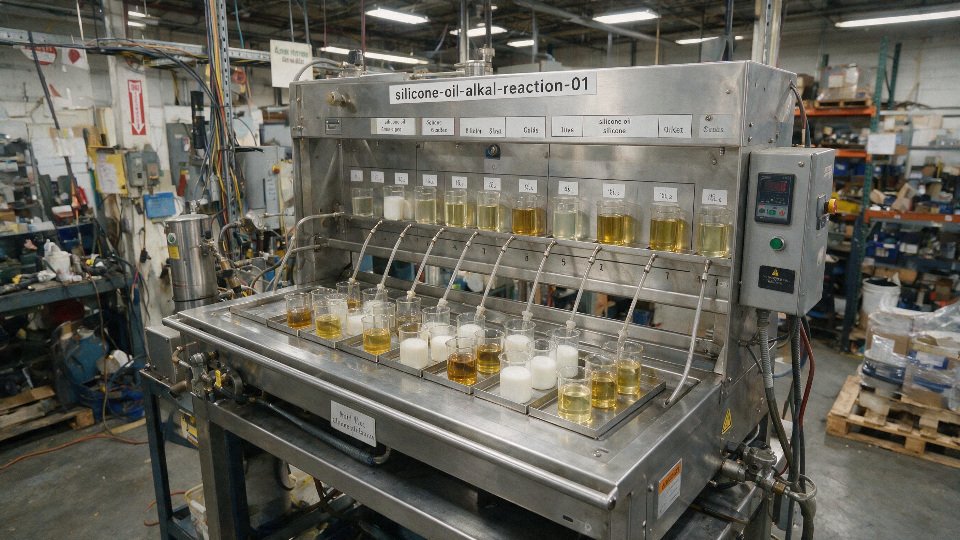
The most common testing mistake is simple: evaluating neat oil only, then approving it for an emulsion, wash bath, or caustic cleaning environment. In practice, the failure often shows up first in the mixed system, where temperature, shear, water chemistry, and fresh alkali contact keep renewing the interface that drives degradation and destabilization.
Control strategies in production
You usually control alkali damage to silicone oil with process design, not heroics after the batch has already gone off-spec. The practical levers are straightforward: choose a silicone that matches the actual pH-water-temperature profile, keep alkaline contact as short and gentle as the process allows, and stop cross-contamination from cleaning chemicals, hard water, and reused liquor before they create a hidden degradation loop.
The first decision is material selection against the actual service conditions, not the nominal recipe.
- Match silicone architecture to alkaline severity
- For intermittent contact with mildly alkaline systems at modest temperature, standard PDMS may be acceptable if water content is low and residence time is short.
- For higher pH, hotter operation, or repeated recirculation, end-group chemistry and modification package matter. Hydroxy-terminated materials, emulsified systems, and some functional silicones can be less forgiving than buyers expect.
- If the silicone is only needed as a defoamer, release aid, or surface additive, a different formulation form can be safer than changing the whole base polymer.
- Consider formulation form, not just polymer type
- Neat oil limits direct contact area with aqueous alkali, which can help if mixing is controlled.
- Emulsions are often more exposed because the silicone-water interface is large by design. That improves dispersion, but it also gives alkali more access to the siloxane network or stabilizer package.
- Compounded concentrates can protect the silicone if the carrier phase is compatible and the final dilution step is controlled.
A lot of bad outcomes start at the interface. Higher shear does not just “mix better”; it renews the oil-water contact surface, strips weak boundary films, and speeds mass transfer of alkali into the most vulnerable zones. In practice, that means a high-speed rotor-stator running in a hot caustic wash can age a silicone far faster than the same chemistry sitting in a tote for the same clock time.
Reduce contact severity before you chase chemistry
- Use the lowest alkali strength that still does the job
- If cleaning, saponification, neutralization, or pH adjustment works at a lower setpoint, the silicone usually sees less chain scission risk.
- Avoid broad operator tolerance bands like “pH 10 to 12 is fine.” That kind of range often hides a large difference in degradation rate.
- Cut exposure time
- Feed the silicone later in the sequence when possible.
- Avoid long hot holds after the target function is already achieved.
- Do not leave silicone-containing side streams circulating in alkaline loops just because the line is waiting on packaging.
- Control temperature with pH together
- Mild alkali at elevated temperature can be as damaging as stronger alkali at ambient conditions. The preferred operating window flips once both water activity and residence time rise.
Sequence additions so the silicone sees less alkali
- Add silicone after neutralization where the product design allows it.
- If the process must stay alkaline, pre-disperse the silicone in a compatible non-alkaline phase before final blending.
- Avoid charging silicone directly into the highest-pH zone, especially near concentrated caustic inlets or local hot spots around steam-jacketed walls.
That sounds obvious, but plants miss it all the time. The batch average pH may look acceptable while the silicone gets hit by a short, highly concentrated local exposure during charging.
Control the hidden accelerants
- Buffer control: unstable pH control causes repeated overshoot and correction cycles, which are harder on silicone than a steady condition.
- Water quality: hardness, residual alkalinity, and dissolved metal ions can shift emulsion behavior and sometimes promote side effects that operators misread as a raw-material issue.
- Contamination prevention: keep caustic transfer hoses, IBC pumps, and quick-connects physically segregated from silicone service. A mislabeled EPDM hose used after a sodium hydroxide transfer is enough to create a mystery batch failure.
Keep cleaning chemistry out of product circuits
- Separate alkaline CIP or washdown circuits from silicone handling lines.
- Validate rinse completeness before restart with a method that fits the risk:
- rinse-water pH
- conductivity trend
- first-flush capture and inspection
- where critical, a small compatibility check against retained product
A line can be 'visibly clean' and still carry enough residual alkali to destabilize a silicone-containing batch.True
Residual caustic films in dead legs, valve cavities, transfer hoses, or pump casings may be small in volume but high in concentration. For silicone emulsions or low-dose additive systems, that can be enough to shift viscosity, break emulsion stability, or cause performance drift.
Set hold-time limits and train operators on early warning signs
- Define maximum hold times for:
- alkaline baths that are reused
- silicone-containing recirculation streams
- intermediate tanks waiting for the next process step
- Requalify reused streams based on the parameters that actually move:
- pH
- viscosity
- appearance
- separation tendency
- functional performance in a quick bench test
Train operators to report small viscosity drift, emulsion creaming, unusual foam behavior, loss of slip, or release inconsistency before the product fully fails. By the time you see obvious separation or a hard performance drop, the process window has usually been drifting for several batches.
Supplier and specification checkpoints
A usable silicone oil purchase specification for alkaline service is not a generic data sheet; it is a short list of properties tied to your actual pH, temperature, residence time, and cleanliness risk. If procurement buys on viscosity and price alone, quality usually pays later through drift, gel, odor, unstable emulsions, or unexplained viscosity loss after a few weeks in process.
Start by matching the product specification to the duty, not to the product family name.
- Viscosity grade
- Set the target range around the function you need: lubrication, defoaming, release, dielectric behavior, or formulation feel.
- In alkaline exposure, viscosity is not just a handling parameter; it is also your easiest incoming and retained-quality indicator. If chain scission occurs, viscosity usually moves before the operator sees any obvious visual failure.
- Ask for the supplier’s viscosity tolerance and the test method and temperature used.
- End-group type
- Confirm whether the oil is trimethylsiloxy-terminated, hydroxyl-terminated, amino-modified, polyether-modified, or another functional structure.
- End groups change alkaline behavior materially. A buyer who substitutes “equivalent silicone oil” without checking termination can create a stability problem even when nominal viscosity matches.
- If the application is sensitive, require the exact end-group description on the specification or controlled product definition.
- Volatile content
- Request limits for low-boiling cyclics or other volatile fractions where relevant.
- This matters commercially as well as technically: a product with higher volatiles can affect odor, emissions, weight loss, foam behavior, and downstream compliance depending on the market.
- Residual acidity or alkalinity
- Ask whether the supplier monitors residual catalyst, neutralization quality, or ionic contamination.
- Small residuals can shift storage stability, especially in emulsions or in plants where transfer lines are not perfectly clean.
- Emulsion system, if you are buying emulsified silicone
- Identify the emulsifier type, ionic character, solids content, pH range, and dilution stability.
- This is where many purchasing errors happen. An emulsion that is stable at neutral pH can break, invert, or lose performance under alkaline make-up conditions even if the silicone phase itself is reasonably robust.
Do not accept broad phrases like “chemically stable” or “alkali resistant” without boundaries. Request compatibility guidance against your actual service window:
- pH range in operation and during cleaning
- Continuous temperature and any batch heat spikes
- Contact time or recirculation time
- Water content
- Presence of surfactants, amines, salts, or metal fines
- Whether exposure is constant, intermittent, or only during CIP
That changes the answer. A supplier may be right in bench storage and wrong in a hot alkaline recirculation loop.
A supplier statement that silicone oil is 'alkali resistant' is enough for purchase approval.False
That phrase has no practical value unless it is tied to pH, temperature, exposure time, formulation context, and acceptance criteria such as viscosity retention, phase stability, or by-product limits.
Consistency is the next filter. Ask how the supplier controls:
- batch numbering and traceability
- raw-material source consistency
- impurity profile and ionic contamination
- certificate of analysis content
- retention samples
- formal change notification for process, raw material, or specification shifts
In practice, change management is where global sourcing either works or turns expensive. A quiet emulsifier change or catalyst-residue shift can upset a qualified formulation long before anyone notices at goods receipt.
Packaging deserves more attention than it usually gets.
- Confirm container cleanliness and lining compatibility
- Check whether drums, pails, IBCs, or tankers are dedicated or effectively cleaned
- Require sealed packaging suitable for moisture and contamination control
- Review your own transfer hardware: hoses, camlocks, tote adapters, and shared pumps are common contamination points with alkaline cleaners
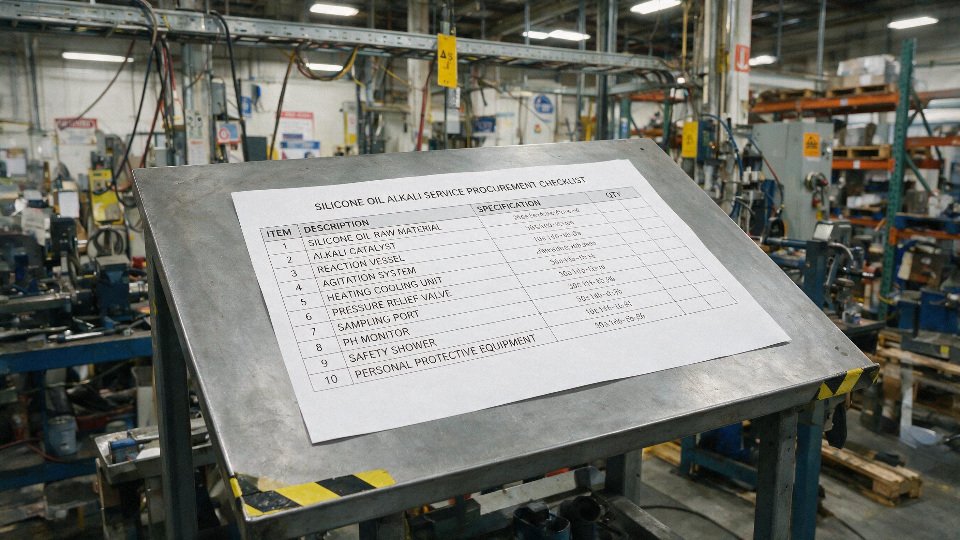
For regulated uses, the supplier should state which application-specific frameworks they can support and with what documentation. The key issue is not only the base fluid but also whether degradation by-products, residual volatiles, or additives create problems for emissions-sensitive systems, food-contact review, electronics cleanliness, or personal care restrictions. If the application sits near a regulatory boundary, verify against current supplier documentation and your local compliance review rather than assuming one region’s acceptance transfers cleanly to another.
For multinational sourcing, compare four things side by side:
| Buying factor | What to ask | Why it matters in alkaline service |
|---|---|---|
| Price | Landed cost, MOQ, payment terms | Cheap material is quickly expensive if qualification repeats or field failures appear |
| Technical depth | Can they discuss pH-temperature-time limits and modified structures? | You need application-specific advice, not brochure language |
| Sample responsiveness | Sample lead time, trial support, retained sample policy | Fast iteration cuts qualification time |
| Customization | Can they adjust structure, viscosity, or modification package? | Sometimes the right answer is not a catalog grade |
SiliconChemicals’ practical position here is straightforward: as an integrated organosilicon supplier with coverage across silanes, siloxanes, silicone polymers, and specialty modified silicone materials, it is set up to support compatibility-driven selection rather than forcing one standard grade into every alkaline environment. That matters when the preferred choice flips from a commodity PDMS to a modified structure, a tighter impurity-control grade, or a different emulsion design because your actual process window is harsher than the generic application label suggests.
Frequently asked questions
Does silicone oil dissolve in sodium hydroxide solution?
Not in the way sugar dissolves in water. Standard PDMS silicone oil is usually immiscible with aqueous sodium hydroxide, so you often see two phases rather than a clear solution; the risk is not simple dissolution but alkali attack at the oil-water interface, which can cleave siloxane bonds over time.
A few practical points matter:
- Concentration changes the failure mode
- Dilute caustic may sit against silicone oil with limited visible change for a while.
- Stronger NaOH increases siloxane bond cleavage and silanol formation, especially with heat and agitation.
- Mixing makes it worse
- A static interface reacts more slowly than a recirculating tank, high-shear mixer, or spray loop.
- Emulsified droplets expose much more surface area, so degradation accelerates.
- Contaminants can shift the result
- Surfactants, alcohols, glycols, or fine solids can help disperse silicone into the alkaline phase and increase contact.
- Metal ions and process residues sometimes catalyze side reactions or complicate what you see analytically.
Silicone oil and sodium hydroxide are always completely non-reactive because they do not mix.False
Immiscibility does not guarantee compatibility. PDMS can still undergo alkaline cleavage at the phase boundary, and reaction rate rises with pH, temperature, residence time, and interfacial area.
Is silicone oil stable in alkaline cleaners during equipment cleaning?
Sometimes, but only for short, controlled cleaning exposure. If the silicone sees moderate-pH cleaner for a brief CIP cycle at modest temperature, many plants get away with it; once cleaner strength, temperature, or hold time climbs, you need to treat compatibility as uncertain until tested on the actual oil grade.
What usually decides the outcome:
- Cleaner chemistry
- “Alkaline cleaner” covers a wide range: mild builder packages, silicated cleaners, and strong caustic blends do not behave the same.
- Surfactant-heavy cleaners can emulsify carryover silicone and increase degradation.
- Cleaning temperature
- Warm caustic that is harmless for stainless can still be aggressive toward silicone oil residues.
- Continuous hot recirculation is usually harsher than a short ambient flush.
- Exposure pattern
- One 20-minute weekly wash is different from daily hot CIP with long soak periods.
- Dead legs, sight glasses, pump seals, and drain pockets often hold residue longer than the main line.
- Acceptance criterion
- If the silicone is only a trace processing aid and gets fully rinsed out, slight damage may not matter.
- If you recover and reuse the oil, even small viscosity drift can become a cost issue.
In practice, maintenance teams often miss the transition point because the first sign is not obvious corrosion or sludge. It shows up later as off-viscosity recovered oil, unstable defoaming, or deposits in a tote that used to stay clean.
Can alkaline water destroy a silicone emulsion even if neat silicone oil seems stable?
Yes. Silicone emulsions are usually less tolerant than the neat oil because the weak point is often the emulsion structure, not just the silicone polymer itself.
Why emulsions fail earlier:
- Emulsifier breakdown
- High pH can hydrolyze or deactivate the surfactant package.
- Once the emulsifier loses balance, droplets coalesce and the emulsion separates.
- Particle-surface attack
- Small droplet size gives a large interfacial area, so alkali has more access to the silicone phase.
- Electrolyte effects
- Alkaline water often brings dissolved salts, which can compress the electrical double layer and destabilize the emulsion.
- Mechanical consequence
- What starts as slight creaming can become oiling-out, viscosity collapse, or irreversible gel specks after circulation.
So a neat silicone oil drum may look fine after brief alkaline contact while the corresponding emulsion breaks in a day. Different problem, different boundary.
Does higher viscosity silicone oil always resist alkali better?
No. Higher viscosity can slow apparent change in some cases, but it is not a reliable proxy for alkaline stability across suppliers or product types.
Here is the trade-off buyers often miss:
- What higher viscosity can improve
- Lower mobility may reduce mixing into the aqueous phase.
- Short-term viscosity loss may be less obvious in a very high-cSt product.
- What it does not guarantee
- Backbone chemistry is still what controls chemical resistance.
- End groups, residual catalysts, emulsifier system, additives, and water content can outweigh viscosity.
- When the rule flips
- In emulsions or high-shear service, a high-viscosity oil can still degrade quickly once dispersed.
- In a formulation where small viscosity drift matters, a high-viscosity starting point may mask early damage until performance drops.
Ask what chemistry the oil is built on, not just what cSt is printed on the drum.
What is the difference between temporary performance loss and irreversible chemical degradation?
Temporary loss usually means the silicone is physically disturbed but not chemically broken. Irreversible degradation means the polymer structure has changed, and performance will not come back just by settling, drying, or adjusting pH.
Typical ways to tell them apart:
- Temporary effects
- Emulsion creaming that re-disperses with gentle mixing
- Viscosity shift caused by temperature
- Foam-control loss from contamination or poor dispersion
- Irreversible effects
- Persistent viscosity drop after standard conditioning
- Silanol increase, chain scission signals, or molecular-weight reduction in lab analysis
- Permanent phase separation, gel particles, or changed application performance after neutral pH is restored
A shop-floor check helps, but it is not enough on its own. If recovered oil looks thinner after caustic exposure, run comparative viscosity and, if the application is critical, ask for analytical confirmation rather than relying on appearance.
Can neutralization restore degraded silicone oil?
Usually not, if chemical cleavage has already happened. Neutralization can stop further alkaline attack, but it does not rebuild siloxane chains that have been cut.
What neutralization can and cannot do:
- Can do
- Bring pH back into a safer handling range
- Stabilize the sample enough for analysis or disposal routing
- Prevent ongoing damage during short-term hold
- Cannot do
- Reverse molecular-weight loss
- Recover original emulsion architecture after severe break
- Guarantee original defoaming, lubrication, release, or dielectric performance
If the material has strategic value, isolate it, neutralize carefully under controlled mixing, and test before reuse. Reblending damaged oil into good stock is a common shortcut, and it usually comes back later as inconsistent product behavior.
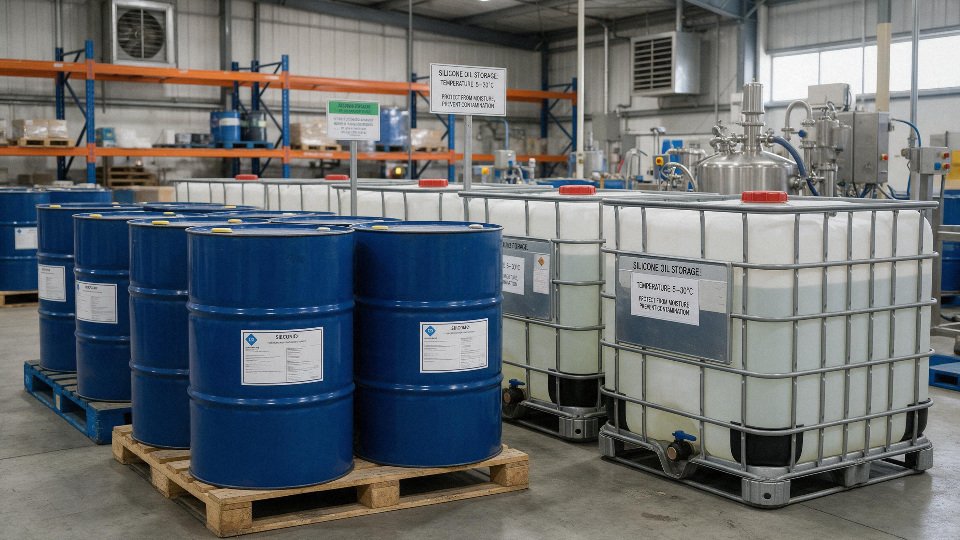
How should silicone oils be stored to avoid accidental alkaline contamination?
- Use clearly segregated transfer lines, pumps, hoses, and fill heads; shared IBC equipment is a common contamination route.
- Keep drums, totes, and day tanks closed and labeled with product name, viscosity grade, and incompatibilities.
- Do not rinse silicone handling equipment with caustic unless the cleaning procedure has been validated for that exact product.
- After CIP, verify rinse completion; residual alkaline cleaner in a hose or diaphragm pump can contaminate the next batch.
- Store away from alkaline raw materials, especially where splash, vapor, or operator mix-up is possible.
- If the plant uses reusable sample thieves, funnels, or quick-connects, dedicate them. A single dirty camlock can spoil a tote.
What data should I ask a supplier for before using silicone oil in a high-pH formulation?
- Recommended pH exposure range, separating short-term contact from continuous service
- Temperature limits under alkaline exposure, with test conditions stated
- Viscosity-retention or stability data versus pH, concentration, and residence time
- For emulsions: dilution-water limits, electrolyte sensitivity, and emulsion stability window
- End-group or product-family information relevant to alkaline resistance
- Typical water content, volatile content, and any additives that affect high-pH behavior
- Compatibility notes for caustic cleaners, process washdown, or CIP if that matters in your plant
- Test method details: duration, temperature, agitation, pass/fail criterion
- Whether the data are generic category guidance or measured on the exact commercial grade you are buying
Your compatibility verification plan
A silicone oil should be approved for alkaline service only after you define the actual exposure window and match the verification effort to the commercial risk. Most bad decisions happen because teams buy on the phrase “good chemical resistance” without pinning down pH, water, temperature, and residence time in the actual process.
Start by fixing the operating window in writing. If any of these are missing, you do not yet have a compatibility decision; you have a guess.
- Silicone grade
- PDMS, amino-modified, epoxy-modified, polyether-modified, phenyl-containing, or another specialty structure
- Target viscosity range and whether that viscosity is process-critical
- Alkali environment
- Alkali type: NaOH, KOH, ammonia, amines, alkaline builders, cementitious alkalinity, detergent system, or mixed chemistry
- Concentration or pH range under actual use, not just make-up concentration
- Water content
- Dry trace contamination, humid storage, water-rich emulsion, or fully aqueous alkaline phase
Water usually decides whether a theoretical risk turns into measurable chain scission, because it gives the system the medium for hydrolysis and redistribution.
- Dry trace contamination, humid storage, water-rich emulsion, or fully aqueous alkaline phase
- Temperature and exposure mode
- Batch peak temperature
- Continuous operating temperature
- Short upset temperature, if relevant
- Mechanical severity
- Low agitation, recirculation, rotor-stator mixing, high-shear emulsification, spray application, or pump shear
Shear does not “cause” the chemistry, but it can speed loss of emulsion stability and make a marginal oil fail much earlier in service.
- Low agitation, recirculation, rotor-stator mixing, high-shear emulsification, spray application, or pump shear
- Exposure time
- Seconds, minutes, hours, days, or long-term storage contact
Then classify the application risk. This tells you how much testing is worth paying for.
- Storage contact: drum liners, transfer hoses, gaskets, tote contamination, shared pump carts
- Incidental contamination: carryover from alkaline cleaners, CIP residues, upstream process leaks
- Intermittent cleaning exposure: periodic alkaline wash, then rinse and return to service
- Continuous alkaline formulation service: the silicone oil is intentionally in an alkaline water-based or alkaline-processed system
The preferred verification depth flips here. For storage contact or brief incidental contamination, a desk review plus targeted bench check is often enough. For continuous alkaline formulation service, that is rarely sufficient; you usually need accelerated aging or a full-use simulation because viscosity drift, silanol formation, and emulsion breakdown can stay hidden in a simple room-temperature jar test.
Choose the verification depth accordingly:
- Desk review only
- Use for low-risk, short-duration exposure with good supplier data already in hand
- Review chemistry family, known pH limits, temperature window, and prior application notes
- Bench screening
- Small blends at actual concentration, water ratio, and temperature
- Check phase behavior, viscosity shift, appearance, odor, and short-term stability
- Accelerated aging
- Elevated temperature and defined residence time
- Useful when plant exposure is long but development time is short
- Boundary: acceleration helps trend risk, but it does not perfectly reproduce every plant failure mode, especially where air entrainment, metals, or mixed surfactants are involved
- Full application simulation
- Actual formulation, process order, shear history, and storage profile
- Best choice when the silicone oil affects release, lubrication, wetting, antifoam behavior, gloss, or downstream coating/adhesion
Set approval criteria before testing starts, tied to cost and consequence rather than preference alone:
- Maximum viscosity change
- Limit depends on what the oil is doing in the process; a defoamer carrier may tolerate more than a metering fluid or release coating component
- Emulsion stability threshold
- No unacceptable creaming, separation, gel, or irreversible viscosity rise within the required shelf or use life
- Functional performance retention
- Foam control, slip, release, lubrication, leveling, softness, or dielectric performance must stay inside your operating target
- Acceptable by-product profile
- No unacceptable odor, volatile generation, silanol-related instability, or residues that interfere with cure, adhesion, or cleanliness
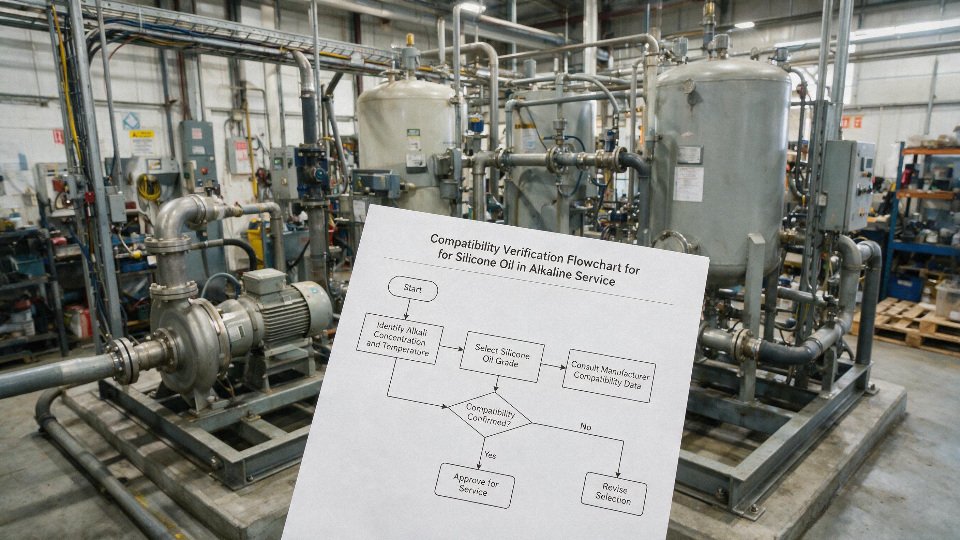
Before you sign off, look for supplier data gaps. In practice, these are common:
- No data at your actual alkali concentration
- No distinction between dry alkali contact and aqueous alkaline exposure
- No temperature-residence-time trend
- No information on viscosity drift or silanol formation
- No application-specific guidance for emulsions or modified silicone oils
Ask for:
- Targeted support samples
- Technical recommendations for the stated pH, temperature, and water conditions
- Alternative or customized grades if the standard product looks marginal in your service window
If you are making an approval decision now, send SiliconChemicals your substrate material, alkali type, approximate concentration or pH, water content, temperature range, exposure time, shear conditions, required finish or function, target rate, and clear part or process photos if relevant. SiliconChemicals can review the compatibility window and propose suitable sample grades for verification, which is a better next step than relying on generic alkali-resistance assumptions.