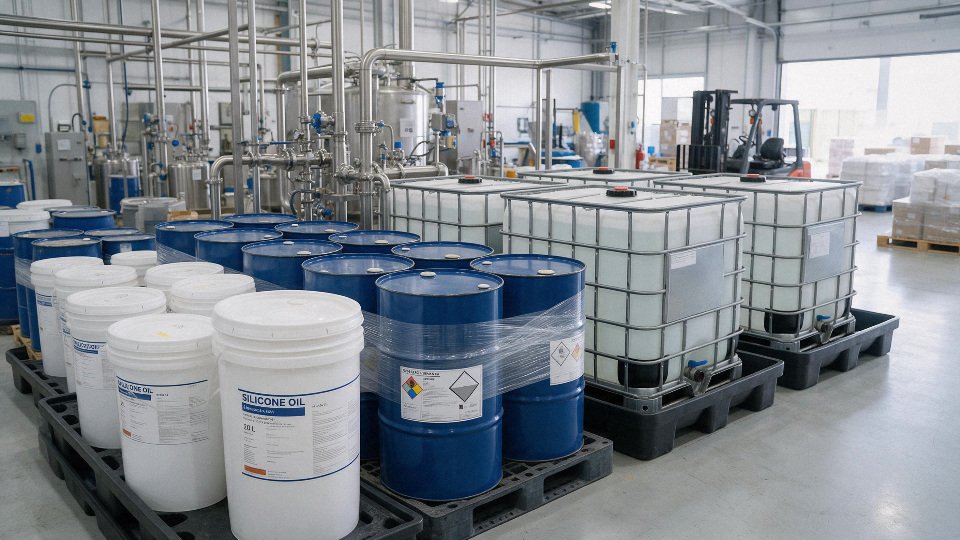
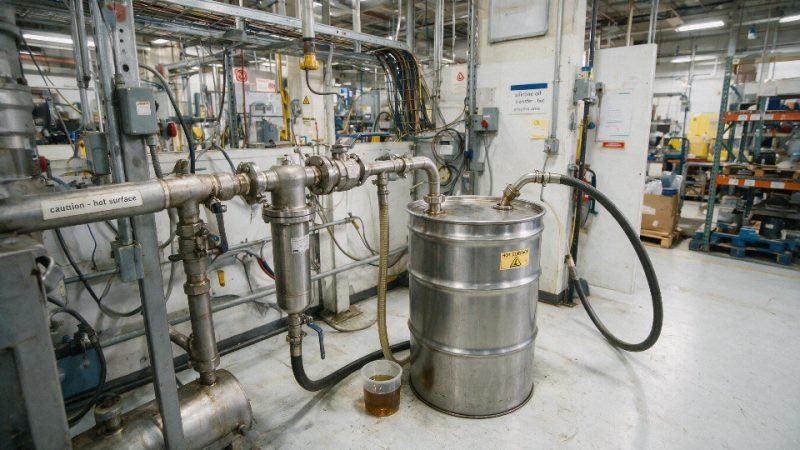
A drum of silicone oil that looked stable on day one can turn into a maintenance problem if it spends too long hot, aerated, or contaminated. The first signs are usually subtle on the plant floor: viscosity drift, darker color, more volatiles, maybe a few gel specks in filters or on heated surfaces. Leave that unchecked and it stops being a chemistry question and becomes a cost problem through fluid changeouts, fouled heat-transfer circuits, seal issues, scrap risk, and unplanned downtime. The practical answer is not “silicone oil never oxidizes” or “it always fails hot,” but understanding the temperature, oxygen exposure, residence time, and contamination conditions that decide which way it goes.
Yes, silicone oil can oxidize, but it usually resists oxidation better than many mineral and organic fluids. In practice, oxidation risk rises much faster when silicone oil is held for extended periods above roughly 150 to 180 C in air, especially if metal catalysts, process contamination, or poor housekeeping are involved.
That gap between “generally oxidation-resistant” and “actually stable in your system” is where buyers and plant engineers get caught. A clean, closed system running well below the upper temperature range behaves very differently from an open, hot process with copper, iron fines, or degraded residues in the loop, and that difference is what decides whether silicone oil is the right choice or a slow-growing reliability problem.
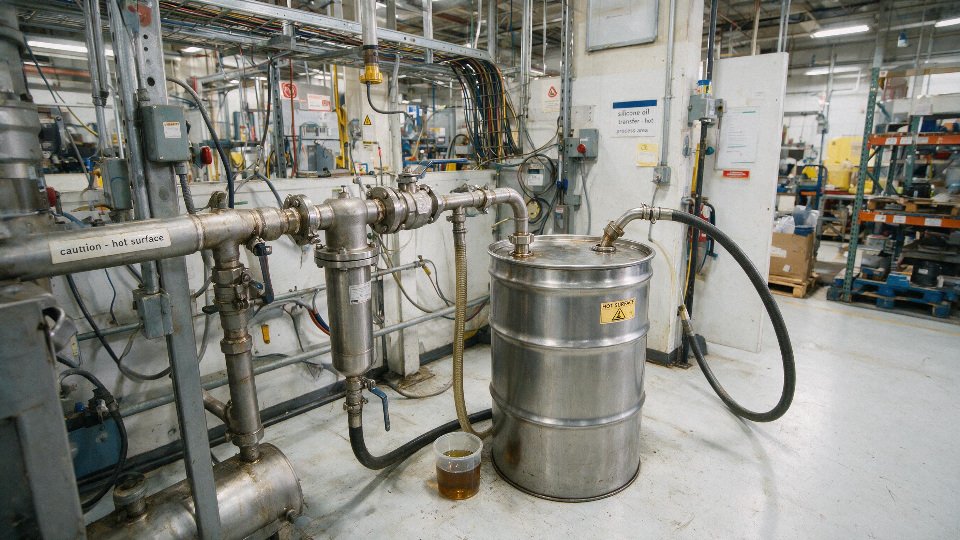
Silicone oil chemistry
Silicone oil is not one molecule; it is a family of fluids built mainly from linear siloxane chains, most often polydimethylsiloxane, and its oxidation behavior follows that structure. The reason these fluids usually outlast hydrocarbon oils at heat is the Si-O-Si backbone, but that advantage has limits because the side groups, end groups, contaminants, and contact surfaces still decide where degradation starts.
At the molecular level, the standard industrial fluid people mean by “silicone oil” is usually PDMS, a linear polymer of repeating siloxane units with methyl groups attached to silicon. Depending on the grade, some of those organic groups can be changed or partially replaced to tune performance:
- Methyl silicone oils: the common general-purpose fluids based on PDMS
- Phenyl-modified silicone oils: used where broader temperature capability or better high-temperature stability is needed
- Amino-functional silicones: typically chosen for surface interaction, lubricity, textile treatment, or compatibility effects rather than pure thermal duty
- Epoxy-functional silicones: used where reactivity or adhesion-related behavior matters
- Other modified siloxanes: vinyl, fluoro, polyether, and specialty copolymers for niche process, compatibility, or surface-property needs
That distinction matters in procurement and failure analysis. Two fluids can both be sold as silicone oil and still behave differently in a hot vessel, on a coating line, or inside a diffusion pump because the backbone may be similar while the organic substitution is not.
The core reason silicone oils resist oxidation better than many mineral and synthetic hydrocarbons is the siloxane backbone itself. The Si-O bond is strong, and the chain is unusually flexible. That flexibility keeps the fluid mobile over a wide temperature range, while the low intermolecular forces help explain familiar silicone traits such as:
- low surface tension
- good spreadability
- relatively flat viscosity-temperature behavior compared with many organic fluids
- easy release and wetting behavior
- a tendency for lower-molecular-weight fractions to volatilize if the grade is not tightly cut
Those same features shape thermal behavior in service. A flexible backbone does not crystallize the way some organic fluids do, so low-temperature flow is usually good. At the same time, weak intermolecular attraction means lighter fractions can evaporate or “boil off” before the backbone itself has chemically oxidized. On a plant floor, that distinction gets missed all the time: an operator sees smoke, odor, or viscosity change and calls it oxidation, when part of the change is simply volatilization of low ends or thermal redistribution.
A strong Si-O backbone does not make silicone oil chemically inert in all hot-air applications.True
The backbone improves thermal and oxidative resistance, but degradation can still begin at end groups, side groups, catalyst residues, metal-contact surfaces, or contaminated sites. In practice, many failures are mixed mechanisms rather than neat textbook oxidation.
That brings up the most useful chemical distinction: oxidation is only one degradation route. In service, silicone oils can change by several pathways, often at the same time:
- Oxidation: reaction with oxygen, usually becoming more important during long exposure in hot air; can lead to viscosity rise, volatile formation, acidity changes, color shift, and eventually gels or deposits
- Thermal rearrangement: bond redistribution at elevated temperature, sometimes forming lower and higher molecular weight fractions without oxygen being the sole driver
- Depolymerization: chains break down into smaller cyclics or shorter linear species, often showing up as volatility increase or mass loss
- Hydrolysis: moisture attacks susceptible siloxane sites, especially in the presence of catalysts or reactive end groups
- Chain scission: backbone cleavage, which can lower viscosity at one stage even if later oxidation or condensation pushes viscosity back up
- Condensation: silanol groups react to build molecular weight, sometimes causing viscosity increase, haze, or gel particles
The mechanism matters because the corrective action changes with it. If a hot silicone bath is thickening because of oxidation and condensation, blanketing, contamination control, and metal isolation may help. If the main issue is depolymerization from excessive film temperature, the fix may be residence time, heater surface temperature, or fluid grade, not an antioxidant package.
End groups are one of the more practical weak points. Many standard fluids are trimethylsiloxy-terminated, which makes them comparatively nonreactive at the chain ends. Hydroxyl-terminated fluids carry silanol end groups, and those ends are more chemically active. In moisture-rich systems, around acidic or basic residues, or against catalytic metal surfaces, silanol-bearing fluids can condense, interact with fillers or substrates, and drift in viscosity faster than a neutral end-capped fluid.
You see this in messy service conditions: open tanks, poorly dried process lines, reused drums, copper or iron contact, and seals that shed trace contaminants. The silicone chemistry may still be sound, but the environment keeps supplying reaction sites. A buyer comparing grades for thermal duty should always ask not just for base viscosity, but for polymer type, end-group type, volatility profile, and any catalyst residue control.
Phenyl-containing silicone oils deserve a separate note because they are often chosen for tougher temperature duty. Replacing some methyl groups with phenyl groups can improve thermal behavior and, depending on the formulation, broaden useful low-temperature performance as well. They are often the better choice where the fluid sees sustained heat or harsher oxidative conditions than a straight methyl fluid comfortably handles.
The trade-off is not subtle:
- What you gain
- better thermal stability margin in demanding service
- often better resistance to property drift at elevated temperature
- useful performance in wider temperature windows for some grades
- What you give up
- higher cost
- possible differences in compatibility with seals, substrates, or formulations
- not every phenyl-modified fluid is optimized for the same viscosity, volatility, or process cleanliness target
So the “best” chemistry flips once the duty changes. For a lightly loaded release or damping application, methyl silicone oil is often the practical choice. For long hot-air exposure near the upper end of silicone service temperatures, phenyl modification may justify itself quickly if the alternative is fluid loss, varnish, or frequent changeout. That conclusion stops holding if the real failure driver is moisture, catalytic contamination, or local hot spots beyond the fluid’s grade limit; in those cases, changing substitution alone may not solve the problem.
Oxidation mechanisms
Silicone oil does not oxidize in a single neat step; it degrades through a coupled set of oxygen-driven and contamination-driven reactions whose speed depends as much on exposure geometry and system cleanliness as on bulk temperature. If you want to predict service life, the useful question is not “What is the maximum temperature?” but “How much oxygen reaches the hot fluid, for how long, and in contact with what surfaces and contaminants?”
That is why one PDMS system can run acceptably near the upper end of its normal air-service range, while another fails much earlier at a lower setpoint. The failure gap usually comes from oxygen transfer, residence time, catalytic metals, and plant-specific dirt that never appears in a tidy datasheet test.
Oxygen has to get into the fluid first
Oxidation rate is limited partly by chemistry and partly by mass transfer. In plain terms, oxygen has to reach the fluid, dissolve, and keep reaching fresh hot oil faster than it is consumed. That is why the same silicone oil behaves very differently in a sealed expansion-limited loop versus an open trough, dip tank, or splash-lubricated housing.
Higher oxidation risk shows up when the operating setup increases fluid-air contact:
- Open reservoirs and vented tanks
- Continuous access to atmospheric oxygen
- Frequent moisture and airborne contamination entry
- Greater temperature cycling, which breathes fresh air into headspace
- Splashing, spraying, and atomization
- Breaks the fluid into droplets or thin moving films
- Multiplies surface area dramatically
- Speeds oxygen pickup and volatile loss at the same time
- Thin films on hot metal
- A 50 to 200 micron film on a heater wall or roll does not behave like the bulk tank
- Oxygen diffusion path is short
- Local temperature is often higher than the measured sump temperature
- High headspace turnover
- Poorly sealed systems, vented gearboxes, or tanks with frequent lid opening keep replacing depleted air with fresh oxygen
By contrast, oxidation slows when the system reduces oxygen availability:
- Sealed or low-headspace systems
- Nitrogen-blanketed vessels
- Deep static fluid volumes with limited agitation
- Equipment layouts that avoid misting and splash return
The mechanism matters. A deep reservoir may look benign on average, yet oxidation can still be driven by a hot return line that showers oil back into the tank. I have seen systems where the lab sample from the tank looked only mildly aged, while the real damage was happening at the top tray, around the vent, and on the hottest baffle where the oil hit as a thin sheet.
Temperature drives the chemistry, but time often decides the damage
Once oxygen is available, temperature strongly accelerates oxidation. The rate rise is not linear; it increases sharply with heat, which is why oxidation concern climbs quickly once silicone oil is held for long periods above roughly 150 to 180 C in air, especially if the system is dirty or metal-contaminated.
The common plant-floor mistake is focusing only on peak temperature. Brief short-term excursions may be tolerable for some grades, sometimes even near about 250 C for limited exposure, but that does not mean the fluid is comfortable there in continuous air service. Long residence time at a lower elevated temperature often does more cumulative damage than a quick overshoot.
A practical way to think about it:
- Short high excursion
- Limited total oxygen uptake if duration is brief
- Damage may stay localized if the event is controlled
- Still risky if it occurs in a thin film, near metal, or with air entrainment
- Continuous moderate overheating
- More total hours for oxygen attack
- More time for byproducts to accumulate
- Greater chance of secondary reactions such as crosslinking and sludge formation
This is why a heat-transfer loop running a little too hot, every day, usually ages fluid faster than operators expect. The control panel may report a stable bulk temperature, but the fluid has already seen hotter wall temperatures, recirculated through them thousands of times, and picked up enough oxidation products to change the next pass.
A lower but continuous overtemperature can shorten silicone oil life more than occasional brief spikes.True
Oxidation depends on both temperature and time. Long residence at elevated temperature allows sustained oxygen exposure and accumulation of degradation products, especially in air-contacting systems.
Metals and catalytic surfaces can turn a manageable condition into a fast failure
Not all metal contact is equal. Stainless equipment in good condition is generally less troublesome than worn carbon steel, copper alloys, rusty internals, or systems shedding fine metallic debris. Trace amounts of iron, copper, and other transition metals can promote oxidation directly or catalyze secondary decomposition of already-formed intermediates.
The path is usually indirect but damaging:
- The hot fluid absorbs oxygen.
- Initial oxidation or thermal cleavage creates reactive species.
- Metal surfaces or dissolved/particulate metal ions accelerate further breakdown.
- The oil forms more silanols, volatiles, and eventually crosslinked material or deposits.
Copper is a repeat offender in mixed-material systems. So are iron fines from pumps, valve wear, and uncoated steel vessels with corrosion history. In practice, the trouble is often worst after maintenance or startup, when fresh wear debris and process contamination are both present.
Watch these risk points:
- Pump internals with wear
- Heat exchangers with corroded carbon steel passages
- Copper or brass fittings in hot zones
- Rust scale from infrequently cleaned tanks
- Mechanical seals shedding particles into a recirculating loop
The trade-off is straightforward: robust metallic equipment is necessary, but the wrong metallurgy in the wrong temperature and oxygen regime shortens fluid life. If a system cannot avoid reactive metal exposure, filtration and contamination control become much more important.
Contaminants are often the reason a “stable” silicone oil stops being stable
Pure silicone oil is one thing; silicone oil after six months in a plant is another. Oxidation risk jumps when the fluid picks up contaminants that either catalyze degradation, destabilize the polymer, or create local reaction sites.
The main categories worth checking are:
- Acids
- Can promote siloxane bond cleavage in some systems
- Often enter through process carryover, cleaning residues, or decomposition byproducts
- Bases
- Strongly relevant because siloxane rearrangement and depolymerization can be base-catalyzed
- Caustic cleaning carryover is a classic avoidable problem
- Water
- Usually not the primary oxidation driver by itself, but it supports hydrolysis pathways and can change how contamination behaves
- Steam leaks and humid vent breathing make things worse over time
- Chlorides and corrosive salts
- Can accelerate corrosion of equipment, indirectly increasing metal contamination
- Residues from upstream process chemistry can be surprisingly persistent
- Residual catalysts
- Leftover metal catalysts or cure catalysts from manufacturing or adjacent processing can destabilize the oil
- Needs supplier-specific review; no safe universal assumption
- Process carryover
- Resins, plasticizers, monomers, elastomer fragments, or organic residues can react or decompose into fouling species
- One dirty seal pot can age a whole loop
- Carbonaceous fines and char
- Act as high-surface-area contamination
- Often indicate prior overheating
- Can seed deposit growth and trap oxidation products
- Incompatible additives
- Antiwear, EP, detergent, or improvised “top-up” additives from other lubricant families can upset stability badly
- Mixing by convenience is expensive later
The boundary here is important: if the fluid is exposed to significant chemical carryover or mixed-fluid contamination, oxidation is no longer the only degradation mode worth discussing. Hydrolysis, catalytic depolymerization, incompatibility precipitation, and simple solids loading may dominate the observed failure.
What oxidation produces in the oil
Silicone oil oxidation does not always announce itself with one simple property change. Several reaction outcomes can happen in parallel:
- Chain scission
- Polymer chains break into lower molecular weight fragments
- Viscosity can fall
- Volatility usually increases
- Silanol formation
- Often detectable by FTIR trends
- These groups can participate in later condensation or secondary reactions
- Volatile byproduct generation
- Losses rise at vents and hot open surfaces
- Odor and vapor loading may change before viscosity moves much
- Oxidation of organic substituents
- PDMS is relatively resistant, but methyl groups and impurities can still generate formal oxidation products under severe conditions
- Crosslinking and gel formation
- Viscosity rises
- Insoluble particles appear
- Filters load faster and small passages start to foul
- Insoluble deposits and varnish-like residues
- Form on heaters, walls, vents, and low-flow dead zones
- Deposits then create hotter surfaces, which accelerates further degradation
One counter-intuitive field pattern catches buyers off guard: the fluid may first thin out because chain scission and volatile formation are dominating, then later thicken as crosslinking, contamination reactions, or condensation of silanol-containing fragments take over. Looking at one sample from one date can miss that sequence entirely.
That is why oxidation trending should use multiple indicators, not viscosity alone:
- Viscosity shift
- Acid number increase
- Growth in volatiles
- Color change
- Gel particles or insolubles
- FTIR evidence of silanol or carbonyl formation
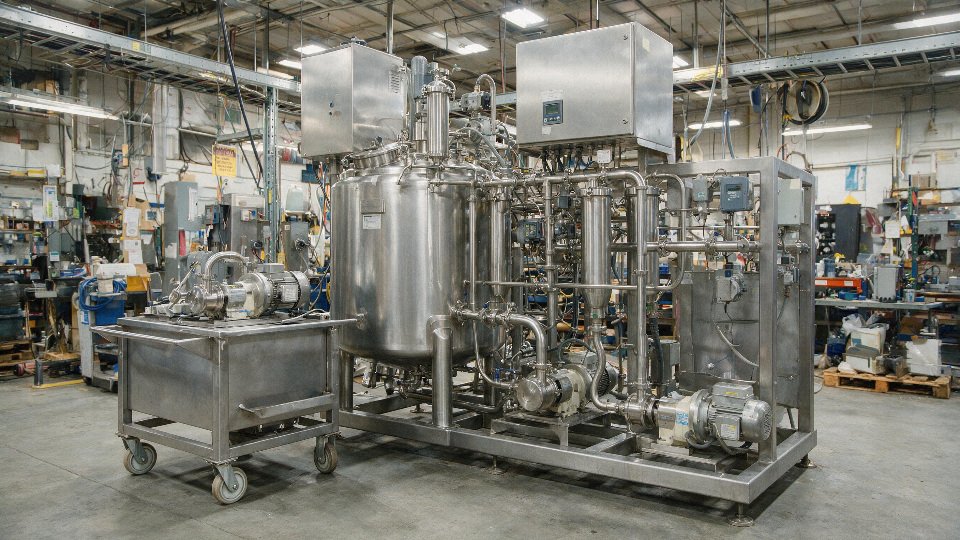
Why lab thermal stability often overstates field life
Static thermal stability tests are useful for comparing materials under defined conditions. They are not a full proxy for plant service. A quiet lab oven sample in a clean container usually sees none of the things that kill silicone oil early in production equipment:
- Air entrainment from pump suction issues
- Splash return and misting
- Local hot spots at heater walls
- Shear through tight clearances
- Metallic wear debris
- Repeated contamination from process leaks or maintenance practices
A pump with a slightly starved suction, for example, can whip microbubbles into a hot fluid. That does two things at once: it raises internal oxygen contact area and pushes the oil repeatedly through high-stress hot zones. The result in practice can look like “unexpected oxidation,” but it is really a system design and maintenance problem showing up as fluid failure.
So the generic temperature limit is only a starting screen. Once the system has open air contact, thin hot films, reactive metals, or dirty carryover, the useful life estimate has to be based on operating geometry, contamination control, and actual condition monitoring rather than brochure numbers alone.
Failure signs
Silicone oil oxidation usually shows up first as a pattern, not a single lab number: localized deposits, gradual property drift, and process instability that operators often blame on “old oil” or “bad batch.” If you wait for a dramatic color change in the whole bath, you will often miss the early stage, because oxidation commonly starts at hot metal surfaces, vents, and low-flow zones long before the bulk fluid looks obviously degraded.
Visual indicators in the fluid and on equipment
Operators tend to notice appearance changes first, but those changes need sorting. Some are oxidation-driven; some come from dirt ingress, incompatible additives, or just volatilization of lighter fractions.
Common visual signs tied to oxidation include:
- Darkening or yellow-to-brown color shift
- More meaningful when it develops during high-temperature service rather than appearing from the supplier drum.
- Color alone is not proof; some contamination events darken oil faster than oxidation does.
- Haze or loss of clarity
- Often indicates suspended degradation products, fine gels, or moisture-assisted instability.
- In clear PDMS fluids, new haze after hot service is worth investigating.
- Insoluble particles
- Can appear as soft gel specks, brittle flakes, or varnish fragments.
- Oxidation-derived particles often feel tacky or smear under pressure, unlike hard mineral dust.
- Varnish or gum
- Frequently seen on sight glasses, heater sheaths, vessel walls, and upper splash zones.
- These deposits matter because they insulate hot surfaces, which raises local metal temperature and pushes oxidation harder at exactly the wrong spot.
- Gel specks in the liquid
- A common sign of localized crosslinking.
- In coating or release applications, even a low level can print through onto the product.
- Crust at vents or around breathing points
- Often missed in routine checks.
- This can form where hot vapor, oxygen, and condensed degradation products meet, especially in systems that cycle hot and cool.
- Deposits on heaters or vessel walls
- Particularly significant if the bulk oil sample still looks acceptable.
- That mismatch usually means the fluid is failing at the surface temperature, not the average bath temperature.
Property changes that point toward oxidation
A decent failure review looks at trend direction, not just pass/fail against a new-oil spec. The mechanism matters here: oxidation can either build molecular weight through crosslinking or reduce it through chain scission, and the dominant path depends on temperature history, oxygen access, contamination, and residence time.
Watch for these measurable shifts:
- Viscosity increase
- Usually indicates crosslinking or formation of higher-molecular-weight species.
- This is common in long hot service with oxygen exposure.
- Consequence on the floor: slower damping response, harder cold starts, higher pump load.
- Viscosity decrease
- Can happen when chain scission dominates or when lighter volatile fractions become a larger share of the remaining fluid.
- This is why “oxidized oil always gets thicker” is too simplistic.
- Rising acid number
- Useful as a trend indicator when measured consistently.
- A low absolute number does not rule out early degradation, but an upward trend is a warning.
- Changing refractive index
- Subtle, but helpful in controlled QC programs.
- More useful for trend comparison against retained samples than as a standalone diagnosis.
- Altered surface tension
- Can show up before operators connect it to chemistry.
- In coating, wetting, defoaming, or release systems, small shifts can create visibly unstable behavior.
- Growth in volatiles
- Often accompanies oxidation and thermal breakdown.
- Needs proper volatile-profile testing if the application is sensitive.
A stable viscosity reading means the silicone oil is not oxidizing.False
Early oxidation can stay localized at heater surfaces or vent regions while the bulk fluid still tests close to nominal viscosity. Trend multiple indicators together: viscosity, acid number, volatile content, color, particles, and, where available, FTIR evidence of silanol or carbonyl formation.
Process symptoms that operators see before the lab report
In practice, production usually feels the problem before QC confirms it. The fluid no longer behaves the same in the machine, even if the tote sample still looks passable.
Typical process symptoms are:
- Reduced heat transfer efficiency
- Deposit on heat-transfer surfaces acts like insulation.
- The mechanism is straightforward: poorer heat transfer forces higher metal temperature to deliver the same duty, which accelerates local degradation again.
- Slower or inconsistent damping response
- Usually linked to viscosity drift.
- Pump noise or cavitation-like sound
- Can come from viscosity change, foaming, volatile formation, or restricted suction from fouled strainers.
- Filter plugging
- Often one of the clearest signs that degradation products are becoming insoluble.
- Foaming
- Not exclusive to oxidation, but common when degradation products or contamination change the fluid surface behavior.
- Seal leakage
- Viscosity loss, volatile enrichment, or deposit-related shaft issues can all contribute.
- Unstable coating behavior
- Wet-out changes, craters, skip coating, or variable release can result from surface-tension shift or gel contamination.
- Dielectric drift
- Relevant in electrical insulation service; verify against application-specific limits and the current equipment requirements.
- Shortened bath life
- Often the commercial symptom that gets attention first: more frequent top-up, filtration, cleaning, and changeout.
The trade-off in diagnosis is speed versus certainty. A quick visual call can catch a developing failure early, but if money is riding on root cause, confirm with retained fresh sample comparison and targeted testing rather than blaming oxidation by habit.
Oxidation, evaporation, or contamination?
These three get mixed up all the time.
Evaporation alone usually causes cleaner mass loss and concentration shift, while oxidation leaves chemistry behind in the form of acids, gels, varnish, or surface deposits. If a system loses weight but stays clear, leaves little residue, and shows limited acid-number movement, simple volatilization is still on the table. If odor changes, residue becomes sticky or crusted, and the volatile profile broadens along with deposits, oxidation is more likely.
To separate oxidation from contamination, check:
- Particle morphology
- Oxidation gels are often soft, translucent, amber, or smearable.
- External dirt tends to be angular, hard, and visually mixed.
- Elemental analysis
- Useful when wear metals, catalyst carryover, rust, process solids, or cleaning-agent residue may be involved.
- Elevated metal content can indicate both contamination and a catalyst source for faster oxidation.
- Reproducibility in a clean test loop or controlled hot test
- If fresh product in a clean system reproduces the failure, the fluid grade or service condition may be the issue.
- If it does not, look harder at external ingress, dead zones, incompatible materials, or poor maintenance practice.
That last point is the boundary on most field judgments: if the system has dirty internals, mixed make-up fluids, or unknown temperature spikes, appearance alone will not give you a reliable root cause. In those cases, retain a fresh reference, sample from both bulk and hot-zone deposits, and compare trends rather than relying on one number from one bottle.
High-risk conditions
Silicone oil becomes a practical oxidation risk not in every hot service, but in the combination zones: heat plus oxygen plus time plus contamination. If a PDMS fluid is kept clean, covered, and below roughly 150 C in a stable system, oxidation is usually slow; once you add air renewal, hot metal films, catalytic residues, or long hold time above about 150 to 180 C, the failure curve steepens fast.
A lot of field trouble starts because buyers look at one brochure temperature number and assume the whole system is safe. It rarely works that way on a plant floor. Bulk sump temperature may read 165 C while the heater sheath runs much hotter, the fluid wets a thin film across oxidized steel, and the tank is open to moving air all shift long.
Open high-temperature baths and air-exposed heat-transfer systems
Open baths, poorly sealed reservoirs, and vented loops are among the most oxidation-prone silicone oil duties because oxygen is constantly replenished. The problem gets worse when the oil spreads into thin films over hot walls, overflow lips, agitator shafts, or heater elements, since thin films heat faster and present much more surface area to air than the bulk fluid below.
Mechanistically, three things stack up here:
- Oxygen renewal keeps feeding the reaction instead of letting the local boundary layer become depleted.
- Thin-film overheating pushes parts of the fluid above bulk temperature, sometimes by a lot, especially near electric heaters or uninsulated transfer points.
- Long residence at temperature gives oxidation time to show up as viscosity change, volatile formation, color shift, and eventually deposits or gel.
In heat-transfer loops, a common mistake is treating a “closed” system as truly closed when the expansion tank is vented, the seals are tired, or maintenance routinely opens the circuit hot. In practice, even a decent loop can behave like a semi-open oxidizing service if it breathes every thermal cycle.
The trade-off is straightforward: open systems are simpler and cheaper to build and maintain, but they expose the fluid to the exact conditions that shorten life. That conclusion stops holding if the process temperature is low enough and the oxygen contact is genuinely limited; below that boundary, oxidation may not be the dominant aging mode.
Electrical and electronic duties with local hot spots or discharge
A silicone fluid can survive a moderate average operating temperature and still fail early if small zones run much hotter. Electrical equipment is full of these traps: overloaded windings, resistor-adjacent pockets, poor heat sinking, corona discharge regions, and metal edges where the fluid sees conditions the bulk temperature probe never captures.
High-risk triggers include:
- Localized hot spots at conductors, coils, or power components
- Corona or partial discharge in insulating applications
- Reactive metal contact, especially with copper-containing parts
- Poor fluid circulation in enclosed cavities
- Dust or residue that creates carbonized hot points
This is why “average oil temperature” can be misleading in electronics. A transformer fill, damping fluid, or dielectric medium may look comfortably within range on paper, yet degrade near a hot conductor or reactive surface. Once breakdown starts locally, the by-products can contaminate the surrounding volume and the failure appears sudden, even though the chemistry started at one small spot.
A silicone oil system can oxidize even when the measured bulk fluid temperature stays within the published service range.True
Published temperature ranges are category-level guidance. Oxidation depends on local hot spots, oxygen access, contaminants, catalytic metals, and time at temperature, not just the average measured bulk temperature.
Textile, coating, and release processes with reactive carryover
Textile finishing, release coating, defoaming, and surface-treatment lines often expose silicone oil to chemistry that was never part of the fluid specification. Catalysts, curing agents, pigments, fillers, residual alkali from washing, acidic carryover, and cleaning solvent residues can all change oxidation behavior.
The highest-risk situations are usually these:
- Platinum, tin, amine, peroxide, or other reactive cure-related residues
- Pigments and fillers with metal content or alkaline surface treatment
- Residual detergents, caustic, or acidic cleaners left in process vessels
- Cross-contamination from release agents, resins, or coating additives
- Wet substrate carryover that introduces water and dissolved residues
What makes these lines awkward is that the silicone oil may not be the “main chemistry,” so no one owns its stability. Procurement buys a fluid by viscosity; operations top up from whatever drum is nearby; maintenance rinses with a cleaner that is fine for stainless but not for long-term fluid life. Then oxidation gets blamed on the silicone itself.
Reused, reclaimed, or mixed-history fluid systems
Reused fluid is where predictability starts to disappear. A reclaimed or repeatedly topped-up system may contain traces of previous grades, oxidation products, moisture, fines, cleaners, and process residues. You can still run such a system, but the oxidation behavior is no longer that of a fresh, known PDMS fluid.
Watch for these risk multipliers:
- Unknown contamination history from prior service
- Moisture ingress during shutdown, storage, or washdown
- Mixed viscosities or mixed chemistries from top-up practice
- Incomplete filtration that removes dirt but not dissolved contaminants
- False confidence from appearance alone; clear fluid is not necessarily healthy
The trade-off here is cost versus control. Reuse can save money, especially in large baths, but once history is uncertain you often lose the ability to forecast service life with any confidence. At that point, condition monitoring matters more than nominal grade.
Catalytic metals and wear debris
Copper, brass, rusting steel, and fine wear particles can accelerate degradation enough to make a service look “mysteriously bad.” In my experience, this gets missed often in older systems with bronze fittings, rusty tank internals, soft-solder repairs, or pumps shedding fine metallic debris.
High-risk metal-related conditions include:
- Copper or brass wetted parts in hot, oxygenated service
- Corroding carbon steel surfaces
- Iron oxide scale from neglected vessels or piping
- Pump or seal wear debris recirculating through hot zones
- Metal fines trapped at heater surfaces where the temperature is already highest
The mechanism is not subtle: catalytic surfaces and particles help decomposition and oxidation reactions proceed faster, then the degradation products create more deposits and more hot spots. It is a compounding failure path, which is why some systems collapse much faster than their temperature profile alone would suggest.
Storage and partially used containers
A drum opened once and used up quickly is usually low drama. A half-full container opened repeatedly over months, breathing with day-night temperature swings and sitting in sun or dust, is a different story.
Storage risk increases with:
- Large headspace after partial use
- Repeated heating and cooling cycles
- Outdoor or window-side sunlight exposure
- Dirty transfer practices, open funnels, or uncapped lines
- Long residence time after first opening
For warehouse stock, oxidation is usually slower than in hot service, but contamination and moisture uptake during storage can set up later in-process problems. If the fluid then goes into a hot, air-exposed application, the damage often shows up there, not in the warehouse.
Designs based only on nominal temperature
Systems designed around a single nameplate temperature are the ones that surprise people. Oxidation risk depends on how long the fluid stays hot, how often fresh oxygen is introduced, whether there are dead legs, what the heater skin temperature is, and how fast the total inventory turns over.
The checks that actually matter are:
- Compare bulk temperature with heater sheath or wall temperature.
- Identify any thin-film flow over hot metal.
- Confirm whether the system is truly closed or just “mostly covered.”
- Map dead zones, low-flow branches, and stagnant reservoirs.
- Estimate residence time at peak temperature, not just average loop temperature.
- Review all wetted metals, not only the major vessel material.
- Check top-up, cleaning, and storage practice as part of the fluid design basis.
If a system sits near the oxidation boundary, the next sensible step is not guessing from catalog data; it is reviewing the actual duty against contamination sources, oxygen exposure, hot-surface geometry, and maintenance habits. That is also where QC trending earns its keep: viscosity shift, acid number, volatile growth, color, gel particles, and FTIR changes will usually tell you more than the nominal operating temperature ever did.
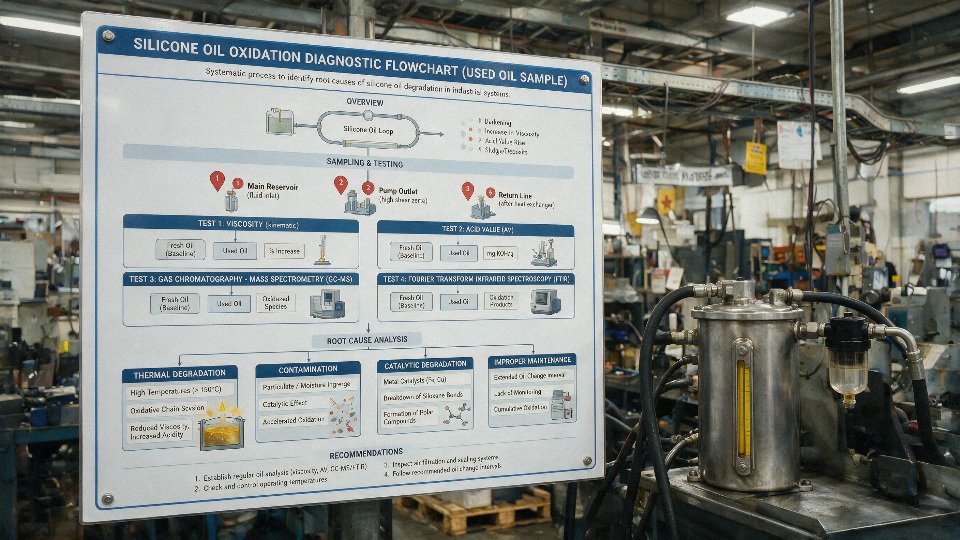
Testing and diagnosis
A usable oxidation diagnosis is usually a sequence, not a single lab number. Start with operating history and a controlled sample, then check simple condition indicators, and only then spend money on targeted lab work; that order catches most false alarms caused by bad sampling, mixed fluids, or process contamination before they turn into a supplier dispute.
The practical goal is not just to answer “is this silicone oil oxidized?” It is to separate oxidation from evaporation loss, hydrolysis, particulate contamination, incompatible top-up, or thermal abuse, then decide whether the fluid can stay in service, needs closer monitoring, or should be changed and the system cleaned.
Use a layered diagnostic sequence
- Review the operating history first
Collect the conditions that actually drive degradation:- Normal and peak bulk fluid temperature
- Estimated hot-spot temperature at heaters, bearings, or thin-film zones
- Air exposure level: sealed reservoir, vented tank, swept headspace, open bath
- Residence time at elevated temperature
- Contact with copper, iron, steel fines, or other catalytic metals
- Water ingress sources: washdown, condensate, humid breathing, process leaks
- Top-up history, including brand, grade, and whether fluids were mixed
- Filter changes, maintenance events, pump failures, seal failures, or heater scorch events
This matters because the same viscosity change means different things in different service histories. A mild viscosity drop in a vented hot bath can point toward chain scission and volatile formation. The same drop in a wet system may be tied to hydrolytic involvement or simple dilution from contamination.
- Control the sampling method
A bad sample can waste a week and send purchasing after the wrong vendor.Use a sampling point that represents the circulating bulk fluid, not just the surface layer or the sludge pocket. If the system stratifies, foams, or carries settled fines, take steps to avoid bias:
- Sample from a live recirculation loop where flow is stable
- Avoid top-layer-only samples if light volatiles or foam are present
- Avoid drain-point-only samples if settled solids or water collect there
- Flush the valve and line before filling the bottle
- Use clean, dry, compatible containers with tight caps
- Label temperature, location, operating state, and time since startup or shutdown
In practice, I prefer paired samples when the situation is messy: one circulating sample and one bottom-reservoir sample. That quickly shows whether you have a fluid problem, a housekeeping problem, or both.
Run a basic appearance check
Before lab work, note:- Clarity or haze
- Sediment or gel specks
- Darkening or yellowing
- Foam persistence
- Odor change, especially sharp cracked-fluid notes
- Visible phase separation
Appearance alone does not prove oxidation, but it tells you where to look next. Haze can mean moisture or fine insolubles. Gels suggest crosslinking or incompatible contamination. Darkening often tracks thermal stress but can also come from process carryover.
Use quick field property checks
These are screening tools, not final verdicts:- Spot viscosity shift with a portable viscometer or controlled cup method where appropriate
- Crackle or rapid moisture screen, if the plant uses it safely and correctly
- Patch test for insolubles
- Simple color comparison against retained virgin sample
- Filter debris inspection under magnification
- Escalate to targeted laboratory analysis
Once the field picture is clear enough, order tests that match the suspected mechanism instead of a generic package.
Core routine tests and what they tell you
The routine panel should be built around comparison with the virgin fluid certificate of analysis and your own historical data.
| Test | What it indicates | Typical diagnostic value |
|---|---|---|
| Kinematic viscosity | Polymer chain length change, contamination, mixing | Drop often points to chain scission or dilution; rise can indicate crosslinking, contamination, or wrong top-up |
| Acid number | Oxidation byproducts or contamination | Trending upward is useful, but absolute limits depend on grade and application |
| Moisture | Water ingress, hydrolytic risk | Important where venting, washdown, or condensation are possible |
| Flash point where relevant | Volatile build-up or contamination | Falling flash point can indicate low molecular weight species or foreign contaminants |
| Color | Thermal history, contamination, oxidation trend | Best used as a trend, not a stand-alone acceptance criterion |
| Insolubles | Gel, soot, wear debris, external dirt | Helps separate fluid degradation from mechanical or housekeeping issues |
| Particle count | Cleanliness and wear contribution | More useful in closed circulating systems than open baths |
| Volatile content | Evaporation tendency and low-boiler formation | Supports diagnosis of thermal cracking or oxidation-related breakdown |
A mechanism is worth keeping in mind here: oxidation and thermal degradation often first change the molecular weight distribution before the fluid looks dramatically bad. That shows up as viscosity shift, volatile growth, and later color or insolubles. If you wait for obvious gel or heavy darkening, the system has usually been running outside a safe envelope for a while.
The trade-off is cost versus confidence. A viscosity and acid number pair is cheap and catches broad change, but it will not tell you whether the problem came from oxidation, mixed product, or process contamination. Once downtime cost is meaningful, the cheaper mistake is usually one more lab test, not one less.
Advanced tests for confirmation and root cause
Use advanced methods when routine tests show change but not cause, or when the fluid failure has procurement, warranty, or safety implications.
FTIR
FTIR is one of the most useful confirmation tools for silicone oil condition. It can show development of:
– Silanol-related absorption, which points toward hydrolytic involvement or oxidation pathways that generate terminal silanol groups
– Carbonyl-type oxidation signatures where present
– Evidence of foreign organic contamination or mixed fluids
FTIR is especially valuable when the used fluid is compared directly against the virgin reference spectrum of the same grade.
GC or GC-MS
These methods identify low molecular weight breakdown products and unusual contaminants. Use them when you suspect:
– Chain scission with volatile fragments
– Solvent or hydrocarbon contamination
– Incompatible top-up fluid
– Storage or handling contamination after delivery
TGA
Thermogravimetric analysis helps show the volatility pattern across temperature. It is useful when:
– Flash point changed but the cause is unclear
– Evaporation loss and oxidation are both plausible
– You need to compare residue and low-boiler behavior against virgin fluid
Elemental analysis
Check for catalytic metals and other inorganics:
– Iron
– Copper
– Aluminum
– Sodium, potassium, calcium where process contamination is possible
– Silicon alone is not enough; it tells you little in a silicone fluid system
Metal contamination matters because trace metals can push oxidation faster once temperature and oxygen are already high enough. The chemistry is not linear. A system that behaves acceptably when clean can turn unstable after wear debris, brazing residue, or rust enters circulation.
A single failed used-oil sample is enough to reject the silicone oil supplier.False
Used-fluid results must be interpreted against virgin product data, service history, sampling quality, and contamination evidence. Many apparent 'fluid failures' originate in mixed top-up fluid, wet storage, metallic contamination, or operating temperatures above design.
Compare against baseline and trend, not one universal limit
There is no responsible single oxidation cutoff that applies to all silicone oils and all service modes. Grade, additive package if any, initial viscosity, application temperature, air exposure, and contamination risk all affect how a result should be read.
Use three references together:
– Virgin product certificate values
– Retained virgin sample, if available
– Historical trend data from the same system
Trend direction often matters more than one absolute number. A steady acid number rise combined with increasing volatiles and slight viscosity loss is a stronger oxidation case than one out-of-family acid number alone. On the other hand, a sudden viscosity jump with gel particles after a maintenance shutdown often points more toward contamination or incompatibility than gradual oxidation.
The main boundary here is mixed or unknown fluid history. If the system has been topped up from different drums over time and nobody can confirm compatibility, trend interpretation becomes weak. At that point, compositional testing and sometimes a controlled drain-and-clean decision are more reliable than arguing over a number.
Root-cause logic: connect the result to the mechanism
Use the chemistry to narrow the cause:
- Silanol rise
- Likely causes: hydrolytic involvement, moisture ingress, oxidation pathways that generate silanol end groups
- Check next: moisture level, venting practice, washdown exposure, condenser leaks
- Metal contamination present
- Likely causes: wear debris, corrosion products, fabrication residue, poor cleaning after repair
- Check next: filter debris, wear source, copper or iron contact points, maintenance history
- Viscosity drop
- Likely causes: chain scission, low-boiler formation, dilution, wrong top-up fluid
- Check next: volatile content, flash point where relevant, GC/GC-MS, top-up records
- Viscosity rise or gel particles
- Likely causes: crosslinking, incompatible contamination, severe thermal stress, aged residues
- Check next: insolubles, compatibility review, hot-spot inspection, reservoir housekeeping
- Color increase with stable viscosity
- Likely causes: early oxidation, thermal history, process contamination
- Check next: FTIR, acid number trend, process leak review
One plant-floor warning: procurement teams sometimes reject a supplier after a used-fluid failure report without checking the storage and transfer chain. Drums left half-open in humid air, top-up through a dirty funnel, or a maintenance tech grabbing “something close enough” from another line can undo a good product fast. If the diagnosis is going to affect supplier approval, make sure the chain of custody and fluid identity are actually defensible.
Prevention strategies
Start with operating reality, not the brochure temperature. Silicone oil life is extended mainly by cutting oxygen exposure, avoiding local overheating, and keeping catalytic contamination out of the circuit; if those three are controlled, service life usually improves more than it does from simply buying a “higher temperature” grade. The catch is that the preferred prevention method changes with system type: an open bath, a sealed thermal loop, and a dosing system do not fail the same way.
A lot of oxidation problems trace back to a purchasing shortcut. Someone buys on price, or on a nominal “200 C capable” claim, while the actual duty includes long hot dwell, splashing return flow, copper contact, weekend shutdown oxygen soak, or repeated contamination during top-up. That is where silicone oil that looks chemically robust on paper starts aging faster than expected.
Select the base fluid family and viscosity grade for the actual duty
PDMS-based silicone oils are often the default because they cover a broad temperature window and handle heat better than many hydrocarbon fluids. But the right choice still depends on how the fluid is used, not just the maximum bulk temperature on the HMI.
What matters in practice:
- Temperature profile, not one number
- Continuous temperature
- Peak temperature duration
- Heat-up and cool-down cycling
- Idle hot-soak periods with little circulation
- System exposure
- Sealed loop
- Vented reservoir
- Open bath
- Metering or coating application with high surface-area air contact
- Fluid duty
- Heat transfer
- Lubrication
- Release or wetting
- Damping
- Vacuum or dielectric service
- Viscosity implications
- Lower-viscosity grades circulate easily and shed bubbles faster, but can show higher volatility and greater loss if the system runs hot or is open to air
- Higher-viscosity grades may reduce evaporation and splash, but they can increase pump load, worsen cold start, and hide stagnant zones if circulation is marginal
The mechanism is straightforward: oxidation rate is influenced by how often oxygen reaches hot fluid molecules and how long those molecules remain at elevated temperature. Viscosity affects both residence pattern and mass transfer. In a poorly designed loop, a very viscous oil may spend too long in boundary layers near heater surfaces. In an open pan, a very low-viscosity oil may continuously refresh a large air-exposed surface and lose more light fractions.
This is where the “best grade” can flip. A lower viscosity may be better in a compact forced-circulation skid with tight temperature control. The same grade may age badly in an open, splashy, intermittently heated process tank. If the supplier offers multiple silicone fluid families or stabilized formulations, selection needs to be tied to the actual duty cycle and exposure mode, not treated as interchangeable.
Reduce oxygen contact wherever the process allows
Closed systems beat open systems for oxidation control, sometimes by a wide margin. If the process does not require direct contact with air, design the fluid circuit to keep oxygen out rather than trying to manage oxidation after it starts.
Practical ways to do that:
- Use closed reservoirs or sealed expansion arrangements where thermal expansion can be accommodated without pulling in ambient air on every cycle.
- Minimize headspace in storage and service tanks, especially for hot standby systems.
- Use inert gas blanketing for higher-temperature or oxidation-sensitive service when the economics justify it.
- Design low-splash returns so returning fluid enters below liquid level or through a diffuser rather than free-falling into the tank.
- Control air entrainment
- Fix suction leaks
- Keep pump seals in shape
- Avoid undersized return lines
- Prevent vortexing in reservoirs
- Reduce unnecessary agitation in open kettles or recirculating sumps.
Air entrainment gets overlooked because operators think only about the fluid surface. In service, microbubbles matter too. They increase gas-liquid contact area, travel through hot zones, and can collapse near pumps and heaters. That does not just promote oxidation; it also affects heat transfer stability and can make the fluid look “foamy” or falsely contaminated.
Inert blanketing is not a universal answer. It works best where the system is already fairly tight and temperatures are high enough that oxygen control changes fluid life materially. On an open tank with frequent lid removal and manual additions, nitrogen can become an expensive gesture.
Control temperature by controlling surfaces, not just bulk fluid
For oxidation prevention, local metal temperature is often more important than the average fluid temperature. A system running at 165 C bulk can oxidize faster than one running at 185 C if the first system has fouled electric heaters, poor circulation, or dead zones that push heater skin temperature much higher.
Focus on these points:
- Limit heater skin temperature
- Check watt density against the fluid and flow condition
- Avoid running immersion heaters partially exposed or with scale buildup
- Verify contact temperature in jacketed equipment, not just vessel setpoint
- Eliminate hot spots
- Remove sludge or coke-like deposits from heat-transfer surfaces
- Correct maldistribution in manifolds
- Avoid stagnant branches and blind legs in hot circuits
- Improve circulation
- Maintain pump performance
- Verify actual flow, not nameplate flow
- Prevent control valve positions that create starvation through heated sections
- Treat shutdown as part of thermal design
- Hot fluid sitting still after pump stop can cook against metal surfaces
- Sequencing matters: often circulation should continue through a controlled cool-down period
The trade-off here is energy density versus fluid life. Aggressive heater loading makes equipment compact and responsive, but it narrows the safety margin sharply. In my experience, oxidation complaints in “high-temperature silicone oil systems” are often really hot-surface design problems.
The boundary of this advice is simple: if the process itself requires direct high-temperature exposure at a free surface, there is only so much temperature management can do. You can slow oxidation, not eliminate it.
Manage materials of construction and assembly residues
Not every metal contact is equally benign at elevated temperature. Noticeable oxidation risk rises sharply when hot silicone oil sees oxygen-rich conditions together with catalytic metal surfaces or contamination. Copper, iron residues, and certain metal salts are common troublemakers, especially when the fluid has already been stressed.
What to check in a build or retrofit:
- Hot contact-zone metallurgy
- Heaters
- Coils
- Fittings
- Thermowells
- Fine screens or strainers near high-temperature sections
- Seal and hose compatibility
- Verify elastomer suitability with the specific silicone fluid and temperature
- Watch for hose liners, adhesives, or sealants that leach into the oil
- Assembly and cleaning residues
- Thread compounds
- Cutting oils
- Solvent residues
- Pickling remnants
- Shop dirt from fabrication
- Maintenance-introduced reactivity
- Greases from shared guns
- Improvised gasket dressings
- Metal fines after field welding or grinding
A system can be clean enough for water or mineral oil service and still be dirty enough to shorten silicone oil life. The difference shows up months later as color shift, viscosity drift, or gel specks, and by then nobody remembers the assembly paste used during commissioning.
Tight contamination control usually pays for itself
Silicone fluids do not like sloppy fluid handling. Water, process carryover, metal fines, residual cleaners, and accidental mixing with non-silicone oils all make oxidation management harder and diagnosis messier.
Use a disciplined handling routine:
- Store drums and totes sealed and dry
- Keep bungs tight
- Avoid repeated partial opening in humid areas
- Protect from outdoor temperature cycling that breathes moist air in and out
- Use dedicated transfer equipment
- Pumps
- Hoses
- Funnels
- Sample bottles
- Filter where appropriate
- Especially during filling, recirculation cleanup, or after maintenance work
- Filter choice depends on viscosity and particle target; there is no single universal micron rating
- Segregate grades and chemistries
- Different silicone viscosities
- Modified silicone formulations
- Hydrocarbon oils, glycols, and other plant fluids
- Control moisture
- Dry containers before use
- Cap lines promptly
- Do not leave expansion or fill ports open during shutdowns
Any silicone oil can be topped up safely with another silicone oil if the viscosity is close.False
Viscosity similarity does not confirm chemical compatibility, additive compatibility, volatility match, or performance equivalence under heat. Cross-mixing can complicate oxidation behavior and make condition monitoring harder. Verify with the supplier before blending grades or formulations.
Use trend-based monitoring and replacement intervals
Waiting for visible deposits is expensive. By the time operators can see darkening, gel particles, or surface residue, the fluid has often moved well past the point where a simple drain-and-refill can be scheduled neatly.
A practical monitoring program should trend:
- Viscosity change
- Acid number shift
- Volatile increase
- Color change
- Insolubles or gel particles
- FTIR indicators such as silanol or carbonyl formation
The mechanism matters here too. Oxidation does not always produce one dramatic failure signal first. In some systems, volatiles rise before viscosity moves much. In others, slight viscosity increase and haze show up while acid number is still modest. That is why single-point pass/fail testing is weak; trend lines are far more useful.
Set sampling intervals based on severity:
- Higher-temperature, oxygen-exposed, contaminated, or critical systems: sample more often
- Sealed, stable, lower-temperature systems: longer intervals may be reasonable
Replacement intervals should be based on trend direction, rate of change, and process consequence, not calendar habit alone. A coating line, a thermal loop, and a precision damping application do not have the same tolerance for fluid drift.
Be careful with antioxidants or stabilizer packages
Stabilizers can help in some formulated systems, but they are not a generic field fix. If a silicone fluid was not designed and validated with a given antioxidant or stabilizer package, adding one ad hoc can create compatibility issues, alter volatility, affect downstream surfaces, or create regulatory problems in sensitive applications.
Before considering any additive approach, verify:
- The exact base fluid chemistry
- Operating temperature range and oxygen exposure
- Contact materials and downstream process sensitivity
- Regulatory or end-use restrictions
- Supplier validation for that specific formulation
In procurement terms, this is where cheap correction becomes expensive experimentation. If oxidation control requires additives, that decision should sit with the fluid supplier and application review, not with improvised plant-floor dosing.
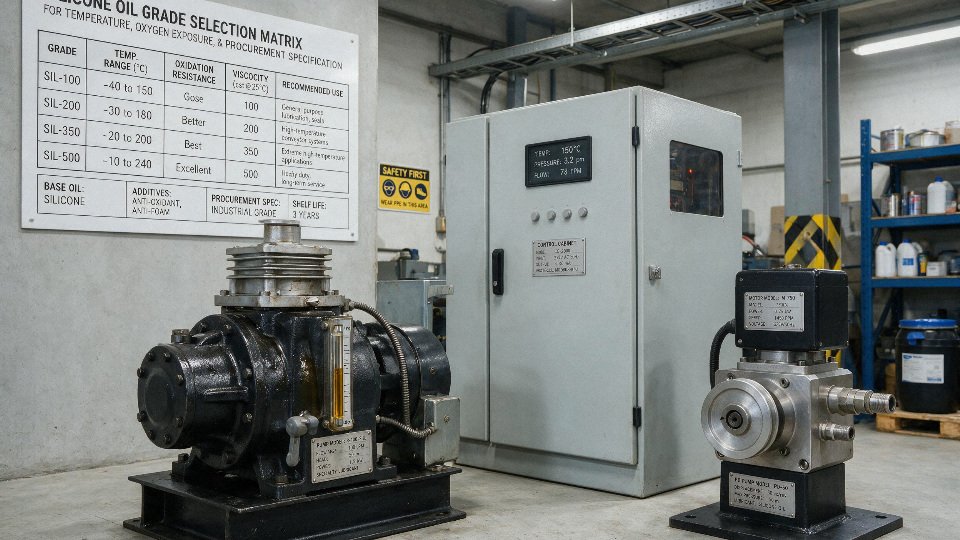
Grade selection factors
If oxidation stability matters, do not buy silicone oil by viscosity alone. The right grade is chosen from the temperature profile, oxygen exposure, metallurgy, contamination risk, and product-quality limits around the fluid; once those are defined, the price gap between grades is usually smaller than the cost gap created by fouling, fluid loss, and unplanned shutdowns.
A plain 100 cSt PDMS that works well in a sealed, clean, moderate-temperature bath may be the wrong choice in an open sump with air entrainment, copper contact, and long dwell at 180 C. In practice, buyers get into trouble when the purchase spec is just “silicone oil, 100 cSt” with no volatility, purity, or oxidation-related limits attached.
Start with the operating inputs that actually drive oxidation risk
You need a selection sheet that captures the conditions the fluid will see, not the conditions the process engineer wishes it would see.
- Continuous temperature and peak temperature
- Record normal bulk temperature, hot-spot temperature, and peak duration.
- A fluid held at 160 C continuously in air behaves very differently from one that touches 220 C for a few minutes in a closed heat-transfer loop.
- Hot spots matter because oxidation and volatilization accelerate at surfaces first: heater sheath, thin film zones, pump clearances, and splash points.
- Oxygen exposure mode
- Distinguish among sealed system, vented reservoir, open bath, thin-film exposure, and aerated circulation.
- The mechanism is straightforward: more oxygen access means more opportunity for oxidative chain scission or end-group change, especially at elevated temperature.
- A vented tank with agitation usually ages fluid faster than a static closed loop at the same bulk temperature.
- Contact materials
- Ask what metals, elastomers, seals, coatings, and filter media the oil will touch.
- Iron is one thing; copper, brass residues, certain catalyst traces, and dirty fabrication surfaces are another.
- Freshly machined parts, welding scale, and poorly flushed piping can shift a stable fluid into early degradation.
- Contamination risk
- Include water ingress, cleaning chemical carryover, process vapors, carbon fines, dust, and previous-fluid residues.
- Oxidation diagnosis gets messy when contamination is present because viscosity drift, acidity, haze, and color can come from more than one cause.
- If the plant cannot keep the system clean, buy a grade and package spec that reflects that reality.
- Required viscosity profile
- Define the viscosity at the operating temperature that the process needs, not just the room-temperature nominal grade.
- Too low, and you lose film strength or heat-transfer behavior; too high, and pumps work harder, cold start gets ugly, and residence at hot surfaces can increase.
- This is one trade-off buyers miss: a heavier fluid may reduce volatility but can worsen circulation and local overheating if the system was not built for it.
- Volatility limits
- Important for open systems, vacuum-adjacent equipment, heated release coatings, and any process sensitive to fumes or condensate.
- Lower volatility can help hold viscosity and reduce deposits, but it often comes with higher cost and sometimes weaker low-temperature handling.
- Regulatory or purity needs
- Food-contact-adjacent, electronics, personal care intermediate, or specialty process use may impose impurity and documentation limits.
- If regulatory or purity needs are real, put them in the RFQ. Do not try to bolt them on after the first commercial batch.
Which grade family fits which job?
The broad families are not interchangeable, even when nominal viscosity overlaps.
| Grade family | Oxidation resistance | Low-temperature behavior | Cost level | Typical fit |
|---|---|---|---|---|
| Standard methyl silicone oils (PDMS) | Good in normal service; risk rises with prolonged high-temperature air exposure | Usually strong | Lowest | General lubrication, damping, heat transfer within moderate limits |
| Phenyl-modified silicone oils | Often better thermal/oxidative stability in demanding heat service; depends on composition | Usually better at very low temperature in many formulations | Higher | Wider temperature swings, optics, specialty heat applications |
| Specialty high-temperature silicone fluids | Chosen where prolonged upper-end service is expected | Varies by chemistry | Higher to highest | Severe thermal duty, oxidation-sensitive systems |
| Formulated blends | Can be tuned for volatility, flow, or process fit; stability depends on formulation discipline | Depends on blend | Varies widely | OEM-specific or process-specific requirements |
A few cautions behind that table:
- Standard methyl silicone oils are still the default industrial choice because they balance cost, availability, and broad compatibility well.
- Phenyl-modified grades can justify their premium where the system spends meaningful time near the upper thermal limit or must keep flowing at lower ambient temperatures.
- “High-temperature” is not a universal performance guarantee. Request the supplier’s actual test basis and application boundary. One supplier’s specialty grade may be optimized for closed heat-transfer systems, another for open-surface stability.
- Formulated blends solve some plant problems and create others. If the supplier cannot clearly state composition intent, volatility behavior, and QC controls, the blend becomes a black box during failure analysis.
A more expensive silicone fluid can lower total operating cost if it materially extends changeout interval or reduces heater fouling.True
This is consistent with standard industrial cost logic. Fluid price is only one part of cost; oxidation-driven deposits, cleaning labor, downtime, scrap, and maintenance can quickly outweigh the purchase premium. The exact crossover depends on service temperature, oxygen exposure, and changeout frequency.
What to put in the purchase specification
At minimum, request the following data and acceptance limits:
- Nominal viscosity grade and allowable tolerance
- Volatile fraction or loss-on-heating test basis
- Moisture limit
- Acid value
- Appearance requirement
- Clear, free of haze, sediment, or visible gel
- End-group information where relevant
- Especially when end-group chemistry affects stability, reactivity, or downstream compatibility
- Lot-to-lot consistency controls
- Ask which properties are checked every batch, which are periodic, and what triggers investigation
- Certificate of analysis format
- Packaging and shelf-life conditions
- Retention sample policy and complaint handling path
If the application is oxidation-sensitive, also ask what analytical methods the supplier uses for trend-relevant properties such as FTIR, volatiles, and acid value. A supplier that can only provide viscosity and appearance is not giving you much leverage when a line starts smoking or a heater bundle comes out brown.
How to qualify the supplier, not just the fluid
The fluid spec looks solid on paper until the fourth shipment arrives slightly off and the process window tightens. That is why supplier qualification matters as much as grade selection.
Check these points:
- Manufacturing integration
- Does the supplier actually manufacture organosilicon intermediates and fluids, or mainly trade them?
- Raw material traceability
- Can they trace key feedstocks and process batches?
- Analytical capability
- Routine viscosity testing is basic. Better suppliers can support FTIR, volatility checks, acid value, moisture, and problem investigation.
- Stable export execution
- Packaging quality, labeling consistency, documentation accuracy, and repeat shipment quality matter if you run global plants.
- Technical support
- Can they review an application, compare used vs fresh fluid, and comment on likely degradation paths?
- Evidence of production consistency
- Ask for typical COAs across several lots, not a single polished sample report.
For buyers who need dependable organosilicon supply with room for grade customization, SiliconChemicals’ position as an integrated manufacturer and supplier of silanes, siloxanes, silicone polymers, and specialty modified silicone materials is commercially relevant. That kind of production base can support traceability, industrial-scale quality assurance, and more stable long-run supply than a purely trading model, though the fit still needs to be verified against your exact duty cycle, purity requirement, and QC expectations.
Frequently asked questions
Does silicone oil oxidize faster than mineral oil at the same temperature?
Usually no, not in the moderate temperature band where both fluids are commonly compared. PDMS-based silicone oil generally resists oxidation better than standard mineral oil because the siloxane backbone is more oxidation-tolerant, but that does not mean it lasts longer in every service.
What flips the result is the failure mode. Mineral oil often shows faster sludge and varnish formation as temperature rises, while silicone oil may hold up cleanly for longer and then show viscosity change, volatile formation, silanol generation, or gel particles once oxidation and chain scission get going. In practice, equal-temperature comparisons only mean something if you also match:
– oxygen exposure
– dwell time at peak temperature
– metal contamination
– water ingress
– fluid film thickness
– system design and refill habits
Silicone oil always outlasts mineral oil at the same temperature.False
Silicone oil usually has better oxidation resistance, but service life still depends heavily on oxygen exposure, catalytic metals, contamination, and the specific failure criterion used in the application.
At what temperature does silicone oil start to oxidize noticeably?
For many PDMS fluids in air, noticeable oxidation risk rises sharply once the oil is held for long periods above roughly 150 to 180 C. Many grades still operate well below that point for long periods, and some can tolerate short-term exposure near 200 C or, grade depending, around 250 C, but sustained high-temperature exposure is where the chemistry stops being forgiving.
A plant-floor detail that matters: a sump temperature of 145 C is not the same as a heater skin temperature of 190 C. Local hot spots around electric elements, tight recirculation dead zones, and metal contact surfaces can drive oxidation even when the bulk reading looks acceptable.
Can silicone oil oxidize in a sealed system?
Yes, if oxygen is present and the residence time is long enough. A “sealed” system is rarely oxygen-free unless it was deliberately inerted, leak-tested, and kept dry through maintenance cycles.
Common oxygen sources in nominally sealed equipment:
– headspace air left during filling
– permeation through seals or hoses
– air ingressed during sampling or top-up
– dissolved oxygen already in the fluid
– repeated thermal breathing through weak gaskets or vents
If the system is truly inerted with nitrogen and stays tight, oxidation slows substantially. That does not rule out other degradation routes.
Does color change always mean oxidation?
No. Darkening can indicate oxidation, but by itself it is not proof. Silicone oil can change appearance from thermal history, additive interaction, contamination, fine wear metals, process carryover, or even slight haze from incompatible residues in lines and drums.
Treat color as a trigger for confirmation, not a verdict. Useful follow-up checks are:
– viscosity shift
– acid number trend
– volatile increase
– particle or gel inspection
– FTIR evidence of silanol or carbonyl formation
Can oxidized silicone oil be filtered and reused?
Sometimes you can remove suspended gel or dirt by filtration, but filtration does not reverse oxidation chemistry. If the oil has already developed significant viscosity drift, acid number increase, or volatile growth, the base fluid has changed and reuse becomes a process-risk decision, not a housekeeping exercise.
Filtration may still make sense when:
– oxidation is mild and solids are the main immediate problem
– the application is noncritical
– a short interim run is acceptable before changeout
– lab data confirms the remaining properties are still inside your operating window
For heat transfer, precision coating, release, or dielectric uses, I would verify with testing before putting reclaimed fluid back in service.
How do metal contaminants affect silicone oil life?
A little metal can do a lot of damage. Iron, copper, and other transition-metal contaminants can catalyze degradation reactions, especially at elevated temperature, accelerating oxidation and sometimes pushing the oil toward gel formation or faster chain scission.
Typical entry paths are pump wear, poor drum handling, corroded reservoirs, dirty fittings, and maintenance tools that are never as clean as the fitter thinks they are.
Are phenyl silicone oils always better for high temperature?
No. Phenyl-modified silicone fluids are often chosen for better high-temperature behavior and low-temperature performance in certain applications, but “better” depends on the duty. They can offer an advantage where thermal stability or broader temperature range matters, yet cost, compatibility, volatility behavior, and property targets may point back to standard PDMS or another modified fluid.
The mistake is buying on chemistry name alone. You still need to verify the actual grade against your temperature profile, oxygen exposure, material compatibility, and required viscosity over time.
What tests should a buyer request before approving a new supplier?
Ask for the tests that protect your failure mode, not a generic data sheet stack.
Minimum practical screening usually includes:
– viscosity at the relevant test temperature
– volatile content or loss-on-heating method
– acid number
– color and appearance
– particle cleanliness or insolubles
– FTIR reference profile for incoming identity control
For higher-temperature service, add:
– accelerated thermal or air-aging data, if the supplier has it
– before/after viscosity change under defined aging conditions
– evidence of gel formation tendency
– metal impurity limits if catalytic contamination is a known risk
The important part is comparability. If a supplier shows aging data, verify test temperature, exposure time, air flow, container geometry, and pass/fail basis. Without that, two “high-temperature stable” claims may not be talking about the same test at all.
Your grade verification step
If your silicone oil spends most of its life below roughly 150 C, sees limited air ingress, and your test data show only modest drift in viscosity, volatiles, or acid number, you can usually stay with the current grade and tighten operating discipline first. Once the fluid is held for long periods in the 150 to 180 C range or above, especially on hot metal surfaces with contamination present, grade suitability stops being a paperwork question and becomes a validation job.
Use this checklist before you blame the fluid:
- Operating temperature profile
- Record normal bulk temperature, startup peaks, upset peaks, and how long each condition lasts.
- Separate continuous exposure from short spikes. A fluid that survives a 20-minute peak may still age too fast at a lower but constant temperature.
- Oxygen exposure
- Check whether the system is open, vented, frequently topped off, or has headspace turnover.
- Oxidation rate usually tracks oxygen access, not just temperature. A quiet sealed loop and an open heated bath are different worlds.
- Hot surface temperature
- Measure heater sheath, plate, and thin-film contact temperatures if possible, not just tank temperature.
- In practice, local metal temperature is often what pushes oxidation first. The bulk oil can read acceptable while the heater skin is cooking it.
- Contamination sources
- Look for carry-in from process vapors, cleaners, water, dust, carbon fines, degraded seals, and mixed fluids from top-up errors.
- Small contamination loads can shift the mechanism from slow oxidation to sludge, gel specks, or catalyst-driven breakdown.
- Contact metals
- Identify wetted metals and any recent hardware changes.
- Copper alloys, dirty iron surfaces, and metal salts can accelerate degradation enough to matter, especially in hot recirculating systems.
- Required service life
- Define whether you need months, one campaign, or multiple years between fluid changes.
- A grade that is technically usable may still be commercially wrong if labor, disposal, and downtime dominate total cost.
- Acceptable property drift
- Set limits for viscosity change, color, volatile content, acid number, particles, and finish impact on the product.
- If you do not define acceptable drift, every fluid review turns into opinion.
Keep the current grade and fix housekeeping first when the oxidation signs are mild, contamination is traceable, and the temperature map shows controllable hot spots. Evaluate a higher-stability grade, tighter specification, or different chemistry when oxidation is repeatable after cleanup, when service life is consistently too short, or when the process cannot avoid high-temperature oxygen exposure.
Before changing supplier or grade, gather the minimum evidence package:
- Current fluid analysis, including trend data if available
- System schematic or flow path sketch
- Maintenance and top-up history
- Photos of deposits, discoloration, gels, or failed parts
- Target performance requirements: temperature range, service interval, finish sensitivity, and allowable drift
A practical validation path is straightforward:
- Lab compatibility review against your materials and process contaminants
- Pilot trial on one loop, bath, or production cell
- Monitored startup with agreed sampling points and intervals
- Condition trending against acceptance criteria set before the trial starts
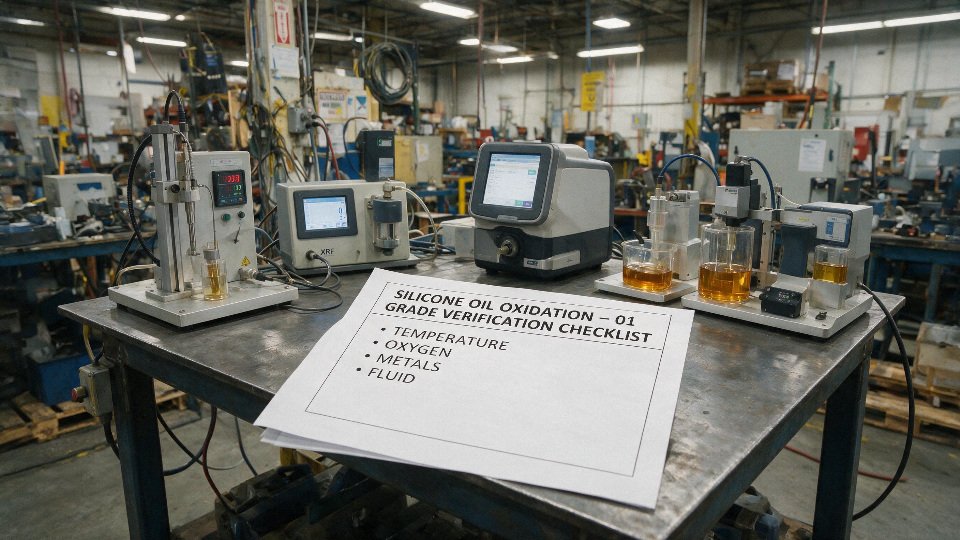
If you want a grade recommendation that is worth acting on, send SiliconChemicals your substrate or process contact material, contaminant type, approximate residue or deposit condition, operating temperature profile, working volume, required finish or cleanliness outcome, target service life, and clear fluid or equipment photos plus any current analysis. From that, the team can review the application, match a suitable silicone fluid grade from confirmed supply options, and propose a technical evaluation path for trial and condition monitoring.