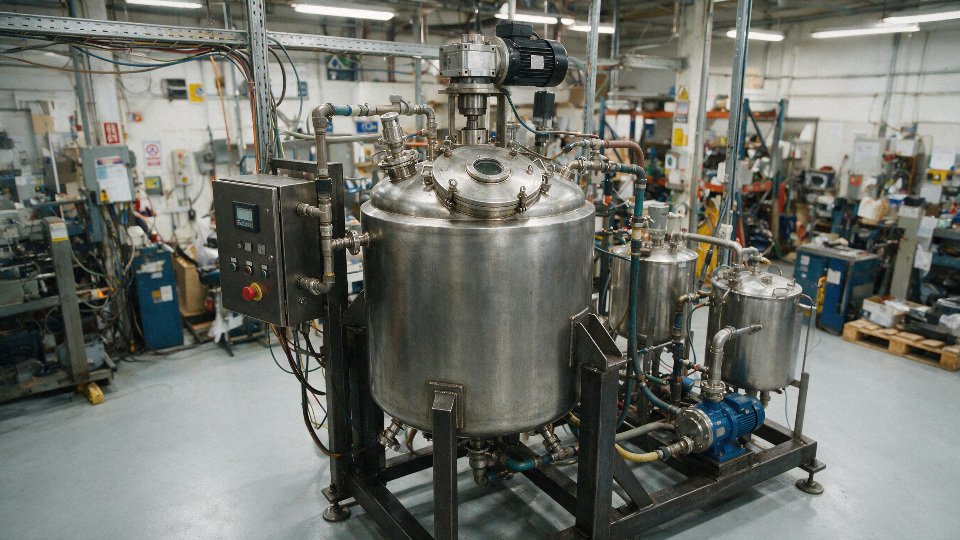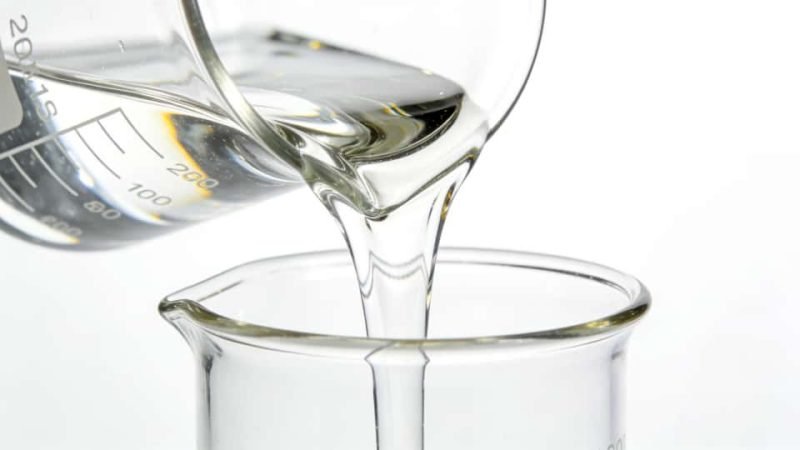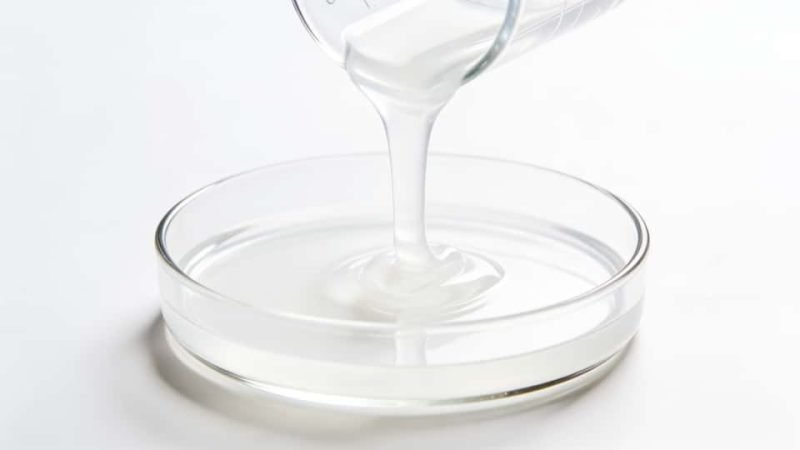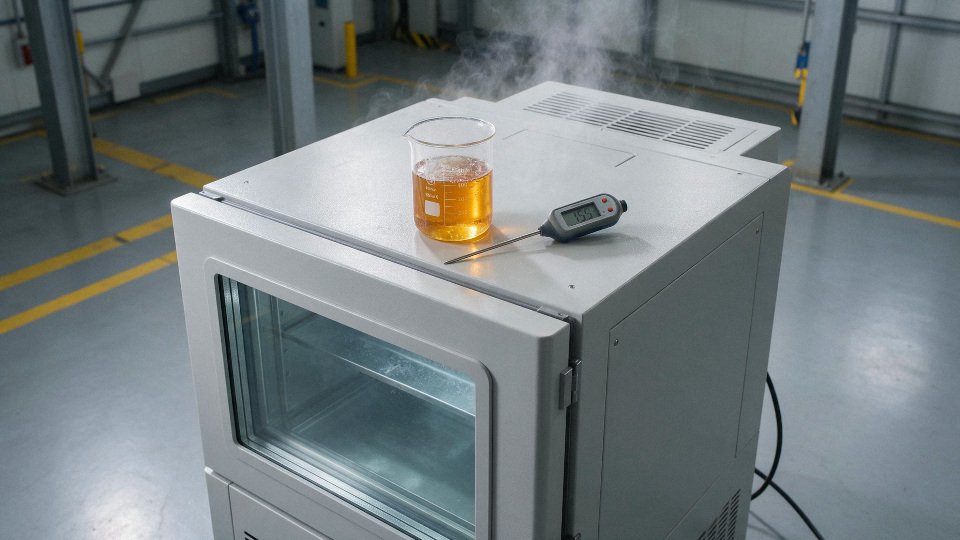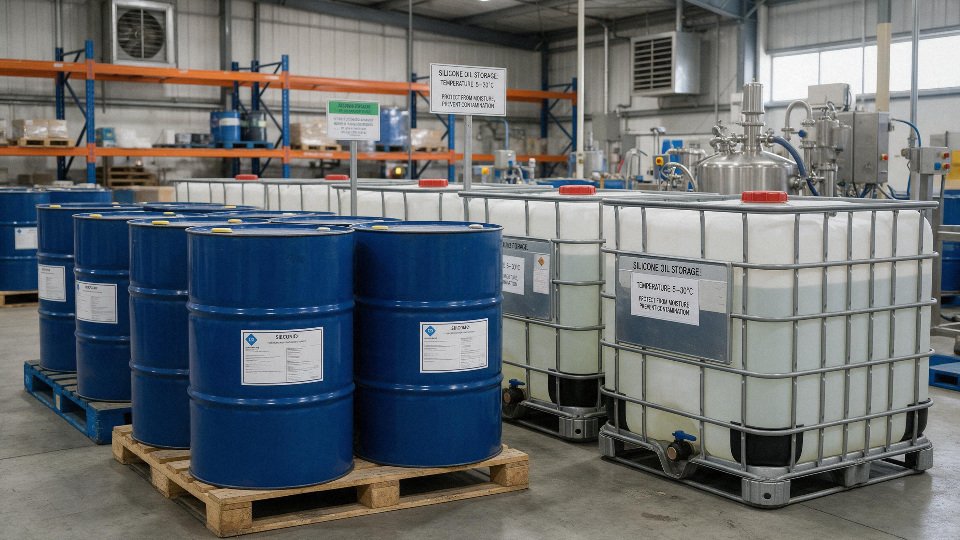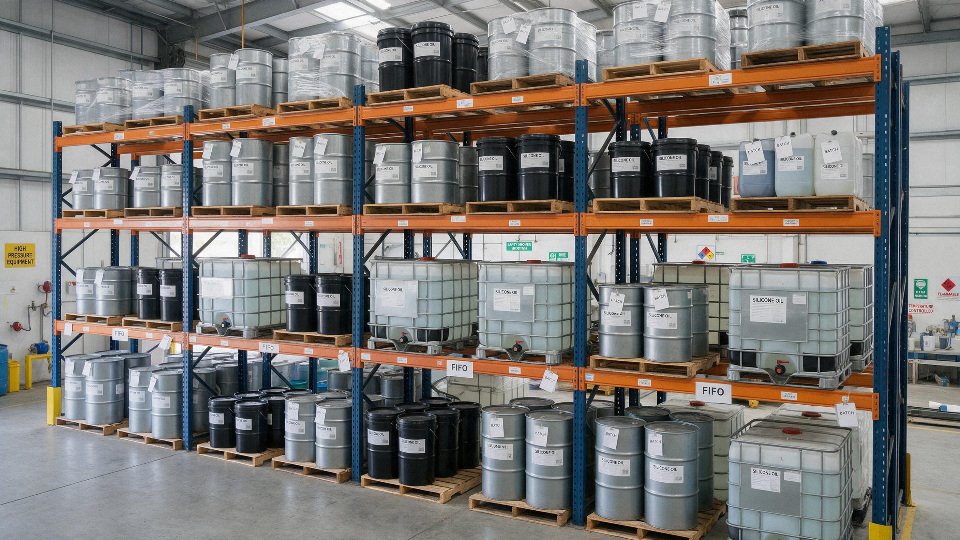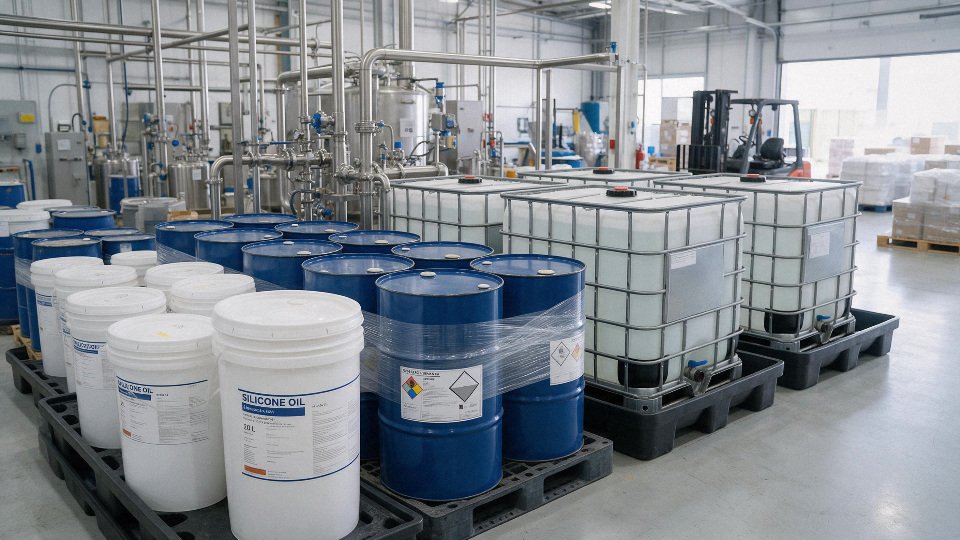
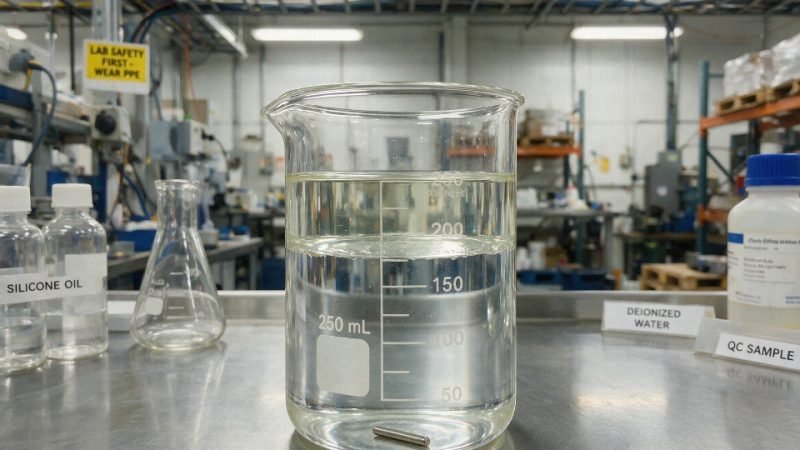
Silicone oil and water look harmless enough in a beaker, but on a production line they create headaches fast: unstable emulsions, separator carryover, fish-eyes in coatings, inconsistent release performance, and wash tanks that stop behaving the way operators expect. That turns into scrap, longer cleaning cycles, off-spec batches, and disposal costs that are usually noticed only after a tank, drum, or wastewater tote has already become someone’s problem. The practical question is not just whether they mix, but under what conditions they stay separate, temporarily disperse, or become difficult to split again.
Silicone oil does not truly mix with water under normal conditions. It is generally immiscible, usually forms a separate phase, and because many standard silicone oils have a density around 0.93-0.98 g/cm3 at 25 C, they often float above water. What changes in practice is dispersion behavior: viscosity, temperature, agitation, and any surfactant present can turn a clean phase split into a stubborn emulsion.
That distinction matters because two plants can both say “silicone oil in water” and be dealing with completely different problems. One has a visible surface layer that decants easily; the other has fine droplets hanging in suspension for hours, or days, because the process chemistry and mixing energy changed the game.
Why they resist mixing
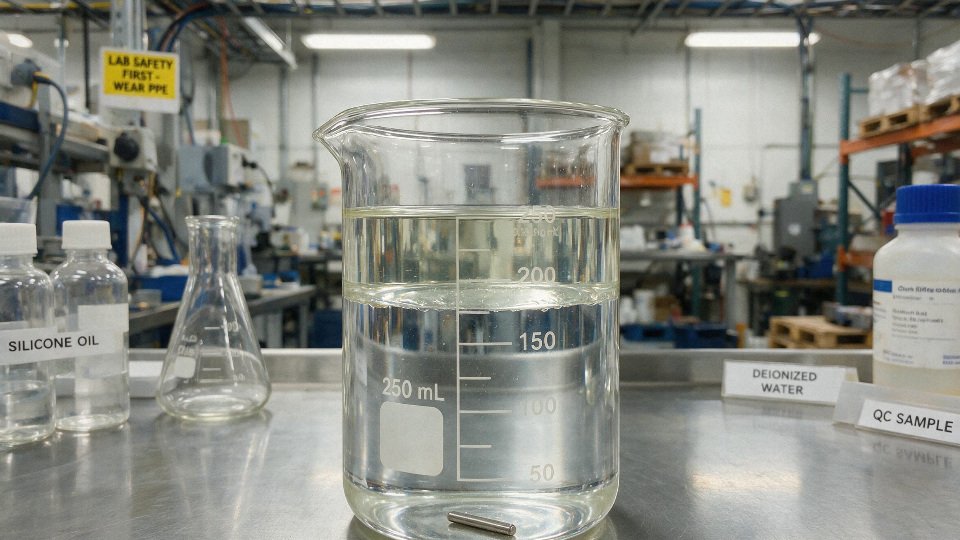
They stay separate because the chemistry is working against molecular-level blending from the start: silicone oil is typically low-polarity and hydrophobic, while water is strongly polar and held together by hydrogen bonding. Even if you whip them into a temporary dispersion, the system usually lowers its energy by pushing the silicone phase back out and rebuilding a clean oil-water interface.
A lot of confusion comes from what people see in a tank or beaker. A cloudy mix after agitation looks like compatibility, but in most plants that cloudiness is just droplets, not true dissolution. Give it enough time, remove the shear, and the phases usually sort themselves out unless a surfactant, fine solids, or some formulation additive is keeping the emulsion alive.
The silicone oil molecule is built to avoid water
Most common silicone oils used in industry are polydimethylsiloxane-type fluids, built around a repeating Si-O backbone with methyl groups attached to the silicon atoms. That structure matters. The Si-O chain is flexible, and the outer methyl groups present a relatively nonpolar, water-repelling surface to the surrounding environment.
In practice, that gives silicone fluids a set of behaviors buyers and process engineers recognize quickly:
- Low affinity for water
- Good spread on many low- and medium-energy surfaces
- Limited cohesive interactions with polar liquids
- Tendency to separate into a distinct phase in aqueous systems unless emulsified
The methyl groups do most of the practical work here. They shield the backbone from interacting strongly with water, so the fluid does not offer the kind of polar sites water prefers. Compare that with alcohols or glycols, where polar groups can participate in stronger interactions with water and support partial or full miscibility. Standard silicone oil generally cannot do that.
There is also a structural nuance that gets missed in purchasing discussions: “silicone oil” is a broad commercial label, but not every silicone fluid behaves exactly the same. End groups, functional modification, molecular weight, and additives can all shift how a product handles in water. The basic immiscibility point still holds for many standard PDMS fluids, but once you move into modified silicones, silicone emulsions, or surfactant-containing blends, you need the exact grade data rather than the category name.
Water pays an energetic price to accommodate silicone molecules
Water is not just polar in a casual sense; it forms a highly organized, constantly rearranging hydrogen-bonded network. That network is why water behaves the way it does in cleaning, extraction, heat transfer, and a hundred other plant operations. To disperse a nonpolar silicone molecule into that network, water has to reorganize itself around a species it cannot bond with favorably.
That costs energy.
The practical consequence is simple: water “prefers” to stay with water, and silicone oil “prefers” to stay with silicone oil. The phases separate because that arrangement is thermodynamically more favorable than forcing nonpolar silicone molecules into the aqueous phase. If you want them to remain mixed, you usually need help from surfactants, functional groups, or a deliberately designed emulsion system.
This is the point where some operators ask why vigorous mixing is not enough. The reason is that agitation changes the physical distribution, not the underlying molecular compatibility. A high-speed mixer, recirculation pump, or inline rotor-stator can break one phase into droplets inside the other, but it does not erase the energetic penalty of keeping those droplets dispersed. Once the external energy input stops, the system starts moving back toward separation.
Low surface tension means silicone oil should dissolve in water.False
Low surface tension helps silicone oil wet many surfaces, but wetting and water solubility are different phenomena. A fluid can spread readily over a surface and still remain immiscible with water because the molecular interactions governing interfacial wetting are not the same as those required for true dissolution.
Interfacial tension is the barrier you see as separation
Silicone oil and water typically show interfacial tension in roughly the 35-45 mN/m range, depending on viscosity, surfactants, and temperature. That interface is not just a visual boundary; it is an energy barrier. Creating lots of small droplets means creating a lot of new interfacial area, and that takes work.
That is why spontaneous mixing does not happen under normal conditions. To go from two clean layers to a fine dispersion, the process has to input enough energy to overcome the resistance to droplet formation. Then, once mixing stops, the system tries to reduce that interfacial area again by:
- Droplet collision
- Coalescence into larger droplets
- Migration under gravity or buoyancy
- Re-formation of separate bulk phases
For many standard silicone oils with densities around 0.93-0.98 g/cm3 at 25 C, the oil phase usually floats above water. That is the common case in tanks, separators, and contaminated rinse systems, though additives or blended formulations can shift phase behavior enough that you should verify by sample rather than assume.
A useful plant-floor distinction: if you see a stable milky appearance for longer than expected, the issue is often not that silicone has somehow become water-soluble. It is usually one of these:
- Residual surfactant from cleaning chemistry
- Fine particulate stabilizing the interface
- Very high shear creating small droplets
- Modified silicone chemistry, not standard silicone oil
- Temperature and viscosity conditions slowing separation enough to mislead the operator
Viscosity changes how the separation looks, not the basic miscibility
Low-viscosity and high-viscosity silicone oils can behave very differently in mixers, wash tanks, and drains, even though both remain fundamentally immiscible with water.
Lower-viscosity grades
Common low-viscosity silicone fluids, say around the lower end of the 10 cSt and upward range, break into smaller droplets more easily under agitation. That can make them appear to “mix better,” especially in pumped systems or spray applications.
What is actually happening:
- Lower internal resistance allows droplet deformation and breakup more readily
- Smaller droplets settle or rise more slowly
- The dispersion can look stable for longer, even without true compatibility
That last point matters in troubleshooting. A low-viscosity contamination problem in a rinse line can stay cloudy long enough that operators blame chemistry, when the issue is simply droplet size and delayed phase separation.
Higher-viscosity grades
As viscosity rises into the hundreds, thousands, or far beyond, breakup becomes much harder. A high-viscosity silicone oil often stays as large globules, stringy masses, or smeared surface films rather than forming a fine dispersion.
The trade-off is straightforward:
- Easier droplet breakup at low viscosity can mean slower visible clarification because droplets are smaller
- Harder breakup at high viscosity can mean obvious phase separation, but also more stubborn residue on equipment walls, hoses, and seals
In cleaning systems, that trade-off flips the preferred approach. If the problem is a low-viscosity silicone fluid, you often need to manage emulsion behavior and residence time. If it is a very high-viscosity grade, the bigger problem may be mechanical removal, surface drag-out, and dead-leg accumulation rather than fine dispersion.
So viscosity affects droplet size, coalescence rate, and handling behavior, but it does not turn silicone oil into a water-soluble fluid. That conclusion stops holding only if you leave the category of standard silicone oils and move into specially modified silicone materials designed for aqueous compatibility.
Low surface tension helps wetting, not water miscibility
This is one of the most persistent misconceptions in production and procurement. Silicone oil is known for relatively low surface tension, so it can spread across many substrates very effectively. On a line, that shows up as release performance, defoaming behavior, slip, leveling, or contamination spread, depending on whether the silicone is wanted or unwanted.
But wetting and dissolving are different tests.
A fluid can wet:
- Metal surfaces
- Glass
- Some plastics
- Painted or coated surfaces
- Textile fibers
and still remain almost completely separate from water.
The mechanism is different. Wetting depends on the balance between the liquid’s surface tension and the surface energy of the solid substrate. Miscibility depends on whether two liquids can mix at the molecular level without a large energetic penalty. Silicone oil often scores well on the first and poorly on the second. That is why a silicone contaminant can spread into a thin film across a wash tank wall and still refuse to dissolve into the aqueous phase.
Heating changes the rate picture more than the compatibility picture
Raising temperature usually lowers silicone oil viscosity and can alter interfacial behavior somewhat, so heated systems often show faster droplet deformation, different coalescence behavior, and shorter apparent separation times. But heating alone does not normally create true molecular miscibility between standard silicone oil and water.
What temperature can change:
- Oil viscosity, sometimes substantially
- Droplet breakup under the same shear conditions
- Coalescence rate
- Phase separation speed
- Performance of surfactants or other formulation aids
What temperature usually does not change:
- The fundamental polarity mismatch
- Water’s preference for hydrogen-bonded association
- The basic immiscibility of standard silicone oil and water
That matters in plant decisions. If a heated wash or blending step suddenly looks “better mixed,” do not assume the chemistry problem is solved. Often you have only changed the kinetics, not the equilibrium state. Once the fluid cools, sits in a tote, or enters a low-shear holding tank, the old separation behavior tends to come back, and that is usually where the complaint starts.
Mixing versus emulsifying
A silicone oil and water blend can look uniform for a few seconds or a few weeks, but that does not make it the same thing. Simple mixing only disperses one phase into the other for a while; emulsifying means building a system that actively resists separation through chemistry, droplet-size control, and formulation balance. That distinction is where a lot of plant-floor mistakes start.
If the job only needs a short-lived spray, wash, or transfer step, a temporary dispersion may be enough. If the product has to sit in a tote, pass through a pump, survive temperature swings, and still apply consistently, you are no longer talking about “mixing” in the casual sense. You are specifying an emulsion.
What the different “mixed” states actually mean in practice
These terms get used loosely in purchasing and production meetings, and that causes trouble fast.
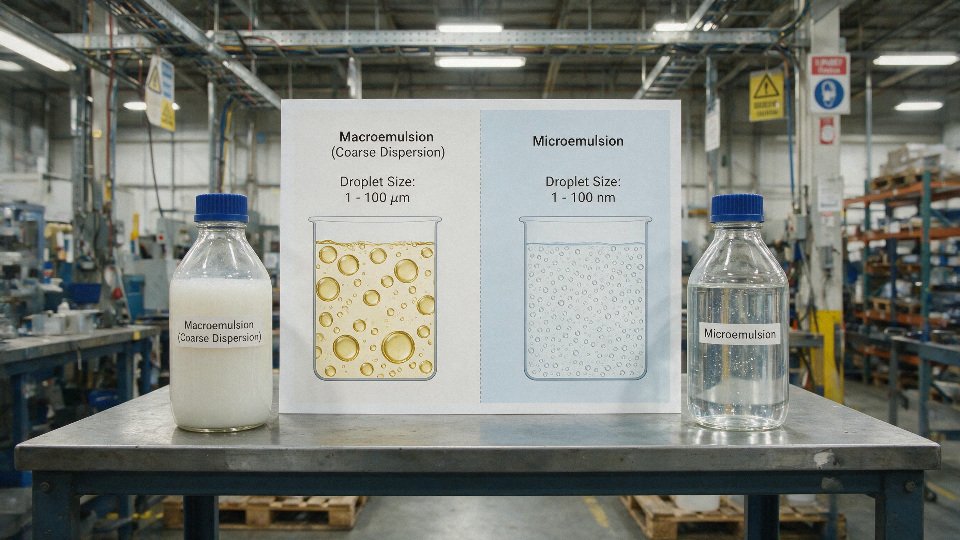
- Coarse dispersion
- Usually made by simple stirring, recirculation, or low-to-moderate shear.
- Droplets are relatively large and separate quickly.
- Often looks milky right after agitation, then clears into layers in minutes to hours.
- Common in field-made tank mixes where operators add silicone fluid into water and assume visual whiteness means compatibility.
- Macroemulsion
- A deliberately emulsified system with droplet sizes typically larger than microemulsions but small enough to give usable storage life.
- Often opaque or bluish-white.
- Needs emulsifiers and adequate processing energy.
- Common in textile finishes, mold-release concentrates, and household care products.
- Microemulsion
- Much finer and often translucent or clear, depending on composition.
- Requires a more carefully balanced surfactant system, often with co-surfactants depending on chemistry.
- Can be more kinetically robust and easier to dilute without immediate breaking, but formulation latitude is narrower.
- More sensitive to raw material variation than many buyers expect.
- Pre-emulsified commercial silicone product
- A supplier-made silicone emulsion or dispersion delivered ready to dilute or use.
- Typically includes silicone phase, emulsifier package, water phase control, and sometimes preservatives, pH adjustment, or protective colloids.
- Chosen when consistent application, shelf life, and predictable dilution behavior matter more than buying neat silicone fluid and “mixing it on site.”
One practical point: a white tank is not proof of a stable emulsion. It only proves light is scattering off droplets at that moment.
Why agitation can fool you
A drum mixer, propeller agitator, inline rotor-stator, or high-pressure homogenizer can all make silicone oil appear to “mix” with water. The difference is how much energy gets into the interface, how long the droplets stay small, and whether anything in the formulation prevents them from fusing back together.
The mechanism is straightforward. Agitation breaks bulk silicone into droplets. Smaller droplets rise or settle more slowly and make the liquid look more uniform. But silicone oil-water interfacial tension is still typically around 35-45 mN/m, depending on viscosity, surfactants, and temperature. Without stabilizers, the system wants to reduce interfacial area, so droplets collide and coalesce into larger ones, then separate.
A few plant variables drive that behavior hard:
- Agitation energy
- Higher energy generally reduces droplet size at first.
- Past a point, if the surfactant package is weak or absent, extra energy gives only temporary improvement and can add heat that later destabilizes the system.
- Shear rate
- High shear helps break droplets, especially with lower-viscosity silicone fluids.
- Very high-viscosity PDMS fluids, say in the upper end of the common 10 cSt to more than 100000 cSt range, resist breakup and often need more specialized equipment.
- Residence time under shear
- Too short, and droplet size never gets down into a useful range.
- Too long, and some systems overprocess: temperature rises, air entrainment increases, and sensitive additives can be damaged.
- Equipment type
- A tote-mounted propeller mixer is fine for blending water-like liquids, but usually poor at making a durable silicone emulsion from neat fluid.
- Rotor-stator mixers, colloid mills, and homogenizers can do much better, though they still cannot compensate for the wrong chemistry.
- In recirculation loops, pump type matters. A centrifugal pump may disperse a little; a positive displacement pump mostly moves the problem around.
That is why operators sometimes swear a field blend “worked yesterday.” It probably did for the duration of that batch window. Leave it standing over lunch, or let it cool overnight, and the truth shows up.
What actually stabilizes silicone droplets in water
Emulsifiers, surfactants, and protective colloids are doing different jobs, even if they get lumped together on a spec sheet.
- Emulsifiers and surfactants
- Lower interfacial tension and help new droplets form during processing.
- Build a stabilizing layer around droplets so collisions do not immediately turn into coalescence.
- Choice depends on silicone structure, target dilution range, pH, electrolyte exposure, and end-use restrictions.
- Protective colloids
- Improve kinetic stability by increasing continuous-phase viscosity or creating a steric barrier around droplets.
- Useful where the product has to tolerate storage, shipping vibration, or mild freeze-thaw stress.
- They can also change application feel, residue, or drying behavior, so they are not free insurance.
There is a trade-off here. More surfactant often improves initial dispersion and dilution stability, but it can hurt defoaming, change substrate feel, increase water sensitivity after drying, or create residue in release and coating applications. In textile and personal care systems, that compromise matters as much as the emulsion stability itself.
High shear alone can convert neat silicone oil and water into a commercially stable emulsion.False
High shear can temporarily reduce droplet size, but durable stability usually requires a matched emulsifier system and formulation controls. Equipment energy cannot replace missing interfacial chemistry.
Why purpose-built silicone emulsions behave differently from field mixes
Commercial silicone emulsions are usually designed backward from the application, not forward from the base fluid. That is the part buyers sometimes miss.
A purpose-built product for one of these uses will be tuned differently:
- Personal care
- Prioritizes sensory profile, spread, gloss, wash-off behavior, and compatibility with other formulation ingredients.
- Textile finishing
- Balances hand feel, sewability, hydrophobicity, yellowing risk, bath stability, and dilution tolerance.
- Release agents
- Needs controlled deposition, substrate wetting, and minimal buildup on tooling or downstream paint zones.
- Agriculture
- Focuses more on spreading, retention, tank-mix compatibility, and water-quality tolerance.
- Household formulations
- Usually needs consumer-safe handling, shelf life, and tolerance to broad storage conditions.
A field-made blend of neat silicone oil plus water rarely matches that performance because it lacks the full stabilizer package and has not been checked against dilution water hardness, pH drift, freeze-thaw exposure, or the actual application equipment. The boundary here is important: if the process is a same-shift consumption loop with constant recirculation and no shelf-life requirement, a temporary dispersion may still be acceptable. Outside that narrow operating window, it usually becomes an avoidable reliability problem.
How silicone emulsions fail
Even a properly designed emulsion can fail. The failure mode tells you where to look first.
- Creaming
- Common because many standard silicone oils are about 0.93-0.98 g/cm3 at 25 C, so dispersed droplets usually move upward in water.
- Reversible early on if the droplet structure is still intact.
- Sedimentation
- Less common for standard silicone fluid droplets, more likely if dense additives, fillers, or contaminated solids are present.
- Coalescence
- Droplets merge into larger ones, then separation accelerates.
- Usually points to inadequate emulsifier coverage, thermal stress, or incompatible additives.
- Flocculation
- Droplets cluster without fully merging.
- Often shows up as viscosity change or uneven application before obvious layer separation.
- Phase inversion
- Oil-in-water flips toward water-in-oil, or vice versa.
- Can be triggered by composition changes, wrong dilution order, electrolyte load, or temperature shift.
- Viscosity drift
- One of the more expensive failures because the product may still look acceptable while pumping, spraying, or metering goes off target.
- Often linked to droplet-structure change, polymer interactions, microbial damage in waterborne systems, or aging of the stabilizer package.
Not all modified silicones improve water compatibility the same way
This is where purchasing specs can get misleading. A “modified silicone” label does not automatically mean easy water incorporation or stable emulsion behavior.
Some modified silicones are designed to:
- self-disperse or emulsify more readily in water
- improve substrate wetting
- increase affinity for fiber, paper, mineral, or painted surfaces
- change slip, gloss, foam behavior, or recoatability
Those are not the same benefit. A silicone that wets a surface well may still separate badly in a storage tank. Another may form a stable dispersion but deliver less lubricity or release than a straight PDMS-based system. Polyether-modified silicones, amino-modified silicones, and other functional variants each shift behavior differently, and the preferred choice flips depending on whether your priority is bath stability, substrate anchorage, softness, spread, or downstream compatibility.
If you are deciding between buying neat silicone fluid and emulsifying on site versus sourcing a pre-emulsified grade, the useful question is not “Can we mix it?” It is “How long must it stay stable, through what equipment, under what dilution water, and with what application tolerance?” Once those boundaries are clear, the right route is usually obvious.
Industrial grades and exceptions
Most of the time, “silicone oil” in an industrial purchase context means standard dimethyl silicone fluid, usually PDMS, and that class does not mix with water. The exceptions are not random; they come from chemical modification, added surfactant packages, solvent blending, or a pre-made emulsion system that was designed from the start to behave differently in water.
That distinction matters because plants lose time on avoidable mistakes here. A buyer orders “silicone fluid” for defoaming, release, or lubrication, assumes water dilution will be fine, and then gets surface fisheyes, tank separation, clogged dosing lines, or a product that creams out over a weekend. In practice, the generic sales name tells you very little. The chemistry and formulation tell you almost everything.
Standard dimethyl silicone oils: the baseline class
If a drum is labeled dimethyl silicone oil, dimethyl silicone fluid, PDMS fluid, or a viscosity grade such as 100 cSt, 350 cSt, or 1000 cSt, treat it as the baseline immiscible material unless the supplier explicitly states otherwise.
Typical features of this class:
- Chemistry: predominantly polydimethylsiloxane backbone
- Water behavior: separates from water; may temporarily disperse under shear
- Density: often about 0.93-0.98 g/cm3 at 25 C, so it usually floats
- Viscosity range: roughly 10 cSt to well above 100000 cSt
- Operational effect of viscosity: lower-viscosity fluids break into droplets more easily during agitation; higher-viscosity fluids resist droplet breakup but, once dispersed, can separate slowly because the droplets deform less and move differently through the continuous phase
That last point trips people up. A 50 cSt fluid can look “mixed” quickly in a tote recirculation loop, then split cleanly not long after the pump stops. A very high-viscosity grade may form stringy globules, cling to vessel walls, and foul sight glasses, which gets mistaken for partial solubility. It is still not water-miscible.
How specialty modifications change water behavior
Modification does not automatically mean water-soluble. It means the fluid has been pushed away from the baseline PDMS behavior in a specific direction.
Phenyl-modified silicone fluids
Phenyl substitution is usually chosen for thermal stability, low-temperature behavior, refractive properties, or compatibility with certain organic phases, not for water mixing.
- Water miscibility generally remains poor
- Emulsification may be possible with the right surfactant system
- Procurement risk: buyers sometimes assume “modified” means easier to disperse in water; with phenyl fluids, that is often false
Amino-modified silicone fluids
Amino-functional silicones are common in textile, personal care, and surface-treatment systems because the amino group changes surface affinity and substrate interaction.
- They are often more polar than standard dimethyl fluids
- They may emulsify more readily, especially in formulated systems
- pH sensitivity matters; stability can shift with neutralization or ionic contaminants
- End-use behavior changes strongly: better deposition on fibers or surfaces, but greater risk of instability if mixed into the wrong aqueous package
On the plant floor, these are the fluids that can behave acceptably in one waterborne bath and crash out in another because hardness salts, pH drift, or an anionic additive upsets the emulsion balance.
Epoxy-modified and other reactive silicone fluids
Epoxy-, hydroxyl-, alkoxy-, or other reactive groups are usually introduced for bonding, crosslinking, coating adhesion, or downstream reaction.
- Water compatibility depends on the full formulation, not the silicone segment alone
- Some reactive groups hydrolyze or change behavior in moisture
- These products may tolerate limited dispersion, but that does not make them water-soluble
This is where procurement errors get expensive. A reactive silicone fluid may be sold under a broad “silicone resin modifier” or “water-reducible” description, but whether it can actually be diluted into water depends on catalyst package, solvent content, pH window, and order of addition.
Polyether-modified silicone fluids
This is the category most likely to break the reader’s baseline assumption. Polyether chains introduce hydrophilic character, and some of these products are designed to be self-emulsifying or water-dispersible.
- Water dispersibility can be good to excellent
- Some grades form clear or hazy dilutions; others only form stable milky dispersions
- Performance depends on polyether content, EO/PO balance, molecular weight, and the rest of the formulation
Once you move into polyether-modified silicone, “does silicone oil mix with water?” stops being a category question and becomes a product-specific TDS question. The trade-off is straightforward: you gain easier incorporation into waterborne systems, but you often give up part of the classic pure-PDMS profile in lubricity, foam behavior, slip, hydrophobicity, or compatibility with nonpolar phases. The preferred choice flips when the process values easy aqueous handling more than the untouched properties of a neat dimethyl fluid.
Silicone emulsions are not water-soluble oils
A silicone emulsion is a formulated waterborne product: silicone droplets dispersed in water with emulsifiers and stabilizers. It is not the same thing as taking neat silicone oil and stirring it into water.
Check these points before buying:
- Emulsion type: oil-in-water or, less commonly, another designed structure
- Active content: for example, the silicone percentage actually delivered
- Particle stability: what happens after freeze-thaw, heat aging, or dilution
- Dilution window: minimum and maximum recommended water ratio
- Mixing order: whether water goes into concentrate or concentrate into water
- Ionic compatibility: cationic, nonionic, or anionic package interactions
A common failure mechanism is over-dilution outside the designed surfactant-to-oil balance. The emulsion looks fine at the mixer, then creams, coalesces, or leaves oily streaks after a day in the holding tank.
Do not lump silicone oil together with silanes, siloxane oligomers, and silicone polymers
The market uses “silicone” far too loosely. That causes specification drift between technical, purchasing, and production teams.
Keep these categories separate:
- Silicone oil / silicone fluid: usually nonreactive or lightly functional PDMS-type liquids
- Silanes: small reactive coupling agents; many hydrolyze in water and behave nothing like silicone oils
- Siloxane oligomers: shorter-chain materials with very different volatility, reactivity, and compatibility
- Reactive fluids: functional silicones intended to cure, graft, or crosslink
- Silicone polymers / resins / elastomer precursors: broader structural materials, often supplied in solvent, emulsion, or reactive package form
Any product sold as a silicone fluid will behave like standard silicone oil around water.False
Supplier naming is inconsistent. Some silicone fluids are standard dimethyl PDMS and remain immiscible; others are polyether-modified, emulsified, solvent-cut, or reactive products designed for dilution or dispersion under specific conditions.
Formulation-dependent exceptions buyers need to verify
Some products are deliberately built to work with water, but only inside defined boundaries.
Examples include:
- Self-emulsifying concentrates
- Usually contain internal surfactant functionality or a surfactant package
- Often require a specific dilution sequence and shear level
- Solvent-containing blends
- May appear to “mix” better because the solvent changes interfacial behavior
- Stability can collapse as solvent flashes off or composition shifts
- Water-dilutable release agents, defoamers, or softener concentrates
- Often stable only across a stated dilution range
- Hard water, pH, and contamination from other additives can break them
- Microemulsion or nanoemulsion-style products
- Supplier-specific systems with tighter formulation control
- Do not generalize one product’s behavior to the entire category
The boundary here is simple: if the supplier has not stated emulsion type, active content, storage stability, and dilution instructions, do not assume water compatibility from the product name alone. For purchasing and formulation sign-off, the minimum safe check is the current technical data sheet plus a bench dilution trial using your actual process water, not deionized lab water unless that is what the line uses.
Process effects and risks
In plant terms, silicone oil and water usually become a process problem long before they become a chemistry lesson. The same immiscibility that makes silicone useful as a defoamer can also trigger coating defects, false lubrication checks, unstable emulsions, and stubborn wastewater carryover. Whether that helps or hurts depends on where the silicone sits, how finely it has been dispersed, and what downstream unit has to deal with it.
A lot of expensive troubleshooting starts with a tank that “looked mixed enough.” That visual impression is often the trap.
Coatings, inks, and adhesives: why trace silicone causes outsized defects
A small amount of silicone in a water-based coating or ink system can cause disproportionate surface trouble because it changes local surface tension at the air-liquid and substrate-liquid interface. The result is familiar on the floor: fisheyes, craters, crawling, poor wetting, print voids, or bond areas that look clean but fail adhesion later.
The mechanism is straightforward, even if the defect pattern is not. Silicone droplets or films tend to migrate to interfaces because they present a lower-energy surface than the surrounding aqueous phase. Once that happens, the coating no longer levels uniformly. Instead, the wet film retracts around contaminated spots, leaving circular depressions or bare patches. In adhesives, the same contamination can leave a weak boundary layer that survives line checks but fails peel or lap-shear later.
Where this shows up most often:
- Paint and coating kitchens
- Cross-contamination from shared transfer pumps, hoses, tote adapters, or reworked batches
- Residual silicone defoamer overdosed or poorly dispersed
- Release agents from molds, conveyors, or packaging surfaces
- Printing and converting
- Silicone transfer from release liners, web handling rolls, or operator-applied lubricants
- Ink wetting defects on films, foil, or coated paper
- Adhesive and sealant operations
- Silicone carryover into water-based acrylic or polyurethane systems
- Poor substrate preparation after contact with silicone-containing maintenance sprays or antifoams
The trade-off is awkward: a little silicone can improve foam control, but too much free silicone or the wrong droplet size distribution can damage film integrity. In practice, the preferred choice flips depending on whether the process values foam suppression more than final surface perfection. A rough industrial coating may tolerate some silicone-based defoamer; a high-gloss topcoat or a laminating adhesive usually has much less room for error.
This section’s main conclusion stops holding when you are dealing with a purposely formulated, substrate-tested silicone additive package designed for that exact coating or ink system. In that case, the supplier may have balanced compatibility, droplet size, and recoatability. Outside that controlled formulation window, contamination risk is the safer assumption.
Why silicone works so well as a defoamer in water-based systems
Silicone oil is effective in many aqueous defoamers largely because it does not dissolve into the water phase. That insolubility lets discrete silicone-rich domains enter foam films, destabilize the lamellae, and promote bubble rupture faster than a fully water-soluble additive typically can.
The mechanism matters here. Foam stability depends on thin liquid films between gas cells staying intact. A silicone defoamer droplet can penetrate or spread across those films, disrupting elasticity and accelerating drainage. Interfacial tension in silicone oil-water systems is typically around 35–45 mN/m, depending on viscosity, surfactants, and temperature. That interfacial mismatch is part of why the droplet behaves as an active phase rather than simply disappearing into the bulk water.
What operators usually see:
- Foam drops quickly after addition
- Surface bubbles break faster than with a purely mineral or alcohol-based knockdown agent
- Performance can be excellent at low dosage, then turn ugly if overdosed
Common failure modes after overdosing or poor incorporation:
- Craters or fisheyes in the final film
- Floating oil specks in hold tanks
- Filter blinding or residue buildup downstream
- Uneven performance because the active is not distributed consistently through the batch
Higher-viscosity PDMS fluids, roughly from 10 cSt up past 100000 cSt across commercial grades, behave very differently in breakup and re-coalescence. Lower-viscosity fluids disperse more easily; higher-viscosity fluids may resist breakup but can be slower to spread where needed. There is no responsible single “best” viscosity without the actual formulation, shear conditions, and required persistence.
If a water-based system foams heavily, adding more mixing energy always improves defoamer performance.False
Stronger agitation may temporarily distribute the defoamer more evenly, but it can also create finer silicone droplets, stabilize carryover with surfactants already in the system, and spread contamination into downstream equipment or coated surfaces. Performance depends on droplet size, surfactant package, viscosity, and where the defoamer is introduced.
Lubrication and heat-transfer service: water ingress changes behavior fast
If water gets into a silicone-oil lubrication or heat-transfer loop, the immediate result is usually phase separation, not true mixing. Since many standard silicone oils have densities around 0.93–0.98 g/cm3 at 25 C, they usually float above water, although additives or contamination can change what operators see in a sight glass.
That matters because visual checks can mislead. A reservoir may look only slightly hazy, or a sample bottle may look uniform right after circulation, yet the loop can still contain enough dispersed water to affect pump suction, heat-transfer consistency, or bearing lubrication. Fine droplets formed by recirculation often take longer to separate than people expect, especially if there are surfactants, oxidation products, or dirt in the system.
Typical operational effects:
- Pumpability changes
- Temporary viscosity shift from entrained water and air
- Cavitation-like symptoms at the pump if free water collects or flashes
- Heat-transfer inconsistency
- Localized loss of thermal uniformity
- Erratic temperature control if phase pockets move through the loop
- Lubrication risk
- Water collecting at low points, dead legs, or housings
- Corrosion on metallic internals that the base silicone fluid itself would not normally cause
- Inspection errors
- “Clear enough” sample judged acceptable before proper settling or centrifuge check
- Top-drawn samples missing water settled below
A common plant-floor mistake is sampling too soon after shutdown. Give the sample time, and very often you see the separation line appear. If the system has been sheared hard through a gear pump or a narrow recirculation loop, that wait time can be longer.
Wastewater, cleaning, and housekeeping: the hidden cost center
Silicone in wastewater is rarely dramatic at the tank, but it is notorious for causing headaches in separation and treatment. Once dispersed into fine droplets, silicone can bypass simple gravity settling, foul coalescers, load cartridge filters, and interfere with biological systems depending on concentration, formulation, and what else is in the waste stream.
The mechanism is mostly physical. Strong mixing reduces droplet size, and smaller droplets settle or float more slowly. If cleaners or process surfactants are present, they can stabilize the dispersion further. What looked like a “better mixed” wash tank upstream becomes a harder separation problem downstream.
Watch for these effects:
- Oil-water separators
- Reduced capture efficiency for finely dispersed silicone
- Floating layers that are thin, patchy, and hard to skim consistently
- Filtration
- Premature differential pressure increase on fine filters
- Sticky fouling on bag and cartridge media
- Biological treatment
- Surface films affecting oxygen transfer in aeration zones
- Uncertain biodegradation behavior depending on the exact silicone chemistry and concentration; this needs site-specific review, not assumptions
- Discharge compliance
- Trouble meeting oil-and-grease or appearance-related limits if pretreatment is not matched to actual droplet size and chemistry
For cleaning, the wrong approach is often “hit it with a stronger detergent and recirculate harder.” Sometimes that helps remove silicone from hardware, but it can also spread contamination through every valve, sight glass, and branch line. In a coating or personal care plant, one bad cleaning sequence can move a localized silicone issue into multiple product contact areas.
Textile, paper, and personal care lines: emulsion stability is process-sensitive
In these lines, the issue is often not raw silicone oil contacting water, but a silicone emulsion or water-dispersible system that becomes unstable in use. The batch may look acceptable at make-up, then separate, cream, or throw deposits after dilution, heating, or circulation.
The most common destabilizers are practical, not exotic:
- Poor dilution water quality
- Hardness salts
- Extreme pH
- Conductivity shifts from recycled process water
- Wrong surfactant environment
- Incompatibility with cationic, nonionic, or anionic packages already in the line
- Residual cleaners changing the emulsion balance
- Bad mixing sequence
- Water added into concentrate instead of concentrate into water, or vice versa, depending on supplier instructions
- High local shear at the point of addition
- Temperature excursions
- Cold-room thickening or hot-loop instability
- Aging and storage history
- Freeze-thaw damage
- Long tote storage without proper turnover
The trade-off here is easy to miss. Stronger shear makes the tank look smoother and more uniform in the short term, but it can create finer droplets that travel farther, contaminate more surfaces, and become harder to separate if the emulsion breaks later. On the other hand, too little mixing can leave poor distribution and variable add-on. In practice, you want controlled incorporation, not maximum agitation.
If a line starts showing softener streaks on fabric, paper release variation, or lotion-phase instability in personal care compounding, check the water source, addition order, and age of the emulsion before blaming the silicone chemistry itself. That sequence catches a lot of problems without a reformulation trial.
How to test compatibility
A silicone product is “compatible” only if it stays usable through your actual water quality, dilution method, temperature range, and process shear long enough to deliver the required effect. In practice, that means a benchtop decision has to answer a plant question: use it neat, make an emulsion, dilute it on site, or keep it completely away from water because the failure cost is higher than the convenience.
Too many teams stop at “it looked mixed in a beaker.” That is not enough. A low-viscosity fluid may disperse briefly and still separate fast in a tote, while a cloudy system may be perfectly acceptable if the functional endpoint is antifoam knockdown over 20 minutes, not long-term optical clarity.
Start with the product documents before touching a beaker
The technical data sheet and any formulation note usually tell you whether you are dealing with a plain silicone oil, an internally emulsified silicone, a silicone polyether, or a concentrate that only behaves if diluted inside a narrow window.
Check these items first:
- Product chemistry
- Straight PDMS fluid, modified silicone, silicone emulsion, or water-dispersible concentrate
- If the document only says “silicone fluid,” ask for clarification; that label is too broad to make a dilution decision safely
- Active content
- A 100% active fluid behaves very differently from a 30-60% emulsion concentrate
- Active content affects both dosing economics and failure mode; low active products can look stable because most of the package is already water and surfactant
- Ionic character
- Nonionic, anionic, cationic, or unspecified
- This matters if your process already contains cationic biocides, anionic cleaners, metalworking additives, or charged coating binders. Opposite-charge systems often destabilize each other fast
- Recommended dilution range
- If a supplier gives a specific range, do not assume wider dilution is fine
- Many systems fail at the “stretch it a little further” ratio used by operators on night shift
- pH window
- Some modified silicones tolerate neutral to mildly alkaline water but destabilize in acidic tanks, or the reverse
- Hydrolysis-sensitive systems need closer checking if the bath pH drifts over time
- Storage stability statement
- Read the conditions: temperature, container type, freeze-thaw limits, and shelf life after dilution
- “Stable for 12 months” often means unopened original packaging, not diluted in plant water
If the documents do not state these basics, you are already in a risk zone. That does not mean the product is bad; it means your evaluation burden just went up.
Run jar tests with the water and additives you actually use
Testing with deionized water alone is fine for a first screen, but it is a poor predictor for factory performance. Hardness salts, alkalinity, cleaning residues, corrosion inhibitors, defoamer carryover, and even municipal seasonal changes can flip a borderline system from acceptable to unusable.
Set up a practical test matrix:
- Use realistic concentrations
- Test the nominal use level
- Test one low point and one high point around expected field variation
- If operators dilute manually, include that dilution path too
- Use actual process water
- Plant water
- Softened or RO water if that is the production standard
- Worst-case water if supply changes by shift or site
- Include the full chemical environment
- Add surfactants, salts, biocides, solvents, alkalis, acids, or binders that will be present in service
- Sequence matters; adding silicone into a high-shear surfactant premix can behave differently from adding it after water make-up
- Match temperature
- Test at the real mix temperature and at likely storage or shipping extremes
- Viscosity shifts with temperature, and that changes droplet breakup and separation speed
- Control mixing energy
- Gentle inversion, propeller mixing, recirculation loop, or high-shear rotor-stator each create different droplet size distributions
- A system that only survives under intense lab shear may not survive plant make-down in a drum with an air-driven mixer
Mechanistically, viscosity is a big lever here. Common silicone fluids can range from roughly 10 cSt to well above 100,000 cSt. Lower-viscosity fluids tend to break into finer droplets more easily during agitation, but that does not guarantee stability; once the agitation stops, coalescence and separation still depend on interfacial behavior, surfactant package, and the rest of the formulation. Higher-viscosity oils often resist droplet breakup, so they can look “worse” in a quick shake test even when the intended use is neat application, not dilution.
What to watch right away and what to watch over time
Do not score the sample only once. Some failures appear in seconds; others wait until lunch break, overnight storage, or a cold truck ride.
Record these observations at minimum:
- Immediately after mixing
- Clear, hazy, milky, or visibly separated
- Large droplets versus fine dispersion
- Foam generation and foam decay
- Wetting of the vessel wall or oily beading
- After timed holds
- 15-30 minutes
- 2-4 hours
- 24 hours
- Longer if the product will be pre-diluted and stored
- Specific instability signs
- Layer formation
- Creaming or floating oil
- Sediment if solids or fillers are present
- Viscosity drift
- Sticky or greasy residue on glass or HDPE walls
- Ring formation at the liquid line
- Red flags from plant experience
- Product that sticks to the side of the tote and never redistributes cleanly
- Batch-to-batch appearance swing with the same nominal recipe
- Dilutions that pass in summer but fail in winter, or the reverse
Many standard silicone oils sit around 0.93-0.98 g/cm3 at 25 C, so they usually float on water unless additives alter the system. If you see a top cream layer after standing, that is not surprising by itself; what matters is whether gentle remixing restores function, or whether the phase split has become effectively permanent for your line.
Use simple tools to separate cosmetic change from real incompatibility
A decent compatibility screen does not require a full analytical lab, but a few simple measurements make the decision cleaner.
A useful set is:
| Tool | What it helps detect | Practical note |
|---|---|---|
| Turbidity | Degree of dispersion and drift over time | Good for trend comparison, not a universal pass/fail value |
| Microscopy | Droplet size and coalescence | Even a basic optical microscope can show whether droplets are growing fast |
| Particle size analysis | Distribution stability under time or shear | Valuable when comparing emulsifier packages or mixing methods |
| Centrifugation | Accelerated separation tendency | Screening tool only; some systems fail in centrifuge but remain acceptable in service |
| Conductivity | Phase continuity changes in water-based systems | Useful for spotting inversion or dilution errors |
| Thermal stability hold | Response to hot warehouse or process temperature | Run at realistic temperatures, not arbitrary extremes |
A visually uniform silicone-water blend is not enough to call the system compatible.True
Temporary dispersion can occur under agitation even when the formulation lacks the interfacial stabilization needed for storage, transport, or process use. Compatibility has to be judged against time, shear, water quality, and the functional endpoint.
Test the performance endpoint, not just the beaker appearance
This is where a lot of buying mistakes happen. A sample can fail a beauty contest and still work, or look perfect and fail where it counts.
Match the trial to the job:
- Defoaming or antifoam
- Measure knockdown speed and persistence under actual recirculation or aeration
- Some diluted systems lose effectiveness after pump shear even though the jar still looks fine
- Slip or lubrication
- Test coefficient change, drag reduction, or handling feel on the real substrate
- Residue, transfer, or fisheye risk may matter more than emulsion appearance
- Release
- Evaluate release force, transfer, and buildup on tooling
- A stable water dilution is useless if it leaves nonuniform silicone deposition
- Gloss, leveling, wetting
- Run coated panels or production coupons
- Watch for craters, poor recoatability, or phase marks after drying
- Deposition control
- For bath or padding systems, verify whether the silicone deposits where intended or stays in the liquor
The trade-off is straightforward: the more aggressively you optimize for easy water dilution and storage stability, the more you may change the silicone’s surface activity, release behavior, or antifoam strength. The preferred choice flips if the process can tolerate on-site mixing just before use; then a less storage-stable but more functionally effective system may be the better commercial answer.
Set acceptance criteria that reflect the line, not the lab
A compatibility decision is only useful if it survives operations, logistics, and operator habits.
Define pass/fail criteria around:
- Required hold time
- Used immediately, same shift, 24-hour tote, or weekly make-up tank
- Shipping and storage
- Hot container exposure, winter freezing risk, warehouse temperature swing
- Field dilution practice
- Metered dosing, manual bucket dilution, or tote-side make-down
- Operational tolerance
- Can the system be remixed easily, or does any separation trigger scrap or downtime?
- Functional minimum
- The lowest acceptable defoaming, slip, release, or coating result at end of hold life
If the product only passes under deionized water, exact lab temperature, and immediate use, it is not broadly “compatible” with water in any commercially useful sense. It may still be workable, but only with controlled handling boundaries that procurement, production, and QA all agree to enforce. If those boundaries cannot be held on the plant floor, keep the silicone neat, buy a purpose-built emulsion, or isolate the water contact point entirely.
Selecting the right product
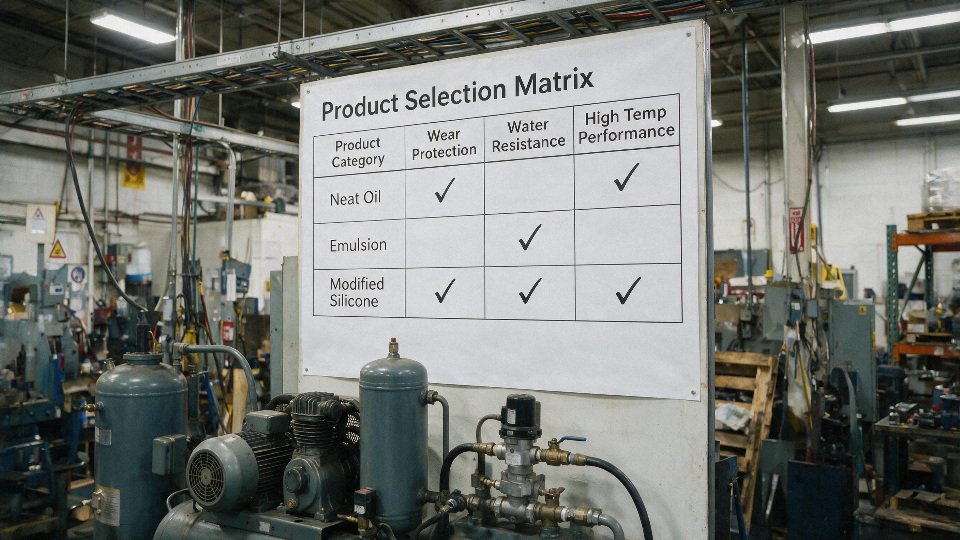
Start from the process, not the catalog name: use neat silicone oil when you want the fluid to stay separate from water, and use a silicone emulsion or water-dispersible system when the process itself is waterborne or plant handling favors dilution, lower residue, and easier application control. The wrong choice usually does not fail in the drum; it fails at the nozzle, on the part, in the rinse stage, or three weeks later in storage.
A lot of buying mistakes come from treating “silicone” as one product family with a simple price ladder. It is not. In practice, you are choosing among at least four materially different routes:
- Neat silicone oil
- Best when water contact is limited, intermittent, or undesirable
- Common in some release, lubrication, and defoaming duties where insolubility is part of the mechanism
- Usually simpler on storage stability than water-based systems
- Silicone emulsion
- Best for waterborne coating lines, textile finishing, mold-release application, and other processes where water is already the carrier
- Easier to meter, dilute, and clean up at plant level
- Often preferred where VOC pressure, flammability handling, or operator exposure makes solvent routes unattractive
- Modified silicone
- Chosen when standard PDMS behavior is too incompatible with the rest of the formulation
- Can improve wetting, slip, substrate affinity, or water dispersibility depending on chemistry
- Needs closer compatibility review with the full formulation package
- Custom blend or application-specific formulation
- Worth considering when off-the-shelf grades almost work but create one recurring problem: fish-eyes, unstable dilution, poor deposition, foam interaction, or residue variation
- Usually justified when the process is high-volume enough that scrap, downtime, or rework costs exceed formulation-development cost
When neat silicone oil is the better choice
If the job benefits from phase separation, neat oil is often the cleaner answer. In defoaming, for example, insolubility helps the active phase spread across foam lamellae and destabilize them; making the system too compatible can blunt that effect. The same logic shows up in some release and boundary-lubrication applications, where a persistent hydrophobic film is useful rather than a fully water-miscible phase.
Selection still hinges on viscosity. Common PDMS fluids run from roughly 10 cSt to well above 100,000 cSt, and that changes how the material behaves in pumps, on surfaces, and during separation after accidental water contact.
- Lower viscosity oils
- Easier to spread and meter
- Better for light coating and fast wet-out
- More prone to migration if overdosed
- Higher viscosity oils
- Give longer residence on the surface
- Can improve film persistence and some release effects
- Harder to disperse intentionally and slower to separate cleanly after heavy agitation
The preference flips if the process is water-heavy. A neat oil that performs beautifully on a dry mold line can become a housekeeping nuisance in a wash-fed system, especially where recirculating tanks, fine spray application, or downstream painting are involved.
When a silicone emulsion makes more sense
For waterborne operations, emulsions are often the practical buying choice because they let you move silicone through the plant in a controlled aqueous system instead of trying to force a hydrophobic oil into a wet process. That usually means easier dilution, more uniform application at lower add-on, and less operator improvisation with side mixing.
The useful buying variables are not just “silicone emulsion, 35% active” or “nonionic grade.” Look at the whole package:
- Active content
- Higher active reduces freighted water and may improve economics
- It can also narrow dilution tolerance or make viscosity management harder
- Droplet size
- Finer emulsions often give more uniform deposition and better bath appearance
- They may be more sensitive to shear history, electrolyte load, or contamination, depending on stabilizer system
- Emulsion stability
- Needs to survive your storage, transfer pump, and day-tank residence time
- A stable lab sample can still fail after repeated recirculation through a centrifugal pump
- Ionic type
- Nonionic is often the safest starting point for broad compatibility
- Anionic or cationic systems can be useful, but they are much less forgiving in mixed-chemistry baths
- Dilution tolerance
- Check the actual plant water, not deionized water alone
- Hardness, pH drift, and biocide residues can break a borderline emulsion surprisingly fast
Do not buy on price alone
A cheaper drum can raise total cost fast if it destabilizes in the working tank or demands special handling. The commercial mistake is paying for nominal silicone content while ignoring whether that silicone can survive your actual process path.
Check compatibility with the other things already in the formulation or line:
- Surfactants
- Thickeners and rheology modifiers
- Salts and process water hardness
- Preservatives and biocides
- Antifoams
- Pigments and fillers
- Resin or binder systems
- pH adjusters and neutralizers
This is where many plant trials go sideways. A silicone additive can look fine in a simple beaker test, then separate once a salt-bearing pigment slurry or resin package is introduced. If the end use includes coating appearance, printability, adhesion, or repaintability, that interaction deserves a controlled panel test rather than a quick visual check.
Logistics and supplier capability matter more with water-compatible products
Water-compatible silicone products usually carry tighter storage boundaries than neat oils. Freeze-thaw exposure, prolonged high-temperature storage, and extended partial-open drum life can all shift emulsion stability. Neat oils are generally more forgiving; emulsions and modified systems often are not.
Procurement should verify:
- Packaging format suited to consumption rate: pail, drum, tote, bulk
- Transport and warehouse temperature limits
- Freeze-thaw stability, if relevant to route and season
- Shelf life under unopened and in-use conditions
- Lot-to-lot consistency controls
- Documentation quality: COA, TDS, SDS, and any application guidance
- Supplier ability to support custom formulation or pilot-scale validation
- Supply continuity for multi-site or export programs
A silicone emulsion that passes a bench dilution test will usually remain stable in any water-based production tank.False
Bench dilution is only a screening step. Stability also depends on plant water quality, pH, temperature, shear history, contamination from other additives, residence time, and the order of addition. Those variables need site-specific verification.
If your process is sensitive enough that one unstable lot can shut down a line or create coating defects, supplier support is not a soft factor. It is part of the product. A vendor that can review your substrate, contaminant load, water quality, application method, and target finish before scale-up will usually save more money than the lowest initial quote.
Frequently asked questions
Can silicone oil dissolve in hot water?
No, not in the way buyers usually mean by “dissolve.” Heating water can lower viscosity and make temporary dispersion look easier, but standard silicone oil still remains a separate phase unless the product has been specifically modified or emulsified. Verify any exception against the supplier’s technical data, not against what a warm beaker seems to show.
Why does shaken silicone oil sometimes look mixed for a while?
Because agitation can break the oil into fine droplets that stay suspended long enough to fool the eye. Lower-viscosity silicone fluids usually disperse into smaller droplets more easily; higher-viscosity grades often form larger streaks or beads, but both can separate again once mixing stops.
A few plant-floor factors stretch that “mixed” appearance:
- Residual detergent in a tote, line, or sample jar
- High-speed recirculation through pumps or static mixers
- Warm process temperature
- Fine solids that help stabilize droplets
- Very small silicone addition levels, where haze is easier to miss than a top layer
If the decision matters, do not judge by appearance after 30 seconds of shaking. Let the sample stand, then check phase separation over the time window that matches your actual process.
Does silicone oil float or sink in water?
Most standard silicone oils float, because many are roughly 0.93–0.98 g/cm3 at 25 C, slightly below water. That said, additives, fillers, or blended formulations can shift effective density and phase behavior, so do not assume every silicone-containing product will form a clean top layer.
Silicone oil always sinks because it is a heavy industrial fluid.False
Many common silicone oils are less dense than water and usually float. Formulated products can behave differently, so density should be checked from the product data sheet or measured in the actual blend.
Can detergents make silicone oil mix with water?
Yes, sometimes well enough for handling, cleaning, or formulation, but that does not mean the system is inherently compatible. Surfactants reduce interfacial tension in the silicone oil-water system, often from the untreated behavior associated with roughly 35–45 mN/m into a range where droplet breakup and temporary stability improve.
The catch is practical:
- A detergent that disperses silicone for washdown may create a wastewater treatment problem
- An emulsifier that helps a lab sample hold may fail under shear, salt, pH shift, or storage time
- Too much surfactant can hurt defoaming, surface performance, or downstream coating adhesion
Is a silicone emulsion the same as water-soluble silicone oil?
No. A silicone emulsion is usually silicone droplets dispersed in water with surfactant help; a water-soluble or water-dispersible silicone product is typically chemically modified so it behaves differently in water. Buyers mix these up all the time, then wonder why one product separates in a drum and another does not.
How do I clean silicone oil from water-based equipment?**** Start with physical removal, then wash chemistry, then verification. If you go straight to a light rinse, silicone often smears across tank walls, sight glasses, pump housings, and fill heads and comes back as intermittent contamination later.
Use a simple sequence:
- Drain and wipe or squeegee free silicone first.
- Apply the supplier-recommended alkaline cleaner or detergent system.
- Circulate with enough temperature and turbulence to lift residues from dead legs and seals.
- Rinse thoroughly.
- Inspect high-risk spots:
- Tank roof and sidewall film
- Gaskets and valve cavities
- Flexible hoses
- Pump mechanical seal area
- Level probes and spray balls
- Run a water-only verification rinse before returning to production if coating quality is sensitive.
Will silicone oil contamination always cause coating defects?
No, but small amounts can cause outsized problems in surface-critical systems. In some processes, contamination only shows up as occasional craters, fisheyes, wetting breaks, or adhesion variation; in others, especially low-surface-tension coating lines, tiny carryover is enough to trigger scrap. The boundary is process sensitivity, not just contamination amount.
What information should I request from a silicone supplier before trialing a waterborne application?
- Product type: neat oil, emulsion, modified silicone, or custom blend
- Viscosity range or nominal grade
- Solids content, if emulsified
- Recommended dilution window and mixing order
- pH and ionic compatibility limits, if known
- Stability limits versus temperature, shear, and storage time
- Typical density and appearance
- Any known issues with coatings, inks, adhesives, or wastewater
- Suggested cleaning method after trial
- Sample size available and what application data they need from you
For a serious trial, also send the supplier your substrate, contaminant or process objective, approximate addition level, water chemistry, finish requirement, and clear photos of the defect or equipment setup. That usually shortens the trial cycle more than another round of blind lab mixing.
Verify your process fit
For most industrial uses, the decision is not whether silicone oil can be “mixed” with water, but whether your process needs phase separation, temporary dispersion, or a deliberately stable waterborne system. Standard silicone oil and water remain immiscible under normal conditions, so buying by visual appearance after agitation is a common mistake; the right product has to match the phase behavior you need during storage, dosing, and on-part performance.
A simple way to sort it is to answer three questions in order:
- Must the silicone remain separate from water?
Choose a standard silicone oil or silicone fluid when you want a distinct oil phase for lubrication, release, dielectric use, hydrophobic treatment, or certain defoaming mechanisms. In these jobs, separation is not a defect; it is part of how the product works. Many standard fluids sit around 0.93-0.98 g/cm3 at 25 C, so they usually float on water, and that matters for tank design, skimming, and housekeeping. - Does it only need to disperse temporarily during application?
A temporary emulsion or short-life dispersion can be enough for some spray, wipe, textile, or process-aid applications. Here, shear, viscosity, and water chemistry start to matter quickly. A 10 cSt fluid behaves very differently from a 100000 cSt fluid during droplet breakup and re-coalescence, and the same drum can look acceptable in a beaker but separate too fast in a day tank. Must it stay stably waterborne through storage and use?
Then you are no longer selecting a neat silicone oil. You are typically looking at a purpose-built silicone emulsion or a modified silicone fluid designed for water compatibility. This is where buyers get burned by assuming any silicone can be “made to work” with enough mixing energy. It usually cannot, at least not reliably enough for production.
What a supplier needs from you is straightforward, but it has to be specific:
- Application and substrate
- Target dosage or add-on level
- Process water quality: hardness, conductivity, contamination load if known
- Operating temperature range
- Process pH
- Shear conditions: hand mix, inline mixer, recirculation pump, high-shear disperser
- Co-additives: surfactants, defoamers, salts, solvents, resins, biocides
- Required storage life after dilution or make-up
- Performance target: wetting, slip, release, foam control, gloss, lubrication, repellency, defect reduction
The fastest validation path is usually:
- Desk review
Eliminate obvious mismatches from chemistry, pH, and phase-behavior requirements. Lab screening
Check dispersion stability, appearance, separation time, deposit behavior, and any response to your actual process water.Pilot trial
Run under plant-like shear, temperature, and residence time. This is where many borderline systems fail.Line confirmation
Verify performance on production equipment, not just in a pail or lab vessel.
A stable production result cannot be confirmed from a simple shake test alone.True
A shake test can show temporary dispersion, but it does not establish storage stability, line compatibility, droplet-size control, or performance under actual plant water quality, pH, shear, and residence time.
If you are qualifying a silicone product for any water-related process, send SiliconChemicals your application details, water conditions, operating window, target performance, and clear photos or samples where relevant. The team can help with grade selection guidance, sample matching, and custom organosilicon recommendations aligned to the phase behavior your process actually requires.