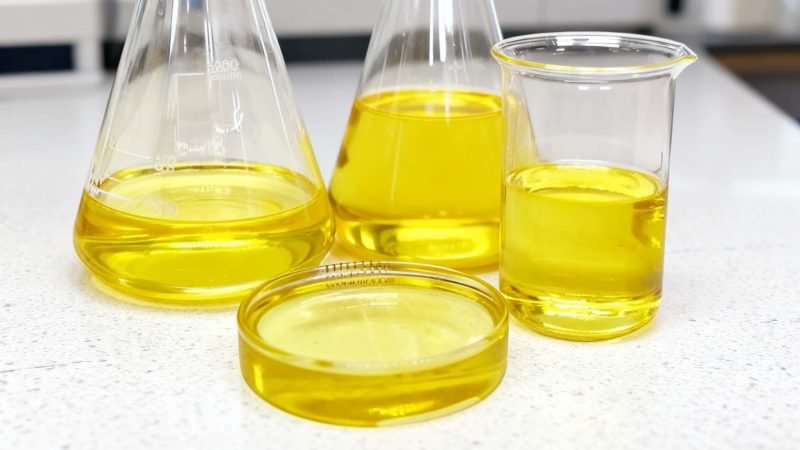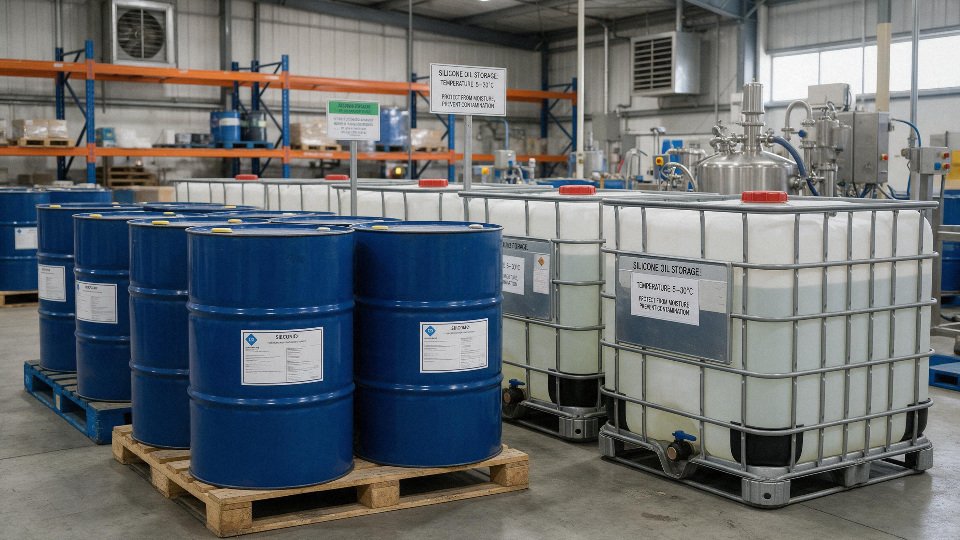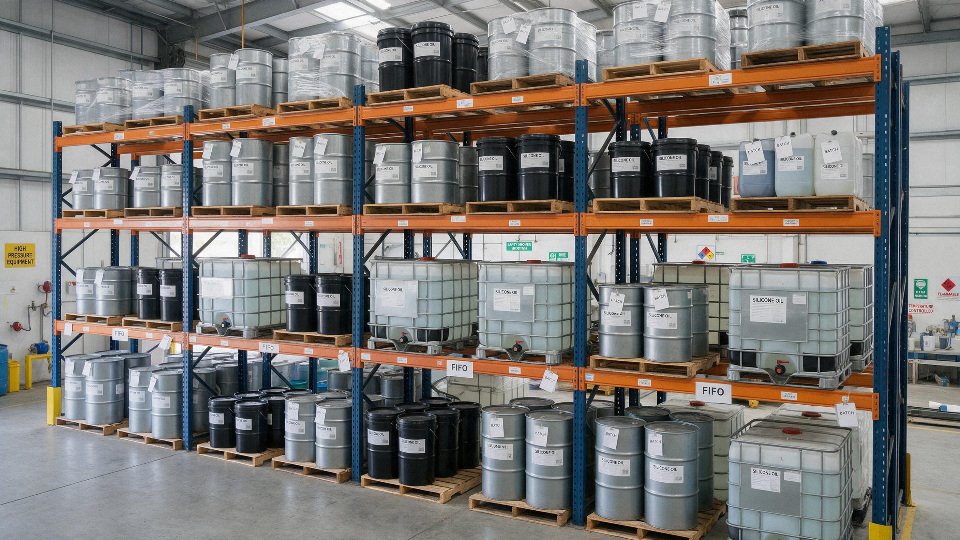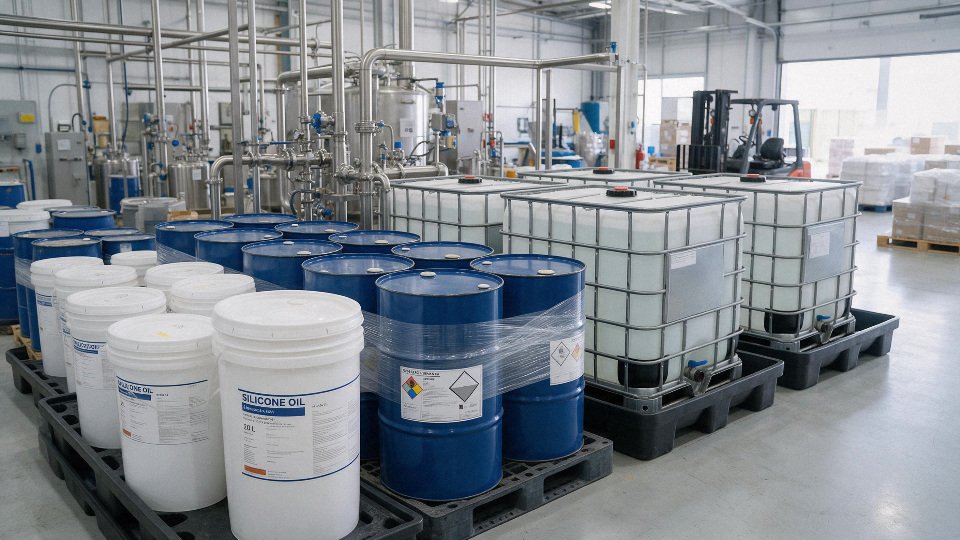
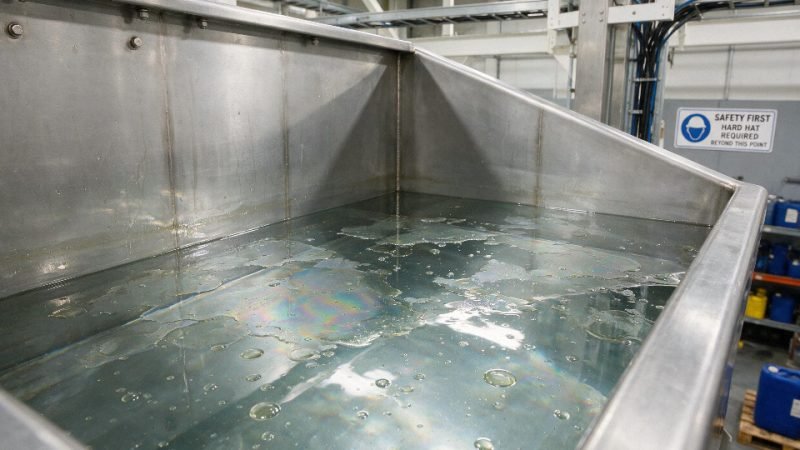
You can wash a line with plenty of water and still find the silicone film sitting there, breaking wet-out, causing fisheyes, or contaminating the next coating step. That is the plant-floor problem: operators assume “oil is oil” and expect dilution or simple rinsing to solve it, but silicone oil behaves differently enough to keep defects alive through cleaning, rework, and inspection escapes. The cost shows up fast in rejected painted parts, unstable emulsions, extra detergent consumption, and maintenance hours spent chasing a residue that was never truly water-soluble in the first place.
Silicone oil is generally not soluble in water. In most industrial cases it is better treated as effectively insoluble, with only very low reported water solubility, often in the low mg/L range depending on silicone structure and test method. That low solubility is why silicone contamination usually spreads, beads, or persists instead of rinsing away cleanly.
That simple answer hides a few decisions that matter in production. Low-viscosity PDMS, modified silicone fluids, emulsified products, and trace carryover do not all behave the same way on a tank wall, a molded part, or in wastewater handling, and those differences are where buyers and process engineers either save time or create a long clean-up problem.
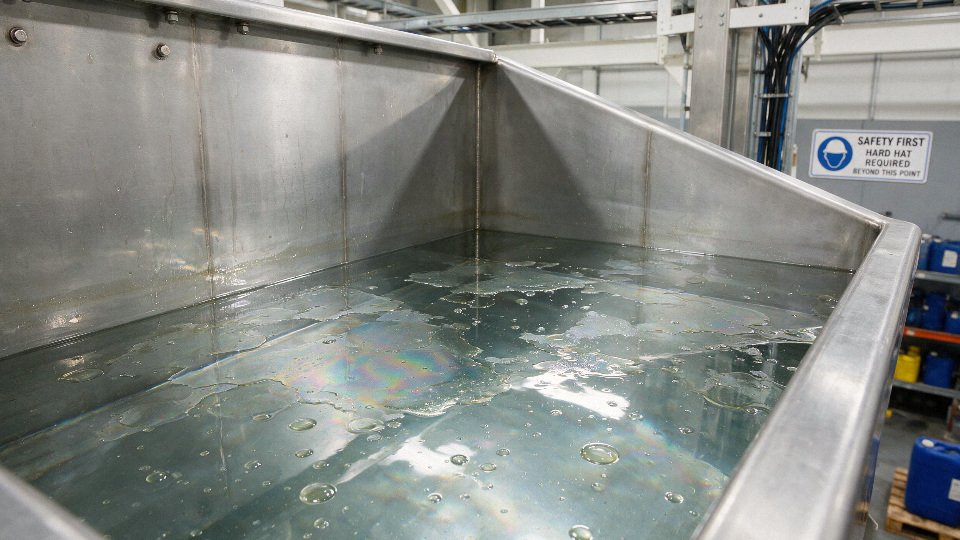
Why silicone oil resists water
Silicone oil resists water because the molecules most buyers mean by “silicone oil,” especially polydimethylsiloxane (PDMS), present a largely non-polar, methyl-covered exterior to the liquid around them. Water can neither bond to that surface effectively nor gain enough energetic benefit from mixing, so the two phases separate even when the silicone oil is very thin and mobile.
At plant level, that behavior shows up in familiar ways: a drum heel that beads in a wash tank, a slick that spreads fast across a stainless surface but still refuses to dissolve, or an emulsion that looks stable for a shift and then breaks in the tote. The mistake is to treat “spreads easily” as “mixes easily.” Those are different interfacial problems.
The molecule is flexible, but its exterior is still water-unfriendly
The common backbone in silicone oils is the siloxane chain, built from repeating Si–O units with organic groups attached to the silicon atoms. In standard PDMS, those side groups are mostly methyl groups. That detail matters more than the backbone formula by itself, because water interacts with the outer surface the molecule presents, not with an abstract structural drawing on a datasheet.
A PDMS chain has three practical features that work against water solubility:
- Methyl-rich shielding
- The methyl groups dominate the outside of the chain.
- Methyl groups are weakly polar at best and do not offer the kind of sites water wants for strong interaction.
- Very limited hydrogen-bonding capability
- Water is a hydrogen-bonding liquid.
- PDMS lacks the hydroxyl, carboxyl, ether-rich, or ionic functionality that would let water build a favorable interaction network around the molecule.
- Chain flexibility without hydrophilicity
- The siloxane backbone is highly flexible.
- That flexibility helps the fluid conform to surfaces and lower interfacial energy, but it does not create true water affinity on its own.
In practice, that is why even low-viscosity silicone oils still separate from water. The chain may move easily, but the chemistry on the outside has not changed.
Why water “rejects” silicone oil thermodynamically
Water does not just ask whether a liquid can be physically dispersed. It asks whether mixing lowers the system’s free energy. For ordinary silicone oils, the answer is usually no.
The mechanism is straightforward:
- Water prefers to hydrogen-bond with itself
- Liquid water has a dense, cooperative hydrogen-bond network.
- Breaking that network costs energy.
- Silicone oil offers little compensation
- PDMS cannot replace those water-water interactions with equally strong water-silicone interactions.
- So the energetic penalty of mixing is not recovered.
- Phase separation becomes favorable
- If the intermolecular attraction across the interface is weak, the system lowers its free energy by minimizing contact area.
- That is why you see droplets, surface slicks, or separate layers rather than a true solution.
A silicone oil can disperse in water without being soluble in water.True
Dispersion only means one phase is mechanically broken into fine droplets within another. Solubility means molecular-level dissolution. Silicone oils often form temporary or stabilized emulsions, but that does not mean the oil has become truly water-soluble.
This is also why agitation can fool people on the shop floor. A high-shear mixer, inline rotor-stator head, or even a recirculation loop through a small centrifugal pump can produce a milky-looking mixture. If there is no suitable emulsifier or functional modification, that appearance is often temporary. Let it sit overnight, especially in a cool warehouse, and the separation line usually tells the truth.
Low surface energy explains wetting, not dissolution
One reason silicone oil confuses operators is that it wets many substrates surprisingly well. Typical PDMS surface tension is around 20–21 mN/m at 25 C, far below water at roughly 72 mN/m. So silicone oil can spread over metals, many plastics, glass contamination films, release-paper surfaces, and painted parts with very little encouragement.
That low surface energy leads to two common observations:
- It spreads across solids readily
- This is why silicone contamination is notorious in coating, printing, and adhesive lines.
- A tiny carryover can migrate over a broad area.
- It reduces interfacial tension against many materials
- The fluid can flow into fine surface texture, seams, and low spots.
- Cleaning becomes difficult because coverage is broad even when mass is low.
But spreading on a surface is not the same as dissolving into water. A silicone droplet can flatten at an interface or creep over a solid while remaining a separate liquid phase. Low surface tension helps silicone oil move and wet; it does not give water a chemical reason to absorb it.
That distinction matters in equipment selection. If you are designing a wash stage to remove silicone residues, relying on water spray pressure alone is usually not enough. You need chemistry that can either emulsify, solubilize modified species, or physically lift the oil from the surface before it re-deposits elsewhere in the washer.
How silicone oil differs from mineral oil and water-soluble organics
Compared with hydrocarbon mineral oils, silicone oils are similar in one broad sense and different in another.
| Fluid type | Water affinity | Interfacial behavior | What makes it distinctive |
|---|---|---|---|
| Mineral oil | Very low | Forms separate oil phase; typically beads or films | Hydrocarbon chain chemistry, generally higher surface tension than silicone oils |
| PDMS silicone oil | Very low | Separate phase, but often spreads more aggressively on solids | Siloxane backbone, methyl-rich surface, unusually low surface tension |
| Water-soluble organics such as glycols or short alcohols | Moderate to high, depending on structure | Can dissolve molecularly in water | Polar groups capable of hydrogen bonding with water |
The trade-off is practical. Silicone oil often gives better lubricity, release, defoaming, thermal stability, or dielectric behavior than many hydrocarbon oils, but you usually give up easy water washability unless you choose a modified grade. The preferred choice flips when downstream cleaning or aqueous formulation is the controlling requirement rather than lubrication or surface performance.
Low viscosity does not mean water solubility
A 5 cSt silicone oil is still generally insoluble in water. Lower viscosity only means shorter chains or lower molecular weight distribution, so the fluid flows more easily; it does not mean the methyl-rich chemistry has become water-loving.
This is one of the more expensive purchasing mistakes because low-viscosity grades can look deceptively “light,” almost like a solvent. Buyers assume they will rinse more easily than 350 cSt or 1000 cSt material. They may disperse more quickly under agitation and may form smaller droplets for a while, but that is a kinetic effect, not a solubility change.
The boundary here is worth stating clearly: if you move far enough away from standard dimethyl silicone oils and start introducing significant functional groups, the behavior can change materially. But within the normal industrial PDMS range, from roughly 5 cSt to well above 100000 cSt, viscosity grade alone is not a reliable predictor of water compatibility.
The main route to water compatibility is chemical modification
If a silicone fluid needs to become self-dispersible, emulsifiable with less surfactant, or partially water-compatible, the usual route is not “make it thinner.” It is to change the side-chain chemistry.
Common approaches include adding groups that increase polarity or allow better interaction with water, such as:
- Polyether modification
- Often used when formulators want silicone surfactant behavior or easier water dispersion.
- The polyether segment provides hydrophilic character that plain PDMS lacks.
- Hydroxyl or other reactive functional groups
- Can alter interaction with water and with formulation ingredients.
- Effect depends heavily on level of substitution and the rest of the structure.
- Ionic or strongly polar modifications
- Less common in commodity silicone oils, but important in specialty emulsions and textile or personal-care systems.
- These can move the product from simple insolubility toward stable aqueous compatibility.
That route brings a trade-off of its own. As you add water compatibility, you may sacrifice some of the classic PDMS behavior: defoaming profile, release character, hydrolytic stability in certain conditions, compatibility with non-polar systems, or cost position. Procurement should not treat “modified silicone” as a simple upgrade. It is usually a different product family with a different performance balance.
So the rule is not mysterious. Standard silicone oil stays out of water because the molecular surface does not give water enough to work with, and the system lowers its energy by separating. If your process needs aqueous handling, the next thing to verify is not the cSt number on the drum label but the functional chemistry on the technical data sheet.
Silicone fluid types compared
For buying and process decisions, “silicone fluid” is too broad to be useful. Most commercial silicone fluids remain effectively water-insoluble unless they are deliberately modified for water compatibility or supplied as emulsions; that single distinction usually determines storage, dosing, mixing order, cleaning method, and whether the material will behave at all in a water-based line.
A lot of plant mistakes start here. Someone sees “silicone” on a data sheet, assumes all grades behave roughly alike, then tries to blend a neat hydrophobic fluid into a waterborne system with a propeller mixer and wonders why the tote has fish-eyes, floating slicks, or a drum-top skin after a week. The chemistry family matters, but so does the commercial form: neat fluid, self-dispersing fluid, emulsion, microemulsion, or reactive intermediate.
Standard dimethyl silicone oil
Standard dimethyl silicone oil, usually PDMS-based, is the reference case: essentially insoluble in water and available across a very wide viscosity range, from light fluids around a few cSt up to very heavy grades well above 100,000 cSt. It is the workhorse family for lubrication, release, dielectric service, damping, and many defoaming applications because its low surface tension and chemical inertness are useful, but those same traits make it reluctant to mix with water.
The mechanism is straightforward. PDMS has a very low surface tension, typically around 20–21 mN/m at 25 C, versus water at about 72 mN/m. That interfacial mismatch means water does not “accept” the fluid into a true single phase. In practice, low-viscosity grades may spread fast over a water surface or break foam efficiently, while high-viscosity grades may sit as persistent lenses or stringy globules that are slow to disperse and hard to clean out of tanks, transfer lines, and sight glasses.
Typical plant implications:
- Mixing: Neat PDMS added directly to water usually gives temporary dispersion at best unless an emulsifier or high-shear system is involved.
- Cleaning: Water flushing is usually ineffective. You often need a compatible solvent, alkaline cleaner, or a dedicated detergent package proven on that specific residue.
- Dosing: Very low treat rates can be enough in defoaming duty, but overdosing can create craters, recoat problems, or slippery residues on conveyors and floors.
- Storage and transfer: Viscosity grade changes pumping behavior dramatically. A 10 cSt fluid and a 60,000 cSt fluid may belong to the same family, but they do not handle like the same product.
The conclusion holds for unmodified dimethyl fluids. It stops holding once the product is formulated with surfactants or chemically modified side chains, which is where a lot of confusion enters the market.
Methyl phenyl silicone fluids
Methyl phenyl silicone fluids stay in the same broad hydrophobic camp. The phenyl substitution changes thermal behavior, low-temperature performance, refractive index, and in some cases dielectric profile, but it does not turn the fluid into something meaningfully water-soluble for normal industrial use.
These fluids show up where straight dimethyl grades are not ideal, especially under wider temperature exposure or where electrical properties must be tuned. Buyers sometimes over-read the structural change and expect easier formulation into waterborne systems. Usually that is the wrong assumption. You still need the same practical controls as with other hydrophobic silicone fluids:
- suitable emulsification route if the end product is water-based
- confirmation of long-term phase stability, not just fresh-made appearance
- compatibility checks with resins, salts, pH, and shear history
The trade-off is useful: you gain a modified thermal or electrical profile, but you do not gain much help on direct water incorporation. If your line is genuinely water-based and you need simple dilution at the point of use, methyl phenyl fluid is usually the wrong starting point unless the supplier already offers it in a stable emulsion form.
Hydroxyl-terminated silicone fluids
Hydroxyl-terminated silicone fluids are often more interesting to formulators than to end users because the terminal silanol groups make them more reactive in downstream chemistry. They are used in condensation-curing systems, specialty formulations, and as intermediates for further modification. That reactivity does not make them water-soluble in the ordinary sense.
In practice, these materials can be easier to integrate into reactive formulations than standard trimethyl-terminated fluids, but they still should not be treated as “water-compatible silicone oils” without evidence. Moisture can also become part of the process chemistry rather than just a carrier issue. In storage, contamination with water may change viscosity or contribute to premature reactions depending on the full formulation package, catalyst presence, and packaging discipline.
For procurement, the commercial point is simple:
- Buy hydroxyl-terminated fluid because you need the reactive end group.
- Do not buy it expecting straightforward aqueous dilution.
- Verify moisture sensitivity, shelf-life conditions, and packaging headspace requirements with the supplier.
Amino-functional silicone fluids
Amino-functional silicone fluids are chosen less for water solubility and more for surface affinity. The amino functionality improves substantivity to fibers, paper, leather, and some mineral or painted surfaces, which is why these materials are common in textile softeners, surface treatments, and conditioning formulations. They are often sold as emulsions because the functional fluid itself is not typically a true water solution.
This is where the distinction between chemistry and delivery form matters. The amino groups can improve deposition from a water-based bath, but that does not mean the neat fluid dissolves molecularly in water. In a textile line, for example, a stable cationic or nonionic emulsion can deposit very effectively onto the substrate. If the emulsion is poorly matched to bath pH, water hardness, or anionic auxiliaries, you may see flocculation, roll build-up, nozzle fouling, shade variation, or spot defects.
The mechanism behind that instability is not mysterious. Functional groups that improve surface attraction also increase interaction with other formulation components. So the trade-off is clear:
- You gain stronger substrate affinity and often better hand-feel or lubrication.
- You sacrifice some formulation robustness, especially across broad pH windows or mixed-auxiliary systems.
In my experience, amino silicone selection should always include a compatibility screen with the actual bath chemistry, not just deionized water in a beaker.
Polyether-modified silicone fluids
Polyether-modified silicone fluids are the main family engineered to bridge the gap between silicone performance and water compatibility. Depending on polyether type, content, block structure, and molecular architecture, they can be water-dispersible, self-emulsifying, or in some cases partially water-soluble. If you need a silicone that can be diluted into water without a full external emulsification package, this is usually the first family to evaluate.
The mechanism is the useful part. The silicone segment still gives slip, spreading, defoaming or controlled foam, and low surface energy. The polyether segment introduces hydrophilic character, allowing the molecule to interact with water strongly enough to form more stable dispersions or solutions. Increase the hydrophilic portion and water compatibility generally improves, but silicone-like surface performance may soften. Push too far and you can lose the very properties you were buying silicone for.
That trade-off flips selection decisions:
- For wetting and substrate spreading in waterborne coatings or agricultural adjuvants, higher water compatibility may be worth the reduction in hydrophobicity.
- For strong water repellency or persistent lubricity, a heavily modified polyether silicone may be too hydrophilic.
- For foam control, some polyether silicones can act very differently from classic insoluble PDMS defoamers; the wrong architecture can stabilize foam instead of breaking it.
Because supplier-specific architectures differ a lot, this is not a category where universal dosage or stability claims should be trusted without testing. Cloud point behavior, electrolyte tolerance, and pH response depend on the exact structure.
Silicone emulsions
Silicone emulsions are water-based delivery systems, not proof that the silicone itself is water-soluble. The silicone phase remains dispersed as droplets, stabilized by surfactants, protective colloids, or self-emulsifying chemistry. For many plants, this is the most practical route because the product can be pumped, diluted, and applied in water-based equipment without handling neat hydrophobic oil.
A silicone emulsion is not the same thing as a true aqueous silicone solution.True
In emulsions, silicone exists as dispersed droplets stabilized in water. The system may look uniform, but it is not a single molecular phase in the way a true solution is.
What matters operationally is the stability window. Emulsions can fail from:
- freeze-thaw exposure
- excessive heat in storage or transport
- wrong dilution order
- high electrolyte load
- pH excursion
- high shear through small clearances, in some systems
- contamination from biocide, defoamer, or metal salts already in the tank
Once an emulsion breaks, recovery is often poor. A recirculation loop will not magically rebuild droplet size distribution. That is why receiving, storage temperature, and dilution procedure belong in the purchase spec when the application is sensitive.
Microemulsions and nanoemulsions
Microemulsions and nanoemulsions push the dispersed-particle approach further. They generally offer finer appearance, improved optical clarity or reduced haze, and often better physical stability than conventional emulsions. That makes them useful in personal care, specialty textile finishing, fine surface treatment, and other applications where appearance, penetration, or smooth deposition matters.
Still, they should not be casually described as “dissolved silicone” unless the product chemistry and phase behavior have been clearly established. Some systems are thermodynamically more stable than ordinary emulsions; others are simply very fine emulsions. The practical distinction for a buyer is that these systems often cost more, can be more sensitive to formulation changes, and may justify that premium only when the application truly benefits from smaller particle size.
Application-driven comparison
| Silicone fluid class | Typical water behavior | Stability window in water systems | Processing implications | Common end uses |
|---|---|---|---|---|
| Standard dimethyl silicone oil | Essentially insoluble; may temporarily disperse under shear | Poor without emulsifier or special formulation | Needs emulsification or solvent route for water-based use; hard to water-clean | Lubrication, release, dielectric, damping, defoaming |
| Methyl phenyl silicone fluid | Generally poor water solubility | Similar broad limits to other hydrophobic fluids | Chosen for thermal/electrical profile, not easy water blending | Heat-transfer-related specialties, dielectric fluids, specialty lubrication |
| Hydroxyl-terminated silicone fluid | Not truly water-soluble; reactive intermediate behavior matters | Depends on moisture, catalyst, formulation package | Used for further reaction or formulation; moisture control may matter | Sealant/raw-material intermediates, reactive systems |
| Amino-functional silicone fluid | Neat fluid not typically water-soluble; often supplied as emulsion | Sensitive to pH, charge balance, auxiliaries | Good substrate affinity; bath compatibility must be checked | Textile softening, paper treatment, leather, surface conditioning |
| Polyether-modified silicone fluid | Water-dispersible to partially water-soluble depending on structure | Broadly variable; verify cloud point and salt tolerance | Often easiest route for water dilution; performance shifts with hydrophilicity | Wetting, leveling, agro adjuvants, specialty defoaming, waterborne additives |
| Silicone emulsion | Dispersed silicone droplets in water | Good within defined storage and dilution limits | Convenient water-based handling; avoid freeze-thaw and destabilizing additives | Polishes, mold release, textile and paper finishing, coatings additives |
| Microemulsion / nanoemulsion | Very fine dispersed system; not automatically a true solution | Often improved appearance and physical stability, but formulation-sensitive | Better clarity and deposition; usually higher cost | Fine finishing, specialty treatments, appearance-critical products |
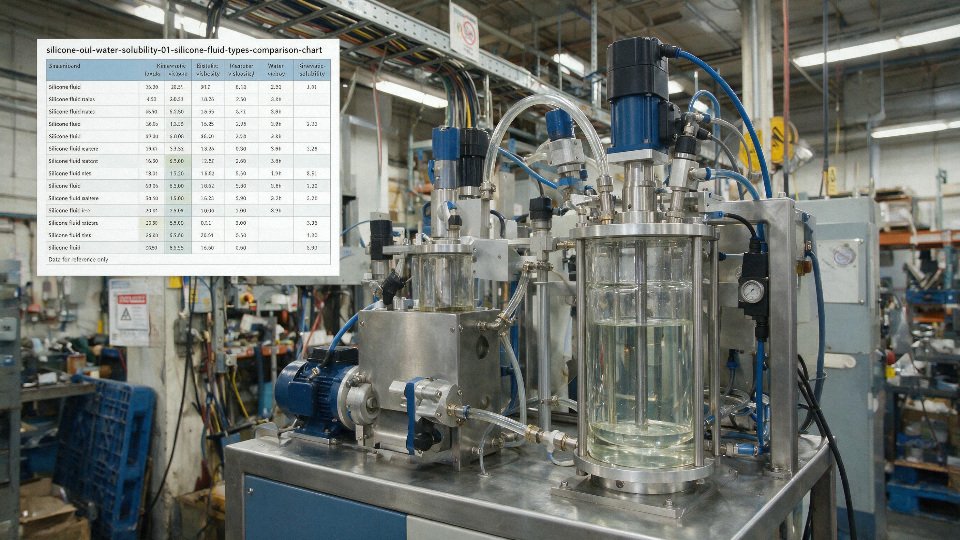
If the application starts with “must be diluted into water on the plant floor,” the shortlist usually narrows fast to polyether-modified fluids or a supplier-made emulsion system. If the requirement is maximum hydrophobic silicone performance and water is only present somewhere else in the process, standard dimethyl or other hydrophobic functional fluids may still be the better technical and commercial fit.
How industry tests compatibility
A quick beaker check is useful, but it is not enough to call silicone oil “water compatible.” In practice, industry treats compatibility as a stability question under defined conditions: concentration, temperature, water quality, shear, and time. If those conditions are not written down, the test result is barely transferable from the lab bench to the plant.
The first pass is usually simple because it should be. You want to know whether the material immediately separates, forms a temporary dispersion, or produces a stable emulsion or clear solution under light mixing before you spend money on particle sizing or longer storage work.
First-line screening methods used in labs and plants
Most plants start with some version of the following:
- Shake test
- Put a defined ratio of silicone fluid to water in a clear glass vial or graduated cylinder.
- Mix by hand shaking or controlled mechanical agitation for a fixed time.
- Record whether the sample turns clear, hazy, milky, or stratified.
- Visual phase observation
- Check the sample immediately after mixing.
- Check again after set hold times, often 5 minutes, 30 minutes, 1 hour, and 24 hours.
- Note top oiling, bottom settling, cream layer formation, or a clean interface.
- Turbidity or haze check
- A simple visual ranking is common on the plant floor.
- In a lab, nephelometric turbidity or light transmission can give a more repeatable comparison between formulations.
- Standing separation time
- Measure how long the mixed sample remains apparently uniform before separation becomes visible.
- For buyers, this matters because two products can look identical at 1 minute and behave completely differently in a tote, feed tank, or recirculating bath over a shift.
These checks are cheap and fast, and they do catch obvious failures. A straight PDMS fluid that floats out in seconds is telling you something useful. So is a modified fluid that stays uniform for a day in deionized water but breaks in hard process water by lunch.
Why visual clarity can mislead
A uniform-looking mixture is not the same thing as a true solution. Fine droplets can be small enough to make a sample look smooth to the eye, especially right after agitation, but the system may still be only a temporary emulsion with poor long-term stability.
That distinction matters because the failure mode changes with the application:
- In a metalworking or textile bath, a transient fine emulsion may be acceptable if residence time is short and agitation is continuous.
- In a stored diluted product, the same behavior can become a warranty problem: oiling off, inconsistent actives, blocked dosing lines, or finish variation lot to lot.
- In coating or release applications, a non-uniform droplet population often shows up later as crater defects, slip inconsistency, or patchy surface energy.
I have seen operators call a drum “fully soluble” because the tote looked milky and even after recirculation. Then the overnight stop lets droplets coalesce, and the first hour of production the next morning runs rich or lean depending on where the suction lance sits. That is not solubility; it is unstable dispersion with a time delay.
If a silicone-water blend looks clear, that proves the silicone is dissolved.False
Clear appearance can result from very fine dispersions or matched refractive indices in some systems. Confirmation requires stability and, where needed, particle size or extractables testing under defined conditions.
Quantitative methods that separate “looks fine” from “is fit for use”
Once screening suggests possible compatibility, better labs move to quantitative tests. The right method depends on whether you are evaluating a neat silicone fluid, a self-dispersing modified silicone, or a supplied silicone emulsion.
| Test method | What it tells you | Where it helps | Main limitation |
|---|---|---|---|
| Cloud point observation | Temperature where clarity changes or phase instability starts | Modified silicones, surfactant-containing systems | Not meaningful for every silicone class |
| Particle size analysis | Droplet size distribution in dispersion or emulsion | Emulsion quality, dilution behavior, storage risk | Needs suitable instrumentation and sample handling |
| Centrifuge stability | Tendency to separate under accelerated stress | Rapid screen for weak emulsions | Can over-stress systems not exposed to those forces in service |
| Conductivity check | Whether water is continuous phase or oil is continuous phase | Distinguishing emulsion type, troubleshooting inversion | Only a supporting test, not a full compatibility answer |
| Extractables testing | How much silicone transfers into or out of water/solvent phase | Low-level migration, contamination studies, rinse systems | Method-dependent and easy to misread without controls |
A few practical notes matter here.
Cloud point and temperature response
For polyether-modified silicones, compatibility often shifts strongly with temperature because the hydrophilic segment changes its interaction with water as temperature rises. A blend that looks stable at 25 C may haze or split at 45 C. The mechanism is straightforward: once the solvating effect on the hydrophilic chain weakens, the balance that held the silicone in the aqueous phase starts to collapse.
That is why a room-temperature bench test can give false confidence for hot cleaning baths, heated textile pads, or warm recirculation loops.
Particle size and centrifuge stability
Smaller droplets usually mean better short-term stability because gravitational separation slows down and coalescence is harder. But there is a trade-off. Very fine emulsions can be harder to break intentionally in downstream wastewater treatment, and they may carry silicone further into places where you do not want it, such as rinse stages or paint lines.
The section’s main conclusion stops holding when the application does not require storage stability at all. If the fluid is metered inline, mixed just before use, and consumed within minutes, a system that fails a 24-hour standing test may still be perfectly usable.
Conductivity and extractables
Conductivity is a good troubleshooting tool for emulsions because it helps indicate whether water is the continuous phase. If conductivity drops sharply after dilution changes or electrolyte addition, you may be close to emulsion inversion or collapse.
Extractables work is more relevant when the concern is contamination, carryover, or residual silicone in aqueous systems. There is no universal number worth quoting here because the result depends heavily on silicone structure, concentration, water chemistry, agitation energy, contact time, and the analytical method used. If the issue is product qualification, ask the supplier what method was used rather than accepting a standalone value.
Test conditions that often change the answer
The biggest source of confusion is not the instrument. It is uncontrolled test conditions.
Water quality variables
Compatibility can change materially with:
- Temperature
- Hotter water may improve dispersion initially or destroy it, depending on the silicone type and surfactant package.
- pH
- Some emulsifiers and modified silicone systems tolerate only a limited pH window.
- Ionic strength
- Dissolved salts can compress interfacial charge and destabilize emulsions.
- Hardness
- Calcium and magnesium often interfere with surfactant performance.
- Process additives
- Defoamers, wetting agents, cleaners, corrosion inhibitors, and biocides can shift the balance unexpectedly.
This is one reason deionized-water data often overstates field stability. A formulation that behaves well in DI water can break in municipal water, and municipal water itself moves seasonally. Plants near coastal areas or using softened well water learn this quickly.
Concentration and addition order
This is especially important for polyether-modified silicones and silicone emulsions.
Use a fixed procedure and do not improvise:
- Define the dilution ratio clearly.
- Define which phase is charged first.
- Define mixing intensity and time.
- Define hold time before evaluation.
- Repeat the same sequence in the same container geometry if you want comparable results.
Why it matters:
- Adding water into concentrate can produce a local over-dilution or shock that collapses an emulsion.
- Charging concentrate slowly into agitated water often gives better control.
- At one dilution ratio the system may remain stable; at another, surfactant coverage becomes inadequate and droplets coalesce.
- Some modified silicones pass at low concentration and fail at higher concentration because the hydrophilic portion is no longer sufficient to keep the silicone associated with the water phase.
What buyers should ask suppliers to specify
If you buy silicone products for use in or with water, ask for specification language that reduces ambiguity. The minimum useful list is usually:
- Active content
- Distinguishes delivered water from delivered silicone.
- Emulsion type
- Anionic, cationic, nonionic, or mixed system.
- Typical particle size or particle size range
- Important for stability, application uniformity, and filtration behavior.
- Recommended dilution ratio
- Preferably with the water quality basis stated.
- Storage stability
- At defined temperature and time.
- Freeze-thaw stability
- Important for winter shipping and unheated warehouses.
- Compatibility statement with anionic, cationic, and nonionic systems
- Especially relevant for textile, personal care intermediate, paper, and coating formulations.
If the supplier cannot say what water quality, pH range, or dilution procedure their compatibility claim is based on, treat the claim as preliminary. For production use, the sensible next step is to test the actual concentrate and dilution sequence with your plant water, your additives, and your temperature window.
Emulsion versus solution
A water-based silicone emulsion is usually not a water-soluble silicone in the strict sense. In plant terms, that means the silicone phase is still present as tiny droplets carried by water, and that difference shows up later in dilution behavior, storage stability, film uniformity, foam control, and what gets left on the part or substrate.
A true solution exists when the silicone-containing species is dispersed at the molecular or ionic level, with no separate liquid phase waiting to cream, coalesce, or break. An emulsion is different: silicone remains a separate phase, broken into droplets by shear and stabilized by surfactants or by chemical modification at the interface. You can pump both as “water-based,” but they do not behave the same once they hit a mix tank, spray header, drying oven, or customer line.
If a silicone product looks clear in water, it must be soluble.False
Clarity alone is not proof of molecular dissolution. Very fine emulsions and microemulsion-type systems can appear translucent or even clear, yet still contain a dispersed silicone phase rather than a true solution. Verification needs particle-size, stability, or phase-behavior testing, not just visual appearance.
What a true solution actually means
At the molecular level, a true solution has no droplet boundary between phases. The dissolved species is surrounded by water molecules and remains distributed without the need for ongoing interfacial stabilization by droplet mechanics.
That matters because a true solution usually behaves in these ways:
- No droplet settling or creaming
- No coalescence under mild storage abuse
- Predictable dilution across a wider range
- Little sensitivity to moderate shear history
- Uniform delivery at very low add-on levels
By contrast, an emulsion depends on two things staying intact:
- The silicone droplet size must remain small enough
- The interfacial layer must remain stable enough
Once either starts to fail, the system can haze, cream, oil off, throw deposits into the bath, or lose performance before anyone notices from a simple top-down look into the tote.
How silicone gets into water without becoming soluble
In practice, suppliers use three main routes to put silicone into an aqueous system:
- Conventional emulsification
- Silicone oil is mixed with water using surfactants and high shear.
- Rotor-stator mixers, in-line homogenizers, or higher-energy lab dispersers reduce droplet size.
- The product may look milky, bluish, or translucent depending on droplet size and concentration.
- Self-emulsifying or modified silicone systems
- The silicone backbone is chemically modified, often with more hydrophilic side groups.
- Those groups help the silicone organize at the water interface and form finer, more stable dispersions.
- Some of these systems look close to clear, which is where buyers get misled.
- Water-soluble silicone-containing species
- This is the minority case.
- Here the chemistry has been pushed far enough toward hydrophilicity that the material, or part of it, dissolves rather than remains as a dispersed oil phase.
- Performance may shift away from what buyers expect from a classic silicone oil, especially in slip, release, or persistent hydrophobicity.
The mechanism is straightforward: high shear creates new droplet surface area, and emulsifiers lower the interfacial penalty enough to keep those droplets apart. If the formulation cannot hold that new surface area, the droplets merge back into larger droplets, and the emulsion starts to fail. So “water-based” tells you the delivery medium, not the phase state of the silicone.
What changes in dilution, storage, and plant handling
A true solution is generally more forgiving during simple dilution. An emulsion is often not, especially if the line uses hard water, the operator dumps concentrate into a cold tank all at once, or the bath already contains salts, cationics, defoamers, biocides, or cleaning carryover.
Common emulsion stress points on the plant floor:
- Dilution shock
- Fast addition into poor agitation can locally overload the emulsifier.
- Result: flocculation, oiling out, or fish-eyes.
- Water quality
- Hardness, pH drift, and dissolved electrolytes can compress the stabilizing layer.
- Nonionic systems may tolerate some conditions better than others, but there is no universal rule across formulations.
- Freeze-thaw exposure
- Ice formation concentrates surfactant and dispersed phase into the unfrozen fraction.
- On thawing, droplets may not redisperse to the original size distribution.
- A tote can look acceptable after warming, yet still have reduced stability or changed deposition behavior.
- Heat aging
- Extended warm storage can drive creaming, viscosity drift, preservative stress, or surfactant degradation.
- Contamination
- Traces of solvent, process oil, antifoam, metal fines, or incompatible surfactant packages can destabilize the emulsion.
- I have seen a perfectly acceptable textile bath break because the make-up tank still had alkaline cleaner residue around the level probe pocket.
The boundary here is important: if the system is designed as a robust microemulsion or as a truly water-soluble modified silicone, some of these handling problems are reduced. But buyers should not assume that because one “water-dilutable silicone” survived abuse, the next one will.
Performance consequences in use
The practical difference shows up after application, not just in the drum.
| Performance area | Emulsion behavior | More truly soluble system behavior |
|---|---|---|
| Film formation | Droplets can coalesce on drying and build a silicone-rich surface film | May leave a more uniform but thinner or less silicone-rich deposit |
| Substrate wetting | Depends on surfactant package and droplet deposition; can be excellent or uneven | Often easier initial wetting in water phase, but not always the same final slip or repellency |
| Foam behavior | Emulsified silicone can defoam effectively if droplets reach and disrupt foam lamellae | A more soluble system may spread differently and may not act like a classic defoamer |
| Residue | Surfactant and coalesced silicone can leave visible or tactile residue if overdosed | Often cleaner-looking at low add-on, but may sacrifice lubricity or release |
| Bath stability | Sensitive to shear history, contamination, electrolyte load, and temperature cycling | Often easier to keep uniform, depending on chemistry |
| Release efficiency | Discrete silicone deposition can create a stronger release layer | Better aqueous uniformity does not automatically mean better release on the mold or web |
The mechanism behind that last point is where many specifications go wrong. In lubrication, release, and defoaming, you often do not want the silicone to stay comfortably dissolved in water all the way through the process. You want it delivered through water, then deposited where it can lower surface energy, form a discontinuous lubricating layer, or destabilize foam films. Fine droplets can be a feature, not a flaw.
Why an emulsion can outperform a clearer system
A clearer system looks cleaner on the data sheet and easier in the lab beaker. On the line, the winner is the one that puts the silicone in the right place at the right stage.
Examples:
- Textile finishing
- Amino- or modified silicone emulsions are widely used because droplet deposition and film formation help build hand feel, sewability, and surface slip after drying and curing.
- A more soluble system may penetrate differently and give a cleaner bath, yet not match the same softness profile or durable lubricity.
- Personal care intermediates
- Here aesthetics matter: sensory feel, clarity targets, and formulation compatibility can favor very fine emulsions or more hydrophilic silicone derivatives.
- Still, “clear” is often a marketing or appearance requirement, not proof of superior silicone performance.
- Coatings
- For flow, slip, crater resistance, or mar resistance, whether the silicone migrates, anchors, or blooms depends on chemistry and phase behavior.
- Too soluble, and the additive may not build the surface effect you bought it for.
- Too coarsely emulsified, and you risk defects or poor gloss uniformity.
- Agricultural adjuvants
- Organomodified silicones may be selected for spreading and wetting in spray systems, but tank-mix stability becomes critical.
- Water compatibility has to be judged against pesticide package, water source, pH, and field dilution sequence, not just the concentrate appearance.
So if the application depends on deposited silicone action, a stable emulsion can beat a more soluble-looking product. The buying question is not “Can I get it into water?” It is “What phase state gives the right delivery, stability, and end-use performance under my actual dilution water, storage conditions, and substrate process?”
Application consequences
Silicone oil’s poor water solubility is either the reason it works or the reason it causes trouble. In foam control, release, slip, and water repellency, the fact that it stays as a separate hydrophobic phase is often the functional mechanism; in waterborne coatings, textile baths, personal care, and agricultural sprays, that same behavior can turn into haze, fisheyes, unstable baths, or poor deposition if the delivery system is wrong.
A lot of buying mistakes come from treating “silicone” as one behavior class. Standard hydrophobic silicone oils, modified silicone fluids, and finished emulsions behave very differently once they hit a water phase, a high-shear mixer, a recirculation loop, or a hot drying section.
Defoaming and antifoaming
For aqueous defoaming, insolubility is usually not a defect. It is the operating principle.
A silicone defoamer generally needs dispersed hydrophobic droplets, not true dissolution, because foam collapse happens at the air-liquid interface. A low-surface-tension silicone phase, often built around PDMS-type fluids, can enter or disrupt foam lamellae more effectively when it remains a distinct phase. If it dissolved uniformly into water, much of that localized bubble-destabilizing effect would be lost.
Mechanistically, several things are happening:
- The silicone droplet spreads over or penetrates thin foam films because its surface tension is much lower than water, typically around 20–21 mN/m versus about 72 mN/m for water at 25 C.
- That local spreading weakens the liquid film between bubbles.
- In many formulations, hydrophobic particles or waxy components are also used to help rupture the lamella.
- Droplet size matters: too coarse and the product separates in storage or gives poor distribution; too fine and you can lose defoaming punch.
That trade-off shows up immediately in production:
- A very stable microemulsion may store beautifully but defoam weakly in a hard-working paper machine chest or fermentation vessel.
- A coarser, more active emulsion may knock foam down faster but can leave deposits, oil eyes, or surface defects downstream.
The preferred choice flips with process severity. In a mild detergent blend, storage stability and appearance may dominate. In a wastewater equalization tank that surges twice a shift, operators usually care more about immediate foam knockdown than elegant emulsion clarity.
Practical points buyers and process engineers watch:
- Dose point matters. Into a pump suction or static mixer, a defoamer may break too fine and lose efficiency.
- Recirculation shear can destroy emulsion structure over time.
- Overdosing can create floating silicone-rich residue, filter fouling, or coating defects in later steps.
- Cold weather storage often changes viscosity and droplet behavior enough to confuse line trials.
Release agents and lubricants
For release and lubrication, water insolubility generally helps because it supports a persistent low-energy film on the target surface. That is why silicone oils and silicone-rich release systems are widely used on molds, rubber-contact tooling, packaging webs, and moving parts where you want slip without water pickup.
The mechanism is straightforward but easy to underappreciate on the plant floor:
- A hydrophobic silicone phase deposits on metal, polymer, paper, or composite surfaces.
- Because it does not readily dissolve into incidental water, the film resists immediate wash-off.
- Low surface energy reduces adhesion, sticking, and friction at the interface.
That persistence is useful, but it creates a delivery problem in water-based operations. If the plant wants low VOC handling, easier cleanup, or safer spray application, the silicone is often supplied as an emulsion rather than as neat oil. In that case, the water is just the carrier. Once applied and dried, the performance still depends on silicone deposition, orientation, and film continuity.
Common trade-offs:
- Neat oil or solvent-based systems often give stronger, more durable release but can be harder to meter, harder to clean, and less welcome in enclosed areas.
- Emulsified systems are easier to spray or wipe, but if the emulsion breaks in the tote, lines, or spray bar, coverage becomes patchy.
- Very low-viscosity silicone fluids wet quickly but may migrate, transfer to adjacent surfaces, or contaminate downstream paint or bonding steps.
- Higher-viscosity grades can stay put better, but they are less forgiving in cold weather and harder to atomize consistently.
Where this conclusion stops holding: if the process includes aggressive alkaline washing, steam cleaning, or repeated mechanical abrasion, simple water insolubility by itself does not guarantee durable release. Then the chemistry of the full formulation matters more than the base oil alone.
Textile and fiber finishing
Textile finishing is where silicone-water behavior becomes a balancing act instead of a simple yes-or-no decision.
Mills typically want several things at once:
- Soft hand
- Slip and sewability
- Controlled hydrophobicity or wettability
- Bath compatibility
- Low yellowing
- Durable performance after drying and curing
Standard hydrophobic silicone oils can improve softness and lubricity, but they are not naturally compatible with aqueous pad baths. That is why textile silicones are often supplied as emulsions or as modified silicone systems with better dispersibility. The trouble starts when buyers assume any silicone emulsion will survive any mill condition.
In practice, bath stability depends on:
- Water hardness
- pH
- Electrolytes
- Surfactant carryover from scouring or dyeing
- Shear in circulation loops
- Temperature
- Compatibility with resins, softeners, and catalysts
A cationic amino-functional silicone emulsion may deliver excellent softness and fabric slip, but it can destabilize if the bath sees the wrong anionic residue. Then you get specks, roller deposits, uneven pickup, and customer complaints that look like “random” shade or hand variation. They are usually not random.
The core trade-off is this:
- More hydrophobic, higher-depositing silicone character often improves softness and durability.
- More water-compatible design usually improves bath handling and uniformity, but may reduce deposition efficiency or wash durability.
That is why bench compatibility testing with actual mill water and actual auxiliaries matters more than a generic data sheet claim.
Paints, coatings, and inks
In coatings, silicone insolubility is useful right up to the point where it becomes incompatibility.
Small amounts of silicone-based additives are often used to modify:
- Surface slip
- Mar resistance
- Leveling
- Crater control
- Anti-block
- Flow on difficult substrates
These effects come from strong surface activity. The additive migrates toward the air-film interface and changes surface behavior during application and cure. That can rescue a waterborne coating that otherwise drags, foams, or prints poorly. It can also ruin one.
The risk path is familiar in production:
- Too incompatible, and the additive separates or forms local domains.
- Those domains disturb wet film leveling.
- The result may be craters, fisheyes, poor intercoat adhesion, or print defects.
If a silicone additive fixes one surface defect, it can still create a different defect elsewhere in the same coating line.True
This is a common formulation trade-off. Surface-active additives can improve slip or defoaming while increasing crater risk, recoat issues, or printability problems if compatibility and dose are not balanced in the full system.
A lot depends on resin chemistry, cosolvent package, pigment volume concentration, and application method. There is no single “safe” universal silicone dose. A flexo ink, a 2K wood coating, and a waterborne architectural topcoat do not tolerate the same additive balance.
Agricultural adjuvants
Agricultural spray work is one of the clearest examples where standard silicone oil is not enough. Superspreading adjuvants are usually modified silicone systems, often organomodified siloxanes, designed to interact with water far more effectively than plain hydrophobic silicone oil.
That stronger water interaction matters because the job is not just to sit as an oil phase. The spray has to:
- Dilute into water
- Survive tank mixing
- Wet low-energy leaf surfaces
- Spread rapidly on waxy cuticles
- Work with the pesticide formulation already in the tank
Standard silicone oil does not reliably do that. Modified systems can. But the trade-off is narrower formulation tolerance. Hard water, certain salts, some EC pesticide packages, and excessive agitation can shift performance fast. The adjuvant that spreads beautifully in one herbicide tank mix may destabilize another.
Personal care and home care intermediates
In shampoos, conditioners, polishes, and household treatment products, insolubility drives sensory and deposition behavior. A silicone phase that stays distinct can deposit on hair, fiber, or hard surfaces and leave slip, gloss, water repellency, or a smoother feel after rinse-off.
The challenge is controlled deposition rather than simple dispersion.
Key consequences:
- If droplets are too large, the product can feel greasy, look hazy, or separate.
- If droplets are too small or too stabilized, rinse-off may be too complete and performance too weak.
- Surfactant system choice strongly affects whether the silicone remains suspended, deposits where intended, or builds up over repeated use.
Anyone who has cleaned a conditioner line after a bad emulsion break knows the operational side of this. Silicone-rich residue finds dead legs, sight glasses, and gasket edges fast.
Process engineering implications
The water-insoluble nature of silicone oils changes how you run the equipment, not just what you buy.
- Order of addition matters. Dropping silicone directly into a nearly finished aqueous batch often gives worse distribution than pre-diluting or adding under controlled shear.
- Agitation intensity has limits. Too little shear leaves poor distribution; too much can invert, over-disperse, or damage a designed emulsion.
- Tank geometry matters more than lab trials suggest. A tote with a simple top-entering mixer behaves very differently from a baffled production vessel with recirculation.
- Transfer lines need cleaning discipline. Silicone carryover into the wrong batch can cause coating defects, label adhesion failures, or paint rejection.
- Wastewater behavior needs checking. Insoluble or emulsified silicone may float, collect in separators, foul probes, or interfere with downstream treatment depending on droplet size and plant chemistry.
- Seasonal changes are not trivial. Winter viscosity rise, cold-water make-up, and slower surfactant hydration can turn an acceptable summer process into a separation problem.
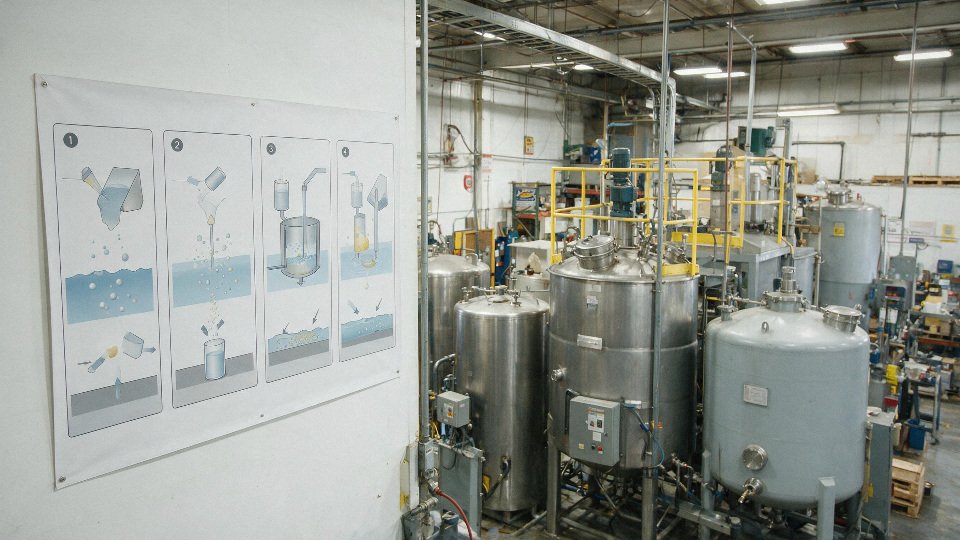
If the application has to run in water, the engineering question is rarely “Is silicone soluble?” It is “What phase do I need the silicone to be in at the point of use, and can my process keep it there long enough to do the job?” That is the question that separates a workable line trial from a month of chasing haze, foam, craters, or dirty tanks.
Selection criteria
Start with the process medium, not the product brochure. If your system is fully water-based, neat silicone oil is usually the wrong starting point unless you are deliberately feeding a defoamer concentrate at a controlled point; if your system is solvent-based, neat silicone or a solvent-diluted grade often behaves better than an emulsion. Modified silicones earn their place when you need the silicone effect but also need the material to stay compatible, spread, or react inside a more complex formulation.
That sounds obvious, but it is where many buying mistakes begin. A maintenance team sees “silicone oil” solve release or lubrication on one line, then purchasing tries to use the same chemistry in a waterborne coating, textile bath, or cleaning concentrate and gets float, fisheyes, or unstable tanks. The selection logic is simpler if you walk it in a fixed order.
1. Choose by application medium first
- Fully aqueous systems
- Start with silicone emulsions or water-dispersible / modified silicone fluids.
- Typical cases: waterborne coatings, textile finishing baths, polish formulations, aqueous mold-release systems, paper treatment, some personal-care or household formulations.
- Neat silicone oil can still be used in water systems, but usually only as:
- a low-dose defoamer component
- a post-added processing aid
- a material dispersed with the help of surfactants and shear
- If the process cannot tolerate oil separation over tank residence time, a plain PDMS fluid is a poor fit.
- Solvent-based systems
- Neat silicone oil or solvent-carried silicone is often easier to use than an emulsion.
- Typical cases: solventborne coatings, release agents, some polishes, dielectric fluids in closed systems.
- Watch the solvent package. A silicone that is chemically suitable can still be operationally wrong if your plant is trying to reduce VOC load or avoid flammable storage.
- Neat oil phase or direct application
- Use neat silicone oil when the silicone itself is the working fluid or deposited directly onto the substrate.
- Typical cases: lubrication, dielectric insulation, heat transfer in some niches, release films, direct softening or glossing, water-repellent treatment where a separate cure or deposition step is acceptable.
- This is where viscosity selection matters most because the fluid is not being “hidden” inside a carrier.
- Reactive formulations
- Look at functional or modified silicone materials, not only conventional silicone oil.
- Typical cases: systems where the silicone must bond, crosslink, or remain anchored in a resin matrix rather than migrate.
- This is the boundary where the simple “silicone oil versus emulsion” choice stops being enough. If permanence, overpaintability, or recoat behavior matters, you need compatibility and reaction-path data from the supplier.
2. Match the required function to the right product form
Different jobs push you toward different forms of silicone:
| Required function | Usually preferred form | Why |
|---|---|---|
| Defoaming | Neat silicone oil blend, compound, or emulsion defoamer | Insoluble droplets destabilize foam; delivery method depends on system |
| Lubrication | Neat silicone oil or high-active emulsion | Film continuity and viscosity control matter |
| Release | Neat oil, emulsion, or reactive modified silicone | Depends on substrate, transfer tolerance, and whether residue is acceptable |
| Softness / hand feel | Emulsion or modified silicone | Easier uniform deposition in aqueous finishing |
| Wetting / leveling | Modified silicone | Needs controlled compatibility, not just low surface tension |
| Water repellency | Modified silicone or reactive system; sometimes emulsion | Needs durable orientation or fixation on substrate |
| Dielectric performance | Neat silicone fluid | Water and emulsifier content are usually undesirable |
Mechanism matters here. Silicone fluids have very low surface tension, roughly 20–21 mN/m at 25 C for typical PDMS, far below water at about 72 mN/m. That helps spreading, release, and foam control. It does not automatically make a product a good wetter inside every formulation. In a coating, for example, a highly incompatible silicone can reduce surface tension so aggressively at the wrong stage that you get craters or intercoat defects instead of smooth leveling. The better choice flips from plain PDMS to a modified silicone once controlled compatibility becomes more valuable than maximum hydrophobicity.
3. Set viscosity, active content, and volatility around the process window
Industrial silicone oils run from about 5 cSt to well above 100000 cSt, and that range changes both performance and handling.
- Lower viscosity grades
- Easier to meter through small pumps and dosing skids
- Spread faster and can give thinner films
- More prone to migration, splash carryover, or loss from surfaces
- In some uses, more likely to contaminate downstream painting or bonding if overapplied
- Higher viscosity grades
- Better film persistence and often lower mobility
- Harder to pump, especially in winter or in unheated lines
- More difficult to disperse uniformly into water systems
- Can leave heavy deposits, dirt pickup, or inconsistent coating weight
- Active content
- High-active materials reduce freight on water and can lower use cost
- But they may demand better mixing, better metering, or dilution controls at the plant
- Lower-active emulsions are simpler to use but increase drum count, storage volume, and wastewater load from container rinsing
- Volatility
- For some silicone-containing products, lighter fractions improve initial spread or feel
- The trade-off is evaporation loss, odor concerns, and possible regulatory or customer restrictions depending on region and market
- Verify product-specific volatility data; it is not safe to generalize across all silicone fluids
A common plant-floor issue: the lab approves a low-viscosity sample because it doses nicely from a beaker, then production runs it through a diaphragm pump, overfeeds by a few tenths of a percent, and suddenly conveyors, rollers, or downstream cartons get contamination. Dosing precision and transfer behavior should be checked together.
4. Check formulation compatibility before scale-up
Compatibility screening should cover more than “looks OK after mixing.”
- Review interaction with:
- Surfactants
- Resins and binders
- Salts and hard water
- pH window
- Use temperature and storage temperature
Why this matters:
- A silicone emulsion may be stable in deionized water but break in a salty bath.
- A modified silicone that performs well in an acrylic system may separate in a PU dispersion.
- pH can slowly damage emulsion stability or shift particle size over time.
- Heat can help dispersion in one system and accelerate separation in another.
A visually uniform silicone-water mixture is not proof of long-term compatibility.True
Temporary dispersion can look acceptable at the bench yet separate, cream, or lose function under residence time, shear, pH drift, salt loading, or temperature cycling.
If the line has recirculation, high-shear inline mixers, or a long hold tank, ask specifically for stability data under those conditions. Benchtop jar testing is useful, but it does not reproduce a week in a tote under plant vibration or a shift in a hot finishing room.
5. Screen storage and handling as a purchasing decision, not an afterthought
- Pumpability
- Match viscosity to your actual pump type, hose diameter, and winter conditions.
- A fluid that moves well through a 1-inch drum pump may struggle in a long tote line with small fittings.
- Shear sensitivity
- Many emulsions tolerate routine mixing, but excessive shear can damage some systems.
- If operators like to “wake up” totes with a high-speed mixer, confirm that practice is acceptable.
- Freeze-thaw stability
- Relevant for emulsions in cold climates or poorly heated warehouses.
- Once an emulsion breaks, it usually does not come back by simple stirring.
- Pack size
- Drums suit smaller users or multi-grade plants.
- Totes reduce handling labor but only if consumption is fast enough to avoid aging and contamination.
- Shelf life
- Check unopened and in-use shelf life separately.
- In practice, half-used containers fail from dirty transfer habits long before the nominal expiry date.
6. Review compliance, customer requirements, and procurement reality
For many buyers, this is where the short list gets cut.
- Confirm as needed:
- purity requirements
- restricted-substance status
- food-contact relevance where applicable
- regional documentation and declarations
- batch traceability
Do not assume one silicone grade is globally interchangeable from a documentation standpoint. The chemistry may be similar while paperwork, declaration scope, or customer acceptance is not.
Then look at the supplier as an operating partner:
- Lot consistency: especially important for defoamers, coating additives, and textile finishing where small changes show up quickly
- Customization ability: useful when standard viscosity, active level, or emulsion package is close but not quite right
- Technical support: sample interpretation, compatibility review, troubleshooting after startup
- Lead time and supply continuity: often more expensive to get wrong than the price per kilogram
- Total delivered cost: include dilution labor, freight, packaging waste, dosing losses, trial scrap, and line interruptions
The cheapest drum is rarely the cheapest program. If a slightly higher-cost modified silicone prevents fisheyes, tank separation, or customer complaints, it usually wins on total cost within one or two production cycles.
Common mistakes
Most avoidable silicone-water failures start with a category error: treating “silicone oil” as one interchangeable material. In practice, a low-viscosity dimethyl fluid, a self-emulsifiable modified silicone, and a finished silicone emulsion can behave like three different product families once water, surfactants, salts, and shear enter the process.
Assuming all silicone oils are interchangeable
The word silicone hides too much chemistry to be useful on its own. Buyers get into trouble when a spec says only “silicone oil” and leaves out structure, viscosity grade, active content, and delivery form.
Common substitution errors look like this:
- Replacing one PDMS viscosity with another
- A 10 cSt dimethyl fluid and a 1000 cSt dimethyl fluid may both be insoluble in water, but they do not deposit, spread, or separate the same way.
- Lower viscosity usually wets and migrates faster. Higher viscosity usually persists longer on the surface but is harder to disperse and can leave non-uniform deposits.
- Swapping dimethyl silicone for modified silicone
- Polyether-modified silicones can show very different water affinity because the organic side chains change how the molecule sits at the oil-water interface.
- That can be useful in waterborne formulations, but it can also change foam behavior, substrate wetting, and rinse-off.
- Treating a silicone emulsion as equivalent to neat oil
- An emulsion includes emulsifier package, droplet size distribution, and often preservatives or stabilizers. Those components drive storage behavior and application performance just as much as the silicone itself.
A lot of plant-floor confusion starts when purchasing tries to save money by matching only viscosity or only the word “silicone.” That is rarely enough.
Mistaking temporary dispersion for true solubility
If you hit silicone oil and water with enough agitation, you can make the tank look uniform for a while. That does not mean the silicone has dissolved.
Typical warning signs that you only have a temporary dispersion:
- Separation after standing
- Surface oiling or rainbow sheen
- Wide batch-to-batch performance swings
- Filter fouling from agglomerated droplets
- Uneven slip, gloss, release, or defoaming on the part
The mechanism matters here. Shear can break silicone into smaller droplets, which slows visible separation, but droplet breakup is not molecular dissolution. Once agitation stops, droplets collide and coalesce unless the system has enough interfacial stabilization. The preferred choice flips if the process needs shelf life or recirculation stability: plain silicone oil may be acceptable for immediate-use spray systems, but not for a packaged waterborne product expected to sit in a warehouse for months.
Vigorous mixing can make silicone oil appear water-soluble.False
Mixing can create a temporary dispersion or emulsion, but typical silicone oils remain effectively insoluble in water. Stability depends on emulsifiers, droplet size, chemistry, and water conditions.
Choosing viscosity by feel instead of process behavior
Viscosity gets overused as a shortcut because operators can see it and applicators can feel it. That is not enough for water-based handling.
What viscosity affects in practice:
- Droplet formation under shear: lower-viscosity oils usually break into smaller droplets more easily
- Coalescence tendency: smaller droplets can still merge if stabilization is weak
- End-use deposition: higher-viscosity fluids often stay on the substrate longer, but may not distribute evenly
- Pumping and metering: a tote of 10,000 cSt in winter does not behave like the same product in a warm lab
A coating line, textile bath, and mold-release station can each want a different viscosity for good reasons. If you choose by spreadability alone, you can end up with the wrong particle size in the bath and the wrong film on the part.
Ignoring water quality
Water quality is where a lot of decent lab work dies in production. Hardness, dissolved salts, and pH can destabilize some emulsions and modified silicones even when the silicone itself has not changed.
Check these before blaming the supplier:
- Hardness
- Calcium and magnesium can compress the stabilizing layer around droplets and promote separation in some systems.
- Dissolved salts
- Conductivity shifts can upset emulsion stability, especially in diluted concentrates made with plant water instead of deionized water.
- pH
- Modified silicones and emulsifier packages may only tolerate a limited pH window. Outside it, you may see viscosity drift, creaming, or loss of performance.
- Temperature history of the water
- Cold makeup water can shock some emulsions; hot dilution can also change stability depending on formulation.
The boundary here is simple: if the process uses variable well water, recycled rinse water, or aggressive pH adjustment, do not assume lab compatibility data transfers directly without a plant-water trial.
Adding silicone at the wrong stage or under the wrong shear
A good product can be ruined by bad addition practice. This shows up most often in batch blending, coating make-down, and tank-side dilution.
Common handling mistakes:
- Charging silicone before the primary surfactant package is fully dispersed
- Dumping concentrate into stagnant water instead of adding slowly into a moving vortex
- Using excessive rotor-stator shear that drives unwanted inversion or over-processes the emulsion
- Recirculating too long through high-shear pumps
- Adding at a point in the process where local concentration spikes cause fish-eyes or foam
There is a trade-off. Enough shear is needed to distribute the silicone phase; too much can damage the very droplet structure that provides stability. In my experience, this is where people lose half a day chasing “raw material problems” that are really order-of-addition problems.
Using standard dimethyl oil where a different system is required
Sometimes the mistake is not process control. It is simply the wrong product family.
Use caution when the application requires:
- Stable dilution into water
- Uniform low-add-on deposition
- Fast substrate wetting
- Controlled foam profile in aqueous processing
- Long packaged shelf life after dilution
Those cases often point toward an emulsified silicone or a polyether-modified silicone rather than a neat dimethyl fluid. Not always, but often enough that it should be the first technical question, not the last one asked after a failed trial.
Overlooking packaging and logistics
Silicone-water performance can be lost before the drum reaches the line. Storage and shipping are part of product selection, especially for emulsions and modified systems.
Watch for:
- Freeze-thaw exposure during winter transport
- Drum or IBC headspace contamination
- Prolonged storage above recommended temperature
- Settling that operators do not re-homogenize correctly
- Packaging compatibility with long-term storage and transfer equipment
A neat silicone oil is usually more forgiving in storage than a formulated emulsion, but that advantage disappears if the application fundamentally needs water compatibility. If logistics include outdoor storage, mixed climate shipping lanes, or long inventory cycles, make that part of the purchasing spec instead of treating it as a warehouse problem later.
Frequently asked questions
Is silicone oil soluble in hot water?
No in the practical sense. Heating water may change viscosity, droplet size during mixing, and how fast phases separate, but standard silicone oils remain effectively insoluble rather than becoming truly dissolved.
In plant terms, hot water can fool people. A low-viscosity silicone fluid shaken into warm process water may look temporarily more uniform because the oil thins out and disperses into finer droplets, but once agitation stops it usually creams, separates, or leaves surface slicks. If you need a stable aqueous system, heat is not a substitute for the right emulsifier package or a genuinely water-compatible modified silicone.
Does lower viscosity silicone oil dissolve better in water?
Usually no. Lower viscosity grades often disperse more easily than high-viscosity grades, but that is a mixing effect, not a solubility shift.
A 5 cSt PDMS fluid and a 1,000 cSt PDMS fluid behave very differently in a mixer, tote, or day tank. The thin grade breaks into droplets faster and may stay dispersed a bit longer under recirculation. That can look like “better solubility” on the floor. Chemically, both are still typically insoluble in water, and any estimate should be verified by structure-specific data rather than viscosity alone.
Can silicone oil be mixed into water without surfactants?
Yes, but only as a temporary mechanical dispersion in most cases. Without surfactants, protective colloids, or a suitable modified silicone structure, you should expect phase separation sooner or later.
Whether that means minutes or hours depends on several things:
- Oil viscosity
- Shear intensity and mixing time
- Water chemistry
- Temperature
- Presence of salts, cleaners, or other organics
- Tank geometry and residence time
In practice, a high-speed rotor-stator may produce a fine-looking dispersion that survives long enough for immediate use in a spray or short batch. It is rarely robust enough for packaged product storage, IBC transfer, or line stoppages.
Is silicone oil more soluble than mineral oil?
Not as a general rule you can rely on. Both are commonly treated as water-insoluble in industrial handling, and the exact comparison depends on the specific hydrocarbon oil, the specific silicone structure, and the test method used.
Silicone fluids do have much lower surface tension than water, often around 20–21 mN/m for PDMS at 25 C versus roughly 72 mN/m for water. That changes wetting and spreading behavior, which is why silicone can appear to “get into” water systems differently than mineral oil. That is not the same thing as being water-soluble.
Lower surface tension means silicone oil dissolves in water more easily.False
Lower surface tension improves spreading and interfacial behavior, not true molecular solubility in water. A silicone fluid can wet a surface very effectively and still remain insoluble.
What type of silicone is water-soluble or water-dispersible?
Water-dispersible and water-soluble are different product classes, and suppliers sometimes blur them in sales language.
- Conventional silicone oil (such as standard PDMS): generally water-insoluble
- Silicone emulsions: water-dispersible because the oil is present as stabilized droplets
- Polyether-modified silicones and other functional silicones: may be self-dispersible, water-reducible, or in some cases genuinely water-soluble, depending on substitution level and molecular design
- Silicone surfactants: often the closest category to practical water solubility, but behavior still depends on concentration and formulation conditions
If your process cannot tolerate haze, creaming, or droplet deposition, ask for confirmation of whether the product forms a true solution or only a stable dispersion.
Why does a silicone emulsion look uniform if the oil is not soluble?
Because the oil is divided into very small droplets and held apart by emulsifiers or other stabilizing mechanisms. Your eye sees a continuous, uniform liquid; it does not tell you whether the silicone is molecularly dissolved.
That distinction matters in use. An emulsion can break under freeze-thaw, high electrolyte load, pH shift, or strong dilution with poor-quality water. A true solution usually fails differently, if it fails at all.
How can I tell whether my product is an emulsion or a true solution?
Use a few checks together rather than trusting appearance alone:
- Appearance
- True solutions are usually clear to transparent.
- Emulsions are often milky, bluish, translucent, or opalescent.
- Microscopy or particle size
- Detectable droplets indicate an emulsion or dispersion.
- Filtration behavior
- A dispersion may leave residue or change appearance across fine filtration.
- A true solution usually does not separate this way.
- Dilution response
- If heavy dilution causes whitening, oiling-out, or creaming, it is not acting like a true solution.
- Centrifuge or storage test
- Separation under acceleration is a practical sign of dispersed oil.
In a plant lab, even a simple jar test with your actual process water is more useful than a beaker test with deionized water.
Will silicone oil separate during storage after dilution?
Often yes, if you diluted a neat silicone oil into water without a stable emulsifier system. Even a purchased emulsion can separate if the dilution water, pH, conductivity, or bioburden is outside the product’s working window.
Watch for these signs:
- Cream layer at the top
- Clear water layer at the bottom
- Oil rings on container walls
- Viscosity drop after standing
- Performance inconsistency from first drum to last drum
If the diluted product must sit in a day tank, verify hold time under your actual agitation pattern. A tote that rides fine in the lab may split after a cold weekend on the shop floor.
Does water insolubility make silicone oil a better defoamer?
Often yes, within limits. Effective defoamers usually need controlled incompatibility so they can enter the foam lamella, destabilize it, and promote rupture rather than simply dissolving into the liquid phase.
That benefit flips if the silicone is too incompatible for the system. Then you can get surface defects, fisheyes, poor coating appearance, or deposits on sensors and filling heads. Good defoaming comes from the right balance of insolubility, droplet size, carrier system, and process compatibility, not from maximum separation.
What data should I request from a supplier before sampling?
Ask for enough information to screen fit before you spend line time:
- Chemical type
- Standard PDMS, emulsion, polyether-modified silicone, amino silicone, reactive silicone, and so on
- Physical form
- Neat fluid, emulsion, microemulsion, water-reducible concentrate, or solution
- Key properties
- Viscosity grade
- Active content
- pH for emulsions
- Ionic character if relevant
- Recommended dilution range
- Water compatibility limits
- Preferred water quality
- Electrolyte sensitivity
- pH stability window
- Freeze-thaw stability, if storage conditions require it
- Application-specific performance data
- Defoaming, release, lubrication, slip, leveling, softness, or wetting data tied to a stated test method
- Handling and storage
- Shelf life
- Agitation requirements
- Separation recovery procedure
- Packaging options
- Compliance and documentation
- SDS
- Regulatory status relevant to your market
- Food-contact or indirect-contact statements if needed
If the supplier cannot clearly state whether the sample is a neat oil, an emulsion, or a genuinely water-compatible modified silicone, stop there and clarify before testing. That single misunderstanding causes a lot of wasted trials.
What should you verify next
For most industrial buyers, the decision is straightforward: assume standard silicone oil is not water-soluble unless the product family is explicitly designed for water compatibility. The next step is not asking whether silicone oil “mixes with water” in general, but defining whether your job needs a neat oil, a silicone emulsion, or a modified silicone that can stay workable in a water-based system under your actual plant conditions.
That distinction matters because the failure mode changes with the choice. A neat oil may deliver the best slip, release, or defoaming in some non-aqueous or surface-applied uses, but it can fisheye, separate, or float in a waterborne formulation. An emulsion can dose cleanly into water, yet particle size, shear, hardness salts, and pH can decide whether it stays stable through storage and use. Modified silicone can solve compatibility, but usually at a cost in pure hydrophobicity, lubricity, or price, depending on the chemistry.
Verification checklist before you ask for a product recommendation
- Application medium
- Pure water, waterborne coating, cleaner, textile bath, personal care base, fermentation system, or mixed solvent
- Required function
- Defoaming, lubrication, release, wetting, gloss, softness, water repellency, surface modification
- Target dilution ratio
- As supplied, 1:5, 1:10, 1:100, or metered continuously into a process line
- Operating temperature range
- Room temperature only, heated tank, cold-weather storage, steam-cleaning exposure
- pH window
- Acidic, neutral, alkaline; include cleaning cycles if the line sees caustic washdown
- Ionic environment
- DI water, hard water, brine, metalworking fluid package, electrolyte-rich process water
- Surfactant system already present
- Nonionic, anionic, cationic, amphoteric, or unknown package from a compounder
- Regulatory or customer restrictions
- Food-contact, VOC limits, specific market documentation, restricted substances, sector-specific approvals
In practice, the surfactant and ionic environment are where many trials go sideways. A silicone emulsion that looks fine in DI water can break in hard water or in an anionic resin system; a modified silicone that behaves in a beaker may still lose performance after recirculation through a high-shear pump.
Minimum supplier data package to request
- Product family and intended water behavior
- Active matter or solids content
- Viscosity grade or typical viscosity range
- Particle size, if emulsified
- Dilution stability guidance
- Storage stability conditions and shelf life
- Recommended addition method and order of addition
- Technical data sheet
- Safety data sheet
- Any application notes relevant to your use
A supplier cannot responsibly predict water compatibility from viscosity alone.True
Viscosity affects handling and spreading, but water behavior depends primarily on silicone structure, modification, emulsification system, and the chemistry of the aqueous formulation.
Qualification path
- Lab screening
- Check dilution behavior, appearance, phase stability, and functional performance in your actual formulation or process water.
- Pilot trial
- Run under realistic mixing, residence time, and temperature conditions.
- Plant trial
- Confirm dosing method, tank stability, line cleanliness, and finished-product consistency.
- Lot-to-lot review
- Verify that incoming material stays inside the performance window you actually need, not just the catalog description.
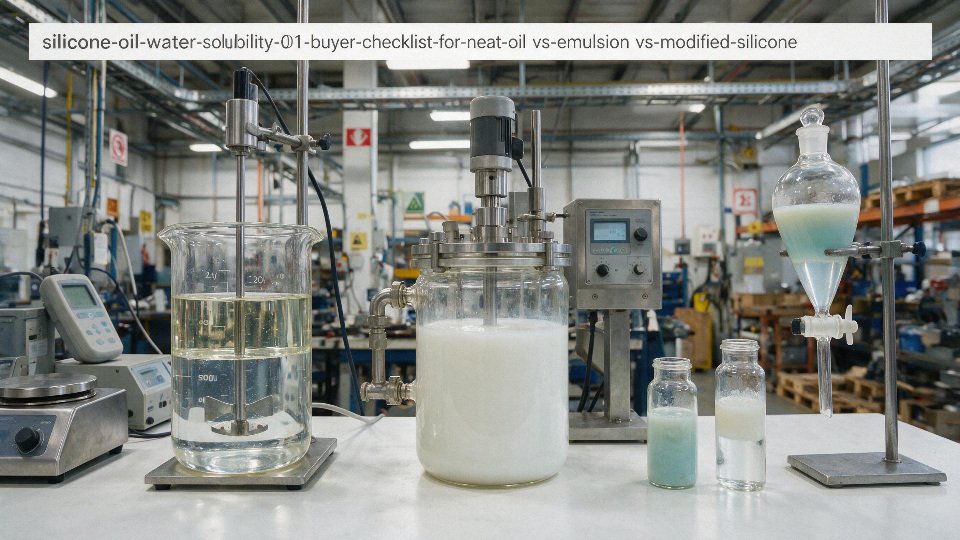
If you are narrowing the choice now, send SiliconChemicals your substrate material, contaminant or process medium, approximate layer thickness if relevant, working area, required finish, target rate, and clear part photos or samples. Based on that water-compatibility requirement, SiliconChemicals can support product matching, custom modification, sample supply, and supply planning for scale-up.