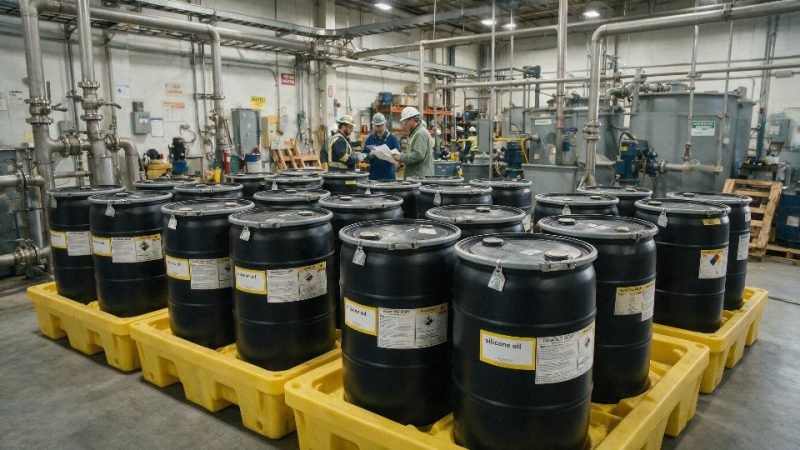
Waste drums labeled “silicone oil” make a lot of environmental conversations go sideways, because buyers assume “oil” means it should break down like a vegetable-based fluid, while EHS teams know disposal invoices and permit language say otherwise. That gap matters on the plant floor: if you choose a fluid on the wrong environmental assumption, you can end up with harder wastewater separation, disputed waste classification, and awkward questions from customers asking for biodegradable inputs. The cost shows up later in testing, treatment, paperwork, and sometimes a forced reformulation, so the practical fix is to assess silicone oil by actual environmental fate pathways, not by the product name alone.
Silicone oil is generally not considered readily biodegradable under standard 28-day screening tests, although behavior depends on chemistry, viscosity, and the environment it enters. For most industrial buyers, the right question is not “does it biodegrade quickly?” but “how is it removed or transformed in water, soil, sludge, and air under my actual use and disposal conditions?”
That distinction is where most of the confusion sits. A low-viscosity silicone fluid, a very high-viscosity polydimethylsiloxane, and a modified silicone can all behave differently in transport and testing, and biodegradation is only one part of the picture beside hydrolysis, volatilization, and adsorption to sludge or soil. If you are selecting fluid for a process, writing a customer response, or reviewing compliance risk, those differences decide whether silicone oil is merely misunderstood or genuinely the wrong fit.
What silicone oil includes
“Silicone oil” is a commercial bucket, not a single substance. A straight PDMS fluid, a polyether-modified silicone surfactant, and a fluorosilicone can all be sold as silicone oil, yet they behave very differently in water, sludge, air emissions, and biodegradation testing. If you do not identify the actual silicone family first, any environmental comparison is on shaky ground.
At the chemistry level, most industrial silicone fluids are built around a silicon-oxygen, or Si-O, backbone with organic side groups attached to the silicon atoms. That common backbone is why these materials get grouped together commercially, but the side groups and structure are what shift performance and environmental behavior. In practice, buyers often focus on viscosity grade because that is what appears on the quotation sheet first; for environmental review, that is not enough.
Main silicone oil families sold under one market label
A useful split on the plant and purchasing side is by chemistry family, not by brand name.
- Linear PDMS fluids
- The standard dimethyl silicone oils used as lubricants, release agents, heat-transfer fluids in some niches, defoamer components, and processing aids
- Usually the reference material people mean when they say “silicone oil”
- Typically hydrophobic, low surface tension, and available across a very wide viscosity range
- Phenyl-modified silicones
- Methyl phenyl or diphenyl-containing fluids used where low-temperature flexibility, refractive index, or thermal behavior matters
- The phenyl groups can change solvency, oxidation response, and compatibility with other organics
- Amino-functional silicones
- Common in textile finishing, personal care intermediates, and specialty surface treatment systems
- The amino functionality changes how the fluid interacts with fibers, pigments, and water-based systems
- These are often sold in emulsified form rather than as a neat bulk fluid
- Polyether-modified silicones
- Often used as wetting agents, foam control components, agricultural adjuvants, or coating additives
- The polyether segment can make the material partly water-dispersible or strongly surface-active
- That one change alone can completely alter wastewater behavior compared with neat PDMS
- Methylhydrogen silicones
- Reactive silicone fluids carrying Si-H groups, used in water repellents, release coatings, and crosslinking systems
- Their environmental profile cannot be discussed purely as an inert oil because they may react during use or cure
- Fluorosilicones
- Chosen for fuel, solvent, or chemical resistance
- Much more specialized, typically higher cost, and not a fair comparison target for commodity PDMS fluids
- Specialty copolymers and branched silicones
- Includes silicone-organic copolymers, alkyl-modified silicones, epoxy-functional grades, and other designed structures
- These are often application-driven products where the “silicone oil” label hides meaningful non-silicone content
Why structure matters before anyone talks about biodegradability
The first control point is the Si-O backbone, but the environmental story does not stop there. Side groups, chain length, branching, and end groups affect how easily the fluid spreads, volatilizes, disperses, adsorbs to solids, or stays in a wastewater phase long enough to be measured.
Here is the practical mechanism. As chain length rises, viscosity usually rises as well. Higher-viscosity silicone fluids tend to have lower mobility, lower volatility, and different test behavior than lower-viscosity grades. A 10 cSt fluid and a 100000 cSt fluid are not just “thin” and “thick” versions of the same procurement line item; they may partition very differently during use, spill response, and wastewater treatment.
Branching and end groups matter too:
- Trimethylsiloxy end-capped fluids are common, relatively stable forms of PDMS
- Hydroxyl-terminated fluids may behave differently in formulation and further reaction
- Functional end groups can change compatibility, cure behavior, and environmental fate pathways
The trade-off is straightforward. Functionalization often improves application performance, wetting, softness, anchorage, or reactivity, but that same modification can make the material less comparable to base silicone fluid in environmental screens. The usual “silicone oils are X” statement stops holding once you move into strongly modified copolymers or reactive systems.
Form matters: neat fluid and emulsion are not the same purchasing object
A drum of neat silicone fluid and a pail of silicone emulsion may contain related silicone chemistry, but they are not equivalent from an environmental review standpoint.
An emulsion can contain:
- Emulsifiers or surfactants
- Water
- Solvents or co-solvents
- Preservatives or biocides
- pH adjusters
- Fillers or stabilizers
- Performance additives
Some of those non-silicone ingredients may biodegrade faster than the silicone phase. Some may dominate COD, aquatic behavior, or sludge interaction. In a wastewater conversation, operators often discover that the “silicone product” causing treatment changes is actually responding through its surfactant package, not the silicone backbone itself. That is a common mistake in procurement reviews.
Two silicone products with the same nominal viscosity can have materially different environmental behavior.True
Viscosity alone does not identify silicone family, functional groups, emulsion package, volatility, or water dispersibility. Those differences can change partitioning, adsorption, and test results before biodegradation is even evaluated.
What buyers should verify on SDS and procurement documents
Names on SDS sheets and quotations can be misleadingly broad. “Silicone oil,” “dimethicone,” “modified silicone,” or a house marketing grade may hide large differences in composition, especially when suppliers use internal blend codes or application-led product names.
Check these items before comparing one product with another:
- Chemical family
- Linear PDMS, amino silicone, polyether silicone, fluorosilicone, reactive hydride silicone, or copolymer
- CAS number
- Useful, but not always enough for mixtures, modified silicones, or emulsions
- Physical form
- Neat fluid, solution, emulsion, microemulsion, compound, or finished formulation
- Nominal viscosity or viscosity range
- Ask at what temperature it is measured
- Active content
- Critical for emulsions and diluted products
- Functional groups or modification type
- Amino, polyether, phenyl, epoxy, alkyl, Si-H, fluorinated
- Presence of non-silicone ingredients
- Surfactants, solvents, preservatives, fillers, catalysts
- Intended application
- Defoamer, lubricant, textile softener, release agent, coating additive, water repellent
That last point sounds basic, but it saves bad comparisons. A silicone defoamer compound, a cosmetic dimethicone, and a textile amino emulsion may all be called silicone oil somewhere in the paperwork. They should not be evaluated as if they were the same material.
How biodegradation is evaluated
A silicone oil is only “biodegradable” in a meaningful procurement or compliance sense if the claim is tied to a specific test method, endpoint, and pass criterion. In practice, many silicone fluids do not pass stringent ready-biodegradability screening within the standard 28-day window, and that is exactly why buyers need to read the test basis instead of the marketing adjective.
The first problem is vocabulary. Suppliers, distributors, and even some technical datasheets will use “degradable,” “environmentally acceptable,” and “biodegradable” as if they mean the same thing. They do not.
What the key biodegradation terms actually mean
- Primary biodegradation
- The substance is chemically altered by microorganisms so that the original molecule loses its specific structure or function.
- This does not mean complete breakdown to simple inorganic products.
- For a silicone fluid, primary degradation might mean the polymer backbone or side groups are being transformed, but not fully mineralized.
- Ultimate biodegradation
- Microorganisms convert the carbon in the substance into final products such as CO2, water, biomass, and under some conditions methane.
- This is the stricter endpoint most people assume when they hear “fully biodegradable.”
- In regulatory and environmental review, this is usually the endpoint carrying the most weight.
- Mineralization
- Often used nearly interchangeably with ultimate biodegradation, though strictly it emphasizes conversion to inorganic end products.
- If a test tracks CO2 evolution, it is trying to measure this stage, not just disappearance of the starting fluid.
- Ready biodegradability
- A severe screening concept, not a casual description.
- The substance must pass a standardized test under relatively low inoculum and limited adaptation conditions, usually within 28 days in OECD screening frameworks.
- Passing is a strong claim. Failing is common for difficult materials and does not, by itself, prove environmental persistence in every setting.
- Inherent biodegradability
- A less stringent concept than ready biodegradability.
- These tests allow more favorable conditions for biodegradation, often with higher microbial loading, longer exposure, or adapted inoculum.
- If a substance is inherently biodegradable, it shows potential to biodegrade, but it still cannot be sold honestly as “readily biodegradable.”
- Environmental persistence
- This is about how long a substance remains in the environment before it is transformed or removed.
- Persistence is broader than biodegradation. A material may disappear from water not because it biodegrades quickly, but because it adsorbs to sludge, binds to soil, volatilizes, or hydrolyzes into other species.
- That distinction matters a lot for silicone oils, because environmental fate is often controlled by more than microbial attack alone.
Failure in a ready biodegradability test proves a silicone oil is environmentally persistent everywhere.False
Ready-biodegradability tests are strict screening tools. Failure means the material did not meet that specific pass criterion under those conditions; it does not by itself establish long-term fate in soil, sludge, sediment, or wastewater treatment.
How OECD-style biodegradability screening works
Most procurement teams will encounter biodegradability references built around OECD test methods or closely related regional standards. The details vary by method, but the basic structure is consistent: expose the test substance to a microbial inoculum under controlled conditions, then measure how much biodegradation occurs over time.
Typical features of these tests include:
- Defined test duration
- Often 28 days for ready biodegradability screening.
- That time window is important because many borderline materials may transform slowly but still fail the screening threshold.
- Microbial inoculum
- Usually sourced from activated sludge, surface water, soil extract, or wastewater treatment biomass, depending on the method.
- Inoculum source and health matter. A fresh municipal sludge sample behaves differently from a thin inoculum prepared for a strict screening test.
- Plants with stable biological treatment often ask, fairly, whether site-specific biomass would perform better than the standard inoculum. Sometimes it does, but that does not change the official ready-biodegradability result.
- Measured endpoint
- Common endpoints include:
- Oxygen demand: how much oxygen microorganisms consume while degrading the test substance
- CO2 evolution: how much carbon dioxide is produced
- DOC removal: dissolved organic carbon reduction, where applicable
- For poorly soluble silicone fluids, CO2 and oxygen-demand methods are often more interpretable than simple disappearance measurements, because disappearance can reflect physical removal rather than true biodegradation.
- Pass criteria
- The pass level depends on the method, but ready-biodegradability tests typically require a high percentage of degradation within the test window.
- Some methods also apply a “window” concept, where the required degradation must occur within a defined period after degradation begins.
- If a silicone oil reaches partial degradation but misses the timing or threshold, it does not pass as readily biodegradable.
- Controls
- A proper test report should include:
- blank control
- reference substance control
- toxicity control, where relevant
- Without these, it is hard to tell whether low degradation came from the substance itself, bad inoculum, or microbial inhibition.
Why silicone oils can test inconsistently in screening methods
Poor water solubility and surface behavior are the practical reasons many silicone oils are awkward in standard biodegradation tests. A test can understate biodegradation potential if the microorganisms cannot physically access the material, but it can also overstate disappearance if the material sticks to glassware, sludge, or the vessel instead of being biologically converted.
This is where shop-floor chemistry and test chemistry collide.
Dispersion and phase contact
Silicone oils span a wide viscosity range, roughly 10 cSt to well above 100000 cSt, and viscosity changes how the material behaves in a flask.
- Lower-viscosity fluids may disperse more easily, though not necessarily dissolve.
- Higher-viscosity fluids tend to form separate phases, coat surfaces, or remain as droplets with very low interfacial area.
- If the test substance is not properly prepared, the inoculum may only contact a fraction of the added carbon.
Preparation method matters more than many buyers realize:
- neat addition
- use of a carrier
- adsorption onto an inert support
- pre-dispersion or mixing method
- vessel geometry and agitation intensity
A sloppy preparation method can produce a poor result that says more about test execution than about the chemistry.
Adsorption and false disappearance
Silicone materials can adsorb onto:
- activated sludge solids
- suspended particulates
- glass or plastic surfaces
- soil or sediment matrices
That creates a common interpretation trap. If concentration in the water phase drops, some readers assume biodegradation occurred. Maybe. Or maybe the material just moved out of the measured phase. In wastewater treatment, that distinction matters because removal from effluent can still be operationally useful, but it is not the same as ultimate biodegradation.
Bioavailability limits
Microorganisms degrade what they can access. If a silicone oil is hydrophobic, highly viscous, or strongly surface-active, bioavailability can become the limiting step rather than intrinsic biodegradation chemistry.
The trade-off is straightforward:
- A tightly aggregated or adsorbed material may show low degradation in a ready test
- gain: lower mobility in water in some cases
- sacrifice: reduced microbial access and weaker screening-test performance
- A more mobile or better-dispersed form may test more favorably
- gain: better microbial contact
- sacrifice: potentially greater short-term distribution through the aqueous phase
The usual conclusion that “poor test performance equals extreme environmental risk” stops holding once physical sequestration, sludge capture, hydrolysis, or volatilization dominate the actual fate pathway. At that point, the buyer needs a broader environmental fate review, not just one screening number.
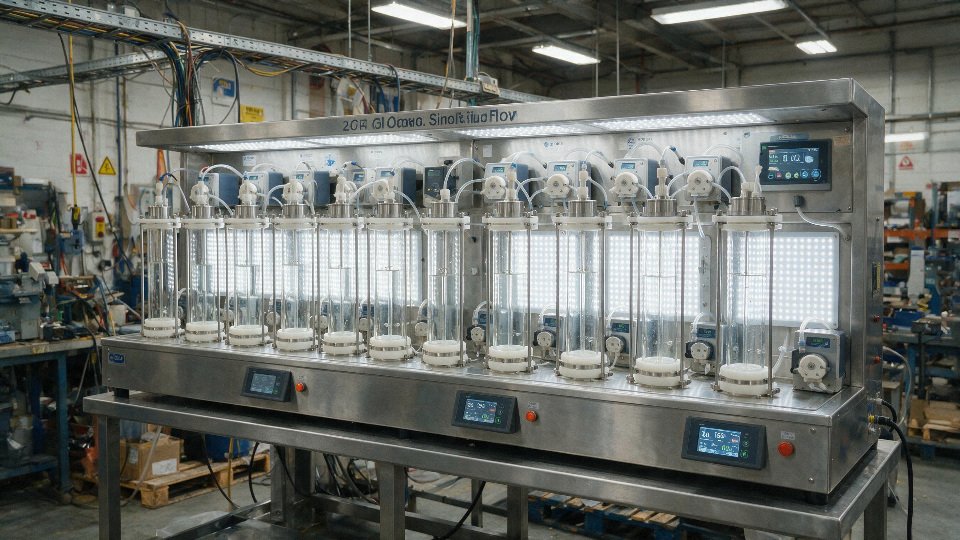
Laboratory screening is not the same as environmental fate
A screening test asks a narrow question under standardized conditions: can this material biodegrade fast enough, far enough, under this protocol? Plant operators and environmental managers usually need a wider answer.
Distinct release scenarios behave differently:
| Scenario | What often matters besides biodegradation | Why it changes interpretation |
|---|---|---|
| Wastewater treatment plant | adsorption to sludge, hydraulic retention time, aeration, biomass condition | Effluent removal may occur even when ready-biodegradability pass criteria are not met |
| Soil release | sorption to soil organic matter, moisture, temperature, microbial community | Lower mobility can reduce leaching but may slow biodegradation |
| Sediment | low oxygen, strong partitioning to solids | Breakdown may be much slower than in aerated systems |
| Open water release | dispersion, surface film behavior, sunlight, dilution | Low solubility can reduce dissolved exposure but complicate cleanup and monitoring |
| Volatile or semi-volatile fractions, if present | volatilization | Apparent loss from the test system may not be biodegradation |
For silicone oils, environmental review usually has to compare at least four pathways:
- biodegradation
- hydrolysis
- volatilization
- adsorption to sludge or soil
That broader mass-balance view is often more decision-relevant than a single ready-biodegradation result, especially for wastewater discharge assessments and spill response planning.
What a credible supplier should show in a test report
If a supplier makes a biodegradability claim, ask for the actual evidence package. A serious document should identify at least:
- Exact test standard
- OECD method number or equivalent standard
- Sample identity
- product name, grade, batch if available, and enough chemical description to know what was tested
- Test concentration
- because loading can change dispersion and inhibition behavior
- Sample preparation method
- neat, dispersed, adsorbed on support, solvent-assisted, emulsified, or otherwise
- Inoculum source
- activated sludge, surface water, mixed inoculum, adapted biomass, and any preconditioning
- Measured endpoint
- CO2 evolution, oxygen uptake, DOC removal, or another defined metric
- Controls
- blank, reference substance, and toxicity control where relevant
- Validity criteria
- confirmation that the method’s control requirements were met
- Result interpretation
- whether the substance passed or failed the stated criterion, and what the result does not prove
Watch for weak supplier language such as:
- “eco-friendly”
- “degradable”
- “biodegradation observed”
- “removed in treatment”
- “passes internal testing”
Those phrases are not useless, but without method and endpoint, they are not procurement-grade evidence.
If you are comparing suppliers, ask them to put the claim in one line you can audit: tested method, endpoint, duration, result, and claim boundary. That usually separates firms with actual environmental data from firms repeating a sales deck.
PDMS environmental behavior
Conventional PDMS silicone oils generally do not pass ready-biodegradability screening in the way buyers usually mean by “biodegradable,” so they are usually not sold on that claim. Their environmental behavior is better described as low water solubility, strong partitioning out of water, slow transformation over time, and removal in treatment systems mainly by physical fate mechanisms rather than fast biological mineralization.
That distinction matters in procurement. If your requirement is “must rapidly biodegrade after release under standard 28-day ready-test conditions,” standard dimethyl silicone fluids are usually the wrong family. If the requirement is “must be controllable in a closed plant process, with predictable wastewater behavior and low mobility in use,” PDMS may still be technically acceptable, but only after checking the actual grade, use pattern, and discharge route.
Standard PDMS silicone oils are generally not considered readily biodegradable.True
This aligns with common OECD ready biodegradability screening outcomes over a 28-day window, where many conventional silicone fluids do not meet pass thresholds. The exact result depends on test method, dispersion approach, viscosity, and sample preparation, so buyers should ask for product-specific reports rather than assume all grades behave identically.
Why PDMS often performs poorly in ready biodegradability tests
The first problem is access. PDMS is hydrophobic, only sparingly soluble in water, and many grades are hard to disperse uniformly in the aqueous test systems used for ready biodegradability screening. If the microorganisms in the flask cannot physically access enough of the material, measured biodegradation will look poor even before you get to the underlying chemistry.
The second problem is molecular structure. The siloxane backbone does not behave like the ester or hydrocarbon structures that many common biodegradation pathways attack more readily. Conventional dimethyl silicone oils can transform in the environment, but that is typically slower and less direct than the “fast biological consumption” implied by a ready-biodegradable label.
There is also a testing nuance buyers miss all the time: viscosity changes test behavior. Industrial silicone oils run from about 10 cSt up to well above 100000 cSt, and that is not a cosmetic difference.
- Lower-viscosity PDMS grades
- Disperse somewhat more easily
- Can spread across surfaces or test vessels more readily
- May show different apparent degradation behavior simply because contact with the test system is better
- Higher-viscosity PDMS grades
- Are harder to disperse
- Tend to form persistent droplets, films, or adhered residues
- Can underperform in screening tests partly because mass transfer is poor, not only because biodegradation chemistry is slow
That does not mean a low-viscosity fluid suddenly becomes “biodegradable” in the commercial sense. It means transport and exposure affect the test result. In practice, if a supplier is making broad biodegradability claims without identifying the exact viscosity grade and test method, I would treat that as incomplete information.
The dominant environmental pathways are usually physical partitioning and slow transformation
For standard PDMS fluids, the main environmental story is not “it quickly disappears biologically in water.” It is usually that the material leaves the water phase and accumulates in another compartment.
Typical PDMS fate pathways include:
- Adsorption to sludge in wastewater treatment
- Hydrophobic silicone fluids tend to partition from the aqueous phase into solids.
- In activated sludge systems, a meaningful share of PDMS removal can occur by association with biosolids rather than biological destruction.
- This is one reason an effluent number can look acceptable while the mass has simply moved to sludge handling.
- Adsorption to soils and sediments
- Once released to soil, PDMS often binds to particulate matter and organic material.
- Mobility in groundwater is usually limited compared with water-soluble organics, especially for higher-viscosity grades.
- The trade-off is persistence in the deposited matrix. Low mobility is not the same thing as rapid breakdown.
- Limited dissolved concentration in water
- Because water solubility is low, bulk water transport is often less significant than many buyers assume.
- Surface spreading can still matter, especially for lower-viscosity fluids and thin films.
- Slow transformation over time
- PDMS can undergo abiotic degradation and longer-term environmental transformation.
- Those processes are usually much slower than a ready biodegradation pass criterion.
- Low acute toxicity in many use contexts
- Many conventional PDMS fluids are not primarily flagged because of high acute aquatic toxicity.
- That is useful, but it should not be confused with biodegradability. Buyers often merge those issues into one environmental question, and they are not the same.
This is where plant reality comes in. A defoamer based on PDMS may be operationally manageable in a controlled process because doses are low, releases are contained, and the wastewater system already handles hydrophobic residues through sludge capture and skimming. The same chemistry can be a poor fit for an open-loss application where the purchasing spec explicitly requires rapid post-release biodegradation.
Abiotic degradation: what actually happens over time
PDMS does not just sit unchanged forever, but the transformation route is usually gradual and condition-dependent. Under certain environmental conditions, the siloxane bonds can undergo hydrolytic cleavage or depolymerization, producing lower-molecular-weight siloxane fragments and silanol-containing species.
A simplified pathway looks like this:
- Initial PDMS fluid
- Dimethylsiloxane polymer or oligomer
- Abiotic cleavage or depolymerization under suitable conditions
- Influenced by pH, moisture, surface interactions, temperature, and the local matrix
- Rate is highly environment-specific; no single universal half-life should be assumed without data
- Formation of silanols and related intermediates
- These species can continue reacting
- Longer-term conversion toward inorganic silica-like end states
- Often described conceptually as progression toward silica, silicates, CO2, and water depending on the pathway and conditions
- The time scale can be extended, and intermediate steps matter
The mechanism matters because it changes how you assess risk and treatment. If a material is removed from water by sludge adsorption and then slowly transforms in solids or soils, the operational control point is not just the wastewater outlet. It extends to sludge management, disposal route, land application rules where relevant, and site-specific environmental review.
The main boundary here is time and setting. In a short regulatory screening test, PDMS may look resistant to biodegradation. Over much longer periods in the environment, especially with appropriate moisture and surface conditions, transformation can proceed. Those are not contradictory statements; they are describing different endpoints and timeframes.
How viscosity and molecular weight affect transport and persistence
As a working rule, lower-viscosity PDMS grades are easier to move, easier to spread, and harder to contain after a spill. Very high-viscosity grades usually stay closer to where they are deposited, but that local retention can make cleanup more mechanical and can leave long-lived residues in absorbents, dust, or sludge.
A buyer choosing between, say, a 20 cSt process fluid and a very high-viscosity silicone oil should think through the whole handling chain:
| Property trend | Lower-viscosity PDMS | Higher-viscosity PDMS |
|---|---|---|
| Spill spread on floors or water surfaces | Higher | Lower |
| Pumpability and transfer ease | Easier | Harder |
| Dispersion in test or process water | More likely | Less likely |
| Potential migration through equipment leaks | Higher | Lower |
| Tendency to remain localized in solids or deposits | Lower | Higher |
| Cleanup method | Often absorbent + washdown control | Often scraping, wiping, absorbent, solids removal |
The trade-off flips depending on the failure mode you care about. If your plant concern is fugitive leakage through seals, sample ports, or worn pump packing, low-viscosity material is usually tougher from a containment standpoint. If the concern is localized accumulation in sludge presses, filter housings, or contaminated packaging, the very high-viscosity grades can be more stubborn and operationally messy.
Anyone promising a generic environmental advantage based only on “higher viscosity” or “lower viscosity” is oversimplifying. Viscosity affects transport and exposure strongly, but final environmental performance still depends on where the fluid goes: drain, soil, product surface, incineration stream, landfill-bound solids, or a controlled recovery loop.
What happens in wastewater treatment
In many industrial wastewater systems, PDMS removal is driven more by separation than destruction. Hydrophobic silicone oils tend to associate with suspended solids, floatable matter, and sludge, so apparent removal from the water phase can be decent even when actual mineralization is limited.
For discharge assessments, check these points:
- Influent form
- Free oil, stable emulsion, diluted rinsewater, and surfactant-stabilized residues behave differently.
- A shop that washes silicone-coated parts with detergent can create a much harder wastewater problem than a dry transfer operation.
- Pretreatment equipment
- Oil-water separators, dissolved air flotation, equalization, and solids capture often matter more than expecting biology alone to solve it.
- If the silicone is finely emulsified, plain gravity separation may disappoint.
- Biological treatment interaction
- PDMS is often removed with biosolids, but excessive silicone loads can interfere operationally in some systems by affecting foam behavior, surface transfer, or sludge characteristics. Site data is needed here; there is no universal threshold worth inventing.
- Sludge destination
- Once PDMS partitions to sludge, disposal and compliance questions move downstream.
- You need to know whether sludge is incinerated, landfilled, land-applied, or further processed.
- Permit basis
- Some discharge programs focus on effluent concentrations, others on broader environmental fate. A low dissolved discharge number does not automatically satisfy a customer spec that calls for biodegradability.
That last point is where commercial confusion starts. A PDMS-based fluid can be perfectly manageable inside a controlled factory system with decent housekeeping, solids capture, and known sludge handling. It can still fail a procurement screen for applications where rapid biodegradation after environmental release is a non-negotiable requirement. Those are different selection criteria, and they should not be mixed just because both sit under the word “environmental.”
Modified silicone exceptions
Yes, some modified silicone fluids and silicone-containing formulations can show meaningfully better biodegradation performance than standard PDMS, but that improvement is conditional, not automatic. What usually improves first is microbial access to the organic part of the molecule or formulation; that does not guarantee fast or complete mineralization of every silicon-containing residue under all test methods or in your plant’s actual discharge path.
The practical point for buyers is simple: a modified silicone may be the right answer if the environmental review is failing on persistence, wastewater treatability, or customer ecolabel criteria, but you still have to recheck performance in the application. In coating lines, textile finishing, foam control, and release systems, the “greener” grade often shifts two or three other operating variables at the same time.
Which modified silicones can biodegrade better, and why?
Polyether-modified silicones, ester-functional silicones, and other hybrid organosilicon structures are the main exceptions people are usually talking about. They can behave differently from straight dimethyl silicone oils because they introduce organic segments that microbes recognize more readily than a PDMS backbone.
The mechanism matters here. A conventional PDMS fluid is dominated by siloxane repeat units, and its poor water compatibility and limited bioavailability work against rapid ready-biodegradation results. Once you graft in polyether chains, ester groups, or other organic functionality, several things can change at once:
- Water affinity often increases
- Dispersion in the test medium improves
- Microbes can attack the organic side chains or linkages more easily
- The molecule may break into smaller fragments faster than unmodified PDMS
That sounds favorable, and often it is, but there is a catch. Microbial attack may start with the modifier rather than the entire silicone structure. A material can show improved oxygen demand, DOC removal, or other biodegradation-related metrics because the organic portion is consumed, while silicon-containing fragments remain and follow a different fate pathway.
A modified silicone that tests better than PDMS is not necessarily 'fully biodegradable' in the everyday sense.True
Improved test performance may reflect biodegradation of organic functional groups, better dispersion, or formulation effects under a specific protocol, rather than rapid and complete breakdown of all siloxane-derived fragments in every environment.
In practice, this is where supplier literature often gets loose. One data sheet may refer to a finished emulsion, another to the active polymer, and a third to a blend containing surfactants or co-solvents that drive the test result. Those are not equivalent purchasing bases.
What improved biodegradability does and does not mean
A modified silicone with favorable data should be treated as “potentially better under defined conditions,” not as universally benign. That distinction matters in technical approvals, especially if your EHS team, customer, or downstream brand owner is asking for proof.
You want to separate four different claims:
- The organic modifier is biodegradable
- Common with polyether or ester functionality
- Says little by itself about the full silicone molecule
- The active modified silicone passes or approaches a biodegradation test
- More useful, but still method-dependent
- Test medium, concentration, inoculum, and dispersion all affect results
- The full commercial formulation shows good biodegradation-related performance
- This can include help from emulsifiers, co-formulants, or lower active content
- Relevant if you buy and use the product as supplied
- The product will disappear quickly in actual wastewater or the environment
- This is the strongest claim and the hardest to generalize responsibly
- It depends on treatment configuration, sludge age, temperature, residence time, loading, and whether the material adsorbs before it biodegrades
The boundary of the “modified is better” conclusion shows up quickly when the product enters a harsh service environment or a difficult waste stream. If the fluid is used at high temperature, exposed to strong alkali or acid cleaning cycles, or discharged into a plant with poor biological treatment control, the advantage suggested by a screening test may shrink or become operationally irrelevant.
Emulsions and water-dispersible silicones: better test behavior, different plant behavior
A water-dispersible silicone or silicone emulsion often performs better in screening tests than a neat hydrophobic oil simply because the test system can “see” it better. That is not a trivial detail. Dispersion controls contact area, droplet size, and microbial access, and those affect measured biodegradation outcomes.
On the plant floor, though, dispersion changes the waste problem rather than removing it.
A well-dispersed silicone can:
- Enter wastewater streams more uniformly instead of floating out in a skim layer
- Reach biological treatment more easily
- Interact more strongly with surfactants, coagulants, and sludge
- Become harder to separate in simple oil-water separation equipment
That can be good or bad depending on the treatment train.
Typical wastewater implications
- Primary separation systems
- Neat oils or unstable emulsions may be removed partly by skimming or flotation
- Stable water-dispersible grades can bypass that step and load downstream treatment
- Biological treatment
- Better-dispersed organics may be more available for biodegradation
- Excess surfactant or silicone-active mixtures can also disturb aeration, foam, or sludge behavior
- Sludge handling
- Some silicone-containing fragments or associated hydrophobes may adsorb to sludge
- Disposal route then matters as much as aqueous-phase test data
A common scenario is a plant switching to a water-dispersible modified silicone to satisfy a customer sustainability questionnaire, then finding that DAF performance changes or aeration basins develop erratic foam. The product may still be the right choice, but now wastewater chemistry has become part of procurement, not just application performance.
What you often trade away when biodegradability improves
In my experience, buyers get into trouble when they assume the greener variant is just a drop-in replacement with one benefit added. It rarely works that cleanly. The same molecular changes that improve dispersion or biodegradation potential can reduce some of the reasons you chose silicone in the first place.
| Property area | Standard PDMS tendency | Modified / more biodegradable silicone tendency | What to verify |
|---|---|---|---|
| Thermal stability | Usually strong | Often lower, depends on modifier | Peak temperature, dwell time, oxidation exposure |
| Foam behavior | Predictable in many antifoam systems | Can shift toward foam stabilization if too surface-active | Dynamic foam test in actual liquor |
| Lubricity / slip | Often excellent | Can drop or become more condition-sensitive | Coefficient of friction, wear, transfer film |
| Dielectric performance | Usually strong | May decline with polar modification | Volume resistivity, dielectric loss, moisture response |
| pH tolerance | Often broad | Can narrow, especially with hydrolysis-sensitive groups | CIP chemistry, bath control limits |
| Service life | Often long | May shorten under heat, shear, water, or chemistry | Time-to-failure in the actual cycle |
The trade-off flips depending on the duty. In a short-contact textile softener, mold-release emulsion, or low-temperature additive package, a modified silicone may deliver enough performance while improving the environmental profile. In a transformer fluid, high-temperature lubricant, or long-life release coating, the lost stability may cost more in replacement frequency, scrap, or downtime than the environmental gain is worth.
The purchasing mistake I see most often
The most common mistake is buying on language like “eco-friendly,” “readily degradable,” or “based on biodegradable components” without asking what exactly was tested. That is not a paperwork issue; it can send the wrong chemistry into a qualified process.
Check these points before approval:
- Exact identity of the tested material
- Active polymer, emulsion, finished blend, or diluted use solution
- Test method
- OECD screening method, inherent biodegradability method, wastewater simulation, or something else
- Pass criterion and actual result
- Not just “passed”
- Ask for the measured percentage, time window, and endpoint used
- Physical form during testing
- Neat fluid, pre-emulsified sample, dispersed with surfactant, or solvent-assisted
- Application compatibility
- Temperature, substrate, bath chemistry, shear, cure system, and shelf life
- Wastewater impact
- Expected concentration, pretreatment route, defoamer interaction, sludge behavior
- What remains uncertain
- If no site-specific wastewater data exist, say so and plan a pilot rather than pretending the uncertainty is solved
A purchasing team that checks only the sustainability claim can end up paying twice: first for the premium modified fluid, then again for process instability, customer complaints, or wastewater troubleshooting.
When a non-silicone or hybrid system may be the better environmental choice
Sometimes the best answer is not standard PDMS and not a biodegradable-modified silicone either. If the duty can be met by a non-silicone ester, PAG, wax dispersion, or another hybrid additive at lower dosage or with easier wastewater removal, total environmental footprint may improve even if the chemistry is less elegant on paper.
That comparison has to include:
- Use rate required to achieve the same function
- Service life and reapplication frequency
- Scrap risk from poorer release, wetting, lubrication, or surface control
- Cleaning burden and solvent use
- Wastewater treatability
- Energy penalty from shorter drain intervals or higher friction
A hybrid system often wins where the process only needs part of the silicone benefit. If you need a bit of slip, some substrate wetting, and acceptable foam control, a silicone-organic blend may beat both extremes. If you need extreme heat resistance, dielectric reliability, or long-term inertness, modified biodegradable grades usually stop being the lead option and you are back to managing conventional silicone responsibly rather than trying to redesign around a weak fit.
Application-specific risk picture
A silicone oil can be acceptable in one plant and a poor choice in another, even if the chemistry is the same. What matters operationally is not just whether it biodegrades, but how it is released: sealed equipment leaks and scheduled change-outs are a different environmental problem from rinse-off discharge, overspray, or continuous low-dose wastewater loading.
The practical mistake I see most often is treating “biodegradable” as a single yes-or-no buying filter. For plant decisions, the better sequence is simpler:
- Identify the likely release pathway.
- Estimate how often material actually leaves the process.
- Check where it goes next: air, floor drain, oily waste, sludge, soil, or receiving water.
- Then decide how much weight biodegradability should carry against stability, service life, and total release volume.
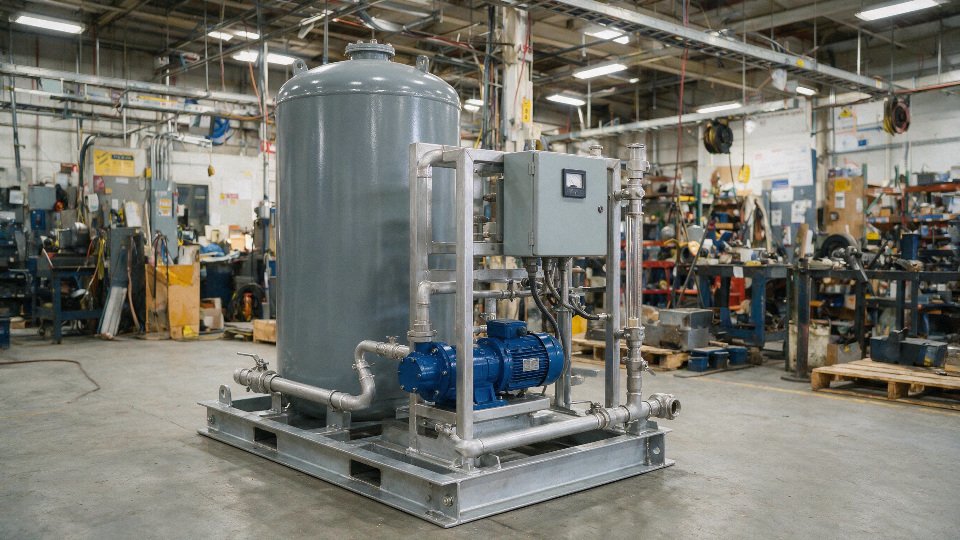
Closed systems: heat transfer, vacuum diffusion, damping, and transformer-adjacent specialty uses
In a well-managed closed system, biodegradability is usually a secondary criterion. Low routine loss shifts the decision toward thermal stability, oxidation resistance, seal compatibility, volatility control, and maintenance discipline, because those factors often determine whether the fluid stays contained for years or starts leaking into drip trays and absorbents every shutdown.
This is where buyers sometimes overcorrect. They focus on end-of-life environmental language while ignoring the mechanism that drives most actual release: fluid degradation, seal hardening, overtemperature episodes, or poor housekeeping around vents and reservoirs. If a less stable alternative oxidizes faster, thickens, forms deposits, or needs more frequent replacement, the plant can easily generate more waste fluid, more contaminated wipes, and more maintenance exposure than with a more persistent but longer-lived silicone fluid.
Typical decision points in these services include:
- Normal loss rate
- Closed-loop heat transfer units and dampers may run for long periods with negligible routine discharge if the system is tight.
- Vacuum diffusion or specialty dielectric-adjacent uses can still lose fluid through breathing, seal leakage, or maintenance handling, especially on older equipment.
- Failure mode
- A small chronic leak can matter more than one planned annual drain if it keeps reaching floors, sumps, or stormwater pathways.
- High-temperature degradation products may complicate disposal even when total volume is modest.
- Maintenance control
- Sight-glass overfilling, loose camlock caps, and improvised hose changes cause more release than the data sheet admits.
- Secondary containment and used-fluid segregation often do more for environmental performance than switching blindly to a fluid with a better headline claim.
The boundary here is obvious but important: this logic holds only if the system is actually closed and maintained that way. Once leakage is chronic, fluid carryout is routine, or the equipment sits outdoors near drains or soil, biodegradability becomes a more material selection factor.
Open-process and intermittent-loss uses: metalworking, textile finishing, paper release, agriculture adjuvants, construction additives
Where silicone-containing material is routinely washed off, dragged out, oversprayed, or left on product surfaces, biodegradability and broader environmental fate move much closer to the front of the spec. In these applications, the question is less “Will the fluid last?” and more “What happens after unavoidable loss?”
The operational path is different across sectors, but the risk picture often comes back to three issues:
- Treatability in wastewater
- Silicone fluids may not mineralize rapidly under ready-biodegradability screening.
- In practice, removal can depend heavily on adsorption to sludge, emulsion stability, droplet size, and pretreatment performance rather than fast biological breakdown.
- A product that enters the effluent as a stable fine emulsion can be harder to separate than one that agglomerates and partitions cleanly.
- Sludge and residue behavior
- Once adsorbed into sludge or collected solids, the environmental question shifts from liquid discharge to residual handling and disposal route.
- That matters in textile mills, paper converting, and metalworking plants where skimming, DAF units, or filter presses already control oily loads.
- Permit exposure
- Plants discharging under local or customer-driven limits need to check what the permit actually addresses: oil and grease, COD, surfactants, extractables, sludge quality, or named substances.
- A fluid can be technically functional and still create a compliance headache if the wastewater contractor or permit authority does not like how it behaves in the system.
A few use-specific notes matter:
- Metalworking
- Carryout on chips, sump dumping, and cleaner wash-off are often the main release routes.
- High-viscosity silicone residues can interfere with downstream cleaning, coating, or painting, so the environmental and quality issues can arrive together.
- Textile finishing
- Fabric hand modifiers and specialty finishes are often judged not only on fabric feel but on wash durability and wash-off profile.
- If much of the finish leaves in early laundering, biodegradability claims face more scrutiny.
- Paper release and converting
- Residual transfer to broke, white water, or cleaning streams may be more relevant than the coating bath itself.
- Agriculture adjuvants and construction additives
- Surface deposition and runoff need separate review from wastewater treatment assumptions.
- Once material is spread in the field or incorporated in site-applied products, release control is weaker by definition.
Personal care and household formulations
For rinse-off products, biodegradability claims need tighter substantiation than they do in industrial closed systems. Repeated consumer discharge, ingredient transparency demands, and region-specific regulatory scrutiny make generic “silicone-safe” or “eco-friendly” language commercially risky unless the supplier can tie it to the actual ingredient, test method, and intended use level.
Two procurement issues come up repeatedly:
- Composition transparency
- Buyers need to know whether the formula uses conventional PDMS, a modified silicone, an emulsion system, or a blend whose non-silicone fraction drives the claim.
- Marketing language often collapses those distinctions.
- Regional expectation
- Customer audits and retailer standards can be stricter than formal regulation.
- In some markets, a technically legal ingredient still loses on brand policy if biodegradability evidence is weak or ambiguous.
A rinse-off personal care formula should not rely on a broad silicone-category biodegradability claim.True
Biodegradability depends on the specific silicone structure, formulation matrix, test method, and exposure pattern. Category-level claims are too coarse for defensible product review.
Defoamers and process aids in food, fermentation, and water treatment
Low dosage does not automatically mean low environmental relevance. These products are often fed continuously or repeatedly, so small concentrations can become a steady mass load over time, especially in large fermentation trains, food plants, or treatment systems running around the clock.
The trade-off is easy to miss. A highly efficient defoamer used at a very low dose may create less total discharge than a “greener-sounding” alternative that needs frequent refeed, causes process instability, or increases product loss through foaming. On the other hand, if the silicone partitions into sludge or persists through the treatment train, the operator needs to understand where that residual ends up and whether it affects downstream solids management, membrane performance, or permit reporting.
Environmentally sensitive lubricants: mining, marine-adjacent, forestry, hydropower
In sensitive locations, broad environmental reassurance is not enough. Buyers may need lubricants or hydraulic fluids that meet specific biodegradability or eco-toxicity standards required by the asset owner, regulator, insurer, or customer contract, and many conventional silicone performance claims do not satisfy that paperwork burden by themselves.
The key checks are usually:
- Which standard or approval is actually required.
- Whether the finished product, not just a base fluid, has been tested.
- Whether the use condition matches the approval basis.
- Whether leakage risk justifies moving away from silicone entirely.
This is one of the few cases where the preferred choice can flip hard against conventional silicone oils even if their oxidation stability and temperature performance are attractive. If the equipment is operating over water, on steep ground, in protected forestry, or in mine drainage zones, compliance and spill consequence can outweigh the service advantages.
The counter-intuitive part is still worth keeping on the table: the most environmentally suitable fluid is not always the one with the best biodegradability headline. If one option lasts three times longer, leaks less because it matches the seals and temperature envelope, and avoids repeated drain-and-fill events, total environmental load may be lower despite weaker screening-test results. That judgment stops holding once routine release to wastewater, soil, or surface water becomes part of normal operation; at that point, site-specific discharge pathway and applicable standards need to drive the decision.
Regulatory and claim pitfalls
The fastest way to create compliance trouble with silicone oil is to treat “biodegradable,” “environmentally friendly,” “eco-safe,” and “non-toxic” as if they mean the same thing. They do not. One can refer to a defined test result over a set period, another may have no legal definition in the target market, and a third may be judged misleading if you cannot support it with complete hazard, exposure, and fate data.
A lot of trouble starts in marketing copy, distributor flyers, and translated product pages rather than in the chemistry itself. A silicone fluid that does not meet an OECD ready biodegradability screening threshold in 28 days might still show partial degradation, hydrolysis under some conditions, strong adsorption to sludge, or low water mobility at higher viscosity. None of that entitles a supplier to call it “biodegradable” in the broad commercial sense unless the claim is tied to the exact test method, material grade, and pass/fail outcome. If the claim sentence is broader than the underlying data package, you are already exposed.
A silicone oil with low acute toxicity can be marketed as eco-safe.False
Low acute toxicity addresses one hazard endpoint only. Environmental acceptability can still be limited by persistence, wastewater treatment behavior, bioaccumulation concerns for certain constituents, or local discharge restrictions.
Why vague environmental language causes legal and commercial problems
In practice, these phrases trigger different reviews:
- Biodegradable
- Usually implies testable breakdown by microorganisms under stated conditions.
- Needs the exact method, window, and result context.
- A failed ready test does not mean “never degrades,” but it does mean you should not imply ready biodegradability.
- Environmentally friendly / eco-friendly
- Often treated as broad comparative claims.
- Can be challenged as unsubstantiated unless you have a defensible life-cycle or impact basis.
- High legal risk because the phrase is expansive and vague.
- Eco-safe
- Common in sales language, weak in regulatory discipline.
- Suggests overall environmental harmlessness, which is rarely supportable for industrial chemicals.
- Non-toxic
- Usually too broad unless tightly qualified, such as “non-toxic under intended use according to specific endpoint data.”
- Can be misleading if it ignores chronic toxicity, aquatic effects, inhalation exposure from mists, or additive package hazards.
The trade-off is obvious: broad language may help a sales sheet read cleanly, but it raises claim risk fast. Exact language looks less polished, yet it travels better through audits, import reviews, and customer ESG questionnaires.
Region, sector, and customer requirements do not line up neatly
A claim that passes informally in one market may fail in another because the decision is not governed by one universal rulebook. You have to check the actual route to market:
- Region-specific chemical frameworks
- Registration, notification, or inventory status can differ by country or customs bloc.
- Environmental claim rules for advertising and labeling also differ; some regulators now scrutinize vague green claims aggressively.
- Customer standards
- Large OEMs often impose restricted substance lists, supplier questionnaires, and material declaration formats beyond statutory requirements.
- Procurement may ask for biodegradation data even where the law does not.
- Ecolabel or preferred-material programs
- These usually apply fixed criteria; partial biodegradation or favorable wastewater behavior is not the same as meeting the label requirement.
- One nonconforming component can disqualify the finished formula.
- Wastewater discharge and local sewer acceptance
- Plant buyers sometimes miss this. A product may be saleable yet still problematic for a user’s onsite treatment system or discharge permit.
- Removal can occur through adsorption to sludge rather than rapid biodegradation, which matters for sludge handling and reporting.
- Sector-specific specifications
- Textile, personal care, agriculture, metalworking, and paper customers often ask different environmental questions about the same base chemistry because release pathways differ.
The main boundary here: if the product is sold into a closed industrial system with near-total recovery, claim pressure may be lower; once you move toward wash-off, wastewater discharge, or consumer-facing language, documentation needs tighten sharply.
SDS is necessary, but it is not a full environmental claim file
Buyers regularly overread the SDS. It is a hazard communication document, not a complete environmental qualification dossier. Many SDSs provide only high-level ecological statements, and some entries rely on generic constituent information, cut-off thresholds, or conservative wording that does not explain actual biodegradation test conditions.
What is often missing from the SDS:
- Test method and laboratory
- Whether the reported result is for the neat fluid, an emulsion, or a formulated product
- Distinction between primary degradation, inherent biodegradation, and ready biodegradation
- The effect of viscosity on dispersion and apparent test behavior
- Fate pathways outside biodegradation, such as hydrolysis, volatilization, and sludge adsorption
- Batch-specific impurity profile
If you need to support a claim, ask for the underlying report set or at least a technical environmental statement signed by the supplier. An SDS line saying “not readily biodegradable” or “no data available” tells you almost nothing about whether the product is acceptable in your application.
The base oil is only part of the compliance picture
A silicone oil can look straightforward on the TDS and still become complicated in review because of everything around the main polymer.
Check these separately:
- Residual cyclic siloxanes
- These may attract independent scrutiny depending on region and end use.
- Even low residual levels can matter for registration, customer declarations, or sector restrictions.
- Solvents and carriers
- A solvent-borne silicone product may inherit VOC, flammability, worker exposure, or wastewater issues that the neat silicone fluid does not have.
- Emulsifiers and surfactants
- In emulsions, the surfactant package can drive aquatic toxicity or biodegradation outcomes more than the silicone phase does.
- Catalyst residues, stabilizers, and trace impurities
- These can affect hazard classification, odor complaints, wastewater treatability, and customer acceptance.
That mechanism matters on the plant floor. Procurement may source “the same silicone oil” from two vendors at the same nominal viscosity, but if one has a different emulsifier system or cyclic residual profile, the wastewater plant, export paperwork, and customer declarations can all change.
Claim discipline and supplier due diligence for global buyers sourcing from China
For cross-border buying, the right approach is boring but effective: state exactly what was tested, on which grade, by which method, and what the result does and does not mean.
Use language like this:
- Tested according to specified method
- Did not meet ready biodegradability criteria in the stated screening period
- Environmental fate should be assessed together with adsorption, hydrolysis, volatilization, and wastewater removal behavior
- Data apply to the identified grade only; formulation changes may alter the result
Avoid language like this:
- Fully biodegradable
- Environmentally friendly
- Safe for the environment
- Non-toxic and harmless
For supplier qualification, I would not stop at a nice PDF deck. Ask for:
- Batch consistency evidence
- COA trend across several lots, not one lot.
- Especially important for residual volatiles, viscosity band, and nonvolatile content.
- Document alignment
- TDS, SDS, COA, and regulatory declarations should describe the same product family and grade.
- Mismatched CAS descriptions, viscosity grades, or additive disclosures are a red flag.
- Third-party test availability
- Not every supplier will have a fresh biodegradation dossier for every grade.
- What matters is whether they can provide credible existing reports or arrange testing when the application justifies it.
- Regulatory responsiveness
- Can the supplier answer follow-up questions from your compliance team without hand-waving?
- Slow or generic answers usually mean the documentation chain is thin.
- Change-control discipline
- You need notice of formulation or raw material changes that could affect declarations or customer approvals.
For buyers importing from China, this is less about geography than supplier maturity. Good manufacturers can support global documentation well; weaker ones may sell acceptable material but struggle to keep COA data, environmental statements, and export declarations synchronized. That gap is where claim failures, customs delays, and customer audit findings usually show up.
How to assess a product
A workable assessment starts with exposure pathway, not with the word “biodegradable” on a data sheet. For most industrial buyers, the right question is whether the product’s chemistry, release route, and plant controls keep environmental and compliance risk acceptable without breaking the process. A silicone oil that is reasonable in a sealed hydraulic or dielectric system may be a poor choice in a rinse-off or direct-release application, even if the base fluid family looks similar on paper.
Begin by mapping the use scenario. This sounds basic, but it is where a lot of poor selections start.
- Closed-loop or contained system
- Heat transfer circuits
- Vacuum pump fluids
- Dielectric baths
- Sealed damping or metering systems
Here, routine environmental loading should be low if housekeeping is decent. Service life, leakage rate, and disposal route usually matter more than headline biodegradation.
- Open application with residual film
- Mold release
- Textile or paper surface treatment
- Conveyor or chain lubrication
- Polish or protectant use
Residue transfer becomes part of the assessment. What stays on the part may later hit wash water, dust collection, or downstream coating operations.
Rinse-off or wastewater-entry use
- Cleaning aids
- Defoamer carryover
- Emulsified process aids
- Personal-care-adjacent industrial uses
In these cases, wastewater behavior moves to the front. You need to know whether the material stays dispersed, breaks emulsion, adsorbs to sludge, floats, or passes through.
Soil contact or outdoor loss
- Construction release agents
- Agricultural equipment lubricants
- Outdoor cable compounds
- Dust suppression or specialty field application
Once soil contact is credible, adsorption, mobility, and persistence questions matter more than bench-top lubricity.
Incidental food contact or sensitive-use environments
- Food packaging lines
- Bakery conveyors
- Pharmaceutical or medical equipment surroundings
This is not just an environmental screen. It brings in separate compliance and contamination-control checks that must be verified against current supplier documentation and local requirements.
Direct environmental exposure
- Marine use
- Forestry
- Spill-prone temporary field systems
This is where a simple “silicone is inert” argument stops being sufficient. You need a much tighter evidence package and usually a stronger reason for using silicone at all.
Identify what is actually in the product
Do not qualify a product based only on “silicone oil” in the product name. In practice, purchasing often gets a trade name, viscosity grade, and maybe a generic SDS line. That is not enough.
Check these points with the supplier:
- Silicone backbone type
- Conventional PDMS
- Modified silicone such as polyether-, alkyl-, amino-, epoxy-, or other functional variants
- Silicone blend rather than neat fluid
- Viscosity range
- Roughly 10 cSt to above 100000 cSt is common in industrial silicone oils
- Higher viscosity usually reduces mobility and changes handling, wash-off behavior, and test response
- It does not automatically mean “safer” or “more biodegradable”
- Volatile fraction
- Low-boiling cyclic or linear siloxanes, if present, can shift emission behavior and exposure route
- A fluid with a meaningful volatile cut behaves very differently from a heavy, non-volatile oil in storage, ventilation, and release scenarios
- Functional groups
- These can improve emulsifiability, substrate wetting, or dispersibility
- The same modification may also increase wastewater entry because the product no longer separates cleanly
- Additives and package components
- Antioxidants
- Corrosion inhibitors
- Fragrance or solvent carriers
- Fillers
- Preservatives in emulsions
- Emulsifier package
- For emulsions, the surfactant system can drive much of the wastewater behavior
- Two products with the same nominal silicone content can treat very differently if one forms stable milky carryover and the other breaks in a pit or DAF unit
- Expected degradation products
- Ask what the supplier can state, and on what basis
- If they cannot identify likely hydrolysis or breakdown products, that uncertainty belongs in your review rather than being glossed over
The mechanism here is straightforward: composition affects physical distribution first, and that distribution controls where degradation can even happen. A high-viscosity hydrophobic oil that adsorbs to sludge follows a different environmental path from a modified, more dispersible silicone that stays in process water long enough to challenge treatment performance.
Request the right evidence set
A decent qualification package usually includes more than one environmental data point.
Ask for:
- Biodegradability test report
- Prefer the actual report or a detailed summary, not only a marketing claim
- Confirm test method, duration, pass criterion, and whether the result applies to the exact product, base polymer, or only a related grade
- Many silicone fluids do not meet OECD ready-biodegradability thresholds in a 28-day screening window; that does not by itself define total environmental acceptability, but it does rule out careless claim language
- Aquatic toxicity data
- Acute data at minimum for likely exposed compartments where relevant
- Chronic data may be needed for direct-release or sensitive applications
- Bioaccumulation indicators, where relevant
- Not every industrial review needs a full deep dive here
- It becomes more important where low-solubility organics, repeated release, or regulatory scrutiny are in play
- Wastewater treatability information
- Tendency to float, settle, emulsify, adsorb to sludge, or foul membranes
- Effects on biological treatment if known
- Any recommended pretreatment approach
- Disposal guidance
- Waste code support where the supplier provides it
- Incineration suitability
- Restrictions on sewer disposal, absorbents, or mixed waste streams
An SDS alone is enough to judge whether a silicone oil is environmentally acceptable.False
An SDS is useful for hazard communication, handling, and basic disposal guidance, but it often does not provide enough product-specific detail on biodegradability method, wastewater treatability, or formulation-level environmental behavior to support a full qualification decision.
Balance environmental targets against process performance
The trade-off is rarely subtle. Products chosen purely to improve environmental profile can raise consumption, shorten maintenance intervals, or create downstream scrap if they do not hold the process window.
Review at least these performance variables:
- Service life
- A longer-life fluid with poorer ready-biodegradability may generate less total waste than a short-life alternative that needs frequent changeout
- Reapplication frequency
- This matters in open lubrication, release, and textile finishing
- If operators double the dose because the “greener” product does not last, site loading goes up fast
- Operating temperature
- Thermal stability, evaporation tendency, and residue formation all shift with temperature
- A fluid that performs well at room temperature may coke, smoke, or volatilize at line temperature
- Compatibility
- Seals, hoses, coatings, elastomers, and plastics
- A compatibility miss becomes a leak problem, and a leak problem quickly becomes an EH&S problem
- Foam control or lubricity
- Modified silicones can improve one performance target while making wastewater separation harder
- Dielectric or residue behavior
- In electrical or optical applications, residue cleanliness and dielectric consistency can outweigh every other factor
The preferred choice flips when release potential dominates service-life benefit. In a contained transformer fluid or sealed damping unit, long life and low leak rate often carry the decision. In a wash-off process aid entering a treatment plant every shift, treatability and discharge consequences usually take priority.
Check plant-specific management factors
A product that looks acceptable in principle can still be wrong for your site.
Use this checklist:
- Spill containment quality and operator discipline
- Floor drainage layout and whether spills can reach sewer
- Oil-water separator or DAF performance on similar fluids
- Biological treatment sensitivity
- Sludge disposal route and whether adsorbed silicone changes classification or disposal cost
- Access to approved incineration
- Local discharge permit constraints
- Seasonal effects, especially cold-weather viscosity increase or summer odor/emission complaints
- Ability to segregate silicone-bearing waste from general oily waste
In practice, plants with weak segregation and marginal wastewater treatment should be conservative with emulsified or highly dispersible silicone products. A neat high-viscosity fluid in drums is easier to contain than a low-dose emulsion metered into a wash stage that nobody fully tracks.
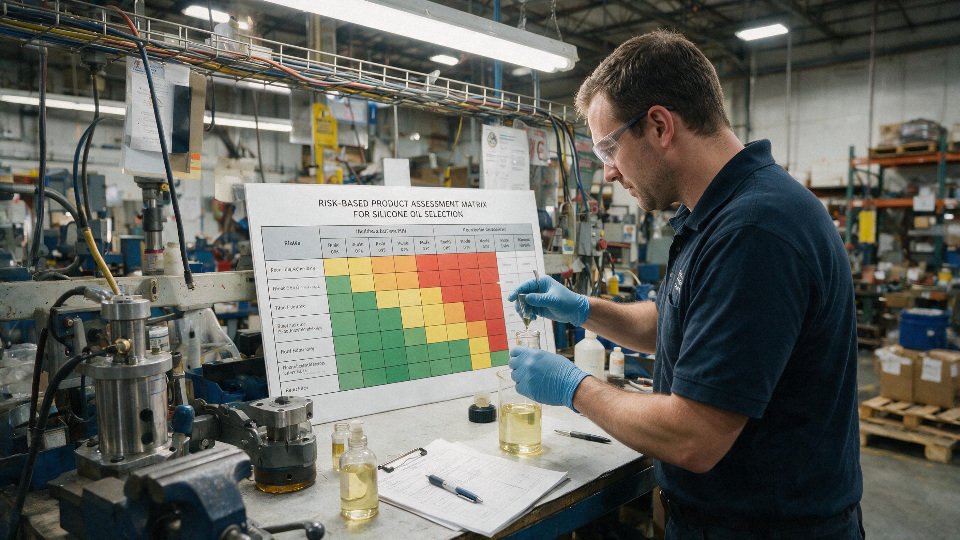
Use a risk-based decision matrix
Do not use a single pass/fail “biodegradable” filter, especially for modified silicones, blends, or emulsions. Score the product across at least four axes:
| Decision axis | Low concern | Medium concern | High concern |
|---|---|---|---|
| Release pathway | Sealed system, rare loss | Open use with controlled cleanup | Continuous rinse-off or direct exposure |
| Environmental evidence | Product-specific data package | Partial data, analogous grades | Marketing claim only |
| Treatability on site | Proven separation or disposal route | Uncertain behavior, manageable trial | Likely permit or treatment conflict |
| Process penalty if switched | Minimal | Some retuning required | High scrap, downtime, or safety impact |
Then rank candidate products by total operational risk, not just chemistry label. If two options are close, run a controlled plant trial with actual wastewater observation, residue checks, and maintenance feedback before locking a purchase specification.
Frequently asked questions
Is silicone oil biodegradable or not?
Usually not in the strict “readily biodegradable” sense used in OECD screening. Many conventional silicone oils, especially PDMS-based fluids, do not reach ready-biodegradability pass criteria within a typical 28-day test window, even though they may still transform or be removed from the environment by other mechanisms.
That distinction matters in purchasing and compliance. “Not readily biodegradable” does not automatically mean “never degrades,” but it does mean you should not market or approve the product on the assumption that it will break down quickly after release.
Silicone oil is biodegradable.False
That statement is too broad to be technically reliable. Some modified silicone materials may show improved biodegradation, but many conventional silicone oils do not meet ready-biodegradability criteria in standard screening tests.
Is PDMS considered environmentally persistent?
In many practical environmental discussions, yes, PDMS is often treated as environmentally persistent relative to readily biodegradable organic fluids. The exact conclusion still depends on molecular structure, viscosity, exposure pathway, and the receiving environment.
What trips people up is that persistence is not the same as mobility. Higher-viscosity PDMS may adsorb to sludge or soil and show limited movement, while lower-viscosity grades can behave differently in testing and release scenarios. So the right question is not just “persistent or not,” but persistent where, in what form, and under what disposal route.
Are silicone emulsions more biodegradable than neat silicone oils?
Not necessarily. An emulsion can change handling, dispersion, and wastewater behavior, but it does not automatically make the silicone phase itself more biodegradable.
In practice, emulsions often look “cleaner” from a process standpoint because they are water-dilutable and easier to meter. That can help with housekeeping and may improve removal in treatment systems through adsorption or phase separation, but biodegradation of the underlying silicone should still be supported by test data on the actual formulation, not assumed from the emulsion form.
Does low viscosity mean faster biodegradation?
Not by itself. Lower viscosity often means the fluid is more mobile and may behave differently in screening tests, but mobility is not the same thing as biodegradation.
For silicone oils, viscosity affects dispersion, surface area, transport, and sometimes volatilization tendency at the low end of the range. Those changes can influence apparent environmental fate. They do not give you a universal rule that 50 cSt will biodegrade faster than 1000 cSt in every wastewater plant, soil condition, or test method.
Are biodegradable silicone oils available commercially?
Yes, but only in a qualified sense. Some modified silicone fluids or silicone-containing formulations are marketed for improved biodegradation, yet that claim is product-specific and cannot be generalized to the whole silicone oil category.
Before approving one, ask what exactly was tested: the neat fluid, the emulsion, or the finished formulation. I have seen buyers accept a claim based on a surfactant package while the active silicone fraction was never independently characterized. That usually causes trouble later when an end customer asks for the original report.
Is silicone oil safer for water systems than mineral oil?
Sometimes, but “safer” is too vague to use as a purchasing conclusion. The comparison depends on leak scenario, aquatic exposure, treatment route, film formation, oxygen transfer effects, cleanup method, and whether you are comparing toxicity, persistence, or treatability.
A mineral oil may biodegrade better in some cases yet create a heavier contamination burden in others. A silicone fluid may have lower reactivity and different toxicity behavior, but if it enters a water system and forms a persistent surface film or interferes with treatment, operators will not care that the chemistry looked favorable on a brochure.
How should spent silicone oil be disposed of?
- Classify the waste using local regulations and the actual contamination profile, not the virgin product datasheet.
- Separate neat used oil from absorbents, sludge, wash water, and mixed maintenance waste.
- Check whether the oil contains process contaminants such as metal fines, solvents, additives, or hazardous residues.
- Review the current SDS and any disposal guidance from the supplier.
- Confirm whether licensed recycling, energy recovery, or hazardous/non-hazardous waste routes apply in your jurisdiction.
- Keep waste streams segregated; once silicone oil is mixed with cutting fluids, paint residues, or solvent flushes, disposal cost usually goes up.
The expensive mistake is casual mixing. A drum of relatively manageable used silicone oil can become a much harder waste stream once it is contaminated with chlorinated cleaner, catalyst residue, or shop-floor sweepings.
What documents should I request from a supplier before approving an environmental claim?
- SDS for the exact product grade
- Technical data sheet for the same revision and formulation
- Biodegradability test report, including method used, test duration, and pass/fail basis
- Statement clarifying whether results apply to the neat substance or a formulation
- Information on hydrolysis, volatilization, and adsorption/removal behavior if biodegradation is limited
- Regulatory status by market, if you sell across regions
- Claim language approved for customer-facing use
- Confirmation of any exclusions, limitations, or untested conditions
If the supplier cannot provide test method, sample identity, and report scope, treat the claim as unverified. That is usually where procurement gets exposed: not on the chemistry itself, but on loose paperwork.
What to verify before buying
If biodegradability is a hard gate, screen on release scenario before you look at price, viscosity, or incumbent brand. Standard PDMS grades without grade-specific supporting data should be ruled out early where rapid biodegradation is mandatory, and the search should move straight to modified silicone options or non-silicone chemistries that are documented for that duty.
Procurement mistakes usually start with a vague requirement such as “biodegradable silicone oil” on the RFQ. That wording is too loose to protect you. A hydraulic leak to soil, a metalworking carryout stream to wastewater, and a closed-system heat transfer application do not create the same environmental decision, even if the base fluid family sounds similar on paper.
Match the product to the actual release path
Start qualification with the most likely way the material leaves the process:
- Closed or near-closed system, low routine release
- Focus on leakage control, maintenance discipline, disposal route, and supplier documentation.
- Biodegradation may matter less than fluid life, oxidation stability, seal compatibility, and waste handling.
- Intermittent loss to plant wastewater
- Ask how the fluid behaves in treatment, not just whether it “biodegrades.”
- You need to understand adsorption to sludge, separation behavior, potential carryover, and whether the reported data comes from a screening test or a more application-relevant study.
- High-loss application with likely release to soil, water, or mixed waste
- Treat environmental fate as a primary selection criterion.
- If rapid degradation is required by customer standard, site permit, or procurement policy, do not spend time evaluating unsupported standard grades.
That first split saves time. In practice, I would rather disqualify a borderline fluid in one phone call than let engineering spend three weeks on pump compatibility and then discover EH&S cannot sign off.
Confirm the data belongs to the product you will actually buy
Supplier literature often mixes family-level language with grade-level claims. That is where buyers get trapped.
Verify these items in writing:
- Exact commercial grade name
- CAS number or stated composition range, where applicable
- Whether the tested sample was neat fluid, emulsion, blend, or formulated product
- Viscosity grade, because 10 cSt and 100000 cSt materials do not behave the same in handling, mobility, or some test conditions
- Test method used, including whether the result comes from an OECD ready biodegradability screen, another protocol, or internal method
- Whether the report applies to the sold grade itself or to a “similar product,” homologous series, or representative sample
A biodegradability result for a related silicone family sample is enough to approve any grade in that family.False
Environmental behavior can shift with molecular structure, viscosity, functional modification, and formulation state. Qualification should be tied to the exact purchased product or a technically justified equivalent supported by the supplier.
A lot of disputes come from one line in a brochure being treated as a full qualification package. It is not.
Require performance evidence alongside environmental data
A fluid that helps your sustainability metric but shortens seal life, foams in service, or drops lubricity is not a successful substitution. The qualification file should cover both environmental acceptance and operating fit.
Ask for evidence on:
- Viscosity at operating temperature range
- Material compatibility with seals, hoses, coatings, and wetted metals
- Volatility or evaporation tendency where relevant
- Thermal or shear stability for the duty cycle
- Surface effects if the oil can contaminate downstream painting, bonding, or printing
- Any field-use limitations the supplier already knows about
The mechanism here is straightforward: changing chemistry to improve environmental profile can also change film strength, wetting, migration, emulsion behavior, or process cleanliness. The trade-off flips depending on the application. A release-prone total-loss process may justify a narrower operating window; a critical closed-loop machine usually will not.
Ask for recommendation, not just a catalog
Give the supplier enough detail to narrow the shortlist properly:
- Substrate or equipment involved
- Contaminant or contact sensitivity, if any
- Approximate layer thickness or add-on rate
- Working area or throughput
- Required finish or functional result
- Target application rate or consumption
- Expected discharge route
- Regional compliance target or customer standard
- Clear part photos or representative samples, where relevant
A capable manufacturer should come back with grade options tied to viscosity, functionality, end use, discharge route, and regional compliance target, not a generic “biodegradable” promise.
For strategic sourcing, favor suppliers that can support repeatability as well as chemistry: batch consistency, document transparency, technical response quality, and willingness to discuss audit questions without hand-waving. SiliconChemicals can review your application grade by grade if you send the operating conditions, release pathway, and compliance requirements, then recommend suitable silicone options or flag where an alternative chemistry should be considered before purchase.