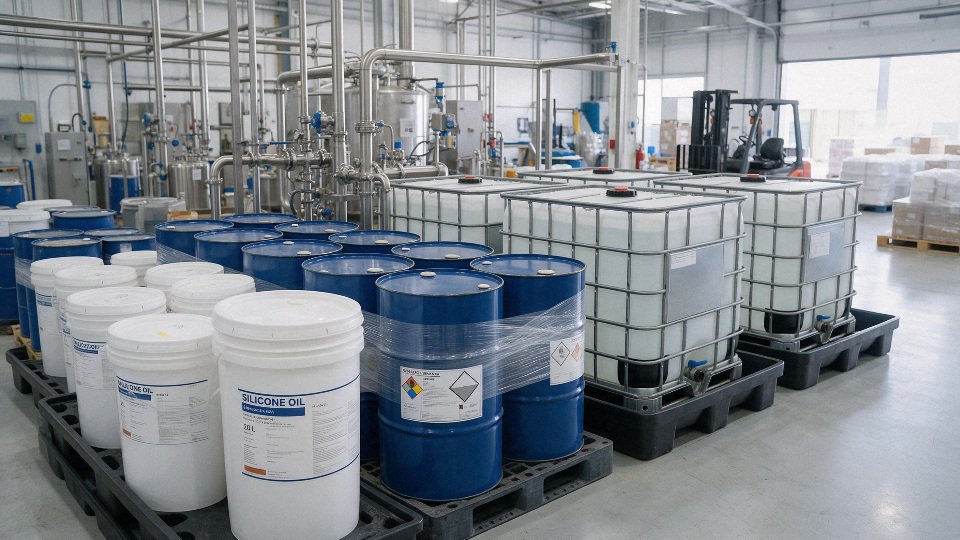

A silicone oil that looks “high-temperature capable” on a datasheet can still become a procurement or process problem if the flash point is misunderstood, compared on the wrong test basis, or assumed from viscosity alone. That shows up fast in thermal-fluid selection, heating-bath safety reviews, transport paperwork checks, and customer audits. Get it wrong and the cost is rarely just a specification correction; it can mean delayed approval, a rejected batch, conservative operating limits that choke throughput, or buying a premium grade you did not actually need.
The flash point of silicone oil is typically about 250-330 C, but the usable number depends on viscosity, molecular structure, purity, and the test method used. In practice, higher-viscosity PDMS grades usually flash at higher temperatures, and Cleveland Open Cup results are commonly higher than Pensky-Martens Closed Cup values for the same fluid.
The useful question, then, is not “what is the flash point?” as a single catalog number. It is which silicone oil chemistry you are evaluating, which test method produced the value, and whether that figure is being used for safety classification, process design margin, or a like-for-like purchasing comparison. That is where the decision usually stops being simple.

What changes the value
For silicone oil, flash point moves mainly with what the fluid is made from, how much low-boiling material is still in it, and how the test was run. That is why two products both sold as “silicone oil” can land at meaningfully different values, and why a field sample can test below the fresh-material datasheet even when the base fluid name looks the same.
A buyer who treats flash point as a single fixed property usually gets caught in one of two ways: either they compare unlike products, or they miss contamination and formulation effects that matter more than the nominal silicone grade. In practice, the number is only reliable when you tie it back to polymer type, viscosity grade, purity, and the exact test method.
Base polymer structure
Not all silicone fluids volatilize the same way. The backbone may still be siloxane, but side groups and reactive sites change intermolecular behavior, thermal stability, and the amount of lighter species that can evolve during heating.
A few broad patterns matter:
- Linear dimethyl silicone fluids (typical PDMS)
These are the benchmark grades most buyers have in mind. Within this family, higher-viscosity grades generally show higher flash points because they contain fewer low-molecular-weight fractions that can vaporize early. - Phenyl-modified silicone fluids
These are often selected for low-temperature performance, radiation resistance, or specific thermal behavior. Their flash point cannot be assumed from standard dimethyl grades; the phenyl content and exact structure shift volatility and combustion behavior, so the supplier’s tested value matters more than category assumptions. Methylhydrogen silicone fluids
These are chemically different enough that you should not map PDMS expectations onto them. Reactive Si-H functionality can affect storage stability, compatibility, and process behavior; if flash point matters in the application, verify the actual tested product data rather than inferring from viscosity alone.Amino-modified silicone fluids
Common in softeners, surface-treatment systems, and specialty formulations. Their performance is often dominated by the modification package and any carrier phase, so the neat polymer’s flash point may not represent the commercial product shipped to site.Fluorinated or other specialty siloxanes
These are niche materials with property sets aimed at difficult chemical or temperature environments. They often break the “standard silicone oil” rule of thumb, both technically and commercially, so direct comparison to commodity dimethyl fluids is usually misleading.
The mechanism is simple enough: flash point depends on whether the liquid can generate a flammable vapor concentration above its surface at the test temperature. Change the molecular structure, and you change vapor pressure, decomposition tendency, and sometimes the identity of the vapors themselves. That is why “silicone oil” is too broad a label for procurement unless the chemistry is pinned down.
Viscosity and molecular weight effects
As a working rule, higher-viscosity PDMS grades usually test at higher flash points than lower-viscosity grades, because the lighter fractions that escape first are less abundant. That trend is useful, but it is not absolute.
What drives it:
- Lower-viscosity fluids usually contain:
- shorter siloxane chains
- a higher proportion of volatile oligomers
- more material capable of reaching ignitable vapor concentration at lower temperature
- Higher-viscosity fluids usually contain:
- longer polymer chains
- lower vapor pressure at a given temperature
- less rapid generation of flammable vapor under the same test conditions
Where buyers get tripped up is assuming viscosity alone sets the flash point. It does not. Two fluids at similar nominal viscosity can still test differently because of:
– different end-blocking chemistry
– different residual cyclic content
– different purification level
– specialty modifiers or carriers
– different test methods
That trade-off shows up in sourcing. Lower-viscosity silicone oils are easier to pump, meter, and disperse in some systems, but they are also more sensitive to low-boiler content and therefore more likely to show a lower flash point. If the application needs both fluidity and high-temperature handling margin, you usually have to look harder at purity and formulation rather than just stepping down viscosity and hoping the safety profile stays the same.
This rule starts to weaken once you move outside comparable PDMS families. Across different modified siloxanes, the chemistry can outweigh the viscosity trend.
Residual cyclics, low boilers, and incomplete refinement
If a silicone oil tests unexpectedly low, the first thing I would suspect is not the main polymer chain. I would suspect the light ends.
Typical causes include:
- residual cyclic siloxanes
- low-boiling linear oligomers
- unreacted feedstocks
- cracked fractions from poor process control
- solvent carryover from finishing or blending
- contamination from reused drums, transfer totes, or filling lines
These materials matter because flash point is governed by the vapors that appear first, not by the bulk of the liquid sitting quietly underneath. A small amount of low-boiling material can pull the measured flash point down far more than its percentage in the drum would suggest.
That has a direct commercial consequence. Lower-cost material sometimes looks competitive on paper if the datasheet is thin, old, or based on a broad product family statement. But if refining is less thorough, or if the supplier does not control residual volatiles tightly, the delivered product may behave more like a downgraded blend than a clean silicone fluid. On a plant floor, that can show up as:
– stronger odor than expected
– more weight loss at temperature
– more smoke or fumes during startup
– a lower-than-expected flash point on incoming inspection
– inconsistent results lot to lot
If the application is heat transfer, textile finishing, defoaming in hot systems, or any process with heated tanks and open surfaces, this is not a paperwork issue. It affects ventilation demand, operator comfort, and the margin before combustible vapors appear.
Additives and formulated products
A surprising number of “silicone oil” products in the market are not neat silicone fluids at all. They are formulated systems: antifoams, mold release agents, heat-transfer blends, textile auxiliaries, polishing agents, emulsions, or carrier-based specialty treatments. In these products, the flash point may be governed by the non-silicone portion.
Watch for these cases:
- Antifoams
The active silicone may be only part of the product. Hydrocarbon carrier oil, mineral oil, or solvent can dominate the flash point. Mold release agents
Many are intentionally diluted for sprayability. If there is petroleum solvent, isoparaffin, or another volatile carrier, that carrier usually sets the test result.Heat-transfer blends
Silicone may be blended to tune stability, viscosity, or heat-transfer performance. The weakest thermal and flammability component often controls the blend’s practical limit.Emulsions
Water-based products may appear “safer,” but the as-supplied emulsion and the dried residue are not the same thing. Once water evaporates, the remaining active phase may have a different flash behavior than the drum label led operators to expect.Textile and surface-treatment specialties
Amino silicone, catalysts, surfactants, preservatives, and co-solvents can all change the measured result.
A silicone-based product always has the flash point expected for neat silicone oil.False
Commercial silicone products are often blends or emulsions. In those cases, the carrier, solvent, or additive package may control the flash point more than the silicone itself.
The trade-off here is practical: formulation can improve wetting, spray performance, cost, or application ease, but every non-silicone addition is a possible path to a lower flash point. Procurement should request the flash point for the exact commercial product, not for the active silicone component in isolation.
Contamination during storage or service
Fresh product data stops being useful once the fluid has spent time in a running system. In service, silicone oil can pick up contaminants that depress flash point or make repeat testing erratic.
Common sources are:
- hydrocarbon oil ingress from pumps, gearboxes, or shared transfer equipment
- cleaning-solvent residue in tanks, lines, or IBCs
- process vapor absorption from adjacent operations
- plasticizer migration from hoses, seals, or liners
- degradation products formed under prolonged heat and air exposure
In my experience, cleaning solvent is the classic culprit. A tank gets rinsed, somebody says it is “dry enough,” and the next batch comes back with a suspiciously low flash point. You see the same thing with sample bottles that were not truly clean.
Degradation can cut both ways. Some aged silicone fluids simply lose light ends over time and test differently from fresh material. Others form smaller fragments under thermal or oxidative stress, especially in badly run hot loops with air ingress, local overheating, or poor housekeeping around electric heaters. Once a fluid has been abused, the datasheet is no longer the right reference; you need a used-oil analysis plan.
Test condition sensitivity
The same fluid can show different flash point values depending on how it was tested. Cleveland Open Cup typically reports a higher value than Pensky-Martens Closed Cup for the same fluid, because the open cup allows vapors to disperse instead of accumulating above the sample.
The main sources of variation are:
- Open cup vs. closed cup
- Closed cup usually gives the lower number
- Method must be stated before comparing suppliers
- Heating rate
- Too fast, and the sample may overshoot equilibrium
- Too slow, and oxidation or volatility changes can skew the result
- Sample conditioning and equilibrium time
- Poor temperature stabilization can shift the observed ignition point
- Sample history
- Agitated, partially evaporated, contaminated, or poorly sealed samples often test differently from retained original material
- Laboratory procedure
- Cup cleanliness, ignition source condition, fill level, and operator handling still matter, especially near borderline results
If two datasheets disagree, do not assume one supplier is wrong. First check whether they used the same method on the same product state. A value from a neat fluid tested in open cup is not directly comparable to a formulated product tested in closed cup.
A common misconception: “high-temperature” does not mean “nonflammable”
A silicone fluid can be marketed for high-temperature use and still have a measurable flash point. Those are not contradictory statements. High thermal stability means the material can retain function better than many organic fluids under heat; it does not mean the vapor above the liquid can never ignite.
That distinction matters in:
– open heated baths
– mist-generating equipment
– leaking hot circulation systems
– spray application
– enclosed spaces with poor ventilation
Once the fluid is atomized, contaminated, or locally overheated on a hot surface, combustible behavior can look very different from what operators expect from a calm bulk-liquid test. So if a product is described as “nonflammable” in sales language, verify what that actually refers to, and check the current safety documentation and test basis before writing operating procedures around it.
Test methods and interpretation
A silicone oil flash point is only comparable when the test method, sample condition, and grade family are aligned. In practice, most confusion comes from buyers reading one supplier’s open-cup value against another supplier’s closed-cup value, then treating the difference as a formulation advantage when it is often just a test-condition artifact.
The two methods most often encountered for silicone oils are Cleveland Open Cup and Pensky-Martens Closed Cup. Both aim to find the temperature at which the vapor above the liquid briefly ignites when exposed to a test flame, but they do not create the same vapor environment, so they do not give the same number.
The main methods buyers will actually see
Cleveland Open Cup (COC)
Cleveland Open Cup is an open-vessel method. The sample is heated in a cup exposed to ambient air, and an ignition source is passed over the surface at set temperature intervals until a flash is observed.
What it tends to represent in plain language:
- A less confined condition
- More vapor loss to the surrounding air during heating
- A result that is usually higher than a closed-cup result for the same fluid
Why that happens is straightforward. In an open cup, vapors generated at the liquid surface can disperse instead of building up. The sample therefore has to reach a higher temperature before enough combustible vapor remains near the surface to flash.
For silicone oils, this method is common on technical datasheets because it is widely recognized and easy for buyers to benchmark across grades. It is useful, but it should not be read as a direct prediction of behavior inside a sealed reservoir, heated dosing tank, or poorly ventilated enclosure.
Pensky-Martens Closed Cup (PMCC)
Pensky-Martens Closed Cup uses a covered test cup. The sample is heated under more enclosed conditions, and the ignition source is introduced in a controlled way while vapors are retained in the headspace.
What it tends to represent in plain language:
- A more confined condition
- Less vapor escape during heating
- A result that is usually lower, and often more conservative for enclosed-process risk review
That lower result does not mean the oil is “worse” in an absolute sense. It means the test is better at detecting the temperature where flammable vapor concentration can accumulate in a limited headspace. If you are evaluating a thermal oil loop expansion tank, a closed dosing vessel, or an intermittently vented process kettle, the closed-cup number is usually the more cautious screening point.
For the same silicone oil, Cleveland Open Cup often reports a higher flash point than Pensky-Martens Closed Cup.True
This is consistent with the basic physics of vapor dispersion versus vapor retention. Open-cup testing allows combustible vapors to escape, while closed-cup testing retains them and usually reaches ignitable concentration at a lower temperature.
Why the method difference matters in plant decisions
The method difference is not just a lab detail. It changes how the result should be used.
- Open-cup values are often acceptable for broad product comparison within one supplier’s silicone oil range.
- Closed-cup values are usually more relevant for enclosed equipment hazard review, ventilation design assumptions, and conservative operating-envelope discussions.
- Neither number, by itself, defines a safe operating temperature. Local hot spots, misting, pump seal leakage, fouling, and air ingress can all change the risk picture before the bulk fluid reaches the published flash point.
A common mistake in procurement is to set a specification that says “flash point above X °C” without stating the test method. That sounds precise but creates a loose requirement. One vendor may quote COC, another PMCC, and both may technically comply or fail for the wrong reason.
Sample condition can move the result more than buyers expect
If the sample has been mishandled, the flash point number can drift enough to create a false pass or false concern. Silicone oils are generally thermally stable, but the test still depends on what is actually in the cup that day.
Watch these sample-condition variables:
- Moisture
- Water does not simply “lower flash point” in a clean, predictable way.
- It can interfere with heating behavior, bubbling, and test observation.
- In contaminated plant samples, moisture often comes with process residues, which is the larger issue.
- Low-boiling contamination
- Solvents, cleaning agents, fuel traces, light hydrocarbons, or process carryover can pull the flash point down sharply.
- This is common after poor drum changeover, shared transfer lines, or maintenance where flushing solvent was not fully removed.
- Previous thermal history
- An oil that has spent time near its upper service temperature can form degradation products.
- Even if bulk viscosity still looks acceptable, low-boiling fragments may appear and shift flash behavior.
- Entrained volatiles or dissolved gases
- Samples taken hot, shaken hard, or pulled from circulating systems without proper conditioning can contain volatile fractions that distort the result.
- This shows up from time to time with returned field samples in unfilled bottles with too much headspace.
- Particulate or process contamination
- Carbon fines, metal dust, catalyst residue, and reaction byproducts may not directly determine flash point, but they can indicate a fluid that no longer matches virgin-product data.
In practice, if a plant sample gives a surprisingly low result, I would not jump straight to “bad batch.” First check whether the sample was taken from a live hot loop, whether the bottle was clean and properly sealed, and whether any solvent cleaning was done upstream in the same line or tote station.
How to read supplier data without fooling yourself
Use a simple procurement discipline:
- Match the test method
- Compare COC with COC, PMCC with PMCC.
- If the method is not stated, ask for it. Do not assume.
- Match the units
- Check whether the value is in °C or °F.
- This sounds obvious, but mixed-unit legacy datasheets still show up.
- Match the product family
- Compare similar silicone oil chemistries and similar viscosity bands.
- A low-viscosity PDMS grade and a high-viscosity specialty modified fluid should not be benchmarked as if they are interchangeable.
- Check whether the value is typical, minimum, or tested-per-batch
- “Typical” means representative, not guaranteed.
- “Minimum” is stronger for purchasing control, if the supplier actually certifies against it.
- If no release criterion exists, ask what quality document supports the number.
- Ask for sample age and source if the value is unusual
- A development sample, retained archive, and fresh production lot can test differently if handling has not been consistent.
A datasheet number is useful for screening. It is not automatically a contractual guarantee. If flash point is critical to your EHS review or insurance questionnaire, the purchase specification needs to say whether you require a certified minimum, a test method, and whether batch documentation or third-party verification is needed.
Where flash point fits in compliance and risk documents
Flash point shows up regularly in:
- Safety data sheets
- Internal chemical approval reviews
- Transport classification screening
- Insurance engineering surveys
- Plant audit questionnaires
- Hot-oil system hazard assessments
That said, do not overread it. Flash point is one property in a broader safety picture. It does not replace review of autoignition temperature, decomposition behavior, ventilation, ignition sources, aerosol formation, leak consequences, or current transport rules for the exact product and package. If a site or shipment decision depends on classification, the current SDS, applicable regulations, and supplier documentation need to be checked directly.
What to do with incomplete supplier information
You will run into three common cases.
Supplier lists a typical flash point only
Request:
- Test method used
- Number of lots behind the typical value
- Whether there is a manufacturing control range
- Whether a certificate of analysis can include flash point on request or by agreement
Supplier lists a minimum flash point
This is stronger, but still verify:
- Test method
- Whether the minimum is part of routine release testing or just a catalog statement
- Whether the minimum applies to all packaging sizes and all production sites
Supplier gives no flash point
Ask for:
- Current SDS
- Test method and latest measured value
- Whether the product contains any intentionally added low-boiling constituents
- Whether the fluid is virgin, compounded, or custom-blended
- Whether a retained sample can be tested if the order is safety-critical
If the answer stays vague, treat that as a procurement risk, not a paperwork nuisance. Usually it means the property has not been tightly controlled or routinely measured.
Why an in-service oil can become riskier than the original lab result
A fresh silicone oil can show a stable flash point in the lab and still become a different risk after months in service. The reason is not mysterious: heat, oxygen, contamination, and residence time can generate lower-boiling fractions that were not present in the original product at meaningful levels.
The mechanism matters. If part of the system runs hotter than the bulk fluid reading suggests, small amounts of thermal cracking or oxidative breakdown can occur at those hot surfaces first. Those lighter fragments move into the circulating oil, and because flash point is sensitive to the most volatile combustible fraction, a relatively modest amount can pull the measured value down. You may not notice it immediately in viscosity or appearance.
The trade-off is familiar in plants running silicone oils near the top end of their service window: pushing temperature improves heat transfer duty or cycle time, but it shortens the interval before the fluid no longer behaves like virgin material. That is the point where a one-time incoming flash point becomes less useful than periodic used-oil analysis.
This conclusion stops holding if the system is well below thermal stress limits, contamination is tightly controlled, and turnover is high enough that degradation products do not accumulate. But in old loops with dead legs, poor venting, or fouled heaters, I would trust a current field sample more than a new-product datasheet every time.

Typical grades and ranges
For standard silicone oils, buyers should expect a range map, not a single “silicone oil flash point” number. In broad terms, common dimethyl silicone fluids often sit somewhere around 250-330 C, with lower-viscosity grades tending toward the lower end and higher-viscosity PDMS grades usually landing higher, but the exact value shifts with formulation, volatility profile, and test method.
That broad trend is useful for screening, not for writing a purchase spec. Once you move outside straight PDMS into phenyl-modified fluids, heat-transfer products, emulsions, or compounded antifoams, the relevant flammability number may change materially, and sometimes flash point stops being the best first metric to compare.
Standard PDMS grades by viscosity band
In most industrial buying situations, the first practical split is low, medium, and high viscosity polydimethylsiloxane.
| PDMS grade family | Typical viscosity band | Usual flash point tendency | What usually drives it |
|---|---|---|---|
| Low-viscosity dimethyl silicone fluid | Very low to light body | Lower within the normal silicone range | Higher fraction of lighter volatile molecules |
| Medium-viscosity dimethyl silicone fluid | General-purpose process range | Mid-range | Balanced molecular weight distribution |
| High-viscosity dimethyl silicone fluid | Heavy body to very high viscosity | Higher within the normal silicone range | Lower volatility, heavier average chain length |
The mechanism is straightforward: as average molecular weight rises, vapor generation at a given temperature generally drops, so the fluid needs more heat before enough vapor forms above the liquid to ignite. That is why, all else equal, a 1000 cSt dimethyl silicone oil will usually show a higher flash point than a very light grade.
That said, viscosity is only a proxy. Two fluids with similar nominal viscosity can still show different flash points because of:
- Residual low boilers from manufacturing
- Narrower or broader molecular weight distribution
- Different end-blocking chemistry
- Purification level
- Additives or trace carriers
- Open-cup versus closed-cup test method
In practice, this is where buyers get tripped up. A maintenance team may assume “thicker means safer at heat,” then substitute a higher-viscosity fluid without checking pumpability, low-temperature startup behavior, or dispensing equipment limits. The flash point may improve, but if the line uses metering pumps, fine nozzles, or winter drum handling in an unheated warehouse, that heavier grade can create a different operating problem.
Phenyl silicone fluids and specialty-modified oils
Phenyl-modified silicone fluids and other specialty siloxane oils are often chosen for properties that standard dimethyl grades do not optimize well. Depending on formulation, they may be selected for:
- Better low-temperature fluidity
- Improved oxidation resistance in demanding thermal service
- Better dielectric behavior for electrical applications
- Different refractive or compatibility characteristics
Their flash point profile can differ from standard PDMS, sometimes upward, sometimes not in the way a buyer expects from viscosity alone. The reason is structural, not just rheological. Once phenyl groups or other modifications enter the backbone or side groups, volatility behavior and thermal response shift, so comparing them against straight dimethyl grades by cSt alone is unreliable.
A common procurement mistake is to treat all “silicone oil” datasheets as if they belong on one linear scale. They do not. If the fluid was selected for cold resistance, dielectric duty, or specialty thermal performance, ask for the exact product family and the flash point by the stated method, not a generic silicone-oil benchmark.
Phenyl silicone fluids should not be benchmarked against standard dimethyl grades using viscosity alone.True
Their chemical structure differs, so flash point and thermal behavior may diverge from the simple viscosity trend often seen in standard PDMS fluids.
Heat-transfer silicone fluids are a separate buying category
A heat-transfer silicone fluid may run at elevated bulk temperatures in service, but that does not make its service temperature claim interchangeable with flash point. Those are different numbers serving different decisions.
Here is the distinction buyers need to keep clean:
- Flash point indicates when enough vapor may form to ignite under a defined test condition.
- Recommended bulk or film temperature reflects long-term thermal stability, oxidation behavior, and fluid life under circulation.
- Maximum intermittent temperature may be a short-duration operating claim, not a normal design point.
The trade-off is practical. A specialized heat-transfer silicone fluid may justify its cost in systems where oxidation stability, long service life, and low coking matter more than first-fill price. But if a buyer compares only flash point, they can miss the reasons that thermal fluid was designed differently from a general-purpose lubricating, damping, or release-grade silicone oil.
The conclusion here stops holding if the product is actually a formulated heat-transfer package rather than a neat silicone fluid. Once inhibitors or other package components are involved, the supplier’s application documentation matters more than category assumptions.
Emulsions, antifoams, and compounded products
Once silicone is sold as an emulsion, antifoam compound, or carrier-based formulation, the relevant flammability picture changes. The product may still “contain silicone oil,” but the flash point you care about may be governed by something else entirely.
Check which of these applies:
- Water-based silicone emulsion
- Water content can make flash point an awkward or secondary metric.
- Drying behavior, boiling, and residue formation may matter more in use.
- If hydrocarbons are absent, the product may behave very differently from neat oil in storage and handling.
- Antifoam with hydrocarbon carrier
- The carrier can dominate the flash point.
- Active silicone percentage does not tell you the flammability risk by itself.
- Drum labeling and storage rules may follow the carrier, not the silicone active.
- Solvent-cut release or process aid
- The solvent package often sets the relevant hazard profile.
- Users sometimes assume “silicone product” means high flash point; that is not safe procurement logic.
- Compounded blends with surfactants or additives
- Closed-cup values may move sharply depending on the additive system.
- Batch-to-batch consistency depends on blend control, not only base oil quality.
In a plant, these differences show up fast. The base silicone may be inherently high-flash, but if the antifoam arrives in a light hydrocarbon carrier, your storage classification, venting practice, and operator precautions are now tied to that carrier.
How silicone oil compares directionally with other industrial fluids
For buyers screening technologies, silicone fluids often sit on the higher-flash side relative to many common hydrocarbon fluids, but not every alternative can be dismissed with one broad statement.
| Fluid family | Directional flash point position vs. many silicone oils | Main caution in comparison |
|---|---|---|
| Mineral oils | Often lower | Wide spread by refining severity and cut |
| PAO fluids | Often lower to competitive in some grades | Product-specific; do not generalize from one PAO |
| Ester fluids | Variable | Performance trade-offs include hydrolytic stability and material compatibility |
| Glycol-based fluids | Variable and chemistry-dependent | Some are chosen for different safety or heat-transfer reasons entirely |
This directional comparison helps shortlist options, but the trade-off flips once the application is dominated by cost, seal compatibility, lubricity, low-temperature viscosity, food-contact requirements, or cleanability. A silicone fluid may look attractive on flash point and thermal stability, then lose on boundary lubrication behavior or budget.
Reading supplier variability the right way
A typical range is not the same thing as a guaranteed specification. Good buyers separate four layers of information before approving a fluid:
- Typical value
- Useful for benchmarking and early screening
- Not always contractually binding
- Guaranteed specification limit
- What matters for procurement and incoming quality agreement
- Must state the test method
- Lot-to-lot consistency
- Depends on manufacturing control, stripping of light ends, and quality system discipline
- Usually more important in export programs, regulated production, and repeat thermal processes
- Grade positioning
- Premium refined grades may justify cost through tighter volatility control and more stable data
- Economy grades may be acceptable for noncritical uses, but you should expect wider variability unless the supplier states otherwise
If the application is sensitive, ask for:
- Product family and chemistry description
- Flash point with named test method
- Whether the value is typical or guaranteed
- Any known effect of additives or carriers
- Certificate of analysis availability by lot
- Storage and handling recommendations
That is usually enough to stop the common procurement argument where one side is quoting a brochure number and the other is looking at a different cup method on a different formulation.
Safety limits in operation
A silicone oil system is usually run with a comfortable margin below the listed flash point, but that number alone is not a safe operating limit. Ignition can occur before the bulk fluid reaches its reported flash point if the process creates local overheating, thin films, aerosol mist, or trapped vapor near an ignition source. That is the part operators and even some buyers miss when they see a high flash-point grade on a datasheet and assume the job is done.
The mechanism is simple enough on paper and messy on the plant floor. Flash point is measured on a defined test sample under a defined method. Your process is not a test cup. In service, silicone oil may be spread over hot steel, wick into insulation, atomize at a leaking fitting, or sit in a stagnant branch line beside a heater. Each of those conditions changes how quickly volatile fractions are released and whether they can mix with air in an ignitable range.
Why bulk temperature is not the whole story
A closed, well-controlled recirculating loop is one thing. An open bath, tenter frame, or coating line with a lot of exposed surface is another. The same fluid can behave very differently.
The main plant conditions that can create earlier-than-expected ignition risk are:
- Local hot spots
- Electric heater sheath temperature can run far above bulk oil temperature if flow drops, scale builds up, or the heater is oversized for the duty.
- Poor circulation around immersion heaters lets a boundary layer overheat. The bulk thermocouple may still look normal.
- Dead legs near tracing lines, pump casings, and control valve pockets can cook oil locally.
- Thin-film exposure
- A thin film on metal has much higher surface-to-volume ratio than oil in a tank or pipe.
- That film heats up quickly and sheds vapor faster.
- On a hot housing, flange face, or dryer roll, a thin contaminated residue can ignite at conditions that would not ignite the bulk fluid in a reservoir.
- Mist or aerosol generation
- Fine droplets are a very different fire hazard from quiet liquid.
- Pump seal leaks, spray leaks from instrument tubing, and high-pressure pinhole leaks can generate an ignitable mist cloud even when the fluid temperature is below the nominal flash point.
- In practice, mist fires are one of the reasons a “high-flash-point fluid” still gets plants into trouble.
- Vapor accumulation
- Enclosed hoods, poorly vented pits, cable trenches, and machine frames can let vapors collect.
- If ventilation is uneven, one corner of the equipment may be much worse than the room average.
- Seasonal conditions matter; in summer, enclosed production areas often run warmer and less forgiving.
- Contamination with lower-boiling materials
- Solvent carryover, cleaning fluid residues, hydrocarbon contamination from transfer equipment, or wrong-top-up incidents can lower the practical ignition threshold sharply.
- A system that was safe last month may not be safe after one maintenance shortcut.
A silicone oil system operated below the listed flash point is automatically safe from ignition.False
Flash point is not an absolute safe-use temperature. Hot surfaces, mists, thin films, vapor pockets, and contamination can create ignitable conditions before the bulk fluid reaches the published flash point.
Engineering controls for heated silicone oil systems
The safest approach is layered control, not reliance on one temperature indicator. Plants that run these systems well usually build protection in this order:
- Keep normal operating temperature comfortably below the supplier-confirmed flash point for the exact grade and test method
- The margin depends on equipment design, exposure to air, and consequence of failure.
- There is no single universal offset that can be defended for every installation. Open systems and high-surface-area processes need more conservative margins than sealed loops.
- If the supplier data is based on Cleveland Open Cup and your process is semi-enclosed, ask for method clarity before setting limits.
- Control heater surface temperature, not just bulk temperature
- Specify heater watt density appropriate to silicone oil service.
- Put temperature sensors where overheating actually starts: heater outlet, heater skin where practical, and low-flow sections.
- Interlock heaters to proven circulation. A flow switch is cheap compared with carbonized oil and a fire event.
- Install independent overtemperature shutdown
- The shutdown device should be separate from the normal control loop.
- It should de-energize the heat source, not just alarm.
- Manual reset is usually the right choice after a trip, because automatic restart can repeat the same fault with worse consequences.
- Manage oxygen and vapor where the process justifies it
- Inerting can make sense for certain enclosed tanks or headspaces, especially where temperatures are elevated and the inventory is large.
- It is not automatically appropriate everywhere; open equipment and frequently accessed systems often make inerting impractical.
- If inerting is considered, verify oxygen monitoring, purge logic, and relief design against the current equipment standard and site safety rules.
- Provide effective ventilation
- Capture at the source beats general room ventilation.
- Hoods over open baths, enclosed coating zones, and extraction near chronic leak points usually do more than a few wall fans.
- Ventilation design has to reflect where vapor actually forms. A fan at operator height does very little for vapors trapped inside a hot machine frame.
- Design for leak containment and fast isolation
- Use proper gasket materials, seal arrangements, and hose specifications for the actual temperature.
- Install drip trays, curbing, and noncombustible insulation jacketing where leaks would hit hot surfaces.
- Put isolation valves where maintenance can stop a leak without draining half the system.
There is a trade-off here. Tighter containment, more instrumentation, and lower heater watt density raise capital cost and can slow warm-up. But they usually pay back through fewer oil changeouts, less fouling, fewer nuisance trips, and less chance of the ugly kind of downtime that starts with “we smelled something hot near the heater skid.”
Storage and housekeeping
A drum of silicone oil in storage is generally lower risk than many hydrocarbon fluids, but storage discipline still matters.
Use this checklist:
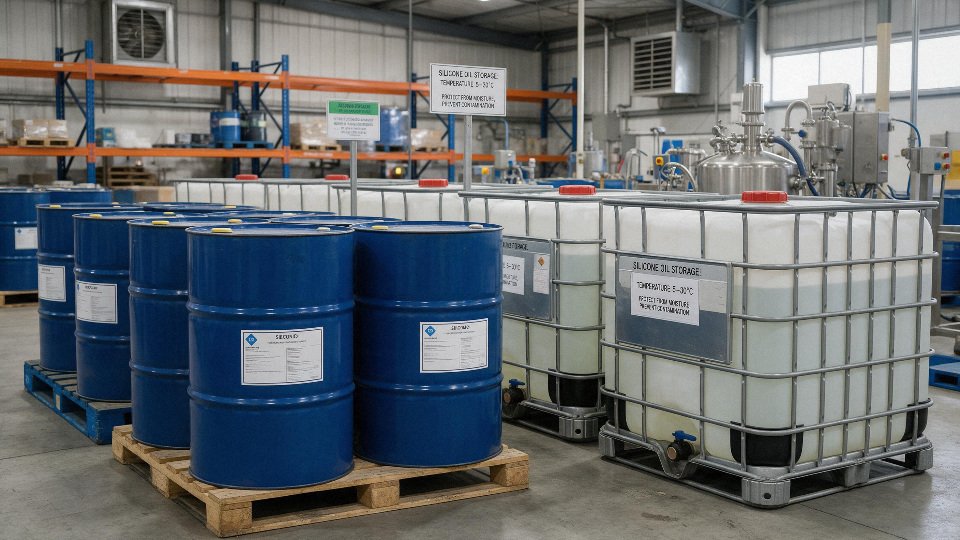
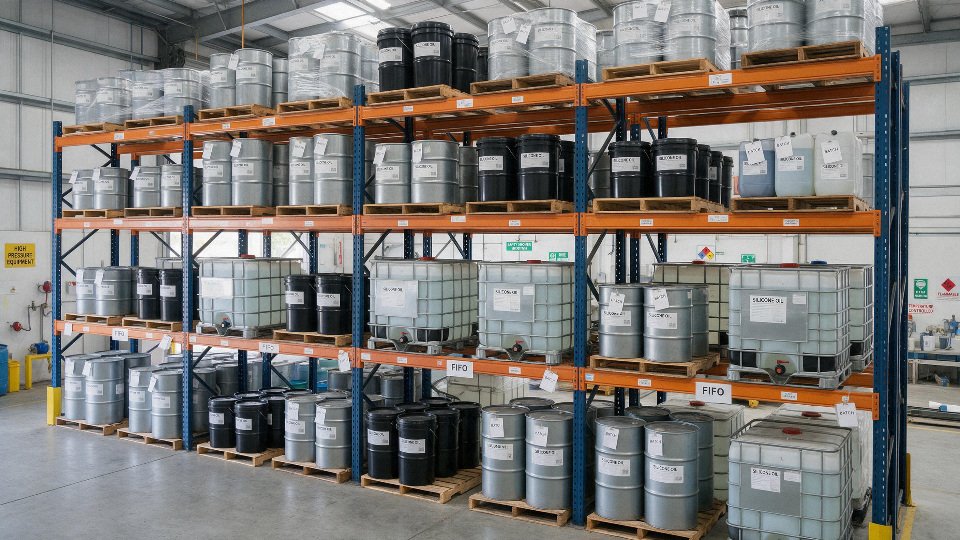
- Container compatibility
- Store in clean steel or supplier-approved containers.
- Keep lids sealed to limit moisture, dirt, and cross-contamination.
- Verify gasket and liner compatibility for long storage and expected ambient conditions.
- Segregation
- Separate from strong oxidizers.
- Do not store beside low-flash-point solvents, cleaners, or mixed chemical decant stations if there is any chance of cross-fill or shared transfer tools.
- Color coding and dedicated pumps save arguments later.
- Housekeeping
- Clean spills promptly; old silicone oil films on floors and machine bases attract dust and become both slip hazards and fire residues.
- Remove oil-soaked lagging, cardboard, and absorbents from the area quickly.
- Keep drum tops clean; rainwater and dust around bungs find their way into the product.
- Contamination prevention
- Dedicate transfer hoses, fill couplings, and sample points.
- Label top-up containers by exact grade, not “silicone oil” in general.
- After maintenance, confirm that flushing fluids and cleaning solvents are fully removed before restart.
The boundary here is contamination. A clean, sealed inventory of the intended fluid behaves one way; a half-used tote that has seen solvent rinse-back and open-shop handling behaves another.
High-surface-area processes need tighter discipline
Open baths, textile tenter frames, paper coating systems, release-coating lines, and similar equipment deserve extra caution because they maximize liquid-air contact. The bulk reservoir may be stable, but the process zone can release vapor much faster.
Watch these conditions closely:
- Large wetted area exposed to hot moving air
- Thin coating films on metal or fabric
- Deposits building up in ovens, hoods, and exhaust ducts
- Oil carryover onto insulation, bearings, chains, or heater housings
- Airflow imbalance that creates stagnant hot zones
In textile and web processes, fouling shifts the risk profile over time. A line that ran cleanly after commissioning may start smoking months later because oxidized residues on internal surfaces hold heat and keep generating fumes. That is one reason preventive cleaning intervals matter as much as the original fluid selection.

Fire response and post-incident decisions
If silicone oil does ignite, response should assume both burning liquid and irritating decomposition products.
For planning purposes:
- Suitable extinguishing media
- Dry chemical, foam, and CO2 are commonly used depending on fire size and enclosure.
- Water spray can help cool adjacent equipment and exposures, but a direct high-force stream may spread burning liquid.
- Site fire strategy should match the installation layout and local fire code.
- Spill isolation
- Stop feed to the leak if it can be done safely.
- Prevent spread into drains, pits, and insulation spaces.
- Isolate ignition sources, especially exposed heaters and electrical gear.
- Fume hazard
- Thermal decomposition can generate irritating and potentially hazardous fumes.
- Emergency response should treat smoke exposure seriously and follow the current safety data sheet for the specific product.
- After the incident
- Do not assume the remaining fluid is fit for service.
- Sample and assess for viscosity change, contamination, odor shift, discoloration, suspended carbon, and acid or volatile byproduct formation where relevant.
- Inspect heaters, seals, filters, and low-flow points for coking. In many cases, partial top-up is false economy; once a fluid has been badly overheated, complete changeout and system cleaning may be the safer decision.
A high flash point is useful. It reduces routine handling risk and gives more operating latitude than many lower-flash-point fluids. It does not make the system fireproof, and it does not cancel out poor heater design, weak ventilation, sloppy housekeeping, or cross-contamination. In practice, those four failures cause more trouble than the datasheet number itself.
Thermal stability versus flammability
A silicone oil can have a high flash point and still fail badly in hot service. Flash point tells you how easily vapors ignite under a defined test; thermal stability tells you whether the fluid keeps its chemistry, viscosity, and cleanliness after hours or months at temperature. Those are related, but they are not interchangeable, and treating them as the same property is where a lot of poor buying decisions start.
In plant terms, flash point is a screening number for ignition risk at a moment in time. Thermal stability is a life-cycle property. It shows up in whether the bath darkens, whether the heater skin fouls, whether the pump seals start weeping, whether operators complain about odor, and whether the same fluid still behaves like the original product after repeated heat-up and cool-down cycles.
What each property actually tells you
Flash point is measured under a standard lab method, usually open cup or closed cup, by heating the sample and checking when enough vapor forms above the liquid to ignite briefly. It is useful, but limited. It does not say the oil is safe to run near that temperature, and it does not predict how the fluid chemistry will evolve after long exposure to oxygen, metals, moisture, or localized hot spots.
Thermal stability is the fluid’s resistance to chemical breakdown during heating over time. For silicone oils, that usually means resistance to:
- Chain scission, where polymer chains break into lower-molecular-weight fragments
- Oxidative attack, especially at hot air-liquid interfaces
- Condensation or crosslinking reactions that push viscosity upward
- Formation of silanols, acids, gels, or insoluble residues
- Volatilization losses that shift the remaining fluid out of spec
That distinction matters because a fluid can pass procurement review on flash point and still create a maintenance problem if its long-term stability is poor under the actual duty cycle.
Why silicone oils perform well, and where that performance ends
Silicone oils are widely chosen for heat transfer, damping, lubrication, release, dielectric service, and specialty process duties because they generally combine:
- Good oxidation resistance relative to many hydrocarbon fluids
- Low volatility for their operating range
- Broad usable temperature window
- Stable viscosity-temperature behavior
- Low surface tension and good wetting in many systems
Those are real advantages. In practice, they often stay cleaner longer than conventional mineral oils in the same temperature band, especially where intermittent heating and ambient moisture would age a hydrocarbon quickly.
Still, “thermally stable” is not the same as “immune to abuse.” Severe conditions can push silicone oils into degradation. The usual triggers are not mysterious; they are the same things maintenance people keep seeing:
- Heater sheath hot spots from scale, poor circulation, or a half-failed control loop
- Thin films exposed to air at elevated temperature
- Copper, iron salts, rust, or process residues acting as catalytic sites
- Water ingress from open tanks, leaky condensers, or bad storage practice
- Long hold times near the upper continuous-use limit
- Cross-contamination with solvents, process oils, cleaners, or additives
Once degradation starts, the safety picture changes because the fluid in service is no longer the fresh fluid on the data sheet.
How aging can lower the effective in-service flash point
The mechanism is straightforward. A fresh silicone oil typically has a flash point driven by its molecular weight distribution, purity, and test method. During prolonged overheating or catalytic degradation, some of the polymer chains break into shorter, more volatile siloxane fragments. Those lower-boiling species enrich the vapor phase first, which means the working fluid can start behaving as if it has a lower flash point than the original delivered product.
Air exposure accelerates part of that path. At the liquid surface, especially in vented reservoirs or poorly blanketed tanks, oxygen attacks become more likely as temperature rises. Moisture can also contribute by promoting hydrolysis in susceptible conditions, generating silanol species and shifting the chemistry further away from the original grade. Metal contamination makes this worse. I have seen systems where the fluid itself was acceptable, but a bit of rust fines and copper residue from reworked piping shortened service life far more than the buyer expected.
The trade-off is easy to miss: a very high initial flash point looks attractive on a purchasing sheet, but if that fluid is less pure, less compatible with the process, or more prone to forming deposits in the actual system, the in-service risk can end up higher. By contrast, a fluid with a slightly lower listed flash point but better purity control and better thermal aging behavior may stay safer over the operating interval because it forms fewer light ends and fewer residues.
That conclusion has a boundary. If your process has credible upset scenarios that approach ignition thresholds or involves direct regulatory classification tied to flash point, the fresh-product flash point still matters a great deal. You do not get to ignore it just because long-term stability is also important.
The highest listed flash point is not always the safest procurement choice for a hot-running silicone oil application.True
Safety over the fluid life depends on both ignition properties of the fresh product and how the fluid ages in the actual system. Degradation can generate more volatile byproducts, deposits, and off-odors that change practical risk even if the original flash point was high.
Short-term temperature claims, continuous-use temperature, and fire limits are different numbers
This is where technical data sheets often get read too casually. Suppliers may cite:
- A flash point
- A short-term exposure or peak temperature
- A recommended continuous-use temperature
- Sometimes a separate autoignition or fire-related property, depending on the product and market
These should not be collapsed into one “safe temperature” number.
A short-term exposure limit usually means the fluid can tolerate brief excursions without immediate catastrophic breakdown under controlled conditions. It does not mean you should run there every shift. Continuous-use temperature is closer to a durability recommendation: the range where viscosity drift, oxidation, volatility loss, and residue formation remain commercially manageable over time. Fire-related limits are another layer again, and they depend on equipment design, ventilation, inventory, ignition sources, and local code requirements.
In a plant review, I would separate them this way:
| Property | What it answers | What it does not answer |
|---|---|---|
| Flash point | At what temperature does the tested sample give off ignitable vapor under the specified method? | How long the fluid will last in service |
| Continuous-use recommendation | Roughly where the fluid can operate for extended periods without unacceptable aging, depending on system design | Whether vapor above the fluid can ignite |
| Short-term peak tolerance | Whether brief temperature excursions may be survivable | Whether repeated peaks are acceptable |
| Fire safety assessment | How the installed system behaves with ventilation, ignition sources, volume, controls, and upset conditions | The chemical aging rate of the fluid |
A common mistake is to select a fluid for a 240 C continuous duty just because its flash point is well above that number. If the heater skin runs much hotter than bulk fluid temperature, or the tank is vented and lightly circulated, that logic falls apart quickly.
What thermal aging looks like on the plant floor
You usually do not need a full analytical lab to know a silicone oil is aging. Operators and maintenance crews will see it first if they know what to watch for.
Practical warning signs
- Viscosity shift
- Lower viscosity can indicate chain scission and formation of lighter fractions
- Higher viscosity can indicate condensation, oxidation byproducts, or early crosslinking
- Gel particles or stringy residue
- Often a sign the fluid has gone beyond simple oxidation into polymerization or contamination-driven instability
- Deposits on heaters, tank walls, or filters
- These raise surface temperature, which accelerates further degradation; it is a nasty feedback loop
- Odor change
- Fresh silicone oils are usually mild; sharp, acrid, or distinctly chemical odors after heating suggest breakdown products
- Visible smoke or haze
- This may indicate volatile byproducts, overheating, or contamination; do not write it off as “normal for startup”
- Darkening or clarity loss
- Not always dangerous by itself, but it is a useful aging flag
- Acid number increase or silanol formation
- Needs proper testing to confirm, but relevant where corrosion, seal compatibility, or electrical properties matter
- Rising vent losses or unexplained make-up demand
- Often points to volatilization increasing as the fluid ages
The mechanism behind several of these symptoms is practical and expensive. Deposits on a heater sheath reduce heat transfer, which pushes metal surface temperature up even if the controller still shows the same bulk setpoint. Higher surface temperature then accelerates local cracking and oxidation, generating still more residue and more light volatile fragments. That is how a stable fluid gets turned into a smoky maintenance problem by one fouled zone and a lazy PM routine.
What procurement should prioritize in a hot-duty application
For long-service applications, the better buying question is not “Which fluid has the highest flash point?” but “Which fluid will stay closest to its original properties over our actual duty cycle?” That means looking at flash point alongside purity, consistency of molecular weight distribution, expected volatility profile, compatibility with seals and process materials, likely exposure to air or moisture, and how the system is heated and maintained.
A few procurement checks that usually pay off:
- Ask for the test method used for flash point and make sure you are comparing like with like.
- Ask what continuous-use temperature guidance the supplier is willing to stand behind for your application type.
- Check whether the system will see catalytic metals, open-air exposure, moisture ingress, or stagnant hot zones.
- Review seal, hose, coating, and elastomer compatibility with aged fluid, not only fresh fluid.
- If the duty is severe, request an application review or aging test approach rather than buying from a single headline property.
If the process is clean, enclosed, well-circulated, and sensibly controlled, a standard grade may perform for a long time with little drama. If it is an open hot bath with intermittent overheating, metal fines, and water getting in every shutdown, the same fluid may age fast enough that the original flash point stops being the number that matters most.
Selection criteria for buyers
If flash point matters in your application, do not buy on that number alone. The right silicone oil is the one that stays inside your operating envelope, keeps its properties over time, and does not create a maintenance or compliance problem elsewhere in the plant. A fluid with a slightly higher flash point can still be the wrong buy if it oxidizes faster, attacks seals, sheds volatiles, or forces you into higher pumping energy and slower heat transfer.
Start with the process, not the catalog.
Define the operating envelope before comparing grades
A surprising number of bad purchases happen because the buyer knows the normal temperature, but not the upset condition. For silicone oils, that gap matters. Flash point is measured under controlled test conditions; your process sees heaters cycling, local hot spots, venting losses, pump shear, and sometimes air ingress through a tired mechanical seal.
At minimum, define these conditions in writing before you ask for a quotation:
- Normal bulk operating temperature
- The steady temperature in the tank, loop, bath, or reactor jacket.
- If there is a heating element, note its surface temperature too. Local film temperature can run well above bulk.
- Maximum upset temperature
- Include control failure, low-flow heating, blocked loop, startup overshoot, and shutdown heat soak.
- In practice, procurement often gets only the nominal temperature. Engineering should provide the plausible worst case.
- Residence time at temperature
- Minutes, hours, or continuous service changes the fluid requirement.
- A fluid that tolerates brief exposure may still age too fast in a 24/7 thermal loop.
- Open or closed system
- Open baths, roll coaters, textile finishing lines, and vented tanks lose light ends more easily and see more oxygen.
- Closed systems usually control vapor better, but any leak point becomes a concentrated hazard.
- Exposure to air
- Oxidation resistance becomes more important when the fluid is splashed, aerated, or stored hot with headspace oxygen.
- Nitrogen blanketing, if used, should be specified rather than assumed.
- Ignition sources nearby
- Heater terminals, hot bearings, static discharge, open electrical panels, welding activity, and burner trains all change the practical safety margin.
- If the system sits near a curing oven or a dusty conveying line, include that context.
The mechanism here is straightforward: lower-boiling fractions and vapor generation increase as temperature rises, especially in open systems and at hot surfaces. That pushes a fluid closer to ignitable conditions even if the published flash point looked comfortable on paper. The conclusion stops holding if the process is fully engineered as an inert, tightly closed system with verified temperature control and no oxygen exposure; then volatility and oxidation may become more decisive than flash point alone.
Match the full property set, not just flammability
Once the operating envelope is clear, screen the fluid on the properties that actually drive process performance and service life:
- Viscosity
- Affects pumpability, heat transfer, leakage tendency, damping, coating behavior, and drain-down.
- Higher-viscosity PDMS grades often show higher flash points, but you pay for that in slower circulation, harder cold starts, and sometimes poorer wetting.
- Volatility
- Important for evaporative loss, odor, vent loading, and cleanliness around hot equipment.
- In precision lines, low volatility can matter more than a modest change in flash point because condensable carryover fouls sensors and covers.
- Pour point
- Matters in cold storage, winter unloading, outdoor tote handling, and startup after weekend shutdown.
- I have seen perfectly suitable fluids become a headache simply because the drum pump cavitated every January.
- Thermal stability and oxidation resistance
- These govern viscosity drift, gel formation, deposit build-up, color change, and service interval.
- A cheaper fluid may survive initial commissioning but leave varnish on heater surfaces, which then drives local overheating and accelerates degradation.
- Dielectric behavior
- Relevant in transformers, electrical potting, test baths, and high-voltage process equipment.
- Verify against the supplier’s current data, not a generic silicone-oil assumption.
- Compressibility
- Usually secondary, but important in hydraulic damping, metering accuracy, and force-transmission applications.
- Surface tension and wetting
- Affects spreading, release, defoaming, fiber treatment, and coating uniformity.
- This is often where straight PDMS and modified fluids part ways.
- Compatibility with seals, hoses, coatings, and substrates
- Check elastomers, adhesives, painted surfaces, plastics, and any porous product-contact material.
- Swelling, softening, extractables, or loss of adhesion can become the actual failure mode, not flammability.
The trade-off is familiar: the more you optimize for one property, the more likely you move another in the wrong direction. A higher-viscosity fluid may improve flash point and reduce misting, yet raise pumping load and worsen low-temperature handling. A modified fluid may improve wetting or release, but introduce compatibility or regulatory questions that straight silicone oil would avoid.
Check purity and low-boiling content like a buyer, not just a lab reviewer
For safety-sensitive service, ask how the supplier controls low-boiling fractions and lot consistency. Flash point can be pulled down by residual lighter components, contamination, or formulation variation, and those issues do not always show up from viscosity alone.
Useful procurement checks include:
- Certificate of Analysis availability
- Confirm which properties are lot-tested versus typical only.
- If flash point is not on every lot, ask what release criteria are used instead.
- Analytical support where relevant
- Depending on application, suppliers may provide data such as viscosity, volatile content, moisture, acid value, or other internal controls.
- Do not assume every supplier runs the same panel on every batch.
- Lot-to-lot consistency controls
- Ask about raw-material traceability, batch retention, and change-control practice.
- This matters if you qualify one lot and then buy for three years.
- Contamination risk in filling and packaging
- Shared lines, reused containers, and poor drum housekeeping can undo a decent manufacturing process.
A silicone oil with the same nominal viscosity as another supplier's grade will have the same flash point and volatility in service.False
Nominal viscosity alone does not guarantee identical low-boiling content, purity profile, structure, additive package, or test-method basis. Those differences can change both reported flash point and field behavior.
Make sure you are buying the right fluid type
Not every process wants a straight silicone oil.
- Straight silicone oil
- Usually the starting point for heat transfer, lubrication, damping, dielectric, and general process applications where broad compatibility and stable baseline properties are needed.
- Modified silicone fluid
- Chosen when you need changed wetting, slip, reactivity, dispersibility, or substrate interaction.
- Good fit in specialty coatings, textile treatment, release, and interface-sensitive processes.
- Emulsion
- Often better where water-based handling, dilution, or easier application is required.
- Flash point interpretation changes because the delivered product is not just neat silicone fluid.
- Formulated blend
- Sometimes necessary to hit a process target, but this is where regulatory support, consistency, and test basis need closer review.
A lot of purchasing errors trace back to using straight silicone oil where the process outcome actually depends on modified chemistry, or buying a blend when the plant needed a simpler, more stable neat fluid.
Procurement checks that save trouble later
Before approval, confirm these points:
- Specification test method
- Flash point without the method is incomplete. Open-cup and closed-cup results are not interchangeable.
- SDS quality
- It should be current, coherent, and aligned with the actual product grade and region of sale.
- Regulatory support
- Ask for REACH status or other jurisdiction-specific documentation only where relevant to your market and use.
- Export-controlled or customer-audited sectors need this early, not after the first container is packed.
- Packaging options
- Drum, pail, IBC, bulk tanker, lined container, nitrogen-blanketed packaging if needed.
- Packaging choice affects contamination risk, unloading method, and residual handling.
- Supply-chain stability
- Plant location, lead time, safety stock, alternate production site if any, and whether the supplier can support repeat industrial volumes.
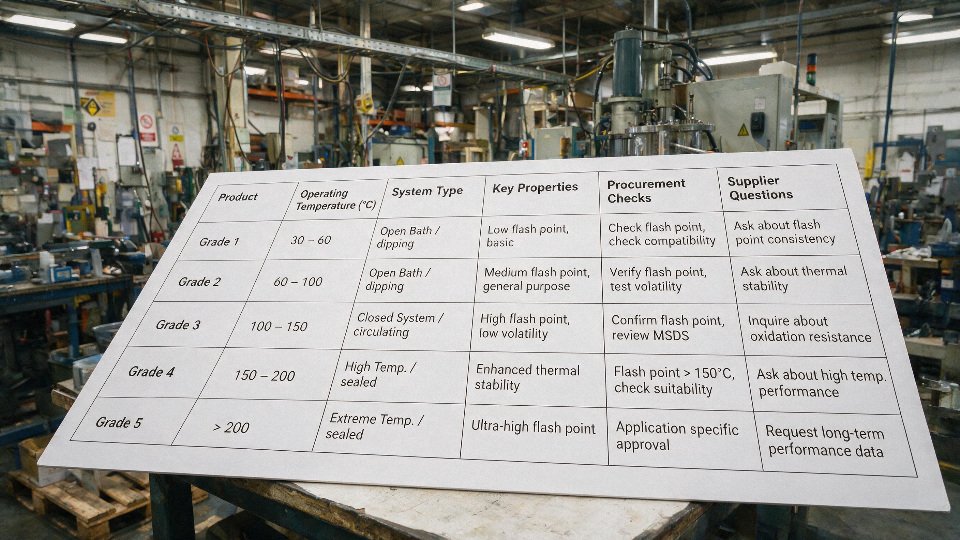
Take a cost-of-ownership view, especially on hot service
The cheapest drum price is often the most expensive fluid over a year. If a lower-cost oil loses light ends faster, forms deposits, or needs tighter ventilation and shorter replacement intervals, the hidden cost shows up as labor, downtime, cleaning, disposal, and production instability.
Ask suppliers these questions when the application is safety-sensitive or export-regulated:
- What flash point test method was used, and is the value typical or lot-specific?
- What operating temperature range do you consider appropriate for this grade in open versus closed service?
- What quality controls are used to limit low-boiling content and maintain lot consistency?
- What supporting documents can you provide: COA, SDS, regulatory statements, change notification?
- Are there known compatibility concerns with common seal materials, plastics, coatings, or target substrates?
- For long-duration hot service, what field indicators usually signal fluid aging: viscosity drift, odor, deposits, color, volatility loss?
Those answers do not replace plant testing, but they tell you quickly whether the supplier understands industrial use or is only selling from a generic datasheet.
Frequently asked questions
What is the typical flash point of silicone oil?
For standard industrial silicone oils, a practical expectation is about 250-330 C, not one fixed number. Where a given product lands inside that band depends mainly on viscosity, molecular structure, purity, and whether the lab used an open-cup or closed-cup method.
In buying work, that range is useful only as a screening tool. If your process is running hot enough that 20-30 C matters, ask for the exact tested value, the method used, and the product grade name or viscosity, because a generic “silicone oil” statement is too loose for equipment sign-off.
Does higher viscosity always mean higher flash point?
Usually, yes for comparable PDMS-based silicone oils, but not always. The trend holds best within the same chemistry family and similar purity level; it stops being reliable when the formulation, additive package, or contamination profile changes.
Why the trend exists is fairly straightforward: lower-viscosity fluids contain a larger fraction of lighter, more volatile molecules, and those are what generate ignitable vapor first. Raise viscosity within the same product family, and you usually reduce that volatile fraction, so the flash point tends to rise. On the plant floor, though, I’ve seen buyers overuse that rule and get burned by comparing unlike products. A modified silicone fluid, a blended heat-transfer medium, or a used oil sample can break the pattern.
Is silicone oil flammable?
Yes. Silicone oil is often less readily ignited than many hydrocarbon oils, but it is not nonflammable.
That distinction matters because people hear “high flash point” and mentally file it under “fireproof.” It is not. Once the fluid is hot enough to generate sufficient vapor, and there is an ignition source, it can burn. Fine mist, oil on hot insulation, leaks onto heater surfaces, and residue in poorly ventilated enclosures all change the risk picture sharply compared with a calm liquid in a drum.
Silicone oil is nonflammable.False
Silicone oils typically have relatively high flash points, but they can still ignite under the right temperature and vapor conditions. Flash point reduces ignition likelihood; it does not eliminate it.
What is the difference between flash point and autoignition temperature?
Flash point is the temperature at which the fluid gives off enough vapor to ignite briefly if an external ignition source is present. Autoignition temperature is higher: it is the temperature at which the material can ignite without a spark or flame.
For design and risk review, confusing the two leads to bad operating limits. Flash point is about vapor formation plus an outside ignition source. Autoignition is about spontaneous ignition under the test conditions. They are related, but they do not substitute for each other, and you should not estimate one from the other unless the supplier has actually tested both.
Which test method should I compare on datasheets?
Compare like with like. If one datasheet reports Cleveland Open Cup and another reports Pensky-Martens Closed Cup, the numbers are not directly interchangeable.
Open-cup testing commonly gives a higher flash point than closed-cup testing for the same fluid because vapor is less confined. That does not mean the oil changed; it means the test geometry and vapor behavior changed. For bid evaluation, keep the method consistent across suppliers before ranking products, or you will create a false safety margin on paper.
Can contaminated silicone oil lose flash point in service?
Yes, and in service this is one of the more common reasons field behavior no longer matches the original datasheet. The biggest drops usually come from ingress of lower-boiling materials.
Typical causes include:
- Solvent carryover from upstream cleaning or coating steps
- Mineral oil or process-fluid cross-contamination
- Thermal degradation generating lighter fractions
- Fuel, hydraulic oil, or compressor-oil leaks into shared systems
- Water plus process contamination that promotes unstable operation and local overheating
The mechanism is simple: even a relatively small amount of volatile contamination can dominate the vapor above the liquid, so the apparent flash point drops before bulk properties like viscosity shift enough to get noticed. If a hot-oil system suddenly smells different, smokes earlier, or trips vent complaints, pull a sample. In many plants, that test is cheaper than one heater shutdown caused by guessing.
Is silicone oil safer than mineral oil at high temperature?
Often yes in terms of flash-point margin, but not as a blanket rule. Safety at temperature depends on the full operating envelope: bulk temperature, local film temperature at heater surfaces, ventilation, leak control, mist formation, and the condition of the fluid after months of service.
The trade-off is practical. Silicone oils are often chosen because they can offer higher flash points and useful thermal performance in demanding temperature ranges, which gives process engineers more room before reaching an ignition-sensitive condition. You pay for that with higher product cost, and in some applications the benefit disappears if the system is badly controlled, contaminated, or run near degradation limits. A poor expansion tank arrangement or coked heater tube can erase the paper advantage of the better fluid.
Can I use flash point alone to set my operating temperature?
No. Flash point is one input, not the operating-temperature rule.
Use it alongside at least these checks:
- Supplier-recommended continuous-use temperature
- Expected bulk and film temperatures in the equipment
- Ventilation and enclosure conditions
- Ignition sources nearby
- Fluid age, contamination risk, and maintenance interval
- Applicable equipment manual and site safety standard
In practice, the safe operating limit is usually set by the weakest part of the system, not by the flash point line on the datasheet. If the heater skin runs much hotter than the bulk fluid, or the process occasionally overshoots during startup, that deserves more attention than the nominal flash point alone.
What should you verify next
Before you approve a silicone oil, verify three things in order: the exact fluid family, the flash point under a named test method, and the way your process actually exposes that fluid to heat, air, and contamination. Most purchasing mistakes happen because a buyer accepts “silicone oil” as if it were a single commodity, then compares datasheets that were never generated on the same basis.
Start with product identity, not the flash point line item.
- Confirm the chemical family:
- standard dimethyl silicone fluid
- modified silicone oil
- specialty high-temperature or low-volatility grade
- application-specific formulation, if additives are involved
- Confirm the intended duty:
- heat transfer
- lubrication
- release
- damping
- dielectric use
- textile, cosmetic, or process aid service
A dimethyl fluid used in a closed bath and a modified silicone oil used on an open heated surface may both be called silicone oil in a quotation trail. That is where confusion starts. The base structure affects volatility, compatibility, oxidation tendency, and how much confidence you can place in a flash point value as a screening tool.
Then request the data package that actually lets engineering sign off.
- Ask for the flash point with the test method named:
- Cleveland Open Cup
- Pensky-Martens Closed Cup
- another stated standard, if used
- Request the associated product identifiers:
- viscosity grade
- product code
- batch or grade designation
- Ask for supporting thermal and compositional data relevant to the job:
- recommended continuous-use temperature
- volatile content, if available
- purity or low-boiling fraction information, where relevant
- any handling limits stated by the supplier
This is not paperwork for its own sake. The mechanism matters: lower-boiling fractions and lighter volatiles tend to influence vapor generation first, which can pull the observed flash point down and also increase odor, evaporation loss, and deposit formation in service. A fluid can look acceptable on viscosity alone yet behave poorly in a vented, heated system if the volatile fraction is not controlled.
A flash point value without the test method is not sufficient for technical comparison or safe process approval.True
Open-cup and closed-cup methods can produce different values for the same silicone fluid. Buyers need the named method to compare products correctly and set realistic operating margins.
Next, compare the datasheet to the plant, not to another datasheet.
- Check whether your process includes:
- open liquid surfaces
- splashing or mist generation
- atomization through nozzles
- contamination from solvents, cleaners, or process carryover
- localized hot spots at heaters, seals, or poorly mixed zones
- seasonal ventilation changes or enclosed equipment spaces
The trade-off is straightforward. A tighter operating margin may let you use a broader set of grades and lower purchase cost, but once you introduce misting, open tanks, or contamination risk, the preferred choice often flips toward a higher-margin fluid or a different system design. Flash point remains useful, but its value as a standalone decision tool drops fast when the process creates vapor-rich or aerosol conditions. That is the boundary of most generic guidance on this topic.
Bring procurement, EHS, and process engineering into the same approval loop before the PO is released.
- Align on acceptance criteria:
- minimum flash point by stated method
- allowable viscosity range
- maximum continuous operating temperature
- documentation required with each lot
- Align on operating controls:
- storage temperature and segregation
- transfer and heating practices
- ventilation expectations
- changeout or replacement interval
- trigger points for investigating contamination or degradation
In practice, this step avoids the common plant-floor argument where procurement buys the cheaper “equivalent,” EHS reads a different flash point basis, and production discovers the fluid darkens early because the heater skin temperature was never checked.
If you are down to two or three candidate grades, use supplier technical support for a side-by-side review rather than trying to infer suitability from one-page datasheets. A standard dimethyl fluid is often the right answer for stable, routine service, but specialty modified silicone oils can make sense where volatility, compatibility, surface behavior, or temperature exposure pushes a standard grade out of its comfort zone.
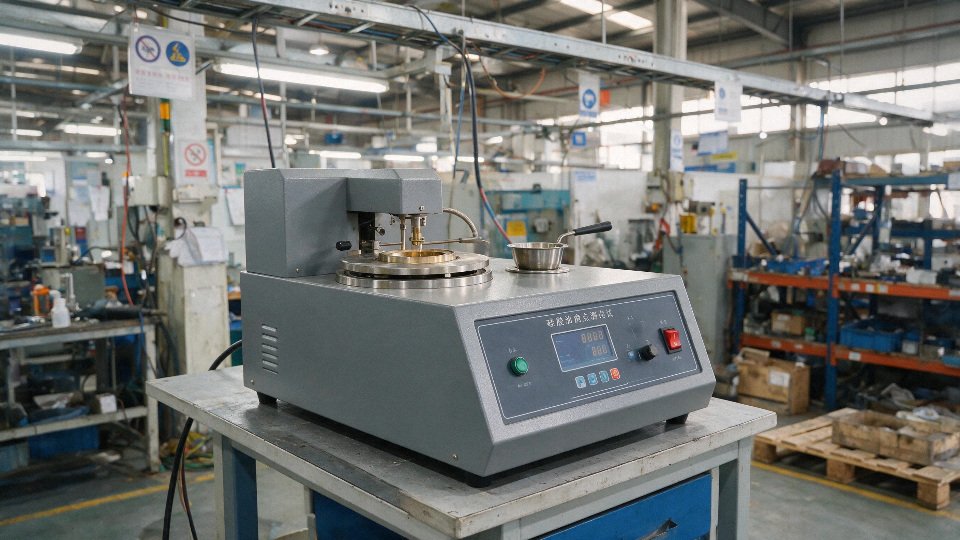
For grade matching and approval support, send SiliconChemicals the application details that actually determine fit: substrate or system material, contaminant type if any, approximate fluid layer or bath condition, working area or equipment type, required finish or functional result, target operating rate or temperature, and clear photos or a representative sample where useful. SiliconChemicals can review candidate grades, check datasheet alignment, support sample evaluation, and help structure supply for global industrial projects.