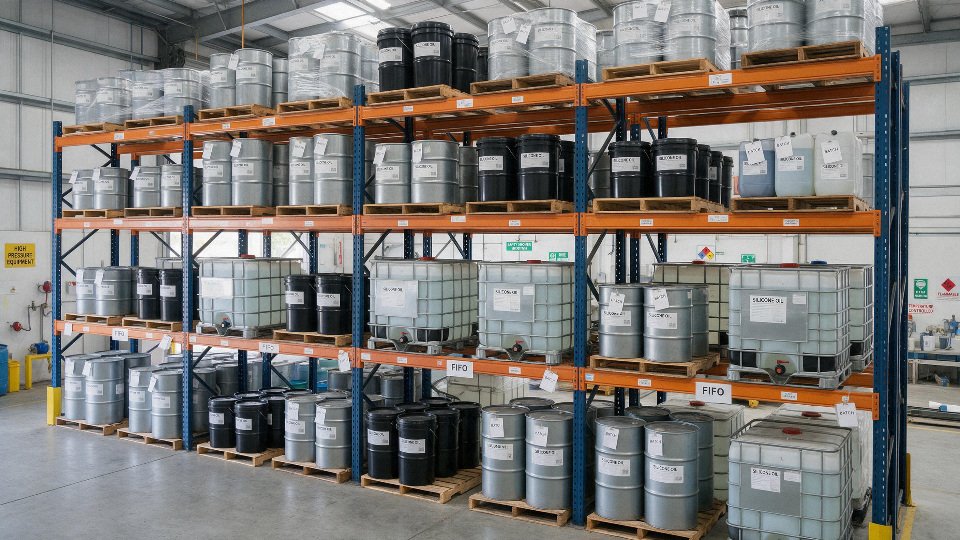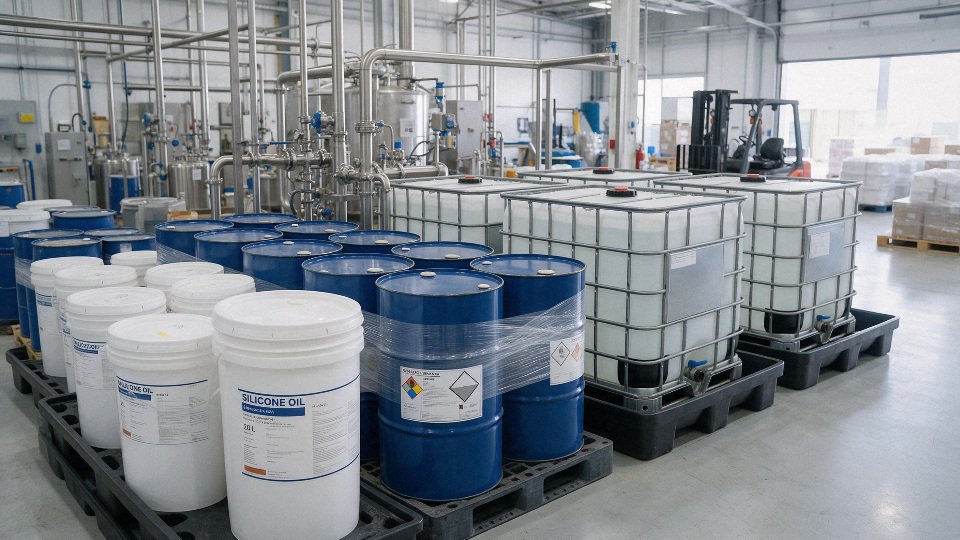
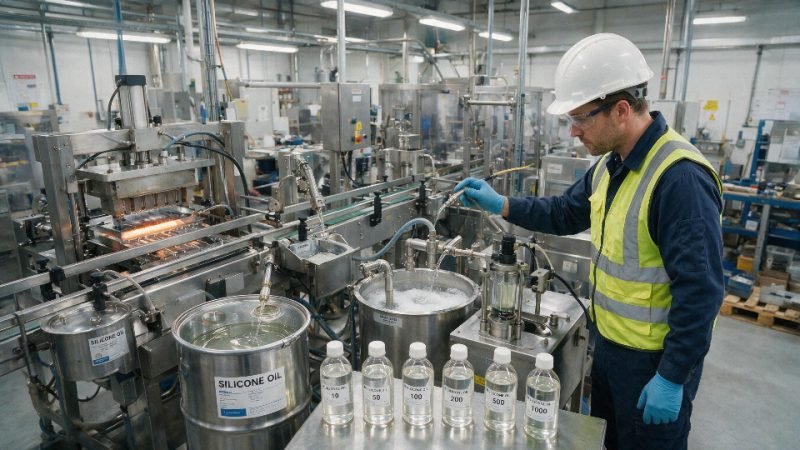
Heat drift, sticking, foam, poor release, and seal drag look like separate plant problems until they start showing up on the same maintenance report. Then the cost gets obvious: slower lines, higher scrap, more washdowns, nuisance shutdowns, and consumables that disappear faster than purchasing expected. In many of those cases, silicone oil is used because one fluid can keep its viscosity across a wide temperature swing, wet surfaces that water and mineral oil struggle to cover, and solve a process issue without forcing a hardware change.
Silicone oil is used in industry because it stays functional across a broad temperature range, spreads easily due to very low surface tension, and is available in viscosity grades from about 0.65 cSt to 1,000,000 cSt. That combination makes it useful as a lubricant, heat-transfer medium, release aid, defoamer base fluid, damping fluid, and dielectric fluid where conventional oils often lose stability or process consistency.
What matters in practice is not the generic claim that silicone oil is “versatile,” but which property is doing the work in each application, and where that logic breaks. The same fluid family that solves release on a hot mold can create downstream coating trouble on a painted part, and the grade that gives smooth damping in an instrument can be completely wrong for a fast-moving packaging line.
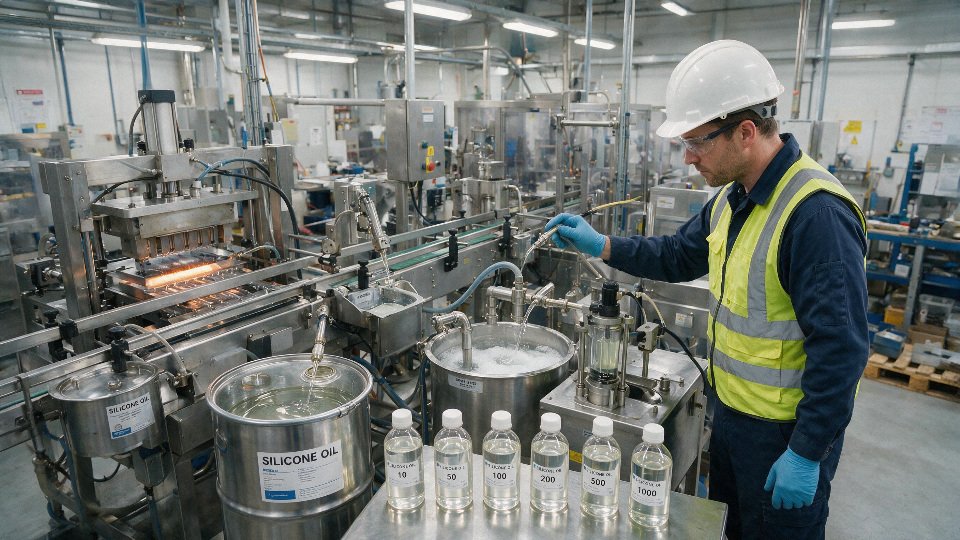
Chemistry behind performance
Silicone oil behaves differently from mineral oil or PAO for one basic reason: the molecule is built on a silicon-oxygen backbone, not a carbon-carbon chain. That structural difference shows up everywhere on the plant floor, from cold-start pumpability and release behavior to dielectric strength, oxidation life, seal compatibility, and what the fluid does when it gets onto a paint line or catalyst bed.
Most industrial silicone oils are based on polydimethylsiloxane, or PDMS. The backbone is repeating Si-O-Si units, with organic side groups, commonly methyl groups, attached to the silicon atoms. Silicon-oxygen bonds are longer and more flexible in rotation than the carbon-carbon links that dominate hydrocarbon fluids, so the polymer chain can move with less internal resistance. In practice, that is why a silicone fluid can stay mobile at temperatures where many conventional oils get thick, sluggish, or outright unpumpable.
The side groups matter too. Small methyl groups keep the chain relatively open and reduce how strongly neighboring molecules attract each other. That weak intermolecular attraction is a big part of why silicone oils have unusually low surface tension, typically around 20 to 21 mN/m, versus roughly 72 mN/m for water. Low surface tension is not just a lab number; it is why silicone fluids wet surfaces aggressively, creep into narrow clearances, spread into very thin films, and act as defoamers, release agents, and leveling aids in formulations where hydrocarbon oils often sit on the surface instead of displacing foam lamellae or covering the substrate evenly.
Silicone oil's low surface tension is one of the main reasons it performs well as a defoaming and release medium.True
This follows from established surface chemistry: lower surface tension improves spreading and penetration at gas-liquid and solid-liquid interfaces, which supports foam control and release behavior.
Why the molecular backbone changes viscosity behavior
Silicone oil is available across an unusually broad viscosity range, roughly 0.65 cSt to 1,000,000 cSt at 25 C, because chain length can be adjusted over a very wide span. Short chains behave almost like highly mobile fluids; long chains move toward syrup-like or gum-like behavior. That range lets buyers stay within the same chemistry while selecting very different handling behavior, damping response, or film persistence.
The useful point is not just the range itself, but how viscosity changes with temperature. Silicone fluids are known for a relatively stable viscosity-temperature relationship compared with many petroleum-based oils. In a dosing system, dashpot, thermal bath, or textile finishing line, that means the fluid’s resistance to flow often shifts less dramatically between winter startup and normal operating temperature.
The mechanism is straightforward:
- Flexible Si-O chains keep segment mobility high at low temperature.
- Weak intermolecular attraction means there is less “sticking together” to overcome as temperature falls.
- Because the baseline interaction between molecules is lower, heating and cooling tend to produce less extreme viscosity swing than in fluids whose flow depends more heavily on stronger intermolecular forces.
That does not mean viscosity is constant. A 100 cSt silicone fluid still thins as temperature rises. What it means is that, within its service envelope, the fluid usually gives operators a wider workable band before metering, damping, splash behavior, or heat-transfer circulation changes enough to become a process problem.
The trade-off shows up when load-carrying lubrication is the main requirement. Silicone oils often have attractive flow stability, but they are not automatically the best choice for boundary lubrication or extreme-pressure duty. If the contact is heavily loaded, sliding, and starved of film, the preferred chemistry may flip toward fluids designed around antiwear packages or base stocks with stronger lubricity for that contact regime. Buyers sometimes miss this because “stable over temperature” sounds like “better lubricant” in every case. It is not.
Thermal behavior: why silicone oil stays usable over a wide window
For standard PDMS fluids, a common service window is roughly -50 C to 200 C, with formulation-dependent variation. The lower end reflects the fluid’s ability to remain mobile at cold conditions; the upper end reflects decent thermal stability under controlled exposure. In ovens, instrument baths, damping systems, or temperature-control assemblies, that broad window is often the reason silicone oil survives where ordinary oils varnish, coke, or thicken too fast.
Here the structure helps in two ways:
- The Si-O backbone tolerates heat well relative to many organic chains.
- The fluid generally has good resistance to some common modes of thermal degradation when oxygen exposure, contamination, and catalytic surfaces are controlled.
That boundary matters. Put the same silicone fluid in clean, closed equipment and it may run for a long interval. Put it in a hot, aerated reservoir with copper contamination, process fines, or acidic carryover, and life can drop fast. In my experience, fluid failures blamed on “bad silicone oil” are often system failures first: dead zones, overheated heaters, poor venting, or a maintenance habit that leaves the drum bung open all summer.
Oxidation resistance is good, but volatility still depends heavily on grade
Silicone oil has a reputation for thermal and oxidative stability, and that reputation is broadly deserved, but grade selection still matters. Higher-viscosity PDMS fluids usually show lower evaporation loss because the molecules are larger and less likely to escape into vapor phase. Lower-viscosity fluids, especially the very light grades, can volatilize significantly at elevated temperature even if the chemistry itself is not decomposing rapidly.
That distinction matters in procurement and troubleshooting:
- If the issue is oxidation, you may see gum, deposits, viscosity drift, or byproducts from chemical breakdown.
- If the issue is volatility, you may simply lose fluid mass over time with less obvious residue, especially in open or ventilated systems.
A light silicone oil can look fine on paper for low-temperature flow, then disappear faster than expected from a heated bath, a treated fabric line, or a mold-release process running hot. The wrong conclusion is “silicone oils are too volatile.” The right conclusion is that volatility cannot be generalized across the category; it must be checked against viscosity grade, molecular weight distribution, operating temperature, dwell time, airflow, and whether the system is open or closed.
If a supplier gives evaporation-loss data, verify the test method and temperature. Numbers from one grade do not transfer cleanly to another, and a bench result in a covered cup is not the same thing as a thin film exposed to moving hot air.
Electrical performance: insulation first, cooling second
Silicone fluids are widely used in electrical and electronic applications because they combine useful dielectric behavior with manageable heat transfer and thermal stability. They can serve as insulating fluids, damping media in electrical devices, or heat-transfer fluids where electrical isolation matters.
Their value here comes from a practical combination of properties:
- Good dielectric insulation relative to many process fluids
- Low conductivity under appropriate conditions
- Broad usable temperature range
- Stable flow behavior that supports heat movement without becoming too viscous in the cold
The mechanism is less exotic than it sounds. A fluid with suitable dielectric properties can occupy spaces around energized components without readily conducting current, while still carrying heat away by convection or circulation. That is useful in transformers, capacitors, sensors, and electronic assemblies designed around fluid contact.
Still, this is not a blanket approval for every electrical duty. Moisture pickup, contamination, additives, and compatibility with plastics or encapsulants can change performance. For safety-critical or regulated electrical use, engineers need the current supplier data, equipment manual limits, and the applicable standard for that device class. Category-level chemistry is not enough to sign off an insulation system.
“Chemically inert” is true only in the limited way engineers mean it
Silicone oil is often described as chemically inert, and in many industrial environments that is a fair shorthand. It generally resists reacting with a wide range of materials under normal service conditions, which is one reason it shows up in so many mixed-material systems. But inert does not mean universally compatible.
The exceptions are where buyers get hurt:
- Elastomers and seals: swelling, shrinkage, or extraction behavior depends on the specific rubber, filler package, cure system, and temperature.
- Coatings and paint shops: trace silicone contamination can cause fisheyes, craters, and adhesion defects.
- Catalyst-sensitive processes: some catalyst systems, especially where surface activity matters, can be poisoned or disrupted by silicone contamination.
- Adhesives and bonding: low surface energy residues can make later printing, painting, or gluing unreliable.
- Certain plastics and composites: stress cracking, softening, or interfacial issues need checking grade by grade.
That is the limit of the usual “silicone is inert” claim. It holds well as a general description of the fluid’s resistance to ordinary chemical attack; it stops holding when the process is contamination-sensitive, surface-dependent, or built around materials whose compatibility hinges on trace migration and wetting behavior. On a plant floor, that usually means one thing: before standardizing a silicone oil, verify not only what it does inside the machine, but also what a small leak, mist, or residue will do to the next process downstream.
Properties that industry values
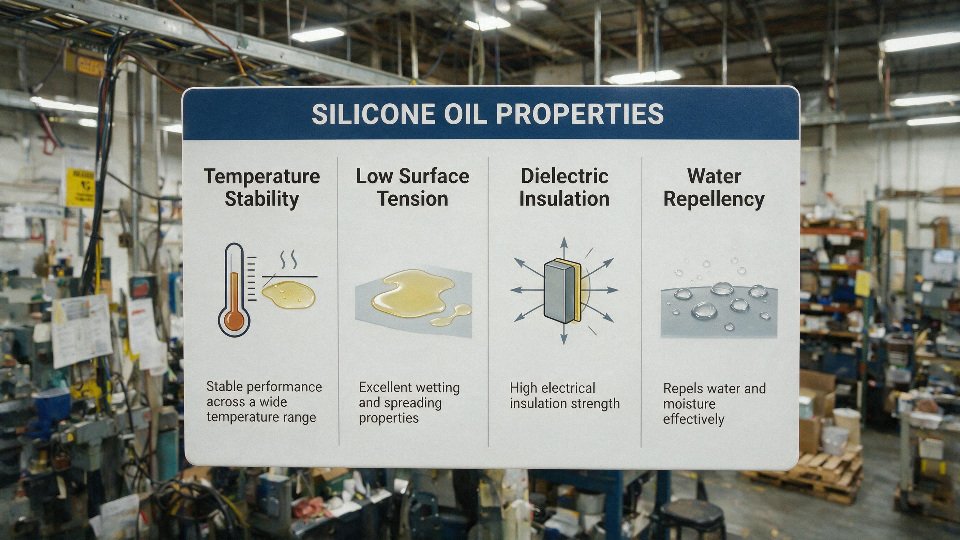
Silicone oil earns its place on plant specifications because the useful properties are not isolated lab curiosities; they solve recurring operating problems. Where buyers get value is in the combination: temperature tolerance, low surface tension, water repellency, dielectric behavior, and stable flow across a wide viscosity range all in one fluid family.
That said, the same traits that make it effective can create trouble downstream if the process is not controlled. A release agent that works beautifully in molding can turn into a paint-shop headache later, and an electrically stable fluid can still fail early if it picks up the wrong contamination or sees a catalyst it does not tolerate.
Wide operating temperature capability and stable viscosity behavior
A practical reason industry keeps coming back to silicone oil is that it stays usable across conditions that make many hydrocarbon oils awkward. Typical polydimethylsiloxane fluids are often used somewhere in the rough band of -50 C to 200 C, formulation depending, which matters in equipment that sees outdoor winters, oven zones, heated rolls, or stop-start duty with cold morning starts and hot afternoon production.
The plant-floor value is straightforward:
- Cold start behavior improves
- Pumps, metering systems, and dashpots are less likely to go sluggish at low ambient temperature
- Actuators and damping devices behave more predictably after overnight shutdown
- Operators do not need to wait as long for the fluid to “come in”
- Hot-side consistency is easier to hold
- In heated baths, ovens, and thermal transfer loops, viscosity shift is often more manageable than with many conventional oils
- Film behavior stays closer to target, which helps coating weight, release consistency, or damping response
- Cycling is less disruptive
- Repeated hot-cold exposure tends to cause fewer dramatic changes in flow behavior
- This can reduce the need for seasonal adjustment of process settings
The mechanism matters. Silicone fluids generally show a more favorable viscosity-temperature relationship than many mineral oils, so the fluid does not thicken as aggressively in the cold or thin as sharply in the heat. That property feeds directly into pumpability, metering accuracy, film thickness, and damping stability.
The boundary is just as important: this does not mean every silicone oil fits every high-temperature duty. Oxidation environment, residence time at temperature, contamination level, and contact with reactive metals or catalysts all matter. For any continuous service near the top end of the nominal range, the current supplier data and the exact grade need checking.
Low surface tension, spreadability, and surface control
At roughly 20 to 21 mN/m surface tension, silicone fluids spread far more readily than water at about 72 mN/m. That single number explains a lot of the category’s industrial usefulness.
In practice, low surface tension shows up in five high-value ways:
- Wetting
- The fluid can cover low-energy or irregular surfaces more easily
- Useful in polishes, surface treatment systems, and some additive packages where uniform coverage matters
- Release
- A thin transferred film reduces sticking between product and tool, liner, roll, or mold surface
- Common in molding, paper handling, converting, and some packaging operations
- Leveling
- In formulations, a small amount can help smooth a surface and reduce defects tied to poor flow-out
- This is why silicone additives show up in coatings, inks, and finish systems
- Anti-stick behavior
- Product buildup on guides, chutes, knives, and contact surfaces may be reduced
- Useful where tacky compounds, elastomers, or adhesive-prone materials foul equipment
- Foam control
- Certain silicone-based fluids and compounds are used because they destabilize foam films efficiently
- This is especially valuable in chemical processing, wastewater, fermentation, and coating circulation systems
Low surface tension is always an advantage.False
It is a major advantage for wetting, release, and foam control, but it can also increase migration and make downstream painting, bonding, printing, or coating more difficult if even trace residues reach the surface.
The trade-off is the one buyers underestimate most often. The same spreadability that makes silicone oil effective also makes contamination travel farther than people expect. A wipe-down rag, a shared glove, or mist from a poorly adjusted spray can be enough to create fisheyes, adhesion loss, or print defects several steps downstream.
Lubricity and slip improvement in boundary-contact conditions
Silicone oil is not a universal replacement for EP gear oils or heavy-load metalworking lubricants. It is valuable where the contact condition is lighter, more intermittent, or driven by release and slip rather than extreme load-carrying capacity.
Typical good-fit situations include:
- Plastic-to-metal sliding guides
- Rubber-to-metal assembly contact
- Seals, grommets, and elastomer installation
- Low-load chains, linkages, and hinges
- Release-dominant contact in molding and converting
- Textile and fiber processing where hand feel or slip matters
What it often improves:
- Reduced squeak and chatter
- Lower insertion force during assembly
- Less stick-slip in guides and tracks
- Better feel on rubber and plastics
- Cleaner release from tooling
The mechanism is mostly boundary film formation and low interfacial shear. Silicone oil forms a thin lubricious layer that can reduce friction where full hydrodynamic lubrication never really develops. That is why it does well on slow-moving parts, elastomer contact, and intermittent motion.
Where the preference flips is under high load, shock loading, or where anti-wear and extreme-pressure chemistry are the main requirement. In those cases, a hydrocarbon or synthetic lubricant specifically built for load-bearing may perform better.
Hydrophobicity and water repellency
Silicone oil’s hydrophobic character is a direct fit for applications where water pickup, wetting, or staining causes trouble. This is one reason it appears in textile finishing, surface treatment systems, mold release products, and polish formulations.
Operationally, water repellency can help by:
- Reducing surface wet-out
- Limiting moisture retention on treated surfaces
- Improving water beading on finished goods
- Supporting release on tools and molds where moisture complicates demolding
- Enhancing feel and appearance in polish and care products
In textiles, this can influence hand feel and surface behavior, though final performance depends heavily on the chemistry of the finishing system, cure conditions, fabric type, and whether a reactive silicone or a simple fluid is used. In mold release, hydrophobicity often supports cleaner part separation, but transfer to the molded part has to be controlled if painting or bonding follows.
Dielectric usefulness in electrical service
Silicone oil is often chosen where electrical insulation has to coexist with heat and moisture exposure. Its dielectric properties, combined with thermal stability, make it relevant in selected transformers, capacitors, damping elements, and insulated assemblies, though exact use depends on grade, purity, and equipment design.
Why plants care:
- Electrical performance can remain reliable under damp conditions
- Thermal stress is handled better than with some conventional fluids
- Stable viscosity helps mechanical damping and heat transfer behavior stay consistent
This is not an area for casual substitution. Dielectric strength, moisture content, gas content, compatibility with seals and varnishes, and equipment approval all need verification against the equipment manual and supplier documentation.
Optical clarity, shear stability, and controlled compliance
Some silicone oil grades are valued because they are clear and transparent, which matters in sight systems, specialty instruments, optical-adjacent mechanical uses, and formulations where haze or color is unacceptable. Not every grade should be assumed optically suitable; clarity depends on purity, viscosity, additives, and service history.
Shear stability is another quiet advantage. In many process conditions, silicone fluids hold viscosity reasonably well because the polymer backbone is not easily mechanically degraded under ordinary mixing, pumping, or recirculation. That helps where a fluid is expected to meter, damp, or coat consistently over time.
The limit is contamination and chemistry, not just mechanics. Severe particulate loading, strong acids or bases, catalytic residues, or contact with reactive process contaminants can change performance or accelerate breakdown. If a line sees metal fines, curing catalyst carryover, or aggressive wash chemistry, field testing matters more than generic product-category assumptions.
Many standard grades are also considered low in toxicity relative to some alternative industrial fluids, which is one reason they are evaluated for indirect-contact or regulated applications. But compliance is never automatic. Buyers need the exact grade, residual profile, additive package, and current regulatory documentation before using it in food-adjacent, personal-care, medical, or tightly controlled consumer applications. A generic “silicone oil” description is not enough for audit work.
The practical lesson is simple: silicone oil is most valuable when you treat its properties as a system, not a single feature. If the line needs temperature stability, wetting, release, water repellency, and electrical reliability at the same time, it often earns its cost. If the next process step is painting, bonding, or printing, migration control becomes part of the specification from day one, not a maintenance note after defects appear.
Core industrial applications
Silicone oil is not one industrial product with one job. It is a fluid family used as lubricant, damper, heat medium, release aid, foam-control component, textile finish, dielectric fluid, polish base, and process aid, and the grade selection usually changes with the duty, substrate, contamination risk, temperature profile, and downstream quality requirement. What matters in practice is not “does the plant use silicone oil,” but “which silicone fluid, in what viscosity, purity, volatility, and formulation package, for which failure mode.”
A maintenance team looking at a fan clutch, a textile finisher trying to reduce needle heat, and a coatings formulator chasing crater defects may all say they use “silicone oil,” but the fluids are not interchangeable. Viscosity, molecular structure, volatility, additives, emulsion form, and cleanliness standards can shift the fluid from useful to completely wrong for the job.
Lubrication and damping in motion-control systems
For damping and controlled motion, silicone oil is often chosen because it keeps a more predictable feel across a broad temperature range than many mineral oils and because it is available in an unusually wide viscosity span, from very thin fluids up to extremely high-viscosity grades. That is why you see it in dashpots, instrument dampers, fan clutches, door closers, shock-related devices, and some precision motion assemblies where stable drag matters more than extreme load-carrying capacity.
Typical uses include:
- Instrument damping
- Gauges, meters, and pointer systems
- Optical and laboratory positioning devices
- Small dashpots in control equipment
- Automotive and transport components
- Fan clutches
- Viscous couplings
- Some damping assemblies in interior or body systems
- Precision and motion-control hardware
- Rotary dampers
- Linear dashpots
- Controlled-close mechanisms
- Shock attenuation in low-stroke devices
The mechanism is straightforward: fluid viscosity resists movement, and the silicone backbone helps that viscosity change less sharply with temperature than many conventional oils. In practice, that means a damper that does not turn sluggish on a cold morning and loose by mid-shift near a heat source. On a machine where operator feel or instrument settling time matters, that stability saves recalibration and reduces nuisance complaints.
The trade-off is load capacity and lubricity under boundary conditions. Silicone oils are excellent for damping and light-to-moderate lubrication duties, but they are not a universal substitute for EP gear oils or heavily loaded bearing lubricants. If metal-to-metal contact dominates and the contact zone relies on anti-wear or extreme-pressure chemistry, the preferred choice usually flips away from a standard silicone fluid.
Different grades matter here because:
– Viscosity sets drag torque, response time, and leakage tendency
– Volatility affects long-term retention in vented or warm devices
– Low-temperature behavior matters in outdoor or refrigerated equipment
– Material compatibility with seals, plastics, and elastomers must be checked at assembly level, not assumed from fluid family alone
Heat-transfer and thermal management fluids
When the process needs a broad operating window, good thermal stability, and manageable viscosity over temperature, silicone oils are widely used in heat-transfer baths, jacketed reactors, laboratory circulators, calibration baths, and temperature-control loops. The usual attraction is not maximum heat-transfer coefficient at any cost; it is controllable thermal service across a wider temperature span with fewer oxidation and sludge problems than some alternatives in the right duty.
Common thermal uses include:
- Laboratory and pilot systems
- Constant-temperature baths
- Reactor jackets
- Analytical and calibration equipment
- Small recirculating thermostatic units
- Industrial temperature-control loops
- Heating and cooling skids
- Molding tool temperature control
- Specialty process reactors
- Batch systems that cycle across wide temperatures
- Indirect heating applications
- Systems where product contamination by the thermal fluid must remain low-risk
- Processes that cannot tolerate the odor, varnish, or fouling profile of some organic heat media
A silicone fluid can remain serviceable from roughly -50 C to 200 C for common PDMS fluids, depending on formulation and system design. That broad window is operationally useful in plants that start cold, run hot, and do not want to drain and refill for seasonal changes.
Still, heat-transfer service is not a one-number selection. You need to balance:
- Viscosity at startup temperature
- Too thick, and pumps cavitate or motors overload on cold start
- Thermal stability at bulk and film temperature
- Local hot spots at heaters can age a fluid faster than the loop average suggests
- Volatility and expansion behavior
- Relevant in vented tanks, open baths, and systems with poor condensate management
- Specific heat and thermal conductivity
- Important, but not enough alone to choose the fluid
A common procurement mistake is buying by viscosity grade alone. In a reactor loop, the wrong volatility profile can show up as fluid loss and odor; in a lab bath, poor low-temperature pumpability causes unstable control. The section’s main conclusion stops holding if the duty moves into very high-temperature service beyond the practical window of the selected PDMS fluid, or where process safety rules, oxidation risk, or equipment design call for another heat medium entirely. Those limits must be checked against the actual heater surface temperature and the equipment manual, not just the bath setpoint.
Release agents and anti-stick duties
In release and anti-stick service, silicone oil works because its low surface tension, typically about 20 to 21 mN/m, helps it wet surfaces and create a low-adhesion interface. That makes it useful in molding, converting, handling, and demolding operations where sticking causes scrap, torn surfaces, cycle-time loss, or tool fouling.
You will see silicone-based release systems in:
- Rubber molding
- General molded rubber parts
- Compression and transfer molding auxiliaries
- Plastics processing
- Mold release for selected parts and tooling conditions
- Anti-stick support in handling hot or tacky components
- Composite manufacturing
- Demolding aids for selected resins and tooling systems
- Surface-conditioning steps before part release
- Paper and converting
- Web handling
- Adhesive-contact surfaces
- Roll and guide anti-stick treatments
- Die casting auxiliaries and ancillary handling
- Not as a one-size-fits-all die lube, but in some support roles where release and surface wetting are useful
The trade-off is contamination risk. The same low-surface-energy behavior that makes silicone release effective can create major downstream trouble in painting, printing, bonding, or secondary coating if the fluid transfers where it should not. A little carryover can be enough to cause fisheyes or adhesion failure. In plants with mixed finishing operations, this is one of the most common reasons production managers restrict where silicone-based release products are allowed.
Grade and form matter a lot:
– Neat fluid vs. emulsion
– Viscosity and spreading behavior
– Volatility and residue
– Purity for downstream finishing sensitivity
– Whether the release system includes non-silicone co-components
Defoamers and foam-control formulations
Silicone oils are widely used as defoamer components because they destabilize foam films efficiently at low treat levels in many systems. That makes them standard tools in coatings, inks, agrochemical formulations, fermentation support systems, wastewater treatment, pulp and paper, and industrial cleaners, though the chemistry is almost never just “straight silicone oil poured in.”
Key application areas include:
- Coatings and inks
- Agrochemical formulations
- Fermentation and bioprocess support
- Wastewater treatment
- Pulp and paper
- Industrial detergents and cleaners
The mechanism depends on incompatibility in the right amount. A defoamer has to enter the foam lamella, spread enough to weaken it, and collapse the bubble without creating surface defects elsewhere. Too compatible, and it sits quietly in the liquid phase. Too incompatible, and it can create craters, haze, or floating residue. In practice, this is why defoamer selection is often a formulation exercise, not a commodity fluid purchase.
A silicone defoamer that works well in one waterborne coating will usually work in all waterborne systems.False
Foam structure, surfactant package, resin chemistry, shear profile, and drying conditions change the required balance of incompatibility, dispersion, and persistence. Site or lab screening is usually needed.
Textile finishing and fiber handling
Textile processors value silicone fluids for soft hand, lubricity, sewability improvement, and surface feel control. Uses span yarn lubrication, fabric finishing, thread performance enhancement, and technical textiles where friction, drape, or tactile response matters.
Typical functions include:
- Fiber and yarn lubrication
- Lower friction in winding, knitting, and weaving
- Reduce yarn damage and processing heat
- Fabric softening
- Change hand feel, drape, and perceived quality
- Sewability improvement
- Reduce needle cutting, skipped stitches, and localized heating
- Technical textile surface modification
- Tune slip, feel, and handling in coated or specialty fabrics
This area is grade-sensitive because molecular weight, emulsion stability, reactivity, and hand-feel profile all change the result. A finish chosen for softness may hurt absorbency; one chosen for slick sewability may shift dyeing or print behavior. Plants that treat silicone textile chemistry as a simple dosage adjustment usually end up fighting rework.
Electrical, maintenance, personal care-adjacent, coatings, and process-aid uses
Several other application families are commercially important, even if they are less visible on the shop floor.
- Electrical insulation and dielectric service
- Selected transformers, capacitors, electronic assemblies, and moisture-prone devices
- Chosen for dielectric behavior, thermal stability, and moisture resistance in some designs
- Equipment-specific approval is mandatory; you cannot generalize from one electrical fluid design to another
- Polishes and maintenance chemicals
- Surface gloss
- Water repellency
- Slip and conditioning
- Used in metal, plastic, rubber, and hard-surface care products where appearance and wipe feel matter
- Personal care and pharmaceutical-adjacent industrial roles
- Intermediate or formulated fluid functions where purity, residual profile, and regulatory handling are tightly controlled
- This is not a category for casual substitution; buyer requirements usually extend beyond normal industrial COA expectations
- Construction and coatings auxiliaries
- Leveling
- Anti-crater
- Anti-blocking
- Water repellency
- Substrate feel modification
- A small formulation change can fix flow defects or create new ones, so application testing matters more than generic dosage advice
- Chemical process aids
- Carrier fluid
- Phase-control support
- Vacuum pump fluid in some systems
- Specialty processing medium where chemical inertness or volatility profile is useful
- Suitability depends heavily on contamination tolerance, vapor pressure requirements, gas load, and maintenance regime
The practical point across all these uses is simple: different applications require genuinely different silicone oil grades, not merely different dosage levels. Once the duty changes from damping to defoaming, or from textile finish to heat transfer, you are no longer choosing “more or less” of the same material. You are choosing among different viscosity bands, purity controls, emulsion states, volatility profiles, and sometimes different silicone chemistries altogether. If the application is sensitive, the fastest route is to match the fluid to the failure mode first, then screen it under your actual process conditions rather than buying on name recognition alone.
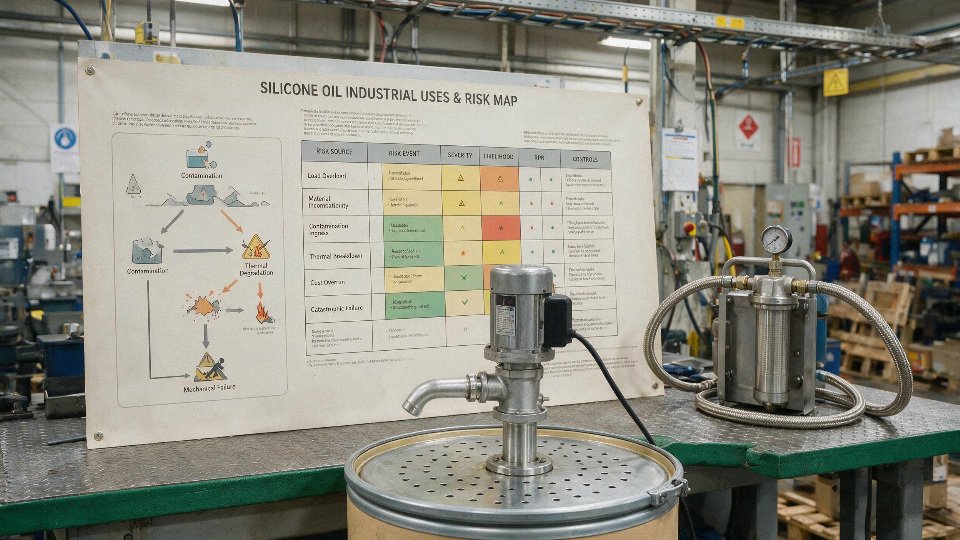
Limits and failure risks
Silicone oil solves a lot of problems, but it is not a universal upgrade over mineral oil, PAO, or fully formulated specialty lubricants. The main failure pattern I see is not “bad silicone oil”; it is the wrong fluid assigned to a duty that actually needs load-carrying additives, strict cleanliness control, material compatibility checks, or easier removability than silicone chemistry usually gives you.
A useful way to think about the limits is this: silicone oil is often selected for temperature stability, release, dielectric behavior, low surface tension, or controlled lubrication. Those strengths can turn into liabilities if the machine needs boundary-film protection under shock load, if the plant also paints or bonds parts, or if downstream quality is sensitive to trace contamination.
Where silicone oil is a poor lubricant choice
For heavily loaded metal-to-metal contacts, standard silicone oil is usually the wrong answer unless the product has been specifically modified and validated for that duty. It does not inherently replace the extreme-pressure and antiwear packages used in gear oils, metalworking fluids, and many boundary-lubrication systems.
On the plant floor, that matters in a few common situations:
- Heavily loaded gears and gearboxes
- Shock load, sliding contact, and high Hertzian stress need film strength plus EP chemistry.
- A higher-viscosity silicone fluid may look safer on paper, but viscosity alone does not create the sacrificial boundary protection that sulfur-phosphorus or other EP systems provide in conventional gear lubricants.
- Result if misapplied: micropitting, scuffing, rising temperature, and noisy operation that gets blamed on the gearbox instead of the fluid selection.
- Extreme-pressure metalworking
- Drawing, tapping, broaching, and difficult forming operations often depend on additive chemistry at the tool-workpiece interface.
- Silicone oil can lubricate lightly loaded sliding or act as a process aid, but that is a different job from carrying severe tool pressure.
- If the process is already near the edge on tool life, silicone oil is rarely the fluid that brings it back.
- Plain bearings or slides with contamination and intermittent lubrication
- In some low-load mechanisms, silicone oil works well.
- In dirty service with shock loading, it can wash around nicely yet still leave the contact insufficiently protected at the moment of peak load.
The boundary of this point is important: if the application is light-load, temperature-driven, chemically aggressive to hydrocarbons, or needs dielectric properties, silicone oil may still be the right fit. But once the duty is defined by load-carrying, not just smooth motion, you need application-specific proof rather than assuming “more viscous silicone” will cover the gap.
Compatibility problems are often discovered too late
Material compatibility is one of the most expensive silicone mistakes because the failure shows up outside the fluid system. A seal swells, a label adhesive loses bond, a painted housing fisheyes, or an optical plastic crazes months after startup.
Typical risk areas include:
- Elastomers and seals
- Some elastomer systems tolerate silicone fluids well; others may swell, soften, shrink after extraction, or lose mechanical properties depending on compound formulation.
- Seal compatibility cannot be generalized responsibly by polymer family name alone. FKM from one supplier and FKM from another may not behave the same because fillers, plasticizers, and cure systems differ.
- Always verify against the seal supplier’s current data or run immersion testing at service temperature.
- Plastics
- Certain plastics handle silicone contact without issue; others are vulnerable to stress cracking, softening, or additive extraction.
- Thin molded parts, clear covers, and low-cost engineering plastics are where surprises tend to show up first.
- Paints, inks, adhesives, and coatings
- Low surface tension is useful in some formulations and disastrous in others.
- Trace silicone contamination can cause craters, fisheyes, dewetting, print defects, poor adhesive wet-out, or coating holidays.
- This is not just a “large spill” problem. Aerosolized mist, operator gloves, shared wipes, and reused containers are enough to create headaches.
If a plant paints or bonds parts, silicone contamination control needs to be treated as a line-separation issue, not just a housekeeping issue.True
Because silicone fluids spread easily and transfer in very small amounts, routine cleaning habits that are acceptable for standard oils may still leave enough residue to disrupt coating or adhesive wetting.
Migration and cleanability are persistent operational risks
Silicone oil is often difficult to remove completely once it gets where it does not belong. That is the trade-off for the same low surface tension and spreading behavior that make it useful in release, wetting, and anti-stick duties.
In practice, the problem shows up in mixed-process plants:
- a maintenance technician lubricates a fixture near a paint line
- a defoamer carryover reaches a wash stage
- an overapplied fluid migrates onto a bonding surface
- parts look clean, but downstream coating rejects climb
Why it happens:
- Low surface tension promotes spreading over large areas from a small amount of fluid.
- Thin films are hard to see and easy to transfer by contact.
- Conventional aqueous cleaning may not fully remove residues unless the chemistry, time, temperature, and mechanical action are matched to the specific fluid and substrate.
If the plant has painting, printing, lamination, medical assembly, optics, battery coating, or precision bonding, silicone use should be segregated physically and procedurally. Separate tools, marked dispensers, dedicated gloves, and validation of the cleaning method save far more money than reworking a batch of defected parts.
The foam-control paradox
Silicone-based materials are widely used to suppress foam, but uncontrolled carryover can create the opposite of process control. A defoamer that works beautifully in one tank can destabilize filtration, interfere with coating uniformity, or leave surface defects in the next step.
Common failure routes:
- Overdosing
- More is not better. Once the dose exceeds what the system needs, residual droplets or incompatible dispersed phases can cause defects rather than solve foam.
- Downstream contamination
- Carryover into painting, ink, adhesive, or plating operations can create surface nonuniformity.
- Separation and deposit issues
- In recirculating systems, poor dispersion or incompatibility can lead to localized silicone-rich areas, filter loading, or visible residues.
This is one of those cases where a bench test is not enough. You need a process-path test that follows the chemistry through every downstream stage that matters.
Overheating, oxidation, and catalytic degradation still happen
Polydimethylsiloxane fluids are known for a broad service window, but they are not immune to abuse. Under severe overheating, prolonged air exposure, or contact with catalytic contaminants, the fluid can change in ways operators notice only after quality or maintenance problems appear.
Typical degradation paths include:
- Viscosity drift
- Chain scission can lower viscosity.
- Crosslinking or deposit formation can increase effective viscosity or create gels.
- Which direction dominates depends on temperature history, contamination, and formulation.
- Volatile formation
- High heat can generate lower-molecular-weight species, increasing loss by evaporation or vent emissions.
- Deposits and residue
- Hot surfaces, especially in the presence of metal contaminants or reactive residues, may build films or varnish-like deposits.
- Air entrainment and oxidation effects
- Long residence time at elevated temperature with constant air exposure is harder on the fluid than the same bulk temperature in a more protected system.
The practical warning sign is not just darkening. Watch for drift in dosing performance, heat-transfer response, misting, seal behavior, and residue on heaters, vents, or nearby surfaces. For thermal limits, actual equipment geometry, hot-spot temperature, air contact, and contamination load matter more than a catalog bulk-temperature number.
Cost, compliance, and the over-specification trap
If a standard mineral oil or PAO already meets the duty cycle, switching to silicone oil can add cost without adding usable performance. That is common in ordinary bearings, enclosed drives at moderate temperature, and systems where replacement interval is already acceptable.
Selection should be screened against:
- Actual temperature and load profile, not a theoretical worst case
- Drain interval economics, including labor and downtime
- Compatibility testing cost
- Cleaning and contamination-control burden
- Waste handling and local regulatory obligations
- Application-specific approvals for food-adjacent, medical-adjacent, clean manufacturing, or emissions-sensitive use
Regulatory treatment is highly regional and application-specific, so it needs current verification. For food-adjacent or medical-adjacent use, do not infer suitability from base chemistry alone; confirm the exact product status, documentation, and allowed use conditions from supplier data and the relevant local framework.
One last selection mistake is worth stating plainly: higher viscosity does not automatically mean better performance. It may reduce pumpability, worsen heat transfer, impair wetting, slow metering response, and hurt low-temperature startup. In a dosing system, for example, going too heavy can improve leak resistance while quietly wrecking shot repeatability and line speed.
Grade selection criteria
Start with the job the fluid must do, not the generic label “silicone oil.” The right grade for a release wipe, a dielectric bath, a defoamer package, or a damping chamber can differ by orders of magnitude in viscosity, purity, volatility, and additive package even when the base chemistry is still PDMS. If procurement buys on viscosity alone, the plant usually pays later in foam carryover, seal swell, residue, short bath life, or inconsistent metering.
A workable selection process ties five things together:
- The operating function in the process
- The viscosity and flow behavior the equipment actually needs
- Thermal and aging behavior under plant conditions
- Compatibility with the substrate, seals, and surrounding chemistry
- Supply-form, documentation, and consistency requirements that match the end use
Start with the operating function
The first filter is simple: what is the fluid expected to do physically inside the process? That determines which properties matter and which are just catalog noise.
- Lubrication and damping
- Priorities: viscosity stability across temperature, film persistence, low volatility, material compatibility with seals and plastics
- Typical concern: a fluid that feels fine at room temperature may lose damping character at elevated enclosure temperature or become too stiff in winter storage
- Release and surface treatment
- Priorities: wetting, spreadability, low surface tension, transfer behavior, residue control, downstream paint/print/adhesion risk
- Typical concern: the same low-surface-energy behavior that gives clean release can create fish-eyes or bonding failures if migration is not controlled
- Heat transfer
- Priorities: thermal stability, flash point, pour point, oxidation behavior, evaporation loss, viscosity over the operating range
- Typical concern: a fluid that survives brief heat does not automatically hold up in a circulating hot system with air ingress and metal contact
- Dielectric insulation
- Priorities: dielectric properties from supplier data, moisture control, cleanliness, oxidation stability, gas release behavior if relevant to the equipment
- Typical concern: contamination often hurts performance faster than the base fluid does
- Antifoam component
- Priorities: strong spreading at low dose, compatibility with the foaming medium, dispersion stability, absence of crater or coating defects in the final product
- Typical concern: overfeeding often causes as many problems as underfeeding
- Textile finish or process aid
- Priorities: hand feel, lubricity, emulsion stability, wash durability if required, yellowing tendency, compatibility with softeners or resins
- Typical concern: line operators notice build-up on guides and rolls long before the lab notices a formulation drift
- Carrier fluid or processing medium
- Priorities: solvency limitations, volatility tolerance, residue profile, purity, ease of metering and recovery if recovery matters
- Typical concern: “inert” is often overstated; trace contaminants or additives can still matter to the next process step
If the function is mixed, rank the priorities. In practice, one parameter usually dominates. A release fluid for a high-speed converting line may be selected more by transfer consistency than by textbook thermal stability; a dielectric fluid may be bought more on moisture and cleanliness control than on viscosity.
Select viscosity from process behavior, not from habit
For silicone fluids, viscosity grades can range from roughly 0.65 cSt up to 1,000,000 cSt at 25 C, but that range is too broad to be useful by itself. What matters is how the fluid behaves in your hardware, at your temperature, at your shear rate, and under your dosing method.
Use these process questions:
- How much film do you need to maintain?
- Thicker films usually point toward higher viscosity grades.
- Very light grades spread quickly but may not stay where you put them.
- Is the fluid providing damping or force resistance?
- Damping applications often need tighter viscosity control than simple lubrication.
- A small viscosity shift can change closure feel, return speed, or instrument response.
- How is it metered?
- Gear pumps, needle dosing, spray systems, dip tanks, felt rollers, and gravimetric filling all respond differently.
- Low-viscosity grades meter easily but can leak past loose clearances. High-viscosity grades may require heat tracing, larger suction lines, or slower fill rates.
- What is the lowest and highest process temperature?
- Silicone fluids are often chosen because PDMS-based products can work across roughly -50 C to 200 C, depending on formulation.
- That does not mean every grade behaves the same across that whole range. Cold-start pumpability and high-temperature evaporation are grade-dependent.
- How much volatility can the process tolerate?
- Lower-viscosity fluids generally sacrifice volatility performance.
- That trade-off matters in ovens, open baths, vacuum exposure, and applications where fogging or weight loss is a problem.
- Will contamination thicken, thin, or emulsify the fluid in service?
- Water ingress, solvent carryover, fines, and detergent residues can change apparent performance more than one nominal viscosity step.
The mechanism is straightforward. Viscosity affects film formation, residence time on a surface, leakage through clearances, energy required to move the fluid, and evaporation tendency indirectly through molecular weight distribution. Push viscosity too low and you gain flowability, wetting, and easy pumping but lose persistence and often increase loss by carryoff or evaporation. Push it too high and you gain staying power and damping but sacrifice metering accuracy, startup behavior, and line cleanliness.
A common mistake is selecting by room-temperature sample feel. That works badly on lines with hot tooling, unheated warehouses, or seasonal ambient swings. Ask suppliers for viscosity-temperature data, not only the nominal grade at 25 C.
Review thermal indicators the way maintenance will experience them
A silicone oil grade used in warm or hot service should not be approved without a hard look at the thermal data sheet and the operating environment around it.
Check at least these items:
- Flash point
- Relevant for storage, handling, and hot-process safety review
- Must be verified against the exact product grade and current SDS/TDS
- Pour point
- Useful for cold storage, winter transfer, and outdoor equipment
- A fluid that technically remains liquid can still become too sluggish for reliable dosing
- Evaporation loss or volatility indication
- Critical in open systems, thin-film applications, and high-temperature dwell
- Lower evaporation usually supports cleaner equipment and longer top-up intervals
- Long-term thermal stability in air
- Matters in circulating systems, hot reservoirs, and partially vented tanks
- Oxidative thickening, deposits, or volatile formation may appear gradually rather than as a sudden failure
- Shear and contamination stability
- Mechanical shear alone is not always the main issue; shear plus entrained air, moisture, metal fines, or process chemicals is where trouble starts
- Pump recirculation loops with poor suction conditions can age a fluid faster than the nominal bulk temperature suggests
The boundary here is important: a data sheet value from a clean lab sample does not fully predict life in a dirty, aerated production system. If the fluid will run hot, exposed to air, or in contact with catalytic contaminants, ask for application-specific aging guidance or run a controlled trial.
Check compatibility before scale-up
Compatibility work is where a lot of expensive surprises are prevented. Silicone fluids are broadly useful, but they are not universally harmless to every rubber, plastic, coating, adhesive, and composite surface in a process.
Review these contact surfaces systematically:
- Metals
- Usually straightforward, but watch for contamination with machining residues, corrosion inhibitors, or reactive salts
- Plastics
- Clear plastics, stress-sensitive molded parts, and some engineering polymers need confirmation by immersion or exposure testing
- Appearance changes, stress cracking, and dimensional issues should be checked, not assumed away
- Rubbers and elastomers
- Seal swell, softening, or extraction effects can shift from acceptable to problematic depending on grade and temperature
- Verify against the actual O-ring, hose liner, gasket, and pump seal materials on the machine
- Coatings, inks, adhesives, and composites
- This is often the highest-risk category for release, wetting, and contamination applications
- Trace transfer can cause adhesion loss, craters, repaint defects, laminate weakness, or printability problems
Use a staged check:
- Desk review against supplier compatibility notes
- Bench exposure on actual production materials
- Short controlled machine trial
- Inspection of both the treated part and every downstream process it touches
In practice, the downstream defect is what hurts. The fluid may perform its primary task perfectly and still be the wrong choice if the next operation is painting, bonding, or printing.
Define purity and consistency around the risk of the application
High-volume industrial use does not always require ultra-clean fluid, but some applications absolutely do. The right specification should reflect the defect risk, not a vague preference for “better quality.”
Common purity and consistency checks include:
- Color and visual clarity
- Odor
- Residual cyclics
- Moisture
- Acidity or neutralization status, where relevant
- Particulate level
- Ionic contamination
- Batch-to-batch viscosity consistency
- Lot traceability and certificate format
For a carrier fluid, dielectric use, cosmetic-adjacent process, or sensitive coating line, those details can matter a lot. For a rough mechanical release step, they may matter far less than stable viscosity and dependable supply.
Higher purity is always the best commercial choice for silicone oil.False
Purity should match defect risk, compliance needs, and process sensitivity. Over-specifying purity can increase cost without improving plant performance if the application is mechanically tolerant.
Match compliance and supply form to the end use
Compliance should be selected by where the product goes, not by marketing language.
Check whether you need documented support for:
- REACH status
- RoHS
- SVHC screening
- Food-contact support documentation, if relevant to the market and use
- Cosmetic or pharmaceutical support data, where applicable
- Any customer-specific restricted-substance list
Also confirm the formulation form:
- Straight fluid
- Emulsion
- Modified silicone
- Reactive functional silicone
- Compounded blend with additives
That choice changes storage, dilution, mixing, application method, and sometimes the failure mode. An emulsion may handle more easily in a water-based plant, but it introduces emulsion stability, microbial control, and drying behavior questions that a neat fluid does not.
Finally, line up packaging and handling with the plant:
- Pail, drum, IBC, or isotank
- Nitrogen protection if oxidation, moisture pickup, or cleanliness justifies it
- Clean-room or controlled filling, if your application needs it
- Labeling and lot traceability level
- Sampling method on receipt
- Storage temperature limits and shelf-life guidance
Procurement tends to focus on unit price. Maintenance, quality, and operations live with the rest of the bill: shorter service intervals, line cleaning labor, rejected parts, customer complaints, and unscheduled downtime. A slightly higher-cost grade that runs cleaner, lasts longer, and causes fewer downstream defects is often the cheaper buy once the process is stable. If you are comparing two candidate grades, ask suppliers to frame the trial around fluid consumption, defect rate, maintenance interval, and uptime rather than price per kilogram alone.
Supply chain and quality control
A silicone oil purchase is only as reliable as the supply chain behind it. For industrial buyers, supplier type, batch control, documentation discipline, and export execution often matter just as much as the stated viscosity grade. Two drums can carry the same nominal cSt on the label and behave very differently in foaming, coating, heat transfer, or release service once volatiles, cleanliness, or batch repeatability enter the picture.
The first thing I would verify is what kind of supplier you are actually dealing with. A trader can be perfectly workable for spot buys or standard grades, but they usually depend on someone else’s process control and may not have much authority when a lot drifts. A toll producer may have decent equipment but still work from customer-supplied formulations or mixed raw material sources. An integrated manufacturer with upstream siloxane access and downstream formulation capability usually has better control over cost, lead time, and consistency, especially when you need repeat orders over a year or more.
That distinction affects more than price:
- Trader
- Best for: readily available commodity grades, urgent fills, local stock access
- Main risk: limited technical root-cause support, inconsistent source plant, weak change visibility
- Toll producer
- Best for: contract manufacturing, private label, standard custom blends
- Main risk: process capability may be decent, but raw material and formulation ownership can sit elsewhere
- Integrated manufacturer
- Best for: stable industrial programs, custom viscosity windows, modified silicone fluids, export continuity
- Main risk: minimum order quantities can be higher, and not every integrated producer is equally strong in documentation
In practice, if your process is sensitive to carryover, dielectric behavior, coating defects, foam collapse speed, or residue after evaporation, I would push toward a supplier that actually controls production rather than one that only relabels.
What quality systems should buyers audit?
A certificate package is not the same thing as a quality system. Buyers should look past ISO logos and ask how the plant actually controls lots, investigates deviations, and manages change. I have seen plants with clean certificates and weak retained-sample discipline, which leaves nobody able to settle a complaint three months later.
Check these points directly:
- Laboratory capability
- Can the supplier test viscosity, volatile content, density, refractive index, moisture where relevant, and appearance on every batch or at a defined frequency?
- If the product is an emulsion or antifoam, can they evaluate stability, particle size where applicable, dilution behavior, and performance consistency?
- Retained sample practice
- Ask how long production retains batch samples.
- Confirm whether retains are stored in sealed containers under controlled conditions and linked to lot records.
- Change-control procedure
- Verify whether changes in raw material source, catalyst, filtration media, process sequence, packaging liner, or test method trigger customer notification.
- This matters because a “same spec” lot can still behave differently if the residual profile changes.
- Certificate reliability
- Ask whether the COA is based on actual batch testing, composite testing, or copied typical data.
- A COA that repeats the same values across many lots deserves scrutiny.
A COA alone does not prove consistent silicone oil quality.True
A COA confirms reported batch results, but consistency depends on validated test methods, representative sampling, process control, retained samples, and change management across many lots.
Which documents actually matter?
The minimum document set should be complete and internally consistent. Missing or vague paperwork is usually a sign of weak commercial discipline, and that tends to show up later in customs delays, complaint handling, or uncontrolled substitutions.
Buyers should verify:
- TDS
- Product description, intended use, key test items, units, and test methods where available
- Clear distinction between nominal viscosity and allowable tolerance
- SDS
- Current revision, transport classification, safe handling, storage guidance, and disposal information
- COA
- Lot-specific values, batch number, manufacture date, test date, and release authority
- Typical vs guaranteed properties
- Typical properties describe what a product often measures
- Guaranteed properties define what the supplier commits to release against
- If that distinction is not clear, disputes get messy fast
- Regulatory or compliance statements
- Only ask for the ones relevant to your market and end use
- Do not accept blanket compliance claims without scope and document date
- Lot traceability
- Batch code should link product back to production records, raw material lots, packaging date, and shipping unit
Where production consistency is won or lost
Silicone oil quality is heavily affected by process discipline, not just chemistry on paper. Reactor control influences polymer chain distribution; devolatilization influences low-molecular residuals; filtration affects particle cleanliness; raw material consistency influences color, odor, and downstream stability. The mechanism is straightforward: if residuals or particulates vary, application behavior moves first, often before the headline viscosity number moves.
For buyers, the most consequential process questions are:
- Raw material sourcing consistency
- Reactor temperature and residence control
- Vacuum devolatilization effectiveness
- Filtration rating and change frequency
- Impurity and gel management
- Packaging line cleanliness, especially for pails, drums, and IBCs used in clean processes
The trade-off is simple. A supplier can lower cost by widening raw material options, shortening processing, or relaxing packaging controls, but that saving may come back as coating fisheyes, unstable emulsions, antifoam underperformance, or customer complaints over odor and residue. That conclusion stops holding if your application is genuinely tolerant, such as a noncritical release or low-spec general lubrication use; then a lower-control source may be commercially acceptable.
Customization and export execution
Not every buyer needs a fully custom fluid, but many need a supplier who can adapt the product and pack to the process. Useful capabilities include:
- Viscosity adjustment within practical manufacturing limits
- Functional modification for downstream formulation
- Emulsification for water-based systems
- Antifoam compounding for process-specific foam control
- Packaging options from small containers to drums, IBCs, or bulk, with liner and sealing choices suited to the product
Export readiness is its own competency. Verify whether the supplier can support hazardous or non-hazardous shipment classification as applicable, customs paperwork, packing lists, palletization standards, container loading discipline, and destination-market document requests. Poor pallet wrap or weak drum securement sounds minor until a container arrives with chafed labels, dented drums, and an insurance argument.
China’s organosilicon manufacturing clusters can offer a real advantage here: upstream feedstock depth, broad grade availability, and cost-competitive production scale. That only translates into procurement value if it is paired with technical control, stable QA, and export discipline. Without those, cluster strength becomes just another low-price story.

The buyer mistake I see most often is choosing on unit price alone. If you do not verify residual profile, packaging cleanliness, and repeatability across future orders, the “cheap” lot can become the expensive one after scrap, line cleaning, complaint handling, and a rushed second-source qualification.
Frequently asked questions
Is silicone oil the same as silicone fluid, and when does the distinction matter?
In most industrial purchasing conversations, the two terms are used interchangeably for liquid silicone materials, usually PDMS-based fluids. The distinction starts to matter when the supplier’s portfolio includes reactive silicone fluids, emulsions, modified silicones, or high-viscosity materials that behave more like compounds than simple oils.
- “Silicone oil” usually implies a nonreactive liquid used for lubrication, release, heat transfer, damping, dielectric service, or processing aid.
- “Silicone fluid” is broader and may include:
- straight PDMS fluids
- phenyl-modified fluids
- amino-, epoxy-, or polyether-modified silicones
- emulsified products
- custom blends
- In procurement, ask for:
- chemical type
- viscosity at 25 C
- whether the fluid is neat, diluted, or emulsified
- whether it contains reactive functionality or additives
That last point matters more than the name on the drum. A line mechanic can tolerate loose terminology; a coating, adhesive, or electronics process usually cannot.
How does silicone oil compare with mineral oil, PAO, ester, and fluorinated fluids?
Silicone oil is usually chosen for broad temperature capability, low surface tension, dielectric behavior, and oxidation resistance that stays useful where many hydrocarbon fluids start thickening, evaporating, or varnishing. It is not the universal winner for boundary lubrication, load-carrying, paint-shop compatibility, or every seal material.
| Fluid type | Where it usually wins | Where it usually loses |
|---|---|---|
| Mineral oil | Lowest cost, common lubrication duty, broad availability | Narrower temperature range, more oxidation/sludge risk |
| PAO | Good low-temperature flow, strong lubricant base stock, common in synthetic lubricants | Usually higher cost than mineral oil, still less thermally broad than silicone in some services |
| Ester | Good lubricity, polarity helps some additive systems | Hydrolysis sensitivity in some environments, seal/material compatibility needs checking |
| Silicone oil | Wide viscosity range, low surface tension, dielectric use, damping, release, thermal stability | Lower film strength in heavily loaded contacts, contamination risk in painting/bonding areas |
| Fluorinated fluids | Extreme chemical inertness, specialty electronics/oxygen/harsh chemical duty | Very high cost, narrower commercial practicality for general plant use |
If the application is a loaded gearbox, hydraulic system, or anti-wear bearing duty, silicone oil is often the wrong first choice. If the job is release, damping, thermal bath stability, electrical insulation, or keeping flow behavior predictable from cold start to hot operation, it moves up the list quickly.
What viscosity grade is most common for lubrication, release, or damping applications?
There is no single “most common” grade across industry because the working mechanism changes with the job. The same family spans roughly 0.65 cSt to 1,000,000 cSt at 25 C, and the useful range depends more on application method and target film behavior than on the label alone.
- Release and surface treatment
- often low to medium viscosity
- chosen for wetting, spread, and thin transfer film
- too high, and you get uneven laydown or residue
- General light lubrication
- often medium viscosity
- enough body to maintain a film, but still pumpable or wipeable
- exact selection depends on speed, load, temperature, and feed method
- Damping
- often medium to very high viscosity
- the damping torque comes directly from viscous resistance
- if the mechanism sees temperature swing, the viscosity-temperature behavior matters as much as nominal cSt
A 350 cSt silicone oil is the standard grade for all industrial uses.False
Some grades are commercially common, but no single viscosity is correct across lubrication, release, thermal, dielectric, and damping duties. Application method, shear conditions, and temperature window determine the practical grade.
Can silicone oil be used at very high temperature continuously?
For standard PDMS fluids, a common continuous-use window is roughly -50 C to 200 C, with formulation-dependent variation. Above that, you need supplier-specific data, actual air exposure conditions, volatility limits, and usually a pilot test, because “survives brief excursion” and “runs continuously for months” are not the same thing.
Two things usually end the service life first:
- Volatility or evaporative loss
- lighter grades disappear faster at heat
- open baths and vented systems accelerate this
- Oxidative degradation
- air, hot metal surfaces, catalysts, and contamination can push the fluid toward viscosity change or deposits
In a closed, cleaner system, a fluid may remain usable longer than it would in an open heated tray. In a plant with dusty ovens, flux residues, or metal fines, the safe upper limit tends to come down.
Will silicone oil damage rubber seals or plastic parts?
Sometimes yes, sometimes no. Silicone fluids are compatible with many materials, but they can swell certain elastomers, stress-crack some plastics, or extract additives depending on polymer type, temperature, contact time, and whether the fluid is neat or part of a blend.
Check compatibility against the exact seal and plastic grade, not just the generic polymer family.
- Verify:
- elastomer type: NBR, FKM, EPDM, silicone, etc.
- plastic type: PC, PMMA, ABS, nylon, acetal, and so on
- temperature and exposure time
- whether the part is stressed, transparent, or dimension-critical
- Best practice:
- soak test
- dimensional check
- hardness change
- visual cracking or haze inspection
- function test after exposure
A static gasket that sees occasional splash is a different risk from a molded sight glass under clamp stress.
Is silicone oil food-safe or pharmaceutical-safe by default?
No. A silicone oil is not food-safe, pharma-safe, or medically acceptable by default just because the chemistry sounds familiar or the fluid looks clean.
Ask for application-specific documentation such as:
- product composition disclosure as far as the supplier can provide
- regulatory status relevant to the target market and end use
- impurity profile if critical
- manufacturing and packaging controls
- declaration on intentionally added restricted substances
- for sensitive uses, migration/extractables or other fit-for-use data where applicable
If the application touches food, drug process streams, packaging contact surfaces, or regulated manufacturing equipment, your QA and regulatory teams need to approve the grade against the actual use case.
Why does a silicone contamination issue ruin paint or adhesive performance?
Because silicone fluids have very low surface tension, typically around 20 to 21 mN/m, so even a trace transfer can outcompete the coating or adhesive for surface coverage. The result is poor wetting: fisheyes, craters, crawl, pinholes, bond loss, or erratic printability.
This is one of the most expensive shop-floor mistakes because the contamination source is often indirect:
- aerosolized release sprays
- oily gloves or wipes
- leaking dosing equipment
- shared benches
- compressed air lines with carryover
- reused containers
Once a paint or bonding line is involved, cleanup is usually harder than people expect. You often need source isolation, dedicated tools, aggressive cleaning verification, and sometimes disposal of affected WIP.
Can silicone oil be diluted, emulsified, or blended for easier application?
Yes, but only with a system designed for the target process. You can dilute, emulsify, or blend silicone-based materials for spray, wipe, textile, mold-release, or surface-treatment use, but stability, flash point, residue, and downstream compatibility all have to be checked.
Typical routes:
- Dilution
- used to reduce viscosity for coating or wipe application
- solvent choice must match safety rules and process compatibility
- Emulsification
- used where water-based application is preferred
- emulsion stability, droplet size, and drying behavior matter
- Blending
- used to adjust feel, spread, release, or processability
- phase stability and performance drift need verification over storage time
Do not assume a home-made plant blend will stay uniform through winter storage or after a week beside a warm machine.
How should silicone oil be stored, sampled, and handled in a plant environment?
- Store in clean, sealed containers away from dust, water ingress, and unnecessary heat cycling.
- Use dedicated transfer pumps, hoses, funnels, and sample bottles if the plant also runs paints, adhesives, or precision assembly.
- Label viscosity grade, batch number, opening date, and intended line or machine.
- Before sampling:
- mix only if the supplier says the product requires homogenization
- clean the valve or bung area
- avoid top-only sampling from settled or contaminated containers
- During handling:
- prevent cross-contamination from hydraulic oils, grease, solvents, and shop rags
- keep traceability by batch
- avoid using old open drums as “general-purpose” top-up stock
A surprising amount of silicone-oil trouble is not chemistry. It is dirty transfer gear, reused pails, and unmarked hand-pump carts.
What test data should a buyer request before approving a new supplier?
- Certificate of analysis for the supplied batch
- Typical properties data sheet
- Viscosity at 25 C, and at another temperature if temperature sensitivity matters
- Appearance and color
- Volatile content, if relevant to heating or residue
- Density and refractive index, if used for incoming verification
- Moisture or contamination limits where the process is sensitive
- Thermal stability or weight-loss data when hot service is planned
- Dielectric properties for electrical uses
- Surface tension or spreading data for release/coating uses
- Material compatibility guidance
- Shelf-life and storage recommendation
- Packaging specification and batch traceability
- Change-control commitment from the supplier
Your next specification check
Silicone oil is the right call when the process is being limited by heat, wetting behavior, dielectric stability, release performance, or viscosity drift that mineral or synthetic hydrocarbon oils are not solving at an acceptable total cost. If those failure modes are not present, the premium and contamination controls that silicone fluids often require may not pay back.
A useful way to settle the decision internally is to treat silicone oil as a functional material, not just a lubricant or generic process fluid. In practice, the best specifications come from stating the job first, then the operating envelope, then the purchasing controls. That avoids the common mistake of buying only on nominal viscosity and finding out later that the fluid spreads too far, migrates into a coating step, or loses approval because the paperwork package is thin.
Internal approval shortlist
Use this checklist before you ask suppliers to quote:
- Application function
- Heat transfer
- Damping
- Dielectric insulation
- Release or anti-stick
- Lubrication of low-load interfaces
- Defoaming process aid
- Surface conditioning or wetting control
- Operating temperature
- Normal continuous temperature
- Start-up and shutdown extremes
- Local hot spots at heaters, seals, bearings, or molds
- Seasonal ambient variation if storage or dosing is exposed
- Target viscosity
- Required viscosity at operating temperature, not just at 25 C
- Acceptable tolerance band for process consistency
- Pumpability, drip behavior, carryout, and film persistence
- Substrate and material compatibility
- Elastomers, plastics, adhesives, paints, coatings, labels
- Sensitive assemblies such as optical parts, electronics, or medical-contact components
- Any downstream bonding, printing, plating, or coating step that can be harmed by silicone transfer
- Contamination sensitivity
- Whether trace silicone causes fish-eyes, craters, adhesion loss, or sensor fouling
- Housekeeping controls needed around filling, maintenance, and operator handling
- Regulatory and documentation needs
- Application-specific compliance statements
- Change-control expectations
- Traceability lot by lot
- Packaging format
- Drum, pail, tote, or bulk
- Nitrogen blanket or sealed packaging if cleanliness matters
- Dispensing method and minimum order practicality
The mechanism behind this checklist is simple: the wrong silicone fluid usually fails through an interaction, not a single bad property. A low-surface-tension fluid that improves wetting can also spread into places you do not want it; a higher-viscosity grade that improves residence time can raise drag, slow dosing, or leave more residue. The preferred grade flips once contamination risk or downstream surface finishing becomes more expensive than the performance gain.
Qualification sequence
Do not release a new grade plant-wide off a data sheet. Run it in stages:
- Lab screening
- Confirm viscosity, appearance, basic handling, and a first-pass fit to the application
- Compatibility test
- Check contact with seals, hoses, plastics, coatings, inks, and any critical substrate
- Include heated exposure if the process sees elevated temperature
- Pilot trial
- Use production-like dwell time, temperature, and contamination controls
- Watch for carryover, residue, foaming, migration, or unstable dosing
- Line validation
- Verify output rate, quality yield, cleanability, and maintenance impact over enough runtime to catch drift
- Supplier quality review
- Confirm lot consistency, documentation response time, retention practice, and change notification discipline
A short bench trial tells you whether the fluid works; it does not tell you whether the line stays stable after a week of heat soak, weekend shutdown, and an operator swapping a hose. That boundary matters.
Minimum supplier data package
Request these documents and clarify them before approval:
- TDS
- SDS
- COA template and lot-specific COA availability
- Viscosity specification and tolerance
- Volatility or mass-loss data under relevant temperature conditions
- Compliance statements relevant to your application
- Sample retention policy and complaint investigation process
- Packaging specifications and storage recommendation
- Shelf-life statement, if applicable
- Change-control or formulation change notification policy
A viscosity grade alone is not enough to qualify industrial silicone oil.True
Nominal viscosity helps narrow options, but actual suitability depends on thermal exposure, substrate compatibility, migration risk, documentation requirements, and lot-to-lot control. Those factors often decide whether the fluid works reliably in production.
Compare at least two grades before locking the spec
If you are balancing wetting, migration, thermal exposure, and cost, compare more than one candidate grade side by side. Usually that means a lower-viscosity option for spreading and easier dosing, and a higher-viscosity option for film persistence and reduced volatility or migration, then checking where the process window actually lands.

For a useful recommendation, send SiliconChemicals the actual application inputs: substrate material, contaminant or process-contact condition, approximate layer thickness or dose, working area, required finish, target production rate, and clear part photos or representative samples where practical. With that, SiliconChemicals can review grade fit, suggest candidate silicone oil options, and support a structured trial based on your operating conditions.