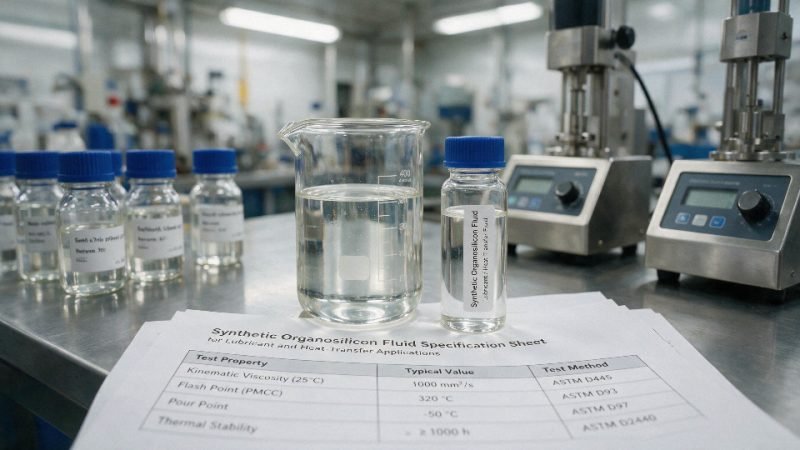
Procurement teams still get tripped up by the word “silicone.” It sounds natural enough to invite the wrong assumptions in lubricants, release agents, defoamers, heat-transfer fluids, and dielectric applications, and that confusion leaks straight into the plant as wrong material approvals, compatibility mistakes, and bad supplier comparisons. The cost shows up later: rejected batches, seal swelling, poor low-temperature performance, or paying a premium for a “natural” story that has nothing to do with how silicone oil is actually made or how it behaves in service.
Silicone oil is generally synthetic, not natural. Most commercial silicone oils are man-made organosilicon fluids, typically based on polydimethylsiloxane or related siloxane chemistries, produced through controlled chemical processing rather than extracted from plants, animals, or mineral reservoirs.
That simple answer hides a few distinctions buyers should care about. “Synthetic” does not mean every silicone oil performs the same, and “silicone” is not the same thing as petroleum oil, mineral oil, or naturally derived oil with a silicone additive package. The practical question is less about the label and more about what origin implies for viscosity range, thermal stability, purity, modification options, and where the material stops being a sensible choice.
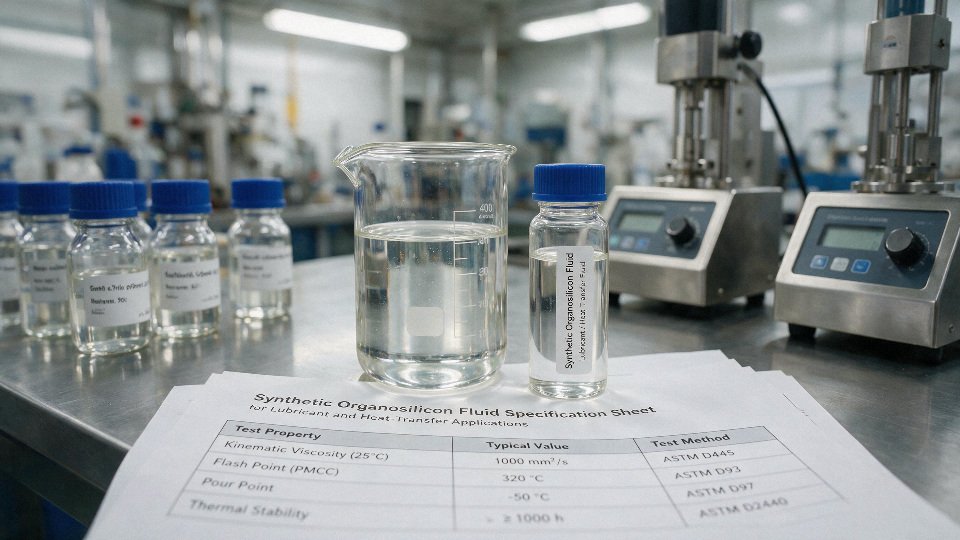
Silicon versus silicone
They are not the same material, and treating them as interchangeable causes purchasing mistakes, specification errors, and bad assumptions about “natural” content. Silicon is an industrially produced element, silica and silicates are mineral forms found in sand and rock, and silicone is a family of synthetic organosilicon materials made through multi-step chemical processing from those upstream feedstocks.
On a plant floor, this confusion shows up in small but expensive ways. A buyer asks whether a silicone fluid is “basically refined sand,” a maintenance team assumes silicone oil and silica filler will behave similarly in heat transfer, or a regulatory form gets filled out as though “silicon” and “silicone” were naming variants of one substance. They are related by supply chain, not by identity.
Elemental silicon is a processed industrial material
Silicon, strictly speaking, is the chemical element Si. In industry, elemental silicon is not pumped from the ground as a fluid and it is not a naturally occurring oil. It is produced by high-temperature reduction of silica-rich minerals, typically in electric furnaces, yielding metallurgical silicon as a solid industrial material.
That distinction matters because “origin” and “form” are doing different jobs here:
- Origin tells you the upstream raw material came from mineral sources such as quartz or silica-rich rock.
- Form tells you what the material actually is when you buy and use it: metal, mineral, monomer, polymer, fluid, resin, elastomer, and so on.
Elemental silicon sits upstream in the chain. It is a feedstock for organosilicon chemistry, electronics, alloys, and other industries. It is not itself silicone oil, and it does not behave anything like a lubricating or dielectric fluid.
In practical procurement terms, if a document says silicon when it means silicone, stop and correct it. The wrong term can ripple into customs descriptions, SDS matching, internal approvals, even maintenance storage rules. I have seen bins and transfer totes labeled loosely enough that operators treated unlike materials as if they were in the same family. That is how contamination starts.
Silica and silicates are minerals, not silicone fluids
Silica usually refers to silicon dioxide, SiO2, found in sand, quartz, and many mineral deposits. Silicates are a broader class of minerals containing silicon and oxygen, often combined with metals such as aluminum, magnesium, calcium, sodium, or potassium. These are common geological materials. They are not silicone oil.
A few distinctions help keep this straight:
- Silica
- Mineral oxide form
- Common in sand, quartz, glass raw materials
- Hard, inorganic, non-polymeric in the way buyers mean when discussing silicone fluids
- Silicates
- Mineral salts or frameworks built around silicon-oxygen units with metal ions
- Found in clays, rocks, ceramics, cements, detergents, fillers
- Silicone
- Synthetic organosilicon polymer or oligomer family
- Contains silicon-oxygen backbone plus organic groups such as methyl, phenyl, amino, vinyl, polyether, or other functional substituents
- Can be a fluid, gum, elastomer, resin, emulsion, antifoam, or modified specialty material
The mechanism behind the confusion is simple: all three involve silicon and oxygen somewhere in the chemistry, but the structure changes the behavior completely. Once you move from mineral oxides and salts into an engineered Si-O backbone with organic side groups, you get the low surface tension, thermal stability, water repellency, flexibility, and viscosity control that make silicone useful. The upstream mineral does not carry those properties forward by default. Manufacturing creates them.
Because silicone ultimately comes from silica, silicone oil is a natural oil.False
Silica is a mineral feedstock. Silicone oil is a manufactured organosilicon polymer produced through several chemical conversion and purification steps. Mineral origin does not make the finished polymer a natural oil.
Silicone is a synthetic family, not one single product
Silicone is a broad commercial category, not one substance. The common feature is a siloxane backbone, meaning repeating Si-O units, modified with organic side groups that tune performance.
That family includes:
- Silicone oils and fluids
- Commonly dimethyl silicone fluids, but also phenyl-modified, amino-modified, and other variants
- Used in lubrication, heat transfer, personal care, release, dielectric service, polishing, antifoam systems
- Elastomers
- RTV, HTV, LSR and related rubber systems
- Used for sealing, gasketing, molding, electrical insulation
- Resins
- Higher-functionality systems for coatings, varnishes, thermal resistance, weatherability
- Emulsions
- Waterborne delivery form for textiles, mold release, surface treatment, polishes
- Antifoams and defoamers
- Often silicone-based active ingredients in process fluids, wastewater, fermentation, coatings, food processing systems, depending on formulation and compliance requirements
- Specialty copolymers and modified silicones
- Polyether-modified, alkyl-modified, reactive-functional grades, and application-specific blends
This is where buyers sometimes overgeneralize. A dimethyl silicone oil with representative density around 0.95 to 0.97 g/cm3 at 25 C and a very wide viscosity range, from roughly 0.65 cSt to well above 1,000,000 cSt depending on molecular architecture, is only one branch of the silicone family. You cannot assume all silicones are clear oils, nor can you assume a “silicone-based” product has the same thermal window, compatibility, or volatility as standard PDMS fluid.
From mineral feedstock to silicone oil: the transformation chain
The production route is the clearest way to separate “mineral origin” from “synthetic product identity.”
- Silica-rich mineral extraction and preparation
- Quartz, sand, or other silica-rich materials are mined and beneficiated.
- This stage is mining and mineral processing, not silicone manufacturing.
- Reduction to metallurgical silicon
- Silica is reduced at high temperature to elemental silicon.
- The output is a solid industrial intermediate.
- Conversion to organosilicon intermediates
- Elemental silicon reacts to form chlorosilanes or, in some process routes, alkoxysilanes.
- These are reactive chemical intermediates, not end-use silicone fluids.
- Hydrolysis and condensation to siloxane intermediates
- The reactive silanes are converted into siloxane structures.
- This is where the backbone chemistry that defines silicone starts taking shape.
- Polymerization, equilibration, modification, and finishing
- Manufacturers build target molecular weight and functionality.
- They then strip volatiles, adjust viscosity, control impurities, and package the finished fluid, gum, resin, or emulsion.
The trade-off in that chain is straightforward: every processing step adds cost, control, and performance separation from the raw mineral source. You gain predictable viscosity, purity, thermal behavior, and application fit; you lose any sensible argument that the final product should be classed as a naturally occurring oil. That conclusion stops holding only if the discussion is about feedstock origin alone rather than product classification, regulatory identity, or material behavior in use.
A useful comparison is synthetic polymer made from plant-derived carbon, or glass fiber sizing built onto mineral fiber. Upstream natural or mineral feedstock does not make the finished chemistry natural in the commercial or technical sense. For silicone oil, the same logic applies: the raw material chain may begin in quartz, but the product in the drum is an engineered synthetic organosilicon fluid.
How silicone oil is made
Silicone oil is made by a multi-stage industrial synthesis route, not pressed, refined, or extracted from a natural feedstock the way vegetable or mineral oils are. The practical proof is the process itself: silica is first converted to silicon metal in a furnace, then reacted into chlorosilane intermediates, then hydrolyzed, condensed, equilibrated, and finished into a controlled siloxane fluid with a target viscosity and impurity profile.
Silicone oil is a manufactured product rather than a naturally occurring oil.True
Industrial silicone fluids are produced through metallurgical and chemical synthesis steps, including silicon metal production, chlorosilane formation, hydrolysis, condensation, and fluid finishing. There is no natural reservoir of silicone oil analogous to petroleum or vegetable oil sources.
The reason buyers should care is straightforward. Quality, consistency, odor, volatile content, dielectric behavior, seal compatibility, and even customer complaint rates are often set upstream, long before the fluid is filled into drums or totes. If you only compare viscosity and price, you can miss the part of the process that determines whether the oil stays stable in service or creates trouble in the line.
From silica to silicon metal: a furnace route, not an oil extraction route
The starting point is usually silica, commonly supplied as quartz or other high-silica raw material, plus a carbon source such as coke, coal, charcoal, or a blend. In a submerged-arc furnace, those materials are reacted at very high temperature to reduce SiO2 to elemental silicon metal. That is a metallurgical conversion. It matters because some marketing language blurs “made from silica” into something that sounds naturally derived; in process terms, it is as synthetic as any other high-temperature industrial intermediate.
A few plant-floor points matter here:
- Raw material purity affects downstream chlorosilane quality
- Iron, aluminum, calcium, and other mineral impurities can carry through into silicon metal.
- Those impurities can influence catalyst behavior later in the direct process.
- Trace metals that seem minor at the furnace stage can become a finishing problem in high-spec electronics, personal care, or release-coating grades.
- Furnace operation affects consistency
- Burden mix, electrode control, furnace temperature profile, and tap practice all influence metal quality.
- Different silicon metal sources are not always interchangeable in sensitive silicone fluid processes, even if they meet a broad metallurgical grade description.
- This step creates cost structure
- Power cost is a major factor.
- Silicon metal economics move with electricity pricing, reductant cost, and regional capacity utilization.
- Buyers sometimes see fluid price shifts and assume packaging or freight caused them; often the pressure started much earlier in the chain.
Converting silicon into chlorosilanes: where organosilicon chemistry starts
The next decisive step is converting silicon metal into organochlorosilanes, most commonly through the direct process. In broad terms, finely divided silicon reacts with an organic chloride feed, often methyl chloride, in the presence of a copper-based catalyst system to form a mixture of methylchlorosilanes. One of the key intermediates is dimethyldichlorosilane, which is the main building block for many standard dimethyl silicone fluids.
This is one of those stages where process know-how separates commodity output from controlled output.
Why the direct process matters so much
- Product distribution is not fixed by chemistry alone
- Reaction temperature, pressure, fluidization quality, silicon particle characteristics, catalyst formulation, promoter package, and residence time all affect the ratio of useful intermediates to byproducts.
- More dimethyldichlorosilane usually supports better economics for standard PDMS fluid production. Lower selectivity means more recycle, more separation load, or less favorable coproduct balance.
- Separation quality matters after reaction
- The crude chlorosilane stream must be fractionated.
- Distillation efficiency determines how cleanly dimethyldichlorosilane and related fractions are isolated.
- Poor separation can leave behind species that shift later hydrolysis behavior, color, odor, or stability.
- Catalyst and corrosion control are not side issues
- Chlorosilane systems are moisture-sensitive and corrosive.
- Handling standards, gasket selection, valve maintenance, and line dryness are not paperwork details. A wet flange or poorly dried transfer line can cause hydrolysis where you do not want it.
There are related routes for certain specialty intermediates, but for mainstream silicone oils, the direct process is the core industrial pathway. That alone should settle the “natural or synthetic” question for any technical buyer.
Hydrolysis and condensation: turning chlorosilanes into siloxane structures
Once the desired chlorosilanes are isolated, they are hydrolyzed. Water reacts with the Si-Cl bonds, generating silanol-containing intermediates and hydrochloric acid, which then condense into siloxane bonds, the Si-O-Si backbone that defines silicone chemistry. Depending on the feed mix and conditions, this stage produces a combination of cyclic siloxanes and linear materials.
The mechanism is worth understanding because it explains several quality issues downstream:
- Water ratio and mixing affect the reaction path
- Too little control can create local overreaction, emulsions, difficult phase separation, or broad product distributions.
- Heat removal matters. Hydrolysis is exothermic, and poor temperature control can widen variability lot to lot.
- Acid removal and neutralization matter later
- Residual acidity can continue to affect condensation, corrosion, odor, storage stability, or compatibility with customer formulations.
- On the other side, overcorrection with alkaline treatment can leave its own residue problems if washing and purification are weak.
- Byproduct handling is commercially relevant
- HCl generation is not trivial. Recovery, scrubbing, materials of construction, and emissions control all add cost and operational complexity.
At this stage you do not yet have a finished silicone oil in the commercial sense. You have a siloxane mixture that must be further built, rearranged, stripped, and finished to hit a usable specification.
Equilibration, polymerization, end-capping, and viscosity control
For linear silicone fluids such as polydimethylsiloxane, the producer typically uses equilibration or controlled polymerization to build the required molecular weight. End-blockers are introduced to cap the chain ends and stop the fluid from continuing to react upward in viscosity. That is how the market gets products spanning from very low viscosity fluids up to extremely high viscosity materials, with typical kinematic viscosity ranges running from about 0.65 cSt to more than 1,000,000 cSt at 25 C depending on grade and structure.
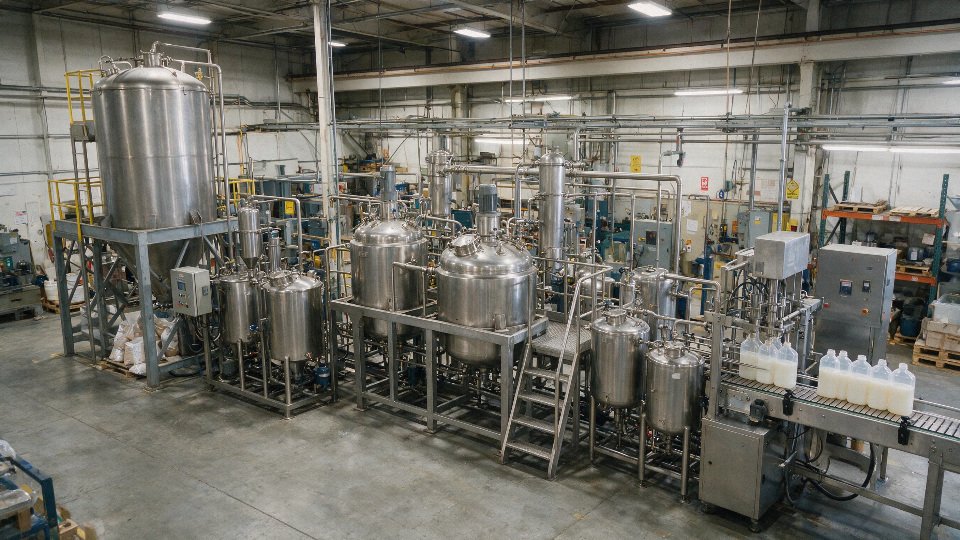
A buyer should not think of viscosity as a simple dilution number. It is tied to molecular architecture.
What controls the final fluid
- Equilibration conditions
- Acid or base catalysts can be used depending on process design.
- Temperature, catalyst strength, and residence time affect how completely the system redistributes into the target chain-length range.
- End-capping strategy
- Trimethylsilyl or other end groups are used to cap linear chains.
- Inadequate end-capping can leave reactive silanol ends that shift storage stability or encourage viscosity drift.
- Volatile stripping
- Low boilers and cyclics are often removed by vacuum stripping or thin-film evaporation.
- This is especially important for applications sensitive to fogging, odor, evaporative loss, or regulatory scrutiny over volatile siloxanes.
- Filtration and polishing
- Fine solids, catalyst residues, or gel particles are removed.
- This is where a fluid can move from “usable” to “reliably clean,” which is not the same thing.
The trade-off is familiar in production. Tighter control over molecular weight distribution and lower volatile content usually improves consistency, flash-off behavior, and customer acceptance, but it costs more in processing time, energy, yield loss, and analytical control. For a low-end defoamer carrier or a noncritical release application, that extra refinement may not pay back. For textile finishing, personal care, electronics, or precision lubrication, it often does.
This conclusion stops holding if the customer’s process is insensitive to volatiles, trace residues, and viscosity drift. In a forgiving application, a broad-spec fluid can work perfectly well and may be the better commercial buy.
How modified silicone oils are made
Modified silicone oils start from the same siloxane backbone but are changed by introducing other groups into the molecule, either during synthesis or through post-functional modification. That is how suppliers tailor performance far beyond standard dimethyl silicone oil.
Common modifications include:
- Phenyl-modified
- Improves low-temperature fluidity in some systems, changes refractive properties, and often helps thermal behavior.
- Amino-modified
- Adds reactivity and affinity to certain substrates, widely used where softness, adhesion, or conditioning effects are required.
- Polyether-modified
- Increases compatibility with water or polar systems and changes wetting, spreading, and emulsifiability.
- Hydrogen-containing
- Provides reactive Si-H functionality for further crosslinking or addition reactions.
- Fluorinated
- Used where chemical resistance, low surface energy, or demanding lubrication environments matter.
- Alkyl-modified
- Alters lubricity, compatibility, and tactile properties.
- Other reactive functional groups
- Epoxy, methacrylate, mercapto, and similar groups are introduced for coating, release, textile, or adhesion-driven systems.
The mechanism here is direct: change the side group, and you change intermolecular interactions, polarity, surface behavior, and reactivity. That affects wetting on metal versus plastic, foam control in aqueous versus solvent systems, oxidation resistance, or whether the fluid stays clear in a formulation. It also changes cost, because specialty intermediates, tighter reaction control, and lower production scale all push the number up.
Where quality variation shows up in the finished drum
Two silicone oils can share nominal viscosity and still behave differently in the customer’s process. In my experience, the usual hidden drivers are:
- Catalyst residues
- Can affect cure systems, dielectric performance, color stability, or long-term storage.
- Cyclic content and light volatiles
- Influence evaporation loss, odor, fogging, and compliance review.
- Moisture
- A nuisance in some applications, a serious defect in others, especially moisture-sensitive formulations.
- Acidity or alkalinity
- Residual acid or base can destabilize downstream blends or interfere with reactive systems.
- Color and odor
- Often treated as cosmetic, but they are a useful warning sign of upstream control quality or contamination.
- Trace metals
- Critical in certain electronic, optical, and catalytic applications.
A counter-intuitive point is worth saying plainly: the silicone oil that feels “more industrial” on paper, because it has tighter impurity limits, more stripping, more finishing, and more lot control, is often safer and more predictable in actual production than a loosely described fluid marketed with softer natural-sounding language. Buyers do not get reliability from the story around the product; they get it from controlled chemistry and verified finishing.
If a fluid will be used in a sensitive formulation or regulated end use, ask for more than a viscosity line on the COA. Residual volatiles, acid or alkali, moisture, color, and any application-specific contaminants are where the process history becomes commercially visible.
Why the natural label fails
Silicone oil should not be bought, specified, or marketed as a natural oil in any serious industrial context. The reason is simple: natural oils are typically extracted from biological or mineral sources and then refined, while silicone oil is a deliberately synthesized polymer fluid with a man-made siloxane backbone.
That distinction is not semantic. It affects regulatory claims, customer documentation, internal material approval, and even whether purchasing compares the right suppliers against the right performance requirements. I have seen buyers lose weeks arguing over “natural versus synthetic” while the actual failure risk sat somewhere else entirely, usually viscosity stability, volatility, purity, or compatibility with seals and coatings.
What industry usually means by a natural oil
In practice, a natural oil is understood as a fluid obtained from a naturally occurring source and processed by physical separation, purification, or relatively limited chemical treatment. The feedstock already exists in nature as an oil or oil-bearing material. You may refine it hard, bleach it, deodorize it, winterize it, hydrogenate it, or fractionate it, but you are still starting from something nature produced.
Typical categories include:
- Vegetable or seed oils
- Soybean oil
- Rapeseed oil
- Castor oil
- Coconut oil
- Palm-derived fractions
- Animal-derived oils or fats
- Fish oils
- Tallow derivatives
- Lanolin-related materials
- Mineral oils
- Petroleum reservoir fluids separated and refined into usable hydrocarbon fractions
The important common feature is not that these materials are untouched. They are often heavily processed. The common feature is that they are source-extracted, not built by polymer synthesis into a new molecular backbone.
Silicone oil does not fit that pattern. There is no field, reservoir, seed, or animal source from which polydimethylsiloxane fluid is physically harvested. The finished fluid exists because manufacturers carry out chemical synthesis steps, purification, and controlled chain-building to create the product.
Silicone oil does not occur in nature as a harvestable fluid
Silicone oil is synthetic because it must be intentionally manufactured from precursor chemistry. Earlier in the article, the production route already established that point; what matters here is the procurement implication. You are not buying a refined natural oil with incidental cleanup. You are buying a designed polymer fluid whose properties come from how the chain was built, equilibrated, stripped, filtered, and sometimes modified.
That matters because performance is tied to synthesis choices:
- Viscosity depends largely on polymer chain length and molecular weight distribution
- Volatility is affected by low-molecular-weight cyclics and short chains left after processing
- Oxidative and thermal behavior depends on backbone chemistry, end groups, purity, and the operating system
- Compatibility shifts with functional modification, additives, contamination, and surrounding materials
A standard dimethyl silicone oil may cover an extremely wide viscosity range, roughly from about 0.65 cSt to above 1,000,000 cSt at 25 C, precisely because it is not a single naturally occurring fluid. It is a family of engineered materials. That kind of controlled spread is one of the practical tells that you are dealing with synthetic manufacture, not natural extraction.
Silicone oil can be accurately described as a natural oil because silicon is abundant in nature.False
Abundance of elemental silicon or silica in nature does not make silicone oil natural. Silicone oil is a synthetic organosilicon polymer produced through industrial chemical conversion and controlled polymer formation.
The terms buyers confuse most often
A lot of bad specifications come from mixing five different ideas into one sentence. They are not interchangeable.
| Term | What it actually means | Does it make silicone oil natural? |
|---|---|---|
| Natural origin | Derived directly from naturally occurring material already present in usable form | No |
| Bio-based content | Some carbon content comes from biomass-derived feedstock | Not by itself |
| Renewable content | Feedstock may be replenished on a biological timescale | No |
| Mineral origin | Derived from petroleum or geological reservoir sources | No; also different from silicone |
| Synthetic manufacture | Built through intentional chemical synthesis into the target substance | Yes, this is the correct category for silicone oil |
The confusion usually starts with silicon, silica, or sand. Yes, the broader raw-material chain ultimately traces back to mineral resources. That still does not make the final silicone fluid a natural oil any more than stainless steel is a natural metal ore or nylon is a natural fiber.
A second source of confusion is partial bio-based formulation. You may see a blend containing silicone oil plus plant oil, natural ester, or bio-based additive. The blend may have some renewable or bio-based content. That does not change the identity of the silicone fraction. Unless the chemistry is genuinely different and documented as such, the silicone portion remains synthetic.
Where the wrong label creates commercial and regulatory risk
Calling silicone oil natural may sound harmless in casual sales language. It is not harmless once the claim gets copied into a specification, brochure, customs file, cosmetic dossier, or ESG spreadsheet.
The main risk areas are:
- Cosmetics and personal care communications
- “Natural” claims are often scrutinized against ingredient-origin rules, private certification schemes, and brand claim standards.
- A silicone-containing formula may still be perfectly acceptable, but it should not be presented as natural simply because it feels inert or comes from a mineral resource chain.
- Food-contact communications
- Industrial buyers sometimes overstate status in technical sheets or distributor summaries.
- If a fluid is being considered around food processing equipment, release coatings, or incidental-contact environments, claims must track the actual regulatory basis and approved use conditions, not marketing shorthand.
- ESG and sustainability reporting
- Internal reporting teams may wrongly classify silicone oil with renewable or naturally derived materials.
- That can distort Scope 3 narratives, sustainable sourcing claims, and supplier scorecards.
- Customer specifications and tender language
- “Natural oil preferred” can accidentally exclude suitable silicone fluids, or worse, let in unsuitable products because no one defined what natural meant.
- I have seen RFQs where the natural/synthetic question got more attention than the actual performance envelope.
- Cross-border regulatory review
- Different markets treat ingredient claims, product descriptors, and customs-supporting documents with different levels of scrutiny.
- Loose wording that passes in one market can trigger questions in another, especially for cosmetics, consumer goods, and specialty process aids.
The more useful questions procurement should ask
The natural-versus-synthetic debate often hides the practical selection work. For silicone oil, the buying decision usually turns on form, purity, modification, and process fit, not on a marketing-origin label.
A useful procurement review should ask:
- Is the fluid linear dimethyl silicone, or is it modified?
- Phenyl-modified, amino-modified, polyether-modified, and other variants behave differently in lubrication, wetting, release, defoaming, and thermal service.
- What viscosity range is actually needed at operating temperature?
- Room-temperature cSt alone is not enough if the system sees cold starts, pump recirculation, or high-film-temperature exposure.
- Is the grade inhibited, uninhibited, highly purified, or technical grade?
- Those differences can affect storage stability, odor, residue, cyclic content, volatility, and suitability for sensitive manufacturing.
- What is the contamination tolerance?
- In some plants, trace carryover from surfactants, metal fines, moisture, or previous batch chemistry causes more trouble than the base fluid choice.
- What approvals, declarations, or compositional disclosures are required?
- This is where regulatory fit is decided, not by calling the product natural.
The trade-off is straightforward. A loose “natural” label may make early conversations easier with non-technical stakeholders, but it usually makes qualification harder later because the term does not tell operations, QA, or EHS what they actually need to know. The conclusion only changes if the product under review is not silicone oil at all, but a different chemistry being misnamed in the market. In that case, start over from composition, not from brochure language.
Property profile
Silicone oil earns its place in industrial service because the siloxane chain behaves differently from either vegetable oils or standard mineral hydrocarbons. The Si-O backbone is unusually flexible, and the molecular attraction between chains is relatively low, so you get a combination that is hard to duplicate: broad temperature usability, predictable flow behavior across temperature swings, and clean surface performance in applications where many organic oils thicken, oxidize, or leave gum.
That advantage is structural, not marketing language. A typical dimethyl silicone fluid can be supplied from roughly 0.65 cSt to well above 1,000,000 cSt at 25 C, with representative density around 0.95 to 0.97 g/cm3 at 25 C. Standard dimethyl grades are often used in continuous service somewhere around -50 C to 200 C, but the actual upper limit depends on exposure time, air contact, local hot spots, contamination, and whether the system is open or sealed. A buyer who treats that window as a blanket guarantee usually ends up disappointed.
Why the siloxane structure changes performance
The core mechanism is simple enough to use in buying decisions. The Si-O bond geometry leaves the polymer chain more flexible than a comparable carbon-chain fluid, and that flexibility remains useful at low temperature, where many natural and hydrocarbon oils lose mobility fast. At the same time, low intermolecular attraction helps silicone oils maintain relatively smooth flow over a wide temperature span and gives them low surface tension, which is why they spread easily and wet many surfaces aggressively.
That combination affects plant behavior in several ways:
- Cold-start performance
- Silicone oil usually stays mobile at temperatures where mineral oils become sluggish and many natural oils are no longer practical.
- In instrument damping, outdoor actuators, and low-temperature baths, this can be the difference between immediate response and a startup lag that trips alarms.
- Viscosity-temperature behavior
- Silicone oils generally show less dramatic viscosity change across temperature than many hydrocarbons.
- In practice, that means less drift in damping force, heat-transfer circulation, or release-film formation as ambient conditions move from winter mornings to a hot machine enclosure.
- Boundary lubrication feel
- They often provide good lubricity in light-load or mixed-service regimes because the fluid spreads well and forms a persistent film.
- That should not be confused with high load-carrying ability under extreme-pressure metal contact; those are not the same thing.
The trade-off sits right there in the same structure. Low intermolecular attraction helps flow and spreading, but it also means silicone oils can migrate into places you do not want them, contribute to foam in some recirculating systems, and contaminate coating or painting lines at very low carryover levels. One leaking seal upstream of a paint booth can create days of finger-pointing.
Key physical properties buyers should read correctly
Property sheets matter, but only if you read them as a family of behaviors rather than isolated numbers.
| Property | Typical silicone-oil behavior | What it means on the plant floor |
|---|---|---|
| Kinematic viscosity | About 0.65 cSt to over 1,000,000 cSt at 25 C | Very wide formulation latitude for damping, lubrication, heat transfer, release, defoaming, and processing |
| Volatility | Lower as molecular weight and viscosity increase; chemistry also matters | Low-viscosity grades may evaporate or lose mass faster in hot open systems |
| Surface tension | Typically lower than many hydrocarbon and natural oils | Strong spreading, release behavior, wetting, migration, contamination risk |
| Compressibility | Usually higher than mineral oils | Can matter in hydraulic or pressure-transfer uses where stiffness is critical |
| Dielectric behavior | Often good electrical insulating performance | Useful in electrical and electronic fluid applications, but verify grade purity and current standards |
| Density | Roughly 0.95 to 0.97 g/cm3 for common PDMS fluids at 25 C | Different pump calibration, level indication, and phase-separation behavior than water or many oils |
| Refractive index | Usually lower than many organic oils and varies with chemistry | Relevant in optical, cosmetic, and process-visibility applications |
| Oxidation resistance | Often better than many natural oils, especially at moderate heat | Cleaner service life, less varnish and sludge in the right operating window |
A few of these deserve extra caution.
Volatility is not the same as thermal stability
A silicone fluid can be chemically stable yet still be the wrong choice for an open hot process if the viscosity is too low. Low-viscosity grades often have higher vapor loss, and residual cyclic content can matter in vacuum service, electronics, and sealed assemblies. Buyers sometimes look at “service temperature to 200 C” and assume low evaporation. That is a mistake. In an open tank, a thin fluid may slowly walk away even when it is not decomposing.
Dielectric performance depends on cleanliness, not just base chemistry
Silicone oils are widely respected as dielectric fluids, but moisture, ionic contamination, byproducts, and field conditions all change the result. If the application is electrical insulation, corona exposure, or transformer-adjacent service, do not generalize from generic PDMS data. Verify against the specific grade, test method, and end-use equipment requirement.
Oxidation behavior is usually favorable, but not unlimited
Compared with many natural oils, silicone oils resist oxidation well and are less prone to forming sticky oxidation products under moderate thermal stress. Once local temperatures climb high enough, especially in the presence of air, catalytic metals, or contaminants, the chemistry can still shift toward viscosity increase, volatile formation, or deposits. Heater-skin temperature often matters more than bulk temperature. I have seen systems “rated” comfortably on paper fail because a compact electric heater ran much hotter than the sump sensor suggested.
Silicone oil is always non-reactive and maintenance-free at high temperature.False
Silicone oils are generally more oxidation-resistant than many natural and hydrocarbon oils, but service life still depends on fluid type, air exposure, contamination, hot-spot temperature, and system design. Open heated systems and localized overheating can still drive fluid loss or degradation.
How silicone oil compares with natural and hydrocarbon oils
Against common natural oils, silicone oil usually wins on cold-flow behavior, oxidation resistance, and consistency over temperature. Vegetable-derived oils can offer strong lubricity and are attractive in some biodegradable or food-adjacent contexts, but they are more vulnerable to oxidation, polymerization, acidity shift, and residue formation when heat and air exposure stack up. In a lightly maintained line, that often shows up as gum, darkening, and sticky deposits.
Against hydrocarbon oils, the picture is more mixed.
- Where silicone oil is often better
- Low-temperature mobility
- Viscosity stability over temperature
- Water repellency
- Clean release behavior
- Lower tendency toward carbonaceous residue in many moderate-heat applications
- Where hydrocarbon systems may be better
- Extreme-pressure lubrication with the right additive package
- Cost per liter
- Compatibility with common seals, paints, and downstream finishing operations
- Lower gas solubility in some services
- Broader familiarity for maintenance teams
The preferred choice flips when the duty shifts from thermal consistency and surface behavior to high-load tribology or cost-driven bulk lubrication. If a gearbox, chain, or heavily loaded metal contact depends on EP additives and sacrificial boundary films, silicone oil is often the wrong starting point unless the formulation is specifically engineered for that job.
Limitations buyers should put on the RFQ, not discover after startup
Silicone oil solves some ugly operating problems. It also creates a few of its own.
- Poor extreme-pressure performance
- Standard silicone fluids are not a substitute for EP gear oils or heavily additized compressor lubricants.
- Under high contact stress, they can lose badly to hydrocarbon or synthetic hydrocarbon packages built for antiwear and EP duty.
- Elastomer compatibility issues
- Some elastomers swell, soften, or change dimension in silicone-fluid contact.
- Seal compatibility must be checked against the exact fluid chemistry, temperature, and dwell time. “Rubber compatible” is too vague to buy against.
- High gas solubility
- Silicone oils can dissolve more gas than many competing fluids.
- In vacuum systems, damping devices, and rapid pressure-cycle service, that can affect bubble release, compressibility, and response stability.
- Foam tendency in some systems
- Low surface tension helps spreading, but entrained air handling is not automatically ideal.
- Agitation pattern, return-line design, and contamination level matter. A quiet reservoir on paper may still foam if the line dumps above fluid level through a badly aimed elbow.
- Paint and coating contamination
- Even trace silicone carryover can cause fisheyes or surface defects.
- This is one of the biggest operational boundaries: if the process sits anywhere near painting, printing, adhesive bonding, or certain coating lines, housekeeping and containment standards need to be much tighter.
- Cost sensitivity
- Silicone oil is often chosen for a problem it uniquely solves, not because it is cheapest.
- If the service does not truly need its temperature range, surface behavior, or dielectric profile, the premium may not survive a procurement review.
The advanced suitability checks buyers often miss
Good headline properties do not guarantee a good application fit. The failures I see most often come from not matching the fluid to the actual operating window.
Check these before approval:
- Volatility at the real operating temperature
- Use the actual bulk temperature, likely hot-spot temperature, and whether the system is open, vented, vacuum-exposed, or sealed.
- A fluid that works in a sealed damper may fail in an open heated pan.
- Cyclic level and low-molecular fractions
- These can matter for evaporation loss, odor, fogging, and some regulatory or customer-specific requirements.
- If this is a sensitive electronics, personal-care-adjacent, or vacuum application, ask for grade-specific information rather than assuming all silicone oils are equivalent.
- Shear environment
- Silicone oils are often mechanically stable, but pump type, clearances, and high-shear recirculation still matter, especially in very high-viscosity grades or formulated blends.
- A gentle jacketed kettle and a tight gear pump are not the same service.
- Substrate wetting and migration
- Low surface tension can be an asset in mold release and defoaming, or a problem in coating, adhesion, and contamination-sensitive assembly.
- Verify on the actual substrate, not a generic coupon.
- Additive and material compatibility
- Antifoams, pigments, elastomers, plastics, adhesives, and process residues can all change behavior.
- If the fluid enters a blended system, bench compatibility work is cheap compared with a shutdown.
The practical message is straightforward: silicone oil’s synthetic structure gives it a property set that natural oils rarely match across temperature, oxidation, and surface behavior. But selection only holds up when the grade, viscosity, volatility profile, and compatibility package are tied to the equipment, contamination sensitivity, and maintenance reality of the line.
Grades and modifications
The practical buying question is rarely “synthetic or natural” once silicone oil is on the table. It is which silicone fluid family, molecular architecture, viscosity band, and purity level fit the process, because a commodity dimethyl fluid and a reactive organomodified silicone can behave like completely different products in the same plant.
A lot of purchasing mistakes start with the label “silicone oil” being treated as if it were one material. It is a broad commercial bucket. In practice, application results depend more on chain structure, functional groups, volatility profile, and contamination control than on the generic name on the drum.
Linear dimethyl silicone oils: the baseline industrial grade
For many industrial uses, linear dimethyl silicone oils, typically PDMS-based fluids, are the default reference point. They are usually the right starting point when you need inertness, broad viscosity availability, electrical insulation behavior, surface slip, or stable lubricity without asking the fluid to chemically bond, cure, or emulsify itself into water.
These are the products most buyers mean when they say “silicone oil.” They are sold across a very wide viscosity range, roughly from very low centistoke fluids up to extremely heavy materials, with standard dimethyl grades often used where the main job is physical rather than reactive:
- Light lubrication for plastics, elastomers, and instrument components
- Release and anti-stick service
- Dielectric and insulating fluid roles
- Heat-transfer related use in suitable closed systems
- General-purpose antifoam bases and formulation intermediates
- Surface conditioning and polish systems
The mechanism is straightforward: chain length drives viscosity, and viscosity strongly affects film persistence, mobility, leakage tendency, and damping behavior. A 10 cSt fluid may spread fast and wet narrow geometries well, but it will migrate and evaporative loss becomes more relevant than with a 1,000 cSt or 10,000 cSt grade. The heavier grade stays put better, yet it pumps worse, traps air longer, and can turn a simple metering setup into a maintenance complaint once the weather cools down.
That trade-off matters on the plant floor. For a release application, a low- to mid-viscosity dimethyl oil may give cleaner laydown and less drag-out. For a damping or sealing application, that same fluid can be too mobile, too easy to sling off, or too likely to creep into places you do not want contamination.
The conclusion stops holding when the application needs chemistry rather than baseline inertness. If you need water dispersibility, substrate anchorage, textile affinity, crosslinking, or resistance to a particularly aggressive medium, straight dimethyl oil is often the wrong family even if the viscosity looks attractive on paper.
Low-viscosity and volatile silicone fluids
If spreading, fast surface renewal, or controlled evaporation matters, buyers move into low-viscosity silicone fluids and volatile fractions. These are common in defoaming systems, personal care, process aids, specialty cleaners, and thin-film applications where residue profile matters as much as lubricity.
Typical decision points include:
- Whether the fluid should remain on the surface or flash off
- Whether the process can tolerate VOC-related review or local environmental controls
- Whether rapid wetting is helpful or causes migration into bond lines, print areas, or coating defects
- Whether downstream painting, bonding, or labeling is sensitive to silicone contamination
The evaporation profile is not a side issue here; it is often the whole point. Lower molecular weight silicone fluids spread quickly because they have lower viscosity and lower surface tension, then some grades dissipate faster than standard non-volatile oils. That helps in applications where you want temporary slip or process aid performance without a heavy residual film. It hurts when operators expect durable lubrication or long-term release from a fluid that was never meant to stay.
In defoaming, this is one of the easiest places to get burned commercially. A low-viscosity silicone can knock down foam fast, but if it is too mobile or too incompatible with the system, you may see craters, fisheyes, or unstable control. The cheapest drum price often loses to the grade that gives slower but cleaner foam control.
High-viscosity fluids, ultra-high-viscosity grades, and silicone gums
Once you move into high-viscosity and ultra-high-viscosity materials, you are no longer buying “just an oil” in the everyday sense. You are often buying rheology, film strength, damping response, or an intermediate for downstream compounding.
These materials are used in:
- Damping media
- Grease and compound manufacture
- Pressure-sensitive and release-related intermediate systems
- Personal care structuring
- Rubber and elastomer compounding aids
- Specialty surface treatment concentrates
The practical distinction is that handling changes before chemistry does. A very high viscosity silicone fluid or gum may need heated transfer, follower-plate pumping, or specific drum unloading equipment. In winter, the same product that looked manageable in a sample jar can become a shift-long unloading problem. Procurement should check not only viscosity at 25 C, but also how the material will be transferred, metered, and cleaned from lines.
Phenyl-modified silicone oils
Phenyl modification is selected when standard dimethyl grades run out of room, especially at temperature extremes or in optical and specialty electrical uses. Depending on the exact structure, phenyl-containing fluids can offer improved low-temperature flexibility, better radiation resistance in some environments, and higher refractive index than straight PDMS.
That does not make them universally better. They usually cost more, and the value only appears if the duty actually needs that property shift. If your issue is ordinary release, routine lubrication, or generic antifoam duty, phenyl modification can be expensive overkill. If your issue is cold-start response, optical matching, or service in a harsher radiation environment, it may be the grade that keeps the system stable.
Reactive organomodified silicone oils
Reactive silicone oils are where many non-specialists get misled by the word “oil.” Amino-, epoxy-, and other functional silicones are not just passive fluids; they are designed to interact with substrates, resins, fibers, or crosslinking systems.
Common families include:
- Amino-modified silicones for textile softening, hand feel, fiber lubrication, and some surface conditioning systems
- Epoxy-modified silicones for adhesion promotion, resin compatibility, and certain coating or treatment systems
- Other organofunctional silicones tailored for specific substrate affinity or formulation compatibility
Mechanistically, the functional group changes how the silicone sits at the interface. Plain PDMS tends to migrate toward low-energy surfaces and provide slip. An amino or epoxy functionality can improve attraction to polar substrates or participation in a curing network. That can improve durability, wash fastness, adhesion, or coating integration. The sacrifice is usually simplicity: reactive grades are more formulation-sensitive, more likely to have shelf-life constraints, and more likely to create variability if pH, catalysts, or mixing order drift.
This is where supplier claims need close reading. “Modified silicone oil” says almost nothing by itself. Buyers should ask:
- What is the functional group?
- Is the product nonreactive, self-reactive, or intended for a specific curing chemistry?
- What is the active content?
- Is it neat fluid, solvent-based, or emulsion form?
- What substrate was the performance claim generated on?
A reactive silicone oil can be selected mainly by viscosity, just like standard PDMS.False
For reactive organomodified silicones, functional group type, compatibility, active content, and cure or deposition behavior are often more important than viscosity alone. Viscosity still matters for handling and laydown, but it does not define performance by itself.
Polyether-modified silicone oils
Polyether-modified silicones sit in the overlap between silicone behavior and surfactant behavior. They are widely used where wetting, leveling, controlled foam behavior, agrochemical spreading, or water-dispersibility matters.
Typical uses include:
- Coating wetting and leveling additives
- Controlled defoaming or foam management
- Water-based formulations
- Agrochemical adjuvants
- Emulsifiable or self-dispersing treatment systems
The trade-off is classic surface chemistry. More polyether character usually improves compatibility with polar systems and helps water dispersibility, but it can reduce the clean, hydrophobic, high-slip behavior associated with straight dimethyl silicones. In some formulations, too much compatibility means the additive stays dissolved rather than migrating effectively to the interface where you wanted it to work.
Hydrogen silicone fluids and other reactive intermediates
Hydrogen silicone fluids, often carrying Si-H functionality, are usually bought as intermediates rather than final-use “oils” in the casual sense. They are used in water repellents, crosslinking systems, and hydrosilylation-based formulations where the fluid must react with another component.
Typical buying concerns are different from those for commodity PDMS:
- Functional content consistency
- Catalyst compatibility
- Storage stability
- Moisture sensitivity in the formulated system
- Safety and handling under the intended reaction conditions
For these materials, application testing is not optional. Small changes in functional content or catalyst balance can shift cure speed, network density, byproduct profile, and finished-surface behavior.
Fluorinated and other specialty silicone fluids
Fluorinated silicones and other specialty-modified fluids are niche products for difficult environments: chemical exposure, special lubrication demands, unusual solvent contact, or tightly defined surface-energy behavior. They can solve problems standard silicones cannot, but they should be justified by the duty. Lead times, qualification burden, and cost are usually higher, and substitutes are not always straightforward.
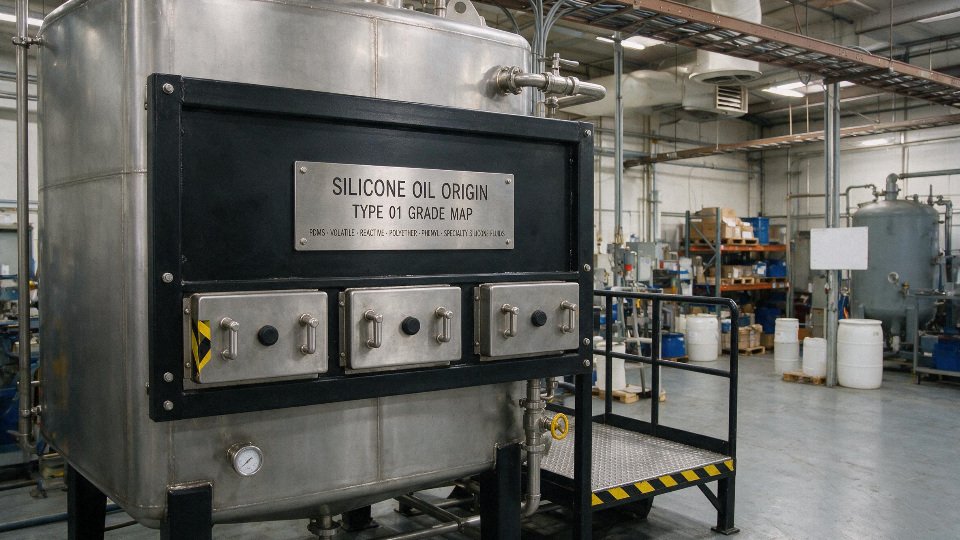
For technical buyers, the useful distinction is not broad category marketing but functional family. If a supplier offers “silicone oil” without clearly identifying whether it is linear dimethyl, volatile fluid, phenyl-modified, amino-functional, polyether-modified, hydrogen-functional, or another specialty type, you do not yet have enough information to compare offers responsibly.
Application-specific implications
Across most industries, the fact that silicone oil is synthetic matters less as a marketing label than as a design constraint: you are buying a fluid with a controllable molecular structure, not a naturally variable extract. That changes how you evaluate fit-for-purpose, because performance depends on chain length, functional modification, purity, delivery form, and how the fluid behaves inside your actual process window.
A textile mill, a mold shop, and an electronics assembler may all buy “silicone oil,” but they are not buying the same thing in any meaningful engineering sense. The same siloxane backbone that gives broad thermal stability and lubricity can also create residue, fish-eyes, paint rejection, filter blinding, or contamination if the wrong grade gets into the wrong line. In practice, the useful question is almost never “Is it natural?” It is “Does this silicone fluid, at this viscosity and this form, survive my process without creating downstream trouble?”
Textiles and leather
In finishing lines, silicone oil is usually selected because it can deliver hand feel, slip, sewability, and some water repellency in one chemistry family, but the exact result depends heavily on whether you are using a neat fluid, a macroemulsion, a microemulsion, or a functional silicone softener.
A few points decide whether the line runs cleanly:
- Softness and smoothness
- Lower-viscosity or well-emulsified products usually give a cleaner, less greasy hand.
- Higher molecular weight or amino-modified systems often improve softness and slickness, especially on cotton and blends.
- The trade-off is build-up risk on guides, rollers, and needles if pickup is too high.
- Sewability
- Silicone reduces yarn-to-metal and fabric-to-metal friction, which helps needle penetration and can cut heat generation at the needle.
- That benefit flips if overdosed finishes transfer to sewing equipment and start attracting lint.
- Hydrophobicity
- Plain dimethyl fluids can improve surface water beading, but durable repellency usually needs a more engineered system, often used with silanes, resins, or reactive finishes.
- On leather, the target is often balanced feel and water resistance, not maximum repellency at any cost.
- Emulsion stability and bath compatibility
- Hard water, pH drift, cationic/anionic incompatibility, and residual auxiliaries can break silicone emulsions.
- Once an emulsion destabilizes, you stop applying a controlled finish and start applying spots, deposits, and shade variation.
- Yellowing risk
- Amino-functional silicones are useful, but they can increase yellowing risk during drying, curing, or long storage, especially on whites and pale shades.
- Heat history, fabric chemistry, optical brighteners, and catalyst residues all matter here.
If a finisher is struggling with uneven hand or oily streaks, I would check bath compatibility before blaming the silicone itself. The synthetic nature helps because the product can be tailored tightly, but it also means you need the right ionic type, particle size, and add-on level for that bath.
Release agents and mold processes
For mold release, synthetic silicone fluids earn their place on thermal endurance and low surface energy, but they are also one of the fastest ways to create downstream finishing problems when applied carelessly.
Key selection issues are usually these:
- Thermal endurance
- Standard dimethyl silicone oils often tolerate repeated exposure better than many hydrocarbon or vegetable-based release fluids, though actual mold temperature and cycle time still govern life.
- Continuous service figures for generic silicone oils do not automatically equal release performance at the tool face.
- Migration behavior
- Low-viscosity fluids spread well, but they also migrate more easily onto non-target surfaces.
- That matters in multi-cavity molds, automated handling, and any line feeding paint, adhesive, printing, or bonding.
- Residue control
- Too much release agent causes part contamination, dust pickup, and mold fouling.
- Too little gives sticking, short cycles interrupted by manual intervention, and surface damage on demolding.
- Paintability and bondability
- Silicone contamination is notorious because even trace transfer can cause craters or adhesion loss in downstream coatings.
- If parts must be painted, printed, plasma treated, or bonded, release chemistry needs to be screened around the entire finishing route, not just the mold.
- Dilution system
- Solvent-based, water-based, and neat systems each change wetting, drying behavior, operator exposure profile, and housekeeping.
- Water-based systems can reduce some handling issues, but they add emulsion stability and drying-rate variables.
A silicone-based release agent is always the safest choice for high-temperature molding.False
Silicone release agents often perform well at elevated temperatures, but 'safest choice' depends on downstream paintability, residue tolerance, mold material, polymer being molded, and application method. In some lines, a non-silicone system is selected specifically to avoid contamination in later finishing steps.
Lubrication and damping
In lubrication and damping assemblies, silicone oil’s synthetic consistency is a big advantage because viscosity can be specified across a very wide range, roughly from below 1 cSt to well above 1,000,000 cSt at 25 C depending on grade. That range lets designers target free movement, controlled damping, or seal-friendly fluid behavior without jumping to a different chemistry family.
What matters on the ground:
- Viscosity selection
- Low viscosity supports fast movement and easier filling.
- Higher viscosity improves damping and leakage resistance, but raises drag and can complicate dispensing in cold conditions.
- Shear conditions
- Silicone oils are often chosen where stable damping feel matters over time.
- Still, extreme shear, aeration, or contamination can change apparent performance in service.
- Material compatibility
- Compatibility with elastomers, plastics, adhesives, and coatings must be checked case by case.
- “Silicone-compatible” is not a universal truth. Some seals swell, some plastics craze, some greases separate.
- Seal performance
- A very low-viscosity fluid may leak past seal designs that were adequate for thicker oils.
- The practical path is matching fluid viscosity to seal geometry, shaft finish, pressure variation, and assembly tolerance stack-up.
- Long-term stability
- In instruments, dampers, and some automotive subassemblies, oxidation resistance, volatility, and viscosity retention matter more than initial feel on day one.
This is one of the clearer examples where synthetic origin is useful commercially: you can buy repeatable viscosity targets and tighter lot-to-lot behavior than many natural-fluid systems. That conclusion weakens, though, if the assembly is limited by seal design or material incompatibility rather than by the fluid itself.
Electronics and electrical uses
For electrical and electronics applications, the selling points are usually dielectric behavior, thermal stability, and low-temperature fluidity. The risk side is contamination. A fluid that looks clean in a drum can still be unacceptable around contacts, optics, sensors, conformal coating lines, or vacuum-adjacent components if purity and outgassing are not tightly controlled.
Buyers usually need to verify:
- dielectric requirements against the actual equipment spec, not a generic family claim
- volatility and outgassing limits for enclosed or sensitive assemblies
- ionic and particulate cleanliness where residues can affect reliability
- compatibility with potting compounds, plastics, labels, and connector materials
- whether any trace migration could interfere with contact resistance, soldering, or coating adhesion
Low volatility is relative, not absolute. In a sealed electrical system, even small mass loss over time can redistribute onto colder surfaces, and that is where trouble starts.
Personal care and household formulations
In these markets, the synthetic origin has two immediate implications: sensory performance is highly tunable, and claim language gets sensitive fast. Formulators choose among non-volatile fluids, lower-viscosity spreading fluids, and more volatile silicone classes depending on slip, dry feel, gloss, residue, and evaporation profile.
Commercially, the decision points are usually:
- Sensory profile and spreadability
- Silicone fluids can reduce tack, improve combability, and give a dry-smooth afterfeel that natural oils often struggle to match consistently.
- Volatility class
- Some formulations need quick flash-off; others need persistent conditioning.
- Volatility also affects packaging, worker exposure review, and regional acceptance.
- Regulatory documentation
- INCI naming, composition disclosure, and market-specific documentation need to align with the exact material supplied.
- Natural claim sensitivity
- If the brand platform depends on “natural,” “naturally derived,” or similar language, silicone content needs legal and marketing review before launch.
A lot of trouble here is not technical failure but positioning failure: a technically excellent formula can still be commercially wrong if the claim set and ingredient story do not match.
Process industries and defoaming
In antifoam service, silicone chemistry is powerful because it can knock down foam quickly at low treat rates, but persistence and side effects matter as much as first-pass knockdown. The wrong antifoam can fix the foam problem and create a filtration, coating, or cleanliness problem somewhere else.
Watch these factors:
- Foam knockdown versus persistence
- Fast knockdown is useful in reactors and tanks, but some systems need sustained control through recirculation, heating, or high agitation.
- Carrier selection
- Silicone actives may be supplied in water, oil, emulsion, or compound form.
- Carrier choice affects dosing, dispersion, storage stability, and whether the antifoam spreads where it is needed.
- Food or pharma constraints
- Where these apply, the exact grade and supporting documentation must be checked against the current regulatory framework and plant requirements.
- Side effects
- Silicone antifoams can interfere with membrane filtration, surface coating quality, printability, or downstream analytical cleanliness in some systems.
If a plant is seeing sporadic foam return after an initial good result, I would look at dispersion and dosing location before raising dosage. A badly placed injection quill can make a decent antifoam look weak.
Construction, coatings, and water repellency
In masonry, coatings, and surface treatment, silicone fluids are rarely judged by origin story. They are judged by whether the substrate stays dry without trapping water, losing appearance, or failing early under UV and weathering.
Selection usually turns on:
- Substrate response
- Dense concrete, porous brick, mineral render, gypsum-based materials, and painted surfaces do not absorb or anchor treatment the same way.
- Reactive versus non-reactive fluids
- Non-reactive fluids can improve water beading and slip, but reactive systems often give more durable substrate bonding in water-repellent applications.
- Weatherability
- UV exposure, alkalinity, freeze-thaw cycling, and salt environment all change treatment life.
- Integration with silanes or emulsions
- Many practical systems are not just “silicone oil”; they are formulated packages combining silicone fluids with silanes, siloxanes, emulsifiers, or resins to get penetration, cure, and durability where needed.
Across these sectors, the practical takeaway is steady: the operational decision is usually not whether silicone oil is natural, but whether the chosen structure, purity, viscosity, and delivery form fit the process, the downstream quality requirements, and the compliance envelope. If those three do not line up, the fact that the fluid is synthetic will not save the line.
Compliance and sustainability
Silicone oil should usually be treated as a synthetic industrial chemical that may or may not be compliant for a given market, use, or formulation depending on its exact chemistry, impurity profile, and documentation set. For buyers, the practical job is not to argue “synthetic versus natural” but to verify whether the supplied grade is correctly registered, declared, controlled, and supportable for the intended application and destination country.
The first place this shows up is in product paperwork. In most industrial supply chains, silicone fluids are described through a combination of SDS, TDS, regulatory statements, and application-specific declarations, and each document does a different job.
- SDS (Safety Data Sheet)
Usually identifies the substance or mixture, hazard classification if applicable, handling precautions, and transport information. It is not a performance document, and it often does not disclose a full formulation if the product is proprietary. For silicone oils, the SDS may identify a PDMS-type substance broadly, but buyers should not assume that broad naming answers inventory, food-contact, or emissions questions. - TDS (Technical Data Sheet)
Normally gives viscosity, density, appearance, flash point range, and sometimes volatility or surface-tension data. Useful for process selection, but not enough for compliance. A TDS will not reliably tell you whether a fluid is listed on the required chemical inventory or whether low-level cyclic content is controlled tightly enough for your sector. REACH-related or regional inventory status statements
These matter when material is sold into the EU, UK, US, and other regulated markets. The buyer should verify the exact legal status relevant to the shipment model: registered, exempt, polymer treatment, monomer coverage, Only Representative support, or inventory listing under the destination regime. Those details are product- and jurisdiction-specific; they cannot be inferred from “silicone oil” as a category.Food-contact, pharma, personal-care, or electronics declarations
These are application-limited statements, not universal badges. A supplier may provide a declaration for a particular grade under a defined use condition, migration limit, purity standard, or sector framework. That does not automatically carry over to another viscosity, another package size, or another region.Sector-specific statements
In practice this includes declarations on intentionally added substances, restricted substance lists, biocompatibility support data, residual volatile content, or statements aligned to OEM requirements. Buyers in automotive, electronics, textile, and release-coating work usually need these before production approval, not after the first complaint.
If a silicone oil is synthetic, it is automatically worse for compliance than a natural oil.False
Compliance depends on the specific substance identity, impurity profile, intended use, regional regulation, and supporting documentation. Natural-origin materials can be restricted, sensitizing, unstable, or unsuitable for regulated use; synthetic materials can be fully acceptable when properly characterized and controlled.
That point is worth being blunt about: synthetic does not automatically mean environmentally poor, and natural does not automatically mean safer or permissible. A vegetable oil that oxidizes fast, forms deposits, or varies seasonally can create waste, downtime, cleaning labor, and scrap that a stable synthetic fluid avoids. On the other hand, a synthetic fluid with a poor emissions profile in an open process can become a regulatory headache even if its in-service performance is excellent.
What matters more than the natural label is the full use-cycle.
Sustainability factors buyers should actually evaluate
- Manufacturing efficiency
Integrated upstream control can reduce rework, transport legs, and off-spec material generation. That matters, especially in high-volume commodity viscosities where the margin for hidden process inefficiency is thin. Energy intensity
The production route, purification burden, and plant utilities profile matter more than marketing language. This usually requires supplier-level data; it cannot be read from a generic chemistry name.Product longevity in service
A fluid that lasts two or three maintenance intervals longer can reduce total consumption, labor exposure, line stoppages, and disposal frequency. In sealed systems, this often has more environmental relevance than whether the feedstock sounds “natural.”Dosage efficiency
In defoaming, release, lubrication, or surface modification, a lower treat rate can offset a higher unit price. The mechanism is straightforward: better film behavior or stability reduces the amount needed to achieve the same process effect, which cuts packaging waste and residuals downstream.Waste reduction and service-life extension
If the silicone fluid prevents sticking, lowers wear, or stabilizes processing temperature, it may reduce rejects and extend component life. That benefit is genuine, but it only counts if the chosen grade is actually matched to the application.Impurity control
This is one of the least glamorous and most important points. Trace volatiles, residual catalysts, gels, and particulates can drive odor, fogging, cure interference, dielectric issues, or customer returns. Sustainability reports rarely dwell on that, but plants pay for it quickly.
Persistence and environmental scrutiny need a chemistry-specific view
Some siloxane chemistries face environmental scrutiny, particularly where persistence, bioaccumulation concerns, volatility, or diffuse emissions are part of the exposure picture. The right assessment depends on:
- the specific siloxane chemistry
- whether the use is closed-system, semi-open, or open application
- the emissions pathway during processing and use
- the regional regulatory position
- the end-of-life route, including incineration, recovery, wastewater exposure, or landfill restrictions
This is where broad statements fail. A high-viscosity PDMS used in a controlled industrial process is not assessed the same way as a lower-molecular-weight volatile siloxane in a consumer-dispersive application. Buyers should verify current regional restrictions and supplier declarations against the exact grade, because these positions do change.
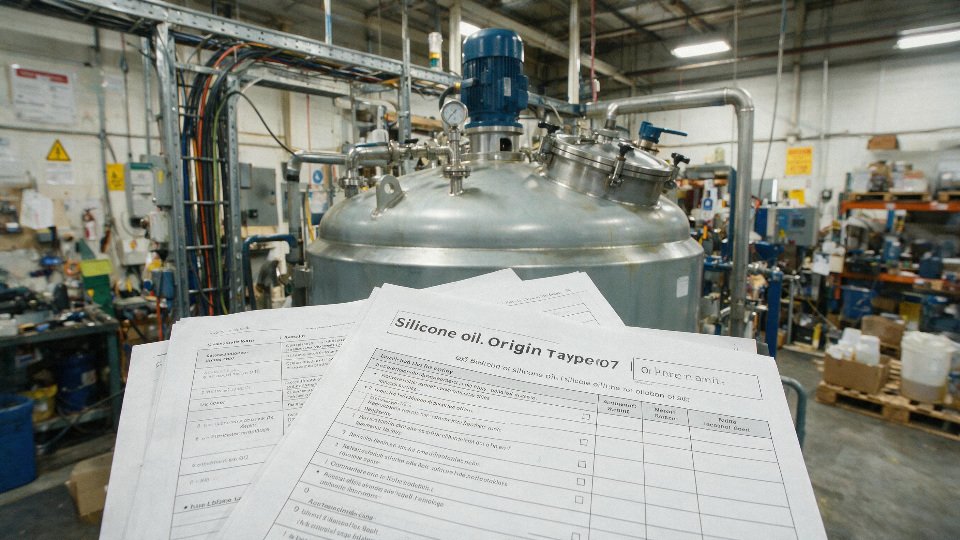
What supplier transparency should look like
A credible supplier should be able to support at least the following:
- Clear product identity: CAS-based or composition-based description at a useful level
- Composition disclosure appropriate to the purchase: enough for regulatory review without expecting trade-secret surrender
- Cyclic siloxane control data where relevant: especially for markets or sectors sensitive to low-molecular-weight species
- Batch traceability: raw material lot linkage, production date, and retention practice
- Change management: notification rules for raw material, process, or specification changes
- Third-party testing support: either internal COA plus external lab support, or acceptance of customer verification testing
- Auditable quality systems: not just a certificate on a website, but a working process for deviation control and corrective action
A cost-optimized, integrated manufacturing chain can absolutely improve affordability and consistency. You see it when upstream intermediates, finishing, and packaging are controlled in one system instead of being traded through multiple hands. But that advantage only holds if the supplier can document what changed, what did not change, and how each batch stays inside the agreed impurity and performance window. Without that discipline, low price is just delayed cost.
Frequently asked questions
Is silicone oil petroleum-based?
Not in the way mineral oils or most hydrocarbon synthetic oils are. Standard silicone oil is an organosilicon polymer made through a chemical process built around silicon-containing intermediates, then reacted with methyl or other organic groups; petroleum may sit somewhere upstream in the broader chemical supply chain, but the finished fluid is not a refined petroleum fraction.
That distinction matters on spec sheets and in approvals. A buyer comparing silicone oil with white oil, paraffinic oil, or PAO should treat silicone as a different chemistry family, with different compatibility, volatility behavior, and regulatory treatment. If someone says “petroleum-free,” ask whether they mean no petroleum-derived feedstocks anywhere in manufacture, or simply “not a mineral oil.” Those are not the same claim.
Is silicone oil derived from sand?
Yes, partly, but that shorthand can mislead. Industrial silicone oil ultimately comes from silicon derived from silica, which is commonly sourced from quartz or sand, then converted through high-temperature processing and subsequent synthesis into chlorosilanes and finally siloxane polymers.
So “made from sand” is not wrong, but it skips the hard part. The performance comes from a heavily engineered synthetic route, not from a direct natural extraction. In procurement terms, this is like saying stainless steel is “made from rocks.” True at a distance, not useful for qualification.
Is silicone oil biodegradable?
Usually not in the simple sense buyers often expect from the word. Most standard dimethyl silicone oils are not selected because they biodegrade quickly; they are selected because they stay stable across temperature and time.
Biodegradability depends on molecular structure, viscosity, additives, environmental conditions, and the test method used. Some modified silicone fluids can show different environmental behavior, but you should not generalize from one grade to the whole category. If disposal route, wastewater risk, or environmental labeling matters, request the supplier’s SDS, ecological data, and the exact test basis rather than accepting a broad “eco-friendly” claim.
Silicone oil is biodegradable because it comes from silica.False
Silica origin does not make the final polymer readily biodegradable. Environmental fate must be verified for the specific grade and test method.
Is silicone oil safe for skin, food-contact, or medical use?
Sometimes, but only by grade and intended use. A silicone oil that works well as a release aid in a textile line is not automatically acceptable for skin-contact, food-related equipment, or medical devices.
For approval, check the exact product designation and supporting documents:
– Skin or personal-care use: ask for cosmetic or topical suitability documentation, purity profile, and residual volatile or impurity information.
– Food-contact-related use: verify the relevant regional compliance basis, migration limits where applicable, and whether the grade is intended for incidental contact, processing aid use, or direct contact.
– Medical use: this is the tightest case; require formal medical-grade documentation, biocompatibility data where applicable, change-control expectations, and lot traceability.
In practice, many qualification failures come from assuming “silicone” means universally inert and acceptable. It often behaves gently in use, but compliance sits on paperwork and grade control, not reputation.
Can silicone oil be called organic?
Chemically, it is an organosilicon material because it contains organic groups bonded to silicon. Commercially and regulatorily, calling it “organic” without context is a bad idea, because many readers hear that as “natural” or “certified organic,” which silicone oil is not.
If you need precise language, use “synthetic organosilicon fluid” or “siloxane fluid.” That avoids a lot of pointless back-and-forth with quality, regulatory, and customers.
What is the difference between silicone oil and mineral oil?
They may both be clear, slippery fluids, but they behave very differently. Silicone oil is a siloxane polymer; mineral oil is a petroleum-derived hydrocarbon mixture.
A quick comparison helps:
| Parameter | Silicone oil | Mineral oil |
|---|---|---|
| Chemistry | Organosilicon polymer | Petroleum hydrocarbon |
| Typical temperature stability | Often broader; standard dimethyl grades commonly used around -50 C to 200 C depending on system | Usually narrower, grade-dependent |
| Surface behavior | Very low surface tension, strong spread | Higher than silicone oils |
| Oxidation behavior | Often better in heat exposure, depending on grade | Typically more prone to oxidation/varnish over time |
| Compatibility | Can swell or interfere with some elastomers, coatings, and paint systems | Different compatibility profile; often better with hydrocarbon-based systems |
| Density at 25 C | Roughly 0.95 to 0.97 g/cm3 for common PDMS grades | Often lower, grade-dependent |
The trade-off is simple: silicone oil usually wins on thermal range and surface properties, while mineral oil often wins on raw material cost and easier fit in hydrocarbon-based formulations. That flips if your process cannot tolerate silicone contamination; one bad transfer pump or reused tote can create paint defects or bonding trouble.
Does synthetic mean lower quality than natural?
No. In industrial fluids, synthetic often means the opposite: tighter control of molecular structure, viscosity, volatility, and service behavior.
Natural oils can work very well where renewability, lubricity, or formulation familiarity matter. They usually struggle once the job needs long thermal exposure, low-temperature flow, dielectric stability, or low surface tension over a wide operating window. The boundary is application-driven, not ideological. If the duty is mild and cost pressure is high, a natural oil may be perfectly adequate.
Why do some suppliers use the terms silicone fluid and silicone oil interchangeably?
Because in many markets they refer to the same broad product family, especially for PDMS-based materials. “Fluid” is the safer technical term because some grades are very low viscosity and behave more like a process fluid than what operators casually call an oil.
Still, the terms are not always perfectly interchangeable. Some suppliers use “silicone fluid” as an umbrella term covering modified siloxanes, reactive fluids, emulsions, or specialty blends. When buying, do not approve from the name alone; confirm:
– polymer type
– viscosity at 25 C
– whether it is neat fluid or formulated blend
– volatility or molecular weight range if relevant
– any functional modification
Can natural oils replace silicone oil in industrial formulations?
Sometimes, but only in a narrow part of silicone oil’s application range. If the silicone is there mainly as a low-cost lubricant, carrier, or temporary processing aid in a mild-temperature system, a natural oil may be worth screening.
Replacement usually fails for one of these reasons:
– temperature window is too wide
– oxidation stability is inadequate
– viscosity drifts too much over temperature
– odor, color, or residue is unacceptable
– dielectric or defoaming behavior changes the process
– microbial stability or storage life becomes a problem
A bench test is cheap compared with a production upset. If the line has heaters, vacuum, corona treatment, downstream painting, or adhesive bonding, test under those exact conditions before even talking about substitution.
What certificates or test data should a buyer request before approval?
Start with the documents that control risk, not the ones that just decorate the supplier file.
Request, as applicable:
1. Technical data sheet
– viscosity at 25 C
– density
– refractive index if relevant
– volatile content or molecular weight indicators where needed
– recommended service temperature window
- Safety data sheet
- hazard classification
- handling and spill guidance
- transport information
- composition disclosure limits
- Certificate of analysis for each lot
- actual viscosity result
- appearance
- moisture, acidity, or other agreed critical values
- Regulatory declarations
- REACH status if relevant
- food-contact statement where needed
- cosmetic, pharma, or medical declarations only if specifically applicable
- Application-specific test data
- compatibility with elastomers, plastics, coatings, or substrates
- dielectric properties
- foam control performance
- thermal aging or volatility data
- Quality and supply assurance
- manufacturing site identity
- ISO certification if available
- change-notification policy
- traceability and retention sample practice
If approval risk is high, ask for a retained sample from the production lot, not just a lab sample from a nice clean bottle. That one detail has saved plenty of arguments after drums arrive.
Your next supplier check
Treat silicone oil as a synthetic organosilicon fluid, not a natural oil category. That shifts supplier evaluation onto the points that actually decide performance and risk in purchase orders: chemistry, purity, batch consistency, documentation, and whether the grade fits the process you are running rather than the label printed on the drum.
A lot of bad buying starts with a generic request for “silicone oil 100 cSt” and ends with avoidable trouble: haze in a coating, unstable defoaming, seal swell, odor complaints, or a line trial that behaves nothing like the bench sample. Viscosity matters, of course, but it is only one control variable. For many applications, the wrong modification package, carrier, or residual volatile profile will hurt performance faster than a small viscosity mismatch.
Buyer checklist: what to lock down before you compare prices
Use a specification sheet or RFQ checklist that covers the fluid you actually need in service:
- Target viscosity at the stated test temperature
- Silicone fluids span roughly 0.65 cSt to above 1,000,000 cSt at 25 C.
- Make sure all offers quote the same test basis. A number without temperature is incomplete.
- Modification type
- Plain PDMS
- Amino-modified
- Polyether-modified
- Phenyl-modified
- Reactive or specialty functional siloxanes
The preferred chemistry flips with the job. A release application, textile hand feel, defoaming package, and lubricant formulation may all use “silicone oil,” but not the same molecule.
- Volatility window and cyclic content
- Especially relevant for coating, personal-contact, electronics-adjacent, and closed-environment uses.
- Lower-volatility material may reduce odor, weight loss, and deposit formation, but it can cost more and may change wetting or spreading behavior.
- Active matter and carrier system
- Is the delivered product neat fluid, an emulsion, a solvent dilution, or a formulated concentrate?
- In defoamers and textile auxiliaries, active content changes freight cost, dosing accuracy, and plant performance.
- Appearance-related controls
- Color
- Odor
- Clarity or haze
- Visual cleanliness
These are not cosmetic if the fluid goes into transparent coatings, white textiles, molded parts, or any customer-facing finish.
- Moisture and acidity/alkalinity
- Moisture can upset hydrolysis-sensitive systems.
- Residual acidity or alkalinity can interfere with catalysts, finishes, or substrate stability.
- Compatibility
- Substrates: metals, plastics, elastomers, textiles, paper, coatings
- Additives: surfactants, solvents, resins, antistats, catalysts, waxes
In practice, this is where line trials save money. A drum of technically “correct” silicone can still separate in your blend tank or crater your coating.
Commercial verification: what separates a usable supplier from a trading layer
Ask direct questions, and expect specific answers rather than brochure language:
- Production route capability
- Can the supplier actually make the relevant siloxane type, or only resell standard PDMS?
- Integrated upstream supply
- Better upstream integration usually improves cost stability and batch continuity, though it does not replace QC.
- Batch traceability
- Lot coding, retained records, and raw material linkage matter when you are handling claims or requalification.
- QC methods
- Ask which tests are run routinely: viscosity, volatile content, moisture, color, acid value or pH-related checks, density where relevant, and any application-specific release or foam tests.
- Sample retention and complaint support
- If a batch issue appears six weeks after receipt, can they pull a retain and investigate?
- Change-control policy
- If a supplier cannot define how formulation, raw material source, or process changes are communicated, assume you are carrying the requalification risk yourself.
- Lead time and packaging options
- Pails, drums, IBCs, ISO tanks, private labeling if relevant.
- Packaging detail matters more than buyers sometimes admit. A high-viscosity fluid that pours fine in summer can become a handling nuisance in winter if the pack size and unloading method are wrong.
- Export documentation support
- COA, SDS, packing list, origin documents, and any application-specific compliance declarations your market requires.
A silicone oil supplier should be qualified on application fit and process control, not on natural-origin language.True
Silicone oil is an industrially synthesized organosilicon fluid. For procurement and technical approval, the meaningful differentiators are chemical type, purity, consistency, QC discipline, and compliance support.
Ask for recommendations by application, not by name alone
For textile finishing, release, defoaming, lubrication, coatings, or specialty modified silicone use, send the operating details and ask the supplier to narrow the grade family before you order a production quantity. Generic naming hides too much. The same “silicone oil” label can cover fluids with very different spreading, compatibility, volatility, and downstream behavior.
A useful inquiry should include:
- Substrate material
- Contaminant or process problem being addressed
- Approximate layer thickness or add-on level, if relevant
- Working area or application method
- Required finish or performance target
- Target production rate
- Clear part photos or representative samples
- Any regulatory or documentation requirements

If you are qualifying a silicone oil or modified siloxane grade, send the application conditions, target performance, and compliance requirements. SiliconChemicals can review the use case, shortlist suitable silicone oil or specialty modified silicone materials, and support evaluation with technical data, sample review, and export documentation aligned to the grade under consideration.