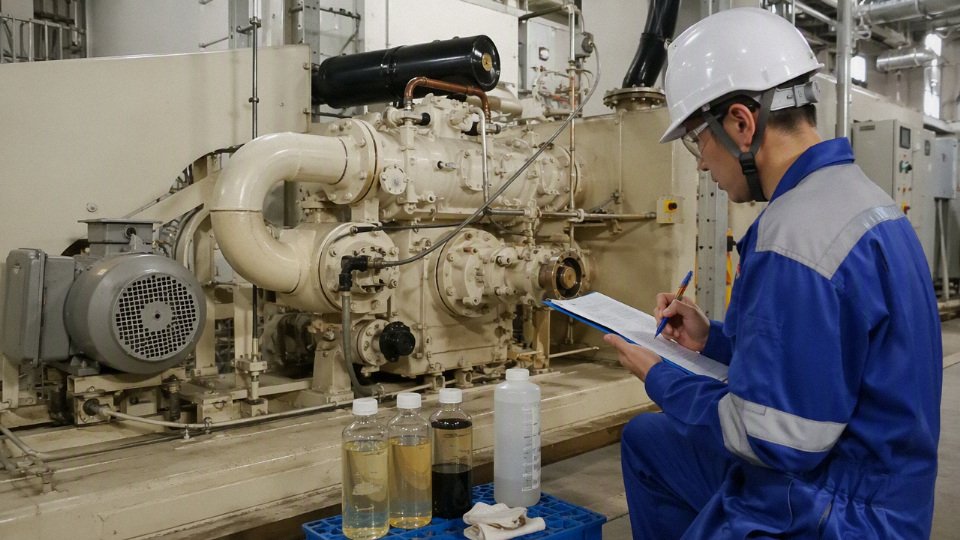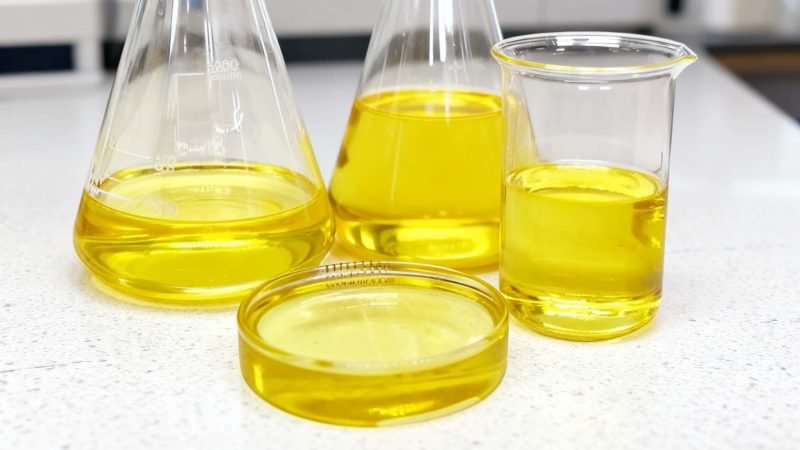
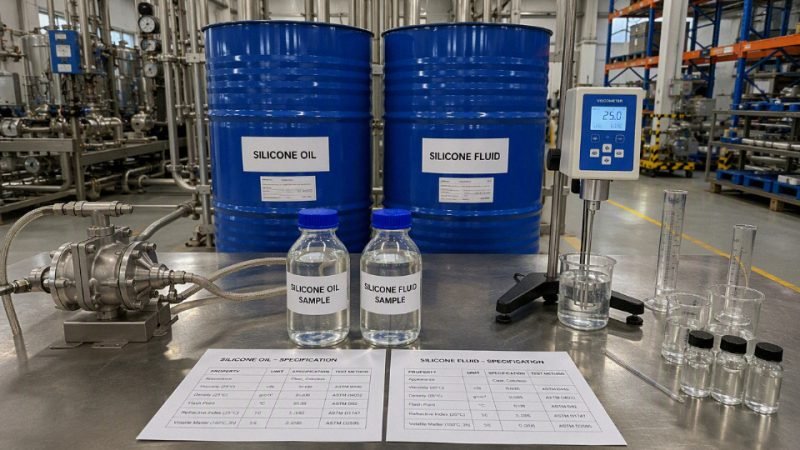
Teams lose time and money over this distinction more often than they should. A buyer asks for “silicone oil,” engineering means a heat-transfer or release-grade PDMS fluid, QC expects a certain viscosity window, and the supplier quotes a broader silicone fluid category that may include modified chemistries with very different wetting, volatility, or temperature behavior. On the plant floor, that turns into misapplied lubricants, unstable dosing, finish defects, requalification work, and sometimes a full batch hold when the fluid does not behave like the last drum. The fix is not semantic; it is to separate naming convention from functional specification before you issue the PO.
Silicone oil is usually a subset of silicone fluid, not a completely different material class. In industrial use, “silicone fluid” is the broader term for pourable silicone-based liquids across a wide viscosity range, while “silicone oil” often refers more narrowly to oil-like silicone liquids, commonly PDMS-based, used for lubrication, heat transfer, release, damping, or processing.
That sounds simple until you get into actual buying decisions. Viscosity can run from roughly 0.65 cSt to well above 1,000,000 cSt at 25°C depending on polymerization and chemistry, density is usually around 0.93-0.98 g/cm3 for typical PDMS materials, and the same product family label can cover straight dimethyl silicone fluids and modified versions built for foam control, slip, or compatibility. If your application depends on flow, film persistence, surface interaction, or service temperature, the naming shortcut stops helping very quickly.
Chemical families and structures
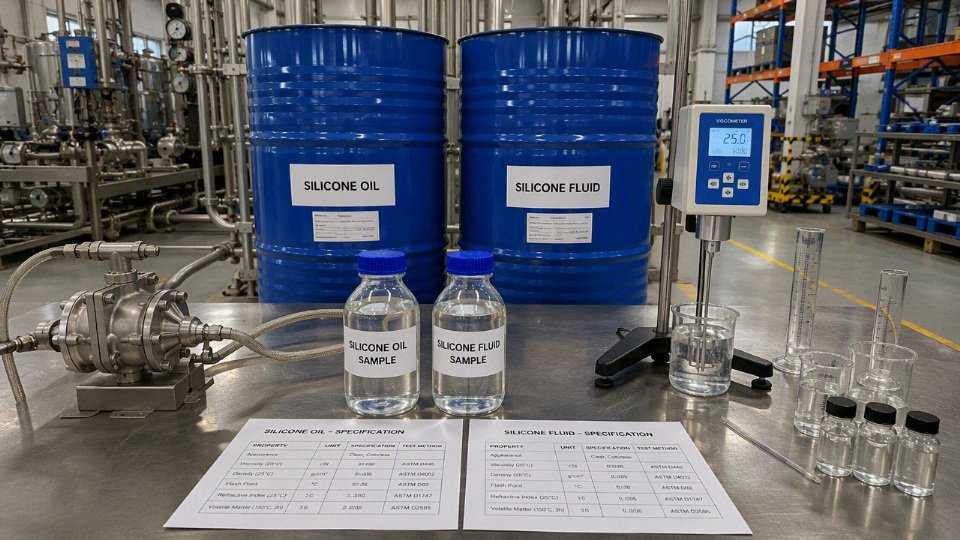
At the molecular level, most products sold as silicone oil or silicone fluid are siloxane polymers built on the same Si–O backbone, and the useful differences come from what is attached to that backbone, how long the chains are, and what sits at the chain ends. In practice, that is why two drums can both say “100 cSt silicone fluid” yet behave very differently in wetting, volatility, cure response, foam control, or compatibility with your formulation.
The backbone is the easy part. A typical silicone polymer is made of alternating silicon and oxygen atoms, written broadly as a repeating siloxane chain, with organic side groups attached to the silicon. That Si–O structure matters because it is more flexible than a carbon-carbon backbone, and that flexibility is a big reason silicone materials keep moving at low temperature, stay stable over a fairly wide service range, and hold their rheology differently from mineral oils or many organic polymers.
For many industrial buyers, PDMS, or polydimethylsiloxane, is the default base chemistry behind both “silicone oil” and “silicone fluid” labels. In PDMS, the side groups are mostly methyl groups. That gives the classic balance the market expects: low surface tension, decent thermal stability, water repellency, electrical insulation behavior, and a viscosity range that can run from nearly water-like material to very heavy, slow-pouring liquids depending on polymerization degree. Typical kinematic viscosity can span roughly 0.65 cSt to well above 1,000,000 cSt at 25°C, but that range is not one chemistry behaving identically throughout; the handling, pumpability, and film behavior shift a lot across it.
Why chain length changes so much
The simplest way to picture it is this: short siloxane chains act more like mobile fluids, long chains start to entangle and resist flow. Same backbone family, very different plant behavior.
A few consequences matter on the floor:
- Low molecular weight material
- Lower viscosity
- Easier pumping and metering
- Usually better spreading
- Often higher volatility and greater weight loss risk at elevated temperature
- More likely to migrate if used as an additive
- Higher molecular weight material
- Higher viscosity
- Better film persistence and lubricity in some uses
- Harder to filter, transfer, and clean out of lines
- Can trap air more easily during blending
- May need heated lines, drum warmers, or slower fill rates
The mechanism is straightforward: as chain length rises, intermolecular entanglement increases, so the liquid resists shear more strongly even though the chemistry family is still “silicone.” That gives you body and persistence, but you pay in handling. A 10 cSt product and a 100,000 cSt product may both be PDMS, yet one will run through a small gear pump and a standard basket strainer with no fuss, while the other may need positive-displacement pumping, careful startup temperature control, and patience from the operator.
That conclusion stops holding once the structure changes materially. A modified silicone of modest viscosity can process worse than a simple PDMS of higher viscosity if it is reactive, moisture-sensitive, or incompatible with the rest of the system.
Linear, branched, and reactive end-blocked structures
Not all silicone fluids are just plain linear chains.
Linear fluids
These are the standard workhorse materials. Their chains are mostly unbranched, so viscosity tracks molecular weight in a fairly predictable way. If a buyer asks for “silicone oil” without more detail, this is often what they mean: non-reactive or minimally reactive PDMS used for lubrication, release, dielectric service, antifoam bases, textile treatment, or as a formulation component.
Slightly branched fluids
A little branching can change flow and film behavior without making the material a solid resin. Branching often raises effective viscosity at a given molecular weight and can alter spread, cohesion, and stability in blends. In practice, these products may feel “heavier” than a linear fluid with a similar nominal viscosity, and they can behave differently in coating holdout or migration resistance.
The trade-off is useful: branching can improve persistence or reduce excessive flow-off on a surface, but it can also complicate emulsification, make residue harder to remove, or shift the way the material responds under shear.
Reactive end-blocked fluids
Here the chain ends are not just passive caps. Terminal groups such as hydroxyl, vinyl, hydrogen, amino, epoxy, or alkoxy can make the fluid a reactive intermediate rather than just a lubricant or carrier. Those end groups control what happens next:
- whether the fluid can crosslink
- whether it can graft onto another polymer
- whether it can be emulsified more easily
- whether it needs moisture control during storage and transfer
- whether catalyst residues or contamination become a quality risk
This is one place where naming gets messy commercially. A supplier may sell a reactive silicone as a “fluid” because it is flowable, but chemically it is much closer to a functional intermediate than a simple oil.
Products with the same viscosity can have very different performance if their side-group or terminal-group chemistry differs.True
Viscosity reflects resistance to flow, but it does not uniquely define volatility, surface tension, polarity, reactivity, compatibility, or cure behavior. Those depend strongly on side groups, end groups, molecular weight distribution, and formulation details.
What the side groups actually change
The side groups are where silicone chemistry stops being generic.
| Side group or modification | What it typically changes | Where it matters commercially |
|---|---|---|
| Methyl | Baseline PDMS behavior, low surface tension, broad utility | General-purpose oils, release, lubrication, defoamer bases |
| Phenyl | Better low-temperature flexibility in some grades, improved refractive index, often better heat/radiation behavior than plain methyl systems | Heat transfer blends, optical and specialty thermal applications |
| Amino | Higher affinity for some substrates, cationic or polar interactions, softer hand in textile use | Textile finishing, polishes, surface conditioning |
| Epoxy | Reactive functionality for curing or bonding into systems | Coatings, additives, reactive intermediates |
| Vinyl | Enables addition-cure chemistry with appropriate crosslinkers/catalysts | RTV, LSR, crosslinkable systems |
| Hydrogen | Reactive Si–H sites for hydrosilylation or other downstream reactions | Crosslinkers, intermediates, release and coating systems |
| Fluoro | Better resistance to fuels, solvents, and some aggressive chemicals | Specialty lubrication, seals, chemical-contact uses |
| Polyether | Improved water dispersibility, altered foam behavior, changed compatibility with organic phases | Surfactants, defoamers, wetting agents, emulsifiable systems |
A few of these deserve a practical note.
- Phenyl-modified silicones are not just “higher performance” in a vague sense. They are chosen when plain dimethyl chemistry stops meeting optical, thermal, or low-temperature requirements. They also cost more, so they only make sense when that property shift solves an actual failure mode.
- Amino and polyether modifications often improve substrate interaction or dispersibility, but they also increase formulation sensitivity. Tanks that happily handle straight PDMS can end up with stubborn residues or phase issues once modified fluids are introduced.
- Vinyl- and hydrogen-functional fluids may look like ordinary clear liquids in receiving, but they are purchasing-critical materials because contamination, inhibitor carryover, or wrong catalyst matching can ruin a downstream cure system.
Why viscosity alone is not enough
Buyers often over-trust viscosity because it is easy to specify and easy to compare. It is necessary, but it is nowhere near sufficient.
Two silicone products at the same stated viscosity can differ materially in:
- surface tension and wetting behavior
- volatility and flash-off tendency
- compatibility with mineral oils, solvents, resins, or water
- dielectric performance
- emulsification route and stability
- cure reactivity
- substrate affinity
- residue character after heating
The mechanism is simple: viscosity mainly reflects molecular size and flow resistance, while those other properties depend heavily on molecular architecture and polarity. So if the application is release, leveling, foam control, textile hand, or reactive compounding, buying “equivalent viscosity” from the wrong silicone family is a common and expensive mistake.
This is why some products sold as silicone oil are basically base polymers, while some sold as silicone fluids are engineered functional materials. The first group is often bought by viscosity grade and purity. The second has to be bought by application logic: side-group chemistry, terminal functionality, compatibility window, and what the fluid is expected to do after it leaves the drum.
Property differences that matter
A silicone liquid is usually specified first by viscosity grade, but performance in service is often decided by a second layer of properties: volatility, thermal behavior, wetting, compatibility, dielectric strength, and how the fluid actually stays on a surface. Two products can both be called “silicone oil,” both look water-clear in a bottle, and still behave very differently in a release line, damping unit, textile bath, or personal-care blend.
Viscosity gets attention because it is easy to measure, easy to quote on a datasheet, and strongly tied to handling. Across silicone fluids, the kinematic viscosity range is broad, roughly from about 0.65 cSt to above 1,000,000 cSt at 25°C depending on chemistry and polymerization degree. In practice, buyers often start there because viscosity affects pumping, dosing, atomization, film thickness, migration tendency, and whether the product will stay where you put it.
That said, viscosity is only the first screen.
Viscosity behavior: necessary, but not sufficient
For standard dimethyl silicone fluids, higher molecular weight usually means higher viscosity. On the plant floor, that translates into very different handling behavior:
- Low-viscosity grades flow fast, spread easily, and are simple to meter through small lines and nozzles.
- Mid-range grades are common where a persistent but still workable film is needed.
- High-viscosity grades resist runoff and evaporation better, but they can create dosing problems, air entrainment, and slow cleanout.
The mechanism matters. Viscosity affects:
– Residence on the substrate: thicker fluids tend to remain longer before draining or migrating
– Application method: spray, roll coat, dip, and gravure all respond differently to fluid thickness
– Heat transfer and circulation: lower viscosity reduces pumping load and improves flow in narrow passages
– Damping response: higher viscosity usually increases resistance to motion, but the geometry of the device still controls the final damping curve
A common mistake in procurement is treating viscosity grade as a proxy for all performance. It is not. A 100 cSt dimethyl fluid and a 100 cSt modified silicone may have similar flow numbers at 25°C but very different spreading, compatibility, and retention once applied.
Higher viscosity does not automatically mean better lubrication, better release, or lower migration. If the fluid does not wet the substrate well, or if it is incompatible with the surrounding formulation, a thicker grade can still bead up, transfer poorly, or get displaced from the contact zone.
A higher-viscosity silicone fluid always gives better lubrication and release.False
Lubrication and release depend on film formation, surface interaction, load, speed, substrate energy, and additive chemistry. Viscosity helps with film persistence, but it does not guarantee lower friction or cleaner release across all materials.
Volatility and flash behavior: where light grades become tricky
Low-viscosity silicone fluids are attractive in personal care, textile finishing, cleaning, and some release systems because they spread quickly and leave a light feel or a thin, uniform film. The trade-off is volatility. As molecular weight drops, vapor loss generally increases, and with that come odor concerns, workplace exposure questions, weight loss in storage, and less durable residual films.
This is where buyers sometimes run into trouble moving from lab success to production. A 1 cSt or similarly light silicone fluid may make a wipe-on cleaner feel excellent in a bench test, but on an open line with warm tanks, long recirculation, and drum lids left loose during shift changes, losses can become noticeable. In some applications, the fluid disappears too quickly to provide durable slip or release.
Flash behavior also matters, especially where the fluid is heated, aerosolized, or used around ignition sources. It is not responsible to generalize one flash point across all silicone fluids; it depends heavily on viscosity grade, composition, and any volatile fraction. For safety-critical decisions, the current supplier SDS and product-specific test data have to govern, not category assumptions.
A useful rule in selection:
– Choose lower volatility when film persistence, storage stability, or worker exposure margin matters most
– Accept higher volatility when fast spreading, light sensory profile, or easy removal is the main job
That preference flips if the process requires rapid evaporation or minimal residue.
Thermal stability, oxidation resistance, and low-temperature fluidity
Dimethyl silicone fluids are used widely because they keep workable properties across a broad temperature window. As a general reference, many dimethyl silicone fluids are used roughly from about -50°C to 200°C, with formulation-dependent variation. That does not mean every grade is suitable across that full range in every piece of equipment.
At elevated temperature, several failure paths matter:
– Evaporative loss
– Oxidative thickening or breakdown
– Deposit formation
– Change in dielectric or damping performance over time
In closed systems with low air exposure, a fluid may perform well at temperatures that would cause trouble in an open bath. Oxidation is strongly affected by oxygen access, residence time, catalytic metal contamination, and local hot spots. I have seen systems fail less from bulk temperature than from one poorly controlled heated elbow or a fouled cartridge heater.
At the low end, silicone fluids generally remain more fluid than many mineral oils. That is one reason they are used in instruments, damping devices, and specialty heat-transfer or insulating roles. Phenyl-modified silicones can improve cold flexibility and, in some systems, heat resistance as well. The reason is structural: phenyl groups alter chain mobility and intermolecular behavior, which can improve low-temperature performance and broaden useful service range.
But there is a trade-off. Phenyl-modified materials may cost more, and the best choice depends on whether the limiting factor is cold startup, sustained high temperature, oxidation, or compatibility with adjacent materials. If your process never sees sub-zero conditions, paying for improved cold performance may buy nothing.
Surface behavior: spreading, wetting, lubricity, and defoaming
Silicone liquids are known for low surface tension, and that is often where they outperform hydrocarbon oils. Low surface tension improves spreading over many substrates, helps produce thin films, and supports release and anti-stick behavior. In coating and treatment lines, this can be an advantage or a headache depending on what comes next.
Standard dimethyl silicone fluids provide good slip and release on many surfaces, but modified silicones often do the job better when the target is difficult to wet or when the system is polar, water-based, or foam-prone. That includes:
– Polyether-modified silicones for improved wetting or emulsifiability
– Reactive or functional silicones for better anchoring to substrates
– Silicone defoamers designed to enter and destabilize foam lamellae efficiently
The mechanism behind defoaming is not just “silicone kills foam.” Effective foam control depends on how the silicone phase disperses, enters the foam film, and spreads enough to weaken it. A fluid that is too compatible may not disrupt foam well. One that is too incompatible may separate badly, create surface defects, or give inconsistent control.
That trade-off shows up all the time in water-based systems:
– Better compatibility can mean easier formulation and cleaner appearance
– Lower compatibility can mean stronger defoaming, but greater risk of craters, fish-eyes, or deposit issues
So if a buyer asks for “just a silicone oil for foam,” the right response is usually: foam in what system, at what pH, with what surfactants, under what shear?
Dielectric properties and why they matter beyond insulation
Many silicone fluids are valued for dielectric behavior, which supports use in electrical insulation, transformers in certain specialty contexts, capacitors, damping devices, and sensors. Stable dielectric properties combined with thermal tolerance can make silicone liquids attractive where both electrical and thermal demands exist.
In electrical service, selection is rarely about dielectric property alone. You also need to check:
– Viscosity at operating temperature
– Moisture sensitivity of the system
– Oxidative life in contact with metals
– Compatibility with seals, varnishes, and insulation materials
– Heat transfer requirements if the liquid also removes heat
For damping and instrument applications, dielectric behavior may be secondary to compressibility and response stability. Silicone fluids are often chosen because they maintain relatively consistent motion resistance over temperature compared with many alternatives. That still needs application-specific verification. Small changes in fluid viscosity-temperature curve can shift the feel of a gauge, dashpot, or actuator noticeably.
Solubility and compatibility: the source of many field failures
Compatibility is where nice-looking lab samples turn into warranty claims. Silicone fluids are generally not universally soluble in everything, and the answer changes a lot with modification.
Key compatibility areas to check:
– Hydrocarbons: some silicone fluids show limited compatibility depending on composition and ratio
– Esters and polar solvents: modified silicones may behave very differently from standard PDMS
– Water-based systems: standard dimethyl fluids are typically not water-soluble; emulsification or chemical modification is needed
– Elastomers and plastics: swelling, stress cracking, extraction of additives, or seal softening must be checked by test
– Active ingredients: in personal care, coatings, or specialty formulations, actives may partition poorly or destabilize the system
Typical PDMS density, roughly about 0.93-0.98 g/cm3 at 25°C depending on structure and modification, also affects phase separation behavior in blends and emulsions. Density mismatch alone does not predict stability, but it influences creaming, settling, and how quickly a poorly stabilized system shows trouble in storage.
The boundary here is simple: compatibility cannot be confirmed from generic chemistry labels alone. If the fluid will contact a critical plastic, elastomer, coating resin, or active package, bench immersion and aging tests are worth the time.
Compressibility, shear stability, and damping behavior
Silicone fluids are often selected for instruments, dashpots, and controlled-motion devices because they combine useful viscosity range with stable flow behavior. In many cases they show good shear stability compared with more structurally fragile fluid systems, which helps keep damping response predictable over time.
Still, “stable” is not the same as universal. Device performance depends on:
– Orifice size or gap geometry
– Temperature swing
– Shear rate
– Air entrainment
– Seal condition
– Whether the fluid is absorbing contaminants or wear debris
A high-viscosity fluid in a narrow orifice may give excellent damping at room temperature and become sluggish in winter startup. A lower-viscosity grade may cure that problem but increase leakage or reduce shock control when the unit is hot. This is why instrument and mechanical applications are usually finalized by test curve, not datasheet reading alone.
The practical separation between one silicone liquid and another is not the label “oil” or “fluid.” It is the property package under your process conditions: how the liquid flows, stays put, survives heat and air, wets the target, behaves around your formulation, and whether that behavior holds after a month in the line instead of five minutes in a beaker.
Application language by industry
Across industry, the term usually follows the job the material is doing, not a strict chemical rule. “Silicone oil” is still common where buyers think in lubrication, damping, fill media, or legacy maintenance language; “silicone fluid” shows up more often where formulators care about volatility, functional modification, emulsion form, or compatibility with a broader recipe.
That sounds like semantics until you are comparing quotes or trying to match a plant-approved material. A plain dimethyl product may be listed as either oil or fluid with almost no practical difference if viscosity and purity line up. The confusion starts when the same word gets carried into modified silicones, emulsions, or formulated blends, where the backbone is only part of the performance story.
Lubrication and mechanical systems
In mechanical service, “oil” is the default word because the application resembles conventional oil duty even when the chemistry is silicone. Buyers ask for silicone oil for dashpot damping, instrument filling, vacuum pump ancillaries, O-ring lubrication, valve lubrication, diffusion media in niche systems, and low-load plastic-to-plastic or plastic-to-metal lubrication.
Why that language persists is straightforward:
- Maintenance teams think by function: lubricant, damping oil, gauge fill oil
- Older equipment manuals often use “silicone oil” generically
- Viscosity is usually the first buying parameter, often in cSt at 25°C
- The base chemistry in many of these cases is still dimethyl silicone fluid, so “oil” and “fluid” overlap in practice
The mechanism matters here. In damping and instrument filling, viscosity controls resistance to motion and response time; temperature stability controls how much that damping changes between winter startup and a hot panel enclosure. A dimethyl silicone liquid with stable viscosity-temperature behavior can hold a more predictable damping curve than many hydrocarbon oils, which is why it survives in small precision assemblies.
The trade-off is that “silicone oil” sounds broad enough to invite substitution when it should not. A 350 cSt dimethyl product from one supplier may behave very similarly to another 350 cSt dimethyl product if contamination, volatility, and additives are comparable. Once the product includes phenyl, amino, epoxy, or other modification, matching by the word oil alone is not safe.
Cosmetics and personal care
In personal care, “fluid” is usually the better reading of the market. Formulators routinely distinguish volatile silicone fluids, low-viscosity spreading fluids, high-gloss non-volatile fluids, elastomer carriers, and specialty blends for sensory tuning; “oil” is used sometimes, but less often as the precise commercial term.
Typical usage language includes:
- Volatile carrier fluids for quick spread and dry feel
- Non-volatile silicone fluids for slip, shine, and conditioning
- Silicone fluid blends for hair serums and skin feel modifiers
- Emulsified systems for creams, lotions, and rinse-off products
Here the mechanism is sensory and formulation behavior, not just lubrication. Volatility affects dry-down time and residue. Viscosity affects spread profile, film thickness, and perceived richness. Surface tension influences wetting and gloss. Those variables drive why “fluid” is preferred: it signals a formulation ingredient with defined behavior inside a cosmetic system, not just a generic oil.
This is also where commercial misunderstandings show up fast. A buyer asking for “silicone oil” may receive a non-volatile PDMS, while the actual need is a volatile carrier or a specific modified fluid compatible with emulsifiers, pigments, or actives.
Textiles and leather
In textiles and leather finishing, the simple word “oil” usually stops being useful. The buying language shifts toward amino silicone fluids, macro- or microemulsions, softener concentrates, block copolymer modifiers, and softener intermediates because handle, sewability, yellowing tendency, hydrophilicity, and bath stability matter more than the base siloxane identity alone.
You will commonly see products described as:
- Amino silicone fluid concentrates
- Amino silicone microemulsions
- Hydrophilic silicone softeners
- Reactive or self-crosslinking softener intermediates
- Silicone softener compounds for padding or exhaust application
Amino functionality changes how the material anchors to fiber and how softness develops after drying and curing. Microemulsion form changes penetration, bath stability, and hand feel. In practice, a mill does not buy “silicone oil” for towel softness or leather feel; it buys a finishing chemistry with a specific ionic character, particle size, dilution route, and process window. The old shorthand still appears in casual conversation, but not where performance disputes get settled.
Coatings, release, and mold treatment
In release and coatings, both terms appear, but they usually signal different levels of complexity. Dimethyl silicone oils are still common language for straightforward release or slip use, especially where a plain PDMS is blended into a system. Modified silicone fluids are the normal language when the product is engineered for leveling, anti-crater behavior, anti-blocking, substrate wetting, or controlled migration.
A practical comparison helps:
| Application context | Typical language | What usually matters most |
|---|---|---|
| Basic mold release, simple lubricity | Silicone oil | Viscosity, volatility, transfer level |
| Paper, rubber, or plastic release blends | Silicone fluid or release fluid | Compatibility with carrier system, film uniformity |
| Coatings slip and anti-blocking | Modified silicone fluid | Surface migration, recoatability, defect risk |
| Leveling and wetting additive | Organomodified silicone fluid | Dynamic surface tension, foam side effects, compatibility |
The trade-off is familiar to anyone who has chased coating defects. A plain dimethyl silicone may improve slip or release at low cost, but uncontrolled migration can create fisheyes, intercoat adhesion trouble, or printability issues. A modified fluid often gives better control and lower defect risk, but it is more formulation-sensitive and not always as forgiving in plant mixing if the order of addition is wrong.
Electrical and electronics
In electrical service, the terminology depends heavily on the function. Insulating liquids and dielectric fill media may still be called silicone oils, especially in transformers, capacitors, damping devices, or sealed instruments. In electronics formulations, the language shifts toward silicone fluids, silicone additives, or silicone base fluids for thermal interface compounds, greases, potting systems, and defoaming packages.
Common distinctions include:
- Dielectric fill or insulating oil language for bulk liquid service
- Silicone fluid language for additive packages in encapsulation or potting
- Base fluid language in thermal greases and interface compounds
- Specialty modified fluids where wetting, bleed control, or filler dispersion matters
The section boundary here is important: once the liquid is part of a formulated electronics material, the term “oil” tells you very little about dielectric strength, volatility, outgassing, filler compatibility, or cure interaction. Those need current supplier data and often application testing.
Agriculture and adjuvants
Agricultural organosilicone adjuvants are rarely understood correctly if you call them oils. They may share the siloxane backbone, but their job is surfactant behavior: wetting, spreading, stomatal infiltration effects in some use cases, tank-mix performance, and spray coverage improvement.
That is why product language usually becomes:
- Organomodified silicone surfactant fluid
- Silicone adjuvant
- Super-spreading silicone surfactant
- Agricultural wetting or penetration aid
Mechanistically, the polyether or other organic modification changes the liquid from a mostly inert lubricious phase into a surface-active additive. At that point, “silicone oil” is too blunt a term to guide selection or safe use. Water quality, pesticide package, spray concentration, crop sensitivity, and local use regulations can all change suitability.
Process industries and chemicals
Process plants use both terms, often in the same site. Operators may ask for silicone oil for foam control, heat-transfer service, or hydraulic damping, while procurement and technical staff specify silicone fluid once the product enters a broader chemical formulation.
You will hear the language in contexts such as:
- Antifoam active phase or defoamer component
- Process aid for extrusion, molding, or pelletizing
- Heat-transfer media in selected temperature ranges
- Hydraulic damping in specialty equipment
- Lubricating or release additive in batch processing
One caution from the plant floor: antifoams are a good example of terminology failure. A drum labeled silicone oil may only be the active ingredient, not a ready-to-dose defoamer. The finished antifoam could be an emulsion, compound, or dispersion with very different feed behavior and storage stability.
Regional and supplier naming differences
A supplier in one market may list “silicone oil 350 cSt,” while another lists “dimethyl silicone fluid 350 cSt,” and those two products can be close enough to compare directly if they are both unmodified PDMS of similar purity and volatility profile. That is normal.
A product called silicone oil 350 cSt can always be substituted with any silicone fluid 350 cSt.False
Viscosity match alone is not enough. Base chemistry, modification, volatility, additives, purity, and intended application all affect interchangeability. For plain dimethyl grades the overlap is often high, but modified products need closer review.
Where buyers get into trouble is assuming the naming overlap extends to modified materials:
- Amino silicone fluid is not interchangeable with dimethyl silicone oil
- Silicone emulsion is not interchangeable with neat silicone fluid
- Organomodified surfactant fluids should not be bought by viscosity alone
- Formulated release fluids may contain carriers or additives that change handling and performance
If the catalog language is loose, match these before approving equivalence:
- Chemical type: dimethyl, phenyl, amino, polyether, epoxy, fluorinated, blend
- Physical form: neat fluid, emulsion, dispersion, compound, formulated blend
- Viscosity and test temperature
- Volatility or flash-related handling data where relevant
- End-use fit: damping, softening, release, dielectric, adjuvant, defoaming
For straight PDMS grades, the naming issue is often manageable. For modified products, the name is just the front label; the actual buying decision sits in the functional group, formulation form, and use conditions.
Specification and testing priorities
If you are comparing two products called “silicone oil” or “silicone fluid,” start with the test sheet, not the name. A usable comparison begins with chemical identity, then physical consistency, then the one or two functional tests that actually drive your process; viscosity alone is not enough, and it is one of the most common causes of bad substitutions.
A procurement file that only says “100 cSt silicone oil” is thin to the point of being risky. In practice, you need enough detail to answer three questions: is it the same chemistry, is it physically consistent, and will it behave the same way in the machine or formulation.
Start with identity before you compare numbers
Two clear liquids can share a viscosity grade and still behave very differently because the backbone chemistry or functional modification is different.
At minimum, the identity check should cover:
- Chemical type
- PDMS or dimethyl silicone fluid
- methyl phenyl silicone fluid
- amino-modified silicone
- epoxy-modified silicone
- Si-H functional silicone
- vinyl-functional silicone
- hydroxyl-terminated silicone
- fluoromodified or other specialty types
- Modification type and level
- Terminal functionality versus pendant functionality
- Approximate functional content if relevant to reactivity or performance
- Whether the modification is intended for slip, release, coupling, crosslinking, defoaming, or dielectric use
- CAS alignment where applicable
- Useful for broad identity screening
- Not enough by itself for modified or formulated products, because one CAS can cover a family with wide performance variation
- Product form
- neat polymer
- blend of silicone fractions
- solvent dilution
- emulsion precursor
- formulated additive package with antifoam, surfactant, or carrier components
That last point gets missed a lot. A buyer sees “silicone fluid” on both offers, but one is a neat polymer and the other is a formulated additive at lower active content. They do not substitute one-for-one, no matter how similar the label looks.
Matching CAS number and viscosity is sufficient to confirm two silicone fluids are interchangeable.False
CAS may only confirm broad chemical family, and viscosity does not capture functional groups, active content, volatility, impurity level, or formulation additives that often determine process performance.
Core physical tests: the baseline for incoming control
For most industrial buyers, these are the first-line acceptance checks because they are fast, repeatable, and useful for spotting wrong material or drift.
| Test | Why it matters | What to verify |
|---|---|---|
| Viscosity at defined temperature | Primary grade identifier | Test temperature, method, and allowable tolerance |
| Specific gravity or density | Helps confirm composition and detect dilution | Temperature basis, often 25°C |
| Refractive index | Useful identity check for some silicone families | Temperature and wavelength basis |
| Appearance | Detects haze, phase split, particulate, gel | Clear, slightly hazy, colorless, etc. |
| Color | Important in coatings, cosmetics, transparent systems | Gardner, APHA, or supplier visual scale |
| Volatile content | Affects odor, weight loss, flash behavior, and residue | Test method and heating conditions |
Viscosity is the headline property, but it has to be tied to temperature. Silicone fluids can range from roughly 0.65 cSt to over 1,000,000 cSt at 25°C, depending on chemistry and polymerization degree. If one supplier reports at 25°C and another at 40°C, the comparison is already compromised.
The mechanism matters here. Viscosity controls film thickness, pumpability, spread behavior, and in some applications residence time on the surface. But a matching viscosity can hide major differences in chain-end chemistry or volatile fraction. That is why a 100 cSt fluid that is a clean neat PDMS may perform well in a thermal bath, while a different 100 cSt product with higher volatiles or functional additives may smoke more, lose mass faster, or interfere with downstream adhesion.
Functional tests: only select the ones tied to your chemistry
Functional testing should follow the product family, not a generic checklist. A dimethyl silicone fluid used as a heat-transfer or damping medium does not need the same analytical controls as an amino silicone softener or a hydride crosslinker.
Typical function-linked tests include:
- Surface tension
- Important for wetting, leveling, and spreading
- Low surface tension usually improves substrate coverage, but can also increase contamination risk on lines that later need printing or bonding
- Active content
- Critical for formulated additives, emulsifiable products, or concentrates
- If active content is lower than expected, plant operators often compensate by overdosing, which shifts foam behavior, coating feel, or cure balance
- Hydroxyl value
- Used for hydroxyl-terminated silicones
- Indicates reactive end-group content relevant to condensation or further synthesis
- Amino value
- Matters in textile, softener, and surface-treatment chemistries
- Too low and you lose affinity or softness effect; too high and yellowing, instability, or substrate interaction can show up
- Epoxy value
- Relevant where epoxy functionality drives adhesion or cure participation
- Si-H content
- Essential for hydride-functional silicones
- Directly tied to crosslinking capacity in addition-cure systems; if this drifts, cure speed and network density drift with it
- Vinyl content
- Important in addition-cure formulations and reactive blends
- Must be interpreted with the matching hydride level and catalyst system, not alone
- Cloud point
- Useful for some modified silicones or surfactant-containing systems
- Tells you where phase behavior changes, which matters in dilution, emulsion prep, or cold-weather storage
The trade-off is straightforward: the more functional the silicone, the less safe it is to buy by broad grade description alone. Neat dimethyl fluids are often easier to standardize. Once you move into reactive or modified systems, incoming QC has to follow the function.
Application-specific tests should reflect the failure mode you care about
If the fluid goes into an electrical, thermal, release, wetting, or antifoam duty, ask for the test that predicts that duty. Do not accept a generic COA just because the supplier says the product is “widely used” in that application.
Common examples:
- Dielectric strength
- For insulating oils and electrical potting-related uses
- Must be checked against moisture and ionic contamination because those often pull the result down
- Pour point
- Relevant in cold-service storage or outdoor equipment
- Particularly important if startup happens in winter without heated tanks
- Thermal weight loss
- Useful for heat-transfer, lubrication, or high-temperature exposure
- A lower-volatility fluid usually sacrifices some low-temperature mobility or cost position, so the preferred choice can flip depending on whether startup or hot-end stability is the bigger constraint
- Flash point
- Important for handling and process safety review
- Must be verified by the current SDS and test method, not assumed from fluid family
- Foam knockdown
- For defoamers and process antifoam systems
- Bench foam tests need to resemble the plant liquor; the wrong test medium gives very misleading rankings
- Wetting speed and spread coefficient
- For coating, fiber, and surface-treatment work
- Fast wetting on stainless in the lab does not guarantee similar performance on dusty film, oxidized aluminum, or a warm moving web
- Release force
- For release coatings and mold release applications
- Usually needs substrate-specific testing; a universal release number is not credible across papers, films, rubbers, and cure schedules
The section’s main conclusion stops holding once the product is a heavily formulated compound rather than a mostly single-component silicone. At that point, application simulation often tells you more than isolated fluid tests, because package interactions dominate performance.
Impurity control and batch consistency decide whether a good lab sample survives the plant
A silicone may pass the headline property checks and still create trouble from contamination or poor manufacturing control. In the field, these are the issues that turn into nozzle plugging, fish-eyes, cure inhibition, odor complaints, unstable foam control, or sporadic rejects.
Check these controls where relevant:
- Acidity
- Ionic residues
- Catalyst residues
- Gel particles
- Moisture
- Odor profile
- Insoluble matter
Then look at the manufacturing side:
- Process control discipline
- Stable polymerization and finishing conditions matter more than buyers sometimes assume
- Filtration level
- Especially important for coating, electronics, and fine metering systems
- Packaging cleanliness
- Dirty drums, fiber shed from liners, or poor transfer hygiene can undo good product quality
- Lot-to-lot reproducibility
- Ask for historical variation on the few tests that matter most in your application
A common buying error is simple: the team matches viscosity and maybe density, sees the same generic product name, and approves the substitute. Then the line starts showing slower wetting, weaker release, cure variation, haze, or unstable defoaming because the missing comparison was active content, functional-group value, volatiles, or impurity profile. That is not a naming problem. It is a specification problem.
Selection risks and substitution traps
The expensive mistakes usually start with a harmless sentence: “Same viscosity, so it should be equivalent.” It often is not. If you substitute silicone products by cSt alone, you can get different wetting, evaporation loss, seal behavior, antifoam response, regulatory status, and even downstream coating adhesion, while the incoming QC still looks acceptable on a single-point viscosity check.
On a plant floor, that kind of substitution failure is awkward because it rarely shows up as an immediate catastrophic defect. It shows up as slower fill weights drifting, labels not sticking, foam returning after CIP, a cosmetic batch failing appearance after three weeks, or a buyer discovering too late that one supplier quoted a straight dimethyl fluid and another quoted a modified silicone blend. The terminology overlap between “silicone oil” and “silicone fluid” makes those errors easier than they should be.
Viscosity-only substitution is the most common trap
Two silicone liquids can both test, say, 100 cSt at 25°C and still behave very differently in service.
What changes in practice:
- Volatility
- Lower-molecular-weight fractions can be very different between products.
- That affects evaporative loss, odor, fogging, and long-term film retention.
- In open systems, heated tanks, textile finishing, and release applications, this matters more than buyers expect.
- Spreadability and surface wetting
- Modified fluids often wet faster or level differently than straight dimethyl grades.
- A coating line may see fewer fisheyes with one product and worse crater formation with another, even at the same nominal viscosity.
- Extractables and purity profile
- Equal cSt does not mean equal content of cyclics, residual catalysts, low-boilers, or diluents.
- In medical-adjacent, personal care, electronics, or food-related applications, those differences can become a compliance or odor problem.
- Film persistence
- A silicone that spreads very well may also migrate more aggressively.
- That can be useful in a release or defoaming duty, but a problem where you need the film to stay put for lubrication or gloss retention.
Mechanistically, viscosity mostly reflects molecular size and flow resistance. It does not fully capture molecular architecture, end groups, blend composition, or volatile fraction. That is why one 350 cSt product can run clean for months in a textile guide lubricant application while another leaves transfer marks or dries down faster near ovens.
The boundary here is simple: if the silicone is being used only as a bulk, inert, closed-system heat-transfer or damping medium, and all other key properties have been verified, viscosity matching may get you closer. In surface-sensitive, reactive, regulated, or open-to-atmosphere service, it is nowhere near enough.
Functional-group mismatch can break the formulation
A modified silicone fluid is not just a “better silicone oil.” It may be a different chemical participant in your process.
Common mismatch points:
- Amino-functional fluids
- Improve softness, substantivity, and surface affinity in textiles and some finishes.
- Can yellow under heat in some systems.
- May interfere with coating cure, ink adhesion, or certain catalyst packages.
- Epoxy-functional fluids
- Used where adhesion promotion or reactive anchoring is needed.
- Can react with formulation components or substrates that a dimethyl fluid would simply wet and leave alone.
- Polyether-modified fluids
- Often chosen for emulsifiability, wetting, defoaming balance, or compatibility with waterborne systems.
- Can change foam profile, water sensitivity, and rinse behavior.
- In some plants they also bring more sensitivity to storage conditions than a simple PDMS fluid.
- Vinyl-containing fluids
- Relevant in addition-cure systems and specialty formulations.
- Wrong substitution can alter cure speed, crosslink density, or leave undercured material.
- Hydrogen-containing silicone fluids
- Used in hydrosilylation and water-repellent treatments.
- Can be chemically active in ways a buyer expecting an inert “oil” may not anticipate.
A functional silicone fluid with the same viscosity as a dimethyl silicone oil can still react differently with the formulation or substrate.True
Viscosity is only one physical property. Functional groups such as amino, epoxy, vinyl, polyether, or Si-H determine reactivity, compatibility, cure behavior, and surface interaction.
This is where the trade-off flips. A simple dimethyl grade is usually more forgiving, easier to qualify, and often cheaper. But in an emulsion, waterborne coating, textile hand-feel finish, release treatment, or reactive system, the specialized fluid may be the only grade that actually does the job consistently.
Regulatory and purity mismatches are easy to miss in procurement
The label “silicone oil” tells you almost nothing about regulatory fit.
You need to separate at least these categories:
- Cosmetic or personal care suitability
- Purity expectations, restricted substances, odor, residual cyclic content, and documentation can differ sharply.
- One supplier’s industrial silicone fluid may be technically similar but commercially unusable for personal care.
- Food-contact or indirect food-contact status
- Depends on jurisdiction, formulation, additive package, and intended use conditions.
- Do not assume transferability across countries or across grades from the same supplier.
- Restricted substance compliance
- REACH, RoHS, POPs, specific cyclic siloxane restrictions, or customer blacklists may apply depending on market and application.
- Verification has to be grade-specific and current.
- Purity-sensitive industrial uses
- Electronics, optical, medical-related, and specialty coating uses may require tighter control on ions, volatiles, particles, or residual catalysts than a general industrial lubricant grade.
A buyer can get technically “good” product and still fail customer approval because the paperwork, origin traceability, or restricted-substance declaration does not line up. That is not a lab problem; it is a sourcing problem.
Material compatibility failures usually appear downstream
Silicones are often described as broadly compatible, which is directionally true and operationally dangerous if taken too far.
Watch for these failure modes:
- Elastomer swelling or property shift
- Some seals, hoses, and valve seats tolerate PDMS well; others soften, swell, or lose compression set over time.
- NBR, EPDM, FKM, and silicone rubber can behave quite differently depending on temperature and contact time.
- Plastic stress cracking
- Polycarbonate, acrylic, and some transparent engineering plastics deserve a check before line conversion.
- Surface-active modified fluids can expose weaknesses that a previous process never triggered.
- Paint and coating defects
- Tiny carryover is enough to cause fisheyes, craters, poor recoat, or patchy gloss.
- This gets ugly in mixed-use plants where one area uses silicone release or antifoam and another runs paint, printing, or bonding.
- Seal contamination and bonding failure
- Residual silicone on a substrate can ruin adhesive wet-out, gasket bonding, label adhesion, or downstream printing.
In practice, the worst cases are not dramatic incompatibility. They are low-level contamination issues that pass unnoticed until a customer sees paint rejection or bond failure weeks later.
Processing and handling risks show up during line changeover
A substitution that is chemically acceptable can still be operationally poor.
Check these before conversion:
- Pumpability
- High-viscosity grades may need heated lines, follower plates, larger suction piping, or slower pump speed.
- A gear pump that handles one silicone well may cavitate or shear another blend.
- Mixing behavior
- Some fluids disperse quickly; others rope, float, or resist incorporation.
- Tank geometry matters. So does whether the operator is using a top-entering prop mixer or just recirculation through a small loop.
- Emulsion stability
- If you are making emulsions or dilutions, the emulsifier package and order of addition matter.
- A modified fluid may look fine on day one and separate after a weekend.
- Antifoam overdose sensitivity
- Small compositional differences can shift the effective dose window.
- Too little does nothing; too much can create surface defects or destabilize the system.
- Filtration behavior
- Some silicone products pass nominal filtration easily; others blind filters, especially if the line is cold or the product contains structured components.
- Packaging and transfer
- Low-viscosity fluids can leak past marginal drum fittings, mist more easily, and lose mass faster if containers are not sealed well.
- High-viscosity materials may need drum warming, pump selection review, or decanting support just to keep labor time reasonable.
Typical PDMS densities are often around 0.93-0.98 g/cm3 at 25°C, and dimethyl silicone fluids often serve roughly from -50°C to 200°C depending on formulation. Useful references, yes, but they do not replace a transfer test, seal check, and line trial on your actual equipment.
Ambiguous RFQs create commercial noise and bad comparisons
If your RFQ says only “silicone oil, 1000 cSt,” expect incomparable offers.
Ask suppliers to state, at minimum:
- chemical type or functional modification
- nominal viscosity and test temperature
- volatility or low-boiler information, if relevant
- density reference
- regulatory declarations required for the application
- whether the quote is straight fluid, diluted blend, compounded product, or emulsion
- packaging type and handling requirements
- recommended storage conditions and shelf life
That one page of clarification saves a lot of fake price competition. A cheap quote for a base dimethyl fluid is not a bargain if your process actually needs a polyether-modified defoamer carrier or a reactive functional fluid. The reverse is also true: plants sometimes overbuy a specialty silicone because the catalog language sounds advanced, when a standard dimethyl grade would be more robust, easier to source, and less likely to contaminate downstream coating or bonding operations.
Procurement and supplier evaluation
A good silicone liquid purchasing decision is usually won before the RFQ goes out. If the brief is vague, buyers end up comparing names, not materials, and that is how a low-price drum turns into line instability, reject parts, or a field complaint six months later. For silicone oil versus silicone fluid purchases, the supplier matters less than the control of chemistry, viscosity window, documentation, and batch consistency.
Start by tightening the purchasing brief. In practice, many inquiries still say something like “need 350 cSt silicone oil for release use,” which is not enough if the material is going into a coating bath, cosmetic intermediate, heat-transfer loop, textile softener concentrate, or mold-release blend.
Specify at least the following:
- Base chemistry
- Dimethyl silicone fluid
- Methyl phenyl silicone fluid
- Modified silicone, such as amino, epoxy, polyether, or alkyl modified
- Straight PDMS versus emulsion precursor versus reactive intermediate
- Viscosity target and acceptance range
- Give the nominal viscosity and the allowed range at the stated temperature, usually 25°C
- Do not ask for “close to” unless you are prepared to absorb process variation
- Typical silicone liquids can span roughly 0.65 cSt to above 1,000,000 cSt at 25°C, depending on type and polymerization degree
- Performance objective
- Lubricity
- Leveling
- Foam control
- Dielectric performance
- Water repellency
- Thermal stability
- Release effect
- Gloss, hand feel, slip, or surface defect control
- Application medium and process conditions
- Solvent-based, water-based, neat use, or high-shear concentrate
- Contact with metals, elastomers, plastics, paper, textiles, or food-contact adjacent equipment
- Temperature range, residence time, agitation, filtration, and exposure to acids, alkalis, or oxidizers
- Regulatory or customer-specific requirements
- REACH-related declarations
- RoHS-related needs
- VOC constraints where relevant
- Purity or restricted-substance screens required by your end customer
- Any sector-specific documentation your quality team actually audits
- Packaging and handling format
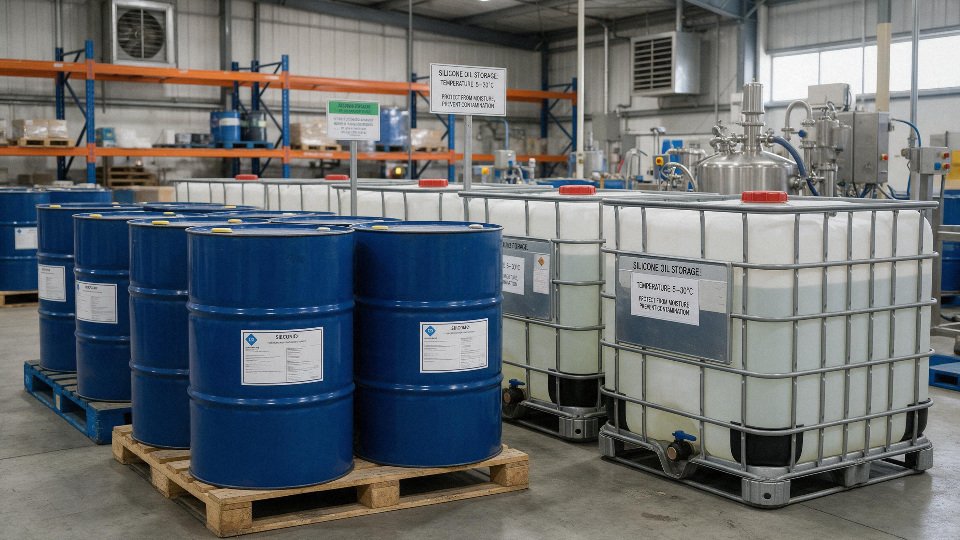
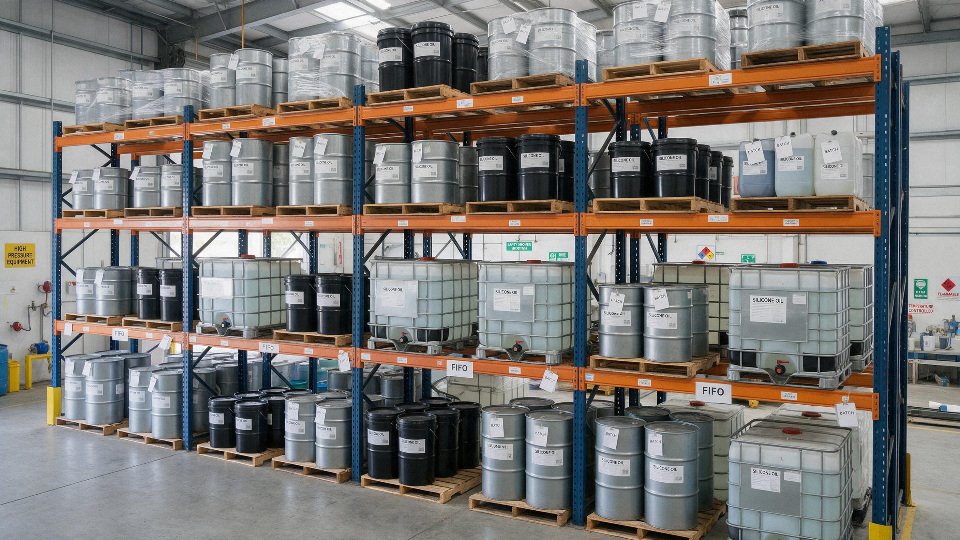
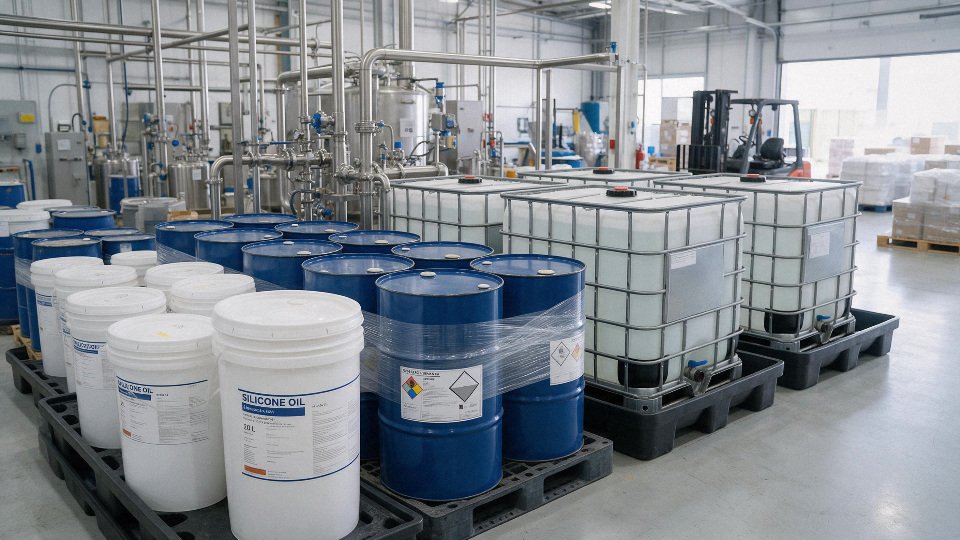
- Drum, pail, IBC, isotank, flexitank, or bulk tanker
- Nitrogen blanket requirement, if any
- Pumpability at winter temperatures
- Cleanliness expectations for returnable or dedicated containers
The next filter is supplier role. That affects traceability more than many buyers assume.
| Supplier type | What it usually means for the buyer | Main risk to check |
|---|---|---|
| Original manufacturer | Better process visibility, stronger batch traceability, more direct technical feedback | Some are strong in production but slow in export documentation |
| Integrated producer | Upstream control of key intermediates, often better cost and continuity | Verify whether all claimed steps are truly in-house |
| Toll producer | Can make to spec, sometimes very capable | Formulation ownership and change control can be less transparent |
| Blender / formulator | Useful for customized products and packaged solutions | Base fluid source may change if controls are weak |
| Trader | Fast sourcing and flexible brands | Traceability, batch consistency, and technical depth vary widely |
Ask directly who made the batch, who filled the package, and who owns the specification. If a trader cannot tell you the manufacturing site, reactor route, and COA basis, you are buying blind.
Production capability deserves a plant-floor level review, not just a brochure check. For silicone liquids, consistency is tied to molecular distribution, residual volatiles, and contamination control. Two fluids can both test near the same nominal viscosity and still behave differently in defoaming, wetting, dielectric use, or migration because the chain-length distribution is different.
Check these points:
- Raw material integration
- Access to consistent siloxane intermediates
- Stability of upstream supply, especially for large-volume PDMS grades
- Reactor and finishing capability
- Batch scale versus your annual demand
- Ability to control polymerization end point
- Stripping or purification steps for low-boiling residuals
- Filtration and clean transfer systems
- Quality control methods
- Viscosity testing method and temperature control
- Density checks, where relevant
- Moisture, volatile content, acid value, refractive index, or appearance checks as applicable to the product
- Retained samples and batch records
- Consistency control
- Whether the supplier tracks batch-to-batch drift, not just pass/fail
- Whether off-spec material is reworked, downgraded, or blended back in
- How they manage process changes in catalysts, raw materials, or packaging lines
A viscosity match alone does not guarantee equivalent silicone fluid performance in service.True
Different molecular weight distributions, residual cyclics, impurities, or functional modifications can change volatility, compatibility, foam behavior, release performance, and long-term stability even when the nominal cSt value is similar.
Documentation should be reviewed like a quality agreement, not skimmed like marketing. The TDS tells you what the supplier wants to sell; the COA tells you what they actually shipped. The gap between those two documents is often where purchasing trouble starts.
Review these documents and controls:
- TDS
- Core properties
- Recommended use range
- Known incompatibilities
- Typical service temperature guidance if relevant; for some dimethyl silicone fluids, a common reference range is about -50°C to 200°C, but formulation and use conditions still need checking
- SDS
- Transport classification
- Handling and spill requirements
- Storage conditions
- Worker exposure considerations
- COA
- Actual release parameters and limits
- Lot number traceability
- Test date and method reference
- Storage and shelf-life guidance
- Container closure requirements
- Temperature sensitivity
- Settling, haze, or moisture pickup risk where applicable
- Change-control practice
- Prior notification period
- Site change, raw material change, process change, and packaging change controls
Application support is where weak suppliers get exposed quickly. If your line has fisheyes, craters, poor release, unstable emulsion, or seal swelling, you need more than a sales contact forwarding PDFs.
Ask whether the supplier can provide:
- Lab samples from current production, not mystery retain stock
- Reformulation guidance if the fluid goes into a compound or emulsion
- Compatibility screening with your substrate, solvent, resin, elastomer, or additive package
- A named technical contact with realistic response time
- Failure analysis support when a batch is challenged
Global supply factors matter once the material leaves the catalog page. A technically acceptable silicone fluid that misses vessel cut-off, arrives with poor palletization, or changes labeling format at customs is not a reliable industrial supply.
Check these commercial points:
- Export track record
- Destination markets served
- Familiarity with shipping documents, labels, and declarations
- Lead times
- Standard production lead time
- Buffer stock policy
- Rush-order feasibility
- Shipment configuration
- Drum type, pallet pattern, stretch wrap, and leak prevention
- IBC compatibility
- Private label or OEM labeling if required
- Continuity planning
- Alternate plant or campaign backup
- Raw material contingency
- Port disruption response
Do not stop at price per kilogram. A cheaper fluid that requires overdosing, causes filter fouling, increases surface defects, or drives customer complaints is rarely cheaper over a quarter, never mind a contract year. The mechanism is simple: small chemistry variation changes process behavior, operators compensate by adding more material or slowing the line, and the hidden cost shows up in labor, scrap, energy, and maintenance rather than on the PO line.
For buyers who need both manufacturing access and disciplined export supply, SiliconChemicals fits the practical middle ground: manufacturer and integrated supplier, with organosilicon production depth in China and the documentation, specification control, and long-term commercial support international customers usually need. That combination tends to matter most when the requirement is not just “send silicone oil,” but “hold this performance window batch after batch, pack it correctly, and stay responsive when the application shifts.”
Frequently asked questions
Is silicone oil the same as PDMS?
Not always. PDMS, or polydimethylsiloxane, is the most common base chemistry behind what many buyers call silicone oil, but the term silicone oil is broader than PDMS alone.
- PDMS is a specific silicone polymer family with a dimethylsiloxane backbone.
- Silicone oil is a market term often used for clear, water-insoluble silicone liquids, many of which are PDMS-based.
- Some products sold as silicone oil are modified silicones, such as phenyl-modified, amino-modified, or polyether-modified fluids.
- If the application is sensitive to compatibility, dielectric behavior, wetting, foam control, or release performance, do not assume “silicone oil” means straight PDMS. Ask for the actual chemical type and any modification.
All silicone oils are PDMS.False
Many commercial silicone oils are PDMS-based, but the market term also covers modified silicone liquids with different side groups and performance profiles.
Is every silicone fluid an oil?
No. “Silicone fluid” is the broader technical term, and it includes liquids that are not normally described as oils in process or commercial language.
- Straight PDMS at low to medium viscosity is often called silicone oil.
- Highly modified silicone liquids may be called silicone fluids because “oil” can imply a narrow set of behaviors that no longer hold.
- Water-dilutable, reactive, or specialty-functional liquids are usually better described as fluids.
- At very high viscosity, some products are still sold as fluids even when they handle more like syrup or soft gum.
In practice, if a datasheet says silicone fluid, read that as “liquid silicone material” first, then check composition. The name does not tell you enough on its own.
Which term is more correct on a technical datasheet?
For a technical datasheet, silicone fluid is usually the safer and more precise label unless the product is clearly a conventional oil-type liquid such as standard PDMS. It leaves room for modified chemistries and avoids implying that lubrication behavior is the main function.
A good datasheet should state:
– Chemical description
– Viscosity at a defined temperature, often 25°C
– Density
– Volatility or mass loss, if relevant
– Flash point or handling limits, where applicable
– Functional modification, if any
If the sheet only says “silicone oil” and gives a single viscosity number, that is not enough for substitution approval.
Can I replace mineral oil with silicone oil directly?
Usually not without checking the whole system. Silicone liquids and mineral oils differ in seal compatibility, solvency, lubricity regime, additive response, air release, and surface behavior.
Check these points before any trial:
1. Elastomers and plastics: some seals that tolerate mineral oil behave differently in silicone service.
2. Lubrication mechanism: silicone fluids can perform well in some boundary conditions but may not replace additive-treated mineral lubricants in gears or heavily loaded bearings.
3. Contamination sensitivity: silicone carryover can create downstream paint, coating, or bonding defects.
4. Heat transfer and pumpability: viscosity-temperature behavior differs, so startup torque and circulation may change.
The substitution flips from reasonable to risky once the original mineral oil depended on a heavy additive package, EP performance, or close material compatibility margins.
How do I choose the right viscosity grade?
Start with the operating function, not the catalog. Viscosity can range from roughly 0.65 cSt to above 1,000,000 cSt at 25°C, but the right grade depends on what the liquid has to do in the equipment or process.
Use this sequence:
1. Define the job: lubrication, damping, heat transfer, release, defoaming, dielectric insulation, or surface treatment.
2. Set the operating temperature range. A fluid that looks right at room temperature may be too thin at 120°C or too stiff in winter startup.
3. Check delivery method: spray, drip, wick, pump, roll-coat, dip, or metered dosing.
4. Review residence time and volatility needs.
5. Run a bench or line trial if the process window is narrow.
Lower viscosity usually gives easier pumping and faster spreading, but you give up film thickness and often persistence. Higher viscosity improves staying power, yet it can raise metering error, trap bubbles, and slow line speed.
What is the difference between silicone fluid and silicone emulsion?
A silicone fluid is the neat liquid silicone phase. A silicone emulsion is that silicone dispersed in water with surfactants and, sometimes, additives.
- Silicone fluid: water-insoluble liquid used as supplied or blended into nonaqueous systems
- Silicone emulsion: easier to dilute, often safer to handle in water-based processing, usually lower active content
- Emulsions can be attractive for textile finishing, release, polishes, and some surface treatments, but they introduce another failure path: emulsion stability
On the plant floor, this matters because emulsion performance depends not only on the silicone itself but also on pH, shear, storage temperature, dilution water quality, and freeze-thaw exposure.
Are modified silicone fluids more expensive because they are better?
Not automatically. Modified silicone fluids are usually more expensive because they add chemistry, processing complexity, or narrower production volume, but “better” only applies if the modification solves your actual problem.
Examples:
– Polyether-modified grades can improve wetting or water dispersibility, but may lose some water resistance.
– Phenyl-modified fluids can improve certain low-temperature or thermal properties, depending on formulation.
– Amino-modified grades can improve softness or adhesion effects in some finishes, yet may create compatibility or yellowing concerns.
You are paying for targeted behavior. If you only need inert heat stability and basic lubricity, a standard PDMS may be the better buy.
Which tests should I request before approving a new supplier?
Request the tests that control your failure mode, not a generic lab pack. For most industrial approvals, start with:
- Kinematic viscosity at 25°C and, if temperature-sensitive, at a second relevant temperature
- Density at 25°C, typically around 0.93-0.98 g/cm³ for many PDMS fluids, depending on structure
- Appearance and clarity
- Volatile content or mass loss
- Moisture, where process-sensitive
- Flash point or handling data, if required for storage and EHS review
- Compatibility or application-specific screening, such as foam control, release force, dielectric properties, or coating-defect checks
- Certificate of analysis format and lot-to-lot consistency history
If the material will be used across a broad temperature window, verify that the supplier can support the intended service range with data relevant to the chemistry; for standard dimethyl silicone fluids, a common reference range is roughly -50°C to 200°C, but the actual usable limit depends on formulation, time at temperature, and the equipment design.
Verify the right grade
Most buying mistakes here start with the label and end with the wrong liquid in the tank. In practice, the decision is usually not “oil versus fluid” as a naming problem, but standard dimethyl silicone versus a broader or modified silicone chemistry matched to viscosity, volatility, and end-use performance. If the application only needs inert lubricity, release, damping, or heat stability, a standard dimethyl silicone oil may fit; if you need wetting, defoaming, spreading, reactivity, or formulation compatibility, you are often in modified-fluid territory.
A workable decision sequence looks like this:
- Define the actual end use
- Lubrication, heat transfer, release, damping, defoaming, textile finishing, personal care, coating additive, dielectric service, or process aid.
- Be specific about failure mode: poor slip, foam persistence, fish-eyes, cratering, poor substrate wetting, migration, volatility loss, or seal swelling.
- Identify whether functional chemistry is required
- Plain PDMS-type dimethyl silicone is often enough for inert lubrication and general thermal stability.
- Modified grades come into play when you need compatibility with water, solvents, resins, or a surface-active effect.
- This is where the preferred choice flips: the more you need interaction with the system, the less likely a plain dimethyl fluid will solve it cleanly.
- Set the viscosity window at the actual test temperature
- Silicone liquid viscosity can run from about 0.65 cSt to above 1,000,000 cSt at 25°C depending on chemistry and polymerization degree.
- That number only means something if the temperature is fixed. A 100 cSt target at 25°C is a different purchasing instruction from “medium viscosity” on a summer shop floor at 38°C.
- Confirm the few test items that control performance
- Viscosity at stated temperature
- Volatility, solids, or active content as relevant
- Density if dosing is by volume
- Critical functional values: surface tension, refractive index, hydroxyl value, amino value, flash point, dielectric properties, foam-control behavior, or compatibility data depending on use
- Any market or regulatory requirement must be verified against the current supplier documentation, not assumed from the term “silicone fluid”
- Validate by compatibility trial
- Bench test first, then pilot, then production.
- Watch for delayed effects: haze after 48 hours, coating defects after cure, phase split in storage, changed foam profile, or interaction with elastomers and pumps.
Minimum buyer checklist:
- Product identity and chemistry family
- Viscosity grade and test temperature
- Volatility or active content
- Application-critical functional values
- Compliance or documentation needs
- Packaging size, liner type, and handling requirements
Request lab samples when you are screening chemistry, pilot quantities when the process window is narrow or contamination risk is high, and side-by-side benchmarking when replacing an incumbent that already works but costs too much or has supply issues.
For an accurate recommendation, send the supplier:
– Substrate or contact material
– Process and service temperature
– Dosage or addition level
– Full formulation system, if any
– Current failure symptoms
– Target market and compliance needs
– Current product TDS, COA, or a sample if available
If you want a grade match or substitution review, send SiliconChemicals your current specification or application details. The technical team can compare candidate grades, flag likely compatibility issues, and arrange sample support for lab or pilot evaluation.