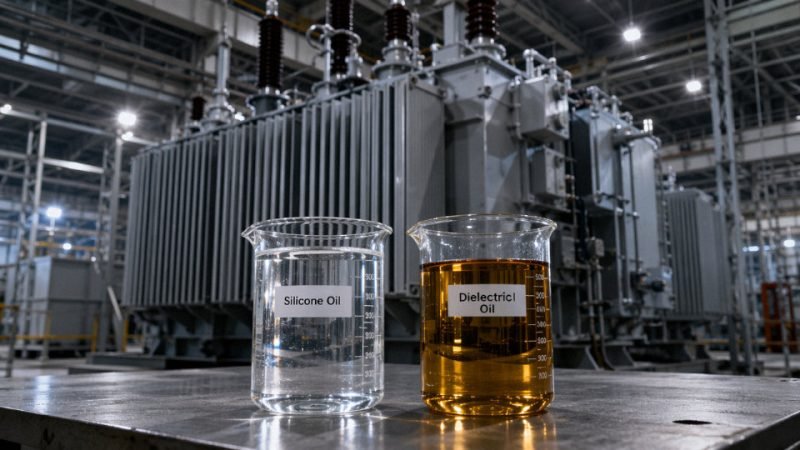
Specifying the wrong dielectric fluid for a transformer or high-voltage cooling application is the kind of mistake that stays quiet until it doesn’t — a winding failure at -45°C because the mineral oil gelled, a fire suppression bill because nobody checked flash point, a transformer pulled from service six months early because oxidation sludge choked the cooling ducts. Getting the fluid selection right matters financially in ways that go well beyond the purchase order.
Silicone oil and dielectric oil are not interchangeable. Silicone oil offers a wider operating range (-60°C to +200°C), higher dielectric strength (15–20 kV/mm), and far better fire resistance, but costs significantly more and is roughly five times more viscous than mineral-based dielectric oil (around 50 cSt vs 9–12 cSt at 25°C), which affects heat transfer and pump sizing. Mineral dielectric oil is the default choice for most standard transformers because it performs reliably within its limits and costs a fraction of the price.
What makes the comparison genuinely complicated is that neither fluid is universally superior — the right answer depends on operating temperature extremes, fire risk classification, voltage class, cooling system design, and total lifecycle cost, not just the spec sheet numbers. The differences between these two fluids cascade through procurement, maintenance scheduling, and equipment design in ways that aren’t obvious from a fluid data sheet alone.
Molecular Architecture: How Silicone and Mineral Dielectric Oils Are Built Differently
The performance gap between these two fluids isn’t arbitrary — it traces directly to how each molecule is assembled. Understanding that is worth more than memorizing a spec sheet.
The Siloxane Backbone
Silicone oil is built on repeating Si–O–Si linkages, the siloxane chain, with organic side groups — almost always methyl (–CH₃), sometimes phenyl (–C₆H₅) for high-temperature grades — hanging off each silicon atom. That inorganic backbone is what makes silicone chemically stubborn. Silicon-oxygen bonds are substantially stronger than the carbon-carbon bonds that hold hydrocarbon oils together, which is why silicone doesn’t oxidize or crack under sustained heat the way mineral oil eventually does.
Viscosity grade is controlled by chain length and, to a lesser extent, by side-group substitution. Trimethylsiloxy-terminated polydimethylsiloxane at short chain lengths runs around 2–5 cSt; extend the chain and you climb toward 60,000 cSt without fundamentally changing the chemistry. That’s a viscosity range you simply can’t cover with a single hydrocarbon base stock. In practice, transformer and switchgear applications typically sit in the 50–100 cSt range at 25°C, which gives you the right combination of convective cooling and dielectric clearance. The phenyl-substituted grades cost noticeably more — sometimes 3–4× the price of standard dimethyl grades — but they’re the ones that hold viscosity at temperatures above roughly 175°C without vaporizing.
Mineral Dielectric Oil: A Mixture, Not a Pure Compound
Mineral transformer oil is not a single molecule. It’s a carefully refined fraction of petroleum containing naphthenic rings, paraffinic chains, and some residual aromatics, with the exact ratio depending on crude source and refining route. Naphthenic-dominant oils have historically been preferred for transformers because they stay fluid at low temperatures and dissolve gases better, which matters for dissolved gas analysis (DGA) interpretation. Paraffinic oils have slightly better oxidation stability at ambient temperatures but can wax badly below about –20°C depending on pour point additives.
Refining depth matters enormously here. Conventional solvent-refined mineral oils carry more sulfur compounds, polar molecules, and aromatic fractions that accelerate oxidation and produce sludge at elevated temperatures. Hydrotreated or severely hydrotreated oils — the ones often labeled as Type II or inhibited uninhibited depending on the IEC/ASTM designation in your purchase spec — start out with far lower sulfur and aromatic content. Their oxidation induction time is significantly longer, sometimes 3–5× depending on the inhibitor package and operating temperature.
Mineral dielectric oil oxidation stability depends heavily on refining depth, not just additive levelTrue
Severely hydrotreated base stocks have lower initial sulfur and aromatic content, which reduces the formation of polar oxidation byproducts even before antioxidants are considered. Additive packages extend life further but cannot compensate for a poorly refined base.
Where Ester Fluids Sit
Synthetic and natural ester fluids — pentaerythritol esters, rapeseed-based fluids — deserve a quick mention because procurement teams increasingly ask about them. They occupy a middle ground: better biodegradability and fire resistance than mineral oil, lower cost than silicone, but more moisture-sensitive and generally limited to around 120–140°C continuous. They’re a real option, especially in fire-risk locations or where environmental regulations are tightening. They’re just not the subject here.
Polarity, Surface Tension, and What Happens Inside a Winding
Silicone oil’s low surface tension — roughly 20 mN/m versus 28–32 mN/m for mineral oil — means it wets cellulose and pressboard more aggressively and penetrates tight winding geometries faster during initial fill. That sounds like an advantage, and usually is for impregnation. The flip side: it also wicks more readily along surfaces, so joint design and gasket material selection matter more. Silicone is essentially nonpolar, which means it has very low affinity for water — moisture doesn’t dissolve into it readily. Mineral oil absorbs slightly more water before saturation, which can actually be useful for pulling residual moisture out of new windings during drying, but it also means contaminated mineral oil carries that moisture into service if processing is sloppy.
Antioxidant Strategy
Mineral oil almost universally contains 2,6-di-tert-butyl-p-cresol (DBPC, also called BHT) as an inhibitor, typically at 0.2–0.3% by weight in inhibited grades. It works by scavenging free radicals in the oxidation chain. The problem is it depletes — usually over 10–25 years depending on temperature and oxygen ingress — and once it’s gone, oxidation accelerates nonlinearly. Silicone oil doesn’t need DBPC because the siloxane backbone resists oxidative attack without help. That’s not marketing language; it’s a direct consequence of bond energy. You do still need to keep silicone oil dry and particle-free, but the aging mechanism is fundamentally different and considerably slower under normal service conditions.
Dielectric Performance Head-to-Head: Breakdown Voltage, Permittivity, and Dissipation Factor
The numbers matter here, but the context around the numbers matters more. A transformer spec sheet will give you one breakdown voltage figure; what it won’t tell you is how fast that figure degrades once moisture gets into the system, or what your DGA technician will see six months after a partial discharge event. That’s where the two fluids genuinely diverge.
Breakdown Voltage Under IEC 60156 and ASTM D1816
Tested at a 2.5 mm electrode gap under IEC 60156 conditions, fresh and dry silicone oil typically delivers 30–40 kV, depending on base viscosity grade and cleanliness of the test sample. Mineral dielectric oil comes in at roughly 28–35 kV under the same protocol — close enough that procurement managers sometimes treat them as equivalent. That’s a mistake.
The real difference is moisture sensitivity. Mineral oil is hygroscopic enough that even modest water content — call it 30–50 ppm by weight, which is easy to reach in a poorly sealed tank during seasonal temperature cycling — can drop breakdown voltage below 20 kV. Silicone oil is substantially more tolerant; its breakdown strength degrades more slowly with moisture uptake, partly because of the hydrophobic character of the Si–O–Si backbone (this connects directly to the molecular architecture already covered). In humid climates or where transformer breathing is poorly managed, that tolerance can be the difference between a predictable maintenance interval and an unexpected fault.
Silicone oil maintains higher breakdown voltage at elevated moisture levels compared to mineral dielectric oil under equivalent contamination conditionsTrue
Silicone oil's hydrophobic polymer backbone resists water absorption and retains dielectric strength at moisture levels that would significantly degrade mineral oil performance, consistent with IEC 60156 comparative testing data.
Permittivity and What It Means for Your Application
Silicone oil sits at a relative permittivity (dielectric constant) of roughly 2.7–2.8. Mineral dielectric oil is lower, around 2.2–2.3. For most 50/60 Hz power transformers this difference is largely academic. Where it becomes operationally relevant is in high-frequency applications — pulse transformers, power electronics cooling, certain traction equipment — where capacitive coupling losses scale with permittivity. If you’re specifying fluid for a converter transformer or an inverter-fed drive transformer running above a few kilohertz, the lower permittivity of mineral oil is a legitimate reason to favor it, all else being equal.
Dissipation Factor and the Aging Problem
At 90°C, both fluids look reasonably close when new: silicone oil tan δ typically falls in the 0.001–0.005 range; mineral oil can achieve 0.001–0.003 when fresh and clean. The divergence shows up in service.
| Condition | Silicone Oil tan δ (90°C) | Mineral Dielectric Oil tan δ (90°C) |
|---|---|---|
| New, dry | 0.001–0.003 | 0.001–0.002 |
| After 5 years typical service | 0.003–0.008 | 0.005–0.03+ |
| Moisture-contaminated (50 ppm H₂O) | 0.004–0.010 | 0.02–0.10+ |
The spread in the aged mineral oil column is wide because it depends heavily on oxidation inhibitor depletion, metal contamination from windings, and load cycling history. Silicone oil’s dissipation factor rises more slowly because it doesn’t oxidize through the same chain-scission mechanism.
Volume Resistivity and Partial Discharge Inception
Silicone oil volume resistivity runs 10¹³–10¹⁵ Ω·cm. Mineral oil is typically 10¹²–10¹⁴ Ω·cm, and the lower end of that range is where you start worrying about partial discharge inception voltage dropping to levels that accelerate insulation degradation. In practice, a transformer running on aged mineral oil with elevated conductivity will show earlier PD activity than one filled with silicone oil at equivalent contamination levels — not because the voltage is higher, but because the field geometry at defects becomes more favorable for discharge.
Gassing Behavior and DGA Fault Diagnosis
This is the area that catches maintenance teams off guard when they switch fluid types between transformer generations. Under electrical stress — arcing, PD, or thermal faults — silicone oil produces primarily hydrogen and methane, with relatively little of the heavier hydrocarbons. Mineral oil generates a broader signature: ethylene, ethane, acetylene, and carbon oxides alongside hydrogen and methane, each pointing to different fault temperatures and mechanisms under Duval triangle or Rogers ratio analysis.
If your condition monitoring program is calibrated around mineral oil DGA thresholds and gas ratios, those same fault diagnosis rules do not translate to silicone oil. Hydrogen and methane alone in a silicone-filled unit can indicate a serious arcing fault that the standard IEC 60599 interpretation chart would classify as ambiguous or minor. Update the protocol before you commission the unit, not after you’ve been sitting on a developing fault for two maintenance cycles.
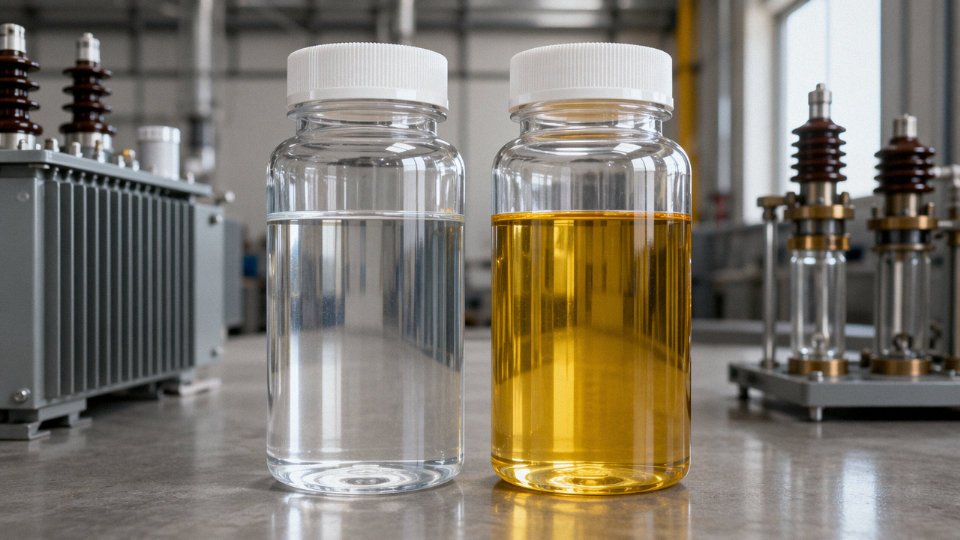
Thermal Management Realities: Heat Transfer, Viscosity Grades, and Extreme-Temperature Limits
Thermal performance is where the silicone-versus-mineral-oil decision gets genuinely complicated — because the fluid with better raw thermal conductivity isn’t necessarily the one that keeps your transformer cooler in practice.
Thermal Conductivity and the Convection Problem
Silicone oil sits around 0.15–0.16 W/(m·K) thermal conductivity at operating temperature; mineral dielectric oil runs 0.13–0.135 W/(m·K), depending on base stock and additive load. That 15–20% advantage looks meaningful on paper. In a real ONAN (oil-natural, air-natural) cooled transformer, though, convective circulation does most of the heat-moving work — and convection is brutally sensitive to viscosity. Silicone 50 cSt versus mineral oil’s 9–12 cSt at 25°C is a large gap. Thicker fluid circulates more sluggishly through radiator passages, especially in smaller-bore channel designs that were originally engineered around mineral oil’s flow behavior. The net result is that silicone oil’s conductivity edge often gets partially eaten by its resistance to natural convective flow, and in some ONAN designs the temperature rise can actually run slightly higher with silicone unless the cooling circuit is re-engineered.
Silicone oil's higher thermal conductivity does not automatically produce better cooling in ONAN transformersTrue
Convective heat transfer in naturally cooled transformers depends strongly on fluid viscosity and flow rate. Silicone oil's viscosity (~50 cSt at 25°C) is roughly 4–5× higher than mineral dielectric oil, which suppresses natural circulation and partially offsets the conductivity advantage.
Viscosity-Temperature Behavior: Where Silicone Pulls Ahead
The viscosity index tells the real story for installations that see wide ambient swings. Mineral transformer oils have a VI in the 90–110 range — meaning viscosity changes substantially between winter and summer. A paraffinic oil that flows fine at 25°C can become sluggish enough at -20°C to impair startup circulation. Silicone oil’s VI runs roughly 190–400 depending on the grade, which is an unusually flat curve. A 50 cSt silicone oil at -40°C stays pumpable and maintains meaningful convective flow, while many mineral oils approach gel territory in that range. For arctic substations — northern Canada, Siberian grid extensions, high-altitude Andean installations — this isn’t a marginal improvement, it’s operationally critical. There are sites where mineral-oil transformers have failed to cool adequately on cold-start simply because the oil was too stiff to circulate before load-generated heat could warm the tank.
Pour point figures reinforce this: silicone oil pours at around -60°C, with some specialty grades rated to -100°C. Naphthenic mineral oils do reasonably well, typically -40°C to -60°C, which is why they’re often preferred over paraffinic grades (-20°C to -30°C pour point) for any application that might see genuine cold. For arctic service, silicone wins outright. For a desert substation in the Middle East or a tropical coastal installation where minimum ambient is never below 5–10°C, pour point is essentially irrelevant to the decision.
Upper Temperature Limits and Transformer Loading Capacity
Mineral transformer oil starts oxidizing aggressively above roughly 90–110°C at the hotspot — the cellulose insulation degrades in tandem, and IEC 60076-7’s thermal aging models assume these limits as the baseline. Running persistently above that band shortens expected insulation life on a roughly exponential curve. Silicone oil’s continuous service ceiling sits at 150–200°C, and it doesn’t produce the same acidic oxidation byproducts that mineral oil generates. This directly enables higher overload capacity or reduced cooling hardware for the same hotspot margin. If a plant needs to routinely push a transformer into emergency overload territory — say, during a summer peak demand spike when a second unit is offline — silicone oil gives meaningful headroom that mineral oil doesn’t.
Cooling System Hardware Sizing
None of this comes free. Silicone’s density (~0.96 g/cm³ versus mineral oil’s 0.85–0.89 g/cm³) combined with its viscosity typically means that if you’re retrofilling an existing mineral-oil transformer or specifying a new unit, the radiator fin area needs to increase — estimates in the range of 20–40% larger surface area are common, though the actual figure depends on tank geometry, channel sizing, and whether you’re willing to add forced oil circulation. ONAF or OFAF cooling configurations can compensate, but that adds pump maintenance, power consumption, and one more failure mode. A transformer originally designed around mineral oil and then switched to silicone without cooling circuit review will likely run hotter than its nameplate rating implies. That’s not a hypothetical — it’s a predictable consequence of swapping a low-viscosity fluid for a high-viscosity one in a circuit that was optimized for the former.
Fire Safety and Flammability: Flash Point, Fire Point, and Building Code Compliance
Flash point is where fluid selection stops being a pure engineering question and becomes a legal and insurance one. Mineral transformer oil typically flashes at 135–160°C depending on refining depth and additive package — a Nynas Nytro 10X, for example, sits near the lower end of that band. Silicone oil doesn’t flash until above 300°C, with some dimethylpolysiloxane grades pushing past 340°C. Fire points follow the same gap: mineral oil at roughly 160–170°C, silicone at 350°C or higher. That 180–200°C margin isn’t academic. In a faulted transformer inside a building, the arcing energy released in the first few hundred milliseconds can easily exceed mineral oil’s ignition threshold before protection relays clear the fault.
Silicone transformer oil has a flash point above 300°C compared to approximately 135–160°C for standard mineral transformer oil under IEC test conditions.True
Published fluid data sheets from major silicone fluid suppliers and IEC 61039 classification criteria consistently show these ranges. The difference drives IEC Class K vs Class O designations and is the basis for indoor installation permitting in many jurisdictions.
IEC 61039 Classifications and What They Actually Mean on a Project
IEC 61039 sorts insulating fluids into three fire-risk classes. Class O covers conventional mineral oils — the ones most of the world’s distribution transformers ran on for the past century. Class L includes fluids that are difficult to ignite under defined test conditions but do burn once ignited. Class K is the relevant one for silicone: high fire-point synthetic fluids that meet a flash point threshold above 300°C.
Why does this matter for installation engineers? Many national fire codes — and most building department plan checkers — tie transformer vault requirements directly to IEC fluid class. A Class O transformer in an urban substation basement typically requires a reinforced oil-containment sump, vault ventilation rated for flammable vapor, and in some jurisdictions an automatic suppression system. Switch to a Class K fluid and the same regulator will often accept a shallower sump, relaxed ventilation, and in some FM Global-aligned jurisdictions a sprinkler exemption for the vault. Hospitals, tunnels, high-rise cores, data center substations, offshore topsides — anywhere the fire consequence is catastrophic — these exemptions translate directly into capital cost and schedule.
What Actually Burns, and What That Means for First Responders
The combustion behavior difference matters beyond ignition threshold. Burning mineral oil produces dense black smoke laden with polycyclic aromatic hydrocarbons. Firefighters working a mineral-oil transformer fire are dealing with toxic smoke, a surface fire that spreads with the oil flow, and a cleanup afterward that often requires hazmat protocols for soil and drain contamination.
Silicone oil, when it does combust — which requires sustained high-temperature conditions well beyond normal fault scenarios — burns to silicon dioxide: a fine white powder, essentially amorphous silica. No PAH emissions, no toxic smoke cloud. SiO₂ residue on equipment is a nuisance to clean up and can be mildly irritating to respiratory tracts, but it is not classified as a hazardous combustion product the way mineral oil smoke is. In practice, this changes the first-responder calculus and affects post-incident site access timing.
Insurance Premiums and FM Global Implications
FM Global’s data sheets for transformer installations explicitly recognize fluid fire-point classification in property risk ratings. In practice, facility owners switching from mineral to silicone oil in indoor network transformers have documented insurance premium reductions in the 15–40% range — the actual figure depends on building occupancy class, total transformer kVA, and how the insurer weights fluid class against other fire controls already present.
A quick regulatory checklist for project engineers specifying fluid class:
| Requirement | Class O (Mineral) | Class K (Silicone) |
|---|---|---|
| Containment sump volume | Full oil volume + margin | Reduced, jurisdiction-specific |
| Vault sprinkler | Usually required indoors | Often exempt — verify locally |
| Ventilation rating | Flammable vapor rated | Standard mechanical |
| FM Global risk credit | Baseline | Credit available, document fluid spec |
| NFPA 70 / NEC vault rules | Article 450 standard vault | Less-flammable fluid provisions may apply |
One operational warning: silicone oil’s fire safety advantages only hold if the fluid stays uncontaminated. Mineral oil cross-contamination from maintenance equipment — pumps, hoses, filter units not properly flushed between jobs — lowers the effective flash point of the blend. I’ve seen field samples from “silicone-filled” units test at flash points closer to 250°C because a maintenance crew used shared transfer equipment. Verify fill purity at commissioning and document it.
Environmental Compliance and End-of-Life Disposal: Biodegradability, Ecotoxicity, and Regulatory Exposure
Environmental liability is one of those areas where engineers often underestimate the total cost of fluid selection until something goes wrong. The transformer spec sheet won’t tell you what a 200-liter spill into a storm drain costs to remediate. Procurement will feel that number.
Biodegradability: Neither Fluid Is Clean, But the Risks Are Different
Silicone oil — polydimethylsiloxane and its variants — does not break down readily in biological systems. Under OECD 301B (the closed bottle test), typical industrial silicone fluids achieve less than 20% biodegradation, often considerably lower depending on viscosity grade and molecular weight. The longer-chain, higher-viscosity silicones used in transformers tend to sorb into sediment rather than mineralize, which creates a slow-accumulation problem in aquatic environments near repeated spill events. It won’t cause an acute fish kill the way a fuel oil spill might, but regulators are increasingly aware of PDMS persistence in sediment profiles.
Mineral transformer oil sits in the 40–70% range under OECD 301F (manometric respirometry), which sounds better — and it is, in purely biological terms. The practical problem is that petroleum-derived contamination carries a much heavier regulatory burden regardless of that biodegradation figure. A soil sample showing 500 ppm total petroleum hydrocarbons triggers remediation requirements in most US states and EU member countries even if the oil itself would eventually biodegrade. The regulatory framework doesn’t really reward moderate biodegradability.
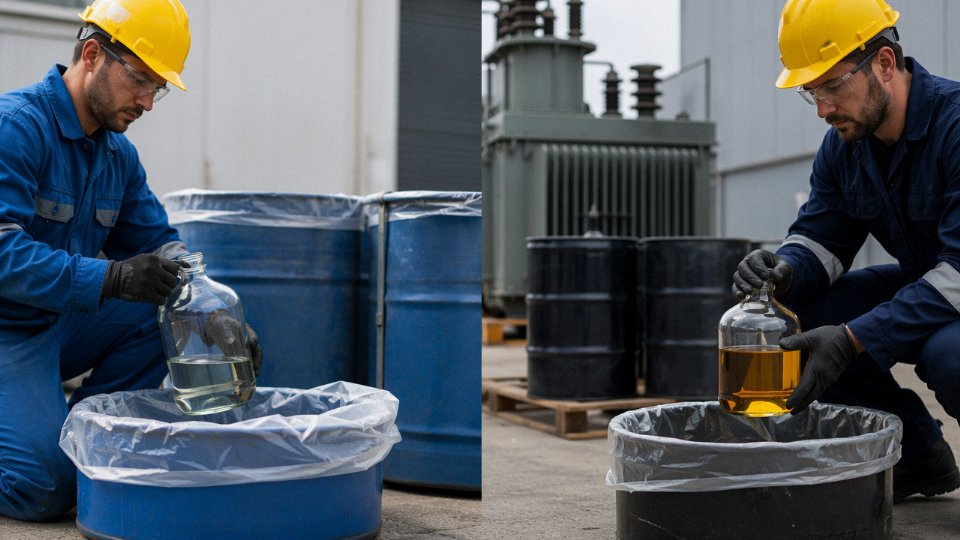
Ecotoxicity Classification and Secondary Containment Thresholds
Under EU CLP/GHS, most mineral transformer oils are classified H304 (aspiration hazard) and carry aquatic chronic category 3 or 4 designations. Under US EPA SPCC (40 CFR Part 112), petroleum oils — including transformer mineral oil — trigger secondary containment requirements at aggregate stored quantities above roughly 1,320 gallons above ground, with lower thresholds near navigable waters. Any transformer installation in a flood-prone location or near a drainage ditch gets scrutinized.
Silicone oil typically falls outside petroleum-specific SPCC applicability, which is a genuine regulatory advantage for plant siting near waterways. That said, it isn’t ecotoxicity-free. High-molecular-weight silicones receive aquatic hazard classifications under GHS in some jurisdictions, and this is an area where regulatory guidance is still evolving — what’s exempt today may not be in five years. Don’t take “not a petroleum product” as a permanent regulatory shield.
Silicone oil is completely exempt from environmental regulation and requires no containment planningFalse
Silicone oil falls outside most petroleum-specific SPCC thresholds but still carries GHS aquatic hazard classifications in several jurisdictions and requires site-specific environmental assessment, particularly for high-volume transformer installations near drainage or waterways.
PCB Legacy Risk in Mineral Oil Systems
This one catches people off guard during acquisitions and retrofits. Transformer oils manufactured before roughly the mid-1980s may contain PCBs as contaminants, sometimes above 50 ppm — the threshold at which EPA 761 classifies the material as PCB-contaminated waste, requiring manifested disposal and significantly higher handling costs. Silicone oil has no association with PCB contamination whatsoever; it simply wasn’t part of that supply chain. When you’re buying used equipment or retrofilling an aging unit, testing the existing oil for PCBs before blending or topping off is not optional. Mixing even a small volume of PCB-contaminated oil into a clean batch contaminates the entire volume.
Spill Response and Remediation Cost Reality
Documented remediation costs for mineral oil releases into waterways or sensitive soil range widely — roughly $50,000 on the low end for a contained, promptly-reported small spill on an impervious surface, up past $500,000 or more when surface water is involved, the volume is significant, or response is delayed. Those numbers depend heavily on state environmental agency response posture, proximity to drinking water intakes, and whether natural resource damage assessments get triggered.
Silicone spills are generally addressed through mechanical recovery — absorbent booms, excavation of contaminated soil — without the biological oxygen demand concerns that make petroleum spills so aggressive in aquatic systems. Cleanup is still a cost and a headache, but it rarely escalates to the six-figure remediation territory that a waterway petroleum release can reach.
End-of-Life Disposal Infrastructure
Mineral oil re-refining is a well-established global supply chain. Certified re-refiners in North America, Europe, and parts of Asia accept used transformer oil, process it back to base stock specification, and the cost to the generator is typically modest — sometimes net-zero if volume is sufficient and the oil is uncontaminated. In practice, most utilities and industrial operators have standing agreements with oil recyclers.
Silicone oil disposal is a different story. Recycling infrastructure is limited; there’s no equivalent re-refining pathway at industrial scale. Most used silicone transformer fluid ends up incinerated at high-temperature permitted facilities — temperatures need to exceed roughly 1,000°C to ensure complete combustion of the siloxane backbone to silica, CO₂, and water. That incineration route typically costs 2–4 times more per liter than mineral oil re-refining, depending on regional disposal market conditions and whether the fluid is classified as hazardous in the receiving jurisdiction. For a large transformer with several hundred liters of fill, that difference adds up.
The practical takeaway: silicone oil carries lower acute spill liability and sidesteps petroleum-specific regulations, but it does not make your environmental obligations disappear — and its end-of-life cost is structurally higher. Budget for that before the purchase order goes through.
Compatibility with Transformer Materials: Seals, Cellulose Insulation, Copper, and Paint Systems
Swapping insulating fluids without auditing the hardware is one of the more expensive mistakes you can make on a retrofill job. The electrical performance numbers look fine on paper, and then six months later you’re chasing a slow leak that’s pooling under the tank skid, or you’re pulling a transformer out of service because the dielectric strength has dropped below spec and nobody can explain why.
Elastomer Seals: Where Silicone Oil Creates Immediate Problems
Standard nitrile rubber (NBR) O-rings — the default seal compound in probably 70–80% of distribution transformers built before the mid-2000s — swell aggressively in silicone oil service. Volume increases of 30–40% are well-documented in accelerated soak tests, and in practice that kind of growth distorts the seal geometry enough to cause bypass leakage rather than the tight compression fit you need. Neoprene behaves similarly. Mineral dielectric oil, by contrast, is broadly compatible with NBR, neoprene, and most of the standard transformer seal compounds, which is part of why it became the default: the seal ecosystem grew up around it.
If you’re specifying a new silicone-filled transformer or converting an existing unit, the seal stack needs to be fluorosilicone (FVMQ) or PTFE-lined — and that applies to every static and dynamic seal in the assembly, including gaskets around the conservator, bushing flanges, tap changer housing, and drain valves. Missing even one legacy NBR gasket is enough to cause a weeping leak. Some manufacturers use Parker Hannifin’s V884-70 or equivalent FVMQ compounds specifically rated for silicone fluid environments; that’s the kind of material-level specificity your procurement spec should include.
Cellulose Insulation: Impregnation Is Slower Than You Expect
Both fluids are chemically compatible with kraft paper and pressboard — no degradation, no unusual aging reactions under normal conditions. The practical issue is surface tension. Silicone oil’s surface tension is roughly 20–21 mN/m at 25°C compared to around 28–30 mN/m for typical mineral oil, which sounds like silicone should penetrate faster, but the full impregnation picture depends on viscosity too. At 25°C, silicone oil at 50 cSt is considerably more viscous than mineral oil at 9–12 cSt, and that viscosity difference slows capillary penetration into the paper structure.
Factory processing times for vacuum impregnation with silicone oil typically run 20–35% longer than mineral oil for the same paper geometry, depending on paper density and residual moisture level. Rush that step and you leave dry voids in the insulation that become partial discharge sites under voltage stress.
Silicone oil is chemically compatible with kraft paper and pressboard insulation and does not degrade cellulose under normal transformer operating conditions.True
Peer-reviewed aging studies and IEC service experience confirm silicone oil does not chemically attack cellulose. The compatibility concern is process-related (impregnation rate), not chemical degradation.
Copper Interaction and Fluid Aging
Mineral oil is a reasonably good solvent for the copper soaps — primarily copper naphthenate — that form when dissolved copper migrates from winding surfaces. Those copper compounds are oxidation catalysts, meaning they accelerate the oil’s own aging cycle, which is one reason mineral oil oxidation inhibitors (usually DBPC at 0.3–0.4% by weight) matter so much in service life management. Silicone oil has very low metal-catalytic activity. Copper and aluminum don’t meaningfully accelerate silicone oxidation in the same way, which gives silicone-filled units a genuine aging advantage in hot, copper-rich winding environments — particularly in high-loss designs running close to thermal limits.
Internal Coatings: The Overlooked Failure Mode on Retrofills
Alkyd-based tank coatings soften and blister in silicone service. This isn’t hypothetical; it’s a known failure mode on retrofill jobs where the original tank was primed and painted for mineral oil and the conversion team didn’t specify recoating. Coating fragments circulating in the fluid contaminate the insulation paper and can bridge clearances in the winding assembly. Any tank going into silicone service needs internal surfaces finished with an epoxy or polyurethane system verified against silicone fluid — and that verification should come from the coating manufacturer, not just an assumption based on chemical family.
Residual Fluid Mixing and Flush Protocol
Silicone and mineral oil are partially miscible at low concentrations, which creates a deceptive situation: the blend looks clear at 1–2% mineral oil contamination but the dielectric properties are already degraded, and at higher contamination levels you can get visible cloudiness and a measurable drop in breakdown voltage. IEC and CIGRE guidance is consistent here — flush to below 1% residual mineral oil before filling with silicone. In practice that means two to three drain-and-refill flush cycles with clean silicone oil, not just a single drain. Each cycle takes time and fluid, so the real cost of a retrofill is higher than the fluid price alone. Budget accordingly.
Total Cost of Ownership: Purchase Price, Maintenance Intervals, and 20-Year Life Cycle Analysis
The price tag on the drum is not the cost of the fluid. Every procurement manager who has approved a silicone oil purchase based on per-liter cost alone has eventually had that conversation with finance — and every one who rejected silicone purely on upfront price has occasionally had a more expensive conversation after a maintenance event or a fire suppression system installation quote came back.
Unit Price Reality and What It Actually Means at Fill Volume
Industrial transformer-grade silicone fluid runs roughly $5–$10/kg depending on viscosity grade, order volume, and whether you’re sourcing from a domestic distributor or direct from a chemical manufacturer. Food- and pharma-grade silicone oil (which some specialty transformer OEMs specify for certain sensitive environments) pushes $8–$18/kg. Inhibited mineral transformer oil sits at $1.50–$3.00/kg — sometimes lower on large spot buys when naphthenic crude pricing is favorable.
That 3–5× per-liter differential sounds alarming until you put it against actual fill volumes. A 2 MVA distribution transformer holds roughly 1,000–1,500 liters. At the midpoint of each range, the silicone fill costs somewhere around $9,000–$11,000 versus $2,500–$3,500 for mineral oil — a gap of $6,000–$8,000 on a unit that might represent $80,000–$150,000 in total installed cost. Meaningful, but not transformative at that scale.
Scale up to a 100 MVA power transformer with 30,000–60,000 liters of fluid, and the arithmetic changes significantly. You’re looking at a silicone fill cost potentially $200,000–$400,000 above equivalent mineral oil. At that volume, the TCO case has to be genuinely solid, not just a vague appeal to “lower maintenance.”
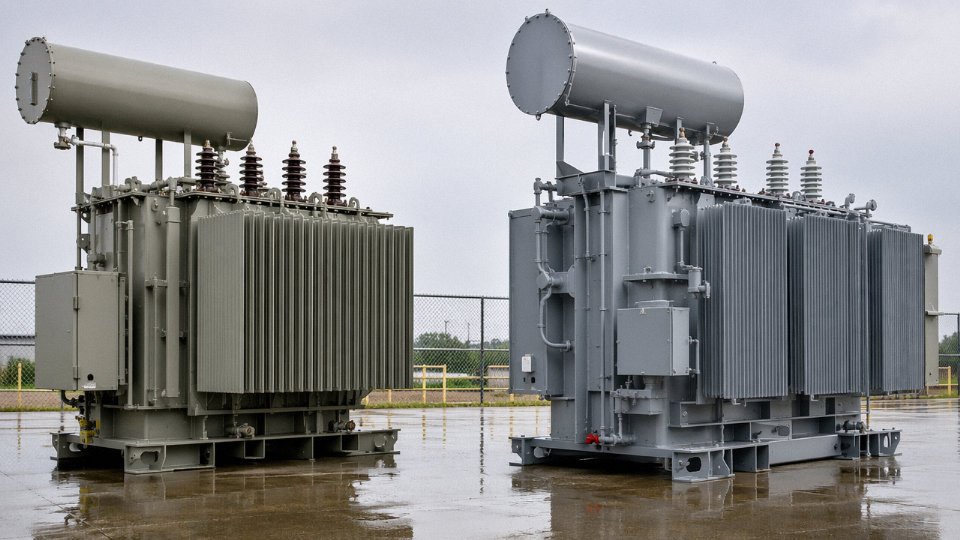
Maintenance Intervals: Where the OPEX Gap Opens Up
Mineral transformer oil under IEC 60422 requires annual dissolved gas analysis (DGA), acidity testing, and interfacial tension checks at minimum — more frequently for transformers in harsh environments or above a certain age. Each sampling-and-analysis cycle costs $300–$900 per transformer depending on the lab, the number of parameters tested, and whether you’re pulling samples yourself or contracting the work. Add inhibitor top-up (mineral oil oxidizes gradually and most specifications call for antioxidant replenishment every few years), and annual OPEX on fluid maintenance for a mid-size substation transformer runs $800–$2,500/year in direct costs, not counting technician time.
Silicone fluid’s oxidation resistance — rooted in the Si-O backbone stability covered earlier in this article — extends realistic maintenance intervals to 3–5 years for DGA and routine chemical checks under normal operating conditions. In practice, most operators doing this right are still pulling annual visual inspections and dissolved gas snapshots on critical units, but the full analytical cycle genuinely stretches out. Across a 20-year asset life, that’s roughly 30–50% reduction in direct sampling and chemical maintenance costs. On a fleet of 20 transformers, that adds up to something worth putting in a spreadsheet.
Fire Protection Infrastructure: The Line Item That Changes the Calculation
This is the one that surprises people who haven’t priced a deluge system lately. An indoor transformer filled with mineral oil — with a flash point around 145–160°C depending on grade — typically requires a fixed fire suppression system under NFPA 850, FM Global, or local equivalents. Water deluge, foam, or CO₂ systems for a single medium-voltage indoor transformer bay run $20,000–$150,000 in installed civil and mechanical cost, depending on building construction, system type, and local code authority interpretation.
Silicone transformer fluid can eliminate the requirement for fixed fire suppression systems in some indoor transformer installationsTrue
Silicone fluid has a flash point above 300°C and is classified as a less-flammable fluid under NFPA 70 and IEC 61039, which allows authorities having jurisdiction to waive or reduce fixed suppression requirements in many indoor installations — though this requires AHJ review and is not automatic.
Silicone fluid, classified as less-flammable under IEC 61039 with flash points typically above 300°C, often qualifies for reduced or eliminated suppression infrastructure in the same installation. Getting that ruling requires engaging the authority having jurisdiction early — it is not automatic — but when it comes through, the civil savings frequently exceed the entire fluid cost premium on smaller transformers.
Putting It Together: A 20-Year NPV Framework
Assume a 10,000-liter fill (roughly a 10–15 MVA unit), 2% annual top-up to account for minor losses and sampling draws, and a moderate indoor installation with real fire suppression exposure.
| Cost Element | Mineral Oil (20-yr) | Silicone Oil (20-yr) |
|---|---|---|
| Initial fill | ~$20,000–$30,000 | ~$70,000–$100,000 |
| Top-up fluid (2%/yr) | ~$6,000–$12,000 | ~$14,000–$28,000 |
| Maintenance sampling/inhibitor | ~$16,000–$50,000 | ~$6,000–$18,000 |
| Fire suppression system | ~$40,000–$120,000 | ~$0–$30,000 (reduced) |
| Approximate total | ~$82,000–$212,000 | ~$90,000–$176,000 |
Figures depend heavily on fleet size, local labor rates, AHJ ruling on suppression, and whether you’re in a jurisdiction with stringent environmental liability for mineral oil spills. The break-even point in high-fire-risk indoor applications typically falls somewhere around year 8–12. In outdoor yard installations with no suppression requirement and easy spill containment, the economics rarely close in silicone’s favor on cost alone — which is why most utilities still run mineral oil in outdoor substations and reserve silicone for tunnels, buildings, and offshore platforms where the risk profile shifts.
The honest answer for procurement: silicone fluid is not cheaper. It is sometimes cheaper to own, in specific installation contexts, over a long enough horizon. Know which context you’re actually in before you sign the purchase order.
Application Selection Matrix: Which Fluid Wins in Eight Real-World Scenarios
All the chemistry and electrical data discussed earlier only matters if you can translate it into a decision for a specific installation. The table below maps eight real scenarios to a recommended fluid, then the commentary explains why — including where the decision is genuinely close.
| Scenario | Recommended Fluid | Primary Driver |
|---|---|---|
| Urban indoor network transformer (mall substation) | Silicone oil | Fire safety, FM Global / NFPA compliance |
| Rural overhead distribution, temperate climate | Mineral dielectric oil | Lowest TCO, easy maintenance |
| Arctic substation, –50°C ambient | Low-pour-point silicone or naphthenic mineral | Cold-start pumpability |
| Offshore platform, ATEX zone | Silicone oil (strongly) | Fire point >300°C, hot-work permit relief |
| High-frequency converter transformer (10–100 kHz) | Mineral oil preferred | Lower permittivity, lower dissipation factor |
| Hospital / data center critical power | Silicone oil | Low smoke toxicity, maintenance interval |
| Traction substation (railway) | Authority-specific; Class K in tunnels | Regulatory mandate |
| Retrofill of existing mineral-oil unit | Evaluate seals first; consider synthetic ester | Seal compatibility risk |
Urban Indoor Substation — Shopping Mall or Office Tower
This is the scenario where silicone oil earns its price premium most clearly. FM Global data sheets and NFPA 70 both treat fluids with fire points above roughly 300°C as “less flammable,” which changes the containment bund sizing requirement, the sprinkler specification, and sometimes the insurance classification of the whole room. In a dense retail or mixed-use building, the cost of upgrading the containment vault to handle a mineral-oil spill scenario can easily exceed the fluid cost differential over the transformer’s lifetime. Silicone oil doesn’t eliminate fire risk, but it substantially changes the risk profile in the eyes of the authority having jurisdiction.
Rural Overhead Distribution — Temperate Climate
Mineral oil wins here without much contest. The transformer is pole-mounted or pad-mounted in open air, ambient temperatures stay within roughly –20°C to +40°C across most temperate zones, fire exposure to adjacent structures is low, and your maintenance crew is likely servicing dozens of similar units on a fixed schedule. Stocking one fluid type, using standard spare gaskets, and working with a fluid that any regional lab can test — that’s real operational value. The silicone cost premium buys nothing here.
Arctic Substation at –50°C Ambient
The decision is closer than people expect. A well-specified naphthenic mineral oil with a pour point around –60°C can match silicone’s cold-start behavior in ONAN (natural convection) designs. Where silicone pulls ahead is in OFAF (forced oil, forced air) systems: at –50°C, mineral oil viscosity can spike to a range where pump cavitation becomes a real risk, whereas silicone at roughly 50 cSt at 25°C still flows at low temperatures without the same viscosity-cliff behavior. If the transformer is ONAN, either fluid works; if it has an oil circulation pump, check the pump’s rated minimum viscosity and compare it against your actual cold-start oil temperature. That single calculation often decides the question.
Offshore Platform, ATEX Zone
Silicone is the strong preference and in some operator standards it’s effectively mandated. A fire point above 300°C means that hot-work operations — welding, cutting, grinding — in adjacent areas don’t automatically require the transformer room to be isolated and the transformer to be de-energized. On a platform where every hot-work permit costs crew time and production downtime, that operational flexibility has real monetary value. The weight penalty from silicone’s higher density (~0.96 g/cm³ versus ~0.86 g/cm³ for mineral oil) is worth evaluating on weight-critical topsides, though for most distribution-scale transformers it’s not a deciding factor.
High-Frequency Converter Transformer (10–100 kHz)
This one surprises engineers who assume silicone’s superior dielectric strength means it’s always the better insulating fluid. At high frequencies, the dielectric dissipation factor of silicone oil (typically 0.001–0.002 at power frequency) rises more steeply than that of a well-refined mineral oil, meaning more energy is lost as heat in the fluid itself. Mineral oil’s lower relative permittivity also reduces parasitic capacitance in the winding structure, which matters for switching efficiency. Silicone remains acceptable if the transformer runs hot and thermal limits are the binding constraint, but for a room-temperature high-frequency design, mineral oil is usually the tighter engineering fit.
Several European rail authorities including DB and Network Rail mandate Class K fire-resistant fluid in tunnel sections regardless of other fluid approvals for the same transformer type.True
Both DB Netz and Network Rail publish infrastructure design standards that classify tunnel environments as requiring fire-resistant insulating fluids (Class K per IEC 61039); this is separate from general transformer fluid approval and applies to the installation location rather than the equipment type.
Hospital and Data Center Critical Power
Two factors drive this recommendation beyond fire safety. First, silicone oil produces significantly lower smoke toxicity in a fire compared to mineral oil, which matters enormously in an occupied building where evacuation time is measured in minutes. Second, silicone’s extended maintenance interval — oil sampling typically every 3–5 years rather than annually for a loaded mineral-oil unit, depending on loading and temperature history — reduces the number of planned outages in a facility where scheduled downtime is expensive and politically difficult to schedule.
Retrofill Warning
Retrofilling an existing mineral-oil transformer with silicone is not a fluid-swap job. NBR (nitrile) seals and gaskets that perform perfectly with mineral oil can swell, soften, or lose their sealing integrity with silicone, and a seal failure on an energized unit is a serious event. Before committing to a silicone retrofill, pull a gasket sample for compatibility testing — or budget for a full seal replacement using silicone-compatible elastomers. In many cases, a synthetic ester fluid is the lower-risk retrofill option because it has broader compatibility with existing seal materials while still offering improved fire performance over mineral oil. Don’t let the fire safety argument push you into a retrofill that trades one risk for another.
Frequently Asked Questions
Can you mix silicone oil and mineral dielectric oil in the same transformer?
Technically they will blend — silicone polydimethylsiloxane fluids and naphthenic mineral oils are partially miscible — but the result is not a stable, well-characterized insulating fluid. Mixed batches typically show a measurable drop in dielectric breakdown voltage, sometimes 15–25% below either fluid tested alone, and over time the mixture can produce a gelatinous sludge that clogs cooling ducts and coats windings. In practice, once contamination is discovered, the transformer usually needs a full drain, hot-oil flush, and vacuum dry-out before recharging with a single fluid type.
If you are converting an existing mineral-oil-filled unit to silicone, follow the CIGRE flush protocols — multiple drain-and-rinse cycles with clean silicone fluid, not just a single drain. Residual mineral oil content in the final charge should be below roughly 1–2% by volume; above that threshold you are operating with an undefined blend and most OEM warranties will not cover it. Some field crews try to shortcut this and regret it when DGA results come back anomalous six months later.
Is silicone transformer oil safe for food-processing facilities?
This question comes up a lot in dairy, beverage, and pharmaceutical plants, and the answer requires more care than a simple yes or no. Standard transformer-grade silicone oil is not food-grade. It may meet fire safety and environmental requirements for indoor installations, but that is a separate regulatory track from food contact compliance.
FDA 21 CFR 178.3570 covers silicone compounds approved for incidental food contact. Some fluid manufacturers do offer NSF H1-certified silicone variants formulated specifically for that regulatory environment. If your transformer is in or adjacent to a processing area where fluid leaks could reach product lines, you need to explicitly request an NSF-certified fluid and get written confirmation from the supplier — not just assume that “silicone” equals safe. Consult both the fluid manufacturer and your plant’s food safety officer before specifying.
How does dissolved gas analysis work differently for silicone-filled transformers?
This is an underappreciated operational issue. Silicone fluid degrades differently under thermal and electrical stress than mineral oil does, so the standard Duval Triangle and Rogers Ratio interpretations do not translate directly. Silicone thermal faults tend to produce elevated hydrogen and methane with relatively low ethylene — a gas signature that would look mild or ambiguous on a mineral-oil DGA chart but actually indicates meaningful degradation in a silicone-filled unit.
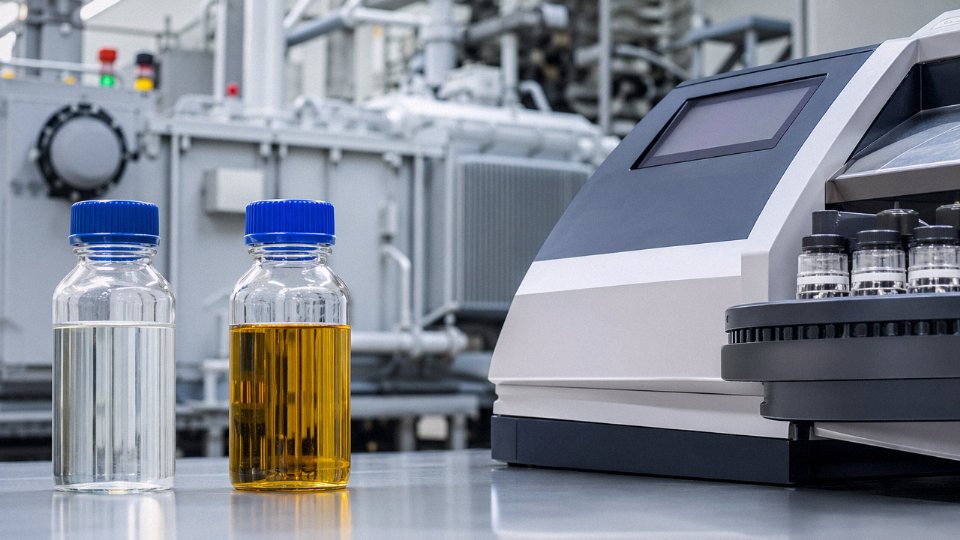
IEC 60599 includes an annex with silicone-specific threshold guidance, and that is the reference your lab should be working from. If your service provider is running silicone DGA samples through standard mineral-oil interpretation software without adjustment, the fault severity can be systematically underestimated. Worth verifying with your diagnostics contractor before the next scheduled DGA.
Does silicone oil accelerate or degrade transformer cellulose insulation?
Silicone is generally gentler on kraft paper than aged mineral oil, primarily because it does not generate acidic oxidation byproducts. Mineral oil that has lost its inhibitor package and started oxidizing produces organic acids that attack cellulose chains directly, shortening paper life considerably. Silicone does not go down that degradation pathway.
Silicone transformer oil extends cellulose insulation life compared to oxidized mineral oilTrue
Silicone fluid does not produce acidic byproducts during aging, which are the primary chemical mechanism for cellulose depolymerization in mineral-oil transformers. This is supported by aging studies and IEC technical literature on alternative insulating fluids.
The catch is at initial fill: cellulose paper requires a longer vacuum drying and impregnation cycle to achieve adequate silicone saturation compared to mineral oil, which wicks in faster due to lower viscosity (mineral oil at 25°C runs roughly 9–12 cSt versus silicone at roughly 50 cSt for common transformer grades). Skipping adequate drying time at commissioning is a real risk with silicone fills.
What is the shelf life of silicone transformer fluid in storage?
Sealed drums of silicone transformer fluid are stable for well over ten years under normal warehouse conditions — no antioxidant packages to deplete, no meaningful oxidative breakdown if moisture ingress is prevented. This is a genuine handling advantage over inhibited mineral oil, where the DBPC (dibutyl paracresol) antioxidant package can oxidize even in sealed containers, particularly if stored in a warm environment or with repeated temperature cycling. Inhibited mineral oil in storage should be retested after roughly two to three years; silicone generally does not need that precaution unless the drum seal has been compromised.
Can a transformer manufacturer void your warranty if you use silicone oil?
Yes, and it happens more often than procurement teams expect. Several major OEMs specify mineral oil or a short list of approved alternative fluids by brand or specification number on the nameplate data plate and in their technical bulletins. Substituting silicone in a unit that was designed, dried, and impregnated for mineral oil — without OEM authorization — can void the warranty outright, even if the electrical performance looks fine initially.
Before any fluid substitution, pull the transformer nameplate fluid designation and request the manufacturer’s current approved fluid list. If the OEM has since been acquired or discontinued that product line, get the position in writing from whoever holds the service obligations. A verbal okay from a field service technician is not sufficient documentation if a warranty claim comes up later.