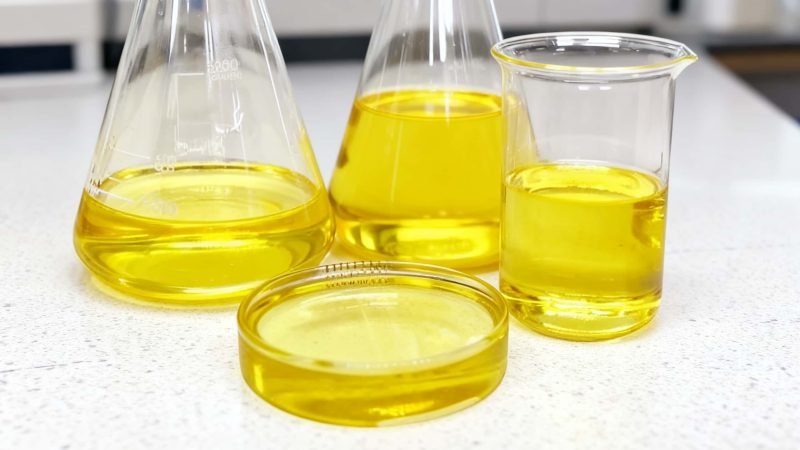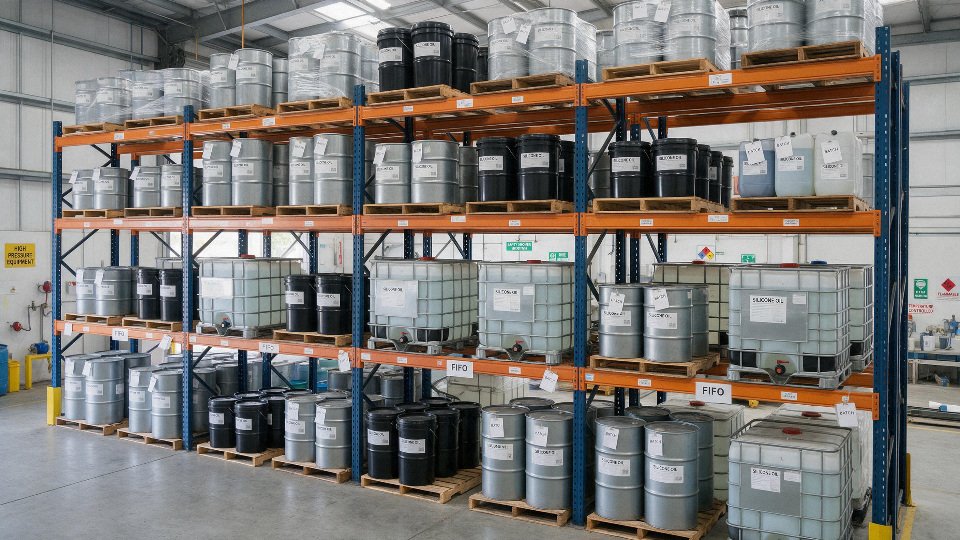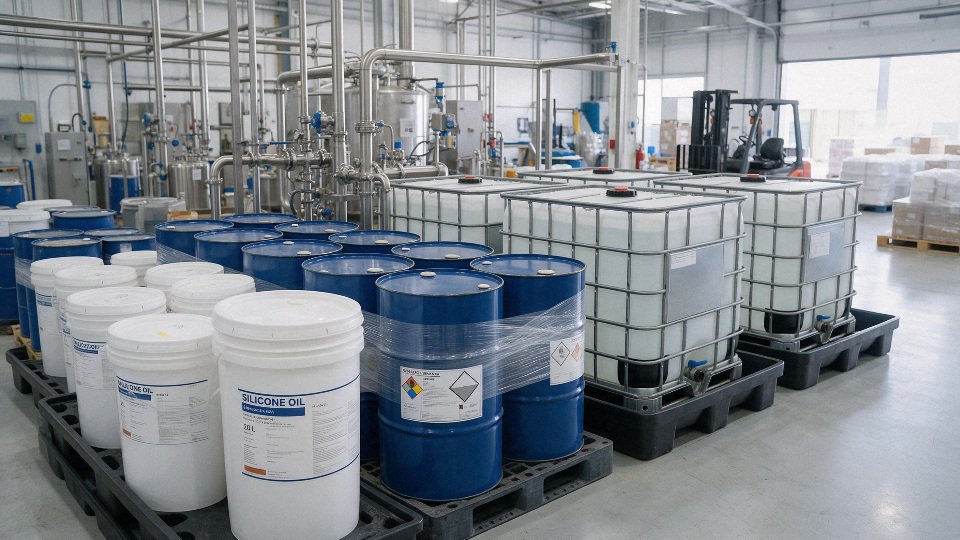
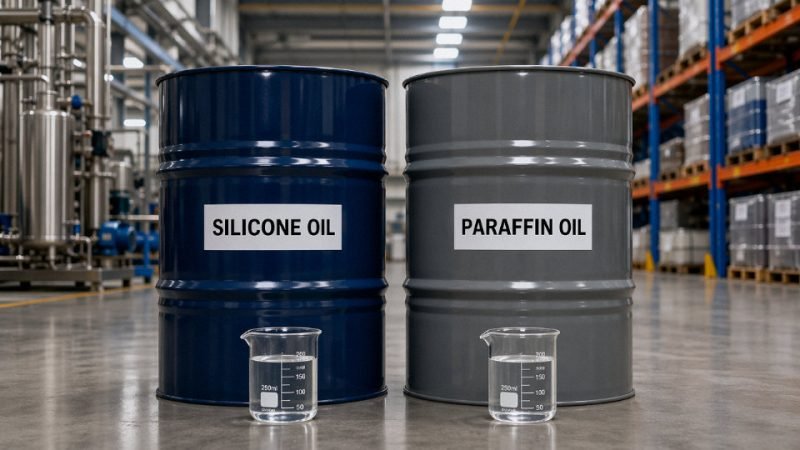
Specify the wrong lubricant or process oil for a production line and the consequences stack up faster than most engineers expect — seized bearings running hot in a high-temperature oven conveyor, a batch of cosmetic emulsion that separates overnight because the oil’s viscosity drifted with ambient temperature, or a food-contact compliance failure that pulls your product off shelves. Both silicone oil and paraffin oil look like clear, inert fluids in the drum. Choosing between them based on price alone, or on a vendor’s one-page datasheet, is how plants end up with the wrong fluid doing the wrong job.
Silicone oil (PDMS) and paraffin oil are both used as lubricants, heat-transfer fluids, and process oils, but they differ fundamentally in thermal stability, viscosity range, compatibility with plastics and elastomers, regulatory status, and cost. Silicone oil handles roughly −60 °C to 200 °C continuously and spans 0.65 cSt to 2,500,000 cSt; paraffin oil stays practical between about −20 °C and 120 °C with a narrower viscosity range of 10–500 cSt at 40 °C. The right choice depends on your operating temperature, material compatibility constraints, and whether food or pharma contact is involved.
What makes this comparison genuinely tricky — and worth working through carefully — is that the cases where paraffin oil is the obviously wrong answer are actually rarer than vendors imply, and the cases where engineers reflexively reach for silicone oil and overpay by a factor of three are more common than most procurement teams realize. The difference between a $1–$4/kg mineral white oil and a $3–$12/kg industrial PDMS grade matters enormously at scale, but only if you’ve already confirmed the paraffin option can actually survive your process conditions.
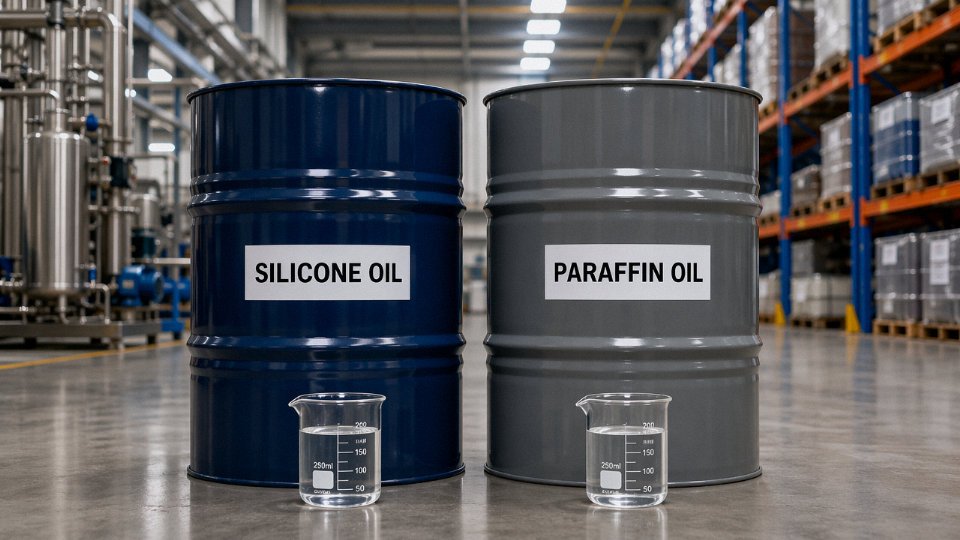
Molecular Structure and Physical Property Profiles: Reading the Spec Sheet Correctly
The two oils look similar on a purchase order — clear, colorless liquids, both sold by viscosity grade — but their molecular architectures are fundamentally different, and that difference explains nearly every practical divergence you’ll encounter once the drums are on the floor.
What You’re Actually Buying at the Molecular Level
Polydimethylsiloxane (PDMS), the dominant silicone oil type, is built on a silicon-oxygen backbone with methyl side groups. Low-viscosity grades around 5 cSt have molecular weights in the range of roughly 1,000–1,500 g/mol — short oligomeric chains that flow almost like water. Climb to a 60,000 cSt grade and you’re looking at polymer chains somewhere in the neighborhood of 200,000–400,000 g/mol. The backbone is genuinely inorganic; that’s not a marketing claim, it’s the reason for the thermal and electrical properties discussed later.
Paraffin oil is a different story entirely. White mineral oil and technical paraffin oils are blends of saturated hydrocarbons — predominantly C20 to C40 n-alkanes and isoalkanes — with individual molecule weights sitting between roughly 280 and 560 g/mol. They’re not polymers. The viscosity comes from the collective entanglement of many medium-length hydrocarbon chains rather than from the chain length of single large molecules. That distinction matters when you’re thinking about shear stability under high-speed machinery.
The Viscosity Grading Trap
This is where procurement teams get burned more often than they should. Silicone oil viscosity is quoted in centistokes (cSt) at 25°C. Paraffin and white mineral oils follow ISO VG grading, which references kinematic viscosity at 40°C. A product data sheet showing “ISO VG 46” paraffin oil and a silicone oil listed at “46 cSt” are not equivalent — the paraffin measurement was taken 15°C hotter, so at actual operating temperatures the paraffin oil will be noticeably more viscous than the silicone at 25°C comparisons suggest.
Silicone oil viscosity is measured at 25°C while paraffin/white oil ISO VG grades are referenced at 40°C, making direct numerical comparison misleading without temperature correction.True
This is standard industry practice: ASTM D445 / ISO 3104 allows viscosity to be reported at any reference temperature, and silicone suppliers conventionally use 25°C while the ISO VG system for mineral oils specifies 40°C as the reference point.
In practice, if you’re substituting one for the other in a lubrication or damping application, always pull the full viscosity-temperature curve from the TDS, not just the headline number. Most reputable suppliers publish curves; if yours doesn’t, ask.
Physical Constants Side by Side
| Property | Silicone Oil (PDMS) | Paraffin / White Mineral Oil |
|---|---|---|
| Density at 25°C | ~0.96–0.97 g/cm³ | ~0.82–0.89 g/cm³ (grade-dependent) |
| Refractive index (nD20) | ~1.400–1.404 | ~1.460–1.480 |
| Surface tension | ~20–21 mN/m | ~28–32 mN/m |
| Flash point | 300–320°C (typical PDMS) | 180–260°C (varies strongly by grade) |
| Pour point | Down to –60°C (low-viscosity grades) | Typically –10°C to –20°C |
| Dielectric strength | ~14–18 kV/mm | ~10–14 kV/mm |
The lower surface tension of silicone oil is operationally significant — it will wet and spread across surfaces far more aggressively than paraffin. That’s an asset in mold release and surface coating applications. In gasket or seal assemblies it can be a liability if the oil migrates into areas where it causes swelling or contamination.
Pour Point Is Often the Decisive Number for Cold Environments
Most paraffin oils start to congeal somewhere between –10°C and –20°C, with heavier grades gelling closer to –10°C. Low-viscosity PDMS grades (5–50 cSt) remain pourable down to around –60°C. For equipment running in unheated outdoor enclosures in northern climates — or any cryogenic adjacent process — this isn’t a minor footnote on the spec sheet. It’s the specification. A damping fluid or transformer coolant that turns to a waxy semi-solid at startup has caused enough equipment damage in cold-weather facilities that it’s worth treating as a failure mode, not just a cold-weather inconvenience.
The refractive index difference is smaller than you’d expect given how differently the two oils behave, but it matters in optical and photonic applications, and occasionally in food inspection lines where index-matching fluids are used. Silicone’s lower index (around 1.40) versus paraffin’s 1.46–1.48 can shift optical path calculations enough to affect sensor calibration.
Thermal Stability and Operating Temperature Windows: Where Each Fluid Survives and Where It Fails
Standard PDMS silicone oil handles continuous service from roughly –60°C up to 200°C without significant molecular breakdown. That’s not marketing language — it reflects the Si–O backbone’s bond energy (~452 kJ/mol), which is meaningfully higher than the C–C bonds that hold paraffin chains together. In practice, a 100 cSt PDMS running in a heated roller bearing at 180°C will still be recognizable fluid after thousands of hours. Push it to 220°C continuously and you’ll start seeing slow depolymerization, gradually dropping viscosity as cyclic siloxane oligomers form and volatilize off.
High-phenyl grades — sometimes labeled PMPS or phenylmethyl silicone — shift the ceiling upward. Continuous service to 250°C is realistic, and short-term spikes to around 300°C are survivable, though at that point you’re close enough to the edge that I’d want thermocouples on the application, not just datasheet confidence. Above 300°C, depolymerization accelerates and you get silica deposit formation — fine white powder that migrates into seals, plugs orifices, and is genuinely difficult to clean out of tight clearances. That’s a maintenance event nobody wants.
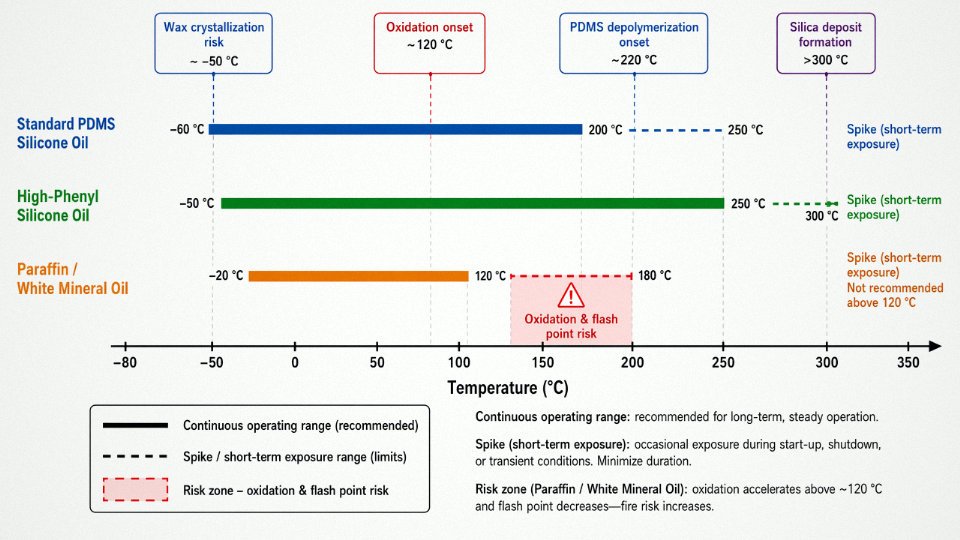
Paraffin oil’s situation is more complicated, and the complication matters for procurement decisions. In an oxygen-free atmosphere — sealed system, nitrogen blanket, that sort of thing — a good-quality mineral white oil can technically survive to around 250°C before thermal cracking becomes significant. But that ceiling is nearly irrelevant for most plant environments because oxidative degradation kicks in well before then. Exposed to air above roughly 120–150°C (the exact threshold depends on base oil refining quality and additive package), paraffin oil begins oxidizing. The byproducts are varnish deposits and low-molecular-weight acidic compounds. Varnish coats heat-exchanger surfaces, reduces film strength, and clogs servo valve spools in hydraulic systems. The acids attack yellow metals and accelerate bearing fatigue.
Paraffin oil can be safely used continuously at 200°C in standard industrial applicationsFalse
Oxidative cracking in air begins at roughly 120–150°C for most mineral white oil grades, producing varnish and acidic byproducts well before 200°C. Only in truly inert atmospheres does the thermal cracking ceiling approach 250°C, and flash point constraints (180–260°C depending on grade) impose a fire-safety ceiling that makes 200°C operation impractical and hazardous in most plant environments.
The flash point issue deserves its own sentence: paraffin oil flash points run 180–260°C depending on grade and viscosity, which means an oven-chain lubricant application running at 160°C is already eating into your safety margin, not sitting comfortably below it. Silicone oil flash points typically land at 300–320°C, which is why food-processing and paint-oven chain applications almost universally use PDMS regardless of the cost premium.
On oxidative stability testing, ASTM D943 (TOST) and pressure differential scanning calorimetry (PDSC) data consistently show silicone oil induction times roughly 3–5× longer than paraffin oils of comparable viscosity under identical temperature and oxygen conditions. The exact multiplier depends on the paraffin oil’s additive package — heavily inhibited Group II or Group III base stocks narrow the gap somewhat, but they don’t close it, especially above 130°C where inhibitor depletion accelerates.
The cold end is where paraffin oil fails quietly and expensively. Paraffin wax fraction — present to some degree in every mineral oil regardless of dewaxing treatment — begins crystallizing at temperatures that vary by grade, but sub-zero operation is genuinely risky. Wax crystals block 25–40 micron filter screens, starve bearing lube circuits, and cause slow, ambiguous failures that often get misdiagnosed as pump cavitation. For refrigeration compressor shaft seals, outdoor equipment in cold climates, or any system that cold-soaks below –10°C, silicone oil is the default choice. It contains no wax fraction. A 100 cSt PDMS at –40°C is still pumpable fluid, thickened but functional. A paraffin oil at the same temperature may be a semi-solid gel sitting motionless in your supply line.
| Condition | Standard PDMS | High-Phenyl Silicone | Paraffin (Mineral White Oil) |
|---|---|---|---|
| Continuous upper limit (air) | ~200°C | ~250°C | ~120–150°C before oxidation |
| Short-term spike limit | ~250°C | ~300°C | Flash point dependent: 180–260°C |
| Lower operating limit | –60°C | –50°C (approx.) | –10°C to –30°C (wax-dependent) |
| Failure mode at high temp | Depolymerization, volatility | Silica deposits above 300°C | Varnish, acid formation, fire risk |
| Failure mode at low temp | Viscosity rise, manageable | Similar to standard PDMS | Wax crystallization, filter blockage |
For any application where ambient or process temperature exceeds 130°C in an air-exposed environment, paraffin oil requires serious justification. For sub-zero continuous operation, the wax crystallization risk alone typically rules it out.
Lubrication Performance and Tribological Behavior in Mechanical Systems
Silicone oil has a reputation, mostly deserved in certain circles, as a versatile, chemically inert lubricant that works everywhere. That reputation has caused real damage in plant environments where engineers swapped out a mineral oil “just to try” the silicone alternative — and ended up with spalled bearings within a few thousand hours. The tribological reality is considerably more nuanced than the marketing suggests.
Boundary Lubrication and the Four-Ball Wear Test
Run an ASTM D4172 four-ball wear test on a straight-grade PDMS fluid against a well-formulated paraffinic mineral oil with EP additive chemistry, and the results are not subtle. Paraffin-based oils with sulfurized or phosphated EP packages typically produce wear scar diameters in the 0.4–0.6 mm range, depending on viscosity grade and additive treat rate. Neat silicone PDMS, with no EP additives, routinely scores 0.8–1.2 mm under the same contact conditions. That difference doesn’t sound dramatic until you translate it to contact mechanics: wear scar diameter scales roughly with the cube root of material loss volume, so a 0.9 mm scar represents somewhere between five and eight times the material removal of a 0.5 mm result.
The reason is straightforward chemistry. Under boundary lubrication — the regime where the film breaks down under high load and asperities actually touch — what saves metal surfaces is reactive chemistry, not film viscosity. Sulfur- and phosphorus-based EP additives react with nascent metal surfaces at the contact flash temperature, forming iron sulfide or iron phosphate sacrificial layers. PDMS cannot host those chemistries. Its Si–O backbone is essentially inert toward metal surfaces, which is precisely why it’s chemically stable and non-reactive elsewhere, but that same inertness means it offers no boundary-film protection worth relying on for steel-on-steel contacts under serious load.
Silicone PDMS oil without EP additives produces worse four-ball wear test results than EP-additivized mineral paraffin oil under high-load steel-on-steel contact conditions.True
ASTM D4172 test data consistently shows neat PDMS yielding wear scar diameters of 0.8–1.2 mm versus 0.4–0.6 mm for EP-additivized paraffinic mineral oils, reflecting silicone's inability to form boundary-protective reaction layers on steel surfaces.
Where Silicone Oil Actually Wins Tribologically
None of that means silicone oil loses everywhere. Switch the substrate from steel-on-steel to plastic-on-plastic, rubber-on-metal, or PTFE-lined bearings, and the calculus flips almost entirely. Hydrocarbon oils — paraffin included — swell elastomers, attack certain nylons and acetals, and degrade rubber seals over time. Silicone oil’s non-polarity and chemical inertness make it genuinely the right call for those contact pairs. In practice, lubricated plastic bushings in food-processing or medical equipment, rubber-gasketed valve stems, and PTFE-wrapped sliding pads in civil or structural applications all perform significantly better on silicone. The failure mode with paraffin in those contexts isn’t gradual — seal swell can close off a flow path or seize a stem valve in a matter of weeks in a hot environment.
Viscosity Stability Across Temperature: Where Silicone’s VI Advantage Is Real
Viscosity index matters whenever a machine cycles through wide temperature swings — outdoor gearboxes in northern winters, automotive test equipment, industrial ovens with cold startups. PDMS fluids carry viscosity indexes typically in the 150–200+ range. Paraffin mineral oils without VI improver additives land at roughly 95–115 VI, which is adequate for stable indoor environments but can mean the oil is nearly twice as thick at cold startup as at operating temperature. For precision instruments, optical equipment drives, or any application where consistent drag torque matters from -20°C to +80°C, the silicone’s flatter viscosity-temperature curve is a genuine operational advantage, not a spec-sheet abstraction.
Load-Carrying Capacity and Gear Applications
The most consequential misapplication I’ve seen, repeatedly, is silicone oil in worm gears or hypoid gear sets under meaningful load. These contact geometries generate extreme localized pressures — 1,500–2,500 MPa at the gear tooth interface is a reasonable working range for heavily loaded units, depending on geometry and speed. EP-additivized paraffinic oils are engineered specifically for this: the sulfur and phosphorus additives activate at those flash temperatures and protect the surface. Silicone oil cannot be meaningfully additivized with conventional EP chemistry; the PDMS matrix doesn’t carry or activate those packages the same way mineral oil does. Put silicone in a loaded worm gear and you’re running essentially unprotected boundary lubrication. Gear tooth scuffing follows, sometimes within dozens of hours at full load, and the damage is typically irreversible without a gear replacement.
The selection rule is blunt: if the contact is metal-on-metal under high load, use an EP-additivized paraffin mineral oil. If the contact involves elastomers, plastics, or PTFE, and load is low-to-moderate, silicone oil earns its place.
| Contact Pair | High Load | Preferred Fluid | Risk of Wrong Choice |
|---|---|---|---|
| Steel-on-steel (gears, bearings) | Yes | EP paraffin mineral oil | Scuffing, spalling within hours–weeks |
| Steel-on-steel (bearings, light duty) | No | Either; paraffin more cost-effective | Marginal wear increase with silicone |
| Rubber-on-metal (seals, stems) | Low–moderate | Silicone PDMS | Seal swell, stiction with paraffin |
| Plastic-on-plastic (bushings, slides) | Low | Silicone PDMS | Substrate attack, cracking with paraffin |
| PTFE-lined bearings | Low–moderate | Silicone PDMS | Paraffin contamination of PTFE surface |
Chemical Compatibility, Material Attack, and Regulatory Classification by Industry
Most equipment failures traced back to lubricant selection aren’t viscosity problems. They’re compatibility problems — discovered only after a gasket has ballooned, a plastic housing has cratered, or an auditor pulls up your SDS and asks whether your food-line lubricant is actually approved for what you’re using it for.
Elastomer Compatibility: Know Which Seals You’re About to Destroy
Paraffin oil is a hydrocarbon, and hydrocarbon fluids have a well-documented tendency to swell nitrile rubber (NBR). In practice you’ll see 5–15% volumetric swell in NBR seals exposed to paraffinic white oils, sometimes climbing toward 20% depending on the specific rubber compound’s acrylonitrile content and the oil’s aromatic fraction. That swell starts as a soft, compliant seal feeling — and ends as a degraded, extruded gasket that can no longer hold pressure. EPDM behaves similarly in the presence of paraffinic hydrocarbons. Neither failure happens immediately; you’ll often get a few hundred hours before the leak shows up, which makes the root cause hard to diagnose.
Silicone oil (PDMS) is largely inert toward most elastomers, which tempts people into thinking it’s universally safe. It is not. Put PDMS in contact with silicone rubber gaskets and you can see swell approaching 150–200%, depending on the silicone rubber’s cross-link density and the oil’s molecular weight. This catches engineers who assume “same chemistry = safe.” It doesn’t. If your equipment uses silicone rubber O-rings — common in pharmaceutical mixing vessels, some food-grade fittings, and high-temperature oven conveyor systems — you need PTFE, Viton, or FFKM seals instead before introducing any silicone oil.
Plastics, Coatings, and Process Stream Contamination
Paraffin oil acts as a mild solvent for several thermoplastic and thermoset families. Styrenic plastics — polystyrene, ABS, HIPS — soften and craze on prolonged contact. Bitumen-based protective coatings on older gearboxes or pipe flanges can blister and lift. In VOC-sensitive environments like cleanrooms or pharmaceutical suites, even trace paraffinic oil carry-over in process air or on component surfaces can create compliance headaches.
Silicone oil doesn’t dissolve most organic resins and sits safely on the majority of painted or powder-coated surfaces. It won’t lift a two-part epoxy coating or attack most engineering polymers. The catch is surface contamination — PDMS migrates and spreads aggressively, and in any downstream process involving adhesive bonding, printing, or coating, even nanogram-level silicone contamination causes adhesion failure. Assembly plants running silicone lubricants on one line have discovered this the hard way when painted parts started delaminating two operations downstream.
Silicone oil is chemically inert to all plastics and coatingsFalse
PDMS does not dissolve most engineering plastics, but its extreme surface migration causes adhesion failure in bonding and coating operations, and it can swell silicone rubber components by up to 200%.
Regulatory Status: FDA, NSF H1, and REACH — the Details That Actually Matter in Audits
USP-grade liquid paraffin (white mineral oil) carries FDA 21 CFR 172.878 approval as a direct food additive — meaning it can contact food intentionally and in regulated quantities. PDMS holds FDA 21 CFR 178.3570 approval, but only as a release agent or indirect-contact lubricant. That distinction is not a paperwork technicality. Using silicone oil where a direct food additive is required — tablet coating, confectionery panning, oral pharmaceutical processing — is a regulatory non-conformance, regardless of how clean the fluid is.
For incidental food contact lubrication (NSF H1), both oils can be formulated to pass. In bakery conveyor and beverage-bottling applications, NSF H1 silicone greases and oils dominate because of their temperature range and low migration risk onto product. In confectionery release and solid-dose tablet coating, NSF H1 white mineral oils are the standard. Always verify the specific SKU, not just the base fluid — NSF H1 registration is product-specific, and a supplier changing a base stock or additive package can invalidate an existing registration without obvious labeling changes.
On the REACH side, standard high-molecular-weight PDMS is non-CMR and falls under the polymer exemption, which simplifies your substance registration burden considerably. Paraffin oils require more scrutiny. The IP346 test measures DMSO-extractable polycyclic aromatic content, and if that extract exceeds 3%, the oil is classified as a suspected carcinogen (Category 1B) under EU CLP regulation. Reputable suppliers of cosmetic- or food-grade white oils will provide IP346 data sheets confirming low aromatic content — below 3% extract, typically well below 1% for properly refined grades. If a supplier can’t provide this data, treat that as a disqualifying flag, not a minor oversight.
Industry-Specific Application Matching: Choosing the Right Fluid for Eight Key Sectors
The fastest way to narrow down which oil belongs in your process is to look at what the fluid actually has to do — not just its temperature range or viscosity. Sector context drives the decision more than any single property. Here’s how these two oils actually get used across major industries, and where the wrong choice creates real problems.
Pharmaceuticals and Medical Devices
These two oils can coexist in the same facility but serve completely different regulatory functions. Paraffin (white mineral oil) is an active pharmaceutical ingredient in laxative formulations — oral doses typically run up to around 10 mg — and appears in USP and European Pharmacopoeia monographs as a recognized excipient. Silicone oil, specifically PDMS at low viscosity (usually 350–1000 cSt), is used for syringe barrel lubrication at roughly 0.1–0.5 mg per 1 mL syringe, stopper conditioning, and implant-grade coatings. The regulatory pathway for each is fundamentally different: paraffin in an oral product goes through excipient qualification; silicone used on a prefilled syringe barrel requires extractables/leachables testing under ISO 10993 or equivalent, and any visible silicone droplet in the drug product triggers particulate investigation. Wrong oil, wrong application = potentially a full batch investigation and regulatory notification.
Food Processing and Packaging
Food-grade silicone release sprays — typically polydimethylsiloxane emulsions at NSF H1 or FDA 21 CFR 178.3570 status — are applied to bakery molds at roughly 0.5–2 g/m² per bake cycle, depending on product fat content and mold material. White paraffin oil (food grade, USP/technical) handles confectionery panning, cheese rind coating, and citrus surface treatment, where its heavier film-forming character is actually an advantage. Don’t use a silicone spray on a confectionery panning drum — the silicone can prevent the sugar coating from adhering to itself, which is the exact opposite of what you want.
Electrical and Electronics
Silicone oil dominates transformer cooling where IEC 60836 applies — it handles partial discharge environments and extended thermal cycling better than mineral alternatives. Paraffin-derived oils will carbonize on live contacts above roughly 150°C and should not be used in enclosed high-voltage equipment. Cable-pulling operations use silicone compounds routinely because they don’t attack conduit jackets or leave residues that harden over time.

Plastics and Rubber Processing
Silicone oil is the default mold release for urethane, epoxy, and phenolic molding because it provides clean release across a broad temperature range without reacting with cure chemistry. Paraffin oil works internally in PVC and polyolefin compounding as a processing aid and external lubricant at loadings typically between 0.1–1.0 phr — specific loading depends on the base resin and extruder shear conditions. Using silicone oil as an internal lubricant in PVC is generally a mistake; it doesn’t integrate into the melt the same way and can cause plate-out on the die.
Automotive and Aerospace
Hydraulic dampers from major OEM suppliers (shock absorbers, rotary dampers) commonly use 5–100 cSt PDMS because viscosity stability over a wide temperature swing is critical for consistent ride behavior. For most drivetrain and engine lubrication, Group I/II paraffinic mineral base stocks still dominate by volume — they’re cheaper, they accept additive packages well, and the tribological performance on steel-on-steel contacts is proven. Silicone isn’t always better; in boundary lubrication conditions on steel, it usually isn’t.
Textiles and Leather
Paraffin oil is used as a fiber lubricant in spinning and knitting, where it reduces yarn-to-yarn and yarn-to-guide friction. Silicone oil’s role here is in finishing: applied from aqueous bath at roughly 0.5–3% concentration, it imparts durable water repellency and a characteristic soft hand. The two oils can appear in the same textile finishing line but at different process stages.
Cosmetics and Personal Care
Liquid paraffin (INCI: Paraffinum Liquidum) appears in baby oils, barrier creams, and hair products at concentrations anywhere from around 10% up to near 98% in some mineral oil bases. Dimethicone (low-viscosity PDMS, typically 5–50 cSt in leave-on products) delivers the silky glide in hair serums and primer cosmetics. In practice, formulators often blend both — paraffin for occlusive moisturization, dimethicone for spreadability and thermal protection during heat styling.
Laboratory and Scientific Instruments
Silicone oil is the standard reference fluid for viscometer calibration, with NIST-traceable standards available across a wide range — roughly 5 cSt up to 60,000 cSt — which makes it essentially irreplaceable in metrology labs. Paraffin oil still handles oil-bath heating setups reliably up to about 150°C and remains common as an immersion medium in optical microscopy where refractive index matching is less critical. Above 150°C in a bath, though, the flash point margin on lower-grade paraffin oils gets uncomfortable; that’s where silicone bath fluid earns its price premium.
Food-grade paraffin oil is approved for direct food contact applications including citrus surface treatment and confectionery panning under FDA 21 CFR regulations.True
FDA 21 CFR 172.878 permits certain highly refined mineral white oils in food applications including fruit coating and confectionery, provided they meet USP or food-grade purity specifications.
Environmental Fate, Biodegradability, and Sustainability Considerations
Sustainability pressure on fluid selection has moved well past box-ticking. Procurement managers at multinationals now face supplier questionnaires, Scope 3 reporting requirements, and regional chemical regulations that can disqualify a lubricant or process fluid before it ever reaches the plant floor. Understanding where silicone oil and paraffin oil actually stand — not where marketing datasheets imply they stand — changes how you specify both.
Biodegradability: What the OECD 301B Result Really Means
Highly refined, food-grade paraffin oils consistently reach 60–80% biodegradation in OECD 301B closed-bottle tests, which clears the 60% threshold for “readily biodegradable” classification. That matters operationally: spills onto soil or into drainage systems carry lower regulatory consequence, and some jurisdictions allow simplified disposal pathways. The key qualifier is highly refined. Less-refined mineral oils with residual polynuclear aromatic hydrocarbons can perform significantly worse and carry their own hazard classifications entirely (more on that below).
Standard PDMS silicone oil typically achieves only 20–30% degradation under the same protocol — well short of the readily biodegradable threshold. In practice, PDMS released into soil or sediment persists, partitioning into organic matter rather than mineralizing. For applications with chronic low-level release — open-gear lubrication outdoors, mold-release spray in ventilated sheds, conveyor chain lubrication in food processing — that persistence is worth factoring into your environmental risk register, not just your SDS filing cabinet.
Standard PDMS silicone oil meets the readily biodegradable classification under OECD 301B testingFalse
PDMS typically achieves only 20–30% biodegradation under OECD 301B, well below the 60% threshold required for readily biodegradable classification. It is generally classified as inherently biodegradable at best.
Aquatic Toxicity: A Nuance Most Procurement Specs Miss
Both fluids, in their premium grades, present low aquatic hazard. PDMS shows LC50 values above 1,000 mg/L for Daphnia magna, effectively non-toxic by standard ecotoxicology criteria. Highly refined paraffin oils are similarly classified as non-toxic to aquatic organisms.
The split happens with grade selection. Paraffin oils that haven’t undergone deep hydrofinishing — cheaper industrial grades, some imported bulk stocks — can carry residual polynuclear aromatics classified under EU CLP as Category 1 chronic aquatic hazard. If your procurement team is sourcing on price and switching between suppliers seasonally, this is where an apparently equivalent product creates a compliance gap. Always request the CLP classification and the IP346 polycyclic aromatic content result, not just the SDS headline.
Atmospheric Fate and the EU REACH Siloxane Question
When PDMS is released to atmosphere — aerosol spray applications, heated process baths with vapor loss, open surface coating lines — it eventually oxidizes to silanols, then to silicon dioxide, CO₂, and water. The inorganic end products themselves are broadly benign. The regulatory issue sits upstream, with cyclic siloxane impurities: D4, D5, and D6 are under SVHC evaluation in the EU, and D4 is already restricted in wash-off cosmetics. Industrial PDMS grades are not the same formulation, but if your silicone oil supplier cannot provide verified low-cyclic content data, the regulatory exposure is real and growing.
Carbon Footprint: The Number That Surprises People
Paraffin oil production via petroleum refining runs roughly 0.5–0.8 kg CO₂e per kg product on a cradle-to-gate basis, depending on refinery energy mix and hydrotreatment depth. PDMS synthesis via the chlorosilane route — quartz sand to silicon metal to chlorosilanes to polymer — lands in the range of 3–6 kg CO₂e per kg. That’s a factor of four to eight difference in embedded carbon. For companies building out Scope 3 inventories or responding to customer decarbonization questionnaires, specifying silicone oil carries a meaningful carbon cost that paraffin oil does not, at least on a per-kilogram basis.
Whether that matters depends on volume. A 20-liter annual consumption of silicone release agent in a precision mold shop barely registers. A bulk silicone oil heat-transfer system holding several tonnes is a different conversation.
End-of-Life Handling
Paraffin oil has a clear circular-economy pathway: it can be re-refined and blended back into base stock, which is standard practice in Europe and increasingly in North America. Collection infrastructure exists. Silicone oil does not have an equivalent recovery route at industrial scale. Incineration is the preferred disposal method, but it must be high-temperature — above roughly 850°C — to fully combust silicon-containing compounds and avoid generating silicone-derived particulates that foul downstream equipment and create their own air quality issues. Landfilling silicone oil is not prohibited everywhere, but the soil silica accumulation concern is why several waste contractors now explicitly route it to high-temp incineration only.
In practice, end-of-life cost for silicone oil tends to run higher than for mineral-based alternatives, and that delta rarely appears in the initial fluid selection comparison.
Total Cost of Ownership Analysis: Raw Material Price vs. Service Life vs. Replacement Frequency
Procurement managers who evaluate lubricant and release-agent bids on price-per-kilogram alone routinely make the wrong call. It’s one of the more expensive habits in plant maintenance, and it shows up in the MRO data consistently — high relubrication labor hours, unplanned conveyor shutdowns, and the occasional catastrophic contamination event that rewrites the whole budget calculation in one afternoon.
Raw Material Benchmarks and the Apparent Price Gap
Industrial PDMS at 350 cSt — the workhorse viscosity grade for most general lubrication and release applications — runs roughly $4–8/kg when bought in 200 kg drum quantities. The exact position in that range depends on the supplier, order volume, and where PDMS feedstock pricing sits in the silicones market cycle (it can swing 20–30% between years). ISO VG 100 white paraffin oil in comparable drum quantities typically lands at $1.50–3.50/kg. So yes, silicone oil is somewhere between 2× and 4× more expensive at the point of purchase. That number is real, and no amount of TCO framing makes it disappear. The question is whether it’s the right number to be optimizing.
Service Life Is Where the Math Flips
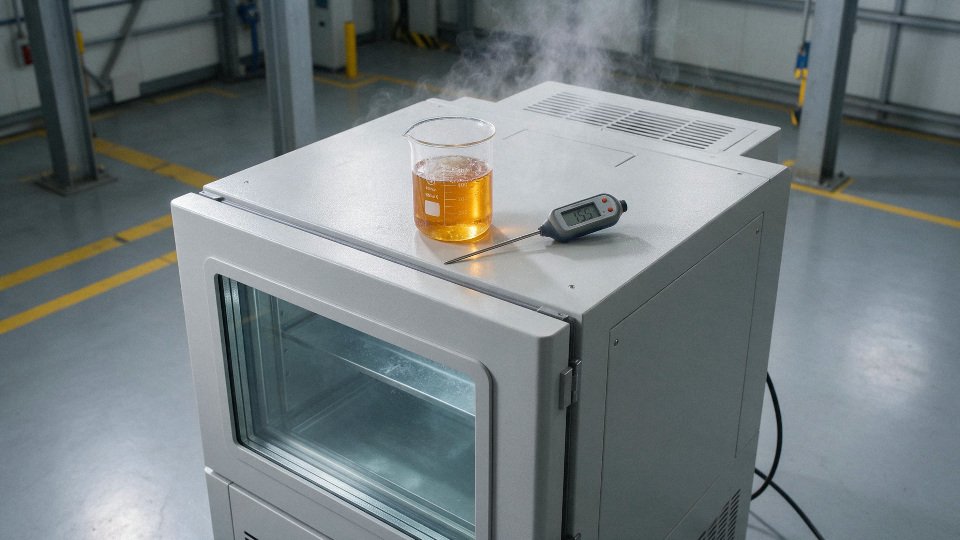
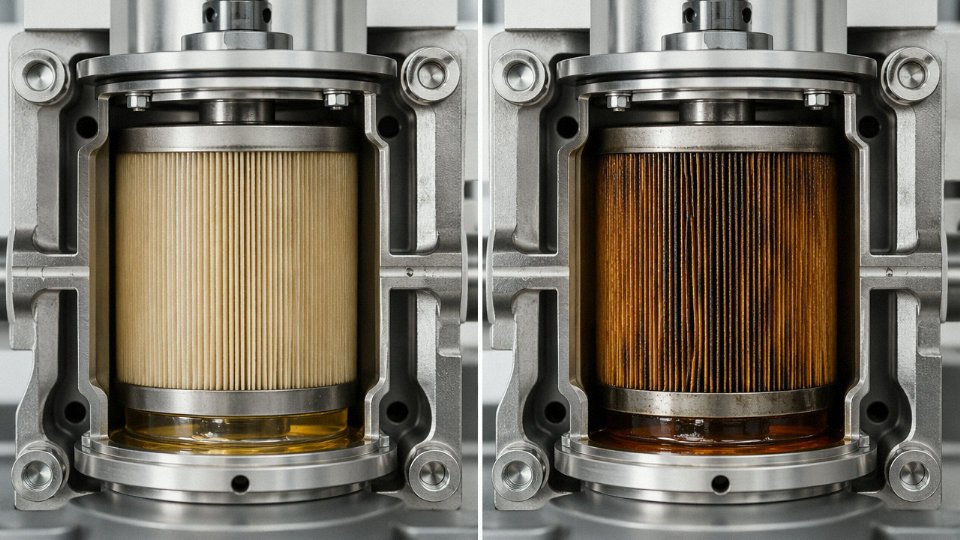
Consider a continuous baking or powder-coat oven conveyor running at 175–185°C. Paraffin-mineral grease at those temperatures oxidizes and carbonizes relatively fast — relubrication intervals in the 500–1,500 hour range are typical, and the lower end of that range is common when the bearing sees any heat soak during slowdowns. Silicone grease on the same bearing usually runs 6,000–8,000 hours before a relubrication is warranted, sometimes longer in sealed units with low contamination ingress.
Do the arithmetic at the unfavorable end: if paraffin grease needs attention every 800 hours and silicone every 6,000, you’re performing roughly 7–8 relubrication cycles with the cheaper product for every one with the expensive one. Factor in the labor — a maintenance tech spending 20–40 minutes per bearing point, at a fully-loaded labor rate that in most Western European or North American plants runs $45–90/hour — and the material cost premium evaporates before you finish the spreadsheet. In plants with dozens of oven conveyor bearing points, the annual labor differential alone can reach $15,000–40,000 depending on plant size and staffing model.
Silicone oil's service life advantage in high-temperature conveyor bearings typically offsets its higher purchase price within a 12-month maintenance cycle.True
At 180°C operating temperature, oxidative degradation of mineral/paraffin grease reduces relubrication intervals to 500–1,500 hours versus 6,000–8,000 hours for silicone grease, making total annual lubrication cost (material + labor) lower for silicone in most high-temperature conveyor applications.
The Contamination Cost Nobody Budgets For
Here’s the scenario that should make any automotive or industrial coatings plant owner genuinely uncomfortable. A single silicone oil contamination event — a mist migration from a nearby conveyor, a shared transfer pump, a technician who grabbed the wrong drum — landing in a solvent-borne topcoat line will cause fish-eye cratering across affected panels or parts. Rework costs in automotive OEM finishing typically run $10,000–100,000 per incident once you account for line stoppage, stripping, recoat, and quality hold labor. That’s not a theoretical number; it’s what paint shop quality managers actually report when these events get tracked honestly.
The point isn’t that silicone oil is dangerous in absolute terms. It’s that the contamination risk profile is asymmetric and application-specific, and it belongs in the cost model with a realistic penalty weighting — especially if silicone lubricants and coating lines share the same facility.
Volume Efficiency and the Density Correction
One small correction that’s worth making when comparing price-per-kg bids: silicone oil runs around 0.96–0.97 g/cm³ while paraffin oil sits closer to 0.85–0.87 g/cm³. If your dispensing system or application method is volume-based — most spray systems and bath applicators work by volume — the cost-per-liter gap is narrower than the cost-per-kg gap suggests, roughly 10–12% narrower. Not dramatic, but worth adjusting in the procurement model rather than ignoring it.
Silicone’s high viscosity index also means less volume is needed to maintain target operating viscosity at elevated temperatures compared to a paraffin-grade with a lower VI. In hot applications, you may actually be applying less fluid per cycle.
A 5-Factor TCO Scorecard
Rather than a single price comparison, a structured evaluation across five factors produces a defensible procurement decision:
| TCO Factor | Typical Paraffin Oil Position | Typical Silicone Oil Position |
|---|---|---|
| Material cost (per kg) | Low ($1.50–3.50) | High ($4–8) | |
| Service interval | Short (500–1,500 hr at >150°C) | Long (6,000–8,000 hr at >150°C) |
| Disposal cost | Moderate (hazardous waste in many jurisdictions) | Moderate to high (PDMS not readily biodegradable) |
| Contamination risk penalty | Low in most applications | High near coatings, adhesives, electronics |
| Regulatory compliance cost | Low–moderate (NSF H1 grades available) | Low–moderate (food-contact grades available, but verify each grade) |
Score each factor on a 1–5 scale weighted by your application’s actual exposure — a food processing plant weights regulatory compliance heavily; a steel mill weights service interval and thermal stability. The raw material line rarely wins when the other four factors are filled in honestly.
Frequently Asked Questions About Silicone Oil and Paraffin Oil
Can silicone oil and paraffin oil be mixed together?
Short answer: don’t. PDMS and paraffinic mineral oil are largely immiscible — they will phase-separate within hours, sometimes minutes depending on temperature and agitation. What you get in the interim is an unstable emulsion with viscosity behavior that bears little resemblance to either starting fluid. In lubrication circuits, that means unpredictable film thickness and the real possibility of momentary starvation. In release agent applications, phase separation during spray or brush application leaves uneven coverage, which translates directly to torn parts and mold fouling. Blending the two isn’t technically impossible — specialty emulsifier packages exist — but unless a formulation chemist has validated that specific combination for your application, you’re creating a problem, not solving one.
Is silicone oil safe for skin and cosmetic use?
Cosmetic-grade dimethicone has a genuinely long and well-documented safety record. The EU Cosmetics Regulation (EC) No 1223/2009 places no restriction on its use level in rinse-off products, and the evidence for skin sensitization is essentially nonexistent at concentrations used in personal care. It’s non-comedogenic at low concentrations, which is why it appears in everything from hair serums to wound dressings. The practical caveat for procurement: “cosmetic grade” requires documentation — certificates of analysis showing absence of cyclic siloxane impurities (D4, D5, D6 are restricted in EU wash-off products above 0.1%), not just a supplier’s verbal assurance.
Which oil is better for high-temperature mold release above 200°C?
Silicone-based release agents, full stop. Paraffin-based releases begin carbonizing somewhere in the 180–220°C range depending on grade, and that carbon residue doesn’t stay where you want it — it migrates into surface texture, loads up vents, and eventually requires solvent-blast cleaning that shortens mold life measurably. Anyone who has spent time scrubbing carbon deposits out of a rubber compression mold at 2 a.m. before a morning run knows how expensive that choice was. Above roughly 180°C, the selection isn’t really a debate.
Does paraffin oil go rancid or expire?
Highly refined white mineral oil is about as chemically inert as a stored liquid gets. Sealed containers in a cool, dark environment realistically hold 3–5 years without meaningful degradation — no hydrolysis, no microbial growth, no rancidity in the biological sense. The failure mode is oxidative: open containers, UV exposure, or contamination with trace metals can generate color bodies and peroxide oxidation products over time. If stored paraffin oil has yellowed or developed an off-odor, it’s worth running a fresh peroxide value test before using it in any food-contact or pharmaceutical context, regardless of the original shelf-life date on the drum.
What is the difference between liquid paraffin, white mineral oil, paraffin oil, and baby oil?
These are mostly commercial and regional naming conventions for the same underlying material: a highly refined, colorless, odorless paraffinic hydrocarbon oil. The refining depth varies by grade — pharmaceutical and cosmetic grades have tighter limits on aromatic content and UV absorbance — but the base chemistry is identical. Baby oil is simply cosmetic-grade mineral oil with fragrance added. The naming inconsistency causes genuine procurement headaches; when specifying, always anchor to a viscosity grade, a regulatory standard (USP, BP, NSF H1), and a CAS number rather than the trade name alone.
Can silicone oil replace mineral oil as a transformer coolant?
Yes, and IEC 60836 is the governing standard for silicone insulating liquids in transformers. The fire-safety case is real: silicone fluid fire points exceed 300°C versus roughly 160°C for standard transformer mineral oil, which matters considerably in substations inside buildings or near combustible structures. The tradeoffs are cost — expect to pay roughly 3–5× the mineral oil price per liter — and the fact that silicone fluid has different compatibility requirements for seals and paint systems than mineral oil does. Some older transformer designs used seal compounds that swell unacceptably in silicone fluid. Verify elastomer compatibility before retrofilling.
Which oil is better for lubricating plastic gears?
Silicone oil is generally the safer choice for plastic-on-plastic gear applications, largely because PDMS doesn’t swell or craze most common engineering thermoplastics — ABS, polycarbonate, nylon, acetal. Paraffin and mineral oils can cause stress cracking in polycarbonate and polystyrene, particularly under load, and the damage often isn’t visible until a gear tooth fractures. The exception worth knowing: silicone oil’s relatively poor boundary lubrication means that for heavily loaded plastic gears, a PTFE-thickened silicone grease usually performs better than neat silicone oil.
Paraffin oil causes stress cracking in polycarbonate components under sustained contact and load.True
Paraffinic and aromatic mineral oils are known environmental stress cracking (ESC) agents for polycarbonate (PC). The hydrocarbon penetrates the polymer surface under mechanical stress, lowering the critical stress threshold for crack initiation. This is well-documented in plastics compatibility literature and is a standard exclusion in PC component maintenance guides.
Are there food-grade versions of both oils, and how do I verify them?
Yes to both. NSF H1 registration covers incidental food contact lubricants and release agents for either oil type — that’s the minimum bar for anything that might touch food machinery surfaces. For direct food contact or oral pharmaceutical use, the standard steps up to FDA 21 CFR compliance: 21 CFR 172.878 for white mineral oil in food, 21 CFR 178.3570 for lubricants with incidental food contact. For silicone, 21 CFR 178.3900 covers PDMS in food-contact applications. Always request a current Certificate of Analysis confirming heavy metal limits, sulfur content, and polycyclic aromatic hydrocarbon (PAH) absence — not just a supplier declaration letter. Regulatory status can change between production batches if the refining source changes, and that CoA is your paper trail if a food safety auditor comes through.
Decision Framework and Final Selection Checklist for Engineering Specifications
If you’ve read through the thermal, tribological, regulatory, and cost sections above, the pattern should be clear: neither oil wins universally. What follows is a structured way to make the call once, document it properly, and avoid revisiting it every time a maintenance tech grabs whatever’s on the shelf.
Binary Decision Tree for Fluid Selection
Start with temperature. If the application requires continuous service above 150°C — oven chain lubrication, heated mold release, transformer cooling — silicone (PDMS) is the working fluid. Paraffin-based mineral oil oxidizes, cokes, and deposits varnish in that range, and no additive package fully compensates. That’s not opinion; it’s oxidation kinetics.
Below 150°C continuous, keep evaluating.
Next, look at the contact interface. Boundary or extreme-pressure metal-on-metal contact — gearboxes, heavily loaded slideways, roller bearings with shock load — favors paraffin oil with an appropriate EP additive. Silicone oil’s low shear strength on metal surfaces is a real liability here; the film collapses under load in ways a well-formulated mineral oil won’t. Conversely, if the substrate is a polymer, elastomer, or coated surface, paraffin’s aromatic and naphthenic fractions can swell or extract plasticizers from many rubbers. Silicone wins that interface cleanly.
Then the regulatory gate. Direct oral contact — pharmaceutical laxatives, food-grade conveyor lubrication touching unwrapped product — points firmly to white mineral oil meeting USP or food-grade paraffin specifications. Silicone oil can qualify as an indirect food-contact lubricant under NSF H1, and some PDMS grades carry FDA 21 CFR clearances for incidental contact, but “incidental” is doing a lot of legal work in that sentence. Verify the specific grade, the specific contact scenario, and your own QA sign-off before you specify it.
Finally, environmental discharge. If the plant is in a jurisdiction with strict aquatic toxicity requirements or the fluid enters a biological wastewater treatment system, readily biodegradable is often a hard requirement. Paraffin (white mineral oil) degrades faster and has a more favorable ecotoxicity profile in most regulatory frameworks. PDMS is persistent, even if acutely non-toxic.

Side-by-Side Property Summary
| Parameter | Silicone Oil (PDMS) | Paraffin / White Mineral Oil |
|---|---|---|
| Continuous temp range | –60°C to ~200°C (some grades to 250°C) | –20°C to ~120°C (oxidation-dependent) |
| Viscosity index | 150–200+ | 90–120 (varies by refining) |
| Biodegradability | Persistent, not readily biodegradable | Moderate; depends on refining grade |
| Flash point | 300–320°C typical | 180–260°C depending on grade |
| Cost index (bulk) | $3–$12/kg industrial PDMS | $1–$4/kg food-grade bulk |
| Lubricity on metal | Moderate; poor under EP load | Good with EP additive |
| Lubricity on plastics/elastomers | Excellent; inert to most polymers | Variable; can swell some rubbers |
| FDA status | Indirect contact, grade-specific | Direct oral and food contact grades exist |
| Dielectric strength | High; used in electrical insulation | Lower; not typical for electrical use |
| Shelf life (sealed) | 10+ years typical | 3–5 years before oxidation concerns |
| Compatibility with silicone rubber | Generally safe | Can swell depending on silicone compound |
| Environmental classification | Not readily biodegradable | Moderate; aquatic toxicity varies |
Five Situations Where Silicone Oil Is the Clear Answer
High-temperature continuous service above 150°C. Plastic and rubber substrate lubrication where polymer compatibility is non-negotiable. Electrical insulation applications — transformer fluid, cable filling compound. Anti-foam use in aqueous systems where carryover into product is possible. Extreme cold-start performance, particularly below –30°C where paraffin viscosity climbs sharply.
Five Situations Where Paraffin Oil Is the Clear Answer
Heavy-load EP metal lubrication with shock or boundary contact. Oral pharmaceutical excipient — there’s no silicone equivalent here. Cost-sensitive high-volume food release where NSF H1 silicone’s price premium erodes margin. Applications with a regulatory or procurement mandate for readily biodegradable fluids. Conventional mineral oil base stock blending where Group II compatibility matters.
The Specification Discipline Problem
Writing “oil” on an engineering drawing or maintenance procedure card is, frankly, not acceptable practice — and it’s more common than it should be. In practice, a generic spec gets filled by whatever the storeroom happens to stock, which may change supplier by supplier and delivery by delivery. The result is mixed fluid populations in the same system, unpredictable compatibility, and failure modes that trace back to paperwork, not the fluid itself.
Specifying 'oil' without grade, viscosity, and regulatory classification on an engineering document is an auditable nonconformance in most ISO 9001 and IATF 16949 quality systems.True
Material and consumable specifications are explicitly controlled documents under quality management standards; a generic description fails to define the characteristic being controlled, which creates traceability and consistency gaps that auditors flag as nonconformances.
Any specification that leaves the engineering office should state: fluid type (silicone PDMS or white mineral paraffin), ISO viscosity grade or cSt at operating temperature, regulatory classification (NSF H1, USP, food-grade, industrial), and if relevant, the specific 21 CFR or NSF category. That’s the minimum. A material change notice swapping one for the other without a documented compatibility and regulatory review is a process change — treat it as one.