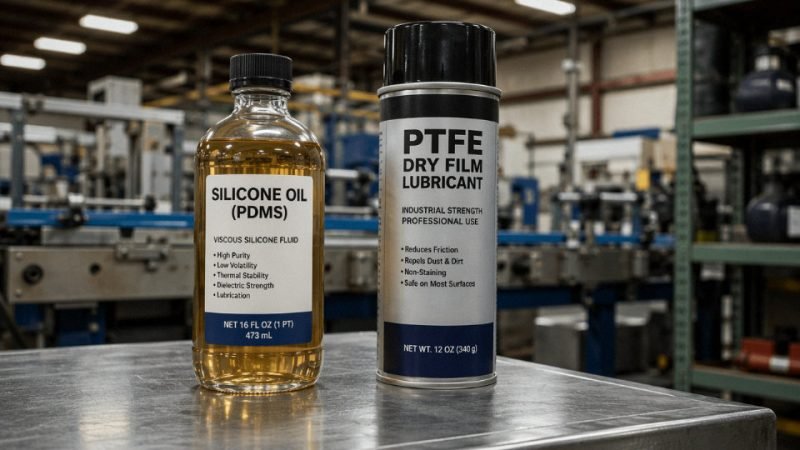
Wrong lubricant choice on a production line rarely announces itself loudly. It shows up as a conveyor that starts seizing in summer heat, a pneumatic actuator that weeps fluid onto food-contact surfaces, or a plastic guide rail that clouds and swells after three weeks — and by the time maintenance traces the failure back to the lubricant spec sheet, you’ve already eaten the downtime, the scrap, and the embarrassing conversation with the customer. Silicone oil and PTFE-based dry-film lubricants are both marketed as “clean,” “inert,” and “long-lasting,” which makes the selection feel interchangeable when it absolutely isn’t.
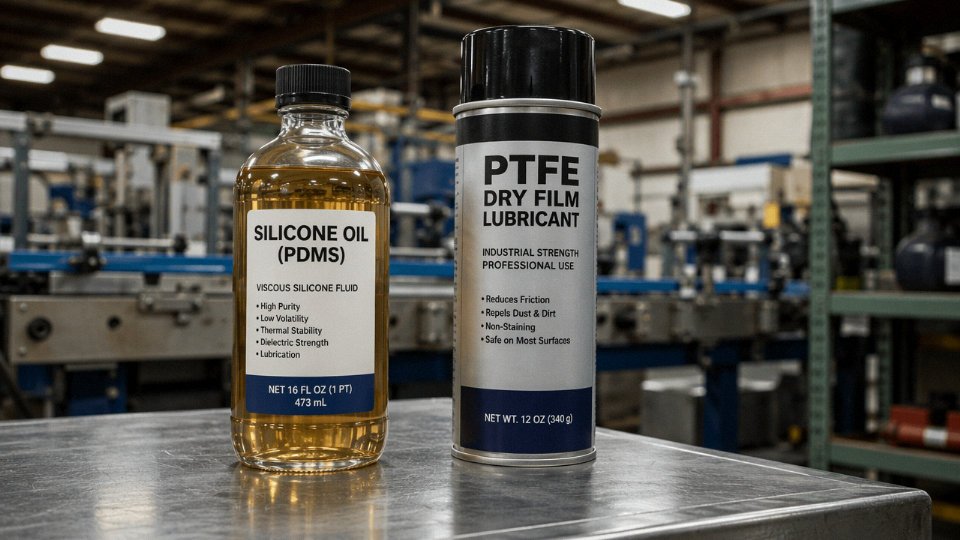
Silicone oil (PDMS) and PTFE dry-film lubricants solve different problems. Silicone oil suits fluid-film lubrication, damping, and release applications up to roughly 200°C continuous, with friction coefficients of 0.10–0.30 depending on viscosity and substrate. PTFE lubricants — sprays, dispersions, bonded coatings — deliver lower friction (0.04–0.10 static) and handle up to 260°C, but they don’t flow, don’t self-replenish, and fail silently when the film wears through.
What makes this comparison genuinely tricky isn’t the obvious cases — nobody debates whether to use dry PTFE on a food-conveyor chain versus silicone oil in a hydraulic dashpot. The hard calls come from the middle ground: plastic-on-metal sliding contacts, O-ring assemblies that see thermal cycling, or precision mechanisms where residue migration is a contamination risk. Those are the situations where picking the wrong product costs more than the lubricant budget for the entire year.
Chemical Composition and Physical Form: What Each Lubricant Actually Is
Understanding what these materials actually are at the molecular level matters more than most product datasheets let on. The differences in structure explain nearly every downstream performance gap — why one migrates and the other doesn’t, why one survives an oven and the other gums up, why one feels slick on plastic and the other leaves a white residue that causes headaches on a packaging line.
Silicone Oil: A Polymer You Can Tune at the Reactor
Silicone oil — the commercially dominant type being polydimethylsiloxane, or PDMS — is a synthetic polymer built on an alternating silicon-oxygen backbone (–Si–O–Si–O–) rather than the carbon backbone you’d find in mineral or PAO oils. Each silicon atom carries two pendant groups, typically methyl (–CH₃) groups in standard grades, or phenyl rings in the higher-temperature phenyl-silicone variants. That Si–O backbone is unusually flexible at low temperatures and surprisingly stable at high ones, which is why silicone oil stays pourable when mineral oil would gel in an unheated winter warehouse.
The practical handle the chemist gives you is chain length. Shorter chains mean low viscosity — the lightest PDMS grades run around 0.65–5 cSt at 25°C and feel closer to water than oil. Extend the chains and viscosity climbs steeply; 1,000,000 cSt grades are more putty than fluid and need heat or shear to move at all. In practice, most lubrication applications sit somewhere between 50 and 10,000 cSt, depending on load, speed, and whether the designer cares about oil migration onto adjacent surfaces (low-viscosity grades wander; high-viscosity grades more or less stay put).
Density runs around 0.96 g/cm³ across most grades — noticeably lighter than water, which matters if you’re dosing by weight on an automated dispenser calibrated for mineral oil. Flash point for high-viscosity grades is typically above 300°C, which is genuinely useful in environments near heat-treat furnaces or injection mold platens.
PTFE: The Fluorinated Carbon Chain That Refuses to React
Polytetrafluoroethylene is a different animal entirely. The backbone is carbon-carbon, same as polyethylene, but every hydrogen atom is replaced by fluorine. That sounds like a small change; the consequences are enormous. The C–F bond (roughly 544 kJ/mol) is among the strongest bonds in organic chemistry. The fluorine atoms form a tight, electronegative sheath around the carbon chain that resists attack from almost every industrial chemical — concentrated acids, hydraulic fluids, solvents, even fuming nitric acid in most conditions. Nothing wants to stick to it, and it doesn’t want to stick to much either. That property is what drives the static coefficient of friction down to roughly 0.04–0.05 in clean dry-film applications, the lowest recorded value for any bulk solid.
PTFE melts at around 327°C and has a density of 2.1–2.2 g/cm³ — more than twice that of silicone oil, and noticeably heavy for a polymer. It doesn’t flow when melted the way nylon or HDPE does, which is why PTFE parts are sintered rather than injection-molded, and why PTFE lubricant products are always suspensions or dispersions rather than a melt.
PTFE has the lowest coefficient of friction of any known solid materialTrue
PTFE's static COF of approximately 0.04 is the lowest measured for a bulk solid, attributed to the smooth fluorine sheath on the carbon backbone and extremely weak intermolecular van der Waals interactions at the surface.
Commercial Forms: What You Actually Buy
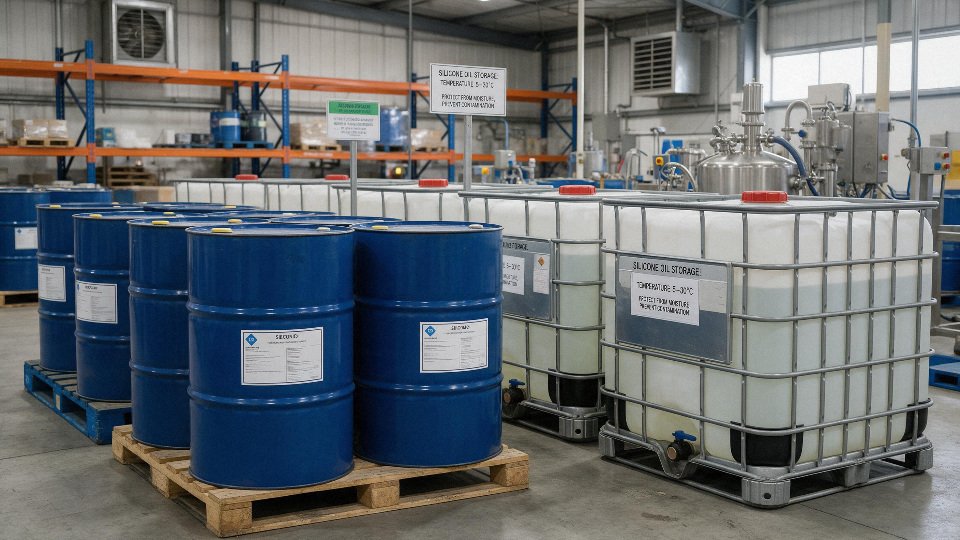
Neither material arrives at your dock as a pure polymer slab. Silicone oil ships as a neat fluid (the most common form for precision dosing), as a water-based emulsion for spray application onto food-contact molds or textile equipment, or pre-blended into a thickener to make silicone grease — typically using fumed silica or lithium soap. The grease form is useful when you need the lubricant to stay in place on a vertical surface or inside a slow-moving joint where a fluid would drain out overnight.
PTFE-based lubricants come in more distinct formats and the choice matters operationally. Dry-film aerosol sprays deposit a thin fluoropolymer layer that dries within a minute or two and leaves no wet residue — common on conveyor guides, zipper tracks, and mold-release points in cleanroom or food environments. PTFE dispersions (typically 50–60% solids in water or solvent) are used where a thicker, more durable film is needed and can be applied by brush or flood coat then cured. Oil-carried PTFE suspensions blend micronized PTFE particles into a mineral or synthetic base oil; these behave like conventional lubricating oils during application but deposit a PTFE layer as the carrier evaporates or is squeezed out. Wax-blend sprays are a lower-cost variant common in woodworking and light assembly.
The Branding Question
One practical point worth settling early: “Teflon” is a registered trademark of Chemours (formerly a DuPont division). It covers PTFE and several related fluoropolymers including FEP and PFA. When a supplier offers “Teflon lubricant,” they usually mean a PTFE-based product, but the name doesn’t guarantee purity or particle size. Generic equivalents — Dyneon (3M/AGC), Dynaflon, and unbranded PTFE powders from Chinese or Indian compounders — are chemically identical if the polymerization process is correct, though particle size distribution and surface treatment vary and do affect dispersion stability and film quality. For most maintenance lubrication, an unbranded PTFE aerosol performs comparably to a branded one. For a precision PTFE dispersion going into a medical device coating, the brand and the specification sheet both matter considerably more.
Friction, Load Capacity, and Wear Performance Under Real Operating Conditions
The numbers here matter more than most buyers realize when they’re standing in front of a distributor shelf choosing between a silicone spray and a PTFE dry-film can.
Static and Kinetic Coefficients of Friction
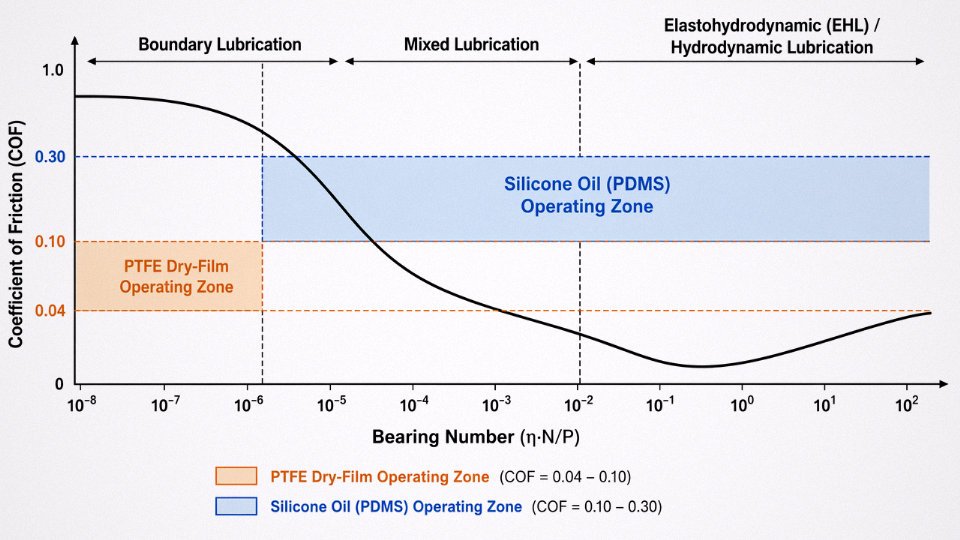
PTFE dry-film lubricants — whether applied as a spray, brushed dispersion, or bonded coating — operate in the 0.04–0.10 COF range (static), depending on film thickness, substrate preparation, and how cleanly the transfer film has established itself. That’s genuinely low. Silicone oil fluid films run 0.10–0.30, and where you land in that range depends heavily on viscosity grade, sliding speed, and the surface couple involved. On a smooth steel-on-polymer contact at moderate speed, a 1,000 cSt silicone oil might sit around 0.12–0.15. Drop to 50 cSt on the same surface and you lose film thickness fast; friction climbs toward the upper end of that range and you’re essentially in boundary territory.
The reason silicone oil’s friction performance is so speed-sensitive is hydrodynamic film mechanics. The oil has to build a continuous wedge between surfaces. Shaft speed, oil viscosity, and bearing clearance all feed into that film thickness — the classic Sommerfeld number relationship. Get those variables right and silicone oil genuinely separates surfaces; get them wrong and you’re relying on boundary additives that silicone PDMS simply doesn’t carry.
EHL vs. Boundary: Where Each Lubricant Actually Lives
Silicone oil earns its keep in the elastohydrodynamic lubrication (EHL) regime — rolling contact, cam followers, lightly loaded ball bearings running at reasonable speed. Under those conditions the contact pressures deform surfaces elastically, the oil viscosity spikes under the local pressure, and a coherent film sustains itself. Silicone’s viscosity-pressure coefficient is lower than mineral oil or PAO, which is a real limitation under heavy EHL loads, but for light-to-moderate rolling contact it performs acceptably, and the thermal stability advantage (more on that in the temperature section) often tips the decision.
PTFE dry film is a boundary lubricant by nature. The particles — typically 0.1–5 µm in bonded coatings, somewhat coarser in aerosol sprays — physically fill surface asperities and provide a low-shear-strength solid layer. That’s exactly what you want under high static loads, slow sliding, or reciprocating motion where a fluid film never gets the chance to build. A pneumatic cylinder rod that sits pressurized and stationary for hours before stroking is a textbook case where PTFE film outperforms silicone oil every time.
PTFE dry-film lubricants achieve lower static friction than silicone oil fluid films under high-load, low-speed boundary conditionsTrue
PTFE's solid particle layer fills asperities and provides a low-shear-strength interface independent of sliding speed, while silicone oil fluid films depend on hydrodynamic wedge formation and break down under high static load without speed to regenerate the film.
PV Limits and What They Mean for Bearing Selection
PV (pressure × velocity) limits give you a practical design ceiling. Silicone-oil-lubricated plain bearings — think sintered bronze or cast iron with oil impregnation — typically handle PV up to roughly 0.1 MPa·m/s, though that figure drops noticeably above 150°C or when the oil supply is intermittent rather than continuous. PTFE-lined bushings running dry manage 0.05–0.10 MPa·m/s depending on liner composition; filled grades (glass-fiber or bronze-filled PTFE) push that range upward.
The operational trap is intermittent duty. A machine that runs fast in bursts but sits idle is hard on silicone-oil systems because the film drains and takes time to reestablish. PTFE transfer film stays put between cycles. In practice, if the duty cycle is under roughly 40–50% or the motion is purely oscillating, lean toward PTFE.
Wear Rate and Film Longevity
Established PTFE transfer films on hardened steel can reduce specific wear rates to the 10⁻⁷ mm³/N·m range — low enough that a properly prepared bearing surface will outlast many other components in the assembly. The catch is the break-in period. Until that transfer film burnishes uniformly, wear rates are higher and unpredictable. Surface finish on the mating steel matters enormously here; Ra below 0.4 µm generally gives faster, more consistent transfer.
Silicone oil requires replenishment to maintain film integrity under continuous sliding. It doesn’t deposit a protective transfer layer the way PTFE does. On a centralized lube system or a sealed-for-life bearing this is manageable. On an open, manually re-lubed mechanism — a slow-moving conveyor guide, say, or an infrequently serviced valve stem — the oil either migrates away or oxidizes before it gets topped up, and wear accelerates quietly until someone notices the slop.
Fretting and Micro-Motion Contacts
This is where silicone oil greases specifically (not thin sprays) have a real advantage over aerosol PTFE. Fretting wear — the damage from tiny oscillating displacements, a few microns to maybe 100 µm — is brutal on dry lubricants because the small motion displaces the PTFE particles out of the contact zone faster than they replenish. A viscous silicone grease resists that displacement; the fluid is effectively squeezed back into the contact on each half-cycle by surface tension and viscous recovery. Electrical connector pins, press-fit joints that see vibration, small pivot pins on linkages — these are all candidates where a medium-to-high viscosity silicone compound (100,000 cSt range) will outperform a PTFE aerosol by a substantial margin on fretting life.
| Contact Condition | Preferred Choice | Primary Reason |
|---|---|---|
| High static load, slow/no sliding | PTFE dry film | Boundary layer fills asperities without speed |
| Rolling contact, moderate load, continuous duty | Silicone oil | EHL regime builds coherent film |
| Reciprocating, high duty cycle | PTFE film or filled PTFE bushing | Consistent COF, no film drain-off |
| Fretting / micro-oscillation | Silicone grease (high viscosity) | Viscous recovery resists displacement |
| Intermittent or low duty cycle sliding | PTFE dry film | Transfer film persists between cycles |
Temperature and Environmental Resistance: Silicone Oil vs PTFE Across Extreme Conditions
Temperature is usually the first screen, and it eliminates one candidate faster than almost any other variable. Get this wrong and you’re not looking at gradual performance degradation — you’re looking at seized valves, failed seals, or a film that washes away on the first cleaning cycle.
Operating Temperature Windows
Silicone oil (PDMS grades) runs continuously from roughly −60°C up to +200°C. That upper limit is real; push it and you get oxidative crosslinking, not just thinning. Phenyl-modified silicone grades buy you another 40–50°C on the top end, putting continuous service around +250°C, though those grades cost noticeably more and aren’t always stocked by domestic distributors. Below −60°C, standard PDMS starts to gel depending on viscosity grade — higher-viscosity grades gel earlier, so a 1,000 cSt fluid behaves very differently at −55°C than a 50 cSt fluid does.
PTFE-based dry-film lubricants operate across a broader thermal envelope: −200°C to +260°C continuous, with short excursions to roughly 300°C before the binder system (if one is present) starts to fail. The PTFE resin itself doesn’t care much — its decomposition threshold is above 327°C — but solvent-deposited films with an acrylic or urethane binder will lose adhesion well before the resin degrades. Specifying “PTFE lubricant” without knowing the carrier and binder chemistry is a procurement mistake that shows up months later as flaking.
Viscosity Stability Through Thermal Cycles
One genuinely underappreciated advantage of silicone oil is its viscosity-temperature behavior. Mineral oils might thin by a factor of 20× or more between room temperature and 150°C. Silicone oil typically drops only 3–4× across that same range. In practice, this means a 100 cSt silicone oil applied at assembly still provides meaningful film thickness after a production oven cycle or repeated thermal cycling on a packaging line. For equipment that sees wide temperature swings — say, a conveyor running through a freeze tunnel and then a heat-seal station — that stability reduces the frequency of relubrication noticeably.
PTFE dry film doesn’t have a viscosity in the conventional sense, but its friction performance remains essentially flat across its thermal range, which is one reason aerospace and semiconductor tooling engineers favor it for applications where consistent breakaway torque matters at every temperature.
Oxidation, UV, and Long-Term Stability
Silicone oil resists oxidative degradation reasonably well up to about 150°C, but above 200°C continuous exposure, it crosslinks. The oil doesn’t simply evaporate — it turns into a gummy residue that can be harder to remove than the original lubricant. Outdoor UV exposure is a secondary concern; silicone oil shows better UV resistance than most mineral oils, but extended direct sunlight exposure on thin films will eventually cause some surface oxidation.
PTFE is essentially chemically inert below its decomposition threshold. Oxygen, ozone, most solvents, concentrated acids — none of them meaningfully attack the film under normal service conditions. For outdoor or chemically aggressive environments, that inertness is a real advantage, not marketing language.
PTFE dry-film lubricant is chemically inert to most industrial solvents and acids below 260°CTrue
PTFE's carbon-fluorine bond is among the strongest in organic chemistry, giving it near-universal solvent and chemical resistance below its decomposition threshold of approximately 327°C. This is well-documented in polymer chemistry literature and confirmed by ASTM chemical resistance testing.
Wet Environments and Washdown
Silicone oil is hydrophobic and repels water effectively under low-pressure contact. The problem shows up under high-pressure washdown — the kind used in food processing and pharmaceutical facilities. Pressurized water can mechanically emulsify or displace the oil film, and you’re back to bare metal faster than you’d expect. I’ve seen this cause corrosion on stainless guide rails within a few weeks on a production line that ran daily CIP cycles.
PTFE dry film survives steam cleaning and high-pressure washdown far better because there’s no liquid phase to emulsify. Once cured, the film is mechanically bonded to the substrate, not just sitting on top of it. For food-zone or pharma applications with frequent aggressive cleaning, this is often the deciding factor.
Cryogenic Applications
Both lubricants remain functional at liquid nitrogen temperatures (−196°C), which is genuinely unusual. Most lubricants turn brittle or lose film integrity at cryogenic conditions. This makes silicone oil and PTFE among the short list of viable options for cryogenic valve stems, liquid gas transfer fittings, and aerospace actuators that must operate after cold-soak. The choice between them at these temperatures usually comes down to whether you need a liquid film (silicone oil, especially low-viscosity grades around 5–20 cSt) or a dry interface with no risk of fluid migration (PTFE).
Radiation Environments
This one catches procurement teams off guard. PTFE degrades under gamma radiation above roughly 10 kGy — chain scission weakens the film and it becomes friable. For nuclear facilities, hot-cell equipment, or any application near a radiation source, PTFE is a poor choice despite its otherwise excellent chemical resistance. Silicone oil tolerates gamma radiation up to around 100 kGy before significant property loss, making it the practical option in those environments. If you’re sourcing lubricants for nuclear maintenance tooling or medical sterilization equipment, this distinction matters and it’s worth confirming radiation dose rates with the facility’s health physics team before finalizing the spec.
Material and Surface Compatibility: What Each Lubricant Does to Plastics, Elastomers, and Metals
The single most expensive compatibility mistake I’ve seen on production lines involves silicone oil and silicone rubber seals. An engineer, reasonably assuming that a silicone-based lubricant would be benign on silicone-based elastomers, applies PDMS oil to an O-ring assembly — and within weeks the seals have swollen 10–25% by volume, depending on molecular weight of the oil and the crosslink density of the elastomer. The lower the viscosity grade, the worse it usually is: thin oils (below roughly 100 cSt) diffuse into the elastomer network more aggressively than high-viscosity grades like 1,000 cSt or above. EPDM can behave similarly in certain formulations, particularly where plasticizer content is already high. The fix sounds obvious in hindsight — use PTFE-based lubricant or a compatible grease — but the downtime, seal replacement, and contaminated fluid costs are not trivial.
Silicone oil causes swelling in silicone rubber seals and some EPDM compounds, despite the intuitive assumption that matching chemistries are safe.True
PDMS oligomers diffuse into vulcanized silicone networks because the crosslinked polymer and the fluid share backbone chemistry, allowing solvent-like absorption. Lower viscosity grades (shorter chain lengths) penetrate faster and cause greater volumetric swell.
Plastics: Which Ones Tolerate Silicone Oil and Which Don’t
PTFE, nylon (PA6 and PA66), acetal (Delrin and its equivalents), PEEK, and most polyolefins are generally safe with silicone oil across typical service temperatures. Polycarbonate deserves a caveat — it tolerates silicone oil at room temperature reasonably well, but at sustained elevated temperatures (above roughly 80–90°C) or under mechanical stress, stress-crazing has been reported, particularly with lower-viscosity grades. I’d always run a 30-day soak test on stressed PC parts before committing.
Polystyrene and ABS are more problematic. Polystyrene is effectively attacked by hydrocarbon-like penetration effects even from silicone oils, especially at temperature. ABS holds up better at ambient conditions but gets unpredictable above 50–60°C, particularly in thin-wall parts under load. If your assembly uses ABS housings and the lubricant can migrate — which it will through capillary action along a joint — this is a real failure mode, not a theoretical one.
PTFE dry-film sprays are far less aggressive toward plastics generally. The carrier solvent is the main hazard during application; once it flashes off, the deposited film is chemically inert to nearly every engineering plastic. The practical concern with PTFE sprays on plastics is different: the white chalky residue they leave can prevent subsequent adhesive bonding or ultrasonic welding from achieving full joint strength. If your process sequence involves bonding after lubrication, this matters.
Metal Substrates and Corrosion Considerations
Both lubricants are essentially non-corrosive to carbon steel, stainless steel, aluminum alloys, and copper alloys under normal conditions. Neither promotes rust in the way water-based fluids do. Silicone oil has a useful secondary property here — its hydrophobicity and low surface tension allow it to displace moisture from bimetallic contact zones, which can meaningfully slow galvanic corrosion at aluminum-copper or steel-aluminum interfaces in humid environments. Whether this effect lasts depends entirely on film replenishment frequency; a single application won’t protect indefinitely.
Electrical and Electronic Applications
Silicone oil’s dielectric strength — typically 14–16 kV/mm for a 100 cSt PDMS grade, though this drops with contamination or water ingress — makes it genuinely useful for transformer cooling, high-voltage connector lubrication, and switchgear applications. PTFE spray applied to electrical contacts is a different story. A light, controlled application on a sliding contact is fine. Too heavy a deposit and you’re adding a resistive layer; contact resistance can climb enough to cause intermittent faults in low-voltage signal circuits, which are far harder to diagnose than an outright open circuit.
Compatibility Quick-Reference
| Substrate | Silicone Oil | PTFE Dry-Film Spray |
|---|---|---|
| Silicone rubber (VMQ) | Incompatible — swells | Compatible |
| EPDM elastomer | Conditional — test first | Compatible |
| Nitrile rubber (NBR) | Compatible | Compatible |
| Nylon (PA6/PA66) | Compatible | Compatible |
| Acetal (POM) | Compatible | Compatible |
| Polycarbonate (PC) | Conditional — avoid stress + heat | Compatible |
| Polystyrene (PS) | Incompatible | Compatible |
| ABS | Conditional — ambient only | Compatible |
| PEEK | Compatible | Compatible |
| Carbon steel / aluminum / copper alloys | Compatible | Compatible |
“Conditional” in this table means run a representative soak or exposure test under your actual temperature and stress conditions before releasing to production. Don’t rely on supplier data sheets alone — they rarely cover combined load-temperature-time conditions that mirror what happens on a real assembly line.
Food, Medical, and Cleanroom Regulatory Status: NSF, FDA, and ISO Requirements
Regulatory compliance is where a wrong lubricant choice stops being a maintenance headache and becomes a product recall, a 483 observation, or a contaminated wafer lot. The technical performance differences between silicone oil and PTFE lubricants matter less than you might think if the product can’t clear your facility’s compliance gate.
FDA 21 CFR 178.3570 and NSF H1 — What Actually Qualifies
FDA 21 CFR 178.3570 covers lubricants used on food-processing equipment where incidental food contact is possible. To carry NSF H1 registration, a lubricant must be formulated entirely from ingredients listed under 178.3570 or other approved FDA food additive regulations. Polydimethylsiloxane — PDMS, CAS 9006-65-9 — is explicitly listed and is the basis for most food-grade silicone oils. A straight PDMS fluid at the right viscosity grade (typically 350 cSt is the workhorse, though 100–1000 cSt grades all qualify provided the base polymer is pure) will generally obtain NSF H1 registration without drama, assuming no restricted additives are blended in.
The NSF registration number is the thing to ask for. “Meets 21 CFR” printed on a TDS is not the same as an active NSF listing — verify the product at the NSF White Book database, not just the supplier’s data sheet.
All silicone oils are automatically NSF H1 approved for food contactFalse
Only PDMS-based silicone oils formulated exclusively from 21 CFR 178.3570-permitted ingredients and carrying an active NSF registration number qualify as H1. Blended silicone oils with non-permitted additives or untested viscosity modifiers do not automatically qualify, regardless of the base polymer.
PTFE Lubricants: PTFE Itself vs. What’s in the Can
PTFE resin is FDA-approved as an indirect food additive, and dry PTFE film, properly applied from a compliant carrier, can achieve H1 registration. The complication is the carrier. Many aerosol PTFE sprays use hydrocarbon propellants, alcohols, or — in older formulations — fluorinated solvents. Each carrier ingredient must independently qualify under 178.3570. A number of popular PTFE spray products on the market are not H1 rated even though the PTFE particle itself would be fine. Always check the NSF listing for the finished product, not the individual components.
Older aerosol formulations using PFOA- or PFOS-based carrier solvents are now restricted under EU REACH Annex XVII. If your supply chain touches Europe, audit your PTFE aerosol SDS carefully — particularly for products sourced before roughly 2020, which may still be sitting in MRO stockrooms.
Medical Device Applications: USP Class VI and ISO 10993
Medical-grade silicone oils — Shin-Etsu KF-96, Dow Corning 360 Medical Fluid, and equivalent pharmaceutical-grade PDMS fluids — have a long track record under USP Class VI and ISO 10993 biocompatibility testing. They’re used as syringe barrel lubricants, implantable device coatings, and catheter surface treatments. The critical caveat: lot-to-lot consistency matters enormously. Even a qualified grade requires batch-specific certificate of analysis (CoA) showing residual catalyst levels, peroxide content where applicable, and viscosity within spec. Don’t assume a new lot from the same supplier is automatically clean.
PTFE dispersions used in catheter lubrication sit in a different position. The particle size distribution, dispersion medium, and any surfactants used all require individual biocompatibility assessment. Lot-specific testing is not optional here.
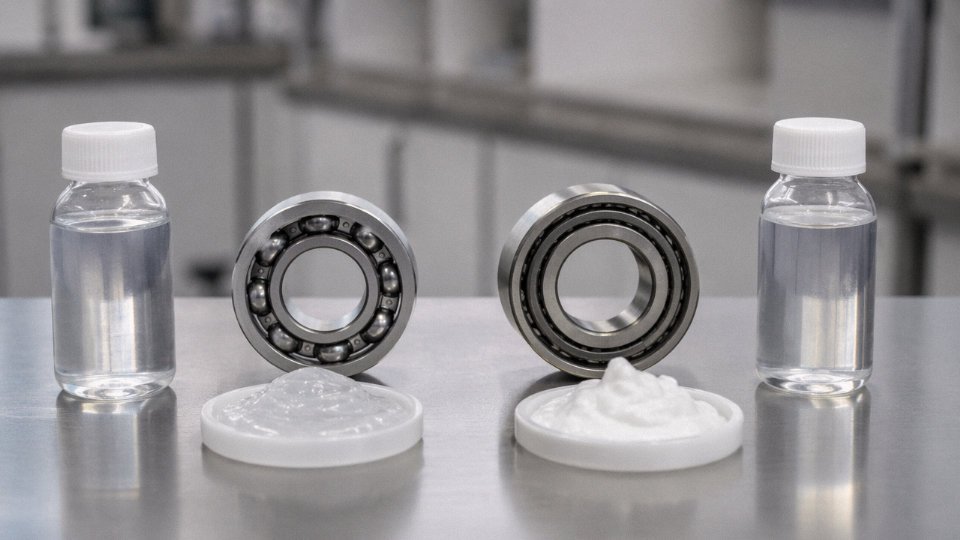
Cleanroom Environments: The Silicone Contamination Problem
In semiconductor packaging and precision optics, silicone oil is essentially a banned substance in production areas. PDMS vapor — even from a sealed bearing running nearby — deposits silicone on bond pads and optical surfaces. Silicone contamination on a bond pad prevents wire bonding adhesion and typically isn’t caught until electrical test. Rework cost per unit can exceed 10–40× the value of the lubricant. ISO Class 5 and cleaner environments almost universally specify PTFE dry film or fluorinated greases (PFPE-based) precisely because they don’t migrate or outgas in meaningful quantities at room temperature.
Silicone oil absolutely has a place in lower-classification cleanrooms — ISO Class 7 or 8 HVAC actuators, for instance — but if there’s any path from the lubricated component to an optical or bonding process, keep silicone out entirely.
Supplier Documentation Checklist
Request these before approving any lubricant for regulated use:
- Current SDS with full ingredient disclosure
- Active NSF registration number (verify independently)
- USP Class VI test report with issuing lab identification and test date
- ISO 10993 cytotoxicity and sensitization data if skin or mucous membrane contact is possible
- Batch-specific CoA including viscosity, purity, and residual impurity data
- REACH compliance declaration confirming absence of SVHC substances above 0.1% w/w
A supplier who hesitates on any of these documents for a regulated application is a supplier worth replacing.
Application Methods, Relubrication Intervals, and Total Cost of Ownership
Purchase price is almost never the right number to optimize. In my experience, the lubricant that costs three times more per liter often ends up cheaper over a twelve-month maintenance cycle once you account for labor, downtime, and cleanup.
How Each Lubricant Gets Onto the Part — and Why That Matters
Silicone oil is flexible in delivery. Low-viscosity grades (50–500 cSt) run well through drip oilers, wick-feed systems, and centralized metered lubrication lines. Spray mist works for light-film applications on conveyor chains or linear guides, though overspray is a serious housekeeping problem — silicone migrates, and it will contaminate any painted surface or adhesive bond nearby. Impregnation (soaking porous sintered bushings in heated silicone oil under vacuum) is a factory process, not a maintenance one, but it gives you a reservoir that bleeds lubricant passively for the life of the bushing. Film thickness control on spray mist is honestly tricky without a metering nozzle; you get variation station to station unless someone is disciplined about it.
PTFE dry-film lubricants come as aerosol sprays, brush-on dispersions in solvent or water carriers, or dip-coating baths for high-volume parts. Aerosol is the most common and the least controlled — a three-second burst from twelve inches delivers a very different film than the same burst from six inches. Automated robotic spray arms solve that, but they’re a capital investment. Brush-on dispersion gives you better thickness repeatability on flat or simple curved surfaces; dip coating is ideal for small fasteners or springs in volume. Typical dry-film thickness lands between 5–25 µm depending on solids content and number of coats, and that matters because going below roughly 8 µm on a loaded metal cam accelerates wear measurably.
Relubrication Intervals in Practice
A centralized silicone oil system on a low-load packaging machine can reasonably run 2,000–8,000 hours between service intervals, with the wide range depending on operating temperature, seal quality, and whether the system has a reservoir with a level sensor. On an open chain running at 80°C ambient, expect the lower end. On a sealed linear actuator in a clean, cool environment, you can push toward the higher end without anxiety.
PTFE dry film behaves differently — it’s cycle-based rather than hour-based for most applications. A lightly loaded plastic cam in an intermittent-duty actuator can exceed 500,000 cycles before the film breaks down enough to warrant recoating. A steel-on-steel sliding contact under any meaningful load? You might see that film gone in 50,000 cycles. The substrate hardness and contact pressure dominate the wear rate far more than the lubricant brand does.
Cleanup, Reapplication Labor, and the Hidden Costs
This is where silicone oil loses points fast. Silicone overspray bonds to glass, plastics, and painted surfaces at the molecular level — isopropyl alcohol at high concentration will remove it, but it takes time, and contaminated surfaces reject paint and adhesive reliably. One maintenance tech who over-lubes a conveyor can cause a rework problem downstream that costs more than the lubricant budget for the quarter.
PTFE dry film, once cured, either dusts off lightly or wipes clean with a dry cloth. Reapplication means scuffing the old film, wiping, and respraying — maybe fifteen minutes per location for a trained tech.
A Simplified TCO Model
| Cost Factor | Silicone Oil | PTFE Dry Film |
|---|---|---|
| Product cost | $15–60/liter (depends on viscosity grade and volume purchased) | $8–25/can (~1.5 m² coverage per can) | |
| Application labor | Low with centralized system; moderate for manual spray | Moderate; high without robotic arm |
| Relubrication frequency | Every 2,000–8,000 hours | Every 50,000–500,000+ cycles |
| Cleanup labor on overspray | High — solvent required | Low — dry wipe |
| Contamination risk penalty | High in paint/adhesive lines | Low |
| Shelf life | Indefinite if sealed | 3–5 years (propellant loss) |
Sealed silicone oil has an indefinite shelf lifeTrue
PDMS-based silicone oils are chemically inert and stable; degradation requires sustained heat, UV, or contamination — none of which affect sealed containers in normal warehouse storage. Major suppliers including Shin-Etsu and Dow confirm no expiration date under proper storage conditions.
The propellant shelf-life issue with PTFE aerosols is worth taking seriously if your plant keeps a storeroom buffer. A can that’s lost pressure by year four applies an inconsistent film — you won’t necessarily know it’s happening until wear rates climb. Rotate stock and mark receipt dates.
Automation compatibility tips toward silicone oil for high-cycle continuous processes. Metering pumps handle it cleanly, flow rates are programmable, and integration with PLC-controlled lube systems is straightforward. PTFE spray, unless you’ve invested in robotic application, introduces labor variability that shows up as inconsistent coating quality across shifts — a real problem in any process where friction consistency matters.
Industry-by-Industry Decision Guide: Which Lubricant Wins in Eight Key Sectors
The technical data only gets you so far. Once you’re standing in front of a maintenance planner or a procurement committee, what they actually want to know is: for my line, which one? Here’s how the choice shakes out across eight sectors, with the reasoning behind each call.
Food and Beverage Processing
Silicone oil — H1-registered, typically 350–1,000 cSt depending on conveyor speed and ambient temperature — is the workhorse for chain lubrication on can lines and bottle conveyors. It holds up to CIP wash cycles better than most mineral oils, and incidental contact with product doesn’t trigger a recall. Where silicone oil loses is on slide guides, indexing cams, and packaging machine fold plates: any pooling or drip attracts sugar dust, flour, and other debris, turning the lubrication point into a contamination trap. PTFE dry film is the right answer there — applied once, cured, and essentially invisible to the sanitation team.
Medical Devices and Pharmaceutical Manufacturing
These two lubricants rarely compete here; they cover different surfaces. Silicone oil (typically 12.5–1,000 cSt, USP-grade PDMS) is the standard syringe barrel lubricant because it reduces plunger break-loose force without leaching, and it’s been the default catheter coating base for decades. PTFE is used where dimensional control and zero fluid transfer matter most — surgical stapler jaws, guidewire coatings, endoscope working channels. Trying to substitute silicone oil on a PTFE-coated guidewire surface would compromise trackability and potentially contaminate the sterile field.
Electronics and Semiconductor Manufacturing
Silicone oil is essentially banned from PCB assembly environments. The reason is not toxicity — it’s silicone contamination: even trace vapor deposition can devastate conformal coating adhesion, cause coating fisheye defects, and fail board-level reliability tests. PTFE dry film on robotic pick-and-place linear guides, fixture rails, and shuttle mechanisms is the standard answer. Silicone oil’s only legitimate foothold in this sector is inside hermetically sealed components or in transformer fluid-cooling systems where it never contacts open circuit boards.
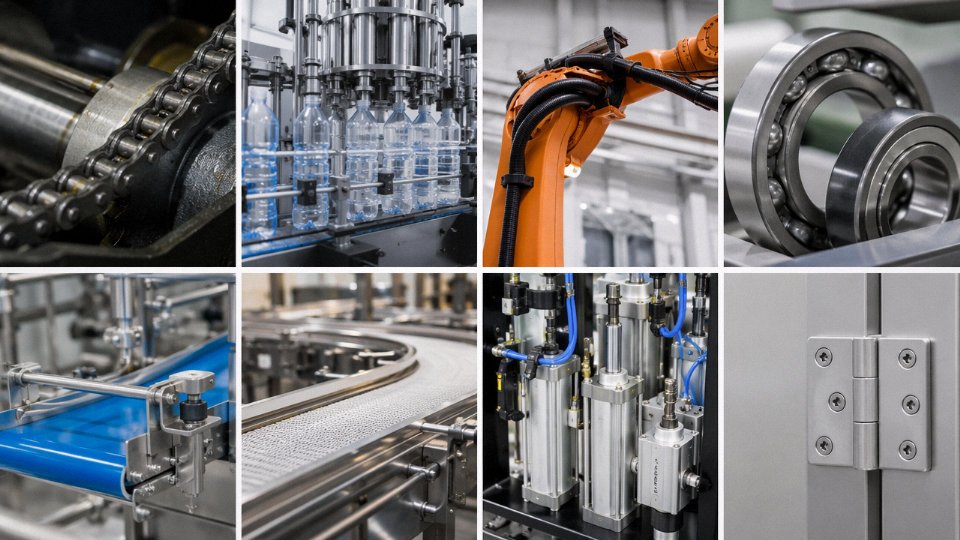
Automotive and Powertrain
High-viscosity silicone oil (50,000–300,000 cSt range, depending on coupling design and target torque characteristics) is specifically engineered into viscous couplings and torsional dampers — it’s not a generic lubricant choice, it’s a functional fluid. For everything at lower loads and smaller clearances — throttle linkages, door check hinges, brake caliper guide pins — PTFE-impregnated or PTFE-sprayed surfaces eliminate the stick-slip that generates squeaks and uneven pedal feel. Using a heavy silicone grease on a caliper guide pin instead of proper PTFE or silicone-PTFE blend grease can lead to pin seizure after one winter of salt exposure, which is a brake drag and uneven wear problem that doesn’t show up until the next service interval.
Aerospace and Defense
Both lubricants have formal military specifications, and both earn their place. Silicone-based fluid meeting MIL-PRF-83282 is used in aircraft hydraulic systems where fire resistance is a design requirement — it replaced the older petroleum-based MIL-H-5606 in many platforms specifically because of its better flash point. PTFE dry film under MIL-L-46010 covers sliding surfaces, actuator rails, and structural hinges that see thermal swings from -54°C to well above 200°C during a single sortie. Mixing the two without understanding which spec applies to which surface is how you create a maintenance documentation error that fails an audit.
Silicone oil meeting MIL-PRF-83282 is fire-resistant and was adopted to replace petroleum hydraulic fluids in military aircraft for improved fire safety.True
MIL-PRF-83282 is a synthetic hydrocarbon with silicone-based additives specifically qualified for its higher flash point and fire resistance compared to MIL-H-5606, and has been widely adopted in military aviation hydraulic systems on that basis.
Plastics and Rubber Manufacturing
Silicone oil earns its reputation as a mold release and rubber processing aid — it releases elastomer parts cleanly without degrading the mold surface, and it’s compatible with most rubber compounds at typical cure temperatures. PTFE’s role here is different: it’s compounded into engineering plastics as an internal lubricant, usually at 5–15 wt% loading (up to 20 wt% in some bearing-grade PTFE-filled nylon or acetal grades). That changes the part’s tribological properties permanently, which is the whole point.
HVAC and Building Systems
Silicone grease — not oil — is standard for O-ring and gasket assembly in refrigerant circuits. It’s compatible with most elastomers and doesn’t attack copper or aluminum. PTFE thread tape is technically not a lubricant, but it shares the same base chemistry and belongs in this category: it seals threaded NPT fittings on refrigerant and gas lines where other thread compounds would be incompatible with the service fluid.
Consumer and DIY Markets
PTFE dry sprays dominate the retail shelf for practical reasons — no drips, no residue, no staining fabric or trim. Silicone spray products are positioned for rubber weatherstripping, garage door tracks, and treadmill belts, where a light oily film is acceptable and rubber conditioning is part of the value. In practice, most consumers reaching for a “Teflon spray” are just avoiding the mess of oil, which is a valid operational reason even outside an industrial context.
Frequently Asked Questions About Silicone Oil and Teflon Lubricant
Can I use silicone oil and PTFE lubricant together, or will they interfere?
You can combine them, and in practice some aerosol products already do — a PTFE particle suspension in a silicone oil carrier. The two materials don’t react chemically. What matters operationally is whether the carrier solvent in the PTFE spray has fully evaporated before the silicone oil goes on top; if it hasn’t, you get a diluted, poorly-adhered film that wipes off under the first load cycle. Apply PTFE dry film first, let it cure fully (typically 15–30 minutes at room temperature, longer in humid conditions), then apply silicone oil if you want the combined low-friction, wet-lubrication effect. Layering them in the wrong order — wet silicone first, then PTFE spray on top — usually just means the PTFE film never bonds to the substrate properly.
Is PTFE lubricant safe for rubber O-rings and seals?
Generally yes, and it’s often the preferred choice for elastomer seals precisely because PTFE carries almost no plasticizer-leaching risk. PTFE dry film and PTFE grease (in a compatible base) are routinely specified for nitrile, EPDM, and fluorosilicone O-rings in pneumatic and hydraulic assemblies. The caveat is the carrier: some PTFE aerosols use petroleum-distillate or acetone carriers that will swell or crack nitrile rubber on contact. Always check what the PTFE is suspended in, not just the active ingredient. Silicone oil, by contrast, is compatible with most elastomers but will degrade natural rubber and some polysulfide compounds over time.
PTFE lubricant is always safe for rubber O-rings regardless of formulationFalse
The PTFE particle itself is inert to most elastomers, but the carrier solvent in many PTFE sprays can swell or degrade nitrile and natural rubber. Compatibility depends on the complete formulation, not the PTFE content alone.
Which is better for squeaky plastic hinges, drawer slides, and window tracks?
For dry, intermittent-contact applications like these, a PTFE dry-film spray wins almost every time. Silicone oil works short-term but migrates, attracts dust, and turns into a gritty paste in window tracks within a season — especially in dusty or outdoor environments. PTFE dry film stays put, doesn’t pick up debris, and one application typically lasts 6–18 months depending on use frequency and UV exposure. Silicone oil is better if the plastic slides under sustained load and you need a cushioning wet film, but for household hinges, the dry film is cleaner and longer-lasting.
Why does silicone oil cause adhesive bonding failures, and how do you remove it?
Silicone spreads aggressively on surfaces — even microscopic contamination from handling a silicone-lubricated part creates a low-energy barrier that adhesives, paints, and sealants cannot penetrate. This is a persistent problem on paint lines and in assembly operations where silicone grease has been used nearby. Removal requires an aggressive degreasing sequence: wipe with isopropyl alcohol first to remove bulk residue, then follow with a silicone-specific remover (there are several solvent blends marketed for this, often xylene- or toluene-based for metal substrates), then re-wipe with fresh IPA. A single wipe with ordinary mineral spirits won’t do it — silicone re-smears rather than lifting. On plastics where aggressive solvents would damage the substrate, abrasive scuff plus a plastic-safe silicone remover is the practical option. Some paint shops institute a no-silicone rule plant-wide and track silicone-contamination rejects separately as a quality metric.
What’s the difference between a PTFE spray, a Teflon-coated surface, and PTFE-impregnated material?
These are three entirely different things and the confusion causes real specification errors. A PTFE spray deposits a thin, dry particle film on the surface — it’s a lubricant applied in the field, easily worn away, easily reapplied. A Teflon-coated surface (like a non-stick pan or a coated valve seat) has PTFE bonded or sintered onto the substrate during manufacturing; it’s a surface treatment, not a lubricant you apply. PTFE-impregnated material — bronze bushings loaded with PTFE, or certain porous plastics — has the PTFE built into the bulk structure so it continuously migrates to the contact surface under load. The impregnated type gives self-lubricating behavior over the part’s service life without any reapplication. Specifying a field-applied spray where an impregnated bushing is needed is a common maintenance trap that shows up as accelerated wear within the first few hundred hours.
How do I confirm my silicone oil is food-grade H1, and where is the NSF number?
H1 status means the lubricant is registered for incidental food contact — it doesn’t mean unlimited contact or food-safe consumption. The NSF registration number is a specific alphanumeric code (format: typically a 6-digit number prefixed by the category, e.g., “NSF Reg. No. 123456”) that should appear on the product label, the safety data sheet, or both. If it’s not printed on the label, ask the supplier for the NSF registration certificate and look it up directly in the NSF White Book database (whitebook.nsf.org) to confirm the registration is current — registrations do lapse. A supplier claiming “meets H1 requirements” without an active registration number is not the same as a registered product, and that distinction matters during a food-safety audit.
Can silicone oil substitute for mineral oil in an electric motor or gearbox?
Not routinely, and this comes up more often than it should when someone has silicone oil on hand and a motor that needs a top-up. Silicone oil has poor load-carrying capacity compared to mineral oil with EP additives — it shears out of loaded gear contacts quickly. It also has low affinity for metal surfaces, meaning the boundary-lubrication film at startup is thin. In a lightly loaded, slow-speed motor bearing where you just need thermal stability and electrical insulation, silicone oil can work, and some specialized transformer and high-temperature motor applications do use it. But in a gearbox with significant tooth loads, substituting silicone for a GL-4 or GL-5 gear oil will accelerate wear noticeably, usually within weeks to a few months depending on load cycle. Use the specified lubricant type; silicone oil is not a universal substitute.
At what temperature does PTFE lubricant become unsafe, and does it release fumes below 327°C?
The 327°C figure is the melting point of bulk PTFE, but hazardous pyrolysis products — primarily fluorinated gases and ultrafine particles — can begin forming at temperatures above roughly 260°C for thin films and coatings under prolonged exposure, and outgassing of lower-molecular-weight fragments can occur somewhat below that, especially from freshly applied or degraded films. The acute occupational hazard is polymer fume fever, documented in workers exposed to PTFE decomposition products, typically in poorly ventilated environments. Below 200°C in normal air, a properly cured PTFE dry-film lubricant is stable and poses no fume risk in practice. The danger zone is sustained operation above 250°C, open-flame contact, or any situation where the coated surface is being machined, welded, or incinerated. Ventilation matters more than most people think when applying PTFE sprays in confined spaces, even at room temperature, due to the aerosol carrier rather than the PTFE itself.
Summary Comparison Table and Final Selection Framework
The table below consolidates the key technical parameters covered throughout this article. Use it as a first-pass screen — not a final answer — because real-world selection always requires you to cross-check viscosity grade, substrate chemistry, and regulatory paperwork specific to your assembly.
| Parameter | Silicone Oil (PDMS) | PTFE Dry-Film Lubricant |
|---|---|---|
| Chemical type | Polydimethylsiloxane polymer | Polytetrafluoroethylene particles in carrier |
| Operating temperature range | –50°C to ~200°C continuous | –70°C to ~260°C continuous; short excursions to ~300°C |
| Coefficient of friction | 0.10–0.30 (viscosity- and substrate-dependent) | 0.04–0.10 (static; load- and surface-finish-dependent) |
| Load capacity | Moderate; hydrodynamic film at speed | Low-to-moderate; limited by PTFE creep under high point loads |
| Water resistance | Excellent; hydrophobic, non-emulsifying | Excellent; PTFE is essentially inert to aqueous media |
| Material compatibility risk | Swells some silicone elastomers; generally safe on metals and most thermoplastics | Very low risk; chemically inert to nearly all substrates |
| Regulatory status | NSF H1 available; FDA 21 CFR 178.3570 grades exist | NSF H1 available; FDA-compliant grades exist; verify carrier solvent separately |
| Application method | Dip, spray, brush, metered dosing, grease blend | Aerosol spray, dispersion coating, dry-film bonding |
| Relubrication need | Periodic; interval depends on operating speed, temperature, and contamination ingress | Infrequent; reapply when film visually depleted or friction rises |
| Cleanroom suitability | Marginal at ISO Class 5 or better; oil mist is a contamination risk | Preferred; dry film produces no vapor or aerosol in service |
| Typical cost | $15–$80/liter depending on viscosity grade and purity | $20–$120/liter aerosol equivalent; bonded coatings are significantly higher |
| Best-fit industries | Medical devices, transformers, electronics, food processing (fluid film), textile machinery | Semiconductor, aerospace sliding surfaces, food conveyor guides, high-temp oven chains |
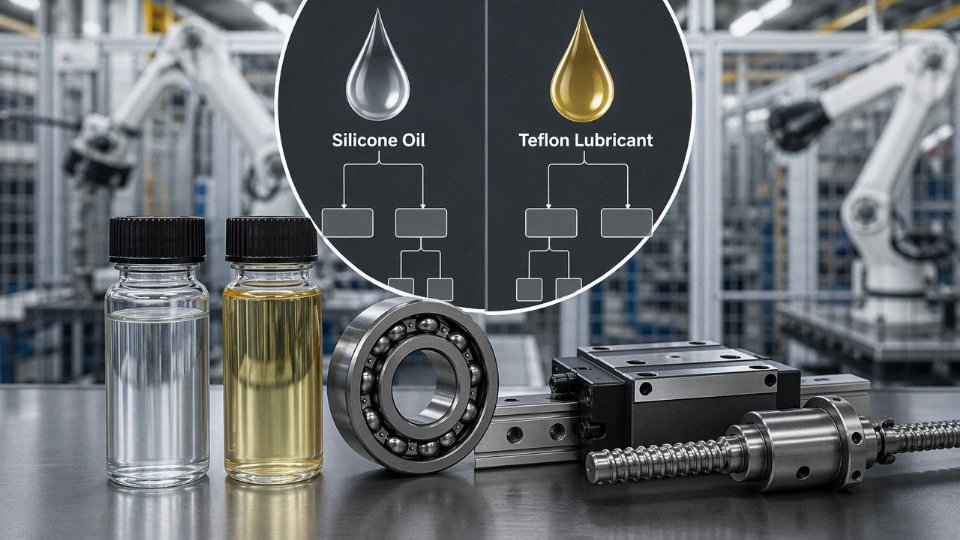
The 5-Question Decision Flowchart
Work through these in order. The first question that produces a hard answer stops the process.
- Is operating temperature above 200°C continuously? If yes, silicone oil is at its ceiling or past it. Use PTFE.
- Is electrical insulation a functional requirement? Transformer cooling, cable insulation, and PCB conformal applications need silicone oil’s dielectric properties. PTFE dry film provides no bulk insulation.
- Is the environment ISO Class 5 cleanroom or better? Any fluid lubricant introduces aerosol and outgassing risk. PTFE dry film wins here. Full stop.
- Does the contact need a continuous hydrodynamic fluid film at operating speed? Dry film cannot form an elastohydrodynamic layer. If your journal bearing or high-speed rotating contact depends on fluid-film separation, silicone oil — properly viscosity-matched — is the right call.
- Is NSF H1 food contact certification required? Both product families have compliant grades, but you must verify the specific SKU and carrier solvent, not just the base chemistry. “PTFE spray” and “silicone oil” are not automatically H1; the paperwork has to exist for that exact product lot.
Three Scenarios Where Silicone Oil Wins Outright
Transformer and high-voltage cooling: the dielectric constant and thermal stability are irreplaceable — no dry-film product does this job.
Medical syringe barrel lubrication: a controlled silicone oil film of 350–1,000 cSt grade gives the smooth, consistent plunger force that PTFE particulate coatings struggle to maintain across sterilization cycles.
High-speed rotating contacts needing hydrodynamic separation: spindle bearings, textile rollers, and similar applications running above roughly 3,000 RPM genuinely benefit from fluid-film lift. PTFE alone cannot build that wedge.
Three Scenarios Where PTFE Wins Outright
Dry cleanroom linear guides: no oil migration, no particle trap, no relubrication access required between maintenance intervals.
Food contact where zero oil accumulation is tolerable: conveyor side rails, portioning guides, and packaging fold plates where any visible oil film triggers a line hold. A properly bonded PTFE coating runs dry, invisibly.
Extreme-temperature sliding above 200°C: oven conveyor pins, exhaust-side actuators, and similar applications where silicone oil simply oxidizes and carbonizes over a maintenance cycle.
Using Both in the Same Assembly
This is underused and worth considering seriously. A PTFE-lined plain bearing with a silicone grease fill in the housing gives you dry-running capability during start-stop cycles — when the hydrodynamic film hasn’t built yet — combined with genuine fluid-film lubrication under dynamic load. The PTFE liner handles the momentary boundary contact; the silicone grease handles sustained running. In practice this arrangement can extend relubrication intervals by a factor of two to three compared to grease alone, depending on load and duty cycle.
Both silicone oil and PTFE lubricants can achieve NSF H1 food-grade certificationTrue
NSF H1 certification applies to specific formulated products, not entire chemical families. Both PDMS-based oils and PTFE dispersions have commercially available H1-certified grades, but you must verify certification for the exact product SKU, not assume it from base chemistry.
Before You Commit to Production
Request the full technical data sheet — not the marketing one-pager — from your supplier. Specifically, you want viscosity-temperature curves for silicone oil, or film thickness and adhesion test data for PTFE coatings. Run tribology bench testing at your actual PV (pressure × velocity) conditions; published COF ranges are measured on standard test rigs that probably don’t match your surface finish, load geometry, or operating temperature. Regulatory compliance needs to be validated against the actual product lot number and your jurisdiction’s requirements before any production deployment. A phone call to the supplier’s application engineer costs nothing and regularly catches grade mismatches that would otherwise show up as warranty failures six months in.