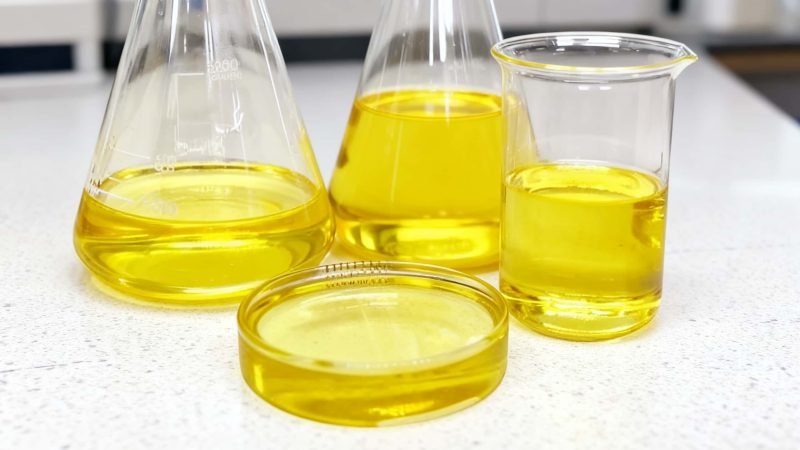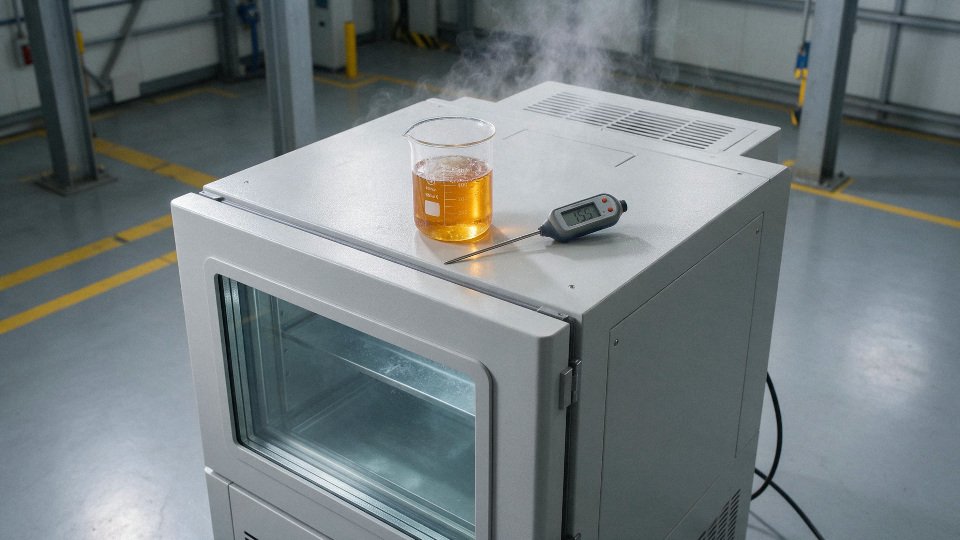
Wrong lubricant choice quietly bleeds money — seized actuators on a packaging line, black graphite smear contaminating a food-contact surface, silicone migration causing adhesion failures three stations downstream. Most of the time the root cause doesn’t show up until the damage is done: a scrapped batch, an unplanned maintenance window, or a warranty claim that traces back to a lubrication spec someone picked in five minutes off a datasheet.
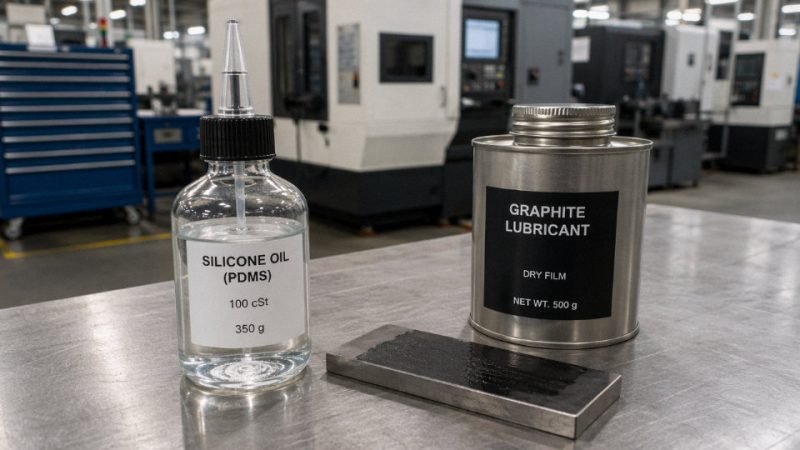
Silicone oil and graphite lubricant solve fundamentally different problems. Silicone oil — typically PDMS-based, covering viscosities from under 1 cSt to well over a million cSt — excels in wet-film, low-contamination-risk applications across roughly −60 °C to +200 °C. Graphite operates as a dry film, tolerates far higher temperatures (up to 450 °C in air, much higher in inert atmospheres), and handles heavy loads better, but its performance is humidity-dependent and it cannot be used anywhere cleanliness matters.
What makes this comparison genuinely tricky isn’t the obvious cases — nobody debates whether to use graphite in a food-filling machine. It’s the middle ground: high-cycle plastic mechanisms, outdoor electrical connectors, hot stamping guides, vacuum environments where graphite’s lubrication mechanism partially breaks down. Those edge cases are where the expensive mistakes happen, and that’s exactly what the rest of this breakdown works through.
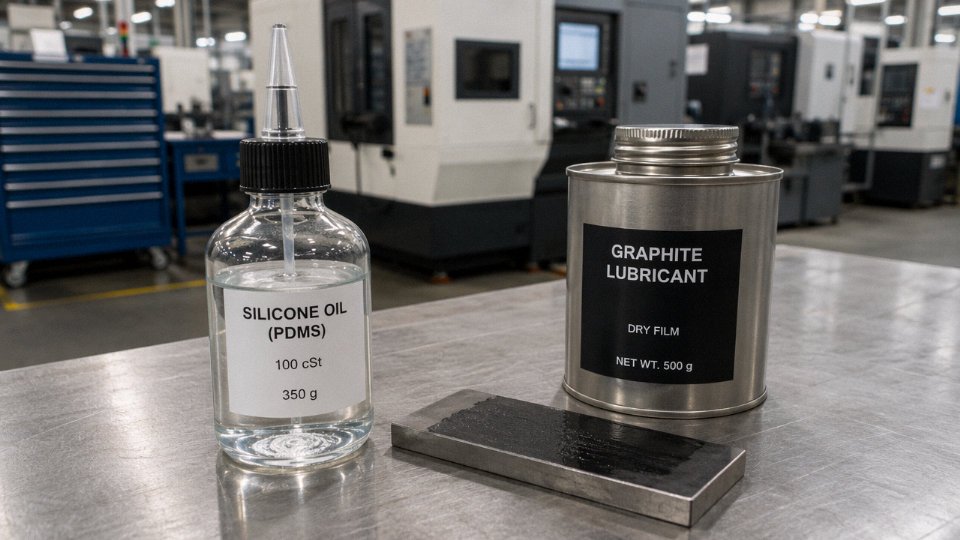
Chemistry and Physical Form: How Silicone Oil and Graphite Lubricants Are Made and Supplied
These two lubricants work by fundamentally different physical mechanisms, and that difference starts at the molecular level — not at the application stage. Understanding the chemistry tells you why they behave the way they do on the plant floor, and why mixing up your choice is rarely just a minor inconvenience.
Silicone Oil: PDMS Chains and How Viscosity Gets Tuned
Standard silicone oil is polydimethylsiloxane — PDMS — synthesized by hydrolyzing dimethyldichlorosilane and then polymerizing the resulting silanol intermediates under controlled conditions. The backbone alternates silicon and oxygen atoms (–Si(CH₃)₂–O–) rather than carbon-carbon bonds, which is precisely why the fluid resists thermal degradation better than most mineral oils.
Viscosity is controlled almost entirely by chain length, i.e., molecular weight. Short chains give you fluids in the 0.65–10 cSt range; longer chains push into the tens of thousands or even millions of cSt at 25°C. That span — 0.65 cSt to roughly 2,500,000 cSt for commercial PDMS grades — is genuinely enormous, wider than almost any single lubricant chemistry you’ll encounter in procurement. In practice, most industrial applications land somewhere between 100 and 5,000 cSt; the extreme ends of that range require specific justification.
Phenyl-substituted silicones (replacing some methyl groups with phenyl rings) extend the low-temperature performance further and improve radiation resistance — relevant in nuclear adjacent environments or sterilization equipment. Fluorosilicones swap methyl groups for trifluoropropyl substituents, giving solvent and fuel resistance that standard PDMS simply cannot match. Both variants are meaningfully more expensive; expect to pay a 3x–8x premium over equivalent-viscosity PDMS depending on the supplier and order volume.
Graphite: A Lattice That Shears Because It Wants To
Graphite is sp²-hybridized carbon arranged in flat hexagonal sheets stacked in parallel. Within each sheet, carbon atoms are covalently bonded — very strong. Between sheets, you have only van der Waals forces, which are weak. That mismatch is the entire lubrication mechanism: basal planes slide over each other at low shear stress while the crystal itself stays intact. The coefficient of friction for graphite runs 0.05–0.19 depending on humidity and contact load, and that humidity dependency is worth taking seriously — graphite performs noticeably worse in very dry environments or vacuum because adsorbed water vapor actually assists interlayer sliding.
Natural flake graphite comes from mined ore and retains a well-developed crystalline structure; it generally lubricates better in pure sliding contacts. Synthetic graphite, produced by high-temperature graphitization of petroleum coke or pitch, is more consistent in purity but may have a slightly less perfect lattice structure depending on the process temperature. Graphite oxide — produced by chemical oxidation — is a distinct material with oxygen functional groups intercalated between layers; it is used in coatings and composite formulations but is not a direct substitute for either flake or synthetic grades.
Graphite lubricates effectively in vacuum at high temperaturesTrue
In inert or vacuum atmospheres, graphite remains effective from cryogenic temperatures up to roughly 2000°C because the mechanism is structural (interlayer shear), not dependent on oxidizing conditions. In air, the upper limit drops to around 450°C before oxidation degrades the structure.
Commercial Supply Forms and What They Mean Operationally
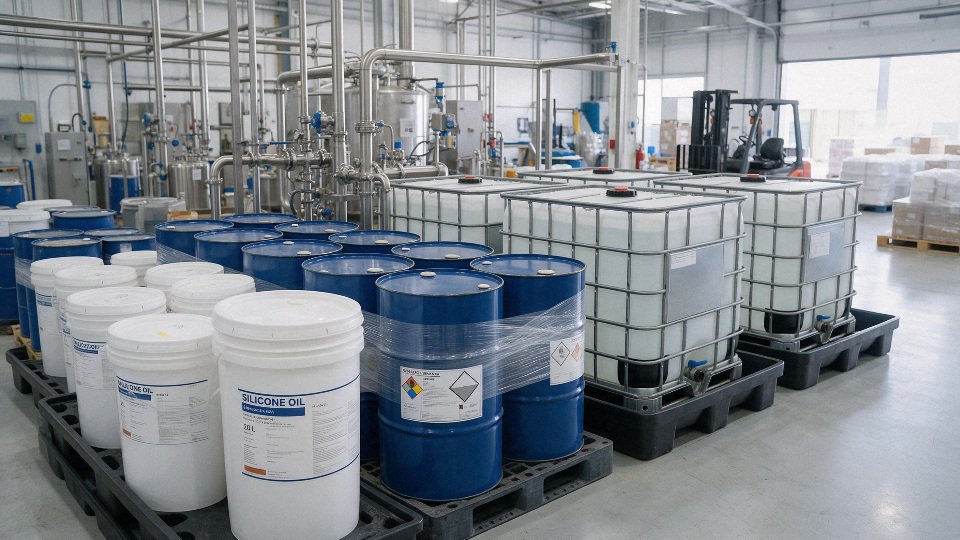
| Form | Silicone Oil | Graphite | Notes |
|---|---|---|---|
| Neat / pure fluid | Yes — dispensed by syringe, pump, or bath | No direct equivalent | Silicone requires controlled metering; easily over-applied |
| Aerosol spray | Yes — carrier solvent flashes off | Yes — carrier solvent or water-based | Aerosol graphite leaves a dry film; silicone aerosol leaves a thin wet film |
| Grease / paste | Yes — thickened with fumed [silica](https://siliconchemicals.com/silica/) or PTFE | Yes — mixed into petroleum or synthetic grease base | Graphite grease is common for threaded fasteners and slide ways |
| Dry powder | Not applicable | Yes — natural or synthetic flake | Inhalation risk; requires respiratory PPE (see warning below) |
| Colloidal suspension | Emulsion in water common | Aqueous or solvent-based colloidal graphite | Graphite colloids used for mold release and forging lubricants |
| Wax stick / crayon | Rare | Yes — common for die lubrication and saw blades | Convenient for maintenance; inconsistent film thickness |
Operational warning: Airborne graphite dust is a real hazard in enclosed spaces. Fine graphite particles are electrically conductive, so powder contamination inside switchgear or near open bus bars is a fire and short-circuit risk — not just a housekeeping issue. Use dry graphite powder only with proper respiratory protection (minimum P100 filtering facepiece) and keep it away from electrical enclosures.
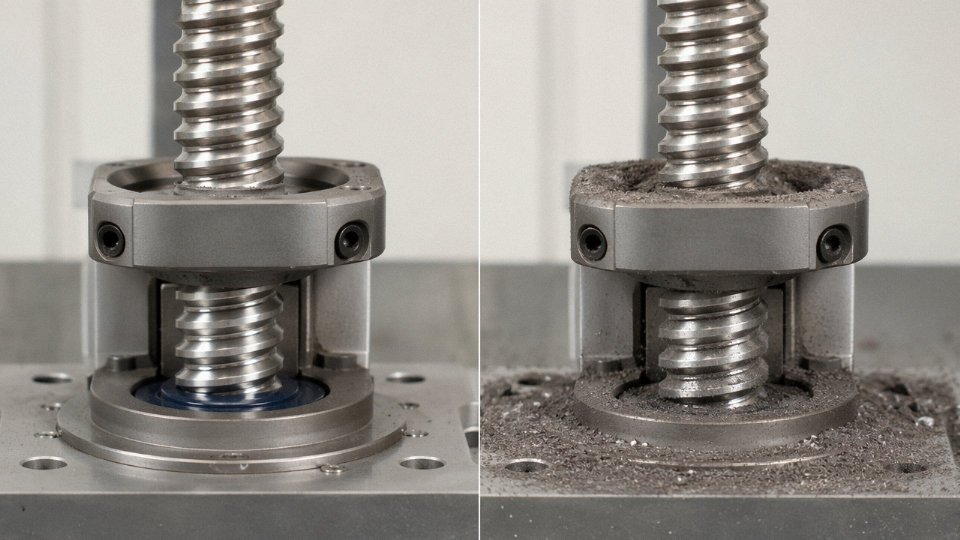
Neat silicone oil has its own operationally annoying characteristic: it migrates. Capillary action carries it along surfaces well beyond the application point, and silicone contamination of paint adhesion surfaces or certain plastics can cause weeks of downstream rework. If your line runs near a painting or bonding station, aerosol silicone in the same air space is a frequent root cause of adhesion failures that gets misdiagnosed as a coating problem.
Key Physical Properties at 25°C
| Property | PDMS Silicone Oil (typical mid-viscosity, ~1000 cSt) | Graphite (solid, bulk crystalline) |
|---|---|---|
| Density | ~0.97 g/cm³ | 2.09–2.23 g/cm³ (crystalline); lower for graphite powder |
| Vapor pressure | Very low — <0.01 Pa; essentially non-volatile at ambient | Effectively zero (solid) |
| Solubility in water | Insoluble | Insoluble; disperses coloidally with surfactant |
| Solubility in hydrocarbon solvents | Soluble in chlorinated and aromatic solvents; limited in aliphatics | Insoluble; forms suspension only |
| Dielectric constant | ~2.7 (useful electrical insulator) | ~10–15 parallel to basal plane; highly anisotropic; conductive in-plane |
| Thermal conductivity | ~0.16 W/(m·K) — poor heat conductor | ~100–400 W/(m·K) along basal planes; ~3–10 W/(m·K) cross-plane |
The dielectric constant difference has direct procurement consequences. Silicone oil is routinely used as a dielectric fluid in transformers and high-voltage switching equipment. Graphite, being electrically conductive, is categorically excluded from those same applications. Selecting the wrong lubricant in that context is not a performance issue — it is a safety incident waiting to happen.
Friction and Wear Performance: Load Capacity, Speed Limits, and Film Strength Under Real Operating Conditions
Silicone oil lubricates through a fundamentally different mechanism than graphite, and mixing up which one you need is the kind of mistake that shows up quietly — as accelerated bearing wear, a seized slide, or unexplained scrap rates — before anyone thinks to blame the lubricant.
How Silicone Oil Carries Load — and Where It Runs Out
PDMS-grade silicone oils function as hydrodynamic or elastohydrodynamic (EHD) lubricants: they work by maintaining a continuous fluid film that physically separates two surfaces. As long as that film holds, friction coefficients sit in the 0.04–0.08 range under moderate load and steady sliding speed. The problem is that film integrity depends on viscosity, speed, and load all staying within a workable window simultaneously. Under extreme pressure — Hertzian contact stresses above roughly 1–2 GPa, depending on surface finish and geometry — the film collapses and you’re in boundary lubrication territory, where silicone oil without EP additives performs poorly. Four-ball wear tests reflect this: standard PDMS oils typically produce scar diameters in the 0.6–1.1 mm range at 40 kgf, noticeably worse than a comparably viscous mineral oil with an EP additive package. Timken OK load values for unadditized silicone oils tend to land in the 10–20 lb range, which is low for any application with shock loading or high contact stress.
That said, silicone oil’s viscosity-temperature behavior is genuinely better than mineral oil across a wide span. The viscosity index of PDMS oils is typically 150–200+, meaning viscosity drops less steeply with temperature rise — useful in applications where startup temperature and operating temperature differ significantly.
Graphite as a Boundary Lubricant: What Actually Makes It Work
Graphite’s lubrication mechanism is less intuitive than it looks. The layered hexagonal crystal structure allows basal planes to shear easily against each other, but — and this matters operationally — that low-friction behavior depends heavily on adsorbed water vapor and gases (oxygen, nitrogen) filling the spaces between layers and reducing interlayer cohesion. In genuinely dry environments, vacuum, or very high temperatures where adsorbed species desorb, graphite’s coefficient of friction can climb from its typical 0.05–0.10 range up toward 0.18–0.19. This is why aerospace and vacuum applications that assume graphite will “just work” sometimes get burned.
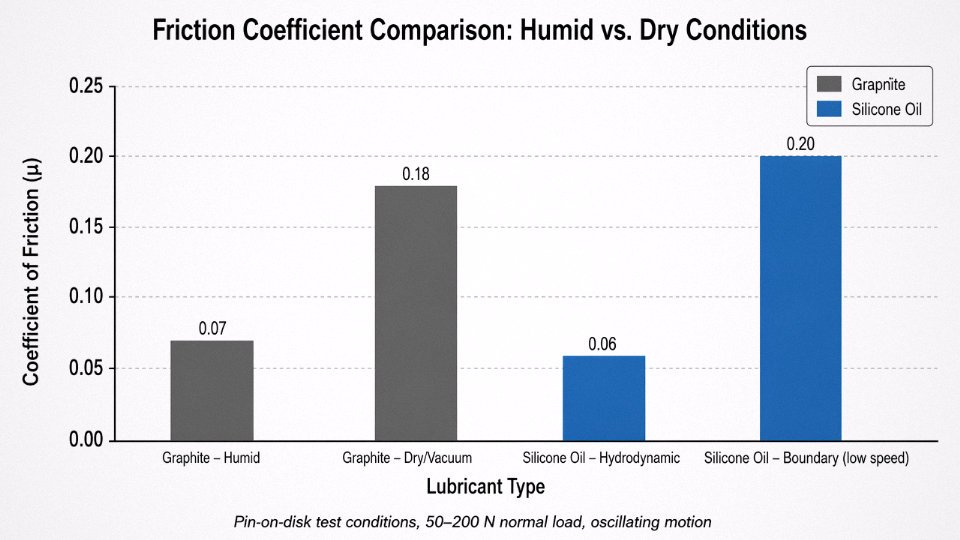
Where graphite genuinely excels is under conditions that destroy fluid films: high contact stress, oscillating motion, slow or intermittent movement, and start-stop cycles. A plain bearing running at 5 rpm with reversing load sees constant boundary contact; graphite handles that well because it doesn’t rely on hydrodynamic wedge formation. Pin-on-disk tests under 50–200 N normal load with oscillating motion typically show graphite maintaining stable friction in the 0.06–0.12 range across humid conditions, while silicone oil under the same regime — without a film-sustaining speed — climbs into the 0.15–0.25 range depending on viscosity grade.
Graphite's low friction depends entirely on fluid film formation like silicone oilFalse
Graphite is a solid boundary lubricant that operates by shear between crystal basal planes, not by maintaining a fluid film. Its mechanism depends on adsorbed gases and moisture, not hydrodynamic wedge pressure.
Speed Sensitivity and DN-Value Practical Limits
Silicone oil is not speed-insensitive. Higher-viscosity grades work well at low-to-moderate speeds but generate significant viscous drag and heat at high DN values — roughly above 200,000–400,000 DN for grease-consistency silicone products, depending on bearing geometry and cooling. Graphite, by contrast, is genuinely speed-insensitive up to thermal degradation limits (~450°C in air). It doesn’t thin out, doesn’t churn, doesn’t generate shear heat in the lubricant itself.
Hybrid Formulations: Graphite Dispersed in Silicone Carrier
Some applications justify combining both mechanisms. Graphite-in-silicone dispersions — typically 2–15% graphite by weight in a silicone base oil or grease — aim to cover the gap between hydrodynamic and boundary regimes. The fluid phase handles moderate loads at speed; the graphite provides residual boundary protection during low-speed or startup phases. In practice, these hybrids work well for slow-rotating mechanisms operating across wide temperature swings, like damper pivots or valve stems in industrial ovens. The limitations are real though: graphite particle settling is a concern in low-viscosity silicone oil carriers below roughly 100–200 cSt, and the solid loading reduces the already modest EP performance rather than transforming it. Don’t expect a hybrid to rescue an application where either lubricant alone would be fundamentally mismatched to the contact geometry.
Thermal and Environmental Operating Limits: Where Each Lubricant Survives and Where It Fails
Temperature is usually the first filter. Get it wrong and nothing else matters — viscosity collapses, oxidation accelerates, and you’re replacing components on a schedule that makes no economic sense.
Silicone Oil: A Stable Fluid with Hard Ceilings
Standard PDMS-based silicone oil holds its lubricating film reliably from around −60°C up to roughly 200°C. That’s a wide band, and for most industrial machinery — conveyor systems, packaging equipment, general-purpose actuators — it’s sufficient. Push past 200°C continuously and oxidative degradation starts eating the polymer backbone. You don’t get a sharp failure; you get gradual viscosity drift, acid byproduct formation, and eventually a gummy residue that can seize close-tolerance parts worse than running dry.
Phenyl-substituted silicones (methylphenyl or diphenyl grades) extend the upper ceiling to roughly 250°C by disrupting the regularity of the polymer chain and improving thermal stability. The tradeoff is cost — phenylsilicone can run three to five times the price of standard PDMS depending on viscosity grade and supplier — and slightly lower low-temperature performance.
On the cold end: at −60°C, most standard grades approach their pour point and begin to gel. In cold-room conveyor applications or outdoor equipment in northern climates, this matters more than engineers expect. Fluorosilicone grades maintain adequate fluidity down to about −68°C and are worth specifying for sub-arctic or cryogenic-adjacent environments, though they carry their own incompatibility issues with certain elastomers.
Standard PDMS silicone oil begins oxidative degradation above 200°CTrue
The Si-O backbone is stable, but methyl side groups undergo oxidation at elevated temperatures, producing volatile low-molecular-weight siloxanes and leaving a non-lubricating silica-like residue. Published thermal stability data from Dow, Shin-Etsu, and Wacker consistently place continuous-use limits at 150–200°C for standard grades.
One practical point: silicone oil is indifferent to humidity. Its lubrication mechanism — hydrodynamic or mixed-film, depending on speed and load — does not require adsorbed moisture or any atmospheric species to function. This sounds obvious until you compare it to graphite.
Graphite: Extreme Heat, but Read the Fine Print on Atmosphere
Graphite’s temperature ceiling is genuinely impressive. In air, surface oxidation becomes significant somewhere above 400–450°C, which already puts it well beyond any silicone. In nitrogen, argon, or hard vacuum, the material remains structurally intact past 1500°C, and specialized nuclear and aerospace applications push components to 2000°C under inert conditions. No organic lubricant gets close to this.
The critical caveat — and this catches people out more than almost anything else in tribology — is that graphite’s lubricity in normal conditions depends on adsorbed gas molecules, primarily water vapor. Those intercalated layers reduce interlayer shear strength and give graphite its characteristic low friction. Strip those molecules away, as happens in high vacuum or extremely dry inert gas atmospheres, and the coefficient of friction spikes to somewhere in the 0.5–0.8 range. Severe adhesive wear follows quickly. This is not a theoretical concern; it’s a documented failure mode in early satellite mechanisms and dry-environment processing equipment. If your application involves vacuum chambers, certain semiconductor fab environments, or rigorously dried inert gas purging, graphite without a co-lubricant or binder system can actively make things worse.
UV, Ozone, and Chemical Exposure
Silicone oil handles UV and ozone exposure well — better than most hydrocarbon oils. Outdoor or UV-exposed mechanisms that use silicone grease or oil generally show minimal photo-oxidative degradation over years. Graphite coatings applied to external surfaces are more vulnerable to simple mechanical wash-off from rain or condensation; the lubricating layer is thin and physically bound to the substrate only by adhesion.
On chemical resistance: silicone oil tolerates dilute acids, alkalis, and salt solutions without meaningful degradation, which makes it a reasonable choice for food-adjacent or light-chemical environments. Its weakness is aromatic solvents (toluene, xylene) and chlorinated solvents — both cause swelling of silicone-based materials and will extract or dilute a silicone oil film rapidly. Graphite sits at the opposite end of the chemical resistance spectrum. It shrugs off almost every acid and alkali in common industrial use. The exceptions are strong oxidizing acids — concentrated nitric acid and hot concentrated sulfuric acid can attack the graphite lattice — but those aren’t conditions where you’re typically worried about routine lubrication anyway.
| Condition | Silicone Oil | Graphite |
|---|---|---|
| Continuous temp, air | Up to ~200°C (PDMS), ~250°C (phenyl) | Up to ~450°C |
| Extreme heat, inert/vacuum | Not suitable above 250°C | Stable past 1500°C |
| Hard vacuum lubricity | Effective | COF spikes to 0.5–0.8; severe wear risk |
| Sub-zero performance | Gels near −60°C (fluoro grade: −68°C) | Stable to −200°C |
| Aromatic solvents | Swells / dissolves | Resistant |
| Strong oxidizing acids | Resistant | Attacked |
| UV / ozone | Good resistance | Coating wash-off risk |
Material Compatibility and Contamination Risk: Plastics, Elastomers, Electrical Components, and Food-Contact Surfaces
Compatibility is where lubricant selection gets genuinely tricky — and where the most expensive mistakes happen. Both silicone oil and graphite dry film perform well in isolation; the problems emerge when you introduce them into a real assembly with mixed materials, tight tolerances, or regulatory constraints.
Silicone Oil and Polymer Substrates
Silicone oil (PDMS-based) is broadly compatible with most engineering thermoplastics you’ll encounter on a typical assembly line — nylon PA6/PA66, acetal (Delrin is the trade name most technicians use), PEEK, PTFE, and polypropylene all behave well under standard soak conditions. That’s part of why it became the default lubricant for plastic gears, cam followers, and medical device actuators.
The subtle trap is polycarbonate. At low concentrations or brief incidental contact, PC usually survives. At higher concentrations, or with prolonged immersion — particularly with higher-viscosity grades above roughly 1,000 cSt — crazing and stress cracking show up. It’s easy to miss in prototype testing because the failure is time-dependent and stress-dependent. If your assembly has molded-PC covers or lens components anywhere near the lubrication zone, run a proper soak test before you commit. ISO 6072 gives you the immersion and tensile test framework; most serious silicone oil suppliers will provide their own soak test data, though the test conditions vary enough to warrant verifying against your actual grade and exposure time.
The other trap that catches people out: silicone oil will swell silicone elastomers. Not aggressively, not overnight, but it happens — and it’s a credibility problem when your customer has specified silicone O-rings and you’ve chosen a silicone-oil-based lubricant on the assumption that “same chemistry equals safe.” It doesn’t. Run the test; don’t assume.
Silicone oil is universally compatible with all silicone elastomers.False
PDMS-based silicone oils can swell silicone rubber seals and elastomers over time because the base polymer is chemically similar and absorbs the fluid. Compatibility depends on cross-link density and immersion duration; soak testing per ISO 6072 or supplier data sheets is required.
Graphite in Electrical Environments
Graphite’s bulk resistivity sits around 10⁻⁵ Ω·m — which makes it a conductor by most practical standards. For brush contacts, collector rings, and current-carrying sliding interfaces, that’s exactly what you want. Graphite has been used in motor brushes for over a century for this reason.
Bring that same material anywhere near a PCB, a connector pin array, or a sensitive insulation gap, and it becomes a liability. Graphite particles migrate. They’re fine, they’re black, and they don’t stay where you put them. A few grams of graphite paste applied to a nearby sliding rail has been known to migrate as airborne dust onto neighboring electronics during vibration. The result can be intermittent short circuits that are genuinely difficult to diagnose because the contamination layer is thin and spotty. In connector assemblies especially, treat graphite as electrically live — because it is.
Silicone oil sits at the opposite end of this spectrum. Dielectric strength for a 100 cSt PDMS grade typically runs 14–18 kV/mm, depending on purity, moisture content, and electrode geometry. High-voltage transformer and capacitor manufacturers use it specifically for this property. Graphite would be disqualifying in those same applications — not just unhelpful, actually dangerous.
Food-Grade and Pharmaceutical Applications
Certain silicone oil grades carry NSF H1 registration and fall within FDA 21 CFR 178.3570 for incidental food contact. That covers lubrication of food-zone machinery where trace contact with product is possible but not intentional. In practice, H1 silicone oils are common in beverage filling lines, bakery conveyor systems, and pharmaceutical tablet press components.
Graphite dry lubricants can achieve food-grade certification — some suppliers do list NSF-approved graphite-based products — but the visual contamination issue is real and not trivial to manage. Black residue on a white substrate or on a food product triggers an automatic rejection in most food processing facilities, regardless of toxicological status. Auditors and QA teams see color; they don’t see particle counts. In my experience, food manufacturers tend to default to silicone oil or PTFE-based dry film rather than graphite, purely because the contamination trail is invisible when it happens.
Migration, Staining, and Process Engineering Controls
Silicone oil migrates. It travels along surfaces by capillary action and thin-film spread, reaching areas well beyond the initial application zone. On a machined metal assembly this is usually harmless. On a paint line or a bonded assembly it’s a serious problem — even trace silicone contamination on a weld prep surface or a bonding substrate will kill adhesion. Rework is expensive. Some plants run separate lines entirely to prevent cross-contamination; others use barrier tapes and strict application discipline.
Graphite leaves a persistent black residue that transfers to skin, gloves, light-colored substrates, and fabric. In a clean-room or white-goods assembly environment, the handling discipline required is real overhead. Neither lubricant is “clean” in the way PTFE dry spray or synthetic PAO might be — they just make different kinds of mess, and your process controls need to account for whichever mess you choose.
Application Methods, Shelf Life, and Relubrication Intervals in Maintenance Programs
Getting the chemistry right is only half the job. How you deliver the lubricant to the surface, how often you go back, and whether the product in your storage room is still any good — those questions determine whether your maintenance program actually works on the floor.
Applying Silicone Oil: Match the Method to the Point Count and Viscosity
For precision metering — think small instrument bearings, actuator pivot pins, or miniature linear slides — a blunt-tip syringe is the right tool. Volumes in the 0.1–5 µL range are realistic per point; anything over 50 µL on a small bearing tends to migrate out and attract particulate, which defeats the purpose. Aerosol silicone oil covers more ground faster and works well on conveyor guide rails or wide sliding surfaces, but you lose metering control, and overspray onto nearby electrical contacts or optical surfaces is a real hazard on a crowded machine frame.
Viscosity selection matters more than most maintenance teams acknowledge. A rough working rule: for bore diameters under roughly 10 mm running above 3,000 rpm, stay in the 10–100 cSt range. Larger bores or slower speeds tolerate — and often need — 500–1,000 cSt to maintain film thickness under load. High-speed spindle applications sometimes use oil-mist or bath lubrication with low-viscosity grades (50 cSt or below), where the bearing itself churns the oil into a mist. Going too thick at high speed generates heat through viscous drag; too thin at low speed leaves metal-to-metal contact.
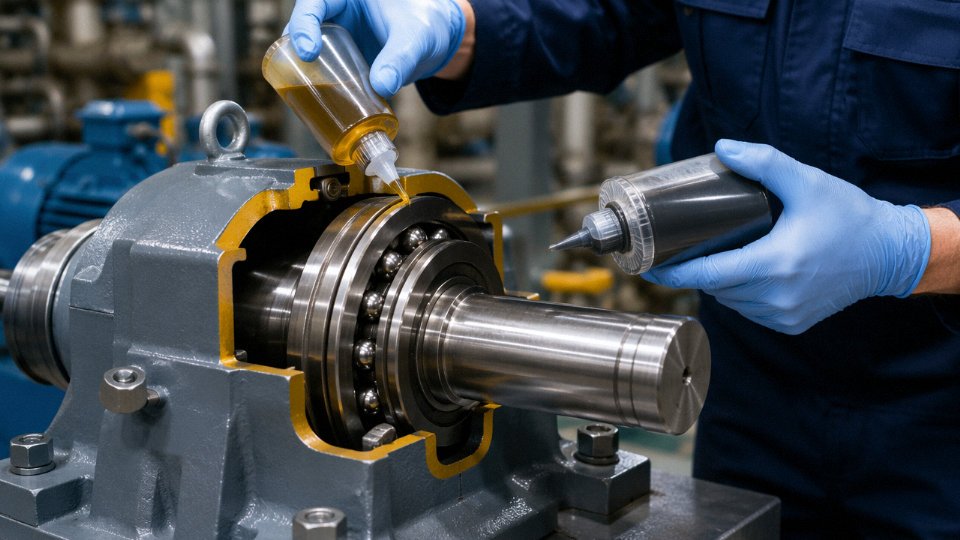
Applying Graphite: Film Quality Depends on Surface Prep and Dry Time
Spray-and-dry is the most common industrial method for colloidal graphite in solvent suspension. The solvent — typically isopropanol or a light petroleum carrier — flashes off in roughly 5–15 minutes at room temperature, leaving a thin, burnished graphite film. Don’t rush it. Applying load before the carrier is fully gone risks washing the particles and producing an uneven, patchy film that fails early. In cold or humid conditions (below 10°C or above 80% RH), drying can stretch to 30 minutes or longer.
For interference-fit fasteners in high-torque applications — large flange bolts, for instance — burnishing graphite paste directly onto the thread flanks with a stiff brush gives more consistent coverage than spray. Open gears and wire rope are similar: brush-on paste, work it into the gaps, let any carrier flash. Aerosol graphite is fine for door locks, cabinet hinges, and slide mechanisms where thin, clean coverage is more important than film thickness.
Bonded graphite coatings require a clean, dry substrate — ideally grit-blasted or chemically etched — to achieve rated adhesion and service life.True
Graphite particles in binder systems rely on mechanical and chemical anchoring to the substrate surface. Contamination with oils, oxides, or moisture breaks that bond, leading to early delamination under load or thermal cycling.
Surface prep is genuinely non-negotiable for bonded graphite coatings. A light oxide layer or residual machining oil will cause delamination within weeks of startup. Silicone oil is more forgiving — it can be applied to lightly contaminated metal and still provide useful lubrication — though performance on a clean, degreased surface is always better and the film lasts longer.
Relubrication Intervals: What the Numbers Actually Depend On
Silicone oil in sealed or shielded bearings under light-to-moderate loads and temperatures below 80°C can realistically run 10,000–25,000 operating hours before relubrication. That range collapses fast under high temperature, contamination, or heavy radial loads. Don’t apply the upper end of that range to a bearing running at 120°C in a dusty environment and expect it to hold.
Graphite solid-film coatings on fasteners are essentially a one-shot application per assembly cycle. Each time you pull and retorque, reapply. Dry graphite in locks and hinges under normal indoor use typically lasts 6–12 months; outdoor exposure or frequent cycling shortens that.
Shelf Life and Storage
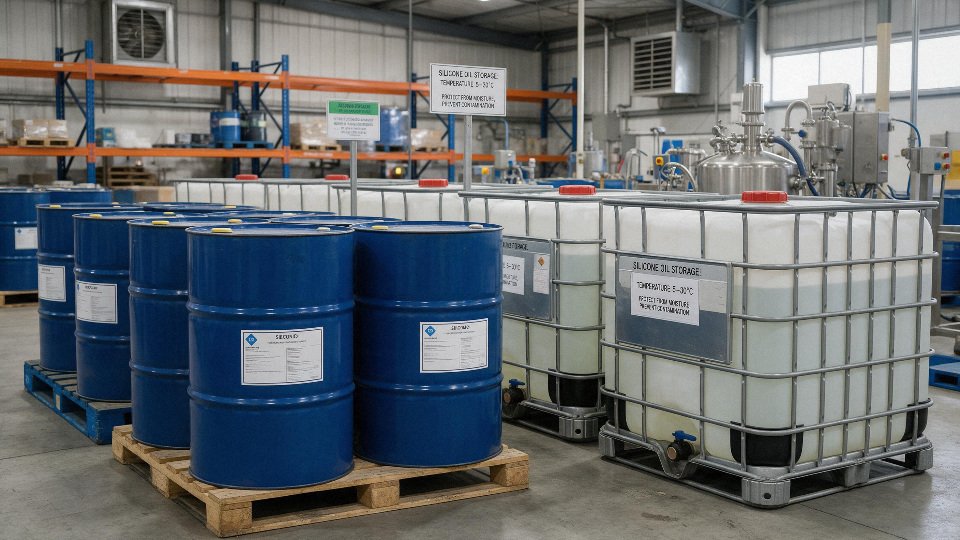
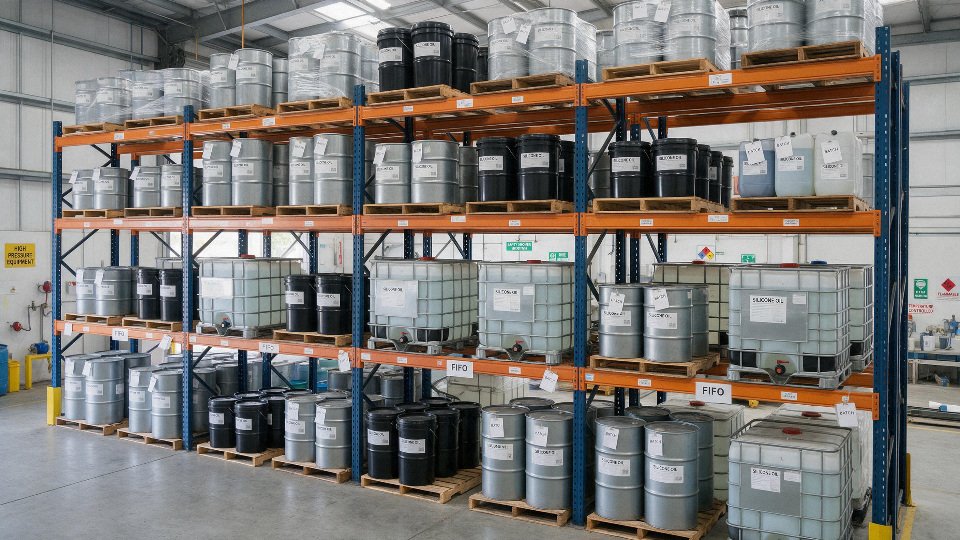
Silicone oil in sealed metal or HDPE containers, stored below 40°C away from UV and direct sunlight, is stable for 5–10 years. It doesn’t oxidize meaningfully at room temperature. Colloidal graphite suspensions in water or solvent are a different story — 1–3 years is typical, and the product will settle in the container over time. Always agitate thoroughly before use, otherwise the first draws from the can are mostly carrier and the last draws are thick sludge, and neither applies a uniform film. Dry graphite powder, if kept genuinely dry and sealed against moisture ingress, has an essentially indefinite shelf life. The enemy is humidity, which causes clumping and interferes with the particle flow properties that make dry graphite work in locks and fine mechanisms.
Industry-Specific Selection Guide: Aerospace, Food Processing, Electrical Engineering, Automotive, and DIY
The right lubricant in one industry can be genuinely wrong in another, even for what looks like the same joint type. A sliding threaded fastener on a jet engine pylon and a sliding threaded fastener on a conveyor frame share a geometry but almost nothing else in terms of what the lubricant needs to do. The sector breakdowns below are prescriptive, not theoretical.
Aerospace and Defense
Graphite is the default for high-temperature fastener assembly in airframes and engine pylons — exhaust-zone bolts, turbine case studs, and actuator thread interfaces where metal-to-metal galling under cyclic thermal load is the failure mode to prevent. Molybdenum disulfide often shares the shelf with graphite in this space, but graphite’s oxidation stability up to around 450°C in air keeps it specified wherever MoS₂’s upper limit is a concern. Landing gear thread interfaces and flight-control push-pull rod end threads also lean heavily on graphite paste or dry film coatings because contamination with hydraulic fluid or water — which would wash an oil film away in seconds — doesn’t degrade the solid film meaningfully.
Silicone oil shows up in the same aircraft, just in completely different subsystems. Hydraulic dampers, avionics bay cooling loops, and O-ring assembly all call for silicone fluid at viscosities typically in the 50–500 cSt range depending on flow and sealing requirements. The electrical insulation properties matter here too; connector boot lubrication and pressure-sensing transducer O-ring assembly frequently specify silicone because it’s chemically inert to the elastomer and won’t compromise dielectric performance.
Food and Beverage Processing
NSF H1-registered silicone oil and silicone grease dominate here, and for good reason. Incidental food contact is possible on conveyor chains, bottling head threads, and agitator shaft seals, and silicone’s low toxicity and flavour-neutral profile at typical processing temperatures give it a compliance advantage that petroleum and most synthetic oils don’t have without extensive NSF registration work.
Graphite is genuinely rare in food plant environments. The staining risk on light-coloured products — flour, sugar, dairy — is usually a hard no from quality assurance. It does appear in some food-grade chain lubricant formulations as a minor solid additive where PTFE isn’t available or where the chain operates above silicone oil’s practical film-stability ceiling, but this is more the exception than the rule. If you’re spec’ing a food line and someone suggests graphite, ask to see the NSF registration and the application engineering case before approving it.
Electrical and Electronics
Silicone oil’s dielectric strength — roughly 14–18 kV/mm for clean PDMS grades, depending on viscosity and contamination level — makes it the transformer cooling and insulating fluid of choice in distribution hardware and some specialty power electronics. Connector protection, switch lubrication, and relay pivot points also default to silicone because any conductive contamination is a failure mode.
Graphite is, of course, exactly the right choice where you want conductivity: carbon-brush motor commutators, rheostats, and sliding contact interfaces. Using silicone on a commutator would insulate the brush contact and kill the motor.
Graphite improves electrical conductivity at sliding contacts in carbon-brush motorsTrue
Graphite's layered crystal structure provides both lubrication and electrical conductivity, making it standard practice for commutator and brush interfaces in DC motors and rheostats.
Automotive
Brake caliper slide pin bores are where graphite paste earns its keep on every passenger vehicle. The combination of intermittent very high temperatures — brake rotors can see 400–600°C under hard use — and the anti-seize requirement on steel pins in aluminium calipers makes graphite paste nearly universal here. Exhaust manifold studs are similar: petroleum grease carbonizes and seizes; graphite holds.
Silicone takes over everywhere rubber or plastic is involved. Door seal channels, plastic trim clips, sunroof track rollers, and brake master cylinder reservoir seals all require a lubricant that won’t swell EPDM or attack polypropylene. In practice, a single silicone spray can handles most of this in a body shop. Using a petroleum-based lubricant on EPDM door seals is a common mistake — it softens the rubber and accelerates cracking over one to two winters in cold climates.
DIY and Consumer Maintenance
Graphite powder is the correct choice for pin tumbler locks, padlocks, and wooden drawer slides — specifically because it’s dry. Oil spray in a lock attracts dust, builds a paste that eventually freezes the mechanism, and creates exactly the problem it was supposed to solve. One small squirt of graphite powder lasts a surprisingly long time in a lock cylinder under normal use.
Silicone spray handles garage door tracks, zip fasteners on outdoor gear, rubber window seals, and garden hose fittings. The consumer market is where these two products get most badly confused. People spray silicone on locks (leaves a residue that gums up), or squirt graphite powder on rubber seals (abrades and dries them). Most consumer product misapplication cases I’ve seen come down to one of those two swaps — they’re worth calling out explicitly on any maintenance checklist.
Health, Safety, and Environmental Compliance: Handling, Disposal, and Regulatory Status
EHS obligations rarely drive lubricant selection until something goes wrong — a respiratory complaint, a failed environmental audit, or a disposal contractor refusing a drum. Getting ahead of these issues is worth the ten minutes it takes to read the SDS properly before the material arrives on site.
Silicone Oil: Occupational Exposure and Toxicology
PDMS-based silicone oils have an unusually benign toxicological profile. Oral LD50 in rats runs above 17 g/kg — roughly in the same category as table salt in terms of acute hazard, which is why you’ll see these fluids used in food-contact and medical applications. Skin and eye irritation is minimal under normal handling; most standard-grade PDMS oils rate as non-irritating on Draize tests, though some formulators add carrier solvents or functional additives that shift that picture, so always check the specific SDS rather than assuming the base polymer rating applies to the whole product.
The hazard that catches plants off guard is aerosol generation. In bulk liquid form, silicone oil is easy to handle safely. Spray application is a different story. Fine mist from pressure spray systems or ultrasonic atomizers can deposit deeply in the lungs if concentrations build up in poorly ventilated areas. Engineering controls — local exhaust ventilation, spray booths, enclosed application systems — should be the first line of defense. Half-face respirators with P100 filters are the fallback where ventilation cannot be adequately controlled. This isn’t a theoretical concern; it shows up in SDS sections 8 and 11 for most spray-grade formulations.
PDMS silicone oil has an oral LD50 in rats above 17 g/kg, placing it in the practically non-toxic category.True
This figure is consistent with published PDMS toxicology data from Dow Corning and Shin-Etsu safety data sheets and is cited in EU REACH dossiers for dimethylpolysiloxane.
Graphite: Dust Exposure and Chronic Risk
Dry graphite powder is where the occupational health picture gets more serious, and in my experience this is underestimated on plant floors that treat it as “just carbon.” At low airborne concentrations graphite dust is a nuisance — itchy eyes, dark mucus, nothing acutely dangerous. The risk accumulates with years of uncontrolled exposure. Chronic high-dose graphite inhalation is associated with pneumoconiosis (sometimes called graphite lung), a progressive fibrotic condition that shares characteristics with coal worker’s pneumoconiosis.
OSHA’s PEL sits at 15 mg/m³ total dust, but ACGIH’s TLV for respirable fraction is 2 mg/m³ — a substantially tighter number that reflects updated epidemiology. Many EU member states and the UK enforce limits closer to the ACGIH figure. If your plant is grinding, tumbling, or bulk-dispensing graphite powder without respirable dust monitoring, that’s an audit finding waiting to happen. P100 or FFP3 respiratory protection is standard for any task generating visible dust cloud. Good housekeeping matters too; graphite migrates everywhere, and accumulated surface dust can be re-entrained by forklift traffic or HVAC.
Environmental Fate and Disposal
PDMS degrades slowly in soil — half-lives measured in years to decades, depending on temperature, UV exposure, and microbial community. The saving grace is that PDMS binds tightly to soil particles and organic matter, which limits leaching into groundwater and reduces bioavailability to aquatic organisms. Regulatory agencies in the EU and US EPA have not classified standard PDMS as bioaccumulative in the aquatic food chain, though you should stay current on this because the regulatory conversation is active. Fluorosilicone variants — used in fuel and solvent-contact applications — sit closer to PFAS-adjacent chemistry, and both EU REACH regulators and the US EPA are tightening scrutiny of fluorinated compounds as a class. If your spec calls for fluorosilicone, flag it for your EHS team now rather than waiting for a compliance letter.
Silicone oil waste, spent or contaminated, must not go to drain or surface water discharge. Treat it as industrial oily waste and route it to a licensed waste contractor. Some high-viscosity grades can be blended into cement kiln fuel or industrial combustion systems — check with your contractor on the practicality, as viscosity and halogen content affect co-processing acceptability.
Graphite is genuinely clean on the environmental side. Solid graphite waste and dry graphite residue are generally classified as non-hazardous in most jurisdictions and can be disposed with general industrial solid waste after confirming local rules. The complication is colloidal graphite suspensions, which typically use hydrocarbon or water-based carriers. The carrier determines the disposal classification, not the graphite itself. A petroleum-carrier colloidal product likely requires disposal as oily waste. A water-based colloidal suspension may be dischargeable after treatment, or may need collection — it depends entirely on the carrier chemistry and your local permit conditions.
The practical habit is straightforward: train handling staff on the SDS before first use, set up a dust monitoring baseline if graphite is used in volume, and never assume the “it’s just carbon” logic extends to disposal paperwork.
Total Cost of Ownership: Price per Application Point, Labor, Equipment Protection Value, and Hidden Costs
Unit price is the number procurement managers look at first. It is almost never the right number to act on.
Technical-grade silicone oil at 100 cSt runs roughly $4–$12 per liter in bulk, depending on order volume, supplier tier, and whether you’re buying a drummed commodity grade or a tighter-spec fluid with documented viscosity certification. Aerosol silicone spray sits around $3–$8 per 300 mL can at distributor pricing. Colloidal graphite suspension costs considerably more — typically $15–$40 per liter — and dry graphite powder lands somewhere between $5–$20 per kg depending on particle size distribution and purity grade. On raw unit price, silicone oil wins easily. That comparison becomes meaningless once you factor coverage rate.
Coverage Rate Changes the Arithmetic Entirely
A single 300 mL aerosol graphite can, applied at a reasonable film weight to fasteners or slide surfaces, typically covers 50–150 application points. The range is wide because it depends heavily on surface roughness, the applicator’s discipline, and whether you’re treating a recessed socket bolt or an open flange face. Silicone oil, by contrast, requires periodic reapplication — in a reciprocating mechanism or a lightly loaded pivot running outdoors, you might be back at it every 3–6 months. Graphite bonded to a threaded joint on a high-temperature bolted flange can remain effective for years without re-treatment.
The correct metric is cost per lubricated joint over the asset’s service life, not cost per liter on the invoice. Work that calculation for your specific interval and application count and the picture often reverses completely.
The Equipment Protection Value Dwarfs Lubricant Cost
A failed rolling-element bearing in a production environment costs somewhere between $500 and $50,000 when you account for the replacement part, the labor to pull and re-install, the unplanned downtime, and — in severe cases — secondary damage to shafts or housings. That range is wide because a small conveyor idler bearing is not the same as a main drive bearing on a press or a precision spindle in a machining center. Either way, the lubricant that prevented the failure rarely costs more than 1–3% of the event it avoided.
Lubricant cost typically represents less than 3% of the total cost of a bearing failure event in industrial production environments.True
Industry maintenance cost studies and OEM maintenance manuals consistently show that lubricant expenditure is a minor fraction of unplanned failure costs, which include parts, labor, and lost production. The 1–3% figure is a realistic upper bound for most mid-size industrial machinery.
Framing lubricant selection as a cost-minimization problem is the wrong mental model. It is a risk-management decision.
Hidden Costs That Don’t Appear on the Lubricant Invoice
Wrong lubricant selection generates costs that show up in completely different budget lines, which is exactly why they get underestimated. Silicone oil contamination in a paint or coating environment is a classic example — airborne silicone from a nearby maintenance operation can cause fish-eye cratering on a freshly coated panel. Stripping and refinishing a single panel runs roughly $200–$2,000 depending on the part size and coating system, and in a high-throughput line the problem multiplies before anyone identifies the source. This is a well-known enough hazard that some automotive assembly plants ban silicone lubricants entirely from certain zones.
Graphite carries its own contamination risk profile. Conductive graphite particles that migrate into electrical insulation assemblies or connector housings can create a leakage path or, in the worst case, a dead short. The repair cost for a damaged control panel or variable-frequency drive makes the lubricant cost look absurd in comparison.
Normalizing Labor: Annual Hours per 100 Lubrication Points
One useful way to compare maintenance burden is to estimate total annual labor hours per 100 lubrication points. Silicone oil in sealed or semi-sealed bearings running clean indoor service might need attention once or twice a year — call it 0.5–1.5 hours per 100 points annually if the access is reasonable. Graphite on high-temperature bolted joints that would otherwise seize and require torch work at disassembly can genuinely reduce touchpoints to near zero over a multi-year maintenance cycle; the labor saving on those joints alone usually justifies the higher unit price.
The plants that manage this well treat lubrication as a cost-per-asset-year calculation, not a consumables line item. That shift in framing changes which product gets specified.
Frequently Asked Questions: Silicone Oil vs Graphite Lubricant
Can I mix silicone oil and graphite together?
Yes, and this is actually a commercially established product category — graphite-in-silicone dispersions are used on open gears, wire ropes, and slow-speed heavily loaded slides where you want both an elastohydrodynamic carrier film and solid boundary protection when the film thins out under load. The combination works because PDMS provides the fluid film at moderate speeds while graphite platelets carry the load during slow or reversing motion. Commercial grades use milled colloidal graphite (typically 1–5 µm particle size) suspended with dispersants to prevent settling in the container.
Don’t try to blend these yourself on the plant floor. Particle agglomeration will plug applicators, create uneven film thickness, and give you unpredictable friction — probably worse than either product alone. If your application genuinely needs this behavior, source a stabilized pre-formulated product. Some open-gear lubricants use this approach; specify the graphite loading (usually 5–15% by weight) and confirm the suspension stability spec before ordering in bulk.
Is silicone oil or graphite better for door locks and padlocks?
Graphite powder is the traditional answer, and for good reason. Locks are enclosed mechanisms with tight tolerances, and any oil-based lubricant — silicone included — will attract fine grit and metallic wear debris, turning the lubricant into a lapping compound over time. In a padlock exposed to outdoor dust and road grime, an oil film that felt smooth in month one can genuinely jam the mechanism by month six.
Silicone spray is acceptable in a pinch, particularly the dry-film silicone aerosols that leave a thin residue after the carrier solvent evaporates. Apply sparingly, let it dry fully before closing the lock, and expect to reapply more often than with graphite. For a padlock that gets used hard outdoors, stick with graphite powder.
Will silicone oil damage rubber seals and O-rings?
Standard PDMS silicone oil is chemically inert toward EPDM, neoprene (CR), nitrile (NBR), and Viton (FKM) elastomers under normal temperature conditions.True
PDMS is non-reactive with most synthetic rubbers; industry compatibility tables from seal manufacturers consistently list these elastomers as compatible with silicone oil at temperatures within the seal's rated range.
The one trap: silicone oil will swell silicone rubber (VMQ) and fluorosilicone (FVMQ) seals — like dissolves like, essentially. If your assembly has VMQ O-rings (common in some automotive and aerospace uses), silicone oil is the wrong choice. Always cross-check against the seal manufacturer’s immersion swell data, not generic compatibility charts from lubricant suppliers.
Why does graphite lose lubricity in vacuum or very dry conditions?
This catches people off guard. Graphite’s low shear strength is not intrinsic to the carbon structure alone — it depends on adsorbed species (water vapor, CO₂, oxygen) intercalated between graphene layers, which weaken interlayer bonding and allow easy shear. Remove those species, as happens in hard vacuum or extremely dry inert atmospheres, and the coefficient of friction can jump from roughly 0.05–0.1 up toward 0.3–0.5. For vacuum chambers, satellite mechanisms, or dry-gas environments, MoS₂ is the standard solid lubricant replacement. Its lubricity mechanism works in the opposite direction — it actually performs better in vacuum and dry conditions.
Is graphite lubricant safe for food processing equipment?
Certain colloidal graphite products carry food-grade designations, but the practical answer for most food processing environments is: use NSF H1 silicone grease instead. Auditors and OEMs almost universally prefer it. Even a small quantity of graphite contamination is visually obvious — black residue on product is a line-stop event. Silicone grease contamination is at least colorless. That visibility asymmetry matters enormously on a food line where visual inspection is part of the QA process.
How do I remove silicone oil contamination before painting or welding?
This is a real problem — silicone oil spreads in invisible thin films and causes fish-eye defects in paint even at parts-per-million levels. Isopropyl alcohol (IPA) is the common first choice, but it takes multiple wipe passes with fresh wipes each time; one wipe simply redistributes the contamination. A dedicated wax-and-grease remover solvent blend is more effective for heavier deposits. Verify removal with a water-break test: water should sheet evenly across the metal surface with no beading or pulling away. Any beading means silicone is still present. In a welding context, residual silicone can cause porosity in the weld bead, so thorough degreasing before any hot work is non-negotiable.
What is the maximum temperature for silicone oil, and when should I switch to graphite?
Standard PDMS silicone oil handles continuous service to around 180–200°C reliably; push beyond that and you get oxidative degradation, viscosity breakdown, and acidic byproducts that can corrode bearing surfaces. Between roughly 200°C and 450°C in air, a high-temperature silicone-based grease with solid lubricant additives (often graphite or MoS₂ blended in) is a practical step-up, or switch to colloidal graphite paste directly. Above 450°C in air, graphite itself starts oxidizing — the carbon burns off, which means no lubricant left and potentially carbon oxide emissions in an enclosed space. For sustained temperatures above 450°C, look at boron nitride lubricants or ceramic-based pastes. The boundary is not perfectly sharp; actual oxidation onset depends on partial pressure of oxygen and exposure time, but 450°C is a reasonable planning limit for graphite in normal industrial atmospheres.