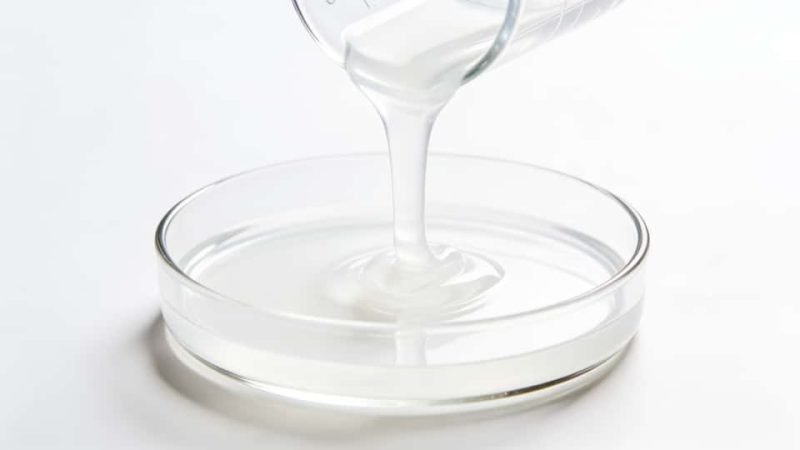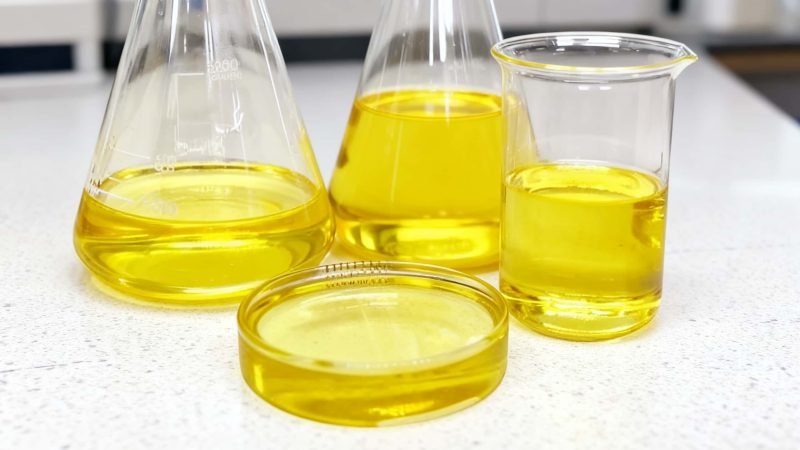
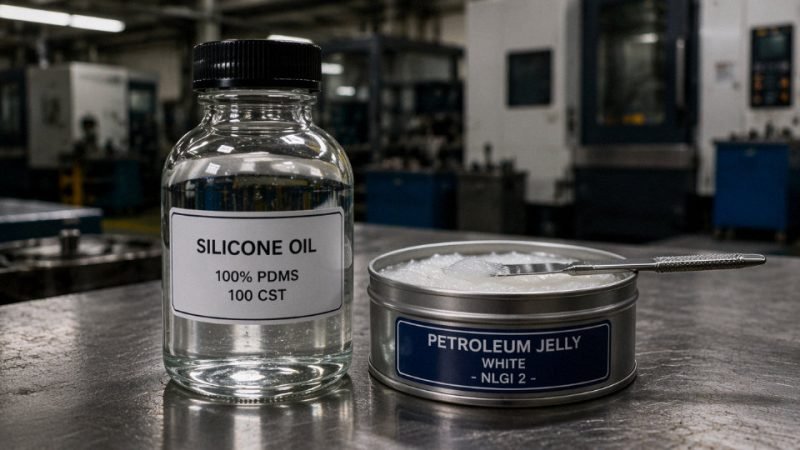
Wrong lubricant choice on a production line doesn’t always announce itself dramatically — sometimes it’s a slow bleed: a connector that corrodes over six months, a rubber seal that swells and starts weeping, a gearbox running hotter than it should because someone grabbed whatever was on the shelf. By the time the failure mode is obvious, you’ve already eaten the downtime, the replacement parts, and whatever scrap came off the line during the degradation window. Picking between silicone oil and Vaseline isn’t a trivial substitution question; the two materials behave completely differently under temperature cycling, electrical stress, and chemical exposure.
Silicone oil and Vaseline (petroleum jelly) are not interchangeable lubricants. Silicone oil operates continuously from –60 °C to +200 °C, spans viscosities from 0.65 cSt to over 1,000,000 cSt, and offers dielectric strength around 14–15 kV/mm. Vaseline softens near 40–50 °C, loses structure above roughly 60 °C, and tests at approximately 10 kV/mm — adequate for low-voltage connector protection but unsuitable for high-heat or high-voltage applications.
What makes this comparison genuinely useful — and messier than most spec sheets suggest — is that each material has a category where it clearly wins and a category where using it is an active mistake. Knowing which is which depends on your actual operating conditions, not the product description on the tub.
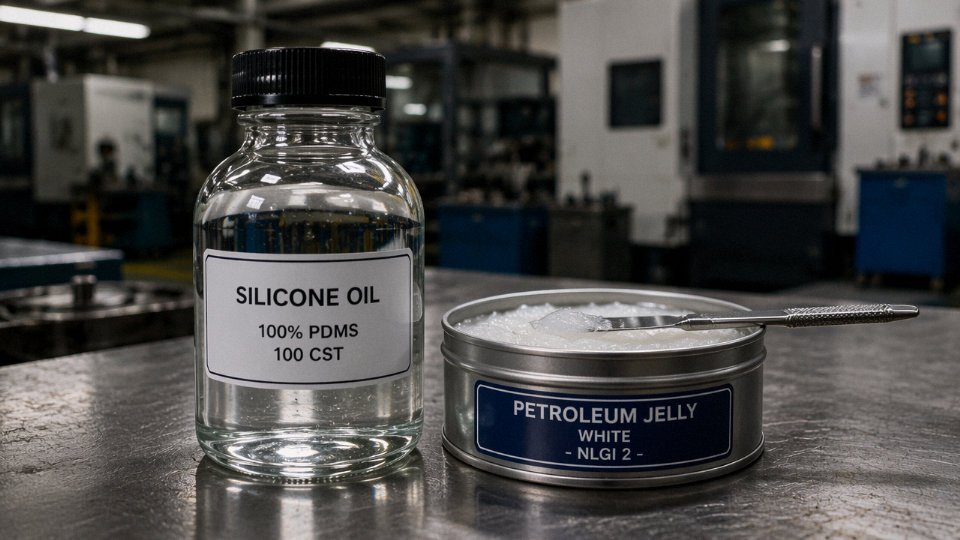
Molecular Architecture and Physical Property Profiles: What the Data Actually Show
The difference starts at the molecular level and it matters more than most procurement specs acknowledge. Silicone oil — polydimethylsiloxane in its most common form — is a synthetic polymer built on a Si–O backbone with methyl or phenyl side groups. That backbone is why it behaves so differently from petroleum-derived products across temperature, electrical, and oxidative stress. Vaseline (petroleum jelly) is a semi-solid blend of straight-chain and branched hydrocarbons, essentially a microcrystalline wax network holding mineral oil in suspension. Different feedstocks, different refining batches, slightly different properties — there’s more batch-to-batch variation in Vaseline than most engineers expect.
Viscosity and Consistency: Why You Can’t Compare These Directly
Silicone oil viscosity runs from 0.65 cSt for the lightest methyl silicone fluid up past 1,000,000 cSt for high-polymer grades — that upper end is closer to a soft gel than a flowing liquid. Where you land in that range depends on the degree of polymerization, and most industrial-grade fluids for lubrication or damping sit somewhere between 100 and 12,500 cSt.
Vaseline doesn’t have a viscosity in the conventional sense. It’s characterized by penetration hardness: 132–220 dmm at 25 °C per ASTM D217, where a lower number means harder. That unit measures how far a standardized cone sinks into the material in tenths of a millimeter over five seconds. Converting your mental model: a 200 dmm Vaseline is roughly as yielding as a moderately soft grease, but it flows like a viscous paste under shear rather than behaving as a true fluid. Trying to compare it against a 10,000 cSt silicone oil using one number isn’t meaningful — you’d need to know the shear rate, temperature, and application geometry before the comparison makes operational sense.
Thermal Behavior
Silicone oil handles continuous service from about –60 °C to +200 °C, and phenyl-modified grades push that ceiling to around 250 °C. Flash point is typically above 300 °C. That’s why you find it in transformer cooling circuits and oven chain lubrication, places where petroleum products simply cook off or catch fire.
Vaseline softens between 40 and 50 °C — meaningfully, not just technically. A jar left on a south-facing factory windowsill in summer can be a puddle by afternoon. Its usable range is roughly –10 °C to +60 °C, and above about 120 °C it begins oxidizing and depositing carbon. That carbon residue is abrasive and can trap moisture, which is a real problem on precision sliding surfaces.
Vaseline's flash point is approximately 210 °C, while silicone oil flash point typically exceeds 300 °CTrue
These figures are consistent with published material safety data sheets for pharmaceutical-grade petroleum jelly and polydimethylsiloxane fluids respectively, and are well supported in chemical engineering reference literature.
Property Comparison Table
| Property | Silicone Oil | Vaseline | Engineering Implication |
|---|---|---|---|
| Dielectric strength | 14–15 kV/mm | ~10 kV/mm | Silicone preferred for HV connector sealing |
| Flash point | >300 °C | ~210 °C | Silicone safer in hot enclosures |
| Operating range | –60 °C to +200 °C | –10 °C to +60 °C | Vaseline unsuitable for most industrial equipment |
| Vapor pressure | Very low (50 °C | ||
| Cold-climate outdoor equipment (below –20 °C) | Silicone oil | Pour point, viscosity-temperature coefficient | Pour point verified below minimum site temperature; Vaseline goes waxy below –10 °C |
| High-vacuum sealing (10⁻⁶ mbar range) | Silicone oil (low vapor pressure grade) or PFPE | Vapor pressure, outgassing | Use polydimethylsiloxane grades rated <10⁻⁷ mbar vapor pressure, or switch to PFPE for <10⁻⁸ mbar |
| Implantable device fluid | Neither without specific qualification | Biocompatibility, extractables/leachables | FDA 21 CFR or ISO 10993 testing required; medical-grade PDMS only, and only with device-specific clearance |
Red-Line Exclusions
Vaseline must never be used above roughly 80 °C in mechanical systems — it softens, migrates, and leaves carbonaceous residue that’s genuinely hard to clean. Never apply it to silicone rubber or natural rubber seals; swell and extract are documented, not theoretical. Polystyrene and polycarbonate under mechanical stress will craze in contact with petroleum-based products. And it has no place as a transformer insulating fluid, full stop — the dielectric strength just isn’t there, and the thermal breakdown risk is serious.
Silicone oil exclusions are fewer but non-negotiable. On an automotive paint line or any surface that later gets painted or bonded, even trace silicone contamination causes fisheye defects and adhesion failure that can write off an entire batch. PCB assembly is the same story. And while silicone oil is usually compatible with silicone rubber, “usually” isn’t good enough — swelling varies by filler loading and crosslink density, so test it.
Substitution Protocol
Switching from one material to the other mid-program requires more than a procurement decision. Run a 72-hour minimum immersion compatibility test on every polymer, elastomer, and coating in contact. For regulated applications — food machinery, medical devices, pharmaceutical equipment — re-qualification under the relevant standard is mandatory, not optional. In ISO 9001 or IATF 16949 environments, document the change formally: update the control plan, re-run PFMEA if failure modes shift, and get sign-off from quality before release. Performance testing duration depends on the application; a bearing test needs at least the relubrication interval plus 20% run time to be meaningful.
Silicone oil is always safe on silicone rubber sealsFalse
Silicone oil can cause measurable swell in some silicone rubber compounds depending on crosslink density and filler type. Compatibility must be verified per ISO 1817 for each specific elastomer grade.
Emerging Alternatives Worth Monitoring
PFPE fluids now take share from silicone oil in semiconductor, high-vacuum, and aggressive-chemical environments where even trace silicone is disqualifying. They’re expensive — often 10–30× the cost of silicone oil depending on grade and volume — but the performance gap at temperature extremes and in reactive gas atmospheres is real. Ionic liquid lubricants are attracting serious R&D attention for precision bearings and space mechanisms, though cost and supply chain maturity remain obstacles for most plant environments. Bio-based synthetic esters are the most credible near-term alternative to both materials in food-grade and biodegradability-regulated applications, with H1 registrations now available from several formulators.
Neither silicone oil nor Vaseline is under existential threat in their core applications. But for anyone specifying a new product line or re-evaluating an existing one, it’s worth knowing these alternatives exist before locking in a long-term supply agreement.
Final Recommendation Summary
Silicone oil wins on thermal range, long service intervals, dielectric performance, and the breadth of regulatory frameworks it fits. Vaseline wins on unit cost, global availability, adhesion to polar metal surfaces, and a century of proven skin-barrier use. The wrong instinct is to declare a universal winner. The right instinct is to match the material’s actual property profile to what the application actually demands — and to verify rather than assume when the stakes are high.