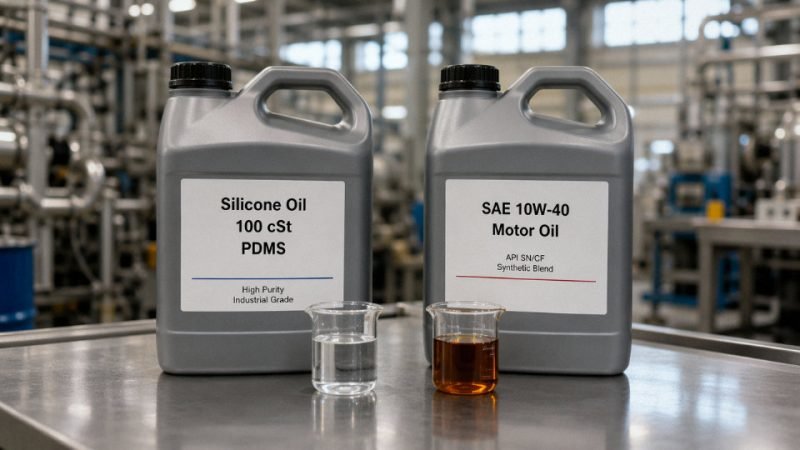
Someone grabs the nearest quart of fluid off the shelf, fills the wrong reservoir, and three weeks later you’re explaining to ownership why a $14,000 actuator is scrap. It happens more than anyone admits. The confusion is understandable on paper — a 100 cSt silicone oil and a SAE 10W-40 motor oil look nearly identical in a viscosity table at 40°C, both sitting around 95–110 cSt. The problem surfaces when temperatures swing, when elastomers start weeping, or when someone asks why the fluid looks fine but the system keeps running hot.
Silicone oil and motor oil are not interchangeable. Silicone oil (PDMS-based) stays stable from roughly -60°C to +300°C continuously and won’t degrade most plastics, but it carries almost no load and dissolves certain elastomers. Motor oil handles boundary lubrication and moderate temperatures (-40°C to around +150°C) but thermally degrades, oxidizes, and carries additive packages that can attack incompatible seals. The right choice depends entirely on application, not viscosity alone.
What makes this genuinely tricky is that the viscosity overlap gives false confidence. An engineer who has only ever worked with petroleum-based fluids will look at a spec sheet, see comparable centistoke numbers, and assume behavior scales predictably — it doesn’t. Thermal stability, lubricity, elastomer compatibility, and electrical properties diverge sharply once you move away from that narrow 40°C reference point, and those divergences are exactly where equipment failures hide.
Molecular Architecture and Base-Stock Chemistry That Drive Every Performance Difference
The performance gap between silicone oil and motor oil doesn’t start at the test bench — it starts at the atomic bond level. Understanding that gap is what separates an engineer who chooses the right fluid from one who spends three days troubleshooting a seal failure that was, in hindsight, entirely predictable.
The Silicone Backbone: Why Si–O Changes Everything
Silicone oil — properly called polydimethylsiloxane (PDMS) in its most common form — is built on an alternating silicon–oxygen spine: Si–O–Si–O, repeating for as many units as needed to hit the target viscosity. Pendant methyl groups (–CH₃) hang off each silicon atom, shielding that backbone from the outside world. Swap some methyls for phenyl rings and you get phenyl-modified grades with better low-temperature performance and slightly different surface behavior, but the fundamental inorganic spine stays the same.
That Si–O bond carries a dissociation energy in the range of roughly 440–450 kJ/mol. A typical C–C bond in a hydrocarbon base stock runs around 345–355 kJ/mol. That ~100 kJ/mol difference is not trivial. It’s what allows a PDMS fluid to sit at 250°C continuously without meaningful oxidation, while a Group II mineral oil at the same temperature is producing varnish deposits within hours. The silicon–oxygen backbone simply doesn’t hand oxygen the reactive sites that carbon chains do.
Motor Oil Base Stocks: Where Silicone Fits in the API Classification
Motor oil base stocks are graded under API’s Group I through Group V system. Group I is old-school solvent-refined mineral oil — still used in some industrial applications but largely fading from passenger-car formulations. Groups II and III are hydrocracked, with Group III approaching synthetic territory in terms of saturates content. Group IV is polyalphaolefin (PAO), a true synthetic with predictable molecular weight distribution. Group V is the catch-all: esters, polyalkylene glycols, and — yes — silicones. Silicone oil is technically a Group V base fluid.
In practice, this classification matters when you’re reading a motor oil data sheet and trying to understand what’s actually in the bottle. A full-synthetic 5W-30 is usually Group III or IV with a robust additive package on top. Silicone oil, as a Group V fluid, is never the base for a finished motor oil in normal automotive use. The chemistry is simply too different.
The Additive Package Gap
This is where things get operationally consequential. A finished motor oil carries a carefully engineered additive system: zinc dialkyldithiophosphate (ZDDP) for anti-wear protection on cam lobes and lifters, calcium or magnesium sulfonates as detergents to keep combustion deposits suspended, pour-point depressants (usually alkylated naphthalenes or polymethacrylates) to maintain pumpability at cold start, and organic friction modifiers to trim boundary-layer losses.
Silicone oil carries none of these natively. Straight PDMS in a metal-on-metal sliding contact without additives will not protect adequately — its film strength under load is poor compared to even a modest mineral oil with ZDDP. That liability is real and worth stating plainly.
The flip side: that same additive-free purity is why silicone fluids dominate food-contact and pharmaceutical lubrication. No ZDDP, no sulfonates, no contamination risk. NSF H1 registration for many grades follows directly from that clean chemistry.
Silicone oil provides better anti-wear protection than motor oil in engine applicationsFalse
PDMS lacks the ZDDP and film-forming additives present in finished motor oils; in metal-on-metal contact under load, unformulated silicone oil performs significantly worse in anti-wear terms.
Polarity, Surface Tension, and the Seal Compatibility Problem
Silicone oil has a surface tension in the range of 19–21 mN/m depending on grade and temperature. Motor oil typically runs 30–35 mN/m. That lower surface tension is why PDMS spreads so readily across surfaces, creeps past labyrinth seals, and migrates in ways that surprise maintenance teams the first time they encounter it.
It also explains seal compatibility issues that catch people off guard. Nitrile rubber (NBR) — by far the most common seal material in general industrial equipment — swells and softens in contact with silicone oil over time, not because silicone is chemically aggressive, but because of differential polarity effects and the plasticizing behavior of low-viscosity PDMS grades. Fluorosilicone (FVMQ) or PTFE seals handle it cleanly. If a plant is switching a gearbox from mineral oil to silicone for temperature reasons, the seal material audit needs to happen before the oil change, not after the first leak.
Shear Stability: A Structural Advantage PDMS Holds Quietly
Motor oil viscosity grades are partly maintained by polymeric viscosity index (VI) improvers — olefin copolymers (OCP) or polymethacrylates (PMA) are common. These long-chain polymers coil up at low temperature (contributing less to viscosity) and extend at high temperature (contributing more), which is how a 10W-40 achieves its apparent viscosity spread. The problem is mechanical shear degrades those polymer chains permanently over time. ASTM D6278 quantifies this as shear stability index (SSI); a high-SSI polymer loses significant viscosity after extended service, which is one reason oil change intervals matter and why a used 10W-40 often tests closer to a straight 30 weight after 8,000–10,000 miles.
PDMS chains don’t rely on that mechanism. The viscosity of a silicone oil comes from chain length, not from polymer additives that can be mechanically destroyed. Under shear, PDMS does thin temporarily — this is reversible, pseudoplastic behavior — but it returns to baseline viscosity when shear is removed. For applications like damping fluids, transformer cooling, or certain constant-load bearings, that permanent-viscosity-stability is a genuine engineering advantage, not marketing language.
Viscosity, Viscosity Index, and Flow Behavior Across the Full Temperature Range
Viscosity is where most of the confusion starts — and where the practical consequences of getting it wrong show up fastest, usually as seized bearings or churned-up fluid at startup.
What Viscosity Index Actually Means
Viscosity index (VI) is calculated per ASTM D2270 using kinematic viscosity measurements at exactly 40°C and 100°C. A high VI means the fluid resists thinning as temperature rises — the viscosity-temperature slope is flatter. A low VI means the fluid thins dramatically with heat, which can destroy the hydrodynamic film in a bearing before the machine even reaches steady-state operating temperature.
Conventional Group I mineral motor oils typically land at VI 95–100. Group IV PAO synthetics push that to roughly 130–150, which is why fleet operators often justify the cost premium in high-cycle diesel applications. PDMS silicone oils, depending on molecular weight, run VI 150–400 — the high end of that range belongs to the longer-chain, higher-viscosity grades. That’s not a marketing claim; it’s a direct consequence of the Si–O backbone’s comparatively weak intermolecular forces and low thermal expansion coefficient.
PDMS silicone oils can achieve viscosity index values above 300, far exceeding conventional mineral motor oilsTrue
High-molecular-weight PDMS fluids genuinely exhibit VI values in the 200–400 range as confirmed by supplier technical data sheets from Dow Corning (now Dow) and Shin-Etsu. This reflects the inherent thermal-viscosity stability of the polysiloxane backbone, not additive treatment.
Side-by-Side Viscosity Comparison
The table below uses realistic ranges pulled from technical data sheets. Your actual results will vary with specific formulation, additive package, and whether the motor oil has accumulated shear degradation in service.
| Fluid | KV at −20°C (cSt) | KV at 40°C (cSt) | KV at 100°C (cSt) | KV at 150°C (cSt) | VI (approx.) |
|---|---|---|---|---|---|
| SAE 5W-30 (Group III) | 1,500–3,500 | 65–75 | 10–11 | 4–5 | 155–170 |
| SAE 10W-40 (Group II) | 3,000–7,000 | 95–110 | 14–16 | 5–7 | 140–160 |
| SAE 15W-40 (Group I) | 8,000–15,000 | 105–115 | 14–16 | 4–6 | 95–110 |
| 100 cSt PDMS silicone | 600–1,200 | ~95 | 18–21 | 12–15 | 180–220 |
| 1000 cSt PDMS silicone | 8,000–14,000 | ~960 | 200–240 | 140–170 | 300–400 |
A few things jump out. The 100 cSt PDMS and SAE 10W-40 look nearly identical at 40°C — about 95–110 cSt either way. But trace the 150°C column and the gap opens dramatically. The motor oil is barely hanging on; the silicone is still delivering a useful film.
Cold-End Behavior and Pour Point
Silicone oil pour points can reach −65°C in low-viscosity grades. SAE 0W formulations typically hit around −40°C, and that’s the best-in-class for conventional motor oil. For equipment operating in northern Canada, Siberian installations, or cold chambers in food processing, that 25-degree difference in pour point isn’t trivial — it’s the difference between a fluid that flows freely at startup and one that has essentially become a gel, starving bearings in the first few seconds of operation when wear risk is already highest.
What Happens at the High End — 200°C and Beyond
At 200°C, a conventional SAE 10W-40 has lost its lighter volatile fractions through evaporation, the VI improver polymers have started shearing and oxidizing, and the remaining base oil is degrading. Film thickness at this point is unreliable. A 100 cSt PDMS under the same conditions retains roughly 12–15 cSt — still a coherent lubricant film, chemically stable, with no meaningful oxidation unless you’re pushing above 250–280°C in an open-air environment.
Newtonian vs. Shear-Thinning — Why It Matters for Film Calculations
PDMS silicone oils behave as Newtonian fluids across virtually all practical shear rates. Viscosity is viscosity; what you measure in a lab is what the bearing sees at speed. Motor oils with VI improvers — polymethacrylates, olefin copolymers — are pseudoplastic. They thin under high shear, which is convenient for fuel economy metrics but means the EHD (elastohydrodynamic) film in a gear mesh or rolling-element bearing is thinner than the bulk viscosity figure implies. If you’re doing bearing L10 life calculations or gear film thickness ratios, using the 40°C kinematic viscosity of a VI-improved motor oil without applying a shear correction will overestimate film thickness. In practice, the correction factor for a heavily VI-improved SAE 10W-40 under high-shear conditions can drop effective viscosity by 20–35% compared to its low-shear measurement.
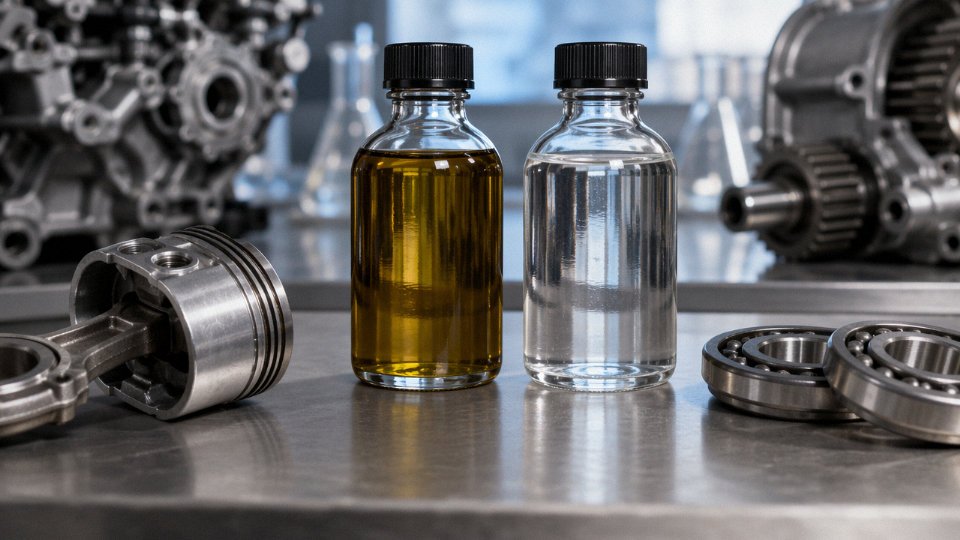
That shear stability gap is one reason silicone fluids are preferred in precision instrument damping, where predictable, grade-stable resistance matters more than any other property.
Thermal Stability, Oxidation Resistance, and High-Temperature Service Limits
Temperature is where the two fluids stop being comparable and start being categorically different. A technician who grabs silicone oil instead of motor oil in a cold-storage application makes a manageable mistake. A technician who grabs motor oil instead of silicone oil for a conveyor oven lubrication job at 200°C is looking at a fire-hazard audit, a fouled chain, and an unplanned shutdown — probably within a few hundred hours.
Continuous Service Temperatures and the Substitution Effect
Standard methyl-substituted PDMS silicone oils hold up continuously from roughly −60°C to +250°C without significant viscosity drift or chemical decomposition. Phenyl-substituted grades extend that upper ceiling to around +300°C and improve low-temperature pour characteristics at the same time — useful in aerospace and high-temperature instrument applications where you need both ends of the range. The tradeoff is cost: phenyl grades run noticeably more expensive and aren’t always stocked by regional distributors.
Conventional mineral-based motor oils are typically rated to about +150°C for continuous service. Full-synthetic PAO-based motor oils push that to roughly +175–180°C before oxidation accelerates to a rate where TAN (total acid number) rise becomes a maintenance problem rather than a background noise figure. That gap — 180°C for the best motor oil versus 250–300°C for silicone — is not a rounding error. It’s the difference between a fluid that’s viable at a bakery oven and one that isn’t.
What Oxidation Actually Looks Like in Each Fluid
Hydrocarbon motor oil oxidizes through a peroxy radical chain reaction. Oxygen attacks the hydrocarbon backbone, generates peroxides, those decompose into aldehydes and carboxylic acids, and the whole thing cascades. The ASTM D2272 rotating bomb oxidation test (RBOT) quantifies induction time before that chain reaction takes off. Once it does, you get viscosity increase, sludge formation, and acidic byproducts that attack elastomeric seals — especially nitrile and EPDM compounds that aren’t formulated for acid exposure.
Silicone oil’s oxidation mechanism is different and, in practice, less operationally catastrophic in most cases. At temperatures above 300°C, oxygen attacks the Si–CH₃ bond. The degradation product is essentially SiO₂ — fine white powder. It’s chemically inert. It won’t corrode a seal or raise the acid number of your fluid. The failure mode, though, is still real: that powder can and does migrate into fine orifices. In pneumatic logic circuits or precision metering valves, SiO₂ particulate accumulation causes stiction, erratic valve response, and eventually stuck spools. If you’re running silicone oil near its thermal ceiling, your filtration and inspection intervals need to reflect that.
Under ASTM D2893 oxidation conditions (120°C, 6 hours), silicone oil shows negligible viscosity change while conventional motor oil shows measurable viscosity increase and early sludge formation.True
ASTM D2893 is a standard oxidation characteristics test for lubricating oils. PDMS silicone fluids are chemically resistant to oxidation at 120°C — well below their degradation threshold — while hydrocarbon oils begin oxidative thickening under those same conditions. This is documented in fluid supplier technical data sheets from Dow Corning (now Dow) and Shin-Etsu.
Flash Point and Fire Risk Near Open Heat Sources
SAE 10W-40 motor oil has a flash point in the range of 210–220°C, depending on the specific formulation and additive package. Silicone oil flash points typically come in above 300°C — some grades won’t flash until 320–340°C. That’s not just a laboratory number. In steel mills, foundries, heat-treatment lines, or anywhere with open-flame equipment or radiant heat sources, OSHA 29 CFR 1910.106 governs the handling and storage of flammable and combustible liquids. Silicone oil’s higher flash point can meaningfully affect compliance classification and the engineering controls required around lubrication points.
The Conveyor Oven Case That Comes Up Constantly
Food processing and industrial baking operations run continuous chain conveyors at temperatures that typically sit in the 175–210°C range, sometimes higher in direct-fire zones. With a conventional petroleum-based chain oil, relubrication intervals in that temperature range land somewhere between 200 and 400 hours — and that’s assuming the oil was correctly matched to the application in the first place. Operators who are under-lubricating, which is more common than anyone admits, see chain wear and elongation long before that.
Silicone oil on the same application extends those intervals to roughly 1,500–2,000 hours, based on OEM field data from conveyor manufacturers who supply food-grade specifications. That’s not marketing language — it reflects the simple fact that silicone oil isn’t thermally degrading between service intervals. The fluid that comes out at hour 1,800 looks chemically similar to what went in. With motor oil at 200°C, you’re pulling out a partially oxidized residue.
The practical calculation matters here. If a lubrication technician spends 45–60 minutes per relubrication cycle on a long conveyor, cutting cycles from roughly every 300 hours to every 1,800 hours recovers real labor hours across a year — easily 15–20 technician-hours per conveyor line, depending on chain length and access.
That said, silicone oil is not the default right answer for every high-temperature application. Gear contacts under heavy load, boundary-lubrication regimes, and applications requiring EP additives are areas where silicone’s weak film strength becomes the limiting factor — regardless of what the temperature chart says.
Lubrication Film Strength, Load-Carrying Capacity, and Anti-Wear Performance in Metal Contacts
Silicone oil has an almost unfair reputation in some corners of the internet as a premium, universal lubricant. It’s not. For metal-on-metal contact under real load, PDMS-based silicone fluids are genuinely poor performers, and putting them into the wrong application doesn’t just cause accelerated wear — it causes fast accelerated wear, sometimes within hours of startup.
Why the Pressure-Viscosity Coefficient Is the Number That Actually Matters
In elastohydrodynamic lubrication — the regime governing rolling element bearings, gear tooth flanks, and cam followers — film thickness depends not just on bulk viscosity but on how much the fluid stiffens under localized Hertzian contact pressure. That stiffening behavior is captured by the pressure-viscosity coefficient, alpha (α).
Conventional motor oil (a Group II or III base stock with a typical additive package) carries an α of roughly 15–22 GPa⁻¹, depending on base stock quality, viscosity grade, and temperature. PDMS silicone oil sits around 5–8 GPa⁻¹. At identical kinematic viscosity, silicone oil builds a meaningfully thinner EHL film under contact stress — thinner by a factor of 1.5 to 2x in many contact geometries. In a 6205-series deep groove ball bearing running at moderate speed and even moderate radial load, that difference can push the film parameter (lambda ratio) below 1.0, which is the boundary where asperity contact becomes unavoidable and wear begins accumulating every revolution.
Four-Ball Test Numbers Tell a Blunt Story
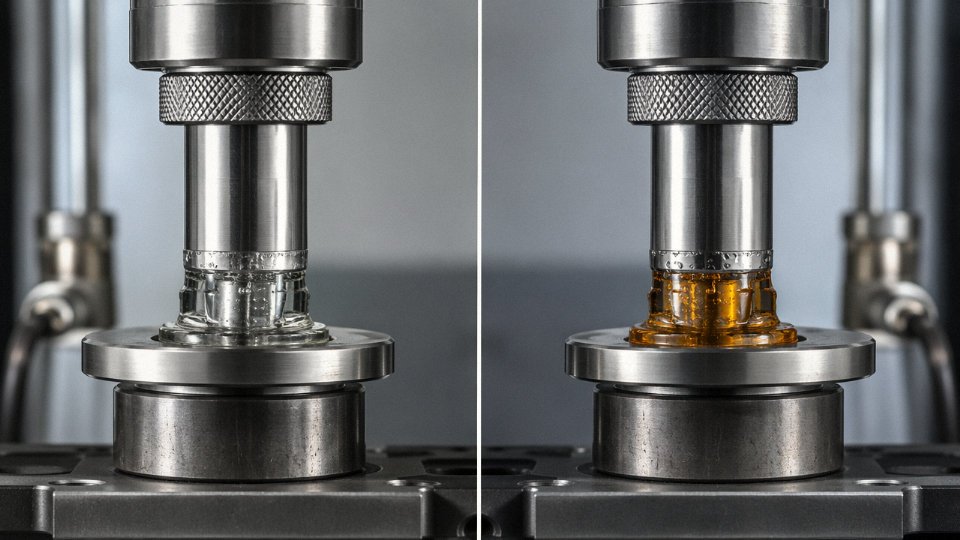
ASTM D4172 four-ball wear testing gives you a concrete, comparable wear scar diameter after a standardized run. A fully formulated SAE 10W-40 motor oil containing ZDDP (zinc dialkyldithiophosphate) typically produces wear scars in the 0.35–0.45 mm range. The same test on a 100 cSt PDMS silicone oil? Usually 0.70–0.90 mm — roughly twice the wear scar area.
Silicone oil produces approximately twice the wear scar diameter of motor oil in ASTM D4172 four-ball testing under equivalent conditions.True
PDMS fluids have a low pressure-viscosity coefficient and no native anti-wear additive chemistry (no ZDDP equivalent). Published four-ball data from fluid suppliers and independent tribology literature consistently show wear scar diameters of 0.70–0.90 mm for unfunctionalized PDMS versus 0.35–0.45 mm for additivated SAE 10W-40.
That’s not a marginal difference. In boundary lubrication — the regime you’re in during startup, low speed, or overload — the additive chemistry in motor oil is doing real work that silicone oil simply cannot replicate.
Extreme Pressure Performance: No Contest
ASTM D2783 load-stage testing further illustrates the gap. Motor oil with sulfur-phosphorus EP additives routinely passes load stage 10 or above. Unfunctionalized silicone oil typically fails at load stage 4–5. Unless a silicone fluid has been specifically compounded with EP additives (some specialty products exist, but they’re niche and expensive), it offers essentially no extreme pressure protection.
Hypoid gears, heavy rolling mill bearings, industrial gearboxes carrying real torque — silicone oil has no business in any of these. The same goes for engine crankshafts, heavily loaded journal bearings in hydraulic motors, and anything involving shock loading.
Where Silicone Oil Actually Wins on Load
The picture isn’t entirely grim; it just requires honest application mapping. Silicone oil is genuinely appropriate for lightly loaded plain bearings where PV (pressure × velocity) stays below roughly 0.05 MPa·m/s, plastic-on-metal sliding contacts, cam followers in office equipment and medical devices, and small electric motor bearings that run at low load with infrequent starts. Food-grade and cleanroom applications often accept the wear trade-off because contamination constraints rule out conventional additive packages entirely.
| Contact Type | Preferred Fluid | Reason |
|---|---|---|
| Rolling element bearings, moderate-heavy load | Motor oil / synthetic gear oil | Higher α, ZDDP anti-wear |
| Hypoid / spiral bevel gears | EP gear oil | Silicone fails ASTM D2783 |
| Lightly loaded plastic-on-metal slides | Silicone oil | Compatible, low adhesion |
| Small electric motor bearings, low load | Either; silicone acceptable | Load regime tolerates thin film |
| Engine crankshaft / rod bearings | Motor oil only | Boundary regime on every start |
One Compatibility Warning Worth Flagging
Motor oil has roughly a century of additive development behind it, and that chemistry protects steel, cast iron, aluminum, and copper alloys simultaneously without much drama. Silicone oil, by contrast, is chemically inert in most respects — but if water contamination enters a brass fitting or component in the presence of certain silicone formulations, dezincification risk rises. In practice this usually means avoiding silicone lubricants in brass valve bodies or fittings in humid environments unless the fluid has been explicitly tested for that contact pair. It’s not a universal problem, but it’s the kind of thing that causes a puzzling failure six months into service that nobody connects to the lubricant until the second time it happens.
Material Compatibility — Seals, Plastics, Coatings, and Electronic Components
This is where wrong fluid choices stop being a theoretical problem and start costing you seals, boards, and paint lines. Viscosity comparisons are interesting; a swollen NBR shaft seal leaking onto a hot exhaust manifold is an emergency.
Elastomer Compatibility — the NBR/EPDM Divide Matters More Than Most People Realize
Silicone oil (PDMS-based) is chemically inert toward EPDM, PTFE, fluorosilicone, and silicone rubber itself. Those four materials cover a large share of modern chemical-process and food-handling seals. The problem is NBR — nitrile butadiene rubber — which is the dominant seal material in virtually every automotive, hydraulic, and general industrial application built in the last fifty years. Silicone oil will swell NBR. Not slowly and subtly; in prolonged contact you can see volume increases in the range of 25–40%, depending on the specific NBR compound, the silicone fluid grade, and operating temperature. A swollen shaft seal may seize on the shaft or lose its lip geometry entirely. Either way, it fails.
Motor oil is essentially the opposite: it was developed alongside NBR, and the two are deliberately compatible. Neoprene (polychloroprene) also handles motor oil fine. EPDM, however, does not — motor oil degrades EPDM, which is why you should not see EPDM seals in standard gearboxes or crankcase applications. This is not a subtle long-term effect; an EPDM O-ring sitting in SAE 30 motor oil at 90°C will show measurable degradation within days.
Silicone oil causes significant swelling in NBR (nitrile) seals, while motor oil is compatible with NBR.True
PDMS-based silicone fluids are non-polar, low-surface-tension fluids that penetrate and swell non-polar elastomers like NBR; conventional motor oil base stocks were specifically formulated alongside NBR in automotive applications and maintain dimensional stability in nitrile compounds under normal service conditions.
| Seal Material | Silicone Oil (PDMS) | Conventional Motor Oil |
|---|---|---|
| NBR (Nitrile) | Not compatible — swells 25–40% | Compatible — standard automotive use |
| EPDM | Compatible | Not compatible — degrades |
| Neoprene | Marginal — check specific grade | Compatible |
| PTFE | Compatible | Compatible |
| Fluorosilicone | Compatible | Compatible |
| Natural Rubber | Not compatible — swells | Marginal — degrades over time |
| Silicone Rubber | Compatible | Not recommended |
Plastics and Polymer Housings
Silicone oil is generally safe on engineering plastics — ABS, polycarbonate, acrylic (PMMA), nylon 6/6, and POM (Delrin) tolerate it well under normal service conditions. Motor oil is less forgiving, particularly grades with higher aromatic content. Polycarbonate is notoriously vulnerable: stress-cracking can appear within weeks of contact, especially if the part carries any mechanical load. Acrylic crazes. In practice, this matters most in instrumentation enclosures, sight glasses, and any assembly where a technician might spray or wipe a lubricant near a clear polymer window without thinking twice.
Paint and Coating Contamination — the Automotive Assembly Problem
Even trace PDMS contamination — parts per million in spray booth air — prevents paint adhesion on automotive body panels. Once silicone oil gets into a paint line, decontamination is a full shutdown event: stripping booth surfaces, replacing filters, purging tooling. Some plants prohibit silicone-based products entirely on the assembly floor and use barrier protocols at receiving to prevent accidental introduction. If you work near a paint or powder-coat operation, this is a hard constraint, not a preference.
Motor oil is not benign here either — oil mist on a surface before powder coating causes fisheyes and adhesion loss — but it is generally easier to degrease than silicone, which bonds tenaciously to almost everything.
Electronic Components and Dielectric Properties
Silicone oil’s electrical behavior is actually useful: it meets IEC 60836 requirements as a dielectric fluid and sees real application in transformer cooling and high-voltage component potting. It does not conduct, and it does not attack most PCB substrate materials.
Motor oil contains polar additives, antiwear packages, and combustion-derived contaminants that make it conductive enough to short PCB traces if it migrates onto a board. If you have ever seen a control cabinet with an oil mist leak from a nearby hydraulic fitting — that brownish film on the terminal strips — you have seen the failure mode. Keep motor oil away from electronics. Full stop.
Bearing Cage Materials
PEEK and glass-filled nylon cages handle silicone oil without issue across most service temperatures. Polyamide (PA6, PA66) cages are generally fine with fresh motor oil but can degrade over time if the oil oxidizes heavily and the acid number climbs. This is rarely a primary failure mode, but when switching from a conventional motor oil to a silicone fluid in a bearing application, it is worth confirming cage material with the bearing manufacturer — especially in smaller, lightly constructed bearings where the cage is a structural element.
Food-Grade and Regulatory Status
Dow Corning 200 fluid and similar PDMS grades carry NSF H1 and FDA 21 CFR 178.3570 status for incidental food contact. That approval is real and has value in food, beverage, and pharmaceutical manufacturing where lubricant incidental contact with product is unavoidable. Motor oil — regardless of what additives the formulator uses, regardless of how clean the base stock is — is not food-grade and cannot be made food-grade within the H1 framework. This is a binary distinction. There is no motor oil with “low enough” additive content to qualify; the classification simply does not exist. Substituting motor oil for an approved silicone fluid in an H1-required application is a regulatory violation, not just a technical mismatch.
Application-by-Application Decision Matrix: Where Each Fluid Belongs and Where It Must Never Go
The prior sections established why silicone oil and motor oil behave differently. This section answers the more pressing shop-floor question: given a specific piece of equipment, which fluid goes in — and which one causes a warranty void, a food safety rejection, or a gearbox seizure?

Automotive Engines and Drivetrains
Motor oil. Full stop. No substitution is defensible here.
Engine oils carry a ZDDP anti-wear package, a detergent-dispersant system, and a carefully balanced additive chemistry that took decades to develop for metal-on-metal hydrodynamic and boundary lubrication regimes. A crankshaft bearing film under load depends on that full additive stack. Silicone oil has no anti-wear additives and forms no chemically reactive protective layer on steel — run it in a gasoline engine and you’ll likely see measurable bearing wear within two to four hours at operating load, depending on clearances and rpm. The catalytic converter issue matters too: PDMS combustion byproducts coat catalyst washcoat surfaces and are notoriously difficult to regenerate. This is not a theoretical concern; it’s a documented failure mode in automotive test cells.
Food and Beverage Processing Equipment
Here silicone oil is the practical default for most incidental-contact points — oven conveyor chains, mixer shaft seals, packaging machine cams and slides, filling nozzle mechanisms. The operative constraint is NSF H1 registration, which permits certain PDMS fluids under FDA 21 CFR 178.3570. Conventional motor oil is disqualified outright by that same regulation; its detergent and dispersant additives have no pathway to incidental food contact approval. In practice, look for H1-certified silicone oils from suppliers who maintain current NSF registration documentation — the registration lapses more often than procurement teams realize, so verify the database rather than trusting a TDS date.
Medical Devices and Laboratory Instruments
USP-grade PDMS is the material of choice for syringe plungers, peristaltic pump tubing lubrication, and centrifuge seal interfaces. The toxicity profile of motor oil additives — particularly ZDDP and certain VI improvers — disqualifies conventional engine oil immediately in any application where extractables or leachables matter. Regulatory audit trails in ISO 13485 environments require documented biocompatibility; silicone oil has a well-established precedent, motor oil does not.
High-Voltage Electrical Equipment
Silicone oil performs as both a dielectric coolant and an arc-quenching medium in transformers and switchgear per IEC 60836. Its fire point typically runs above 300°C depending on grade — a meaningful safety margin in urban substations or indoor installations where a mineral oil fire is a code compliance and liability catastrophe. Motor oil’s lower flash point and inconsistent dielectric breakdown voltage (which varies significantly with additive loading and moisture absorption) make it unsuitable. Don’t mix grades either; even two silicone transformer fluids from different formulations can shift dielectric properties unpredictably.
Silicone oil used in IEC 60836-compliant electrical equipment provides superior fire safety compared to conventional mineral transformer oil in indoor high-voltage installations.True
Silicone fluids have fire points generally exceeding 300°C versus roughly 160–180°C for standard mineral transformer oil, making them a recognized lower-fire-risk alternative documented in IEC 60836 and insurance underwriting guidelines for indoor substations.
Pneumatic Tools and Cylinders
Silicone oil is compatible with aluminum valve bodies and most Viton seal compounds. The critical failure mode with conventional motor oil in pneumatic actuators is EPDM seal swell — EPDM is extremely common in pneumatic system seals precisely because it handles moisture and temperature variation, but it swells significantly in petroleum oil. The efficiency consequences are real: ISO 6358 air consumption testing on affected actuators routinely shows something in the range of 12–18% increased air consumption as spool geometry changes from swollen seals. Over a year of production in a compressed-air-heavy plant, that number shows up on the utility bill.
Plastic Gear Mechanisms
Printers, copier drives, automotive HVAC actuators, and similar light-load plastic gear trains benefit strongly from silicone grease or low-viscosity silicone oil. Petroleum-based oils attack polycarbonate housings through stress cracking and swell POM gear teeth measurably over months of contact. Field MTBF comparisons from service depot analysis typically show three to five times longer gear life with silicone, depending on temperature cycling and load. The mechanism isn’t subtle — petroleum aromatics dissolve or swell engineering polymers while PDMS is essentially inert to them.
Heavy Industrial Gearboxes and Rolling Mill Bearings
This is where silicone oil has no place. Under high Hertzian contact stress — helical gear flanks, tapered roller bearings carrying radial loads in the tens of kilonewtons — silicone oil’s low EP (extreme pressure) performance and weak film-forming under boundary lubrication conditions make it genuinely dangerous rather than merely suboptimal. Purpose-formulated gear oils with sulfur-phosphorus EP additives, or synthetic PAO/ester blends with EP treatment, are the correct selection. Using silicone oil in a heavy gearbox because it’s “high-temperature capable” is a category error; thermal stability doesn’t compensate for inadequate film strength under load.
| Equipment Type | Correct Fluid | Disqualified Fluid | Primary Reason |
|---|---|---|---|
| Automotive engine / drivetrain | Motor oil (API-rated) | Silicone oil | No anti-wear additive; PDMS combustion fouls catalyst |
| Food processing (incidental contact) | NSF H1 silicone oil | Motor oil | FDA 21 CFR 178.3570 additive disqualification |
| Medical devices / lab instruments | USP-grade PDMS | Motor oil | Additive toxicity / biocompatibility failure |
| HV transformer / switchgear | IEC 60836 silicone fluid | Motor oil | Flash point and dielectric reliability |
| Pneumatic actuators (EPDM seals) | Silicone oil | Petroleum-based oil | EPDM seal swell, efficiency loss |
| Plastic gear mechanisms | Silicone grease / oil | Motor oil | Polymer attack (PC, POM) |
| Heavy gearboxes / rolling bearings | EP gear oil / PAO | Silicone oil | Inadequate film strength under Hertzian stress |
The consistent pattern: silicone oil wins on chemical inertness, temperature range, and regulatory compliance; motor oil wins wherever you need an additive-active, film-building lubricant under real mechanical load. Mixing them up in either direction creates either a safety problem or a premature failure — the direction just depends on which application you’re standing in front of.
Cost, Availability, Disposal, and Total Cost of Ownership Over Equipment Life
Unit price is the number that gets quoted in every procurement meeting, and silicone oil loses that comparison badly on the surface. Industrial-grade 100 cSt PDMS silicone oil runs roughly $8–$18 per liter in drum quantities as of 2024, depending on supplier, order volume, and whether you’re buying a standard Shin-Etsu KF-96 or a Dow Corning 200 Fluid equivalent versus a specialty modified grade. SAE 10W-40 conventional motor oil sits around $2–$4 per liter in bulk. Even a premium full-synthetic PAO-based motor oil — the kind you’d specify for a high-end gearbox or a servo actuator running at elevated ambient — typically lands at $6–$12 per liter. So silicone oil is 2–4× more expensive per liter, sometimes more for high-viscosity or phenyl-modified grades. That number, taken alone, will kill the specification at budget review every time.
The problem with stopping at unit price is that it ignores everything that actually drives fluid cost over an equipment lifespan.
Drain Intervals Change the Math Completely
In a conveyor oven application — the kind used in coating or food processing lines where chain lubricant sees sustained temperatures around 200–250°C — motor oil carbonizes and loses viscosity within 8–12 weeks under load. You’re doing quarterly changes at minimum, sometimes more often if the oven runs long shifts. A properly selected PDMS silicone fluid in the same application can realistically run 18–24 months before a drain is justified, assuming no contamination ingress. Over a five-year equipment life, that’s roughly 20 motor oil changes versus 2–3 silicone oil changes. When you price out fluid volume, labor time, shutdown windows, and waste disposal fees, the silicone option frequently comes out cheaper in net fluid cost — not dramatically, but measurably. The crossover point depends heavily on labor rates at your plant and how strictly you enforce drain intervals with motor oil.
Silicone oil's higher unit cost is always offset by longer drain intervalsFalse
The TCO advantage holds in high-temperature or low-contamination applications with long change intervals. In moderate-temperature, heavily loaded, or frequently contaminated systems, motor oil changed on schedule often wins on total cost. The math must be done application by application.
Contamination Risk Is a Hidden Line Item
This one tends to get left off the TCO spreadsheet until after the incident. In automotive paint shops and food packaging lines, a silicone oil spill or seal weep that migrates into a product stream can trigger line shutdowns, coating adhesion failures, and rework campaigns that run from $50,000 into the low hundreds of thousands of dollars depending on how far contaminated product traveled before detection. That’s not a hypothetical — it’s why some paint facilities ban silicone-containing products entirely from certain zones. If you’re specifying silicone oil anywhere near a surface-finish or adhesion-sensitive process, the contamination exposure cost has to sit inside your TCO model, not in a separate risk register nobody reads.
Disposal and Environmental Compliance
Used motor oil is a regulated waste stream in most jurisdictions — heavy metals from the zinc dialkyldithiophosphate (ZDDP) additive package accumulate in used fluid along with wear debris, requiring a licensed waste oil collector. That’s a recurring line item. PDMS silicone oil is biologically inert and generally classified as non-hazardous when uncontaminated, which simplifies disposal paperwork. The catch is biodegradability: PDMS scores below 10% in OECD 301B testing over 28 days. It won’t acutely harm a drain field, but it persists. Some European facilities are already fielding questions from environmental auditors about silicone discharge, and that regulatory picture may tighten.
Supply Chain Reality for MRO Planners
Motor oil is everywhere. Any industrial distributor, any auto parts counter, often same-day availability. Specialty silicone grades — anything above roughly 10,000 cSt, fluorosilicone variants, or phenyl-modified fluids for radiation resistance — typically come from chemical specialty distributors with 2–6 week lead times, sometimes longer if a grade is imported. For an MRO planner managing a critical conveyor or a temperature-controlled process bearing, that lead time is a real operational risk. Stocking a reserve quantity isn’t optional for those applications; it needs to be policy.
Labor and Food-Safety Window Savings
In food manufacturing, every re-lubrication event that requires a line stop is a food-safety shutdown window — sanitation, verification, documentation. Fewer lubrication intervals with silicone oil directly reduce those windows and the associated labor hours, which in high-throughput facilities can translate to meaningful recovered production time annually. That recovered time rarely shows up in a fluid price comparison, but plant controllers who’ve modeled it tend to remember the number.
Frequently Asked Questions About Silicone Oil vs Motor Oil
Can silicone oil replace motor oil in a car engine?
No. Full stop. PDMS silicone oil contains no anti-wear additives, no detergents, no dispersants, and no extreme-pressure chemistry. A crankshaft bearing running at 5,000 RPM under firing loads needs a hydrodynamic film reinforced by a robust additive package — silicone oil cannot build or maintain that under realistic engine conditions. In practice, you’d see bearing failure within minutes, not hours. The oil pressure warning light would be the last thing you read before scoring the journals.
Silicone oil can substitute for motor oil in a car engine in an emergency.False
PDMS silicone oil lacks the anti-wear additives, detergents, and extreme-pressure performance that engine bearings and valve train components require. Using it as an engine lubricant would cause catastrophic bearing failure within minutes under normal operating loads and temperatures.
Is silicone oil safe to use on rubber seals?
Depends entirely on what the seal is made of. Silicone oil is compatible with EPDM, PTFE, and fluorosilicone elastomers — in those applications it’s actually a reasonable choice. The problem is nitrile rubber (NBR), which is the default seal material in the overwhelming majority of automotive hydraulic, fuel system, and general industrial equipment. PDMS causes NBR to swell, soften, and lose dimensional integrity. A hydraulic cylinder seal that swells by even 8–12% can jam in its groove or extrude past a retaining edge. Always verify the seal compound before applying silicone oil anywhere near a dynamic sealing surface.
Why does silicone oil ruin car paint and spray booth equipment?
PDMS molecules migrate through the air and deposit on any surface they contact, forming a near-invisible molecular barrier. That barrier prevents adhesion between the substrate and primer or topcoat — the result is the fisheye crater defect that body shop technicians dread. What makes this genuinely dangerous from a manufacturing standpoint is the threshold: contamination as low as 1–5 ppm in spray booth atmosphere is enough to trigger defects across an entire production run. PDMS is also stubbornly difficult to remove. Standard solvent wipes often just redistribute it rather than eliminate it, and conventional detergents don’t break the silicone film reliably. Automotive OEM plants typically ban silicone-containing products from any area within proximity of paint operations, sometimes facility-wide.
What viscosity of silicone oil is equivalent to SAE 10W-30 motor oil?
SAE 10W-30 runs roughly 65–75 cSt at 40°C, depending on the base stock and additive package. A 50–100 cSt PDMS fluid sits in a numerically similar range at that temperature. That’s where the similarity ends. Viscosity index, pressure-viscosity coefficient, and film-forming behavior diverge significantly once you move away from ambient conditions or apply real contact stress. The number alone does not make them interchangeable for any mechanical application.
Can you mix silicone oil and motor oil?
They’re largely immiscible — at room temperature they’ll separate into layers like water and cooking oil. If you shake them together you get a temporary emulsion, but it separates quickly and behaves unpredictably in between. Beyond the phase separation, mixing deactivates oil additives and creates a fluid with undefined elastomer compatibility. There’s no legitimate reason to mix them intentionally, and accidental cross-contamination of a system should be treated as a flush-and-refill event, not something you run through.
Is silicone oil better than motor oil for electric motors?
For small, lightly loaded brushless DC motors with polymer housings and EPDM-compatible seals — bearing preloads in the single-digit Newton-meter range — silicone oil is often a sensible choice, particularly where temperature swings are wide or chemical resistance matters. For large industrial motors carrying significant radial or axial loads with steel and cast-iron construction, a properly specified PAO or mineral-base lubricant is the right answer. Silicone oil’s weak film strength under high contact stress is the limiting factor; it’s not a universal upgrade just because it handles temperature well.
How do you identify whether an unknown fluid is silicone oil or motor oil?
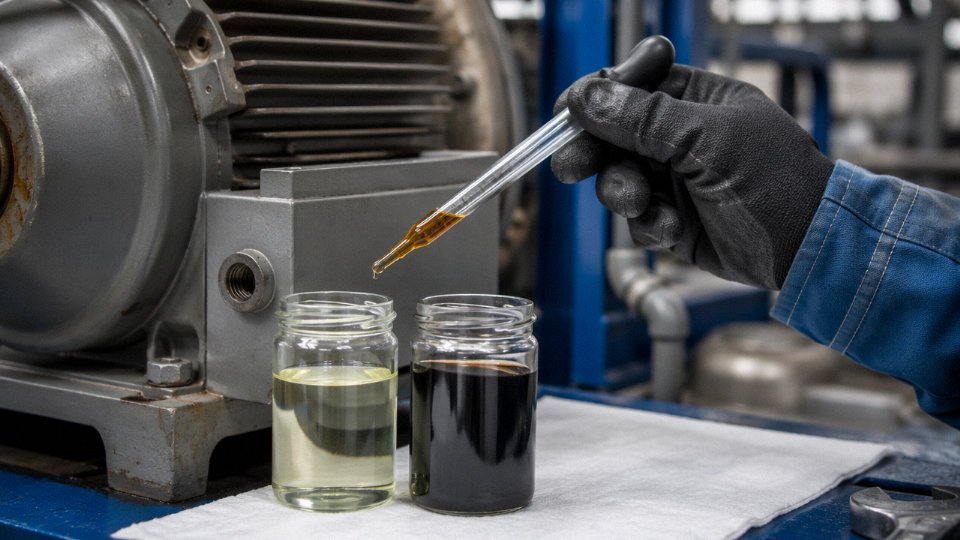
FT-IR spectroscopy is definitive in a lab setting — PDMS shows characteristic Si–O–Si absorption bands at roughly 1000–1100 cm⁻¹, which are absent in hydrocarbon oils. On the plant floor without instrumentation, a reasonable field test: apply a small amount to clean glass and let it spread. Silicone oil leaves a clear, extremely thin, nearly invisible film that resists wiping and feels slightly slick without obvious color. Motor oil leaves a yellow-to-brown residue with a detectable hydrocarbon odor as the lighter volatiles off-gas. It’s not a perfect method, but in a contamination investigation it’s usually enough to distinguish the two before you send a sample to the lab.