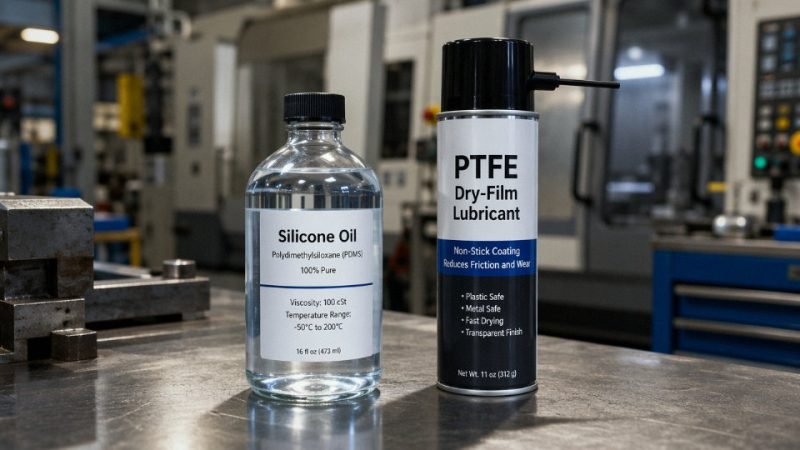
Pick the wrong lubricant for a seal, a sliding rail, or a food-contact surface and you won’t know immediately — you’ll find out three weeks later when the downtime report lands on your desk. Silicone oil and PTFE-based lubricants both occupy the “specialty, high-performance” shelf at the distributor, both get specified for plastics and elastomers, and both show up in the same maintenance cabinet on half the plants I’ve walked. That overlap breeds complacency. The wrong call drives premature wear, seal swell, contamination flags in regulated environments, or a seized actuator at the worst possible shift.
Silicone oil is a liquid lubricant spanning viscosities from 0.65 cSt to roughly 2,500,000 cSt, suited for temperatures from about -60°C to +200°C, offering excellent material compatibility and shear stability. PTFE dry-film lubricants deliver friction coefficients of 0.04–0.10 — among the lowest of any solid lubricant — and handle continuous service from -200°C up to +260°C. Choosing between them depends on load type, application geometry, regulatory requirements, and whether you need a wet film or a dry, non-migrating surface.
What makes this comparison genuinely tricky is that the two products don’t really compete head-to-head in most applications — they solve different problems, and the cases where they overlap are exactly where engineers tend to make expensive mistakes.
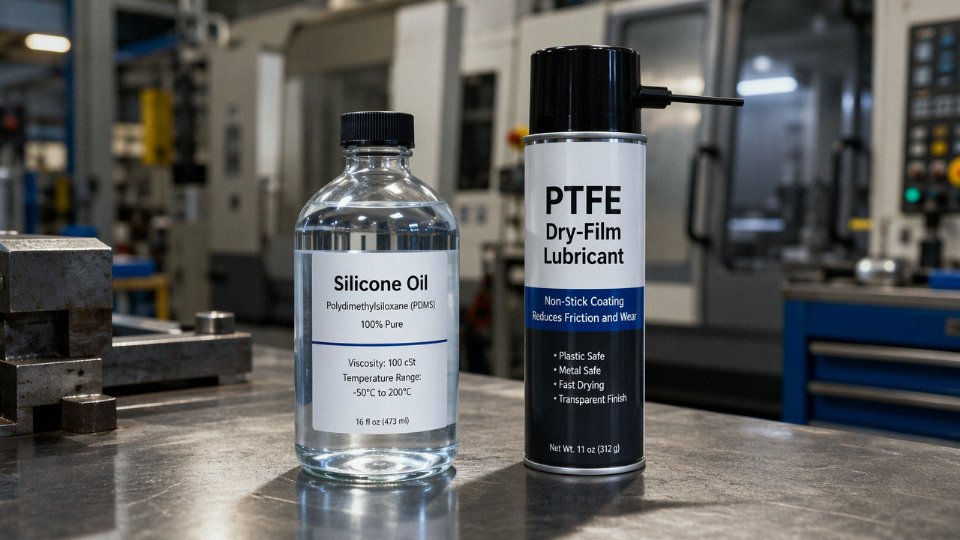
Molecular Architecture: How Silicone Oil and PTFE Are Physically Different Lubricants
These two lubricants get lumped together in casual conversation — “clean, non-reactive, good for plastics” — but their underlying structures produce fundamentally different behavior under load, temperature swings, and chemical exposure. Understanding the chemistry means you can reason from first principles when you encounter an application nobody has written a spec sheet for yet.
The Polydimethylsiloxane Backbone
Silicone oil is polydimethylsiloxane, PDMS, built on a repeating Si–O–Si backbone with two methyl groups hanging off each silicon atom. That inorganic siloxane backbone is what sets it apart from petroleum or synthetic hydrocarbon oils. The Si–O bond is longer and more flexible than a C–C bond, which is why silicone oil stays fluid across a wide temperature range — roughly -60°C to +200°C continuous, depending on grade and oxidative environment — without the viscosity collapse you see in mineral oils approaching their upper limits.
Surface tension sits around 20–21 mN/m. That low surface tension is why silicone oil spreads aggressively and why it’s so difficult to keep confined to exactly where you applied it; in a precision assembly environment, migration onto electrical contacts or optical surfaces is a real contamination risk. Vapor pressure at standard conditions is negligible, which matters in vacuum systems or sealed enclosures where outgassing would cause problems. The methyl groups also explain why silicone oil is hydrophobic and largely inert to aqueous environments, though it is not impervious to everything — concentrated acids and some solvents will degrade it.
Viscosity range is genuinely enormous: 0.65 cSt on the thin end (instrument-grade, used in sensitive gyroscope or meter mechanisms) up to 100,000 cSt and beyond for damping fluid in rotary dashpots or hydraulic snubbers, with specialty grades reaching 2,500,000 cSt. The right grade depends on operating speed, clearance geometry, and whether you need the film to carry load or simply reduce stick-slip.
The Fully Fluorinated Carbon Chain
PTFE — polytetrafluoroethylene, the (CF₂–CF₂)n repeat unit — replaces every hydrogen on a polyethylene backbone with fluorine. Fluorine’s electronegativity and the tight electron sheath it wraps around the carbon chain creates the lowest surface energy of any bulk polymer, around 18 mN/m. Nothing wants to stick to it, including most solvents, aggressive acids, and oxidizers. Continuous service temperature runs from -200°C up to roughly +260°C, which covers cryogenic valve seats and moderate-temperature oven conveyors on the same datasheet.
The lubrication mechanism is structurally different from silicone oil. PTFE is a solid — even in carrier formats, the lubricating agent itself is a particulate or film solid. Its crystalline structure consists of layers that shear against each other relatively easily, a lamellar slip mechanism that produces friction coefficients of 0.04–0.10 in practice. Those numbers depend heavily on load, surface finish, and whether a proper transfer film has had time to deposit and condition the mating surface. That transfer film is the key: PTFE doesn’t just reduce friction at the moment of application, it leaves a sacrificial layer bonded to the substrate that continues to work even after the carrier (solvent, water, aerosol propellant) has evaporated.
Film Type and What It Means at the Interface
Silicone oil forms a hydrodynamic or elastohydrodynamic liquid film — it physically separates surfaces by pressure built up in the lubricant wedge as surfaces move relative to each other. This only works reliably when speed and load are sufficient to maintain that film thickness. Drop below the critical entrainment velocity and you’re in boundary conditions where the oil film breaks down and you’re relying on surface chemistry alone.
PTFE operates in the boundary regime by design. There is no liquid wedge. The transfer film, typically 10–100 nm thick in practice, is doing the work. That means PTFE dry-film lubricants are appropriate for slow-moving, high-load, or intermittent-contact applications where a hydrodynamic film would never establish itself — threaded fasteners, sliding drawer mechanisms, cam followers that dwell.
PTFE dry-film lubricants achieve lower friction coefficients than silicone oil under boundary lubrication conditionsTrue
PTFE's lamellar shear mechanism and transfer film produce friction coefficients of 0.04–0.10 in boundary contact, while silicone oil in boundary conditions (film breakdown) loses its hydrodynamic advantage and performs comparably to other liquid lubricants without a solid additive.
Blended Products: Not a Best-of-Both Guarantee
PTFE-in-silicone oil suspensions exist — typically 5–30% PTFE particles dispersed in a silicone carrier at viscosities anywhere from 50 to 5,000 cSt, depending on manufacturer formulation. The appeal is obvious: liquid spreadability combined with solid-film boundary protection. In practice, though, these blends require attention to particle settling during storage (always shake or agitate before application), and the PTFE loading affects viscosity in ways that differ from a neat silicone oil of nominally the same grade. If you’re qualifying a blend for a precision application, treat it as its own product category rather than assuming it behaves like either constituent. I’ve seen engineers swap in a blended product assuming it would perform identically to the neat silicone oil it replaced, only to find damping characteristics had shifted enough to cause intermittent actuation failures in a spring-return valve assembly.
Friction and Wear Performance: Static Coefficients, Load Capacity, and Surface Transfer Behavior
Picking a lubricant on viscosity alone is a common mistake. The number that actually governs whether a joint survives its design life — or scores itself into scrap within a shift — is the friction coefficient under the specific contact geometry, load, and velocity your application sees. Both silicone oil and PTFE-based lubricants reach impressively low friction, but they get there through entirely different mechanisms, and their failure modes are nothing alike.
Friction Coefficient Benchmarks
Dry PTFE film lubricants consistently achieve static and kinetic coefficients of friction in the 0.04–0.10 range on hard substrates — steel, anodized aluminum, hardened tool steel. That figure holds reasonably well across a wide speed range under light-to-moderate loads, which is why PTFE became the default in precision slides, valve stems, and food-contact mechanisms where oil contamination is unacceptable. The low end of that range (near 0.04) typically requires a well-burnished, uniform transfer film on a smooth counterface; rough surfaces or thin, inconsistent coatings push you toward 0.08–0.10.
Silicone oil in boundary lubrication regimes — which is the regime that matters for start-stop motion, slow oscillation, or any joint running below the speed threshold for full hydrodynamic film — typically yields kinetic CoF somewhere between 0.10 and 0.20, depending heavily on viscosity grade, surface finish, and whether any anti-wear additives are present. Without EP (extreme-pressure) additive packages, silicone performs closer to the upper end of that band under metal-on-metal contact. That’s not terrible, but it’s meaningfully higher than PTFE, and over millions of cycles it matters.
Load Capacity and the PV Limit Problem with PTFE
PTFE’s Achilles heel is cold flow. Under contact pressures above roughly 7 MPa, the transfer film begins to extrude laterally out of the contact zone rather than replenishing it. The result isn’t dramatic seizure — it’s gradual film starvation, rising friction, and accelerated wear of both the PTFE coating and the counterface. This threshold shifts depending on temperature (lower temperatures make PTFE stiffer and slightly more resistant; elevated temperatures accelerate creep significantly), surface area, and whether the load is static or dynamic.
In practice, PTFE-based lubricants are the right answer for low-to-moderate PV applications: instrument mechanisms, pneumatic seals, lightly loaded linear guides, door hinges in controlled environments. Trying to use a dry PTFE film in a press-fit bushing seeing 15–20 MPa contact stress is a maintenance callback waiting to happen. I’ve seen exactly this mistake on a conveyor pivot assembly — the coating looked fine at installation, but three months of cyclic loading had extruded the film entirely, and the steel-on-steel contact had galled.
Silicone oil carries load through a fluid film rather than a deposited solid, so the cold-flow limitation doesn’t apply the same way. But silicone lacks the viscosity-pressure response that mineral oils rely on to thicken under heavy contact — its pressure-viscosity coefficient is substantially lower. Under heavy shock loads without EP additives, the film can collapse almost instantly, leaving metal-on-metal contact. This makes silicone oil poorly suited to gear teeth, camshafts, or any application with high Hertzian contact stress unless you’re using a formulated product specifically engineered for it.
PTFE dry-film lubricants achieve lower friction coefficients than silicone oil under light-to-moderate loads on hard substratesTrue
Pin-on-disk tribometry and published ASTM G99 data consistently show PTFE transfer films reaching 0.04–0.10 CoF, while silicone oil in equivalent boundary-lubrication conditions typically measures 0.10–0.20 CoF without EP additive packages.
Wear Rates: What Pin-on-Disk Data Actually Tells You
Wear rate is where the performance gap becomes stark. PTFE-coated steel surfaces on hardened steel counterfaces show wear rates as low as around 10⁻⁷ mm³/N·m in standardized pin-on-disk testing under light loads. Silicone-lubricated steel-on-steel under equivalent boundary lubrication conditions can run an order of magnitude higher — roughly 10⁻⁶ mm³/N·m — without EP additives. That gap closes somewhat with higher-viscosity grades or additive-fortified silicone formulations, but it rarely closes entirely.
What those numbers mean operationally: a PTFE-coated bushing running a lightly loaded pivot might outlast a silicone-lubricated equivalent three to five times over between maintenance intervals. The qualification caveat is that wear rates from pin-on-disk tests don’t translate directly to real components — surface finish, counterface hardness, lubricant replenishment interval, and contamination all shift the real-world numbers considerably.
| Parameter | Silicone Oil (boundary regime) | PTFE Dry Film |
|---|---|---|
| Kinetic CoF range | 0.10–0.20 | 0.04–0.10 |
| Max contact pressure (practical) | Depends on viscosity and EP additives; typically limited by film collapse above ~10–15 MPa without additives | ~5–7 MPa before cold-flow becomes significant |
| Wear rate order of magnitude | ~10⁻⁶ mm³/N·m (unadditized) | ~10⁻⁷ mm³/N·m |
| Best suited load type | Moderate dynamic, fluid-film regimes | Light-to-moderate static and dynamic |
The decision isn’t simply “which has lower friction” — it’s which failure mode you can tolerate and which PV envelope your application actually lives in.
Temperature and Environmental Resistance: Operating Limits Across Extreme Conditions
Thermal range is where the two lubricants diverge most sharply, and getting this wrong costs more than a seized bearing — it can mean a contaminated product line, a toxic-gas incident, or a seal replacement campaign you could have avoided at the design stage.
Silicone Oil: Where It Holds and Where It Starts to Struggle
Silicone oil maintains usable viscosity across roughly -60°C to +200°C in continuous service. The actual low-end pour point depends on grade — a 50 cSt dimethyl silicone will flow freely well below -50°C, while a 100,000 cSt grade will start to drag noticeably below -30°C. High-viscosity grades used in dampers or rotary shaft seals can handle short excursions to around +250°C without catastrophic breakdown, but you’re burning through service life with each cycle above 200°C.
The real issue above 150°C in air is oxidative degradation. Without antioxidant additives — and most off-the-shelf silicone oils don’t carry them — the Si-O backbone begins to chain-scission and form volatile cyclic siloxanes. In a sealed gearbox or enclosed cavity this is manageable. In a convection oven, a heated mold, or any application where the oil film is exposed to circulating air at elevated temperature, you’ll see viscosity drift and deposit formation faster than the datasheet implies. Phenyl-modified silicone grades push thermal stability meaningfully higher and are worth specifying for anything running hot continuously.
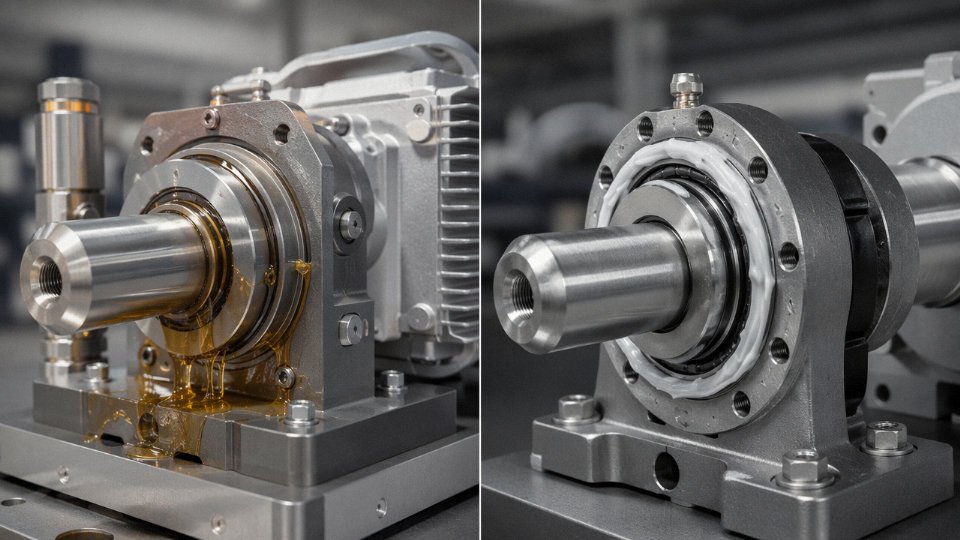
PTFE: Cryogenic Capability and the 260°C Hard Ceiling
PTFE’s thermal envelope is broader on both ends: stable from -200°C down to liquid nitrogen temperatures, and rated for continuous use up to +260°C. That cryogenic performance is genuinely useful in valve packing, cryogenic pump seals, and aerospace actuation systems where silicone oil would simply freeze into a semi-solid and stop functioning as a lubricant.
The upper limit, though, is a hard ceiling, not a soft suggestion. Above 260°C, PTFE begins to decompose and releases perfluoroisobutylene (PFIB) among other perfluorinated decomposition products. PFIB is acutely toxic at low concentrations — far more hazardous than most technicians realize. Any application where a PTFE-coated surface or PTFE-carrier spray might see flame impingement, accidental contact with a heat gun, or proximity to process equipment running above 250°C needs ventilation engineering and worker awareness built in from the start. This isn’t theoretical; overspray onto a nearby hot surface is a realistic scenario in production environments.
PTFE dry-film lubricants are chemically stable for continuous use up to 260°CTrue
Virgin PTFE and PTFE-based coatings remain chemically intact up to approximately 260°C in continuous service; decomposition and toxic off-gassing begin above this threshold and accelerate significantly above 300°C.
UV, Weathering, and Outdoor Exposure
Silicone oil holds up well outdoors. The Si-O backbone is intrinsically resistant to UV radiation and ozone — which is exactly why it’s the go-to lubricant for rubber seals, automotive door gaskets, and outdoor electrical cable connectors. It won’t crack the elastomer the way petroleum products will, and it doesn’t become brittle or gummy after seasons of sun exposure.
PTFE itself is UV-stable. But PTFE-in-carrier sprays are a different story. Many aerosol PTFE products use a petroleum-based or solvent carrier that evaporates after application — if that carrier doesn’t fully flash off, or if it’s reapplied repeatedly in an outdoor setting, the residual carrier can degrade. Read the carrier composition, not just the PTFE content, before specifying for outdoor hardware.
Chemical Resistance: Nearly Opposite Risk Profiles
PTFE’s chemical inertness is close to absolute for practical industrial purposes. Concentrated sulfuric acid, sodium hydroxide, acetone, toluene — essentially none of these affect it. The only exceptions that matter in practice are molten alkali metals and elemental fluorine gas, both of which are niche enough that most engineers will never encounter them.
Silicone oil resists water, dilute acids, and most aqueous cleaning solutions without issue. Where it fails is in concentrated aromatic solvents — toluene, xylene — and in ketones and chlorinated hydrocarbons. If your process involves solvent wash-down, parts cleaning with MEK or trichloroethylene, or any immersion in chlorinated media, silicone oil will swell or be stripped from the surface. In those environments PTFE dry film is the more robust choice, provided the substrate temperature stays within range.
Water Displacement and Corrosion Protection
Silicone oil functions as a water repellent and provides a reasonable corrosion-inhibiting barrier on ferrous surfaces, particularly useful on storage hardware, outdoor fasteners, or any metal component that sees seasonal condensation. PTFE dry films are hydrophobic and shed water well once cured, but they don’t displace standing water or penetrate into rust the way an oil-based product does. For a bolt that’s already wet on a cold morning, silicone oil will protect it; a cured PTFE coating applied to a dry, clean surface the week before will too — but you can’t apply it reactively the way you can with an oil.
Material Compatibility: Plastics, Elastomers, and Coatings That React Badly to Each Lubricant
Getting the friction coefficient right and then destroying a $40 seal or crazing a polycarbonate lens housing is a failure mode that shows up in failure reports more often than it should. Material compatibility is where most field returns actually originate — not from the lubricant performing poorly on the sliding surfaces, but from it quietly attacking something adjacent.
Silicone Oil and Elastomers
Silicone oil is generally benign toward EPDM, neoprene, and nitrile rubber (NBR). In most pneumatic and hydraulic circuits where those elastomers appear as static or dynamic seals, silicone oil causes minimal swell and no meaningful durometer shift over normal service intervals. That said, there’s one failure mode that catches engineers off guard repeatedly: silicone oil will swell silicone rubber seals, sometimes dramatically.
The mechanism is straightforward — like-dissolves-like. The polydimethylsiloxane backbone of silicone oil is chemically close enough to cross-linked silicone elastomer that it acts as a plasticizer, penetrating the network and causing volumetric expansion. Swell of 15–40% is realistic depending on oil viscosity and exposure time, though higher-viscosity grades migrate more slowly and sometimes show less total swell in short-duration testing, which can mask the long-term problem.
In practice, this bites pneumatic actuator assemblies hardest. A designer specifies silicone rubber piston seals for their temperature range and chemical inertness, then someone in maintenance reaches for silicone grease or a low-viscosity silicone oil as a convenient assembly lubricant. Within a few hundred cycles the seal has swollen enough to spike breakout force, and the actuator starts sticking at the end of stroke. It gets misdiagnosed as contamination or a bent rod for weeks.
Silicone oil causes significant swelling in silicone rubber (VMQ) seals due to chemical similarity between the oil's PDMS backbone and the elastomer matrix.True
Both silicone oil and silicone rubber share the polydimethylsiloxane (Si–O backbone) structure. The solubility parameter similarity drives plasticizer-type ingress into the elastomer network, producing measurable volumetric swell — well documented in seal manufacturer compatibility data from Parker, Trelleborg, and others.
Silicone Oil and Plastics
Polycarbonate, nylon (PA6, PA66), and PEEK all tolerate silicone oil without issue in most service conditions. These are safe default pairings for lubricated plastic bushings, gears, and actuator components.
Polystyrene and many acrylic grades are a different story. Silicone oil can initiate stress-crazing in polystyrene, particularly under any residual molding stress — which is almost always present. Thin-walled PS housings in consumer electronics or lab equipment are vulnerable. Acrylic (PMMA) behavior is less predictable and depends heavily on grade and prior annealing; test first, always.
Polypropylene sits in an uncertain middle ground. Most grades tolerate silicone oil reasonably well, but certain filled or impact-modified grades show surface tackiness or micro-cracking after extended exposure. Don’t assume compatibility on PP assemblies without a 72-hour soak test at operating temperature.
PTFE Sprays and Carrier Solvent Risk
Dry PTFE lubricants in aerosol form deliver PTFE particles suspended in a carrier solvent — typically a fast-evaporating hydrocarbon, ester, or halocarbon. The PTFE itself is essentially inert to almost every elastomer and plastic. The carrier solvent is not.
NBR, EPDM, and polyurethane seals can all swell or soften during the window between application and full carrier evaporation. On a slow-draining assembly or a tight cavity where solvent pools, that window can stretch from seconds to several minutes. Spray a PTFE product into a valve body with polyurethane lip seals and walk away — when you come back the seals may have swollen enough to seize the spool.
Always pull the carrier solvent data from the product’s TDS, not just the active ingredient. Some manufacturers will confirm elastomer compatibility for PTFE while leaving carrier compatibility unstated.
PTFE on Painted, Anodized, and Pre-Bond Surfaces
PTFE dry-film spray leaves a visible white particulate residue. On raw metal or internal mechanisms that’s usually irrelevant. On decorative anodized aluminum or painted housings it’s a cosmetic defect that drives rework. More critically, any PTFE residue on surfaces destined for secondary adhesive bonding or powder coating acts as a release agent — bond strength drops significantly and adhesion failures become erratic and hard to trace back to the lubricant application step.
Keep PTFE sprays away from any surface that will be bonded, painted, or coated downstream. In assembly sequences where lubricated sub-assemblies move through a paint line, this requires explicit process control, not just a verbal guideline.
Compatibility Matrix
| Substrate Material | Silicone Oil | PTFE Dry Film (Cured) | PTFE Spray (During Application) |
|---|---|---|---|
| Silicone rubber (VMQ) | Incompatible | Compatible | Compatible |
| NBR (nitrile rubber) | Compatible | Compatible | Caution (carrier solvent) |
| EPDM | Compatible | Compatible | Caution (carrier solvent) |
| Polyurethane | Compatible | Compatible | Caution (carrier solvent) |
| Polycarbonate | Compatible | Compatible | Compatible |
| Polystyrene | Caution (crazing risk) | Compatible | Caution (carrier solvent) |
| PEEK | Compatible | Compatible | Compatible |
| Aluminum (anodized) | Compatible | Caution (residue/bond risk) | Caution (residue/bond risk) |
| Stainless steel | Compatible | Compatible | Compatible |
Caution ratings mean test under your specific conditions before committing — they are not automatic disqualifications, but they have burned enough projects that treating them as “probably fine” is a real operational risk.
Food-Grade and Regulatory Compliance: NSF H1, FDA 21 CFR, REACH, and RoHS Considerations
Regulatory compliance isn’t a paperwork exercise. Get it wrong in a food plant or a pharmaceutical line and you’re looking at a recall, an FDA warning letter, or a halted production run — consequences that dwarf whatever you saved by buying an unverified lubricant off a catalog. The compliance landscape for both silicone oil and PTFE-based lubricants is navigable, but it requires reading more carefully than most procurement teams do.
NSF H1 Registration: What “Incidental Food Contact” Actually Means
NSF H1 covers lubricants that may contact food accidentally — think conveyor chain lubrication near an open product line, or a valve stem in a CIP-cleanable fitting. Certain silicone oil products, including well-known grades in the Dow Corning 200 Fluid series, carry NSF H1 registration and have a long track record in food processing environments. PTFE-based lubricants with H1 status do exist, but they’re genuinely less common in aerosol form; most of what you find on distributor shelves as “PTFE spray” has not been registered.
The critical operational point: never rely on a product label or a sales datasheet to confirm NSF H1 status. Labels get outdated, registrations lapse, and some suppliers print “food-safe” language that is not backed by active registration. Go directly to the NSF White Book database (nsf.org/certified-products) and search by manufacturer and product name before you approve a lubricant for use anywhere near a food contact surface. Run that check at every reorder, not just initial qualification, because registrations do expire.
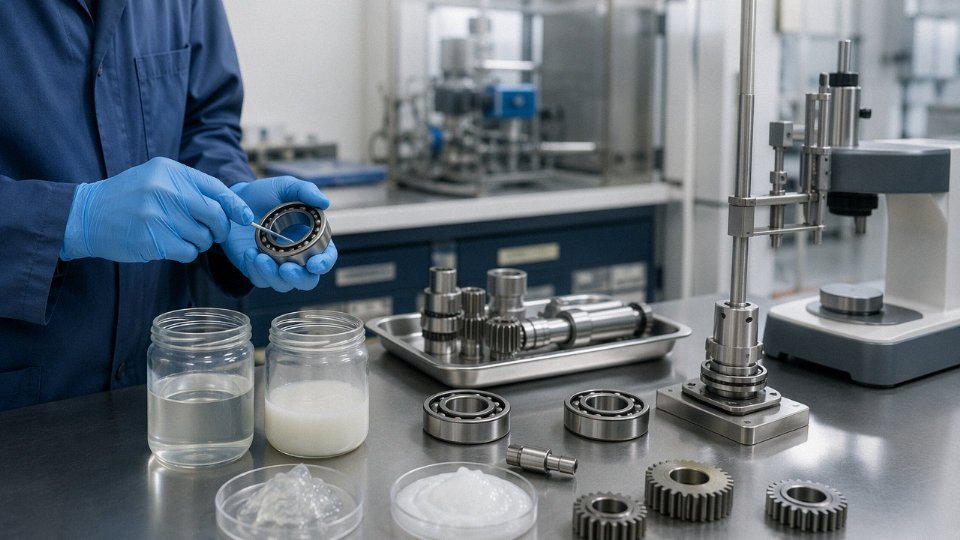
FDA 21 CFR 178.3570 and the Formulation Problem
The FDA’s 21 CFR 178.3570 regulation lists permitted lubricants for food-processing equipment, and both silicone oil and PTFE can qualify under it — in principle. In practice, the formulation matters enormously. A silicone oil base stock may be fully compliant, but if the blended product contains an anti-wear additive, a rust inhibitor, or a colorant that isn’t listed as an approved substance, the whole formulation is disqualified. The same logic applies to PTFE dispersions that use carrier solvents or surfactants not covered by the regulation.
Always request both the Safety Data Sheet and a third-party compliance declaration — ideally a letter from the manufacturer explicitly citing 21 CFR 178.3570 and confirming no non-listed ingredients. Some suppliers resist this; that resistance tells you something.
Both silicone oil and PTFE lubricants can comply with FDA 21 CFR 178.3570 for food-contact surfaces.True
21 CFR 178.3570 permits certain lubricant types including silicone compounds and PTFE when the full formulation — including any additives, carriers, or stabilizers — contains only listed approved substances. Compliance is formulation-specific, not a blanket category approval.
REACH, Cyclic Siloxanes, and Choosing the Right Silicone Grade
High-molecular-weight polydimethylsiloxane (PDMS) — the backbone of most industrial silicone oils — is not classified as a Substance of Very High Concern (SVHC) under REACH. The problem sits with low-molecular-weight cyclic siloxanes: D4 (octamethylcyclotetrasiloxane), D5, and D6 are restricted in rinse-off consumer products in the EU and are under increasing scrutiny in industrial contexts. Silicone oil products with significant cyclic content are a regulatory liability, especially if your process involves any washdown or drain discharge.
Specify non-cyclic, high-MW linear PDMS grades explicitly in your procurement specification. Don’t assume a “silicone oil” purchase order covers this — it won’t unless you write it in.
PTFE, PFAS Pressure, and Supplier Declarations
PTFE polymer itself is not currently classified as a PFAS substance under most major regulatory frameworks, including the EU REACH candidate list as of this writing. That distinction matters because PFAS regulatory pressure is intensifying rapidly, and some procurement teams have started blanket-banning any fluoropolymer, which is an overreaction based on conflating the polymer with the processing chemistry. The real issue is PFOA (perfluorooctanoic acid) and related processing aids historically used during PTFE manufacture — those are heavily regulated and rightly so.
Request a written PFOA-free manufacturing declaration from any PTFE lubricant supplier. Reputable manufacturers have these ready. If a supplier can’t produce one, move on.
RoHS Compliance in Electronics Applications
Silicone oil used in transformer cooling or electronics assembly must have low ionic contamination — even trace chloride or sulfate content can corrode PCB traces over time. PTFE films on edge card connectors and PCB contacts are common and effective, but any lubricant used in electrical equipment sold into the EU market must comply with RoHS Directive 2011/65/EU, which restricts lead, mercury, cadmium, hexavalent chromium, PBBs, PBDEs, and four phthalates. Neither silicone oil nor PTFE inherently violates RoHS, but again, it’s the additives and carriers in the blended product that can introduce restricted substances. Get the full substance declaration, not just a “RoHS compliant” checkbox.
Application Methods and Shelf Life: Sprays, Dispersions, Greases, and Solid Forms in Practice
Selecting the right lubricant chemistry is only half the job. How you deliver it to the contact surface — and whether the film actually cures before the machine loads up — determines whether you get the performance the datasheet promises or a premature failure that gets blamed on the product.
Silicone Oil Delivery Formats
Neat silicone oil is the most straightforward format: brush application for static or slow-moving surfaces, dip coating for small components run in batches, or controlled-volume dispensing pumps where you need repeatable shot sizes on an assembly line. The pump route is worth the setup cost on any high-volume line — hand-applied oil has a nasty habit of pooling in recesses and starving the actual bearing surface. Viscosity matters more here than people expect; a 1,000 cSt oil will bridge gaps and stay put on a vertical surface, while a 50 cSt grade will drain off before the part ever reaches assembly.
Silicone grease — oil thickened with amorphous fumed silica or sometimes lithium soap — is the go-to for static O-ring lubrication, threaded plug valves, and electrical connector seals. It doesn’t flow under moderate compression, which is exactly what you want when a rubber seal is sitting dormant for months. On threaded fasteners in plastic housings, a thin smear prevents galling and makes disassembly possible without cracking the boss. Don’t overpack it; excess grease in a sealed cavity will find somewhere to migrate, usually somewhere inconvenient.
Silicone emulsions — oil dispersed in water with a surfactant — are mostly a textile and rubber processing story. They’re applied by padding mangle or spray bar, provide surface slip during forming, and wash out or volatilize during downstream processing. Not a maintenance lubricant in any conventional sense, but procurement teams buying for a facility that runs both rubber molding and general maintenance sometimes get the product codes mixed up. Worth keeping the SKUs clearly separated in your warehouse.
PTFE Delivery Formats
Aerosol dry-film spray is the format most engineers encounter first. The PTFE particles are suspended in a fast-evaporating solvent carrier — typically a hydrocarbon or acetone blend — and after application the solvent flashes off, leaving a thin, dry, white film. Simple in theory. In practice, the most common field error is loading the part too soon.
Aerosol PTFE sprays require full solvent evaporation before the part is loaded; applying mechanical load during the wet phase transfers an incompletely formed film that performs far below rated friction coefficients.True
The PTFE particles in aerosol products are held in a carrier solvent that must fully evaporate to allow particle consolidation and film adhesion. A wet or partially cured film has no structural integrity under shear and will smear off rather than function as a solid lubricant.
At ambient temperature that’s typically 5–15 minutes, longer in humid or cool conditions. Give it time. On a cold plant floor in winter — say, below 10°C — budget closer to 20–25 minutes or use a heat gun on low.
Water-based PTFE dispersions are a different animal entirely. These go on by spray or dip, but they require oven sintering at roughly 360–380°C to coalesce the particles into a coherent, bonded film. That step is not optional. Unsintered dispersion coating looks fine visually but has almost no adhesion and will flake off under the first load cycle. This format produces the most durable PTFE coatings available and is common on cookware, valve stems, and textile guides — but it requires capital equipment and process control that rules it out for field maintenance.
PTFE-loaded grease and oil suspensions occupy a useful middle ground: wet lubrication with solid PTFE particles in suspension, giving you both fluid film and solid-film protection through the transition from startup to full hydrodynamic conditions. The suspension can settle during storage, so agitate the container before use — this is one of those obvious steps that gets skipped constantly in busy shops.
Machined or pressed solid PTFE components — pads, bushings, slide bearings — are worth mentioning because they get ordered through procurement rather than applied by maintenance. Lead time and dimensional tolerance are the operational concerns here, not application technique.
Film Cure, Re-lubrication, and Shelf Life
Re-lubrication intervals vary widely. Silicone oil in a closed bearing system typically needs replenishment every 500–2,000 operating hours — the low end if temperatures are running above 150°C or loads are heavy, the high end under light duty near ambient. PTFE dry film on a low-load sliding component, properly cured and not exposed to abrasive contamination, can survive 500,000 cycles or more before the transfer film depletes. That number drops sharply if there’s any particulate ingress; PTFE is soft, and grit cuts through it.
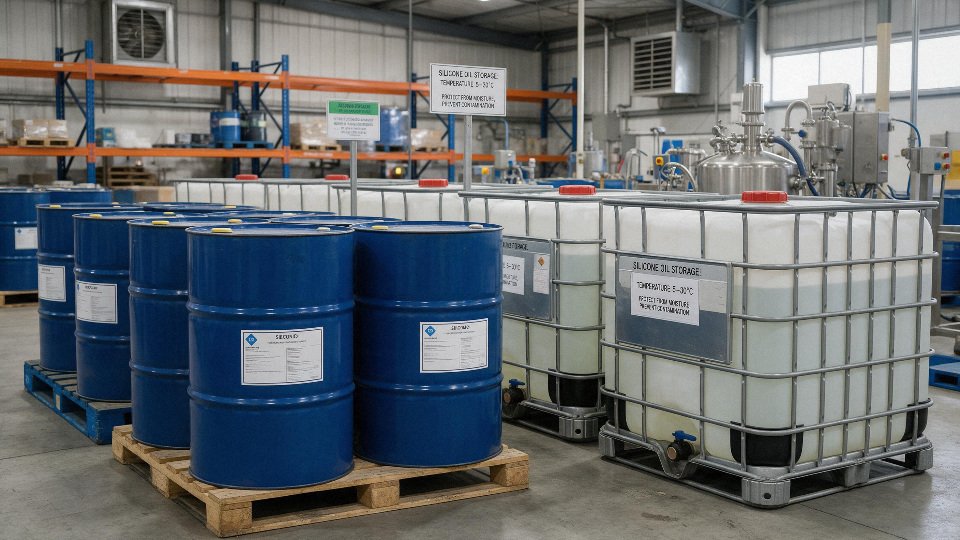
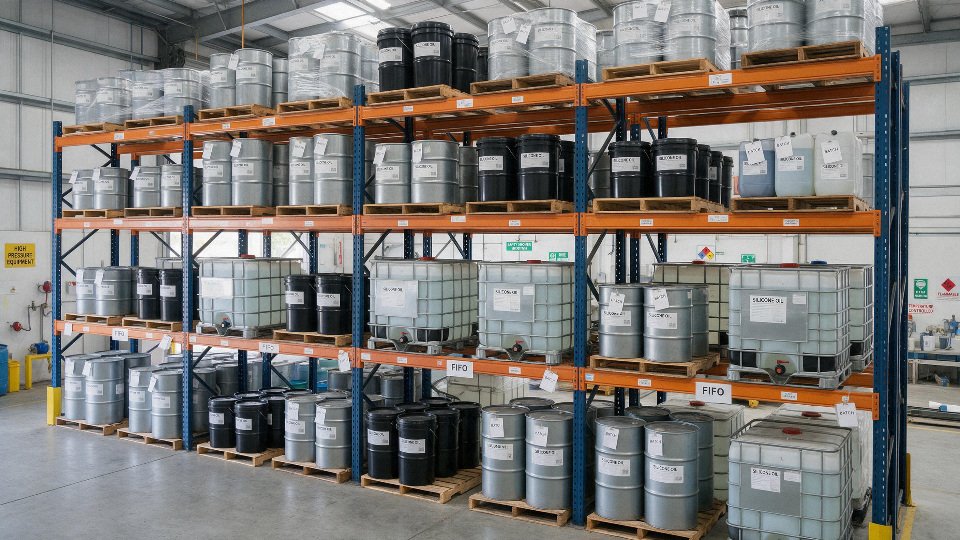
Shelf life is rarely a problem with silicone oil. A sealed drum stored below 50°C away from moisture is effectively indefinite — five-year-old stock is generally fine. Aerosol PTFE products are another matter: manufacturers typically rate them at around three years because propellant integrity and carrier stability degrade on that timescale. Past that date, spray pattern and film quality both suffer. PTFE aqueous dispersions may settle noticeably over 12–24 months but don’t chemically degrade if kept sealed and away from freezing temperatures; a good shake or mechanical agitation before use is usually sufficient to restore the suspension.
A practical note on labeling: mark your date of receipt on aerosol cans when they arrive. Stockrooms have a tendency to rotate new cans to the front, and an expired aerosol on a critical assembly is a problem that costs far more to fix than the can was worth.
Industry-Specific Use Case Mapping: Where Each Lubricant Outperforms the Other
Knowing the chemistry is useful. Knowing which lubricant wins in your specific assembly — and why — is what actually prevents a 3 a.m. line-down call. The breakdown below is organized by industry because that’s usually how procurement and maintenance decisions get made. Cross-reference with your material compatibility and compliance constraints from earlier sections before treating any of these as final.
Automotive Seals, Weatherstripping, and Mechanisms
Silicone oil or silicone grease is essentially the industry default for EPDM door seals, trunk gaskets, and sunroof tracks. The compatibility with rubber is the reason — PTFE dry film applied directly to EPDM works, but silicone stays pliable at -40°C in a way that matters during winter door slam cycles. Brake caliper slide pins are another classic silicone grease application; you want a lubricant that doesn’t attack the rubber boots, tolerates the intermittent heat spikes from braking, and doesn’t wash out immediately in wet conditions.
Flip to throttle cables, hood latch mechanisms, and door lock rods, and PTFE dry spray is usually the better call. These are dry-zone applications where an oily residue would collect road grit, eventually grinding the mechanism into sluggishness. A thin PTFE film stays clean and doesn’t migrate into electrical connectors or lock cylinders the way aerosol silicone notoriously does. Spray silicone anywhere near a door latch and you may be chasing a lock failure complaint six months later.
Food and Beverage Processing
NSF H1 silicone oil dominates conveyor chain lubrication, mixer shaft seals, and filling-machine O-rings. It handles incidental food contact, resists washdown with hot caustic cleaners reasonably well, and provides genuine corrosion inhibition on the carbon steel components that still show up in older plants. Viscosity selection matters more here than people realize — a 350 cSt oil that works fine on a slow conveyor will fling off a high-speed bottling line; you’d want something in the 1,000–5,000 cSt range for that, applied via drip or brush rather than spray.
In dry zones — anywhere product powder or granules are present — PTFE-coated guides and rails eliminate the contamination risk entirely. Particle products like flour, spice blends, or powdered infant formula will absorb any oil film and create either a food-safety problem or a housekeeping nightmare. PTFE gives you the low friction you need without anything to absorb.
Medical Device Manufacturing
Siliconization — applying a thin silicone oil coating to the inside barrel of prefilled syringes — is a well-established process, tightly controlled because the oil must meet ISO 11040 and related standards. The goal is consistent plunger break-loose and glide force; too little oil and the plunger sticks, too much and you risk silicone particles in the drug product. Catheter lubrication follows the same logic: a hydrophilic or silicone coating reduces insertion trauma.
PTFE tubing and liner coatings are preferred for guidewires and introducer sheaths precisely because the friction requirement is extreme — repeated flex cycles under vascular insertion loads, where any film that wears away is unacceptable. PTFE doesn’t wear away in the same sense a liquid lubricant does.
Silicone oil used in prefilled syringe siliconization must meet specific pharmacopeial standards and is subject to extractables/leachables testing.True
Regulatory bodies including FDA and EMA require characterization of silicone oil in drug-contact applications; the process is not simply applying any food-grade silicone oil.
Electronics and Precision Instruments
Low-viscosity silicone oil — typically 5–10 cSt — handles potentiometer wipers and clock escapement pivots where you need just enough film to reduce wear without affecting electrical resistance measurably. The catch is that silicone oil migrates. In a confined electronics enclosure, it will creep onto contact surfaces over time. That’s not a theoretical risk; it shows up as intermittent relay failures in instruments that were lubricated without enough discipline about quantity.
PTFE dry spray is the right answer for keyboard switch stems, printer carriage rails, and optical drive sled guides. No migration, no optical contamination, and the dry film tolerates the repetitive low-load cycling those mechanisms see.
Industrial Plastics Processing and Tooling
Silicone oil works well as a release agent on injection molding tools for most non-silicone-sensitive polymers, and on extrusion dies where a renewable anti-stick coating is acceptable. It’s inexpensive and easy to apply between shots.
Where the tooling runs above 200°C continuously — think compression molding or some extrusion processes — PTFE dispersion coatings baked onto the die surface outlast renewable silicone applications by a wide margin. The baked PTFE survives thermal cycling that would carbonize or volatilize a silicone oil film, though re-coating the tool requires pulling it from service and sending it through the oven process again.
Aerospace and Defense
Both lubricants appear in aerospace, but in clearly separated roles. Silicone-based greases seal hydraulic fittings and environmental connector backshells — Molykote 111 is probably the most common example people encounter in MRO contexts. It keeps moisture out and doesn’t harden at altitude temperatures.
PTFE-based dry film lubricants per MIL-PRF-46010 handle actuator linkages, missile rail guides, and structural fasteners where the temperature swing from ground ops to high altitude would cause any viscous lubricant to migrate, freeze, or outgas. The operating range difference between silicone oil (roughly -60°C to +200°C) and PTFE (down to -200°C, up to +260°C continuous) is actually relevant in aerospace in a way it isn’t in most factory applications.
| Industry Segment | Silicone Oil Preferred For | PTFE Preferred For |
|---|---|---|
| Automotive | EPDM seals, caliper pins, weatherstripping | Cables, latches, lock mechanisms |
| Food & Beverage | Chain lube, O-rings, wet zones | Dry guides, powder-handling zones |
| Medical Devices | Syringe siliconization, catheter coating | Guidewires, introducer sheaths |
| Electronics | Potentiometers, clock mechanisms | Switch stems, carriage rails, optics areas |
| Plastics Processing | Mold release (renewable), extrusion dies | Baked die coatings above 200°C |
| Aerospace / Defense | Hydraulic seals, connector backshells | Actuator linkages, fasteners, rail guides |
The table simplifies, as tables do. Actual selection still depends on load, speed, regulatory requirements, and the specific materials in contact — but this covers the high-probability calls correctly about 80–85% of the time in practice.
Cost-in-Use Analysis: Unit Price vs. Total Cost of Ownership Over Component Lifecycle
Unit price is where procurement conversations start. It’s almost never where they should end.
A liter of 200 cSt industrial silicone oil runs roughly $8–$25 in bulk, depending on grade purity, supplier tier, and order volume — a drum buy from a distributor looks very different from a spot purchase of laboratory-grade material. PTFE aerosol sprays land between $12 and $30 per 400 mL can, which sounds comparable until you account for coverage area and reapplication frequency. PTFE aqueous dispersions for industrial coating or impregnation typically run $30–$80 per liter, and solid PTFE bushings start anywhere from $5 to $50 per piece depending on bore size, wall thickness, and whether the tolerance is commercial or precision-ground. None of these numbers mean much in isolation.
Relubrication Labor Is Where the Math Usually Shifts
A silicone oil system on a conveyor or sliding mechanism typically needs attention every three months in a normal production environment — more often in dusty or high-temperature areas where the fluid migrates or oxidizes faster. At 30 minutes per machine per service cycle, and using a realistic blended labor rate of $40–$60 per hour including overhead, you’re spending somewhere between $60 and $120 per machine per year just on the labor of relubrication. Multiply that across a 40-machine line and the number gets uncomfortable fast.
PTFE dry-film coatings and sintered PTFE composite bushings routinely run 12 months or longer between service events, and some sealed PTFE-lined assemblies are genuinely maintenance-free for the component’s working life. In practice that cuts relubrication labor by 60–80%, though the actual savings depend heavily on how disciplined your PM program was to begin with. Plants running reactive maintenance don’t always realize the baseline cost they’re carrying.
Contamination Risk Is a Hidden Line Item Almost Nobody Budgets
Silicone oil migration is real and it travels farther than most people expect. Siloxane vapors off-gas even at room temperature, deposit on adjacent surfaces, and in a paint booth or adhesive bonding area that contamination can cause fisheye defects, adhesion failures, or full rejects of coated assemblies. Remediation involves solvent wipe-downs, potentially stripping and reprocessing parts, and root-cause investigation that pulls engineering time. A single contamination incident near a coating line can cost anywhere from $200 to over $2,000 depending on part value, batch size, and whether the defect was caught before or after cure. If your facility does any painting, bonding, or conformal coating within the same airspace as silicone-lubricated machinery, that risk premium belongs in your cost model. PTFE dry film carries essentially none of this exposure.

Component Life Extension Changes the Break-Even Calculation Entirely
A plain steel sliding guide relubricated with silicone oil on a quarterly schedule might last 18 months before wear or corrosion forces replacement. The same guide with a sintered PTFE or PTFE-composite coating — applied once at initial build — can realistically reach five to seven years of service, assuming load and speed stay within the coating’s design envelope. That shifts the financial logic from “lubricant cost” to “coating cost divided by replacement cycles avoided,” typically three to four cycles over a five-year horizon.
Here’s a simplified five-year cost comparison for a 20-unit conveyor system, using mid-range estimates:
| Cost Category | Silicone Oil (5 yr) | PTFE Dry Film (5 yr) |
|---|---|---|
| Lubricant / coating material | $400–$900 | $1,200–$2,400 (one-time coat) |
| Relubrication labor | $6,000–$12,000 | $1,200–$3,000 |
| Component replacement | $3,000–$6,000 | $800–$1,600 |
| Contamination incidents (est.) | $1,000–$8,000 | $0–$200 |
| Compliance testing overhead | $500–$1,500 | $300–$800 |
| Total estimated | $10,900–$28,400 | $3,500–$8,000 |
Figures assume 20 machines, moderate-duty cycle, and one contamination event per two years for the silicone oil scenario. Adjust contamination rows to zero if the line is isolated from coating operations.
PTFE dry-film lubrication almost always has a lower total five-year cost than silicone oil on sliding steel components in production environmentsTrue
When relubrication labor, component replacement intervals, and contamination risk are included in the model, PTFE dry film's higher upfront material cost is typically recovered within 12–24 months across multi-machine installations, with the gap widening over longer horizons.
The table above is a starting framework, not a guarantee. Your numbers will shift based on local labor rates, actual contamination incident history, and whether your components are already optimized or running on legacy specs. Build the model with your own data, and the procurement conversation becomes a lot easier to win.
Frequently Asked Questions: Silicone Oil vs PTFE Lubricant
Can I mix silicone oil and PTFE lubricant together?
Technically, yes — and some commercial products do exactly that deliberately. A silicone oil carrier loaded with suspended PTFE particles gives you wet lubrication during the initial contact phase, then a solid boundary film as the carrier migrates or evaporates. That combination works well in slow-speed, oscillating, or intermittently loaded joints where neither product alone is ideal.
What you should not do is grab a can of PTFE dry spray and a bottle of silicone oil and mix them yourself in a parts tray. The particle dispersion in a purpose-made product is carefully controlled — particle size, surface treatment of the PTFE, and carrier viscosity all matter. DIY blending risks agglomeration, uneven suspension, and settling that leaves some components starved while others get flooded. Use only formulated blends from a supplier who can provide a technical data sheet showing particle size distribution and stability data.
Is silicone oil safe on rubber O-rings?
Generally yes, and it is one of silicone oil’s most practical strengths. EPDM, NBR (nitrile), neoprene, and Viton O-rings all tolerate silicone oil well, which is why it shows up in pneumatic tool maintenance kits and hydraulic cylinder rebuild kits almost universally.
The exception that catches people off guard: silicone rubber O-rings swell noticeably when exposed to silicone oil. It sounds counterintuitive — same base chemistry, right? — but the polydimethylsiloxane fluid is absorbed by the crosslinked silicone elastomer and the seal deforms. In pneumatic systems where silicone rubber seals are common, this can close off a bore or cause a fitting to seize. Check the O-ring material spec before applying any silicone lubricant, not after.
Does PTFE lubricant conduct electricity?
No. PTFE is one of the best electrical insulators available — dielectric constant around 2.1, volume resistivity above 10¹⁸ Ω·cm.
PTFE dry-film lubricants are electrically insulating and unsuitable for sliding contact surfaces requiring electrical continuityTrue
PTFE's volume resistivity exceeds 10^18 Ω·cm; a PTFE film on contact surfaces increases contact resistance significantly, interrupting electrical continuity in applications such as brush contacts or connector wiping surfaces.
For printed circuit board edge connectors, rotary switches, or any sliding electrical contact, a PTFE coating will increase contact resistance and cause intermittent signal loss. This is a real field-failure mode in connector maintenance. Use a dedicated contact lubricant for those applications.
Which lubricant is better for plastic gears?
PTFE dry spray is the default choice for plastic-on-plastic gear pairs. It does not attack most engineering plastics, leaves no wet residue to trap abrasive dust, and the film is thin enough that it does not gum up fine-pitch tooth geometry. In dusty or dirty environments, the “oily residue attracts grit” failure mode is a serious one — I have seen nylon gear sets turned into lapping compounds inside six months because someone applied a hydrocarbon oil in a machine shop environment.
That said, for nylon or acetal gears running under continuous moderate-to-heavy load, a silicone grease often holds up better. The dry PTFE film can wear through faster than expected under sustained contact pressure, and silicone grease replenishes the interface continuously. The right answer depends on duty cycle, load, and environment — not just gear material.
How do I remove silicone oil contamination before painting?
This one causes more paint-shop headaches than almost any other maintenance lubricant issue. Silicone oil is invisible on a metal surface, resists most general-purpose degreasers, and causes fish-eye or complete adhesion failure in topcoats.
The correct procedure: use a solvent specifically formulated as a silicone remover — products like 3M’s General Purpose Adhesive Cleaner or equivalent purpose-made silicone removers work; standard acetone or MEK alone often just spreads it. Follow with an IPA (isopropyl alcohol) wipe using clean lint-free cloths, single-pass technique only — wiping back-and-forth re-deposits contamination. Confirm removal with a water-break test; water should sheet evenly with no beading. If you see any beading, repeat the process before priming.
Do not assume a parts washer cycle is sufficient. It usually is not.
Is PTFE lubricant food-safe?
PTFE polymer itself is chemically inert and accepted in food-contact applications, and NSF H1 registered PTFE lubricants are widely used in food processing equipment — chain drives, conveyor guides, filling machine slides.
The critical point: always verify the specific product’s NSF H1 registration number in the NSF White Book (nsfwhitebook.org), not just the label. The PTFE particles might be inert but the aerosol propellant, carrier solvent, or anti-corrosion additive in that same can may not be H1 approved. Label claims without a verifiable registration number mean nothing during an audit.
At what temperature does silicone oil break down?
Standard polydimethylsiloxane silicone oil handles continuous service up to roughly 180–200°C depending on viscosity grade and whether it is exposed to air or an inert atmosphere. Short-duration excursions to around 250°C are survivable. Above 200°C in air, oxidative chain scission starts — the oil thickens, then deposits form, then you have a residue that behaves more like a varnish than a lubricant.
For applications that regularly see above 200°C, fluorosilicone (FVMQ-based) oils push that ceiling somewhat higher, though they are considerably more expensive and less available. Alternatively, switching to PTFE-based solid lubrication makes sense — PTFE handles continuous service to 260°C and does not oxidize or deposit in the same way. The choice between those two paths usually comes down to whether the application needs a wet film or can tolerate a dry one.
Final Selection Framework: A Decision Tree for Engineers Choosing Between Silicone Oil and PTFE
Every section in this article has been building toward one practical question: which lubricant goes on the purchase order? The five steps below force a structured answer. Work through them in sequence — skipping to Step 4 or 5 because they feel more familiar is how engineers end up with the wrong product on a $40,000 actuator.

Step 1 — Define the Lubrication Regime
Start here, not with price or brand.
If your application demands a continuous, separating fluid film under moderate-to-high contact loads — think journal bearings, hydraulic seals under sustained pressure, or a slow-turning shaft that needs genuine elastohydrodynamic film thickness — silicone oil is the working candidate. Its viscosity range (roughly 0.65 cSt up to several million cSt, depending on grade) gives you real latitude to match film thickness to load and speed.
If the application involves intermittent contact, low loads, tight clearances where wet residue causes problems, or surfaces that must stay dry between cycles — pneumatic valve stems, sliding plastic guides, cable conduit interiors — PTFE dry film is the starting candidate. The friction coefficients it delivers (0.04 to 0.10, depending on load, counterface, and film quality) are genuinely hard to beat with any fluid lubricant in that regime.
Get this step wrong and no amount of correct compliance paperwork saves you.
Step 2 — Check Material Compatibility
Pull up the full compatibility matrix before you go further. Identify every material in the tribological system: seals, housings, mating surfaces, adjacent coatings, overmolds, even the paint on a nearby bracket if silicone migration is a concern. An “Incompatible” rating against any single material in that system eliminates the lubricant entirely — the other four steps become irrelevant. Polycarbonate swelling from silicone oil contact, PTFE carrier-solvent attack on certain elastomers — these failures are documented and preventable. In practice, this step alone eliminates one candidate in roughly a third of mixed-material assemblies.
Step 3 — Verify Regulatory and Cleanliness Requirements
Confirm applicable standards before specifying anything. NSF H1 registration, FDA 21 CFR 178.3570 compliance, MIL-spec requirements for aerospace, and current REACH SVHC declarations all constrain which specific products qualify — not just which lubricant category. If your customer requires PFAS declarations or PFOA-free documentation, get that in writing from the PTFE supplier; some dispersion formulations still carry legacy concerns, and the regulatory environment around PFAS is tightening across the EU and several US states. If the application is inside an automotive paint booth or any aerospace structure where silicone contamination causes adhesion failures, silicone oil is automatically disqualified regardless of how well it performs tribologically. Silicone-free zones are real, they are enforced, and the rework cost when someone ignores them is not trivial.
Some PTFE dry-film lubricants marketed as PFOA-free may still contain other regulated PFAS compoundsTrue
PFOA is one specific PFAS compound; PTFE polymer itself and certain processing aids in dispersion formulations may involve other PFAS substances subject to emerging regulations. Engineers should request full PFAS compositional disclosure, not just PFOA-free certification.
Step 4 — Confirm the Temperature and Environment Envelope
If sustained operating temperature exceeds 200°C, PTFE is the only viable choice between these two. At the other extreme, cryogenic service below -60°C also favors PTFE, which remains functional down to roughly -200°C continuous. For the broad middle range — approximately -60°C to +200°C — both lubricants are technically capable, and the outcomes from Steps 1 through 3 should be the tiebreaker. Seasonal effects matter too; a silicone oil specified for an indoor conveyor in a climate-controlled facility may behave unexpectedly when that same conveyor runs in an unheated warehouse through a northern winter.
Step 5 — Conduct Total Cost of Ownership Analysis
Unit price is almost never the right metric. Use the five-row cost model from the cost section — covering initial product cost, application labor, relubrication interval, component replacement frequency, and contamination or compliance risk premium — and project across a realistic 3-to-5-year horizon. Relubrication intervals for PTFE dry film can be several times longer than for fluid lubricants in low-load applications, which changes the labor math substantially at high labor rates. Silicone oil in a sealed system with long drain intervals can look expensive per liter and cheap per year. Run the numbers for your specific labor rate, maintenance access cost, and component replacement price before the decision is final.
Document the Rationale
Record which lubricant was selected and why, mapped against each step, in the design file. This is not bureaucratic overhead — it is the only way a future engineer, a customer auditor, or your own team during a field failure investigation can reconstruct the original logic. If operating conditions change, substrate materials are revised, or regulatory requirements shift, revisit the selection from Step 1 rather than assuming the original choice still holds. Both silicone oil and PTFE are legitimate, well-characterized engineering materials. The failure mode is not choosing one or the other — it is applying either one without documented, step-by-step reasoning to back it up.