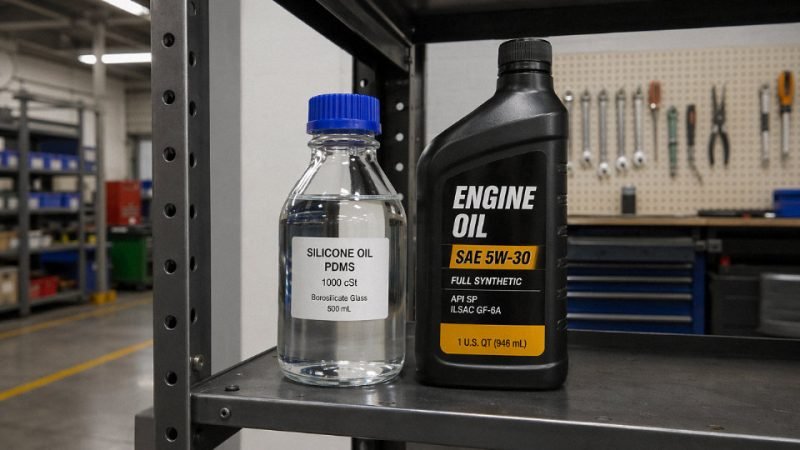
Grab the wrong drum off the shelf — silicone oil instead of engine oil, or the reverse — and the consequences range from a seized compressor to a dissolved rubber seal, depending on which direction you got it wrong. It happens more than people admit, especially when a maintenance tech is working from a handwritten BOM or a procurement manager sources a substitute during a shortage. The viscosity numbers can look deceptively similar on a data sheet: an SAE 5W-30 runs roughly 60–65 cSt at 40°C, and a mid-grade PDMS silicone oil sits in that same ballpark — but the two fluids behave almost nothing alike under real operating conditions, and the cost difference ($1–$6/liter for engine oil versus $8–$40/liter for silicone oil, depending on grade and order volume) means substitution errors cut both ways financially.
Silicone oil and engine oil are not interchangeable. Silicone oil (typically polydimethylsiloxane, or PDMS) offers a wider thermal range — stable from roughly -60°C up to 300°C continuous — superior oxidation resistance, and near-zero reactivity with most substrates, but it lacks the load-bearing additives and boundary-lubrication chemistry that engine oil is specifically formulated to provide. Engine oil is engineered for metal-on-metal friction, fuel dilution, and combustion byproducts. Silicone oil is not.
What makes the comparison genuinely complicated is that both fluids overlap in a handful of applications — damping, heat transfer, certain specialty bearings — which is exactly where engineers get into trouble. Knowing where the overlap ends, and why, is the practical question this article works through.
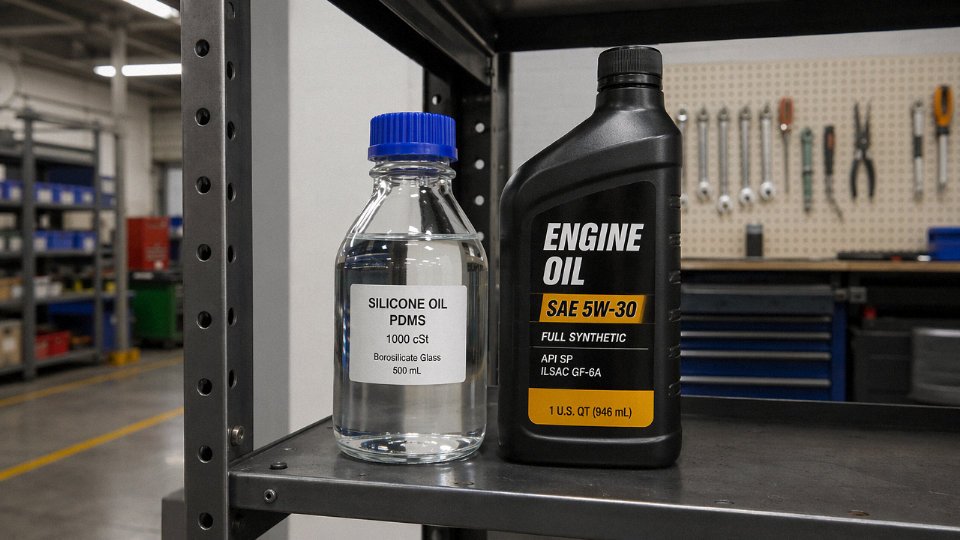
Chemical Composition and Molecular Architecture: Silicone Polymer vs. Hydrocarbon Lubricant
The performance gap between these two fluids isn’t arbitrary — it’s written directly into their molecular structure. Understanding that structure saves you from costly substitution errors and explains why no additive package will ever make one behave like the other.
Silicone Oil: A Polymer Backbone, Not a Lubricant Blend
Silicone oil — specifically polydimethylsiloxane (PDMS) in its most common industrial form — is built from repeating -Si(CH₃)₂-O- units strung together in a linear chain. That’s it. No aromatic rings, no sulfur-containing antiwear agents, no detergent additives. Just a backbone of alternating silicon and oxygen atoms, each silicon carrying two methyl groups.
Chain length is everything here. A short-chain PDMS with molecular weight around 1,000–2,000 Da gives you a fluid thin enough to feel like water — viscosities down near 0.65–5 cSt. Extend that chain out toward several hundred thousand Da and you’re looking at something closer to cold honey, 100,000 cSt or more. The same chemistry, just more of it. This is why silicone oil viscosity grades span an almost absurd range — 0.65 cSt to 1,000,000 cSt at 25°C — that no hydrocarbon fluid comes close to matching.
Phenyl-substituted variants (PMPS, where some methyl groups are replaced with phenyl groups) push the thermal ceiling even higher and improve radiation resistance, which matters in nuclear or aerospace applications. Methyl hydrogen silicone fluids — where some methyls are replaced with Si-H groups — can crosslink under heat or catalyst exposure, useful in release coatings and paper treatment but a liability if you accidentally introduce them into a system expecting stable PDMS.
Engine Oil: A Carefully Engineered Blend, Not a Single Molecule
Engine oil is not a compound. It’s a formulated product — typically 75–85% base stock by volume and 15–25% additive package, depending on the grade and intended service.
The base stock classification under API Groups I through V tells you a lot about what you’re buying. Group I and II are mineral oils derived from crude refining, containing paraffinic and naphthenic hydrocarbons in a relatively broad molecular weight distribution. Group III is heavily hydrocracked mineral oil — so thoroughly processed it legally qualifies as “synthetic” in some markets, which has caused genuine commercial controversy. Group IV is polyalphaolefin (PAO), a fully synthesized base stock built from oligomerized 1-decene, offering tighter molecular weight distribution and better low-temperature performance. Group V is a catch-all that includes esters, polyalkylene glycols, and — here’s what surprises many procurement managers — silicone fluids themselves.
Silicone oil is classified as a Group V base stock under the API base oil categorization systemTrue
API Group V covers all base stocks not falling into Groups I–IV, explicitly including silicone fluids, polyalkylene glycols, and esters. Silicone is occasionally used as a specialty base stock in niche formulations but is never a drop-in engine lubricant replacement.
That Group V classification explains the occasional confusion. Yes, silicone can sit inside an engine oil formulation in theory. In practice it almost never does at meaningful concentrations, because silicone is incompatible with the elastomer seals, has essentially zero film-forming capacity under boundary lubrication, and won’t suspend combustion byproducts.
The additive package in a finished engine oil does the heavy lifting most users never think about. ZDDP (zinc dialkyldithiophosphate) handles both antiwear protection at metal surfaces and antioxidant function — it sacrifices itself to protect cam lobes and lifters. Calcium sulfonates neutralize acidic combustion products and keep deposits suspended until the next drain. Viscosity index improvers, typically polymethacrylate or olefin copolymer polymers, temporarily thicken the oil at high temperature to maintain film thickness — which is the entire point of a multigrade designation like 5W-30.
Pure silicone oil carries none of this. No ZDDP, no detergent, no VI improver. Running it in an engine isn’t just suboptimal — it will deposit lacquer, starve boundary-lubricated surfaces, and likely wreck seals within hours.
Bond Energy: The Root Cause of Thermal Stability Differences
The Si-O bond that forms the PDMS backbone has a dissociation energy around 452 kJ/mol. Compare that to the C-C bond at roughly 347 kJ/mol and the C-H bond at about 413 kJ/mol that dominate hydrocarbon base stocks. Higher bond energy means more thermal energy required to initiate oxidative degradation — which is the direct molecular reason silicone oil holds up continuously to 300°C where a Group II mineral oil starts breaking down above 150°C or so, depending on the additive package protecting it.
That difference isn’t marketing. It shows up in differential scanning calorimetry, in viscosity measurements after thermal soak testing, and on plant floors where someone ran the wrong fluid through a high-temperature bath and spent a shift cleaning out varnish deposits.
Viscosity Behavior Across Temperature: Viscosity Index, Pour Point, and Operational Windows
Viscosity is where the real selection decision gets made. Everything else — chemistry, price, compatibility — matters, but if a fluid can’t maintain the right viscosity at operating temperature, nothing else saves you.
Viscosity Index: Why Silicone Oil Barely Flinches With Heat
Viscosity Index (VI) measures how much a fluid thins as temperature rises. Higher VI means more stable viscosity across a temperature swing. Mineral engine oils typically land in the 95–120 VI range; PAO-based full synthetics push that to roughly 130–160 with good VI improver packages. Silicone oil (PDMS grades) commonly runs 150–400+, and certain high-MW grades exceed that. That’s not a marginal difference — it’s a different class of behavior.
In practice, a 100 cSt silicone oil at 25°C might drop to somewhere around 30–40 cSt at 100°C. An SAE 5W-30 full synthetic starts near 60–65 cSt at 40°C and drops to roughly 9–12 cSt at 100°C. The silicone fluid’s viscosity curve is nearly flat by comparison. For applications like transformer cooling, heating bath circulation, or hydraulic dampers where you need consistent flow resistance across a 150°C operating window, that flat curve is genuinely useful rather than just a spec-sheet talking point.
Silicone oil (PDMS) has a higher Viscosity Index than PAO-based synthetic engine oils.True
PDMS silicone oils typically exhibit VI values of 150–400+, while PAO-based full synthetic engine oils, despite their strong performance, typically achieve VI 130–160. This difference is due to the fundamentally different backbone structure of polysiloxane versus hydrocarbon chains and their respective temperature-sensitivity of intermolecular forces.
Pour Point and Cold-End Performance
Pour point is where silicone oil creates a real operational advantage in cold environments. Depending on grade and molecular weight, silicone oil pour points range from roughly -65°C down to -73°C for low-viscosity grades. SAE 5W-30 engine oil typically pours at -35°C to -40°C — already respectable, but not remotely in the same league for Arctic, aerospace, or cryogenic-adjacent service.
The aerospace community learned this the hard way with hydraulic and instrument damper fluids decades ago. Silicone-based damper fluids kept operating at temperatures where hydrocarbon fluids had essentially solidified. If your application involves unheated outdoor equipment in northern Canada or Scandinavia in winter, or aircraft instrument mechanisms, this low end matters enormously.
High-Temperature Viscosity Retention
Above 150–180°C sustained, most mineral and hydrocarbon-based engine oils begin either oxidizing (thickening, depositing) or losing lighter fractions (thinning, smoking). Full synthetics extend that ceiling somewhat — some PAO blends handle 200°C short-term — but degradation mechanisms accelerate sharply past that point.
Silicone oil maintains measurable, predictable viscosity up to 250–300°C continuously, with short excursions to roughly 350°C before significant degradation starts. That’s the working range. For heat transfer baths, oven chain lubrication, or any application near a process heat source, this matters directly to maintenance interval and fluid change cost.
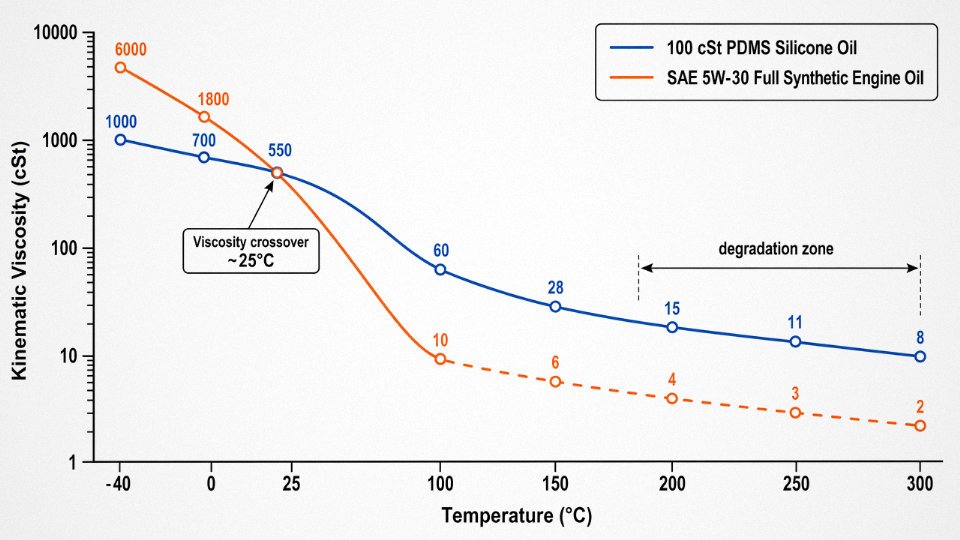
The table below gives approximate kinematic viscosity ranges across key temperatures, using a 100 cSt PDMS silicone oil versus a typical SAE 5W-30 full synthetic. Exact values depend on specific formulation and additive package.
| Temperature | 100 cSt PDMS Silicone Oil | SAE 5W-30 Full Synthetic |
|---|---|---|
| -40°C | ~800–1,200 cSt | ~5,000–8,000 cSt (near limit) |
| 25°C | ~100 cSt | ~90–110 cSt |
| 100°C | ~30–40 cSt | ~9–12 cSt |
| 200°C | ~12–18 cSt | fluid degrading; not reliable |
Notice the crossover near 25°C — both fluids sit at roughly similar kinematic viscosities at ambient temperature. Below and above that point, their behavior diverges sharply in opposite directions.
Shear Stability: Silicone Oil’s Real Weakness
Here’s where silicone oil loses the argument for many mechanical applications. The long polysiloxane chains that give PDMS its excellent VI are susceptible to permanent viscosity loss under mechanical shear — gear teeth, high-speed pump impellers, tight bearing clearances. Shear that breaks polymer chains doesn’t reverse. You end up with a thinner fluid than you started with, and it stays that way.
Engine oil VI improvers (usually olefin copolymers or polymethacrylates) also shear-degrade, but the base hydrocarbon stock retains its fundamental lubricity and the additive package compensates for most practical service conditions. Engine oils are engineered specifically to survive high-shear metal-on-metal contact.
The operational warning here is direct: do not use silicone oil as a general-purpose gear or rolling-element bearing lubricant expecting the same longevity you’d get from a proper gear oil. You will see viscosity drift, reduced film thickness over time, and potentially accelerated wear. In dampers, heat transfer loops, and transformer cooling — low-shear, low-contact-stress environments — silicone oil’s VI advantage plays out cleanly. In a worm gearbox or a high-speed pump, it tends to disappoint.
| Application Type | Shear Level | Temperature Range | Better Choice |
|---|---|---|---|
| Hydraulic damper / shock absorber | Low | -50°C to 200°C | Silicone oil |
| Transformer / heat transfer bath | Very low | 50°C to 280°C | Silicone oil |
| Automotive engine, gear lubrication | High | -30°C to 150°C | Engine / gear oil |
| General industrial bearing (moderate speed) | Moderate | 0°C to 120°C | Engine oil or dedicated bearing oil |
| Arctic outdoor equipment | Low-moderate | -60°C to 80°C | Silicone oil (low-viscosity grade) |
The selection logic is almost always: wide temperature swing plus low-to-moderate shear equals silicone oil territory. Narrow temperature range plus high shear plus metal-on-metal contact equals engine oil (or a purpose-built gear oil) territory. Where both conditions exist simultaneously, neither fluid is ideal and a PAO-ester blend or specialty grease usually makes more sense.
Lubrication Performance and Tribology: Where Engine Oil Dominates and Silicone Oil Falls Short
The viscosity comparison gets most of the attention, but viscosity alone does not protect metal. Tribology — the actual science of friction, wear, and surface interaction under load — is where the gap between these two fluids becomes stark and, in the wrong application, catastrophic.
Four-Ball Wear Testing Tells the Story Quickly
ASTM D4172 four-ball wear testing is blunt and reliable: three stationary steel balls, one rotating ball pressing against them at a fixed load and speed, run for 60 minutes. The wear scar diameter (WSD) left on the stationary balls tells you how well the fluid protected metal under sliding contact.
A decent SAE 5W-30 engine oil with ZDDP additive package typically produces a WSD in the range of 0.35–0.45 mm under standard test conditions. Pure PDMS silicone oil — same test, same load — comes in around 0.80–1.20 mm. That’s roughly two to three times the wear. The exact numbers shift depending on test load and the specific PDMS viscosity grade, but the gap is consistent across the literature and consistent with what you’d expect from the chemistry.
Why the EHL Film Is Thinner Under Real Contact Pressures
In elastohydrodynamic lubrication — the regime governing cam lobes, roller bearings, and gear teeth — the fluid is momentarily pressurized to 1–3 GPa at the contact zone. Under that pressure, most lubricating oils viscosity-stiffen substantially, which is exactly what builds the protective film. The pressure-viscosity coefficient α quantifies this response.
Mineral engine oil carries an α of roughly 15–25 GPa⁻¹ depending on base stock and formulation. PDMS silicone oil? About 5–10 GPa⁻¹. The silicone oil barely thickens under the contact pressure, so the EHL film it generates is meaningfully thinner. In a cam-follower contact running at realistic lift velocities, that thinner film means more asperity interaction, more wear, and faster surface fatigue. This is not a marginal difference. It’s a fundamental property of the siloxane backbone.
ZDDP Does Something Silicone Oil Simply Cannot Do
Engine oil’s real protection at boundary lubrication conditions — low speed, high load, the moment you start a cold engine — comes from zinc dialkyldithiophosphate (ZDDP). At metal surface temperatures of roughly 100–150°C, ZDDP thermally decomposes and forms a zinc phosphate glassy tribofilm, typically 30–100 nm thick, directly on the steel surface. That film sacrifices itself instead of the metal. It’s reactive, surface-active chemistry.
PDMS has none of that. It’s chemically inert by design, which is wonderful for many applications and completely wrong here. There is no analogous surface chemistry in silicone oil that forms a sacrificial protective layer. Under boundary conditions, you get metal-on-metal contact with only a thin fluid film standing between you and accelerated wear.
Silicone oil can substitute for engine oil in a pinch if the viscosity grades are similarFalse
Matching kinematic viscosity does not replicate the boundary lubrication, EHL film-building, or antiwear additive performance that engine oil provides. Wear rates in metal-on-metal contact will be significantly higher with silicone oil regardless of viscosity match.
Extreme Pressure Performance — or the Lack of It
Gear tooth contact pressures routinely exceed 1 GPa in a loaded transmission. Engine oils formulated with sulfur-phosphorus EP additives can maintain film integrity and prevent welding at contact stresses up to roughly 3–4 GPa. Silicone oil has no EP chemistry. Under high gear-tooth loading, it fails. The surfaces weld momentarily, tear apart, and you get adhesive wear — scuffing — that ruins gear geometry fast.
Where Silicone Oil Actually Belongs as a Lubricant
None of this means silicone oil is a poor lubricant universally. It means it’s a poor lubricant for high-contact-stress metal applications. In the right environment it works well: plastic gear trains where hydrocarbon oils would swell or degrade the polymer, rubber-on-plastic sliding interfaces, valve stems in pneumatic assemblies, medical device joints, and similar light-load, low-speed situations. Contact stresses in those applications are modest — often below 100 MPa — and chemical inertness toward the substrate matters more than EHL film thickness.
Seal Compatibility: The Failure Mode That Happens Overnight
One more practical hazard worth flagging directly. Many nitrile (NBR) and neoprene seals — extremely common in engines, hydraulic systems, and gearboxes — swell significantly when exposed to silicone oil. Volume swell of 20–40% is plausible depending on the specific compound and exposure temperature. A swollen seal distorts, loses its sealing geometry, and either leaks or seizes in its groove. The reverse problem exists too: silicone and fluorosilicone seals can swell in conventional hydrocarbon engine oil.
In practice, if you’re specifying silicone oil for any system with existing elastomer seals, verify compatibility with the actual seal compound before commissioning. Don’t assume. A seal datasheet listing “silicone compatible” usually refers to silicone rubber seals in a non-silicone-oil fluid — the terminology gets confusing fast and the wrong assumption costs you a teardown.
Thermal and Oxidative Stability: Heat Transfer Fluids vs. Engine Lubricant Oxidation Management
Thermal stability is the one domain where silicone oil doesn’t just compete with conventional engine oil — it wins decisively, and by a wide margin. Understanding exactly why that is, and where the limits still apply, saves engineers from both under-specifying and over-specifying these fluids in high-temperature applications.
Silicone Oil’s Thermal Ceiling
PDMS-grade silicone oil begins meaningful thermal decomposition somewhere around 300°C in air, though the precise onset depends heavily on molecular weight, the presence of trace catalysts (even trace metals from a pipe fitting accelerate chain scission), and whether the atmosphere is open or closed. Phenyl-substituted silicone oils push that ceiling to roughly 350°C continuous — useful when you need a few extra degrees of headroom in, say, a semiconductor diffusion furnace bath or a high-temperature hydraulic circuit.
Flash point tells a similar story. SAE 5W-30 engine oil typically flashes around 220–230°C by ASTM D92. A mid-viscosity PDMS silicone oil sits at 300–340°C. That 80–100°C gap isn’t academic — it’s the difference between a fluid that can safely run an oven-chain lubrication system at 230°C and one that becomes a fire risk.
Engine Oil and the Oxidation Cascade
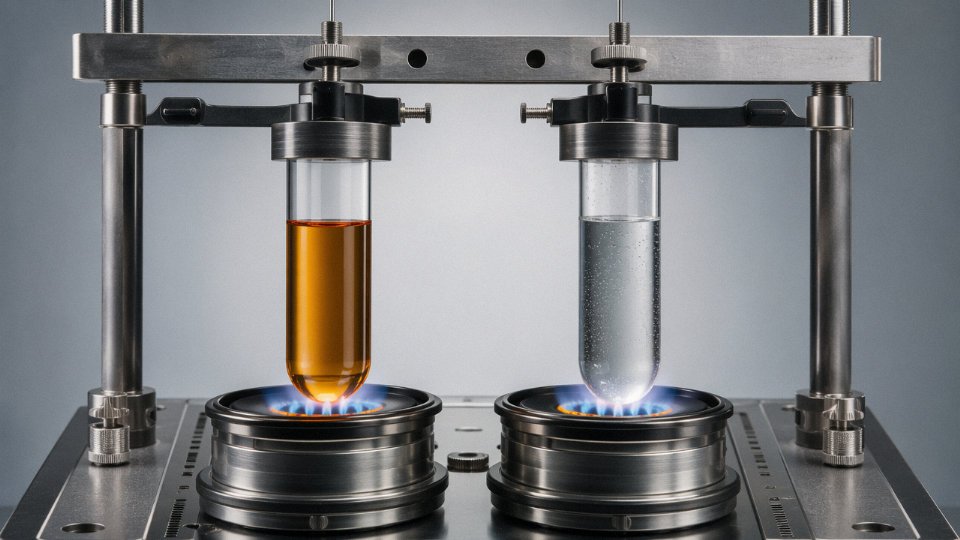
Engine oil has a fundamentally different thermal problem. Above roughly 120°C — and modern turbocharged engines routinely drive oil film temperatures well past that in the ring-belt zone — base oil hydrocarbons begin forming hydroperoxides. That’s the trigger. Hydroperoxide decomposition kicks off chain-branching free-radical oxidation that accelerates nonlinearly with temperature, generating acidic species, sludge, and varnish precursors. The acids attack bearing copper-lead or bi-metal surfaces directly. The varnish deposits on valve train components and, in severe cases, hydraulic lash adjusters start sticking.
This is why engine oil is packed with antioxidants: ZDDP handles peroxide decomposition and provides some anti-wear coverage on the zinc-phosphate chemistry, hindered phenols and aromatic amines mop up radicals. The problem is that those additives are consumed over service — they don’t regenerate. Oil change intervals of roughly 5,000–15,000 km (depending on engine design, oil quality tier, turbocharging, and drive cycle severity) exist precisely because the antioxidant package depletes before the base oil itself is fully degraded. Run it past depletion and bearing corrosion and sludge accumulation follow predictably.
Engine oil antioxidant additives are consumed over service life and do not regenerate, which is why drain intervals existTrue
Antioxidants such as ZDDP and hindered phenols react irreversibly with peroxides and free radicals during oxidation, reducing their concentration over time. Once depleted, the base oil is unprotected and oxidation accelerates — this is well-documented in used-oil analysis literature and is the mechanistic basis for oil change intervals.
Silicone oil doesn’t manage oxidation — it largely avoids it. The Si–O backbone is inherently more resistant to free-radical oxidation than a hydrocarbon chain. That means no additive depletion cycle, no drain interval, and stable viscosity over long service in sealed mechanisms. Industrial oven chains running at 200–250°C in textile finishing plants sometimes run silicone lubricants for six to twelve months between reapplication where a mineral oil would carbonize within weeks.
Where the Trade-Offs Bite Back
Thermal conductivity of PDMS is only around 0.15–0.16 W/m·K — roughly a quarter of water’s 0.6 W/m·K. That matters in heat exchanger design: you need larger surface area or higher flow rate to transfer equivalent heat. For oil baths, laboratory heating mantles, and industrial immersion heaters operating between 150 and 300°C, the stability advantage outweighs the conductivity penalty. For applications demanding aggressive heat removal, water-glycol or synthetic esters often beat silicone oil despite the narrower thermal window.
Volatility deserves a mention. SAE 5W-30 engine oil typically loses 8–13% by NOACK evaporation test (ASTM D5800). A comparable-viscosity silicone oil loses under 1–2%. In long-service sealed mechanisms — actuators, precision instrument pivots, some aerospace hydraulic systems running continuous 200°C cycles — that low evaporative loss means the fluid stays in grade for years rather than months.
One genuine environmental concern: thermal or oxidative breakdown of PDMS at extreme conditions produces volatile cyclic siloxanes, notably D4 and D5. Both are persistent in the environment and regulated in some jurisdictions. Open-system high-temperature applications with poor exhaust management can accumulate these species. It’s not a reason to avoid silicone oil in its legitimate applications, but vapor recovery or enclosed system design should be part of the specification conversation, especially in food-adjacent or pharmaceutical facilities.
Electrical, Chemical, and Material Compatibility: Dielectric Properties and Seal-Fluid Interactions
Lubrication is only part of the story. Once you step outside the tribology conversation, silicone oil and engine oil diverge so sharply that they almost stop being comparable products at all.
Dielectric Strength and Electrical Resistivity
PDMS silicone oil achieves dielectric strength in the range of 15–20 kV/mm under ASTM D877 test conditions — the exact figure depends on viscosity grade, purity, and whether the fluid has absorbed any moisture. Engine oil typically measures 10–14 kV/mm under the same protocol. That gap sounds modest, but electrical resistivity tells the more important story: PDMS sits above 10¹³ Ω·cm, while engine oil, loaded with polar additive chemistry, runs closer to 10⁹–10¹⁰ Ω·cm. Four orders of magnitude. That difference is why silicone oil is a genuine dielectric fluid used in high-voltage transformers, power capacitors, and — more recently — EV battery thermal management systems where the coolant can come into close proximity with live bus bars or cell terminals. Engine oil would short things out. Silicone oil won’t.
In EV thermal management specifically, the push toward immersion cooling has made dielectric fluid selection genuinely critical. Using a fluid with inadequate resistivity in a direct-immersion pack isn’t just a performance issue — it’s a fire and warranty liability.
Chemical Inertness vs. Designed Reactivity
Silicone oil is chemically boring, and that’s the point. It doesn’t react with most metals, plastics, or elastomers under ambient and moderate thermal conditions. Engine oil is the opposite: it is chemically active by design. The zinc dialkyldithiophosphate (ZDDP) antiwear package, the sulfur-based extreme-pressure additives, the detergent/dispersant system — all of these work by reacting with metal surfaces, acid species, and combustion byproducts. That reactivity is a feature in an engine. In any other context, it’s a liability. Put engine oil against a polycarbonate housing or a PEEK seal seat and you’re gambling on whether the additive package attacks the polymer.
Silicone oil (PDMS) is chemically inert and does not react with most metals or engineering plastics under normal service conditions.True
PDMS has a stable Si-O backbone with methyl side groups that are non-polar and non-reactive toward most substrates at ambient and moderate temperatures. This inertness is documented across medical device, food processing, and electrical insulation applications.
Polymer and Elastomer Compatibility
This is where plant maintenance teams get burned. Silicone oil is generally safe with PTFE, PEEK, polycarbonate, and most rigid thermoplastics. It causes measurable swelling in natural rubber and neoprene — sometimes 20–40% volume swell depending on fluid temperature and exposure time, which is enough to jam a valve or seize a seal gland. Engine oil degrades most non-oil-rated plastics through plasticizer extraction and surface crazing, while it intentionally swells some nitrile and fluorosilicone rubber seals just enough to maintain sealing contact under pressure. The irony: engine oil is incompatible with silicone rubber, and silicone oil is incompatible with the rubber types that engine oil tolerates fine. Get the seals wrong and you’re looking at either a weeping leak or an unpressable fitting within weeks.
Medical and Food-Grade Applications
USP-grade PDMS is FDA 21 CFR 178.3570 compliant for incidental food-contact lubrication. It’s used inside pharmaceutical syringes as a plunger lubricant, in ophthalmic surgery as a vitreous tamponade fluid, and as a lubricating film in implantable device components. Engine oil contains ZDDP-derived zinc, sulfur compounds, and — in used form — polynuclear aromatic hydrocarbons (PAHs) and combustion-derived heavy metals. It is never food-safe, full stop.
Hygroscopicity and Crankcase Moisture
Silicone oil absorbs less than roughly 0.1% water by weight under typical ambient conditions. Engine oil, by contrast, accumulates water during cold-start condensation cycles — short-trip driving in humid climates is the classic scenario — which promotes bacterial and fungal growth in the crankcase and accelerates additive depletion through hydrolysis. This is a real maintenance concern in fleet vehicles doing a lot of short urban runs. In a closed silicone oil system, such as a transformer or a laboratory bath, that problem simply doesn’t arise.
Environmental and Regulatory Disposal
Neither fluid gets a clean bill of environmental health. The EU’s REACH regulation has placed restrictions on cyclic siloxanes D4 and D5 — found as trace impurities or intentional components in some silicone formulations — because of persistence and bioaccumulation in aquatic sediments. Linear PDMS itself degrades in soil via abiotic hydrolysis, but slowly. Used engine oil is classified as hazardous waste in most jurisdictions, carrying PAHs, heavy metals from additive chemistry, and combustion-derived soot. Both fluids require controlled collection and disposal; neither belongs down a drain. In practice, used silicone oil from a clean thermal bath is simpler to handle than used crankcase oil, but “simpler” is not the same as “unrestricted.”
Cost, Sourcing, and Lifecycle Economics: When the Premium Price of Silicone Oil Is Actually Cheaper
The sticker shock is real. Industrial-grade PDMS silicone oil at 100 cSt runs somewhere between $8 and $40 per liter depending on purity, supplier, and order volume — pharmaceutical-grade or ultra-low-volatility grades sit at the top of that range. A full synthetic SAE 5W-30 engine oil costs $1–$6 per liter through most industrial and automotive distributors. That’s a 5–10× unit price premium for silicone oil, which is enough to get a procurement manager to close the tab.
That per-liter comparison is the wrong calculation for most applications where silicone oil is legitimately specified.
Service Life Changes the Math Entirely
In a sealed, low-shear application — a rotary damper, a transformer bath, a constant-force hinge mechanism — silicone oil doesn’t get depleted by combustion byproducts, doesn’t oxidize meaningfully at moderate temperatures, and isn’t contaminated by fuel dilution or soot. A well-designed sealed PDMS fill can realistically operate 5 to 20 years without change-out, with the range depending on operating temperature (high heat above 200°C accelerates oxidation even for silicone), whether the system is truly sealed or breathes, and the starting viscosity grade. At 150°C continuous in a properly sealed housing, 10+ years is a reasonable expectation.
Engine oil doesn’t get that luxury. Drain intervals of 5,000–15,000 km (or roughly 6 months to 2 years under mixed-use industrial conditions) mean you’re buying the fluid repeatedly, paying a technician to drain and refill it, and disposing of hazardous waste every single cycle — for the entire operational life of the equipment.
TCO Worked Example: Industrial Oven Chain
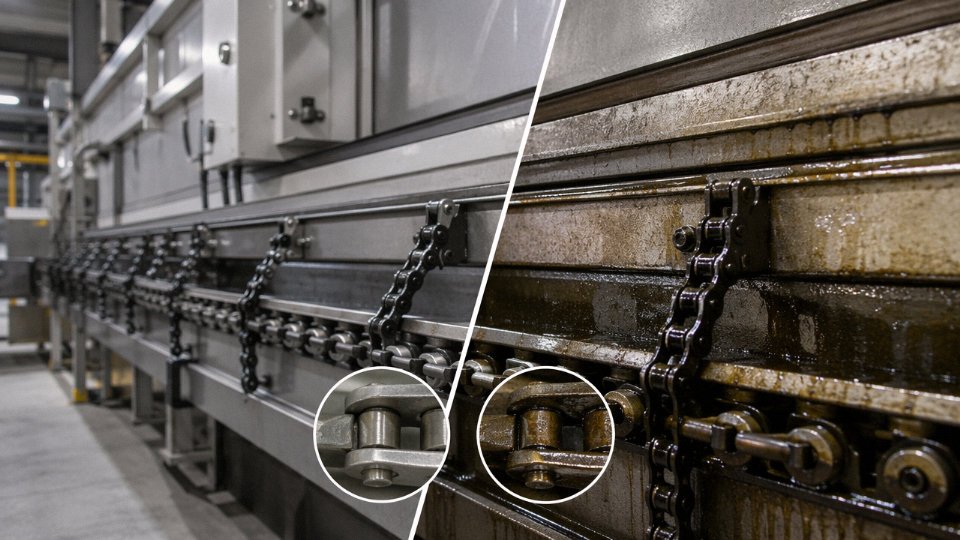
Take a continuous baking or coating oven running a chain lubrication system. Mineral-based chain oil at around $3/liter needs replenishment every 4–6 months under typical conditions (depends on oven temperature, chain speed, and whether you’re using a drip-feed or spray system). Over ten years that’s roughly 20 replenishment cycles. Add the labor — on a busy plant floor, a maintenance tech spending 2–3 hours per service event is not unusual — plus the downtime cost of even a partial shutdown, and the per-liter price of $3 starts looking less attractive.
Silicone oil at $25/liter in the same system, if the application is correctly matched to a high-viscosity grade suited to elevated oven temperatures, can extend service intervals to 2–4 years. Over the same 10-year window, total cost including fluid, labor, and lost production during servicing often comes out 30–50% lower for the silicone option. That range is wide because it depends heavily on local labor rates and how aggressively the plant accounts for downtime — in a high-throughput operation, even a 4-hour chain service event carries real production cost.
Silicone oil's higher unit cost is offset by longer service life in sealed or low-contamination systems, resulting in lower total cost of ownership in many industrial applications.True
In applications such as sealed dampers, transformer baths, and oven chain lubrication where silicone oil's chemical stability prevents degradation, documented service intervals of 5–20 years make the lifetime fluid and labor cost lower than frequently replaced petroleum-based oils, despite the 5–10× unit price differential.
Waste Disposal: The Hidden Cost Line
Used engine oil is classified as hazardous waste in most jurisdictions. Disposal typically costs $0.10–$0.50 per liter through licensed collectors, and that assumes you’re generating enough volume to get a competitive rate — small shops sometimes pay more. Silicone oil disposal runs $0.50–$2.00 per liter as a specialty waste stream, which sounds worse until you account for the volume differential. A system that generates 200 liters of used engine oil over ten years versus 20–30 liters of silicone oil produces a very different disposal bill in practice.
Sourcing Risk Is Real and Often Ignored
Engine oil has one of the most diversified supply chains in industrial materials. Hundreds of blenders, regional distributors everywhere, and strong availability even in remote or developing markets. If your usual supplier falls short, you find another one by next week.
Silicone oil is different. The global PDMS supply base is genuinely concentrated — Dow, Wacker, Shin-Etsu, and Momentive account for the majority of production capacity. When upstream siloxane feedstock tightens (and it does, particularly when semiconductor and personal care demand spikes), lead times stretch and spot prices move sharply. Any procurement plan for a silicone-oil-dependent system should carry safety stock or a long-term supply agreement. This isn’t hypothetical; plants that learned this lesson informally tend to remember it.
The Grade Selection Cost Trap
One avoidable cost mistake: specifying a higher purity or higher viscosity grade than the application actually requires. Medical-grade PDMS, with its stringent extractable and leachable testing, can cost 3–5× more than an equivalent industrial grade. For an industrial shock damper or a transformer cooling bath, that premium buys nothing functional. Similarly, specifying a 10,000 cSt grade when 500 cSt would perform identically at operating temperature just adds cost with no benefit. Get the application specification right first, then buy to that spec — not to whatever grade a datasheet happens to feature.
Application Decision Matrix: Which Fluid Belongs in Which System
The fastest way to cause expensive, preventable damage in a plant or under a hood is to treat these two fluids as functionally similar. They are not. The decision tree is actually fairly clean once you anchor it to contact stress, temperature range, and electrical environment.
Internal Combustion Engines — Engine Oil, No Exceptions
Gasoline, diesel, natural gas engines: always a qualified engine oil meeting the OEM’s API/ACEA specification. Full stop. Silicone oil carries none of the zinc dialkyldithiophosphate (ZDDP) or other antiwear chemistry that protects cam lobes, lifters, and ring-liner interfaces under boundary lubrication. It has no EP additives, no detergent-dispersant package, and — critically — it does not swell the nitrile and fluoroelastomer seals that engine designers sized assuming a hydrocarbon fluid. Run silicone oil in an engine and you are looking at measurable wear within hours and catastrophic failure not long after. This is not a theoretical concern. The viscosity alone is not what lubricates an engine; the additive stack does most of the heavy lifting under start-up conditions.
Silicone oil can substitute for engine oil in an emergency if the viscosity is matched to the SAE grade.False
Viscosity matching is irrelevant here. Silicone oil lacks antiwear additives (ZDDP), EP protection, detergency, and the seal-swell characteristics that engine seals require. Using it in a combustion engine will cause rapid metal-on-metal wear and seal leakage regardless of viscosity.
Shock Absorbers and Hydraulic Dampers
Silicone fluid — most often a PDMS product like the Dow Corning 200 Fluid series in the 50–1,000 cSt range — is widely specified here precisely because its viscosity barely changes with temperature. A damper tuned at the factory will behave consistently from a cold desert morning at -20°C to a hot track surface pushing fluid temperatures toward 120°C. Engine oil’s viscosity index, even with a good VI improver package, cannot match that stability. The practical result of using engine oil in a precision damper is inconsistent force response — the suspension feels loose on a cold day and stiff when hot, which is the opposite of what the engineer designed for.
High-Temperature Chain and Conveyor Lubrication
Above roughly 150°C, mineral-based engine oil carbonizes. It does not just vaporize cleanly; it leaves hard, varnish-like deposits that jam chain side plates and sprocket teeth. A paint oven conveyor chain running at 200–230°C needs a fluid that stays fluid and doesn’t build up. Silicone oil handles this range without carbonizing. The cost of cleaning baked-on hydrocarbon deposits from a long conveyor chain — often requiring soak tanks, wire brushing, and several hours of labor — typically dwarfs the price premium of using the right fluid from the start.
Electric Motor and Transformer Cooling
Dielectric-grade silicone oil is the correct choice. Engine oil contains sulfur compounds (even low-sulfur grades carry some), and its electrical conductivity is high enough to risk tracking and shorts in transformer windings or motor end-bell pools. Sulfur also corrodes copper windings over time in warm, confined spaces. Silicone fluid’s dielectric strength runs 15–25 kV/mm depending on grade and contamination level — significantly higher than a comparable mineral oil.
Enclosed Industrial Gearboxes
Do not use silicone oil in gear sets. Its film strength under high tooth-contact pressure is poor, and PDMS shears down under the cyclic loading in a helical or worm gear mesh. The result is gear pitting, sometimes within a few thousand hours of operation. Use a dedicated gear oil with an appropriate GL rating, or a synthetic PAO if thermal range demands it.
Plastic, Rubber, and Light-Load Sliding Interfaces
Medical actuators, office equipment, consumer device hinges — silicone oil is effectively the default here. It is inert to most engineering plastics (ABS, polycarbonate, acetal), it does not stain, and it works well at the low contact pressures involved. Engine oil would swell certain rubbers, leave oily residue on plastic surfaces, and in a white-room or food-contact environment it is simply not acceptable.
Vacuum Systems and Diffusion Pumps
PDMS-based silicone fluids dominate diffusion pump applications because their vapor pressure at operating temperature is genuinely low — in the range of 10⁻⁷ to 10⁻⁸ mbar depending on grade. Engine oil’s lighter hydrocarbon fractions volatilize readily at pump temperatures, back-streaming into the vacuum chamber and contaminating whatever process is running there. In semiconductor or thin-film deposition work, that contamination can scrap an entire batch.
| Application | Correct Fluid | Key Reason |
|---|---|---|
| ICE (gas/diesel/NG) | Engine oil (API rated) | Antiwear additive package, seal compatibility |
| Shock absorbers / dampers | Silicone oil (PDMS) | Temperature-stable viscosity, consistent damping |
| Oven/conveyor chain >150°C | Silicone oil | No carbonization, no deposit buildup |
| Transformer / motor cooling | Dielectric silicone oil | High dielectric strength, no sulfur corrosion |
| Enclosed gearboxes | Gear oil (GL-rated) or PAO | EP film strength, shear stability |
| Plastic-on-plastic, light load | Silicone oil | Chemical inertness, no plastic degradation |
| Diffusion / vacuum pumps | PDMS silicone fluid | Ultra-low vapor pressure |
The underlying decision rule is straightforward: high-load metal-on-metal contact demands a fluid with a real tribological additive package — engine oil or a dedicated gear/hydraulic oil. Anywhere the job is thermal management, electrical isolation, compatibility with polymers and elastomers, or stable behavior across an extreme temperature range at low contact stress, silicone oil is the right call. Trying to optimize cost by cross-using these fluids in the wrong application almost always costs more in downtime and hardware than the fluid savings ever justify.
Frequently Asked Questions: Silicone Oil vs Engine Oil
Can I use silicone oil instead of engine oil in my car?
No. Full stop. This is the most dangerous misconception in the entire silicone-vs-petroleum conversation, and it comes up more often than it should.
Engine oil works because of what’s in it beyond the base fluid — zinc dialkyldithiophosphate (ZDDP) for antiwear protection on cam lobes and lifters, detergents to suspend combustion soot, dispersants, extreme-pressure additives for the valve train. Silicone oil contains none of that. It’s a pure polysiloxane fluid. Pour it into an engine crankcase and you’ll see accelerated metal-on-metal wear within the first few hours of operation, oil passages partially blocked by seal debris (more on that below), and eventually bearing failure. The engine doesn’t care that the fluid looks clean and feels slippery. Lubricity under high-load boundary conditions requires the additive chemistry, and silicone oil simply doesn’t have it.
Using silicone oil as a crankcase lubricant in place of engine oil will cause engine failure.True
Silicone oil lacks the antiwear (ZDDP), detergent, dispersant, and EP additive packages that engine oil requires to protect metal surfaces under the load, temperature, and contamination conditions inside an internal combustion engine. Without these additives, wear rates increase dramatically within hours of operation.
Is silicone oil the same as synthetic engine oil?
A common point of confusion, and understandable — both carry the word “synthetic.” Synthetic engine oils like PAO (polyalphaolefin) or ester-based formulations are still hydrocarbon-derived lubricants, engineered to have better viscosity index and oxidative stability than mineral oil, but blended with the same class of additive packages. Silicone oil is a polysiloxane polymer — chemically a completely different family. Calling them both “synthetic” is a bit like calling both polyester fabric and polycarbonate plastic “synthetic materials.” Technically true, functionally irrelevant.
Can silicone oil damage rubber seals in an engine?
Yes, and this is a real failure mode. Most engine seals — crankshaft seals, valve stem seals, O-rings in the oil circuit — are nitrile rubber (NBR) or neoprene. Both materials absorb silicone oil and swell noticeably, typically 10–25% volume increase depending on grade and exposure time, though the exact figure depends on the specific elastomer compound and fluid viscosity. That swelling distorts the sealing geometry, increases friction on dynamic seals, and eventually causes leakage. In practice, by the time you notice the oil drips, the seal has already deformed past its elastic recovery limit.
Why is silicone oil used in shock absorbers instead of engine oil?
Consistent damping force across the full operating temperature range. A shock absorber running on engine oil will feel progressively softer after hard use — say, a track session or a loaded truck on a rough road — because the oil’s viscosity drops sharply as it heats up. Silicone damper fluid maintains viscosity far more consistently from roughly -40°C to well over 150°C. That’s the viscosity index advantage (VI 150–300+ for silicone versus roughly 100–160 for a good synthetic engine oil) translated directly into predictable suspension behavior. For performance and motorsport applications especially, that consistency matters more than cost.
Is silicone oil safe for food-contact applications?
USP-grade and H1-designated food-grade PDMS silicone oils are FDA-compliant and meet EU food-contact regulations for incidental lubrication — conveyor guides, filling machine components, oven chain lubrication in food processing plants. Engine oil is categorically not food-safe. The sulfur compounds, zinc, phosphorus, and various other additive components are toxic, and no regulatory body anywhere classifies engine oil as acceptable for any food-adjacent contact.
How do I dispose of used silicone oil versus used engine oil?
Used engine oil is regulated hazardous waste in virtually every jurisdiction — it must go to a certified collection or re-refining facility. Don’t pour it out, don’t burn it without proper equipment. Used silicone oil is generally not classified hazardous under most frameworks, but it’s still a specialty chemical waste and shouldn’t go to drain. Check with your local waste authority before disposal; some regions treat high-viscosity silicone waste differently from low-viscosity grades, and the rules do vary.
Does silicone oil conduct electricity?
It does not. Silicone oil is an excellent dielectric, with breakdown strength typically in the 15–20 kV/mm range depending on purity and viscosity grade — figures that hold up well even at elevated temperatures, which is why it’s used in transformers and high-voltage switchgear. Engine oil is a poor insulator and degrades further as it picks up conductive combustion byproducts. Never use engine oil in any electrical application expecting insulation.