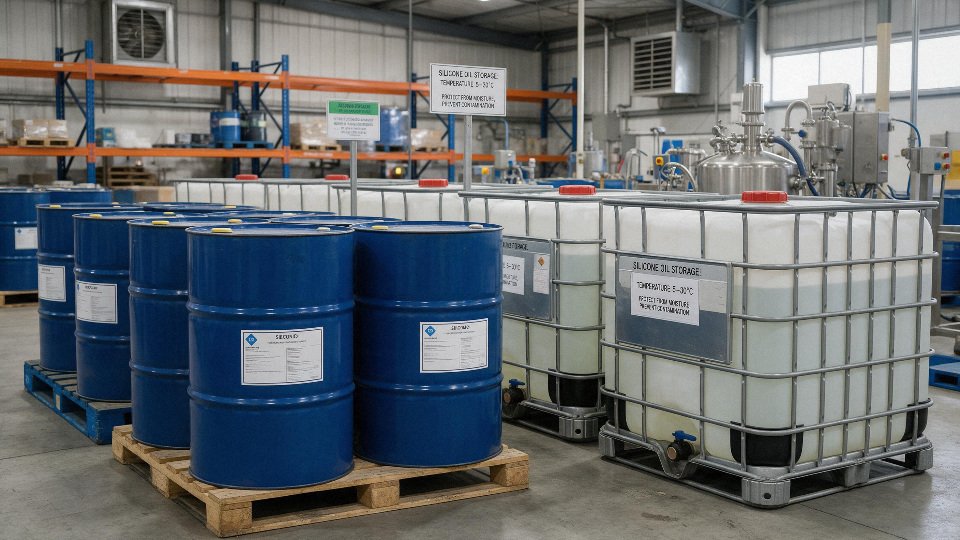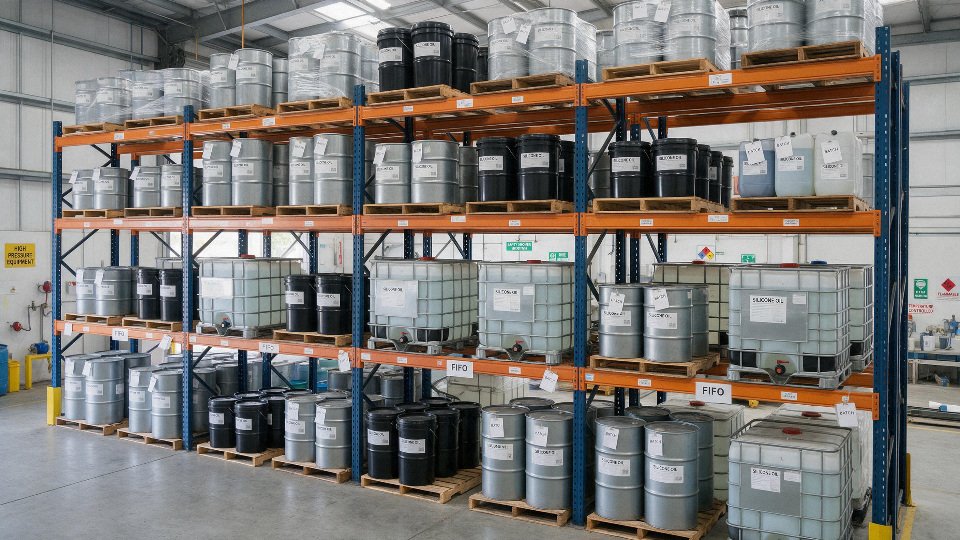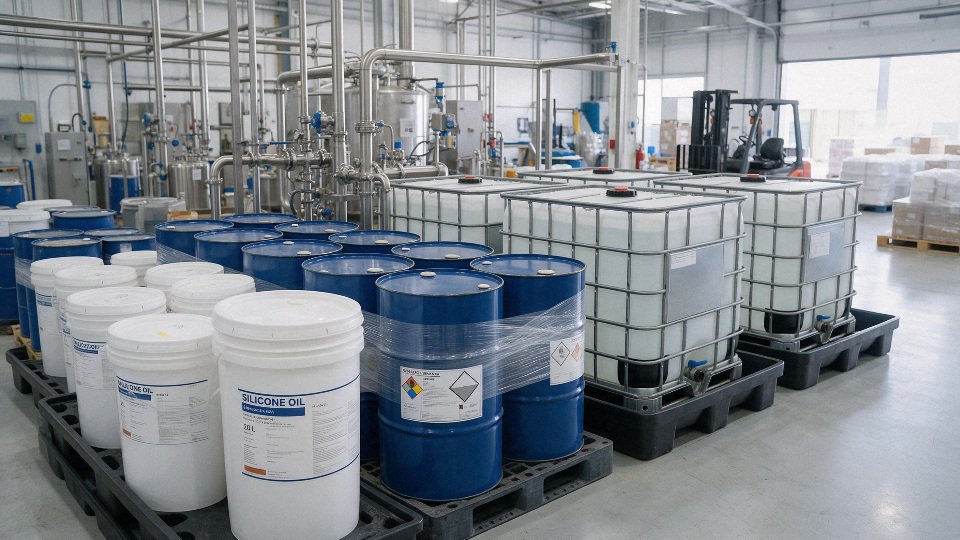
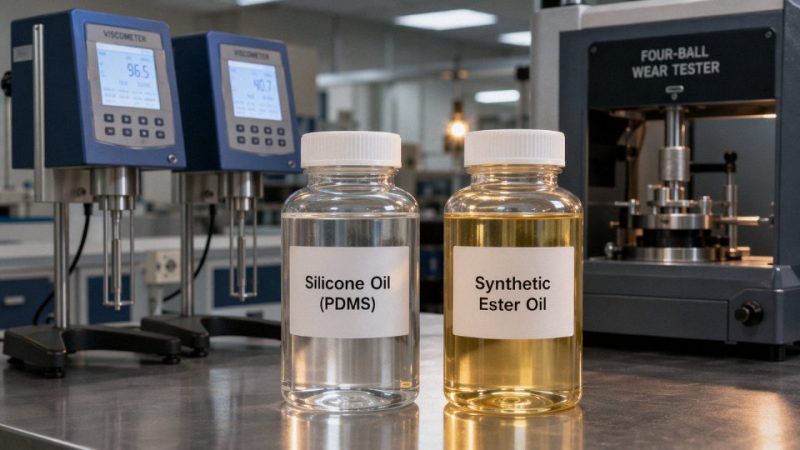
Specifying the wrong specialty fluid for a hydraulic system or gearbox isn’t just a technical embarrassment — it shows up as premature bearing wear, seal degradation, or a fluid change interval that makes no economic sense. Engineers running high-temperature ovens or cryogenic test rigs reach for silicone oil because nothing else stays pourable at -55°C and stable past 180°C in the same pour. But procurement managers who see the per-kilogram price on silicone and then look at ester oil quotes start asking hard questions, and those questions deserve real answers rather than datasheet summaries.
Silicone oil (PDMS) and ester oils serve genuinely different applications. Silicone oil offers a viscosity index of roughly 200–400 and a continuous service range from -60°C to +200°C, making it the default for extreme-temperature or chemically inert applications. Synthetic ester oils run -50°C to +170°C, cost $4–$15/kg versus $8–$25/kg for bulk silicone, biodegrade at 60–90% (OECD 301B) compared to under 10% for silicone, and deliver meaningfully better boundary lubricity — wear scar diameters of 0.35–0.55 mm versus 0.65–1.10 mm under ASTM D4172 conditions.
What makes the comparison genuinely complicated is that the property where silicone wins biggest — that extraordinary temperature stability — is almost irrelevant in a standard industrial gearbox running at 80°C, where ester oil’s lubricity advantage quietly saves bearing life every hour. The decision isn’t really about which fluid is better. It’s about which failure mode you’re most trying to avoid.
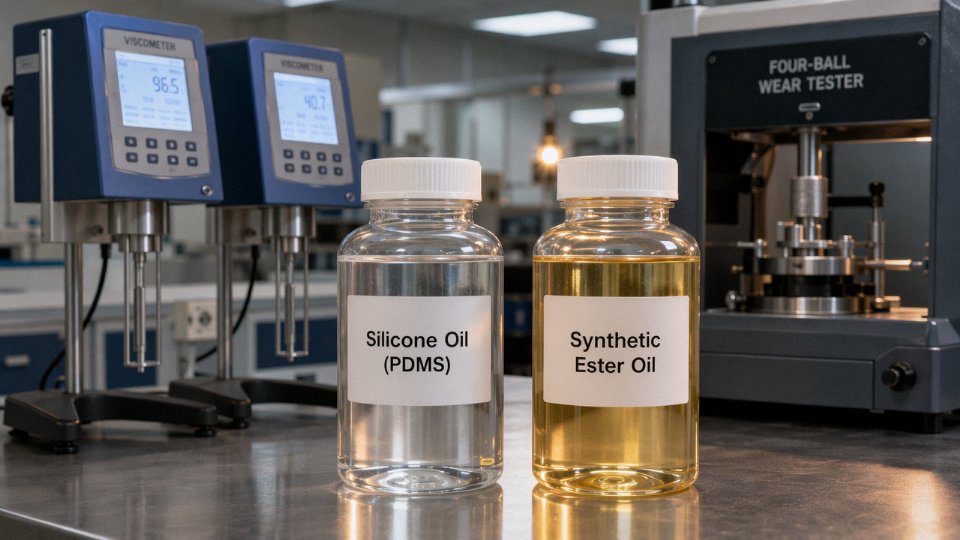
Molecular Architecture and Base-Fluid Chemistry of Silicone vs. Ester Oils
The performance gap between these two fluid families isn’t arbitrary — it’s baked into their atomic structure, and once you understand that, a lot of the spec-sheet numbers stop being surprising.
The Siloxane Backbone: Why PDMS Behaves the Way It Does
Polydimethylsiloxane (PDMS) is built around a repeating Si–O–Si chain. The Si–O bond energy sits around 445 kJ/mol, which is noticeably higher than the C–C backbone of most organic fluids (~350 kJ/mol). That extra bond strength is the direct reason silicone oil resists thermal cracking at temperatures where a mineral oil would already be carbonizing on your heater surfaces. Continuous service to +200°C is achievable in practice, though I’d be conservative with anything above +180°C unless you’ve verified headspace oxygen levels are controlled — oxidative degradation still occurs even when the backbone itself is stable.
The Si–O–Si chain also has unusually low rotational barriers. The backbone is genuinely flexible at a molecular level, which suppresses the viscosity-temperature sensitivity that plagues most hydrocarbon fluids. That’s the structural origin of the viscosity index running 200–400 for commercial PDMS grades — roughly double what you’d get from a good polyol ester. Pendant methyl groups extend outward from this backbone, creating a non-polar, low-surface-energy exterior. Useful for release applications and electrical insulation. A problem for anything requiring metal wetting or boundary lubrication.
The Si–O bond in PDMS has higher thermal stability than the C–C bonds in conventional hydrocarbon base oils.True
Si–O bond dissociation energy is approximately 445 kJ/mol versus roughly 347 kJ/mol for C–C, which directly contributes to the higher thermal ceiling of silicone oils compared to mineral or standard synthetic hydrocarbons.
Ester Chemistry: How the Synthesis Route Determines Performance Class
Esters are made by reacting an alcohol with a carboxylic acid or acid anhydride — straightforward condensation chemistry, but the specific alcohol and acid chosen determine almost everything that matters operationally.
Linear diesters (think sebacates, adipates) use straight-chain components. They have decent low-temperature flow and reasonable lubricity, but the linear structure exposes more of the backbone to oxidative attack. Neopentyl polyol esters — built on pentaerythritol or trimethylolpropane — are a different animal. The quaternary carbon center in pentaerythritol has no beta-hydrogen atoms, which blocks the primary oxidative degradation pathway. This is why a good polyol ester in a jet engine accessory gearbox survives conditions that would destroy a diester in a fraction of the service interval. For most industrial polyol ester grades, continuous service reaches roughly -50°C to +170°C, which covers the vast majority of rotating equipment applications outside of deliberate high-temperature process duties.
The carbonyl group (C=O) in the ester linkage is polar. That polarity is the structural reason esters wet metal surfaces and adsorb onto oxide layers — which is directly why the four-ball wear scar diameters for polyol esters (typically 0.35–0.55 mm under ASTM D4172) run substantially smaller than PDMS (0.65–1.10 mm under the same conditions). Silicone oil’s non-polar exterior simply doesn’t grip metal the same way. This matters enormously in any application with sliding or mixed-film contact.
That same polarity also makes esters biodegradable. OECD 301B results of 60–90% for synthetic esters versus under 10% for silicone oil reflect a fundamental difference in how biological systems can attack these molecules, not just a formulation decision.
Molecular Weight, Volatility, and What That Means for Your Application
| Property | PDMS (silicone oil) | Polyol ester |
|---|---|---|
| Commercial MW range | ~1,000–100,000 g/mol | ~400–1,200 g/mol |
| Typical flash point | 300°C+ for mid-to-high MW | 240–310°C depending on grade |
| Vapor pressure at 100°C | Very low for MW >5,000 | Moderate; grade-dependent |
| Volatility concern | Low MW fractions evaporate; can cause deposits | Low MW esters (diesters) more volatile than polyols |
The wide MW range available in PDMS is both an advantage and a trap. Low-viscosity PDMS grades — trimethylsiloxy-terminated oligomers under roughly 1,500 g/mol — carry meaningfully higher vapor pressures and can volatilize from hot surfaces, leaving a silica-like residue that’s nearly impossible to clean from painted surfaces or electronics. Specifying a grade without checking the MW distribution, not just the nominal viscosity, is a mistake I’ve seen made more than once in equipment cooling applications.
Phenyl and Fluorosilicones: Bridging the Gap at a Price
Substituting phenyl groups for some methyl groups in the siloxane backbone changes the picture considerably. Phenylmethyl silicones improve radiation resistance and push solubility parameters closer to organic fluids, which helps compatibility with certain seal materials and slightly improves lubricity. Fluorosilicones — with trifluoropropyl substituents — add chemical resistance and reduce the already-low surface energy further, which is valuable in fuel-contact or solvent-splash environments. Neither variant is cheap. Expect to pay a significant premium over standard PDMS, which already runs $8–25/kg in bulk depending on MW grade and purity specification, compared to $4–15/kg for most industrial-grade synthetic esters. Whether the performance bridge is worth it depends entirely on which specific gap you’re trying to close — radiation resistance and solvent compatibility are very different problems from bearing lubrication.
Viscosity–Temperature Behavior and Flow Performance Across Operating Ranges
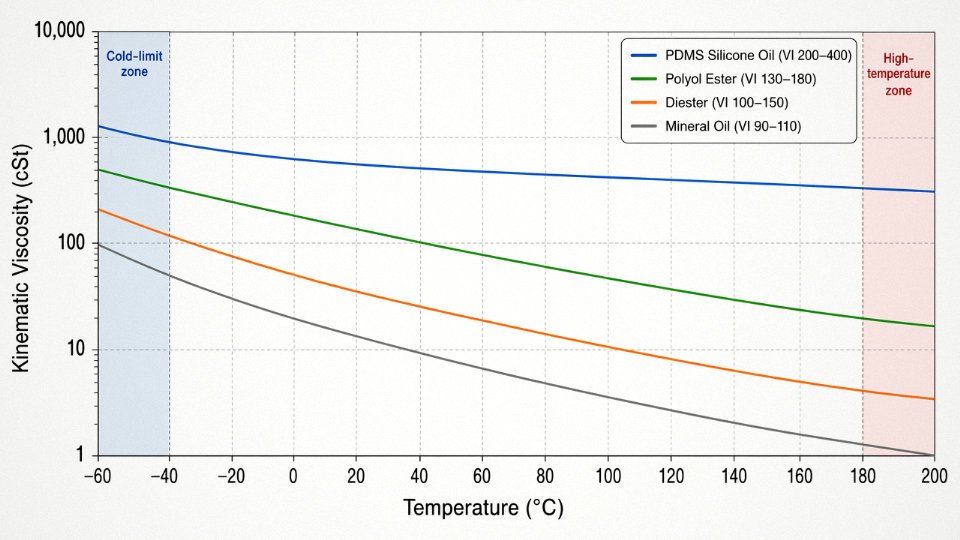
The viscosity index — calculated per ASTM D2270 from kinematic viscosity measurements at 40°C and 100°C — is one of those numbers that looks academic until you’re watching a hydraulic press struggle on a January morning or tracking down why a recirculating lube system is running hot in August. Higher VI means viscosity changes less as temperature swings. That’s either irrelevant or critical depending on what the fluid is doing.
PDMS silicone oils typically land between VI 200 and 400, with the exact value depending on chain length and any phenyl substitution — phenylmethyl silicones tend to sit lower in that range. Polyol esters (POEs) run VI 130–180, which is already competitive with most PAOs. Diesters are more modest, usually 100–150. The gap between PDMS and a good POE sounds large, but the practical payoff isn’t uniform across applications.
What a Flat Viscosity Curve Actually Buys You
For wide-temperature instruments — think calibration baths, damping fluid in aircraft gyroscopes, transformer coolants cycling between outdoor winter and full-load thermal rise — silicone’s near-flat viscosity curve is genuinely useful. The fluid you fill in November behaves predictably in July without reformulation or seasonal grade changes. That removes one variable from troubleshooting, which matters more than it sounds when you’re diagnosing erratic sensor response at 3 a.m.
On the energy side, a higher VI reduces the viscosity penalty during cold starts. Pump power scales with fluid viscosity, so a fluid that stays closer to its rated grade at low temperature pulls less parasitic power and generates less heat at startup. In recirculating systems with frequent cold starts — outdoor compressors, agricultural hydraulics, Arctic drilling support equipment — this can reduce cold-start wear meaningfully. How much? Roughly 15–35% lower startup torque compared to a conventional mineral oil at -20°C is a realistic range for PDMS versus a mid-VI mineral, though the comparison against a good POE narrows considerably.
Pour Point and Cold-Limit Performance
Silicone oils typically pour at -60°C to -65°C. Most polyol esters manage -40°C to -55°C depending on branching — heavily branched neopentyl-based POEs push toward the lower end of that range, while linear-chain variants can gel earlier than their data sheet implies if contaminated with water. For aviation hydraulic systems operating above 10,000 m or ground equipment in northern Canada or Siberia in winter, that extra 5–15°C of cold margin in silicone can be the difference between a system that starts and one that doesn’t. This is exactly why some aerospace damper and actuation fluids historically leaned on silicone formulations before the military ester specifications (MIL-PRF-5606, MIL-PRF-83282) matured.
Shear Stability Under Sustained Load
High-molecular-weight PDMS shows negligible shear degradation under the kind of sustained shear you see in high-speed gear systems or journal bearings. The Si–O backbone is not particularly susceptible to mechanical chain scission under typical industrial shear rates. High-viscosity ester blends — particularly those thickened with polymeric VI improvers rather than intrinsically high-VI base stocks — can thin measurably under prolonged shear, dropping toward a lower effective viscosity grade. In a worm gear running continuously at elevated temperature, that thinning increases metal contact and accelerates wear. Worth checking the KRL taper-roller shear stability test (CEC L-45) results before committing to any thickened ester for gear applications.
High-molecular-weight silicone oil (PDMS) shows negligible viscosity loss under sustained mechanical shear compared to polymeric VI-improved ester formulations.True
PDMS shear stability is well-documented in tribology literature; its Si–O backbone resists mechanical chain scission, unlike polymer-thickened oils where the additive chains degrade under shear stress.
Viscosity Grade Range and Where the Comparison Gets Lopsided
The commercial viscosity range available in silicone oils is almost absurd compared to esters: from 0.65 cSt (short-chain trimethylsiloxy-terminated PDMS, lower surface tension than water) up to 1,000,000 cSt pastes that barely flow at room temperature. Ester oils cover roughly 2–460 cSt in standard ISO VG commercial grades, which handles most lubrication and hydraulic needs but leaves gaps at the extremes.
For most plant-floor hydraulic and gear applications, that extreme PDMS range doesn’t matter. But for instrument damping, high-torque rheostats, or silicone transformer fluids where viscosity tuning is part of the thermal design, the breadth of options is genuinely useful.
The one place silicone’s flat viscosity curve actively works against you: traction-dependent drives. CVT transmissions, toroidal drives, and certain friction-based torque limiters depend on the fluid forming a pressurized film with measurable shear resistance — traction. Silicone oil has an unusually low traction coefficient. The same molecular flexibility that stabilizes its viscosity across temperature also means the fluid shears easily under contact stress. Use PDMS in a traction drive and it will behave like a very efficient lubricant in precisely the situation where you want some controlled slip resistance. That’s a scrap-parts or catastrophic-drive-failure scenario, not a minor efficiency loss.
Lubricity, Load-Carrying Capacity, and Anti-Wear Performance Under Mechanical Stress
This is where engineers get burned the most. Silicone oil’s viscosity stability is genuinely impressive — covered in the previous section — and that performance tends to create an assumption that the fluid is a broadly capable lubricant. It isn’t. Under mechanical stress at real contact zones, silicone oil and polyol ester behave like entirely different classes of material, and the gap is not marginal.
What the Four-Ball Wear Test Actually Shows
ASTM D4172 is blunt, reproducible, and hard to argue with. Under standard test conditions (1200 rpm, 40 kg load, 75°C, one hour), polyol ester oils produce a wear scar diameter in the range of 0.35–0.55 mm — the exact figure depends on additive package, ester type (neopentyl vs. trimethylolpropane-based), and test fluid viscosity grade. Silicone oil (PDMS) under identical conditions produces scars of 0.65–1.10 mm. That’s roughly double the wear scar area, which translates to a corresponding reduction in component life in any application where boundary or mixed-film lubrication occurs regularly.
The reason is structural, not a formulation deficiency you can easily additivate away.
Why Silicone Oil Cannot Form a Boundary Film
Ester oils adsorb onto metal surfaces through the carbonyl oxygen of the ester group (C=O). That polar interaction with iron oxide — the native surface layer on steel — creates a physically tenacious, oriented molecular film that persists even when hydrodynamic film thickness collapses at low speed, high load, or cold-start conditions. The film reduces direct asperity contact, which is exactly where wear damage originates.
PDMS has no polar functionality. The siloxane backbone (Si–O–Si) is nonpolar in the sense that it simply doesn’t adsorb competitively to metal oxide surfaces the way a carbonyl group does. Under boundary conditions, silicone oil effectively drains away from the contact zone rather than clinging to it. You can see this in practice: a steel-on-steel journal bearing running through a slow start cycle will show measurably more startup wear with silicone than with a comparable-viscosity polyol ester.
Silicone oil (PDMS) provides equivalent boundary lubrication to polyol ester oil on steel surfacesFalse
PDMS lacks polar functional groups capable of adsorbing to metal oxide surfaces. Polyol esters adsorb via their carbonyl oxygen, forming a tenacious boundary film. Four-ball wear test data (ASTM D4172) consistently shows silicone oil producing wear scars 0.65–1.10 mm vs. 0.35–0.55 mm for polyol esters under identical conditions.
Extreme-Pressure Performance and Additive Response
Gear applications expose this limitation even more sharply. Neat silicone oil typically fails the FZG gear test (A/8.3/90 method) somewhere around load stage 4–5. A well-formulated polyol ester with EP additives routinely passes stage 10–12. That’s not a small difference — it’s the difference between a gearbox fluid and something that will score gear flanks under moderate industrial loads.
The deeper problem is that EP and anti-wear additives don’t work well in silicone. Sulfur-phosphorus EP chemistry relies on the additive decomposing at high-temperature asperity contacts and forming a protective reaction layer. In a nonpolar silicone matrix, the additive tends to phase-separate or simply doesn’t concentrate at the contact zone at the right moment. Formulators have tried; the results are underwhelming compared to what the same chemistry achieves dissolved in an ester base.
Where Ester Oil Clearly Wins in Service
High-speed spindle bearings operating above DN 500,000 are a good benchmark. These bearings run in mixed or boundary lubrication during startup and at dynamic load reversals, and long-term wear accumulates exactly from those moments. Compressor bearings — especially refrigeration compressors where the lubricant sees dilution from refrigerant and frequent load cycling — also depend on boundary film strength to survive. Automotive transmission synchronizers are another obvious case; the synchronizer ring relies on controlled friction and film durability simultaneously, which polyol ester handles and silicone does not.
The Applications Where Silicone’s Weak Lubricity Doesn’t Matter
None of this means silicone oil is the wrong choice across the board. Lightly loaded sliding contacts — think plastic-on-plastic guides, rubber seals against metal housings, or textile machinery where loads are low and surface materials are soft — don’t generate the asperity stress that exposes silicone’s boundary-film weakness. Open-gear rust-prevention coatings, mold release agents, and dielectric damping applications don’t require load-carrying capacity at all. In those uses, silicone’s temperature stability, inertness, and surface properties are genuinely useful, and the lubricity limitation is irrelevant. The mistake is carrying that success into a rolling-element bearing or a gearbox without reconsidering whether the contact mechanics actually match.
Thermal and Oxidative Stability From Cryogenic Conditions to Sustained High Heat
Thermal degradation is where fluid selection decisions stop being theoretical and start costing money — failed seals, clogged filters, shortened drain intervals, and in transformer applications, service interruptions that can run into six figures before you’ve even called a repair crew.
How Silicone Oil Behaves Under Sustained Heat
PDMS-based silicone fluids are genuinely impressive in oxidative stability up to roughly 150–180°C in continuous service. The Si–O backbone is inherently resistant to oxidation because silicon has already been oxidized in the polymer chain — there’s no vulnerable organic carbon site sitting next to a carbonyl group waiting to kick off a radical chain reaction. In practice, a silicone fluid running at 160°C in a sealed instrument enclosure can go years without measurable viscosity drift.
The problem starts above 200°C, and it’s a specific kind of failure that’s easy to miss until it’s too late. Thermal chain scission of the Si–O backbone doesn’t just thin the fluid — it generates low-molecular-weight cyclic siloxanes, primarily D4 and D5. In a semiconductor fabrication environment, those volatiles contaminate wafer surfaces. In any application near a three-way catalytic converter, D4 deposits on the platinum and cerium catalyst sites and deactivates them — sometimes permanently. This is not a theoretical concern; emissions compliance testing failures have been traced to silicone fluid contamination in connected systems. If your application is anywhere near exhaust aftertreatment or clean-room air handling, that risk changes the selection calculus entirely.
Cyclic siloxanes (D4, D5) from silicone oil thermal degradation can poison automotive catalytic convertersTrue
D4 and D5 deposit on precious-metal catalyst sites; this mechanism is well-documented in automotive engineering literature and is why silicone-based greases are excluded from certain drivetrain applications near exhaust systems.
The other failure mode people underestimate: as silicone degrades at high temperature, it also produces insoluble silica gel particles. These are abrasive, they blind filters quickly, and they cause elastomer seals to swell or harden depending on the seal compound. A 10-micron filter element that should last six months can be choked in weeks if a silicone fluid is running too hot.
Ester Oil Degradation Mechanisms Are Different — and Usually More Manageable
With ester oils, oxidative attack begins at the alpha-carbon adjacent to the carbonyl group. This is predictable chemistry, and it’s why formulating around it is possible. Polyol esters — where the alcohol component is a neopentyl polyol like trimethylolpropane or pentaerythritol — lack the beta-hydrogen that makes diesters more susceptible to elimination reactions. That structural difference shows up clearly in RPVOT testing (ASTM D2272): polyol esters typically run 500–900 minutes, depending on antioxidant package and base stock purity, while diesters tend to fall in the 300–500 minute range. Aviation turbine oils are almost universally polyol ester-based for exactly this reason.
The degradation products from ester oxidation are carboxylic acids and, at higher severity, alcohol vapors. Both are detectable — acid number monitoring per ASTM D974 gives you an early warning before the fluid has done mechanical damage. That’s a real operational advantage: you’re managing a gradual, measurable deterioration rather than discovering a silica plug in your filter housing.
Transformer Cooling: A Realistic Service-Life Comparison
Long-term electrical insulation service illustrates where both fluids are genuinely competitive.
Silicone transformer fluid meeting IEC 60836 typically achieves 20–30 year service intervals in sealed transformers, assuming no severe thermal events. The fluid itself is stable, but the silica degradation risk returns if the transformer runs hot during overload conditions.
Ester transformer fluid qualified to IEC 61099 Type II lands in the 20–25 year range — slightly shorter, but with a meaningful operational advantage: ester fluid tolerates moisture ingress better than silicone and is biodegradable, which matters enormously for pad-mounted distribution transformers near waterways or in urban areas where a rupture triggers an environmental incident response.
Application-by-Application Decision Summary
| Application | Preferred Fluid | Key Reason |
|---|---|---|
| Aviation turbine lubrication | Polyol ester | High RPVOT, measurable degradation, OEM spec |
| Wide-temperature instrument bath | Silicone (PDMS) | VI 200–400, stable across -60°C to +180°C |
| Industrial gearbox, continuous duty | Synthetic ester | Load-carrying, manageable acid number monitoring |
| Electrical insulation, urban/sensitive site | Ester (IEC 61099) | Biodegradable, moisture-tolerant |
| Electrical insulation, sealed/arid environment | Silicone or ester | Application-dependent; evaluate overload profile |
| Any application near catalytic aftertreatment | Ester only | Silicone volatiles risk catalyst poisoning |
The bottom line on thermal stability is that silicone oil wins on raw oxidative resistance at moderate temperatures and excels where you need that flat viscosity curve from cryogenic to elevated heat. But its failure modes — silica gel, volatile cyclic siloxanes — are harder to catch early and harder to clean up. Ester oil degrades more, but it tells you when it’s degrading. For most industrial maintenance programs, that predictability is worth something.
Material Compatibility — Elastomers, Plastics, Coatings, and Metals
This is where fluid selection stops being a chemistry exercise and becomes a maintenance problem. Wrong fluid, wrong seal, and you’re looking at a leak within weeks — or worse, a slow weep that contaminates product or ruins a freshly painted surface before anyone notices where it came from.
Silicone Oil and Elastomers
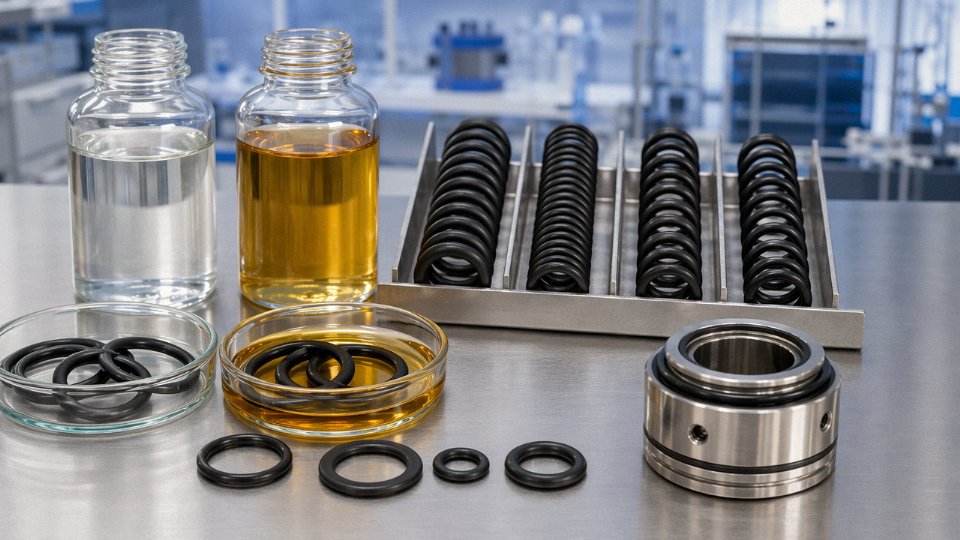
The most counterintuitive failure mode in silicone oil applications is using silicone rubber seals. It seems logical — silicone with silicone — but that’s exactly the problem. Like-dissolves-like applies here directly: PDMS fluid swells silicone rubber seals by roughly 20–30% by volume depending on seal crosslink density and fluid viscosity grade. That much swell distorts the seal geometry, relaxes the compression set, and usually produces a slow leak rather than a dramatic blowout. In practice, by the time you find it, the surrounding area is already contaminated.
Switch to EPDM, neoprene, or FKM (Viton and equivalents) and the picture changes entirely. Volume swell with silicone oil in FKM typically runs below 5%, which is well within normal operating tolerance for a dynamic seal. EPDM holds up similarly well. If you’re designing a system around silicone oil, specifying FKM O-rings is almost always the right call — they’re not the cheapest option, but the cost difference over a neoprene ring is trivial against a seal replacement on a sealed gearbox or a damper unit.
Ester Oil and Elastomers
Polyol esters behave differently, and the aggression comes from polarity. Ester molecules are polar; nitrile rubber (NBR) is moderately polar as well, and the two interact enough to cause 8–15% volume swell in standard NBR — the exact range depends on the ester’s molecular weight and degree of branching, with shorter-chain, higher-polarity esters being the worst offenders. For a lot of older hydraulic equipment spec’d with NBR seals, switching from mineral oil to a synthetic ester without a seal audit is asking for trouble.
FKM and PTFE are genuinely excellent with polyol esters, which is one reason ester-based aviation hydraulic fluids almost universally call for FKM or PTFE seals. That compatibility is well established and reliable across temperature ranges.
Where ester oils catch people off guard is with polyurethane foam gaskets and lacquered surfaces. The polarity that makes esters good lubricants also makes them aggressive solvents toward some polyurethane foams — gasket material in older control cabinets, for instance — and toward alkyd-based lacquers and certain wire varnishes. Worth checking if the fluid path runs anywhere near electrical enclosures or coated components.
Plastics
Silicone oil is broadly safe with most engineering thermoplastics — nylon, ABS, polypropylene, acrylic-free assemblies — but prolonged contact with polycarbonate is a known issue. It won’t crack the PC immediately, but clarity degrades, and stress-cracking can develop over months in loaded parts. If the application involves transparent PC sight glasses or sensor windows, test first.
Ester oils attack polystyrene and PMMA (acrylic) components. Not slowly, either — contact with a high-polarity ester can craze acrylic within hours under mechanical stress.
Metal Corrosion
Silicone oil provides rust protection equivalent to rust-inhibited mineral oil without additivesFalse
Base PDMS has no rust-inhibiting chemistry. Its non-polar, hydrophobic nature can actually allow water to pool rather than emulsify, and without a dedicated rust inhibitor package, ferrous surfaces in humid environments will corrode. Ester oils formulated with rust inhibitor packages routinely pass ASTM D665 A and B; silicone-based systems need the same additive treatment to achieve comparable protection.
Both fluid types need separate inhibitor packages for yellow metals. Copper and brass components are vulnerable regardless of base fluid — neither silicone nor ester offers intrinsic protection there.
Paint and Coatings — the Hidden Cost of Silicone Contamination
This deserves a direct warning: silicone oil is the leading cause of fisheye defects in industrial painting and powder-coat operations. One ppm of PDMS on a metal surface — transferred by a handprint from a silicone-lubricated fitting, or airborne mist from a nearby application — is enough to cause craters in electrostatic coatings. Once silicone contamination gets into a paint shop environment, it’s extraordinarily difficult to eliminate. Rags, gloves, air lines, and personnel all become vectors.
Ester oil contamination is far more manageable. It’s not harmless — any oil on a surface before coating is a problem — but esters are saponifiable, respond to standard alkaline degreasing, and don’t spread at the molecular level the way silicone does. If your facility has any painting or coating operations within the same building, think carefully before introducing silicone-based fluids into the process chain. The productivity cost of a fisheye epidemic in a paint line is not small.
Environmental and Regulatory Profile — Biodegradability, Ecotoxicity, and Food-Grade Status
Fluid selection increasingly gets decided by environmental compliance teams as much as by mechanical engineers — and the gap between silicone oil and synthetic ester is stark once you look at the actual test data.
Biodegradability: Where the Numbers Actually Come From
Under OECD 301B (the standard 28-day ready biodegradability test), polyol esters typically score 60–90% degradation, depending on chain length and ester architecture. Diesters tend to hit the lower end; hindered polyol esters with branched fatty acids can reach the upper range. The regulatory threshold for “readily biodegradable” is 60%, which means most well-formulated synthetic esters clear that bar — not easily, and not every grade, but they do.
Silicone PDMS scores below 10% in the same test. That is not a rounding difference. It reflects the fundamental stability of the Si–O–Si backbone, which soil microorganisms essentially cannot metabolize at any useful rate under ambient conditions. Low aquatic toxicity in short-term tests is sometimes cited as a mitigating factor, and it is true that PDMS has relatively low acute ecotoxicity. The problem is persistence. Under REACH SVHC screening, high-MW cyclic and linear siloxanes carry a P (persistent) classification, and some cyclic fractions (D4, D5, D6) are formally listed as SVHCs. For a procurement manager working on a public-sector forestry or marine contract, that distinction matters more than the acute toxicity number.
Silicone oil is a viable substitute for EAL-certified ester in environmentally sensitive hydraulic systemsFalse
Silicone oil exhibits poor bulk modulus and higher compressibility than mineral or ester-based hydraulic fluids, making it unsuitable for responsive hydraulic control. It also fails EAL biodegradability requirements under OECD 301B, with degradation below 10% versus the 60%+ threshold required for EAL classification in most jurisdictions.
In practice, the compressibility issue is the first failure mode you’ll encounter — spongy controls, sluggish response, potential cylinder drift on loaded equipment. The regulatory problem compounds that. Don’t attempt it.
Medical and Semiconductor Applications
These two categories are where silicone oil’s biological and chemical inertness simply has no ester-based competition. A 5,000 cSt PDMS has been used as intraocular tamponade for decades because it doesn’t hydrolyze, doesn’t produce cytotoxic breakdown products, and maintains optical clarity in an aqueous environment. Ester oils hydrolyze under the same conditions — the resulting fatty acid fragments are not tissue-compatible at those contact durations. In semiconductor fab, ester residues near ultrapure water loops introduce ionic contamination at concentrations that are unacceptable at advanced process nodes. The choice there isn’t really a comparison; it’s a category restriction.
Total Cost of Ownership — Purchase Price, Service Life, Disposal, and System Downtime
Purchase price is the number that shows up on the purchase order, and it’s often the only number procurement sees. That’s where the comparison goes wrong.
Baseline Purchase Price
Bulk PDMS 350 cSt runs roughly $8–$25/kg depending on purity grade and supplier — lower end for technical-grade drum quantities, upper end for low-volatility or medical-grade material. Polyol ester ISO VG 46 hydraulic fluid sits at $5–$12/kg in comparable volumes, so on a per-kilogram basis ester oils frequently look cheaper at the point of purchase. That gap narrows fast once you factor in service intervals, but it’s real and it matters when you’re filling a 500-liter reservoir.
Specialty silicone grades are a different conversation entirely. Phenyl methyl silicone for high-temperature transformer applications, fluorosilicone for solvent-contact service — those run $40–$120/kg, sometimes higher for small lots. If your application actually requires one of those grades, you already know cost isn’t the primary driver. If someone is specifying phenyl silicone where standard PDMS would suffice, that’s a procurement flag worth raising.
Service Life and Annualized Cost
This is where silicone oil’s economics can flip decisively in its favor — under the right conditions. In a sealed instrument bath, a damping dashpot, or a static transformer, PDMS fluid can realistically last 20–30 years with zero fluid changes. The annualized cost of a $20/kg fill in a system that holds 10 kg and runs for 25 years is negligible.
Ester oil in a recirculating compressor or hydraulic system is a different calculation. Polyol ester fluids oxidize and hydrolyze in service; you’re monitoring acid number and water content and typically pulling a fluid change every 4,000–8,000 hours depending on operating temperature, moisture ingress, and whether the system has a proper desiccant breather. Call it every 18–36 months in a typical industrial compressor. Over a 10-year period that’s 3–6 fluid changes plus the sampling and analysis cost — in practice, $300–$900 per change for fluid alone in a mid-size system, plus labor. Silicone in that same dynamic application wouldn’t necessarily last longer in service life terms; it would need different monitoring and might actually change more frequently due to additive depletion. Service-life advantage is application-specific, not universal.
The Hidden Cost of Silicone Degradation Products
Here’s the one that catches people off guard. PDMS doesn’t degrade gracefully under sustained mechanical shear and heat — it can form silica (SiO₂) particulates, essentially microscopic gel fragments, that are nearly insoluble and abrasive. In a fine-filtration system with 3–5 micron absolute filters, those particles load filters fast and can pass into clearances before the filter reaches its differential pressure alarm.
Silicone oil degradation can produce silica gel particles that clog fine filters and cause unscheduled maintenance in dynamic lubrication systems.True
PDMS undergoes thermal and oxidative scission that generates low-molecular-weight cyclic siloxanes and, under sustained high-temperature conditions, amorphous silica particulates — documented in turbine and compressor service where silicone fluids were misapplied.
An unscheduled strip-down on a high-throughput production line to clear a contaminated hydraulic manifold or servo valve stack costs somewhere between $5,000 and $50,000 in lost production per event, depending on line rate and shift structure. One event can wipe out years of fluid cost savings. This isn’t a theoretical risk — it’s the reason most hydraulic OEMs explicitly exclude silicone fluids from warranty coverage on servo systems.
Disposal Cost Adder
End-of-life cost is underweighted in most TCO analyses. Spent silicone oil typically requires specialist high-temperature incineration — it doesn’t co-process cleanly with other waste streams because of the silica ash residue and potential for burner fouling. Expect to pay $0.80–$2.50/kg for compliant disposal, depending on region and waste contractor. Ester oils, particularly those with good biodegradability profiles, often qualify for co-processing or biodegradation pathways at $0.20–$0.60/kg. On a 1,000 kg annual consumption, that’s a $600–$1,900 difference in disposal cost alone — enough to matter in a tight operating budget.
A Practical Decision Framework
| Primary Constraint | Fluid Direction |
|---|---|
| Operating temp >150°C, light load, sealed system | Standard or phenyl PDMS |
| Biodegradability required, moderate temp | Polyol ester |
| High load-carrying, dynamic lubrication | Ester oil (confirmed) |
| Both thermal stability and lubricity critical | Phenyl methyl silicone + ester co-solvent package (evaluate carefully — still maturing) |
| Long service life, minimal fluid contact with seals | PDMS if compatible; ester if seal risk exists |
The blended approach — phenyl methyl silicone with ester co-solvent additive packages — is commercially available from a small number of specialty formulators and genuinely addresses both the thermal ceiling and the lubricity gap. Treat it as emerging technology: demand third-party seal compatibility data and ask for field reference sites before committing to a large system fill.
Frequently Asked Questions About Silicone Oil vs. Ester Oils
Can silicone oil and ester oil be mixed in the same system?
No — and this catches people out more often than it should. PDMS is a non-polar siloxane fluid; synthetic esters are highly polar. They are thermodynamically incompatible, and blending them doesn’t produce a stable intermediate fluid — it produces phase separation, usually within hours at operating temperature. What you get in practice is a gelatinous sludge, precipitation of any amine or zinc-based additives already dissolved in the ester, and almost immediate seal swelling behavior that satisfies neither fluid’s compatibility profile. If you’re converting a system from one fluid to the other, flush thoroughly with a compatible neutral solvent — naphthenic mineral oil works for the ester-to-silicone direction; get the solvent recommendation in writing from your fluid supplier before you start. Skipping the flush and just topping up is how bearing housings get destroyed quietly over a few hundred operating hours.
Is silicone oil safe for food contact?
NSF H1-registered silicone oils are permitted for incidental food contact under FDA 21 CFR 178.3570, and they’re genuinely widespread in bakery conveyor systems, bottling lines, and meat-processing equipment where a small amount of lubricant migrating onto product surface is practically unavoidable. The key word is incidental. These fluids are not approved for intentional ingestion or direct food additive use, so the distinction matters operationally — chain lubricant on a conveyor that occasionally contacts a bread loaf is acceptable; a release agent applied directly to food contact surfaces where it becomes part of the product is a different regulatory conversation entirely. Always verify the specific product’s NSF registration number; “food-grade silicone” as a marketing claim means very little without that documentation.
Why does silicone oil fail as a gear lubricant?
The siloxane backbone is non-polar. It cannot adsorb onto steel surfaces to form the thin boundary film that actually carries load when the hydrodynamic wedge collapses under impact or high contact pressure. Ester molecules, by contrast, bond weakly to metal oxide layers through their carbonyl groups, maintaining a protective film even at near-zero sliding speed. In a gear mesh, that difference shows up fast — four-ball wear scar diameters for silicone oils run roughly 0.65–1.10 mm under ASTM D4172 conditions versus 0.35–0.55 mm for esters, depending on additive package and load. EP additives behave poorly in silicone matrices too; the sulfur-phosphorus chemistry that works in mineral or ester carriers simply doesn’t activate the same way in a PDMS base. Using silicone oil in a worm gear or helical gearbox expecting ester-level protection is a fast path to pitting and early tooth failure.
EP additives are as effective in silicone oil as in mineral oilFalse
EP additives rely on polar activation mechanisms that function poorly in non-polar PDMS matrices; their load-carrying effectiveness is significantly reduced compared to mineral or ester base fluids.
What is the difference between diester and polyol ester performance?
It comes down to molecular structure at one specific location. Diester molecules — adipates, azelates, sebacates — have hydrogen atoms on the carbon adjacent (beta position) to the ester group. At temperatures above roughly 150°C those beta-hydrogens facilitate thermal cracking and acid formation. Polyol esters built on pentaerythritol or neopentyl glycol have no beta-hydrogen atoms in that position, which effectively blocks that degradation pathway. In practical terms: diester oils are cost-effective and perfectly adequate for moderate-duty applications below about 120°C, but push them into sustained 150°C+ service and the acid number climbs, viscosity drifts, and varnish deposits form on hot surfaces. Jet engine lubricants and high-performance compressors overwhelmingly use polyol esters for this reason. For a standard industrial hydraulic system running under 100°C, spending the premium on polyol ester is usually unnecessary.
Does silicone oil contaminate paint?
Yes, and it’s persistent. Even 1–5 ppm of PDMS residue on a prepared metal surface is enough to cause fish-eye cratering in both solvent-borne and water-borne topcoats — the silicone reduces surface energy locally, and the coating simply pulls away from those spots during curing. Automotive body shops are acutely aware of this; a single contaminated rag or aerosol overspray in a preparation bay can ruin an entire panel. In metal fabrication environments where parts get painted downstream, silicone-based release agents or lubricants anywhere in the process chain create quality escapes that are time-consuming to trace. Ester oils don’t cause this defect. If your facility has any painting, powder-coating, or adhesive bonding operations downstream of machining or assembly, this single point often rules silicone oil out entirely.
Which oil has better fire resistance?
Silicone oil, by a meaningful margin. Most PDMS grades have flash points above 300°C; polyol esters typically fall in the 260–280°C range depending on molecular weight and additive package. Under Factory Mutual and IEC 61100 classification frameworks, silicone fluids qualify as fire-resistant dielectric or heat-transfer fluids for indoor electrical equipment — transformers, hydraulic power units in enclosed spaces, and similar applications where a fluid leak near ignition sources is a realistic scenario. Ester oils in comparable applications generally require supplemental fire-suppression infrastructure to satisfy the same risk classifications. That said, silicone is still combustible; “fire-resistant” is not “fireproof,” and treating it as such in risk assessments creates its own problems.
Are synthetic esters the same as natural esters?
They are not, and conflating them leads to specification errors. Synthetic esters are manufactured through controlled esterification of purified acids and alcohols — either petrochemical-derived or oleochemical-derived — giving consistent molecular weight distribution, low acidity, and predictable additive response batch to batch. Natural esters like rapeseed or soybean oil are triglycerides: three fatty acid chains on a glycerol backbone, with composition that varies by crop origin and season. Their oxidative stability is lower, their useful temperature ceiling is narrower (typically below 130–140°C in continuous service), and their viscosity index, while reasonable, is less controllable in formulation. Where natural esters genuinely win is biodegradability — they typically score higher on OECD 301B than even the better synthetic esters. For transformer fluids in environmentally sensitive locations, natural esters have carved out a real niche. For precision industrial lubrication or high-temperature compressor service, synthetic esters are the correct choice.