Misclassifying a chemical during transport or storage doesn’t just create a paperwork headache — it can trigger shipment holds at customs, failed IATA audits, or a rejected dangerous goods declaration that delays a production line waiting on a lubrication fluid or transformer coolant. Procurement managers who simply label bulk silicone oil as “chemical, NOS” without confirming its actual regulatory status are gambling with freight costs, carrier surcharges, and in some jurisdictions, real liability exposure if an incident occurs en route.
Bulk liquid silicone oil — specifically polydimethylsiloxane (PDMS) at viscosities of 50 cSt and above — is generally not assigned a UN number because it does not meet the criteria for a dangerous good under ADR, IMDG, or IATA regulations. Its flash point typically exceeds 300°C, placing it well outside flammable liquid thresholds. The one exception worth knowing: silicone oil in aerosol form is classified under UN 1950. Lower-viscosity grades below roughly 5 cSt deserve a closer look before you assume the same exemption applies.
That “generally not regulated” status sounds straightforward, but the practical reality is messier. Viscosity grade, container type, formulation additives, and the specific transport mode all push the answer in different directions — and the GHS aspiration hazard question for very thin PDMS grades is something a lot of safety data sheets handle inconsistently. Worth understanding exactly where the boundaries are.
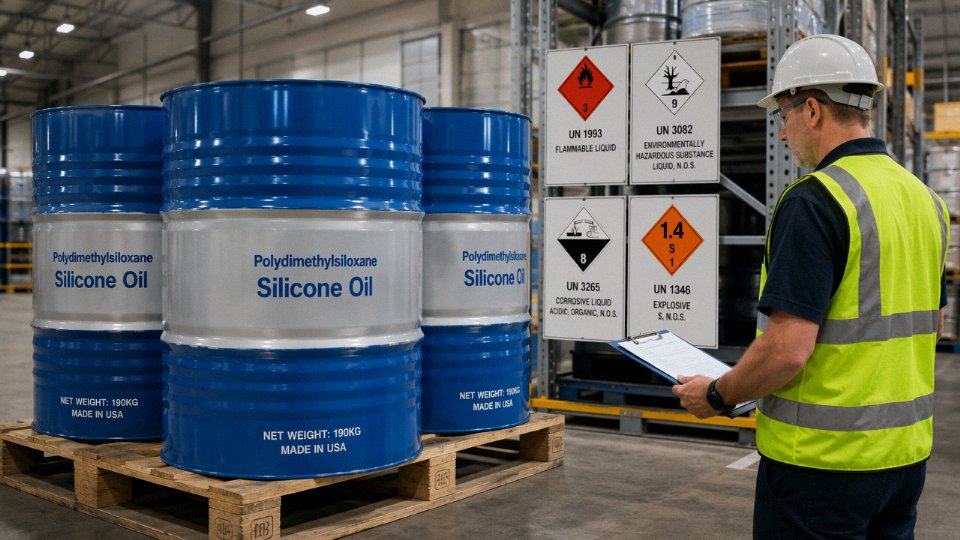
How UN Dangerous Goods Classification Works: The Framework Silicone Oil Must Navigate
The UN dangerous goods system is built on a single core question: does this substance, under realistic transport conditions, pose a significant hazard to people, property, or the environment? Everything else — the numbering, the packing groups, the special provisions — is structured decision logic layered on top of that question.
The Nine Classes and Where Industrial Liquids Usually Land
The UN Model Regulations divide hazards into nine classes. Class 1 covers explosives. Class 2 is gases (compressed, liquefied, dissolved). Class 3 is flammable liquids — the category that catches most organic solvents, fuels, and light process oils. Classes 4 through 6 cover flammable solids, oxidizers, and toxic or infectious substances. Class 7 is radioactive material. Class 8 is corrosives. Class 9 is miscellaneous dangerous goods, a catch-all that includes environmentally hazardous substances, elevated-temperature materials, and a handful of other items that don’t fit elsewhere cleanly.
In practice, when you’re classifying an industrial liquid for the first time, you’re asking: does it flash below 60°C? Is it toxic by ingestion, inhalation, or skin contact at realistic exposure levels? Is it corrosive to skin or metal? If all three answers are no, and it isn’t a gas or an oxidizer, you’re usually heading toward “not regulated.”
Most industrial liquids assessed for transport end up in Class 3, Class 6.1, Class 8, or off the list entirely. Silicone oil, for reasons tied directly to its Si-O-Si backbone (covered in the preceding section), tends toward the last of those options.
Packing Groups and the Flash Point Thresholds That Matter
Class 3 flammable liquids are assigned one of three packing groups based on flash point and boiling point. PG I captures the most dangerous: flash point below 23°C and initial boiling point at or below 35°C — diethyl ether is the textbook example. PG II covers flash point below 23°C with boiling point above 35°C. PG III applies to liquids with flash points in the 23–60°C range.
High-viscosity PDMS — say, 100 cSt or above — has a flash point typically above 300°C. That’s not close to any of these thresholds. It doesn’t qualify for Class 3 under any packing group. The flash point isn’t borderline; it’s categorically different from hydrocarbon oils of similar viscosity.
Silicone oil with viscosity ≥ 50 cSt is non-flammable under UN/GHS Class 3 criteriaTrue
Flash point for PDMS at these viscosities typically exceeds 300°C, well above the 60°C upper threshold for Class 3 flammable liquids under the UN Model Regulations.
Navigating the Dangerous Goods List
The UN Model Regulations publish a Dangerous Goods List — a structured table giving each entry a UN number, a proper shipping name, a class, a packing group, special provisions, and limited/excepted quantity columns. A classifier either finds the substance on that list, maps it to a generic entry (“FLAMMABLE LIQUID, N.O.S.” for example), or concludes that it has no applicable entry and is therefore not regulated.
For standard bulk PDMS in non-pressurized containers, working through the list systematically leads to that last conclusion. The substance simply doesn’t meet the criteria for any hazard class. That conclusion has a name depending on which modal regulation you’re working under: IATA DGR calls it “Not Restricted” (NR); some frameworks use “Not Subject to Dangerous Goods Regulations” (NSDGR).
Here’s where people make mistakes. NR or NSDGR status is not an assumption you inherit from a supplier’s label. It requires documented justification — typically a completed Safety Data Sheet with test data supporting the flash point and, for lower viscosity grades, aspiration hazard assessment. If a customs inspector or freight forwarder asks why a drum of silicone oil ships without dangerous goods paperwork, “the supplier said it was fine” is not a defensible answer. Your SDS Section 14 (Transport Information) is the documented basis, and it needs to reflect actual test data, not a copy-paste from a similar product.
Self-Classification, SDS Section 14, and Local Regulatory Layers
Under GHS, the classification obligation sits with the manufacturer or importer. You don’t wait for a regulatory agency to assign a class; you assess your own substance using available data. That obligation flows directly into SDS Section 14, which must state the UN number (or “not regulated”), proper shipping name, transport hazard class, and packing group for road (ADR), sea (IMDG), and air (IATA) transport.
A correctly completed Section 14 for standard PDMS in typical drum or IBC shipments reads something like: UN number — none; proper shipping name — not regulated; transport hazard class — not applicable; packing group — not applicable. Across ADR, IMDG, and IATA DGR, the entry is consistent for viscosities above roughly 5–10 cSt with well-documented flash point data.
The complication is national implementation. The UN Model Regulations are a framework; modal regulations (IATA DGR, IMDG Code, ADR) and national laws adapt them. U.S. DOT 49 CFR, EU ADR, and Chinese GB standards each add layers — different quantity thresholds for exemptions, different requirements for documentation, occasionally different test methods for flash point. A shipment that moves without documentation domestically in one jurisdiction may still need a declaration form at a border crossing in another. This is particularly relevant for manufacturers in China shipping into EU or U.S. distribution networks, where SDS quality and transport classification documentation get scrutinized more closely than many suppliers expect.
Low viscosity grades — below about 5 cSt — deserve a separate, more careful look, which the next section covers in detail.
Official UN Number Status of Silicone Oil: What the Dangerous Goods Lists Actually Say
The short answer: standard polydimethylsiloxane silicone oil at viscosities of 5 cSt and above carries no UN number. It is not listed as a dangerous good in the UN Model Regulations (23rd revised edition), the IATA Dangerous Goods Regulations, the IMDG Code, or ADR/RID. You can ship a drum of 350 cSt PDMS by road, sea, or air as a non-hazardous material — no dangerous goods declaration, no hazard label, no packing group requirement. That is not a loophole or an oversight. It is the correct outcome when you run the substance through the actual classification decision tree.
Standard polydimethylsiloxane silicone oil at ≥5 cSt viscosity is not classified as a dangerous good under the UN Model Regulations, IATA DGR, IMDG Code, or ADR/RID.True
PDMS at ≥5 cSt has a flash point well above 60°C (typically above 300°C for 50 cSt and higher), negligible vapor pressure, no measurable acute toxicity at classification-relevant doses, and is non-corrosive and non-reactive — none of the nine UN hazard class criteria are triggered.
Why the Classification Logic Leads Here
Work through the nine UN hazard classes against what PDMS actually does. Class 3 flammable liquids require a flash point at or below 60°C — PDMS at 50 cSt is typically above 300°C, and even a 10 cSt grade sits well clear of that threshold. Classes 6.1 and 8 require demonstrable acute toxicity or corrosivity; PDMS has neither at any commercially relevant concentration. Class 5 oxidizers, Class 4 flammable solids, Class 7 radioactives — none remotely applicable. The substance is chemically inert, has negligible vapor pressure at ambient conditions, and doesn’t react with water. Every branch of the classification tree terminates at “not classified.” This is not a borderline call for standard viscosity grades.
The Low-Viscosity Edge Case You Cannot Ignore
Below 5 cSt, the picture changes enough to warrant individual SDS review rather than assumption. Grades like 0.65 cSt, 1 cSt, and 2 cSt have flash points that can fall below 100°C — some sub-1 cSt grades approach the 60°C Class 3 threshold depending on molecular weight distribution and purity. More practically relevant is the GHS Category 1 aspiration hazard (H304) that applies to low-viscosity hydrocarbon-like fluids with kinematic viscosity below roughly 7 mm²/s at 40°C. H304 can trigger classification considerations under Class 6.1 for certain transport regimes, though the exact outcome depends on the full test dataset for that specific grade.
In practice, a procurement manager ordering 0.65 cSt trimethylsiloxy-terminated PDMS for a precision optics cleaning application should pull the supplier’s SDS, check Section 14 (transport information) against the specific regulatory regime, and not assume the same non-hazardous status that applies to the 100 cSt drum sitting next to it on the shelf.
Aerosol Formats: UN 1950 Takes Over
When silicone oil is packaged as an aerosol — mold release sprays, lubricant sprays, conveyor belt sprays — the classification is governed entirely by the pressurized container and propellant system. UN 1950, Aerosols, Class 2.1 applies regardless of whether the silicone oil fraction itself would be non-hazardous in bulk form. The silicone oil’s chemistry becomes almost irrelevant to the transport classification at that point. Warehouse staff handling pallet quantities of aerosol mold release need to treat those as Class 2 dangerous goods, full stop.
Silicone Oil in Blended Formulations
PDMS frequently appears as one component in a formulated product. In cyclopentasiloxane-based cosmetic or hair care products — common in contract manufacturing — the cyclopentasiloxane carrier has a flash point in the range of roughly 70–80°C, which can push the mixture’s flash point below 60°C once you account for blending effects. The mixture is then Class 3, even though the PDMS fraction alone would attract no classification at all. The same logic applies to any blend where a flammable co-solvent is present: the mixture flash point governs, not the PDMS fraction in isolation.
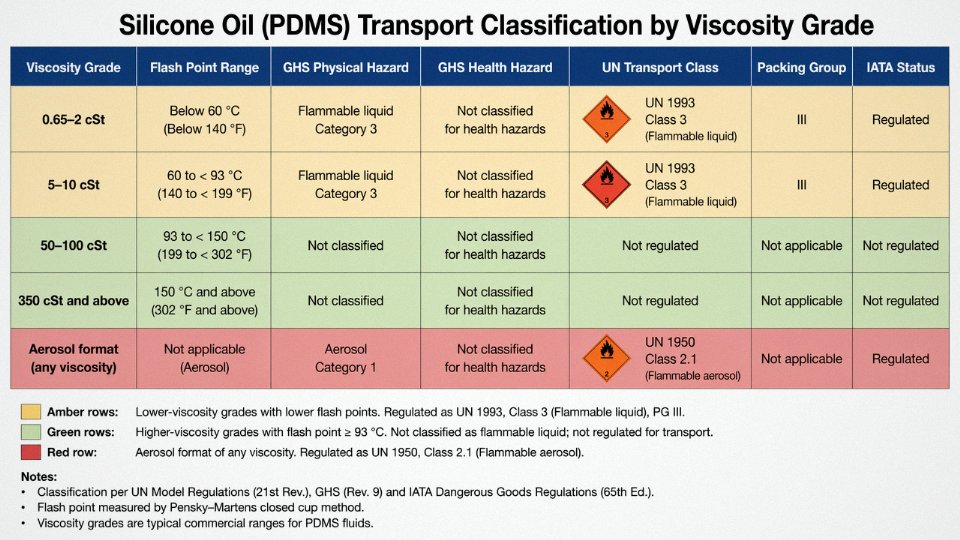
Quick-Reference Classification by Viscosity Grade
| Viscosity Grade | Flash Point Range | GHS Physical Hazard | GHS Health Hazard | UN Transport Class | Packing Group | IATA Status |
|---|---|---|---|---|---|---|
| 0.65 cSt | ~50–70°C (grade-dependent) | Flammable liquid Cat. 3 possible; verify per SDS | H304 aspiration hazard Cat. 1 possible | Class 3 possible; confirm with full test data | PG II or III if Class 3 applies | Restricted; check current DGR entry |
| 5 cSt | ~120–150°C | Not classified | Not classified | Not regulated | None | Unrestricted |
| 50 cSt | >300°C | Not classified | Not classified | Not regulated | None | Unrestricted |
| 350 cSt | >300°C | Not classified | Not classified | Not regulated | None | Unrestricted |
| 1000 cSt | >300°C | Not classified | Not classified | Not regulated | None | Unrestricted |
Flash point ranges for low-viscosity grades depend on end-group chemistry and supplier-specific molecular weight distribution — always verify against the actual SDS for the grade in question, not a general data sheet for the product family.
GHS Hazard Classification of Silicone Oil: SDS Sections 2 and 14 Decoded
Reading a silicone oil SDS for the first time, many procurement and EHS staff assume a “no classification” entry in Section 2 means the supplier got lazy with the paperwork. Usually the opposite is true — for standard mid-to-high viscosity PDMS, the “not classified” result is the scientifically correct one, and a heavily populated hazard section should make you suspicious.
Physical Hazards: Why Section 2 Is Largely Empty for Standard Grades
Work through the GHS physical hazard criteria one by one and PDMS simply doesn’t trigger them. Flash point for grades at or above 5 cSt runs well above 300°C — comfortably above the 60°C threshold that separates flammable liquids from non-regulated materials. It’s not explosive, not oxidizing, carries no self-reactive chemistry, isn’t pyrophoric, won’t self-heat under ambient storage, and doesn’t react with water. There’s no peroxide functionality in the backbone. A compliant SDS Section 2 for a 100 cSt or 1000 cSt product should show no physical hazard classifications at all. If a supplier has ticked “flammable liquid” on a high-viscosity grade, ask them to cite the flash point test method and result. Nine times out of ten, they’ve copied a template from a mineral oil SDS without reviewing the data.
Health Hazards: The Numbers Are Genuinely Reassuring, With One Real Exception
Oral LD50 for high-purity PDMS in rat studies typically comes back above 17,000 mg/kg — that’s roughly 3–4 times higher than the ceiling threshold for GHS Acute Toxicity Category 5, which itself is the least severe classification tier. There’s no practical acute oral hazard. Skin and eye irritation studies, both in vitro and in vivo, consistently return non-irritant results for standard grades. No credible evidence of respiratory or skin sensitization. Carcinogenicity, reproductive toxicity, and STOT classifications are not warranted for high-purity PDMS under current data review.
The exception that catches people is aspiration hazard. PDMS grades below roughly 20 cSt kinematic viscosity at 40°C can meet the GHS Chapter 3.10 criterion for Aspiration Hazard Category 1 (H304). The mechanism is straightforward: low kinematic viscosity means the fluid can penetrate lung tissue rapidly if aspirated during ingestion or vomiting, causing chemical pneumonitis. This triggers the skull-and-crossbones pictogram, H304 hazard statement, and specific first aid language — critically, “do NOT induce vomiting.” If you’re procuring 0.65 cSt, 1 cSt, or 2 cSt trimethylsiloxy-terminated PDMS for release agent or cosmetic carrier applications, your SDS must reflect this. A supplier SDS on a 1 cSt grade that shows no health classifications at all should be sent back for revision.
PDMS below 20 cSt may require GHS Aspiration Hazard Category 1 (H304) classification on the SDS.True
GHS Chapter 3.10 uses kinematic viscosity at 40°C as the primary criterion; fluids below 20.5 mm²/s (cSt) that are not classified as flammable liquids can still meet the aspiration hazard threshold if other criteria are satisfied, requiring H304 and the associated skull-and-crossbones pictogram.
Environmental Hazards and the D4/D5 Problem in Section 12
Standard PDMS polymer itself tests practically non-toxic to aquatic organisms — LC50 and EC50 values in OECD 203 and 202 studies typically come back above 1,000 mg/L, which is orders of magnitude above classification thresholds. Section 12 for the polymer backbone alone: not classified.
The complication is impurities. Some PDMS grades, particularly those produced via certain ring-opening polymerization routes, contain residual cyclic siloxanes — primarily D4 (octamethylcyclotetrasiloxane) and D5 (decamethylcyclopentasiloxane). Both are listed as SVHC substances under REACH due to PBT and vPvB concerns, and D4 is subject to concentration limits in wash-off cosmetic products in the EU. A supplier’s Section 12 that says nothing about cyclics when the product is a low-to-mid viscosity emulsion-grade PDMS warrants a direct question about D4/D5 content by GC analysis. This isn’t theoretical — EU customs has flagged shipments over this, and reformulated grades with reduced cyclic content now exist specifically because downstream customers demanded SDS compliance.
What a Correct Section 14 Entry Looks Like
For non-pressurized, bulk liquid PDMS at standard industrial grades (roughly 5 cSt and above), the transport information section of a compliant SDS should read approximately like this:
| Field | Correct Entry |
|---|---|
| UN number | Not applicable |
| Proper shipping name | Not regulated as dangerous goods |
| Transport hazard class | None |
| Packing group | None |
| Marine pollutant | No |
| Special precautions | None identified |
Any deviation from this pattern — a UN number appearing, a packing group assigned, a marine pollutant “Yes” — needs an explanation from the supplier before you accept it. Sometimes it reflects a legitimately different product (an aerosol form, which falls under UN 1950; a low-viscosity grade with H304; or a blend containing regulated components). Occasionally it’s a copy-paste error from a different product line. Either way, you need to know which one before your logistics team labels a pallet wrong or a carrier applies unnecessary hazmat surcharges.
HazCom 2012 vs. GHS Rev. 7/8: Why Two SDSs for the “Same” Product Can Look Different
OSHA’s HazCom 2012 aligns with GHS Revision 3, which is now several cycles behind the current GHS Rev. 8. This creates real-world SDS inconsistencies. A U.S.-origin SDS for a silicone oil might omit certain environmental hazard classifications or use slightly different signal word conventions compared to an SDS prepared under EU CLP (which tracks more recent GHS revisions) for chemically identical material. The aspiration hazard criteria and the chronic aquatic toxicity category language shifted between revisions. In practice, if you’re sourcing PDMS from an Asian or European supplier for use in a U.S. facility, you may receive an SDS formatted to a different GHS revision than your EHS management system expects. The solution is to specify in your supplier qualification documentation which GHS revision and which regulatory framework (OSHA HazCom, EU CLP, or both) you require the SDS to address. Accepting whatever format arrives and assuming equivalence is where compliance gaps develop.
Shipping Silicone Oil by Air, Sea, and Road: Modal Regulations and Practical Compliance Steps
Once you’ve established that standard PDMS — anything ≥ 5 cSt and unformulated — sits outside the dangerous goods lists, the practical question becomes: how do you document, package, and move it without tripping over carrier policies or customs queries? The classification conclusion is the easy part. Execution is where compliance actually lives.
Air Freight Under IATA DGR
For bulk PDMS at typical industrial viscosities (50 cSt, 100 cSt, 350 cSt and up), IATA DGR classifies the material as Not Restricted. No Shipper’s Declaration for Dangerous Goods is required. In practice, though, some carriers — particularly ground handlers at major hubs — will flag any chemical shipment without explicit documentation. The clean solution is a brief notation on the air waybill: “Not Restricted as per IATA DGR”, accompanied by the SDS if the carrier requests it. That single line kills 90% of the hold-up queries before they start.
The passenger versus cargo aircraft distinction is worth understanding even if it doesn’t apply today. If a formulation change — say, adding a reactive functional group or dropping viscosity below 5 cSt — pushed the product into a regulated class, passenger aircraft quantity limits (typically capped at a few liters per package for many Class 3 liquids) would immediately constrain your supply chain. Keep that in mind when procurement is evaluating reformulated or ultra-low-viscosity grades.

Sea Freight and the MARPOL Consideration
Under IMDG, standard unformulated PDMS requires no Dangerous Goods Declaration, no segregation compliance, and no special stowage coding. For containerized drums or IBCs, the paperwork burden is essentially the same as shipping industrial packaging materials. Simple.
Bulk liquid shipments in tank vessels are a different matter. Even for non-hazardous chemicals, MARPOL Annex II triggers a requirement for a Shipment Information Form and, depending on the port state, a preliminary assessment of the product’s category under the IBC Code. PDMS generally falls into Category D (or is listed as “Unassessed” depending on the specific grade and authority), which carries the lightest controls — but the paperwork still has to exist. Missing it at a port inspection creates delays that dwarf any time saved by skipping the form.
Road and Rail: ADR, RID, and US DOT
Non-regulated silicone oil needs no hazard placards, no orange panels, and no ADR transport document. Drivers are not required to carry ADR training certificates for this material. What often gets missed, even by experienced hauliers, is ADR Section 8.1.4: the carrier is still required to carry the SDS (or equivalent written emergency information) for non-dangerous chemical loads. A driver stopped at a checkpoint with 20 drums of 350 cSt PDMS and no SDS on board can still receive a compliance notice. Keep a laminated copy in the cab documentation folder — it costs nothing.
Under US DOT 49 CFR, the situation is comparable. Non-regulated materials require no hazmat marking, no emergency response information placard, and no hazmat employee training certification for the shipment itself. Standard bill of lading with the product name and quantity is sufficient.
Packaging: Not Required, But Worth Doing Right
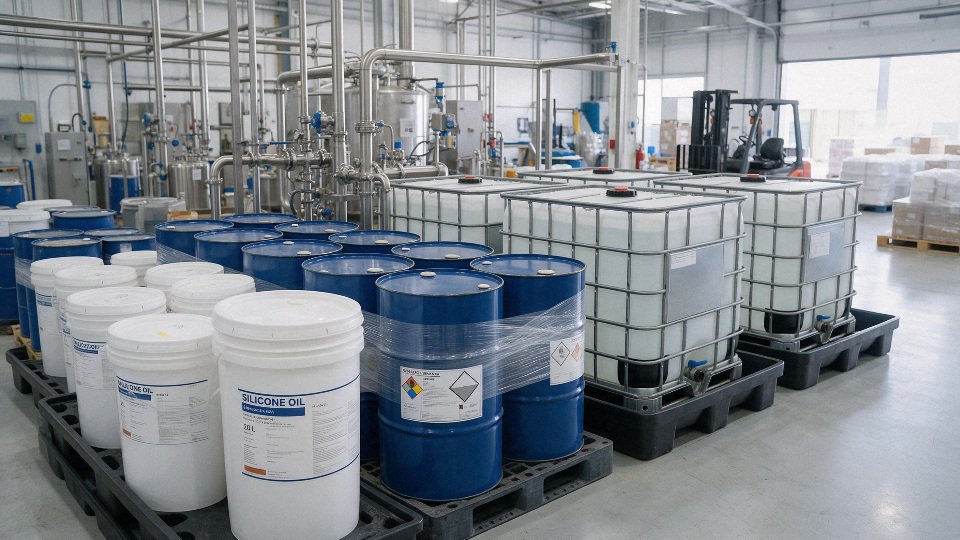
UN-specification packaging is legally unnecessary for non-regulated PDMS. That said, using UN 3H1 HDPE drums for 200 L bulk shipments is a reasonable default. Customers — especially in electronics, personal care, and food-adjacent manufacturing — routinely require UN-approved containers regardless of regulatory status, and if a formulation ever shifts into regulated territory, you’re already compliant. Switching drum specifications mid-contract is genuinely disruptive.
Labeling and Emergency Response
Transport marking for non-DG goods means: product name, net quantity, supplier name and contact. That’s the legal floor. Many facilities voluntarily apply precautionary GHS labels (H304 watch for low-viscosity grades, P260 if relevant) because their internal warehouse procedures require GHS marking on all chemical containers regardless of transport status. Those two obligations — transport marking and workplace GHS labeling — are legally separate, though they often appear on the same label in practice.
For emergency response planning, standard 350 cSt PDMS carries an NFPA 704 diamond of Health 0, Flammability 1, Reactivity 0. Flash point is typically above 300°C for this viscosity, so the Flammability 1 rating is largely precautionary.
Standard PDMS (≥5 cSt, unformulated) does not require a Shipper's Declaration for Dangerous Goods under IATA DGR when shipped as a non-pressurized bulk liquid.True
IATA DGR classifies unformulated polydimethylsiloxane at these viscosities as Not Restricted due to its high flash point (typically >300°C) and absence of other hazard triggers under the dangerous goods criteria.
The firefighting consideration is real but low-stakes: PDMS will not sustain ignition under normal handling conditions, and spill response is primarily a containment and slip-hazard issue rather than a fire event. That framing — low acute hazard, worth containing cleanly — should shape how your emergency response procedures are written even when no transport placard is required.
Regulatory Compliance Hotspots: REACH, RoHS, FDA, and Sector-Specific Rules That Intersect with UN Classification
Transport classification — or the absence of one — tells you almost nothing about the full compliance burden on silicone oil. A shipment that clears customs with no dangerous goods documentation can still trigger significant regulatory obligations in the receiving plant, the formulation lab, or the end product. These rules operate independently, and conflating them with UN status is a common mistake that costs procurement teams time and occasionally money.
REACH and the Cyclic Siloxane Problem
PDMS polymer (CAS 63148-62-9) is registered under EU Regulation 1907/2006 across the relevant tonnage bands, and for most industrial grades — heat transfer fluids, mold release, hydraulic damping — the substance itself sits comfortably outside SVHC concern. The real REACH exposure for formulators comes from impurities. Commercial PDMS synthesis routes can leave residual cyclic volatile methylsiloxanes: D4 (CAS 556-67-2), D5 (CAS 541-02-6), and D6 (CAS 540-97-6). All three are SVHC-listed, and D4 and D5 are subject to concentration restrictions in wash-off cosmetic products above 0.1% w/w under EU Regulation 2018/1519. If you are buying silicone oil for a personal care formulation and your supplier’s certificate of analysis does not explicitly report D4/D5/D6 levels, that is a gap worth closing before you go to market — not after.
The PMT/vPvM framework under the EU Chemicals Strategy for Sustainability adds another layer. High-molecular-weight PDMS polymer has low mobility and effectively zero bioavailability; regulators have generally distinguished it from the short-chain cyclics on that basis. But the political trajectory around siloxanes in the EU is clearly tightening, and buying decisions for 2025–2027 procurement contracts should at minimum include a clause that allows reformulation if the regulatory picture shifts on D4/D5 specifically.
FDA Pathways: Food Contact, GRAS Status, and Pharmaceutical Grade
Dimethylpolysiloxane has a long-standing GRAS determination under 21 CFR 173.340 as a defoaming agent in food processing applications, with a maximum permitted level of 10 ppm in the food. That sounds permissive, but it applies to the finished food — not to the concentration in the process fluid itself. Plants using silicone oil on conveyor systems, in baking release applications, or in food-grade pump lubrication need to verify that their specific use case falls within the 21 CFR 173.340 scope and that the grade they are purchasing does not contain additives (antioxidants, extreme-pressure additives) that lack their own food-contact clearances.
Pharmaceutical-grade PDMS is a different animal. USP/NF monographs govern identity, viscosity, and purity testing. ICH Q3C applies to residual solvents in the manufacturing process, and Q3D applies if trace elemental impurities — catalysts used in PDMS polymerization — could migrate into drug product. Procurement for pharma applications without a current Drug Master File cross-reference or equivalent supplier documentation is, in practice, an audit finding waiting to happen.
Dimethylpolysiloxane (PDMS) is listed as GRAS under 21 CFR 173.340 as a defoaming agent in food processing.True
The FDA's 21 CFR 173.340 regulation explicitly permits dimethylpolysiloxane as a defoaming agent in food processing, subject to a maximum of 10 ppm in the finished food.
Workplace Exposure Limits and What Happens When You Heat It
OSHA has no established PEL for high-MW PDMS, and ACGIH has not set a TLV. Under ambient conditions, the inhalation risk from bulk silicone oil is minimal. The hazard profile changes once you introduce heat — injection molding tool release, die casting, or any process where PDMS contacts surfaces above roughly 150–200°C. Pyrolysis products include formaldehyde and low-MW siloxane fragments, and SDS Section 8 for most industrial grades will recommend local exhaust ventilation at processing temperatures above that range. In practice, a lot of die-cast shops treat silicone mold release as essentially inert and skip the exhaust. That is the wrong call, particularly in confined press areas with limited air turnover.
Sector-Specific Approvals
NSF/ANSI 61 certification matters if silicone oil is used in any component contacting drinking water — pump diaphragms lubricated with silicone grease or fluid, for instance. Certification is product-specific, not generic to the substance, so a supplier’s NSF listing for one grade does not automatically transfer to a reformulated or alternative-viscosity product.
Aerospace applications typically reference AMS 3050 or equivalent OEM-specified standards for silicone hydraulic and heat-transfer fluids. These impose viscosity-temperature performance bands, oxidation stability requirements, and cleanliness levels that go well beyond what a standard industrial TDS covers. Substituting a generic industrial-grade 100 cSt silicone fluid for an AMS-qualified fluid because the UN classification and flash point look the same is the kind of procurement shortcut that generates a nonconformance report six months later.
California Prop 65 currently lists no PDMS substance, but D4 has been under scrutiny in the context of reproductive toxicity, and the California OEHHA list does evolve. Consumer product formulators selling into California should have a monitoring process in place rather than assuming current status is permanent.
Industrial Handling, Storage, and Emergency Response Protocols Aligned with the Classification
The classification picture established in earlier sections — essentially non-hazardous for transport in bulk liquid form at viscosities ≥ 5 cSt — should drive proportionate, realistic handling controls. In practice, two failure modes show up on plant floors: teams that treat silicone oil like a solvent (over-engineering PPE, storing it in flammable liquid rooms, filling out hazmat paperwork unnecessarily) and teams that assume “non-hazardous” means “no precautions needed at all.” Neither is correct.
Storage
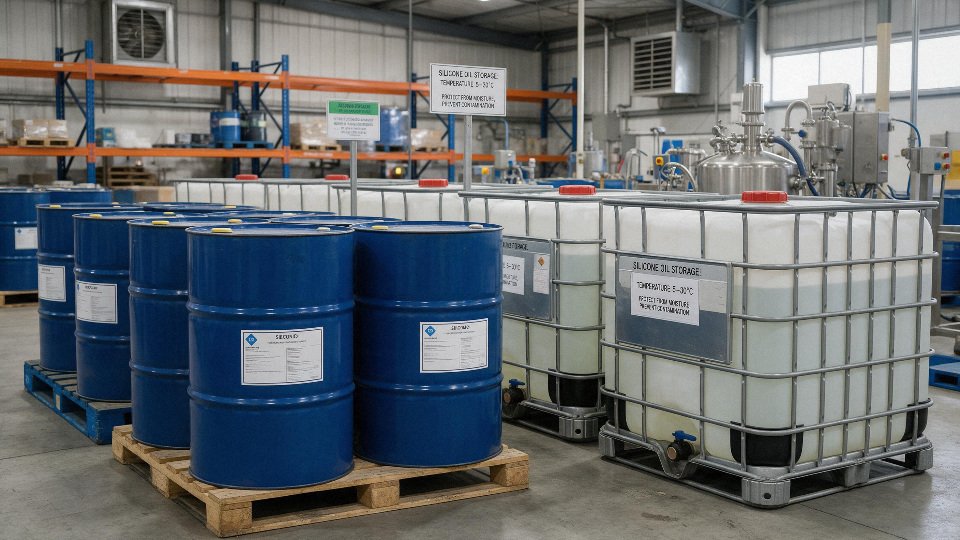
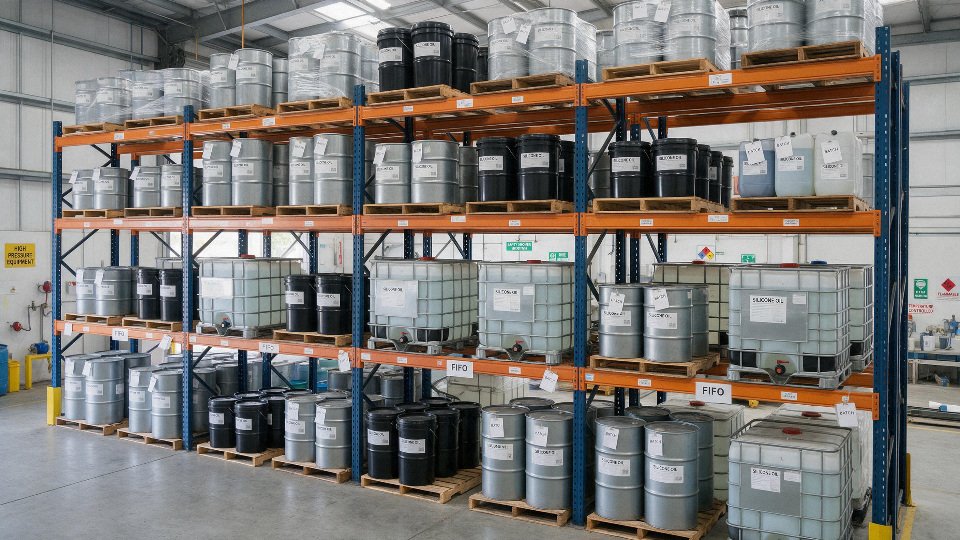
Standard warehouse racking is fine for PDMS in sealed containers, full stop. You do not need a classified flammable liquid store for grades ≥ 5 cSt. Keep containers away from strong oxidizing agents — concentrated peroxides, nitric acid, sodium hypochlorite in quantity — and away from sustained temperatures above roughly 200°C. Below that threshold, PDMS is chemically stable for years. Shelf life in original sealed containers runs typically 3–5 years from manufacture date, though in my experience well-stored product in cool, dry conditions often tests within spec beyond that window. Depends heavily on whether the drum was resealed properly after partial use.
One operational note worth flagging: silicone oil will pick up particulate contamination readily because of its surface tension behavior. Store drums bung-side up, keep the area around fittings clean, and label partial drums clearly with date opened. It sounds basic, but contaminated silicone oil causes havoc in cosmetic, food-grade, and mold-release applications where it gets used without re-inspection.
Material Compatibility
PDMS is broadly benign toward most metals, glass, and HDPE. The problem area — and it catches people regularly — is elastomeric seals and gaskets. PDMS swells certain polymers meaningfully, sometimes 30–80% by volume depending on the grade and duration of contact.
| Seal / Gasket Material | Compatibility with PDMS | Notes |
|---|---|---|
| PTFE | Excellent | Preferred for pumps, valves, fittings |
| Viton (FKM) | Good | Verify with specific PDMS grade and temperature |
| Nitrile (NBR) | Moderate | Acceptable for brief contact; avoid prolonged immersion |
| EPDM | Poor–Moderate | Swelling risk; test before committing |
| Natural rubber | Poor | Significant swelling; avoid |
| Neoprene (CR) | Poor | Similar to natural rubber in practice |
If you’re retrofitting existing pump systems that ran mineral oil or water-glycol, check every seal before you assume compatibility. A Viton shaft seal that lasted five years on mineral oil may behave differently on a low-viscosity PDMS grade at elevated temperature. The viscosity and temperature combination both matter.
PPE Scaled to Actual Hazard
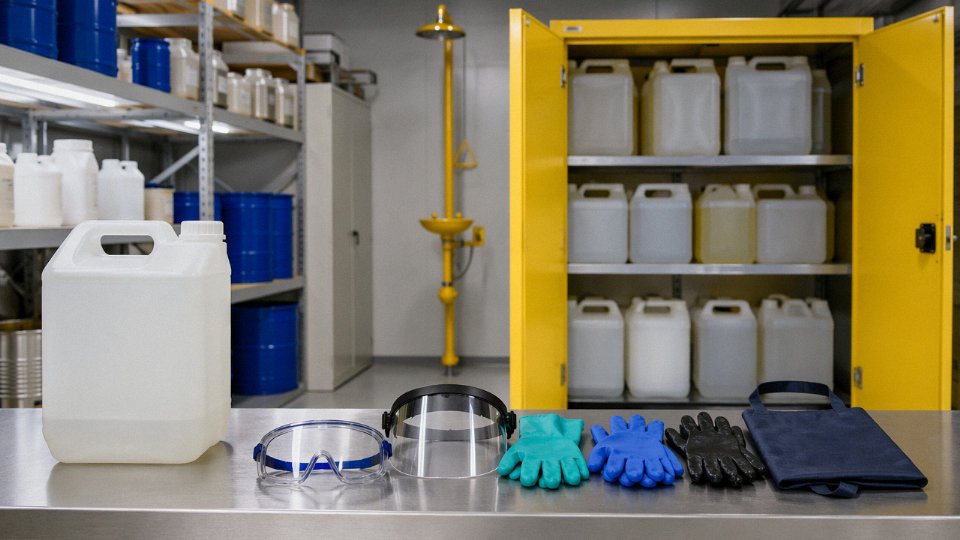
For ambient-temperature handling of high-viscosity PDMS, the realistic PPE requirement is splash goggles and chemical-resistant gloves — nitrile or PE-laminate gloves are adequate; you don’t need heavy neoprene or butyl rubber. No respiratory protection is needed at ambient temperature for grades above roughly 20 cSt. For low-viscosity grades (below 5 cSt), nitrile gloves remain appropriate, but take the aspiration hazard seriously: keep it away from the face, don’t use compressed air to move it, and don’t siphon by mouth.
Spill Response
Absorb with sand, vermiculite, or diatomaceous earth. Do not flush to drain. PDMS isn’t acutely toxic to aquatic life, but it forms a persistent hydrophobic surface film that physically disrupts oxygen transfer at the water surface — a real ecological nuisance even at low concentrations.
PDMS is safe to dispose of down floor drains because it is non-toxic to aquatic organisms.False
While PDMS has low acute aquatic toxicity, it forms a persistent surface film that impairs oxygen transfer in water bodies. Most jurisdictions classify it as an industrial waste requiring collection and disposal through licensed channels, not drain discharge.
Collect absorbed material in labeled industrial waste containers and dispose per local non-hazardous industrial waste regulations — though “non-hazardous” at the federal or national level doesn’t always mean unrestricted disposal at the municipal level. Verify with your waste contractor, especially if you’re handling volumes above a few hundred liters.
Fire Response
Silicone oil is genuinely difficult to ignite under normal conditions. If it becomes involved in a larger fire — say, a warehouse fire where PDMS drums are present but not the primary fuel — use CO2, dry chemical, or foam. Avoid straight water jets; you’ll spread the burning material and potentially create a slipping hazard. Combustion products are the real concern here: silicon dioxide particulate (fine silica) and trace carbon monoxide are generated, which means SCBA is required for anyone entering the fire area, not optional. The silica particulate is not trivial — fine amorphous silica in smoke is a respiratory irritant at minimum.
Thermal Processing Hazards
This is where industrial users of silicone oil — mold-release applicators, heat-transfer fluid operators, silicone compounders — need to pay closer attention than the baseline SDS often communicates. Above roughly 150°C in open systems, low-molecular-weight cyclic siloxanes (D4, D5 in particular) can volatilize from the PDMS matrix. These are present in varying concentrations depending on the grade and supplier; some manufacturers offer “stripped” grades with reduced cyclics specifically to address this. Above 300°C in air, oxidative degradation begins in earnest, generating fine silica dust and trace formaldehyde. Local exhaust ventilation is warranted for any heated open-system application above 150°C. In my experience, this gets overlooked in processes where silicone oil is applied as a release or lubricant on hot tooling — operators figure it’s non-flammable, so there’s no hazard. The flammability point is valid. The vapor and degradation product point is not.
Common Misclassification Scenarios and How to Audit Your Supplier’s SDS for Accuracy
Misclassification of silicone oil is surprisingly common, and it costs real money — unnecessary hazmat surcharges, rejected shipments, over-engineered storage requirements, and occasionally a customs hold that delays production. The errors usually fall into a handful of recognizable patterns, and once you know what to look for, auditing a supplier’s SDS becomes a straightforward exercise.
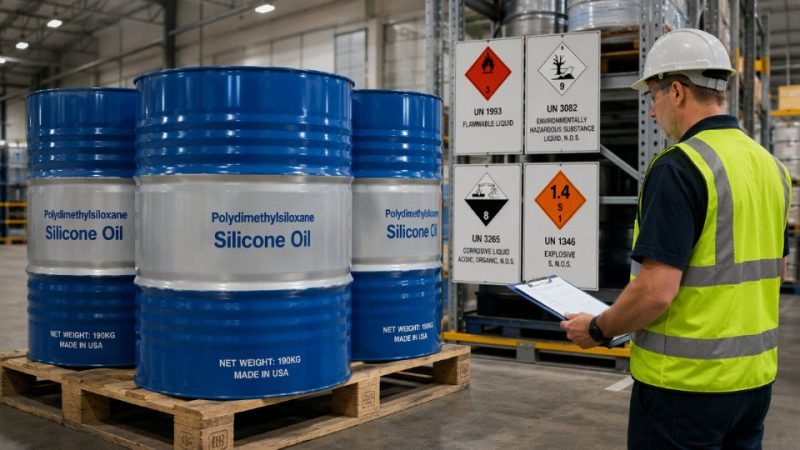
Scenario 1: Applying UN 1999 (Tars, Liquid) or UN 3082 (Environmentally Hazardous Substance, Liquid)
Some freight forwarders and third-party logistics providers default to UN 3082 for any oily, viscous liquid they can’t immediately identify — it’s a catch-all that feels “safe” from a liability standpoint. UN 1999 gets misapplied less often but shows up occasionally when a classifier sees a dark or heavily loaded silicone compound and pattern-matches it to a petroleum tar.
Neither applies to neat PDMS. UN 3082 requires a substance to meet the criteria for aquatic hazard under the UN Model Regulations — specifically, acute aquatic toxicity Category 1 or chronic aquatic hazard Categories 1 or 2. High-viscosity PDMS has low bioavailability, and the ecotoxicity data in a properly prepared SDS Section 12 consistently shows no classification threshold met. If a carrier is insisting on UN 3082, ask them to cite the specific aquatic toxicity endpoint and test result driving that conclusion. They usually can’t, because it isn’t there.
Neat polydimethylsiloxane (PDMS) does not meet the aquatic toxicity criteria required for UN 3082 classification under the UN Model Regulations.True
PDMS has very low bioavailability in aquatic environments due to its high molecular weight and low water solubility. Properly conducted ecotoxicity testing on PDMS does not yield results that trigger Acute Category 1 or Chronic Category 1/2 classification thresholds under the UN/GHS system.
Scenario 2: Legacy Class 3 Flammable Liquid Entries on Old SDSs
This one is an artifact of the pre-GHS HazCom 1994 era. Under the old OSHA framework, “combustible liquid” covered anything with a flash point above 37.8°C (100°F) — a very low bar. A lot of silicone oil grades technically had measurable flash points above that threshold, so cautious SDS authors ticked the combustible liquid box. That MSDS got filed, never updated, and is now circulating as a “current” SDS.
Under GHS Rev. 3 and later, and under 49 CFR 173.150 for U.S. domestic transport, the Class 3 threshold sits at 60°C. For silicone oils at or above 50 cSt viscosity, flash points run well above 300°C by Cleveland open cup (ASTM D92 or ISO 2592). That puts them in a completely different universe from Class 3. If Section 2 of a supplier SDS still lists “combustible liquid, Category 4” for a 100 cSt or higher grade, that’s a legacy document problem — push for a reissued SDS citing the current flash point test result with method and date.
Scenario 3: Conflating Pure PDMS with Silicone Spray Formulations
This is probably the most operationally dangerous misclassification in practice, because it runs in both directions. Someone classifies a silicone spray aerosol as non-hazardous because the active ingredient is PDMS; meanwhile the product contains 60–70% isopropanol or naphtha as the carrier solvent.
Silicone sprays, silicone release agents, and many “silicone fluids” sold in MRO catalogs are formulated products. The PDMS classification does not transfer to the blend. Cyclopentasiloxane (D5) — common in personal care and some industrial spray formulations — has its own flash point profile and regulatory status entirely separate from linear PDMS. The product name says “silicone”; the hazard comes from everything else in the can.
SDS Section 14 Audit Checklist
When reviewing a supplier’s transport section, check each of these:
| Audit Point | What to Verify | Red Flag |
|---|---|---|
| Flash point test method | ISO 2592 or ASTM D92 cited with actual result | No method stated, or result suspiciously round |
| Aquatic toxicity basis | Product-specific test data, matched viscosity grade | Read-across from different grade or no data cited |
| Section 2 vs. Section 14 alignment | Hazard class in Section 14 must correspond to classification in Section 2 | “Not classified” in Section 2, UN number in Section 14 |
| UN number vs. physical state | UN 3077 is for solids; liquid products cannot carry it | Liquid product listed under UN 3077 |
| Packing group without hazard class | PG III must reference a hazard category | PG listed alone with no class entry |
Building a Classification Audit File
Keep a per-SKU classification file — not just the SDS itself. The file should contain the current SDS (ideally less than three years old, definitely updated after any regulatory revision cycle), the underlying test data for flash point and ecotoxicology, and a written classification justification letter signed by the supplier’s regulatory affairs contact. One page is fine; the key is that it references specific test results, not generic statements.
That file earns its keep during customs inspections, carrier compliance audits, and OSHA walkthroughs. Scrambling to find documentation after a hold is far more expensive than maintaining a simple folder. In practice, most compliance problems with silicone oil shipments trace back to a document that was never updated, not to any genuine hazard the material presents.
Frequently Asked Questions About the UN Classification of Silicone Oil

Does silicone oil have a UN number?
Standard polydimethylsiloxane at viscosities of 5 cSt and above carries no UN number under the UN Model Regulations, IATA DGR, IMDG Code, or ADR/RID. The correct transport status is “not restricted” or “not regulated as a dangerous good.” SDS Section 14 should be blank or read “Not applicable” across all modal fields.
The one genuine exception: silicone oil packaged in a pressurized aerosol dispenser falls under UN 1950 (Aerosols). That classification attaches to the pressurized container, not the oil chemistry. A 200-liter drum of the same fluid is unrestricted; a 400 mL spray can of it is UN 1950. Conflating the two is a common documentation error.
Is silicone oil flammable or combustible?
For viscosities at or above 5 cSt, the flash point typically exceeds 300°C — well clear of the GHS flammable liquid cutoff of 60°C and the 93°C combustible liquid threshold used in some North American domestic codes. It does not qualify as flammable or combustible for transport or GHS purposes. In practice, you can store standard-grade silicone oil in an ordinary warehouse without the segregation requirements that mineral oil solvents demand.
Low-viscosity grades below 5 cSt are a different matter. The flash point drops with molecular weight, and at 0.65–2 cSt you need actual measured flash point data before signing off on a classification. Don’t assume the high-grade SDS covers the thin grade.
Can I ship silicone oil internationally without a dangerous goods declaration?
Yes, for standard PDMS at ≥ 5 cSt in non-pressurized containers. No Shipper’s Declaration for Dangerous Goods is required for air freight, and no Dangerous Goods Manifest is needed for sea. That said, carry a current SDS, label containers clearly with product name and quantity, and check import regulations for the destination country before the first shipment on any new trade lane. Classification status does not guarantee frictionless customs clearance everywhere.
Why does my supplier’s SDS list a UN number for silicone oil?
A UN number on an SDS for standard-viscosity PDMS silicone oil always indicates an error or a formulated blend containing hazardous components.True
Pure PDMS at ≥5 cSt meets no UN hazard class criteria and therefore cannot legitimately be assigned a UN number under the UN Model Regulations or any of the major modal codes.
Three possibilities: it’s a legacy MSDS that was never updated after the GHS transition; it’s a copy-paste error from a different product; or the product isn’t pure PDMS — it’s a formulation with a flammable carrier solvent or other hazardous component. Ask for the raw flash point test report and aquatic toxicity data. If the supplier can’t produce test data to justify the classification, the SDS is wrong and you’re entitled to request a corrected version. Accepting an over-classified SDS quietly creates unnecessary hazmat handling costs and can complicate your own downstream documentation.
Does silicone oil qualify as a marine pollutant under IMDG?
High-molecular-weight PDMS is generally not classified as a marine pollutant — aquatic LC50/EC50 values typically exceed the IMDG Appendix B thresholds, and bioaccumulation is low for the linear polymer. However, formulations containing meaningful concentrations of cyclic siloxanes D4 or D5 can trigger marine pollutant status under EU PBT criteria, which feeds into IMDG classification for EU-flagged or EU-port vessels. Check the specific product’s aquatic toxicity data, not just the base polymer classification.
What packing group applies to silicone oil?
None. Because standard PDMS doesn’t meet the criteria for any UN hazard class, packing group is not assigned. SDS Section 14 entries for Packing Group should read “Not applicable” or “N/A.” If you see a packing group listed without a corresponding hazard class and UN number, that’s a documentation error — flag it with your supplier’s regulatory affairs contact.
Are there countries where silicone oil might be treated differently than exporters expect?
Most major jurisdictions follow the UN Model Regulations closely and don’t classify standard PDMS as a dangerous good. Surprises tend to come not from hazard classification but from import licensing requirements that apply to chemicals as a category. China’s GB 12268 dangerous goods standard, India’s Hazardous Chemicals Rules under the Manufacture, Storage and Import of Hazardous Chemical Rules, and the Gulf Cooperation Council’s chemical registration frameworks all warrant a specific check against your product’s HS code and grade before opening a new trade lane. In my experience, the paperwork burden on the receiving end often has nothing to do with whether the product is technically classified as dangerous — it’s about chemical import controls that run on a parallel track entirely.