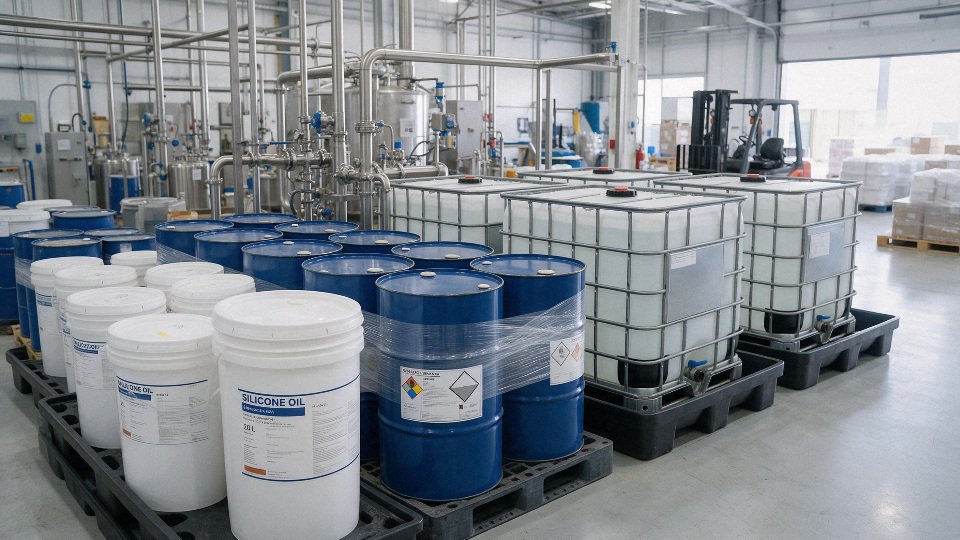

Sourcing silicone oil without a clear picture of the regulatory landscape is a faster path to trouble than most procurement managers expect. A batch of food-grade dimethylpolysiloxane used at the wrong concentration in a paper coating line can trigger an FDA noncompliance finding; a European importer handling more than a tonne per year who skips REACH registration is looking at potential market bans, not just paperwork fines. Either way, the production line stops, the customer relationship strains, and the legal exposure compounds well before anyone budgets for it.
Silicone oil regulation depends heavily on application and jurisdiction. In the US, FDA 21 CFR 176.200 caps dimethylpolysiloxane as a defoaming agent in food-contact paper at 0.2% by weight of fiber. The EU approves it as food additive E 900 under Regulation (EC) No 1333/2008, with a 10 mg/kg limit in edible oils and fats. Separately, REACH (EC) No 1907/2006 requires registration for volumes above 1 tonne per year per manufacturer importing or producing in the EU.
What makes silicone oil genuinely tricky is that the same fluid sitting in a drum on your dock can be simultaneously subject to food-contact rules, chemical registration requirements, and workplace safety obligations — all at once, all from different agencies, sometimes pulling in different directions. The fluid doesn’t change. The regulatory layer it falls under shifts entirely based on what you do with it next.

FDA Regulations Governing Silicone Oil in Food Contact and Food Processing Applications
The US FDA doesn’t treat silicone oil as a single material with a single rule. It carves the regulatory space by application — what the silicone oil is doing, where it ends up, and whether it contacts food directly or through an intermediate substrate. That distinction matters enormously on the plant floor, and getting it wrong is how you end up with an FDA 483 observation during a routine inspection.
21 CFR 173.340: Defoaming in Direct Food Processing
The primary authorization for dimethylpolysiloxane as a defoaming agent in food processing sits in 21 CFR 173.340. The ceiling is 10 ppm in the finished food — not in the processing bath, not in the additive concentrate, but in the finished food itself. That number sounds comfortable until you’re running a high-agitation fermentation or a continuous frying line where foam knockdown requires repeated dosing. In practice, a fryer operator adding a silicone antifoam emulsion to cooking oil needs to know the dilution math cold, because the concentration in the oil reservoir can be substantially higher than 10 ppm while still yielding compliant finished product — but that calculation has to be documented and defensible.
The regulation covers a reasonably broad list of food categories: beet sugar and yeast processing, wine production, rendered animal fats, chewing gum base, and a handful of others. It does not cover everything by default. If your application isn’t on that list, 173.340 doesn’t save you, and you’d be looking at a food additive petition or a GRAS determination — a longer road entirely.
21 CFR 176.200 and 176.210: Food-Contact Paper and Paperboard
For silicone oil used in the manufacture of food-contact paper — think baking parchment, meat-wrap, or coated food-service paperboard — the governing citation is 21 CFR 176.200, with 176.210 covering the wet-strength resin side of that same substrate world. The permitted concentration of silicone fluid (dimethylpolysiloxane) as a defoaming adjuvant in paper manufacturing is capped at 0.2% by weight of the fiber furnish. That ceiling applies to the manufacturing process, not a migration limit in food, which is a different frame of reference than 173.340.
One operational detail that trips up smaller converters: 176.200 also specifies permissible adjuvants — the silicone can’t arrive at the paper mill as a pure fluid and get dumped in freely. The emulsifying and dispersing agents used to get it into the water-based furnish are themselves regulated, and the whole package has to comply. Using an off-spec emulsifier to stabilize your antifoam addition can invalidate the 176.200 safe harbor even if the silicone concentration itself is fine.
21 CFR 177.2600: Silicone Oil in Rubber Articles and Mold Release
When silicone oil functions as a mold release agent or processing lubricant in the manufacture of rubber gaskets, seals, or O-rings intended for repeated food contact — equipment used in dairy lines, beverage filling, and the like — 21 CFR 177.2600 becomes the relevant frame. This section governs rubber articles for repeated food contact and sets out which elastomers and processing aids are permitted. The practical implication: a silicone oil used to release gaskets from molds during manufacturing is considered a component of that rubber article by FDA’s logic, so it needs to be extracted and tested to demonstrate it doesn’t migrate into food at levels that would raise a safety concern.
21 CFR 177.2600 governs rubber articles intended for repeated food contact, which includes silicone oil used as a processing lubricant or mold release agent in rubber gasket manufacturingTrue
21 CFR 177.2600 specifically addresses rubber articles intended for repeated use in contact with food, and FDA's position is that processing aids like mold release lubricants that remain in or on the article are subject to its provisions.
GRAS Status: Simethicone versus Unactivated Dimethylpolysiloxane
This is where procurement teams sometimes create compliance problems for production. Simethicone — activated dimethicone, essentially dimethylpolysiloxane with silicon dioxide incorporated — carries GRAS status (GRAS Notice GRN 000528 and related determinations) for specific uses, including as an antifoaming agent in certain food-contact equipment lubricant formulations. Straight, unactivated silicone oil does not carry blanket GRAS status for equipment lubrication. Buying a cheaper unactivated silicone fluid because the spec sheet says “food grade” without verifying the specific regulatory basis is a shortcut that can cost you considerably more than the price difference when your next audit comes around.
FDA Enforcement and Documentation Expectations
FDA inspectors checking a food processing facility for silicone oil compliance will typically look for extraction and migration test data, supplier letters of guarantee referencing specific CFR citations, and batch records showing that defoamer addition rates were controlled and logged. The extraction testing methodology matters — FDA expects testing under conditions that simulate actual use, meaning temperature, contact time, and food simulant all have to reflect your real process. A generic CoA from a silicone supplier saying “complies with FDA regulations” is not sufficient documentation on its own, and experienced inspectors know that.
NSF/ANSI 51 and NSF 61 as Practical Compliance Pathways
For equipment manufacturers — rather than food processors themselves — NSF International Standard 51 (Food Equipment Materials) and NSF/ANSI 61 (Drinking Water System Components) are the practical third-party certification routes that demonstrate FDA-aligned compliance without each individual buyer having to audit the underlying chemistry. An NSF/ANSI 51-certified silicone lubricant has gone through extraction testing and formulation review under a recognized protocol. Most major food equipment OEMs now require NSF 51 certification for any lubricant used in food zones, and many retail grocery and foodservice customers cascade that requirement down to their suppliers via their own supplier quality agreements. It’s become table stakes in that market — not a differentiator, just a baseline expectation.
USP, EP, and JP Pharmacopeial Standards for Pharmaceutical-Grade Silicone Oil
Pharmaceutical silicone oil occupies a regulatory tier most industrial buyers never encounter. Once you cross into drug products or drug-delivery devices, you’re no longer just managing a lubricant — you’re managing a pharmacopeial excipient, and the documentation burden alone can surprise procurement teams used to sourcing industrial-grade PDMS.
USP-NF Monograph for Dimethicone
The United States Pharmacopeia lists Dimethicone under the NF (National Formulary) section. The monograph specifies viscosity in centistokes, with grades typically ranging from around 20 cSt up to 60,000 cSt — the exact grade you purchase must match the labeled viscosity within roughly ±10–15% depending on the grade, and that tolerance is tighter than what most industrial spec sheets bother to state. Refractive index is specified at 1.400–1.404 (measured at 25°C), which sounds narrow but is generally achievable from reputable suppliers; where manufacturers slip up is failing to re-verify incoming lots rather than trusting the CoA. Heavy metals testing is required at a threshold of not more than 5 ppm, typically run by ICP-OES or the older colorimetric limit test — the method matters because ICP gives you element-specific data that the colorimetric approach does not. Assay purity is expressed as silicon content, and the monograph sets a minimum that defines the polymer backbone integrity. In practice, the heavier viscosity grades (above roughly 1,000 cSt) are more forgiving on some physical tests but can carry more residual catalyst metals from polymerization if the manufacturer’s purification step is inadequate.
Indirect Regulation Through USP and
This is where things get operationally interesting. Silicone oil used to siliconize prefilled syringe barrels and rubber stoppers is not always purchased as a monographed excipient — but it ends up regulated anyway. USP on Containers and on Elastomeric Closures require extractables and leachables characterization for packaging components that contact the drug product. If the siliconization layer on a stopper or barrel leaches dimethicone oligomers or low-molecular-weight cyclic siloxanes (D4, D5, D6 in particular) into a parenteral product, those compounds become subject to safety qualification. D4 and D5 in particular have drawn regulatory attention in Europe. The implication for a device manufacturer is that specifying “pharmaceutical-grade silicone oil” for siliconization is necessary but not sufficient — you also need migration data, and that data has to be generated under conditions that reflect actual drug product contact, not just worst-case extraction.
Ph. Eur. Monograph 0418 and Where It Diverges from USP
The European Pharmacopoeia monograph 0418 (Dimeticone) covers the same material but with some specification differences worth knowing before you assume your USP-compliant material automatically satisfies EP. Viscosity tolerance and the specific test method for kinematic viscosity can differ slightly in temperature conditioning and timing protocols, which occasionally produces grade-boundary disagreements on borderline lots. Ph. Eur. also includes a specific test for volatile matter — a 4-hour heating test at 150°C — that the USP monograph handles differently. Purity testing for siloxane cyclics is addressed more explicitly in Ph. Eur., which reflects the EMA’s concern about low-molecular-weight species in parenteral applications.
USP and Ph. Eur. Dimethicone monographs are identical in all specificationsFalse
While both cover pharmaceutical-grade dimethicone (PDMS), the two monographs differ in viscosity tolerance protocols, volatile matter test conditions, and the handling of cyclic siloxane impurity testing. Assuming automatic cross-compliance without lot-by-lot verification has caused supplier qualification failures in practice.
Japanese Pharmacopoeia and Triple-Compliance Manufacturing
The JP monograph for Dimethylpolysiloxane follows similar principles but uses Japanese Pharmacopoeia test methods that are procedurally distinct — different solvent systems for some tests, different reference standards. For a Japanese drug manufacturer distributing injectables globally — say, a parenteral product sold in the US, EU, and Japan simultaneously — triple pharmacopeial compliance means the silicone oil supplier needs to provide CoAs referencing all three monographs, or the manufacturer runs incoming testing against all three method sets internally. In practice, most major silicone suppliers (Shin-Etsu, Dow, Momentive and similar) maintain multi-pharmacopeial documentation for their pharmaceutical grades, but you should explicitly request the JP conformance data separately; it is not always included in the default documentation package. The viscosity grade labeling also differs slightly between JP and USP in how nominal grades are designated, which creates occasional purchase order confusion.
21 CFR Part 211 cGMP Requirements
Under FDA’s current Good Manufacturing Practice regulations, silicone oil purchased as a pharmaceutical excipient triggers supplier qualification, approved vendor list management, and incoming material testing against specifications. The specification has to be written — not just referenced to the pharmacopeia — and it needs to include at minimum identity, purity, viscosity, and heavy metals. For incoming testing, reduced testing programs (skip-lot or identity-only) are defensible if you have a robust supplier qualification history and periodic full-test audits, but this has to be documented in your quality system. Skipping the paper trail is where companies run into 483 observations. Silicone oil used purely as a processing aid (mold release on equipment, for instance) sits in a different regulatory zone, but if it can contact the drug product directly or indirectly, treat it like an excipient from a documentation standpoint — regulators have been consistent on this point.
EMA Guidance and Migration Studies for Drug-Device Combinations
The EMA Guideline on Plastic Immediate Packaging Materials, along with the broader extractables and leachables guidance framework, extends to combination products where silicone oil contacts the drug. Prefilled syringes are the most common case. Migration studies need to reflect the actual contact conditions — temperature, duration, drug product pH and solvent composition — and the analytical threshold for reporting cyclic siloxanes is low enough (typically in the low ppb range for some species) that you need sensitive GC-MS or LC-MS methods. The consequence of inadequate migration characterization is not just a regulatory finding; it can trigger a clinical safety concern if low-MW siloxanes accumulate in a protein biologic formulation and affect aggregation behavior. That is a downstream risk most procurement decisions do not price in, but should.
Medical Device Regulations: ISO Standards and Premarket Approval Requirements for Silicone Oil
Silicone oil in a medical device context stops being a chemical ingredient and becomes a device constituent material — or, in some cases, the active device itself. That distinction matters enormously for your regulatory pathway, your timeline, and your testing budget.
Primary Use Cases and Why Regulatory Burden Varies So Much
The four main device applications each carry a different weight. Intraocular tamponade agents (used in vitreoretinal surgery to hold detached retinas in place) are the most heavily regulated because the silicone oil is the therapeutic agent — it goes inside the eye, often for months. Syringe barrel lubrication is at the opposite end: a thin film of 350 cSt or 1,000 cSt dimethylpolysiloxane applied to a barrel is indirect-contact, short-duration, and typically falls under extractables/leachables analysis rather than a standalone device filing. Catheter coatings sit somewhere in the middle — prolonged mucosal or vascular contact triggers biocompatibility testing but not necessarily a new premarket submission if the coating formulation matches an existing predicate. Implantable lubricants (joint prostheses, neurostimulator lead coatings) are at the high end again: implant-contact, long duration, and scrutinized under the full ISO 10993 series.
Get the contact duration and contact type wrong in your risk classification, and you’ll either over-test (wasting six figures and several months) or under-test (and face a complete response letter from FDA or a notified body major finding).
FDA Pathways: 510(k) vs. PMA for Ophthalmic Tamponade
Intraocular silicone oil products — specifically the 1,000 cSt and 5,000 cSt viscosity grades used in vitreoretinal procedures — are Class III devices in the US. That means PMA, not 510(k). FDA’s product code MRX covers vitreous tamponade agents, and any sponsor going this route needs valid clinical data demonstrating safety and effectiveness, typically from a controlled trial with retinal reattachment rates and intraocular pressure outcomes tracked over at least 12 months. The clinical data expectation is not trivial; historical submissions in this space have included 200–400 patient cohorts, though exact requirements depend on indication and predicate history.
For silicone oil used as a device component (syringe lubrication, catheter coating), a 510(k) is usually the path, with substantial equivalence to a predicate. The key submission element is a materials characterization package showing the silicone oil source, viscosity grade, and extractables profile match or are no worse than the predicate.

ISO 10993 Biocompatibility: Where Most Projects Actually Stall
ISO 10993 is a series, not a single test. For silicone oil in prolonged or implant contact, the minimum relevant standards are ISO 10993-5 (cytotoxicity) and ISO 10993-11 (systemic toxicity, including subacute and subchronic studies depending on duration). Prolonged contact is generally defined as 24 hours to 30 days; implant contact exceeds 30 days. For intraocular tamponade, you’re in implant territory by definition.
ISO 10993-5 cytotoxicity testing alone is sufficient biocompatibility evidence for implantable silicone oil devicesFalse
ISO 10993-5 covers cytotoxicity only. Implant-contact applications require at minimum ISO 10993-11 systemic toxicity, ISO 10993-6 implantation study, and often genotoxicity per ISO 10993-3. Relying solely on cytotoxicity data will result in a deficiency finding from FDA or a notified body.
In practice, many device manufacturers underestimate the implantation study timeline under ISO 10993-6 — animal studies running 4–26 weeks depending on contact duration, plus histopathology analysis. Plan 9–14 months for a full implant-grade biocompatibility package, and budget accordingly.
EU MDR 2017/745: Stricter Evidence, Harder Audits
Under EU MDR 2017/745, intraocular silicone oil tamponade products are classified as Class III under Rule 8 (devices in contact with the central nervous system or in direct contact with the heart) — actually Rule 6 for surgically invasive long-term devices, depending on the exact intended use characterization. Class III under MDR requires a notified body conformity assessment and clinical evaluation under Annex XIV, which replaced the older MDD literature-review approach with a requirement for device-specific clinical data. Pooling clinical evidence from equivalent devices is still allowed but requires a documented equivalence demonstration that is far more rigorous than it was under MDD — same intended use, same biological and technical characteristics. Notified bodies are auditing this closely post-2021, and gaps in clinical evidence are among the most common major nonconformities reported in MDR transitions.
The new Annex X requirements for clinical investigations mean that for novel intraocular silicone oil formulations without a strong MDD legacy, a prospective clinical investigation is effectively unavoidable.
UDI and Labeling Under 21 CFR Part 830
Any medical device containing silicone oil as a functional component — whether it’s a tamponade kit, a prefilled syringe, or a lubricated catheter — falls under FDA’s UDI requirements. Class III devices must have a UDI on the label and must be registered in the Global Unique Device Identification Database (GUDID) before commercial distribution. For silicone oil tamponade agents, the device identifier must appear on both the individual unit label and any higher-level packaging. The labeling must also specify the silicone oil viscosity grade (1,000 cSt or 5,000 cSt) as a device specification, since interchanging grades without a design change filing is not permissible — their clinical behavior and removal characteristics differ enough that FDA treats them as distinct device configurations.
A common labeling gap: manufacturers list the trade name of the silicone oil but omit the viscosity specification and the nominal fill volume. That combination will draw a 510(k) or PMA deficiency comment almost every time.
EU REACH, CLP, and National Chemical Regulations Affecting Silicone Oil Manufacturers and Importers
REACH is, in practice, the heaviest administrative burden most silicone oil producers and importers face in the EU market. The framework under (EC) No 1907/2006 requires registration with ECHA before a substance can be manufactured in or imported into the EU above 1 tonne per year per legal entity. For standard dimethylpolysiloxane — CAS 63148-62-9, the most widely traded grade — registration is mandatory once you cross that tonnage floor, and the dossier requirements scale upward through bands: 1–10 t/yr, 10–100 t/yr, 100–1,000 t/yr, and above 1,000 t/yr. Higher bands require progressively more extensive toxicological and ecotoxicological data, which in practice means joining a SIEF (Substance Information Exchange Forum) and co-registering through a lead registrant. If you are sourcing PDMS from a non-EU supplier and bringing it in at any meaningful volume, you are the importer of record and the registration obligation falls on you — not the manufacturer in China or the US.
The CAS number situation for silicone oils is messier than it looks on a spec sheet. PDMS is a polymer category, not a single compound, so different viscosity grades and molecular weight ranges may carry distinct identifiers or fall under the same CAS depending on how the registrant has structured their dossier. Get your substance identity confirmed against the ECHA database before assuming your material is covered under an existing registration. Buying into a joint submission without verifying scope is a common and expensive mistake.
CLP Classification: Usually Low Hazard, but Not Always
Under CLP Regulation (EC) No 1272/2008, standard linear PDMS fluids — the clear, odorless types used in lubrication, hydraulics, and release applications — are generally not classified as hazardous. No H-statements, no signal word, straightforward SDS. That changes with reactive silicone fluids. Amino-functional silicones and some crosslinker-containing formulations can carry H317 (skin sensitization, category 1) or H411/H412 designations for aquatic toxicity. Chlorosilane-based intermediates used in silicone oil synthesis are severely corrosive and carry acute toxicity classifications — relevant if your plant handles these upstream. Know your chemistry, not just the finished fluid.
D4 and D5 Cyclic Siloxane Restrictions: A Real Supply Chain Problem
This is where compliance gets genuinely difficult. Octamethylcyclotetrasiloxane (D4, CAS 556-67-2) and decamethylcyclopentasiloxane (D5, CAS 541-02-6) are cyclic siloxane impurities that appear in many commercial PDMS grades at low but detectable concentrations. Both are listed as SVHCs under REACH — D4 for PBT/vPvB properties (persistent, bioaccumulative, toxic), D5 for vPvB. Since January 31, 2020, Annex XVII Entry 70 restricts D4 and D5 in wash-off cosmetic products placed on the EU market at concentrations at or above 0.1% by weight of either substance.
D4 and D5 cyclic siloxanes are restricted in wash-off cosmetics sold in the EU at concentrations at or above 0.1% by weightTrue
This restriction is established under REACH Regulation Annex XVII Entry 70, which entered into force on January 31, 2020, covering both D4 (octamethylcyclotetrasiloxane) and D5 (decamethylcyclopentasiloxane) in wash-off personal care products.
For a silicone oil formulator supplying ingredients into personal care, the practical implication is straightforward but painful: you need analytical data — typically GC-MS — showing D4 and D5 levels below 0.1% in your supplied material, and that data needs to be defensible to your customer’s regulatory team. Suppliers who cannot provide this documentation are losing EU personal care contracts. The restriction does not currently extend to industrial lubricants or release agents, but downstream customers in cosmetics manufacturing will push the specification regardless.
SDS Requirements and Extended Exposure Scenarios
REACH Article 31 mandates a Safety Data Sheet in the standardized 16-section format for any substance or mixture classified as hazardous, or for SVHC-containing products above 0.1% concentration. For standard non-hazardous PDMS supplied in industrial quantities above 10 t/yr, the SDS must be accompanied by an Exposure Scenario annex — a chemical safety report-derived document that describes conditions of safe use for each identified use. In practice, this means your SDS for, say, a 350 cSt PDMS supplied for metalworking use needs to specify application method, ventilation controls, and skin protection conditions derived from modeled or measured exposure data. Generic SDSs without exposure scenarios are not REACH-compliant for industrial supply above that threshold.
The Emerging Grouping Risk for Linear Siloxanes
The EU’s Chemicals Strategy for Sustainability — part of the Green Deal — has introduced a substance grouping approach that regulators are actively applying to siloxanes. ECHA’s GenX approach and the ongoing restriction evaluation suggest that linear PDMS polymers could eventually be subject to group restrictions modeled on the D4/D5 precedent, based on environmental persistence arguments. Nothing has entered the restriction pipeline as formal Annex XV documentation for linear PDMS as of mid-2025, but several Member State competent authorities have submitted evaluation conclusions flagging persistence concerns for high-molecular-weight PDMS in aquatic environments.
For manufacturers and importers, the practical response is to start tracking your PDMS grades against ECHA’s CoRAP (Community Rolling Action Plan) and public activities database now, rather than waiting for a restriction proposal to land. Regulatory timelines from SVHC listing to Annex XVII restriction have ranged from roughly 3 to 8 years historically — enough lead time to adjust supply chain and reformulate if you are watching, almost no time at all if you are not.
OSHA, NIOSH, and Workplace Exposure Regulations for Industrial Silicone Oil Handling
One of the first things a safety manager discovers when trying to write a silicone oil job hazard analysis is that OSHA simply has no dedicated Permissible Exposure Limit for silicone oil mist. That gap is real and creates genuine ambiguity on the plant floor. In practice, most industrial hygienists fall back on the NIOSH Recommended Exposure Limit of 10 mg/m³ for oil mist, treating silicone fluid aerosols as a mineral-oil surrogate — which is a reasonable working assumption but not a perfect one, since silicone fluids have a different toxicological profile than petroleum oils. That 10 mg/m³ figure applies as a time-weighted average; actual airborne concentrations during spray operations or open-bath processes vary widely depending on fluid viscosity, temperature, nozzle pressure, and ventilation. Facilities operating below that threshold without any exposure controls may still want to revisit that posture if they’re running high-temperature processes, for reasons covered below.

Hazard Communication and SDS Requirements
Under OSHA’s Hazard Communication Standard, 29 CFR 1910.1200, silicone oil requires a fully GHS-formatted Safety Data Sheet whenever it meets the definition of a hazardous chemical — and the answer is not always obvious. Pure polydimethylsiloxane at ambient temperature is generally classified as non-hazardous under GHS criteria, which means some suppliers ship it with a simplified SDS carrying no hazard pictograms at all. That’s technically defensible for a low-viscosity fluid used at room temperature. The situation changes if the product formulation includes additives (catalysts, crosslinkers, processing aids) that are themselves classified hazards, or if your process involves heating, atomizing, or otherwise generating mist or vapor. Downstream employers are still obligated to maintain SDSs for all chemical products on-site, train workers on SDS access under the HazCom standard, and include silicone oil in their written hazard communication program — even for low-hazard materials.
Respiratory Hazards: Where Thermal Decomposition Changes the Picture
At ambient conditions, silicone oil aerosol is a low-order respiratory irritant at most. The exposure picture shifts meaningfully above roughly 150°C. Thermal decomposition of polydimethylsiloxane can generate formaldehyde and various siloxane fragments; at temperatures above 300°C, amorphous silica particulates become a concern. This matters practically for heat-transfer bath operations, molding press lubrication, and any process where silicone oil contacts hot tooling or an open flame.
Silicone oil thermal decomposition above 150°C can produce formaldehyde and amorphous silica as decomposition products.True
Peer-reviewed thermal degradation studies and supplier technical data sheets for polydimethylsiloxane confirm formaldehyde generation beginning around 150–200°C and silica formation at higher temperatures, consistent with OSHA and NIOSH guidance on heated oil processes.
For spray-application lines running silicone release agents, respiratory protection selection should be based on an actual industrial hygiene air sample, not an assumption. A half-face respirator with organic vapor and P100 combination cartridges is a common choice when engineering controls alone are insufficient, but the cartridge selection depends on what’s actually in the air.
PPE Selection: Gloves Are Not Interchangeable
Glove compatibility trips people up. Silicone oil permeates certain nitrile formulations faster than most safety data sheets imply — particularly thin disposable nitrile gloves used in electronics assembly and lubrication tasks. Butyl rubber or laminated barrier gloves (such as Silver Shield/4H) provide better resistance for prolonged contact. For splash protection, chemical splash goggles are appropriate; safety glasses alone are marginal if pressure is involved. Silicone oil isn’t acutely toxic on skin contact, but repeated dermal exposure combined with inadequate glove protection leads to nuisance dermatitis in practice, especially in warm production environments.
Fire Classification and Storage Implications
Most silicone oils — PDMS-based fluids across the common viscosity range — carry flash points above 300°C. Under NFPA 30, that places them in Class IIIB combustible liquid territory. This is genuinely good news for storage and handling compliance: Class IIIB liquids face significantly lighter storage cabinet requirements, ventilation thresholds, and bonding/grounding obligations compared to Class I or Class II flammable liquids. A facility switching from petroleum-based release agents or hydraulic fluids to silicone oil often finds that NFPA 30 compliance overhead drops noticeably. That said, finely atomized silicone oil mist in an enclosed space near ignition sources still warrants respect; flash point governs bulk storage, not necessarily every spray application scenario.
Process Safety Management: Usually Not Triggered, But Verify
Silicone oil does not appear on OSHA’s PSM highly hazardous chemical list under 29 CFR 1910.119, so most silicone oil operations don’t trigger a formal PSM program on that basis. Large heated silicone oil baths used in heat transfer applications — some industrial systems run several thousand liters at 200°C or higher — should still go through a facility-level risk assessment. The PSM regulation may not technically apply, but a process hazard analysis is still defensible engineering practice. Thermal runaway, containment failure, and hot-oil spray scenarios are real loss events in heat-transfer applications regardless of regulatory classification, and insurers increasingly expect documented risk reviews for high-temperature fluid systems even when the chemical itself isn’t PSM-listed.
Environmental Regulations Controlling Silicone Oil Discharge, Persistence, and Waste Disposal
Silicone oil’s environmental regulatory story is genuinely unusual — not because it’s acutely dangerous, but because its fate in the environment defies the assumptions baked into most standard chemical frameworks. PDMS (polydimethylsiloxane) is essentially insoluble in water, binds aggressively to organic matter and sediment, and degrades slowly under certain soil conditions but very slowly in aquatic sediment. That combination of high persistence and very low aquatic toxicity means it doesn’t fit neatly into the “toxic chemical discharged to water” template that most EPA frameworks were built around.
EPA TSCA Oversight and the Persistence Problem
Under TSCA Section 5, any new silicone oil variant or formulation not already on the TSCA Inventory triggers a Premanufacture Notice (PMN) review before commercial production or import. The EPA’s assessments of PDMS-class materials have consistently flagged sediment persistence as the primary environmental concern — not acute toxicity, which is negligible by most standard measures. Section 6 risk evaluation timelines for high-production-volume siloxanes have stretched considerably because the agency has to weigh persistence data against a genuine lack of ecological harm signals. In practice, this means manufacturers introducing novel silicone oil grades or blends should budget 12–36 months for TSCA review, depending on the molecular weight range and any functional additives in the formulation.
PDMS has very low aquatic toxicity despite high environmental persistence in sediment.True
EPA and OECD assessments consistently show PDMS LC50 values for aquatic organisms well above regulatory concern thresholds, while simultaneous sediment persistence data confirms low biodegradation rates in anaerobic aquatic environments.
Clean Water Act NPDES Permits and the Absence of Federal Effluent Limits
Here’s where things get operationally complicated. There are no federal effluent limitation guidelines specific to silicone oil under the Clean Water Act. Facilities discharging process water that contains silicone oil — metalworking shops, textile mills, food processing plants using silicone-based defoamers — have to comply with their individual NPDES permits, which means permit writers typically fall back on Best Management Practices rather than hard concentration limits. What that looks like in practice: oil/water separators, coalescing filters, regular monitoring of total petroleum hydrocarbons (TPH) or oil and grease as surrogates, and documentation of BMPs for the permit record. The absence of a specific silicone oil effluent standard is not a free pass; a state regulator can still cite a facility for an “interference” violation if silicone-containing wastewater disrupts WWTP biological processes downstream.
D4 and D5 Restrictions in the EU
The EU took a harder line. D4 (octamethylcyclotetrasiloxane) and D5 (decamethylcyclopentasiloxane) — cyclic siloxanes that are common process impurities or intentional components in some silicone oil grades — are restricted under REACH because D4 meets the PBT criteria (persistent, bioaccumulative, toxic) and D5 meets vPvB criteria (very persistent, very bioaccumulative). The restriction, effective since 2020, limits D4 and D5 concentrations in wash-off consumer products to 0.1% by weight. Industrial and professional use has separate requirements. Suppliers shipping silicone oil into the EU need current analytical data on D4/D5 content — not just a SDS statement — because customs and market surveillance authorities have become more active on this.
RCRA Waste Classification for Spent Silicone Oil
Virgin, uncontaminated PDMS is not a listed hazardous waste under RCRA — it doesn’t appear on the F, K, P, or U lists. The problem is what happens to it during use. Silicone oil used as a hydraulic fluid, heat transfer medium, or mold release in environments where it contacts heavy metals, chlorinated solvents, or PCB-bearing equipment fluids can become characteristically hazardous through contamination. At that point, the spent oil must be tested using TCLP or other characteristic tests before disposal. Generators who skip this step and dispose of contaminated silicone oil as non-hazardous waste are exposed to RCRA enforcement. The cost difference between non-hazardous and hazardous waste disposal runs roughly $0.30–$1.50 per pound depending on contaminant type, volume, and regional disposal market — a meaningful number when you’re disposing of hundreds of gallons from a heat transfer system changeout.
WWTP Sludge Partitioning and Biosolids Regulations
One underappreciated consequence of PDMS’s water-insoluble, lipophilic character: it partitions strongly to sludge in wastewater treatment rather than passing through in the effluent. That sounds like good news for effluent quality, and in a narrow sense it is. The catch is that PDMS then concentrates in biosolids, and facilities that land-apply biosolids under EPA 40 CFR Part 503 may face scrutiny as regulators pay increasing attention to persistent synthetic polymers in agricultural soils. The 40 CFR 503 framework doesn’t currently set explicit limits for PDMS, but state programs in California and several northeastern states are actively developing guidance. Any facility generating sludge with known silicone oil inputs should be tracking this.
DOT Transport of Silicone Oil Waste
Uncontaminated PDMS waste is non-hazardous under DOT 49 CFR and ships without hazmat placarding or special documentation beyond a basic waste manifest. That classification flips if the silicone oil mixture contains regulated concentrations of other chemicals — flash-point depressants, chlorinated compounds, heavy metal salts. A blended silicone heat transfer fluid that contains even a small fraction of a listed hazardous constituent can require full DOT hazmat shipping classification, emergency response information, and appropriate placarding. Transporters and generators who rely on the “silicone oil is non-hazardous” assumption without testing contaminated batches are running a real compliance risk on every load that leaves the facility.
Cosmetics and Personal Care Regulations: EU, US, and ASEAN Requirements for Silicone Oil Ingredients
Silicone oils sit in an awkward regulatory position in personal care: chemically inert enough that most agencies have historically treated them as low-risk, but structurally diverse enough that “silicone oil” on a formula sheet tells a regulator almost nothing useful. Dimethicone, cyclomethicone, phenyl trimethicone, dimethiconol — each carries its own INCI name, its own dossier history, and in some markets, its own restriction status. Formulators who treat them as interchangeable invite compliance problems.
MoCRA and What It Actually Changes for US Silicone-Containing Cosmetics
The Modernization of Cosmetics Regulation Act of 2022 is the first meaningful structural change to US cosmetics law in roughly 85 years. For silicone oil users specifically, three obligations are now live or phasing in: facility registration (due for most manufacturers by December 2023, small businesses by December 2024), product listing with the FDA, and documented safety substantiation that must be on file before a product ships.
That last requirement is where silicone formulations get attention. Dimethicone at typical use levels — usually 0.5–25% depending on product type — has a long safety track record and existing CIR (Cosmetic Ingredient Review) assessments to draw from. Most safety substantiation files for standard dimethicone applications will reference CIR conclusions and existing toxicological literature without needing new studies. But if your formula includes a cyclic siloxane as a carrier or processing aid, even at trace levels, expect your safety substantiation to need more explicit documentation. FDA hasn’t finalized all MoCRA guidance, so the practical advice right now is to build your safety files conservatively.
EU Regulation 1223/2009: Dimethicone Is Fine, D5 Is Not
Under EC No 1223/2009, dimethicone (CAS 9006-65-9) is permitted as a skin conditioning agent with no concentration ceiling in either rinse-off or leave-on products. That’s the straightforward part.
Cyclopentasiloxane (D5) is a different matter. Annex III restricts D5 in rinse-off cosmetics to a maximum of 0.1% — effectively a functional ban, since D5 is primarily useful as a carrier at levels of 5–20%. The restriction followed SCCS opinions identifying D5 (and to a lesser extent D4 and D6) as persistent, bioaccumulative substances. The downstream effect on supply chains has been real: European brands reformulated rinse-off hair products and shower gels from roughly 2020 onward, shifting to lower-viscosity dimethicone fluids or isododecane-based alternatives. Silicone producers responded by tightening cyclic impurity specifications in linear dimethicone grades, because a batch of nominally compliant dimethicone that carries 0.3% residual D5 can push a finished formula over the Annex III threshold.
Cyclopentasiloxane (D5) is banned in all EU cosmeticsFalse
D5 is restricted only in rinse-off cosmetics above 0.1% under EU Annex III. Leave-on products such as moisturizers and serums are not currently subject to this restriction, though SCCS review of leave-on applications is ongoing.
The SCCS opinion process is worth watching. Opinions on D4 and D6 have tightened progressively, and there is an active scientific discussion about cyclotetrasiloxane (D4) in leave-on products. Brands planning five-year product lines should not assume the current leave-on exemption is permanent.
ASEAN and the Cyclic Impurity Problem for Exporters
The ASEAN Cosmetic Directive aims for harmonization across member states, but implementation is uneven in practice. Vietnam, Thailand, and Indonesia have adopted the ACD restricted substance framework, which mirrors EU thinking on cyclic siloxanes to varying degrees. The ASEAN negative list does not currently impose an explicit numerical limit on D5 equivalent to the EU’s 0.1% rinse-off restriction, but several member states are watching EU enforcement outcomes and may tighten national guidance.
For silicone oil suppliers exporting into Southeast Asian markets, the practical risk is cyclic siloxane impurity content in linear dimethicone shipments. A certificate of analysis that simply says “dimethicone, viscosity 350 cSt” without specifying D4/D5/D6 residual levels is becoming commercially inadequate for serious buyers in the region. Buyers sourcing for ASEAN-market cosmetics increasingly ask for cyclic content by GC analysis, often requiring D4+D5+D6 combined below 0.1–0.3% in the raw material itself.
China NMPA: The Catalog System Changes Everything
China’s 2021 Cosmetics Supervision and Administration Regulation (CSAR) introduced a raw material catalog system that directly affects imported silicone grades. Ingredients already listed in the catalog — which includes standard dimethicone — can be used without new notification. Ingredients not in the catalog, or new variants (novel viscosities, functionalized silicones), require a new raw material registration, which runs 6–18 months depending on ingredient type and NMPA workload.
Safety assessment obligations under CSAR are substantive. A safety assessment report signed by a qualified assessor must accompany product registration, and it needs to address each silicone ingredient explicitly. The tricky part for multi-grade dimethicone users: NMPA has historically treated different viscosity grades as potentially distinct ingredients. A formulator who uses 100 cSt dimethicone in one SKU and 1000 cSt in another may need to confirm both grades are individually cataloged rather than assuming one listing covers all viscosities. This is not a hypothetical — it has caught several international brands during CSAR transition.
INCI Naming: A Small Detail With Large Compliance Consequences
INCI nomenclature discipline matters more in multi-market launches than most formulators realize. Dimethicone and dimethiconol are not the same INCI name and not the same regulatory entry. Dimethiconol carries hydroxyl terminal groups; dimethicone does not. Using “dimethicone” on an EU product information file when the actual ingredient is a dimethiconol-dimethicone blend creates a labeling discrepancy that can surface during a market authority audit.
For cyclic siloxanes, the naming must be specific: cyclopentasiloxane, cyclotetrasiloxane, cyclohexasiloxane — not the generic “cyclomethicone,” which is a trade convenience term rather than a recognized INCI entry. In markets enforcing the EU Annex III D5 restriction, a product labeled “cyclomethicone” without specifying which cyclic species creates an automatic question from regulators about D5 content. Accurate INCI declaration isn’t a paperwork formality. It is the first line of defense in any inspection.
Transportation and Bulk Handling Regulations for Silicone Oil Shipments
Standard polydimethylsiloxane (PDMS) silicone oil — the clear, inert fluid most industrial buyers recognize — is not classified as a dangerous good under the UN Model Regulations, and that status carries through into ADR (road, Europe), IMDG (sea), and IATA DGR (air). For most viscosity grades above roughly 100 cSt, the flash point runs well above 200°C, often above 300°C, which puts it comfortably outside the flammable liquid threshold. This is genuinely good news for logistics teams. But “not regulated as dangerous” does not mean “ship with nothing but a packing slip.”
Carriers — especially freight forwarders handling intermodal moves — routinely ask for written confirmation. In practice, what satisfies them is a current Safety Data Sheet (SDS) prepared under GHS (or 29 CFR 1910.1200 for US domestic) clearly showing no hazard classification, plus a shipper’s declaration or a “non-dangerous goods” statement on the bill of lading. Some tank truck operators also want a flashpoint test certificate from the manufacturer, particularly when the grade is unfamiliar. Keep those documents in the cab or with the shipping file. A driver stopped at a DOT inspection who can’t produce an SDS for an unlabeled IBC tote will have a bad afternoon even if the product is technically non-hazardous.
When the Classification Changes
Low-viscosity silicone fluids — typically below 10 cSt — can have flash points approaching or below 60°C depending on the manufacturing process and residual volatile cyclic siloxane content. Once flash point drops below 60°C, you’re looking at a flammable liquid under DOT 49 CFR Part 173 and ADR Class 3. The product needs a UN number (likely UN 1993, Flammable liquid, n.o.s.), proper Class 3 labeling, and all the associated shipping papers. The same applies if you’re shipping silicone oil dissolved or blended in a flammable carrier solvent — the mixture properties govern classification, not the silicone fraction alone. This catches people off guard when they buy a silicone-in-naphtha release agent and assume the word “silicone” on the label means non-hazardous.
Silicone oil blended with a flammable solvent must be classified based on the mixture's flash point, not the silicone component alone.True
UN Model Regulations, DOT 49 CFR 173.120, and ADR Chapter 2.2.3 all base flammable liquid classification on the flash point of the mixture as tested, regardless of individual component properties.
Maritime Shipment and D4/D5 Considerations
For bulk maritime shipment in tank containers, the IMDG Code framework applies to any regulated cargo, but for unmodified PDMS the more pressing compliance issue is the marine pollutant assessment. Grades containing residual D4 (octamethylcyclotetrasiloxane) or D5 (decamethylcyclopentasiloxane) above certain thresholds may require marine pollutant marking under IMDG, since D4 in particular has bioaccumulation concerns that have attracted regulatory attention in the EU and Canada. Ask your supplier for a D4/D5 content certificate on any shipment intended for seafreight — this is not standard on every CoA, but reputable producers will have it.
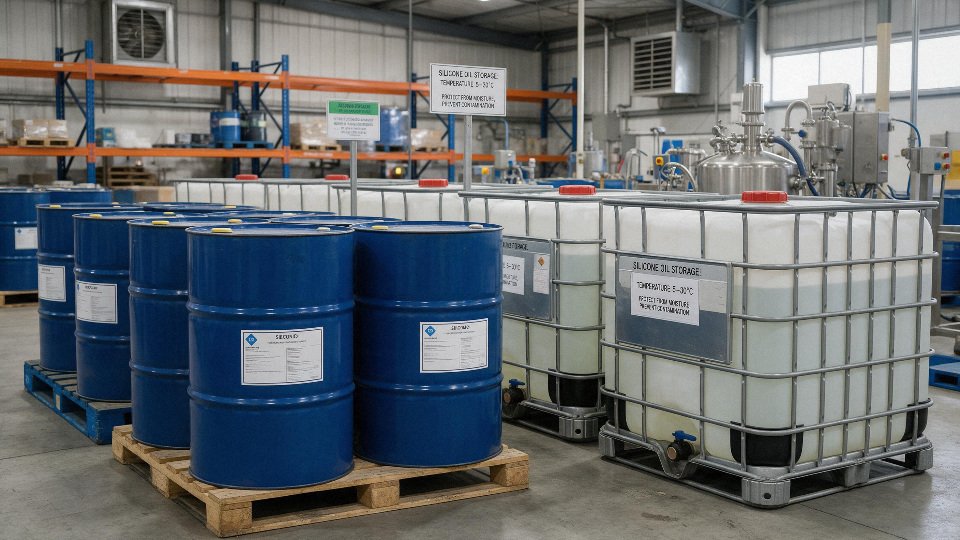
IBC tank containers used for bulk silicone oil should be lined with materials compatible with PDMS: stainless steel (316L preferred) or high-density polyethylene for lower-value applications. Carbon steel can be used but risks contamination if the tank has carried reactive materials previously. Silicone oil absorbs trace contaminants from dirty tanks more readily than its inert reputation suggests.
DOT Bulk Tank Requirements on Road
When moving silicone oil by tank truck in the US at volumes above roughly 3,500 liters, DOT 49 CFR Parts 178–180 govern tank specification. For non-hazardous PDMS, a DOT 406 (atmospheric pressure) or DOT 407 tank is typical. Grounding requirements for non-flammable product are minimal, but if you’re moving a low-viscosity grade near the flammability threshold, static grounding during transfer becomes a real concern — particularly in dry climates or when pumping rates are high. Drivers handling any bulk chemical shipment, regulated or not, should have hazmat awareness training; the paperwork burden is lower for non-DG product, but the operational habits still matter.

Labeling Drums, Totes, and ISO Tanks
For product not classified as hazardous under GHS, the label requirements are simpler but not absent. A GHS-compliant label on a drum or IBC still needs the product identifier, supplier information, and the SDS reference. Since silicone oil carries no signal word and no hazard pictograms under standard classification, the label looks sparse — which sometimes makes customs officers nervous. Adding the CAS number (typically 63148-62-9 for PDMS), viscosity grade, and a clear “Not classified as hazardous” statement reduces inspection friction significantly, especially at EU ports of entry where CLP compliance is checked.
Import/Export Controls and Customs Documentation
Standard commercial grades of silicone oil are generally classified as EAR99 under US Export Administration Regulations, meaning no specific export license is required for most destinations. Specialty silicone fluids used in certain defense or semiconductor applications may attract ECCN scrutiny, but that’s a narrow subset. For EU imports, REACH compliance documentation — specifically confirmation that the substance is registered or exempt, and an up-to-date SDS meeting REACH Annex II requirements — is non-negotiable for customs clearance. A certificate of analysis showing viscosity, purity, and D4/D5 content rounds out the typical import package. For shipments into China, a Chemical Data Reporting equivalent under MEE’s new chemical notification rules may apply depending on volume, so verify with the receiving party’s compliance team rather than assuming EAR99 translates globally.
Frequently Asked Questions About Silicone Oil Regulations
These questions come up repeatedly from plant engineers, procurement teams, and QA managers — often after a compliance audit has already flagged something. The answers below are meant to be practical, not exhaustive.
Is Silicone Oil Considered a Hazardous Material?
Standard linear PDMS (polydimethylsiloxane) in typical industrial viscosity grades — say, 100 cSt to 12,500 cSt — is not classified as hazardous under GHS, DOT 49 CFR, or REACH CLP. No flashpoint concern at ambient temperatures, low acute toxicity, no reproductive or carcinogen flags for the base polymer. For road and sea freight, it generally ships as a non-regulated material, which simplifies documentation considerably.
The exception that catches people off guard: grades containing cyclic siloxanes, particularly D4 (octamethylcyclotetrasiloxane) and D5 (decamethylcyclopentasiloxane), carry environmental hazard classifications under CLP due to their persistence and bioaccumulation potential. If your supplier’s product uses a cyclic siloxane carrier or contains residual cyclics above threshold levels, that changes the SDS Section 2 classification and your discharge obligations. Always check the SDS for the specific grade — not the product family.
Can Food-Grade Silicone Oil Be Used in Pharmaceutical Manufacturing?
No, and this substitution gets made more often than it should. NSF H1 certification and USP/Ph.Eur. monograph compliance are fundamentally different standards. NSF H1 confirms that the lubricant is acceptable for incidental food contact in processing equipment — it does not verify the purity levels, extractables profile, or batch-by-batch testing that pharmacopeial monographs require. USP-grade silicone oil (Dimethicone, USP) demands specific viscosity ranges, refractive index, specific gravity, and impurity limits verified against standardized pharmacopeial methods.
NSF H1 food-grade silicone oil can be substituted for USP-grade silicone oil in pharmaceutical drug product manufacturing without additional testing.False
NSF H1 and USP grades are governed by entirely separate standards with different purity, testing, and documentation requirements. Using NSF H1 silicone oil in a pharmaceutical context without pharmacopeial qualification would constitute an uncontrolled material substitution under cGMP regulations and could trigger regulatory non-conformance.
In practice, a QA rejection of an NSF H1 product in a pharma context is almost inevitable once an auditor checks the Certificate of Analysis against the USP monograph. Get the right certification from the start.
What Are the Rules for Disposing of Used Silicone Oil from Industrial Machinery?
Start with RCRA characterization. Used silicone oil from machinery isn’t automatically hazardous waste, but you’re obligated to evaluate it — particularly if the equipment it lubricated involved solvents, heavy metals, or other listed hazardous constituents that could have contaminated the fluid. The fluid itself may be non-hazardous, but contaminated used oil is a different story.
State rules frequently go further than federal RCRA baseline. California, for instance, has used oil management requirements under Title 22 that differ materially from EPA’s 40 CFR Part 279. If you’re operating across multiple states, assume the most restrictive rule applies until you’ve confirmed otherwise. Disposal should go through a licensed used oil contractor — hauling it yourself, even to a recycler, creates liability exposure if the contractor later mishandles it.
Do I Need a REACH Registration to Sell Silicone Oil into the EU?
If you’re a non-EU manufacturer, you cannot register directly under REACH. You must appoint an Only Representative (OR) — a legal entity established in the EU — who registers on your behalf with ECHA. The OR takes on the legal responsibilities of an EU importer for the substance.
The registration dossier requires hazard data, physicochemical properties, exposure scenarios, and, depending on the tonnage band, varying levels of toxicological and ecotoxicological testing. Tonnage band fees range from a few thousand euros for small volumes up to roughly €30,000–€70,000 or more for higher tonnage tiers, depending on company size and whether the substance is already on the ECHA registry with existing data that can be shared through a SIEF (Substance Information Exchange Forum). The threshold that triggers registration is 1 tonne per year per manufacturer or importer — below that, no registration is required but notification obligations may still apply.
What Regulatory Documentation Should I Request from My Silicone Oil Supplier?
At minimum, request: a GHS-compliant Safety Data Sheet (16-section, current revision), a Certificate of Analysis verified against the applicable specification (USP, NSF, food-grade, or industrial as appropriate), the REACH registration number if you’re buying into or within the EU, a RoHS compliance letter if the product will contact electrical or electronic equipment, and a Proposition 65 compliance statement if you’re selling into California.
For pharmaceutical or medical device supply chains, add the DMF (Drug Master File) reference number if applicable, extractables and leachables data, and a statement of GMP compliance. Suppliers who can’t produce most of this within a few business days are worth scrutinizing.
Are There Regulations Targeting Silicone Oil in Electronics and Semiconductor Manufacturing?
Yes, though they’re less centralized than pharmaceutical rules. RoHS Directive 2011/65/EU (and its UK equivalent post-Brexit) restricts specific hazardous substances in electrical and electronic equipment — PDMS itself isn’t a restricted substance, but formulated silicone products that contain restricted flame retardants or plasticizers could create a compliance issue. IPC standards (such as IPC-7711/7721 for rework and repair) reference acceptable lubricant types for PCB assembly, and silicone oils are explicitly excluded from certain connector and switch contact applications because of contamination and contact resistance concerns.
Semiconductor-grade silicone fluids must meet SEMI standards for ionic contamination and metallic impurities — specifications far tighter than industrial or even pharmaceutical grades. Using an industrial-grade fluid in a cleanroom environment is one of those mistakes that doesn’t show up immediately but tends to cause yield problems that take weeks to trace back to the lubricant.
How Do Regulations Differ for Silicone Oil Sold as a Laboratory Chemical Versus an Industrial Chemical?
The end-use declaration matters more than people expect. Under TSCA, laboratory quantities (typically less than 500 kg/year per site) can qualify for the research and development exemption, which reduces reporting obligations. But if the product is relabeled or sold commercially in larger volumes, that exemption evaporates.
GHS labeling obligations and OSHA HazCom training requirements apply based on what’s actually on the SDS and how the product is classified — not on whether the customer calls it a “lab chemical.” If a worker is handling it, they need access to a current SDS and appropriate training regardless of purchase channel. The distinction between lab and industrial sale mostly affects TSCA inventory reporting and quantity thresholds, not the occupational safety obligations that apply once the drum is open on a workbench.
Building a Compliant Silicone Oil Management Program: Practical Steps for Industrial Facilities
Pulling together FDA food-contact thresholds, REACH registration obligations, pharmacopeial monograph requirements, OSHA thermal decomposition hazards, and D4/D5 environmental monitoring into a single workable program sounds daunting. In practice, the facilities that handle it well share one habit: they mapped their actual silicone oil use before they tried to interpret any regulation. Start there.
Conduct a Silicone Oil Use Inventory Before Anything Else
Walk the floor. Every drum, every cartridge, every inline injection point. For each use node, record the grade (industrial, food-contact, pharma, cosmetic), approximate annual consumption, application method (spray, bath, injection, heat transfer loop), and whether the oil contacts a product, a food-contact surface, a patient-contacting device, or simply a machine component. That last distinction drives everything else — a mold-release application in a bread-baking operation triggers 21 CFR 176.200 scrutiny; the same silicone in a hydraulic actuator in the same building does not. Without this map, compliance teams routinely over-regulate low-risk uses and, more dangerously, miss the high-risk ones.

Tiered Supplier Qualification Tied to Use Category
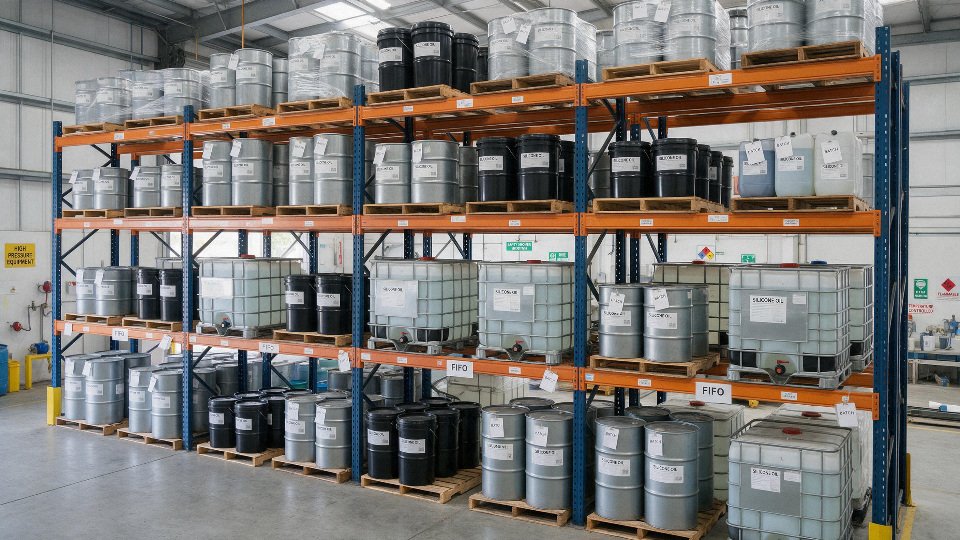
A single approved-supplier list is not sufficient when one facility buys both industrial-grade dimethylpolysiloxane for compressor lubrication and USP-grade silicone fluid for prefillable syringe lubrication. The documentation bar is entirely different. For industrial uses, a current SDS and a certificate of conformance to your internal viscosity and purity spec is usually adequate. For food-contact grades, require written confirmation of compliance with applicable FDA or EU E 900 (EC No 1333/2008) limits, and run incoming viscosity and nonvolatile residue checks at minimum. For pharmaceutical grades, insist on full USP/EP monograph certificates of analysis with actual numerical results — not just “passes” — plus change notification agreements so a supplier reformulation does not blindside your QC team mid-batch.
Batch traceability is non-negotiable in the pharma and medical device tiers. A drum that cannot be traced back to a specific supplier lot is a regulatory liability the moment something goes wrong.
Generic industrial-grade silicone oil can be substituted for USP-grade silicone oil without regulatory consequence if the viscosity matches.False
USP-grade silicone oil must meet pharmacopeial purity, nonvolatile residue, and heavy metal limits that are not tested or certified in standard industrial grades. Viscosity alone does not establish pharmacopeial compliance, and substitution without requalification violates GMP principles and can constitute adulteration under 21 CFR.
Regulatory Change Monitoring — Assign It to a Named Person
ECHA’s SVHC candidate list updates roughly twice a year. FDA Federal Register notices affecting food additives including dimethylpolysiloxane appear without predictable schedules. EU Cosmetics Regulation annex amendments affecting cyclic siloxanes have already caught several formulators off guard. A 90-day internal review cycle — meaning someone actually reads the updates and circulates a one-page impact summary — is about the right cadence for most industrial facilities. Quarterly is frequent enough to catch changes before they become violations; less frequent and you are reacting instead of managing.
SDS Management and Thermal Decomposition Training
Generic SDS documents for silicone fluids often understate the hazards that appear in heat transfer applications. Workers running silicone-based thermal fluids at temperatures above roughly 150–200 °C (the range depends on fluid grade and system oxygen ingress) can encounter formaldehyde and low-molecular-weight siloxane decomposition products that a standard handling SDS does not adequately flag. OSHA HCS 29 CFR 1910.1200 compliance requires that training reflect actual use conditions, not just the SDS as written. Supplement generic SDS training with process-specific thermal hazard instruction for any heated silicone application.
Environmental Compliance and D4/D5 Monitoring
Annual RCRA waste characterization of spent silicone oil streams is straightforward but often skipped until an inspection forces the issue. Spent heat transfer fluid and contaminated process silicone oil are typically non-hazardous under RCRA, but that determination needs documentation, not assumption. If any process water contacts silicone oil and flows toward a discharge point, confirm your NPDES permit covers it. For facilities exporting finished products to the EU, D4 and D5 cyclic siloxane impurity levels in the silicone grades used have become a real qualification parameter — EU restrictions on these substances in wash-off cosmetics have already been implemented, and industrial and personal care grade boundaries are being watched.
Product Stewardship Documentation Library
Maintain, in one accessible location: current REACH registration confirmation numbers for each silicone grade you import into the EU above the 1 tonne/year threshold, China NMPA raw material catalog listings for any silicone ingredients going into products destined for the Chinese market, Korean K-REACH notifications, and any country-specific registration status for markets you are actively entering or exploring. Export compliance determinations belong here too. This library pays for itself the first time a customer’s regulatory team or a customs authority asks for documentation and you can produce it within a day rather than scrambling for weeks.
The whole program does not need to launch at once. Prioritize by risk: pharmaceutical and food-contact uses first, environmental compliance second, the rest in parallel as resources allow. A realistic timeline for a mid-size facility building this from scratch runs six to twelve months to reach a defensible state — faster if you already have a functioning chemical management system to build on.