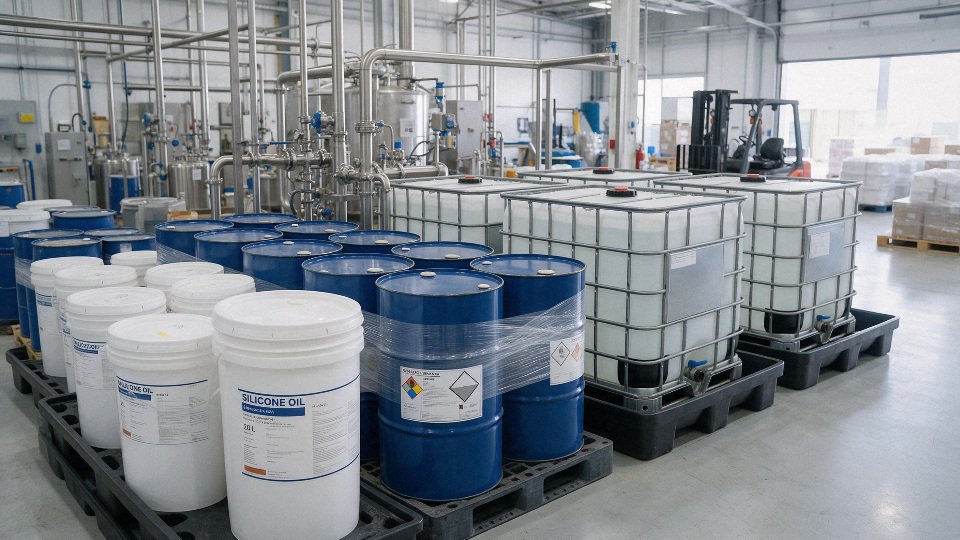
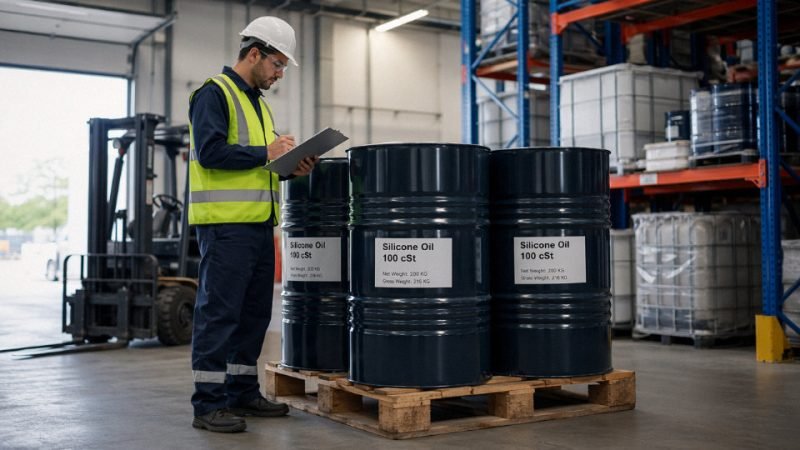
Silicone oil shipments get mishandled more often than most procurement managers want to admit — wrong container material, no viscosity callout on the bill of lading, forklift operators treating a 200 L drum of 100,000 cSt fluid the same as a drum of water. The result is burst seals, contaminated product, and on the receiving end, a production line waiting on a fluid that behaves more like cold honey than anything the fill station was set up to handle. That delay costs real money, especially when the oil is feeding a temperature-bath or release-agent system with no buffer stock.
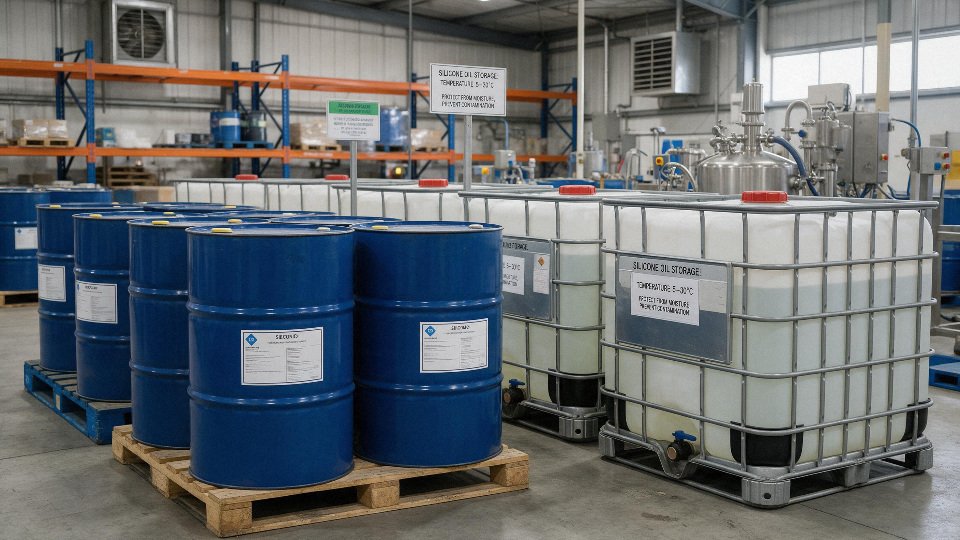
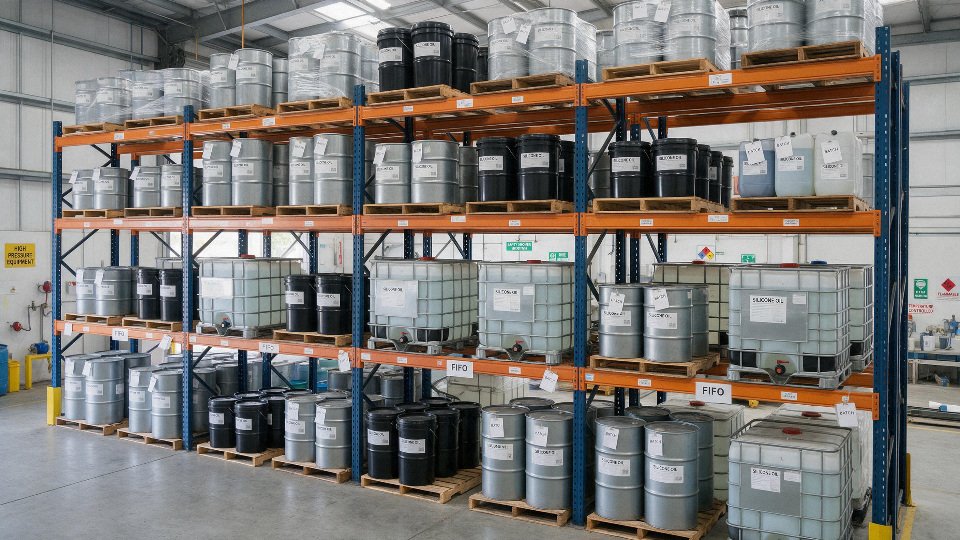
Silicone oil — typically polydimethylsiloxane (PDMS) — should be transported in sealed, moisture-free containers rated for non-reactive fluids: HDPE or carbon steel drums up to 200 L, or IBC totes from 1,000 L to 1,250 L for bulk volumes. Label every shipment with viscosity grade in cSt, because handling, pumping, and spill response differ drastically across the 5 cSt to 1,000,000 cSt commercial range. Flash points generally run 300°C–350°C, so fire hazard classification is low, but that doesn’t mean the logistics are simple.
What catches a lot of engineers off guard is exactly that last point. The low flammability makes people assume silicone oil is a no-fuss material to move — and then they find out that a high-viscosity grade barely flows at ambient temperature in January, or that a poorly vented drum has built enough internal pressure from thermal cycling to pop a bung fitting when the warehouse crew opens it. The physics of this fluid across its viscosity range create more logistics problems than the fire triangle ever will.
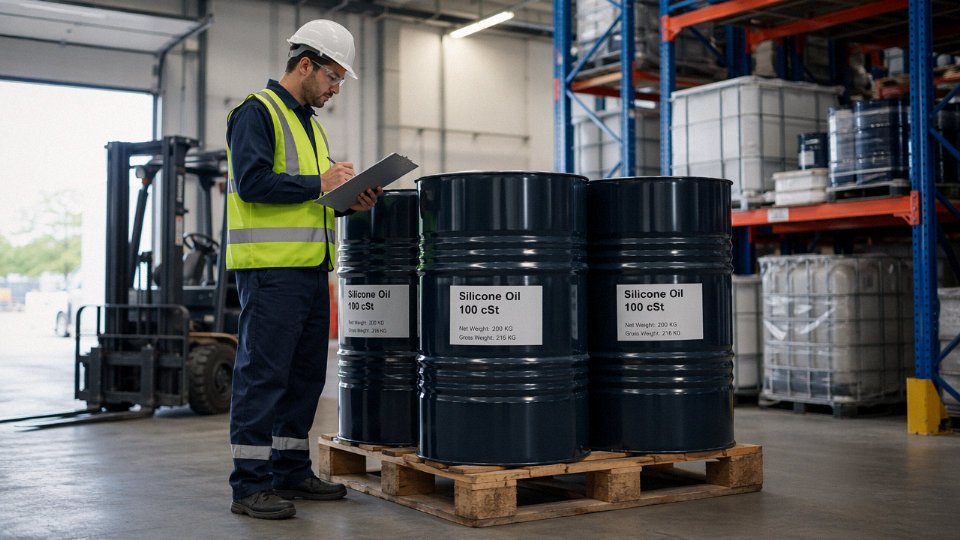
Regulatory Classification and Hazard Identification for Silicone Oil Shipments
Most general-purpose polydimethylsiloxane (PDMS) silicone oils ship as non-regulated materials. That’s the short answer, and it genuinely simplifies logistics — no orange ADR placards, no IATA dangerous goods declarations, no IMDG segregation requirements, no DOT 49 CFR hazmat shipping papers for standard viscosity grades from around 5 cSt up through the thick, almost-gel-like 1,000,000 cSt products. Carriers like this. Freight forwarders like this. The problem is that “non-regulated” gets misread as “no documentation needed at all,” and that’s where shipments start causing headaches at customs or, worse, on arrival when a receiver’s EHS team pulls the SDS and finds the shipper sent nothing.
Non-regulated status means the regulatory burden is lighter, not zero.
When the Non-Regulated Status Disappears
Silicone oil stops being a routine freight item the moment it’s blended or formulated. Two situations come up regularly in procurement work. First: silicone oil products that contain residual volatile solvents — isopropanol, naphtha, or certain aromatic carriers used to reduce viscosity for spray applications — can push the mixture into UN 1993, Flammable Liquid, N.O.S., typically Packing Group II or III depending on flash point testing. The base silicone oil’s flash point may be 300°C or higher, but a blend with 15–20% naphtha behaves like the naphtha, not the silicone. Always test the formulated product, not the silicone component alone.
Second: some high-viscosity silicone fluids and silicone-based heat transfer fluids trigger UN 3082, Environmentally Hazardous Substance, Liquid, N.O.S., Packing Group III when aquatic toxicity data — specifically log Kow values and bioaccumulation potential — meets the threshold criteria under GHS. Cyclic siloxanes, particularly D4 and D5 (octamethylcyclotetrasiloxane and decamethylcyclopentasiloxane), are the usual culprits. If your silicone oil contains measurable cyclic siloxane fractions, check Section 12 of the SDS before assuming clean regulatory status.
Standard linear PDMS silicone oils are non-hazardous under IMDG, ADR, IATA, and DOT 49 CFR regulationsTrue
Linear PDMS lacks the flash point, reactivity, toxicity, or environmental persistence thresholds that trigger dangerous goods classification under these major transport frameworks. This is confirmed in manufacturer SDS documents and regulatory guidance from bodies including the U.S. DOT PHMSA and ECHA.
Reading Section 14 of the SDS — Don’t Skip This Step
SDS Section 14 (Transport Information) is where you confirm classification before booking. A clean non-regulated SDS entry looks like this: UN Number listed as “None,” Proper Shipping Name as “Not regulated,” Hazard Class and Packing Group both blank or marked “N/A,” marine pollutant flag as “No.” If any of those fields is populated with an actual UN number, stop and reclassify the shipment accordingly.
The marine pollutant flag matters more than people expect, especially for ocean freight. A “Yes” on marine pollutant status requires a marine pollutant mark on the package and specific stowage requirements under IMDG, even if the overall hazard class is low. Shippers moving IBC totes of specialty silicone formulations on container vessels and skipping this step have had shipments delayed at port — it’s an annoying, avoidable problem.
Limited quantity provisions (LQ) under ADR/IMDG apply to regulated silicone blends and can reduce packaging and labeling requirements substantially, but the thresholds depend on hazard class, so there’s no single blanket rule.
Country-Specific Labeling Nuances
EU shipments fall under CLP regulation (EC No 1272/2008), which aligns closely with GHS but has some classification differences — particularly around aquatic hazard categories. If your formulation contains cyclic siloxanes above the concentration threshold, a CLP hazard label is required on the package regardless of transport classification.
For export shipments produced in or routed through China, GB 12268 governs dangerous goods classification for road and rail, and it follows GHS structure closely enough that a compliant GHS SDS usually satisfies documentation requirements. In practice, customs authorities in China pay close attention to SDS completeness, so a generic supplier SDS with missing Section 14 data will cause delays.
U.S. OSHA HazCom 2012 aligns with GHS Revision 3, meaning SDS format and hazard communication labels for silicone oils in the U.S. follow the same 16-section structure. The key operational point: OSHA HazCom governs workplace labeling and SDS requirements, while DOT 49 CFR governs transport classification — they’re separate systems, and compliance with one doesn’t automatically satisfy the other.
Grade-Based Documentation Differences
| Grade | Typical Regulatory Status | Key Documentation Requirement | Carrier Acceptance Notes |
|---|---|---|---|
| Industrial-grade PDMS | Non-regulated (pure linear grades) | SDS required; carrier may request copy | Generally accepted without restriction |
| Food-grade silicone oil | Non-regulated; FDA 21 CFR compliance needed | SDS + food-contact compliance letter | Some carriers require grade certification |
| Medical-grade / pharma | Non-regulated for transport; GDP may apply | SDS + CoA + cold chain documentation if specified | Pharmaceutical carriers only for some grades |
| Formulated blends (with solvents) | May be UN 1993 or UN 3082 | Full dangerous goods documentation | Restricted on passenger aircraft; IBC may require special permit |
Food-grade silicone oil — typically a highly refined, low-viscosity PDMS in the 50–1,000 cSt range — carries no extra transport hazard classification, but buyers often need a letter confirming FDA 21 CFR 178.3570 compliance to satisfy their own internal EHS and receiving departments. Get that letter from your supplier before shipment, not after a receiver refuses the load.
Selecting the Right Containers and Packaging for Every Shipment Volume
Container choice is where most silicone oil transport problems actually start. The product is chemically forgiving in many ways, but its low surface tension — typically under 21 mN/m even for mid-viscosity grades — means it wicks through imperfect closures that would hold a conventional lubricant without complaint. Get the packaging wrong and you’re not looking at a dramatic spill; you’re looking at an oily film on a pallet, a contaminated load of adjacent product, and a carrier dispute that takes weeks to resolve.
Small Volumes: 1–25 L
HDPE jerry cans and carboys are the right call here, and the reasoning matters. HDPE contains no plasticizers, so there’s no extractable content for silicone oil to strip out over weeks of contact — a real failure mode with PVC containers, which can leach phthalates into the oil and compromise any food-contact or medical application downstream. Polycarbonate looks attractive on paper but develops stress cracking over time, particularly at the handle welds and around the bung collar. A cracked carboy at the back of a warehouse is a slow, almost invisible contamination event.
Wall thickness should be at least 3 mm for anything in the 10–25 L range. Thinner walls flex during transport and the repeated deformation gradually fatigues the bung seat. Closures should be tamper-evident with a PTFE-lined cap or insert — not bare polyethylene pressing against the thread.
Mid Volumes: 25–200 L Drums
The open-head versus closed-head decision comes down to how the customer intends to empty the drum. Open-head (removable lid, lever-lock ring) is easier for high-viscosity grades above roughly 5,000 cSt where you’re scooping or using a follower plate pump. Closed-head drums with 2-inch and ¾-inch bungs suit pumpable grades and are the standard for the majority of PDMS shipments in the 100–350 cSt range.
Bung torque matters more than most handlers appreciate. Steel bung closures on a 200 L drum should be torqued to 80–100 N·m — below that, vibration during road transport works the plug loose within a few hundred kilometers. Above that range, you risk deforming the bung socket on thinner-gauge drums. Use a calibrated torque wrench; a pipe wrench applied by feel is not adequate for a product this prone to seeping.
Gasket material is not interchangeable. PTFE and silicone gaskets are chemically compatible and dimensionally stable. Nitrile rubber swells in contact with silicone oil over time — not dramatically, but enough to lose the compression set that gives you the seal.
Nitrile rubber gaskets are chemically compatible with polydimethylsiloxane silicone oils for long-term storageFalse
PDMS silicone oils cause progressive swelling and softening in nitrile (NBR) rubber, degrading the compression set of drum bung gaskets over weeks to months. PTFE or silicone elastomer gaskets are the correct specification for silicone oil drum closures.
Bulk Volumes: IBCs at 1,000–1,250 L
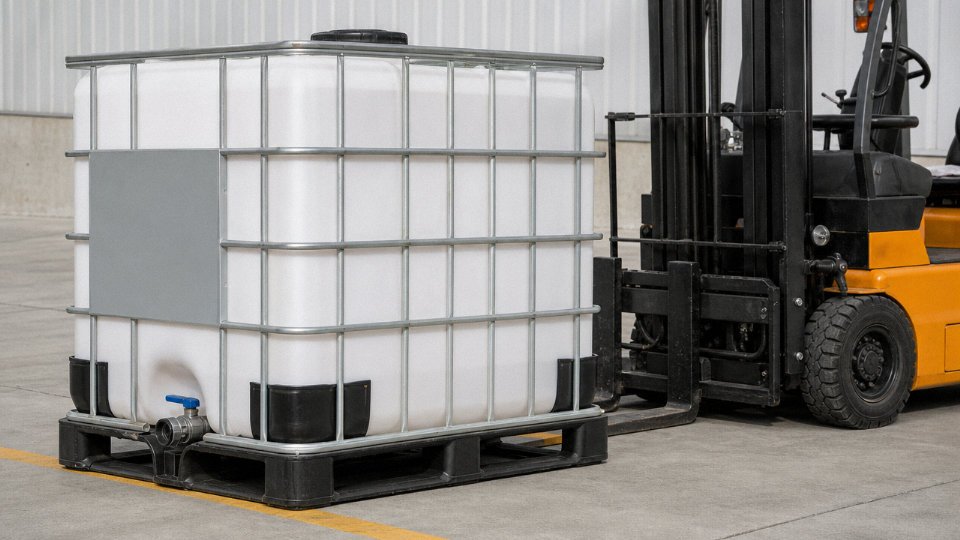
Composite IBCs — HDPE inner bottle inside a steel cage on a pallet — handle the vast majority of industrial silicone oil bulk shipments. They’re economical and the inner bottle can be replaced without scrapping the cage frame. Valve type on the outlet fitting is a surprisingly contentious issue. Ball valves give a full-bore opening and clean shutoff, which matters when you’re draining high-viscosity product. Butterfly valves create a partial obstruction in the flow path and tend to trap residual oil in the disc seat, causing cross-contamination on reuse.
For pharmaceutical-grade or food-grade silicone oil, composite IBCs are generally not acceptable. The inner HDPE bottle carries residual odor and trace extractables that don’t clear with standard IBC washing protocols. Stainless steel IBCs — 316L is the usual specification — are required here. They’re expensive (roughly 4–8× the cost of composite units, depending on fittings and surface finish), but they can be validated, cleaned to FDA or EU food-contact standards, and reused across hundreds of cycles.
ISO Tanks and Tanker Trucks
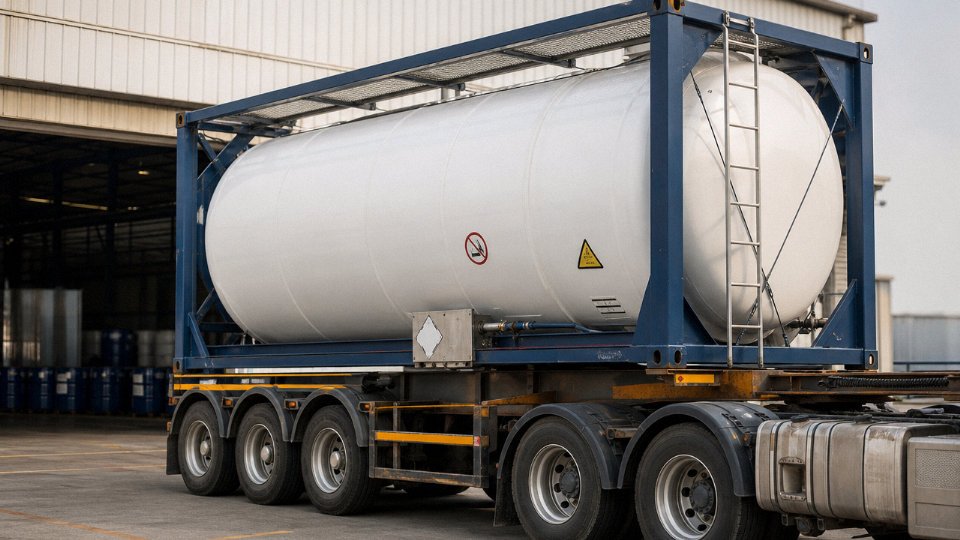
At volumes above what IBCs can reasonably manage — typically when you’re moving 20,000 L or more per shipment — ISO tank containers and dedicated tankers enter the picture. For non-hazardous viscous silicone oils, the minimum ISO tank designation is T11. Heating coils become non-negotiable above roughly 10,000 cSt: unheated, these grades simply won’t flow through a 3-inch outlet valve at ambient winter temperatures without adding hours to a discharge that should take thirty minutes. Coil capacity should be sized to bring the product to at least 40–60°C before discharge begins, and the tank shell needs thermal insulation if transit crosses cold-weather regions between November and March.
Decoding UN Certification Marks
The markings stamped or molded onto drums and IBCs tell you whether a container is legally authorized for the product you’re shipping. A 1H1 mark indicates a closed-head HDPE drum; 1H2 is an open-head HDPE drum; 3H1 identifies an HDPE inner receptacle within a composite IBC. The numbers following the mark indicate performance test levels — you need to match the packing group rating on the container to the packing group assigned to your shipment in the SDS and transport documents.
Verify certification validity before purchasing a batch of drums. Certification stamps carry a manufacturing date and the approval authority code. Containers sitting in a distributor warehouse for two-plus years may have aged seals and out-of-date approval references. A quick check against the issuing authority’s register takes five minutes and has saved more than a few shipments from being rejected at the border.
Anti-Contamination Protocols
For oxidation-sensitive or color-critical silicone oil grades, nitrogen blanketing the headspace before sealing is worth the modest added step. The more practical contamination risk in most plants isn’t oxidation — it’s physical contamination from previous drum contents. Inner liner bags, used as a disposable barrier inside a standard steel drum, are a cost-effective solution when dedicated drums aren’t feasible. For food-grade and medical-grade PDMS, dedicated-use containers are not optional. A drum that held a general industrial lubricant grade should never be repurposed for food-contact silicone oil, regardless of how thoroughly it was cleaned. The traceability requirement alone rules it out.
| Volume Range | Recommended Container | Key Specification |
|---|---|---|
| 1–10 L | HDPE jerry can | ≥3 mm wall, PTFE-lined closure |
| 10–25 L | HDPE carboy | Stress-crack resistant grade, tamper-evident cap |
| 25–200 L | Closed-head steel or HDPE drum | 80–100 N·m bung torque, PTFE/silicone gasket |
| 1,000–1,250 L | Composite IBC (industrial) / 316L SS IBC (pharma/food) | Ball valve outlet, validated clean for food-grade |
| >10,000 L | T11 ISO tank / dedicated tanker | Heating coils required above 10,000 cSt |
Road Transport: Loading, Securing, and Driver Safety Procedures
Getting silicone oil onto a truck and to its destination without incident is mostly about discipline in the details — vehicle choice, load geometry, driver briefing, and spill kit contents. The properties that make silicone oil relatively benign from a fire-risk standpoint (flash points typically north of 300°C) can lull logistics teams into sloppy habits, and that’s where the real problems start.
Vehicle Selection: Enclosed Transport Is Not Optional for Most Grades
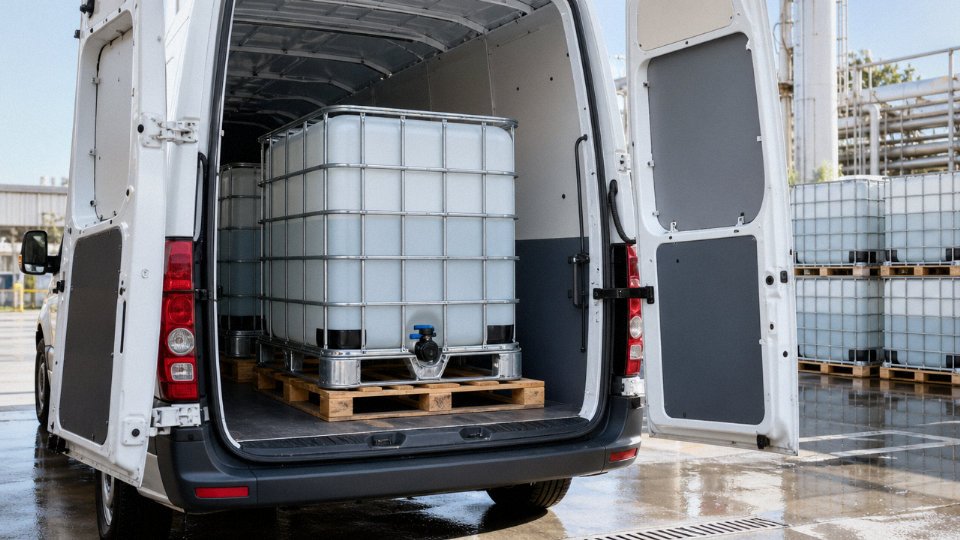
For drum and IBC shipments, enclosed vans or curtainsider trailers with solid side panels are strongly preferred over open flatbeds. The reason is partly practical: HDPE drums and IBC outer shells degrade under prolonged UV exposure, and on a multi-day cross-country run in summer, direct sun on a black HDPE drum can raise surface temperature enough to soften the drum wall slightly, which matters if it’s stacked. UV also attacks pallet wrap, which is your last line of containment redundancy.
Temperature stability is the other driver. High-viscosity grades — anything above roughly 60,000–100,000 cSt — become almost paste-like below about 10°C, and if an IBC valve gets stiff during transit, the driver may force it or attempt field improvisation. That creates spill risk. Enclosed vehicles with insulated panels buffer against the worst of winter temperature swings on long hauls; heated vehicles (typically trailer-mounted diesel heating units) are worth specifying for viscosities above 100,000 cSt on routes where overnight temperatures regularly drop below 5°C. Pre-heating a large IBC of 1,000,000 cSt PDMS without the right equipment can take hours; nobody wants to find that out at a 3 AM delivery dock.
Load Planning and Weight Distribution
A 200 L steel drum of silicone oil weighs roughly 190–210 kg gross depending on grade density, which ranges from about 0.96 to 1.07 g/cm³ across commercial PDMS viscosities. Stack height is effectively limited to two drums on a pallet — not three, regardless of what the structural calculation might suggest — because drum bungs and lids are not designed as load-bearing surfaces under dynamic road vibration over long distances. Use EUR pallets (1,200 × 1,000 mm) rated at a minimum 1,500 kg dynamic load; standard blue exchange pallets often fall short of that rating and have failed under two-high drum stacks on rough roads.
Center-of-gravity management matters more with IBC totes. A 1,000 L IBC filled with a dense silicone grade can weigh close to 1,080–1,100 kg. Place IBCs against the front bulkhead of the trailer where possible — forward-loaded cargo performs better in emergency braking. Do not mix drum pallets and IBCs on the same axle zone without a load plan reviewed by the transport manager.
Cargo Securing Under EN 12195 and FMCSA 393.100
Both EU and U.S. regulations require that cargo cannot shift under defined deceleration forces. For silicone oil loads, anti-slip mats with a coefficient of friction of at least 0.3 (per EN 12195-1) between pallet and trailer floor are a baseline requirement — not a nice-to-have. In practice, most reputable carriers use 4 mm rubber-granulate mats; make sure they actually get deployed and don’t sit folded in the cab.
Strap placement: for a two-pallet-wide, two-drum-high stack, a minimum of two loop lashings per pallet row is the starting point. Add diagonal straps if the load-to-trailer height ratio is above roughly 2:1. Void fill with inflatable dunnage bags where lateral gaps exceed about 150 mm — unsupported drums will walk sideways on sharp curves even with vertical strapping in place.
Anti-slip mats with a friction coefficient below 0.3 do not meet EN 12195-1 requirements for securing industrial drum cargo on road vehicles.True
EN 12195-1 specifies minimum friction coefficients for securing materials, and 0.3 is the threshold commonly required for anti-slip interfaces between cargo and load bed; mats below this value cannot be credited in lashing calculations.
Temperature Management in Transit
For standard-viscosity grades (5–1,000 cSt), ambient temperature management is a non-issue. Above 10,000 cSt, viscosity changes meaningfully with temperature, and above 100,000 cSt, cold weather can create pump-out problems at the receiving end that drivers mistakenly attribute to container damage. Specify in the delivery order that the receiving facility needs to warm high-viscosity IBCs to at least 20°C before attempting discharge — usually 12–24 hours in a heated warehouse, depending on volume and insulation.
For genuinely high-viscosity shipments in winter, some plants run heated tankers rather than IBC, which is worth pricing out if order volume justifies it.
Driver Training and Spill Response
Drivers handling silicone oil shipments should be briefed — in writing, not just verbally — on two things beyond standard ADR/HazMat awareness: the contamination hazard and the spill response kit contents.
Silicone oil is extremely slippery. A modest spill on a loading dock floor creates a serious slip hazard that persists far longer than a water or petroleum spill because PDMS doesn’t evaporate and resists being absorbed by standard sawdust. Spill kits should contain absorbent granules specifically rated for synthetic fluids (not universal cellulose-based granules, which are largely ineffective on low-surface-tension silicone oils), PTFE-lined containment booms if the vehicle carries IBC volumes, and collection bags rated for chemical waste. PPE minimum: nitrile gloves of adequate thickness (0.15 mm or heavier), safety glasses or face shield for any bulk transfer activity.
Communication protocol matters. The driver should know to contact dispatch immediately on any container breach — not to attempt field repairs on a leaking IBC valve with improvised materials — and dispatch should have the SDS on file and the emergency contact for the consignor.
Route Risk Assessment
High-viscosity IBC loads are more sensitive to dynamic load shifts than most teams assume. Route planning should flag and where possible avoid roads with sustained steep gradients (above roughly 8–10%) or hairpin curves at altitude — not because of regulatory prohibition but because load shift risk is genuinely elevated. In the EU, check ADR Chapter 7.5 tunnel restriction codes for the specific UN number of your shipment before routing through major alpine or urban tunnels; some silicone oil formulations with additives carry codes that restrict certain tunnel categories. On ferry crossings, IBCs must typically be braked, chocked, and additionally lashed per ferry operator requirements, which vary — confirm in writing with the ferry line before booking.
Sea Freight: IMDG Compliance, Container Stuffing, and Port Handling
Standard PDMS silicone oils — neat, unfunctionalized, no added biocides or heavy-metal catalysts — are not classified as dangerous goods under the IMDG Code (2024 edition, Amendment 42-24). That sounds like good news, and it largely is. But “not dangerous goods” does not mean “no paperwork.” Shippers still need to issue a Shipper’s Declaration of Non-Dangerous Goods and comply fully with the IMO/ILO/UNECE Code of Practice for Packing of Cargo Transport Units (CTU Code). Freight forwarders who skip the CTU packing certificate because the cargo looks benign are the ones who end up with a container red-tagged at the port of discharge.
Marine Pollutant Assessment — Don’t Assume You’re Clear
This is where silicone oil shipments get complicated. High-viscosity grades — roughly above 10,000 cSt, though the actual trigger depends on the full formulation — and any silicone oil blended with additives (antioxidants, surfactants, metal-containing catalysts) may qualify for the Marine Pollutant (MP) designation under IMDG and MARPOL Annex II. The shipper is responsible for that determination, not the carrier.
If MP designation applies, the consequences are real and immediate: the container must carry the marine pollutant mark, deck placement is restricted (MP cargo typically goes under-deck on regulated services), and any spill in port or at sea triggers reporting obligations under MARPOL Annex II and potentially local port state control requirements. Failing to flag an MP shipment correctly is not a paperwork technicality — port state control inspectors treat it as a deliberate concealment, and the fines in Singapore, Rotterdam, and Los Angeles are not trivial.
Neat, unfunctionalized PDMS silicone oil is not classified as a dangerous good under the IMDG Code 2024 edition.True
Standard polydimethylsiloxane without additives does not meet the criteria for any IMDG hazard class. However, additive-containing or high-viscosity formulations may trigger marine pollutant designation and require additional documentation.
Container Selection and Stuffing
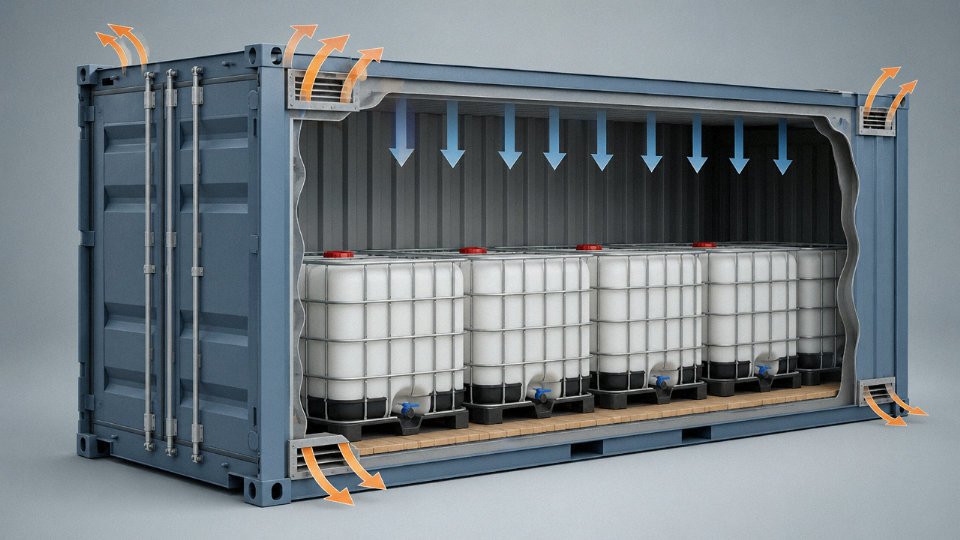
For drum and IBC shipments, a standard dry 20 ft or 40 ft general-purpose container is correct. There is no need for a tank container for these package sizes, and using one typically raises costs without benefit. If you are moving bulk silicone oil (volumes above roughly 15,000–18,000 L per container), flexitanks are an option — but check bladder material compatibility. Polyurethane flexitank walls can absorb low-viscosity silicone fluids over voyage durations of 25–35 days, leading to wall degradation and, in documented cases, slow seepage at the weld seams. Some flexitank suppliers offer PE inner liners specifically rated for silicone service; specify that in writing before booking.
All liquid drums must travel bung-up. This is non-negotiable regardless of how securely the bung is torqued. Drums on their sides migrate closure stress to the seam and, in swell conditions, you get intermittent pressure cycling that works the bung loose over a three-week Pacific crossing.
Blocking and bracing follows CTU Code Chapter 5. For a 20 ft GP container with a typical payload limit around 21,600 kg (verify with the specific container’s CSC plate — numbers vary by unit age and manufacturer), 200 L steel drums at roughly 185–195 kg loaded weight stack two high maximum, four rows wide. Secure with friction mats under the bottom tier and timber or airbag bracing forward and aft. IBCs sit one tier only.
Moisture and Condensation Control
A silicone oil drum arriving at a humid tropical port with condensation on the outer surface is a contamination risk the moment someone cracks the bung. Silicone oil picks up moisture at the interface; in high-viscosity grades this shows up as a haze that takes hours to settle. Pack silica gel desiccant bags — usually 500–1,000 g units, one per 10–15 m³ of container volume depending on origin climate — and hang them from the container lashing rings, not placed on the floor where they get crushed. Before stuffing, inspect container floor boards for delamination or old residue, check door gaskets by running a flashlight test, and confirm the ventilation plugs are closed. A container with a compromised door seal on a Busan-to-Hamburg winter route will sweat badly.
Port Documentation Package
Get this assembled before the vessel booking is confirmed, not the night before cut-off:
| Document | Key Detail |
|---|---|
| Commercial invoice | HS code 3910.00 for PDMS silicone polymers |
| Packing list | Drum/IBC count, net and gross weights, lot numbers |
| Safety Data Sheet | In destination country’s required language |
| Certificate of Analysis | Viscosity, appearance, purity — carrier and consignee both want this |
| CTU Packing Certificate | Signed by the party responsible for container packing |
| Food/Pharma CoC | Only if product is food-grade or pharmaceutical grade; some ports hold containers pending this |
If the shipment touches a port in the EU, the SDS must comply with EU Regulation 2020/878 format. Sending a version formatted for the US market will get it rejected at customs in Hamburg or Antwerp. Small detail, real delay.
Air Freight and Courier Shipments: IATA Restrictions and Quantity Limits
Standard polydimethylsiloxane silicone oils — neat, unblended, with no added solvents — are generally not classified as dangerous goods under IATA DGR. That sounds like good news, and mostly it is. The complication is that “not restricted” and “unconditionally accepted” are not the same thing. Individual airlines maintain their own commodity acceptance policies that can be stricter than the DGR baseline, and a forwarder who books your shipment without checking the operating carrier’s specific policy is setting you up for a ramp rejection.
In practice, most carriers will accept neat silicone oil under a general cargo commodity description — something like “Silicone Oil, non-hazardous, non-flammable, PDMS” — paired with an SDS confirming flash point above 300°C and no hazardous components. Some carriers, particularly on Middle Eastern or South Asian routes where customs scrutiny of chemical shipments runs high, will ask for a shipper’s declaration of non-restricted status. That’s a one-page letter on company letterhead stating the product is not subject to IATA DGR, referencing the relevant SDS and flash point data. It’s worth drafting a standard template and keeping it on file.
When Silicone Oil Blends Become Restricted
The moment you move away from neat PDMS into a formulated product — say, a silicone release agent cut with a petroleum-based carrier solvent, or a silicone emulsion with an alcohol component — the regulatory picture changes completely. Blends containing flammable solvents or reactive components may fall under IATA DGR Class 3 (flammable liquids) or trigger classification as a mixture requiring proper hazard assessment before any booking. Aerosol silicone sprays are Class 2.1 or 2.2 depending on propellant, and those are restricted or forbidden on passenger aircraft outright.
For such blends, Packing Instruction PI 366 governs limited quantity provisions for flammable liquids, and PI 620 applies to certain environmentally hazardous substances. If you’re not sure which PI applies to your specific formulation, the answer is to get an IATA-certified dangerous goods classifier involved before the shipment moves — not after a carrier flags it at origin.
Standard neat silicone oil (PDMS, no flammable additives) is not classified as a dangerous good under IATA DGR.True
Neat PDMS silicone oils lack the flammability, reactivity, and toxicity thresholds that trigger IATA DGR classification. Flash points typically exceed 300°C, far above the Class 3 threshold of 60°C. However, blended or formulated silicone products must be assessed individually.
Passenger Baggage: Simply Don’t
Industrial silicone oil in any meaningful quantity does not belong in passenger carry-on or checked baggage. The 100 mL liquids rule for carry-on eliminates anything useful for industrial purposes, and checked baggage rules for chemicals are strict enough that attempting to travel with a drum or even a multi-liter container is asking for confiscation and a conversation with airport security you don’t want to have. Freight-only is the correct route, full stop.
Packaging Requirements at Altitude
This is where engineers sometimes get caught out. Aircraft cargo holds are not pressurized to sea-level equivalents — the pressure differential can reach roughly 95 kPa depending on altitude and aircraft type. A sealed HDPE container that looks perfectly fine on the ground can bulge or fail under that differential if it wasn’t designed for it. IATA requires that inner containers either vent (with a pressure-equalization valve) or be rated to withstand the pressure differential without distortion or leakage. Standard 200 L drums are too large for air freight in most practical scenarios; air shipments of silicone oil typically involve smaller containers — 1 L to 25 L HDPE bottles or jerry cans — that must pass drop-test performance equivalent to IATA 6E specification. Don’t assume that a container passing UN 4G or 4H2 certification for ground transport automatically meets air freight requirements. Check with your packaging supplier explicitly.
Courier and Express Shipments
DHL, FedEx, and UPS will each accept non-hazardous neat silicone oil, but their per-parcel limits typically cap out at 30 L or 30 kg, whichever is reached first — and that figure can vary slightly by destination country and service level, so always verify with the carrier’s hazardous and non-hazardous commodity acceptance tool before generating the label. Overpacking is required: the inner containers go into a secondary containment layer with absorbent material, then into a labeled outer carton. The outer carton needs the commodity description, the shipper and consignee details, and — for most express services — a copy of the SDS either attached to the outside of the parcel or transmitted electronically to the carrier’s customs pre-clearance system.
For customs in high-scrutiny markets, the documentation approach matters. Australia’s DAFF (Department of Agriculture, Fisheries and Forestry) may flag silicone-based chemical shipments for biosecurity review, particularly if the SDS is incomplete or the commodity description on the airway bill is vague. India’s customs authorities have historically requested additional certification letters for polymer-based chemicals. The Middle East — UAE, Saudi Arabia in particular — often requires an importer-of-record letter and sometimes a local product registration number before clearing chemical shipments. None of this is insurmountable, but finding out about these requirements after the shipment has departed origin is expensive and slow. Build country-specific documentation checklists into your freight booking process before the order ships.
The airway bill commodity description deserves more attention than it usually gets. “Chemical” or “oil” is not sufficient. A description like “Polydimethylsiloxane (Silicone Oil), Non-Hazardous, Non-Flammable, Flash Point >300°C, IATA Non-Restricted” gives customs and airline handling staff the information they need and reduces the chance of a hold at a transit hub. Attach the SDS — or at minimum the safety data sheet cover page with the key physical properties — to every air shipment regardless of whether the carrier explicitly requires it.
Spill Prevention Engineering and Emergency Response Protocols
Silicone oil spills get underestimated. The flash point sits above 300°C, so there’s no ignition risk on the apron or dock floor — and that apparent safety lulls responders into treating a spill like a minor housekeeping issue. It isn’t. Surface tension for typical PDMS grades runs between 18 and 22 mN/m, roughly half that of water, which means a modest spill spreads fast and thin across concrete or asphalt. The resulting film is nearly invisible and extraordinarily slippery. Foot traffic and forklift movement become serious injury risks within minutes of a drum breach or hose failure.
Silicone oil's low surface tension (18–22 mN/m) causes it to spread into films thin enough to be invisible on concrete, creating slip hazards even after the bulk liquid appears to have been removed.True
PDMS surface tension values in this range are well-documented in supplier technical datasheets and physical chemistry literature; the spreading behavior follows directly from the low surface energy.
Primary Prevention: Engineering Out the Risk Before It Happens
Secondary containment pallets are non-negotiable for any IBC or drum storage point. Size the sump to hold at least 110% of the largest single container volume — so a 1,000 L IBC needs a sump rated for 1,100 L minimum. That 10% buffer accounts for absorbent material displacement and any incidental rainwater if the pallet is outdoors or near a loading bay door.
During transfer operations, drip trays go under every connection point without exception. It sounds obvious, but in practice the tray gets skipped when the pump truck is running late. That’s usually when the drip becomes a puddle.
Cam-lock fittings with dust caps on IBC outlets are worth specifying explicitly in your procurement requirements — not all bulk containers arrive with caps fitted, and an uncapped female cam-lock will weep on any vibrating vehicle. Hose assemblies should carry a minimum burst pressure of 6 bar if operating at 2 bar working pressure. Verify this from the hose manufacturer’s certificate, not just the supplier’s verbal assurance. High-viscosity grades (above roughly 5,000 cSt) generate noticeable pressure spikes during pump start-up, so that safety margin earns its keep.
Spill Response Kit: Match the Kit to the Load
For shipments up to 1,000 L, a practical response kit contains: 20 kg polypropylene absorbent granules, two containment booms (each at least 3 m), one non-sparking aluminum or plastic scoop, ten heavy-duty 120-litre waste bags with cable ties, and a full PPE set — nitrile gloves, safety glasses, and chemical-resistant overshoes. Silicone oil is low acute-toxicity, but the slip hazard means responders need grip-rated footwear, not standard safety boots.
Scale up roughly linearly: add 10 kg of granules and two waste bags per additional 500 L of load volume. For loads above 5,000 L you’re into specialist contractor territory for aquatic environment protection.
Cleanup Chemistry: Water Won’t Help You Here
This catches people out. Silicone oil does not emulsify readily with water-based surfactants — hosing the area down or applying standard degreaser disperses the film without breaking it, and you end up pushing contamination toward drains rather than removing it. Pre-treat the spill area with isopropyl alcohol (IPA) to partially displace and break the film’s adhesion to the substrate, then apply absorbent granules, work them in with the scoop, and collect everything for disposal as chemical waste. Do not wash residue into drains. PDMS is persistent in aquatic environments and will coat biofilm in wastewater treatment, disrupting aeration.
Incident Command and Regulatory Notification
First responder — driver or warehouse operative — contains the spill perimeter, deploys booms, and stops all vehicle movement in the area. That’s the priority in the first five minutes, before any documentation.
Escalation to the site safety officer should happen within 15 minutes. In the EU, spills exceeding 200 L to land or any release to water require notification to the competent authority within 24 hours — check your national transposition of the Environmental Liability Directive. In the U.S., PDMS itself doesn’t carry a CERCLA reportable quantity, but any formulated silicone oil containing additives (certain catalysts, chlorinated compounds) may trigger Superfund notification requirements, so review the SDS Section 15 before assuming you’re clear.
Post-Incident Documentation
Root cause analysis should be filed within 48 hours while detail is fresh: record container condition before and after, transfer procedure used, whether the correct hose rating was in place, and who authorised the operation. Carrier incident reports for freight insurance purposes typically need to be submitted within 72 hours of the event — missing that window has a way of voiding claims.
Corrective actions go into a tracked register with a named owner and a close-out date. A spill caused by a failed cam-lock cap is not a one-site problem; it usually means the same fitting type is live on six other vehicles.
Temperature, Viscosity, and Pumping Considerations During Transfer Operations
Silicone oil’s reputation for chemical stability can lull engineers into underestimating how dramatically the physical handling changes between grades and between seasons. A 1,000 cSt PDMS pours freely at ambient temperature. A 100,000 cSt grade in an unheated drum at 10°C moves like cold honey — slowly, reluctantly, and with enough resistance to stall an undersized pump or collapse a flexible hose. Getting the transfer right requires understanding the viscosity-temperature relationship first, then working backward to pump selection, pipe sizing, and heating strategy.
Viscosity-Temperature Behavior of PDMS Silicone Oil
PDMS silicone oils have an exceptionally flat viscosity-temperature (V-T) curve. Viscosity index values typically fall in the 150–400 range depending on grade, compared to roughly 90–110 for a conventional mineral hydraulic oil. In practice this means a 1,000 cSt silicone oil loses perhaps 40–50% of its viscosity going from 10°C to 40°C, whereas a comparable mineral oil might lose 70–80%. That sounds reassuring until you’re working with a 100,000 cSt grade in a northern European warehouse in February.
| Nominal Viscosity (25°C) | Approx. Viscosity at 10°C | Approx. Viscosity at 40°C | Flow Character |
|---|---|---|---|
| 1,000 cSt | 1,800–2,200 cSt | 550–700 cSt | Pourable |
| 10,000 cSt | 20,000–28,000 cSt | 5,500–7,000 cSt | Slow pour |
| 100,000 cSt | 250,000–350,000 cSt | 60,000–80,000 cSt | Near-paste |
| 1,000,000 cSt | Semi-solid behavior | 400,000–600,000 cSt | Requires heating |
Values depend on specific formulation and molecular weight distribution. Treat these as planning estimates, not specification data — always request the supplier’s actual V-T curve for the grade you’re handling.
PDMS silicone oils have a significantly flatter viscosity-temperature curve than mineral oils of equivalent room-temperature viscosity.True
PDMS polymers exhibit high viscosity indices (typically 150–400) due to the flexibility of the Si-O backbone and low intermolecular forces, giving them better viscosity stability across temperature ranges compared to hydrocarbon-based oils, which is well documented in Dow, Shin-Etsu, and Wacker technical literature.
Pump Selection
For viscosities up to roughly 100,000 cSt at transfer temperature, external gear pumps work well — they handle the laminar, non-Newtonian-adjacent flow without cavitation issues, provided you size the inlet generously and keep inlet velocities low. Viking and Roper are common choices on the plant floor; most engineers running silicone transfers have at least one of these already.
Above 100,000 cSt, shift to progressive cavity (Moyno-type) pumps. The helical rotor geometry tolerates very high-viscosity material without the shear stress spikes that can cause gear pump slip and heat buildup. For drum-level unloading of grades above 500,000 cSt, a follower-plate vacuum-assisted drum unloader is often the only practical option — the follower plate maintains contact with the product surface and pushes it out mechanically while vacuum assists flow into the transfer line.
Pipe and Hose Sizing
High-viscosity silicone oil transfers are dominated by laminar flow. Reynolds numbers rarely exceed a few hundred for anything above 10,000 cSt at reasonable velocities, so the Hagen-Poiseuille equation governs pressure drop almost entirely. A useful rule of thumb: to keep pressure drop below roughly 1 bar per 10 m of pipe, pipe internal diameter should satisfy —
D (mm) ≥ 3.6 × (Q × μ)^0.25
where Q is in L/min and μ is dynamic viscosity in mPa·s. For 50 L/min of 10,000 cSt oil (≈ 9,300 mPa·s at 25°C), this gives a minimum ID of around 50 mm. Use 63 mm if the run has multiple bends or fittings. Flexible hoses should be internally smooth-bore PTFE or food-grade rubber lined — avoid corrugated interiors, which add turbulence penalties and create cleaning nightmares.
Heating Systems for High-Viscosity Grades
For drums, 200–400 W band heaters wrapped around the lower two-thirds of a 200 L drum will typically bring a 100,000 cSt grade from 10°C to a pumpable 30–35°C in 4–8 hours, depending on ambient temperature and insulation. IBC totes benefit from full heating jackets or immersion coil systems; expect heat-up times of 12–24 hours for a 1,000 L IBC of very high-viscosity product in winter.
Keep maximum heating temperature at or below 80°C for grades below 100 cSt — thermal oxidation becomes measurable above this point and will shift viscosity and alter surface tension behavior in sensitive applications. Higher-viscosity grades are more thermally robust, but 100°C should be a hard ceiling for any PDMS grade during transfer heating.
Static Electricity Management
Silicone oil’s electrical resistivity typically sits in the 10¹²–10¹⁵ Ω·cm range — it is essentially a dielectric fluid. Unlike conductive liquids, it cannot dissipate electrostatic charge through the fluid itself, which means charge accumulates on the fluid surface and on container walls during transfer. The consequence logic is straightforward: ungrounded container + high-resistivity fluid + splash filling = spark risk at the vapor space, even though the flash point is well above 300°C. Any residual solvent contamination from a previous container use changes that calculus entirely.
Bonding cables between the drum or IBC and the receiving vessel are mandatory. Before starting any transfer, verify continuity with a calibrated tester — resistance across the bond should be below 10 Ω. Ground the entire circuit to a verified earth point, not just a painted structural steel member.
Flow Rate Metering
Turbine meters are largely useless above 10,000 cSt — viscous drag on the rotor introduces errors that compound with viscosity. Coriolis mass flow meters are the right tool: they measure mass flow directly, are insensitive to viscosity changes, and achieve accuracy typically within ±0.2% of reading across the relevant flow range. Calibrate annually at minimum, or after any mechanical impact to the meter body. For batch filling operations where you’re targeting a specific mass per container, Coriolis metering pays for itself quickly in reduced giveaway and rework.
Documentation, Labeling, and Chain-of-Custody Requirements by Shipment Grade
Getting the physical transport right matters, but paperwork failures are what actually stop shipments at customs, trigger FDA import alerts, or void a buyer’s food-safety certification. The document pack for silicone oil is not one-size-fits-all — it scales significantly with product grade, and mixing up requirements between industrial and pharmaceutical grades is an expensive mistake.
Industrial-Grade Silicone Oil: The Minimum Viable Document Set
For standard PDMS silicone oil shipped as a general industrial lubricant or process fluid, the baseline set is:
- SDS (Safety Data Sheet): GHS-compliant, in the official language(s) of the destination country. A single English-language SDS will not clear customs in, say, South Korea or Brazil without the local-language version. Keep revision dates current — some carriers reject SDS documents older than three years.
- Commercial invoice citing HS code 3910.00 (silicones in primary forms). Misclassifying under a lubricant or chemical blend code causes delays and potential duty reclassification.
- Packing list with gross/net weights per container, number of units, and drum or IBC identifiers matched to shipping marks.
- Certificate of Analysis (COA): This should cover at minimum: kinematic viscosity (in cSt at 25°C), refractive index, APHA color value, and specific gravity. For viscosities above roughly 10,000 cSt, some buyers also require a pour point or flow point value — worth confirming before the shipment leaves the plant rather than after it arrives.
Food-Grade Silicone Oil: Antifoam and Processing Applications
Dimethylpolysiloxane sold as an antifoaming agent — used in cooking oils, fermentation tanks, beverage processing — falls under FDA 21 CFR 173.340 in U.S. markets and E900 under EU Regulation EC 1333/2008. The document pack expands accordingly.
The COA still applies, but now the chain of custody has to demonstrate no cross-contamination with non-food-grade materials at any handling point. Practically, this means your COA should explicitly reference the relevant food additive regulation, and you need a food contact compliance declaration on supplier letterhead.
For U.S.-bound shipments, the FDA facility registration number of the manufacturer must appear in the documentation — particularly if the product could be considered a food additive or food-contact substance. This is not optional and is frequently the missing item when brokers clear food-grade chemical shipments. If the buyer’s market or religious requirements demand it, add Kosher or Halal certificates to the pack. These are issued by recognized certifying bodies and typically require the manufacturer to have undergone a separate audit cycle — they cannot be self-declared.
Medical and Pharmaceutical-Grade: Full Traceability, No Gaps
This is where documentation becomes genuinely demanding. Intraocular silicone oil (used in retinal tamponade), syringe-barrel lubricants, and similar pharmaceutical applications require a traceability chain that can be audited backward to raw material synthesis.
Required documents typically include:
- Batch Manufacturing Record (BMR) summary — not the full internal BMR, but a summary covering batch number, manufacturing date, yield, and QC release sign-off
- USP and/or EP grade certificate, referencing the specific pharmacopeial monograph met
- ISO 10993 biocompatibility test report — especially for any silicone oil that contacts implantable devices or ophthalmic tissue
- Temperature monitoring log if cold-chain shipping is specified (some high-purity grades are shipped at controlled ambient, but the log still proves it)
- Chain-of-custody transfer forms, signed and dated at every physical handover point — manufacturer to freight forwarder, forwarder to port, port to final distributor
Medical-grade silicone oil for intraocular use requires ISO 10993 biocompatibility documentationTrue
ISO 10993 is the internationally recognized standard series for biological evaluation of medical devices. Silicone oil used in ophthalmic surgery (e.g., retinal tamponade) is classified as a medical device component with prolonged internal contact, and regulators including the FDA and EU MDR require biocompatibility data per this standard.
One practical warning: chain-of-custody forms are often treated as a formality and signed in bulk at shipment end. That defeats their purpose. If a batch recall occurs — and it does happen — you need timestamps and signatures that reflect actual handover events, not retrospective paperwork.
Labeling Requirements Across All Grades
Every container, regardless of grade, must carry GHS label elements: signal word, applicable hazard and precautionary statements, and pictograms. For most viscosity grades of silicone oil, the relevant pictograms are limited (environmental hazard for marine pollutant grades; exclamation mark in some formulations with additives), but the label must still be complete and legible. Net weight, gross weight, lot number, and manufacturing date are non-negotiable. For pharmaceutical grades, add expiry date and storage condition statements directly on the label.
UN package markings appear only when the shipment triggers a dangerous goods classification — relatively rare for plain PDMS, but possible with certain compounded silicone fluid formulations.
Electronic Documentation and Record Retention
Most industrial shippers now use electronic SDS management platforms (Verisk 3E, MSDSonline, and similar systems are common) to push current SDS versions to carriers automatically. Carrier EDI 856 advance ship notices provide a timestamped electronic trail that matters in dispute resolution.
In pharmaceutical silicone oil supply chains, blockchain-based chain-of-custody platforms are emerging — not yet universal, but increasingly requested by large medical device manufacturers who want immutable audit trails.
On retention: keep industrial shipment records for at minimum 3 years (aligned with EU ADR and U.S. DOT requirements), food-grade records for 5 years, and any documentation linked to medical device-associated silicone oil for 15 years or longer, per FDA 21 CFR Part 820. The 15-year figure catches people off guard. Build that retention timeline into your document management system before the first shipment, not after an audit notice arrives.
Frequently Asked Questions About Transporting Silicone Oil
Is silicone oil classified as a hazardous material for shipping?
Pure PDMS silicone oil — the kind covering the vast majority of industrial, cosmetic, and process-fluid shipments — is generally not classified as a dangerous good under ADR, IMDG, or IATA DGR. It carries no UN number, no hazard class, and no packing group in its neat, unblended form. That said, “not classified” doesn’t mean every carrier treats it identically. Some freight forwarders flag silicone oil on sight and require an SDS before acceptance, simply because it looks like a specialty chemical. Have the SDS ready regardless.
The classification picture changes the moment you’re dealing with blended products — silicone oils formulated with catalysts, solvents, or reactive crosslinkers (common in two-part RTV compounds, for instance). Those blends may trigger flammability or environmental hazard classifications depending on the additive package. Always verify the exact product composition, not just the trade name, before assuming non-DG status.
Pure PDMS silicone oil is not classified as a dangerous good for transport under ADR, IMDG, or IATA DGR.True
Neat polydimethylsiloxane has a flash point above 300°C and low acute toxicity, placing it outside dangerous goods thresholds under standard transport regulations for most grades.
Can silicone oil be shipped by air?
Unblended PDMS silicone oil generally ships as unrestricted cargo — no IATA DGR declaration required, no quantity limits triggered by the base fluid alone. In practice, get written confirmation from the airline or freighter before booking, because individual carrier policies vary more than the regulation text suggests. Blended or functional silicone fluids with flammable solvents will typically fall under IATA Packing Instructions 306 or 355 depending on flash point, and quantity limits kick in fast for passenger aircraft.
What happens if silicone oil spills during transport?
The immediate priority is controlling the slip hazard — silicone oil’s low surface tension means it spreads fast and thin on hard flooring or road surfaces. Water washing is essentially useless; it disperses the film rather than removing it, and you’ll extend the contaminated zone. Absorbent mineral materials (dry sand, diatomite, or proprietary silicone-rated absorbents) are the correct first response. Collect all contaminated absorbent into sealed UN-certified containers for disposal. Depending on spill volume and proximity to a storm drain or waterway, you may have reporting obligations under local environmental regulations — don’t assume a small drum spill exempts you.
What is the shelf life of silicone oil in storage and transit, and does it degrade in transit?
Sealed, properly stored PDMS silicone oil is stable for roughly 2 to 5 years, sometimes longer for high-viscosity grades in opaque drums. Degradation in transit is unusual if containers are intact. The real risks are UV exposure through translucent containers (which can initiate slow oxidation in some specialty grades) and contamination from moisture or incompatible residues in reused drums. Food-grade and pharmaceutical-grade material is more sensitive to contamination than industrial lubricant grades, even if the base chemistry is similar.
Do I need a special license or permit to transport silicone oil in bulk?
For standard non-DG PDMS in drums or IBCs, no special transport license is required in most jurisdictions. Bulk tank transport of large volumes may require operator permits depending on local regulations. If the product is ADR-classified (a blended grade), the driver needs appropriate ADR certification for that hazard class. Food-grade and pharmaceutical-grade silicone oil often requires documentation of handling chain cleanliness rather than a formal transport license, but pharmaceutical-grade shipments may need GDP (Good Distribution Practice) compliance on the carrier side — worth confirming with your quality team before booking.
How do I transport high-viscosity silicone oil above 100,000 cSt in cold climates?
This is where logistics teams get caught off guard. At 100,000 cSt and above, even modest temperature drops — say, from 20°C to 5°C — can push viscosity into a range where standard drum pumps simply stall. Heated vehicles or insulated truck bodies with auxiliary heating are worth the cost on winter routes. Drums can be pre-warmed in a heated warehouse to 30–40°C before loading, which buys enough working time for unloading if the transit is short. Gear pumps with pressure ratings appropriate for the cold-viscosity worst case, sized conservatively, are a safer choice than centrifugal pumps for these grades.
Can silicone oil contaminate other goods in a shared container or truck?
Yes, and it’s underestimated. Silicone oil’s extremely low surface tension means even vapor-phase migration from an improperly sealed container can deposit a film on adjacent goods — a particular problem if those goods include painted surfaces, adhesive-bonded assemblies, or anything that will subsequently be coated or printed. A container-within-container approach (sealed poly liner inside the drum, drum inside a secondary containment tray) reduces the risk substantially. Keep silicone oil segregated from foodstuffs, electronics, and textile goods in shared loads.
What are the environmental regulations for silicone oil spills near waterways?
Linear PDMS is considered low-risk in most environmental frameworks, but D4 and D5 cyclosiloxanes — present as trace impurities in some silicone oils, or as intentional components in certain formulations — are listed as SVHC (Substances of Very High Concern) under EU REACH due to persistence and bioaccumulation potential in aquatic environments. If your product contains D4 or D5 above threshold concentrations, a spill near a waterway may trigger mandatory reporting under EU environmental directives. In the United States, spills reaching navigable waters may require notification under the Clean Water Act, Section 311, depending on volume and whether the product meets the definition of a “harmful quantity.” Check your SDS Section 12 for aquatic toxicity data and confirm reporting thresholds with your EHS team before any bulk shipment departs.
Building a Continuous-Improvement Transport Safety Program for Silicone Oil Operations
Most transport safety work stops at compliance — get the right UN number, label the drum, file the SDS, ship it. That’s the floor, not the ceiling. If you’re moving silicone oil regularly, especially across multiple grades, carriers, and modes, you need a system that learns from its own data and tightens over time. Here’s how to build one that actually functions on a real logistics operation rather than sitting in a binder.
Establish and Maintain a Transport Risk Register
Start with a living risk register, not a one-time exercise. Every route, carrier, and container type gets scored on two axes: probability of a spill, contamination event, or documentation failure, and the consequence if it happens. A 200 L drum of 100 cSt PDMS going 80 km by a vetted regional carrier is a very different risk profile from an IBC of 60,000 cSt silicone moving across three borders by a carrier you’ve used twice.
Review it quarterly, not annually. Seasonal factors genuinely shift risk — winter road conditions change spill probability; summer heat in enclosed containers affects closure integrity on certain drum types. A quarterly cadence catches those shifts before an incident does.
Carrier Qualification: Minimum Bars, Not Preferences
Treat carrier qualification as a hard gate. In practice, a lot of silicone oil moves with carriers who’ve never seen a proper audit. Set minimums and enforce them. At a minimum: a functioning QMS (ISO 9001 or demonstrably equivalent), ADR-certified drivers where hazardous blends are involved, GPS tracking with temperature logging capability (critical if you’re shipping to pharmaceutical or food processing customers who care about chain-of-custody), and liability coverage that actually covers your shipment value — not some blanket policy with a sublimit that makes it worthless for a full IBC loss.
Re-audit annually. Not just a document request — a real audit that checks driver training records, vehicle inspection logs, and claims history. One missed step here has a way of becoming a six-figure problem.
KPI Dashboard: Track What Matters
Four metrics worth tracking on a monthly dashboard: on-time delivery rate (useful baseline; drops often signal carrier stress before incidents do), spill incident rate targeting zero lost-time incidents per 100 shipments, documentation error rate with a realistic target below 0.5% of shipments requiring correction, and customer complaints tied specifically to contamination or damaged packaging. That last one is underrated — contamination complaints from silicone oil are disproportionately damaging in food-grade and electronics-adjacent supply chains.
A documentation error rate above 1% on hazardous goods shipments typically signals a systemic process gap, not random human error.True
At that frequency, errors are usually traceable to inadequate templates, undertrained staff, or poor handoffs between logistics and compliance teams — not isolated mistakes.
Annual Training That Actually Transfers
Run a GHS/SDS literacy refresher every year — not a slideshow, an actual test with grade-specific SDS review. The spill response drill should use water as a surrogate in the yard or warehouse; people handle a real spill very differently when they’ve physically practiced containment. Drum and IBC handling certification should include closure torque checks, because under-torqued bungs on 200 L drums cause more silicone oil losses in transit than most companies ever audit for. Flag ADR and IMDG revision cycles — both update on roughly two-year intervals — and build a standing agenda item into the training calendar so regulatory changes don’t get missed.
Packaging Vendor Qualification and EHS Integration
Verify UN certification currency on drum and IBC suppliers annually. Incoming container inspection should cover visual condition, dimensional tolerances, and closure torque — it takes maybe four minutes per batch and catches defects that cause transit failures. Maintain an approved vendor list with documented re-qualification intervals.
Tie all of this into your ISO 14001 and ISO 45001 systems rather than running silicone oil transport safety as a standalone program. Near-miss reports from transport operations should feed the same corrective action process as plant incidents. That integration is what separates a program that improves from one that just documents.