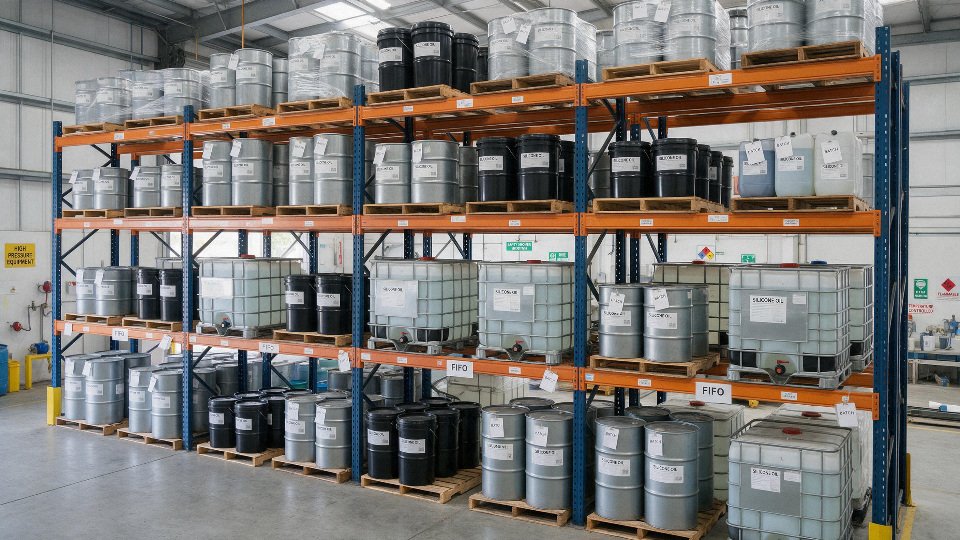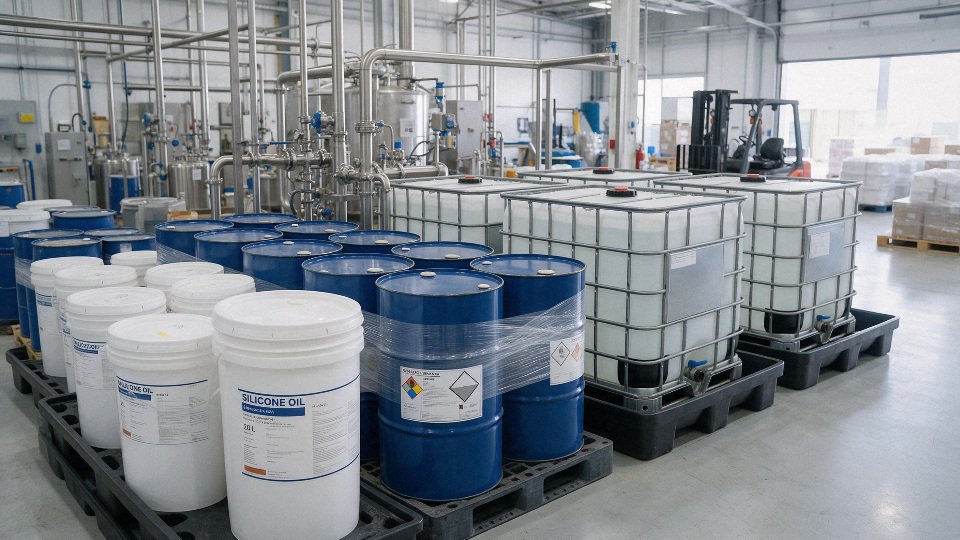

Specify the wrong viscosity grade and you’ll either starve a bearing of film thickness or churn so much energy through a gearbox that the oil itself degrades before the next maintenance interval. Get the base fluid chemistry wrong — say, running a standard PDMS oil against nylon gears in a humid food-processing environment — and you’re looking at swollen polymer components, contaminated product, and a recall that dwarfs whatever you saved on lubricant cost. The choice of silicone oil is rarely treated with the same rigor as specifying a motor or a seal, and that’s exactly where preventable failures breed.
Choose silicone oil for lubrication by matching four variables in sequence: required viscosity grade (PDMS spans 0.65 cSt to 2,500,000 cSt at 25°C), operating temperature window (−60°C to +250°C continuous for standard grades), load regime (silicone’s EP rating of roughly 200–400 N suits light-to-moderate loads, not heavy shock loads), and material compatibility with every polymer, coating, and metal in the contact zone.
What makes silicone oils genuinely unusual — and genuinely misunderstood in procurement — is that their strengths and their weaknesses sit right next to each other. A viscosity index of 150–400 means the oil barely thickens in a Siberian winter or thins in a foundry summer, which sounds like a universal lubricant. It isn’t. Understanding why requires looking at what silicone actually is at the molecular level, and what that backbone chemistry costs you in load-carrying terms.

Mapping the Four Main Chemical Types to Real Lubrication Needs
Before you even open a viscosity chart, the chemistry has to be right. Picking the wrong silicone type — say, standard PDMS in a fuel-wetted environment — will give you a seal that swells, a shaft that galls, and a maintenance call within weeks. The four main families behave differently enough that they’re really four different tools with a shared name.
Polydimethylsiloxane (PDMS): The Workhorse You’ll Use Most
PDMS is what most people mean when they say “silicone oil,” and it earns that default status. The viscosity range alone — 0.65 cSt up to roughly 2,500,000 cSt at 25°C, depending on chain length — means you can formulate anything from a thin release coating to a near-solid damping compound without changing chemistry. Continuous service runs from −60°C to +250°C; intermittent peaks to around 300°C are manageable, though you’ll see oxidative thickening accelerate above 220°C in poorly ventilated housings.
In practice, PDMS dominates wherever the mating surfaces are plastic or elastomeric. Medical device manufacturers rely on it for syringe plungers and catheter insertion because it’s physiologically inert and won’t degrade the silicone rubber components. Consumer appliance engineers use mid-range grades (roughly 1,000–10,000 cSt) for gearbox damping in window blinds, blender couplings, and dishwasher door hinges — applications where a mineral oil would attack the polymer parts or evaporate off within a season. Rubber molding shops apply low-viscosity PDMS (50–350 cSt typically) as a mold release; the low surface tension, 18–21 mN/m, means it spreads into mold texture well without pooling.
The honest limitation: PDMS has modest load-carrying capacity, roughly 200–400 N on a 4-ball wear test. It is not a gear oil for steel-on-steel contact under real shock loading.
Phenyl Silicone (Methylphenylpolysiloxane): When Temperature Extremes or Radiation Enter the Picture
Substituting phenyl groups onto the siloxane backbone does several useful things simultaneously. Low-temperature pour point drops to around −70°C, which matters in aerospace actuators that sit on a cold-soaked airframe overnight and then need to cycle immediately on startup. Load capacity improves somewhat over PDMS. Radiation resistance reaches roughly 10^6 Gy — a figure that makes phenyl silicone essentially the only practical liquid lubricant choice for nuclear plant instrumentation and valve actuators inside containment zones.
Phenyl silicone oils maintain lubricity at −70°C, significantly below the −60°C lower limit of standard PDMS.True
The phenyl substituents disrupt the regular Si–O chain packing that causes PDMS to stiffen and crystallize at low temperature, measurably extending pourable, lubricating behavior to around −70°C in commercial methylphenyl grades.
Optical instrument manufacturers use it where refractive-index matching matters and outgassing must be minimal. Cost is noticeably higher than PDMS — expect to pay roughly 2–4× per kilogram depending on phenyl content and purity grade.
Fluorosilicone (PVMQ): Chemical Resistance at a Price
The trifluoropropyl side chain fundamentally changes the compatibility picture. Where PDMS swells and loses viscosity in aromatic fuels, hydraulic fluids, and many chlorinated solvents, fluorosilicone resists them. This makes it the standard choice for fuel system shaft seals, chemical pump packing, and aerospace fuel control actuators — anywhere the lubricant will be bathed in exactly the fluids that destroy conventional silicone.
The trade-off is real: PVMQ costs considerably more than PDMS, viscosity range narrows, and some grades are harder to source outside specialty chemical distributors. Don’t specify it where PDMS works fine; the cost differential is hard to justify to procurement without documented chemical exposure.
Amino and Reactive Silicone Oils: Not Really Lubricants in the Mechanical Sense
Amino-functional and other reactive silicone oils show up in textile fiber processing, hair-care formulations, and as mold-release additives. They bond to substrates rather than simply wetting them. That’s useful for fiber softening and surface modification, but it means they are poor choices for any bearing, seal, or sliding contact application — the reactive groups can cross-link under heat or shear and create a sticky residue rather than a persistent fluid film.
If a supplier quotes you an amino silicone for a mechanical lubrication job, ask more questions.
Quick-Reference Type Selection Table
| Chemical Type | Continuous Temp Range | Solvent/Fuel Resistance | Load Capacity (4-ball) | Radiation Resistance | Relative Cost/kg | Primary Industries |
|---|---|---|---|---|---|---|
| PDMS | −60°C to +250°C | Low | 200–400 N | Low | Baseline (1×) | Medical, appliances, rubber molding |
| Phenyl silicone | −70°C to +250°C | Low–moderate | Moderate, above PDMS | Up to 10^6 Gy | 2–4× PDMS | Aerospace, nuclear, optics |
| Fluorosilicone (PVMQ) | −60°C to +200°C | High (fuels, aromatics) | Moderate | Low–moderate | 4–8× PDMS | Aerospace fuel systems, chemical processing |
| Amino/reactive silicone | Limited mechanical use | N/A | Not applicable | Low | Varies | Textiles, surface treatment, cosmetics |
Cost multiples are order-of-magnitude estimates; actual pricing depends on grade, purity, order volume, and supplier region.
Selecting the Right Viscosity Grade: From 5 cSt to 1,000,000 cSt
Viscosity selection is where most silicone oil mistakes actually happen. Engineers familiar with mineral oil or PAO sometimes grab a mid-range grade “just to be safe,” and that instinct will cause real problems — churning losses, starvation, or a seized pivot — depending on which direction they guessed wrong.
The Stribeck Curve Doesn’t Change, But Silicone’s Position on It Does
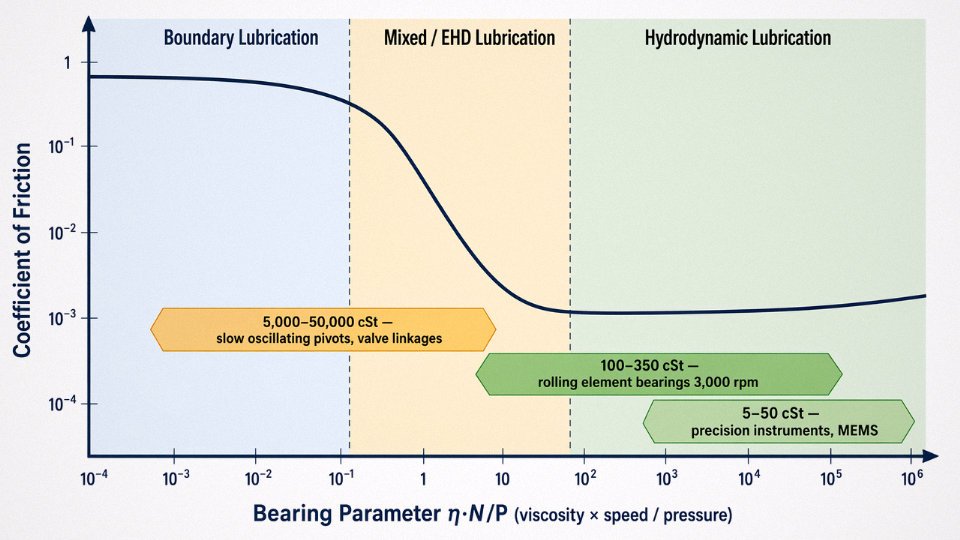
The Stribeck curve still governs everything: boundary lubrication at low speed and high load, hydrodynamic film at high speed and low load, with elastohydrodynamic (EHD) conditions in between. What changes with silicone oil is that its boundary-lubrication coefficient is relatively poor compared to sulfur-phosphorus EP-additive mineral oils or even PAO with friction modifiers. Silicone’s Si–O backbone is chemically inert, which is usually an asset, but it means you cannot lean on boundary additives the way you would with gear oil. The film has to be physically present.
That shifts the design burden: you need enough viscosity to keep the contact in the hydrodynamic or EHD regime under your actual operating conditions. Underestimate viscosity and you drop into boundary contact without the additive chemistry to compensate. The wear accelerates faster than it would with a mineral oil at the same underspecified viscosity.
Using the Bearing Parameter to Anchor Your Grade Selection
The bearing parameter — sometimes written as η·N/P (dynamic viscosity × rotational speed / contact pressure) — gives you a quantitative entry point. Consider two cases.
A rolling-element bearing running at 3,000 rpm under moderate radial load, say 5 MPa contact stress, operates well into the hydrodynamic regime. At 3,000 rpm, a 100–350 cSt grade at operating temperature is usually sufficient to maintain film thickness above the combined surface roughness. You’re targeting a lambda ratio above 1.5, ideally above 3.
Now take a slow oscillating pivot — 5 rpm, high load, maybe 20 MPa contact stress, the kind you find in a valve linkage or a medical device hinge. At 5 rpm the wedge effect that generates hydrodynamic pressure is almost absent. You need viscosity to do the heavy lifting. Required grade jumps to roughly 5,000–50,000 cSt at operating temperature to maintain any meaningful film. That’s one to two orders of magnitude difference between those two cases, driven almost entirely by speed and contact pressure.
Temperature Correction — and Why Silicone’s High VI Actually Matters Here
A 350 cSt PDMS grade at 25°C will run at roughly 40–60 cSt at 100°C and thicken to somewhere around 1,800–2,500 cSt at −40°C. Those are estimates — exact values depend on the specific formulation and molecular weight distribution from your supplier. Compare that to an ISO VG 320 mineral oil: at 100°C it drops to around 20–22 cSt, and at −40°C many grades either gel or won’t flow at all without pour-point depressants.
Silicone oil maintains a usable viscosity bracket across −60°C to +250°C where most mineral oils have already reached their pour point or flash point limitsTrue
Standard PDMS has a VI of 150–400 versus 90–120 for mineral oil; this shallower viscosity-temperature slope is a direct consequence of the flexible Si–O backbone, and is documented in supplier data sheets and ASTM D445 measurements across temperature ranges.
The practical consequence: if your application cycles through wide temperature swings — an outdoor actuator, a food processing conveyor that gets steam-cleaned at 90°C and then sits idle overnight in winter — silicone’s flat viscosity curve reduces the risk of starvation at temperature extremes without requiring you to switch grades seasonally.
Clearance and Gap Geometry: A Constraint That Overrides Everything Else
Thin gaps below roughly 5 µm behave very differently from wide-clearance bearings. In watch jewels, MEMS gyroscope pivots, or miniature encoder bearings, capillary forces dominate. A high-viscosity silicone will be drawn into the gap by capillary action and simply stay there, eventually migrating onto optical surfaces, contact pads, or signal traces. For these applications, stay in the 5–50 cSt range. The film is thin but adequate because loads are light and the contact is nearly frictionless by design.
Wide-clearance plain bearings — bronze bushings in food-grade conveyors, UHMWPE sliders in packaging machinery — need enough body to fill the clearance and maintain a coherent film under load. That usually means 500–5,000 cSt, sometimes higher if the bearing is slow and heavily loaded.
Practical Viscosity Selection by Application Category
| Application Category | Recommended Viscosity Range | Key Caveats |
|---|---|---|
| Electronics / precision instruments | 5–100 cSt | Capillary migration risk above 50 cSt in sub-10 µm gaps |
| Food processing (incidental contact) | 100–1,000 cSt | Must be FDA 21 CFR 178.3570 compliant; speed and load govern upper end |
| Medical devices / implantables | 50–500 cSt | Biocompatibility certification required; confirm with device regulatory path |
| Aerospace / wide temp range | 200–10,000 cSt | Phenyl-modified grades for below −50°C; verify outgassing spec |
| General machinery, rolling bearings | 100–500 cSt | Load and speed per Stribeck analysis above |
| Slow oscillating pivots, valve linkages | 5,000–100,000 cSt | Boundary regime risk; confirm EP additives if load exceeds ~300 N |
| Damping / vibration isolation | 10,000–1,000,000 cSt | Viscosity here is a functional design parameter, not lubrication — select for damping coefficient |
The High-Viscosity Safety Trap
Don’t default to the thickest grade on the shelf. In circulating oil systems — even simple drip-feed or wick-feed systems — grades above roughly 5,000 cSt at ambient temperature may not flow reliably through feed lines smaller than 3–4 mm diameter, especially at startup in cold conditions. In a splash-lubricated gearbox, excess viscosity increases churning losses measurably; a 10,000 cSt grade where 500 cSt is adequate can raise oil temperature by 15–30°C in steady state, which then oxidizes seals and increases vapor pressure. The system runs hotter than it would have with a correctly-sized lower grade.
Pick the lowest viscosity that keeps your lambda ratio above 1.5 under worst-case temperature and load conditions. Then check that the same grade doesn’t cause starvation problems at maximum operating temperature on the hot end of your range. That two-constraint check, anchored by actual operating conditions rather than gut feel, is usually enough to arrive at the right grade within half an order of magnitude.
Metal-on-Metal Contacts: When Silicone Oil Works and When It Fails
Silicone oil is genuinely excellent in a surprising range of applications — but metal-on-metal lubrication under load is where it earns its most honest criticism, and any engineer specifying it for gear drives or cam mechanisms without understanding the tribochemistry is asking for trouble.
The Numbers First
On a standard 4-ball wear test, unformulated PDMS typically produces a wear scar diameter of 0.8–1.2 mm. That compares poorly against PAO at the same test conditions, which usually lands in the 0.4–0.6 mm range. The EP load-carrying comparison is starker: plain silicone oil passes roughly 200–400 N before weld, depending on viscosity grade and exact test protocol, while a well-formulated PAO comfortably manages 600–800 N. These aren’t edge cases — they represent a genuine, repeatable performance gap that shows up in practice, not just in lab reports.
Why This Happens: The Tribochemical Problem
The root cause isn’t just low film strength. Mineral oils and PAOs, when they contain sulfur-phosphorus EP additives, react with iron oxide surfaces at contact temperatures to deposit sacrificial iron sulfide and iron phosphate films — classic tribochemistry that’s well-characterized going back decades. PDMS doesn’t do this. The Si–O backbone has weak affinity for ferrous surfaces at the temperatures typical of boundary contact (roughly 80–200°C at the asperity), so protective chemisorbed films form slowly, incompletely, or not at all. The silicone oil is essentially sitting on top of the surface rather than bonding to it. Under light loads, that’s fine. Push the contact into the boundary regime and you’re relying on viscosity alone, which isn’t enough.
Additive Compatibility: Not as Straightforward as With Mineral Oil
The obvious fix — add EP additives — runs straight into a solubility problem. Most commercial sulfur-phosphorus gear-oil EP packages, including the zinc dithiophosphate (ZDDP) formulations developed for mineral oil, have limited and often inconsistent solubility in PDMS. You can appear to have a stable blend at room temperature and then see phase separation above 80°C or after three months on the shelf. That’s a real procurement and QC headache.
What does blend stably with PDMS? Organic molybdenum compounds (molybdenum dithiocarbamate, MoDTC) disperse reasonably well and do generate a functional boundary film on steel. Colloidal PTFE at 2–5 wt% is a proven approach — the PTFE particles reduce metal-to-metal contact rather than relying on tribochemistry, so the silicone’s surface weakness becomes less critical. Colloidal MoS₂ dispersions work similarly, and 2–5 wt% loading in 1,000–5,000 cSt PDMS can push 4-ball EP performance up to 600–700 N — essentially closing the gap with unadditivated PAO. Particle size matters significantly here: for rolling-element bearings, you need sub-micron particles (below 1 µm, ideally below 0.5 µm) or the particles themselves become an abrasive. Confirm particle size distribution by laser diffraction before committing to a batch, and run a 1,000-hour bearing test if the application is critical.
Adding 2–5 wt% colloidal MoS₂ to PDMS can raise 4-ball EP performance from roughly 200–400 N to 600–700 NTrue
Multiple tribology studies on silicone-MoS₂ dispersions report this range of improvement; actual results depend on particle size, dispersion quality, and base viscosity grade
Where to Draw the Line
Silicone oil is a confident recommendation for lightly loaded metal contacts where Hertz contact stress stays below roughly 400 MPa. Plastic-on-metal, ceramic-on-ceramic, non-ferrous metal interfaces (aluminum, brass, bronze) — silicone handles these well and often outperforms mineral oil thanks to its thermal stability and chemical inertness. Heavily loaded steel gear pairs, cam followers, and heavily preloaded ball screws are poor candidates for unformulated PDMS. High-pressure angular contact bearings in spindles fall into a grey zone where viscosity grade selection and solid lubricant additives together determine whether you get adequate film.
A Real Failure Pattern Worth Knowing
In industrial valve actuator maintenance, a not-uncommon failure sequence goes like this: a maintenance team, trying to standardize lubricants across a plant, substitutes a 500 cSt PDMS grease for the original molybdenum-additivated mineral grease on the cam follower assembly. Viscosity seems adequate. Within 3–6 months — sooner in high-cycle duty — the follower shows accelerating wear, eventually galling. The root cause is exactly what’s described above: boundary lubrication failure on the steel cam/follower interface because the PDMS carries no EP chemistry and generates no protective tribochemical film. Corrective action is either reverting to the original specification or switching to a PDMS-based grease specifically formulated with colloidal MoS₂ and confirmed EP performance — not a standard catalog silicone grease. The lesson is blunt: “silicone grease” is not a single product class, and substituting viscosity grade equivalents across lubricant chemistries without checking additive packages is a reliable way to generate warranty failures.
Compatibility With Plastics, Elastomers, and Coatings
The single most common field mistake with silicone oil isn’t picking the wrong viscosity — it’s assuming that because silicone is chemically inert, it won’t attack anything. That assumption has caused swollen seals, cracked housings, and rejected paint lines. The damage mechanism isn’t chemical reaction in the traditional sense; it’s physical, driven by solubility parameter matching.
Why the Solubility Parameter Governs What Swells and What Doesn’t
PDMS sits at roughly 7.3 (cal/cm³)^0.5 on the Hildebrand solubility parameter scale. Any polymer with a similar parameter will absorb silicone oil into its matrix the way a sponge absorbs water — slowly, but persistently. The fluid doesn’t react with the polymer chain; it simply wedges between them, increasing free volume and softening the bulk material. Polymers with solubility parameters well away from 7.3 — say, above 10 or 11 — have such a thermodynamic preference for their own intermolecular forces that silicone oil penetration stays negligible.
This is why nylon 6/6 (around 13.6), PEEK (roughly 10.7), PTFE (near 6.2 but highly crystalline and nearly impervious), acetal/POM (about 11.1), polypropylene, and UHMWPE all show volume swell under about 2% in standard 168-hour immersion tests at typical service temperatures. These are your safe candidates. In practice, PEEK and acetal are workhorses in food-processing and precision instrument applications where silicone oil is the lubricant of choice, and the compatibility data backs that up solidly.
The Silicone Rubber Paradox
Here’s the one that catches engineers off guard every time: silicone oil is chemically almost identical to silicone rubber (VMQ). Same Si–O backbone, similar side groups. Their solubility parameters match almost perfectly, which means silicone oil is essentially a plasticizer for silicone elastomer seals. Standard VMQ seals immersed in PDMS at 100°C for 1,000 hours typically show volume swell in the range of 5–15%, depending on the specific VMQ formulation and the oil viscosity grade — lighter oils tend to penetrate faster because their lower molecular weight allows easier diffusion. That level of swell softens the elastomer, reduces compression set resistance, and eventually causes a seal that was perfectly functional dry to weep under pressure.
The fix is fluorosilicone oil (FVMQ-compatible fluid). Fluorosilicone’s parameter is shifted by the trifluoropropyl groups, disrupting that near-perfect match. If your application uses silicone elastomer seals — common in medical devices, aerospace actuators, and some food-grade equipment — fluorosilicone oil is the compatible choice, not standard PDMS.
Standard silicone (VMQ) elastomer seals are fully compatible with PDMS silicone oil for long-term lubrication.False
PDMS and VMQ share nearly identical solubility parameters (~7.3), causing physical swelling of 5–15% volume in standard VMQ after 1,000 hours at 100°C. Fluorosilicone oil is the appropriate alternative for silicone elastomer seal systems.
Problem Polymers: Stress Cracking Is the Real Risk
Polycarbonate, polystyrene, and ABS are genuinely problematic — not primarily because they swell, but because of environmental stress cracking (ESC). Silicone oil’s surface tension runs 18–21 mN/m, well below most hydrocarbon fluids, which lets it wick into micro-cracks and surface defects that would otherwise remain benign. In a part that carries residual molding stress, that wicking action accelerates crack propagation dramatically. You can have a polycarbonate lens housing or ABS equipment cover sitting in silicone oil mist for weeks and see crazing start at corners and weld lines before any measurable bulk swelling shows up. Some polyurethane grades, particularly ether-based formulations, also show surface softening that doesn’t always appear in simple immersion weight-gain numbers — worth running hardness checks alongside the standard gravimetric test.
Coating and Paint Lines: A Hidden Factory Problem
Silicone oil migration onto paint-adhesion surfaces is an underappreciated production problem, particularly in automotive body assembly and appliance manufacturing. Because PDMS spreads to an extremely thin film at its low surface tension, even trace contamination — from a silicone-lubricated pneumatic cylinder exhausting near a body panel conveyor, for instance — can cause fisheye defects and adhesion failure in subsequent powder coat or wet paint operations. Some automotive OEM specifications outright ban silicone-based lubricants in body shops for this reason. If your plant processes components that will later be painted, the rule of thumb is straightforward: keep silicone oil quarantined to specific cells and treat any overspray or venting as a contamination event, not just a housekeeping issue.
Running Your Own Compatibility Test
Supplier datasheets give you a starting point, but polymer grades vary enough that in-house testing before committing a design is worth the week it takes. A workable protocol: immerse material coupons in the actual silicone oil grade at your maximum service temperature for 168 hours (one week). Measure mass change, calculate volume change using density, and run tensile strength retention on a dogbone cut from the coupon. Decision thresholds that most precision-equipment and medical-device specifications use: volume swell under 2% is generally acceptable; 2–5% requires engineering review and may be tolerated with seal geometry compensation; above 5% is a red flag and warrants material substitution or switching to fluorosilicone. Don’t skip the tensile test — some materials gain volume through plasticization but lose enough strength that the part fails mechanically at a load it would have handled easily before exposure.
| Polymer | Approx. Solubility Parameter | Typical Volume Swell (168h, 100°C) | Verdict |
|---|---|---|---|
| PTFE | ~6.2 | <1% | Safe |
| Polypropylene | ~7.9 | 1–2% | Generally safe |
| UHMWPE | ~7.9 | 1–2% | Generally safe |
| VMQ (silicone rubber) | ~7.3 | 5–15% (1,000h) | Use fluorosilicone oil |
| Acetal / POM | ~11.1 | <2% | Safe |
| PEEK | ~10.7 | <1% | Safe |
| Nylon 6/6 | ~13.6 | <1% | Safe |
| Polycarbonate | ~9.7 | <2% swell, ESC risk | Avoid under stress |
| ABS | ~10.0 | Low swell, ESC risk | Avoid under stress |
| Polystyrene | ~9.1 | Low swell, ESC risk | Avoid |
Food-Grade, Medical, and Regulated-Industry Compliance Requirements
Regulatory compliance for silicone oil isn’t a checkbox exercise. Get it wrong and you’re facing a product recall, an FDA warning letter, or a rejected batch of implantable devices — outcomes that dwarf whatever you saved by skipping proper qualification. The good news is that PDMS has a genuinely strong safety profile backed by decades of regulatory history, but that history does not automatically transfer to your specific formulation.
FDA 21 CFR 178.3570
This is the primary US food-contact authorization for silicone fluids used as release agents and lubricants. The regulation permits polydimethylsiloxane fluids — and certain phenyl-modified variants — for incidental food contact, with a residue limit of no more than 10 ppm in the finished food. That 10 ppm ceiling sounds generous until you’re running a high-speed bread-slicing line or a confectionery depositor where lubricant misting is a real mechanism of contamination. Viscosity grade matters here: the regulation doesn’t cap viscosity, so you can use anything from a 50 cSt release-agent spray to a 12,500 cSt chain lubricant, provided the base fluid and any additives are listed substances. Fluorosilicone and amino-functional silicones are not covered under 178.3570 — a fact that catches people off guard when they reach for a fluorosilicone grease thinking “it’s still silicone.” Always verify the specific chemical type, not just the brand name.

NSF H1 Registration
In a food or beverage plant, NSF H1 is the operational standard that matters day-to-day. H1 covers lubricants acceptable for incidental food contact — think conveyor guides, mixer bearings, filling-machine cams. To obtain H1 registration, a formulator submits the full composition to NSF, who reviews each ingredient against the White Book permitted substances list. The process typically takes six to twelve weeks for a straightforward silicone oil blend, longer if novel additives are involved. For plant engineers, verification is simple: check the NSF White Book at nsfwhitebook.org using the product’s exact trade name and batch. Don’t rely on a supplier’s datasheet alone — registrations lapse, formulations change, and I’ve seen plants audited where the H1 certificate on file was for a predecessor product that had been quietly reformulated.
NSF H1 registration is legally required for all lubricants used in food processing facilities in the United States.False
NSF H1 is an industry-recognized certification scheme, not a statutory legal requirement. However, it is required by most food safety audit standards (SQF, BRC, FSSC 22000) and by the purchasing policies of the majority of major food manufacturers and contract packers. Regulatory inspections under FSMA also treat its absence as a gap in preventive controls.
USP Class VI and ISO 10993 for Medical Applications
Medical device lubrication demands a different tier of evidence. USP Class VI testing covers three in-vivo implantation protocols — systemic injection, intracutaneous injection, and implantation — alongside cytotoxicity screening. ISO 10993 extends this into a broader biocompatibility framework including sensitization and genotoxicity, with test selection driven by device contact duration and tissue type. PDMS has a long track record of Class VI compliance, which is why it appears in everything from catheter coatings to surgical instrument lubricants. That history is reassuring but not transferable. Each final formulated product requires its own independent testing — a pure 1,000 cSt PDMS fluid from one supplier and an “equivalent” fluid from another are legally distinct materials requiring separate test packages. Change a thickener, change a stabilizer, and you run the tests again.
REACH, RoHS, and the Cyclosiloxane Boundary
Silicone lubricating oils carry no current SVHC (Substance of Very High Concern) designations under REACH. The D4, D5, and D6 cyclosiloxane restrictions that have generated industry anxiety apply specifically to wash-off cosmetic products under EU Regulation 2018/588 — not to lubricants, greases, or industrial process fluids. Worth knowing, because suppliers sometimes conflate these in their compliance documentation and plant managers panic unnecessarily. RoHS is generally a non-issue for neat silicone oils, though formulators adding certain extreme-pressure or antiwear additives should verify those packages independently.
GMP Documentation in Pharmaceutical Manufacturing
In a pharmaceutical plant, the lubricant supplier relationship is more demanding than in most industries. You need a Certificate of Analysis for each batch, full traceability to raw material lot numbers, and a formal change-notification agreement so that any formula or supplier change triggers review on your end before it arrives on your loading dock. Silicone oil has largely displaced mineral oil in tablet-press lubrication for one practical reason: it doesn’t interfere with dissolution testing or active ingredient assays at the concentrations that reach the tablet surface. Mineral oil’s potential for lipid pneumonia risk in inhalation scenarios, however remote, also makes regulatory reviewers uncomfortable.
Aerospace Qualifications
MIL-PRF-6085 covers instrument and precision lubrication oils — think gyroscopes, actuator pivots, and optical system bearings — and silicone fluids meeting this spec typically fall in the 10–100 cSt range with tightly controlled volatility and thermal stability requirements. MIL-PRF-81322 covers general-purpose aircraft greases, some of which use silicone base oils. Boeing and Airbus each maintain their own material approval lists (the D6-17487 and AIMS series respectively), and a product must appear on those lists before it touches an aircraft mechanism, regardless of MIL spec compliance. Verify against the current revision of the relevant approval list — these are living documents and products get delisted. A phone call to the OEM’s materials engineering group before you spec a new lubricant is faster than a non-conformance report after the fact.
Packaging, Storage, Shelf Life, and Handling Contamination Risks
Silicone oil is unusually forgiving chemically, but operationally it creates headaches that most lubricant storage procedures simply aren’t designed for. The migration problem alone has wrecked electrical assemblies in plants that had no idea silicone was even being used nearby.
Migration and Vapor-Phase Contamination
PDMS vapor pressure is negligibly low for viscosity grades above roughly 100 cSt — for practical purposes, those grades stay where you put them. Below 50 cSt, the picture changes. Low-viscosity grades (5–20 cSt range) have measurable volatility, and in enclosed spaces or near heat sources, they deposit as thin insulating films on electrical contacts. Contamination effects have been documented at concentrations below 1 µg/cm² on gold-plated relay contacts, and the deposition range in a moderately ventilated room can reach 2–4 meters from an open container depending on air movement and temperature. The film itself is electrically insulating — dielectric strength of 14–16 kV/mm — which is exactly what you don’t want across a switch contact. If your plant uses silicone-containing mold release, thread lubricant, or even silicone-sealed gaskets near any control panel or sensor assembly, treat that as a contamination risk.
Low-viscosity PDMS below 50 cSt can deposit insulating films on electrical contacts at distances exceeding 2 meters in enclosed spacesTrue
PDMS volatility increases sharply below 50 cSt; thin-film deposition on electrical contacts at sub-microgram per cm² concentrations is well-documented in relay failure analysis literature, and transport distance depends on airflow, temperature, and enclosure geometry.
Packaging and Transfer Line Materials
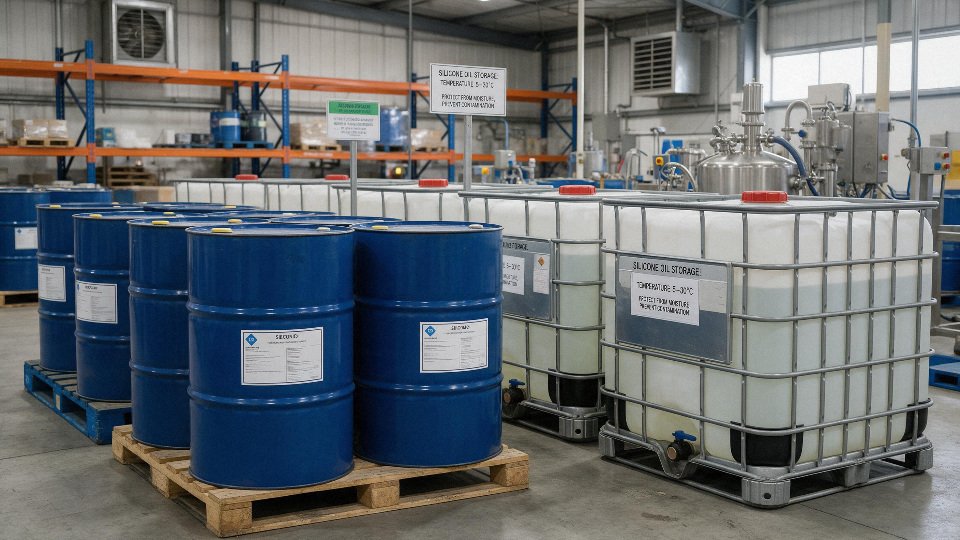
This is where procurement managers routinely cause avoidable problems. Silicone oil attacks natural rubber gaskets and some grades of NBR (nitrile butadiene rubber) — drum bungs and IBC valve seals are the usual failure points. A drum that looks fine when it arrives will have a softened, swollen bung gasket after 6–12 months of contact. Specify drums and IBCs in HDPE or polypropylene, or stainless steel for bulk storage. For transfer lines and dispensing fittings, PTFE-lined hose and PTFE-seated valves are the right call; avoid anything with elastomer seats unless you’ve confirmed compatibility with the specific silicone grade and viscosity. Parker Parflex or similar PTFE-core transfer hose is a reasonable standard spec.
Shelf Life in Practice
Unopened PDMS in a properly sealed container, stored between 5°C and 40°C out of direct UV exposure, is stable for at least 5 years — often considerably longer. The practical degradation indicator isn’t color or odor; it’s viscosity drift. If the measured viscosity at 25°C has moved more than ±5% from the certificate of conformance value, reject the batch or re-test more thoroughly before use. Phenyl-modified and fluorosilicone grades are somewhat less stable: expect a realistic shelf life of 3–5 years, and these grades deserve closer incoming inspection because their rheology can shift without obvious visual cues.
Seasonal temperature swings in unheated warehouses matter. A drum that cycles through −10°C winters and +35°C summers isn’t storing at “ambient” — that cycling stresses seals and, in high-viscosity grades, can cause partial separation of formulation additives if any are present.
Cross-Contamination in Mixed Lubricant Stores
Even a thin residue of silicone oil in dispensing equipment will contaminate mineral oil batches, causing persistent foam and destroyed demulsibility — both serious problems for hydraulic and gear oil circuits. A concentration of a few parts per million is enough to cause foaming failure. Keep dedicated dispensing pumps, funnels, and containers for silicone products, and use a color-coded labeling system. Red for silicone is a common convention; whatever you choose, make it physically impossible to accidentally use the same pump for both.
Spill Management and Waste Disposal
Silicone oil produces one of the slickest floor surfaces of any industrial liquid, at film thicknesses below 1 µm. Standard clay absorbent will pick up the bulk, but the residual film requires a degreaser — ordinary mineral-spirit-based floor cleaner is ineffective because silicone doesn’t dissolve in it readily. Use a surfactant-based industrial degreaser formulated for silicone or food-processing environments. Waste silicone oil is classified non-hazardous in most US and EU jurisdictions, but verify local regulations before disposal; some municipalities treat it as special waste because it doesn’t biodegrade quickly.
Handling at Elevated Temperatures
Under normal ambient conditions, silicone oil has low acute toxicity and presents minimal inhalation risk. Above roughly 150°C — which happens during spray application near hot surfaces, or in some heated dispensing systems — thermal degradation generates formaldehyde and amorphous silica fume. Both are regulated: OSHA PEL for formaldehyde is 0.75 ppm (8-hour TWA), and ACGIH TLV for amorphous silica is 10 mg/m³ as respirable fraction. If your application involves heated silicone oil mist, local exhaust ventilation isn’t optional. In practice, most ambient-temperature handling doesn’t approach these thresholds, but heated reservoir systems or maintenance activities near hot lines deserve a proper inhalation hazard review before someone decides the safety data sheet looks benign enough to ignore.
Step-by-Step Selection Decision Framework With Application Examples
Six steps. Run them in order, and you won’t land on the wrong grade. Skip one, and you’ll usually find out at incoming inspection — or worse, three months into field deployment.
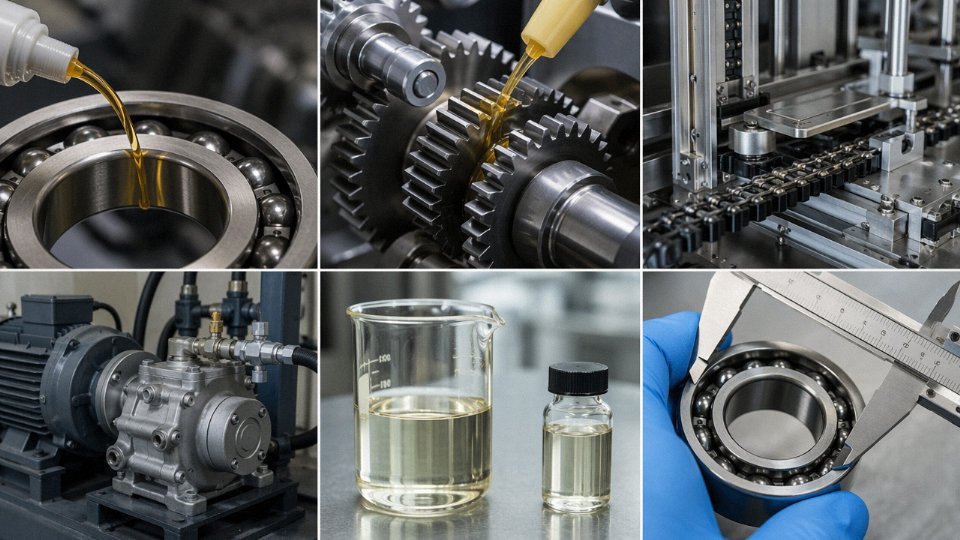
The Six-Step Workflow
Step 1 — Confirm the load regime is within silicone oil’s limits. Before anything else, establish whether your contact is hydrodynamic, mixed, or boundary. Silicone oil’s 4-ball EP rating typically lands in the 200–400 N range depending on formulation and additive package. If you’re running heavily loaded steel-on-steel in boundary conditions without additives, you’re already at the edge. If the answer is “boundary, ferrous, high load,” either you need a heavily additized formulation (as covered in the metal contact section) or you need to revisit whether silicone oil is the right class at all. Don’t rationalize your way past this gate.
Step 2 — Identify the chemical type. Temperature range and chemical environment drive this. Standard PDMS covers −60°C to +250°C continuous and handles most industrial environments. Drop below −55°C or introduce radiation or aromatic solvents, and phenyl-modified is usually the call. Fuels, hydraulic fluids, or aggressive solvents on contact with the lubricant itself — fluorosilicone. Textile or tanning applications where adhesion to fibers matters — amino-functional. Most applications land on PDMS. Phenyl is the next most common in practice.
Step 3 — Calculate required viscosity. Speed, clearance, and temperature — not intuition. A quick Sommerfeld estimate for a journal bearing, or the manufacturer’s speed-viscosity chart for a rolling element bearing, will get you to a target range. The full methodology was covered in the viscosity-selection section.
Step 4 — Verify polymer and elastomer compatibility. Check every non-metal surface in the lubricated zone: seals, bushings, cable insulation, painted housings. The compatibility section has the solubility parameter data. Silicone swells silicone rubber significantly. EPDM, PTFE, and most nylons are generally safe; NBR and polyurethane are not.
Step 5 — Confirm regulatory compliance. Food processing, pharma, medical devices: NSF H1, USP Class VI, FDA 21 CFR 178.3570, or the relevant pharmacopeial standard. Not all silicone oils carry these registrations even if the base fluid would technically qualify. Check the specific product lot documentation, not just the product family.
Step 6 — Bench test before field deployment. A simple soak test on your actual seal material, 72 hours at maximum operating temperature, costs almost nothing. A viscosity-stability check across your temperature range takes one afternoon. Skip this and you’re trusting a datasheet written for a different application.
Worked Example 1 — Medical Device Linear Actuator
Stainless steel leadscrew, PEEK nut, −20°C to +60°C operating range, light axial load (under 50 N typical), low speed (roughly 5–20 mm/s), food-grade classification required for a device with incidental product contact.
Step 1: Load is light and the contact is essentially mixed-film at low speed. Well within silicone oil capability without EP additives. Step 2: Temperature range is comfortably within standard PDMS limits. No chemical aggressors. PDMS confirmed. Step 3: Low speed and tight thread-form clearance suggest a moderately viscous oil rather than a grease — around 350–500 cSt at 25°C gives adequate film thickness without churning losses or migration pooling at the nut ends. Step 4: PEEK has excellent resistance to PDMS. Stainless steel is unproblematic. Check any shaft seal material — if EPDM, fine; if polyurethane wiper seal, substitute. Step 5: Must be NSF H1 registered and USP Class VI compliant. Several 500 cSt PDMS products from established suppliers carry both; verify by lot number. Step 6: 72-hour soak of the actual PEEK nut in 500 cSt PDMS at 60°C, measure dimensional change. In practice, PEEK shows less than 0.1% volume change — negligible.
Result: 500 cSt PDMS, NSF H1 registered, USP Class VI documented.
Worked Example 2 — Aerospace Instrument Gimbal Bearing
Stainless steel ball bearing, precision instrument grade, −55°C to +130°C, vacuum environment (outgassing is a hard constraint, not a preference), MIL-PRF-6085 specification required.
Step 1: Gimbal bearing loads are light — typically under 20 N radial in an instrument application. Boundary lubrication is a concern only at the lowest temperatures when viscosity spikes. A boundary additive is still worth including. Step 2: −55°C rules out standard PDMS, which gets uncomfortably stiff below −50°C in higher viscosity grades. Phenyl-modified silicone retains adequate fluidity to −70°C. It also has lower vapor pressure than PDMS at equivalent viscosity, which matters in vacuum. Step 3: For a precision bearing running at low rpm, 10–30 cSt at 25°C is a reasonable target — just enough film, minimal drag torque. MIL-PRF-6085 qualified products in this range exist from several qualified products list (QPL) suppliers. Step 4: Instrument gimbals typically use PTFE-caged bearings or phenolic retainers. Both are compatible. Step 5: MIL-PRF-6085 is the specification. Buy only QPL-listed product; the datasheet alone is not sufficient for aerospace procurement.
MoS2 added to phenyl silicone oil at 1–3% by weight measurably reduces boundary wear on stainless steel at low temperature in instrument bearing applicationsTrue
MoS2 provides solid-film boundary lubrication that compensates for silicone oil's weak tribochemical film formation on ferrous surfaces, particularly relevant when low-viscosity phenyl silicone is used at cold-temperature startup where elastohydrodynamic film thickness is marginal.
Step 6: Thermal cycle bench test from −55°C to +130°C, 50 cycles, measure torque signature. Outgassing: ASTM E595 total mass loss should be under 1%, collected volatile condensable material under 0.1%.
Result: Low-viscosity (15–22 cSt) phenyl silicone with 2% MoS₂ additive, QPL MIL-PRF-6085 listed.
Worked Example 3 — Food Processing Conveyor Chain With Nylon Rollers
Carbon steel chain pins and sideplates, nylon-6 rollers, ambient −5°C to +80°C (washdown brings intermittent cold), frequent caustic washdown (NaOH-based cleaners, pH 12–13), NSF H1 mandatory, moderate chain load.
Step 1: Carbon steel pins under moderate tension load — this is mixed-film to boundary territory. An EP additive package is needed. Step 2: Temperature range is standard PDMS territory. Chemical environment is where it gets interesting: caustic washdown will contact the chain. PDMS itself is stable to dilute alkali, but some additive packages are not — verify the full formulation, not just the base oil. Fluorosilicone was considered here. It would offer better chemical resistance, but at 3–5× the cost of an H1-additized PDMS, and the actual chemical contact time per washdown cycle is short enough that PDMS survives fine with a relubrication interval that accounts for the washing. Fluorosilicone rejected on cost-to-benefit grounds for this application. Step 3: Chain conveyor at moderate speed — 100–350 cSt is a typical starting range, adjusted upward in cold ambient and downward in warmer zones. Step 4: Nylon-6 compatibility with PDMS is good. Volume swell in soak tests at 80°C is generally under 2%, which is acceptable for a roller that has clearance in the chain aperture. Step 5: NSF H1 registration required, confirmed on the specific product label, not inferred from the base fluid chemistry. Step 6: Spray a test section of actual chain, run for 48 hours under load, measure pin wear, check roller dimensional stability, verify the lubricant film survives a simulated washdown.
Result: 200–350 cSt NSF H1 PDMS with EP additive package, relubrication interval set to account for caustic washdown frequency.
Common Selection Errors
Choosing viscosity by feel is the most frequent mistake on the plant floor. “It looks about right” is not a viscosity specification. A bearing running 0.1 mm clearance at 3,000 rpm needs a calculated film thickness estimate, not a guess.
Ignoring seal material is the second most common failure mode. An engineer specifies the right oil for the bearing, then the polyurethane wiper seal on the actuator rod swells 15% over six weeks and starts weeping. The oil didn’t fail. The selection process did.
Assuming all silicone oils are food-grade is a real problem in food plants. The base fluid may meet FDA requirements in principle, but the registered NSF H1 status belongs to specific formulated products with specific additive systems. Buying an unregistered “silicone oil” and using it in a food zone is a compliance failure regardless of what the base chemistry is.
Neglecting migration in electronics enclosures is underappreciated. Silicone oil at 18–21 mN/m surface tension will wick along surfaces, wick along cable insulation, and deposit a thin film on connector contacts. In a sealed gearbox adjacent to a control board, a small overfill or a fitting leak can contaminate contacts 200–300 mm away within weeks. Use the minimum effective quantity, and consider a grease if migration is a real risk.
Condition Monitoring and Re-Lubrication Intervals for Silicone Oil Systems
Silicone oil is often treated as “fill it and forget it,” which works fine until it doesn’t. The thermal stability that makes PDMS attractive also masks early degradation — you won’t see the color darken the way a mineral oil does. By the time something is visibly wrong, you’re often looking at silica deposits on bearing races or gummed-up clearances.
How Silicone Oil Actually Degrades in Service
The primary failure pathway is thermal oxidation above roughly 250°C. The Si–O backbone begins cleaving, generating low-molecular-weight cyclosiloxanes — particularly D4 and D5 cyclics — that evaporate off, leaving behind progressively heavier residual fluid and, eventually, amorphous silica. That silica is abrasive. In a slow-speed, lightly loaded application it may take years to accumulate enough to matter; in a high-temperature oven conveyor bearing running at 230–240°C continuous, you can see measurable viscosity drift within 6–12 months.
The practical early-warning signal is viscosity increase. A rise above 10% of the baseline value at 25°C is the standard alarm threshold used in industrial silicone fluid monitoring programs. If you commissioned a system with 1,000 cSt oil and your quarterly sample reads 1,140 cSt, that’s your action trigger — not a catastrophe, but schedule a flush within the next planned maintenance window rather than running to the next cycle.
What to Measure and How to Sample
Oil analysis for silicone fluids uses the same analytical suite as conventional lubricants, with a few critical differences in execution.
Viscosity at 25°C is the primary parameter. Target an acceptance band of ±5% from baseline commissioning value; alarm at +10%; action (drain and refill or partial top-up) at +15–20% depending on your criticality tier.
Water contamination matters more than people expect, especially in any application where the equipment sees condensation cycles. Karl Fischer titration is the correct method — target below 500 ppm. Water in silicone oil doesn’t cause the same emulsification you see in mineral oil, but it accelerates hydrolysis at the Si–O backbone under heat, and it promotes corrosion on ferrous surfaces that silicone oil already struggles to passivate.
Particle count per ISO 4406 should be trended rather than used as a single pass/fail. A sudden jump in particle count, even if viscosity is still within spec, often indicates seal degradation or an external contamination event worth investigating before the next scheduled interval.
ICP-OES wear metal trending — iron, chromium, copper specifically — tells you what’s happening at the contact surfaces. Silicone oil’s relatively modest EP performance means that boundary events leave detectable metal signatures earlier than they would with a PAO+EP package.
Sampling procedure deserves attention here because it’s where most labs quietly fail you. Silicone oil is immiscible with water-based cleaning agents, so any lab that uses aqueous wash steps in their sample handling will cross-contaminate your result or simply report nonsense viscosities. Use dry sampling syringes flushed with heptane or isopropanol, fully dried before drawing the sample. Before sending to a new lab, ask explicitly whether they handle silicone fluids — a surprising number of general oil analysis labs don’t, and they won’t volunteer that information.
Standard oil analysis laboratories can always test silicone oil condition accurately using their normal procedures.False
Many general oil analysis labs use aqueous wash steps incompatible with silicone fluids. Silicone oil's immiscibility with water-based agents compromises viscosity and contamination results unless the lab explicitly confirms silicone-capable handling procedures.
Re-Lubrication Interval Expectations
Interval depends heavily on temperature. In sealed bearings with adequate initial fill, high-viscosity silicone oil — 1,000 cSt and above — running below 150°C can realistically achieve 20,000–50,000 operating hours before hitting the viscosity alarm threshold. That’s roughly 2–6 years of continuous operation in a moderate-temperature application, which is why some facilities assume the lubricant is permanent.
At 200°C continuous, the interval shortens substantially: expect 3,000–8,000 hours, heavily dependent on whether the bearing housing is sealed (limits oxygen exposure, slows oxidation) or open to atmosphere. A partially open housing at 200°C can push you toward the lower end of that range faster than the nameplate temperature alone suggests.
| Operating Temperature | Typical Interval (Sealed Bearing) | Key Driver |
|---|---|---|
| Below 150°C | 20,000–50,000 hours | Oxidation rate negligible |
| 150–200°C | 8,000–15,000 hours | Cyclosiloxane volatilization begins |
| 200–250°C | 3,000–8,000 hours | Backbone cleavage accelerates |
| Above 250°C | Monitor quarterly; interval application-specific | Silica formation risk |
Seal Condition as a Secondary Indicator
Don’t overlook the seals. Silicone oil incompatibility with certain elastomers — covered elsewhere in this article — can show up during condition monitoring as an unexpected oil loss rate increase before you see any wear metal signal. On planned disassembly, a quick durometer reading on lip seals and O-rings will catch hardening or softening before it becomes a leak. Visible swelling, surface tackiness, or dimensional change on disassembly is a clear signal that the seal material selection needs revisiting, regardless of what the oil analysis says.
Establishing a Monitoring Baseline
The single most common maintenance failure with silicone oil systems is neglecting to record a commissioning baseline. Without a documented initial viscosity and particle count, your “alarm at +10%” threshold is meaningless — you’re comparing to nothing. At commissioning, pull a sample, run the full panel, and file it in the equipment record. Trend quarterly for anything critical; semi-annually is acceptable for low-temperature, low-criticality applications. Define alarm and action limits in your written maintenance procedures before anything fails, not after.
Frequently Asked Questions About Silicone Oil Lubrication
Can I use silicone oil to lubricate an electric motor bearing?
Yes, but with significant caveats. Silicone oil works acceptably in lightly loaded motor bearings — think small fan motors, instrument servos, or stepper motors where Hertz contact stress stays below roughly 300 MPa. In those conditions, 350–1,000 cSt PDMS with a PTFE additive package gives reasonable film formation and good temperature stability.
The real danger is migration. PDMS spreads aggressively along surfaces, and in an open-frame motor it will reach commutator contacts within weeks, depositing a thin insulating film that increases contact resistance and eventually causes arcing or dropout. Sealed-bearing designs with labyrinth shields are the minimum acceptable configuration. Avoid open-frame motors entirely. If the application is a brushless motor with precision encoder feedback, even trace contamination of the optical or magnetic sensing surface is a service call waiting to happen.
Does silicone oil conduct electricity?
No. PDMS has a dielectric strength of 14–16 kV/mm, which makes it a good electrical insulator — useful for transformer cooling, high-voltage switchgear pivot lubrication, and any application where a lubricant must tolerate incidental contact with live conductors. That property is also why it absolutely cannot substitute for a conductive grease in EMI gasket or ground-strap applications. If someone on the floor is reaching for silicone grease to re-seat an EMI gasket because it’s the only tube on the bench, stop them.

Is silicone oil safe for rubber O-rings?
Depends entirely on the elastomer. PDMS is chemically similar enough to VMQ (silicone rubber) that it swells those seals 5–15% by volume — enough to distort cross-section geometry and cause either extrusion into the clearance gap or a paradoxical leak as the seal hardens and shrinks after the oil is removed. FKM (Viton) handles PDMS well; EPDM shows minimal swell in most grades; PTFE and PEEK are unaffected. NBR is borderline and grade-dependent. The only reliable test is a 72-hour immersion at operating temperature, measuring weight and diameter before and after. Datasheet compatibility tables are a starting point, not a sign-off.
PDMS silicone oil is universally safe for all rubber sealsFalse
PDMS causes measurable volume swell in VMQ (silicone rubber) seals and can be problematic with NBR depending on grade; compatibility must be verified by immersion testing for each specific elastomer.
Can silicone oil be mixed with mineral oil or PAO?
Miscibility is poor. Mix them and you get a biphasic, cloudy system with unpredictable viscosity, foam that won’t break, and additive packages that migrate preferentially into one phase and deplete from the other. In circulating systems, the consequences range from cavitation at the pump inlet to starved bearings. When switching a system from mineral oil or PAO to silicone oil — or the reverse — flush thoroughly with a compatible solvent carrier, inspect for residual film, and verify cleanliness before filling. Dedicated equipment is the cleaner solution if both lubricant types are used regularly in the same facility.
What viscosity is used for firearm lubrication?
The general range is 30–100 cSt PDMS for trigger mechanisms, slide rails, and corrosion protection on blued or parkerized steel. It’s thin enough to wick into tight clearances and won’t gum up in cold weather. That said, silicone oil provides poor EP protection, and high-load bolt or breech components under firing stress genuinely need EP-rated lubrication — purpose-formulated firearm oils exist for that reason. Using straight PDMS on a bolt carrier group in a high-cycle training environment is an invitation for accelerated wear on the cam pin and carrier key.
How should used silicone oil be disposed of?
PDMS is non-hazardous in most jurisdictions, but aquatic persistence means drain disposal is not acceptable anywhere. Collect it through a licensed waste oil contractor. Incineration above roughly 900°C is the preferred destruction route — at that temperature PDMS breaks down to SiO₂, CO₂, and water rather than persistent oligomers. EU operators should reference the Waste Framework Directive (2008/98/EC); US facilities follow EPA 40 CFR Part 279 for used oil management even though PDMS isn’t technically “used oil” under the rule — most contractors treat it equivalently, which is pragmatically the right call.
Why does silicone oil cause paint adhesion failure?
Even nanogram-level surface contamination raises contact angle enough to prevent primer wetting. A single fingerprint from a gloved hand that touched a silicone-lubricated part two stations earlier is enough to cause a fisheye in an e-coat line. Automotive and white-goods manufacturers typically enforce complete silicone-free zones in any assembly area upstream of a painting operation, and some extend that prohibition to the entire building. If your facility paints finished assemblies, silicone oil use anywhere in the production flow deserves a formal contamination risk review.
What is the difference between silicone oil and silicone grease?
Silicone grease is silicone oil — typically 100–1,000 cSt PDMS — thickened with fumed silica or PTFE powder to reach NLGI grade 1 through 3 consistency. Grease stays put on vertical surfaces, in wide clearances, and in applications where relubrication access is limited. The trade-off is lower thermal conductivity than the base oil alone and more difficulty achieving even distribution in sealed precision mechanisms. Silicone oil is the right choice for circulating systems, instrument pivots, and anywhere you need controlled, repeatable film thickness. Grease makes more sense for slow-moving, wide-clearance joints like door hinges, valve stems, or electrical connector backshells where you want the lubricant to stay exactly where you put it for a year or more.