Most lubricants are chosen once and forgotten — until a seal fails at 180°C, a batch of medical devices gets contaminated by mineral oil residue, or a transformer trips because the dielectric fluid broke down under load. That’s when engineers start asking why they didn’t look harder at the base fluid. Mineral oils and synthetics like PAO cover a lot of applications well, but they have real ceilings: thermal degradation kicks in, viscosity swings with temperature, and food-grade or electrical-contact applications force compromises that often show up later as scrap, downtime, or warranty claims.
Silicone oil lubricants — primarily polydimethylsiloxane (PDMS) fluids — offer an operating temperature range of roughly −60°C to +200°C continuous (short peaks to around 300°C), viscosities spanning 0.65 cSt to well over 2,500,000 cSt at 25°C, and dielectric strength of approximately 15–20 kV/mm. They are chemically inert, non-toxic in most grades, and stable across conditions where mineral or ester-based oils either oxidize, thin out, or contaminate process streams.
What makes silicone oil genuinely interesting from an engineering standpoint isn’t any single property — it’s the combination. A fluid that barely changes viscosity between a cold winter startup and a hot summer production run, holds its insulating properties under high voltage, and won’t react with the rubber gasket or the food product it contacts is solving three problems simultaneously. That breadth is unusual, and it explains why silicone oil shows up in applications as different as semiconductor fab equipment, bakery release systems, and high-voltage switchgear. The tradeoffs are real too, and worth understanding before spec’ing it in.
Extreme Temperature Stability: Performance from Arctic Cold to Industrial Heat
The single most common reason engineers specify silicone oil over mineral or synthetic hydrocarbon lubricants is thermal range — and the chemistry behind it is worth understanding, because it also explains the one failure mode you need to watch for.
Why the Si–O–Si Backbone Changes Everything
Silicone oils are built around a siloxane backbone: alternating silicon and oxygen atoms, with methyl or phenyl groups hanging off the silicon. The Si–O–Si bond energy runs around 452 kJ/mol, compared to roughly 347 kJ/mol for the C–C backbone that underlies mineral oils and PAOs. That ~30% increase in bond energy isn’t abstract — it translates directly into resistance to thermal oxidative cracking, the process that turns a mineral oil dark, acidic, and viscous after sustained heat exposure. A mineral oil running at 160°C in an oven chain application is fighting a losing battle. The same duty cycle barely stresses a properly selected PDMS-based silicone fluid.
Viscosity Index: The Number That Shows Up on the Floor
Viscosity index tells you how much a fluid’s viscosity changes across a temperature swing. High VI = stable viscosity = predictable film thickness whether you’re doing cold start-up or running at operating temperature. The differences here are substantial.
| Fluid Type | Typical Viscosity Index | Notes |
|---|---|---|
| Conventional mineral oil | 90–120 | Varies with base stock grade and refining |
| PAO (Group IV synthetic) | 130–150 | Better than mineral, still hydrocarbon |
| Silicone oil (PDMS) | 150–400 | Phenyl-modified grades reach the higher end |
A food-grade silicone oil at VI 200+ holds nearly the same film thickness from cold morning start-up to full process temperature. PAO at VI 140 is decent; mineral oil at VI 100 is noticeably thinner at temperature, which matters for boundary lubrication on lightly loaded surfaces.
Cold-Start Performance Down to −65°C
Certain PDMS grades carry pour points as low as −65°C. That’s not a spec-sheet curiosity — it matters for outdoor switchgear in northern climates, refrigerated warehouse conveyor drives, and cold-chain equipment that may sit idle at −40°C overnight. Mineral oils at those temperatures become semi-solid, and you get metal-on-metal contact during start-up before the pump can circulate fluid. Silicone oils remain pourable and maintain adequate film formation through that initial rotation. For cryogenic conveyor systems in food freezing tunnels, the reliable cold-start viscosity behavior is usually the deciding factor.
Upper Service Limits and Where Silicone Oil Earns Its Price Premium
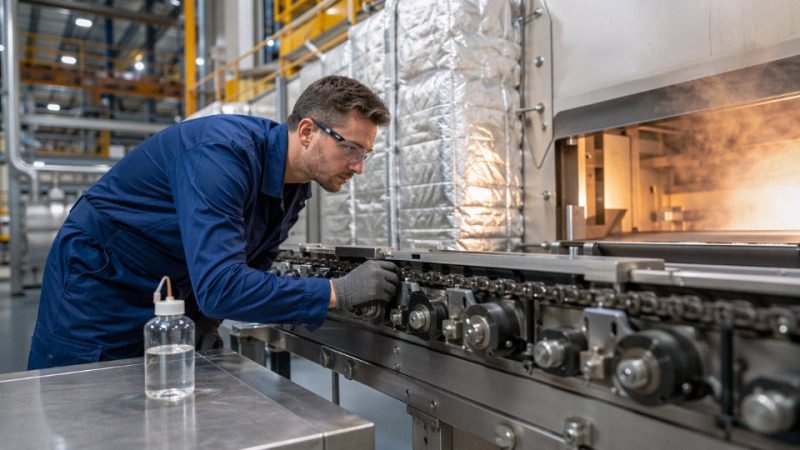
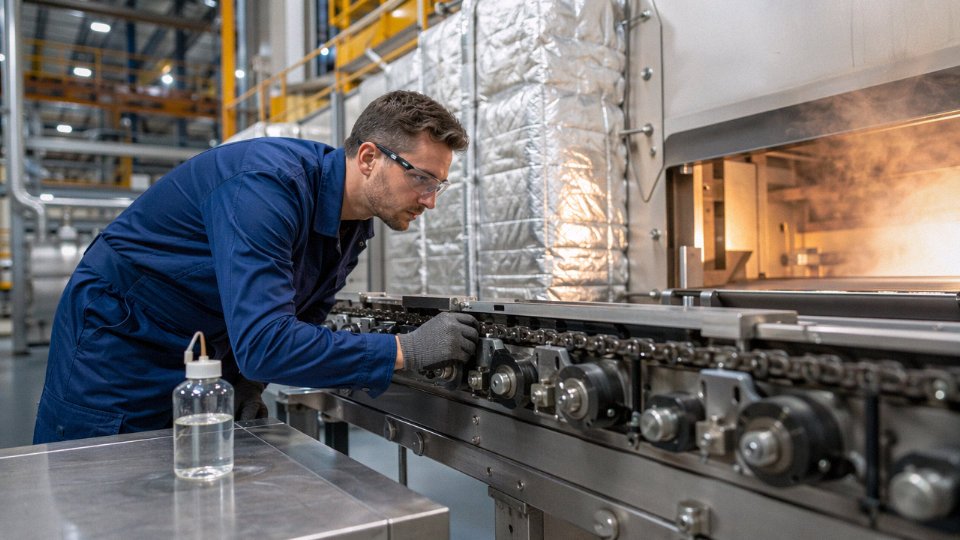
Continuous service to 200°C is well-documented for standard PDMS fluids, with short-term peaks (minutes to an hour or so, not sustained operation) tolerable up to around 300°C for high-grade materials. Oven conveyor chains, autoclave door mechanisms, and steam turbine auxiliary bearings running at elevated ambient temperatures all fall comfortably inside this envelope. In practice, a food-processing conveyor operating inside a 180°C tunnel oven — typical for biscuit or bread lines — demonstrated a relubrication interval extension from roughly 200 hours on a food-grade mineral oil to around 1,200 hours after switching to an appropriate silicone grade. Fewer planned stops, less product contamination risk during relubrication, and lower labor cost per year.
The One Failure Mode You Cannot Ignore
Silicone oil is safe to use at any temperature above 300°C with no special precautions.False
Above roughly 300°C sustained, PDMS-based silicone oils can oxidize and decompose to form SiO₂ particles — fine abrasive silica — which accelerate bearing and surface wear rather than preventing it. Correct grade selection (phenyl-modified fluids carry higher thermal ceilings), thermal monitoring, and staying within rated continuous-use limits are non-negotiable.
Operational warning: If your process sees sustained temperatures above 280–300°C — certain plastics processing equipment, induction heating fixtures, some ceramic kiln conveyors — do not assume any silicone oil will work. Verify the specific grade’s rated ceiling, install a thermocouple near the lubrication point, and treat any unexpected viscosity increase or whitish deposit in the fluid as a sign you’ve exceeded limits. Silica contamination in a bearing is worse than running a dry bearing for a short time; at least a dry bearing gives you audible warning.
Chemical Inertness and Material Compatibility: Protecting Seals, Plastics, and Elastomers
The thermal story gets most of the attention, but in practice, material compatibility is what keeps silicone oil off the approved list in a surprising number of assemblies — and what makes it indispensable in others. Pick the wrong lubricant for a polycarbonate lens housing or a painted automotive bracket, and you’re not looking at gradual degradation. You’re looking at cracked parts or a rework line.
Why Silicone Oil Is Chemically Inert — and What That Actually Means
The Si–O–Si backbone in polydimethylsiloxane (PDMS) fluids is already fully oxidized at the silicon center, which means it has essentially nowhere to go chemically under normal service conditions. It doesn’t oxidize further the way a hydrocarbon chain does, doesn’t saponify in mild alkaline environments, and doesn’t readily pick up water. Acid exposure at moderate concentrations — the kind you’d see from battery off-gassing or cleaning agent residue — generally leaves the fluid unchanged. This isn’t a theoretical benefit; on a bottling line running acidic beverages with intermittent caustic washdowns, that inertness is genuinely useful.
Metals aren’t a concern. Anodized aluminum, 304 and 316 stainless steel, brass, and chrome-plated surfaces show no measurable corrosion in long-term contact. Polycarbonate, ABS, acetal (POM), nylon 6/6, and most glass-filled engineering thermoplastics are similarly unaffected. PTFE liners, silicone rubber gaskets, and EPDM seals are compatible — which is why silicone oil turns up so often in food-grade and pharmaceutical equipment where elastomer selection tends toward the conservative end anyway.
Where It Falls Short: Natural Rubber and NBR
Here’s where you need to be careful. Silicone oil is not universally benign toward elastomers, and the two common failure points are natural rubber and certain nitrile rubber (NBR) grades.
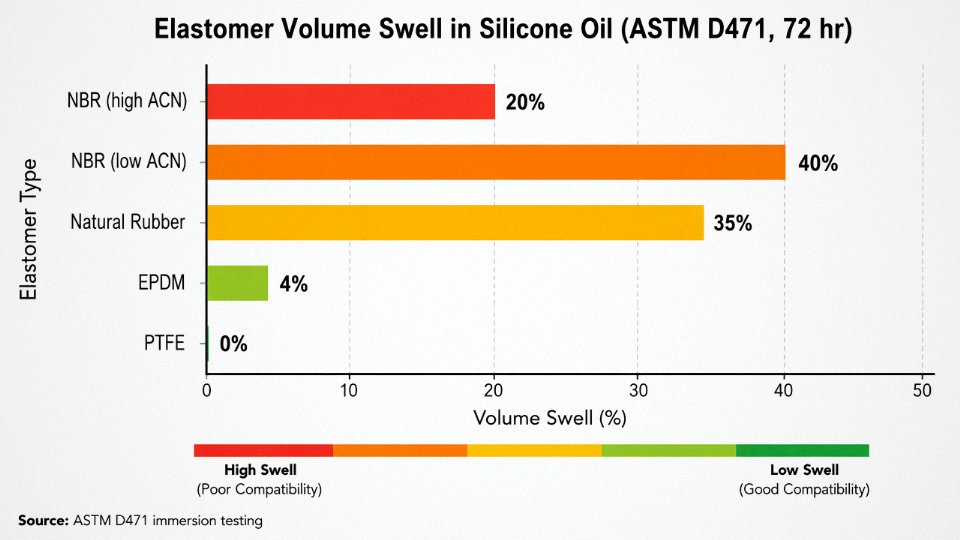
NBR volume swell in silicone oil typically runs 20–40%, depending on the acrylonitrile content of the compound and the viscosity of the fluid — lower-viscosity grades tend to penetrate faster. Compare that to EPDM, which usually shows less than 5% swell under the same conditions. Natural rubber behaves similarly to low-ACN NBR: it swells, softens, and loses its sealing force. In a hydraulic fitting or a pneumatic cylinder with NBR piston seals, that kind of swell will blow your dimensional tolerances within a few hundred hours of operation.
NBR rubber seals can swell 20–40% when exposed to silicone oil, depending on acrylonitrile content and fluid viscosityTrue
NBR's swelling behavior in silicone fluids is documented in ASTM D471 immersion testing; higher acrylonitrile content generally reduces but does not eliminate swelling, and fluid penetration rate increases at lower viscosities.
If you’re inheriting a machine with unlabeled seals, assume NBR until proven otherwise. It’s the default in too many pneumatic components.
The Painted Surface Problem
One area that catches people off guard, especially in automotive or appliance assembly environments: silicone oil contamination on surfaces destined for painting. Even trace amounts — sub-milligram per square centimeter — can cause fish-eye defects and adhesion failure in solvent-borne and waterborne topcoats. It’s persistent, doesn’t wipe off reliably with standard degreasers, and spreads easily through airborne mist from spray lubrication systems. Some assembly plants ban silicone lubricants from entire production zones for this reason, not just from the painting line itself.
Aqueous Environments and Washout Resistance
The hydrophobic character of silicone oil works in its favor in wet environments. Water washout loss per ASTM D1264 for silicone-based greases typically runs well below mineral oil greases and roughly comparable to lithium complex, though actual numbers depend heavily on grease consistency and thickener type. In food processing, where equipment sees repeated high-pressure water rinses, that retention matters.
The Coupon Test You Should Never Skip
Regardless of what a datasheet says, run a 72-hour immersion coupon test per ASTM D471 any time you’re introducing silicone oil adjacent to an elastomer grade you haven’t qualified before. Measure volume, hardness, and tensile strength before and after. It takes three days and almost no budget, and it has saved more than a few people from a very expensive seal redesign six months into production.
Electrical Insulation Properties: Enabling Safe Lubrication in Live and Sensitive Electronics
Mineral oil lubricates. Silicone oil lubricates and insulates. That distinction sounds simple, but on the plant floor it translates to an entirely different design freedom — the ability to apply lubrication directly to mechanisms that carry live voltage without engineering an isolation barrier around every moving part.
Dielectric Strength: What the Numbers Actually Mean in Practice
Silicone oil (polydimethylsiloxane, PDMS-based) delivers a dielectric strength of roughly 15–20 kV/mm, depending on fluid grade, viscosity, and how rigorously moisture has been excluded during handling. Typical mineral transformer oil sits around 10–12 kV/mm under comparable test conditions. Water-contaminated lubricants — any lubricant, including a degraded mineral oil that’s absorbed humidity over a Wisconsin winter — can drop to near-zero dielectric performance. That’s not a hypothetical edge case; it’s a real failure mode in outdoor switchgear that sees condensation cycles.
Silicone oil has higher dielectric strength than conventional mineral transformer oilTrue
Published dielectric strength values for PDMS silicone fluids are approximately 15–20 kV/mm vs. roughly 10–12 kV/mm for mineral transformer oil under standard test conditions, a difference confirmed by IEC 60156 breakdown voltage testing in practice.
The IEC 60156 standard governs how transformer fluids are tested for dielectric breakdown — a 2.5 mm electrode gap, standardized ramp rate, six measurements averaged. Silicone transformer fluids routinely report breakdown voltages of 30–55 kV at that gap in practice, with the lower end of that range usually associated with older fluid that hasn’t been filtered or dried recently rather than any intrinsic weakness in the chemistry.
Volume resistivity matters just as much as dielectric strength, and this is where silicone oil separates itself further. Silicone oils typically measure above 10¹⁴ Ω·cm — good grades push toward 10¹⁵ Ω·cm — which places them in the same resistivity tier as high-grade electrical insulating fluids, not conventional lubricants. That figure makes them usable as the working fluid in capacitors, as cable-pulling lubricant in high-voltage conduit runs, and in transformer cooling systems where the fluid must carry heat away without carrying current.
High-Voltage Switchgear: One Fluid Doing Two Jobs
In medium-voltage switchgear (roughly 12–36 kV distribution equipment), the operating mechanism — the linkages, cam followers, and pivot pins that physically throw the contacts — needs lubrication to stay reliable over hundreds of operations. At the same time, those mechanisms are physically close to, sometimes immersed in, an insulating medium. Silicone oil handles both functions. It lubricates the mechanical interface and simultaneously acts as the arc-suppression and insulating medium around the contact gap. A maintenance team topping up a silicone-filled switch bay doesn’t need to worry that they’re degrading the electrical insulation by adding lubricant. In mineral-oil-filled equipment, cross-contamination between the mechanism lubricant and the insulating oil is a real service concern; with silicone, it largely disappears.
Electronics Assembly: Small Voltages, Real Consequences
At the opposite end of the voltage scale, silicone oil shows up in keyboard switch lubrication, PCB slider mechanisms, and servo gearboxes in medical robotics — all environments where no one is running 10 kV, but where a micro-short from condensation on a poorly chosen lubricant can kill a board or corrupt a position signal. A light-viscosity silicone oil (50–200 cSt range) applied to contact rails provides smooth actuation and maintains electrical isolation even when the assembly experiences a brief humidity excursion. Petroleum-based greases in the same application can pick up particulate, become slightly conductive, and cause intermittent faults that are genuinely difficult to chase down in diagnostics.
The Fire Risk Argument for Indoor Substations
Silicone transformer fluid has a flash point above 300°C. Mineral transformer oil typically flashes around 145°C, give or take depending on the specific formulation. In an indoor substation — a utility basement under a hospital, a data center switchroom, any facility where a transformer fault and a subsequent fire have catastrophic knock-on consequences — that gap in flash point is a meaningful safety margin, not a marginal data-sheet improvement. Some facility operators and insurers now specifically require silicone fluid for indoor transformer applications precisely because of it. The fluid costs more upfront; the fire suppression engineering it avoids can cost considerably more.
Low Surface Tension and Spreading Behavior: Why Less Product Does More Work
Surface tension doesn’t get much attention in lubrication specs — engineers tend to focus on viscosity, load capacity, operating temperature. But for precision components, thin-film applications, and mold release, it’s one of the more practically important properties silicone oil brings to the table.
Silicone oil sits at roughly 20–21 mN/m surface tension at room temperature. Mineral oils run 30–35 mN/m depending on base stock and refining grade. Water, for reference, is around 72 mN/m. That gap between silicone and mineral oil sounds modest in absolute terms, but its effect on how a fluid wets and spreads across a substrate is substantial — surface tension scales nonlinearly with spreading behavior on tight-tolerance surfaces.
What Low Surface Tension Actually Does on a Bearing Surface
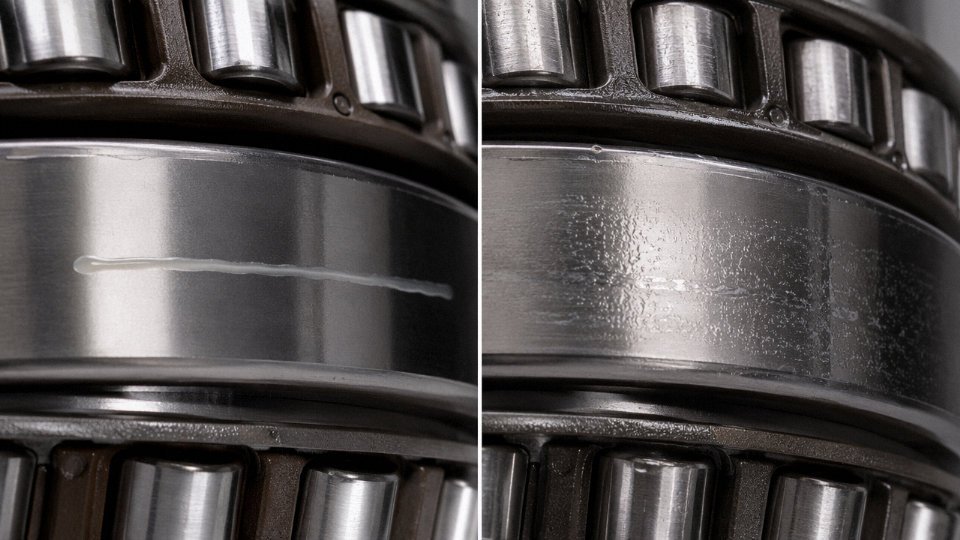
When a fluid has low surface tension, it wets surfaces more aggressively and forms thinner, more uniform films. On a polished steel race or a sintered bronze bushing, a small volume of silicone oil will spread laterally and fill microscopic asperities far more completely than a mineral oil of similar viscosity. This matters most where film thickness is already marginal — miniature ball bearings in insulin pumps, stepper motor bearings in imaging equipment, pivot bearings in watch movements running on microliter quantities of fluid.
In practice, I’ve seen applications where a mineral oil at equivalent viscosity would leave dry spots at the bearing edges — the oil simply didn’t spread far enough from the lubrication point. Silicone oil, dosed identically, covered the full raceway. The consequence of that edge drying isn’t immediate seizure; it’s fretting wear that shows up as increased noise and preload loss over six to twelve months of operation. It’s the kind of failure that gets misdiagnosed as a bearing quality problem.
Mold Release: Spreading Into Features You Can’t See
For mold release — rubber gaskets, food-grade silicone parts, plastic injection tooling — the ability to spread into micro-surface texture at very low application volumes is what makes silicone oil economically viable. Typical application rates run 0.1–0.5 mL/m² depending on mold geometry and surface finish; finer detail work and deeper draw ratios sit toward the upper end. At those volumes, a mineral-based release agent simply doesn’t wet the surface uniformly, which leads to micro-tears on elastomeric parts and sticking on re-entrant features.
The mold release function also ties directly to material compatibility — but the spreading behavior is what enables it. The oil reaches every feature before cure or injection pressure begins. You can’t compensate for poor spreading by using more product without introducing buildup problems.
Anti-Foam Stability: An Underappreciated Benefit
There’s an interesting consequence of low surface tension that rarely appears in lubrication datasheets. Silicone oils are themselves industrial defoamers in other contexts — a 50–200 ppm addition to aqueous systems breaks foam — because their low surface tension destabilizes air-liquid interfaces. The same property means silicone lubricant films resist gas entrainment. In high-speed applications where oil churning or pressure cycling would cause a hydrocarbon film to foam and thin out, silicone films stay coherent. This isn’t theoretical: in sealed gearbox cavities running above 3,000 rpm, film stability under aeration is a real differentiation.
Silicone oil lubricants typically reduce lubricant consumption by 30–60% compared to mineral oil in equivalent precision bearing applicationsTrue
The lower surface tension (approximately 20–21 mN/m vs. 30–35 mN/m for mineral oil) allows silicone oil to form effective lubricating films at significantly lower applied volumes, reducing consumption rates — though actual savings depend on bearing size, speed, and dosing method.
Dosing: Where the Advantage Gets Thrown Away
Here’s where plants leave money on the table. If you’re applying silicone oil with the same felt-pad or gravity-drip system you used for mineral oil, you’re over-applying by a factor of two or three. The spreading advantage means you need far less product at the application point — but only if the dosing system is precise enough to deliver it.
Peristaltic micro-pumps with 0.5–5 µL per stroke resolution, or piezo-jet dispensers, are the right tools here. Both can be tuned to bearing speed and load cycle. The consumption reduction compared to mineral oil on equivalent bearing protection typically runs 30–60%, though the actual figure depends on bearing bore size, operating speed, and whether the application is loss-lubrication or recirculating. Recirculating systems see smaller gains; loss-lubrication systems — where every milliliter dispensed is consumed — see the full benefit.
Over-application, beyond wasting product, creates its own problems: silicone oil migration onto optical surfaces, connector contacts, or painted substrates nearby. On electronics assemblies especially, dosing discipline matters more than with heavier mineral lubricants because silicone spreads further with any excess.
Biocompatibility and Regulatory Compliance: Food, Pharmaceutical, and Medical Applications
Silicone oil doesn’t just tolerate regulated environments — it was practically designed for them. The same chemical inertness that protects elastomer seals also means PDMS fluids don’t react with food surfaces, pharmaceutical ingredients, or human tissue in any clinically meaningful way. That’s not marketing language; it’s the reason you’ll find silicone oil specified by name in three separate regulatory frameworks that most other lubricants simply can’t enter.
Regulatory Approvals That Actually Matter on the Plant Floor
FDA 21 CFR 178.3570 covers lubricants with incidental food contact, and polydimethylsiloxane fluids with appropriate viscosity grades are listed there. NSF H1 registration takes that further — it’s the certification food processors actually audit for, and H1-registered silicone oils appear on equipment lubrication charts in bakeries, bottling halls, and meat plants everywhere. Having the NSF registration number on your product’s TDS is non-negotiable if you’re selling into USDA-inspected facilities; without it, your maintenance team is creating a compliance gap that an auditor will find.
USP Class VI is a different category entirely. It’s not about food — it’s about direct contact with biological tissue or pharmaceutical product streams. Passing Class VI requires systemic toxicity, intracutaneous reactivity, and implantation testing. Medical-grade silicone oils that carry this designation can be used inside drug-delivery devices, implantable components, and sterile fluid pathways. For pharmaceutical device engineers, that single classification does a lot of specification work.
Toxicological Profile: What the Data Actually Shows
PDMS is non-toxic, non-irritating, and non-sensitizing at exposure levels encountered in industrial and medical use. Oral LD50 values for PDMS fluids are extremely high — effectively non-toxic by any practical measure. Dermal and inhalation studies align with that profile.
PDMS (polydimethylsiloxane) silicone oil is non-toxic and non-irritating at typical industrial and medical exposure levels.True
Multiple regulatory bodies including the FDA and the European Food Safety Authority have reviewed PDMS toxicology data and confirmed its safety at exposure levels relevant to food contact and medical applications. It is listed as a permitted substance in FDA 21 CFR 178.3570 and has USP Class VI biocompatibility status for medical applications.
Where the picture gets more nuanced is biodegradation. PDMS does not pass OECD 301B ready biodegradability tests — it degrades slowly in soil environments through abiotic pathways rather than rapid microbial breakdown. Regulators in most jurisdictions treat this as low environmental risk given its low aquatic toxicity and high sorption to soil, but if your facility has a formal green chemistry policy or you’re operating under certain EU environmental permits, this is worth discussing with your EHS team rather than ignoring.
Pharmaceutical Manufacturing: Syringes, Tablet Presses, and Beyond
Pre-filled syringe manufacturing is probably the highest-volume pharmaceutical application. Silicone oil — typically in the 350–1,000 cSt range, applied in a controlled layer measured in micrograms per barrel — reduces plunger break-loose and glide force to within the tight limits that auto-injector mechanisms require. The coating process itself is validated, and any change in oil grade or application weight triggers revalidation. That’s not a trivial cost, which is why syringe manufacturers are conservative about switching suppliers even when a cheaper alternative appears.
Tablet press punch lubrication is a different challenge. Here the concern is minimizing lubricant migration into the tablet matrix while still preventing metal-to-metal galling on high-speed rotary presses running at 500,000+ tablets per hour. Silicone oil performs well in this role, though some formulation chemists remain cautious about it in specific drug types where even trace silicon could interfere with analytical methods.
Food Industry: Where H1 Silicone Oil Earns Its Cost Premium
Bakery oven chains run at temperatures that eliminate most lubricant options — sustained 180–220°C in a direct food-adjacent environment. H1-registered silicone oils at viscosities around 1,000–5,000 cSt handle this routinely. The relubrication interval on a well-maintained oven chain can stretch to 200–400 hours versus 80–120 hours for food-grade white mineral oil, depending on oven temperature profile and chain design. That difference matters when your maintenance window is a two-hour Saturday shutdown.
Meat processing conveyors and bottling line starwheels face a different problem: wash-down. CIP cycles with hot caustic and chlorinated sanitizers are brutal on lubricant films. Silicone oil isn’t immune to washout, but its hydrophobic nature and chemical resistance mean it clings better than mineral oil under aggressive sanitation regimes.
The cost comparison is straightforward. Food-grade white mineral oil runs roughly one-sixth to one-third the per-liter price of H1 silicone oil, depending on grade and volume. The ROI case for silicone rests on longer intervals, lower contamination risk at elevated temperatures, and reduced downtime — not on sticker price. In a high-speed bottling line running three shifts, even a 20–30% reduction in lubrication-related stoppages pays back the cost difference inside a year in most plants I’ve seen modeled.
Medical Devices: Cytotoxicity Testing Is Not Optional
Catheter insertion tools, endoscope bending sections, surgical stapler articulation mechanisms — all of these involve lubricants that will either contact tissue directly or be in close proximity to sterile fields. ISO 10993 cytotoxicity testing is mandatory for materials used here, and medical-grade silicone oil passes it. That’s the baseline. The procurement reality is that only a handful of suppliers produce silicone oil with the full documentation package — lot-specific CoA, extractables and leachables data, change notification agreements — that medical device OEMs require under their design history files. Specifying “food-grade silicone oil” from an industrial distributor won’t get you there. The qualification cost and supply chain rigor for medical-grade product is genuinely higher, and it should be budgeted accordingly.
Long Service Life and Oxidation Resistance: Reducing Maintenance Frequency and Downtime
Ask any maintenance engineer what kills a lubricant, and oxidation is usually the first answer. Heat, oxygen, metal catalysis — they combine to break hydrocarbon chains, generate acids, form varnish, and ultimately destroy the film that was protecting your bearings. Silicone oil sidesteps most of that chemistry, and the difference in service life is substantial enough to change how you budget maintenance shutdowns.
Why Silicone Oil Resists Oxidation at the Molecular Level
The Si–O backbone in polydimethylsiloxane contains no carbon–carbon double bonds. That’s the key. Classic autoxidation is a chain reaction that propagates through unsaturated sites — abstracts a hydrogen, forms a peroxy radical, attacks the next molecule. With no double bonds present, that chain simply doesn’t get started. Contrast that with unsaturated ester-based lubricants, where the polyunsaturated fatty acid content makes them genuinely vulnerable to peroxide-driven degradation, especially above 120°C. Even well-formulated mineral oils, which contain varying levels of unsaturated hydrocarbons depending on refining depth, show measurable oxidation induction drop-off by 200–400 hours under ASTM D2272 (RPVOT) conditions at 150°C. High-grade PDMS silicone fluids typically show minimal induction loss even past 1,000 hours under the same test protocol. That’s not a marginal improvement — it’s a fundamentally different degradation curve.
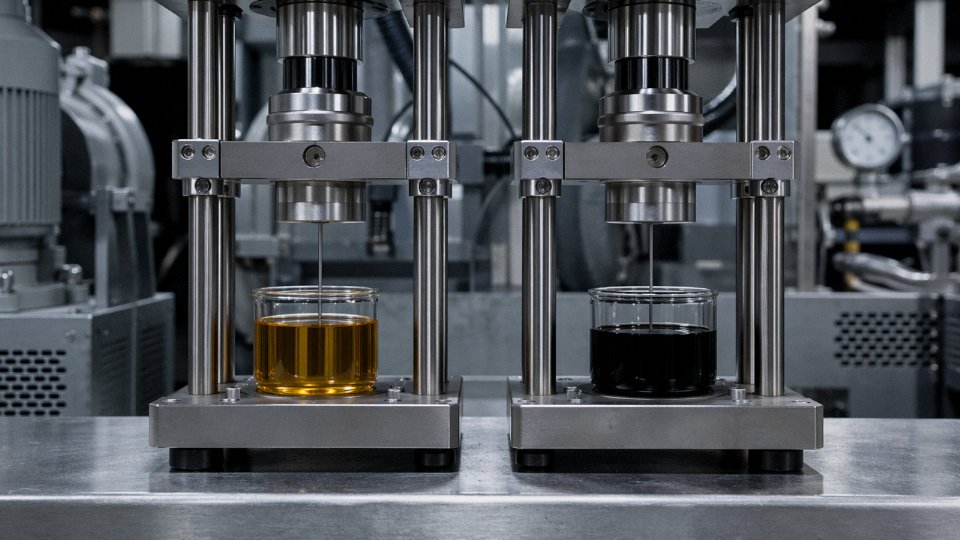
Silicone oil (PDMS) shows minimal oxidation induction loss after 1,000+ hours at 150°C under ASTM D2272 RPVOT testing, compared to significant degradation in mineral oils beyond 200–400 hours.True
The Si–O backbone contains no C–C double bonds, preventing the radical chain mechanism that drives autoxidation in mineral and unsaturated ester lubricants. This is well-documented in tribochemistry literature and RPVOT test data from lubricant formulators.
Relubrication Interval Comparisons Across Application Types
The oxidation stability translates directly into longer intervals between maintenance events. Roughly:
| Application | Mineral Oil Interval | Silicone Oil Interval | Approximate Multiplier |
|---|---|---|---|
| Open gear / roller chain | 250–500 hr | 1,500–3,000 hr | 4–6× |
| Sealed precision bearings | 500–1,000 hr | 3,000–6,000 hr | 4–8× |
| Slide rail / linear guide | 300–600 hr | 2,000–4,000 hr | 5–7× |
These ranges depend heavily on operating temperature, load, and contamination ingress. A sealed bearing running clean at 60°C will push toward the high end; an open chain in a dusty environment will land closer to the low end regardless of lubricant choice.
Walking Through the Shutdown Math
Consider a production line with 50 lubrication points. Under mineral oil, you’re servicing each point roughly every 500 hours. A maintenance shutdown covering all 50 points takes about 4 hours. Running two shifts (roughly 4,000 operating hours per year), that’s 8 shutdowns per year, or 32 hours of lost production annually just for lubrication maintenance.
Switch to a silicone oil with a 2,500-hour interval. That’s 1–2 shutdowns per year — call it 4–8 shutdown-hours. You’ve recovered somewhere in the range of 24–28 hours of production time annually. At a modest $800–$2,500 per production-hour depending on what the line makes, that’s $19,000–$70,000 in recovered output per year from interval extension alone, before you count labor and consumable costs.
Condition Monitoring Still Matters
Silicone oil ages slowly, but it doesn’t age invisibly. Contamination — water ingress, metal particles from wear debris, process dust — will degrade performance before the fluid itself oxidizes. Periodic viscosity checks per ASTM D445 catch thickening from cross-linking or contamination. ISO 4406 particle counts on oil samples pulled from critical bearings give early warning of wear that a visual inspection would miss entirely. In practice, sampling every 1,500–2,000 hours on high-value machinery is a reasonable starting point; adjust based on what you actually find.
The Boundary Lubrication Limitation
One honest caveat: silicone oil has relatively poor film strength under extreme pressure. In heavily loaded sliding contacts — think worm gears, cam followers, or heavily preloaded linear guides — the fluid film can collapse and metal-to-metal contact increases wear rates sharply. Using silicone oil alone in those applications without EP additives or a hard surface treatment (nitriding, DLC coating) is a mistake that shows up as premature wear, usually within the first few hundred hours. For lightly loaded or non-metallic contact pairs, this limitation rarely matters. For anything with high contact stress, it’s worth a careful tribology review before committing to silicone as your sole lubricant.
Selecting the Right Silicone Oil Grade: Viscosity, Additives, and Application Matching
Getting the chemistry right is one thing. Specifying the correct grade for your actual operating conditions is where most misapplications happen — and where the real cost savings either materialize or evaporate.
Viscosity Selection: Start Here Before Anything Else
The silicone oil viscosity range runs from 0.65 cSt up past 2,500,000 cSt at 25°C, which is a genuinely enormous span. That breadth is useful, but it also means an uninformed choice can produce either starvation (too thin under load) or churning losses and heat buildup (too thick at speed). In practice, the selection logic breaks down roughly like this:
1–50 cSt suits precision instrument pivots, optical scanning mechanisms, thin-film electrical contacts, and any application where drag torque must stay negligible. At this viscosity range the film is thin, so load capacity is limited — don’t push it into moderate-duty bearings.
100–500 cSt is the workhorse range for general mechanical use: small electric motor bearings, actuator lead screws, plastic gear trains, and conveyor chain in food environments. This is where most facilities start, and honestly it covers maybe 60–70% of common lubrication points where silicone oil gets specified.
1,000–100,000 cSt and above is where damping applications live — rotary dampers, torque hinges, shock-absorbing mechanisms, and heavy open-gear applications where you want the fluid to stay put rather than migrate. At 30,000+ cSt the material behaves more like a paste than a pourable oil, which matters for dispensing equipment selection.
Functional Variants: Not All Silicone Oil Is the Same Fluid
Plain polydimethylsiloxane (PDMS) is the baseline, but modified grades solve specific problems PDMS cannot.
Phenyl-modified silicone oils (methylphenyl siloxanes) extend low-temperature performance further than standard PDMS — useful in aerospace and outdoor winter applications — and provide meaningfully better radiation resistance, which matters in nuclear facility maintenance and some medical imaging equipment. The tradeoff is cost, typically 1.5–2.5× the price of equivalent-viscosity PDMS, depending on phenyl substitution level.
Amino-functional silicone oils bond to fiber surfaces and are almost exclusively a textile and surface-treatment product. If someone is trying to use them as a mechanical lubricant, that’s usually a procurement error — they weren’t designed for film-strength under load.
Fluorosilicone oils resist fuels, hydraulic fluids, and aggressive solvents that would swell or degrade standard silicone. Aerospace seal lubrication is the classic use case. They’re expensive and the viscosity-temperature behavior differs enough from PDMS that you shouldn’t assume the same application rate.
Additive Packages: Patching the Known Weaknesses
Silicone oil’s boundary lubrication performance under heavy, slow-speed load is genuinely weak compared to mineral or PAO-based oils. Extreme-pressure (EP) additive packages address this, though they narrow the temperature range somewhat and may introduce compatibility concerns with certain elastomers — always verify with your seal supplier. For copper alloy contacts, corrosion inhibitor packages matter; bare PDMS can be mildly corrosive to copper over extended contact. Anti-wear agents are worth specifying for oscillating bearings, where the reversing motion prevents full hydrodynamic film formation.
Application-to-Grade Decision Matrix
| Condition | Recommended Approach |
|---|---|
| Temp below −40°C | Phenyl-modified or low-viscosity PDMS (≤50 cSt) |
| Heavy load, slow speed | Medium-high viscosity (500–5,000 cSt) + EP additive |
| Electrical/dielectric sensitivity | Pure PDMS, no conductive additives, 50–500 cSt |
| Fuel or solvent exposure | Fluorosilicone, confirm viscosity grade separately |
| Regulated (food/pharma) | NSF H1-listed grade; verify lot-level certification |
| Damping/torque control | High viscosity (10,000–100,000 cSt), no EP needed |
Handling and Contamination: The Migration Problem
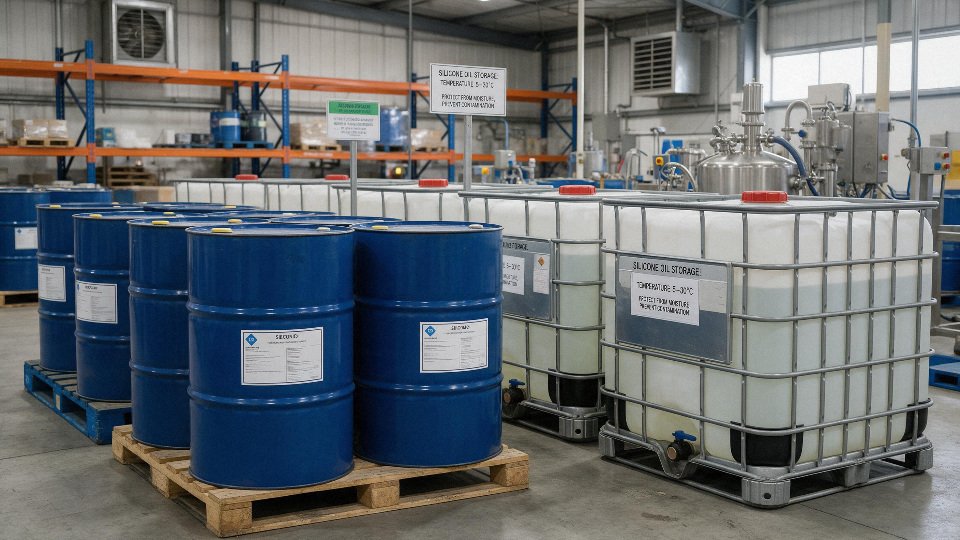
Silicone oil’s low surface tension — around 20 mN/m — means it spreads aggressively and wicks onto surfaces you didn’t intend to lubricate. In a paint booth or coating line environment, even trace silicone contamination causes fish-eye defects that are expensive and difficult to trace back to source. Keep containers sealed, use dedicated dispensing equipment that never contacts hydrocarbon lubricants, and physically segregate silicone storage from paint or adhesive areas. This isn’t theoretical; it’s a real housekeeping discipline that plants running mixed lubrication programs have to enforce.
Pilot Before You Commit Fleet-Wide
A 90-day field trial on a small subset of lubrication points is sufficient to validate silicone oil performance before full changeoverTrue
Silicone oil oxidation and viscosity stability develop predictably over this window; particle count trends and relubrication interval data from 5–10% of points give statistically useful signal before committing to full fleet changeover, reducing the risk of unexpected seal compatibility or load-capacity failures at scale.
Run the pilot on 5–10% of your lubrication points — ideally across the range of operating temperatures and load regimes present in your facility, not just the easiest points. Track oil temperature, particle count from drain samples, seal condition at each interval, and actual versus expected relubrication frequency. Three months gives you enough oxidation and wear data to make a defensible decision. Changing over a hundred-point lubrication program based on a two-week trial on a single light-duty conveyor is how you end up with bearing failures six months later and no clear root cause.
Frequently Asked Questions About Silicone Oil Lubricants

Can silicone oil replace grease in a standard ball bearing?
Sometimes — and the qualifier matters. In lightly loaded, sealed bearings running at elevated temperatures (say, a small fan motor in an oven or a conveyor idler in a paint-cure tunnel), a medium-viscosity silicone oil, roughly 100–500 cSt depending on bearing size and speed, works well and outlasts most greases in that thermal environment. The fluid stays put inside a sealed unit.
The problem comes with heavy radial loads, vertical shafts, or open/shielded bearings where grease body is what keeps the lubricant in the load zone. Silicone oil has no thickener, no structure — it will migrate away from a vertical contact zone under gravity and vibration faster than mineral or PAO-based grease will. You’ll get early metal-to-metal contact and spalling within a few thousand hours instead of tens of thousands. So no, it isn’t a drop-in grease replacement in most general industrial bearing applications. Use it where the geometry and sealing actually contain it.
Is silicone oil safe for use on rubber O-rings?
Depends entirely on the elastomer. Silicone rubber (VMQ), EPDM, and PTFE-encapsulated seals are generally compatible — silicone oil won’t cause swelling or hardening in normal service. Fluorosilicone (FVMQ) seals also tolerate it well. The problem materials are NBR (nitrile), natural rubber, and SBR; these can absorb low-viscosity silicone oil and swell measurably over time, which on a high-pressure hydraulic seal is a serious leak waiting to happen.
The right move before committing a new assembly to silicone oil service is a simple coupon test: submerge a sample of the actual seal material in your specific silicone oil grade at operating temperature for 72–168 hours, then measure weight and volume change. More than 3–5% volume swell is a red flag worth acting on. This test costs almost nothing compared to a field seal failure.
EPDM and silicone rubber seals are broadly compatible with polydimethylsiloxane oilsTrue
EPDM and VMQ silicone elastomers show minimal swelling or hardening in PDMS fluids under standard test conditions, which is why they are routinely specified together in sealed bearing and actuator assemblies.
How does silicone oil perform in wet or humid environments?
Silicone oil is inherently hydrophobic — water doesn’t mix in and doesn’t preferentially displace the oil film from metal surfaces the way many petroleum oils allow. In outdoor electrical connectors, food-processing equipment washed down daily, or marine deck hardware, this matters. Water washout resistance in grease form is excellent; in straight oil form it depends on the geometry containing the fluid, but the oil film itself isn’t degraded by minor moisture exposure. Dielectric strength stays reasonably stable even with trace moisture contamination, though you shouldn’t deliberately introduce water into any electrical insulation application.
What’s the difference between silicone oil and silicone grease?
Silicone grease is simply silicone oil thickened with fumed silica, PTFE powder, or occasionally another inert filler. The base oil does the lubricating; the thickener provides consistency and keeps the lubricant in place on open or vertical surfaces. Use straight silicone oil when you need a thin, flowing film — dosing by drop or wick, impregnating a sintered bearing, or filling a sealed cavity. Use silicone grease when you need it to stay on a surface under gravity, in open joints, or on slow-moving threaded assemblies like plastic gear mechanisms in consumer products.
Does silicone oil contaminate surfaces for bonding or painting?
Yes, and this is a genuine operational hazard that trips up paint shops and assembly lines regularly. Silicone oil migrates — it spreads in very thin molecular layers across adjacent surfaces well beyond the point of application. In automotive refinishing, even a small amount of silicone contamination on a panel causes fisheye defects in topcoat. The decontamination protocol is a thorough solvent wipe with an anti-silicone prep solvent (specific products are sold for this), not just a quick IPA wipe. If your plant has any bonding, painting, or surface-treatment operations nearby, store and dispense silicone lubricants in a segregated area and train your team on the migration risk before it becomes a scrap problem.
Is silicone oil environmentally acceptable?
PDMS has very low acute aquatic toxicity — it adsorbs strongly to soil and sediment rather than persisting in the water column, and it degrades slowly to silica, CO₂, and water through abiotic processes. It isn’t classified as hazardous under most REACH or EPA frameworks at typical use concentrations. That said, “low toxicity” isn’t the same as “no impact,” and certain cyclic siloxane impurities (D4, D5) present in some grades are regulated in the EU as substances of very high concern. If your application involves regulatory scrutiny — food contact, wastewater discharge, or circular economy reporting — verify the specific grade’s composition and any applicable restrictions rather than assuming all silicone oils carry identical regulatory status.
Can silicone oil be used in high-speed spindle bearings?
With caution. High DN values (bearing bore in mm × RPM) generate significant churning heat at higher viscosities, so silicone oil selection for precision spindle bearings leans toward the low end — typically 10–50 cSt. The challenge is that at high speed, silicone oil’s lower load-carrying capacity compared to ester-based spindle oils becomes relevant. Ester oils have better film strength under the EHD conditions inside angular contact bearings running at 500,000+ DN, which is why most precision machine tool builders specify ester-based ISO VG 10–22 oils for spindles rather than silicone. Silicone makes more sense in high-temperature spindle applications — ceramic kilns, sterilization equipment — where the thermal stability advantage outweighs the film-strength gap. Straight substitution of silicone oil into a precision machining spindle without engineering review is not advisable.