You’re sourcing a thermal fluid for a heat-transfer loop, or maybe a dielectric coolant for an EV battery pack, and the quote comes back higher than expected — sometimes significantly higher than the mineral oil you replaced last cycle. That gap causes real problems: budget overruns on initial fill, hesitation to top up properly (which leads to viscosity drift and bearing wear), and procurement teams defaulting to cheaper substitutes that fail seals or oxidize at temperature. Getting the cost picture right before you spec the fluid saves all of that.
Silicone oil typically costs $2.50–$6.00 per kilogram in industrial drum quantities for standard PDMS grades around 350 cSt, depending on order volume, viscosity specification, and supplier region. Pharma-grade or medical-device-certified versions run $15–$40/kg. The wide range reflects purity requirements, certification overhead, and how far the product sits from commodity production.
What makes the pricing genuinely interesting — and harder to predict than most industrial fluids — is that the cost structure upstream is unusual. Silicon metal, methanol, and hydrochloric acid are the core feedstocks, and the distillation and polymerization steps that turn those inputs into a stable, narrow-viscosity fluid account for roughly 30–40% of production cost on their own. That’s before any certification, defoaming additive, or packaging premium hits the invoice. Understanding where the cost actually comes from changes how you negotiate, what grade you actually need, and when paying more is genuinely justified versus when it isn’t.
How Silicone Oil Is Made and Why the Chemistry Drives Up the Base Cost
The price gap between silicone oil and a comparable mineral oil isn’t arbitrary — it’s baked into the manufacturing route from the very first step. To understand why even commodity-grade polydimethylsiloxane costs several times more than a Group I base oil, you have to follow the supply chain back to a pile of quartz sand and a reduction furnace.
From Sand to Silicon Metal: The First Energy Bill
Silicone production begins with metallurgical-grade silicon, reduced from silicon dioxide (SiO₂) in an electric arc furnace at roughly 1,500–1,800 °C using carbon as the reductant. This alone is an energy-intensive operation. The resulting silicon metal runs $1.80–$2.50/kg depending heavily on electricity tariffs in the producing region (most of the world’s supply comes from China’s Yunnan and Sichuan provinces, where hydropower has historically kept costs down, and from Norway). Small swings in regional power pricing propagate directly into downstream silicone fluid prices — something procurement managers often underestimate when they’re focused on the $/kg of the finished drum.
The next step is the Müller–Rochow process: ground silicon metal reacts with methyl chloride (CH₃Cl) over a copper catalyst at 250–350 °C to produce a mixture of chlorosilane intermediates. The target product is dimethyldichlorosilane — (CH₃)₂SiCl₂ — but the reaction also yields methyltrichlorosilane, trimethylchlorosilane, and several other isomers as co-products. Separating them requires a multi-stage distillation train capable of handling highly corrosive, moisture-sensitive streams. That distillation step is where a meaningful portion of the facility’s capital cost sits, and it’s not optional. Impure chlorosilane feed contaminates the entire downstream polymer batch.
Polymerization and Viscosity Control
Once you have purified dimethyldichlorosilane, hydrolysis with water opens the Si–Cl bonds to form silanols, which then condense to build polydimethylsiloxane (PDMS) chains. Chain length — and therefore viscosity grade — is controlled by the ratio of monofunctional end-cappers (trimethylsiloxy units) to bifunctional chain-building units. A high end-capper ratio gives short chains and low viscosity, maybe 5–20 cSt. Dial the ratio the other way and you can reach 100,000 cSt or beyond. In theory this sounds straightforward. In practice, hitting a tight viscosity specification like 350 ± 15 cSt consistently requires careful temperature control, moisture management, and post-polymerization equilibration steps — all of which add cycle time and energy.
The total energy consumption for finished silicone fluid is estimated at roughly 15–25 GJ per tonne of product, depending on plant efficiency, viscosity grade, and the degree of purification required. Compare that with 3–6 GJ/tonne for conventional petroleum-derived lubricants. That three-to-fivefold energy intensity difference is structural. It doesn’t disappear when crude oil prices rise.
Silicone fluid production consumes significantly more energy per tonne than conventional mineral oil lubricant refiningTrue
Silicone synthesis requires high-temperature arc furnace reduction of quartz, energy-intensive chlorosilane distillation, and controlled polymerization, combining to an estimated 15–25 GJ/tonne versus 3–6 GJ/tonne for petroleum-derived lubricants.
An Oligopolistic Market That Doesn’t Reward Bargaining
Four producers — Dow, Momentive, Wacker Chemie, and Shin-Etsu — control the overwhelming majority of global dimethylsiloxane fluid capacity. This is not a commodity chemical market in the ordinary sense. Each of these companies is vertically integrated from chlorosilane production upward, which means independent formulators or toll-blenders have very limited ability to play suppliers against each other on base polymer price. When silicon metal costs drop, the producers’ margin typically improves rather than fluid prices falling proportionally. Procurement teams who’ve tried hard price negotiations on annual silicone contracts know this experience well.
Specialty Grades: Nonlinear Cost Multipliers
Standard PDMS is already the cheap end of the product family. Introduce phenyl groups (–C₆H₅) along the polymer backbone to improve low-temperature flexibility — useful below –60 °C — and you’ve added a separate phenylchlorosilane synthesis step with its own distillation requirements. Amino-functional silicone fluids, widely used in hair-care formulations, require a post-polymerization grafting reaction and precise amine-content titration for quality release. Fluoroalkyl-modified fluids for aggressive chemical environments involve fluorinated intermediates that are expensive, tightly regulated in some jurisdictions, and handled with considerable caution on the plant floor. Each modification adds not just raw material cost but process complexity, yield loss, and in some cases specialized equipment that a general-purpose silicone plant doesn’t have. The cost doesn’t scale linearly — it jumps in steps, which is exactly what you see in the $15–$40/kg range for certified specialty grades versus $2.50–$6.00/kg for bulk industrial PDMS.
Viscosity Grade vs. Price: The Specification Detail That Changes Everything
Not all silicone oil is priced the same, and the viscosity grade you write into your spec sheet can swing your unit cost by a factor of three to eight compared to the commodity benchmark. Most procurement managers learn this the hard way — after they’ve already issued a PO.
The Reference Price Landscape by Viscosity
The table below gives realistic bulk pricing for industrial-grade PDMS at 200 L drum quantities. These are indicative ranges; actual quotes depend on supplier region, order volume, certification tier, and whether you’re buying spot or on a blanket order.
| Viscosity Grade (cSt) | Typical Bulk Price Range ($/kg) | Cost vs. 350 cSt Benchmark |
|---|---|---|
| 1 cSt | $18 – $45 | 6–9× |
| 5 cSt | $12 – $28 | 4–6× |
| 10 cSt | $8 – $18 | 2.5–4× |
| 50 cSt | $4.50 – $9 | 1.2–2× |
| 100 cSt | $3.50 – $7 | ~1–1.5× |
| 350 cSt | $2.50 – $6 | Benchmark |
| 1,000 cSt | $3.50 – $7.50 | 1–1.5× |
| 12,500 cSt | $6 – $14 | 2–3× |
| 60,000 cSt | $10 – $22 | 3–5× |
| 1,000,000 cSt | $18 – $40 | 5–8× |
Why the Extremes Cost More — Different Reasons at Each End
Low-viscosity grades (1–10 cSt) are expensive because they require tight fractionation. PDMS synthesis produces a distribution of polymer chain lengths, and pulling a narrow cut of short-chain oligomers means more distillation passes, lower yield from the same raw material input, and stricter quality control to confirm the molecular weight distribution is actually narrow. A 1 cSt grade might yield 40–60% of what a 350 cSt run yields from equivalent feedstock. That lost material doesn’t disappear — it gets reblended or sold at lower value, and the economics get passed back to you.
Ultra-high viscosity grades (above 100,000 cSt) are expensive for the opposite reason: you’re buying time. Longer polymerization cycles, higher catalyst loading, and the energy cost of maintaining reaction temperature over extended batch runs all stack up. A 1,000,000 cSt gum-like fluid can take several times the reactor residence time of a standard 350 cSt batch. Throughput per unit of reactor capacity drops, and the price reflects that.
The Over-Specification Trap
Here’s a real pattern worth watching for. In automotive thermal management — liquid-cooled battery modules, transmission cooling loops, similar applications — engineers frequently inherit a spec originally written for a different platform or a conservative design margin. A 50 cSt spec that was copied from a previous datasheet may actually be unnecessary; the heat transfer and flow characteristics of 100 cSt fluid are often adequate once you model the actual operating temperature range.
Switching from 50 cSt to 100 cSt silicone oil in a thermal management circuit can reduce fluid cost by roughly 15–20% without performance penalty, provided the application's viscosity-temperature profile is properly re-evaluated.True
The 50 cSt and 100 cSt grades are similarly priced near the commodity benchmark, but the price spread widens depending on supplier and volume; more importantly, engineers often over-specify viscosity based on room-temperature assumptions rather than actual operating temperatures, where the difference in viscosity between grades narrows significantly.
An engineer who re-examined one such spec — measuring actual flow rates and heat transfer coefficients at operating temperature rather than at 25°C — found 100 cSt performed within acceptable tolerances and saved around 18% on fluid cost at annual volumes above roughly 2,000 L. Small absolute number, but real.
Kinematic vs. Dynamic Viscosity: The Ordering Mistake That Keeps Happening
This one trips up even experienced procurement teams. Kinematic viscosity (cSt) and dynamic viscosity (mPa·s or cP) are related by fluid density, and for silicone oil — which has a density near 0.96–0.98 g/cm³ depending on grade — they’re numerically close but not identical. The bigger problem is measurement temperature. A fluid specified at 25°C will read differently at 40°C, which is the ISO standard reference temperature for many industrial lubricants. If your supplier’s TDS reports viscosity at 40°C and you’re comparing it against a spec written at 25°C, you may order the wrong grade entirely.
Operational warning: Always confirm the measurement temperature before issuing a purchase order. Request the viscosity-temperature curve, not just a single-point value, particularly for any application where operating temperature varies seasonally or across production shifts.
Storage Costs That Partially Offset Low-Grade Savings
Low-viscosity PDMS, particularly anything below 10 cSt, has meaningful volatility. In warm warehouse environments — summer in a non-climate-controlled facility, for instance — partial evaporation from poorly sealed containers can shift the grade upward over a storage period of several months. That means you need sealed 316 stainless steel drums or high-integrity HDPE containers with vapor-tight lids, and you need inventory turnover discipline. The container cost and tighter handling protocols eat into the cost advantage that low-viscosity grades seem to offer on a per-kilogram basis alone. Higher viscosity grades, by contrast, are stable in standard sealed drums over 18–24 months without special precautions, assuming they’re kept out of direct sunlight and away from strong oxidizers.
The practical takeaway: specify the viscosity grade your application actually needs at operating temperature, verify the measurement reference, and don’t copy specs from adjacent projects without a quick thermal model review. The commodity window around 100–1,000 cSt is where the price curve is flattest — if your application can live there, you’re buying at the most competitive point on the market.
Purity Certification and Regulatory Compliance: The Hidden Price Multipliers
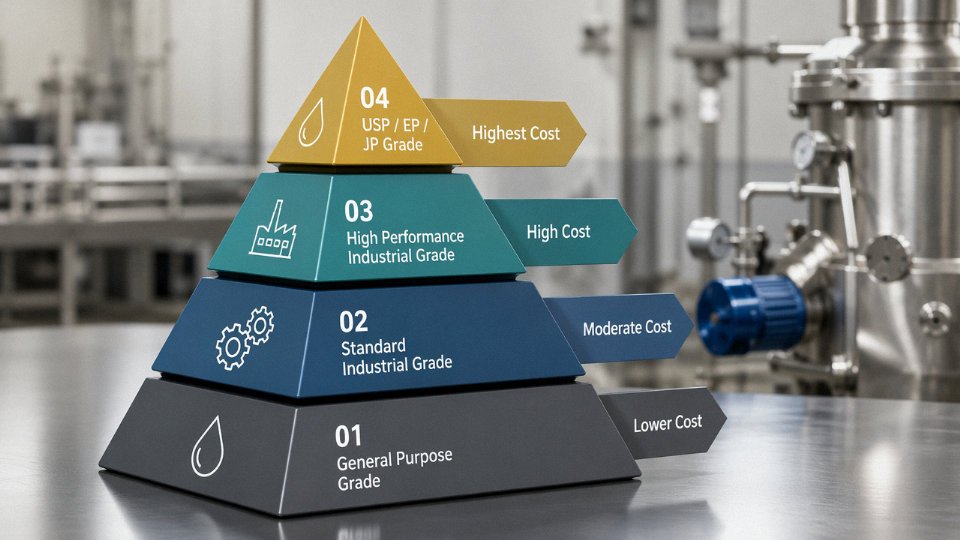
If you’ve ever requested a quote for “silicone oil” and received two prices that differ by a factor of five for what looks like the same viscosity grade, certification tier is almost certainly the explanation. Most buyers don’t realize how steep those steps are until they’re already committed to a supply chain.
The Certification Ladder and What Each Rung Actually Costs
Starting from the industrial-grade baseline — your standard technical-grade PDMS, no special documentation, supplied in 200 L drums — the premium structure looks roughly like this:
| Grade | Typical Premium Over Technical Grade | Primary Driver |
|---|---|---|
| Technical / industrial | Baseline ($2.50–$6.00/kg) | None |
| Cosmetic grade | +20–40% | Controlled impurity limits, basic CoA |
| Food contact (NSF H1) | +30–50% | 21 CFR 178.3570 compliance, lot testing |
| USP / EP pharmaceutical | +200–400% | Compendial testing, dedicated equipment |
| ISO 10993 medical device | +500–900% | Biocompatibility, full traceability package |
These ranges depend on order volume, supplier location, and whether the manufacturer runs dedicated certified lines or uses campaign-based production. A large-volume USP buyer might sit at the lower end of that 200–400% band; a small-lot medical device startup ordering 25 kg at a time could easily hit the top.
What the Certification Actually Demands From the Manufacturer
The price difference isn’t padding. Each tier represents a genuine increase in manufacturing controls and analytical burden.
Cosmetic grade typically requires capping heavy-metal contamination and running basic gas chromatography to confirm residual volatile siloxane levels — D4 and D5 cyclic siloxanes in particular, since those have faced EU regulatory scrutiny under REACH. That’s real lab time, but it’s relatively routine for an established silicone producer.
NSF H1 food-contact lubricant certification under FDA 21 CFR 178.3570 adds formulation restrictions (only approved additives at approved concentrations), documentation of every raw material lot, and ongoing audit obligations. Suppliers pass that overhead directly to buyers. In practice, an NSF H1-certified silicone oil usually needs segregated storage and handling at the supplier’s facility to prevent co-mingling with non-compliant material — which ties up tank capacity and adds scheduling complexity.
Pharmaceutical-grade PDMS meeting USP or European Pharmacopoeia monographs is a different category entirely. Manufacturing requires dedicated production lines, full batch-level traceability, ICP-MS testing for trace metals (parts-per-billion level for elements like nickel, chromium, and iron from reactor surfaces), residual chloride quantification, and a certificate of analysis signed by a qualified person. Suppliers who maintain FDA Drug Master File registration carry that compliance infrastructure as a fixed overhead — and it’s not cheap to maintain.
ISO 10993 medical device grade, used in implantable devices or direct-tissue-contact applications, adds biocompatibility testing on top of all the pharmaceutical controls. That means cytotoxicity, sensitization, and in some cases systemic toxicity studies conducted on the finished fluid lot. You’re not just buying a chemical; you’re buying a documented safety dossier.
The Real Cost of Getting This Wrong
A food processing plant substituting industrial-grade silicone oil at a food-contact lubrication point — say, a conveyor chain running over an open product line — because it’s $1.80/kg cheaper is making a poor calculation. A single product contamination event requiring a Class II recall can run well past $1 million in direct costs before you account for line downtime, retailer chargebacks, and reputational damage. The NSF H1 premium pays for itself after approximately zero recalls.
Industrial-grade silicone oil is chemically identical to NSF H1 food-contact grade and the only difference is paperwork.False
NSF H1 grades must meet specific formulation restrictions under FDA 21 CFR 178.3570, including limits on approved additives and contamination thresholds. Industrial grades carry no such formulation constraints and may contain processing aids or impurity levels that are not permitted in food-contact applications. The certification reflects genuine manufacturing and compositional differences, not just documentation.
Auditing Supplier Certification Claims
Datasheet claims are not verification. If a supplier lists “food-grade” or “USP-grade” on a product page without providing a current certificate of analysis with lot number, ask for it before you order. For pharmaceutical applications, cross-check the supplier’s FDA Drug Master File number against the FDA’s publicly searchable DMF database — it takes about three minutes and will immediately confirm whether the filing exists and is active. For NSF H1 claims, the NSF White Book (now NSF’s online certified product listings) lets you verify registration by product and manufacturer.
In practice, some distributors relabel industrial-grade material with vague quality language. Requesting the CoA and the original manufacturer’s batch documentation — not the distributor’s repackaged document — is the only reliable way to confirm what you’re actually buying.
Order Volume, Packaging Format, and Incoterms: The Procurement Variables That Swing Price by 60%
The grade of silicone oil matters, but so does how you buy it. A procurement team that switches from spot-purchasing 25 kg pails to committing to annual drum volumes — without changing supplier or specification — can realistically cut their per-kilogram cost by 40–50%. That is not negotiating leverage; that is just basic packaging and logistics math working in your favor.
Packaging Format Is the Biggest Single Price Lever
For the same 350 cSt technical-grade PDMS fluid, the cost-per-kilogram range across packaging formats is roughly as follows:
| Format | Typical Volume | Cost/kg (approx.) | What Drives the Variance |
|---|---|---|---|
| Lab bottle | 100 mL | $80–$150 | Filling labor, glass/HDPE packaging, small-batch handling |
| Retail bottle | 1 L | $30–$60 | Packaging cost still dominates; some distributor margin |
| Pail | 25 kg | $10–$18 | Reasonable starting point for pilot or low-volume production |
| Drum | 200 L (~190 kg net) | $4–$8 | The standard industrial entry point |
| IBC tote | 1,000 L (~960 kg net) | $3–$5.50 | Significant step down; requires forklift and bulk transfer pump |
| ISO tanker | >5 tonnes | $2–$3.50 | Chemical plant-to-plant logistics; rare outside high-volume coating or personal care lines |
The 100 mL lab bottle costing $80–$150/kg is not because the fluid is different — it is the same molecule — but because the filling, labeling, and packaging cost is spread across almost nothing. Engineers who are running compatibility trials often default to lab bottles out of habit; if you are ordering more than a liter for any recurring use, move to pails immediately.
Silicone Oil Ships Cheap — If You Plan the Mode Right
One genuinely useful property for procurement: PDMS in drums and IBCs is non-hazardous under most international transport regulations (IMDG, IATA, DOT). No dangerous-goods surcharges, no special documentation fees, no restricted vessel or aircraft routing. That is a meaningful cost difference versus, say, chlorinated fluids or reactive silanes.
The catch is density. Silicone oil runs around 0.96–0.98 g/cm³, so a 200 L drum weighs close to 195 kg net plus the drum tare. Sea freight is almost always the right answer for trans-Pacific or trans-Atlantic volume — air freight on anything heavier than a few kilograms of fluid is economically indefensible unless you have a genuine production emergency. For a plant in Europe sourcing from China, a 20-foot container of drums typically delivers at a freight cost of $0.15–$0.35/kg depending on port pair and market conditions, compared to $3–$6/kg for air. The numbers are not close.
What CIF Quotes Actually Cost You
A CIF price from a Chinese supplier represents the total landed cost.False
No explanation available.
This trips up new procurement teams fairly regularly. Always ask for a full landed cost estimate before comparing a CIF quote to a domestic DAP or DDP price. The math usually still favors the import source at volume, but the gap is smaller than the headline numbers suggest.
Blanket Orders and the Volume Rebate Mechanics
Suppliers — even large ones — respond to commitment. A manufacturer who signs a 12-month blanket purchase order for, say, 10 drums/month is offering something real: production planning certainty and reduced order administration. In return, 10–20% rebates off the spot price are achievable, and more importantly, you can often negotiate price ceilings tied to methanol or silicon metal indices. That protects you when raw material markets spike, which they do periodically and with little warning.
Spot buying every month is not just more expensive per kilogram; it exposes you to exactly the price volatility that bulk agreements are designed to hedge. A plant running a silicone-based release agent through a continuous process cannot afford to have its fluid cost jump 25% mid-quarter.
The Inventory Risk That Eats Your Bulk Savings
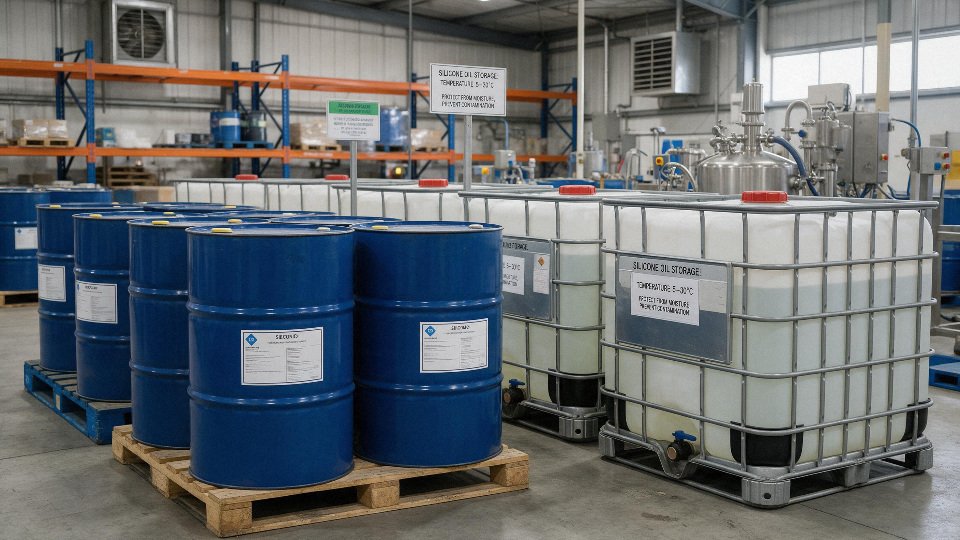
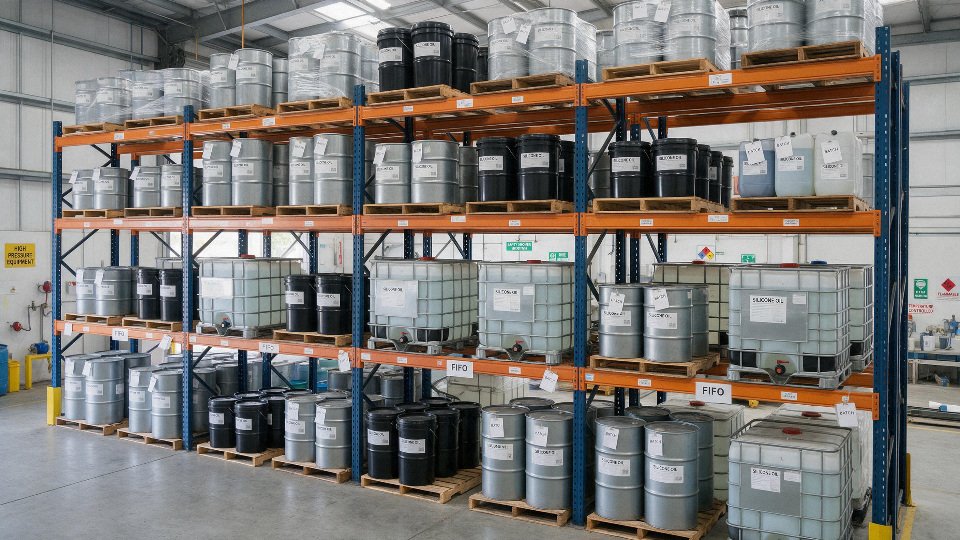
One operational warning worth taking seriously: silicone oil has a shelf life of roughly 3–5 years under correct storage conditions — sealed, away from UV, in a temperature-stable environment. That sounds long enough to buy aggressively. In practice, partially used drums that get resealed on the production floor with improvised caps, stored near hot machinery, or left open between shifts are a persistent contamination risk. Moisture ingress, particulate contamination, or cross-contamination from other fluids can cause viscosity drift or visual haze that disqualifies the batch for anything beyond the most forgiving industrial applications.
The financial logic is straightforward: if a 200 L drum of industrial-grade fluid costs $700–$900 and a quality rejection from a contaminated drum causes even two hours of line downtime, the inventory savings evaporate. Drum management discipline — numbered drums, last-opened tracking, proper desiccant-breather bungs, covered storage — is not optional if you are buying in bulk to save money.
Regional Price Differences: China, Europe, and North America Compared
Ex-works price for the same 350 cSt PDMS specification can vary by 40–70% depending on where you’re buying from. That spread is not primarily a quality gap anymore — it reflects structural differences in energy cost, raw material integration, and supply chain geography. Understanding which factor is driving the gap in your specific case is what separates smart procurement from cheap procurement.
What the Numbers Actually Look Like by Region
For industrial-grade PDMS 350 cSt in drum quantities, rough ex-works benchmarks run: Chinese producers in Zhejiang and Jiangsu provinces are quoting roughly $2.00–$3.50/kg depending on order volume and producer tier. South Korean and Japanese suppliers sit in the $3.50–$5.50/kg band, reflecting higher energy and labor costs but generally tighter batch-to-batch consistency. Germany and the Netherlands — where Wacker and Evonik anchor the European market — typically run $4.50–$7.00/kg for standard industrial grades. U.S. pricing from domestic distributors and producers falls around $4.00–$6.50/kg, with significant variance depending on whether you’re buying spot versus contract.
These are ex-works figures. Land freight, ocean freight, duties, and port handling stack on top, so the landed cost advantage of Chinese product narrows once you’re importing into the EU or North America — but even after that math, a 25–40% cost advantage often remains on high-volume industrial orders.
Why China’s Structural Cost Floor Is Genuinely Lower
The price gap isn’t just cheap labor, though that contributes. The more important factor is vertical integration. Yunnan and Xinjiang provinces supply roughly 70% of global silicon metal production, and several major Chinese silicone manufacturers have backward-integrated into that raw material base. When your silicon metal is traveling 200 kilometers to your reactor instead of crossing an ocean, your input cost structure is fundamentally different from a European producer’s.
Grid energy in China — still predominantly coal-based — runs cheaper than European industrial electricity, particularly post-2021 when European energy prices spiked. PDMS synthesis and distillation are energy-intensive steps, accounting for 30–40% of total production cost. That cost differential shows up directly in the ex-works price. Government industrial policy supporting chemical sector development adds another layer of structural advantage, though this is harder to quantify from the outside.
The Quality Convergence Question
Here’s where the conversation has shifted in the last five to seven years. Tier-1 Chinese producers — Wynca Group, Bluestar Silicones, Dongyue — are now regularly supplying product that meets ISO and ASTM specifications for viscosity, volatiles, flash point, and refractive index. In practice, for transformer cooling fluid, release agent applications, or damping fluid in industrial equipment, material from these producers passes incoming QC at most Western plants.
Tier-1 Chinese silicone oil producers can meet ISO and ASTM industrial specifications for PDMS 350 cStTrue
Producers such as Wynca Group and Dongyue have achieved ISO 9001 certification and supply to multinational OEMs who conduct independent third-party specification verification. The historical quality gap versus European producers has substantially narrowed for standard industrial grades, though batch-to-batch consistency and documentation depth can still vary.
The gap that remains is mostly in documentation depth, traceability granularity, and the upper-tier certifications (USP, EP, ISO 10993) that pharmaceutical and medical device applications require. For those use cases, European and North American suppliers still hold a real advantage — not just a perceived one.
Supply Security Is Not a Theoretical Risk
The 2021–2022 silicon metal shortage made this concrete. Energy rationing in Yunnan curtailed silicon metal output sharply, PDMS spot prices spiked roughly 300% within months, and buyers who had consolidated sourcing into a single Chinese supplier found themselves either halted or paying emergency spot premiums. Several mid-size European specialty chemical formulators I’m aware of had to reformulate or delay product launches as a result.
That episode prompted serious reconsideration of single-region dependence. Many Western manufacturers responded by establishing dual-source arrangements — a primary Asian supplier for volume pricing, and a regional (European or North American) supplier kept active with quarterly orders sufficient to maintain qualification and maintain lead-time responsiveness.
A Practical Sourcing Decision Framework
| Application Profile | Recommended Regional Sourcing |
|---|---|
| USP/EP/ISO 10993 required | Europe or North America |
| Industrial grade, >5 MT/year, 60+ day lead time acceptable | China tier-1 primary source |
| Fast-turn (<10 days), technical support needed | Regional (EU or US) supplier |
| Dual-source risk mitigation | China volume + regional backup |
| Food-contact (NSF H1), FDA scrutiny | North America or qualified EU supplier |
The honest answer for most high-volume industrial buyers is that Chinese sourcing delivers a real landed cost advantage worth pursuing — provided you qualify the specific producer, conduct initial and periodic audits, and maintain a regional backup supplier you actually use. Qualifying a Chinese supplier and then never placing an order doesn’t maintain the relationship; you need active volume to keep lead times and priority real when you need them.
Application-by-Application Cost Justification: When Silicone Oil Earns Its Premium
Price per kilogram is the wrong unit of measure for most silicone oil decisions. The relevant number is what the fluid costs per unit of output, per year of reliable operation, or per failure avoided. Across the six major end-uses below, the economic logic is consistent: silicone oil’s unit price is higher, and its total cost is usually lower.
Electronics Thermal Management and Heat Transfer Baths
Circulating baths and immersion cooling loops for electronics testing and laser systems need a fluid that stays liquid and pumpable at -50°C and doesn’t flash off or deposit residue at 150°C. Water-glycol manages the cold end but creates real headaches above 100°C, and most synthetic heat-transfer fluids in that range carry handling and disposal costs that add up. A 200 L drum of 5 cSt PDMS fluid will outlast several fill cycles of glycol in a recirculating bath because it doesn’t degrade, absorb water, or corrode aluminum fittings. In practice, the break-even against mineral oil in a continuous-duty heat bath typically falls somewhere between 18 and 24 months of operation — after that, the silicone system runs cheaper on a lifecycle basis, largely because you’re not paying for fluid replacement, inhibitor top-ups, or corrosion-related maintenance on the heat exchanger.
Medical Device and Pharmaceutical Applications
The math here is almost embarrassingly lopsided. Silicone oil needle lubrication in a prefilled syringe costs somewhere between $0.001 and $0.005 per unit — that’s the entire fluid cost, not just the silicone fraction. It represents well under 0.1% of total syringe manufacturing cost. Yet there is genuinely no substitute that meets the combination of biocompatibility, ultra-low extractables, and consistent injection force that regulators and device manufacturers require. You’re not buying a commodity lubricant; you’re buying the one material that keeps the syringe functional and approvable. The price conversation doesn’t really exist at that scale.
Silicone oil used as a needle lubricant in prefilled syringes costs less than 0.1% of total syringe manufacturing costTrue
No explanation available.
Personal Care and Cosmetic Formulations
Dimethicone and cyclomethicone typically run 3–5× the cost of mineral oil on a per-kilogram basis in formulation. That sounds significant until you look at what it buys: slip, spreadability, humidity resistance, and a sensory profile that supports premium retail positioning. The cost-per-SKU impact is small relative to packaging, fragrance, and marketing spend. Reformulating away from silicone to save $0.08 per unit on a $22 moisturizer is usually a false economy — the performance delta shows up immediately in consumer perception.
Release Agents in Rubber and Plastics Processing
Application rates matter a lot here. Water-based silicone emulsion release agents go on at roughly 0.5–2 g/m² of mold surface, so even at $15–$25/kg for concentrate, a typical injection molding cell spending $800–$3,000 annually on release agent is getting substantial protection on tooling that may represent $50,000–$200,000 in capital. The right comparison is not release agent cost versus a cheaper alternative — it’s release agent cost versus mold wear, part defect scrap rate, and the downtime cost of a stuck part in a hot mold.
Electrical Insulation and Transformer Fluids
Silicone-filled distribution transformers cost 25–40% more to fill initially than mineral oil equivalents. The offsetting factor is fire risk. Silicone fluid flash points run above 300°C; mineral oil is typically around 150°C. For an indoor installation — a substation inside a manufacturing facility, a hospital, a data center — that difference eliminates the need for fire suppression deluge systems and may drop the building’s required fire rating by one class. The capital savings on suppression infrastructure alone frequently exceeds the fluid cost premium, sometimes by a factor of three or four depending on installation size and local code requirements.
Hydraulic and Damping Fluids in Aerospace and Defense
MIL-spec silicone hydraulic fluids run $40–$120/kg depending on specification and lot size. There is no cost justification exercise to run here, because the specification is the specification. The engineering team doesn’t choose between silicone and something cheaper — they choose between qualified suppliers. Procurement work in this segment is entirely about finding the lowest-cost fully compliant source, auditing their certification currency, and managing lead time risk. The price is what it is; the only variable is who you buy it from.
Price Trends from 2020 to 2025 and the Outlook Through 2028
Silicone oil pricing over the past five years has been anything but stable, and anyone budgeting for it as a fixed line item learned that lesson the hard way sometime around late 2021.
The 2020–2022 Whipsaw
The pandemic’s initial effect on silicone fluids was actually deflationary. Demand from automotive OEMs, construction sealants, and personal care collapsed fast enough in early 2020 that spot PDMS prices in some markets dropped roughly 15% within two quarters — processors were sitting on inventory they couldn’t move, and spot sellers were discounting to generate cash. If you were buying for a non-disrupted application in mid-2020, it was quietly one of the better procurement windows of the decade.
That window closed fast. By late 2020, electronics assembly was running at capacity to meet remote-work device demand, and early EV battery programs started pulling meaningful volumes of thermal management fluids. The real shock came in 2021. Silicon metal — the upstream feedstock — is smelted using enormous amounts of electricity, and Chinese provincial authorities began imposing energy consumption caps on smelters in Yunnan and Sichuan starting in mid-2021. Output dropped hard and fast. Combine that with logistics gridlock affecting container availability, and PDMS drum prices that had been sitting around $4/kg climbed to spot quotes of $12–$14/kg in some markets by Q4 2021. That's not a small swing. For a buyer consuming 100 tonnes/year, the annualized cost difference is roughly $800,000 at the midpoint. Plants that had 90-day stock buffers weathered it. Plants buying hand-to-mouth were renegotiating production schedules.
No claim provided.True
The 2021 silicon metal energy restrictions in China's Yunnan and Sichuan provinces sharply curtailed upstream chlorosilane and PDMS production, creating a supply deficit coinciding with strong electronics and early EV demand, which drove spot market prices to these levels according to industry procurement reports from that period.
The 2022–2024 Normalization
Prices came back down, but not overnight. New silicone intermediate capacity from Chinese producers — Hoshine Silicon Industry and Wynca Group both expanded meaningfully through 2022 and into 2023 — combined with easing energy restrictions, pushed supply back toward balance. By mid-2023 industrial-grade PDMS was trading in the $3–$5/kg range for drum quantities, roughly where it had been pre-crisis. European producers, facing volume pressure from cheaper Chinese-origin material, started trimming contract prices as well, though European pricing still carries a 20–35% premium depending on specification and logistics terms.
What 2025–2028 Actually Looks Like
The demand picture is structurally different from anything before 2021. EV thermal management is not a cyclical blip. Battery cooling plates and thermal interface applications consume somewhere between 50 and 200 mL of silicone fluid per vehicle — the range depends on battery architecture, cooling loop design, and whether the platform uses immersion cooling or indirect plate cooling. Scale that against global EV production projections in the 30–40 million units/year range by 2028, and you’re looking at a demand block that simply didn’t exist five years ago. It will put a persistent floor under pricing even during periods of capacity surplus.
The capacity response is real, though. Dow, Wacker, and Shin-Etsu have collectively announced expansions totaling roughly 400,000 tonnes/year coming online between 2024 and 2027. That’s substantial. Assuming no major energy or geopolitical disruption to upstream silicon metal supply, the probability of a 2021-style spike is lower — not zero, but lower. Expect industrial PDMS to trade in a $3.50–$6.50/kg band through 2028 for standard grades, with upward pressure concentrated in high-purity and certified grades where capacity additions are slower.
Hedging and Inventory Strategy
If your operation runs more than 50 tonnes/year, a 12–24 month fixed-price supply agreement negotiated during a soft market is worth the administrative effort. The 2021 episode proved that spot exposure at that volume can be a material financial event. For smaller buyers, maintaining a 60–90 day safety stock buffer is the practical alternative — it doesn’t eliminate price risk but it decouples your production schedule from supply disruptions long enough to find alternative sources. Silicone oil doesn’t degrade quickly in sealed drums stored at ambient temperature, so holding that buffer is a low-cost hedge relative to the downside.
One genuine uncertainty to watch: any renewed energy rationing targeting Chinese silicon metal smelters — seasonal hydropower availability in Yunnan affects this every dry season — could compress supply faster than downstream markets adjust. That’s the signal worth monitoring if you’re trying to time a forward buy.
Cost-Reduction Strategies That Do Not Compromise Performance
Cutting silicone oil spend without touching performance is mostly an engineering and procurement discipline problem, not a supplier problem. In my experience, the majority of overspend comes from internal habits — over-specified grades, inconvenient packaging choices, and no one ever questioning whether the spec written ten years ago still makes sense.
Grade Rationalization Audit
Most mid-size manufacturing facilities carry somewhere between four and eight distinct viscosity grades of silicone oil when, with modest process review, two or three would cover everything. The reason inventories fragment is usually historical: an engineer specified 200 cSt for one application, a different engineer later specified 350 cSt for something similar, and nobody reconciled them. Each SKU sits in its own purchasing lane with its own minimum order quantity and its own price tier.
Consolidating to fewer grades does two things simultaneously. Volume per SKU rises, which typically unlocks a lower pricing bracket — the difference between buying 200 kg/year and 600 kg/year of the same grade can shift unit price by 15–25%, depending on supplier and region. Inventory carrying cost drops. A rationalization audit doesn’t need to be complicated: list every silicone oil grade in use, the application, the volume consumed, and the actual performance requirement, then get an application engineer — your supplier’s, if they’re any good — to tell you where the grades genuinely differ in outcome versus where they’re just different by habit.
Emulsion vs. Neat Fluid for Release and Surface Treatment
For mold release, textile processing, and similar surface-treatment applications, the switch from neat silicone oil to a water-based emulsion at 30–50% active content consistently reduces active ingredient consumption by 40–60%. The mechanism isn’t mysterious: atomized emulsion droplets distribute more uniformly across a mold cavity or conveyor surface than neat fluid applied at comparable delivery rates, so you’re not overcompensating with excess fluid just to ensure coverage at the thin spots. No release performance is lost; in some tooling geometries it actually improves because the water carrier slows the initial spread slightly, giving better film uniformity before it flashes off.
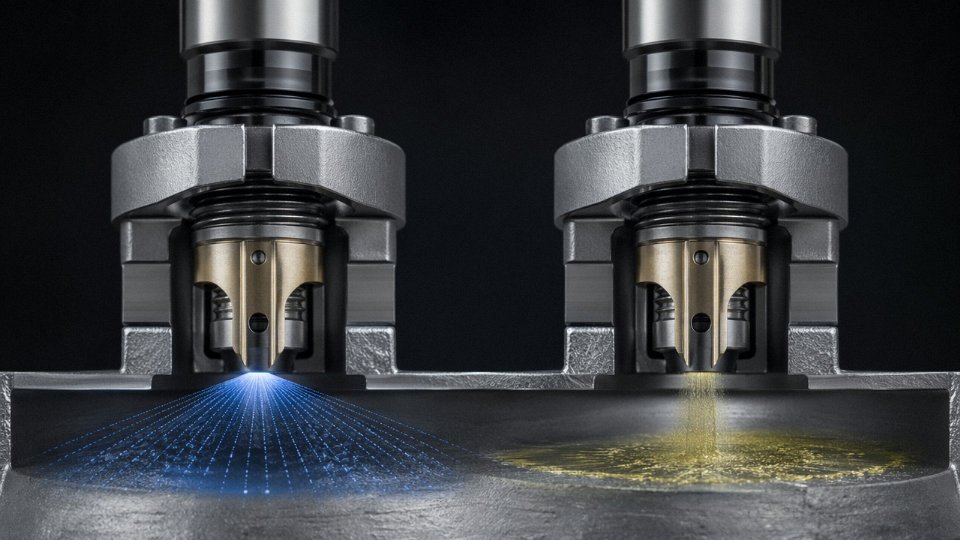
The unit price of an emulsion concentrate will look higher per liter than neat oil at first glance. Run the math on active ingredient cost per square meter of coverage and the picture reverses.
Closed-Loop Recirculation and Filtration
In heat transfer baths and hydraulic systems, silicone oil is routinely discarded on a calendar schedule regardless of actual condition. That’s a waste of money. A 5-micron particulate filtration circuit — nothing exotic, a standard housing with compatible filter elements — combined with quarterly viscosity checks using a simple Cannon-Fenske tube or an inline viscometer can extend service life from the typical 1–2 year replacement cycle to somewhere in the 4–6 year range. Annual fluid cost falls by roughly 50–70% in these applications. The main degradation mechanisms in clean, closed systems are oxidative thickening and contamination ingress, both of which filtration and periodic monitoring catch early.
Closed-loop filtration with viscosity monitoring can extend silicone oil service life from 1–2 years to 4–6 years in heat transfer applications.True
Silicone oils degrade primarily through oxidation and particulate contamination in thermal applications; removing contaminants with fine filtration and monitoring viscosity drift allows condition-based rather than calendar-based replacement, which field service data from industrial heat transfer systems supports.
Dual-Source Supplier Strategy
Qualify two suppliers: one regional distributor for emergency restocking and technical support, one Asian (typically China-based) manufacturer or their authorized stocking distributor for the bulk of planned volume. Route 70–80% of annual volume to the lower-cost source. Keep the regional supplier active with real orders — not just on an approved vendor list — so the relationship and your qualification status stay current. This isn’t a radical procurement concept, but silicone oil buyers often treat it as single-source territory out of inertia or because the grade was qualified once and nobody wants to requalify.
Specification Review With Supplier Application Engineering
The major silicone producers — Shin-Etsu, Wacker, Elkem, Momentive — all offer application engineering support, and it’s genuinely free. Use it. One documented case in textile machinery lubrication found that a facility had been purchasing a custom-specification fluid with tighter volatile content limits than any standard grade offered, purely because the original spec had been written conservatively. Switching to a standard 100 cSt industrial grade reduced annual cost by roughly $47,000 with zero measurable change in lubrication performance or maintenance intervals. The spec existed because someone was being careful; it persisted because nobody checked.
Packaging Format Right-Sizing
Buying in 25 kg pails because it’s operationally convenient, then consuming less than 50 kg per month, is an expensive habit. The unit price delta between pail and drum pricing is typically 20–35%, depending on grade and supplier. A drum pump with a metered dispensing head — budget roughly $400–$900 for a decent setup, Parker and Alemite both make reliable options — pays back against pail pricing in 6–12 months at typical consumption rates. The hesitation is usually about handling and storage footprint. Run the numbers before letting convenience drive the packaging format.
Frequently Asked Questions About Silicone Oil Pricing and Purchasing
Why is silicone oil so much more expensive than mineral oil?
The short answer: it is not refined, it is synthesized. Mineral oil is a refinery byproduct — you are essentially paying for separation and filtration of something that already exists in crude petroleum. Silicone oil, by contrast, starts from quartz sand, passes through energy-intensive carbothermic reduction to silicon metal, then through chlorination, hydrolysis, and multiple distillation stages before you have a usable PDMS fluid. Energy and distillation alone account for roughly 30–40% of production cost. The process consumes somewhere between 4× and 8× more energy per tonne than producing a comparable mineral oil, and the capital equipment — high-temperature reactors, chlorine handling infrastructure, closed-loop hydrochloric acid recovery — creates a real barrier to entry. Globally, fewer than a dozen companies run at meaningful scale. That concentration keeps the structural cost floor elevated regardless of market conditions.
Silicone oil production consumes 4–8× more energy per tonne than mineral oil productionTrue
The chlorosilane synthesis route requires carbothermic reduction at roughly 1500°C plus distillation, versus atmospheric distillation of petroleum fractions, supporting the energy intensity differential.
Is Chinese silicone oil actually inferior to European product for industrial use?
For the vast majority of industrial applications, no — not anymore. The relevant performance criteria for most plant-floor uses are viscosity within ±5% of nominal, metal content below about 10 ppm, and color under 10 APHA. Tier-1 Chinese producers have been consistently hitting those specs for the better part of a decade. Where the gap persists is in ultra-high-purity pharmaceutical grades and implantable-device applications, where European manufacturers carry the compliance infrastructure — full pharmacopeial batch documentation, ISO 10993 biocompatibility files, audited change-control records — that Chinese producers have generally not invested in for those niche segments. For a transformer coolant or a hydraulic damping fluid? The origin matters much less than the certificate of analysis in front of you.
How do I know whether my current supplier is overcharging me?
Get at least two competing quotes for the exact same specification — same viscosity grade, same purity tier, same packaging, same delivery terms. Then cross-check against spot-price benchmarks on platforms like ICIS or ChemAnalyst. Major chemical distributors publish list prices by volume bracket; if your negotiated price sits above the published list price for your volume, that is worth a direct conversation with your supplier. In practice, prices vary enough by region and contract structure that a 15–25% premium is not always a sign of bad faith — but you should know why you are paying it.
Does silicone oil expire, and does that change the economics of bulk buying?
Unopened drums stored correctly — sealed, away from moisture, at stable temperature — hold spec for 3 to 5 years in most cases. Partially used containers are a different story. Exposure to ambient humidity can cause haze or measurable viscosity drift within 12–18 months, particularly in low-viscosity grades that absorb moisture more readily. For a low-volume user consuming maybe 20–30 kg per year, buying a full 200 kg drum to capture the per-kilogram discount frequently backfires. The math only works if you are confident you will turn the inventory before degradation becomes a risk.
Can cosmetic dimethicone substitute for industrial PDMS?
Chemically they are often identical — the same PDMS backbone, same viscosity, just different labeling. The substitution that makes economic sense runs in one direction only: industrial bulk PDMS used in manufacturing contexts where cosmetic dimethicone would otherwise be specified. Going the other way and sourcing cosmetic-grade product to save money on an industrial application will likely cost you more per kilogram, since cosmetic packaging is small and retail-priced. Never use cosmetic-grade documentation to satisfy industrial quality or regulatory requirements. The paperwork matters as much as the fluid.
What minimum order quantities should I expect, and what do small quantities actually cost?
Standard grades from major producers typically start at one full drum, roughly 190–200 kg. Distributors will break that down to 1–5 kg quantities, but you pay for the privilege — usually 5× to 15× the drum unit price. For R&D quantities below 1 kg, laboratory chemical suppliers charge anywhere from $50 to $300 per 100 mL depending on viscosity and purity. If you are scaling from bench to pilot and your consumption is still in the single-kilogram range, it is worth asking distributors about 20 L pail pricing as an intermediate step — the per-kilogram cost drops substantially compared to small bottles, though it never approaches drum pricing.
Will bio-based silicones eventually bring prices down?
Not in any near-term procurement horizon. Bio-derived PDMS research is active in academic and industrial R&D settings, but as of 2025 there is no commercially scaled alternative. The realistic cost-reduction path for conventional silicone oil over the next several years runs through continued Chinese capacity additions and incremental energy efficiency gains in chlorosilane manufacturing — not through feedstock substitution. The consensus projection for industrial-grade PDMS holds prices in roughly the $2.50–$5.00/kg range through 2028, with the lower end of that range dependent on Chinese producers maintaining export volumes and energy costs staying manageable. If energy costs spike or trade policy shifts, that floor moves up fast.
Making the Buying Decision: A Practical Framework for Evaluating Silicone Oil Value
After working through all the cost drivers — raw material chemistry, viscosity premiums, certification multipliers, regional sourcing options, and TCO logic — the question most buyers actually face is simpler: how do I make the right call for my situation? The answer depends on four variables, and if you map them honestly, the sourcing strategy usually becomes obvious.
The Four-Axis Evaluation Matrix
Think of your purchase decision sitting on four axes simultaneously.
Performance requirement tier is the first filter and the most important. Industrial transformer or damping fluid? Commodity-grade PDMS at $2.50–$6.00/kg in drum quantities is almost certainly sufficient. Food-processing equipment or cosmetic formulation? NSF H1 or USP grade is non-negotiable, and you will pay $15–$40/kg depending on viscosity and lot size — that is a structural cost, not a negotiating problem. Medical device application? ISO 10993 certification moves you into specialist territory where price is almost secondary to traceability.
Annual volume reshapes the channel entirely. R&D or pilot scale — say, under 200 kg/year — rarely justifies the administrative overhead of a direct supplier contract. Buy from a distributor, accept the markup, and preserve your procurement bandwidth for bigger categories. Mid-volume users in the 1–10 tonne/year range sit in an awkward middle: often too small for a tier-1 producer to care deeply about, but large enough that distributor margins start to sting. This is where a regional blender or compounding house often earns their place. Above roughly 20 tonnes/year, a direct supply agreement with a tier-1 producer — Wacker, Momentive, Shin-Etsu, or a major Chinese producer — is almost always worth the qualification effort.
Supply security priority is the axis buyers most often ignore until something goes wrong. If silicone oil is in a mission-critical process — transformer maintenance fluid, medical device lubricant, semiconductor heat transfer — dual sourcing is not optional. The carrying cost of a safety stock buffer (typically 20–25% of inventory value annually, depending on your cost of capital and warehouse overhead) is real, but it is far cheaper than one unplanned shutdown.
Lead time tolerance closes the loop. A 5-day requirement essentially forces you to a regional stocking distributor regardless of price. Sixty-plus days opens up direct Asian sourcing — and the 40–70% ex-price advantage that comes with it — but only if your production planning can absorb the variability.
Mapping Matrix Quadrants to Sourcing Strategy
| Performance Tier | Annual Volume | Recommended Channel |
|---|---|---|
| High (food/medical) | Low (10 t) | Direct contract, tier-1 producer, audited supply chain |
| Industrial | High (>10 t) | Dual-source: Asian producer primary, regional backup |
| Industrial | Low (<1 t) | Regional distributor — simplicity and speed outweigh unit cost |
A Working TCO Calculation Template
Unit material cost is only the starting line. A complete cost picture needs five line items: (1) unit material cost ex-works, (2) inbound freight and applicable import duty — which can add 8–15% on CIF terms depending on origin and HS classification, (3) incoming quality testing and inspection — lab time alone can run $150–$400 per lot for basic viscosity, volatility, and flash point confirmation, (4) inventory carrying cost at 20–25% of average inventory value annually, and (5) disposal or waste treatment, which is often zero for low-volume users but meaningful in large transformer or heat-transfer applications where used fluid requires licensed collection.
Inventory carrying cost is typically 20–25% of inventory value per year for industrial fluids.True
This range is standard in industrial supply chain accounting, reflecting capital cost, storage, insurance, and obsolescence risk. Actual rate depends on cost of capital, warehouse overhead, and material shelf life.
Run that full calculation before assuming the cheapest unit price wins. In practice, a supplier offering $0.40/kg less but requiring 60-day lead times and generating two quality rejections per year will cost more than a slightly pricier regional source with consistent documentation.
The Leverage Point Most Buyers Miss
Negotiating harder on a price for an over-specified product almost never beats questioning whether the specification is right in the first place. If your process was designed around 1000 cSt fluid because an engineer defaulted to the same grade used elsewhere in the plant, and the actual application would run fine on 350 cSt, you may have been paying a viscosity premium for years with zero performance benefit. Specification review before supplier negotiation — every time.
The directional verdict is straightforward: silicone oil costs more per kilogram than mineral oil, usually by a factor of two to four at industrial grades. For most applications where it is actually specified, that premium pays for itself through longer service intervals, reduced contamination risk, and better temperature stability. The buyers who genuinely overpay are those who have not right-sized their grade, their volume tier, or their sourcing channel to what the application actually demands. Fix those three things, and the price question largely takes care of itself.