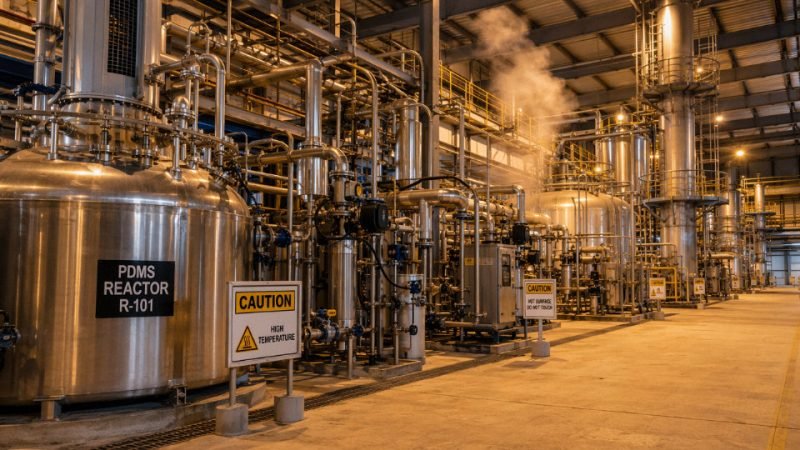
Specify the wrong silicone oil supplier — or worse, source a low-grade PDMS from a distributor who can’t confirm the actual manufacturer — and you’ll find out quickly. Viscosity drift between batches causes rejects in release coating lines, foaming agents lose consistency, and transformer cooling systems run hotter than spec. Qualification re-runs alone can cost weeks of production time, and when the root cause traces back to an undisclosed toll-manufacturer or a mislabeled viscosity grade, the procurement decision that looked like a 12% cost saving ends up costing several times that.
The primary global producers of silicone oil are Dow (USA), Wacker Chemie (Germany), Shin-Etsu Chemical (Japan), Momentive (USA), Elkem Silicones (Norway/France), Silicone Chemicals, and a growing cluster of Chinese manufacturers led by Wynca Group and Dongyue Group. These companies collectively supply PDMS and modified silicone fluids in viscosity grades from 0.65 cSt up to 2,500,000 cSt, covering the vast majority of industrial and specialty demand worldwide.
What makes this market genuinely complicated for a procurement manager isn’t the number of suppliers — it’s understanding which producers actually control their own siloxane feedstock, which ones are compounders buying base fluid and blending it, and how that distinction affects batch consistency, regulatory traceability, and your ability to qualify a second source without starting from zero. The global silicone oil market sat at roughly USD 2.1–2.4 billion in 2023 and is tracking toward USD 3.2–3.6 billion by 2030, depending largely on EV, personal care, and industrial lubricant demand growth. Four companies alone — Dow, Wacker, Shin-Etsu, and Momentive — hold somewhere between 55 and 65% of global production capacity. The rest of the field is worth understanding carefully before you sign a supply agreement.
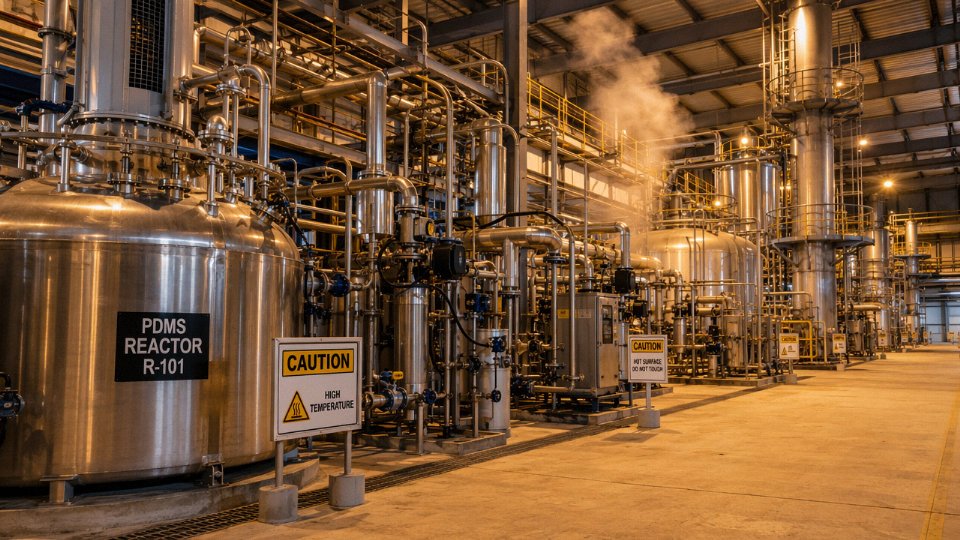
Tier-1 Global Silicone Oil Manufacturers and Their Production Footprints
The silicone oil supply chain is more concentrated than most procurement teams realize. Dow, Wacker Chemie, Shin-Etsu Chemical, and Momentive collectively hold somewhere between 55 and 65% of global production capacity — that figure shifts depending on how you count tolling arrangements and joint-venture output. For a buyer sourcing 100–1,000 cSt PDMS at volume, these four names are unavoidable. Understanding their actual plant footprints, not just their marketing materials, is what separates a resilient supply strategy from one that gets hurt every time a European energy tariff spikes or a Gulf Coast hurricane delays a shipment.
Dow Inc. — Midland Heritage, Global Reach
Dow’s silicone fluids operation traces directly back to Dow Corning, which Dow absorbed fully in 2018. That heritage matters because the technical data sheets, approval registrations, and long-term customer qualifications carried over under the XIAMETER and Dow Corning branded lines. XIAMETER is the commodity-facing channel — standard viscosity grades, web-based ordering, price transparency — while the legacy Dow Corning product numbers (200 Fluid series) still appear on pharmaceutical and food-processing specs written a decade ago.
Primary manufacturing sits at Midland, Michigan, which handles the bulk of North American PDMS production, and Barry, Wales, which serves European demand. Rough annual capacity across those two sites for silicone fluids specifically runs in the range of 80,000–120,000 metric tons, though Dow doesn’t publish a clean number and the figure depends on how much capacity is allocated to silicone rubber and resin intermediates in any given quarter. Viscosity coverage is essentially the full commercial range: 0.65 cSt up to 2.5 million cSt. For pharma procurement, the USP and FDA 21 CFR compliance documentation on their high-viscosity grades is well-maintained and audit-ready — one of the practical advantages of working with a supplier of this scale.
Wacker Chemie AG — European Compliance Depth
Wacker’s WACKER SILICONE FLUID AK series is the reference product in European industrial formulation work. The AK designation covers standard PDMS grades; Wacker also produces reactive silicone fluids (vinyl- and hydrogen-functional) and modified versions for release coatings and personal care emulsions. Their two core silicone sites — Burghausen in Bavaria and Nünchritz in Saxony — give them redundancy within Germany, which is more than most European producers can claim. Burghausen is the larger of the two and functions as the global R&D anchor for silicone chemistry.
REACH compliance documentation from Wacker is generally among the most thorough available, which matters for formulators selling into EU markets where downstream registration obligations can fall on the importer. Combined silicone fluid capacity across both sites is estimated at 60,000–90,000 metric tons annually, weighted toward the mid-viscosity grades that dominate industrial and cosmetic demand.
Wacker Chemie's Burghausen facility is one of the largest integrated chemical production sites in Europe.True
Burghausen spans roughly 2.9 square kilometers with over 100 production plants on a single connected site, widely documented in Wacker's corporate and regulatory filings.
Shin-Etsu Chemical Co., Ltd. — Purity Standards for Electronics and Personal Care
Shin-Etsu’s KF-96 series is probably the most recognized silicone fluid product line in Asia, and in semiconductor-adjacent applications it has no obvious peer for ultra-high-purity grades. Their primary production for silicone fluids runs through Gunma Prefecture (Annaka and Takefu plants), with capacity estimated in the 50,000–80,000 metric ton range depending on product mix. Purity levels on their electronic-grade PDMS — particulate counts, metal ion contamination — are tighter than what most Western suppliers publish as standard, which is why you’ll see Shin-Etsu specified by name in certain semiconductor fab cleaning and heat-transfer applications. Personal care is the other volume segment; their cosmetic-grade KF-96 variants have broad COSMOS and JP (Japanese Pharmacopoeia) compliance.
Momentive Performance Materials — Custom Formulation Strength
Momentive operates primarily out of Waterford, New York, a site with deep roots in GE Silicones history. Their CLEARCO products (formerly a separate brand, now folded into the Momentive portfolio) cover viscosity-standard silicone fluids used as calibration fluids, damping fluids, and dielectric media. SilFloss targets medical and personal care channels. Where Momentive differentiates is custom-viscosity blending and functionalized fluid development — if you need a specific cSt value that falls between standard commercial grades, or a fluid with a particular reactive end-group for a bonding application, Momentive’s technical sales team is usually more responsive than the larger commodity producers. Annual silicone fluid capacity at Waterford is roughly 30,000–50,000 metric tons. ISO 9001 certification is standard; USP Class VI compliance is available on specific medical-grade offerings.
Comparative Overview
| Producer | HQ Country | Key Silicone Oil Series | Est. Annual Capacity (MT) | Primary Regional Strength | Flagship Certifications |
|---|---|---|---|---|---|
| Dow Inc. | USA | XIAMETER, Dow Corning 200 Fluid | 80,000–120,000 | North America, Europe | FDA 21 CFR, USP, ISO 9001 |
| Wacker Chemie AG | Germany | WACKER SILICONE FLUID AK | 60,000–90,000 | Europe, global industrial | REACH, ISO 9001, COSMOS |
| Shin-Etsu Chemical | Japan | KF-96 series | 50,000–80,000 | Asia-Pacific, electronics | JP, COSMOS, ISO 9001 |
| Momentive Performance Materials | USA | CLEARCO, SilFloss | 30,000–50,000 | North America, medical/industrial | ISO 9001, USP Class VI |
Capacity figures are estimates derived from public filings, industry analyst reports, and trade data; actual allocations to silicone fluids specifically vary by production scheduling and market demand at any given time. Regional strength reflects where each producer holds the deepest distributor networks and fastest lead times, not where they are physically unable to ship.
Major Regional Producers: China, India, South Korea, and Russia
The tier-1 multinationals dominate capacity on paper, but regional producers have quietly absorbed a substantial share of local demand — and some are now pushing aggressively into export markets. For procurement teams, ignoring this cohort means leaving cost and supply-resilience levers on the table. Qualifying them properly, though, takes more rigor than most buyers initially expect.
China: Scale, Ambition, and a Narrowing Quality Gap
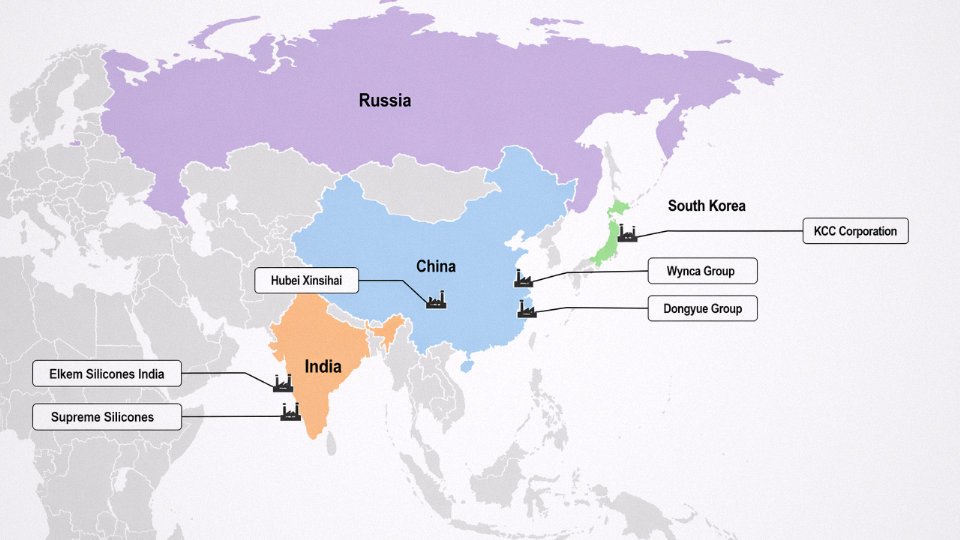
Three names dominate domestic Chinese production. Zhejiang Wynca Chemical Group, Dongyue Group, and Hubei Xinsihai Chemical collectively represent the bulk of China’s silicone oil output, which has expanded sharply over the past several years as upstream silicon metal capacity grew in Yunnan and Xinjiang provinces. Wynca has invested heavily in continuous-process reactors that improve batch-to-batch viscosity consistency — a historical weak point for Chinese PDMS at specialty grades. Dongyue, better known for fluoropolymers, runs integrated silicone monomer-to-finished-oil lines that give it genuine cost advantages on mid-range viscosity grades (roughly 350–5,000 cSt). Hubei Xinsihai is smaller but worth knowing if you’re sourcing for industrial release or textile-finishing applications where ultra-high purity isn’t the primary driver.
All three comply with GB/T 12596 and related domestic standards, which map reasonably well to ISO benchmarks for most commodity grades. Their export push into Southeast Asia and the Middle East is real — in practice, you’ll find Chinese-origin silicone oil showing up in Vietnamese cosmetic formulation plants and Gulf-region metalworking blends at prices that undercut European equivalents by 15–30%, depending on grade and freight conditions. That gap narrows significantly on narrow-tolerance specialty grades, where Dow or Wacker still hold the consistency advantage.
India: Policy Tailwinds and a Growing Domestic Supply Base
India’s silicone oil supply chain has historically leaned on imports, but that picture is shifting. Elkem Silicones India — operating under what was previously the Bluestar Silicones banner before Elkem’s acquisition — serves as the most technically sophisticated local option, with product lines calibrated to personal care and textile-finishing demand. Supreme Silicones, based in Mumbai, covers a broad viscosity range for industrial and cosmetic customers. Clearco Products India holds a niche position in precision-lubrication and damping-fluid applications.
BIS (Bureau of Indian Standards) certification requirements add a qualification layer that catches some importers off guard — factor in 8–14 weeks for initial approval, longer if documentation from a foreign supplier is incomplete. India’s import-substitution push under various domestic manufacturing incentive schemes is actively encouraging formulators to qualify local sources they would have ignored five years ago. For a procurement manager sourcing silicone oil for a shampoo or fabric-softener line in India, the arithmetic on local supply is increasingly compelling.
South Korea: Precision Grades for Electronics Supply Chains
KCC Corporation carries forward a technical heritage that traces partly through its historical ties with Momentive’s technology base. That lineage shows in KCC’s strength in tight-viscosity-tolerance grades — the kind of spec that electronics OEMs running encapsulant or thermal-interface applications actually care about. Korean export pricing is competitive against Japanese and European alternatives in the 100–1,000 cSt range, particularly for customers in Taiwan and Malaysia who need short lead times and consistent certificates of analysis.
Russia: Captive Demand, Limited Export Reach
NIISK (the Scientific Research Institute of Silicone Rubber, based in Saint Petersburg) and Kaustik (Volgograd) are legacy Soviet-era producers that still supply domestic industrial and defense-adjacent applications. Western procurement teams will find them effectively inaccessible under current sanctions regimes, and logistics alone — insurance, payments, documentation — make qualification impractical regardless of technical merit.
Qualifying Regional Sources: Where to Apply Pressure
Regional silicone oil producers always meet the same purity and viscosity-tolerance specifications as tier-1 global manufacturersFalse
For commodity-grade PDMS in mid-viscosity ranges, many regional producers come close enough for most industrial applications. However, for high-purity grades (volatile content below 0.3%, chloride below 5 ppm, or viscosity tolerance tighter than ±2%), independent third-party testing against the actual certificate of analysis remains essential. Batch-to-batch consistency is where the real gap shows up, not the average specification.
When qualifying any regional source, pull three consecutive production-lot CoAs, not just one. Send samples to an independent lab — SGS, Intertek, or a university analytical chemistry department will all do — and test viscosity at 25 °C against the stated grade, volatile content by TGA, and refractive index as a fast purity proxy. For personal care applications, you’ll also need to verify cyclic siloxane (D4/D5/D6) content against EU or California limits, which some regional producers don’t test routinely. The cost of a thorough qualification round is usually under USD 2,000–4,000. The cost of a production-line contamination event or a regulatory non-compliance flag is orders of magnitude higher.
Specialty and Niche Silicone Oil Producers for High-Value Applications
The four majors — Dow, Wacker, Shin-Etsu, Momentive — dominate volume, but volume is not always the point. For a medical device OEM sourcing tamponade fluid for retinal surgery, or an agrochemical formulator needing a polyether-modified silicone that spreads a herbicide without phytotoxicity, commodity PDMS from a bulk tank simply won’t qualify. These segments are served by a different tier of producer, usually smaller, often more technically engaged, and priced accordingly.
Elkem Silicones (Norway/France)
Elkem, formerly Bluestar Silicones before Elkem acquired the business from China National Bluestar, runs its high-value pharmaceutical and medical work primarily out of sites in Saint-Fons and Roussillon, France. Their SILBIONE product family is the one procurement teams in ophthalmic surgery will recognize — specifically the range of ultra-pure PDMS fluids used as vitreous substitutes and in drug-eluting device components. These products carry ISO 10993 biocompatibility dossiers, and Elkem maintains the batch traceability and endotoxin testing (<0.25 EU/mL is a common threshold, though actual spec depends on device classification and regulatory jurisdiction) that a Class III medical device supplier cannot skip. Supply lead times for SILBIONE grades tend to run 8–14 weeks depending on viscosity and order volume — plan accordingly if you’re scaling a device program.
Evonik Industries (Germany)
Evonik’s silicone fluid work sits inside their Care Solutions and Coating Additives business lines. The TEGOPREN series covers polyether-modified silicone fluids — these are the workhorses of agricultural adjuvant formulation, where the goal is dramatically reduced spray droplet surface tension without leaving residue that interferes with active ingredient uptake. Their amino-functional and epoxy-functional silicone oils, marketed partly under VISIOMER and specialty Evonik designations, go into textile softeners and personal care emulsifiers. The technical differentiator here is controlled amine equivalent weight and consistent HLB behavior across lots. Batch-to-batch variability in amino content will wreck a fabric softener’s handle consistency, and Evonik’s QC infrastructure is geared toward holding those tolerances tighter than a general-purpose silicone supplier would bother with.
AB Specialty Silicones (USA)
Smaller operation, very different value proposition. AB Specialty, based in Illinois, fills the gap between “catalog product” and “we need something synthesized.” Their real utility is fast-turnaround custom synthesis — reactive silicone fluids, unusual viscosity blends, co-modified structures that don’t exist in anyone’s standard catalog. R&D teams at personal care companies or adhesive formulators often come to AB when they need 500g samples in three weeks to hit a development milestone. Scale is limited; they’re not a primary supplier for multi-thousand-ton annual volumes, but for pilot-stage qualification or a truly unusual specification, they’re worth knowing.
Gelest Inc. (USA)
A Mitsubishi Chemical subsidiary now, but Gelest’s identity remains built around their catalog depth — over 2,000 silicon-based intermediates and specialty fluids, including trimethylsilyl-terminated PDMS for optical applications and phenyl-modified silicone oils where high refractive index (typically 1.46–1.53 depending on phenyl content) and thermal stability above 200 °C are both required simultaneously. Optical potting and encapsulation work in LED and sensor manufacturing pulls from this range regularly.
Siltech Corporation (Canada)
Siltech focuses on silicone polyethers and silicone quats — custom molecular weight tailoring is genuinely part of their commercial offer, not just marketing language. If you need a silicone polyether with a specific EO/PO ratio to match a particular emulsification system, Siltech will work through that with their synthesis team rather than pushing you toward the nearest standard grade.
What Actually Justifies the Premium
Several technical criteria separate these producers from commodity supply. Cyclic siloxane content (D4, D5, D6) is regulated under EU REACH restrictions in wash-off personal care products, and producers targeting that market must demonstrate analytical control below 0.1% w/w — not every manufacturer tests routinely. VOC compliance varies by application and geography. For pharmaceutical use, endotoxin levels and extractables/leachables profiles are non-negotiable and require documented testing per USP or EP standards. Optical grades add refractive index consistency (±0.001 across lots is a realistic expectation) and particulate cleanliness specs.
ISO 10993 biocompatibility testing is sufficient on its own to qualify a silicone oil for use in an implantable medical device.False
ISO 10993 covers biological evaluation but implantable device qualification also requires extractables/leachables testing, sterility or endotoxin data, device-specific regulatory submissions, and in many cases clinical or animal study data — ISO 10993 is a necessary component, not a complete qualification pathway.
The honest procurement reality: buying a specialty silicone oil from a commodity producer to save 15–20% on unit price usually costs more in failed qualification batches than the savings ever justified.
How Silicone Oil Is Manufactured: From Silicon Metal to Finished Fluid
Understanding the production chain isn’t just academic. When a supplier can’t hold viscosity within ±5% lot-to-lot, or when your medical-grade fluid keeps failing residual cyclic testing, the root cause is almost always upstream — in a step the datasheet never mentions. Here’s what actually happens between a quartz deposit and a drum of 350 cSt PDMS.
Stage 1: Metallurgical Silicon Production
It starts in an electric arc furnace. Quartz (SiO₂) is reduced with carbon — typically a blend of coal, coke, and wood chips — at temperatures around 1,700–2,000 °C:
SiO₂ + 2C → Si + 2CO
The resulting metallurgical-grade silicon runs 98.5–99.5% purity straight out of the furnace, though some producers refine this further toward 99.9% for downstream chemical use. The impurities that matter most are iron, aluminum, and calcium. Iron contamination at even low hundreds of ppm can catalyze unwanted side reactions during chlorosilane synthesis and ultimately show up as discoloration or elevated trace metals in the finished fluid — a real problem if you’re supplying into cosmetics or electronic thermal management.
Not every silicone oil producer owns this step. The large integrated players — Dow, Wacker, Shin-Etsu — operate or co-own silicon metal capacity. Smaller producers buy merchant silicon on the spot market, which means their input purity fluctuates with whoever’s selling that quarter.
Stage 2: Chlorosilane Synthesis via the Müller-Rochow Process
Ground silicon metal reacts with methyl chloride (CH₃Cl) over a copper catalyst bed at roughly 250–350 °C — the so-called direct process:
Si + 2CH₃Cl → (CH₃)₂SiCl₂ + byproducts
The “byproducts” clause is the operational headache. The reactor simultaneously generates methyltrichlorosilane (CH₃SiCl₃), trimethylchlorosilane ((CH₃)₃SiCl), silicon tetrachloride (SiCl₄), and various higher silanes in a distribution that depends on temperature, contact time, catalyst promotion, and silicon particle size. Dimethyldichlorosilane — the compound you actually want as the PDMS backbone precursor — typically makes up 70–80% of the crude product, but that still leaves a substantial impurity stream.
Fractional distillation separates these chlorosilanes, and this is one of the most capital-intensive parts of the whole plant. Getting trimethylchlorosilane cleanly separated from dimethyldichlorosilane matters because both end up downstream — trimethylchlorosilane is used deliberately as a chain-stopper — but uncontrolled carry-over in either direction wrecks viscosity consistency. Producers with purpose-built, multi-column distillation trains run tighter separations. Tollers working with purchased chlorosilane blends are at the mercy of whoever distilled it upstream.
Stage 3: Hydrolysis and Condensation Polymerization
Purified dimethyldichlorosilane is hydrolyzed — typically by controlled addition to water or aqueous HCl — yielding dimethylsilanediol and releasing hydrochloric acid as a co-product. The silanediol condenses rapidly into a mixture of linear oligomers and cyclic siloxanes. Chain-stoppers added at this stage — usually trimethylchlorosilane or hexamethyldisiloxane (MM) — terminate chain growth and set the target molecular weight range. Ratio control here is precise work. A few tenths of a percent shift in stoichiometry translates to a viscosity grade shift of tens to hundreds of cSt.
Stage 4: Equilibration and Finishing
Raw polymer from hydrolysis has a broad, poorly controlled molecular weight distribution. Acid or base catalysts (sulfuric acid and KOH are both common, depending on the producer’s process preference) are used to equilibrate the mixture — essentially reshuffling Si-O-Si bonds until the distribution narrows around the target. This step is what separates a consistent 100 cSt fluid from a “nominally 100 cSt” product that runs anywhere from 80 to 130 cSt depending on the batch.
After equilibration, the catalyst is neutralized and removed, then the fluid goes through vacuum stripping — typically at 150–200 °C under reduced pressure — to remove low-molecular-weight cyclics, primarily D4 (octamethylcyclotetrasiloxane) and D5. Regulatory pressure in the EU (D4 and D5 are restricted under REACH in rinse-off cosmetics) has pushed most serious producers to demonstrate sub-10 ppm cyclic content in finished fluids, but this requires both effective stripping and disciplined process control on equilibration residence time. Cutting corners on stripping time is a common cost-reduction move at smaller plants, and it shows up in compliance failures.
Vertical integration — owning silicon metal smelting and chlorosilane synthesis rather than purchasing merchant intermediates — gives a producer direct control over input purity and allows faster root-cause investigation when off-spec batches occur.True
Integrated producers can trace impurity profiles back to specific smelter heats or reactor campaigns. Toll processors or pure formulators working from purchased chlorosilane have limited visibility into upstream variability, which makes systematic quality improvement slower and more difficult.
The practical implication for procurement: when qualifying a new silicone oil supplier, ask explicitly whether they synthesize their own chlorosilanes or purchase them. It’s a reasonable question, and a credible supplier won’t hesitate to answer. The answer tells you a great deal about how much process latitude they actually have to chase down a quality deviation.
Key Product Grades, Specifications, and Industry Standards Procurement Teams Must Know
Getting silicone oil specifications wrong on a purchase order is surprisingly easy — and the consequences range from annoying (a returned drum) to genuinely costly (contaminated batch, failed regulatory audit, production downtime while you wait for a replacement shipment). Here is what actually matters when you sit down to write a spec or review a supplier data sheet.
Viscosity Grading: Get the Units Right Before Anything Else
Kinematic viscosity, expressed in centistokes (cSt), is the dominant commercial convention for silicone oils. Dynamic viscosity in mPa·s (millipascal-seconds, numerically equivalent to centipoise) appears on some European data sheets and in older pharmaceutical references. At the densities typical of PDMS — roughly 0.96–0.97 g/cm³ across most mid-range grades — the two values are close enough that buyers sometimes assume they are interchangeable. They are not, strictly speaking, and the difference matters above about 10,000 cSt where density variation becomes non-trivial.
Standard test methods are ASTM D445 and ISO 3104, which are technically harmonized but not identical in their temperature control tolerances. Always specify which method you require; a supplier measuring at 25 °C versus 40 °C will give you different numbers for the same fluid.
Viscosity tolerance is where purchase orders most often go vague. A nominal “1000 cSt” grade from one supplier may carry a ±5% tolerance, from another ±10%. For a damping fluid or a transformer coolant, that spread matters operationally. State the tolerance explicitly in your PO — “1000 cSt ± 5% at 25 °C per ASTM D445” — and require the CoA to confirm it lot by lot.
Purity, Volatiles, and the D4/D5/D6 Problem
Flash point testing via ASTM D92 (Cleveland open cup) is standard for silicone oils. Typical values run from around 280 °C for low-viscosity grades up to above 320 °C for heavier fluids — relevant for any application near heat sources, obviously, but also for transport classification.
Refractive index (ASTM D1218) is a fast, low-cost purity check that experienced QC teams use as a first-pass screen on incoming lots. A shift of more than about ±0.002 from the supplier’s certified value usually signals either a blending error or contamination.
Cyclic siloxane content — specifically D4 (octamethylcyclotetrasiloxane), D5, and D6 — requires GC-MS analysis per ECHA SVHC screening protocols. Under EU REACH Annex XVII, D4 and D5 are now restricted in wash-off cosmetic products above 0.1% w/w, and D6 is under active review. If you are supplying into the EU personal care or cosmetics supply chain, your supplier must provide GC-MS lot data, not just a blanket compliance declaration. Some regional producers — particularly certain Chinese manufacturers — still lack reliable in-house GC-MS capability, so third-party testing is worth budgeting for during supplier qualification.
D5 (decamethylcyclopentasiloxane) is restricted in wash-off cosmetic products in the EU under REACH Annex XVIITrue
EU Commission Regulation 2018/1513 added D5 to REACH Annex XVII, restricting its use in wash-off cosmetic products at or above 0.1% w/w. D4 carries the same restriction.
Application-Specific Certifications That Cannot Be Substituted
FDA 21 CFR 172.878 covers food-grade PDMS for direct food contact use, primarily as an anti-foaming agent at concentrations up to 10 ppm in specified foods. This is not a manufacturer certification — it is a formulation compliance status — but your supplier must be able to demonstrate that their fluid meets the identity and purity requirements cited in the regulation.
For medical and pharmaceutical applications, USP Class VI and ISO 10993 biocompatibility testing are the minimum bar. Class VI is a materials-level test; ISO 10993 is a broader biological evaluation framework. In practice, a device manufacturer’s regulatory team will want both, plus full extractables/leachables data for anything implantable or parenteral-adjacent.
Electronics grades — used in transformer fluids, conformal coatings, and thermal interface applications — increasingly require IECQ qualification or at minimum an IPC-compliant data package. Kosher and Halal certification is genuinely relevant for personal care and functional food applications; not every major producer maintains current certification across their full viscosity range, so confirm certificate validity dates.
Packaging, Storage, and Shelf Life
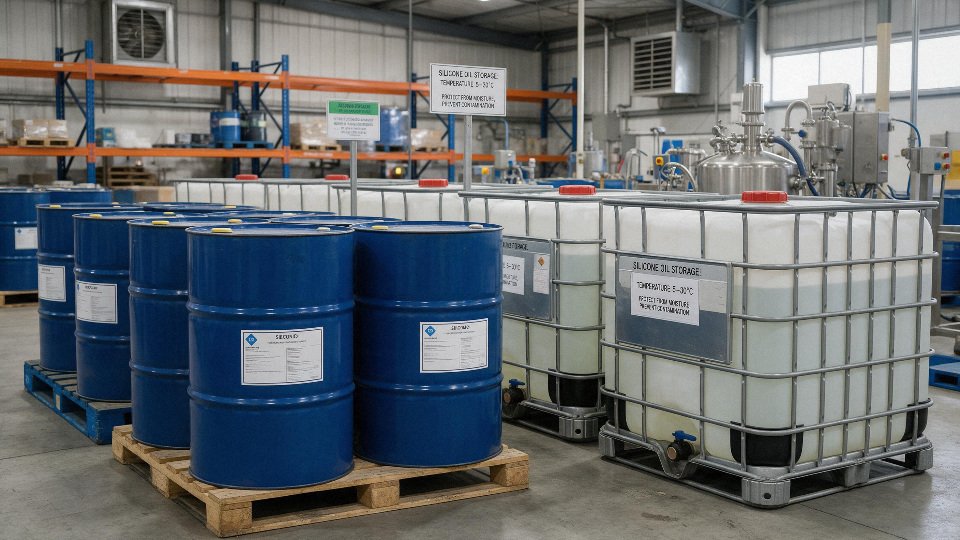
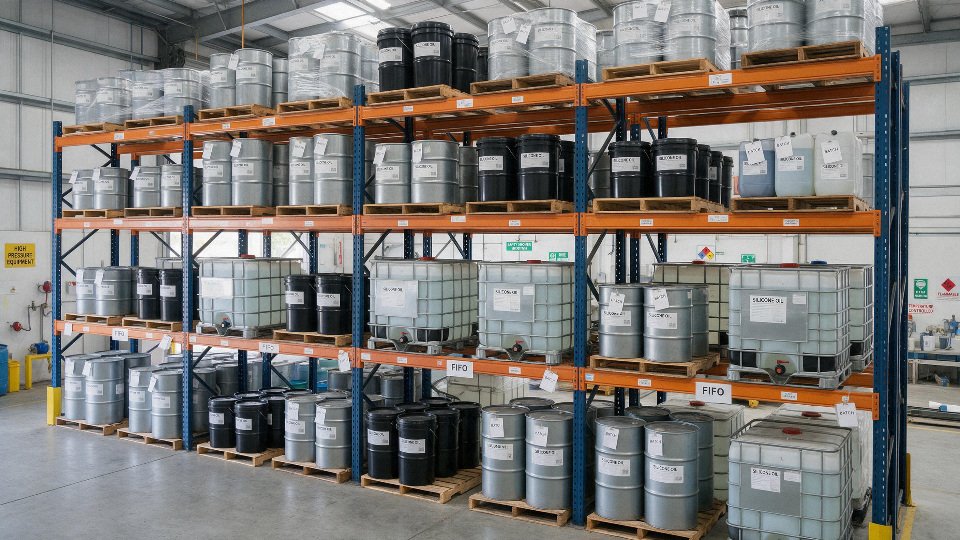
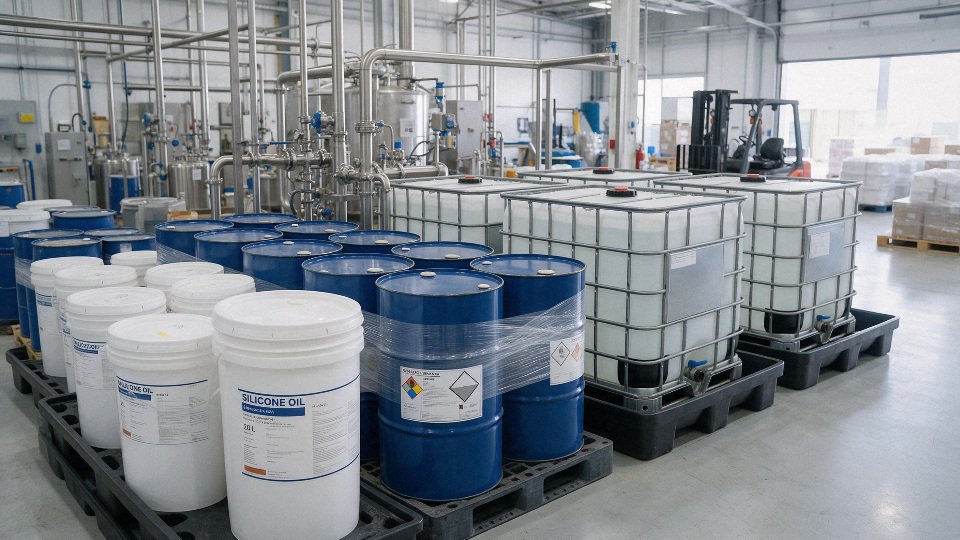
Standard commercial packaging runs 200 kg steel drums, 1,000 L intermediate bulk containers (IBCs), and bulk tanker for high-volume accounts — typically anything above roughly 20–30 tonnes per delivery depending on the supplier’s logistics terms. Some specialty producers pack low-viscosity or high-purity grades in lined drums or HDPE containers to avoid trace metal contamination from drum welds.
Storage below 25 °C, away from moisture and direct sunlight, is the universal recommendation. Silicone oils are hydrophobic and chemically stable, but prolonged storage in humid environments can introduce trace water that affects performance in dielectric or optical applications.
Shelf life is typically stated as 24 months from manufacture date under recommended storage — but re-test before use if stock has been warehoused more than 18 months, especially for viscosity-critical applications. That is a practical habit, not just a liability hedge.
Incoming QC Checklist
A minimal incoming inspection should cover: kinematic viscosity (ASTM D445, against stated tolerance), color by APHA/Hazen scale (ASTM D1209 — water-white to pale yellow is acceptable; anything distinctly yellow or hazy warrants rejection or hold), and specific gravity (ASTM D792). For regulated applications, lot traceability documentation must include a manufacturer’s CoA with test results, an SDS current to the latest GHS revision, and any applicable regulatory compliance declarations (REACH, RoHS, FDA, etc.). Batch/lot numbers should trace back to the manufacturer’s internal records — if a supplier cannot provide that linkage, that is a qualification risk worth taking seriously.
Evaluating and Qualifying a Silicone Oil Supplier: A Practical Framework
Supplier qualification for silicone oil is not a checkbox exercise. Get it wrong and you’re looking at batch rejections, reformulation delays, or — in a regulated application — a full regulatory resubmission. The framework below is sequenced the way an experienced procurement engineer would actually run it.
Step 1 — Lock In Your Specification Envelope Before You Talk to Anyone
This sounds obvious. It’s routinely skipped. Before issuing a single RFQ, your team needs to have agreed on viscosity grade (and whether the tolerance is ±5% or ±10% of nominal), acceptable cyclic siloxane limits (D4/D5/D6 in ppm, increasingly critical for European market products under REACH), applicable standards (USP, EP, NSF, or food-contact regulations), annual volume with seasonal swing, and delivery geography. Packaging format matters too — 200 L drums versus IBC versus bulk tanker changes your qualified supplier list significantly.
Skipping this step means you’ll spend weeks in commercial discussions only to discover the supplier’s standard cyclic spec is three times your limit, or their minimum order quantity is ten times your annual need.
Step 2 — Assess Vertical Integration
Ask directly: does the producer manufacture its own chlorosilanes, or does it buy merchant methyl chloride and hydrolyze purchased intermediates? Integrated producers — those running from silicon metal through chlorosilane synthesis to polymerization — tend to show tighter lot-to-lot viscosity consistency and can provide a more complete raw material traceability chain, which matters considerably for FDA Drug Master File submissions or REACH dossiers. Non-integrated toll processors can be perfectly capable suppliers for industrial lubrication or release applications, but the traceability conversation gets complicated fast.
Vertically integrated silicone oil producers generally deliver better lot-to-lot viscosity consistency than non-integrated toll processors.True
Integration allows control over monomer purity and polymerization chain-length distribution from the first synthesis step, reducing the batch-to-batch variability introduced when purchasing chlorosilane intermediates from multiple external sources.
Step 3 — Audit the Quality Management System
ISO 9001:2015 is the floor, not a differentiator. For any pharmaceutical, medical device, or personal care application, you need to verify ICH Q7 GMP compliance or an equivalent documented quality system. Request the three most recent certificates of analysis for your target grade — not cherry-picked lots, the last three consecutive — and compare them for internal consistency. Ask for the most recent internal audit summary. A supplier who hesitates here is telling you something.
Step 4 — Sample Testing, Done Properly
Order 1–5 kg. Run viscosity at 25°C (Cannon-Fenske or rotational, consistent with the supplier’s method), refractive index, and a volatile strip — typically one hour at 150°C, watching for weight loss above roughly 0.3–0.5%, depending on grade. For cyclic content, GC-MS is the right tool; don’t accept a supplier’s CoA as the only data point on this. Send splits to an ILAC-accredited third-party laboratory. The cost is modest — usually a few hundred dollars per suite — and it’s the only way to validate whether the supplier’s in-house numbers hold up under independent scrutiny.
Step 5 — Commercial and Supply Chain Risk
Single-site producers carry concentration risk that multi-site operations don’t. Ask specifically about safety stock policy, standard lead times (2–6 weeks is typical for common 100–1,000 cSt grades; custom viscosities or functionalized grades often run 8–16 weeks), and minimum order quantities. Force majeure history is fair game. For any critical supply relationship — meaning if this material going unavailable would stop your line — request a written business continuity plan. Most serious producers have one. If they don’t, factor that into your risk scoring.
Step 6 — Ongoing Performance Management
Qualification is the start, not the finish. Define KPIs upfront and review them quarterly: on-time delivery rate (target ≥98%), lot rejection rate (target <0.5%), CoA delivery time relative to shipment, and response time on technical queries. Tie these to a formal corrective action process with defined escalation paths. In practice, the suppliers who respond well to structured performance reviews are also the ones whose quality stays consistent over time — the correlation isn’t accidental.
Market Trends Shaping Silicone Oil Supply Through 2030
The silicone oil supply landscape is shifting faster than most procurement teams have updated their sourcing strategies. Capacity, regulation, application pull, and geopolitical pressure are all moving at once — and they don’t all point the same direction.
Capacity Expansion in Asia Is Adding Real Supply Pressure on Commodity Grades
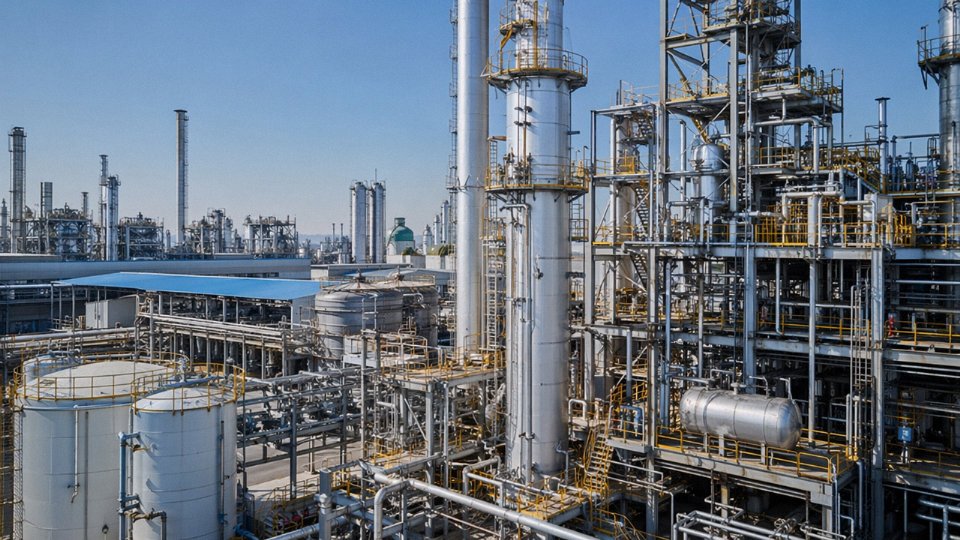
Chinese producers Wynca and Dongyue have both announced meaningful capacity additions — brownfield expansions primarily, though Wynca has greenfield activity at its Zhejiang site. Rough industry estimates put announced additions in the 15–25% range by 2027, depending on capital completion rates and raw material access (silicon metal and methanol feedstock availability being the usual gating factors in that region). KCC in South Korea is also expanding, though at a more measured pace and oriented toward higher-value functional grades rather than straight PDMS commodity fluid.
What this means practically: expect continued price pressure on the 100–1,000 cSt viscosity grades that represent the bulk of industrial volume. For a procurement manager buying trimethylsiloxy-terminated PDMS in bulk, this is probably welcome news on unit cost. For a Tier-1 supplier who spent two years qualifying a specific Chinese source, the risk is that production shifts between lines or sites during an expansion, introducing lot-to-lot variability that wasn’t there before. That scenario plays out more often than it should.
EU REACH Cyclic Siloxane Restrictions Are Expanding Beyond Personal Care
The restriction on D4 and D5 in wash-off personal care products at concentrations ≥0.1% by weight has been enforced in the EU since 2020. What many industrial buyers haven’t tracked closely: the European Chemicals Agency has been reviewing extension of D4/D5/D6 restrictions to industrial rinse-off and certain non-rinse applications, with D6 already under active scrutiny. The timeline for any industrial-use enforcement is still uncertain — realistically somewhere in the 2025–2028 window depending on regulatory process — but formulators who are building products today with moderate cyclic siloxane content should be asking their suppliers for low-cyclic certificates now, not after a restriction lands.
The EU REACH restriction on D4/D5 in wash-off cosmetics at ≥0.1% w/w has been in force since February 2020.True
EU Regulation 2018/35 and 2018/36 entered into force on 31 January 2018 and applied from 31 January 2020, covering D4 and D5 respectively in wash-off personal care products.
The major Tier-1 producers — Wacker, Dow, Shin-Etsu — have all developed and are actively marketing low-cyclic PDMS grades, typically guaranteed at <100 ppm or <50 ppm cyclics depending on the grade. Some regional producers can meet these specs; many cannot do it consistently. That gap will matter more as restrictions broaden.
Sustainability Pathways: Recycling and Renewable Sourcing Are Early but Real
Wacker and Elkem have both published research programs on silicone depolymerization — breaking PDMS back to chlorosilane monomers for reuse — which is technically viable but still energy-intensive and far from commercial scale. Wacker’s work on reducing energy intensity in the Müller-Rochow process is probably closer to near-term impact than full circular recovery. Don’t expect bio-based silicon pathways to move the market before 2030; the thermodynamics of silicon reduction are stubborn. Still, producers who can demonstrate measurable reductions in cradle-to-gate CO₂ will have a real differentiator with European and Japanese OEM customers who are running Scope 3 accounting seriously.
Electric Vehicles, 5G, and Drug Delivery Are the Demand Vectors That Matter
Immersion cooling fluids for EV battery packs and power electronics, thermal interface materials for 5G base station components, and injectable drug delivery systems each require silicone oil grades that commodity volume production doesn’t naturally optimize for — high thermal stability, extremely tight viscosity tolerance (sometimes ±2% rather than the typical ±5–10%), and metal ion contamination specs that most bulk producers don’t routinely certify. These segments are growing fast enough that several Tier-1 producers have stood up dedicated product lines. For procurement teams in these industries, the relevant question isn’t price per kilogram — it’s who can supply the same spec, consistently, at scale, over a five-year program.
Regionalization Is Creating Real Second-Source Opportunities
Post-2020, the willingness of Western OEMs to run single-source from China has dropped sharply. That’s created genuine qualification opportunities for Indian producers like Shin-Etsu’s Indian operations and domestic players, for KCC and other Korean suppliers, and for European toll manufacturers. The qualification work is real — it takes 6–18 months depending on application criticality — but the strategic imperative is there in a way it wasn’t five years ago. In practice, the companies moving fastest on this are those whose procurement teams started qualification before they needed it, rather than after an allocation event forced the issue.
Frequently Asked Questions About Silicone Oil Producers and Sourcing
Who are the three largest silicone oil producers in the world by volume?
Dow, Shin-Etsu Chemical, and Wacker Chemie consistently rank at the top by silicone fluid output. Momentive is a close fourth — close enough that some analysts swap it with Wacker depending on the product category and year. Together these four hold roughly 55–65% of global production capacity, a figure that shifts slightly with capacity expansions and plant turnarounds. The remaining share is split across a growing field of Chinese producers (Wynca, Dongyue, Hoshine), Indian manufacturers, and specialty houses like Elkem and Gelest.
Dow, Shin-Etsu, and Wacker Chemie collectively represent the largest share of global silicone oil production capacityTrue
Industry capacity analyses and publicly available corporate production data consistently place these three producers, along with Momentive, at 55–65% of global silicone fluid output, though exact rankings shift by product segment and reporting year.
Is there a real quality difference between tier-1 global and Chinese regional silicone oil?
For commodity viscosity grades — call it 100 to 1,000 cSt PDMS used in textile finishing, mold release, or general industrial lubrication — the gap has genuinely narrowed over the past decade. Chinese producers have invested in rectification columns and moisture control, and lot-to-lot consistency on standard grades is reasonable. That said, for pharmaceutical, semiconductor, or optical-grade applications where you’re specifying D4/D5 cyclic siloxane limits, narrow viscosity tolerances, or full traceability back to raw silicon metal, tier-1 producers still hold a clear advantage. It’s not about national origin as a quality proxy — it’s about whether the producer has the analytical infrastructure and documented process controls to prove conformance every time, not just most of the time.
What certifications should food-grade silicone oil carry?
At minimum, look for FDA 21 CFR 172.878 compliance if the fluid will contact food directly. If it’s used as an incidental lubricant in food processing equipment — conveyor chains, gearboxes in a bakery line, that kind of application — NSF H1 registration is the relevant credential. Some markets also require Kosher or Halal certification depending on the end product. Always request a current Certificate of Analysis that explicitly states the certified grade designation, not just a general product name. A supplier that can only provide a letter of attestation rather than a CoA tied to a specific lot should give you pause.
Can silicone oil be custom-manufactured to a non-standard viscosity?
Yes, and this is more accessible than many buyers assume. Producers including Gelest, AB Specialty Silicones, and Elkem Silicones offer custom viscosity blending and reactive functionalization — amino-modified, epoxy-functional, phenyl-substituted — at scales ranging from a few kilograms in the lab through full production batches. Realistic lead times for custom grades run 8 to 16 weeks depending on the complexity of the modification and the producer’s current scheduling. Minimum order quantities typically fall somewhere between 100 and 500 kg, though that depends on the producer and how novel the specification is. If your application is unusual, start that conversation early — rushing a custom fluid qualification is a reliable way to delay a product launch.
How do I verify a supplier meets D4/D5 cyclic siloxane limits for EU REACH compliance?
Require a GC-MS test report run to EPA Method 8270 or an equivalent ECHA-recognized analytical method. Critically, the analysis should be performed by an ILAC-accredited external laboratory — not the supplier’s in-house lab, which is a conflict of interest for regulatory compliance purposes. The result needs to confirm D4 and D5 concentrations below 0.1% w/w in the finished fluid. If a supplier pushes back on third-party testing or offers only internal data, treat that as a red flag, particularly if you’re selling into the EU market.
What is the typical shelf life of commercial silicone oil?
Standard PDMS fluids carry a 24-month shelf life from manufacture when stored sealed, below 25°C, away from direct sunlight and moisture ingress. In practice, warehouses don’t always maintain those conditions through summer — a drum sitting on an uncovered loading dock in August doesn’t count as “ambient storage” no matter what the paperwork says. Re-test viscosity and volatile content before use if there’s any doubt about storage history. Silicone oil doesn’t degrade rapidly, but moisture contamination and oxidation of functional groups can quietly shift properties on modified grades.
Are there producers that specialize exclusively in medical and pharmaceutical silicone oil?
Elkem Silicones, through its SILBIONE product line, is the most focused player in this space. Dow has pharma-dedicated production streams that are operationally separated from industrial lines. Momentive and Wacker both offer USP- and EP-compliant grades, but as part of broader industrial portfolios rather than dedicated pharmaceutical manufacturing operations. For medical device applications specifically, request ICH Q7 GMP documentation and ISO 10993 biocompatibility data — not just a spec sheet that mentions “medical grade” in the product name. That distinction matters during FDA or notified body audits.
Building a Resilient Silicone Oil Supply Strategy: Final Recommendations
Everything covered in the preceding sections converges on a single practical reality: silicone oil is not a commodity you can treat like a spot-market purchase. The supply chain is tighter than it looks, the specification landscape is genuinely complex, and a single disruption at a chlorosilane cracker — which you will never see coming — can leave a production line without critical fluid for six to ten weeks. The recommendations below are meant to go directly into a sourcing policy document, not a slide deck.
Dual-Source as a Baseline, Not a Stretch Goal
For any grade where your annual consumption exceeds roughly 10 MT, qualify a minimum of two approved suppliers before you need them. Ideally those two sources sit in different geographies — a European or North American tier-1 and a qualified regional producer, for instance — so that a regional logistics failure or export restriction doesn’t take out both simultaneously. The qualification work takes time (viscosity verification, cyclic content analysis, application trials), so run it in parallel with your current supply relationship, not after your primary supplier declares force majeure.
Match Supplier Tier to What the Application Actually Demands
This is where procurement teams most often over-spend or, more dangerously, under-specify. Pharmaceutical, medical device, semiconductor, and precision optical applications genuinely need tier-1 producers — Dow, Shin-Etsu, Wacker, Momentive, Elkem — because lot-to-lot consistency, regulatory dossier support, and traceable raw material sourcing are non-negotiable. A 350 cSt PDMS going into a textile softener bath or a construction joint sealant formulation does not carry those requirements. Regional producers that have passed a documented qualification can serve those applications at meaningfully lower cost, often 15–30% depending on volume and geography. The mistake is applying tier-1 pricing discipline uniformly across all grades, or conversely, letting a regional supplier drift into a critical application because “it passed incoming QC once.”
Negotiate Safety Stock Before You Need It
Standard lead times from major producers run 2–6 weeks under normal conditions; during tight chlorosilane supply periods that can stretch to 10–14 weeks without warning. Negotiate supplier-held consignment or reserved safety stock covering 4–8 weeks of your consumption at a pre-agreed price for any grade that would halt production if it ran out. Yes, there’s a carrying cost. Compare it to the cost of a single unplanned line stoppage. In practice, most tier-1 and large regional suppliers will agree to this arrangement for customers with consistent annual volumes above roughly 20–25 MT, especially if you’re willing to commit to a rolling forecast.
Major silicone oil producers regularly experience chlorosilane supply disruptions that affect lead timesTrue
Chlorosilane production is concentrated and capital-intensive; unplanned outages at a small number of facilities can tighten global supply quickly, as has occurred multiple times in the past decade across European and Asian producers.
Embed Change Notification Into the Contract Language
Require 90-day advance written notice of any formulation adjustment, raw material source change, or new regulatory restriction — REACH, RoHS, pharmacopoeial revisions — affecting the grades you buy. This isn’t bureaucratic overhead; it’s the mechanism that prevents a changed cyclic siloxane content from appearing silently in a CoA and failing in your end-use application three batches later. Align the notification format to your own QMS change control procedure so the information flows without a manual chase.
Build Internal Specification Literacy
Your procurement and incoming quality teams should be able to read a CoA independently. Viscosity at 25°C, refractive index, volatile strip at 150°C, and cyclic siloxane content are the four parameters that catch most out-of-spec lots before they enter process. This isn’t asking procurement to become chemists — it’s asking them to know what a suspicious number looks like so they can escalate rather than accept.
Review the Approved Supplier List Every Year
Capacity in Asia is expanding, EU REACH restrictions are evolving, and new regional producers continue to reach international quality benchmarks. An annual supplier market review — comparing current approved sources against new qualifications, regional pricing shifts, and regulatory updates — keeps your sourcing policy current rather than reactive. Set it on the calendar now.