Sourcing silicone oil sounds straightforward until your formulation team flags a viscosity inconsistency mid-batch, your procurement contact goes quiet for two weeks, and you’re sitting on a production line running at 40% capacity waiting for 500 cSt PDMS that was supposed to arrive three weeks ago. The wrong supplier choice doesn’t just create paperwork — it can cascade into scrapped batches, broken customer commitments, and expediting costs that quietly erase whatever margin you thought you’d locked in on the contract.
The largest silicone oil manufacturers by global production capacity are Dow (USA), Wacker Chemie (Germany), Shin-Etsu Chemical (Japan), and Momentive Performance Materials (USA). Together, these four producers control an estimated 55–65% of worldwide silicone oil output. Elkem Silicones, Momentive’s regional competitors in China such as Wynca and Hoshine, and several mid-tier specialty producers account for most of the remaining share in a market valued at roughly USD 2.1–2.4 billion in 2024.
What makes this market genuinely tricky to navigate — and why “just buy from a big name” is less reliable advice than it sounds — is that silicone oil isn’t one product. Polydimethylsiloxane alone covers something like 70–75% of total volume sold, but it ships in viscosities ranging from 0.65 cSt water-thin fluid up past 1,000,000 cSt near-solid gum, and the producer who is best positioned to supply your textile softener application may have a six-week lead time on the exact grade your medical device customer requires. Scale matters, but so does portfolio depth, regional warehousing, and — frankly — how seriously a given supplier treats mid-volume buyers.
Tier-1 Global Giants: Dow, Wacker, Shin-Etsu, and Momentive
These four producers aren’t just large — they’re vertically integrated from silicon metal or chlorosilane synthesis all the way through finished fluid formulation. That integration matters enormously in procurement: when a spot shortage hits, a fully integrated producer can prioritize internal silicone monomer supply in ways a downstream blender simply cannot.
Dow — Heritage, Scale, and a Two-Track Commercial Model
Dow’s silicones business traces directly to Dow Corning, the joint venture with Corning Glass that ran from 1943 until Dow absorbed it fully in 2018. The institutional knowledge that came with that acquisition is genuinely hard to replicate — decades of application engineering, a global technical service network, and established approvals in regulated end-uses like medical devices and food contact.
The commercial structure Dow inherited is worth understanding for any procurement team. The XIAMETER line is essentially a no-frills, web-priced commodity channel — standard PDMS fluids at viscosities from roughly 0.65 cSt up to 60,000 cSt, priced on volume, minimal technical support. Dow-branded specialty fluids sit alongside it: higher-purity grades, functional fluids, phenyl-modified silicones, and products requiring documented lot traceability. Buyers who default to XIAMETER for cost savings occasionally get caught when a formulation change requires a grade that isn’t available through that channel — worth confirming before you lock in a spec.
Primary manufacturing for silicone fluids runs out of Midland, Michigan (the historical Dow Corning heartland) and Barry, Wales, which serves European demand and carries its own regulatory certifications. Estimated annual silicone fluid production capacity across Dow’s network runs in the range of 300,000–400,000 metric tons for silicones broadly, though fluid-specific figures aren’t publicly broken out.
Wacker Chemie — European Rigor, Medical and Food Credentials
Wacker’s SILICONES division generated roughly €1.4–1.6 billion in revenue in recent fiscal years, making it the second-largest revenue contributor within the company after polysilicon. The AK series of polydimethylsiloxane fluids is probably the most widely referenced commodity PDMS line in European industrial formulating — AK 10, AK 50, AK 350, and so on, where the number denotes kinematic viscosity in mm²/s at 25°C. Straightforward, but don’t assume AK grades from different production runs are interchangeable without checking the certificate of analysis; batch-to-batch variation in low-viscosity grades can matter in sensitive applications.
Production is split primarily between Burghausen (the main Bavarian site, running continuously since the 1950s) and Nunchritz in Saxony, which handles silicone intermediates and feeds downstream fluid production. Wacker holds USP/NF, FDA 21 CFR, and several food-contact certifications on specific grades — genuinely useful if you’re supplying into pharmaceutical manufacturing or food processing equipment lubrication.
Wacker's AK-series PDMS fluids carry FDA 21 CFR 172.878 compliance on select viscosity gradesTrue
Wacker publicly documents food-contact compliance for specific AK grades under FDA 21 CFR 172.878 (indirect food additives) in their product regulatory documentation, applicable to grades used in food-processing environments.
Shin-Etsu — Asia-Pacific Dominance and Ultra-Pure Grades
Shin-Etsu Chemical’s KF series covers the standard viscosity range familiar to most formulators, but the company’s real competitive edge is in ultra-high-purity fluid production for semiconductor fabrication and premium cosmetics. Their Gunma and Takefu plants in Japan run under process discipline that reflects the company’s broader semiconductor-materials culture. For cosmetics applications — volatile cyclics, emollient PDMS blends — Shin-Etsu’s technical documentation tends to be more detailed than most, which matters when you’re navigating EU cosmetics regulation.
Market share in Asia-Pacific for silicone fluids is estimated at 30–40%, depending on the grade segment, with dominance particularly strong in Japan, South Korea, and Taiwan where the semiconductor supply chain pulls demand.
Momentive — Specialty Focus After Restructuring
Momentive has had a complicated decade. The 2014 bankruptcy and subsequent acquisition by KCC Corporation (a South Korean coatings and construction materials group) reshaped the business away from broad commodity volume toward higher-margin specialty fluids. The Siloil and Silsoft lines lean heavily into high-viscosity grades (above 100,000 cSt) and reactive functional fluids — amino-functional, epoxy-functional, and polyether-modified silicones that Dow and Wacker also offer but where Momentive has carved out specific formulating relationships.
In practice, procurement teams sometimes treat Momentive as a secondary source for standard PDMS but a primary or sole-source supplier for certain reactive grades. That’s a supply-chain risk worth actively managing — confirm whether a reactive fluid from Momentive has a qualified alternate before it becomes a production-critical single point of failure.
Rising Chinese Producers Reshaping the Competitive Landscape
Chinese silicone manufacturers were, for most of the 2000s, largely confined to low-grade commodity output — adequate for domestic textile softeners and basic release agents, but not much else. That picture has changed substantially. By the early 2020s, several Chinese producers had crossed a threshold where their process control, product consistency, and sheer scale made them credible alternatives to Western tier-1 suppliers in a growing number of applications.
Elkem Silicones China (formerly BlueStar Silicones)
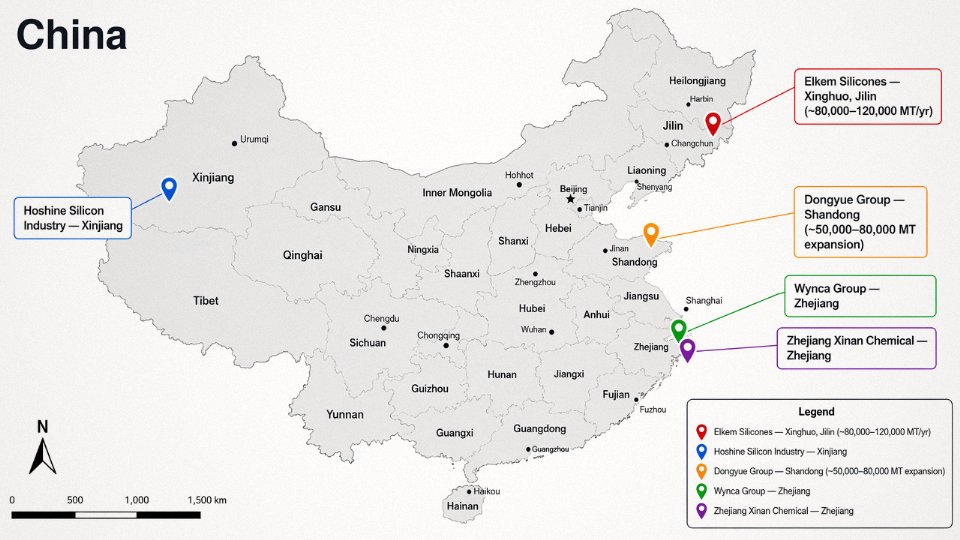
The Xinghuo plant in Jilin province is one of the larger integrated silicone complexes in Asia, with reported PDMS production capacity in the range of 80,000–120,000 metric tons per year across all silicone intermediates and fluids — though the exact figure depends on product mix at any given time, since the same reactor trains can swing between fluids, gums, and resins depending on market signals. When Elkem ASA acquired the BlueStar Silicones business in 2019, it gained not just capacity but a direct upstream connection to Chinese siloxane supply chains that its Norwegian parent had never had before.
The integration has been uneven in practice. On the product side, Elkem Silicones China now offers viscosity grades from 0.65 cSt up through high-viscosity PDMS that overlaps almost entirely with what Dow and Wacker sell into personal care, textile, and industrial fluids markets. Technical data sheets have improved markedly. The gap that remains — and procurement managers should understand this clearly — is in custom functional fluids and highly regulated applications where batch traceability documentation and regulatory dossiers (REACH, FDA 21 CFR) still lag behind Western counterparts.
Hoshine and Wynca: The Raw Material Advantage
Hoshine Silicon Industry sits at the upstream end of the entire silicone value chain — silicon metal — and that position matters more than most buyers realize. Silicon metal is the primary feedstock for methylchlorosilane synthesis, which feeds siloxane monomers, which eventually become PDMS. Hoshine and Wynca Group both have substantial siloxane monomer capacity, and their cost structure at the silicone oil level reflects integration all the way back to the furnace.
Rough estimates from industry observers put their all-in production cost for 350 cSt PDMS at roughly 15–25% below what a non-integrated Western producer pays, depending on energy prices, silicon metal spot rates, and methanol costs at any given quarter. That’s not a small margin. It’s enough to undercut spot market pricing in export markets without sacrificing profitability, which is exactly what has happened across Southeast Asia and parts of the Middle East since 2021.
Hoshine Silicon Industry is one of the world's largest silicon metal producersTrue
Hoshine is widely documented as a leading silicon metal producer in China, with capacity figures referenced in industry filings, analyst reports, and trade data. Silicon metal is their core business, with silicones as a downstream extension.
Zhejiang Xinan and Dongyue: Capacity Additions and Policy Tailwinds
Zhejiang Xinan Chemical and Dongyue Group both executed aggressive capacity expansions between 2020 and 2024, partly driven by favorable financing conditions under Made in China 2025 industrial policy frameworks that explicitly targeted new materials including organosilicones. Dongyue’s Shandong facilities added estimated PDMS-equivalent capacity of 50,000–80,000 metric tons in that window. Zhejiang Xinan followed a similar trajectory. The combined effect on global PDMS markets has been real and measurable: spot prices for commodity 350 cSt and 1000 cSt PDMS dropped sharply in 2022–2023, catching several Western distributors with expensive long-term supply contracts badly offside.
Oversupply in commodity grades is the predictable consequence. For procurement managers buying undifferentiated PDMS for industrial release, textile finishing, or foam control, the current environment is genuinely favorable on price. For anyone who needs certified purity grades, tight viscosity tolerances in the 2–5 cSt range, or application support beyond a TDS, the calculation is different.
Export Reach into Emerging Markets
Chinese producers have moved aggressively into Southeast Asia, the Middle East, and sub-Saharan Africa — markets that were historically served by Western tier-1 distributors at premium margins. The product focus is almost entirely on 350 cSt and 1000 cSt commodity PDMS, shipped in 200 L drums or IBC totes, often through regional trading intermediaries rather than direct technical sales channels. Lead times from Chinese producers to Southeast Asian buyers typically run 3–6 weeks depending on port congestion and vessel availability, which is competitive with European suppliers shipping to the same region.
The practical implication for a factory sourcing in, say, Vietnam or Indonesia: you can probably source commodity PDMS from a Chinese producer at 10–20% below Western list prices, but your technical support infrastructure will be thinner, and your supply chain risk profile changes — particularly around geopolitical disruption and export control uncertainty, which has been volatile enough in adjacent industries to warrant at least a dual-sourcing contingency.
Regional Specialists Worth Knowing: Elkem, KCC, Evonik, and Kemira
The four Tier-1 giants dominate capacity, but they don’t always win the order. Pharmaceutical-grade fluids, tight dielectric specifications, or a Southeast Asian supply chain that actually delivers on time — these are areas where smaller, more focused producers often outperform the volume players. Procurement managers who limit their approved vendor lists to Dow and Wacker are leaving real optionality on the table.
Elkem Silicones: European Heritage with Specialty Depth
Elkem’s silicone business traces back to Bluestar Silicones and, further back, the Rhodorsil brand developed by Rhône-Poulenc — a name that still carries weight with European formulators who have been qualifying it since the 1980s. The Lyon R&D center is the practical heart of the operation, focused heavily on high-purity PDMS fluids for pharmaceutical excipient and cosmetic emollient applications where impurity profiles (cyclic siloxane content in particular) are tightly regulated. Post-COVID, Elkem’s fully European manufacturing footprint shifted from being a neutral fact to an active selling point — customers who got burned by Asian supply disruptions in 2021–2022 actively sought European-sourced fluids even at a 10–18% price premium, depending on grade and volume commitment.
Their specialty fluids for personal care, including volatile and ultra-low-viscosity PDMS variants, tend to meet EU REACH requirements without the documentation burden that sometimes accompanies Asian-origin material. For any buyer sourcing into the EU cosmetics or pharma supply chain, Elkem deserves a serious qualification slot.
KCC Silicone: Dominant at Home, Expanding Its Regional Reach
KCC Corporation — the South Korean conglomerate — is the parent company of Momentive, though KCC Silicone operates its own independent silicone fluid product lines out of South Korea. That distinction matters: KCC Silicone is not simply a reseller of Momentive product. They hold a dominant position in the South Korean domestic market, which is not trivial given South Korea’s large electronics, automotive adhesive, and textile industries. Viscosity ranges from 0.65 cSt up through high-consistency fluids are well-covered.
The more interesting development over the past four or five years is the Southeast Asia push — particularly into Vietnam, Indonesia, and Thailand, where electronics manufacturing migration has created demand for transformer cooling fluids and conformal coating fluids. KCC’s logistics position out of Korea works reasonably well for this geography. They’re not displacing Shin-Etsu in Japan or Dow in the US, but in ASEAN they are a genuine competitor for mid-volume industrial accounts.
Evonik: Formulation Expertise Without the Reactor
Evonik plays this market differently. They are not a monomer-to-fluid vertically integrated silicone producer in the way Wacker or Shin-Etsu are. Instead, they source base PDMS and modify, blend, and functionalize it — primarily under the TEGOMER and ABIL brand platforms — for personal care actives, agricultural adjuvants, and industrial process fluids. This asset-light model means their manufacturing cost structure looks different from a fully integrated producer’s, but their application-development capability for polyether-modified silicones and silicone-polyol copolymers is genuinely strong. For a cosmetic chemist trying to optimize skin feel in a leave-on moisturizer, ABIL fluids are a known quantity with decades of formulation data behind them.
Smaller Innovators: Iota and Clearco
Iota Silicone Oil, based in China, has carved out a credible position in tight-tolerance specialty fluids — particularly high-purity grades for laboratory and dielectric applications. Clearco Products in the US (formerly Clevite Industries’ fluid division, operating quietly for decades) serves the transformer cooling and high-voltage dielectric niche with viscosity tolerances that major producers rarely bother to guarantee on standard commercial-grade product. For a transformer OEM or a metrology lab that needs viscosity certified to ±1 cSt at a specific temperature, these are the names that come up.
Elkem Silicones' Lyon facility holds significant R&D capabilities for pharmaceutical and cosmetic-grade silicone fluids under the Rhodorsil heritage brandTrue
Elkem acquired Bluestar Silicones, which carried the Rhodorsil brand lineage from Rhône-Poulenc, and the Lyon site has been a documented center for specialty PDMS development for regulated-industry applications in Europe.
How to Compare Silicone Oil Manufacturers: A Structured Evaluation Framework
Shortlisting a silicone oil supplier is not simply a matter of checking who offers the lowest price per kilogram. The wrong choice surfaces six months later as a batch rejection, a regulatory audit finding, or a production line waiting on a container that missed the vessel. Here is how to structure the evaluation before you commit.
Technical Capability: More Than a Viscosity Catalog
Start with viscosity range coverage — and dig past the brochure. A supplier claiming full-range capability should be able to deliver everything from 0.65 cSt (the low-viscosity fluids used in diffusion pump applications and certain cosmetic carriers) up through 1,000,000 cSt paste-grade material from the same manufacturing site, with traceable batch consistency across that span. In practice, many mid-tier producers are strong in the 50–5,000 cSt commodity band and get unreliable outside it. Ask for actual production lot data, not just a spec sheet range.
Reactive versus non-reactive portfolio matters more than most buyers initially realize. If your application involves silicone release coatings, functional textile finishing, or any emulsion where crosslinking is part of the process, you need a supplier with hydrogen-terminated or vinyl-terminated PDMS alongside the standard trimethyl-capped fluids — and technical staff who understand the difference. A supplier whose reactive portfolio is thin will quietly substitute or back-order, and you may not find out until your formulation performance drifts.
Custom blending and toll processing capability is worth asking about directly. Some Tier-1 facilities will blend to your internal specification — specific additive packages, target refractive index windows, custom viscosity grades between catalog steps — but minimum order requirements for custom work typically run 1,000–5,000 kg per blend, depending on the plant. Smaller regional producers sometimes offer more flexibility here precisely because they are not optimizing for massive commodity throughput.
Quality and Regulatory Credentials: Get the Actual Certificates
ISO 9001 is a floor, not a differentiator. Every serious supplier has it. What separates suppliers in regulated industries is whether they hold FDA 21 CFR 172.878 compliance for food-contact and food-grade applications, and USP Class VI certification for pharmaceutical and medical device uses. These are not interchangeable — a fluid that satisfies 21 CFR 172.878 is not automatically USP Class VI. Confirm the specific grade and lot traceability, and ask whether the certification covers the manufacturing site you will actually be sourcing from, not a sister plant in a different country.
FDA 21 CFR 172.878 and USP Class VI are distinct compliance standards that cannot be substituted for each other in pharmaceutical or medical device applications.True
21 CFR 172.878 covers food-additive use of dimethylpolysiloxane under FDA jurisdiction, while USP Class VI is a biological reactivity test standard for plastics and polymers used in medical/pharmaceutical contexts. A material can satisfy one without meeting the other.
REACH registration status and RoHS compliance affect your ability to sell finished goods into European markets. If your supplier cannot provide an up-to-date REACH registration number for the specific PDMS grade you are buying, that is your problem at customs, not theirs.
Supply Chain Criteria: Geography and Inventory Both Count
Manufacturing proximity to your plant affects more than lead time — it affects your ability to respond when something goes wrong. A supplier with a warehouse or tolling partner within two to three days’ ground transport of your facility is qualitatively different from one shipping ocean freight out of a single Asian export terminal, even if the nominal price is lower. Safety stock programs — where the supplier holds 4–8 weeks of your forecasted volume in allocated inventory — exist at most Tier-1 producers and some regional ones, usually tied to annual volume commitments in the range of 20–100 MT depending on the supplier’s minimum thresholds.
Dual-sourcing feasibility should be evaluated at the specification level. If your internal spec is written around one supplier’s exact viscosity grade and additive package, you have unintentionally created single-source dependency. Write specs to viscosity ranges and functional properties, not to a catalog SKU.
Commercial and Support Criteria: Who Actually Answers the Phone
Technical field application engineers — real ones, not a call center reading from a datasheet — are genuinely valuable when you are troubleshooting a defoamer that is behaving unexpectedly or qualifying a new pharmaceutical excipient. Ask prospective suppliers specifically whether they have application engineers with direct experience in your end-use sector, and how those engineers are deployed.
Practical commercial checklist before signing anything:
| Criterion | What to Verify | Red Flag |
|---|---|---|
| Certificate of Analysis format | Lot-specific, matches shipped batch | Generic or undated CoA |
| SDS availability | Current revision, local language if required | Outdated revision, slow to provide |
| Sample provisioning | Under 2 weeks for standard grades | “Samples not available” for stock items |
| Pricing structure | Spot vs. indexed contract terms clear | Price changes without formula |
| MOQ flexibility | Stated MOQ with break-point pricing | No flexibility below pallet quantities |
Pricing transparency matters more than the number itself. Spot pricing on silicone intermediates can swing 15–30% across a calendar year depending on methanol and silicon metal feedstock costs, so understanding whether your supplier offers formula-linked contracts — indexed to a published feedstock benchmark — versus pure spot exposure will have a real impact on your cost planning over a 12-month horizon.
Silicone Oil Grades, Viscosities, and Which Manufacturers Lead in Each Segment
Knowing a supplier’s name isn’t enough. The relevant question is whether they actually lead — in quality consistency, minimum order flexibility, and regulatory documentation — in the specific viscosity range you’re buying. That answer differs substantially depending on where you sit on the centistoke scale.
Low-Viscosity Fluids (0.65–50 cSt): Cosmetic and Personal Care Carriers
This is the most specification-sensitive segment of the market. Personal care formulators buying 1–10 cSt PDMS aren’t just purchasing a fluid; they’re purchasing a regulatory dossier. Cyclic siloxane content — specifically D4 and D5 — is the controlling spec. The EU’s restrictions under REACH have pushed suppliers to document D4 below 0.1 wt% and D5 below 0.1 wt% for leave-on cosmetic applications, and getting that paperwork right is genuinely harder than it sounds when you’re sourcing from a second-tier producer.
Shin-Etsu’s KF-96L series and Dow’s 200 Fluid series (the low end of it, anyway) dominate here, and they dominate for a reason: both run dedicated low-viscosity trains with tighter distillation control than most mid-tier plants bother with. Typical purity for commercial cosmetic-grade product runs 99.5–99.9% PDMS, with cyclics held well below the regulatory ceiling. In practice, if your formulation is a leave-on skin product going into the EU or UK market, you’re almost certainly going to end up with one of these two on your approved supplier list, or you’ll spend months qualifying someone else.
Medium-Viscosity Fluids (100–1,000 cSt): Release Agents, Textile Softeners, Antifoam Bases
Volume-wise, this is the workhouse range. Wacker’s AK 350 and AK 1000 have been benchmark industrial products long enough that many process engineers just use “AK 350” as shorthand for the grade itself, regardless of actual supplier — which creates real risk if your plant gets substituted without a proper qualification run. These grades cover the bulk of mold release emulsions, textile-handle softeners, and the base fluid in many antifoam formulations.
Chinese producers — Wynca, Dongyue, Hoshine, and a handful of others — have moved hard into this segment over the last five or six years. On price, they’re competitive: landed cost from Chinese suppliers typically runs 15–30% below Wacker or Dow equivalents, depending on order volume, shipping route, and the yuan/euro rate at the time. The quality gap has narrowed meaningfully for straight PDMS commodity grades. Where it hasn’t fully closed is in batch-to-batch viscosity consistency and in the speed and completeness of TDS/SDS documentation — both of which matter when you’re running a continuous textile finishing line and your technical team needs to troubleshoot a problem fast.
Chinese silicone oil producers now supply commercial-scale medium-viscosity PDMS that meets ISO and REACH documentation requirementsTrue
Multiple Chinese producers including Wynca and Dongyue have achieved ISO 9001 certification and supply to European industrial buyers with full REACH compliance documentation, though consistency varies by producer and should be verified per batch.
High-Viscosity and Gum Grades (12,500–1,000,000 cSt): Damping Fluids, Transformer Oils, Hydraulic Applications
Supply gets tight here, and lead times reflect it. Momentive and Shin-Etsu hold the strongest positions in high-end damping fluids and dielectric-grade transformer oils — applications where a 10% viscosity excursion or trace ionic contamination isn’t a quality complaint, it’s a field failure. Lead times for 100,000 cSt+ gum grades can run 10–16 weeks from Tier-1 producers, sometimes longer if you’re ordering outside their standard production cycle.
Don’t assume you can swap in a Chinese alternative for transformer or hydraulic damping applications without running your own dielectric strength and oxidation stability tests. The base polymer chain length control at very high molecular weights is where the manufacturing gap is still real.
Functional and Modified Fluids: The Integrated-Producer Advantage
Amino-functional fluids like Wacker’s FINISH WR 301, phenyl-modified grades like Shin-Etsu’s KF-54 (thermal stability to around 250°C sustained, versus roughly 180°C for standard PDMS), and hydrogen-functional fluids used in crosslinking and coating applications — these are not commodity products and should not be sourced like them.
Only vertically integrated producers reliably supply these at commercial scale with consistent functional group content. The amine value, SiH content, or phenyl molar ratio need to fall within a narrow band for your downstream chemistry to work. A partial-synthesis producer buying base polymer externally and functionalizing it can hit spec on a good day and miss it on a bad one. For R&D quantities that’s manageable. For a production line running 24/7, it isn’t.
Raw Material Supply Chain: Silicon Metal to Siloxane Monomer and Its Effect on Manufacturer Power
The silicone oil you buy at the end of the chain started as quartz sand. That’s not a simplification — it’s a reminder that the cost structure of every producer in this market is ultimately anchored to mining, smelting, and basic inorganic chemistry, not just polymer processing. Understanding that chain tells you a lot about who has real pricing power and who is essentially a price taker.
From Quartz to PDMS: The Value Chain in Practical Terms
Carbothermal reduction in electric arc furnaces converts quartzite and a carbon source (coal, coke, or wood chips, depending on the plant) into silicon metal at roughly 1,800–2,000 °C. That silicon metal then reacts with methyl chloride over a copper catalyst — the Müller-Rochow direct process — to yield a mixture of chlorosilanes, primarily dimethyldichlorosilane (Me₂SiCl₂) alongside smaller fractions of trimethylchlorosilane and methyltrichlorosilane. Hydrolysis and condensation of Me₂SiCl₂ produces cyclic siloxanes, chiefly D4 (octamethylcyclotetrasiloxane) and D3, which then undergo ring-opening polymerization under acid or base catalysis to produce polydimethylsiloxane (PDMS) fluids across the viscosity range buyers actually purchase — anywhere from 0.65 cSt to well above 1,000,000 cSt.
Each step is a place where integration either protects a manufacturer’s margin or exposes it.
China’s Silicon Metal Position and What It Means for Everyone Else
China produces roughly 65–75% of global silicon metal output, and that figure has been stable enough to treat as structural rather than cyclical. Yunnan and Xinjiang are the two dominant producing provinces, for different reasons — Yunnan has hydroelectric power that can be genuinely cheap during wet season, while Xinjiang historically ran on subsidized coal power. Producers like Hoshine Silicon Industry and Wynca Group sit at or near the top of this chain, giving them a cost basis on monomers that Western integrated producers simply cannot replicate through their own smelting operations in higher-cost energy environments.
China accounts for approximately 70% of global silicon metal productionTrue
Multiple industry sources including USGS and Wood Mackenzie reporting consistently place China's share of global silicon metal output between 65% and 75%, making this range well-supported for procurement planning purposes.
Elkem is an interesting case here. The company operates upstream in silicon metal through its Norwegian smelters — relatively clean hydropower, but expensive by Chinese standards — and has expanded downstream into silicones. That gives Elkem partial integration, but it doesn’t eliminate their cost gap versus Chinese producers on the metal itself.
Energy Intensity and Price Volatility Linkage
Smelting silicon metal consumes roughly 11–14 MWh per metric ton produced, depending on furnace efficiency, raw material quality, and how aggressively the plant pushes output. That’s not a trivial energy draw. When Yunnan province has imposed power rationing during dry seasons — which has happened more than once — output from those smelters drops, spot monomer prices move, and the ripple reaches silicone oil buyers in Europe and North America within a quarter or two. In practice, buyers with no contract coverage have seen short-term price swings of 15–30% during these disruption windows, though duration matters a lot.
Why Integration Determines Contract Stability
Fully backward-integrated producers — Shin-Etsu and Dow being the clearest examples — control the chain from chlorosilane synthesis through finished fluids. When monomer spot prices spike, their cost of goods rises less sharply than a formulator buying Me₂SiCl₂ on the open market. That’s why long-term supply agreements with integrated producers typically carry narrower price escalation clauses. A formulator reselling PDMS fluids blended from purchased intermediates has to pass volatility through or absorb it; neither outcome is attractive when you’re running a production line that depends on consistent input pricing.
For procurement managers sourcing significant annual volumes — say, above 50–100 metric tons per year — the question of where your supplier sits in this chain matters as much as their quoted price on any given day.
Market Pricing, Contract Structures, and Current Supply Dynamics (2024–2025)
Spot prices for commodity PDMS have softened considerably over the past 18 months, and if you’re still budgeting off 2022 contract rates you’re probably leaving money on the table — or getting taken by a distributor who isn’t passing on the drop.
Indicative Price Benchmarks for 2024
For 350 cSt PDMS in bulk (ISO tank, CFR Southeast Asia), expect roughly USD 2.20–2.80/kg on spot. Where you land in that band depends on order size, the supplier’s inventory position at the time, and whether you’re buying direct from a producer or through a regional distributor adding their margin. The 1000 cSt grade typically runs USD 2.50–3.20/kg under similar terms; the higher-viscosity product carries a modest premium because throughput per reactor run is lower and blending tolerance is tighter. Prices into Western Europe and North America add freight, duties, and in some cases anti-dumping deposit costs on top, so landed cost calculations for a European compounder look materially different from a Thai personal care plant buying on the same CFR basis.
Medical-grade and ultra-pure silicone fluids — the kind used in pharmaceutical processing, implantable device lubrication, or semiconductor applications — sit in a completely different pricing universe. Premiums of 3x to 5x commodity benchmark are common and sometimes higher for lot-certified, extractables-tested material. That premium pays for traceability documentation, tighter viscosity tolerance (often ±1–2% versus ±5–10% on industrial grade), and the supplier’s regulatory burden. Buying commodity PDMS and hoping to qualify it into a medical application is not a shortcut worth taking; I’ve seen that path end in a full revalidation cycle and several months of production delay.
The Chinese Capacity Overhang and What It Actually Means for Buyers
The 25–30% excess siloxane capacity reported across Chinese producers in 2023–2024 has been the dominant pricing force in commodity grades. Several Chinese integrated producers — carrying fixed costs on new lines built during the 2021 demand surge — have been running at utilization rates that make margin-positive operation difficult, yet volume keeps flowing because halting lines entirely is operationally and politically complicated. The practical result: commodity PDMS spot prices in Asia have been under steady downward pressure, and Western producers including Dow and Wacker have visibly repositioned their commercial emphasis toward specialty fluids, functional silicones, and high-purity grades where Chinese competitors are less competitive today.
Chinese silicone producers collectively built significant excess siloxane capacity during 2021–2022, contributing to commodity PDMS price compression in 2023–2024True
Multiple industry tracking sources and producer earnings commentary corroborate a demand-supply imbalance in Chinese siloxane monomer capacity during this period, though exact utilization figures vary by source
For procurement managers, this creates a genuine short-term opportunity in commodity grades and a structural caution: if you lock into long fixed-price contracts at today’s low spot rates and Chinese producers rationalize capacity or face regulatory curtailments, you could find yourself under-covered.
Contract Norms by Buyer Type
Small formulators and distributors typically buy spot or on short rolling agreements — quarterly at most. Large industrial accounts (coatings compounders, textile processors, transformer fluid blenders) generally prefer 6–12 month fixed-volume agreements with a price adjustment clause tied to a published index or, in some contracts, to methanol or silicon metal feedstock prices. That indexing mechanism is worth negotiating hard for; without it, a producer can absorb input cost spikes quietly while you absorb the output price increases loudly.
Tolling arrangements are common among major personal care brands that own their own formulation IP and want to control the finished blend quality directly. Under a toll model, the brand supplies the PDMS specification and the toll manufacturer runs the blending or emulsification step — useful when you don’t want your specific formulation visible to a supplier who also sells to your competitors.
Supply Risk Events Worth Tracking Right Now
Environmental compliance enforcement at Chinese silicon metal smelters — particularly in Yunnan and Xinjiang, which together account for a significant share of China’s silicon metal output — has historically caused abrupt spot tightening. A compliance shutdown in peak production season can move spot prices 15–25% within weeks, as smelter output feeds directly into chlorosilane monomer production. Seasonal power allocation in Yunnan (hydropower-dependent) adds another variable that procurement teams outside Asia often underestimate until they’re scrambling for spot supply in Q4.
On the trade policy side, both US and EU anti-dumping and countervailing duty investigations into Chinese silicone imports are worth monitoring closely. Tariff outcomes can shift landed cost economics substantially and, in some cases, redirect Chinese export volumes to other markets, tightening supply in regions you hadn’t expected to feel the squeeze.
Wacker’s Nunchritz expansion in Germany, when fully online, will add meaningful integrated capacity in Europe and may provide some relief on lead times for European buyers currently dependent on spot imports. Timeline slippage on large chemical plant expansions is routine, so treat any announced completion date with a reasonable buffer in your supply plan.
Sustainability Credentials and Regulatory Pressures Facing Silicone Oil Producers
The regulatory environment around silicone fluids has shifted meaningfully in the last five years, and procurement teams that haven’t updated their supplier evaluation criteria are carrying real risk — both supply continuity risk and downstream compliance exposure.
Cyclic Siloxane Restrictions: Where the Rules Stand Now
EU REACH restrictions on D4, D5, and D6 cyclic siloxanes in wash-off cosmetics have been in force since 2020, with concentration limits set at 0.1% w/w. That part is settled. What’s less settled is the trajectory toward industrial applications — rinse-off and leave-on personal care was the opening move, not the final one. The European Chemicals Agency has been evaluating D4 and D5 under the Substances of Very High Concern process for persistence, bioaccumulation, and toxicity. Industrial lubricants, textile softeners, and release agent formulations all use PDMS grades that can carry residual cyclic siloxane content depending on process control and purification depth.
Dow and Wacker both moved early on this. Wacker’s HDK and AK-grade product lines now include explicit low-cyclic-content variants, and their technical data sheets quote residual D4/D5/D6 levels — something that wasn’t standard practice five years ago. Dow’s silicone fluids documentation similarly flags low-VOC and low-cyclic specifications for grades targeting European cosmetic and personal care customers. Manufacturers who haven’t invested in stripping or distillation capacity to reduce cyclic content will struggle if restrictions extend to industrial wash-off applications. That’s not hypothetical — it’s the direction the ECHA dossiers are pointing.
Carbon Footprint and ESG Disclosure: A Wide Gap Between Producers
Wacker publishes Scope 1 and Scope 2 greenhouse gas emissions data for its silicones segment as part of its annual sustainability reporting. The figures vary year to year depending on production volume and energy sourcing at Burghausen, but the point is the data exists, is audited, and is accessible to procurement teams doing lifecycle assessments or responding to customer sustainability questionnaires. Dow’s published 2050 net-zero roadmap includes intermediate targets and covers its silicones business; they’ve also disclosed Scope 3 methodology, which matters if you’re a Tier 1 supplier to an automotive OEM with its own decarbonization commitments.
The honest picture with most Chinese producers is different. A few larger players have begun publishing sustainability reports — typically aligned with GRI frameworks — but granular, segment-level emissions data for silicones specifically is rarely available. That’s not a moral failing, it’s a maturity gap in disclosure infrastructure. For a buyer whose end customers require supplier carbon data, though, it’s a practical problem right now.
Wacker publishes audited, segment-level Scope 1 and 2 emissions data for its silicones production.True
Wacker's annual sustainability reports include silicones-specific GHG data for its Burghausen site, consistent with its EMAS certification and third-party verification practice.
Persistence, End-of-Life, and the Producer Responsibility Question
Silicone oil has low acute toxicity — that’s well established. The longer-term concern is environmental persistence. PDMS adsorbs strongly to sediment and soil particles and degrades very slowly under anaerobic conditions. Aquatic ecotoxicity studies show effects are largely indirect and concentration-dependent, but regulators in Europe are increasingly applying a “persistent, mobile, and toxic” lens rather than purely acute hazard criteria.
Extended producer responsibility frameworks are starting to reach specialty chemicals in the EU. For silicone fluid manufacturers selling into coatings, textiles, or personal care, this likely means product stewardship documentation requirements and potentially end-of-life take-back schemes for certain industrial grades. Dow and Wacker are ahead here simply because they’ve had longer exposure to European regulatory pressure.
Green Chemistry: Who Is Actually Investing
Enzymatic ring-opening polymerization of cyclosiloxanes — essentially using biocatalysts to build PDMS chains rather than conventional acid or base catalysis — is an active research direction that would reduce energy input and potentially allow tighter molecular weight control. Evonik has published work in this space and has the specialty enzymatics capability internally to push it toward pilot scale. Wacker has research programs exploring bio-derived silicon feedstocks, though the silicon-to-silicone chain is long and replacing petrochemical precursors entirely remains years away from commercial reality. Elkem, coming from a position of actual silicon metal production in Norway with hydropower-based smelting, already has a lower-carbon upstream story to tell; they’ve been positioning this explicitly in European market conversations.
None of this is commercial at scale yet. Buyers should treat “sustainable silicone” claims with some skepticism until they can see process-level data, not just corporate narrative.
Frequently Asked Questions About Silicone Oil Manufacturers
Who is the single largest silicone oil manufacturer in the world by production volume?
Shin-Etsu Chemical is generally regarded as the world’s largest silicone producer by both revenue and nameplate capacity, a position it has held for most of the past two decades. Dow is genuinely close — and depending on how you slice the measurement (total silicone output versus silicone oil specifically, or revenue versus metric-ton volume), Dow can appear ahead in certain product categories. The honest answer is that both companies sit in essentially the same tier, and for most procurement decisions the distinction is less relevant than understanding which producer leads in your specific viscosity range or application grade.
Shin-Etsu Chemical is the world's largest silicone producer by revenueTrue
Shin-Etsu consistently reports the highest silicone segment revenues globally, though Dow's broader chemicals portfolio means total company revenue comparisons can be misleading for silicone-specific ranking.
Are Chinese silicone oil manufacturers reliable for industrial supply chains?
This question gets asked a lot, and the short answer is: it depends entirely on which Chinese producer and which application. Tier-1 names — Dongyue Group, Hoshine Silicon Industry, and operations that supply into the Elkem Silicones China network — are technically capable at scale and have demonstrably improved quality systems over the past decade. Cost competitiveness is real, not marginal.
The operational caution is specific, not general. For regulated applications — particularly personal care, food contact, or medical-adjacent uses — buyers must audit cyclic siloxane content (D4, D5, D6) against the EU’s REACH restrictions and any applicable FDA thresholds. Export documentation rigor also varies; some Chinese suppliers are thorough, others produce CoAs that don’t survive a serious incoming-inspection challenge. Audit the documentation chain before you commit volume, not after you’ve received a 20-tonne IBC shipment that your quality team won’t release.
For industrial lubricants, release agents, and transformer fluids where regulatory traceability requirements are lighter, qualified Chinese sources are a legitimate cost lever. Just build in a second-source option — supply disruptions tied to Chinese export logistics or raw-material allocation events have caught buyers off guard before.
What minimum order quantity should I expect from major manufacturers?
Standard commodity PDMS grades from large integrated producers — Wacker, Dow, Shin-Etsu — typically carry MOQs in the 1,000 to 20,000 kg range, depending on viscosity, packaging format, and whether you’re buying direct or through a regional distribution agreement. Specialty or custom-functionalized grades often carry higher MOQs, sometimes with lead times of 8–14 weeks on top of that.
If your process needs are below that threshold, authorized distributors and regional agents are the practical bridge. Drum quantities down to 25 kg are routinely available through distribution, usually at a 10–25% premium over bulk contract pricing — rough figure, varies with grade and region.
How do I source food-grade or pharmaceutical-grade silicone oil?
Specify the regulatory standard explicitly in your RFQ, not as a preference but as a hard requirement. For food contact, that means FDA 21 CFR 172.878 compliance. For pharmaceutical or medical device applications, you’re looking at USP Class VI or ISO 10993 biocompatibility documentation. Dow, Wacker, and Shin-Etsu all maintain dedicated product lines for these segments with full lot-traceable CoAs and, in most cases, Drug Master File (DMF) support for pharmaceutical customers.
One practical note: “food-safe” and “food-grade certified” are not the same thing. Plenty of suppliers will tell you a product is suitable for incidental food contact without providing the actual CFR documentation. Get the certificate, not just the assurance.
Will silicone oil prices fall further in 2025?
Commodity PDMS pricing has been under sustained downward pressure since 2022, driven largely by Chinese capacity additions that outpaced global demand recovery. That surplus hasn’t fully cleared, so further softness in standard viscosity grades (50–1,000 cSt commodity PDMS) is a plausible base case through 2025, though the magnitude depends on Chinese domestic demand recovery and any policy-driven capacity rationalization.
Specialty grades — phenyl-modified silicones, amino-functional fluids, high-purity transformer oils — are a different story. Western producers have been deliberately repositioning away from commodity volume, and tight supply in those segments means pricing holds better. If your application can tolerate a commodity grade, now is a reasonable time to lock in contract pricing. If you need specialty grades, don’t assume the same downward pressure applies.
What is the difference between silicone oil and silicone fluid?
Functionally, nothing. In practice, “silicone fluid” is the more precise INCI nomenclature and the term most technical datasheets and trade specifications use. “Silicone oil” is the common commercial shorthand — what most buyers say, what most non-specialist engineers write in a spec, and what you’ll find on the label of a consumer-facing product. Both terms refer to the same family of PDMS-based materials across the viscosity range. If a supplier draws a technical distinction between the two in a sales conversation, ask them to clarify exactly what they mean — occasionally a supplier uses “silicone oil” to refer specifically to lower-viscosity, less-refined grades, but this is not a standardized industry distinction.