Ordering silicone oil without thinking through packaging first is the kind of mistake that only hurts you once — but it hurts badly. A 200 L steel drum of a 5 cSt grade sitting on a loading dock in July, improperly sealed, will lose enough light fraction to shift viscosity measurably by the time it reaches your process line. Get the container wrong for a ultra-high-viscosity grade and you’re scooping product out with a spatula and writing off two hours of labor per drum. These aren’t edge cases; they’re routine complaints from plant buyers who treated packaging as an afterthought.
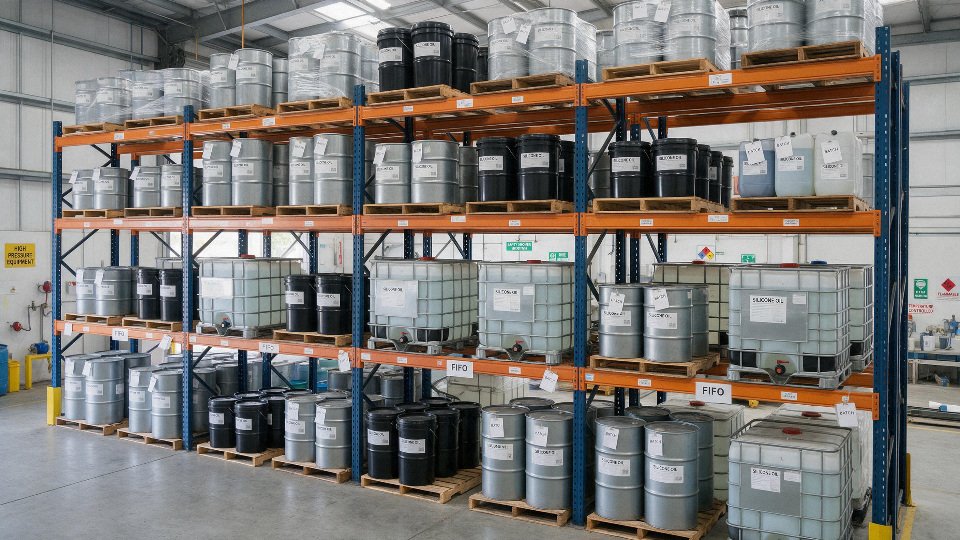
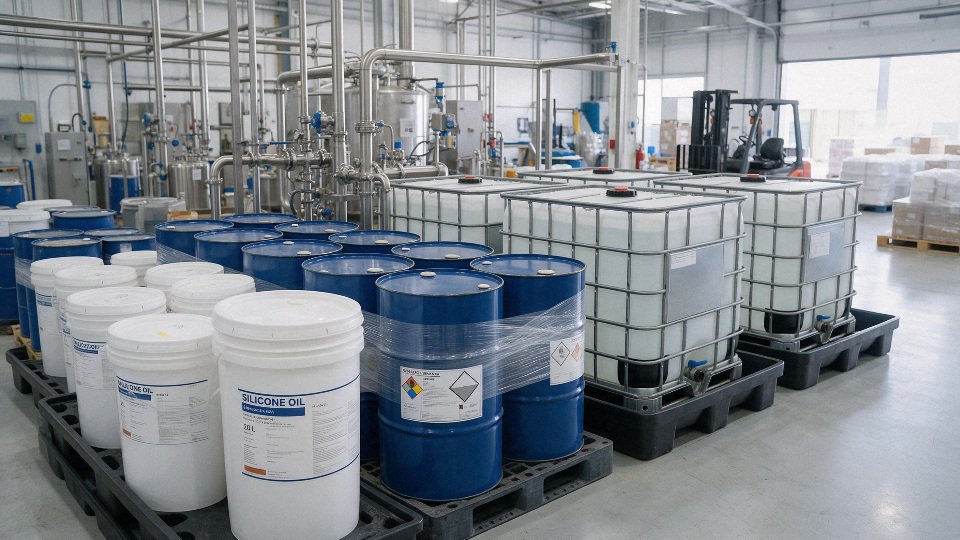
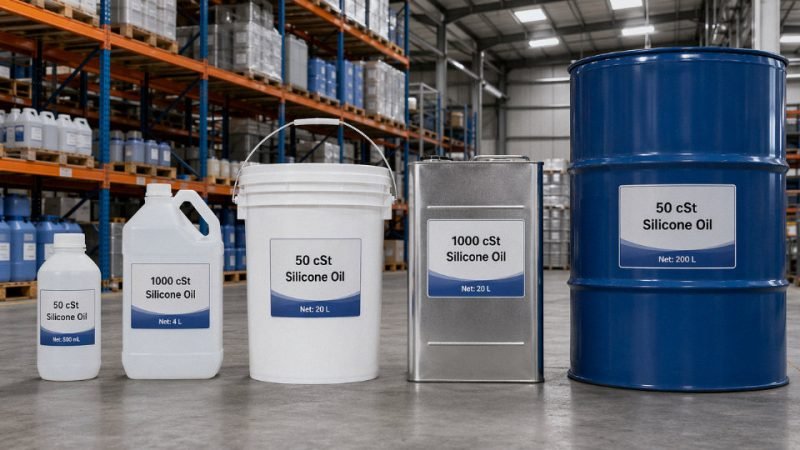
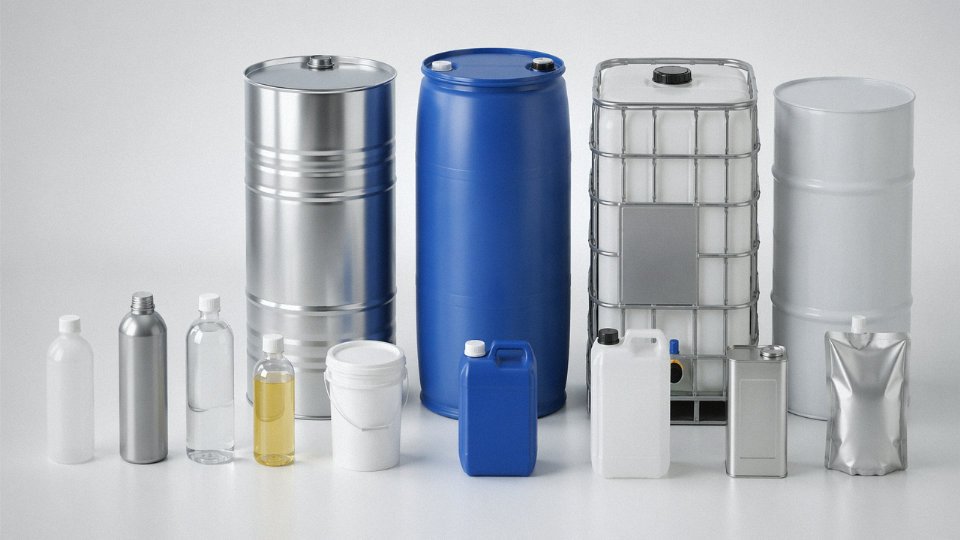
Silicone oil is available in containers ranging from 1 L sample bottles and 5 L pails up to 1,000 L IBCs, with 200 L steel drums being the dominant unit for industrial buyers. The right choice depends on viscosity grade, order volume, storage conditions, and whether the product requires UN-certified packaging for international shipment. Low-viscosity grades need vapor-tight closures; high-viscosity grades often come in lined fiber drums or wide-mouth pails.
What most procurement specs miss is that the packaging decision isn’t just about volume — it’s about the interaction between the fluid’s physical properties, your site’s dispensing setup, and the regulatory status of the specific blend you’re buying. A plain PDMCS fluid and a functional oil with amine or phosphate additives can look identical in a spec sheet but ship under completely different packaging requirements. That gap is where unexpected freight holds, customs delays, and storage losses tend to originate.
Small-Volume Laboratory and Specialty Containers: Bottles, Vials, and Cans from 100 mL to 20 L
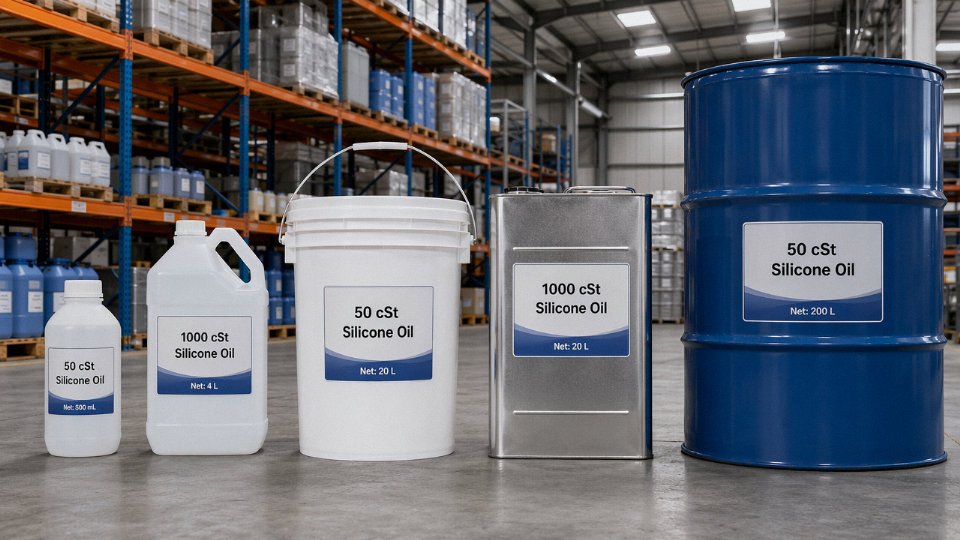
For R&D labs, cosmetics formulators, and electronics OEMs, the 200 L drum is simply the wrong unit of purchase. You might be developing a thermal interface compound, qualifying a medical device lubricant, or running diffusion pump trials — quantities in the range of 500 mL to 5 L are what you actually need, and the container choice matters more at this scale than most procurement teams realize.
HDPE Bottles: The Default for Most Lab and Light Industrial Use
High-density polyethylene handles PDMS well across most standard viscosity grades. The material is essentially inert to polydimethylsiloxane, and the slight translucency lets you check fill level without opening the container — a small but genuinely useful feature when you’re pulling small aliquots repeatedly over weeks. Sizes typically run 100 mL, 250 mL, 500 mL, 1 L, and 4 L, and most regional chemical distributors keep the 1 L and 4 L formats in stock without minimum order constraints.
The practical ceiling for HDPE is roughly 1,000 cSt. Above that, pouring from a 4 L bottle becomes frustrating and messy — you end up losing product on the bench, which matters when you’re paying specialty prices. For anything in the 5,000 cSt range or higher, a wide-mouth pail format starts making more operational sense even at small volumes.
Glass Bottles and Amber Vials: When Contamination Thresholds Are Tight
Pharmaceutical-grade and optical-grade silicone oils — USP-grade PDMS used for medical device lubrication or ophthalmic applications, for example — often can’t go into HDPE at all. Trace leachables from plastic, even at low ppb levels, can disqualify a batch in validation. Glass is the standard here. Amber glass specifically filters UV and matters for functional grades where photo-degradation of additives is a real concern, not a theoretical one.
USP-grade PDMS silicone oil must be packaged in glass to meet USP standardsFalse
USP-grade PDMS has purity requirements but the USP monograph does not universally mandate glass packaging; glass is often preferred by formulators and specified by end-user quality systems, but compliant HDPE containers are used by some suppliers depending on the application and validation approach.
Vial formats (typically 20 mL to 100 mL) show up in analytical and reference standard contexts, where you’re storing a certified viscosity reference fluid and opening the container maybe twice a year. Induction-sealed caps are standard here — both for tamper evidence and to block moisture ingress, which can shift the viscosity of moisture-sensitive functional grades over time.
Metal Tin Cans: Niche, But Worth Knowing About
For silicone-based diffusion pump fluids and high-performance heat-transfer fluids, some suppliers still package in steel or tinplate cans from 0.5 L up to roughly 5 L. The reason is straightforward: certain formulations contain additives or carrier fractions with solvent-like character that creates compatibility uncertainty with HDPE, and a metal can eliminates that question. It’s a conservative choice, and honestly in most routine PDMS applications you’ll never need it — but if you’re sourcing a specialty functional fluid for vacuum equipment and the supplier specifies tin, don’t try to substitute a plastic container to save a few cents on packaging cost.
Fluoropolymer Containers for Semiconductor-Grade Fluids
PTFE bottles or HDPE containers with fluoropolymer liners appear when the purity spec is extreme — semiconductor wafer processing environments where metallic and ionic contamination budgets are measured in parts per trillion. These containers are expensive, often 5–10× the cost of an equivalent HDPE bottle depending on size and liner specification, and lead times for custom fills in this format typically run 2–4 weeks with MOQs somewhere in the 10–50 unit range. Plan accordingly if you’re qualifying a new process fluid.
Labeling and Lot Traceability at Small Scale
At this volume tier, labeling compliance is where procurement teams sometimes get caught out. GHS pictograms and SDS references need to appear even on 100 mL bottles if the product is classified. Viscosity grade should be on the primary label, not just the technical data sheet — in a busy lab running multiple grades simultaneously, a mislabeled 100 cSt bottle used in place of 10 cSt can ruin a batch or a calibration run before anyone notices. Lot number and fill date, shelf-life date, and country-of-origin markings for customs clearance round out the requirement. For specialty or functional grades crossing international borders, verify whether the specific formulation triggers UN 3082 classification; some additive-containing silicone fluids do, and a shipment of amber vials without proper dangerous-goods marking will sit in customs longer than you want.
Mid-Volume Industrial Pails and Jerry Cans: 5 L to 30 L Format Guide
For most maintenance teams and small-to-mid-size compounders, this is the practical sweet spot — enough volume to avoid constant reordering, light enough that one person can handle it without mechanical lifting aids. The 5 L to 30 L range covers more real-world use cases than any other tier of silicone oil packaging, and the container choice matters more than buyers often expect.
HDPE Pails: The Default Workhorse
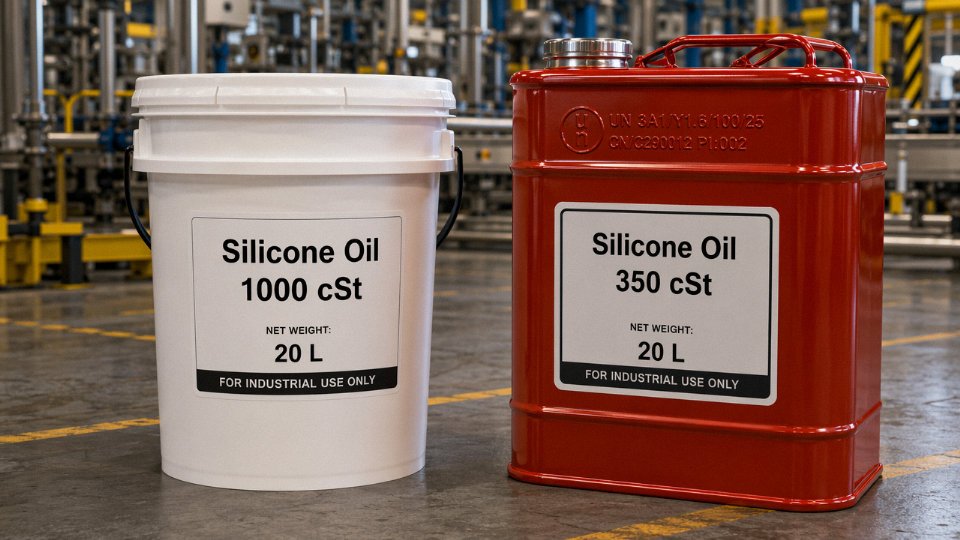
Standard 5 L and 20 L high-density polyethylene pails with bail handles dominate MRO purchasing for mold release agents, conveyor lubrication, and textile finishing applications. HDPE is chemically compatible with neat polydimethylsiloxane across the full viscosity range — from thin 5 cSt spindle oils up through 60,000 cSt compounds — and the bail handle makes repeated partial dispensing manageable on a production floor where workers are handling other things simultaneously. The 20 L pail in particular has become something close to a de facto standard for silicone fluids in these segments, largely because it fits neatly on a shelf, ships without special freight classification, and a standard EUR pallet holds 32 units at roughly 2 layers of 16 (4×4 configuration), netting somewhere around 600–650 kg of product per pallet depending on fluid density and exact fill level.
One practical note: HDPE pails are prone to paneling (sidewall distortion) if stored in direct sunlight or near heat sources above roughly 50–60 °C. In a hot press room or next to a vulcanization line, that’s a real concern. The lid seal loses integrity before the material itself is at risk.
Steel Pails: When the Environment Demands It
The 18 L (5 US gallon) steel pail is the right answer in any environment classified as ATEX Zone 1 or NEC Class I Division 1. Neat PDMS is non-flammable — that’s well established — but the moment you’re dealing with a blended functional fluid that incorporates hydrocarbon co-solvents for viscosity modification or carrier purposes, the flash point calculation changes entirely. Procurement teams sometimes specify HDPE across the board to simplify purchasing, then discover the EHS team flagged the storage area. Steel pails with grounding lugs eliminate that conversation. They’re heavier, cost more (usually $4–$10 more per unit than equivalent HDPE), and harder to inspect for fill level, but in the right environment they’re not optional.
Neat PDMS silicone oil is classified as non-flammable under standard GHS criteriaTrue
Pure polydimethylsiloxane has a flash point well above 300°C for most viscosity grades and does not meet flammability thresholds under GHS or DOT 49 CFR Part 173; however, blended formulations containing hydrocarbon solvents require individual assessment.
Jerry Cans and Cube Containers
Jerry cans — 10 L and 20 L, available in HDPE or steel — are common in automotive and aerospace MRO supply chains where the pouring ergonomics matter and containers often travel between plant locations or service depots. UN-approved jerry can formats (marked with the UN certification triangle and relevant hazard class) are required when the fluid is a blended additive-containing product subject to dangerous goods regulations. For standard neat silicone oils this usually isn’t triggered, but it’s worth confirming the SDS before ordering plain cans for a fluid you haven’t used before.
Collapsible cubitainers (10–20 L) serve a different purpose entirely: single-use cleanroom dispensing. You collapse the liner as the fluid is consumed, which eliminates the need to insert a drum pump and eliminates the contamination risk that comes with it. Electronics manufacturers and medical device compounders use these regularly. The cost premium over a rigid pail is real — typically 15–30% more per unit — but the avoided contamination event more than justifies it in a controlled environment.
Dispensing Fitments and Why They’re Underrated
Child-resistant caps are standard on most retail-oriented pails and largely irrelevant for industrial use. What matters on the plant floor is the dispensing fitment: a lockable spigot for controlled-dispensing stations, or a Flexi-Spout insert that creates a no-drip pour without requiring a separate pump. High-viscosity grades (above roughly 1,000 cSt) will not pour cleanly from a standard bail-handle pail without some form of fitment — you end up with product running down the outside of the container, which is a waste and a slip hazard. This is one of those details that gets overlooked at the purchasing stage and becomes a maintenance supervisor’s recurring complaint.
Cost and Break-Even Logic
The packaging increment for a 20 L HDPE pail runs roughly $3–$8 per unit above bulk pricing, depending on supplier, order volume, and whether you’re sourcing domestically or importing. The break-even against purchasing in 200 L drums typically occurs somewhere above 200 L of silicone oil per delivery cycle — below that, the per-liter cost of pails is often competitive with drums once you factor in drum pump cost, cleaning requirements, and the dead inventory sitting in a partial drum. Above that threshold, drums almost always win on unit economics, though pails retain a handling and dispensing convenience that some operations genuinely value enough to pay for.
Standard 200-Liter Steel Drums: Specifications, Closures, and Handling Requirements
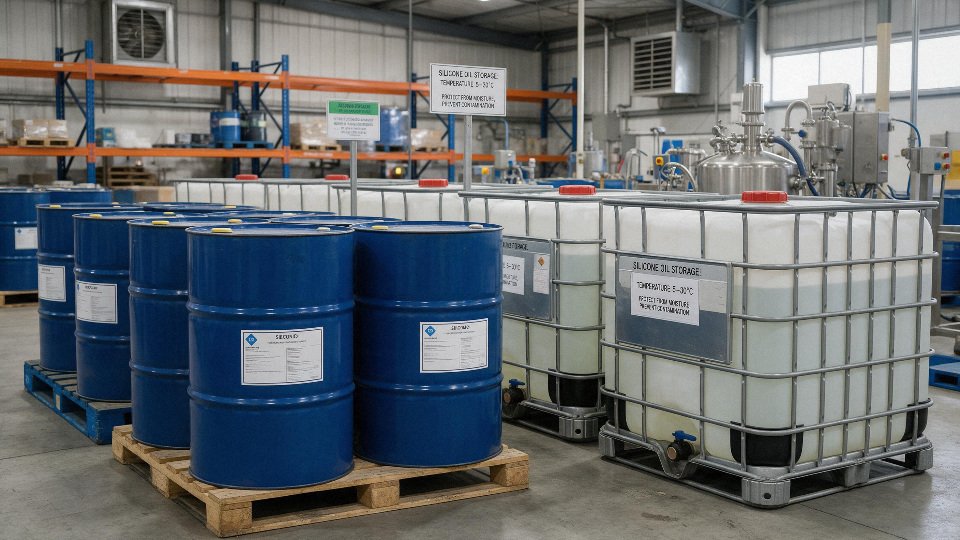
The 200 L closed-head steel drum — the “55-gallon drum” in North American parlance — is the dominant bulk unit for silicone oil globally, and for good reason. It threads the needle between manageable handling weight and meaningful fill volume, fits standard pallet footprints, and is universally understood by freight carriers, customs brokers, and warehouse operators alike. If you’re procuring industrial PDMS in any quantity above a few hundred liters, this is almost certainly the format you’re dealing with.
Drum Construction and UN Certification
Standard drums for silicone oil are 1A1 closed-head bung-type steel drums, fabricated from cold-rolled steel at 0.9–1.2 mm wall thickness depending on the manufacturer and target market. The 1A1 designation under UN performance testing certifies these drums for net contents up to 250 kg — relevant because high-viscosity silicone oils can run heavier than water per unit volume at certain grades. Open-head 1A2 drums do appear in the silicone market, but almost exclusively for greases, silicone compounds, and ultra-high-viscosity fluids above roughly 100,000 cSt, where you simply cannot pump the product out through a bung and need direct access with a spatula or paddle.
Internal Linings: Match the Grade, Not Just the Product Family
Unlined steel is perfectly acceptable for standard polydimethylsiloxane at most viscosity grades — PDMS is not particularly aggressive toward mild steel under normal storage conditions. Where you need to specify otherwise is when purity requirements enter the picture. Food-contact and pharmaceutical applications require epoxy-phenolic lined drums to comply with FDA 21 CFR 178.3570 and equivalent EU food-contact regulations; the lining prevents trace iron migration that, while trivial for a textile lubricant, is not acceptable when the fluid is going into a food processing release application or a topical cosmetic. Electronic-grade silicone oils, particularly those destined for semiconductor or display manufacturing, typically ship in drums with a loose polyethylene liner inside the steel shell — belt and suspenders, essentially, because even a compliant epoxy lining can contribute ionic contamination at the ppb levels that matter to a chip fab.
Reconditioned steel drums are UN-certified acceptable for industrial silicone oil fills.True
UN regulations permit R-grade reconditioned drums for non-food, non-pharmaceutical industrial liquids provided the drum passes hydraulic and drop testing to the original 1A1 standard. The prohibition applies only to regulated applications such as food-contact, pharmaceutical, and high-purity electronic grades.
Reconditioned (R-grade) drums are commercially normal for industrial silicone oil. Suppliers use them routinely, and from a quality standpoint they’re fine for lubricant, mold release, and general industrial grades. Just don’t let a purchasing shortcut push R-grade drums into a food or pharma fill line — that’s a compliance failure waiting for an audit.
Closure Configuration and Torque
The standard closure arrangement is a 2-inch NPT bung for filling and dispensing, paired with a 3/4-inch NPT vent bung on the opposite side of the drum head. Transport seal integrity depends on proper torque: 80–120 N·m is the accepted range, and under-torqued bungs are one of the more common causes of in-transit leakage. Gasket material matters more than people expect — EPDM and PTFE-faced gaskets both offer broad compatibility with PDMS across the full viscosity range, though PTFE-faced is the safer call for any specialty blend containing functional additives, where unknown extractables from the gasket can be a real problem.
Dispensing: Pump Selection by Viscosity
Getting silicone oil out of a 200 L drum without making a mess or damaging the fluid requires matching the pump to the viscosity grade. Low-viscosity grades below roughly 100 cSt flow freely enough that gravity-feed through a bottom-mounted ball valve is workable, though you’ll want a tight shut-off to avoid drips. Mid-range grades from about 350 to 12,500 cSt are the natural territory for air-operated diaphragm (AOD) pumps — they handle variable back-pressure well and don’t shear sensitive silicone chains the way gear pumps can at high RPM. Above 10,000 cSt, and certainly above 60,000 cSt, a drum-mounted gear pump with a follower plate is the practical answer, because at that viscosity the fluid simply will not move on its own and an AOD pump will cavitate.
Palletization and Storage
Four 200 L drums per EUR pallet is the standard configuration, banded with two polyester straps and stretch-wrapped to at least 200% overlap. Maximum safe stack height in warehouse storage is generally two pallets — eight drums — though this depends on rack design and floor load rating. In warm climates or heated warehouses, even low-viscosity silicone oils are stable; thermal cycling isn’t the concern it would be with water-based products. The practical storage hazard is drum denting from forklift tine contact, which can deform the bung seat and compromise seal integrity on the next fill cycle.
Label Requirements and Regulatory Markings
Every drum shipped internationally carries UN markings, gross and net weight, viscosity grade designation, manufacturer lot code, production date, and country of manufacture. For EU customers, REACH compliance statements and increasingly RoHS declarations are expected on the drum label itself — not just in the SDS. This is worth confirming with your supplier before the first shipment rather than discovering it during an incoming goods inspection.
On packaging cost: the premium for a new lined drum over a standard unlined new drum runs roughly $15–35 per drum depending on liner specification and order volume; the actual range depends heavily on steel commodity pricing at the time of order. Using a deposit-and-return system for reconditioned drums can reduce net packaging cost by 40–60% over the life of a supply relationship, which sounds significant and actually is at scale — on a 500-drum annual program, that’s real money.
Intermediate Bulk Containers (IBCs): 1,000-Liter Totes for High-Volume Procurement
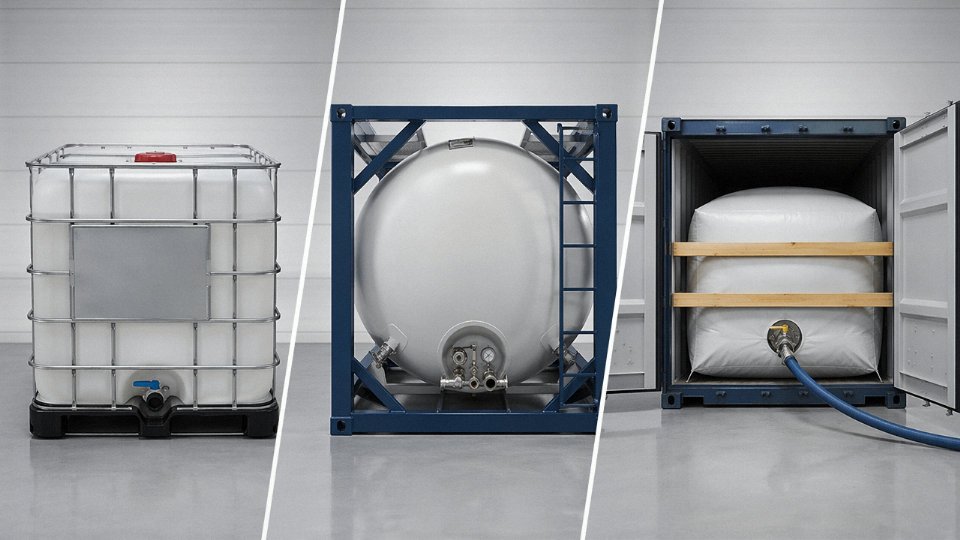
For any operation consuming more than a few drums per month, the IBC tote is where the economics start to make real sense. One 1,000 L composite IBC replaces five 200 L drums — fewer lifts, fewer closures to torque, fewer labels to manage, and one connection point to your process line instead of five. The efficiency argument is straightforward, but the operational constraints are real and worth understanding before you commit to tote-quantity purchasing.
IBC Construction: Composite vs. Stainless Steel
The vast majority of silicone oil shipments in IBC format use composite IBCs — an HDPE inner bottle nested inside a galvanized steel cage, sitting on a timber or plastic pallet. For unfilled PDMS grades across essentially the entire viscosity range (0.65 cSt up through the heavier 60,000 cSt grades), standard HDPE is chemically compatible and handles the job without issue. These composite units are what you’ll receive from most industrial silicone distributors unless you specify otherwise.
Stainless steel IBCs — Grade 316L specifically — enter the picture for pharmaceutical-grade dimethicone and ultra-high-purity electronic fluids where metal ion contamination limits are tight and cleaning validation is required. They cost substantially more to procure and to return-ship, and in practice most pharmaceutical buyers find single-use polyethylene liners inside composite IBCs to be a more practical answer: you get a fresh, uncontaminated contact surface every fill, and you skip the IBC reconditioning headache entirely.
For reactive functional silicone fluids — amino-functional, epoxy-functional, or hydrogen-functional grades — fluoropolymer-lined IBCs are available and worth the premium. Standard HDPE can show slow adsorption of certain functional groups over long dwell times, which matters when the fluid’s reactivity is precisely what you’re paying for.
Capacity, Weight, and Forklift Handling
Nominal capacity is 1,000 L, but net fill for silicone oil typically lands between 950 and 980 kg, depending on the specific grade’s density — most PDMS grades run 0.94 to 0.98 g/cm³. Total gross weight, including the IBC itself (usually 55–70 kg for a composite unit), stays comfortably under 1,200 kg. That matters because a standard 2-tonne rated counterbalance forklift handles it without difficulty, but your floor loading calculation and racking specs still need to account for that gross weight. Don’t assume — check the rack dataplate.
Valve and Outlet Selection by Viscosity
This is where buyers sometimes get caught out. A standard 2-inch butterfly valve works fine for grades up to roughly 10,000 cSt, but above that, flow rate through a 2-inch port becomes a real problem — you’re waiting a long time or pumping against significant resistance. For higher-viscosity grades, specify a 3-inch or 4-inch ball valve with a DN80 camlock fitting. The top-fill opening (typically 150 mm NW) handles drum-to-IBC transfer or top loading from a bulk tanker.
A 2-inch butterfly valve is adequate for silicone oils above 60,000 cStFalse
High-viscosity PDMS grades above roughly 10,000–20,000 cSt require 3-inch or larger outlet valves to achieve practical flow rates; a 2-inch valve on thick-grade silicone oil produces extremely slow discharge and risks pump cavitation or incomplete drainage.
Heated IBCs for High-Viscosity Grades
Grades above roughly 60,000 cSt often won’t flow at ambient temperature without heating. Electric jacket systems or hot-water heated IBC blankets running at 40–60°C are the usual solutions. Budget lead time for this equipment if it’s not already on your floor, and factor in the warm-up period — depending on ambient temperature and jacket type, reaching pumpable viscosity can take two to four hours. In cold climates, unheated composite IBCs stored outside below 0°C need insulated covers just to prevent the HDPE bottle from becoming mechanically stressed during temperature cycling, even if the silicone itself doesn’t freeze.
IBC Pooling, Rental, and Return Logistics
Major IBC pooling operators — SCHÜTZ, Greif, and Mauser Group being the most widely encountered globally — run rental and reconditioned-IBC programs that reduce per-unit capital cost. For most industrial silicone oil applications, reconditioned IBCs are acceptable and cost-effective, provided the reconditioning standard matches your contamination tolerance. For food-contact or pharmaceutical applications, that’s a non-starter: one-trip (new) IBCs are effectively mandatory, and your QA team will require documentation to that effect.
Return logistics deserve a procurement conversation upfront. Totes are bulky empties and return freight is rarely free. Composite IBCs reduce packaging waste per liter by roughly 30–40% compared to equivalent drum volumes, but the empty tote still needs to go somewhere — either back into a pool program, to a reconditioner, or to scrap. Factor that into your total landed cost model; it’s easy to overlook and occasionally turns a tote-economics argument thinner than expected.
Warehouse Footprint and Storage
Composite IBCs are generally not stackable without purpose-built racking rated for the purpose — stacking one loaded tote on another is a safety violation and a collapse risk. Plan on roughly 1.2 m × 1.0 m of floor footprint per tote. For a warehouse running 20 totes in active storage, that’s a real chunk of floor space, and it’s worth mapping before the first delivery arrives rather than after.
Bulk Tanker and Flexitank Shipments: When and How Silicone Oil Moves Without Rigid Containers
At a certain volume threshold, rigid containers stop making economic sense. The handling labor, the empty drum disposal costs, the IBC cleaning cycles — it all adds up. For buyers regularly moving 15 tonnes or more of PDMS per delivery, bulk liquid transport is usually the right answer, and the format you choose has real consequences for delivered cost, contamination risk, and seasonal reliability.
Road Tanker Delivery: Domestic and Regional Bulk Moves
Standard road tankers used for silicone oil run 15,000–30,000 L depending on chassis configuration and regional axle-weight limits — the actual usable volume on any given route often comes down to bridge laws more than tank geometry. Stainless steel (304 or 316L) is the preferred material for food, pharma, and personal care grades. Mild steel with a phenolic or epoxy lining is acceptable for industrial PDMS where trace metal pickup isn’t a disqualifying concern, though I’ve seen lining failures cause real grief when a liner starts flaking into a batch.
Minimum order quantities typically land around 15 tonnes — roughly a half-load on a standard tanker — because suppliers aren’t going to deadhead a vehicle or clean a tank for a marginal delivery. Full tanker loads give you better freight rates per kilogram, but you’re committing warehouse space or a receiving tank, which not every plant has.
One practical issue that doesn’t get enough attention: unloading time. High-viscosity grades — say, anything above 5,000 cSt — can take two to four hours to transfer at ambient temperature depending on pump capacity and line diameter. If your receiving bay isn’t set up for that, you’re paying the driver to sit.
ISO Tank Containers: Intercontinental Freight of Standard PDMS Grades
For cross-border and intercontinental shipments, T11 or T14 ISO tanks are the dominant format for standard-viscosity PDMS. A 20-foot ISO tank holds roughly 20,000–24,000 L depending on product density, and cost per liter typically runs 30–50% below IBC economics once you’re above the 15,000 L crossover point. That spread depends heavily on origin, destination, and demurrage exposure — sitting tanks at a congested port eat margin fast.
Documentation requirements are real. You need the bill of lading specifying grade and viscosity, a certificate of analysis, the tank inspection record (T-certificate), and for EU imports, the relevant REACH registration number for the PDMS polymer. Customs in some markets also want a certificate confirming the tank has been cleaned to PCD (prior cargo declaration) standards.
Silicone oil contamination from trace residue in a previously used tanker can affect subsequent cargo even after standard cleaning procedures.True
PDMS has extremely low surface energy and adheres tenaciously to metal walls. Even after hot-wash cleaning cycles, silicone residue in ppb-range concentrations has been documented in subsequent loads — sufficient to cause coating defects or foam stabilization issues in sensitive downstream processes.
Flexitanks: Lower Cost, Real Viscosity Limits
Flexitank systems — single-use polyethylene bladders fitted inside a standard 20-foot dry container — have become increasingly common for mid-viscosity silicone oils in the 50–1,000 cSt range. Usable capacity runs 16,000–24,000 L. The cost advantage over ISO tanks is genuine, partly because you’re not paying tank lease or return logistics.
The hard limit is viscosity. Above roughly 5,000 cSt, flexitanks become impractical without supplemental heating, and even then you’re fighting slow transfer rates and incomplete discharge — residual product sticking to the bladder walls is a real loss issue. Flexitanks are also single-use, so the environmental trade-off matters if your procurement policy accounts for it.
Heating Requirements and Cold-Weather Operations
Most silicone oils above 10,000 cSt need heated transfer infrastructure. Road tankers serving these grades typically carry steam coils or electric trace heating, and delivery temperature is usually held between 40–80°C depending on viscosity and ambient conditions. In practice, a European winter delivery of a 60,000 cSt compound to an unheated warehouse dock is a logistics headache that needs to be planned, not improvised. Insulated tanker jackets help, but they’re not a substitute for a proper heated receiving line.
Dedicated Fleets and Cross-Contamination Risk
Silicone oil’s reputation for being nearly impossible to fully remove from tanker walls is well-earned. For food-contact, pharmaceutical, or personal care grades, dedicated tanker fleets are standard practice, not a premium option. The cost premium for a dedicated or silicone-history-only tanker is real, but it’s far less than a batch rejection or a customer recall. Any supplier offering food-grade PDMS via shared-fleet transport without rigorous PCD documentation and cleaning validation deserves a hard question on your next audit.
Packaging Material Compatibility Matrix: Matching Viscosity Grade and Application to Container Type
Selecting the wrong container for a given silicone oil grade isn’t just an administrative inconvenience — it shows up as contamination, yield loss, or a regulatory hold at customs. The matrix below consolidates the practical logic that experienced procurement managers and plant chemists already carry in their heads, but rarely see written down in one place.
Low-Viscosity Grades (0.65–10 cSt)
These grades behave more like solvents than lubricants. Vapor pressure is measurable, particularly below 5 cSt, and ordinary screw-cap bottles will allow slow losses and potential cross-contamination in storage. The correct answer is induction-sealed HDPE bottles or amber glass with PTFE-lined caps for lab quantities; for bulk movement, ISO tank containers or flexitanks work because the product transfers easily and the closed system limits evaporative loss. Standard open-bung steel drums are technically possible but not advisable for anything below about 5 cSt unless the drum is completely full and shipped quickly. Shelf life in poorly sealed containers drops fast in warm climates — worth specifying this to a supplier if you’re in Southeast Asia or the Middle East.
Mid-Viscosity Grades (20–1,000 cSt)
This is where packaging flexibility peaks. The 50 cSt, 100 cSt, and 350 cSt grades that dominate global silicone oil trade will tolerate nearly any format — HDPE bottles, steel or plastic pails, standard 200 L drums (tight-head or open-head), composite IBCs, flexitanks, ISO tanks. The product is fluid enough to pump through standard 2-inch fittings without heating, stable under normal warehouse temperature swings, and not volatile enough to demand heroic sealing. Most of the world’s silicone oil moves in this viscosity band inside standard 200 L closed-head steel drums with a PE or unlined interior, which is why it’s such a deep, liquid (no pun intended) secondary market for containers.
High-Viscosity Grades (5,000–60,000 cSt)
Pourable at 20°C, but slowly — and below about 10°C, pump-out from a tight-head drum becomes genuinely difficult. Open-head drums with large-bore discharge fittings or full-open covers are the practical choice. PE drum liners do real work here: recovery rates from lined drums run noticeably higher than from bare steel, and cleaning out residual high-viscosity fluid from an unlined drum before reconditioning costs time and solvent. IBC totes require either a heated jacket or a heated storage bay in cold climates; unheated IBCs of 60,000 cSt product sitting on a concrete floor in January in northern Europe or the upper Midwest can become almost unpumpable.
Ultra-High-Viscosity Grades (100,000 cSt to Gum Consistency)
At 300,000 cSt and above, you’re not really dealing with a liquid in any normal handling sense. Open-head steel drums with fitted PE liners, fiber drums with PE liners, and rigid plastic pails are the standard formats. IBCs are not suitable without substantial heating infrastructure that most facilities don’t have. Flexitanks and ISO tanks are impractical. Product recovery is the dominant packaging concern — even with a liner, some material stays behind. For silicone gum or high-consistency rubber base, some suppliers ship in large PE-lined corrugated boxes or wooden crates lined with film bags, which is worth knowing if your incoming goods handling isn’t set up for non-standard packaging.
Food-Contact Grades
Food-contact silicone oil (FDA 21 CFR, EU 10/2011 compliant) must be packed in new, never-reconditioned containers with documented liner and coating compliance from the packaging manufacturer.True
Reconditioned drums carry contamination risk from previous contents that cannot be fully verified; food-contact regulations require full traceability of all materials in contact with the product, including the container itself.
Epoxy-phenolic or PE-lined steel drums and food-grade composite IBCs are the accepted formats. The documentation requirement is often underestimated: you need a compliance statement from the drum or IBC manufacturer, not just from the silicone oil supplier. Auditors from food customers will ask for both. No reconditioned containers, no exceptions in a properly run supply chain.
Pharmaceutical and Medical Device Grades (USP Class VI, ISO 10993)
Glass bottles remain the default for small quantities because glass is chemically inert and the extractables profile is well understood. Larger quantities — filling lines, compounding operations — typically use 316L stainless steel vessels or single-use PE liner bags inside rigid secondary containers. Controlled humidity storage is specified because moisture ingress affects viscosity stability over time. Full batch traceability extends to the container: lot numbers on bottles, liner certifications, and in some cases a certificate of conformance from the packaging supplier as a standalone document separate from the CoA on the oil itself.
Electronic and Semiconductor Grades
Particle count matters here, not just chemical purity. Fluoropolymer-lined containers or PTFE bottles are standard for quantities up to a few liters. Larger volumes use nitrogen-blanketed, cleanroom-assembled containers — typically with a certification of particle counts on the packaging itself, not just the fluid. If a supplier can’t provide that documentation, the product is probably not appropriate for semiconductor fab use regardless of the stated purity spec.
Summary Compatibility Table
| Grade / Type | Bottle (≤20 L) | Pail (5–30 L) | 200 L Steel Drum | IBC (1,000 L) | Flexitank | ISO Tank |
|---|---|---|---|---|---|---|
| 0.65–10 cSt (low viscosity) | ✓ (induction seal required) | ✓ (vapor-tight only) | Conditional | Conditional | ✓ | ✓ |
| 20–1,000 cSt (mid viscosity) | ✓ | ✓ | ✓ | ✓ | ✓ | ✓ |
| 5,000–60,000 cSt (high viscosity) | ✓ | ✓ | ✓ (open-head preferred) | ✓ with heating | Not recommended | Not recommended |
| 100,000 cSt+ / gum | ✓ | ✓ | ✓ (open-head + liner) | Not recommended | Not suitable | Not suitable |
| Food-contact grade | ✓ (new only) | ✓ (new only) | ✓ (new, lined, documented) | ✓ (new, food-grade) | Not recommended | Conditional |
| Pharma / medical grade | ✓ (glass or SS) | Single-use liner only | Not recommended | Not recommended | Not suitable | Not suitable |
| Electronic / semiconductor | ✓ (PTFE / fluoropolymer) | Cleanroom-packed only | Not recommended | Not recommended | Not suitable | Not suitable |
“Conditional” in this table means technically feasible but dependent on temperature, transit time, or supplier capability — not a default choice. When in doubt about food or pharma grades especially, a wrong container choice discovered at a customer audit is a far more expensive problem than the incremental cost of specifying correctly from the start.
Labeling, Regulatory Marking, and Documentation Requirements Across Packaging Formats
Getting the product itself right and then shipping it in a mislabeled or under-documented container is a surprisingly common source of customs holds, customer complaints, and internal mis-application incidents. Labeling is not an afterthought — it is part of the product’s chain of custody, and for silicone oil specifically, the requirements vary significantly depending on whether you are shipping neat PDMS or a functional blend, and where it is going.
GHS Classification: Not All Silicone Oils Are Equal
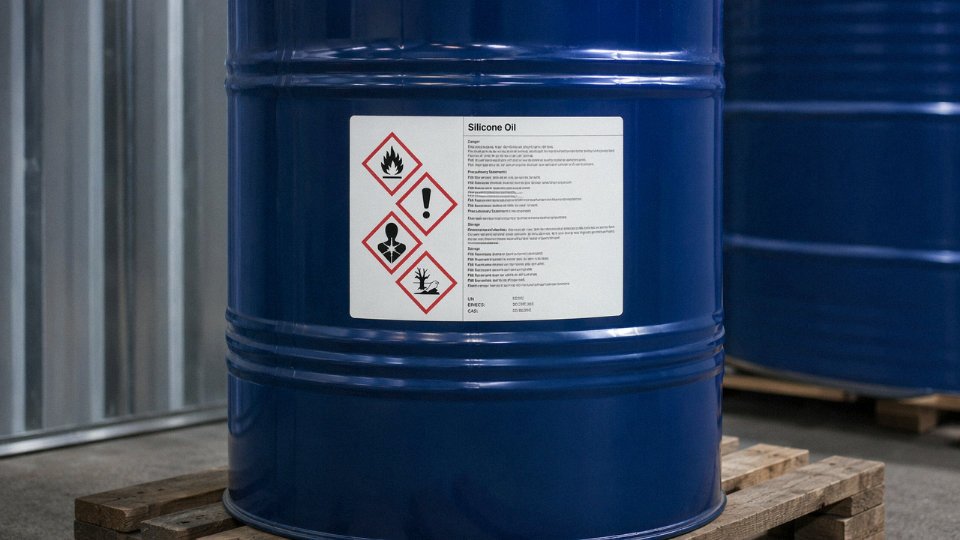
Pure polydimethylsiloxane in the 5 cSt to 60,000 cSt viscosity range is generally classified as non-hazardous under GHS. No pictogram, no signal word, clean label. That changes fast once you introduce hydrocarbon carrier solvents, reactive functional groups (amino, epoxy, vinyl), or cyclosiloxane content above threshold limits. A blend cut with a petroleum-derived solvent may trigger the flammable liquid classification or the chronic aquatic hazard pictogram, depending on the solvent flash point and concentration. At that point, the label must carry all required GHS elements: product identifier, supplier block, signal word, hazard statements, and precautionary statements — and the print must be legible at the point of use, not just technically present. In practice, labels printed on glossy polyethylene drums in poorly lit warehouse environments are often borderline illegible within six months of outdoor storage. Specify UV-resistant labels in your supplier quality agreement if drums will sit in a yard.
UN Dangerous Goods Marking
Neat PDMS generally ships non-regulated. Blended functional silicone oils — particularly those formulated with additives that trigger environmental hazard classifications — may fall under UN 3082, Environmentally Hazardous Substance, Liquid, N.O.S., Packing Group III. When that applies, every outer packaging unit (drum, IBC, carton) must display the UN number, the proper shipping name, the packing group diamond, and gross weight. Forgetting the gross weight marking is a recurring issue with relabeled drums at third-party distributors. Carriers, particularly sea freight forwarders operating under IMDG Code, will reject or re-label at shipper’s cost.
Pure PDMS silicone oils with no additives or reactive functional groups are typically not classified as dangerous goods under IMDG, ADR, or IATA regulations.True
Major producer SDS documentation (Dow, Shin-Etsu, Wacker) consistently classifies neat PDMS as non-dangerous for transport. Functional or blended silicone oils require individual assessment based on formulation.
Viscosity Grade Identification
This one is operational, not regulatory, but the consequences of ignoring it can be severe. A 10,000 cSt fluid in an unlabeled or generically labeled drum, sitting next to 100 cSt drums in a multi-grade facility, is a mis-pour waiting to happen. Wrong viscosity in a release agent application or a transformer cooling circuit is not a minor quality issue. Best practice — and several major producers already do this — is to print the viscosity grade in a font large enough to read from a drum trolley, ideally 14–16pt bold on a contrasting background, and repeat it on both the side label and the closure tag.
Lot Traceability and Digital CoA Integration
Dow, Shin-Etsu, Momentive, and Wacker have all moved toward 2D QR codes on drum and IBC labels that link directly to real-time or downloadable certificates of analysis. This is genuinely useful in procurement: a receiving inspector can verify refractive index, viscosity at 25°C, and flash point against the specific lot — not just the generic grade spec — before the drum moves to the production floor. If your current supplier is not offering this, it is worth asking for a batch-specific CoA tied to the drum serial number at minimum.
REACH and EU Import Documentation
Shipments entering the EU require an SDS in the official language of the destination country — not English, unless the destination is Ireland or Malta. The SDS must list REACH registration numbers for any substance present above 0.1% w/w on the candidate list of substances of very high concern. D4 (octamethylcyclotetrasiloxane) and D5 (decamethylcyclopentasiloxane) are restricted under REACH for wash-off cosmetic applications and carry registration obligations even in non-cosmetic industrial products if present above threshold. The REACH registration number also needs to appear on the commercial invoice for customs clearance in some member states — check with your EU customs broker, because enforcement varies.
China GB Standard Requirements
Exports to China require compliance with GB/T 22267 for silicone oil products, which means the product standard number must appear on the label. The SDS must be in Chinese (Mandarin). Packaging that does not carry the GB standard reference has been held at Chinese ports, particularly at Shanghai and Tianjin, and the cost of re-documentation or re-export from bonded storage adds up quickly. If you are supplying a Chinese customer through a trading company, confirm explicitly who carries responsibility for GB-compliant labeling — it is frequently ambiguous until something goes wrong.
Food-Contact and Pharmaceutical-Grade Documentation
This is the most paperwork-intensive category. A lot shipping as food-grade or pharma-grade silicone oil should arrive with a lot-specific CoA, a material safety certificate, a packaging certificate of compliance confirming the liner and any drum coating meet FDA 21 CFR or EU Regulation 10/2011 for food contact materials, and a stated shelf life from date of manufacture. The shelf life statement matters more than most buyers realize — silicone oil itself is stable for years, but a liner that was compliant when manufactured may not be if the drum has sat in a distributor’s warehouse for 18 months in ambient heat. Get the packaging certificate dated per lot, not just per liner material specification.
Sustainability, Packaging Waste Reduction, and Circular Economy Practices in Silicone Oil Supply Chains
Packaging sustainability has moved from a procurement afterthought to a line item on RFQ scorecards. ESG reporting pressure from multinational buyers, tightening EU regulation, and real cost incentives around drum logistics are all pushing silicone oil distributors and their customers to rethink single-use packaging. The business case is clearer than it used to be — though execution on the plant floor is messier than the sustainability brochures suggest.
Drum Return and Recertification Programs
The three dominant industrial drum suppliers — Greif, Mauser, and Schütz — all operate closed-loop reconditioning networks, though coverage varies significantly by region. A reconditioned steel drum can realistically achieve 3–5 reuse cycles before the shell is scrapped, and that matters: lifecycle analyses typically show embodied carbon per liter delivered drops somewhere in the range of 40–60% versus buying virgin drums each time, depending on transport distances between the reconditioning facility and your plant, and on the energy mix of the reconditioner.
Reconditioned steel drums from certified programs reduce embodied carbon per liter of silicone oil delivered by up to 60% versus single-use virgin drumsTrue
This range is consistent with published lifecycle assessments from Mauser Group and independent packaging LCA studies, and accounts for avoided steel manufacturing emissions. The actual figure varies with transport distance and energy source at the reconditioning facility.
In practice, participation requires your supplier to have a return logistics agreement in place. If you’re buying ex-works from a warehouse in an industrial estate that has no drum-return contract, the drums are going to waste-haulers or scrap dealers regardless of what the sustainability policy says. Ask specifically: does your supplier participate in a certified drum return program, and can they document the reconditioning cycle count?
IBC Pooling and Stainless Steel Totes
Composite IBCs — the standard HDPE-bottle-in-steel-cage format — are theoretically reusable, but single-use behavior is common in markets where logistics for empty-return are poorly organized. Managed pool programs from operators like Schütz ECOBULK can push reuse rates to 8–12 cycles before the inner bottle is replaced and the cage recertified. That keeps roughly 9 kg of steel framing and 10 kg of HDPE out of the waste stream per IBC per avoided single-use cycle. Not trivial when you’re moving hundreds of totes per year.
Stainless steel IBCs are a different category entirely. With proper cleaning protocol — hot water rinse, validated for silicone oil residue — service lives of 20 years or more are realistic. For high-viscosity grades (think 60,000 cSt and above) where residue clings to internal surfaces, cleaning validation is worth spending time on. A liner change is cheaper than a contamination event.
Flexitanks: The Hard Problem
Single-use PE flexitanks generate roughly 25–35 kg of mixed polymer waste per shipment. Some logistics providers have introduced take-back programs for PE film recycling, but availability is patchy — largely concentrated in Western Europe and parts of East Asia. If your supply chain terminates in Southeast Asia or South America, there is often no practical recycling outlet, and the flexitank ends up landfilled or incinerated. Honest answer: flexitanks are convenient and economical for certain high-volume routes, but their sustainability case is weak unless your logistics provider can document actual film recycling, not just collection.
ISO Tanks and the Long-Term Carbon Math
For buyers with sufficient volume — typically above roughly 20 tons per shipment on a recurring lane — ISO tanks make a compelling sustainability argument. Reused over 15–20 years, lifecycle carbon per liter delivered runs approximately 70–80% lower than single-use drum alternatives on high-frequency routes. The upfront complexity (tank cleaning, certification, depot availability) is real, but ESG-focused multinationals buying PDMS at scale are increasingly treating ISO tank access as a supplier qualification criterion rather than a logistics detail.
Lightweighting and Material Innovation
Thinner-wall steel drums — 0.9 mm versus the older 1.2 mm standard — can reduce steel content per drum by roughly 15% while still achieving UN certification, provided the drum design is engineered accordingly. It is a meaningful reduction at high volumes. Hybrid fiber-composite drums for non-hazardous PDMS grades are in development with several European packaging manufacturers; they haven’t broken through commercially yet as of 2024, but the testing data for non-reactive, non-flammable silicone oil grades looks promising. Worth watching if you’re locking in long-term supply agreements.
Regulatory Pressure and Supplier Evaluation
The EU’s revised Packaging and Packaging Waste Regulation (PPWR), proposed in 2024, will require industrial packaging producers and importers to report packaging waste volumes and hit recycled content targets by 2030. Silicone oil distributors selling into the EU are starting packaging audit programs now — partly compliance-driven, partly because large chemical buyers are already demanding it in procurement questionnaires.
When you’re issuing an RFQ for silicone oil in volume, consider requesting: packaging-related Scope 3 emissions data (increasingly available from larger suppliers), recycled steel content percentage in drums, and documented participation in a certified drum or IBC return program. Not every supplier will have this data ready. The ones who do are generally running tighter operations overall.
Frequently Asked Questions About Silicone Oil Packaging
Can silicone oil be stored in plastic containers long-term?
For standard PDMS grades — the clear, odorless fluid most industrial buyers are working with — HDPE containers are fully compatible and will hold up well for 24 months or more provided the closure stays sealed. Avoid PVC and polystyrene entirely; both absorb low-molecular-weight siloxanes and can leach plasticizers back into the fluid, which matters enormously in electronics and personal care applications where trace contamination causes real downstream defects. For ultra-pure or semiconductor-grade silicone oil, PTFE-lined containers or borosilicate glass are the practical choices. HDPE is fine for most plant maintenance and compounding use cases, but if you’re buying food-grade or optical-grade fluid, the container certificate needs to come with the product, not be an afterthought.
What is the shelf life of silicone oil in a sealed 200 L drum?
Typically 24–36 months from the production date, assuming the drum is stored sealed, between roughly 5°C and 40°C, away from UV exposure and standing moisture. Low-viscosity grades below about 5 cSt are the exception — their shelf life is closer to 18–24 months because the lighter fractions have higher vapor mobility and can migrate through compromised seals more readily than a 350 cSt fluid ever would. In practice, most facilities rotate stock well within this window, but if you’re carrying safety stock through a winter shutdown, it’s worth marking the fill date on the drum yourself rather than relying solely on the label.
Do I need UN-certified packaging for silicone oil?
Neat PDMS silicone oil is generally classified non-hazardous and does not require UN-rated packaging for road or sea freight. The situation changes with functional blends. Formulated release agents, reactive silicone fluids, products containing cyclosiloxanes above regional regulatory thresholds (D4/D5 concentrations are increasingly regulated in the EU), or anything cut with a hydrocarbon co-solvent may require UN 3082 or another classification depending on the specific chemistry. The only reliable source of truth here is SDS Section 14 — not the product name, not the viscosity grade, not what the previous supplier used.
Neat polydimethylsiloxane (PDMS) silicone oil is classified as non-hazardous under UN transport regulations in the absence of reactive additives or regulated co-solvents.True
Standard PDMS is chemically inert, non-flammable at typical viscosities, and non-reactive under normal transport conditions. Regulatory classification changes when blends contain substances such as hydrocarbon solvents, cyclosiloxanes above threshold limits, or reactive functional groups — all of which require SDS Section 14 verification per GHS and ADR/IMDG frameworks.
What drum size is most cost-effective for a facility using 500–1,000 liters per month?
At that consumption rate, 200 L steel drums — roughly 3 to 5 per month — hit the best balance of per-liter pricing, storage footprint, and operational flexibility. IBCs start making economic sense somewhere above 2,000 L/month, where the lower per-liter fill cost and reduced drum-handling labor offset the higher tare weight and return logistics complexity. Below 500 L/month, 25–30 L jerry cans often win on simplicity even if the unit cost is higher.
Can I reuse silicone oil drums for other chemicals?
Don’t. PDMS bonds tenaciously to metal and polymer surfaces at the molecular level, and residues that look invisible to the naked eye are more than enough to contaminate a subsequent product. Even ppm-level silicone contamination causes fish-eye defects in coatings, adhesion failures in sealants, and defoaming problems in aqueous systems. Return used drums to a certified drum reconditioner — do not repurpose them in-house.
How should high-viscosity silicone oil above 60,000 cSt be packaged for winter shipment?
Open-head drums with PE liners are the standard choice because you can physically access the product when it behaves more like a stiff gel than a pourable liquid at low temperature. For IBC quantities, electric jacket heaters maintaining 40–60°C are typically required before any pumping attempt is practical. Allow at least 24 hours of warming time for a full 200 L drum stored below 10°C — trying to pump a cold 100,000 cSt fluid with an undersized transfer pump is a reliable way to burn out a motor or strip a hose fitting. A high-torque gear pump rated specifically for the viscosity grade is non-negotiable at this end of the product range.
What packaging is required for food-grade silicone oil?
New containers only — reconditioned drums are not acceptable regardless of how well they’ve been cleaned, and most food-industry auditors will flag this immediately. The drum liner needs to be FDA-compliant, typically an epoxy-phenolic or PE liner with documented material certification. Required documentation includes the Certificate of Analysis, a written FDA 21 CFR 178.3570 compliance statement, and the packaging material certificate from the drum manufacturer. Full traceability from raw silicone material through to the filled and sealed container is expected — if a supplier can’t provide it, that’s a supply chain risk worth taking seriously.
Are there minimum order quantities for IBC or bulk tanker packaging?
Composite IBC fills generally carry a minimum of 2–4 units (roughly 2,000–4,000 L) because of filling line changeover and cleaning costs at the supplier’s end. ISO tank and road tanker shipments typically don’t pencil out below about 15,000–24,000 L, and some suppliers set the floor higher depending on logistics zone and product grade. Below these thresholds, drum pricing is almost always more practical — the per-liter premium you pay for drums over bulk is usually less than the dead freight cost on a half-empty tanker.