You finally find the right silicone oil grade — say, 350 cSt PDMS for a textile finishing line or a cosmetics emulsion — and then the supplier quotes you a minimum order that’s either laughably small for your volume or painfully large for your cash flow. Get the MOQ wrong and you’re either sitting on drums you can’t turn over before viscosity-altering contamination sets in, or you’re paying spot-price premiums on small top-up orders that quietly erode your margin run after run. Neither is a procurement win.
Silicone oil MOQ from Chinese manufacturers typically ranges from 25 kg (a single sample drum) up to 1,000–25,000 kg for standard bulk orders, depending on the viscosity grade, supplier tier, and order frequency. Standard PDMS grades like 100–1,000 cSt carry the most flexible MOQs. Specialty or high-viscosity grades often require larger minimums because batch setup costs don’t spread efficiently at small volumes. Price breaks commonly fall at the 1 MT, 5 MT, and 20 MT tiers, where per-kg cost on standard 350 cSt PDMS can range from roughly USD 2.50 to 6.50 depending on grade purity, packaging, and market timing.
What most buyers don’t realize is that the published MOQ is rarely the real constraint — it’s the interaction between grade specificity, your supplier’s reactor scheduling, and your own storage and turnover rate that actually determines the right order size. Understanding that relationship is what separates a procurement strategy from a guessing game.
How Viscosity Grade and Purity Specification Drive MOQ Thresholds
Viscosity is not just a performance parameter — it’s a manufacturing cost driver that directly sets the floor on how little a supplier will sell you. Treating all silicone oil grades as interchangeable commodities when negotiating MOQ is one of the more expensive procurement mistakes you can make.
Low-Viscosity Grades (0.65–10 cSt): Small Batches, High Unit Cost
The lightest PDMS grades require fractional distillation to isolate narrow molecular-weight fractions from a broader polymerization output. That distillation step is energy-intensive, column time is finite, and yield per run is relatively low. The practical consequence is that a supplier can realistically offer you 25–50 kg as a sample quantity — and sometimes will, because the margin per kilogram is high enough to make it worth their time. Expect to pay USD 5–10 per kg or more for 0.65–5 cSt grades in 2024, depending on purity tier and order volume. The catch is that even at 25 kg, you may be waiting three to four weeks for a confirmed distillation slot rather than pulling from stock.
For most industrial applications requiring a light carrier fluid or release agent, you’re probably fine sourcing 50–200 kg at a time in this range. Just don’t assume a quick reorder. Low-viscosity grades are not always kept in standing inventory at distribution level.
Mid-Range Grades (100–1,000 cSt): The Commodity Sweet Spot
This is where most of the world’s silicone oil volume sits. Grades like 350 cSt and 500 cSt are genuine commodities — produced in continuous or semi-continuous processes, held in bulk storage, and available from dozens of Chinese, European, and US producers with minimal lead time. Suppliers typically set MOQ at 200–1,000 kg for these grades, with 200 kg (roughly one IBC tote) being the realistic floor at most tier-1 factories. Price in 2024 ran USD 2.50–6.50 per kg depending on producer origin, certification level, and order size, with meaningful breaks at the 1 MT, 5 MT, and 20 MT thresholds.
If you’re buying less than 200 kg of 350 cSt, you’re probably buying through a distributor and paying a 20–40% margin premium over factory price. That’s not always wrong — sometimes speed and flexibility matter more than unit cost.
Ultrahigh-Viscosity Grades (100,000–1,000,000 cSt): Long Cycles, Hard Minimums
High-viscosity silicone oil requires extended polymerization cycles, often 12–48 hours per batch depending on target molecular weight, and the reactor cannot be economically stopped partway through. A partial batch run for a 500 kg order of 500,000 cSt material is genuinely wasteful — the producer incurs nearly the same energy and labor cost as a full run of 3–5 MT. That’s why commercial MOQs for ultrahigh-viscosity grades tend to cluster at 1–5 MT minimums from most producers, and pushing below 1 MT usually triggers a small-batch surcharge that can add USD 0.80–1.50 per kg to the base price.
| Viscosity Range | Typical MOQ (Standard PDMS) | Indicative 2024 Price (USD/kg) | Primary Driver |
|---|---|---|---|
| 0.65–10 cSt | 25–100 kg | 5.00–12.00+ | Distillation yield, column time |
| 50–100 cSt | 100–500 kg | 3.50–7.00 | Moderate production cost |
| 100–1,000 cSt | 200–1,000 kg | 2.50–6.50 | Commodity volume, stock availability |
| 5,000–50,000 cSt | 500–2,000 kg | 3.50–7.50 | Batch polymerization setup |
| 100,000–1,000,000 cSt | 1,000–5,000 kg | 4.50–9.00+ | Long cycle cost, partial-batch waste |
Ranges depend on producer tier, order frequency, and certification level. European and US producers typically sit at the upper end; Chinese tier-1 producers at the lower-to-mid range for equivalent industrial grade.
Purity Tiers Add Overhead That Inflates Functional MOQ
This is where procurement managers frequently get caught off guard. A supplier may nominally accept a 200 kg order of cosmetic-grade silicone oil, but the qualification testing, documentation, and dedicated line cleaning required to produce material compliant with EU Regulation 1223/2009 means the actual cost structure only makes sense at 500 kg or above. Below that, you’re often paying for a full compliance batch regardless.
Food-contact grades meeting FDA 21 CFR 178.3570 carry similar overhead — dedicated equipment, lot-specific testing, and chain-of-custody documentation that doesn’t scale down proportionally with order weight. Electronic-grade material, where ionic contamination limits are tight and particle counts matter, frequently requires cleanroom handling and specialized packaging that make anything under 1 MT commercially marginal for the supplier.
Cosmetic-grade silicone oil meeting EU Regulation 1223/2009 requires additional testing and documentation that meaningfully increases the minimum economical order size compared to industrial grade.True
EU Regulation 1223/2009 mandates specific safety and labeling requirements for cosmetic ingredients. Producers must conduct additional purity testing, maintain traceability documentation, and in some cases dedicate separate production lines — all overhead costs that are typically recouped through higher MOQs or per-order surcharges on small quantities.
Custom certificate-of-analysis parameters are a subtler version of the same problem. If you request specific D4/D5 cyclic siloxane limits — increasingly common given EU SVHC restrictions — or tighter heavy-metal thresholds beyond a supplier’s standard CoA, they need to run additional analytical tests, often through a third-party lab. That testing cost is real, typically USD 150–400 per sample batch depending on the panel. On a 100 kg order it’s a rounding error as a percentage of total value; on a 50 kg sample order it starts looking like a line item. In practice, requesting a custom CoA panel below roughly 200–300 kg is often the trigger for a supplier to quietly push back on MOQ or add a testing surcharge — even if their nominal minimum is lower.
The operational takeaway: before you approach a supplier with a quantity, know your grade, know your certification requirement, and know whether you need a standard or custom CoA. Those three variables, taken together, will tell you more about your realistic MOQ than any number on a price list.
Supplier Tier and Geography: How Production Origin Shapes Your MOQ
Where a silicone oil is manufactured matters as much as what it is. The same 350 cSt PDMS carries wildly different MOQ expectations depending on whether you’re talking to a tier-1 multinational, a Chinese domestic producer, or a regional distributor sitting on bonded warehouse stock. Understanding that structure before you send a single RFQ will save you several rounds of wasted negotiation.
Tier-1 Global Producers: Scale Means Rigidity
Dow, Wacker Chemie, Shin-Etsu, Elkem Silicones, and Momentive all run continuous polymerization lines. That’s the fundamental commercial reality. A continuous line optimized for thousands of metric tons per month does not gracefully accommodate a 200 kg special pull — not without a deviation charge that often runs 20–40% above the standard price, and sometimes a 4–8 week lead-time penalty while they schedule around a normal production run.
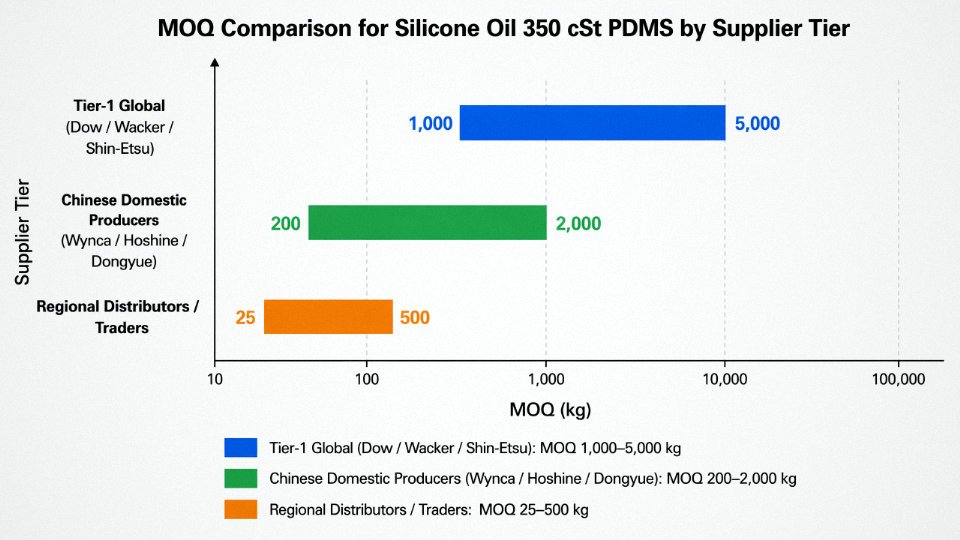
For standard PDMS grades, these producers typically quote commercial MOQs in the 1–5 MT range, with the lower end (1 MT) usually reserved for grades they keep in finished-goods inventory — 100 cSt, 350 cSt, 1,000 cSt being the most common. Specialty grades (high-viscosity pastes above 60,000 cSt, or pharma-grade material requiring lot-specific certificates of conformance) often step up to 5 MT minimum, sometimes more, because the batch documentation and line flush costs are real. Wacker in particular has been fairly transparent about this in their published distributor framework — the economics of their Burghausen plant don’t really support sub-tonne direct sales to end users.
None of this is a criticism. It just means tier-1 is the right channel if you need consistent lot-to-lot quality and you can absorb the volume. If you can’t, you need a different path.
Chinese Domestic Producers: Flexibility Through Trading Arms
Wynca Group, Hoshine Silicon, Dongyue Group operate at enormous scale, but their export commercial structures tend to be more accommodating for smaller buyers — particularly through their own trading subsidiaries or through the dense layer of Zhejiang- and Guangdong-based chemical traders who aggregate orders.
In practice, you can often find 200 kg–2 MT MOQs from these channels for standard PDMS grades. The mechanics behind that flexibility: a trading arm might be consolidating orders from a dozen buyers into a single 20 MT production pull, so your 500 kg slot gets absorbed without causing anyone a scheduling headache. Export pricing in 2024 for standard 350 cSt material has been running roughly USD 2.50–3.80/kg at these volumes, depending on order size, delivery terms, and whether the grade requires any additional finishing or filtration.
Chinese silicone oil producers can offer lower MOQs than Western tier-1 manufacturers for standard PDMS gradesTrue
Chinese producers' trading arms regularly aggregate smaller export orders, and their domestic market volume supports more flexible batch scheduling for standard grades like 350 cSt PDMS. This is consistent with reported commercial terms from export traders operating out of Shanghai and Ningbo.
One caveat worth stating plainly: the certificate trail matters. A 500 kg lot aggregated by a mid-tier trader may not carry the same batch traceability that Shin-Etsu provides directly. For cosmetic or medical-device applications, that gap is significant. For industrial lubrication or transformer fluid, it often isn’t.
Distributors and Traders: Paying for Fragmentation
An authorized Wacker or Dow distributor who bought 20 MT in Rotterdam can break that into 200 kg lots and sell them to you tomorrow. That’s genuinely useful. But you’re paying for the service — typically a 15–30% premium over the price you’d get buying direct at equivalent volume, and the margin can widen toward the top of that range when spot supply is tight or freight costs spike.
The decision logic is straightforward: if your annual consumption sits below 2–3 MT, the distributor premium is almost certainly cheaper than carrying the inventory cost of a 5 MT direct purchase. Once you’re reliably moving 5+ MT per year of a single grade, a direct account with a tier-1 producer or a direct import arrangement from a Chinese manufacturer usually pays back within one or two order cycles.
Regional Warehousing Hubs and Spot Access
Three hubs dominate for most buyers: Rotterdam (ARA region), Houston (Gulf Coast petrochemical corridor), and Shanghai Waigaoqiao Free Trade Zone. Each changes the effective MOQ equation.
Rotterdam is the entry point for most European industrial volume. Multiple distributors hold bonded stock of the top five or six standard PDMS grades, so a buyer in Germany or the Netherlands can realistically purchase 25–50 kg from warehouse stock with same-week delivery. No MOQ negotiation required; you’re buying off a shelf. The same logic applies in Houston for North American buyers. Waigaoqiao FTZ serves importers moving material into China but also acts as a consolidation point for Southeast Asian export flows.
Being close — or having a freight forwarder close — to one of these hubs is probably the single most practical way to reduce your effective MOQ without negotiating anything.
Regulatory Thresholds That Quietly Reshape Economics
Two regulatory triggers are worth knowing before you finalize an import plan. US Section 301 tariffs currently apply to many Chinese chemical imports, and silicone fluids classified under relevant HTS codes have faced tariff rates that, depending on the specific classification and any granted exclusions, can add meaningfully to landed cost — sometimes enough to flip the cost advantage of Chinese supply versus European or US domestic supply at sub-5 MT volumes. The math changes constantly as exclusion lists are reviewed, so running a current landed-cost comparison before committing to a supplier geography is not optional.
EU REACH is the other lever. If you’re importing above 1 MT per year as an importer of record into the EU, you carry registration obligations for substances not already registered by a downstream supplier. For most standard PDMS grades this is manageable — registrations exist and are available through the REACH consortium structure — but for specialty grades or blends, you may find that the 1 MT/year REACH threshold is effectively a floor that shapes your economic MOQ whether you want it to or not. Buying 800 kg to stay under the threshold might look clever until you realize you’re paying distributor spot prices and still absorbing compliance overhead.
The geographic and regulatory landscape doesn’t stay static. Procurement managers who locked in Chinese supply chains in 2020 found themselves recalculating in 2022 when tariff lists shifted and freight rates tripled. Building some supplier-geography flexibility into your sourcing strategy — even if it means maintaining two approved suppliers at slightly different price points — tends to pay off over a three-to-five year horizon.
Packaging Format and Logistics Unit: The Hidden MOQ Multiplier
Most procurement conversations about silicone oil MOQ focus entirely on the supplier’s published minimum quantity — and stop there. That’s a mistake. The packaging format and the shipping unit size impose their own effective floors, and they don’t always align with what the spec sheet says. Buyers who discover this at the freight-forwarding stage are the ones paying for half-empty pallets or scrambling to find a co-buyer for surplus material.
How Fill Format Maps to Practical Order Minimums
Silicone oil moves through the supply chain in four main packaging formats, and each one carries a different cost profile and operational implication.
Aluminum bottles (0.5–5 kg) are genuinely sample-scale. You’ll see these used for lab qualification, color-matching in cosmetics, or first-article testing on a new lubrication application. Unit cost per kilogram is high — sometimes 8–15× the bulk price — but that’s expected. No plant manager is building a production BOM around aluminum bottles.
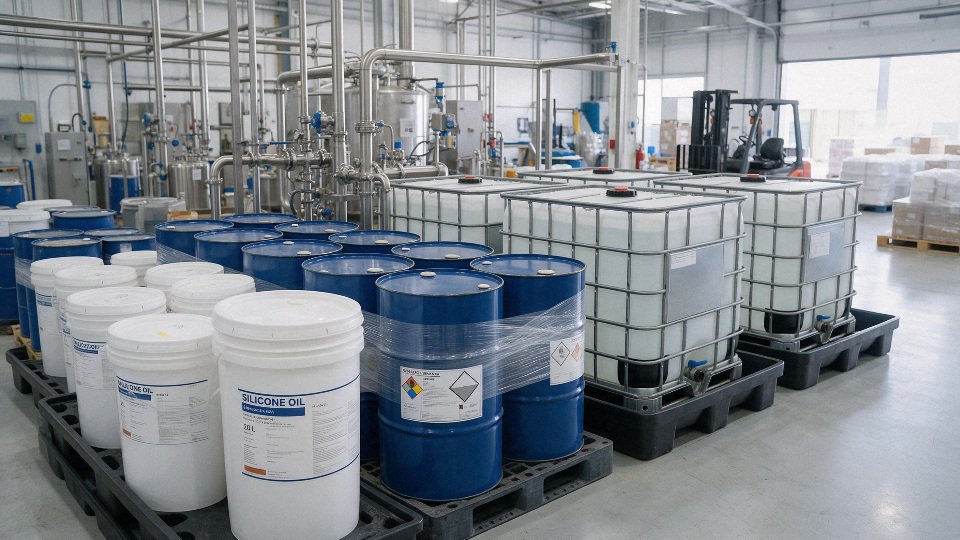
HDPE drums at 25 kg are the standard sample-to-trial format, and at 200 kg they become the workhorse of small-to-mid volume industrial buyers. The 25 kg drum is manageable: one person, a standard pallet, no special equipment. The 200 kg drum is a different conversation — you need a drum pump, a spill containment bay, and somewhere to store a partial drum without contamination.
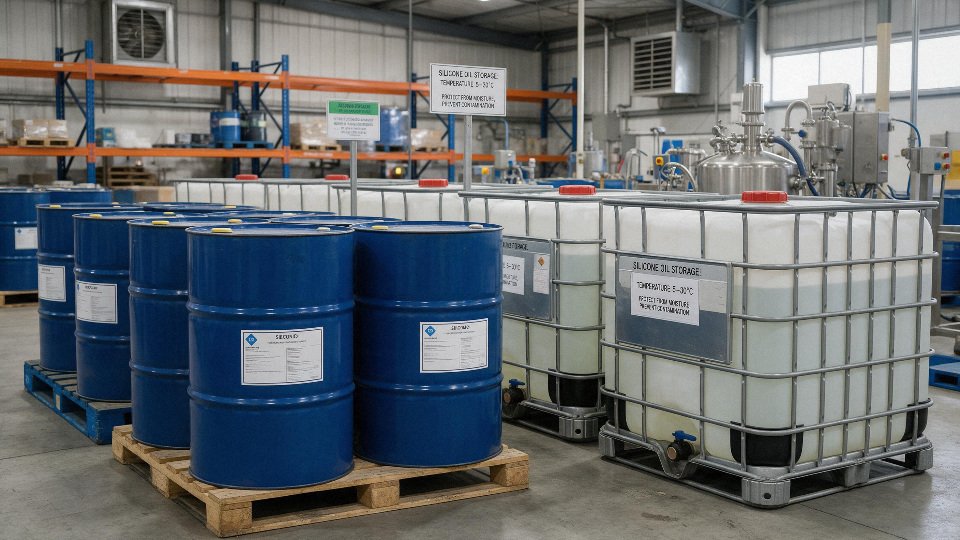
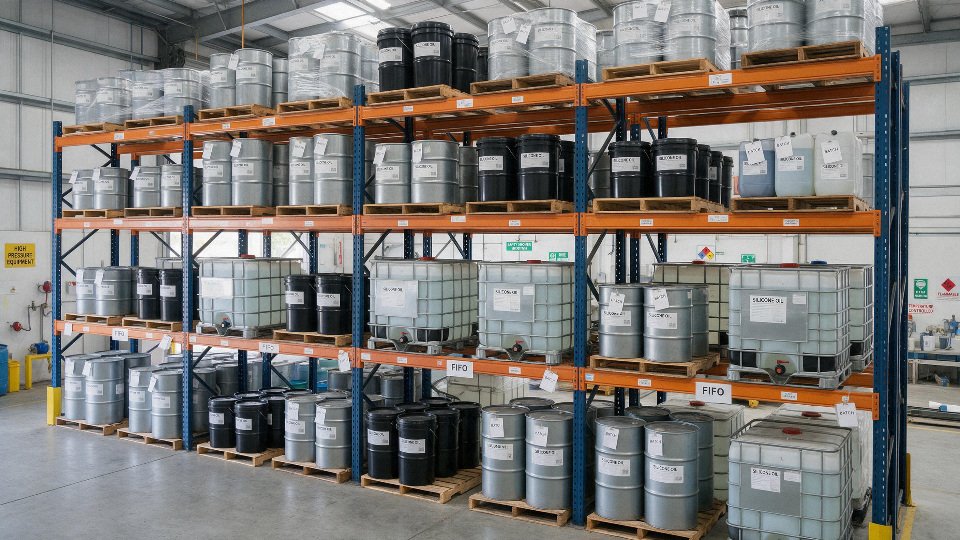
IBC totes at 1,000 kg are where the economics start shifting noticeably. Per-kg packaging cost typically drops 20–40% compared to 200 kg drums, depending on the supplier’s drum versus tote differential and your freight lane. The catch is infrastructure. If your site doesn’t have a forklift rated for the load, a hardstand pad with secondary containment, and a compatible tote discharge valve, you’ve just transferred cost from packaging to handling and compliance. Smaller operations often underestimate this.
ISO tank containers run 16–24 MT and are effectively only relevant for formulators, distributors, or large-scale industrial consumers with permanent tank storage. Most readers buying in this range already know what they’re doing.
The Drum Minimum Phenomenon
Here’s something that rarely appears in a supplier’s published MOQ: filling-line economics. A 200 kg drum line requires purging the previous viscosity grade, flushing transfer lines, and running a volume check before the first good drum comes off. In practice, many Chinese manufacturers won’t run a 200 kg drum fill for fewer than five drums per SKU per run — that’s 1,000 kg — because the purge and cleaning loss alone can account for 15–30 kg of product, and the labor setup cost doesn’t scale down proportionally.
So even if the datasheet says “MOQ: 200 kg,” the operational MOQ for that drum size is frequently 1 MT. Ask directly: “What is your minimum run quantity on the 200 kg drum line for this grade?” You’ll get a more honest answer than the website shows.
Hazardous Classification and What It Does to Your Minimum Shipment
Most PDMS grades — the 350 cSt standard lubricant grade, the 1,000 cSt release agent grades, anything with a flash point well above 100°C — are not classified as dangerous goods for transport. That simplifies logistics considerably.
Ultra-low-viscosity grades below roughly 10 cSt behave differently. Their flash points can fall below 65°C, which pushes them into flammable liquid territory under GHS and ADR/IATA frameworks.
Low-viscosity silicone oils below 10 cSt may be classified as flammable liquids (UN 1993) for transport purposesTrue
PDMS viscosity correlates with molecular weight and flash point. Very low-viscosity grades (0.65–5 cSt) have flash points that can fall below 65°C, meeting the UN Class 3 flammable liquid threshold and requiring UN 1993 classification, specific packaging group assignment, and transport documentation accordingly.
Freight forwarders handling UN 1993 shipments often impose their own practical minimums — partly because the documentation overhead per shipment is fixed regardless of size, and partly because some carriers apply a hazmat surcharge per consignment rather than per kilogram. A 100 kg trial order of 1 cSt PDMS can end up costing more in freight compliance than the product itself.
A Practical Decision Matrix Before You Call the Supplier
| Quantity Needed | Best-Fit Format | Approximate Landed Cost Premium vs. IBC Bulk | Infrastructure Required |
|---|---|---|---|
| Under 25 kg | Aluminum bottles or 25 kg drum | 3–6× bulk price | None beyond basic storage |
| 25–200 kg | 25 kg or 200 kg drums | 1.5–2.5× bulk price | Drum pump, spill tray |
| 200 kg–1 MT | 200 kg drums (full run) | 1.2–1.8× bulk price | As above; confirm 5-drum run minimum |
| 1–5 MT | 200 kg drums or IBC totes | At or near reference price | IBC: forklift, containment pad |
| Above 5 MT | IBC totes or ISO tank | Reference price or below | Bulk storage tank for ISO option |
Cost premiums are indicative and depend on freight lane, supplier margin structure, and whether the grade is standard or specialty. Use this as a starting framework, not a quote.
The core takeaway is blunt: packaging format isn’t a passive choice that happens after you negotiate price and quantity. It actively sets your effective minimum and your landed cost. Get format and infrastructure requirements clear on your side before the supplier conversation, and you’ll avoid the most common and frustrating sourcing surprises in silicone oil procurement.
Negotiation Tactics to Reduce or Waive MOQ Requirements
Getting a supplier to bend on MOQ isn’t about haggling — it’s about giving them a credible reason to do so. Suppliers set minimums because small orders genuinely hurt their economics: reactor turnaround, QC testing, custom packaging labor, and documentation overhead eat margin fast on a 25 kg drum run. Show them a path to recovering that margin another way, and most will move.
Blanket Purchase Orders: Commit Annually, Release Quarterly
A blanket purchase order (BPO) is probably the single most effective tool available to a mid-sized buyer. The structure is straightforward: you commit in writing to purchasing, say, 8–12 MT of a specific PDMS grade over 12 months, with firm quarterly call-off releases of 500 kg–2 MT each. The supplier plans one or two production runs against a known annual demand rather than scrambling to fill a one-off 600 kg request that barely justifies setting up the batch.
In practice, a BPO negotiated at this scale will often drop the per-release minimum from 1,000 kg to 500 kg or sometimes lower — and typically locks a price tier that reflects the larger annual commitment rather than the small individual release. The key is that the annual volume must be credible and contractually referenced. A vague “we expect to order more” accomplishes nothing; a signed BPO with specific delivery windows and a cancellation penalty clause does.
Grade Consolidation Across SKUs
Buyers running multiple product lines often need two, three, or even four viscosity grades — maybe 100 cSt for a release coating, 350 cSt for a hydraulic damping application, and 1,000 cSt for a cosmetic formulation. Each grade carries its own MOQ. Approached individually, that’s three separate minimums, potentially 3 MT of stock sitting in a warehouse.
The negotiation lever here is a consolidated MOQ: propose a single purchase order covering all three grades, with the combined weight meeting or exceeding the supplier’s standard minimum. In my experience this cuts total inventory commitment by roughly 40–60% versus ordering each grade separately, and many manufacturers — especially mid-tier Chinese producers running multi-grade blending lines — will accept it because their production planning benefits from the consolidated volume signal. Get it written into the contract as a precedent, not just handled informally on one order.
The Sample-to-Production Pathway
There’s a right way and a wrong way to request a small sample lot. The wrong way is emailing a supplier asking for “a few kilograms to test” with no further context. The right way is purchasing a formal qualification sample — typically 0.5–5 kg, sometimes invoiced at a significant premium, which is normal and acceptable — and simultaneously submitting a written letter of intent referencing a specific commercial volume tied to a target qualification date. Something like “subject to successful qualification by Q3, we intend to place an initial commercial order of 2 MT followed by quarterly purchases” carries real weight. Suppliers see this constantly from serious buyers and almost never from time-wasters.
Referencing a committed commercial volume in writing alongside a sample request meaningfully increases the likelihood of a supplier granting a below-standard MOQ concession.True
Suppliers face fixed costs per batch regardless of size; a credible future volume commitment offsets the economic risk of running a small qualification batch, giving procurement teams a legitimate path to below-MOQ initial purchases.
Third-Party Consolidators and Toll Blenders
If your annual requirement genuinely sits below what any manufacturer will accommodate — say you need 20–80 kg of a specialty 60,000 cSt grade for a niche sealing application — the realistic solution is a chemical distributor or toll blender that purchases in bulk and repackages. These operations buy 1 MT or more directly from producers, decant and relabel to customer specification, and sell in increments as small as 10–25 kg. Lead time runs roughly 2–6 weeks depending on stock position and any custom blending required. Unit cost will be 15–35% higher than manufacturer direct, but the alternative — carrying 500 kg of slow-moving high-viscosity inventory — often costs more in warehousing, shelf life risk, and working capital than the markup does.
What Reliably Backfires
A few approaches consistently harden supplier positions instead of softening them.
Requesting below-MOQ quantities without explaining the application or end-use gives a supplier no reason to treat your inquiry differently from a hundred other spot inquiries they’ll decline. Context signals intent and helps them justify an exception internally.
Presenting distributor pricing in a negotiation with a manufacturer is a category error. Distributors have bought in bulk and absorbed the volume risk already; comparing their per-kg price to a manufacturer’s small-order rate isn’t a legitimate negotiating point, and experienced sales managers will recognize it immediately and lose confidence in the buyer’s understanding of the supply chain.
Underestimating packaging costs is a subtler mistake. Asking for 200 kg in 1 kg retail pouches instead of standard 25 kg drums can multiply the supplier’s packaging labor cost by a factor of 5–8. That cost has to land somewhere. If you need non-standard pack sizes, quantify the volume upfront and give the supplier enough lead time to source materials — don’t treat it as a minor footnote after price is already agreed.
MOQ for Specialty and Functional [Silicone Oils](https://siliconchemicals.com/silicone-oil/) Versus Standard PDMS
Commodity PDMS — your 350 cSt drum-fill product sitting on a spot price index — is almost a different market from functional silicone oils. Buyers who approach amino-functional or hydrogen silicone oil with commodity-sourcing habits routinely get surprised: higher MOQs, shorter shelf lives, more restrictive transport rules, and in some cases regulatory constraints that have quietly eliminated the small-lot market entirely.
Why Batch Reactor Chemistry Changes the MOQ Equation
Standard polydimethylsiloxane runs on continuous or semi-continuous equilibration lines. Most functional silicone oils do not. Amino-functional, epoxy-functional, polyether-modified (rake or ABA block structure), hydrogen silicone oil (PHMS), and vinyl-terminated grades are each synthesized in discrete batch reactors — typically 2–10 MT working volume — where the reactor must be charged, reacted, stripped, and cleaned between runs. A 500 kg order means the producer either runs the reactor at a fraction of its efficient load or batches your order with another customer’s, which adds scheduling complexity and, usually, lead time.
That batch overhead is why amino silicone oil MOQs from Chinese producers typically land at 1–5 MT. The aminopropyl functional monomer is more expensive than straightforward D4/D5 cyclics, and the exothermic amination reaction demands careful temperature management and longer stripping cycles to hit residual amine targets for textile softener or hair care use. Below roughly 1 MT, the reactor setup cost per kilogram becomes genuinely uneconomical for the producer — not an artificial floor, just math.
Hydrogen Silicone Oil: Reactivity as a Procurement Constraint
PHMS (polymethylhydrosiloxane, the Si-H fluid) adds a layer that pure cost doesn’t explain: stability. The Si-H bond hydrolyzes slowly but continuously in the presence of trace moisture, releasing hydrogen gas. That’s a flammability and pressure-buildup concern in sealed containers. Carriers classify it accordingly, and many Chinese manufacturers will not ship PHMS in containers below a certain fill level because partially filled IBCs increase headspace and accelerate degradation.
Effective commercial MOQs for PHMS therefore tend to run 2–5 MT, even from producers who nominally list lower. Practically every supplier I’ve seen also imposes a shelf-life clause — 12 months from production date is standard — and that creates a time-linked MOQ logic: if you buy 500 kg but your consumption rate is 50 kg/month, you will be discarding product before it’s used. The real MOQ is determined by your throughput, not just what the supplier quotes.
Hydrogen silicone oil (PHMS) has a typical shelf life of 12 months from production date under proper storage conditionsTrue
The Si-H bond in PHMS undergoes slow hydrolysis, particularly with trace moisture ingress, degrading crosslinker activity over time. Twelve-month shelf-life clauses are standard practice across major Chinese and international PHMS producers and are reflected in technical data sheets from multiple suppliers.
D5 and Cosmetic-Grade Cyclics: Regulation Has Already Raised Your MOQ
Cyclopentasiloxane (D5) and cyclomethicone blends used in rinse-off personal care — shampoos, conditioners, body wash — hit a hard wall with EU Regulation 2018/1516, which restricts D4 and D5 in wash-off cosmetics above 0.1% concentration. The practical effect on the supply chain has been a contraction of available grades and lot sizes. Several producers withdrew small-volume D5 lots from their catalogs entirely rather than manage the documentation burden for diminished demand. For formulators who still need compliant grades in leave-on applications, de facto MOQs have drifted upward — 500 kg to 1 MT is increasingly common where 200 kg lots were available five years ago.
Quick-Reference: Functional Silicone Oil MOQ Comparison
| Product Type | Typical Application | MOQ Low End | MOQ High End | Lead Time Range | Key Constraint |
|---|---|---|---|---|---|
| Amino silicone oil | Textile softener, hair care | 1 MT | 5 MT | 2–4 weeks | Aminopropyl feedstock cost, exothermic batch |
| Epoxy-functional silicone | Adhesion promoter, coatings | 500 kg | 3 MT | 3–6 weeks | Custom reactor run, limited producers |
| Polyether-modified (rake/ABA) | Foam control, personal care | 500 kg | 5 MT | 3–5 weeks | Ethoxylation step, EO handling classification |
| Hydrogen silicone oil (PHMS) | Crosslinker, waterproofing | 2 MT | 5 MT | 1–3 weeks | Reactivity, shelf-life clause, transport rules |
| Vinyl-terminated silicone | Platinum-cure elastomer base | 1 MT | 10 MT | 2–5 weeks | Purity spec drives batch yield and cost |
| D5 / cyclomethicone (leave-on grade) | Skin feel, hair serum | 500 kg | 2 MT | 3–6 weeks | EU 2018/1516 restriction; compliant grades limited |
One practical note for formulators sourcing multiple functional grades simultaneously: some Chinese specialty producers will aggregate MOQs across product lines in a single order — meaning 1 MT of amino silicone plus 500 kg of vinyl-terminated fluid might get you to a combined threshold that unlocks better pricing and scheduling priority. It’s worth asking directly. The answer depends entirely on whether those products share reactor infrastructure at that specific plant.
Sample Order to Full Production: Building a Compliant Qualification Workflow
Getting silicone oil from “we think this grade will work” to “approved material on our BOM” is where procurement and engineering have to move in lockstep. Skipping phases or compressing timelines to hit a launch date almost always creates rework — and occasionally a regulatory problem that surfaces after you’ve already scaled.
Phase 1: Desk Research and Spec Alignment
Before you contact a single supplier, lock down your internal specification. That means a defined viscosity target with tolerance (not just “around 350 cSt”), your purity floor, any food-contact or cosmetic-grade requirements, and the application temperature range your process actually sees. Suppliers will quote whatever MOQ fits their production schedule if your spec is vague — and you’ll end up testing material that was never quite right to begin with.
At this stage, request the supplier’s standard technical data sheet and a draft SDS. Check whether the SDS is GHS/UN Rev. 9 compliant. For EU-destined material, confirm the SDS is REACH-compliant and prepared in the destination country’s language — technically outside the scope of your spec document, but something procurement should flag early or it becomes a customs headache later.
Phase 2: Sample Request and In-House Testing
A sample request for standard PDMS typically runs 500 g to 5 kg — enough to run viscosity, refractive index, flash point if relevant, and any application-specific tests without burning budget. Insist on a Certificate of Analysis (CoA) that lists the supplier’s actual measured values alongside their test methods, not just “conforms to spec.” A CoA that says “viscosity: 350 cSt” with no method citation is nearly useless for qualification purposes.
Run viscosity per ASTM D445 or ISO 3104 — both are capillary methods and comparable, but note that ISO 3104 was originally written for petroleum products and minor procedural differences exist. If your in-house result differs from the supplier’s CoA by more than 5%, hold everything.
A 5% viscosity deviation between a buyer's in-house ASTM D445 measurement and the supplier CoA is a recognized threshold for commercial hold and retest in silicone fluid procurement practice.True
PDMS viscosity is highly sensitive to temperature calibration, instrument condition, and sample handling; a 5% discrepancy typically signals either measurement inconsistency on the supplier's side or a genuine batch quality issue — either of which warrants investigation before accepting a full shipment.
That 5% figure isn’t arbitrary caution. It’s the point where application performance — whether that’s release coating weight, damping behavior, or heat transfer — starts to drift in ways that matter.

Phase 3: Pilot Batch Qualification and the Lot-to-Lot Consistency Problem
This is where smaller Chinese producers most commonly cause trouble. The sample you received was likely pulled from a well-controlled lab batch or a carefully selected drum. The first production batch may look fine. The third might not.
Write an Approved Supplier Questionnaire (ASQ) that asks directly about batch size, reactor configuration, raw material sourcing, and process controls. If the supplier can’t answer those questions in writing, that tells you something. Your Incoming Quality Control (IQC) plan should specify that every incoming lot gets viscosity verification, with the CoA retained and cross-referenced to the purchase order lot number. Make this a contractual condition, not a nice-to-have. Pilot batch size for most industrial applications is typically one to three drums (25–75 kg), run through your actual process — not a bench simulation.
For food-contact or cosmetic applications, request the food-contact compliance letter at this phase, not after scale-up. Getting it late delays regulatory sign-off by weeks.
Phase 4: Commercial Purchase Order Execution
Don’t issue the commercial PO until the ASQ is returned, the IQC plan is agreed in writing, and the pilot batch has cleared your process validation. Timeline-wise: standard PDMS grades (100–60,000 cSt, commodity specifications) typically move from first sample request to approved supplier status in roughly 6–16 weeks, depending on your internal testing bandwidth and how responsive the supplier is. Specialty functional grades — amino-modified, phenyl-modified, reactive silicone fluids — realistically take 12–26 weeks, sometimes longer if your application requires third-party toxicological review or regulatory registration.
Plan these timelines into your new product launch schedule at the project kickoff meeting, not six weeks before launch. Engineering and procurement both know this — it just rarely happens early enough.
Total Cost of Ownership at Different MOQ Levels: A Quantitative Framework
Unit price is the number everyone fixates on. It’s also the least complete metric for evaluating silicone oil procurement options. A buyer who optimizes purely on per-kilogram price routinely ends up paying more in aggregate once freight, warehousing, testing, and the slow bleed of carrying cost get added up. The TCO model isn’t conceptually complex, but applying it to chemical procurement requires a few domain-specific adjustments.
The Cost Components That Actually Matter
For silicone oil, TCO has six real components: unit price, inbound freight and marine insurance (typically 0.5–1.5% of cargo value for standard PDMS shipments, depending on Incoterms and carrier), import duties and customs brokerage fees (which vary widely — U.S. tariff classifications for PDMS can add 3–6% depending on HTS code and origin, and brokerage runs $150–350 per entry for a straightforward drum shipment), warehousing and inventory carrying cost, third-party quality testing, and disposal or write-off cost for material that goes off-spec or exceeds shelf life before consumption.
The carrying cost figure deserves particular attention. A commonly cited rule of thumb for specialty chemicals is 20–30% of inventory value per year. That range accounts for storage space, insurance, opportunity cost of tied-up capital, and the non-trivial risk of viscosity drift or contamination in drums that sit too long. In practice, where you land in that range depends on your facility’s overhead rate and whether you’re storing in climate-controlled space — high-viscosity grades above roughly 60,000 cSt can gel partially if stored below 10°C, which creates its own quality problem.
A Worked Example: 500 kg of PDMS 1,000 cSt
Say Buyer A needs 500 kg of PDMS 1,000 cSt. Two options are on the table.
Option 1: Buy 1 MT direct from a Chinese manufacturer at USD 3.20/kg. Total product cost: USD 3,200. Inbound freight (sea + local drayage, 200-liter drums): roughly USD 400. Import duty at 5%: USD 160. Customs brokerage: USD 220. Total landed cost for 1,000 kg: approximately USD 3,980, or USD 3.98/kg landed.
Option 2: Buy 500 kg from a European distributor already cleared for your market, at USD 5.10/kg. Freight (palletized drums, regional): USD 80. No import entry needed. Total: approximately USD 2,630, or USD 5.26/kg landed.
On unit price alone, Option 1 looks dramatically better. But Option 1 leaves you with 500 kg of excess inventory. At a 25% annual carrying cost rate applied to that excess material’s value (500 kg × USD 3.98 = USD 1,990, carrying cost = ~USD 498/year), Option 1 only stays cheaper if that excess 500 kg is consumed within roughly 14 months. If your actual consumption rate is slower — say quarterly usage of 150 kg — that excess sits for over three years, and the carrying cost alone erases the unit price advantage entirely.
Buying at a lower per-kg price from a direct manufacturer is not always cheaper than buying from a distributor at a higher unit price.True
When excess inventory carrying costs, freight, duties, and brokerage are factored in, the distributor option frequently produces a lower total cost of ownership for buyers whose consumption rate is insufficient to absorb the manufacturer's MOQ within 12–18 months.
Order Frequency and the EOQ Adjustment
The interaction between order frequency and MOQ is where most procurement teams leave money on the table. Economic Order Quantity (EOQ) gives you the order size that minimizes total ordering plus holding costs: EOQ = √(2DS/H), where D is annual demand in kg, S is cost per order (freight + brokerage + testing), and H is carrying cost per kg per year.
A buyer with steady monthly demand of 200 kg (2,400 kg/year) and an ordering cost of ~USD 650 per shipment, with a holding cost of roughly USD 0.95/kg/year on standard PDMS, gets an EOQ somewhere in the 1,800–1,900 kg range — meaning a quarterly direct order makes economic sense and manufacturer MOQs become easy to meet. Run the same math for a buyer with irregular quarterly demand averaging the same annual volume, and the optimal order size shifts considerably downward, often below manufacturer minimums.
The practical takeaway: calculate your EOQ before you even contact a supplier. It tells you whether their MOQ fits your demand profile or whether you’re structurally better served by a distributor.
Payment Terms as a Hidden Cost Variable
Currency exposure and payment terms quietly modify the effective cost of each option. Chinese manufacturers frequently require T/T in advance on orders below 1 MT — sometimes 100% upfront — while a European distributor might offer net-30 on established accounts. On a USD 4,000 order, net-30 terms are worth roughly USD 35–55 in working capital cost at current rates, which is negligible. But on a USD 20,000 bulk order with 30% advance payment and a 45-day lead time, the financing cost becomes meaningful and belongs in the TCO calculation.
The Decision Rule
If the distributor’s landed price premium over the manufacturer’s landed price is less than the annualized carrying cost of the excess inventory you’d need to purchase to meet the manufacturer’s MOQ, buy from the distributor. Full stop. The math is not complicated, but it requires honest numbers — especially on carrying cost, which most procurement teams underestimate because they aren’t paying a visible line-item storage invoice.
| Scenario | Likely Better Option |
|---|---|
| Consumption rate absorbs MOQ excess within 12 months | Direct manufacturer |
| Irregular or unpredictable demand | Distributor |
| Limited storage or temperature-sensitive grade | Distributor |
| High annual volume, stable demand, own warehouse | Direct manufacturer |
| Tight working capital, advance payment required | Distributor |
Frequently Asked Questions About Silicone Oil MOQ
What is the minimum order quantity for silicone oil samples?
Most producers offer lab samples in the 0.5–5 kg range, usually at a flat fee somewhere between USD 30 and 150 plus actual freight. Tier-1 producers with established industrial account programs — the kind supplying automotive OEMs or large personal care manufacturers — will sometimes waive the fee entirely for qualified buyers who can demonstrate a real development pipeline. Worth knowing: a sample shipment is a technical courtesy, not a commercial transaction. The sample MOQ has no bearing on the commercial MOQ you’ll face once you try to place a production order, and treating them as equivalent is a common rookie mistake that causes schedule problems later.
Can I order less than 25 kg of silicone oil?
Yes, but you’ll pay for it. Laboratory distributors like Sigma-Aldrich or TCI carry standard PDMS grades in 100 g to 1 kg bottles, and their pricing reflects that convenience — typically 5x to 15x the bulk rate per kilogram, depending on viscosity and purity grade. That’s entirely rational for formulation development work where you’re testing a handful of viscosity grades across a few hundred grams each. Running a production line at those prices is not. If your team is still buying 1 kg bottles once a trial formulation is locked in, something has gone wrong in the handoff from R&D to procurement.
Why does MOQ increase for food-grade or cosmetic-grade silicone oil?
The short answer is fixed cost recovery. Food-grade and cosmetic-grade PDMS requires dedicated or thoroughly cleaned production lines, validated cleaning procedures with documented evidence, and in many cases third-party certification audits — Halal, Kosher, ISO 22716, or similar. None of those costs scale down proportionally with batch size. Manufacturers typically set minimums at 500 kg to 2 MT for these grades specifically because below that threshold they’re losing money on the compliance overhead. Some will go lower for an established customer, but expect a line-item surcharge that makes the math ugly.
Food-grade and cosmetic-grade silicone oil always requires a higher MOQ than industrial PDMS of the same viscosity.False
While food-grade and cosmetic-grade specifications do carry higher compliance overhead that typically pushes MOQ thresholds up, some distributors stock these grades in smaller quantities precisely to serve small-batch personal care manufacturers. The MOQ elevation is real but not universal across every supply channel.
Does MOQ change for custom viscosity blends?
It does, and the jump can be significant. A 750 cSt blend produced by proportionally combining 500 cSt and 1,000 cSt PDMS isn’t complicated chemistry, but it adds a blending step, a homogeneity-verification protocol, and often a separate intermediate storage hold. Manufacturers typically set custom-blend MOQs at 1 MT on the low end, and 5 MT is common if the blend spec is tight. If your application genuinely needs an in-between viscosity, it’s worth asking whether the nearest standard grade would perform adequately — even a minor reformulation can unlock much lower MOQs and cut lead time by weeks.
How do I verify a supplier’s stated MOQ is legitimate?
Request a formal quotation with fully itemized pricing at the stated MOQ and again at double that quantity. If the unit price drops sharply between the two tiers, the lower MOQ is real and the supplier is pricing in handling overhead at small volumes — that’s honest. If the price barely moves, something is off; either the MOQ is inflated for margin reasons, or the “factory” is actually a trader with a markup baked in. Asking for production batch records — not certificates of analysis, but actual batch size logs — will usually settle the question. A real manufacturer knows their reactor charge volumes and can show you.
What happens if I order below MOQ?
Most manufacturers apply a below-MOQ surcharge of roughly 15–40%, or they decline outright. A third path exists at some facilities: consolidated batch scheduling, where multiple small orders from different customers are grouped into a single production run. That approach is real and can work, but expect the lead time to stretch by 4 to 8 weeks while you wait for enough orders to fill the batch. For a production line running on tight inventory, that waiting period usually costs more than just meeting the MOQ in the first place.
Is there a standard MOQ on Alibaba or similar B2B platforms?
Listed MOQs on B2B platforms — often shown as 1 kg or 25 kg — reflect the trading company’s stocking position, not the factory’s production minimum. This distinction matters enormously for quality-sensitive applications. A trader buying in bulk and reselling small lots can offer flexibility, but they add a margin layer and may have limited visibility into the actual production batch your material came from. Before placing any order where traceability matters, confirm directly whether you’re dealing with a manufacturer or an intermediary, and ask for the underlying factory’s MOQ and batch documentation.
How does EU REACH regulation affect MOQ for European buyers?
Any EU-based importer sourcing more than 1 MT per year of a given silicone oil substance directly from outside the EU takes on REACH importer obligations — substance pre-registration, supply chain communication requirements, and potential downstream user documentation. That 1 MT/year threshold functions as a de facto commercial MOQ anchor for direct imports. Buying below 1 MT/year from a REACH-registered EU distributor sidesteps those obligations entirely, which is why many smaller European formulators route their procurement through local distributors even when the per-kilogram cost is higher. Once your annual consumption reliably clears 1 MT, the math usually tilts toward direct import, but get proper regulatory guidance before making that call — the REACH compliance costs are real and unevenly distributed depending on substance identity and use category.