Powders that bridge in a hopper, cake in a bag, or dust out of a mixer are not just “material behavior.” They turn into short fills, rejected batches, slow cleanouts, worn feeders, and operators beating on bins with rubber mallets. Pick the wrong substitute for silicon dioxide and you may save a few cents per kilogram, then lose it in downtime, scrap, energy draw, or a customer complaint. The right replacement starts with the job silicon dioxide was doing: flow aid, anticaking agent, thickener, carrier, filler, abrasive, or reinforcement.
A substitute for silicon dioxide can be calcium carbonate, tricalcium phosphate, magnesium stearate, talc, starch, cellulose, alumina, clay, or another silica grade, depending on the product and regulation. In food powders, anticaking agents often run about 0.5% to 2.0% by weight, based on flow target, moisture, and local rules.
That sounds simple until procurement asks for a cheaper alternative and the plant discovers the old grade had a median particle size, surface area, and bulk density that quietly held the whole process together. Fumed silica can be roughly 30 kg/m3 to 150 kg/m3, precipitated silica often sits nearer 100 kg/m3 to 300 kg/m3, while calcium carbonate may be 600 kg/m3 to 1200 kg/m3. Same tote size, very different feeder behavior.
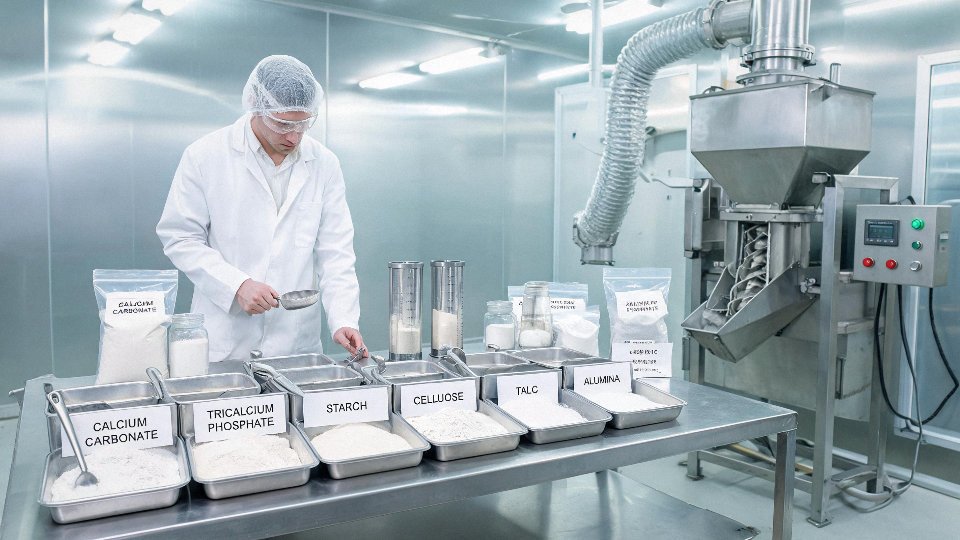
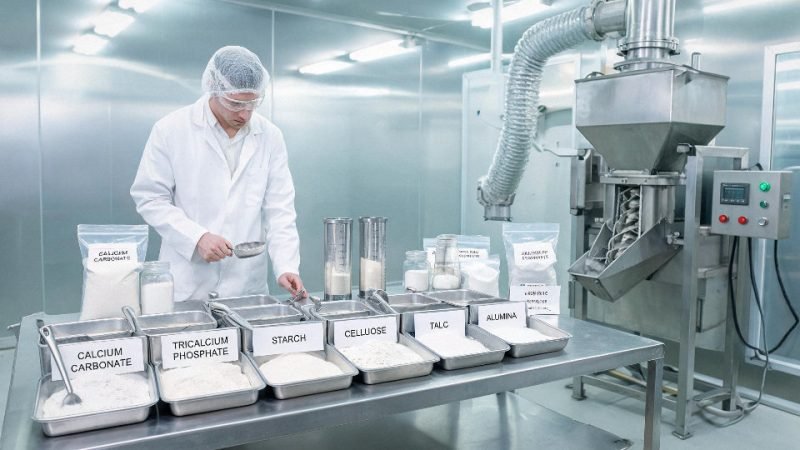
For food powders and seasonings: calcium silicate, tricalcium phosphate, starch, and cellulose
In salt blends, dry rubs, powdered drink mixes, spice blends, cheese powders, instant soups, and nutraceutical powders, silicon dioxide is usually there for one unglamorous reason: keep the powder moving. It reduces caking, picks up surface moisture, separates sticky particles, and helps a screw feeder, auger filler, sachet machine, or tablet press hopper behave the same at 7 a.m. as it does near the end of a humid shift.
That last part matters. A seasoning blend that flows in the lab can bridge in a 300 kg tote after two days near a washdown area. I have seen operators “fix” poor flow by hammering the side of a hopper until the fill weights drifted out of spec. That is not process control. That is noise with a wrench.
Typical food anticaking or flow-aid use levels sit around 0.5% to 2.0% by weight, depending on the powder’s fat content, particle size spread, humidity exposure, flow target, and local regulation. Some systems need less. Cheese powders, hygroscopic drink bases, and spicy oil-coated blends often need more help than plain salt.
Calcium silicate: usually the closest functional substitute
Calcium silicate is often the first substitute I would screen when silicon dioxide is being used as a serious anticaking agent rather than a token label ingredient. It has strong water and oil absorption, performs well in dry seasoning blends, salt-based mixes, soup bases, and cheese-flavored powders, and can work at relatively low levels compared with starch-based options.
It is not invisible. In fine powders, calcium silicate can slightly lighten appearance and may change bulk density or dusting behavior. In a high-speed packaging room, that affects dust collector loading, seal contamination, and checkweigher consistency. Still, from a plant-floor point of view, it is one of the more practical replacements when the original problem is real caking rather than just mildly poor flow.
Tricalcium phosphate: useful when calcium is acceptable on the label
Tricalcium phosphate is common in table salt, powdered foods, drink powders, and dietary supplement blends. It can improve flow and reduce clumping, and it makes sense where a calcium-containing ingredient fits the nutrition panel or product positioning.
The tradeoff is dissolution and mouthfeel. In some drink powders, too much tricalcium phosphate can leave a faint chalky impression or sediment, especially in cold water and low-sugar formulas. In capsules and supplement premixes, it can behave well as a flow aid, but you still need to check blend uniformity. Dense mineral ingredients segregate if the blender, transfer height, and particle size distribution are wrong.
Starches: cheaper and label-friendly, but weaker in wet air
Corn starch, rice starch, and tapioca starch are common substitutes where cost, clean-label preference, or customer perception matters. They can help separate particles and absorb some surface moisture. They are also familiar to procurement teams and usually easier to source from multiple suppliers.
Their weakness shows up under high humidity. Starches do not match high-surface-area silica for moisture management, especially in salty, acidic, or oily blends. They may also change texture, cloudiness, or mouthfeel. In a dry barbecue rub that gets sprinkled onto meat, that may be fine. In a clear lemon drink powder, it may be a problem.
Sourcing claims need attention too. Corn may trigger non-GMO questions. Wheat-derived starch would raise allergen and gluten concerns in many markets. Rice starch can be useful for allergen-sensitive products, but price and supply can swing depending on crop conditions and regional demand.
Cellulose and microcrystalline cellulose: good carriers, not magic dryers
Powdered cellulose and microcrystalline cellulose are useful as flow aids, carriers, and bulking agents, especially for flavors, capsules, tablets, and supplement blends. They can improve handling and reduce stickiness in certain systems.
They do not adsorb moisture like high-surface-area silica. That difference matters in powdered flavors with oil load, cheese seasonings, and humid packing rooms. Cellulose may improve mechanical flow while doing less to prevent long-term hard caking in a pouch or jar. Test both fresh-flow and aged-flow performance; a sample that pours nicely after blending may still brick up after three weeks in a warm warehouse.
Magnesium carbonate and magnesium stearate: use with care
Magnesium carbonate can act as an anticaking agent in some dry foods, but it may affect mouthfeel, dissolution, and mineral labeling. Magnesium stearate is common in tablets and capsules as a lubricant, not a general-purpose food powder anticaking replacement. In drink powders or seasonings, it can create hydrophobic behavior, slower wet-out, or a slick mouthfeel. It may also move the ingredient into a different regulatory or customer-review category.
Practical first-pass screening table
| Substitute | Best food use case | Typical use level | Humidity tolerance | Flavor impact | Labeling considerations |
|---|---|---|---|---|---|
| Calcium silicate | Salt blends, seasonings, cheese powders, soup bases | Roughly 0.5% to 2.0%, depending on oil and moisture load | Good | Usually low, possible slight dryness | Check permitted use and maximum level by market |
| Tricalcium phosphate | Table salt, drink powders, supplements | Often around 0.5% to 2.0%, formula-dependent | Moderate to good | Can be chalky at higher levels | Calcium declaration may be relevant |
| Corn, rice, or tapioca starch | Clean-label dry mixes, rubs, low-cost blends | Often higher than mineral flow aids, depending on flow target | Fair to weak in high humidity | Can affect texture, cloudiness, or mouthfeel | Allergen, non-GMO, gluten, and origin claims |
| Powdered cellulose or microcrystalline cellulose | Flavor carriers, capsules, supplement blends | Formula-specific, often screened across a wider range | Moderate for flow, weaker for moisture adsorption | Can add body or slight fibrous note | Fiber declaration and additive status vary |
| Magnesium carbonate | Selected dry food powders | Use only within approved limits | Moderate | Can feel mineral or dry | Magnesium labeling and additive rules |
| Magnesium stearate | Tablets and capsules, mainly lubrication | Usually low, application-specific | Not a broad anticaking fix | May slow wet-out, slick mouthfeel | Often treated differently from food anticaking agents |
A silicon dioxide substitute that works in one food powder can fail in another if moisture, fat content, particle size, and packaging humidity are different.True
Anticaking performance depends on the powder system, not just the additive name. Oil-coated seasonings, mineral blends, spray-dried flavors, and crystalline salts cake through different mechanisms.
Before approving any substitute, check the relevant market rules: United States Food and Drug Administration permissions, European Union additive rules, Codex standards, and any customer restricted-substance list. The legal answer and the plant answer both have to pass. One without the other still gives you rejected product, blocked shipments, or a packaging line that stops every hour.
For tablets, capsules, and nutraceutical blends: replacing glidant performance without breaking dissolution
Colloidal silicon dioxide earns its place in solid-dose plants because it fixes several ugly problems at once. It improves powder flow into tablet dies and capsule tamping stations, helps reduce moisture-related clumping, and can make a marginal direct-compression blend behave well enough to run through a shift without constant operator intervention. You see it in direct compression, hard-shell capsule filling, wet or dry granulation blends, stick packs, and sachet lines where low-dose actives or sticky botanicals otherwise bridge in the hopper.
Replacing it is not a simple “use talc instead” job. The wrong change may still look fine in a lab scoop test and then fail at scale: rat-holing above the feed frame, capsule weights drifting after lunch when humidity rises, tablets capping at higher turret speed, or dissolution falling out because the blend now repels water.
Magnesium stearate is not a direct functional substitute for colloidal silicon dioxide in tablets or capsules.True
Colloidal silicon dioxide is mainly used as a glidant and moisture scavenger, while magnesium stearate is primarily a lubricant. Increasing magnesium stearate to improve flow can slow dissolution and weaken tablet bonding.
What can replace the glidant function?
Talc can work as a flow aid in some tablets and capsule blends, especially where plate-like particles help reduce interparticle friction. In practice, I treat talc as a controlled excipient, not a cheap mineral filler. Pharmaceutical grade is mandatory, with asbestos-free certification, supplier traceability, and regulatory acceptance for the intended market. Procurement should not “dual source” talc casually. Different mines and milling routes can shift particle shape, surface chemistry, and loss on drying enough to show up as weight variation or slower disintegration.
Calcium phosphate grades, such as dibasic calcium phosphate or tricalcium phosphate, are often better thought of as carriers or diluents with flow benefits. They can make a sticky nutraceutical blend run cleaner through a capsule filler, and some direct-compression grades have useful density and compressibility. The catch is tablet mechanics. Calcium phosphate can push hardness up or make compacts more brittle, depending on grade and compression force. With pH-sensitive actives, minerals can also change the microenvironment around the active ingredient. That can move dissolution in a direction nobody wants, especially in low-water, high-mineral formulations.
Starch, pregelatinized starch, and microcrystalline cellulose bring different tools to the bench. Starch may help with moisture and disintegration behavior, but native starch is not usually a high-performance glidant. Microcrystalline cellulose can improve compactibility and blend robustness, though very fine or fibrous grades may not cure poor flow on their own. Sodium starch glycolate is a superdisintegrant, not a flow substitute, but it may be needed when the new flow system makes tablets disintegrate more slowly.
Engineered co-processed excipients are often the cleanest route when the product is already sensitive. These are not magic powders; they are controlled combinations of diluents, binders, disintegrants, and sometimes flow-enhancing components designed to behave consistently in compression or filling. They cost more per kilogram. They can cost less per batch if they stop rejected lots, rework, and weekend maintenance calls.
The measurements that usually expose a bad substitution
Do not qualify a substitute by angle of repose alone. It is useful, but it can flatter a blend that still floods, segregates, or sticks.
A practical screen should include angle of repose, Carr index, Hausner ratio, bulk and tapped density, discharge consistency through the actual hopper geometry, tablet hardness, friability, disintegration time, dissolution profile, and active ingredient uniformity. For capsule products, include fill-weight variation at the intended machine speed, not just hand-filled samples. For sachets, watch seal contamination from dusty substitutes. Talc and very light excipients can migrate into places operators will complain about later.
Acceptance targets depend on dose strength, regulatory filing, and line capability, but typical working examples look like this:
| Check | Practical acceptance example | What it protects |
|---|---|---|
| Blend uniformity | Relative standard deviation often below about 3% to 6%, tighter for low-dose actives | Content uniformity failures |
| Capsule or tablet weight variation | Within internal limits at start, middle, and end of run | Fill drift and feeder instability |
| Discharge rate | No bridging or rat-holing over a defined run window | Line stoppages |
| Moisture pickup | No meaningful gain under expected plant humidity exposure | Clumping and dissolution shift |
| Line stoppage rate | No increase versus the silicon dioxide baseline | Real production reliability |
A qualification workflow that holds up under audit
Start by benchmarking the current silicon dioxide batch, including vendor, grade, loss on drying, particle size, and the way operators actually add it. Order of addition matters. I have seen blends change just because silica was screened with the active instead of layered into the final blend.
Run a small design-of-experiments study rather than one trial at one level. Vary substitute type, use level, blending time, and lubricant blending time. Include magnesium stearate as its own factor, because over-lubrication is a common hidden failure after a silica change. Magnesium stearate may reduce ejection force beautifully while quietly reducing hardness or slowing dissolution through a hydrophobic film. That is a bad trade if the product claim depends on release rate.
Then compress or fill at pilot conditions that resemble the commercial line. Test flow, compression force, ejection force, hardness, friability, disintegration, dissolution, assay, and uniformity. Put the best candidates into short stability first, then formal stability if the change is material. Update master batch records, incoming specifications, supplier qualification files, and operator instructions. If the old process relied on “add a little silica if it runs poorly,” remove that habit before validation. Uncontrolled fixes are where good formulations go to die.
For cosmetics and personal care: talc, mica, starch, boron nitride, and polymer microspheres
In cosmetics, silicon dioxide is rarely just “filler.” It may be absorbing oil in a loose powder, giving a soft-focus blur in a primer, holding fragrance in a dry shampoo, keeping pigments from caking, thickening an anhydrous gel, suspending exfoliant particles, or putting a dry matte finish on skin. One grade can behave like a sponge; another like a flow aid; another like a scrub particle. That is why a substitute has to be chosen by function, not by INCI-line convenience.
A typical precipitated silica used in powders may sit around 3 micrometers to 20 micrometers median particle size, depending on grade, with high surface area versions above 100 m2/g. That surface area is what gives oil pickup and matting, but it also steals fragrance, changes preservative partitioning, and can make a pressed cake feel drier than the lab sample did on day one.
Talc: cheap, useful, and not politically neutral
Talc is still one of the most practical substitutes where silica is being used for powder slip, bulking, payoff control, and a soft dry feel. It presses well, feels familiar in face powders and body powders, and usually costs far less than boron nitride or specialty microspheres. In a color cosmetic plant, talc also behaves nicely in ribbon blenders and hammer mills. It does not bridge as badly as very low bulk density fumed silica, which can run roughly 30 kg/m3 to 150 kg/m3 depending on grade and aeration.
The catch is not processing. It is trust.
Cosmetic talc needs documented asbestos-free testing, controlled mineral sourcing, and incoming quality checks that procurement cannot treat as paperwork decoration. X-ray diffraction and microscopy results matter. So do regional rules and retailer policies. Some brands avoid talc entirely because consumer perception has moved faster than the technical argument. Others still use it, but only with strict supplier qualification and clear batch traceability.
Talc can replace all functions of silica in cosmetic powders.False
Talc can replace some slip, bulking, and pressability functions, but it normally does not match high surface area silica for oil absorption, sebum control, or strong matting.
Mica and sericite: better slip and glow, weaker oil control
Mica and sericite are good choices when the silica contribution is mainly sensory: glide, spread, reduced drag, and a more elegant powder payoff. Sericite can soften a formula without making it look as shiny as larger pearlescent mica. Fine mica grades help loose powders feel less chalky, especially in mineral makeup.
They are not strong oil absorbers. If a formula depends on silica to keep a T-zone matte for several hours, mica alone will usually disappoint. It can even push the finish toward luminosity, which is great in a highlighter and wrong in a matte foundation. Pigment shade strength may shift too, because plate-like minerals change light scattering. A beige that matched in a beaker can look half a shade lighter after milling.
Starches: natural feel, good oil pickup, real stability questions
Rice starch, corn starch, and tapioca starch are common replacements in face powders, dry shampoo, deodorant powders, and body powders. They give a warmer, less mineral feel than silica. Rice starch in particular can give pleasant oil control without the squeaky dryness of some silica grades.
In practice, starch is not a free swap. It can carry higher bioburden risk than mineral powders, so preservation strategy and water activity deserve attention if the formula has any water phase or repeated consumer contact. Starch can also swell, clump under humidity, and hold fragrance differently. Dry shampoo lines see this every summer: a formula that flowed in February starts rat-holing in the hopper during a humid July run unless the powder handling and packaging moisture barrier are right.
Boron nitride: premium slip and soft-focus, at a premium price
Boron nitride is one of the better high-end substitutes for slip, adhesion, and optical blurring. It gives a silky glide that talc and starch do not quite match. In pressed powders, it can improve skin adhesion and reduce patchy payoff. For prestige foundations, primers, and eye products, formulators use it when the sensory target is “smooth but not greasy.”
The drawback is cost, often several times higher than commodity mineral fillers, depending on grade and purchasing volume. Procurement will notice. Regulatory acceptance and brand positioning also need checking by market, especially where “clean beauty” lists are stricter than actual law. I have seen otherwise good formulas get delayed because marketing approved the sensory panel before regulatory reviewed the ingredient story.
Polymer and elastomer microspheres: performance with a sustainability asterisk
Polymethyl methacrylate, nylon, polyurethane, and silicone elastomer microspheres can replace silica for slip, wrinkle blurring, cushion, and a dry-touch finish. They are especially useful in primers, liquid foundations, sunscreens, and long-wear products where the consumer feels the film more than the powder.
But the microplastic question is now a commercial risk, not just a regulatory footnote. Restrictions vary by region and particle type, and customer claims around biodegradability or plastic-free positioning may rule these out even where they are technically legal. Silicone elastomers bring another layer of scrutiny in some markets. Always check the claim language before scaling. Reworking labels after the first production lot is a miserable way to spend a launch week.
Clays and silicates for thickening, suspension, and masks
Hydrated magnesium silicate, kaolin, bentonite, and hectorite are useful when silica is there for viscosity control, suspension, or texture rather than skin feel alone. Kaolin gives opacity and oil absorption in masks and cleansers. Bentonite and hectorite build structure in gels, creams, and anhydrous systems, helping suspend pigments, beads, and scrubbing particles.
They can also create viscosity drift. Electrolytes, pH, mixing shear, and order of addition matter. A batch may look fine in the kettle and tighten overnight in the filling tank. Or the opposite: beautiful lab gel, thin production batch because the operator dumped clay into the wrong phase and never fully hydrated it.
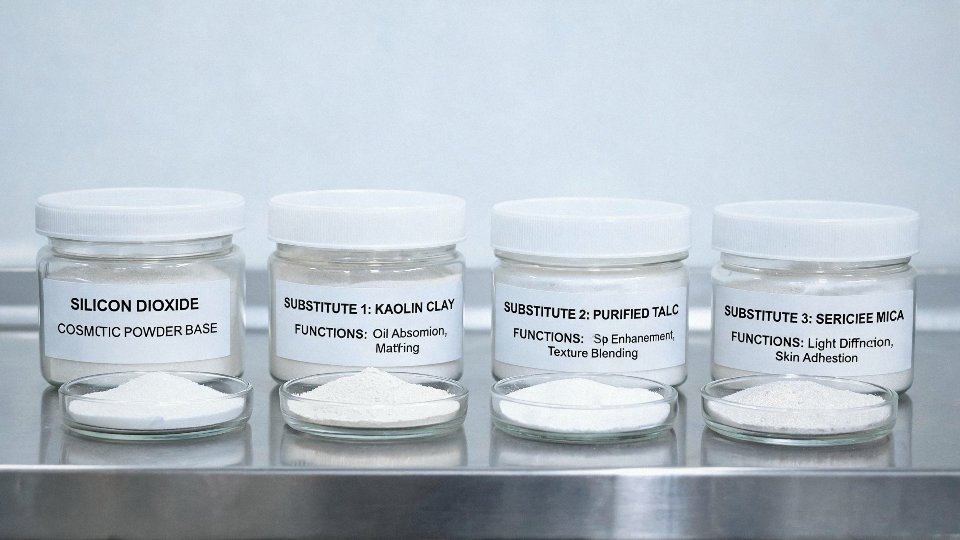
Formulation checks before approving the substitute
| Substitute family | Best fit | Watch closely |
|---|---|---|
| Talc | Slip, bulk, pressability, cost control | Asbestos-free documentation, perception, regional limits |
| Mica and sericite | Glide, luminosity, soft payoff | Lower oil absorption, shade shift, unwanted shine |
| Starch | Natural feel, oil pickup, dry shampoo | Humidity, microbial load, fragrance retention |
| Boron nitride | Luxury slip, adhesion, blur | Cost, claim fit, regional acceptance |
| Polymer microspheres | Cushion, soft-focus, dry touch | Microplastic rules, sustainability claims |
| Clays and silicates | Viscosity, suspension, masks | Hydration, pH sensitivity, viscosity drift |
Run side-by-side stability, pressability, payoff, shade, fragrance, and panel testing. A substitute that looks identical in a drawdown may still change how hard a compact presses, how much powder releases on a brush, how a deodorant drags on skin, or how a cream settles after three freeze-thaw cycles. That is where silica substitutions usually succeed or fail: not in the ingredient list, but on the filling line and on the customer’s face.
For paints, coatings, inks, and sealants: calcium carbonate, kaolin, talc, alumina, and polymer matting agents
In coatings work, silicon dioxide is not one material doing one job. Fumed silica may be holding a sealant bead on a vertical joint. Precipitated silica may be knocking gloss down in a clear wood finish. A treated silica may be improving scratch resistance or keeping dense pigments from settling during a hot warehouse summer.
That is why the substitute depends on the function: matting, anti-settling, rheology control, abrasion modification, corrosion-resistant filling, or reinforcement.
Calcium carbonate: the default extender, not a universal silica replacement
Ground calcium carbonate is usually the first material procurement asks about because it is available, bright, easy to disperse, and cheap compared with specialty silica. In architectural paints, primers, some inks, putties, and sealants, it can carry a lot of volume at a sensible cost. Fine grades help brightness and smoothness. Coarser grades build body and lower resin demand, though they can drag down scrub resistance if pushed too hard.
The handling difference is not small. Fumed silica may sit around 30 kg/m3 to 150 kg/m3 bulk density, precipitated silica roughly 100 kg/m3 to 300 kg/m3, while calcium carbonate is often in the 600 kg/m3 to 1200 kg/m3 range, depending on grade and compaction. That changes bag dumping, screw feeder calibration, dust load, batch yield checks, and how fast the powder wets out.
Its weak spots are acid resistance and high-performance matting. In exterior or industrial service where acidic cleaners, cement exposure, or aggressive environments show up, calcium carbonate can react or lose durability. It also will not behave like a porous silica matting agent in clear coats. You may get lower cost, but not the same 60° and 85° gloss profile.
Calcium carbonate can replace silica matting agent in any coating without changing gloss or viscosity.False
Calcium carbonate can work as an extender, but its density, particle shape, oil absorption, hardness, and surface chemistry differ from silica. Gloss, sag resistance, settling, and abrasion performance often shift enough to require reformulation.
Kaolin and calcined kaolin: opacity, scrub, and barrier value
Hydrous kaolin is a practical substitute where silica is acting partly as an extender and partly as a film-structure modifier. It disperses cleanly with the right dispersant package and can improve opacity, tint holdout, and cost control in architectural coatings. In water-based inks, it can help control print density and reduce formulation cost without the grit you get from some coarser minerals.
Calcined kaolin is a different animal. The heat treatment creates a more porous, brighter, harder particle. It can lift dry hiding, improve scrub resistance, and contribute to barrier properties. In a mid-sheen wall paint, replacing part of a silica or expensive extender package with calcined kaolin can be a good move, but watch viscosity rise. Some grades drink resin and water. Operators will notice it at the high-speed disperser before the lab report arrives.
Typical precipitated silica used in industrial powders may run about 3 micrometers to 20 micrometers median particle size, with high surface area grades above 100 m2/g. Kaolin may match the particle size range on paper, yet behave nothing like it in the mill base because plate shape and surface treatment matter.
Talc for primers, sealants, and industrial coatings
Talc is lamellar, soft, and useful when the coating benefits from plate-like reinforcement. In primers and sealants it can improve sanding, reduce cracking tendency, and help build a more tortuous path for moisture. That barrier effect is why talc shows up in industrial primers and corrosion-resistant systems, usually alongside other fillers and anti-corrosion pigments.
It is not a clean swap for silica thickening. Talc can reduce sag in some systems through packing and plate alignment, but it will not give the same thixotropic recovery as fumed silica in a polyurethane sealant or a high-build epoxy. In practice, a plant may need to adjust dispersant, wetting time, and even blade speed. If talc is under-dispersed, the drawdown looks fine wet and then shows specks or weak rub-up after drying. Annoying, and avoidable.
Harder mineral options: alumina, aluminum silicate, and ceramic microspheres
Where abrasion resistance, burnish resistance, or thermal stability matters more than raw material cost, alumina and ceramic fillers deserve a look. Alumina is hard, dense, and useful in floor coatings, coil coatings, high-wear clear systems, and some industrial topcoats. Aluminum silicate grades can offer a balance of opacity, reinforcement, and chemical resistance.
Ceramic microspheres can reduce density, improve burnish resistance, and help thermal insulation in certain coatings. They are sensitive to shear. Put hollow spheres through an aggressive grind and you may crush the value out of them. I have seen operators treat them like calcium carbonate because the batch ticket did not say “post-add.” Bad instruction, bad result.
Polymer matting agents and waxes for clear and UV systems
For clear coats, wood coatings, UV-curable finishes, and high-clarity systems, organic polymer matting agents can be a better substitute than mineral extenders. They can reduce gloss with less haze than some silica grades, depending on particle size, refractive index, and film thickness. Polyamide, acrylic, polyurethane, and urea-formaldehyde-type matting agents are all used in different niches.
Waxes bring slip, mar resistance, blocking resistance, and matting, but they can hurt recoat adhesion or create craters if compatibility is poor. In UV systems, cure shrinkage and surface migration can exaggerate defects. Test under the actual lamp, line speed, and film build. A lab drawdown cured slowly under a bench unit can lie.
What to test before approving the substitute
A sensible substitution trial should include grind gauge readings, particle size analysis, 60° and 85° gloss, drawdown panels over black and white charts, viscosity at relevant shear rates, thixotropic recovery, sag resistance, and storage stability after heat aging. For industrial coatings, add abrasion testing and salt spray where corrosion protection is part of the claim.
Application trials matter. Spray, roll, and brush do not punish a formula the same way.
| If silica was mainly used for… | Better starting substitutes | Watch first |
|---|---|---|
| Low-cost extension | Calcium carbonate, kaolin | Scrub loss, settling, pH sensitivity |
| Matting in clear coats | Polymer matting agents, waxes, selected silicates | Haze, 60°/85° gloss split, recoat adhesion |
| Anti-settling or sag control | Treated clays, talc blends, rheology additives | Viscosity drift, poor leveling |
| Abrasion or burnish resistance | Alumina, ceramic microspheres | Cost, density, spray wear, film roughness |
| Barrier improvement | Talc, kaolin, aluminum silicate | Dispersion quality, water resistance, corrosion results |
The wrong substitute may pass purchasing review and still fail on the line: settled drums, poor tint strength, roller spatter, gloss complaints, clogged spray tips, or a coating that sands like rubber. Run the trial like production, not like a brochure sample.
For rubber, plastics, and composites: carbon black, calcium carbonate, clay, talc, and alumina trihydrate
In rubber and polymer compounds, silicon dioxide is usually doing heavier work than “taking up space.” Precipitated silica is a reinforcing filler in tires, footwear soles, transmission belts, hoses, rollers, vibration mounts, cable compounds, and technical molded goods. It can raise tensile strength, tear resistance, abrasion performance, and wet traction, depending on surface area, particle structure, polymer type, and whether the compound uses a proper coupling system.
Typical precipitated silica used in industrial powders sits roughly around 3 micrometers to 20 micrometers median particle size, while high surface area grades can run above 100 m2/g. Those numbers matter on the mixer floor. A fine, high surface area silica eats plasticizer, raises viscosity, traps moisture, and can make a Banbury batch feel “dry” before dispersion is actually complete.
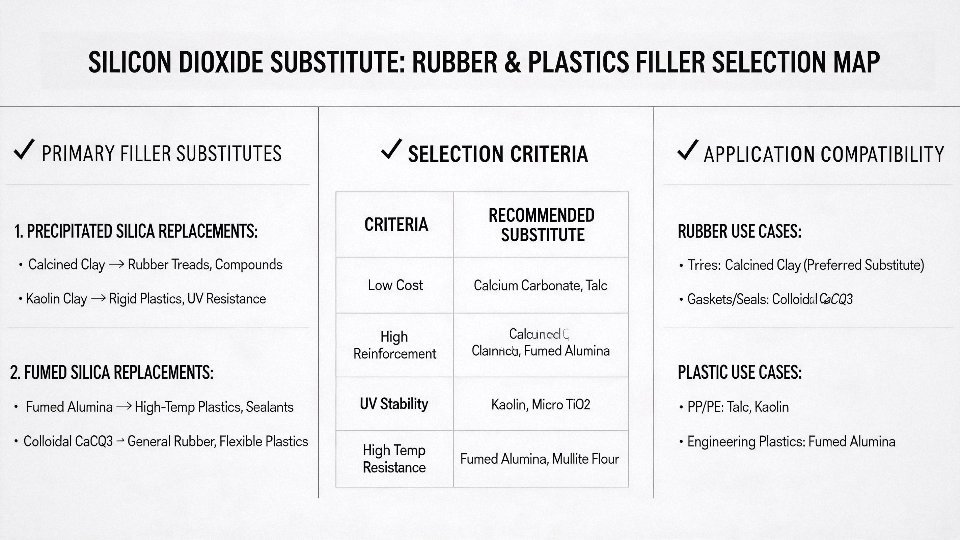
Carbon black is the closest rubber-world substitute, but it is not neutral
Carbon black is the primary reinforcing alternative in many rubber systems. In natural rubber, SBR, BR, NBR, EPDM, and many specialty elastomers, the right black grade can deliver strong tensile properties, abrasion resistance, and manageable processing. For belts, hoses, mounts, and black molded goods, it is often the first place I would look.
But it changes the product.
Carbon black turns the compound black, raises electrical conductivity depending on grade and loading, affects heat buildup, and shifts dynamic properties. In tires and dynamic mounts, that can be good or bad. A compound that runs cooler on silica may build more heat with the wrong black structure. Weathering behavior changes too; carbon black usually improves UV resistance, but it may not match silica’s wet grip or low rolling resistance behavior in tread compounds.
Wrong substitution here shows up as hot-running parts, cracked flex zones, noisy extrusion, or abrasion results that look fine in the lab but fail on a dusty conveyor line.
Calcium carbonate is the workhorse extender
Calcium carbonate is common in rubber and plastics because it is cheap, dense, easy to feed, and available in many particle sizes and surface treatments. It is not a one-for-one reinforcing filler for silica. Treat it as a cost-reducing extender or stiffness modifier unless the grade is very fine and well-treated.
In PVC, polyolefins, rubber floor mats, cable jackets, profiles, and molded consumer parts, calcium carbonate can be loaded quite high if the process can tolerate the viscosity and density change. Bulk density is part of the handling story: fumed silica may be around 30 kg/m3 to 150 kg/m3, precipitated silica around 100 kg/m3 to 300 kg/m3, while calcium carbonate often sits near 600 kg/m3 to 1200 kg/m3. Same percentage by weight, very different hopper behavior. Screw feeders, dust collectors, and bag dump stations notice immediately.
Clay, calcined clay, and talc sit in the semi-reinforcing middle
Kaolin clay, calcined clay, and talc are useful when the target is stiffness, dimensional stability, barrier performance, smoother extrusion, or lower compound cost. They do not usually give the same reinforcement as a good silica-silane system, but they can make a part behave better in service.
Talc is plate-like, so it often improves modulus, heat deflection temperature, and shrink control in polypropylene and other plastics. Kaolin can improve electrical properties and processing in wire and cable compounds. Calcined clay is more abrasive than untreated clay, so check screw and barrel wear if loadings are high. I have seen plants blame the resin for rising melt temperature when the real issue was a filler change plus a worn screw tip.
Flame retardant fillers are a different category
Alumina trihydrate and magnesium hydroxide can replace silica only when the job has changed to flame retardancy, smoke suppression, or mineral loading. They are not direct reinforcing equivalents.
Alumina trihydrate releases water at elevated temperature and is common in wire and cable, flooring, roofing membranes, and some thermoset composites. Magnesium hydroxide works at higher decomposition temperatures, so it may suit higher-temperature polymers. Both often require high loadings, which can hurt elongation, impact strength, and extrusion rate. Surface treatment helps, but there is no free lunch. Expect to adjust plasticizer, lubricant, coupling agent, and processing temperature.
Other mineral options for modulus and dimensional control
Glass beads, wollastonite, mica, and mineral fibers belong on the list when the reason for using silica is not reinforcement in the rubber sense, but dimensional control, modulus, heat deflection temperature, or creep resistance.
| Target property | Likely substitute | Practical warning |
|---|---|---|
| Black rubber reinforcement | Carbon black | Changes heat buildup, conductivity, color, and dynamic response |
| Low-cost loading | Calcium carbonate | Lower reinforcement; density and feeder settings change |
| Stiffness and shrink control | Talc, mica, wollastonite | May reduce impact strength or elongation |
| Barrier and electrical behavior | Kaolin, calcined clay | Moisture and abrasion need watching |
| Flame retardancy | Alumina trihydrate, magnesium hydroxide | High loading can punish processing and toughness |
Coupling agents and process settings decide whether the swap works
Silica often needs silanes, especially in sulfur-cured rubber, to bond the filler to the polymer and keep hysteresis under control. Remove silica and that silane package may become useless, excessive, or even troublesome. Replace silica with calcium carbonate, talc, or clay and you may need a different surface-treated grade instead of the same coupling agent.
The cure package can shift too. Silica can adsorb accelerators and moisture; carbon black does not behave the same way. Plasticizer demand changes. Mixing sequence changes. Dump temperature changes. Extrusion die swell, scorch safety, mill banding, and surface finish can all move enough to matter.
A silicon dioxide substitute in rubber or plastics can usually be selected by matching only hardness and filler loading.False
Hardness and loading are useful screening numbers, but they miss reinforcement, dynamic heat buildup, abrasion, aging, cure behavior, melt flow, density, and processing stability. Those are often the properties that decide whether the substitution survives production.
Test it like a production material, not just a lab plaque. For rubber, check tensile strength, elongation, tear resistance, abrasion loss, compression set, Mooney viscosity, cure curve, aging, and heat buildup if the part is dynamic. For plastics and composites, run melt flow index, impact strength, flexural modulus, heat deflection temperature, shrinkage, warpage, and aging. Then run the extruder or press long enough to see feeding drift, screen pack pressure, die drool, and scrap rate.
The bad substitution is the one that passes the first-hour sample and ruins the night shift.
For filtration, drying, and adsorption: activated alumina, zeolite, clay, cellulose, and perlite
Do not treat this category like a filler swap. In filtration, drying, and adsorption, the useful part is not just “silicon dioxide content.” It is pore geometry, surface chemistry, particle strength, and how the media behaves under flow.
Silica gel and diatomaceous earth are both silica-based, but they do different jobs on the plant floor. Silica gel is an adsorbent. It pulls moisture and some polar compounds into a porous structure. Diatomaceous earth is usually a filtration aid. It builds a permeable cake that traps fine solids while letting liquid pass. Replace one with the wrong material and you can get wet gas, cloudy product, blinded filters, or a disposal headache.
Silica gel and diatomaceous earth are not interchangeable just because both are silica-based materials.True
Silica gel is selected mainly for adsorption performance, while diatomaceous earth is selected mainly for filter cake structure, permeability, and solids capture.
Activated alumina where heat, polarity, and rugged service matter
Activated alumina is often the first serious substitute for silica gel in drying duties. It works in compressed air, natural gas polishing, solvent drying, transformer oil treatment, and some liquid-phase adsorption services. It is also used for fluoride removal, polar impurity capture, and catalyst support applications.
Its advantage is thermal and mechanical toughness. Regeneration temperatures are commonly in the rough range of 150°C to 300°C, depending on the contaminant, bed design, purge gas, and outlet dew point target. Some plants run hotter, but then binder stability, dusting, and vessel metallurgy start to matter. In my experience, alumina beds tolerate rougher handling than fragile gels, though a bad distributor plate or slug of liquid can still turn the top layer into fines.
Watch the pH. Activated alumina can shift pH in water treatment, and it can leach trace metals or alkalinity depending on grade and rinse procedure. For food, pharma, electronics, or high-purity chemical service, ask for extractables data, not just a sales sheet saying “high purity.”
Molecular sieves and zeolites for selective drying
Molecular sieves and zeolites are the sharper tools. They have uniform pore openings, commonly selected around 3A, 4A, 5A, or 13X depending on what must enter the pore and what must be excluded. That makes them useful when the process needs very low dew point, selective gas separation, ethanol dehydration, refrigerant drying, or removal of water without pulling too much product.
They usually cost more than basic silica gel or clay. They also need cleaner feed. Oil mist, heavy organics, amines, compressor carryover, or polymerizable vapors can foul a sieve bed and ruin capacity. Regeneration is often in the 200°C to 350°C range, tied to bed loading, cycle time, purge rate, and the depth of dryness required. If the spec says minus 40°C dew point or lower, do not guess from a jar test. Run breakthrough testing with real feed gas.
Clay adsorbents for lower-cost cleanup
Bentonite, attapulgite, sepiolite, and acid-activated clays are practical substitutes where the job is decolorizing, oil polishing, binding, odor control, or environmental capture. They show up in edible oil refining, lube oil reclamation, animal feed binders, spill absorbents, wastewater treatment, and some chemical purification steps.
The tradeoff is selectivity and residue. Clays can adsorb pigments and polar bodies well, but they may also retain valuable product. In an oil plant, that can mean higher spent cake losses. In a feed or food application, moisture, microbiological quality, heavy metals, and local approval status are not paperwork trivia; they decide whether the material can be used at all.
Typical clay use levels vary widely, from fractions of a percent in polishing to several percent in heavy cleanup, depending on color target, contact time, temperature, mixing intensity, and oil or liquid chemistry.
Replacing diatomaceous earth in filtration
Cellulose, perlite, and synthetic filter aids are common alternatives to diatomaceous earth in beverage, chemical, edible oil, fermentation, mining, and wastewater service. The reason for switching is often dust exposure, disposal classification, ash content, product clarity, or supply consistency.
Cellulose gives a softer, fibrous cake and is useful where low ash or incineration behavior matters. Perlite tends to form a lightweight, porous cake and can be attractive where high flow is needed. Synthetic filter aids can be engineered for narrow particle size, chemical resistance, or low extractables, but cost and validation work can be painful.
Bulk density changes handling immediately. Fumed silica may sit around 30 kg/m3 to 150 kg/m3, precipitated silica around 100 kg/m3 to 300 kg/m3, while mineral products like calcium carbonate can be 600 kg/m3 to 1200 kg/m3. Filter aids vary too, and the number affects feeder calibration, bag change frequency, dust collection loading, and how operators judge a “full” precoat tank.
Metrics that decide whether the substitute survives production
Do not approve the substitute from a certificate of analysis alone. Compare:
| Metric | Why it matters in operation |
|---|---|
| Pore size and surface area | Drives adsorption selectivity, moisture pickup, and breakthrough curve shape |
| Adsorption capacity | Determines bed size, cycle length, and regeneration frequency |
| Pressure drop | Affects pump load, compressor load, flow rate, and filter cycle time |
| Extractables | Critical for beverage, pharma, electronics, and high-purity chemicals |
| pH effect | Can destabilize product, corrode equipment, or alter downstream chemistry |
| Regeneration temperature | Sets energy use, heater design, purge gas demand, and media life |
| Mechanical strength | Controls dusting, attrition, bed channeling, and filter cake integrity |
| Disposal classification | Spent media may inherit hazards from the captured contaminant |
A common mistake is replacing diatomaceous earth with perlite or cellulose at the same feed rate and expecting the same filter behavior. The cake may become more compressible. Filtration rate can fall as differential pressure rises. Turbidity may improve at first, then slip when the cake cracks. Product yield can move a few tenths of a percent or several percent depending on retained liquid, solids loading, and cleaning method. On a large beverage or oil line, that is real money.
Run pilot-scale filtration and breakthrough tests before conversion. Use real slurry, real contaminant load, real temperature swings, and the same screen, leaf, candle, plate, or cartridge geometry if you can. Lab funnels hide too many sins. For food, pharmaceutical, beverage, and high-purity chemical processes, validation should include clarity, extractables, sensory or impurity impact, cleanout time, and at least one dirty-feed upset case. That is where the substitute either proves itself or saves you from a bad shutdown.
For high-temperature, ceramic, and electrical applications: alumina, zirconia, boron nitride, and glass alternatives
Silicon dioxide is not just a white filler in this part of the plant. In furnaces, labware, insulators, sight glasses, kiln furniture, sensor housings, and electrical feedthroughs, silica-based materials are often chosen because they survive a combination of heat, chemistry, voltage, and dimensional stress that cheaper powders cannot handle.
Quartz, fused silica, and other silica-rich materials earn their keep through low thermal expansion, good thermal shock resistance, useful optical clarity in selected grades, high electrical resistivity, and broad chemical resistance. Fused silica is especially hard to replace one-for-one because its coefficient of thermal expansion is very low, often around half a part per million per degree Celsius, depending on grade and temperature range. That is why a hot quartz tube can often survive abuse that would crack ordinary glass.
Wrong substitute here means cracked parts, ground faults, warped fixtures, or a furnace shutdown at 2 a.m. I have seen maintenance teams blame “bad heaters” when the real issue was a ceramic spacer absorbing flux, tracking electrically, then carbonizing contamination across the surface.
Alumina when strength, wear, and insulation matter
Alumina is usually the first technical ceramic to evaluate when silica is doing a structural or electrical job. Common industrial grades run from roughly 92% to 99.8% alumina, with performance depending heavily on purity, porosity, grain size, and firing quality.
Use alumina for electrical insulators, thermocouple tubes, wear plates, pump components, ceramic rollers, welding fixtures, and high-temperature stand-offs. It is hard, stiff, chemically stable in many environments, and a good electrical insulator. Service temperatures can sit in the 1,200°C to 1,700°C range, give or take, depending on grade, load, atmosphere, and whether thermal cycling is gentle or brutal.
The catch is expansion. Alumina expands far more than fused silica, roughly in the 7 ppm/K to 8 ppm/K range over many industrial temperature bands. If the part is bonded into metal, clamped between stainless plates, or used as a long tube with uneven heating, that mismatch matters. Alumina is strong, but it is not forgiving once tensile stress finds a flaw.
Zirconia when toughness beats price
Zirconia is the substitute I look at when silica or alumina is too brittle for the mechanical duty. Yttria-stabilized zirconia has high fracture toughness for a ceramic, good strength, and low thermal conductivity, which makes it useful for thermal barrier parts, forming tools, wear components, and hot mechanical interfaces.
It is not the low-expansion choice. Zirconia’s thermal expansion is closer to many metals than fused silica, often around 10 ppm/K to 11 ppm/K depending on grade and temperature. That can be helpful in a metal assembly, but poor if the original design relied on fused silica staying dimensionally quiet. Zirconia also costs more, machines differently, and may age or transform under certain steam, temperature, and stress conditions. Do not buy it by chemistry alone; ask for the stabilized grade and service history.
Boron nitride for hot release, dry lubrication, and insulated heat transfer
Hexagonal boron nitride is a very different animal. It feels almost graphite-like, but it remains electrically insulating. That makes it useful for high-temperature release surfaces, molten metal contact in selected applications, vacuum furnace fixtures, semiconductor handling, hot pressing aids, and electrically isolated heat-spreading parts.
BN can conduct heat while resisting current flow, though conductivity is strongly directional in many grades. It also machines nicely compared with dense alumina or zirconia. The warning is atmosphere. In air, boron nitride can start oxidizing in the high hundreds of degrees Celsius; in vacuum or inert gas it can survive much higher temperatures, depending on grade and binder. A part that works beautifully in a nitrogen furnace may fail fast beside an open-air burner.
Glass, borosilicate glass, and glass-ceramics
Glass substitutes belong in selected windows, labware, insulation parts, lamp envelopes, viewports, and electrical components. Borosilicate glass handles thermal shock better than soda-lime glass because of its lower expansion, usually around 3 ppm/K to 4 ppm/K. Glass-ceramics can go lower still, sometimes near zero expansion across a useful range, which is why they show up in cooktops, telescope mirrors, and thermal shock parts.
Still, glass is not magic. Alkalis attack some compositions. Hydrofluoric acid attacks silica-based glass. Hot caustic can be nasty. Thermal shock resistance depends on thickness, edge finish, scratches, mounting stress, and heat-up rate. A thick borosilicate sight glass clamped too tightly in a warped flange may crack while a thinner one survives.
Do not use low-temperature fillers as ceramic substitutes
Calcium carbonate, talc, starch, and cellulose are not substitutes for silica in high-temperature electrical or ceramic service. Calcium carbonate decomposes at elevated temperature and releases carbon dioxide. Starch and cellulose char, shrink, burn, or disappear. Talc can be useful in some ceramic bodies, but as a direct substitute in a hot insulator or precision thermal part it can lose strength, change phase, or create dimensional movement. That is a recipe for loose fixtures and contaminated product.
Practical selection checks
| Selection factor | Why it matters on the floor |
|---|---|
| Maximum service temperature | Must include peak temperature, soak time, load, and atmosphere, not just catalog rating |
| Thermal expansion | Drives cracking, seal failure, and bolt preload loss during cycling |
| Dielectric constant and dielectric strength | Affects insulation spacing, signal behavior, arcing risk, and high-voltage safety margin |
| Thermal conductivity | Controls hot spots, heat spreading, and operator burn risk |
| Corrosion resistance | Fluxes, alkalis, acids, molten metals, and cleaning chemicals change the answer |
| Machinability | Impacts lead time, tolerance, edge quality, and replacement cost |
A silicon dioxide substitute for high-temperature electrical service should be qualified by thermal, electrical, chemical, and dimensional testing rather than selected only by matching appearance or filler percentage.True
Materials with similar color or powder form can have completely different expansion, dielectric behavior, decomposition temperature, and corrosion resistance.
A sensible qualification plan is not complicated. Thermal-cycle the part across the real operating window. Run dielectric strength and insulation resistance testing after heat exposure, not only on new parts. Immerse coupons in the actual cleaning chemical, flux, oil, melt, or condensate. Measure dimensions before and after exposure. Then cut open failed samples and look for cracking, glaze attack, surface tracking, binder burnout, or grain pullout.
That last step saves arguments. The fracture surface usually tells the truth.
Regulatory, safety, and supply-chain checks before approving a substitute
A silicon dioxide substitute can run beautifully in a lab beaker and still be a bad plant decision. I have seen powders pass flow tests, then get stopped by a customer specification, a food additive limit, a pharmaceutical monograph, or an environmental review because nobody asked the boring questions early enough.
For food, the replacement must be permitted for the product category and selling region. Typical anticaking use levels sit around 0.5% to 2.0% by weight, depending on the flow target, moisture load, and local regulation, but “works at 1%” does not mean “legal at 1%.” For pharma and nutraceuticals, check compendial status, excipient grade, residual limits, and whether the change affects dissolution or label claims. Cosmetics bring their own restrictions, especially around talc purity, mineral origin, microplastic concerns, and claims such as “natural” or “clean.” Industrial coatings and rubber may look looser, until a customer’s restricted substances list blocks the filler.
A technically effective substitute can still be rejected if it changes legal status, labeling, worker exposure, or customer approval requirements.True
Approval depends on intended use, selling country, customer specification, and plant handling conditions, not only on powder performance.
Paperwork that should be on the desk before trials scale up
Do not wait until the first production batch to request documents. Procurement should collect them before engineering spends time tuning feeders and dust collection.
At minimum, ask for:
- Safety data sheet, current revision, with exposure limits and transport classification
- Technical data sheet with particle size, surface area, bulk density, moisture, pH, and recommended storage
- Certificate of analysis for the supplied lot, not just a generic sample
- Allergen statement, especially for starches, cellulose derivatives, or plant-based carriers
- Heavy metals limits, with test method and reporting basis
- Microbiological limits where the material enters food, pharma, supplements, or personal care
- Residual solvent statement, even when the supplier says “not applicable”
- Country-of-origin declaration and, where needed, animal-origin, vegan, halal, kosher, organic compatibility, and non-GMO statements
- Vendor change notification agreement covering source, process, site, specification, and packaging changes
A weak certificate of analysis is a warning sign. “Conforms” with no actual numbers may be acceptable for a low-risk extender in a noncritical application, but it is thin evidence for regulated products or export business.
Dust exposure is not a purchasing detail
Powder substitutions change the air in the room. That sounds simple, but it gets missed.
Respirable dust needs review, even for materials often treated as harmless nuisance dusts. Fine precipitated silica commonly sits around 3 micrometers to 20 micrometers median particle size, with high surface area grades above 100 m2/g; those grades can become airborne quickly during bag dumping. Talc needs purity confirmation, including absence of asbestiform contamination. Mineral fillers should be checked for crystalline silica content, not assumed clean because the trade name sounds safe.
Organic alternatives bring a different problem. Starch, cellulose, rice hull fiber, and some polymer powders can create combustible dust hazards. If the current system was designed around a dense mineral, swapping to an organic powder may require dust explosibility data, grounding checks, housekeeping changes, and possibly explosion protection. A 25 kg paper bag split at the mixer throat can turn into a cloud fast. Operators notice before managers do.
Ventilation, local extraction, sealed transfer, respirator selection, glove compatibility, and eyewash placement belong in the approval file. Personal protective equipment is the last layer, not the engineering solution.
Labeling and claims can cost more than the ingredient
A substitute may force a label rewrite or kill a marketing claim. Calcium silicate, tricalcium phosphate, starch, cellulose, talc, mica, and polymer microspheres all carry different declaration language depending on product type and jurisdiction. “Natural origin” may survive one mineral filler and fail another. Vegan status can be affected by processing aids or anti-dusting agents. Halal and kosher approval depends on the full supply chain, not the chemical name alone.
Microplastic concerns deserve a sober review for polymer particles in cosmetics, detergents, and coatings. Even where legal, some retailers and brand owners restrict them. Mineral declaration can matter too, especially in food, supplements, and personal care where consumers actually read the panel.
Supply risk, handling, and real cost
Price per kilogram is a poor way to approve a substitute. Use level, yield loss, batch time, cleaning time, scrap rate, packaging changes, quality testing, and regulatory filing updates all count.
Bulk density changes are one of the sneaky ones. Fumed silica may run roughly 30 kg/m3 to 150 kg/m3, precipitated silica about 100 kg/m3 to 300 kg/m3, while calcium carbonate often lands around 600 kg/m3 to 1200 kg/m3. Those ranges depend on grade, compaction, and moisture. A low-density powder can overflow bins, bridge in hoppers, slow bag charging, and inflate freight cost because you are shipping air. A dense substitute can overload a feeder calibration or settle in transport.
Check regional availability, lead time, shelf life, moisture sensitivity, bag type, pallet height, and whether the supplier can dual-source the same grade. For hygroscopic powders, a warehouse near a roll-up door in August is not the same as a controlled room in January.
Practical change-control sequence
A clean substitution process usually looks like this:
| Step | What to decide | Why it matters |
|---|---|---|
| Define the reason | Cost, shortage, claim change, safety, performance | Prevents random “equivalent” trials |
| Set acceptance criteria | Flow, assay, appearance, strength, dissolution, viscosity, dust, label impact | Keeps the trial from becoming opinion-based |
| Screen candidates | Regulatory status, documents, supply, exposure risk | Removes dead ends early |
| Run plant trials | Normal equipment, normal operators, normal humidity if possible | Lab flow does not always predict hopper behavior |
| Document risk | Quality, safety, environmental, customer, and commercial effects | Protects the decision later |
| Validate and notify | Production lots, specifications, customer approvals where required | Avoids surprise rejections or audits |
The sign-off should include quality, regulatory, engineering, procurement, production, and environmental health and safety. If one of those groups is missing, the substitute has not really been approved; it has only been tried.
Frequently asked questions about silicon dioxide substitutes
What is the best substitute for silicon dioxide?
There is no single best substitute. The right answer depends on what the silicon dioxide is doing: anticaking, thickening, matting, reinforcing, drying, polishing, insulating, or just adding cheap bulk.
For food anticaking, calcium silicate is often one of the stronger practical substitutes, especially in seasoning blends, powdered drink mixes, and hygroscopic salts. Use levels are commonly around 0.5% to 2.0% by weight, depending on the powder, humidity exposure, flow target, and local food rules.
For low-cost filler work, calcium carbonate is usually the first commercial candidate. It is dense, cheap, widely sourced, and easy to process. For cosmetics and coatings, talc or kaolin may make more sense where slip, opacity, softness, or matting matter. For high-temperature or electrical service, alumina is often a more serious technical replacement than any food-grade or cosmetic filler.
Wrong match, wrong result. A plant may save a few cents per kilogram on filler, then lose it in plugged hoppers, poor dispersion, soft film, tablet capping, or customer complaints about texture.
Can cornstarch replace silicon dioxide?
Yes, in some food and cosmetic powders, but it is not a direct match.
Cornstarch can improve powder feel, reduce clumping a bit, and soften sensory profile. It works best in relatively dry systems where the powder is packed and used quickly. In a humid warehouse, it can disappoint. Starch usually has weaker moisture resistance than mineral anticaking agents, and it may change mouthfeel, color, bulk density, and label declarations.
There is also the plant-floor issue nobody likes to talk about: starch can increase microbial and allergen management concerns, depending on the product and country of sale. If your sanitation program is already stretched, do not approve starch from a bench sample alone. Run storage trials at realistic summer humidity.
Is calcium carbonate a substitute for silicon dioxide?
Calcium carbonate can substitute for silicon dioxide when the job is extender, filler, opacity support, cost reduction, or hardness adjustment. It is common in coatings, plastics, rubber, sealants, and some tablet systems.
It is not a true replacement for high-surface-area silica, silica gel, or fumed silica. Bulk density alone tells part of the story: calcium carbonate is often around 600 kg/m3 to 1200 kg/m3, while fumed silica may be only 30 kg/m3 to 150 kg/m3 and precipitated silica roughly 100 kg/m3 to 300 kg/m3. That affects feeder settings, bag handling, airborne dust, batch volume, and dispersion energy.
If the current silica grade is controlling viscosity, anti-settling, adsorption, or flow at very low dosage, calcium carbonate will usually need a formulation redesign, not a one-for-one swap.
Can talc replace silicon dioxide?
Talc can replace some slip, filler, powder-feel, and matting functions. It is useful in cosmetics, coatings, plastics, and rubber compounds where plate-like particles help with smoothness, barrier properties, or sanding behavior.
The caution is purity. Buyers should require asbestos-free certification, grade-specific test data, traceability, and regulatory confirmation for the target market. Consumer perception also matters. In cosmetics, a technically acceptable talc may still be a marketing problem. In coatings or plastics, the discussion is usually more about particle size, oil absorption, color, and abrasion on screws or pumps.
What can replace silica gel?
Activated alumina, molecular sieves, zeolites, clay desiccants, and calcium chloride can all replace silica gel in the right service.
Molecular sieves are strong at low relative humidity and can dry aggressively, but they cost more and may over-dry sensitive goods. Activated alumina is rugged and regenerable in many industrial systems. Clay desiccants are economical for packaging where moderate humidity control is enough. Calcium chloride pulls a lot of water, but leakage and liquid brine contact can create a real mess; I avoid it near electronics or cartons that cannot tolerate staining.
A desiccant substitute should be chosen by humidity target, regeneration method, contact safety, and packaging design, not just by water capacity on a datasheet.True
High capacity can be useless or risky if the material releases liquid, needs excessive regeneration heat, contaminates the product, or performs poorly at the actual humidity range.
What can replace fumed silica?
For thickening, anti-sag, and suspension control, candidates include organoclays, castor wax derivatives, polyamide waxes, cellulose ethers, bentonite, hectorite, and specialty rheology modifiers. The best choice depends on whether the system is solventborne, waterborne, epoxy, polyurethane, oil-based, or powder.
Fumed silica is awkward to handle but powerful. It builds structure at low loading because of its extremely low bulk density and high surface area. If maintenance is used to changing dust collector socks after silica charging, a wax or clay package may look attractive. Still, check shear thinning, storage stability, pumpability, and application temperature. A beautiful lab gel can turn into stringy garbage in a diaphragm pump.
Are silicon dioxide substitutes safer?
Not automatically.
Each substitute brings its own exposure and compliance profile: respirable dust, heavy metals, crystalline silica contamination, asbestos risk, allergen status, microbial load, mining source, food-contact clearance, cosmetic restrictions, or wastewater impact. Even “natural” materials can be dusty, inconsistent, or contaminated.
A safer substitution is proven through SDS review, supplier audits where justified, incoming QC, dust control checks, and operator feedback during trials. If the new powder blinds a filter receiver every third batch, operators will find shortcuts. That is where safety programs start leaking.
Can natural alternatives replace silicon dioxide?
Sometimes. Rice starch, cellulose, kaolin, bentonite, diatomaceous earth, and rice hull ash may fit natural-positioned products, depending on the claim language and local rules.
But “natural” is not a process specification. Rice starch may cake. Cellulose may change mouthfeel or tablet hardness. Bentonite may carry color and odor. Diatomaceous earth can raise inhalation concerns if the wrong grade is used. Rice hull ash varies with burn conditions and supplier control.
A practical trial should compare flow after storage, moisture pickup, label impact, microbial risk, dusting, and cost-in-use. The cheapest natural substitute on a quote sheet can become the most expensive one after slow filling, rejected lots, or a relabeling fight.
Practical selection matrix: match the substitute to the application and validation test
By this point, the practical answer should be clear: do not start with “What powder looks like silicon dioxide?” Start with “What failure am I trying to prevent?” Caking in a seasoning line is not the same problem as gloss control in a coating, and neither one is the same as reinforcement in a tire compound.
A useful selection matrix looks like this.
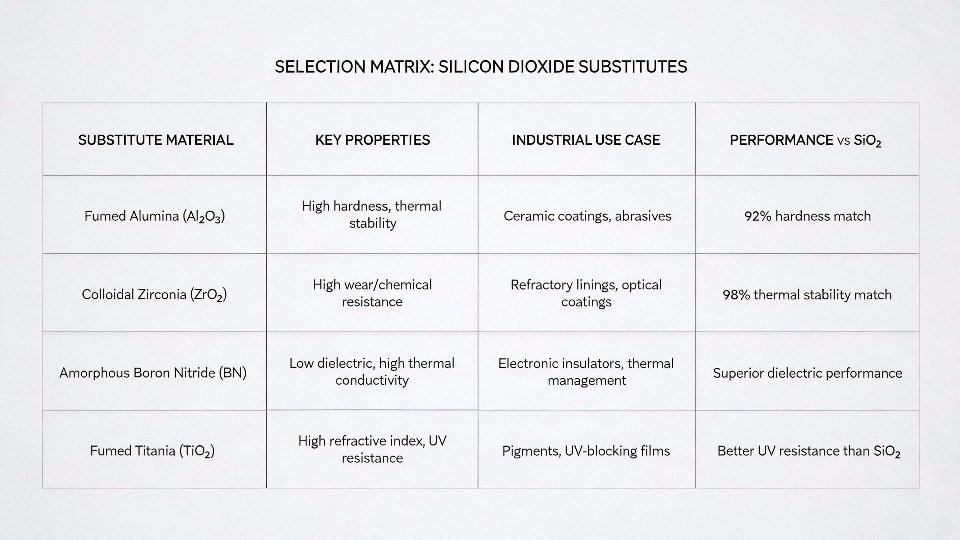
| Silicon dioxide function | Likely substitutes | What they usually preserve | What they may change | Validation test that matters most |
|---|---|---|---|---|
| Anticaking in food powders | Calcium silicate, tricalcium phosphate, starch, cellulose | Flowability, reduced bridging, lower lump formation | Taste, opacity, mineral declaration, moisture pickup | Flow-through hopper test, caking test after humidity exposure, label and local food additive review |
| Glidant in tablets or capsules | Microcrystalline cellulose, talc, magnesium stearate in limited cases | Blend movement, die filling, capsule filling consistency | Dissolution, hardness, lubrication balance, assay uniformity | Blend uniformity, tablet weight variation, dissolution, stability |
| Matting in coatings and inks | Calcium carbonate, kaolin, talc, alumina, polymer matting agents | Lower gloss, some body, lower formulation cost | Burnish resistance, transparency, viscosity, scrub resistance | Gloss at target angle, viscosity profile, rub-up, scrub or abrasion testing |
| Thickening or rheology control | Organoclay, cellulose ethers, castor wax, fumed alumina, polymers | Sag resistance, suspension, bead hold-up | Shear thinning, application feel, pump load, batch hydration time | Brookfield or cone-and-plate viscosity over shear range, sag test, storage settling |
| Reinforcement in rubber and plastics | Carbon black, clay, talc, calcium carbonate, alumina trihydrate | Stiffness, dimensional stability, some cost reduction | Tensile strength, elongation, wear, cure behavior, electrical properties | Tensile, tear, abrasion, Mooney viscosity, cure curve |
| Filtration aid | Perlite, cellulose, diatomaceous earth where allowed, specialty clays | Cake formation, solids capture, flow path structure | Extractables, disposal profile, pressure rise, clarity | Filter press or leaf filter trial, turbidity, flow rate versus pressure |
| Desiccation or adsorption | Activated alumina, zeolite, molecular sieve, clay desiccant | Water capture, humidity control, drying duty | Regeneration temperature, selectivity, dusting, pH effects | Moisture breakthrough curve, regeneration cycle test, dust test |
| Abrasive or polishing action | Alumina, calcium carbonate, pumice, polymer beads where allowed | Cleaning, mild cutting, surface conditioning | Scratch pattern, surface gloss loss, residue | Surface roughness, gloss retention, controlled abrasion test |
| Ceramic insulation and high-temperature duty | Alumina, zirconia, boron nitride, glass-ceramic materials | Thermal stability, dielectric behavior, structural spacing | Thermal expansion, brittleness, sintering shrinkage, cost | Thermal cycling, dielectric test, hot strength, chemical resistance |
| Filler extension | Calcium carbonate, kaolin, talc, clay, barytes | Volume build, cost reduction, solids increase | Density, color, opacity, wear on pumps and screws | Density, viscosity, color, mechanical properties, wear observation during pilot run |
For food anticaking, the high-probability choices are still calcium silicate or tricalcium phosphate. Use levels often sit around 0.5% to 2.0% by weight, but that depends on the powder’s fat content, salt level, humidity exposure, particle shape, and the regulation covering that product. A barbecue seasoning going through a humid summer warehouse behaves differently from a dry beverage premix packed with desiccant.
For tablets, microcrystalline cellulose or talc is often a better starting point than a random mineral filler. In cosmetics, starch can get you closer on absorbency and softness, while boron nitride is chosen when slip and premium skin feel matter. In coatings, calcium carbonate and kaolin are the workhorses. Rubber people will usually look first at carbon black, clay, or treated mineral fillers. For drying, activated alumina and zeolite are serious candidates, not cosmetic swaps. In high-temperature ceramic service, alumina is often the first credible direction.
A silicon dioxide substitute should be selected by function and validated in the real process, not approved by chemical similarity alone.True
Silicon dioxide grades differ widely in particle size, surface area, porosity, bulk density, and surface chemistry. Those properties drive flow, adsorption, reinforcement, matting, and handling behavior.
Red flags where a direct swap is risky
Be careful with regulated active dosage forms, infant food, sterile products, optical parts, high-temperature service, tire compounds, and customer-approved material lists. These are not good places for a quiet purchasing substitution.
One plant-floor example: replacing a low-bulk-density fumed silica with a dense mineral filler may look harmless on a spreadsheet. Then the feeder output changes, the dust collector loading drops but the mixer torque jumps, and the finished product fails viscosity or dispersion. Fumed silica can run roughly 30 kg/m3 to 150 kg/m3 bulk density, precipitated silica often sits nearer 100 kg/m3 to 300 kg/m3, while calcium carbonate can be around 600 kg/m3 to 1200 kg/m3. Those ranges depend on grade, compaction, moisture, and handling history, but the handling difference is real.
Also document the existing silicon dioxide grade before anyone buys the substitute. Median particle size for common precipitated silica grades used in industrial powders may be about 3 micrometers to 20 micrometers, and high surface area grades can exceed 100 m2/g. Grade-to-grade differences inside “silica” can be as large as the differences between material families.
A three-stage trial plan that usually works
Start with bench screening. Compare the current grade, at least two substitute candidates, and one “do nothing” control if the formulation can tolerate it. Check the main function first: flow, gloss, viscosity, adsorption, tensile strength, or dielectric performance. Do not bury the key result under twenty nice-to-have tests.
Move to pilot-scale processing. This is where bad substitutions expose themselves. Watch feeder stability, dusting, bag emptying, mixing time, filter pressure rise, pump amperage, die fill, screw torque, and cleanup. A material that passes a lab jar test can still bridge in a loss-in-weight feeder or polish a conveying elbow faster than expected.
Then run full production validation. Keep retained samples. Run accelerated stability testing where shelf life matters. For regulated or customer-controlled products, lock the change through the formal approval route before regular shipment. Procurement should not be left guessing here; neither should production.
Engineering checklist before approval
Use this short checklist before signing off:
- Target function: flow, adsorption, reinforcement, matting, insulation, extension, or something else.
- Regulatory category: food, drug, cosmetic, medical, industrial, or customer-specific.
- Particle size and shape.
- Surface area and porosity.
- Moisture behavior under real storage humidity.
- Chemical compatibility with actives, binders, resins, pigments, oils, and packaging.
- Processing impact: mixing, feeding, pumping, compression, filtration, extrusion, or firing.
- Safety controls: dust exposure, respirable fraction, housekeeping, explosion risk where organic powders are used.
- Supplier quality: certificate data, change notification, lot consistency, backup source.
- Cost-in-use, not just price per kilogram.
- Customer approval, especially for automotive, aerospace, medical, food, and brand-owned formulas.
The best substitute for silicon dioxide is the one that reproduces the required function with acceptable compliance, worker safety, process stability, and total cost. Write down exactly what the current silicon dioxide grade is doing before replacing it. That single step prevents a lot of expensive “equivalent material” surprises.