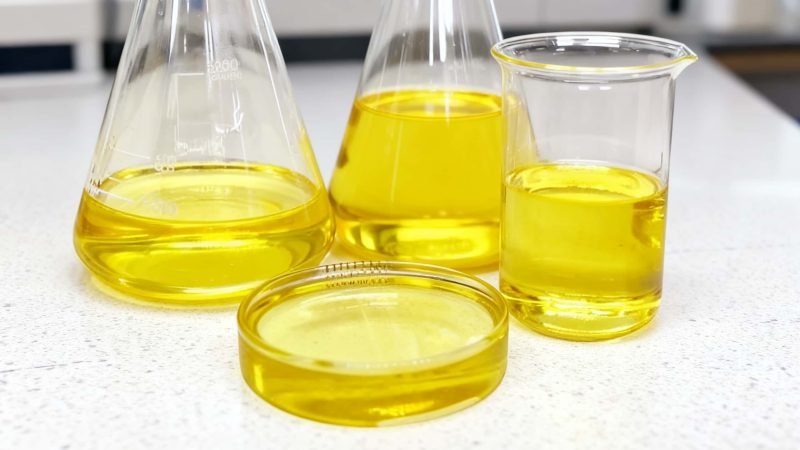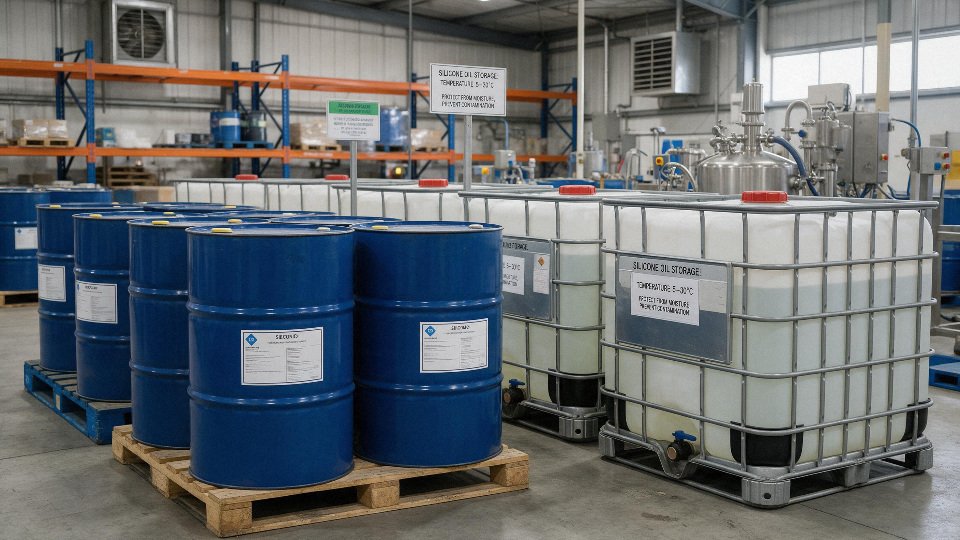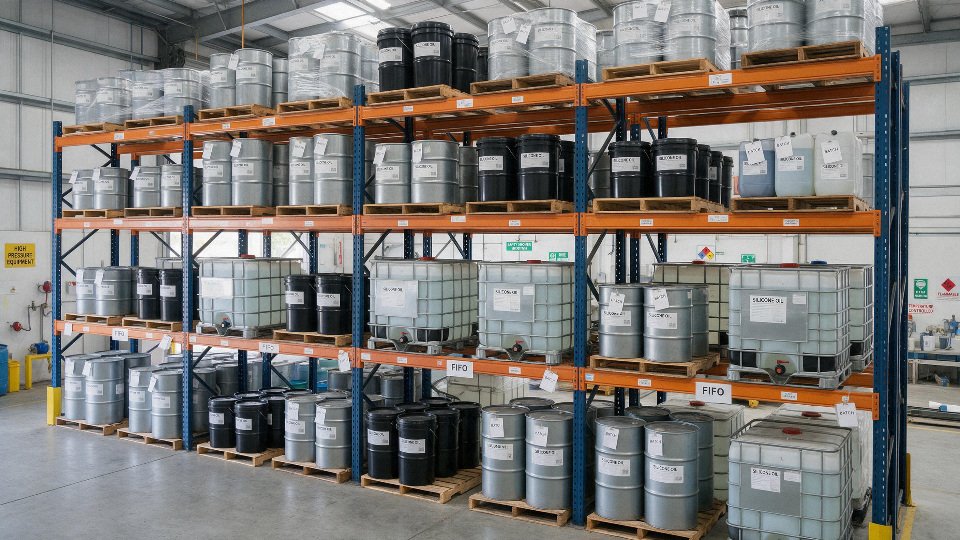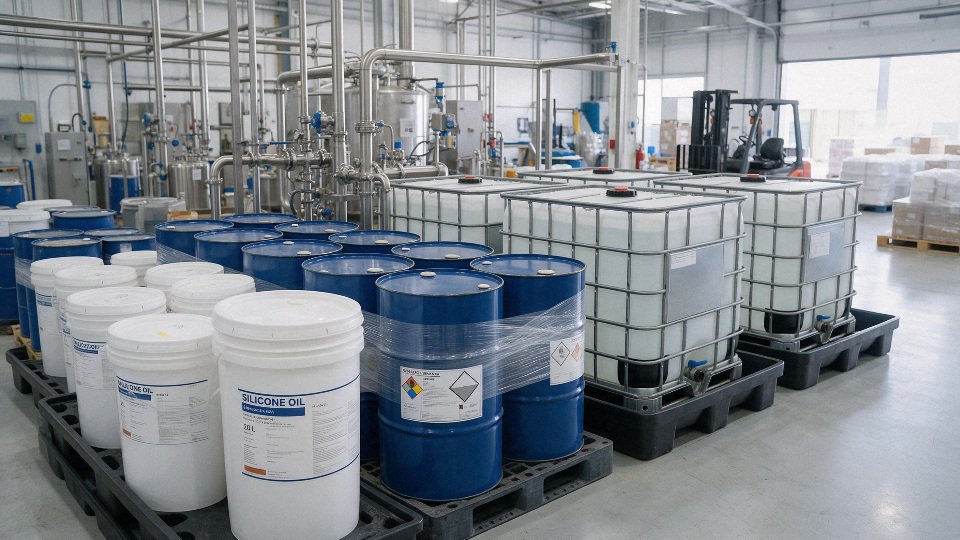
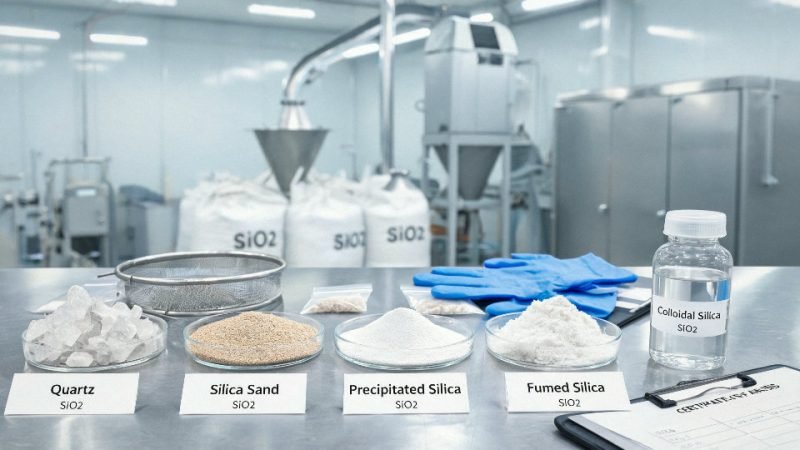
Use the wrong name for silicon dioxide on a purchase spec and the problem may not show up until the material is already in the silo, the mixer, or the dust collector. Quartz sand, precipitated silica, fused silica, and fumed silica can all trace back to SiO2, but they do not behave the same in screening, conveying, compounding, filtration, or worker exposure controls. A bad match can mean plugged lines, off-spec batches, premature tool wear, rejected coating lots, or a safety audit that gets expensive fast. The practical fix is to tie the name to the form, purity, particle size, and use case before anyone cuts a purchase order.
Another name for silicon dioxide is silica. In industry, people also use quartz for crystalline SiO2, sand in bulk mineral supply, and precipitated silica or fumed silica for manufactured amorphous forms. The right term depends on crystal structure, purity, particle size, and intended use.
That simple answer is where the trap starts. On a plant floor, “silica” might mean a high-purity quartz feedstock, a dusty bagged filler, a rubber reinforcing agent, or a respirable crystalline silica exposure concern. Same chemistry on paper. Very different behavior in a bin, a blender, a furnace, or someone’s lungs.
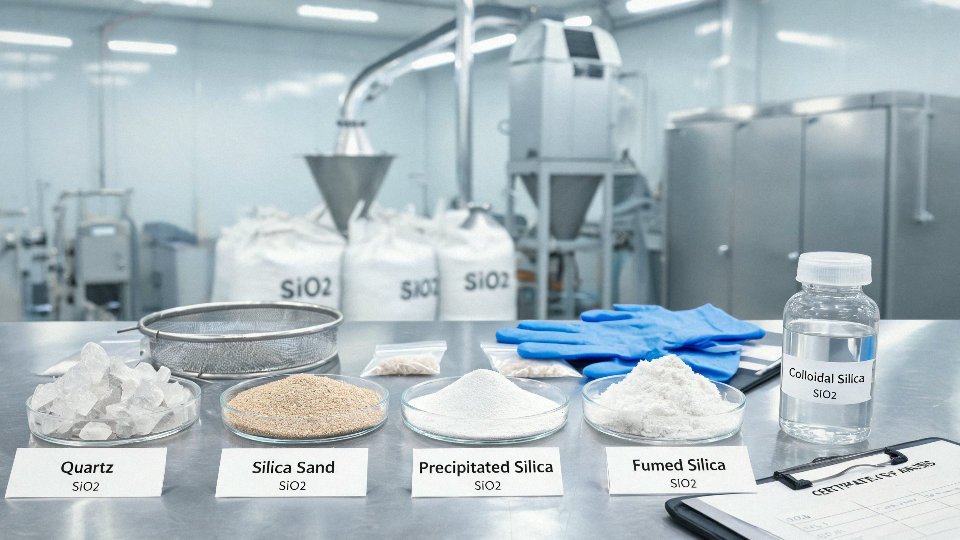
How SiO2 becomes different names in chemistry, geology, and industry
Silicon dioxide is a compound made from silicon and oxygen in a 1:2 atomic ratio. One silicon atom, two oxygen atoms: SiO2. That formula is what engineers use in calculations, purchase specifications, assay reports, furnace charge sheets, and SDS reviews because it strips the material down to composition.
The naming gets messy because composition is only one layer of the story. “Silicon dioxide” tells you the chemistry. “Silica” is the common material name. “SiO2” is the formula. None of those, by themselves, tells you whether the material is a hard crystalline mineral, a fine amorphous powder, a mined sand, or a high-surface-area additive that will bridge in a pneumatic conveying line if the humidity is wrong.
That distinction matters on a plant floor.
A bag labeled “precipitated silica” and a bulk tanker of “silica sand” may both be based on SiO2, but they behave nothing alike. One may be a fluffy amorphous powder with a BET surface area somewhere around 50 to 300 m²/g for common rubber, coating, and carrier grades, depending on the precipitation route and post-treatment. The other may be a dense granular mineral used in foundry molds, filtration, glass batching, or construction products. Same formula. Different handling, dust control, storage, flowability, and health-risk profile.
Composition is not the same as structure
SiO2 can be crystalline or amorphous.
Crystalline forms have atoms arranged in repeating patterns. Quartz is the one most people run into first. Cristobalite and tridymite are also crystalline forms of silica, usually associated with higher-temperature histories or specific industrial processes. In geology, these names are mineral names. In an EHS meeting, they may be treated as respirable crystalline silica hazards if the particle size is small enough to reach deep into the lungs.
Amorphous silica has no long-range crystal lattice. Fumed silica, precipitated silica, silica gel, and many synthetic silicas fall into this broad category. They may still generate nuisance dust, create housekeeping issues, blind filters, absorb moisture or oils, and make operators curse during bag dumping. But they are not the same material, from a hazard and performance standpoint, as respirable crystalline quartz.
All quartz is silicon dioxide, but not all silicon dioxide is quartz.True
Quartz is one crystalline mineral form of SiO2. Silicon dioxide can also occur as cristobalite, tridymite, or amorphous silica, depending on atomic structure and processing history.
The name usually follows the discipline
A geologist tends to say quartz, cristobalite, opal, or chalcedony because source and mineral structure are central. A chemist writes silicon dioxide or SiO2 because the compound identity is the focus. A production buyer may see silica flour, silica sand, fumed silica, precipitated silica, or colloidal silica because the commercial form and application drive the purchase.
In procurement, this is where mistakes happen. A buyer substitutes “silica” for “silica flour” because the quote looks close. The receiving team gets the material in the right chemical family but the wrong particle size distribution. Now the mixer cycle runs longer, the dust collector loads faster, or the finished surface texture goes off. Not always catastrophic, but expensive enough to get remembered.
Industrial quartz, for example, may contain roughly 95% to more than 99.9% SiO2 depending on ore grade, washing, magnetic separation, flotation, acid leaching, and how tightly the supplier controls contamination. That range is not academic. Iron, alumina, alkalis, and heavy minerals can affect glass color, ceramic firing behavior, refractory performance, and electronics-grade suitability.
Common SiO2 naming framework
| Term | Typical context | What it usually means | Caution |
|---|---|---|---|
| Silicon dioxide | Chemistry, SDS, regulations, specifications | Formal compound name for SiO2 | Does not define particle size, crystal form, purity, or surface treatment |
| Silica | General industry, purchasing, EHS, materials talk | Broad common name for SiO2-based materials | Too broad for buying unless grade, form, and specification are attached |
| Quartz | Geology, mining, glass, ceramics, fillers | A crystalline mineral form of SiO2 | Fine respirable quartz dust is the concern, not large visible grains sitting in a bin |
| Silica sand | Foundry, glass, filtration, construction, sports surfaces | Granular sand rich in quartz or other silica minerals | Check grain size, roundness, moisture, clay content, and crystalline silica exposure controls |
| Amorphous silica | Rubber, coatings, food carriers, defoamers, specialty powders | Non-crystalline SiO2 such as precipitated, fumed, or gel silica | Can be very dusty and high surface area; flow behavior may be poor without good equipment design |
| Crystalline silica | EHS, mining, cutting, grinding, blasting, foundry work | Quartz, cristobalite, or tridymite in respirable particle form | In the United States, OSHA’s permissible exposure limit is 50 micrograms per cubic meter as an 8-hour time-weighted average |
| Silicates | Ceramics, cement, detergents, minerals, water treatment | Compounds containing silicon and oxygen with metals such as sodium, calcium, magnesium, or aluminum | Not the same as pure SiO2; do not treat sodium silicate, calcium silicate, and silica as interchangeable |
A practical way to read any silica-related name is to ask four questions before accepting it: What is the chemistry? What is the crystal structure? What is the particle size and surface area? What is the intended use?
Miss one of those and the label can mislead you. Right name, wrong grade, bad day.
Quartz, silica sand, and glass sand: when the common names are technically correct
Quartz is the mineral name most engineers meet first. Chemically, it is silicon dioxide, SiO2. Structurally, it is crystalline, with atoms arranged in a repeating lattice. That detail matters. In everyday plant talk, though, people often use “quartz” as a practical synonym for naturally occurring silica because quartz is the dominant crystalline mineral form of SiO2 in many hard-rock and sand deposits.
That shortcut is usually harmless in a geology meeting. It can be risky on a purchase order.
Industrial quartz may run from about 95% to more than 99.9% SiO2, depending on the ore body, washing, magnetic separation, flotation, acid leaching, and how aggressively the supplier rejects off-grade material. A crushed quartz product for engineered stone, refractory mixes, or ceramic bodies is not the same thing as a precipitated silica powder, a fumed silica thickener, or a colloidal silica binder. Same formula at the high level. Very different behavior in a bin, mixer, filter press, or baghouse.
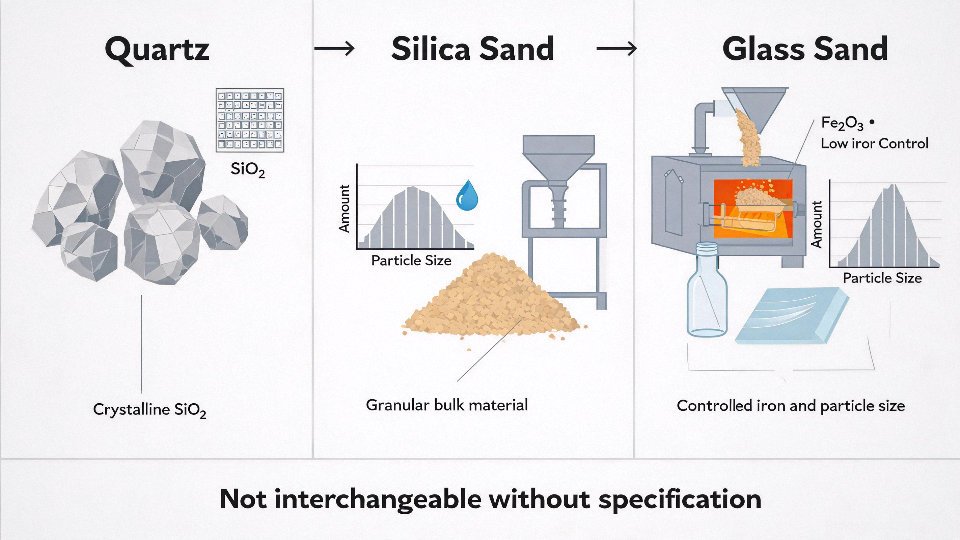
Silica sand is a bulk material, not just a chemistry label
Silica sand means sand with high SiO2 content, usually dominated by quartz grains. The word “sand” also tells you the particle size is in a granular range, not a fine powder or gel. That is why silica sand shows up in so many ordinary but demanding applications: container and flat glass, foundry molds and cores, filtration media, ceramics, hydraulic fracturing sand, sports turf infill, grouts, mortars, and some construction products.
In practice, the same pit may produce several cuts. A coarse washed sand might go to water filtration. A tighter screen fraction might go to foundry. A cleaner, lower-iron stream may be reserved for glass. The loader operator, stockpile drainage, and screen cloth condition can change the delivered product more than the brochure suggests. I have seen moisture alone turn a “free-flowing” sand into a bridging headache over a weigh hopper.
Not all sand is silica sand. Beach sand can carry shell fragments and carbonates. River sand may include feldspar, mica, clay coatings, organics, or mixed rock fragments from the upstream geology. Desert sand can be too rounded, too fine, or contaminated with salts. Manufactured sand from crushed rock may contain whatever the parent rock contains: basalt, limestone, granite, clay seams, or heavy minerals. Calling any sand “SiO2” without a lab report is asking for process drift.
Glass sand is silica sand with tighter commercial controls
Glass sand is a grade of silica sand sold for glassmaking. The controls are stricter because glass furnaces punish inconsistency. Iron oxide affects color. Alumina, alkalis, chromite, heavy minerals, and refractory grains can create defects or change melting behavior. Particle size distribution affects batch segregation, carryover, melting rate, and dusting. Moisture affects batch weight and feeder consistency.
For clear container or flat glass, buyers usually care hard about Fe2O3. The acceptable range depends on glass color, furnace design, cullet ratio, decolorizers, and customer tolerance. Amber glass can live with more iron than high-clarity glass. Fiberglass, sodium silicate, and ceramic glaze producers each have their own pain points.
A typical wrong-spec scenario: purchasing switches from a familiar glass sand to a cheaper “high silica sand” that meets SiO2 percentage but has higher iron and a broader particle size curve. The chemistry looks close on one line of the certificate. On the floor, the batch starts segregating, furnace pull becomes less stable, color correction creeps upward, and rejects rise. The saving on raw material gets eaten by energy, cullet handling, and customer claims.
How to treat the names on a purchase order
| If the request says | Confirm before buying | Usual risk if assumed wrong |
|---|---|---|
| Silicon dioxide | Form: mineral sand, powder, gel, fumed, precipitated, colloidal, nano-grade | Wrong handling, wrong surface area, wrong performance |
| Quartz | Crushed mineral, grain shape, crystalline silica content, hardness | Abrasion, dust exposure, sizing mismatch |
| Silica sand | SiO2 level, grading, clay, carbonates, moisture, application | Poor flow, contamination, weak molds or filters |
| Glass sand | Iron, alumina, heavy minerals, size distribution, color target | Glass defects, color shift, furnace inefficiency |
Quartz, silica sand, and glass sand can all refer to silicon dioxide, but they should not be treated as interchangeable commercial products.True
Quartz identifies a crystalline mineral form, silica sand identifies a high-SiO2 granular bulk material, and glass sand identifies a controlled grade of silica sand for glass production.
Practical specification checklist
For procurement, I would ask for these items before approving a new source:
- SiO2 percentage: often about 95% to above 99.9% for industrial quartz and silica sand, depending on deposit and beneficiation route.
- Fe2O3 level: critical for glass, ceramics, fillers, and any white or clear product.
- Particle size distribution: not just top size; request sieve curve or laser data where relevant.
- Loss on ignition: flags carbonates, organics, hydrated minerals, or clay contamination.
- Moisture: affects delivered weight, feeding, pneumatic conveying, and winter handling.
- Whiteness or color values: useful for fillers, ceramics, sports surfaces, and architectural products.
- Hardness and grain shape: important for wear, compaction, filtration, and foundry permeability.
- Crystalline silica declaration: required for hazard communication and exposure control; in the United States, respirable crystalline silica has an OSHA permissible exposure limit of 50 micrograms per cubic meter as an 8-hour time-weighted average.
The safe rule is simple: use “silicon dioxide” for chemistry, “quartz” for the crystalline mineral, “silica sand” for high-SiO2 granular material, and “glass sand” only when the impurity and sizing controls are suitable for glass production. Procurement should write the specification, not just the name.
Amorphous silica names: fumed silica, precipitated silica, silica gel, and colloidal silica
Amorphous silica is still silicon dioxide, SiO2, but its atoms are not arranged in the long, repeating crystal lattice found in quartz, cristobalite, or tridymite. That sounds like a textbook distinction until you handle the material in a plant. Amorphous grades can behave like a thickening aid, a drying agent, a polishing abrasive, a carrier, or a binder, even though the chemical formula on the certificate of analysis still says SiO2.
Amorphous silica and crystalline quartz can both be silicon dioxide, but they are not interchangeable materials in processing, performance, or exposure assessment.True
They share the same chemical formula, SiO2, but differ in atomic structure, particle form, surface chemistry, and regulatory treatment. Procurement should check the specific grade and safety data sheet rather than buying only by formula.
Fumed silica
Fumed silica is made by flame hydrolysis, typically from silicon tetrachloride or related silicon compounds burned in a hydrogen-oxygen flame. The result is an extremely fine, fluffy amorphous silica with very small primary particles fused into branched aggregates.
On the floor, fumed silica is the powder that wants to float everywhere if a bag is dumped too aggressively. It has low bulk density, high dusting potential, and a habit of clinging to hoppers, operators, and poorly grounded flexible hoses. Common BET surface areas run roughly 50 to 400 m2/g, depending on grade and surface treatment.
Its value is in rheology control. In coatings, sealants, adhesives, greases, inks, and composites, fumed silica helps stop settling, build thixotropy, and give sag resistance. Hydrophilic grades disperse differently from hydrophobic treated grades, so substituting one for the other can turn a smooth batch into fish-eyes, poor wet-out, or a mixer that suddenly needs another 20 minutes to reach target viscosity.
Precipitated silica
Precipitated silica is made by wet chemical precipitation, commonly by reacting sodium silicate with acid under controlled pH, temperature, salt level, and shear. The particles form in water, are filtered, washed, dried, and milled or granulated. That route gives producers more control over pore structure, oil absorption, particle size distribution, and surface area.
For common rubber, coatings, carrier, and related grades, BET surface area is often about 50 to 300 m2/g, with the actual target depending on reinforcement needs, dispersion behavior, and customer processing limits. Tire compounds use precipitated silica heavily, especially where rolling resistance and wet traction matter. It also shows up in molded rubber goods, toothpaste abrasives, food and feed carriers, defoamer carriers, battery separators, matting agents, and coatings.
A typical purchasing mistake is treating all “precipitated silica” as equivalent. A high-structure rubber grade may overload a toothpaste line. A low-dust granule that feeds well into a Banbury mixer may disperse too slowly in a low-shear coating tank. Same name. Different headache.
Silica gel
Silica gel is a porous amorphous silica known for adsorption. It is made through gel formation from silicate chemistry, then aged, washed, dried, and sized. The pore network is the point. Depending on grade, silica gel may have surface areas in the broad range of roughly 300 to 800 m2/g, with pore size and residual moisture tuned for the job.
Most people know it from desiccant packets, but industrial use is wider: gas drying, transformer breathers, instrument air protection, humidity buffering, chromatography, solvent drying, and some purification services. Beads are common because they handle better than powder and create less pressure drop in packed beds. Broken beads are a warning sign. Fines migrate, screens blind, and dryer performance falls off before anyone notices on the panel.
Colloidal silica
Colloidal silica is not a dry powder in the usual sense. It is a stable dispersion of nanoscale amorphous silica particles in a liquid, usually water, though solvent-based systems exist. Particle sizes often sit somewhere around 5 to 150 nm, while solids content may run roughly 15% to 50%, depending on stabilization chemistry, viscosity, and end use.
It is used in investment casting slurries, precision polishing, paper and textile treatment, catalysts, coatings, refractory binders, and concrete densifiers. In polishing slurries, particle size distribution and pH control drive scratch performance. In investment casting, binder stability can make the difference between a shell room that runs calmly and one fighting gelled tanks on a humid Friday afternoon.
Comparison of common amorphous silica names
| Name | Particle morphology | Typical surface area range | Typical particle or aggregate size | Common packaging | Main industrial uses |
|---|---|---|---|---|---|
| Fumed silica | Flame-made primary particles fused into branched aggregates | Roughly 50 to 400 m2/g, grade dependent | Primary particles often about 5 to 50 nm; aggregates larger and irregular | Multiwall bags, sacks, bulk bags, sometimes compacted grades | Rheology control, anti-settling, thixotropy, reinforcement, sealants, coatings, greases |
| Precipitated silica | Wet-formed porous particles, often agglomerated or granulated | About 50 to 300 m2/g for many rubber, coating, and carrier grades | Agglomerates commonly in micron-scale ranges; granules larger for low dust handling | Bags, bulk bags, supersacks, silos for large users | Tires, rubber goods, toothpaste, food and feed carriers, coatings, matting agents |
| Silica gel | Porous beads, granules, or crushed particles | Often roughly 300 to 800 m2/g, depending on pore design | Beads or granules commonly sub-millimeter to several millimeters | Drums, bags, cartridges, packets, bulk vessels | Desiccants, gas drying, chromatography, humidity control, purification beds |
| Colloidal silica | Discrete nanoscale particles dispersed in liquid | Often specified by particle size and solids; surface area varies widely | Particles commonly about 5 to 150 nm | Drums, totes, tankers, pails | Investment casting, polishing slurries, paper, catalysts, coatings, concrete densifiers |
Operational warning: do not assume “amorphous” means the dust program can ignore it. Check the safety data sheet for crystalline silica content, particle size, and any respirable fraction. In the United States, the OSHA benchmark for respirable crystalline silica is 50 micrograms per cubic meter as an 8-hour time-weighted average; whether that applies depends on the actual crystalline content and exposure conditions, not just the word “silica” on the purchase order.
Crystalline silica names that matter for safety: quartz, cristobalite, and tridymite
In purchasing language, “silica” can sound harmless enough: sand, flour, filler, aggregate. In safety language, the name gets sharper. Crystalline silica means silicon dioxide arranged in a repeating crystal lattice, and the forms that show up most often in occupational health work are quartz, cristobalite, and tridymite.
Quartz is the one most plants recognize. It is common in rock, sand, concrete, mortar, engineered stone, foundry sand, and many mineral feedstocks. Cristobalite and tridymite are also crystalline forms of SiO2, but they tend to matter in more specific thermal histories. If a process has seen serious kiln temperatures, refractory service, ceramic firing, or calcination, I would not assume “just quartz” until the material has been checked.
The safety term that drives most compliance work is respirable crystalline silica, often shortened to RCS. That does not mean every grain of sand on the floor is respirable. It means a fraction of airborne crystalline silica particles is small enough to get deep into the gas-exchange region of the lungs. The nasty part is that the hazardous cloud is not always the dramatic visible dust. A loader bucket dumping dry sand looks dirty, yes, but a concrete grinder or stone saw with a faint haze around the operator can be worse from an exposure standpoint.
Respirable crystalline silica is about particle size and airborne exposure, not simply the presence of quartz or sand in a material.True
Bulk quartz, silica sand, or engineered stone only becomes an inhalation hazard when operations generate airborne particles small enough to be respirable. Exposure depends on task, dust control, duration, ventilation, and crystalline silica content.
In the United States, OSHA’s permissible exposure limit for respirable crystalline silica is 50 micrograms per cubic meter as an 8-hour time-weighted average. That figure is a regulatory benchmark, not a comfort line. Actual measured exposure can swing widely depending on the tool, enclosure, water delivery, ventilation capture, maintenance condition, housekeeping, and how long the worker stays in the dust zone.
Where the name changes from material description to risk control
The word quartz on a purchase order may only tell you the mineral. The phrase respirable crystalline silica in an industrial hygiene report tells you somebody is looking at inhalation risk.
Common operations that can generate RCS include:
- Cutting, grinding, or polishing engineered stone, especially dry or with weak water flow at the blade
- Crushing rock, screening aggregate, and feeding dry mineral systems
- Abrasive blasting with silica-containing media or blasting silica-bearing surfaces
- Foundry shakeout, sand reclamation, mold handling, and knockout stations
- Concrete grinding, chipping, jackhammering, and tunneling
- Ceramic batching, fettling, kiln car cleanup, and fired scrap crushing
- Refractory demolition, gunning, tear-out, and dry cleanup after outages
- Dry sand transfer, bag dumping, and silo venting where fines are present
A typical miss I still see: the material safety data sheet lists quartz, but the plant treats it as a paperwork issue because the sand arrives damp. Six months later, the same sand is being swept dry under a conveyor after it has dried out in winter air, and the exposure profile is completely different. The material did not change. The operation did.
Cristobalite deserves extra attention around heat
Cristobalite can be present naturally in some materials, but in industry the bigger trap is high-temperature transformation. Silica-bearing materials exposed to elevated temperatures can form cristobalite, depending on temperature, time, impurities, fluxes, particle size, and cooling history. Ceramic plants, refractory linings, diatomaceous earth calcination, investment casting materials, and some kiln operations are the places where I would ask harder questions.
This matters during maintenance. A refractory wall in service may not have the same crystalline silica profile it had when installed. During demolition, the crew is not handling a neat catalog product anymore; they are breaking aged, heat-cycled material with unknown phase changes, bonded deposits, and friable edges. Dry tear-out with skid steers and compressed air cleanup is a bad combination. It spreads fine dust fast, and it usually contaminates adjacent work areas.
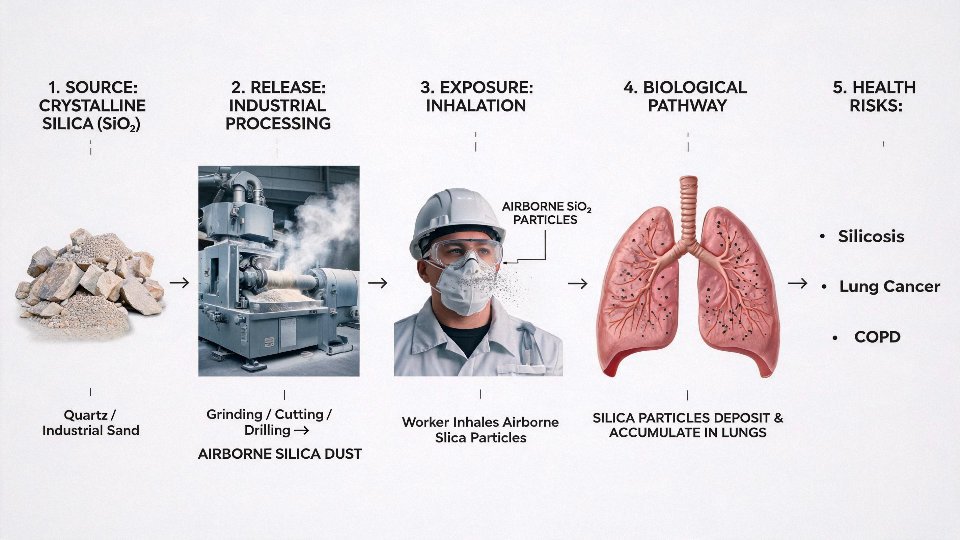
Where the terminology appears in plant documents
Crystalline silica names show up in safety data sheets, exposure assessments, industrial hygiene sampling reports, job hazard analyses, respiratory protection programs, and regulatory compliance files. Procurement sees them in supplier declarations. Engineering sees them during equipment selection and dust collection design. Maintenance sees them, or should see them, in outage planning.
The practical question is not “Does this contain SiO2?” The better question is: Can our task make respirable crystalline silica airborne, and can workers breathe it?
A compact way to sort the issue:
| Situation | Main concern | Better control direction |
|---|---|---|
| Wet sand in sealed bulk handling | Low dust unless dried or leaked | Enclosed transfer, good seals, clean spill response |
| Dry cutting engineered stone | High RCS generation at the tool | Substitution, wet cutting, local exhaust, exposure monitoring |
| Refractory demolition after kiln service | Possible cristobalite plus heavy dust | Wet methods where feasible, isolation, HEPA cleanup, respiratory protection |
| Foundry shakeout | Fine silica-bearing dust from impact and heat history | Enclosures, capture ventilation, controlled sand handling |
| Concrete grinding indoors | Dust accumulation and worker proximity | Shrouded tools, HEPA vacuums, wet grinding, restricted access |
Controls need layers. Substitution is best where it is practical: non-silica blasting media, lower-silica formulations, pre-cut components, or process changes that remove dry grinding. Wet methods help, but only if the water actually reaches the cutting interface and the slurry is managed before it dries into powder. Local exhaust ventilation must capture dust at the source; a hood two feet too far away is often just expensive background ventilation.
Housekeeping is a control, not a cosmetic task. Dry sweeping and compressed air blowdown can undo a decent dust collection system in minutes. Use HEPA-filtered vacuums or wet cleanup. Enclose transfer points. Maintain baghouses, pulse valves, duct velocities, and bin vents. Train workers on why the invisible fraction is the problem, not just the pile of grit they can see.
Respirators have their place, especially during maintenance and non-routine work, but they are not a substitute for engineering controls. Fit, cartridge choice, facial hair, heat stress, and supervision all decide whether respiratory protection works in the real plant, not just in the written program.
Commercial and regulatory aliases: CAS numbers, E numbers, INCI names, and SDS terminology
On purchase orders and labels, silicon dioxide rarely travels under one clean name. The same base chemistry may show up as silica, silicic acid anhydride, amorphous silica, synthetic amorphous silica, hydrated silica, quartz, cristobalite, or tridymite. None of those terms should be treated as automatically interchangeable.
That is where mistakes creep into procurement. A buyer sees “silica” on an old specification and sources a cheaper silica sand. The production engineer expected a treated precipitated silica with controlled surface area and moisture. The batch still runs, but dispersion is poor, viscosity shifts, and the line spends half a shift chasing settings. Same family name. Wrong material.
CAS numbers reduce confusion, but they do not solve everything
CAS numbers are useful because they tie a name to a chemical registry entry. They are not a substitute for a full material specification.
For example, silicon dioxide is commonly associated with CAS 7631-86-9. Quartz, the crystalline mineral form most people meet in sand and mineral fillers, is commonly associated with CAS 14808-60-7. Cristobalite and tridymite have their own registry identities as crystalline polymorphs. Some synthetic amorphous silica products may be listed under broader silicon dioxide CAS numbers or under CAS numbers used for specific manufactured forms, depending on the supplier, region, and regulatory database.
That last part matters. I have seen two technically similar precipitated silicas arrive with different regulatory naming on the SDS because one supplier classified it through a broad silicon dioxide identity and the other through a synthetic amorphous silica entry. The plant did not care about the registry argument; it cared about oil absorption, BET surface area, pH, loss on drying, and how the bags emptied into the mixer.
For common precipitated silica grades used in rubber, coatings, and carrier applications, BET surface area often sits somewhere around 50 to 300 m2/g, depending on precipitation route, aging, washing, drying, and any surface treatment. That performance window tells an engineer far more than the word “silica” alone.
Food, pharmaceutical, and label names
In food and pharmaceutical documentation, silicon dioxide may appear as silicon dioxide, silica, colloidal silicon dioxide, or E551, where that E-number system is used. The function is often anti-caking, glidant behavior, or flow improvement, but the allowed use depends on the jurisdiction, grade, purity, and the product being made.
Do not assume that an industrial amorphous silica is acceptable just because the chemistry looks familiar. Food and pharmaceutical grades usually carry tighter controls on heavy metals, microbial limits where relevant, residual processing aids, documentation traceability, and manufacturing controls. The difference may not be obvious from a casual line item description.
A simple receiving rule helps: if the material touches food, tablets, capsules, personal care bulk, or packaging with regulatory exposure, match the supplier’s grade to the intended use before the first pallet is unloaded.
Cosmetics and personal care names
Cosmetics and personal care labels often use INCI-style names such as Silica, Hydrated Silica, or Silica Silylate. These names are tied to ingredient identity and function, not just academic chemistry.
In practice, the name often hints at what the material is doing. Hydrated silica may be used for mild abrasion, thickening, or rheology control. Silica can act as an absorbent, sensory modifier, or anti-caking ingredient. Silica silylate is surface-modified and behaves differently from untreated silica, especially in oils and anhydrous systems. If your plant has ever tried to swap a treated powder for an untreated one in a cream or gel, you already know the result: clumps, air entrainment, poor wet-out, and a very annoyed batching supervisor.
SDS terminology: product name versus hazardous constituent
Safety data sheets often list a trade name on the front page and a different set of names in the composition or hazard sections. A product might be sold as “silica flour,” “mineral filler,” “quartz powder,” or “glass sand,” while Section 3 identifies quartz as a hazardous constituent. If the product contains respirable crystalline silica, the crystalline form is the safety driver, not the friendly commercial name.
A product labeled only as silica may still require crystalline silica controls if it contains respirable quartz, cristobalite, or tridymite.True
Safety classification depends on the crystalline form, respirable fraction, exposure route, and applicable regulation, not only on the broad commercial name.
For U.S. workplaces, OSHA’s permissible exposure limit for respirable crystalline silica is 50 micrograms per cubic meter as an 8-hour time-weighted average. Actual exposure depends heavily on particle size, handling method, ventilation, enclosure, moisture, transfer points, housekeeping, and whether operators are cutting, grinding, dumping bags, or cleaning with compressed air. Dry sweeping a fine quartz-containing powder is still one of those bad habits that looks harmless until the air sampling results come back.
What to verify before approving a silicon dioxide material
| Document term seen | What to check before accepting it |
|---|---|
| Silica or silicon dioxide | CAS number, assay, impurities, moisture, particle size, intended use |
| Amorphous silica | Synthetic or natural source, BET surface area, treatment, dust profile |
| Hydrated silica | Water content, abrasive behavior, pH, cosmetic or industrial grade status |
| Quartz, cristobalite, tridymite | Crystalline silica content, respirable fraction, exposure controls |
| Colloidal silicon dioxide | Particle size, dispersion medium, solids content, pharmaceutical or industrial grade |
| E551 | Jurisdiction, food-grade documentation, purity limits, approved application |
The practical approach is boring but reliable: verify composition, crystalline or amorphous form, particle size distribution, surface treatment, purity, intended use, and regulatory status. A common name is only the starting clue. The specification is what protects the process, the workers, and the customer.
Industrial specification guide: how to choose the correct silica name when buying or approving material
Start with the job the material has to do, not with the word “silica.” That sounds obvious until a purchasing team substitutes a low-cost silica sand for a fine quartz flour, or a plant trials “silica” from a coatings supplier in a rubber compound and wonders why the mixer amps, cure behavior, and tensile numbers all move.
In practice, I ask one question first: is the silicon dioxide meant to be a bulk mineral, a functional powder, a liquid dispersion, or a high-purity source?
A structural filler in ceramics may need quartz flour with controlled particle size and low iron. A reinforcing filler in rubber usually points toward precipitated silica, often with BET surface area somewhere around 50 to 300 m2/g depending on the grade, polymer system, and coupling package. A desiccant is normally silica gel, where pore structure and adsorption capacity matter more than chemical purity alone. Glass and foundry plants buy silica sand by mineral quality, grain shape, sizing, refractory behavior, and contamination limits. Polishing may use colloidal silica or fine abrasive silica, depending on the surface finish target and slurry chemistry. A carrier or anti-caking agent may be precipitated silica or silica gel. A catalyst support needs pore volume, surface chemistry, and thermal stability nailed down. A rheology modifier in sealants, resins, coatings, or greases often means fumed silica, sometimes surface-treated to change hydrophobic behavior.
Same formula. Very different factory result.
Match the application to the correct commercial form
A quick procurement filter helps avoid expensive wrong turns:
| Application need | Usually correct name to specify | What to watch on the data sheet |
|---|---|---|
| Ceramic body, glaze, investment casting | Quartz flour or ground silica | Particle size distribution, crystalline phase, Fe2O3, moisture |
| Container glass, flat glass, fiberglass | Silica sand or glass sand | SiO2 purity, iron, alumina, grain sizing, loss on ignition |
| Foundry molding sand | Foundry silica sand | AFS grain fineness, clay content, acid demand, thermal expansion |
| Rubber reinforcement | Precipitated silica or hydrated silica | BET surface area, CTAB, oil absorption, pH, moisture, granule form |
| Viscosity and sag control | Fumed silica | Surface area, surface treatment, tamped density, dispersion behavior |
| Moisture adsorption | Silica gel | Pore size, adsorption capacity, bead size, attrition, regeneration temperature |
| Polishing or binder systems | Colloidal silica | Particle size, solids content, pH, stabilizer, sodium or ammonia level |
| Electronics, optics, specialty glass | High-purity SiO2 source | Trace metals, alkali level, particle control, packaging cleanliness |
Industrial quartz can run roughly 95% to more than 99.9% SiO2, depending on ore body, washing, flotation, magnetic separation, acid leaching, and classification. That range is too wide for casual approval. A tile plant may tolerate impurities that would be a disaster in optical glass or semiconductor-adjacent processing.
Specification parameters that prevent costly substitutions
For mineral silica, lock down purity, crystal phase, particle size distribution, moisture, bulk density, loss on ignition, and contaminants such as iron, alumina, alkalis, heavy minerals, and organics. If the material is handled dry, include respirable dust controls and crystalline silica classification in the safety review. The OSHA benchmark in the United States for respirable crystalline silica is 50 micrograms per cubic meter as an 8-hour time-weighted average, but actual plant exposure depends on transfer points, bag dumping, ventilation, housekeeping, and whether operators use compressed air to “clean up.” That last habit still causes trouble in real plants.
For synthetic amorphous silica, purity alone tells you little. You need surface area, pore volume, pH, oil absorption, moisture, ignition loss, surface treatment, and form of supply. A 10-kilogram bag of fumed silica can fill a surprising amount of space, bridge in hoppers, and turn a poorly sealed charging station into a white cloud. A ton of silica sand behaves like aggregate. A drum of colloidal silica behaves like a chemical liquid with freeze risk, settling risk, and pH sensitivity. All are silicon dioxide products. They are not interchangeable.
A buyer can approve silicon dioxide by chemical formula alone if the product is listed as SiO2.False
The formula does not define crystal phase, particle size, surface area, porosity, moisture, purity, surface treatment, or delivery form. Those properties often control performance and safety more than the basic chemistry.
Supplier documents worth requiring before approval
Do not approve the first lot from a brochure page. Ask for a current technical data sheet, safety data sheet, certificate of analysis, test method references, regulatory declarations, lot traceability format, and a written change notification policy. If the material is food, pharma, cosmetics, rubber for regulated markets, electronics, or export-controlled customer work, add the relevant declarations before the first purchase order, not during a customer complaint.
I also like to see retained-sample policy and manufacturing site disclosure, at least at country or plant level where the supplier will provide it. A change from one mine seam, furnace route, precipitation line, or surface treatment package can look minor commercially and still upset a process window.
Sample decision tree for naming the material correctly
- Is the material a mined, ground, or classified mineral?
- Yes: specify mineral silica, silica sand, quartz flour, or glass sand. Define SiO2 purity, crystal phase, sizing, and contaminants.
- No: go to step 2.
- Is it a dry synthetic powder used for reinforcement, carrying liquid actives, anti-caking, or adsorption?
- Reinforcement or carrier: specify precipitated silica or hydrated silica.
- Adsorption: specify silica gel.
- Rheology control: specify fumed silica.
- Is it supplied as a stable liquid dispersion?
- Yes: specify colloidal silica. Define particle size, solids, pH, stabilizer chemistry, viscosity, and storage limits.
- Is the end use electronics, optics, specialty glass, or ultra-low contamination processing?
- Yes: do not buy by the general name “silica.” Specify high-purity SiO2 source with trace metal limits, packaging cleanliness, and handling controls.
- Is there worker exposure to dry dust?
- Yes: identify crystalline versus amorphous content, review the SDS, and confirm local exposure controls before scale-up. A cheap powder is not cheap after a dust exceedance, a line shutdown, or a rejected audit.
Common naming mistakes that create quality, safety, and compliance problems
Silicon dioxide naming errors are not academic. I have seen them show up as plugged filters, drifting viscosity, rejected incoming lots, dust exposure surprises, and purchasing arguments that should have been caught at the RFQ stage. The problem usually starts with a harmless sentence: “It’s just silica.” Sometimes it is. Often, it is not close enough.
Mistake one: assuming sand equals pure silica
Sand is a size range before it is a chemistry. A bag, bulk truck, or railcar described as “sand” may contain mostly quartz, but it can also carry feldspar, mica, iron oxides, carbonates, shell fragments, clay fines, soluble salts, organics, or moisture picked up from outdoor stockpiles. Beach sand, foundry sand, construction sand, frac sand, and glass sand are not interchangeable categories.
Industrial quartz can run roughly 95% to more than 99.9% SiO2, depending on ore body, washing, flotation, magnetic separation, acid leaching, and screening. That range matters. A glass furnace may care about iron at low ppm levels. A resin-coated sand line may care more about clay and loss on ignition. A waterjet shop may mainly fight grading consistency and nozzle wear.
Wrong assumption: “sand equals silica.”
Likely result: color shift, poor melt quality, higher binder demand, abrasive variation, or blocked handling equipment.
Mistake two: using quartz as a universal synonym for silica
Quartz is crystalline silicon dioxide. It is not the same thing as fumed silica, precipitated silica, silica gel, colloidal silica, or a treated hydrophobic silica. Calling everything “quartz” on a purchase request is a fast way to make a buyer source the wrong class of material.
This is especially risky in rubber, coatings, adhesives, and defoamers. If the formulation calls for amorphous precipitated silica with a BET surface area around 50 to 300 m²/g, depending on grade and application, a ground quartz flour will not behave like a reinforcing filler. It may load the formulation, but it will not give the same structure, oil absorption, or dispersion profile.
A simple rule: use “quartz” only when the crystalline mineral form is actually intended.
Mistake three: ignoring crystalline silica content in hazard work
Crystalline silica is a safety term as much as a mineral term. Powders, aggregates, refractory tear-out, ceramic raw mixes, investment casting materials, recycled concrete, and mineral waste streams can all contain respirable crystalline silica if they are cut, milled, blasted, crushed, dumped, or pneumatically conveyed.
The United States OSHA permissible exposure limit for respirable crystalline silica is 50 micrograms per cubic meter as an 8-hour time-weighted average. Actual exposure depends on particle size, task energy, enclosure, ventilation, wet methods, housekeeping, and respirator discipline. Sweeping dry dust with a push broom in a refractory repair area is very different from handling damp coarse aggregate in an outdoor bay.
A material described as silica-free on a sales sheet may still require review if the process creates dust from mixed mineral ingredients or recycled streams.True
Marketing language may refer to intentionally added crystalline silica, while exposure assessment must consider actual mineral content, contaminants, particle generation, and workplace handling.
Mistake four: swapping fumed silica and precipitated silica as if they are the same
Both are amorphous silica. That does not make them plug-and-play substitutes.
Fumed silica tends to be very fine, highly structured, and strong in rheology control. Precipitated silica is usually made through a wet process and is commonly used for reinforcement, carriers, matting, and anti-caking, with behavior tied to surface area, pore structure, aggregate size, and residual chemistry. Treated grades add another layer.
If procurement changes from one to the other to fix price or lead time, engineering needs to recheck viscosity curve, mill base dispersion, moisture pickup, torque draw, fill rate, dusting, and cleaning behavior. A high-shear mixer that handled one grade may climb 15% to 40% in energy draw with another, depending on loading, liquid phase, and dispersion endpoint. Sometimes the batch still passes lab viscosity after sitting overnight, then fails on the line because pumpability is poor at process temperature.
Mistake five: relying on percent SiO2 alone
Percent SiO2 is only one coordinate. It does not describe particle size distribution, specific surface area, porosity, oil absorption, surface silanol density, pH, soluble salts, moisture, whiteness, heavy metals, crystalline fraction, or regulatory suitability.
For purchasing, “99% SiO2” can describe a coarse quartz sand, a fine quartz flour, a fused silica, or a synthetic amorphous powder. They may share chemistry on paper and behave nothing alike in a silo, extruder, slurry tank, furnace, or human lung.
Mistake six: confusing silicon, silicone, silicate, and silicon dioxide
This one sounds basic, but it still causes real purchase order damage.
Silicon is the element, used in metallurgy, semiconductors, and alloys. Silicone is a polymer family used in sealants, oils, elastomers, and release coatings. Silicates are salts or minerals containing silicon and oxygen with metals such as sodium, calcium, magnesium, or aluminum. Silicon dioxide is SiO2.
Order sodium silicate when the process needed silica, and you may change pH, cure behavior, corrosion risk, and wastewater load. Order silicone oil instead of silicon powder, and the receiving dock will know before engineering does.
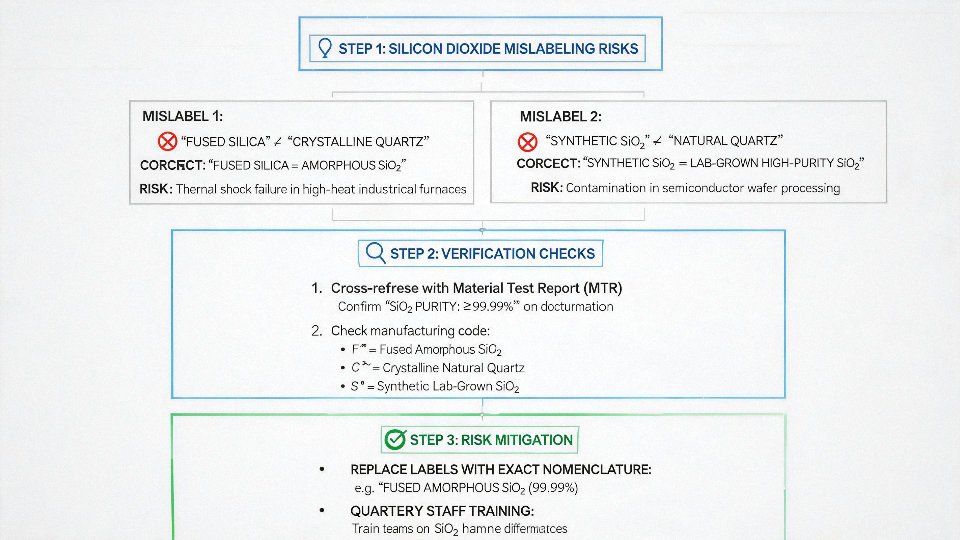
Corrective checklist for engineering change control
Before approving a new silica-related material, lock down the basics in writing:
| Checkpoint | What to confirm before release |
|---|---|
| Name and formula | Commercial name, chemical name, SiO2 confirmation, and whether the supplier uses “silica” loosely |
| Physical form | Quartz, amorphous powder, gel, colloid, sand, flour, treated grade, fused material, or mixed mineral stream |
| Grade and supplier | Exact grade code, manufacturing route, plant of origin if critical, packaging, and shelf-life limits |
| Test methods | Particle size method, BET surface area, moisture, loss on ignition, purity, crystalline silica method, and acceptance ranges |
| Hazard classification | SDS review, respirable crystalline silica content, dust generation tasks, exposure controls, and local regulatory duties |
| Process validation | Trial at real batch size, not only lab beaker scale; check viscosity, feed behavior, dispersion, energy draw, filtration, scrap, and cleanup |
| Change approval | Engineering, EHS, quality, production, and procurement sign-off before substitution |
The cheap mistake is a renamed line item. The expensive one is discovering, during production, that the name was the only thing the two materials had in common.
Frequently asked questions about other names for silicon dioxide
What is the most common other name for silicon dioxide?
The most common other name for silicon dioxide is silica. In plant documents, purchasing specs, SDS sheets, and lab reports, “silica” is the everyday term you will see most often.
That does not mean every silica behaves the same. A bag of ground quartz, a drum of colloidal silica, and a sack of precipitated silica can all be silicon dioxide-based materials, but they will handle very differently on a line. One may dust badly, one may thicken a coating, and one may arrive as a stable water dispersion that freezes if it sits in an unheated dock in January.
Is quartz the same as silicon dioxide?
Quartz is a crystalline mineral form of silicon dioxide. Chemically, it is SiO2. Technically, though, quartz is not the same as every silicon dioxide product.
That distinction matters. If a drawing, formulation, or purchasing note says “quartz,” the buyer should not substitute fumed silica or silica gel just because the chemistry is SiO2. Quartz brings hardness, particle shape, mineral purity, and crystalline silica exposure concerns. Synthetic amorphous silica brings surface area, porosity, oil absorption, and rheology effects.
Industrial quartz often runs roughly 95% to more than 99.9% SiO2, depending on ore body, washing, flotation, magnetic separation, acid leaching, and how much feldspar, iron oxide, or heavy mineral contamination remains. That range is wide for a reason. Quarry feed is not a laboratory reagent.
Is sand another name for silicon dioxide?
Not exactly. Sand is a particle-size and physical material term, not a chemical name.
Some sand is mainly silica, especially high-purity silica sand or glass sand. Other sand can contain feldspar, limestone, shell fragments, iron minerals, mica, clays, or volcanic material. I have seen “local sand” used casually in maintenance talk, then the same word cause trouble in a refractory or foundry specification because the chemistry was never pinned down.
Right choice: specify silica sand with SiO2 content, grain size distribution, moisture, clay content, iron content, and intended use.
Wrong choice: write “sand” on a purchase request and assume the supplier knows you mean low-iron silica sand for glass, resin-coated foundry sand, or kiln bed material.
The consequence is not academic. Wrong sand can mean poor melt color, casting defects, blocked screens, high dust, or accelerated wear in screw conveyors and elbows.
Is silica gel silicon dioxide?
Yes. Silica gel is a porous amorphous form of silicon dioxide, mainly used for adsorption, drying, humidity control, and some purification duties.
It is not a gel in the way a mechanic thinks of grease or sealant. Commercial silica gel is usually hard granules or beads with internal pores. Those pores give it the surface area needed to adsorb water vapor. In packaging, transformer breathers, instrument cabinets, compressed air dryers, and some lab columns, the useful property is not “SiO2 content” by itself. It is pore structure, moisture capacity, bead strength, dust level, indicator chemistry if present, and regeneration behavior.
Is silicon dioxide safe?
It depends on the form, particle size, exposure route, concentration, and controls. Food-grade silicon dioxide used as an anti-caking agent is a different risk discussion from respirable crystalline silica generated during cutting, blasting, milling, or bag dumping.
The major industrial hazard is respirable crystalline silica, especially fine airborne quartz, cristobalite, or tridymite dust that can reach deep lung tissue. In the United States, OSHA’s permissible exposure limit for respirable crystalline silica is 50 micrograms per cubic meter as an 8-hour time-weighted average. Actual exposure depends on task, ventilation, enclosure, wet methods, housekeeping, respirator fit, and whether operators defeat local exhaust because it is noisy or pulls heat out of the area. That last bit happens more than people admit.
All silicon dioxide materials have the same workplace health risk because they share the formula SiO2.False
Risk changes sharply with crystalline versus amorphous structure, respirable particle fraction, dust generation, exposure duration, and controls. A wet colloidal silica dispersion and dry ground quartz powder are not equivalent hazards.
What is the difference between silica and silicate?
Silica is silicon dioxide, SiO2. Silicates are a broader family of compounds containing silicon, oxygen, and usually metal ions such as sodium, calcium, magnesium, aluminum, or potassium.
That difference shows up in purchasing and process chemistry. Sodium silicate solution, often called water glass, is not the same material as silica powder. Calcium silicate board is not interchangeable with silica gel. Magnesium silicate, aluminum silicate, and zirconium silicate each bring their own chemistry, melting behavior, pH effects, and regulatory profile.
If a maintenance tech says “silicate” while pointing at a silica desiccant canister, clarify before ordering. One word off can put the wrong pallet on the dock.
Why do labels say silicon dioxide instead of silica?
Labels often use silicon dioxide because it is the formal chemical name. Food additive rules, pharmaceutical monographs, cosmetic ingredient lists, SDS systems, and quality specifications may prefer the chemical name over the common trade or mineral name.
That does not mean the supplier is hiding anything. It usually means the document is written for regulatory traceability. A pharmaceutical excipient label may say silicon dioxide where a rubber compounder would say precipitated silica, and a maintenance spare parts list might simply say desiccant.
A practical habit: read the label name, then check the form. Powder, granule, gel bead, dispersion, crystalline mineral, amorphous synthetic grade — that is where the engineering decision starts.
Final engineering takeaway: choose the name that matches the form, risk, and performance requirement
Another name for silicon dioxide is silica. That is the plain answer, and it is usually the right answer in casual technical conversation.
On a purchase order, batch record, safety review, coating formulation, foundry sand approval, rubber compound trial, or food-contact file, that answer is not enough. The correct name depends on what the material actually is: mineral or synthetic, crystalline or amorphous, dry powder or dispersion, hydrated or anhydrous, porous or nonporous, coarse sand or respirable dust.
That distinction is not academic. I have seen “silica” used correctly on one line of a bill of materials and dangerously loosely on the next. Same word. Very different shop-floor result.
Use the naming hierarchy, not guesswork
Think of silicon dioxide naming in layers:
| Naming level | Best term to use | What it tells you | What it does not tell you |
|---|---|---|---|
| Chemical formula | SiO2 | Silicon and oxygen ratio | Structure, particle size, safety risk, grade |
| Formal chemical name | Silicon dioxide | General chemical identity | Whether it is quartz, gel, fumed powder, or dispersion |
| Common material name | Silica | Broad industrial family | Performance behavior without more detail |
| Mineral or crystalline form | Quartz, cristobalite, tridymite | Crystal structure and respirable crystalline silica relevance | Purity, particle size distribution, beneficiation route |
| Engineered amorphous form | Fumed silica, precipitated silica, silica gel, colloidal silica | Manufacturing route and typical morphology | Exact surface area, moisture, pH, treatment, impurities |
| Commercial grade | Rubber-grade precipitated silica, high-purity quartz, matting silica, carrier silica | Intended use and quality controls | Full acceptance unless documents are checked |
That is the practical ladder. Start at SiO2, then climb toward the exact form you need.
For example, industrial quartz may contain roughly 95% to more than 99.9% SiO2, depending on ore grade, washing, flotation, magnetic separation, acid leaching, and how aggressively the supplier controls heavy minerals. A paint plant asking for “silica” does not mean the same thing as a semiconductor crucible buyer asking for high-purity quartz. Both may be talking about SiO2. They are not buying the same risk.
Amorphous precipitated silica is another good example. Common rubber, coatings, and carrier grades often sit somewhere around 50 to 300 m2/g BET surface area, depending on precipitation conditions, aging, drying, milling, and surface treatment. That number changes compound viscosity, oil absorption, reinforcement, dusting, and feed behavior. If procurement swaps one “silica” for another because the price looks better, the mixer operator usually finds out before the buyer does.
The right name protects five things
Accurate naming protects product quality because form controls performance. Quartz flour, silica gel, and colloidal silica do not behave alike even if the formula points back to SiO2.
It protects process repeatability. A fumed silica with high structure can bridge in a feeder, float in a charging port, and turn a tidy formulation into a housekeeping problem. A colloidal silica dispersion can fail because of pH, sodium content, or freeze exposure during winter freight. The name should steer people toward the right control points.
It protects worker safety. Crystalline silica terminology matters because respirable quartz, cristobalite, and tridymite are handled under exposure-control expectations that do not apply the same way to many amorphous silicas. In the United States, OSHA’s permissible exposure limit for respirable crystalline silica is 50 micrograms per cubic meter as an 8-hour time-weighted average. Whether a plant meets that depends on airborne fraction, task duration, ventilation, housekeeping, cutting or blasting energy, enclosure, and respiratory protection. A bulk bag label that just says “silica” is not enough for a serious exposure assessment.
It protects regulatory compliance. Food, cosmetics, pharma, construction products, rubber goods, coatings, and electronics all use different approval language. The synonym on the invoice needs to match the synonym in the specification, safety data sheet, and customer compliance file.
It protects supplier communication. Vague names invite substitutions. Precise names reduce arguments.
Silicon dioxide, silica, quartz, fumed silica, precipitated silica, silica gel, and colloidal silica can all refer to SiO2-based materials, but they are not automatically interchangeable in purchasing, safety, or process specifications.True
They share silicon dioxide chemistry, but differ in crystal structure, manufacturing route, particle size, porosity, hydration, surface area, dispersion state, and regulatory treatment.
A three-step rule that works on the plant floor
Use this sequence before approving, substituting, or writing a specification:
- Identify the chemical formula. Confirm the material is actually SiO2 or a silica-based material. Do not rely only on a trade name or distributor description.
- Identify the physical and crystalline form. Ask whether it is quartz, cristobalite, tridymite, amorphous precipitated silica, fumed silica, silica gel, or colloidal silica. Then check particle size, moisture, surface area, pH, loss on drying, and any surface treatment. The useful details depend on the application.
- Identify the industrial grade and application. Foundry sand, glass sand, rubber reinforcing silica, anti-caking silica, matting agent, catalyst carrier, CMP slurry, and desiccant-grade silica gel belong in different approval paths. Treat them that way.
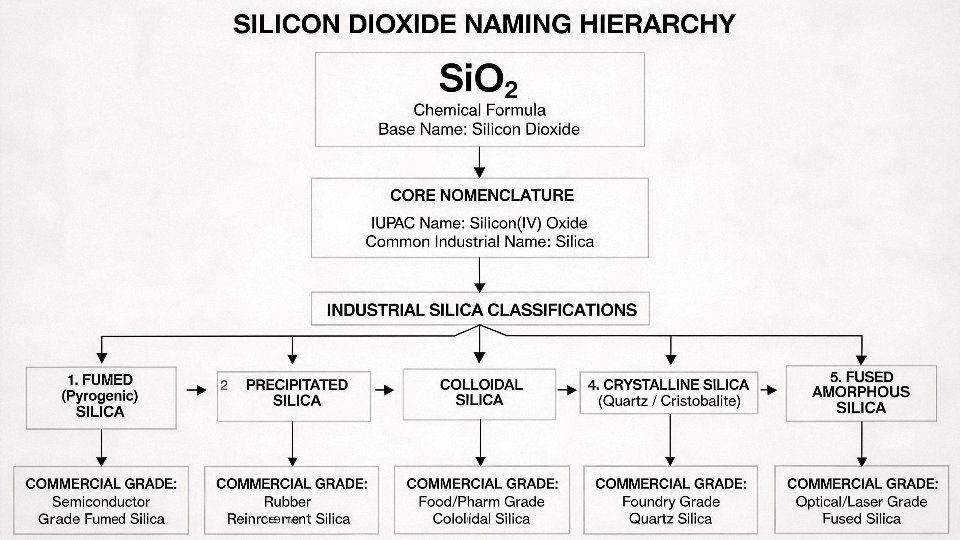
The closing recommendation is simple: never approve a silicon dioxide material on name alone. Verify the certificate of analysis, safety data sheet, technical specification sheet, and intended-use compliance before the first shipment is released. If the supplier cannot tell you the form, grade, key properties, and safety classification, the material is not fully specified. That is where avoidable scrap, dust exposure, failed audits, plugged feeders, and late-night production calls tend to start.