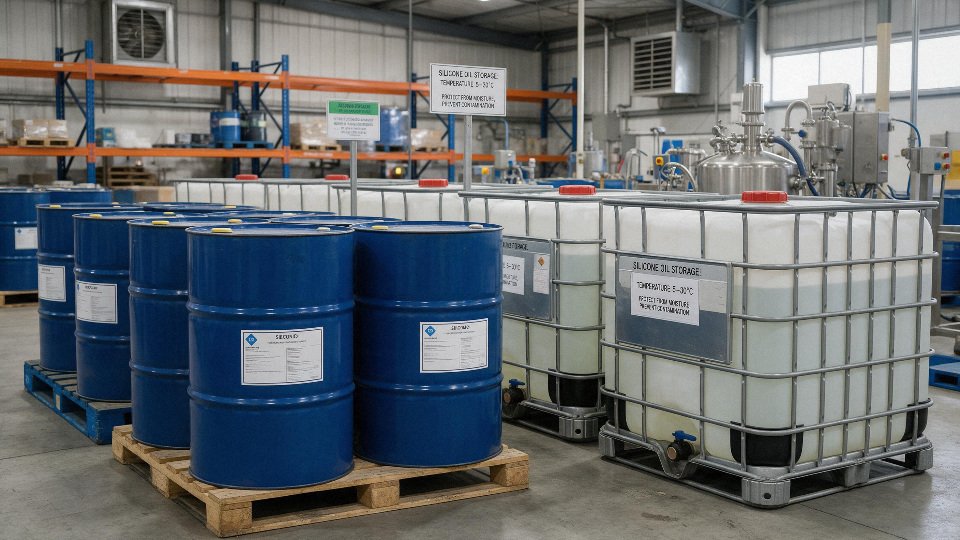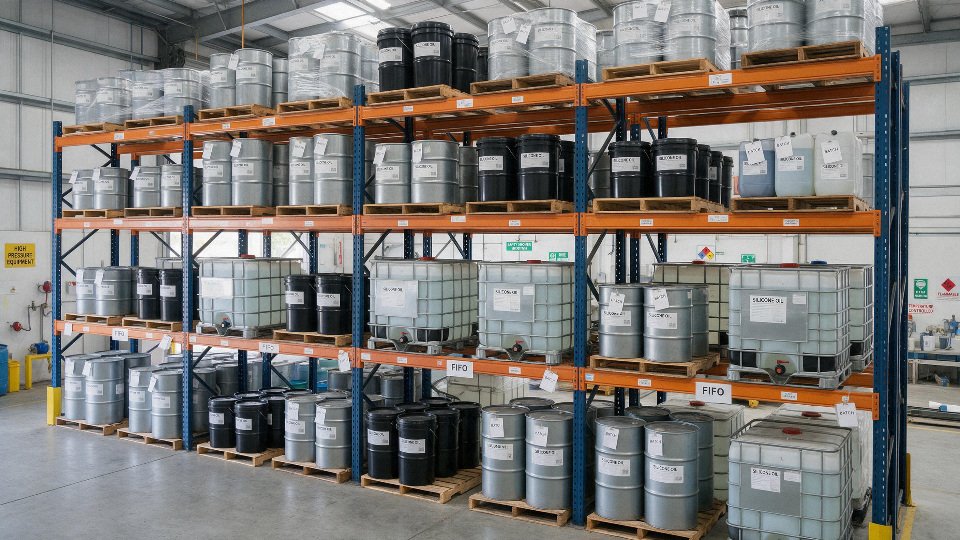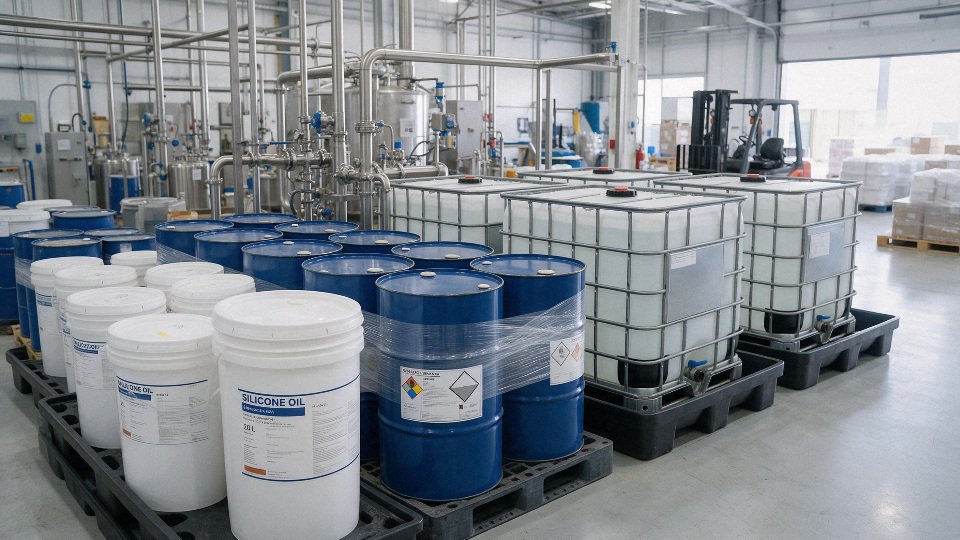
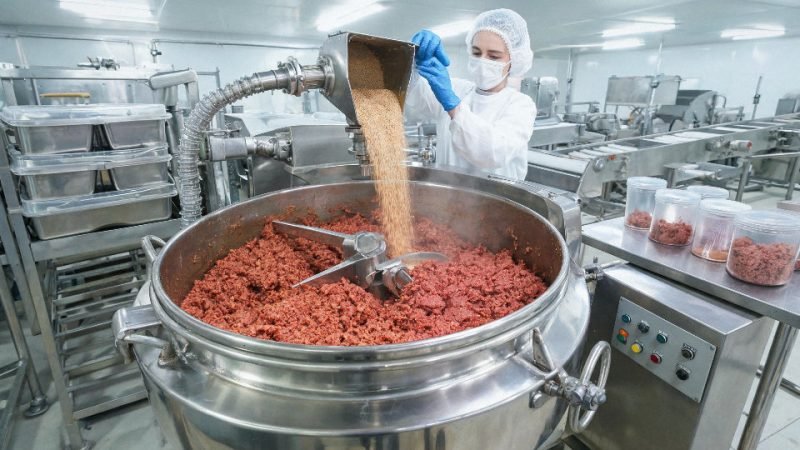
A clumped seasoning tote is a small problem until it hits the line: augers bridge, operators start tapping hoppers with a wrench, beef batches come out uneven, and somebody has to decide whether to rework, hold, or scrap. That is the practical reason silicon dioxide shows up in some dry seasoning systems, including Taco Bell’s seasoned beef history. The money side is just as plain: poor flow means downtime, giveaway, QA holds, and messy procurement substitutions. The right answer starts with separating “what is it doing there?” from “how much is actually in the food?”
Yes, Taco Bell’s seasoned beef has historically listed silicon dioxide in its seasoning system, mainly as an anticaking aid to keep dry spices flowing. FDA rules allow silicon dioxide up to 2% by food weight, though seasoning use is usually far below that. Check Taco Bell’s current official ingredient page.
The interesting part is not the scary-sounding name. Silicon dioxide can mean everything from common mineral material to a tightly specified food additive used at low levels for powder handling. The better question is where it sits in the formula, what the regulation allows, and whether the current Taco Bell ingredient statement still shows it.
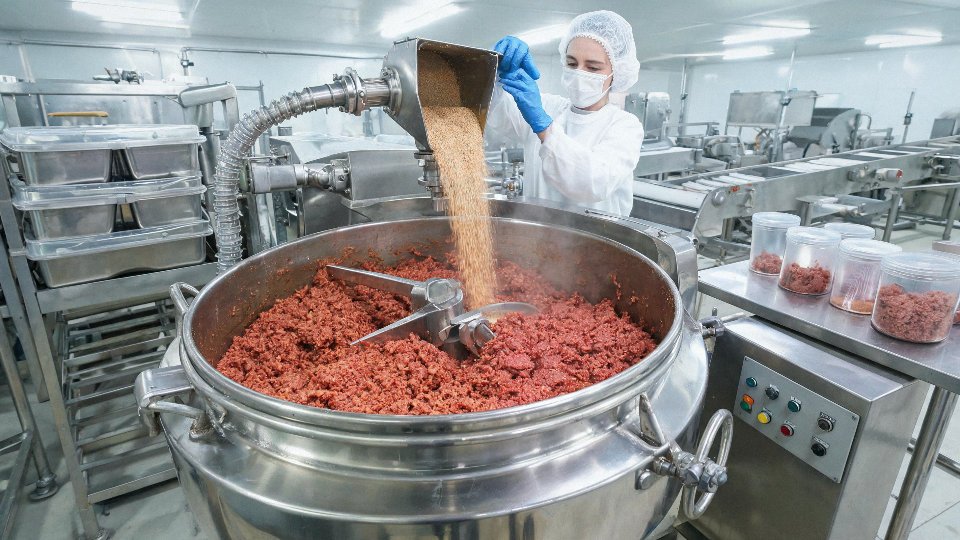
How to verify Taco Bell beef ingredients from official sources
The cleanest way to check whether Taco Bell seasoned beef currently lists silicon dioxide is not a social post, an old screenshot, or a copied ingredient list on a calorie site. Use Taco Bell’s own nutrition, ingredient, and allergen resources, then check the specific menu item that contains seasoned beef.
I treat this the same way I would treat a seasoning spec in a plant: current revision beats memory. A five-year-old ingredient sheet may be interesting, but it is not a purchasing document.
Start with the official Taco Bell nutrition and allergen page
Go to Taco Bell’s official website and look for its nutrition, ingredients, or allergen information. On many restaurant sites, this sits in the footer under labels such as “Nutrition,” “Allergen Info,” or “Food & Ingredients.” Use the U.S. site if you are checking U.S. menu items. International Taco Bell markets can use different suppliers, different legal labeling formats, and sometimes different recipes.
From there:
- Select the item that actually contains seasoned beef, such as a taco, burrito, or nacho item.
- Open the ingredient detail, not just the calorie panel.
- Find the component called “seasoned beef” or similar wording.
- Read the full ingredient statement for that component, including any seasoning sub-ingredients.
- Look for a revision date, print date, effective date, PDF footer, or page version if available.
If the website lets you customize the item, make sure seasoned beef is still selected. It sounds obvious, but I have seen procurement teams misread restaurant ingredient tools because the component was removed during customization. Same problem as checking a bill of materials after someone filtered out a subassembly.
The most reliable public check is Taco Bell's current official ingredient or allergen resource, not archived screenshots or third-party menu databases.True
Restaurant formulations and disclosures can change. Official current ingredient pages are the closest public source to the active specification, although consumers should still confirm directly with the company for medical, allergy, or regulatory needs.
Check the seasoned beef component, not only the menu item name
A menu item name will not tell you much. “Beef taco” is a sales description. The useful detail is the seasoned beef ingredient statement.
Historically, Taco Bell seasoned beef has listed silicon dioxide in the seasoning system, where it helps keep dry seasoning ingredients from clumping. That is a normal technical use for silicon dioxide. In dry spice and seasoning operations, anticaking agents are used because powders are not polite. Salt pulls moisture, chili powders bridge in hoppers, fine powders stick to blender walls, and a humid warehouse in July can turn a free-flowing blend into a brick if the formula is marginal.
Typical silicon dioxide use in dry seasoning blends is usually a fraction of 1 percent of the finished food, depending on the seasoning dose, moisture exposure, particle size, packaging, and flow requirements. The FDA allows silicon dioxide as an anticaking agent at not more than 2 percent by weight of the food under 21 CFR 172.480. That regulatory ceiling is not the same thing as the actual amount used in a taco. A plant engineer would call the legal limit the guardrail, not the recipe.
Why the ingredient list may not match an old screenshot
Ingredient lists move. Not every week, but they do move.
A supplier may change a spice premix to improve flow through a depositor or to stop clumping in bulk bags. A chain may reformulate for cost, sodium targets, flavor consistency, or clean-label pressure. Sometimes the recipe is the same but the labeling format changes because the legal or regulatory team revises how sub-ingredients are displayed. Regional sourcing can also matter. A distribution center serving one area may use a different approved supplier than another, especially during shortages or seasonal demand spikes.
In practice, these changes show up as small wording differences: “seasoning,” “spices,” “natural flavors,” or a parenthetical list of sub-ingredients. Silicon dioxide, if disclosed, may appear near the end of a seasoning sub-list rather than in the main visible part of the menu description.
Read it like a packaged-food label, but with restaurant caution
Packaged-food ingredient rules are a useful cross-check habit: ingredients are generally listed in descending order by weight. If silicon dioxide appears near the end, that usually signals a low-use ingredient. For a seasoned meat component, the beef and water or major seasoning carriers would normally outweigh an anticaking agent by a wide margin.
Restaurant disclosures are not always formatted exactly like a retail package label, though. Sub-ingredients may be nested inside a seasoning blend. Processing aids can be handled differently depending on function and disclosure rules. That is why the best reading is careful, not dramatic.
A compact way to verify:
| What you check | Why it matters | Practical warning |
|---|---|---|
| Official Taco Bell ingredient page | Best current public source | Save the access date if you are documenting it |
| Specific item with seasoned beef | Ingredients vary by item and customization | Do not rely on the menu name alone |
| Seasoned beef sub-ingredients | Silicon dioxide would likely appear in the seasoning details | Look inside parentheses or blend descriptions |
| Date, version, or PDF footer | Recipes and disclosure formats change | Old screenshots can be wrong even if they were once accurate |
| Region or country site | Sourcing and labeling rules can differ | U.S. data may not apply outside the U.S. |
If you need certainty for a sensitivity, compliance review, or procurement comparison, take one extra step: contact Taco Bell through its official customer support channel and ask for the current ingredient statement for seasoned beef in your market. Keep the response with the date. That is not overkill; it is basic document control.
What silicon dioxide is and why it appears in food systems
Silicon dioxide is a simple compound: silicon plus oxygen, written as SiO2. That plain formula is where a lot of bad explanations start, because SiO2 also shows up in quartz, sand, glass-making raw materials, and certain industrial dusts. Same chemistry does not mean same risk, same particle structure, or same use.
In food systems, silicon dioxide is normally used in a controlled, food-grade form as an anticaking agent or flow aid. In practical plant language, it helps dry powders keep moving instead of bridging in a hopper, packing into a spice drum, or coming out of a pouch in damp clumps.
That is the reason it can appear in taco seasoning systems, dry spice blends, cheese powders, powdered drink mixes, soup bases, and other dry formulations. The ingredient is not there to “bulk up” beef in any meaningful way. At normal use levels, it is a technical helper in the seasoning side of the formula.
Silicon dioxide in a seasoning blend is the same thing as eating sand.False
Sand may contain crystalline SiO2, but food-grade silicon dioxide is produced and controlled for food use, usually as a fine amorphous material used in small amounts for powder flow. The chemistry overlaps; the physical form, purity controls, and exposure route are not the same.
Food-grade silicon dioxide versus industrial [silica](https://siliconchemicals.com/silica/) dust
This distinction matters. I have seen procurement teams get nervous because a safety data sheet mentions silica hazards, then assume the same warning applies to the finished food ingredient in the same way. That is not how exposure works.
The serious workplace hazard people hear about is respirable crystalline silica dust. That is the fine dust generated in jobs such as cutting concrete, sandblasting, mining, stone fabrication, or handling certain mineral powders without proper controls. The concern there is breathing microscopic crystalline particles deep into the lungs over time. That is an occupational inhalation hazard, not the same as a permitted food additive being dispersed in a dry seasoning blend and eaten at low levels.
Food-grade silicon dioxide used in foods is generally an amorphous silica product, manufactured to meet food specifications. “Amorphous” means it does not have the same ordered crystal structure as quartz. That does not make dust control irrelevant in a factory. A powder room still needs ventilation, housekeeping, and sensible handling. Anyone who has dumped 25 kg bags into a mixer knows fine powders float, cling to sleeves, and find every ledge if the bag station is poorly designed.
But the consumer question is different from the operator exposure question.
In the United States, silicon dioxide is permitted by FDA regulation as an anticaking agent at not more than 2 percent by weight of the food under 21 CFR 172.480. Actual use in dry seasonings is usually well below that ceiling, often a fraction of 1 percent in the finished food. The exact amount depends on the seasoning formula, particle size distribution, fat or oil in the blend, warehouse humidity, packaging, and how well the powder needs to feed through equipment.
A mild, real-world example: a taco seasoning with salt, chili pepper, onion powder, garlic powder, paprika, and hydrolyzed protein can behave nicely in a dry lab sample, then turn stubborn after a humid August week in a distribution center. The salt and fine spice particles pick up surface moisture. The blend starts to cake. If it feeds through a small auger or volumetric cup, the dose can swing. Too little seasoning and the product tastes flat. Too much and sodium, color, and flavor intensity move out of target. Scrap does not always look dramatic; sometimes it is just a hold tag on three totes while quality decides what to do.
How it works in a powder blend
Silicon dioxide works mostly by surface action. The particles are very fine and have a high surface area. Mixed into a dry seasoning, they help absorb or bind tiny amounts of surface moisture and reduce particle-to-particle sticking. Think less “drying out the food” and more “keeping the outer surfaces from grabbing each other.”
That small physical change can matter a lot in a plant. Powders fail in annoying ways: they bridge over a hopper outlet, rat-hole down the center, smear on a screw feeder, or clump inside a pouch so the operator starts thumping the side of the bin with a rubber mallet. That last one is common, and it is also a sign the process is compensating for a formulation or storage problem.
Used correctly, a flow agent helps the seasoning discharge consistently, blend evenly, and dose more predictably. Used poorly, or used as a bandage for wet raw materials and bad storage, it will not save the process. If the spice room sits at high humidity, bags are left open, or warm product is packed before it has equilibrated, silicon dioxide can only do so much.
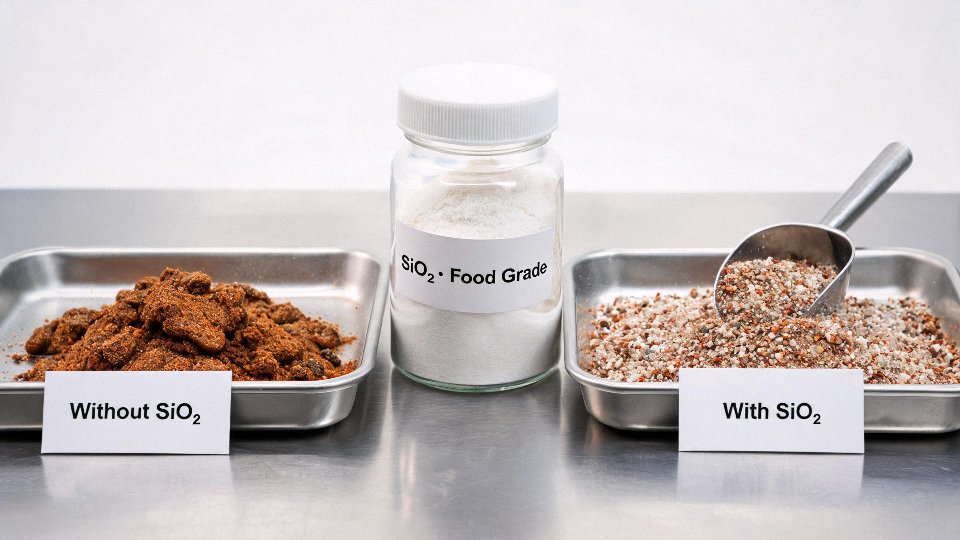
That is the practical reason silicon dioxide may show up in a seasoned beef ingredient statement. It is not a mysterious meat chemical. It is a common dry-blend processing aid with a narrow job: keep powdered ingredients flowing and distributing the way the formulation engineer intended.
Why seasoned beef manufacturing may need an anticaking agent
Restaurant seasoned beef is not just ground beef with a scoop of spice thrown in. In a high-volume food system, it is closer to a controlled formulation: cooked or prepared beef, water, salt, chili pepper, onion or garlic-type flavors, hydrocolloids or other texture aids in some formulas, and a seasoning package that has to behave the same way on Monday morning as it does during a Friday dinner rush.
That last part is harder than it sounds.
A seasoning blend may look simple on the label, but on the plant floor it is a powder handling problem. Fine powders absorb moisture, separate by particle size, pack into corners, stick to hopper walls, and sometimes form lumps hard enough to survive mixing. If the blend contains salt, sugar, dried vegetable powders, spice fines, yeast extract, or flavor carriers, the flow behavior can change a lot with humidity and storage time. One pallet kept near a dock door in August can behave differently from the same material stored in a conditioned dry room in February.
That is where an anticaking agent such as silicon dioxide may come in.
The seasoning has to meter, not just taste good
In production, the seasoning is usually not handled one small kitchen spoon at a time. It may be dumped from bags, lifted through a vacuum transfer line, loaded into a hopper, or fed by auger, loss-in-weight feeder, or manual batch station. Even in smaller operations, someone is weighing from sacks into totes, and the powder still needs to pour cleanly.
If the seasoning bridges inside a hopper, the feeder can run while very little product actually moves. Operators may see the auger turning, but the powder is hung up above it like wet beach sand in a funnel. Then the bridge breaks and a slug drops through. Now one part of the batch is light on seasoning and the next part is heavy.
That creates a real defect, not a paperwork nuisance. Under-seasoned beef tastes flat. Over-seasoned beef can be salty, dark, harsh, or outside the intended nutrition target. In a restaurant chain system, the bigger issue is variation. Customers may not know why one taco tastes different from another, but they notice.
A food-grade anticaking agent can be used to improve seasoning flow and dose consistency, not to replace meat.True
Silicon dioxide is commonly used in small amounts in dry seasoning systems to reduce clumping and improve powder handling. Its function is physical flow control, not protein extension or meat substitution.
Humidity is the quiet troublemaker
Most people outside manufacturing underestimate humidity. Dry seasoning can arrive within specification and still become difficult to run after a few days in a humid room, especially if bags are opened and reclosed with a clip, tape, or the classic half-hearted fold under a pallet lid. I have seen operators blame a feeder, then maintenance blames the auger, then procurement blames the spice supplier. Sometimes the root cause is simply that the powder picked up moisture and stopped flowing like it did during the trial.
Silicon dioxide helps because its fine particles can coat or separate other particles in the blend, reducing surface tackiness and limiting moisture-driven clumping. It does not make a bad storage practice good. If a plant leaves open seasoning bags beside a washdown area, no anticaking agent is going to save the day for long. But in a reasonable process, it can widen the operating window.
Typical use in dry seasoning blends is usually a fraction of 1 percent of the finished food, depending on the formula, ambient humidity, ingredient particle size, and the flow requirement. The FDA limit for silicon dioxide used as an anticaking agent is not more than 2 percent by weight of the food under 21 CFR 172.480. A finished seasoned beef system would normally be designed well below the maximum if the goal is simply to keep a seasoning blend moving, but the exact level depends on the supplier formulation and validated process.
Clumps become process variation
A clump is not just ugly. It changes the batch.
In a kettle or continuous mixer, seasoning needs to disperse before the meat matrix tightens up or before the batch moves downstream. A hard lump of spice may break late, leaving a hot spot of flavor. Or it may not break at all, showing up as dark specks or concentrated seasoning pockets. Quality may catch that during sampling, but not every defect announces itself neatly in a cup sample.
The consequences are practical:
| If the seasoning flows correctly | If the seasoning clumps or bridges |
|---|---|
| Feeder output stays closer to target | Dose may drift low, then surge high |
| Flavor is more uniform across the batch | Some portions taste weak, others too salty or spicy |
| Operators make fewer manual interventions | Line stops for poking, shaking, clearing, and rework |
| Batch records are easier to defend | Deviations need investigation and possible hold time |
| Less material sticks in bins and transfer points | Waste and sanitation time creep upward |
A small powder-flow aid can prevent a larger operational headache. That is the unglamorous truth.
Speed at the restaurant starts with control upstream
Fast service at the counter depends on predictable food upstream. If seasoned beef arrives with consistent texture, salt level, color, and seasoning distribution, restaurant crews can heat, hold, portion, and serve it without improvising. If the product varies, the restaurant inherits the problem. Crew members may stir more, hold longer, add sauce to compensate, or discard product that looks wrong. None of that is elegant process control.
For a procurement manager, the question is not only “Is silicon dioxide present?” The better question is, “What function does it serve, at what level, under which specification, and is there a cleaner or more robust way to achieve the same flow?” Sometimes the answer is better packaging, tighter humidity control, different particle sizing, or a supplier with a more stable premix. Sometimes the simplest validated answer is a small amount of anticaking agent in the seasoning system.
That is normal food manufacturing logic. Not glamorous. Very useful.
How much silicon dioxide is likely present in a serving
The practical answer is: usually a small amount, because silicon dioxide used for anticaking is normally part of the dry seasoning system, not a bulk ingredient in the cooked beef. It is there to keep powders moving through bags, bins, augers, measuring scoops, and plant dosing equipment without turning into damp clumps. That is a very different role from beef, water, salt, spice, or textured ingredients that make up the mass of the serving.
A useful way to think about it is dilution. The beef portion contains a seasoning blend. The seasoning blend may contain an anticaking agent. The anticaking agent is only one minor part of that blend.
In a real production environment, nobody wants to pay for excess silicon dioxide. It adds no flavor, no yield, no protein, and no marketing value. The formulator uses enough to keep the powder flowing through storage, transport, batching, and dispensing. That required amount depends on the spice mix, salt level, particle size, humidity exposure, carrier ingredients, bag size, and how long the seasoning sits before use. A seasoning that behaves well in a dry western warehouse may bridge badly in a humid Gulf Coast kitchen or distribution center.
If silicon dioxide appears in a seasoned beef ingredient statement, it does not mean the beef portion contains up to 2 percent silicon dioxide.True
The 2 percent figure under FDA rules is a maximum limit for silicon dioxide used as an anticaking agent in food. Actual use is usually based on flow performance and is commonly much lower, especially after a dry seasoning blend is mixed into finished beef.
A practical estimation framework
This is not Taco Bell’s proprietary formula. It is only a transparent engineering estimate to put the ingredient into scale.
Start with the finished seasoned beef serving. Depending on the menu item, portion control, line practice, and whether the product is being weighed or scooped, a serving of seasoned beef might be somewhere in the broad range of a few dozen grams. The seasoning portion is only a slice of that mass. In many cooked meat systems, the dry seasoning addition might land roughly in the low single-digit percent range of the finished product, though it can move higher or lower depending on salt target, spice intensity, water addition, and whether the seasoning includes functional carriers.
Now look inside the dry seasoning. Silicon dioxide, if used, is typically not the main dry ingredient. Salt, chili pepper, onion powder, garlic powder, paprika, yeast extract, sugar, hydrolyzed proteins, starches, or other carriers usually dominate the blend. Silicon dioxide may be present at a fraction of the seasoning blend, selected to prevent caking and improve flow.
So, as an illustrative example:
If a serving contained about 40 to 70 g of seasoned beef, and the dry seasoning contribution were roughly 1 to 4 g, and silicon dioxide were somewhere around a small fraction of that seasoning blend, the final amount in the served beef would typically be measured in milligrams, not grams. Depending on the assumptions, you might land somewhere from a few milligrams to several dozen milligrams per serving. If the seasoning system is more difficult to handle because of humidity, fine powders, or long storage time, the number could run higher. If the blend is coarse, dry, and flows well, it could be lower.
That is the right scale. Not spoonfuls. Not a visible dusting. Usually a small processing aid-type ingredient doing a powder-handling job.
Illustrative scale, not a proprietary formula
| Item in the formulation | Main role | Likely location in the food system | Regulatory ceiling | Practical use level range |
|---|---|---|---|---|
| Beef | Primary food ingredient | Main cooked meat portion | Not applicable to silicon dioxide rule | Largest share of the serving; depends on menu item and portion control |
| Seasoning blend | Flavor, salt, color, aroma, processing consistency | Mixed into cooked or prepared beef system | Ingredients within the blend must meet their own rules | Often a modest share of the finished beef; depends on flavor target, water addition, and formulation |
| Silicon dioxide | Anticaking and flow improvement | Usually inside the dry seasoning blend | FDA allows silicon dioxide as an anticaking agent at not more than 2 percent by weight of the food under 21 CFR 172.480 | Typically far below the ceiling in finished food; often a fraction of 1 percent, depending on humidity, powder flow, storage, and dosing equipment |
| Salt and dry spices | Flavor and seasoning identity | Major components of the dry blend | Governed by general food ingredient rules and labeling requirements | Usually much higher than silicon dioxide within the seasoning blend |
The big trap is reading the FDA ceiling as if it were a recipe. Plant people do not formulate that way. A legal maximum is a guardrail. The actual level is set by what works during handling and what the finished food specification allows.
I have seen dry blends that ran beautifully in a lab jar and then turned into a lumpy mess after sitting on a pallet through a humid weekend. That is where anticaking agents earn their keep. Without them, the seasoning can feed unevenly. Uneven feed means one batch is bland, the next is salty or over-spiced, and the operator starts fighting the process with a rubber mallet and a scoop. Wrong answer. That creates variation, rework, customer complaints, and sometimes scrapped product.
For a consumer reading the ingredient statement, the sensible interpretation is this: presence on the label tells you silicon dioxide may be part of the seasoning system. It does not tell you the exact dose. To know whether it is currently used, check Taco Bell’s current official ingredient information. To understand likely scale, think dry seasoning dilution, not bulk beef ingredient.
Food safety review: what regulators say about silicon dioxide
The FDA position is not vague: it is a permitted food additive
In the United States, silicon dioxide is permitted by the FDA for specified food uses under 21 CFR 172.480. The regulation allows silicon dioxide to be used as an anticaking agent, subject to conditions, with a maximum level of not more than 2 percent by weight of the food.
That 2 percent figure is a legal ceiling, not a normal recipe target. In plant terms, nobody wants to load a beef seasoning system with more anticaking agent than needed. It adds cost, takes up formulation space, and can affect blend behavior if abused. Typical use in dry seasoning systems is usually much lower, often a fraction of 1 percent in the finished food, depending on the seasoning carrier, moisture pickup, storage time, particle size distribution, packaging, and how rough the distribution chain is.
A seasoning blend sitting in a dry, climate-controlled ingredient room in Arizona behaves differently from the same blend moving through humid dock doors in the Southeast during summer. Procurement people know this pain. A powder that flowed cleanly during supplier approval can bridge in a tote after three months of real storage and forklift handling. That is the practical world where anticaking agents get specified.
The FDA permits silicon dioxide as an anticaking agent in food under 21 CFR 172.480, with a maximum of not more than 2 percent by weight of the food when used under that regulation.True
The regulation lists silicon dioxide for use in food as an anticaking agent and sets the 2 percent by weight limit under the stated conditions of use.
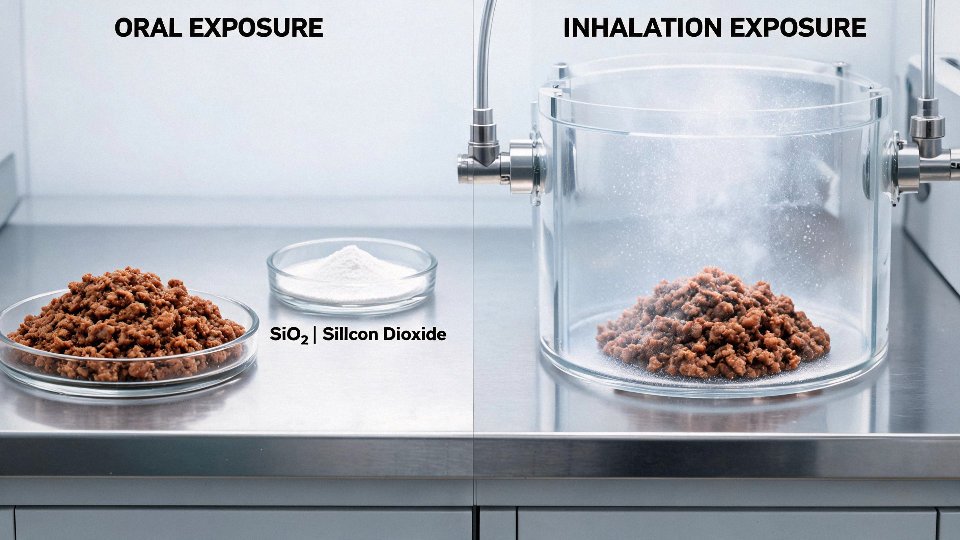
Oral exposure is the relevant safety route here
A lot of public confusion comes from mixing up two very different exposure routes: eating food-grade silicon dioxide and breathing respirable crystalline silica dust.
Those are not the same risk profile.
Workplace silica hazards are real. I have seen the dust side of industry, and it is not something to hand-wave away. Cutting concrete, handling certain mineral powders, sandblasting, poor dust collection around bulk bag unloading — those situations can create airborne particles small enough to reach deep into the lungs. Chronic inhalation of respirable crystalline silica is associated with serious lung disease. That is why plants use dust collectors, enclosed transfer points, respirators where needed, exposure monitoring, housekeeping rules, and training that nobody loves but everyone should respect.
Food-grade silicon dioxide in a seasoning system is evaluated on the basis of oral exposure. It is consumed in small amounts as part of the food matrix, passes through the gastrointestinal tract, and is regulated according to food additive standards and intended use. The toxicological question is not, “Would I want to breathe a cloud of this powder all shift?” The better question is, “At the level used in food, does oral intake present a safety concern under the regulation?”
Those are different questions with different answers.
A simple plant-floor analogy: sodium chloride is ordinary table salt in a taco seasoning, but a concentrated salt dust cloud in a poorly ventilated blending room is still bad practice. Same material category on a label does not mean the same exposure hazard.
The 2 percent limit should be read with context
The FDA limit of up to 2 percent by weight sounds large if read without manufacturing context. For a 100 gram portion of food, 2 percent would be 2 grams. That is the regulatory cap under the rule, not a claim about what is present in a fast-food serving.
In an actual seasoned beef application, silicon dioxide would generally be part of the dry seasoning component, not the main meat mass. The final level depends on the seasoning dose rate, how much anticaking agent the seasoning supplier used, moisture control, and the flow performance required for the plant’s equipment. A high-speed system feeding seasoning through hoppers and augers has less tolerance for caked powder than a small kitchen scoop operation.
Wrong formulation choices show up fast. If a seasoning cakes in the feeder, the line operator starts tapping the hopper with a wrench. Then the feed rate surges, seasoning distribution goes uneven, and somebody in quality starts chasing sodium, flavor, or color variation. In a worst case, production stops while maintenance cleans a compacted bridge out of a screw feeder. Nobody wants that during a lunch-rush production window.
That is why anticaking agents exist. Not because the product needs “filler,” but because powders are moody.
Practical safety takeaway for consumers
For most consumers, food-grade silicon dioxide used at permitted anticaking levels is not considered a primary food safety concern. If someone is evaluating a seasoned beef item, the larger nutrition and tolerance questions are usually sodium, saturated fat, total calories, allergens, and personal digestive triggers. Silicon dioxide, when used within the FDA framework, is generally not the first thing I would flag.
That does not mean every consumer should ignore personal medical context. People with kidney disease, unusual gastrointestinal conditions, complex medication restrictions, or a clinician-directed diet should ask a qualified medical professional rather than relying on menu-label interpretation or social posts. A regulator’s permitted-use decision is population-level guidance; a clinician deals with the individual sitting in front of them.
The clean way to think about it is this: regulators allow silicon dioxide for defined food uses, the safety basis relates to eating small amounts rather than inhaling industrial dust, and the legal maximum is far above what is usually needed for powder flow in a seasoning system. If the current Taco Bell ingredient statement lists silicon dioxide in the seasoned beef seasoning system, its presence alone is not a strong food safety alarm. It is a sign that the dry seasoning was engineered to flow, meter, and mix consistently under real production conditions.
What silicon dioxide does not tell you about beef quality
Silicon dioxide on an ingredient statement tells you one narrow thing: somewhere in the dry seasoning system, the supplier or processor wanted better flow and less clumping. It does not, by itself, tell you the beef is unsafe, fake, poor grade, or radically different from other commercial seasoned meat products.
That distinction matters because ingredient lists are easy to misread. A technical additive can look suspicious simply because the name is chemical. In a plant, though, the question is usually more boring: will the seasoning meter correctly, will it bridge in the hopper, will it cake after sitting in a humid storeroom, and will each batch taste the same on Monday morning as it did Friday night?
Silicon dioxide answers that kind of problem. It is not a meaningful marker of beef quality in the way fat level, salt load, cooking loss, spice balance, holding time, or portion control are.
If Taco Bell seasoned beef lists silicon dioxide, that alone proves the beef is unsafe or fake.False
Silicon dioxide is permitted for food use as an anticaking agent within regulatory limits. Its presence indicates a functional role in a seasoning system, not a conclusion about whether the beef is real, unsafe, or nutritionally poor.
Do not confuse a processing aid with the main formulation
In food manufacturing, not all ingredients carry the same weight. A major ingredient changes the product’s nutrition, eating quality, cost structure, and consumer experience. Ground beef, water, seasoning, salt, binders or texturizers if used, fats, and sauces can materially affect calories, sodium, mouthfeel, yield, and flavor release.
A low-level anticaking agent sits in a different category. It may help a powdered seasoning pour through a feeder, disperse into meat more evenly, or survive warehouse humidity without becoming a brick. It is usually present at a fraction of 1 percent of the finished food, depending on the seasoning design, the local humidity, storage time, particle size, and how much flow improvement the supplier needs. That is a process-control function, not the backbone of the recipe.
I have seen this same logic in spice rooms and blending areas outside quick-service restaurants: garlic powder clumps in summer, chili powder packs hard after a pallet sits near a dock door, and operators start beating bags against a stainless table to break them loose. That is not a quality program. That is a workaround. A controlled anticaking system is often the cleaner option.
The wrong lesson would be, “silicon dioxide equals bad beef.” The better lesson is, “this is a mass-produced seasoned food, so judge it by the things that actually move health and quality outcomes.”
The variables that matter more on the plate
For most diners, sodium deserves more attention than silicon dioxide. Seasoned quick-service beef products often rely on salt for flavor, preservation support, and consistency across locations. The actual sodium in a meal depends on the item, serving size, cheese, sauces, shell or tortilla, beans, rice, and whether you add packets of sauce. One taco may be one thing. A combo meal with multiple seasoned components is another.
Saturated fat is another practical measure. It depends on the beef specification, added fats if any, cheese, sour cream, fried shells, and total portion size. A small serving of seasoned beef inside a taco does not carry the same impact as a larger meal built around several high-fat components.
Calories are similar. The beef is only one contributor. Shell type, sauce, cheese, portioning accuracy, and side items can push the meal up quickly. In real operations, portion control also varies. A well-trained line with portion tools will run tighter than a rushed line during peak service where scoops get heaped. That is not a conspiracy; it is restaurant execution.
Fiber rarely gets enough attention. If the meal includes beans, vegetables, or a higher-fiber component, the nutritional profile changes. If it is mostly seasoned meat, cheese, sauce, and refined tortilla, the meal behaves differently from a satiety standpoint. Silicon dioxide has almost nothing to do with that.
Allergens and sensitivities matter too. A current allergen statement is more useful than guessing from one additive. Wheat, milk, soy, egg, and cross-contact risks can be decisive for some customers. People with medically significant allergies should check the official nutrition and allergen page and, frankly, assume restaurant environments are imperfect. Shared utensils, steam tables, gloves, and rush-hour habits are not laboratory conditions.
A better way to read the label
A short decision table is more useful than a scare headline.
| Label or meal factor | What it can actually tell you | What it cannot prove by itself |
|---|---|---|
| Silicon dioxide listed in seasoning | The dry seasoning may use an anticaking agent for flow and consistency | That the beef is fake, unsafe, or low grade |
| Sodium level | How salty the item or meal is, especially when combined with sauces and cheese | Whether the seasoning system was well controlled in the plant |
| Saturated fat and calories | The likely dietary load from beef, cheese, shell, sauces, and portion size | Whether one minor additive is harmful |
| Allergen statement | Whether declared allergens or cross-contact warnings matter for you | That every restaurant execution will be risk-free |
| Portion size and frequency | How the item fits into a normal eating pattern | That a single ingredient defines the whole product |
A typical scenario: one customer sees silicon dioxide and worries about “chemicals,” while another ignores it and orders three high-sodium items with cheese and sauce. From a practical nutrition standpoint, the second issue is usually the larger one. Frequency turns occasional food into a pattern. Portion size turns a snack into a heavy meal.
That is where the real quality conversation belongs. Not panic over a trace anticaking agent, and not blind trust either. Read the current ingredient list, check sodium and saturated fat, look at the full meal, and decide how often it belongs in your routine. Silicon dioxide is a data point. It is not the verdict.
How Taco Bell beef compares with common packaged and restaurant foods
A seasoned beef line at a quick-service restaurant is not as different from a retail taco seasoning packet as people imagine. The scale is different. The controls are tighter. The basic powder-handling problem is the same: dry ingredients pick up moisture, form bridges in hoppers, stick to screw feeders, and dose unevenly if the blend is not engineered to flow.
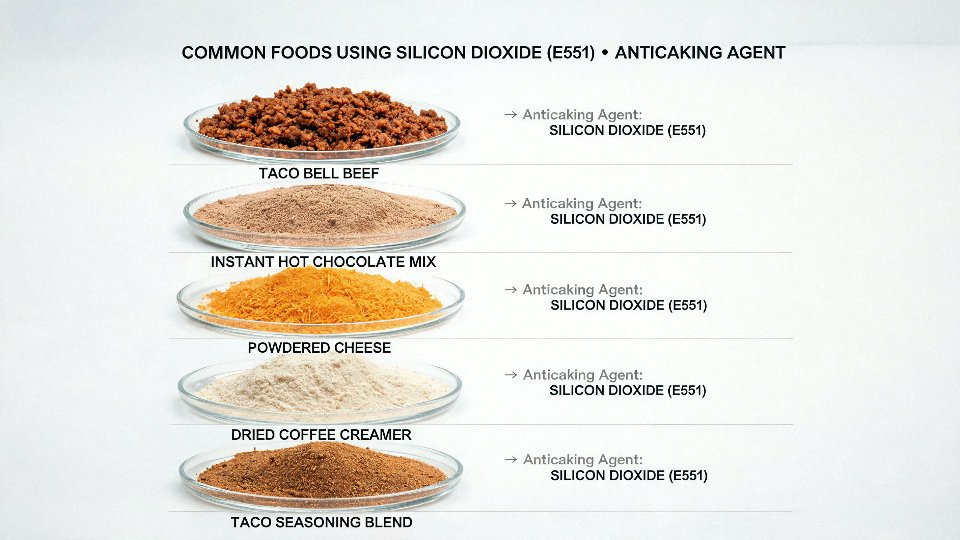
That is where silicon dioxide, calcium silicate, tricalcium phosphate, starches, and other anticaking or flow-aid ingredients show up. They are not there to “bulk up” beef in any meaningful way. They are usually there because a seasoning system has to move through bags, totes, augers, scoops, or automated dosing equipment without turning into damp chunks.
In a plant, clumped seasoning is not cosmetic. One batch gets under-seasoned, the next gets a concentrated slug of salt, chili powder, or onion powder. Then someone is sorting, reworking, or scrapping product. In a restaurant, the same issue shows up as inconsistent flavor, clogged packets, hard lumps in dry mixes, or employees beating bags against a prep table to break up powder. I have seen that last one more than once. It is not a control plan.
Ordinary foods that use the same kind of ingredient technology
Silicon dioxide or similar anticaking agents can appear in a wide range of everyday foods. The exact ingredient depends on the product, moisture sensitivity, fat content, packaging, shelf life, and whether the powder has to run through equipment or just sit in a pouch until a customer opens it.
Common examples include:
- Spice blends and rubs, especially blends with salt, garlic powder, onion powder, paprika, chili powder, or sugar
- Powdered drink mixes, where humidity can turn a free-flowing powder into a brick
- Seasoning packets for tacos, noodles, gravy, chili, rice, and skillet meals
- Dry soup mixes and bouillon-type powders
- Snack seasonings used on chips, crackers, popcorn, and extruded snacks
- Powdered coffee creamers, especially where spray-dried powders need stable flow
- Shredded cheese coatings, though these often use cellulose, starch, or natamycin-related systems depending on the purpose and label
- Bakery premixes, pancake mixes, and dry sauce bases
That does not mean every product in those categories contains silicon dioxide. Some use none. Some use calcium silicate or tricalcium phosphate. Some rely on packaging, lower humidity, larger particle size, or shorter shelf life. A small premium spice jar in a dry climate may behave well without much help. A 25-pound seasoning bag stored near a steamy cookline in August is a different animal.
Silicon dioxide in a fast-food beef seasoning system is unusual compared with packaged foods.False
Dry seasoning systems used in restaurants and packaged foods often face the same flow and caking problems, so silicon dioxide or similar anticaking agents are common across spice blends, seasoning packets, soup mixes, snack seasonings, and powdered products.
Why restaurant seasoning systems look like packaged dry blends
Fast-food operations need repeatability. A crew member or automated process cannot adjust every batch by feel the way a cook might at home. Seasoning has to disperse into meat predictably, and the supplier has to make thousands of pounds of blend that behaves the same from one lot to the next.
Retail seasoning packets have the same core requirement, just on a smaller unit size. The powder must pour out of the packet, mix into food without hard lumps, and taste the way the formulation intended. If the cumin, salt, garlic powder, chili pepper, and hydrolyzed protein components segregate or cake, the consumer notices. In restaurant production, the consequence can be worse because one handling problem can affect many servings.
Humidity is the usual villain. Salt and sugar pull moisture. Fine powders have high surface area. Onion and garlic powders can be sticky. Paprika and chili powders carry oils. Tomato powder, dairy powders, and yeast extracts can behave badly if storage temperature swings. Once a blend cakes, the operator may not discover the issue until dosing becomes erratic.
A well-designed anticaking system buys process margin. Not perfection. Just margin.
Planned comparison chart: where to look and what it means
| Product category | Why clumping is a problem | Typical anticaking strategy | What consumers should check on the label |
|---|---|---|---|
| Fast-food seasoned beef seasoning | Uneven dosing can create flavor swings, salt hotspots, or poor mixing into meat | Silicon dioxide or a similar flow aid in the dry seasoning blend, usually at low use levels in the finished food | Current restaurant ingredient statement, not old screenshots |
| Retail taco or chili seasoning packets | Powder must empty from the pouch and disperse in water, fat, or meat juices | Silicon dioxide, calcium silicate, starch, or formulation control | Ingredient list for “silicon dioxide,” “calcium silicate,” or “anticaking agent” |
| Spice blends and dry rubs | Salt, sugar, garlic, and fine spices can bridge or form hard lumps | Silicon dioxide, calcium silicate, rice flour, starch, or no additive if turnover is fast | Whether the blend contains added flow agents or fillers |
| Powdered drink mixes | Humidity can create clumps that dissolve slowly or dose unevenly | Silicon dioxide, tricalcium phosphate, or moisture-resistant packaging | Ingredient list and storage instructions |
| Shredded cheese | Shreds stick together, especially with moisture and compression in the bag | Cellulose, starches, sometimes other mold or flow-control systems | Coating ingredients, not just the cheese type |
| Dry soup and sauce mixes | Dairy powders, salt, starches, and flavors can cake during storage | Silicon dioxide, calcium silicate, phosphate salts, starch-based carriers | Full dry mix ingredient panel |
| Snack seasonings | Powder must flow through applicators and stick evenly to chips or crackers | Carrier powders, silicon dioxide, starches, oils, and particle-size control | Seasoning sub-ingredients if disclosed |
| Powdered coffee creamers | Spray-dried powders need stable flow and easy spooning | Silicon dioxide, phosphates, emulsifiers, and moisture controls | Anticaking agents, emulsifiers, and sweetener type |
The practical takeaway is simple: Taco Bell beef seasoning, if it lists silicon dioxide, sits in the same industrial family as many dry food blends people keep in their pantry. The better question is not “Is this ingredient shocking?” It is “What is the full formulation, how much is used, and does the current label match my dietary preferences?”
Consumer decision guide: when to avoid it, ignore it, or ask questions
A useful way to look at silicon dioxide in seasoned beef is not “chemical or no chemical.” That framing sends people in circles. The better plant-floor question is: what risk are you actually managing?
For most consumers, silicon dioxide is not the deciding variable in a Taco Bell order. It is typically there to keep a dry seasoning system flowing and blending consistently, not to bulk up the meat. For some shoppers, though, the presence of any anticaking agent is enough reason to choose a simpler food. Both positions can be rational. The mistake is pretending they are the same decision.
Path 1: If you only want the safety answer
If your question is, “Is this ingredient automatically unsafe because it appears in seasoned beef?” the practical answer is no. Food-grade silicon dioxide is permitted for use as an anticaking agent, with the FDA limit set at not more than 2 percent by weight of the food under 21 CFR 172.480. Actual use in a seasoned beef system would normally be much lower than that, often a fraction of 1 percent in the finished food, depending on the seasoning formula, humidity control, supplier flow requirements, and how the blend is handled before cooking.
That last point matters. In a real production environment, powders bridge, cake, and hang up in totes or feeders. Anyone who has watched onion powder turn into a block after a humid weekend understands why a processor may specify a flow aid. It is not glamorous. It is usually just preventing bad dosing, uneven seasoning, rework, and line stoppages.
So, if you eat Taco Bell occasionally and have no specific medical restriction, silicon dioxide should not be the first concern. Meal size, sodium, saturated fat, total calories, and how often the meal shows up in your week will usually matter more.
The presence of silicon dioxide in a seasoned beef ingredient list does not, by itself, mean the food contains a large amount of it.True
Silicon dioxide used as an anticaking agent is normally used at low levels, often far below the FDA maximum, and the actual amount depends on the seasoning blend and finished-food formulation.
Path 2: If you are trying to avoid additives
If your goal is a shorter ingredient list, then yes, silicon dioxide is a reasonable marker to pay attention to. Not because it is uniquely alarming, but because it tells you the food has passed through a formulated seasoning system rather than being plain cooked beef with salt added at the table.
Avoiding it usually means choosing less-seasoned, less-processed foods. In restaurant terms, that means checking whether a protein is plain or pre-seasoned at the supplier level. In grocery terms, it means reading dry seasoning packets, shredded cheese labels, spice blends, powdered drink mixes, soup bases, and meal kits. Silicon dioxide shows up in a lot of ordinary dry systems because factories need powders to move the same way in January as they do in August.
A practical approach:
| Consumer priority | Better move | What to watch |
|---|---|---|
| Avoid most additives | Choose simpler proteins, plain rice, beans, eggs, or minimally seasoned items | Restaurant “plain” may still mean supplier-seasoned |
| Avoid silicon dioxide specifically | Review current ingredient lists before ordering or buying | Recipes can change without much public attention |
| Reduce processed-food intake | Look at the whole meal pattern over a week | One trace additive is less meaningful than frequent high-sodium meals |
| Keep convenience but reduce exposure | Rotate in home-prepped meals with basic seasonings | Spice blends at home may also contain anticaking agents |
In practice, a customer who eats seasoned beef tacos once a month has a very different exposure pattern from someone buying packaged spice mixes, powdered sauces, and fast food several times a week. Frequency is where the real procurement math lives. One low-level ingredient in one meal is rarely the whole story.
Path 3: If you manage allergies, sensitivities, sodium, or medical diet restrictions
This is the group that should ask questions rather than skim one ingredient and move on. Silicon dioxide itself is not a common food allergen, but the seasoned beef system around it may include other ingredients that matter more: wheat-derived components, soy, dairy cross-contact, spices, flavoring systems, preservatives, or high sodium levels. The current ingredient statement and allergen page are the right starting point, not an old screenshot or a third-party menu blog.
For medical diets, compare the nutrition facts before you worry about trace anticaking agents. Sodium can run high in seasoned restaurant proteins, sauces, cheese, and shells. The exact amount depends on the menu item, portion size, sauce choices, and whether you customize. A person managing hypertension, kidney disease, heart failure, migraine triggers, or a physician-directed sodium limit should treat the whole order as the unit of analysis.
Useful actions are simple, but they take a minute:
- Review Taco Bell’s current official nutrition, ingredient, and allergen information before ordering.
- Customize where possible, such as removing sauces, cheese, or seasoned components if those are the bigger concern.
- Compare similar items by sodium, calories, saturated fat, and allergens, not just by whether one additive appears.
- If you have a serious allergy or celiac disease, ask about cross-contact risk. Fast-service kitchens are busy, shared-tool environments.
- Keep the frequency honest. A weekly pattern matters more than a single ingredient name.
A typical scenario: someone sees silicon dioxide on a beef ingredient list and switches to a different fast-food item with no obvious anticaking agent, but that replacement has more sodium, more sauce, and a larger portion. From a health-management standpoint, that may be the wrong trade. The label looked cleaner; the meal got worse.
Operational warning from the factory side: ingredient lists are snapshots, not permanent engineering drawings. Suppliers change seasoning carriers, flow aids, spice sources, and allergen controls when costs, availability, or line performance change. If silicon dioxide is a personal avoid-list item, verify the current statement close to the time you order. For casual safety concerns, do not overwork the issue. For additive avoidance or medical restrictions, check the source and judge the full meal.
Frequently asked questions
Does Taco Bell beef contain silicon dioxide?
Historically, Taco Bell’s seasoned beef ingredient statement has listed silicon dioxide as part of the seasoning system, mainly to keep dry seasoning components from clumping before they are mixed into the beef. That is the honest answer.
For a current yes-or-no answer, check Taco Bell’s official nutrition, ingredient, and allergen page rather than an old screenshot, a lawsuit-era article, or a social post. Restaurant formulations do change. Suppliers change. A spice premix can be reformulated without the finished menu item looking any different to the customer.
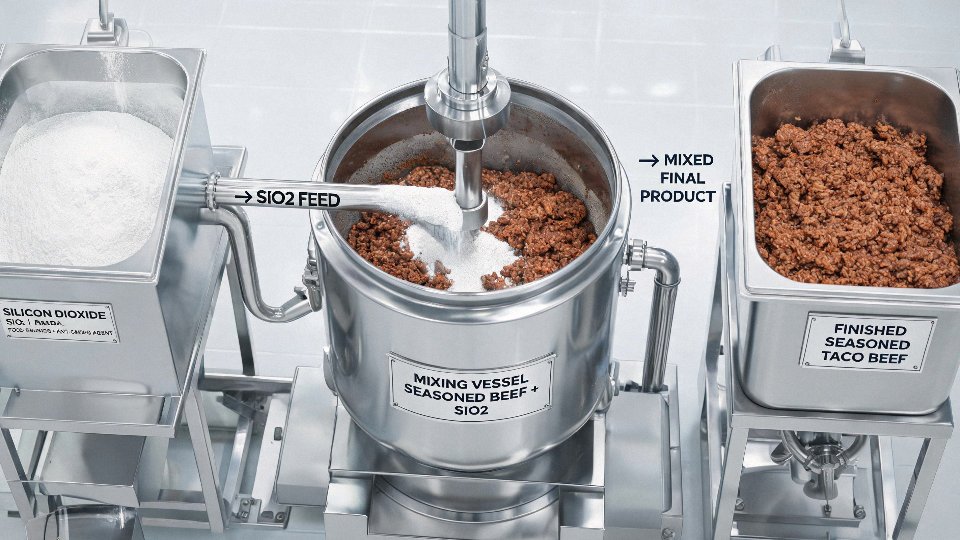
In plant terms, silicon dioxide would normally come in through the dry seasoning blend, not as a scoop of separate white powder being added at the restaurant. The practical reason is flow. Seasoning that bridges in a hopper, cakes in a bag, or sticks inside an auger does not meter cleanly. That can lead to uneven flavor, rework, downtime, and a maintenance tech tapping a bin with a rubber mallet when he should not have to.
Is silicon dioxide just sand or glass?
Chemically, silicon dioxide is SiO2, and yes, SiO2 is also a major component of sand and glass. That comparison is technically true but often misleading.
Food-grade silicon dioxide is a controlled anticaking ingredient with specifications for purity and use. Beach sand is not a food ingredient. Broken glass is not a food ingredient. Industrial abrasive silica is not a food ingredient. Same base chemistry does not mean same particle size, purity, handling controls, or use case. Sodium and chlorine are a good reminder here; as separate elements they are not table salt in any practical sense.
A better shop-floor comparison is this: food-grade silicon dioxide behaves like a flow aid in a dry powder system. It helps spices, salt, dehydrated ingredients, and flavor powders stay free-flowing enough to dose consistently.
Is silicon dioxide plastic, filler, or a meat substitute?
No. Silicon dioxide is not plastic. It is not a protein extender. It is not a meat replacement.
A filler or extender would be used to add bulk, hold water, reduce meat cost, or change texture. Silicon dioxide is used at much smaller levels for powder handling. In a dry seasoning blend, the amount is usually a fraction of 1 percent of the finished food, depending on the formula, humidity, packaging time, and how difficult the powder is to meter.
If someone says silicon dioxide means the beef is “not real beef,” they are mixing up two separate issues: meat content and seasoning flow control. You can criticize a fast-food beef product on sodium, processing level, fat content, or ingredient complexity if those matter to you. Silicon dioxide by itself does not prove the meat has been replaced.
Silicon dioxide in a seasoned beef formula is used as an anticaking agent, not as a meat substitute.True
Food-grade SiO2 is commonly used in dry seasoning systems to improve powder flow and reduce clumping. It does not provide meat protein, fat, or bulk in the way an extender would.
Is silicon dioxide dangerous to eat?
At allowed food-use levels, regulators have treated silicon dioxide as safe for its intended anticaking purpose. In the United States, FDA regulation 21 CFR 172.480 permits silicon dioxide as an anticaking agent at not more than 2 percent by weight of the food.
That 2 percent figure is a legal ceiling, not a typical target. In real seasoning work, the use level is often far below that in the finished food because you only need enough to stop caking and improve flow. The needed amount depends on moisture pickup, salt level, particle size, fat-coated flavors, storage time, and whether the blend has to survive a humid distribution chain.
Eating food-grade silicon dioxide in small approved amounts is not the same risk profile as breathing respirable crystalline silica dust in a mine, foundry, construction site, or abrasive blasting operation. The lung hazard from industrial silica dust is about inhalation of fine airborne particles over exposure time. Food use is an ingestion scenario with a food-grade material and a different exposure route.
Do not blur those together. It makes for scary internet copy, but it is poor risk assessment.
Does silicon dioxide change the flavor of Taco Bell beef?
Not in the way salt, chili pepper, onion powder, garlic powder, yeast extract, or smoke flavor would. Silicon dioxide is not used because it tastes good. It is used because it helps the seasoning behave.
That said, process consistency affects flavor indirectly. If a seasoning blend cakes badly, one batch may get slightly too much of one component and another may get too little. A good flow aid can help keep the metering closer to target. The customer does not taste “silicon dioxide”; they may taste the benefit of a blend that was dosed more evenly.
In practice, flavor drift is usually driven by seasoning ratio, cook procedure, hold time, moisture loss, and salt perception. Not the anticaking agent.
Is silicon dioxide allowed by the FDA?
Yes, when used within the conditions of the regulation. FDA allows silicon dioxide as an anticaking agent under 21 CFR 172.480, with the limit stated as not more than 2 percent by weight of the food.
For procurement people, that means the supplier should be able to provide a specification sheet, food-grade statement, allergen statement where applicable, and documentation showing the material is suitable for its intended food use. In a well-run system, this is not handled casually. The ingredient should be part of the approved supplier program and formula control process.
How can I avoid silicon dioxide if I prefer simpler foods?
Start with the ingredient list. Look for “silicon dioxide,” “silica,” or sometimes wording tied to anticaking agents in seasoning mixes. For Taco Bell specifically, use the current official ingredient page before ordering.
If you want to minimize it, choose foods with fewer dry seasoning premixes, or prepare beef at home with whole spices and salt from containers that do not list anticaking agents. Be aware, though, that many common pantry products use anticaking systems: seasoning packets, grated cheese, powdered drink mixes, spice blends, and some salts.
The tradeoff is practical. Additive-minimized foods may clump, separate, or require more manual mixing. That is not a moral failure; it is just how powders behave, especially in humid kitchens and high-volume food service.
Final verdict: what the ingredient means for an informed Taco Bell order
Yes, silicon dioxide has been associated with Taco Bell seasoned beef ingredients, historically as part of the seasoning system used to keep dry ingredients flowing. That is the practical answer. It is not evidence that the beef is being “replaced” with silicon dioxide, and it is not a bulk filler in the way people often imply online.
In a plant, this kind of ingredient usually sits upstream in a dry seasoning blend: spices, salt, flavor components, possibly maltodextrin or other carriers, and a small amount of flow aid if the blend tends to cake. Anyone who has watched a humid seasoning room in July knows the problem. Powder bridges in a hopper, a feeder starves, the batch gets uneven, and then somebody is scraping a bin wall with a paddle while production waits. That is the boring reason anticaking agents exist.
Silicon dioxide in seasoned beef, when listed, is used as an anticaking agent in the seasoning system rather than as a bulk beef substitute.True
Food-grade silicon dioxide is commonly used to improve powder flow in dry seasoning blends. The FDA permits silicon dioxide as an anticaking agent at not more than 2 percent by weight of the food under 21 CFR 172.480, and typical use in a finished seasoned food is usually far below that, depending on the seasoning formula, humidity exposure, and handling needs.
The sensible test is function and dose, not the name
“Silicon dioxide” sounds more industrial than “salt,” but the name alone does not tell you the risk or the purpose. Engineers and food safety people look at four things first: what it does, how much is present, whether it is permitted for that use, and how it fits into the rest of the diet.
On function, the answer is straightforward. It helps keep a dry powder from clumping so the seasoning can be metered and mixed consistently. On dose, the realistic amount in a serving of seasoned beef would normally be small because the anticaking agent is only one part of the dry seasoning, and the seasoning is only one part of the finished beef. In common dry seasoning work, silicon dioxide use is often a fraction of 1 percent of the finished food, though the actual number depends on the supplier’s blend, moisture pickup, particle size, storage time, and whether the powder has to survive bags, totes, augers, or vibratory feeders before use.
The legal ceiling is also worth keeping in perspective. FDA regulation at 21 CFR 172.480 allows silicon dioxide as an anticaking agent at not more than 2 percent by weight of the food. That is a limit, not a typical target. Procurement people understand this distinction. A spec maximum is not the same as a batch formula. Most plants do not add extra flow aid for fun; it costs money, can affect dusting, and may create its own handling nuisance if overused.
What should actually influence your order
If you are deciding whether to eat a taco, silicon dioxide is probably not the strongest variable. Sodium load, total calories, saturated fat, portion size, frequency of eating fast food, and whether the meal fits your medical or dietary needs deserve more attention. For some buyers, additive avoidance is a personal rule, and that is fair. For most consumers, this ingredient is a minor technical additive rather than the main quality signal.
There is also a current-status issue. Restaurant formulas and supplier blends can change. Ingredient statements get revised. Screenshots from old web pages, old lawsuits, or social media posts are weak evidence for what is being served today. The clean procurement habit is simple: check Taco Bell’s current official nutrition, ingredient, and allergen information before making the call. If silicon dioxide is listed there, treat that as the live source. If it is not listed, do not rely on a years-old ingredient panel as proof of the present formula.
My practical recommendation is this: verify the latest official ingredient list, then judge the meal against your real goal. If your goal is avoiding certain additives, choose another item or another restaurant. If your goal is general food safety, silicon dioxide in this context is not the red flag people make it out to be. If your goal is better nutrition, spend more attention on sodium, portion control, beverage choice, and how often this meal shows up in the week.
Right question: “What is it doing, how much is likely there, and is it permitted for that use?”
Wrong question: “Does the chemical name sound scary?”
That difference is where most of the confusion comes from.