A dry blend that looks fine in the lab can turn into a brick after two weeks in a humid warehouse, especially if it contains salt, sugar, dairy powder, or fine spices. Then feeders surge, augers smear material instead of moving it, checkweighers chase variation, and operators start breaking lumps by hand. That shows up as short fills, rework, slower line speed, and ugly customer complaints. Silicon dioxide is one of the common fixes: not a magic dust, but a practical flow aid when the product, dosage, and regulation all line up.
Silicon dioxide is added to many dry foods as an anticaking agent. In tiny amounts, usually around 0.5% to 2.0% by weight depending on the formula and regulations, food-grade amorphous silicon dioxide helps powders flow, prevents clumps, protects dosing accuracy, and reduces packaging or mixing trouble.
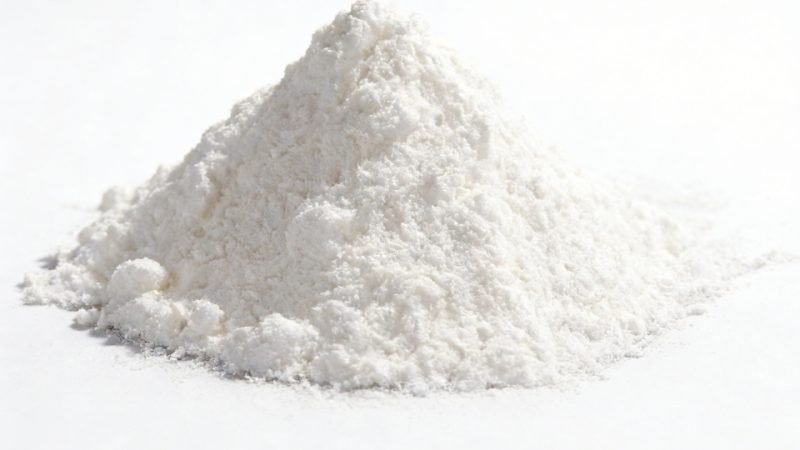
What makes it useful is also what makes people question it. The name sounds like sand or glass, yet the food-grade material used in powders is typically amorphous silicon dioxide, often supplied as an agglomerated powder in the rough 5 to 50 micrometer range. The real answer sits between chemistry, plant handling, and procurement paperwork.
How silicon dioxide keeps powders from clumping
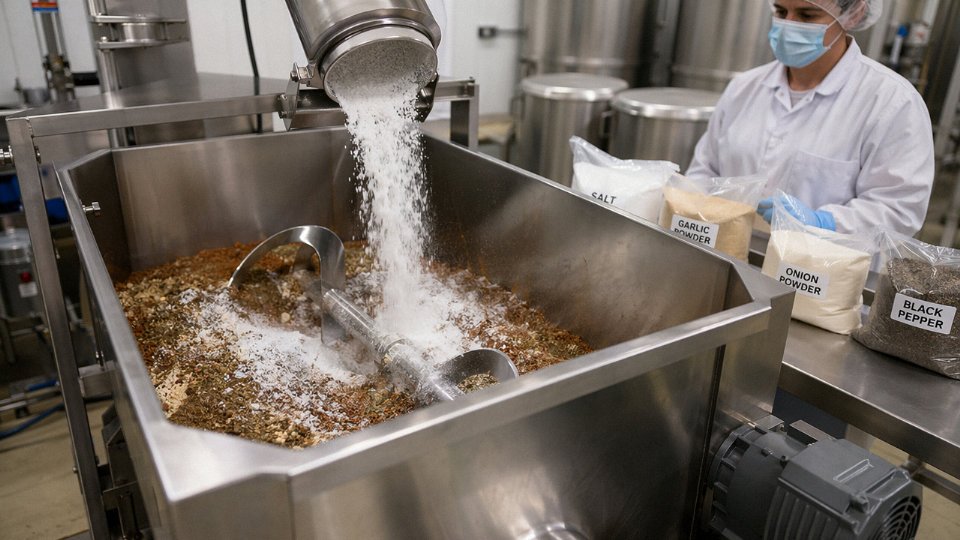
Food-grade silicon dioxide works because it is a very fine, high-surface-area powder sitting inside a much coarser dry food system. In plain plant-floor language, it gives stray moisture somewhere less damaging to go, and it keeps larger particles from welding themselves together in the bag, tote, hopper, or consumer shaker.
Most dry powders are not truly dry. Salt, spice blends, powdered cheese, drink mixes, seasoning carriers, and spray-dried flavors all carry some surface moisture, and they pick up more during humid handling. A few hours with a torn liner in a warm warehouse can be enough. Once a thin water film forms between particles, it creates capillary bridges. Those bridges pull particles together. With time, pressure, and temperature cycling, the weak wet bridges can turn into harder solid bridges as dissolved material recrystallizes. That is how a free-flowing powder becomes a lump that needs a mallet, a screen, or a rejected batch ticket.
Silicon dioxide interrupts that sequence early.
Adsorption, not absorption
The useful word here is adsorption. Moisture adheres to the surface of the silicon dioxide particles. It is not being soaked deep into the material like water into a sponge; that would be absorption. This distinction matters because the anticaking effect depends on surface area, not bulk capacity.
Food-grade amorphous silicon dioxide is commonly supplied as an agglomerated powder, often roughly 5 to 50 micrometers in effective particle size, depending on grade, milling, handling, and test method. Those agglomerates are built from much smaller silica structures, giving the material a large available surface. That surface can tie up small amounts of surface moisture before the water forms sticky liquid bridges between food particles.
Do not picture silicon dioxide drying a wet powder into a perfect powder. It will not rescue a spice blend that was filled hot into a cold room, or a powdered flavor stored in a leaking supersack near a washdown area. It is an anticaking aid, not a dryer and not a process-control substitute.
Silicon dioxide prevents clumping mainly by adsorbing surface moisture and separating larger food particles, not by chemically reacting with the food.True
Food-grade amorphous silicon dioxide is used for its physical surface properties. Its anticaking action comes from moisture adsorption, particle spacing, and reduced bridge formation in dry blends.
Tiny spacers between bigger particles
The second mechanism is mechanical. Fine silica particles sit between larger particles of salt, sugar, spice, starch, flavor carrier, or powdered acid. That small separation reduces direct contact points and lowers the chance that rough surfaces lock together under vibration, pallet stacking, or feeder compression.
This is where a small dose can look surprisingly effective. Typical use levels in powdered foods are about 0.5% to 2.0% by weight, depending on the product, ingredient sensitivity, and local regulations. Many dry food applications allow silicon dioxide as an anticaking agent up to around 2%, but the actual limit depends on jurisdiction and product category, so the specification sheet and regulatory review still matter.
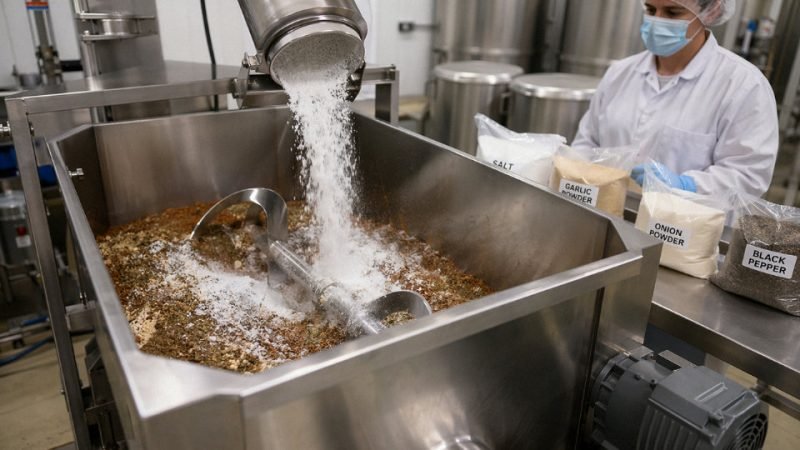
At 1% in a dry seasoning blend, silica is not “filling” the product. It is distributing across a huge number of contact points. A ribbon blender or paddle mixer can spread those fine particles over the surfaces of much larger particles, assuming the addition point and mixing time are right. Dump it in as one tight slug after the minor ingredients, and you may get a local overtreated zone and a poorly protected bulk blend. I have seen operators blame the additive when the real issue was a dead corner in the mixer or a bag added after the final mix timer had already started.
What changes in the factory
Better anticaking performance shows up in boring places, which is usually where money is saved. Powder drops through a hopper without rat-holing as often. Auger fillers hold a tighter fill-weight range because the bulk density and flow are less erratic. Volumetric cup fillers stop throwing light and heavy packages every time the humidity shifts. Screens blind less often. A consumer can pour the product instead of stabbing the container with a spoon.
Wrong mechanism, wrong control point.
If clumping is caused mostly by moisture pickup, silica can help if the package, blend temperature, and storage humidity are also under control. If the problem is fat migration in a powdered cheese blend, sugar glass transition in a drink mix, or compression caking from stacking heavy pallets too high, silicon dioxide may only reduce the symptom. It will not fix an ingredient that is still warm from grinding, a bad foil seal, or a warehouse that runs damp every rainy season.
A typical example is a seasoning line that runs well in winter, then starts bridging in the filler bowl during humid summer shifts. The formula has not changed, but the spice carriers and salt are entering the mixer with slightly higher surface moisture. A controlled silicon dioxide addition, often somewhere in the lower end of the allowed range, can restore flow. Pair that with sealed ingredient staging and shorter open-bin time, and the improvement is usually much more stable than just increasing the additive dose.
The practical target is not “dry as possible.” It is controlled surface condition, predictable flow, and enough separation between particles that the powder survives storage, transport vibration, and the last few grams poured by the customer.
Where food manufacturers use it most often
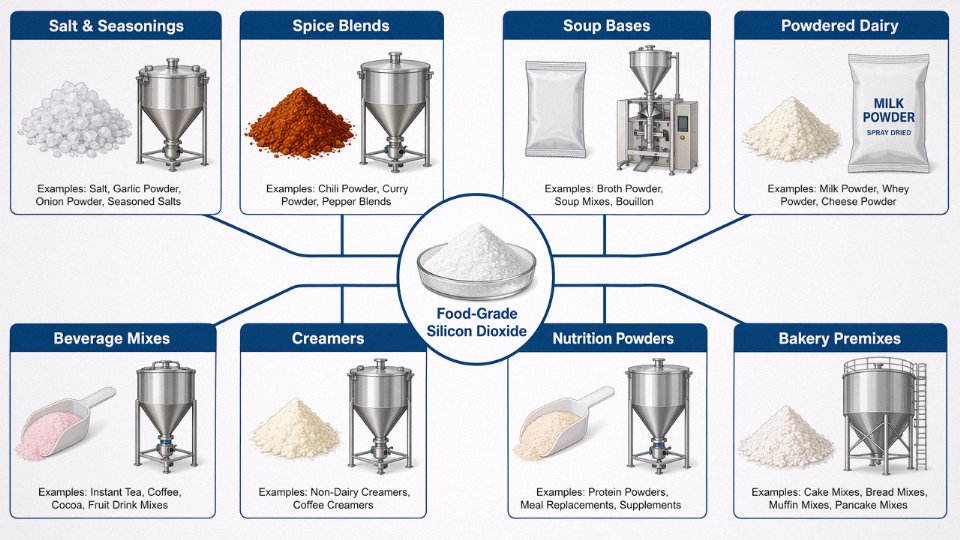
Silicon dioxide earns its keep in dry plants, not wet kitchens. You see it where powder has to move through a hopper, fill a sachet, discharge from a bulk bag, or stay usable after a consumer opens the jar and leaves it beside a steaming cooktop. In most dry food work, use levels sit around 0.5% to 2.0% by weight, depending on the food, the particle size distribution, moisture pickup, labeling rules, and the jurisdiction. Many applications allow anticaking agents up to about 2%, but nobody should buy against that number without checking the actual product category and local regulation.
Salt and salt-based seasonings
Salt is one of the classic applications because it is brutally sensitive to humidity. Sodium chloride crystals can pick up surface moisture, dissolve slightly at contact points, then recrystallize as the air dries. That creates hard bridges between crystals. Anyone who has opened a pallet of bagged salt after a humid weekend knows the result: corners turn into bricks, augers start surging, and the operator reaches for a rubber mallet. Not a great process control strategy.
Retail table salt, seasoning salt, popcorn salt, snack dusting blends, curing mixes, and industrial salt used in bakery or prepared-food plants often need anticaking support. The need depends on crystal size, storage time, packaging barrier, local climate, and whether the salt is blended with hygroscopic ingredients such as dextrose, citric acid, phosphates, or hydrolyzed vegetable protein. Fine salt is usually worse than coarse salt because it has more surface area and tighter packing.
A typical scenario: a seasoning line runs well in winter, then starts throwing checkweigher rejects in July. The formulation did not change. The plant air did. If the salt blend starts rat-holing in the filler hopper, the first symptom is often variable fill weight, not a quality complaint.
Spice blends, rubs, sauce powders, and soup bases
Spice systems are messy powders. Paprika, garlic powder, onion powder, chili, black pepper, celery powder, dried herbs, yeast extract, tomato powder, starches, maltodextrin, sugar, salt, and flavors all behave differently in the same bin. Some are oily. Some are fibrous. Some are extremely fine. Some absorb moisture quickly, then smear on stainless steel like paste.
Dry rubs, taco seasoning, instant gravy mixes, sauce powders, bouillon powders, soup bases, ramen seasoning sachets, and snack coatings can have severe flow trouble because the ingredients do not segregate or cake in the same way. Oil-rich spices tend to form soft lumps first. Hygroscopic carriers pull in water. Fine particles fill voids between larger crystals and make the blend pack tighter during vibration. A truck ride can turn a free-flowing powder into a compacted block if the formula is marginal.
Silicon dioxide is often used here to protect flow through ribbon blenders, tote dischargers, screw feeders, cup fillers, and vertical form-fill-seal machines. The practical target is not “perfectly dry.” It is predictable movement. Right formulation: stable bulk density, cleaner cut-off at the filler, fewer hopper pokes. Wrong formulation: bridging, overfills, underfills, dusty cleanup, and operators quietly changing machine settings every hour to chase the problem.
Powdered dairy, beverages, creamers, and nutrition products
Powdered cheese, cheese sauce bases, whey blends, milk powders, cocoa mixes, powdered beverage bases, coffee creamers, protein powders, meal replacements, and vitamin-mineral premixes are another major zone. The concern is partly plant handling and partly consumer use. A powder that will not discharge from a bulk bag is a production problem. A powder that turns into chunks after two weeks in a kitchen cabinet is a repeat-purchase problem.
Dairy and cheese powders can be sticky because of fat, lactose, proteins, and fine particles. Cocoa mixes bring sugar, cocoa, emulsifiers, and sometimes milk solids into the same flow puzzle. Coffee creamers and nutritional powders often include fats or spray-dried components that behave well when fresh but compact under warm storage. In practice, packaging matters as much as the anticaking system. A good barrier pouch with a tight seal may need less help than a paper canister used in a humid market.
Food-grade amorphous silicon dioxide is commonly supplied as an agglomerated powder, roughly 5 to 50 micrometers in apparent particle size depending on grade and measurement method. That range matters because very fine material can improve flow but may increase dusting, feeder loss, or housekeeping burden. Procurement should not approve a substitute on price alone. Ask for flow data, bulk density, loss-on-drying, heavy metal limits, allergen statements, and regulatory documentation for the target countries.
Bakery premixes, sugar blends, and processing aids
Bakery plants use many dry blends that need to meter consistently: cake mixes, pancake mixes, dough conditioners, icing sugar blends, flour treatment systems, dry yeast nutrient blends, enzyme carriers, leavening systems, starch blends, and powdered processing aids. Silicon dioxide may be used in some of these, subject to the exact country, standard of identity, and ingredient function. Flour, for example, can be tightly regulated in some markets, while a dry premix may fall under a different rule set.
Sugar blends create their own headaches. Fine sugar, brown sugar flavors, acids, starches, gums, and powdered colors can cake during storage, especially if the plant has poor humidity control or the bags sit against an exterior wall in winter and see condensation cycles. I have seen more trouble from bad warehouse practice than from bad formulation: torn liners, pallets parked near washdown doors, partial bags folded over with no clip, that kind of ordinary damage.
Where it is usually not useful
Silicon dioxide is mainly a dry-product tool. It has far less value in beverages, sauces, dressings, fresh foods, refrigerated prepared meals, and other high-moisture systems because powder flow is not the main failure mode there. Once the product is liquid or wet, the question shifts to dispersion, suspension, emulsion stability, mouthfeel, or microbial control. Different toolbox.
Silicon dioxide in food is used most often in dry or low-moisture products where caking, bridging, and poor powder flow create handling or consumer-use problems.True
Its main food function is anticaking and flow improvement. That function is most relevant in powders such as salt, seasoning blends, beverage mixes, dairy powders, bakery premixes, and similar low-moisture systems.
What food-grade silicon dioxide is made from
Silicon dioxide is a simple compound on paper: silicon and oxygen, written as SiO2. In the real world, it shows up everywhere. Quartz is silicon dioxide. So is much of ordinary sand. It is present in many minerals, and small amounts occur naturally in plants because grasses, grains, and some vegetables take up silicon from soil and water.
That does not mean food plants are scooping beach sand into seasoning blends. Food-grade silicon dioxide is manufactured, purified, tested, and sold against additive specifications. The buyer is not just purchasing a chemical formula; they are buying a controlled powder with known purity, moisture behavior, particle structure, and contaminant limits. That distinction matters on a production line. Random mineral silica would bring variable grit, color, metals, and microbiological baggage. A qualified food additive grade is made to behave predictably in a ribbon blender, a tote, a loss-in-weight feeder, and eventually in the consumer’s jar.
Amorphous silica is not the same as crystalline silica
The word “silica” causes confusion because it covers different physical structures. Crystalline silica has an ordered crystal structure. Quartz is the familiar example. Respirable crystalline silica is the material behind serious occupational lung hazards in mining, stone cutting, concrete drilling, foundry work, abrasive blasting, and similar jobs where hard minerals are fractured into fine airborne dust.
Food-grade anticaking silicon dioxide is generally amorphous silica. “Amorphous” means the atoms are not arranged in that same long-range crystal pattern. It is still SiO2, but the structure, particle formation, and exposure scenario are different.
That difference is not just regulatory language. In a fabrication shop, a dry saw cutting engineered stone can generate respirable crystalline silica that reaches deep into the lungs if controls are poor. In a food plant, silicon dioxide is usually handled as a manufactured amorphous powder dosed at low percentages into dry ingredients. Typical use levels in powdered foods run around 0.5% to 2.0% by weight, depending on the product, local rules, and how severe the caking problem is. Many jurisdictions permit it as an anticaking agent up to about 2% in specific dry food applications, but the allowed level still depends on product category and the applicable standard.
Food-grade anticaking silicon dioxide is the same hazard as respirable crystalline silica from stone cutting.False
Food-grade anticaking grades are generally amorphous silicon dioxide and are used under food additive specifications. Respirable crystalline silica hazards usually come from industrial mineral dust exposure, such as cutting, grinding, mining, or blasting crystalline materials. Powder handling in food factories still needs dust control, but the risk scenario is not the same.
Common manufactured forms used around food
Food-grade silicon dioxide can be supplied in several forms. The names sound similar, but they do not behave exactly the same in a plant.
Precipitated silica is made through a wet chemical process, usually from sodium silicate and acid, then washed, filtered, dried, and milled or classified. It is common where processors want good anticaking performance and controlled absorbency without turning the blend into a fluffy nuisance.
Silica gel is also amorphous silicon dioxide, but with a porous structure that makes it useful for moisture adsorption. Most people know it from desiccant packets, though food-related applications depend on the grade and intended contact. In ingredient systems, the key issue is whether the material is approved for that use, not just whether it is chemically “silica.”
Fumed silica is made by flame hydrolysis and has very fine primary particles that form light, branched aggregates. It can be highly effective at changing flow and anti-settling behavior, but it is dusty and can be awkward to feed if the system is not designed for it. Anyone who has opened a bag of very light fumed silica near a drafty mezzanine remembers the lesson. It goes everywhere.
For food-grade amorphous silicon dioxide sold as an anticaking agent, the agglomerated powder particle size is often roughly 5 to 50 micrometers, depending on grade, production method, and how it is measured. That range is not a universal purchase spec. Buyers should look at bulk density, oil absorption or moisture adsorption, sieve residue, flow testing, and the supplier’s certificate of analysis. A material that looks acceptable on a lab bench may bridge in a small hopper or over-fluidize in a pneumatic conveying line.
What food additive specifications actually control
Food additive specifications are the boring paperwork that prevent expensive surprises. They normally define identity first: the material must be silicon dioxide of the permitted type, with required assay or composition checks. Then come purity-related tests such as loss on drying, loss on ignition, pH, soluble salts, and sometimes limits for substances soluble under specified conditions.
Contaminants are a major part of qualification. Depending on the standard and jurisdiction, specifications may set limits for arsenic, lead, mercury, cadmium, or related heavy metals. The exact limits are not identical everywhere, so procurement should not approve a grade based only on a sales sheet that says “food grade.” Ask for the current specification basis, certificate of analysis, allergen statement if needed, country compliance statement, and change-control commitment. For imported material, I also like to see packaging photos and pallet configuration before the first shipment. Torn multiwall bags and humid containers can ruin a technically compliant powder before it reaches receiving.
Safe in food use does not mean careless in the factory
For consumers eating a finished dry mix, food-grade amorphous silicon dioxide is not the same exposure as workers breathing mineral dust in a quarry or stone shop. That reassurance is fair.
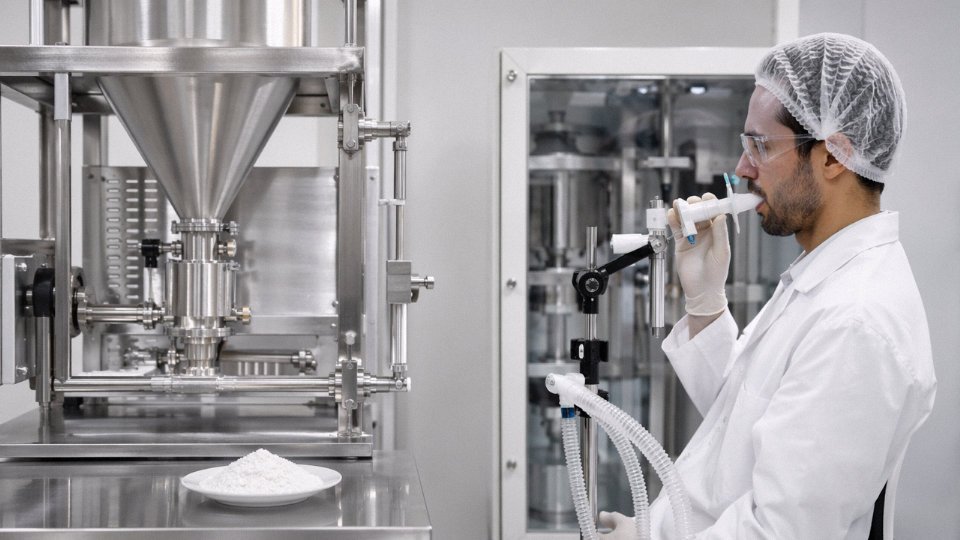
On the plant floor, though, powder is still powder. Charging bags into an open blender, dumping into a surge hopper, or cleaning a spill with compressed air can create visible airborne dust. The correct controls are ordinary but often neglected: local exhaust at dump stations, closed transfer where practical, grounded equipment if dust conditions warrant it, cleanable surfaces, suitable respirators during high-dust maintenance tasks, and vacuum cleaning instead of blow-down. Check the safety data sheet, but do not stop there; watch the actual task. A 20-minute bag dump during winter, when indoor air is dry and operators are rushing a batch changeover, can look very different from the tidy supplier brochure.
Right material, right specification, right handling. Miss any one of those, and the problem usually shows up as caked raw material, dusty work areas, inconsistent dosing, rejected product, or a maintenance crew blaming the feeder when the powder spec was the real issue.
How much silicon dioxide is typically added
Food-grade silicon dioxide is normally used in small percentages, not scooped in like a filler. In many dry food applications, the working range is roughly 0.5% to 2.0% by weight, with a lot of products sitting well below the top end once the formula and packaging are sorted out. The exact number depends on the powder, the plant, and the rules in the market where the product is sold.
A common regulatory ceiling for anticaking use is up to about 2% in many dry food categories, but that should not be read as a target. In practice, product developers usually aim for the lowest level that keeps the product flowing and saleable through its intended shelf life. That is both a technical discipline and a regulatory expectation under good manufacturing practice: use only what is needed to get the intended anticaking effect.
Silicon dioxide is typically added to dry foods at low levels, often below 2% by weight.True
Many food regulations permit silicon dioxide as an anticaking agent up to around 2% in certain dry food applications, though the allowed level depends on jurisdiction and product category. Commercial formulas often use less when flow, shelf life, and packaging performance are acceptable.
Why the amount is not one-size-fits-all
Two powders can look similar in a lab jar and behave completely differently in a filling room at 6 a.m. in August.
The main drivers are moisture sensitivity, particle size distribution, fat content, soluble solids, storage time, and how the product is packed. A fine, hygroscopic seasoning powder with sugar, salt, dairy solids, and chili fines may need more anticaking support than a coarse salt crystal blend. A dry beverage base with very fine particles can bridge in a hopper even when it is not visibly wet. Cheese powders are their own headache because fat, protein, and moisture history all affect flow. Some lots run beautifully. Some smear, lump, or cling to stainless steel like they have a personal grudge against the packaging operator.
Food-grade amorphous silicon dioxide is often supplied as an agglomerated powder, commonly in the rough 5 to 50 micrometer range depending on grade and supplier. That particle structure matters. A grade that disperses well through a spice blend may not be the best grade for a dense mineral mix or a fluffy dairy powder. The same percentage can give different results if the silicon dioxide does not distribute evenly during blending.
Packaging also changes the answer. A product in a tight laminate pouch with a good moisture barrier may need less help than the same product in a paperboard carton with an inner liner that sees humid warehouse air for months. Shelf life target matters too. Designing for 45 days in a controlled warehouse is not the same as designing for 12 months through mixed distribution, warm trucks, and a retailer’s back room.
What happens if the level is wrong
Too little silicon dioxide, and the plant sees it first. Hoppers rat-hole. Auger fillers surge. Checkweighers start chasing variation. Operators thump bins with rubber mallets, which is a maintenance habit that usually means the process has already lost the argument.
On the customer side, low use can show up as hard clumps, poor spoonability, uneven seasoning distribution, or a packet that pours once and then turns into a brick after a humid week in the kitchen.
Too much is not harmless either. Excess silicon dioxide can make powders dusty, dull the appearance, change mouthfeel, reduce bulk density, or make a seasoning look pale and dry. In some fine powders it can create a slightly gritty or drying sensation, especially if the base product is already lean or mineral-heavy. It also costs money. Not always a lot per unit, but in a high-volume line even a few tenths of a percent can become real procurement spend over a year. Then there is label perception. Some customers accept anticaking agents without blinking; others do not. No factory owner wants to defend an ingredient level that was never technically needed.
How developers find the working level
The sensible way is to bracket the dose. A developer might test 0.25%, 0.5%, 1.0%, and 1.5%, then narrow the range after the first round. The exact steps vary, but the better programs look beyond a pretty benchtop sample.
Typical checks include:
- Flow testing, often with shear cells or simpler comparative rigs, to see how the powder behaves under consolidation.
- Angle of repose measurements, useful as a quick screen, though I would not rely on that alone for a sticky dairy or spice system.
- Moisture exposure studies, where samples are held at controlled humidity and checked for lumping, caking strength, and pourability.
- Shelf life trials, because a powder that flows after 48 hours may fail after six months in a warm warehouse.
- Hopper and chute observation, preferably on the actual line or a close pilot setup.
- Packaging line performance, including fill-weight variation, dust at the jaws, seal contamination, and cleanup burden.
A small trial can be misleading if the blend order is wrong. In plant work, silicon dioxide often performs best when it is pre-blended with the troublesome fine or hygroscopic fraction before the full batch is completed. Dumping it late into a large ribbon blender and hoping for perfect distribution is asking a lot, especially with short blend times or worn paddles.
Typical direction by product type
| Product type | Usual anticaking need | What drives the level |
|---|---|---|
| Coarse salt or sugar granules | Lower | Large particles, lower surface area, faster drainage through hoppers |
| Fine salt blends | Moderate | Fines content, humidity exposure, packaging moisture barrier |
| Spice and seasoning mixes | Moderate to higher | Fine particles, oils, color impact, uneven raw material moisture |
| Cheese powders | Moderate to higher | Fat, protein, dairy solids, warm storage, smear risk |
| Dry beverage or soup powders | Variable | Hygroscopic ingredients, bulk density target, consumer mouthfeel |
The right amount is the one that keeps the powder moving, protects the consumer experience, stays inside the legal limit, and does not create a new problem somewhere else. That sounds simple. On a live line with humid air, a tired auger filler, and a purchasing team changing suppliers to save a few cents per kilo, it takes real testing.
Is silicon dioxide safe to eat?
For normal food use, food-grade silicon dioxide has been reviewed by major food safety authorities and is widely permitted as an anticaking additive when it meets the right purity specifications and is used within approved conditions. In practical terms, that means a manufacturer is not supposed to buy any white silica powder from an industrial supplier and tip it into seasoning mix. The material has to match food additive requirements for identity, heavy metals, loss on drying, particle characteristics, and other limits set by the relevant market.
In the United States, silicon dioxide is permitted for specified food uses under FDA rules. In Europe, it is authorized as food additive E551, with conditions tied to product category and specification. International bodies such as JECFA have also evaluated silicon dioxide and related silicates. The wording and permitted levels vary by jurisdiction, which is why a procurement team selling into several markets should not rely on a supplier brochure alone. Check the regulation, the product category, and the certificate of analysis. I have seen plants get this wrong during “equivalent material” substitutions, usually because purchasing matched the name but not the grade.
What happens after you eat it
Amorphous silicon dioxide is poorly soluble in water and in the gastrointestinal tract. It is not a carbohydrate, fat, or protein. Your body does not burn it for energy, and it is not added as a nutrient in the way calcium carbonate or iron salts might be.
Much of the ingested material is expected to pass through the digestive system with limited absorption. Some silicon-containing species can appear in biological fluids after oral exposure, but that does not mean the whole powder is being taken up as intact particles in large amounts. Dose, particle structure, surface chemistry, solubility, and the food matrix all affect what happens. A silica used in a dry soup base, for example, is not behaving exactly like a dissolved mineral salt in a drink.
From a plant-floor point of view, the safety control is boring but serious: buy the right grade, keep the lot traceable, prevent cross-contamination, and stay inside the approved use level. Boring controls are the ones that keep recalls off the calendar.
Eating food-grade amorphous silicon dioxide in approved food uses is the same risk as breathing crystalline silica dust in a factory.False
Oral exposure to food-grade amorphous silicon dioxide is evaluated separately from inhalation exposure to respirable crystalline silica. The route of exposure, particle form, dose, and target organs are different.
Eating it is not the same as breathing silica dust
This is where a lot of public confusion comes from. The word “silica” gets used in very different settings.
Food-grade silicon dioxide used as an anticaking agent is typically amorphous, not crystalline quartz dust. The well-known occupational hazard is respirable crystalline silica, the fine dust generated from cutting, grinding, blasting, or handling certain mineral materials. That hazard is mainly about inhalation into the lungs, where small crystalline particles can cause serious long-term disease after sufficient exposure.
Eating a small amount of approved food-grade amorphous silicon dioxide in a dry powder is a different exposure route and a different material profile. That said, dry silica powders can still be dusty during manufacturing. A blending operator dumping bags into a ribbon blender or a loss-in-weight feeder can create airborne nuisance dust if the system is poorly enclosed. In a decent plant, you handle that with local extraction, sealed transfer, dust masks or respirators where the risk assessment calls for them, and housekeeping that does not involve blowing powder around with compressed air. Never do that. It just moves the problem into someone’s breathing zone.
What about nanoparticles?
This concern deserves a straight answer, not a shrug. Some food-grade silica products are made from very small primary particles. Those primary particles can aggregate or agglomerate into larger structures, and the powder sold to food plants is often described by an agglomerated particle size, commonly in the rough range of several to several dozen micrometers depending on the grade and test method. The material can still contain fine fractions.
Regulators look at more than the ingredient name. They review particle characteristics, purity, toxicology data, expected exposure, and how the additive is used. Analytical method matters here. A laser diffraction result, an electron microscopy image, and a surface area test can tell different parts of the same story. If a supplier changes from one silica grade to another, especially from precipitated silica to fumed silica or to a treated grade, I would want technical approval before purchasing celebrates a lower price.
For consumers, the realistic takeaway is this: approved food uses are not treated by regulators as an open-ended permission to add any silica material at any particle size. The specifications and exposure estimates matter.
Who should ask extra questions
Silicon dioxide is not considered a common food allergen. It is not in the same category as milk, egg, peanut, tree nuts, wheat, soy, fish, shellfish, sesame, or similar regulated allergens. Most people will encounter it only in small amounts from dry foods, tablets, capsules, or powdered mixes.
Still, individual situations can be different. People with specific gastrointestinal conditions, kidney issues, complex supplement routines, unusual sensitivities, or medical instructions to avoid certain excipients should ask a qualified health professional. The same goes for workers who handle silica powders on the job and are worried about inhalation exposure; that question belongs with occupational health, not a food label FAQ.
For factory owners and procurement managers, the safe position is simple: use food-grade material from a qualified supplier, verify the specification against the market you sell into, control dust during handling, and document the dose. Get those four things right and silicon dioxide is usually one of the less dramatic ingredients in the plant. Get casual with grade substitutions or dusty manual handling, and the risk shifts from the consumer’s spoon to your own production floor.
Why removing silicon dioxide can make food quality worse
A cleaner-looking label can be a worse-performing product. I have seen this on the plant floor with dry blends that looked fine in the lab, then behaved badly after six weeks in a humid warehouse or after a pallet sat near a dock door through summer.
Silicon dioxide is not usually there for marketing. It is there because powders are difficult materials. Salt, spice blends, drink powders, grated cheese toppings, soup bases, and vitamin mixes all pick up moisture at different rates. Once that moisture starts making tiny liquid bridges between particles, the product stops acting like a free-flowing powder and starts acting like damp beach sand.
What the consumer sees first
Removing an anticaking agent can show up as small annoyances, then as real quality failures.
Salt hardens into a block. Seasoning comes out in lumps, then suddenly dumps half the jar onto the food. Powder sticks in sachet corners and does not empty cleanly. A drink mix floats, clumps, and leaves dry cores after stirring. A scoop of protein or meal powder may weigh differently from one use to the next because the bulk density has changed in storage.
Uneven flavor distribution is one of the nastier issues. In a seasoning blend, fine garlic powder, salt, sugar, acid powder, and color particles do not all move the same way. If the blend cakes, breaks, and re-cakes during transport, the consumer may get one spoonful that is too salty and another that tastes flat. The formula did not change. The physical handling did.
Removing silicon dioxide from a dry food can reduce label complexity, but it does not automatically improve product quality.True
If no equivalent flow-control or moisture-control system replaces it, the product may cake, segregate, dissolve poorly, or dose inconsistently before the end of shelf life.
What the factory sees before the complaint arrives
On a packing line, poor powder flow is not a philosophical problem. It stops equipment.
An auger filler needs a fairly consistent bulk density and flow into the hopper. If the powder bridges, the screw turns but feed rate drops. Net weights wander. Operators tap hoppers with rubber mallets, which is common but not a process control strategy. On vertical form-fill-seal machines, sticky powder can hang in the forming tube, dust during the drop, or smear into seal areas. That causes leakers, rework, and sometimes a full sanitation break if allergen or flavor changeover rules are tight.
Dust bursts can also get worse. A powder that does not flow steadily often discharges in slugs: nothing, nothing, then a sudden collapse. That puff can foul photoeyes, contaminate seal jaws, and make the room harder to keep clean. In plants that handle sugar, dairy powders, starches, or fine spice dust, housekeeping is not cosmetic. It is part of safety and yield.
Segregation is another hidden cost. Coarser particles roll, fines cling, dense minerals settle. If the blend no longer flows uniformly through bins, totes, and filler hoppers, the first cases off the line may not match the last cases. The lab can approve the batch, yet the packed units still vary.
Packaging can make or break the decision
A product packed in a high-barrier laminate pouch with a tight zipper behaves differently from the same powder in a paperboard carton with an inner bag that gets folded over by hand. Humid climates punish weak packaging. So do long distribution chains, ocean freight, warehouse temperature swings, and opened containers in home kitchens.
Paperboard can buffer moisture, but it is not a moisture barrier in the way a foil laminate is. A jar opened daily above a stove is a different environment from a sealed pouch in a cool pantry. Large foodservice tubs see repeated exposure: lid off, scoop in, lid half-closed, repeat. If the procurement team removes silicon dioxide but keeps the same package, the risk has not disappeared. It has just moved downstream.
Ways brands avoid it, and what they give up
Some brands do avoid silicon dioxide successfully. They may use better moisture-barrier packaging, desiccant sachets, coarser granulation, alternative anticaking agents, oil encapsulation for flavors, or a shorter shelf life. Those are valid engineering choices.
They are not free.
A high-barrier pouch may add material cost and complicate recycling claims. Desiccants need controls so they do not end up loose in the product stream. Coarser particles may dissolve slower or change mouthfeel. Oil encapsulation can protect flavors but may affect dispersion in cold water. Shorter shelf life helps quality, yet it increases inventory pressure and write-off risk for distributors.
A rough decision view looks like this:
| Choice | Likely benefit | Common trade-off |
|---|---|---|
| Keep silicon dioxide | Better flow, dosing, and shelf-life robustness | Longer ingredient list |
| Upgrade packaging | Less moisture pickup | Higher pack cost, sourcing complexity |
| Use coarser particles | Less caking tendency | Slower dissolution, texture change |
| Shorten shelf life | Lower risk of late-life caking | More waste if sales are uneven |
The practical question is not “additive or no additive.” It is whether the product remains usable through the stated shelf life, in the package actually sold, through the climate and handling it will actually face. A small amount of anticaking agent can prevent scrap, customer returns, overweight giveaway, underweight risk, and a surprising amount of operator frustration.
That may not look as clean on a label. It can be cleaner in the factory and more reliable in the customer’s kitchen.
How silicon dioxide compares with other anticaking agents
Food plants do not choose anticaking agents from a catalog by chemistry alone. They choose them after a powder has bridged in a tote, blinded a screen, caked in a humid warehouse, or failed to dose cleanly into a pouching machine at 2 a.m. The right choice depends on the base powder, the label target, the country of sale, and how the material behaves after six months in a real distribution chain.
Silicon dioxide is popular because it is efficient at low addition rates, usually has little to no taste impact, stays white, and works well in fine powders where surface moisture is the main enemy. Food-grade amorphous silicon dioxide is commonly handled as an agglomerated powder in the rough 5 to 50 micrometer range, though the exact behavior depends on grade, bulk density, and how aggressively it is mixed. In many dry foods it is permitted up to about 2% by weight, subject to local rules and product category, but most formulators use less if the flow test passes. Nobody wants to pay for extra additive that adds no measurable benefit.
Practical comparison of common anticaking options
| Additive | Main function | Typical applications | Strengths | Limitations | Label considerations |
|---|---|---|---|---|---|
| Silicon dioxide | Moisture adsorption and particle separation | Seasoning blends, powdered drink mixes, instant soup bases, spice mixes, grated cheese powders, dry premixes | Strong performance at low dose, neutral flavor, white color, broad compatibility with fine powders | Can be dusty; overuse may make some blends feel dry or slightly harsh | Often declared as silicon dioxide or anticaking agent; acceptance depends on market and product rules |
| Calcium silicate | Moisture uptake and flow improvement | Salt, baking powder-type blends, seasoning powders, dry mixes | Good moisture capacity, useful in hygroscopic powders, mineral-based | Can influence calcium content; may affect texture in delicate powders | May suit products where calcium contribution is acceptable |
| Magnesium carbonate | Moisture control and bulking flow aid | Salt blends, powdered ingredients, some dry mixes | Mild alkalinity can help in certain systems; useful where magnesium is not a problem | Not neutral in all formulas; can affect pH-sensitive flavors or colors | Mineral declaration may be relevant depending on dosage and market |
| Tricalcium phosphate | Anticaking plus calcium/phosphate contribution | Powdered beverages, nutritional powders, salt, baking mixes | Useful when calcium or phosphate functionality is welcome; good white color | Phosphate labeling can be a drawback; may not match “simple label” targets | Often chosen when mineral fortification or phosphate function has value |
| Sodium aluminosilicate, where permitted | Flow aid and anticaking | Salt, powdered mixes, seasoning systems in some jurisdictions | Effective in difficult flow systems; robust performance | Regulatory acceptance varies; aluminum-related perception can be poor | Needs careful market review before global use |
| Rice hull concentrate | Physical flow aid, moisture buffering | Natural-positioned seasonings, organic-style dry blends, bakery premixes | Attractive for some “plant-based” or natural label strategies; can reduce reliance on synthetic-sounding names | Often requires higher dose; may add beige specks or slight cereal notes; performance varies by supplier | May help with cleaner label goals, but certification must be verified |
| Starches and maltodextrins | Carrier, dilution, moisture management | Flavors, spray-dried ingredients, seasoning bases | Familiar label, easy to source, can carry oils and flavors | Adds carbohydrate load; can feed clumping if humidity is high; not as efficient as mineral flow aids | Often consumer-friendly, but not always technically strong enough |
| Specialty flow aids and fibers | Flow improvement, carrier support | Premium seasoning, nutrition, and bakery systems | Can be tailored for label or processing goals | Cost, supply consistency, and sensory impact can be limiting | Depends heavily on certification and declared name |
Why silicon dioxide often wins the plant trial
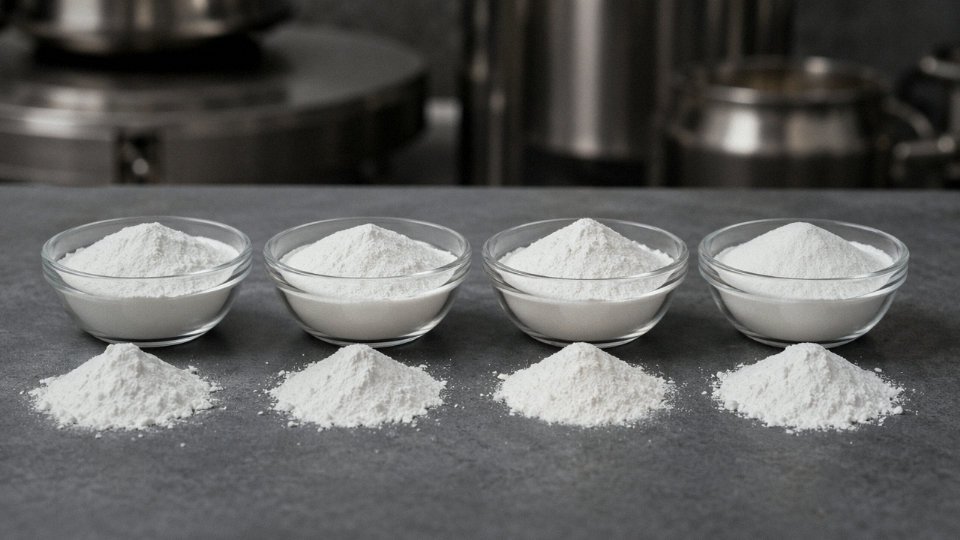
In a fine, oily seasoning powder, silicon dioxide usually earns its keep fast. It can sit between small particles, adsorb surface moisture, and reduce the sticky contact points that make powder arch over a hopper throat. That matters on vertical form-fill-seal lines, auger fillers, and loss-in-weight feeders. A blend that flows for the first 20 minutes but packs into a hard cone by lunch is not acceptable production behavior.
The neutral sensory profile is another reason buyers like it. Calcium silicate and tricalcium phosphate are also white and generally mild, but they bring mineral identity with them. Magnesium carbonate can shift pH in some systems. Starches can dilute flavor intensity. Rice hull materials may be fine in a savory spice blend, yet look dirty in a white beverage powder. I have seen operators reject technically functional blends because the powder picked up a gray cast under plant lighting. It sounds fussy until the customer opens the pouch.
Dustiness deserves a real mention. Silicon dioxide grades can be dusty, especially during bag dumping or high-speed blending. That is a housekeeping, exposure-control, and yield issue, not just an annoyance. Plants using open ribbon blenders may prefer a less dusty grade, a preblend, or a different flow aid if operators are fighting clouds at every charge. Local exhaust and sensible handling beat pretending the problem is not there.
Silicon dioxide is always the best anticaking agent for dry foods.False
It is often highly effective, especially in fine powders, but alternatives may be better for organic certification, mineral positioning, phosphate functionality, lower dust handling, or specific label strategies.
Where alternatives make more sense
A nutritional powder may choose tricalcium phosphate because calcium and phosphate already fit the formula story. A natural-positioned seasoning might use rice hull concentrate if the customer rejects silicon dioxide on the label, accepting a higher use level and slightly weaker flow. Salt blends may use calcium silicate because it handles moisture well and has a long history in that category. In some markets, sodium aluminosilicate may work technically but fail the regulatory or consumer-perception review. That is a procurement trap: cheap and available does not mean sellable.
Cost comparisons are rarely clean. Silicon dioxide may cost more per kilogram than starch or some mineral alternatives, but the working dose can be much lower, often around the lower end of typical anticaking ranges if the powder is cooperative. Rice hull concentrate or starch may look cheaper on a purchase order and still raise formula cost if the plant needs several times more, loses flavor strength, or sees more rejected bags from poor flow.
The best selection process is not romantic. Run bench moisture exposure, then a pilot blend, then a short production trial. Check flow after storage, not just right after mixing. Watch the filler amps, bag weight variation, screen blinding, dust collector load, and whether the last third of the tote behaves like the first third. That is where the real winner shows up.
What labels and regulations tell you about silicon dioxide
A food label will usually name silicon dioxide when it is still serving a technical function in the finished food, typically as an anticaking agent in a dry mix, seasoning, tablet, or powder. The exact wording depends on the market. One country may require the additive name. Another may allow a class name plus a specific identifier. A private-label customer may have its own style guide layered on top of the legal rule, which is where procurement and QA teams start losing afternoons to artwork approvals.
You may see several terms that point to the same general food-additive family:
- Silicon dioxide
- Silica
- Amorphous silica
- E551, used in regulatory systems where approved food additives are identified by E numbers
An E number is not a warning code. It is an identification system. E551 means silicon dioxide has been assessed and approved for specified food uses under that system. That does not mean every silica material from every supplier can go into every food at any level. The grade matters. The application matters. The jurisdiction matters.
Approval is not unlimited permission
Regulations usually work by combining several controls: additive identity, purity requirements, food category, maximum permitted level where one is set, and good manufacturing practice. In many dry food applications, silicon dioxide is often permitted up to about 2% by weight, but that figure depends on the country, product type, and how the additive is being used. Some applications sit well below that, around 0.5% to 2.0% in practical plant use, because higher levels can start affecting flow, dust, mouthfeel, bulk density, or customer specifications.
That last point is easy to miss. A legal maximum is not a formulation target.
On a blending line, the target is the lowest dose that keeps the powder moving through bins, augers, sachet fillers, or retail shakers after storage and distribution. If a spice premix bridges in a hopper every humid August, production may ask for more anticaking agent. QA may push back because the label declaration changes or the customer has a tighter limit. Maintenance may blame the blender or the vibrators. Usually everyone is partly right.
If silicon dioxide is approved for a food category, a manufacturer can use any amount as long as it improves flow.False
Food additive approval is tied to identity, grade, product category, maximum permitted levels where specified, and good manufacturing practice. Manufacturers are expected to use only the amount needed for the intended technical effect.
What purchasing should check before buying it
For industrial buyers, “food grade” should not be a casual phrase in an email. It needs paperwork behind it. At minimum, I would expect a current specification sheet, certificate of analysis, allergen statement, food-contact or food-additive compliance statement, and contaminant limits. Depending on the plant and customer base, you may also need documentation for kosher, halal, non-GMO position, vegan suitability, country of origin, residual solvents, heavy metals, and certification under a recognized food safety scheme.
A decent certificate of analysis should match the lot received, not just provide a generic sales document. Typical specification points include identity, purity, moisture or loss on drying, pH range, particle size, bulk density, and limits for contaminants such as lead, arsenic, cadmium, or mercury where required. Food-grade amorphous silicon dioxide is often supplied as an agglomerated powder, roughly 5 to 50 micrometers in particle size, though the exact distribution depends on the manufacturing route and supplier grade. That particle size affects dusting, dispersion, and how well it coats host particles.
Operational warning: do not approve a substitute grade only because the chemical name is the same. I have seen “equivalent” powders change feeder behavior, create airborne dust at the bag dump station, or make a seasoning look slightly duller in the finished pack. None of that shows up in a one-line ingredient name.
Reading consumer labels without overreacting
For consumers, the presence of silicon dioxide on a label tells you one narrow thing: the manufacturer used an approved additive to manage powder flow or caking. It does not, by itself, prove the product is cheap, unsafe, or overprocessed. A high-quality grated cheese blend, instant soup, mineral supplement, or spice mix may use a small amount because the product has to survive warehouse humidity, truck vibration, and weeks in a kitchen cupboard.
The better question is context. Is the product mostly salt, sugar, flavoring, and filler? That is a nutrition and formulation issue, not a silicon dioxide issue. Is the powder loose and easy to dose after opening, with no hard lumps or oily clumps? The anticaking system is probably doing its job.
Label and purchasing interpretation at a glance
| What you see or receive | What it usually means | What to check |
|---|---|---|
| “Silicon dioxide” on an ingredient list | Named additive with a technical function in the finished food | Product category and local labeling rule |
| “E551” | Approved additive identifier in E-number systems | Whether that market permits the use in that food |
| “Silica” or “amorphous silica” | Alternate naming may be allowed or used in documentation | Confirm it is food-grade amorphous silicon dioxide |
| Supplier says “food grade” | Marketing shorthand unless documented | Specification, COA, allergen statement, contaminant limits |
| Use level near 2% | Could be legal in some dry foods, but not automatically acceptable | Jurisdiction, customer standard, sensory effect, GMP justification |
Frequently asked questions about silicon dioxide in food
Is silicon dioxide the same as sand?
Chemically, it is related. Silicon dioxide has the formula SiO2, and that same formula appears in quartz, many sands, and a long list of natural minerals.
That does not mean a food plant is tipping beach sand into seasoning powder.
Food-grade silicon dioxide is a purified, manufactured amorphous material made to meet food additive specifications. “Amorphous” matters here because the silicon and oxygen atoms are not arranged in the same hard crystalline structure found in quartz dust. The supplier controls purity, moisture, particle structure, heavy metals, microbiological limits where applicable, and how the powder behaves in a blend.
On the plant floor, the difference shows up fast. A certified food additive grade disperses evenly in salt, spice mixes, grated cheese powders, and dry soup bases. Random mineral sand would be gritty, inconsistent, likely contaminated, and useless as a fine anticaking agent. It would also be rejected by any competent quality system before it got near a mixer.
Food-grade silicon dioxide is the same thing as ordinary sand.False
It shares the same basic chemical formula as many sands and minerals, but food-grade silicon dioxide is a purified amorphous additive with controlled food specifications.
Is silicon dioxide natural or synthetic?
Both answers get used, which is why labels can be confusing.
SiO2 occurs naturally all over the earth’s crust. Plants can contain small amounts of silica, water can carry dissolved silicates, and mineral deposits are full of silicon-oxygen chemistry. For food additive use, though, manufacturers usually want something more predictable than a dug mineral. They want repeatable bulk density, controlled agglomerated particle size, low impurities, and the same flow performance lot after lot.
That is why food additive grades are commonly manufactured rather than simply mined and ground. Depending on the grade, the supplier may produce precipitated silica or fumed silica, then process it into a form suitable for dry food blending. A typical food-grade amorphous silicon dioxide powder may have agglomerates roughly in the 5 to 50 micrometer range, though the useful behavior depends on structure and surface area as much as nominal size.
From a procurement angle, I would not buy this material based on the word “natural” alone. I would ask for the specification sheet, food-grade declaration, certificate of analysis, allergen statement, country of origin if required, and confirmation that the grade is approved for the intended market and product category.
Is silicon dioxide vegan, gluten-free, or an allergen?
Silicon dioxide itself is mineral-based. It is not made from milk, egg, fish, shellfish, meat, wheat, soy, peanuts, or tree nuts in the ordinary sense. It is not a protein ingredient, so it is not treated like a typical food allergen.
For vegan and gluten-free programs, the usual answer is that pure silicon dioxide is compatible. Still, the paperwork matters. A factory making certified vegan seasoning or gluten-free drink powder should not rely on a casual verbal answer from a distributor. Get the supplier declaration and check whether the material is packed, repacked, or stored in a facility that also handles wheat-based carriers, dairy powders, or other sensitive materials.
I have seen this trip up smaller plants. The additive was fine, but the broker could not provide a current allergen or gluten statement for the repack location. That creates a label and audit problem, not a chemistry problem.
Does silicon dioxide preserve food?
Not in the way potassium sorbate, sodium benzoate, vinegar, salt, heat treatment, or low pH preserve food.
Silicon dioxide is mainly an anticaking and flow agent. Its job is to help dry particles stay separate, pour consistently, and dose properly through hoppers, augers, sachet fillers, or consumer shakers. It does not kill bacteria, yeast, or mold. It is not a substitute for water activity control, sanitary handling, sealed packaging, or shelf-life validation.
There is an indirect quality benefit, though. If a dry powder takes up moisture, it can bridge in a bin, form hard lumps in the pouch, or make a seasoning packet tear open with one solid brick inside. Moisture can also speed flavor loss, color changes, and localized spoilage risk in products that were supposed to stay dry. By helping manage surface moisture and powder flow, silicon dioxide can support dry product quality. It should not be described as a preservative unless the regulation and technical basis for that claim are very clear.
Operational warning: if a product is clumping because packaging has a poor moisture barrier or the filling room runs humid every summer, silicon dioxide may reduce symptoms but it will not fix the root cause.
Should I avoid foods with silicon dioxide?
For most people, there is no practical reason to avoid foods just because silicon dioxide appears on the label, assuming it is used in permitted food-grade form and within the rules for that product. In many dry foods, use levels are low, often well below the maximum allowed, because too much can dull flavor release, change mouthfeel, create dust, or make a blend behave oddly during filling.
Some consumers still choose to avoid it. That is a personal label preference, and fair enough. Others may be following medical advice, a strict certification standard, or a household rule about additives. In those cases, choose products that match the requirement and expect some trade-offs: more clumping, shorter open-package quality, harder dispensing, or more aggressive packaging needed to keep the powder usable.
For manufacturers and buyers, the better question is not “Can we remove it?” but “What failure are we willing to accept if we remove it?” If the answer is blocked feeder screws, overweight seasoning deposits, caked pouches, customer complaints, or extra rework after humid storage, the small amount of silicon dioxide may be the more honest engineering choice.
The practical takeaway for shoppers, formulators, and quality teams
Silicon dioxide is not put into dry foods for flavor, nutrition, or cosmetic mystery. It is there because powders and small granules are bad actors once moisture, pressure, vibration, and storage time get involved. Salt cakes. Seasoning blends bridge in hoppers. Instant drink powders form hard lumps near the pouch seam. A grated cheese topping or spice premix may run fine on Monday and then refuse to feed after a humid weekend.
That is the real reason manufacturers use food-grade silicon dioxide: it helps dry materials resist clumping and flow with less drama.
What shoppers should take from the label
For a shopper, silicon dioxide on an ingredient list usually means the product needs flow stability. It does not automatically mean the food is unsafe, overloaded with additives, or “chemically preserved.” In many products the use level is small, commonly somewhere around 0.5% to 2.0% by weight in powdered foods, depending on the food type, moisture load, particle size, packaging, shelf life target, and local rules.
A tiny amount can make the difference between a powder that pours and one that has to be attacked with a spoon handle.
Silicon dioxide on a dry food label usually indicates anticaking or flow-control use, not that the food is unsafe by default.True
Food-grade amorphous silicon dioxide is commonly used at low levels in dry products to manage moisture-related clumping and powder flow, subject to food additive regulations and product category limits.
The key phrase is food-grade amorphous silicon dioxide. That is not the same risk profile as respirable crystalline silica dust from mining, cutting stone, or construction work. Consumers are eating a regulated food additive in a finished product, not breathing industrial silica dust. Those are different exposure routes and different materials.
Still, labels are useful. If someone is trying to minimize all additives for personal reasons, the label lets them choose. Just be realistic about the trade-off: a “no anticaking agent” spice blend may clump faster, dose less evenly, or waste more product in the jar.
What formulators should control
From a formulation bench, silicon dioxide should be treated like a functional processing aid with a job to prove, not a magic dust tossed in at the end. The right grade matters. Food-grade amorphous silicon dioxide often behaves as an agglomerated powder in the rough range of 5 to 50 micrometers, but supplier grade, surface area, bulk density, and moisture adsorption behavior can change performance quite a bit.
A good trial does not just ask, “Does it look free-flowing today?” It asks what happens after transport vibration, warehouse cycling, partial pouch use, and a few weeks near the product’s moisture limit.
Practical checks I would expect on a serious project:
| Decision point | What to verify | What goes wrong if skipped |
|---|---|---|
| Minimum effective dose | Test several levels below and near the regulatory ceiling, often under 2% where permitted | Overuse adds cost, dust, and possible texture issues |
| Matrix fit | Check fat level, sugar type, salt crystal size, protein powder behavior, and hygroscopic ingredients | One blend flows; another turns pasty anyway |
| Supplier specification | Confirm food-grade status, amorphous form, particle characteristics, contaminants, allergens, and change-control process | A “same name” substitute performs differently in production |
| Process point of addition | Add where dispersion is reliable without overmixing fragile particles | Localized pockets give uneven flow and inconsistent dosing |
| Shelf-life flow testing | Run humidity exposure, vibration, and storage compression tests | Product passes first article inspection, then clumps in the field |
In practice, the minimum effective dose is often found by ugly plant trials, not neat textbook curves. A ribbon blender may disperse it well. A low-shear tote tumbler may leave streaks. A dense mineral premix may need a different mixing sequence than a light seasoning blend full of onion powder and spray-dried flavors.
What quality and procurement teams should watch
Quality teams should monitor performance, not just paperwork. Angle of repose, bulk density, sieve checks after storage, discharge time from a test funnel, sachet weight variation, and customer complaints all tell part of the story. If the line starts seeing hopper bridging, checkweigher drift, or operators “helping” flow with mallets, the anticaking system may already be failing.
Procurement has its own traps. Buying only on price can backfire fast. A lower-cost grade may carry a different bulk density, dustiness, or adsorption profile, even if the ingredient name is identical. Ask for a current specification sheet, certificate of analysis, food additive compliance statement for each sales market, lot traceability, and notification terms for process changes. If the product sells across borders, do not assume one approval covers every category everywhere.
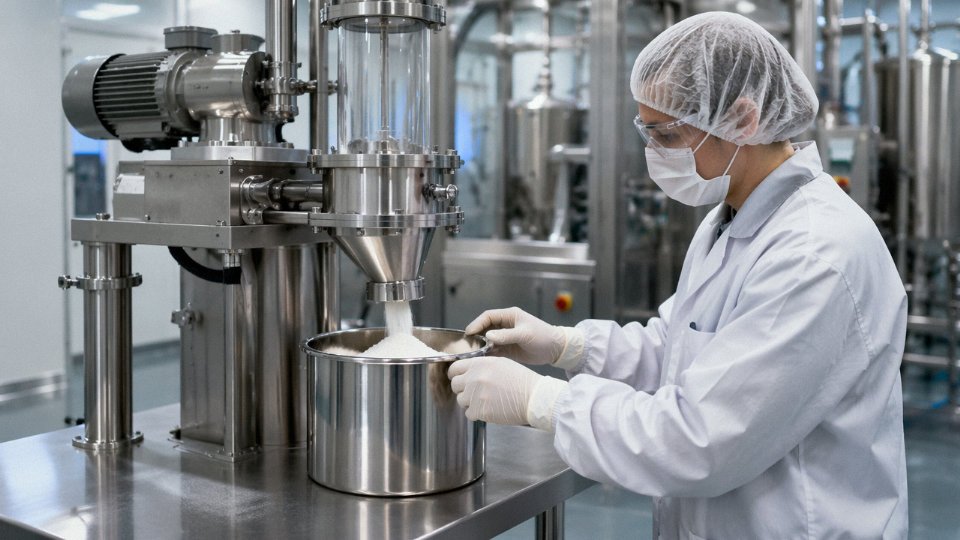
Dust handling deserves a blunt warning. The finished food may be safe to eat, but dry powder handling can still create nuisance dust or occupational exposure concerns. Use local exhaust where the bag is dumped, keep transfer points enclosed when practical, and make respirator policy match the site risk assessment. I have seen operators cut open bags under a weak hood and disappear into a white cloud. That is poor housekeeping and poor engineering.
The bottom-line decision
Use silicon dioxide when the product genuinely needs flow stability, use the correct food-grade amorphous material, and prove the lowest dose that survives manufacturing, shipping, storage, and consumer use. Do not use it as a substitute for bad moisture control, leaky packaging, wet raw materials, or a hopper design that should have been fixed years ago.
For shoppers, it is usually a sign of practical powder control. For manufacturers, it is a controlled additive decision involving formulation, supplier qualification, worker handling, and market-by-market compliance.
Silicon dioxide is used because dry food systems are vulnerable to moisture, and a small amount of the right flow aid can keep the product usable from the factory to the kitchen.