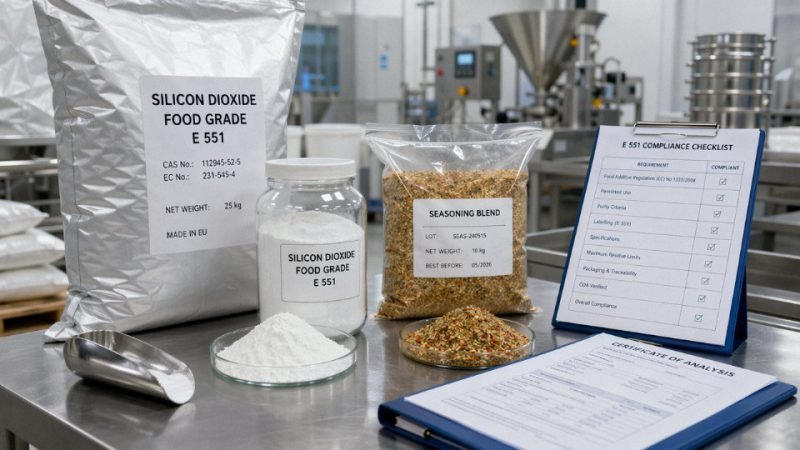
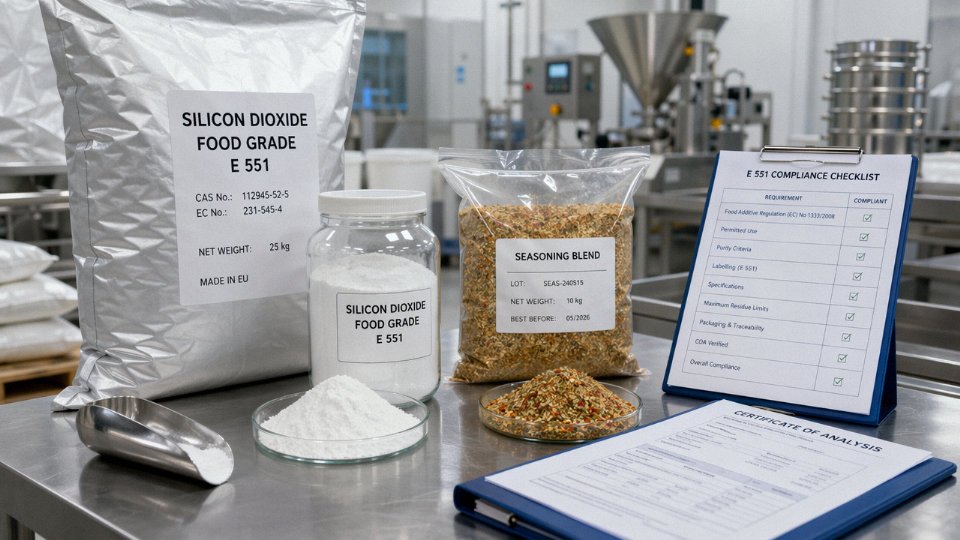
A blocked seasoning line or a rejected dry blend rarely starts with the mixer; it often starts with a small additive that procurement treated as “standard.” If silicon dioxide is specified incorrectly for the EU market, the result can be label rework, held pallets, supplier paperwork loops, or a customer audit finding. That burns money fast: warehouse space, relabeling labor, missed shipment windows, sometimes a full reformulation. The practical fix is to verify its EU status, function, food category, specification, and use level before the purchase order goes out.
Yes, silicon dioxide is approved in Europe as food additive E 551 when used within permitted conditions, mainly as an anti-caking agent or carrier. Typical dry powder use is often around 0.5% to 2.0%, depending on the food category, product design, and whether EU rules allow quantum satis use.
The catch is that “approved” is not the same as “use it anywhere, at any dose, from any supplier.” EFSA has looked at silicon dioxide with particular attention to particle characterization, specifications, and possible nanoscale fractions, which is exactly where technical files can get thin. That is where plant reality and regulatory wording start to meet.
How Europe classifies silicon dioxide before deciding whether it is approved
The first regulatory question in Europe is not “Is silicon dioxide approved?” It is “Which silicon dioxide, doing what job, in which product?”
That distinction sounds bureaucratic until a purchasing team swaps one grade for another because both safety data sheets say “silicon dioxide.” I have seen that sort of shortcut create weeks of document chasing, blocked incoming goods, and sometimes a reformulation trial that nobody budgeted for. Same chemical family, different legal route.
Start with the commercial form, not just the name
“Silicon dioxide” can mean several commercial materials:
- Amorphous silicon dioxide
- Hydrated [silica](https://siliconchemicals.com/silica/)
- Silica gel
- Precipitated silica
- Fumed silica
- Colloidal silica
- Materials containing crystalline silica
For EU food additive use, the relevant material is generally amorphous silicon dioxide, identified as E 551 when used as an anti-caking agent, carrier, or additive-related processing function in permitted food categories. Typical use in dry powders, seasoning blends, instant drink powders, and similar products often sits around 0.5% to 2.0%, depending on particle size, moisture pickup, powder oil content, packaging humidity, and the specific EU food category rules. Some uses operate under quantum satis permissions, which still means “use no more than needed,” not “use whatever the blender operator feels like.”
That is miles away from respirable crystalline silica exposure in mining, construction products, foundry sand, ceramics, glassmaking, refractory work, or abrasive blasting. In those environments, the main concern is worker inhalation exposure, dust control, and occupational disease prevention. A baghouse leak, dry sweeping habit, or bad transfer chute can matter more than the purchase specification.
Do not mix those two worlds casually. Amorphous food-grade silica in a seasoning plant and crystalline silica in a casting shop may sit under the same broad chemical umbrella, but European compliance treats the hazards and approvals very differently.
A supplier certificate showing food-grade silicon dioxide does not automatically approve the same material for use in medicines, cosmetics, feed, or medical devices in Europe.True
European compliance depends on substance identity, grade specifications, intended function, and final product sector. Each sector has its own regulatory framework and documentation expectations.
Function changes the classification
A regulator will look at what the material does in the finished product or process. The same family of silica materials may be used as an anti-caking agent, carrier, stabilizer, adsorbent, flow aid, thickener, polishing agent, filler, excipient, desiccant, reinforcement agent, or processing aid.
That function matters commercially as well. If silica is added to a spice premix to stop bridging in a hopper, the technical discussion is usually flowability, dosing accuracy, moisture sensitivity, and E 551 compliance. If hydrated silica is used in toothpaste, the conversation moves toward cosmetic regulation, abrasivity, impurities, particle characteristics, and claims on the label. If fumed silica is used to control viscosity in a sealant, you are usually dealing with industrial chemical compliance, worker exposure controls, and downstream safety data sheet obligations.
In practice, procurement often sees one line item: “silica.” Engineering sees bulk density, dustiness, angle of repose, loss on drying, and whether the screw feeder surges every Monday morning after a damp weekend. Regulatory sees a legal identity and permitted use. All three views have to match.
The final product decides the approval pathway
Europe does not run one universal approval system for every use of silicon dioxide. The route depends on the sector.
| Final product or use area | Typical classification question | What usually needs checking |
|---|---|---|
| Food | Is it E 551 in a permitted food category? | EU additive rules, use level, purity specification, labeling impact |
| Food supplement | Is it an additive, carrier, or excipient in the supplement form? | Supplement rules, additive permission, capsule or tablet composition |
| Cosmetic | Is it abrasive, absorbent, opacifying, thickening, or anti-caking? | Cosmetic ingredient requirements, impurities, nano status where relevant |
| Medicine | Is it an excipient or processing aid? | Pharmacopoeial grade, medicinal product dossier, GMP documentation |
| Medical device | Is it part of the device material or manufacturing process? | Device classification, biocompatibility, technical file evidence |
| Feed | Is it permitted for that feed use? | Feed additive or feed material status, species and function limits |
| Biocide | Is it active, carrier, or formulation aid? | Biocidal product rules and formulation documentation |
| Packaging material | Could it contact food or migrate? | Food contact material rules, migration and composition data |
| Industrial chemical | Is it used in coatings, rubber, sealants, batteries, or processing? | REACH, CLP, SDS, exposure scenarios |
| Workplace material | Is there respirable crystalline silica exposure? | Occupational exposure controls, monitoring, dust extraction, PPE |
EFSA’s re-evaluation work on silicon dioxide as a food additive has paid particular attention to particle characterization, specifications, and possible nanoscale fractions. That does not mean every silica powder is treated as a nanomaterial, and it does not mean every use is unsafe. It means sloppy identity data is no longer acceptable. A one-page certificate with only “SiO2: 99%” is thin evidence for a European customer with a serious quality system.
A practical decision tree before purchase or release
Use a simple gate sequence before approving a supplier, changing grade, or moving material between product lines:
- Identify the product sector
Food, supplement, cosmetic, medicine, device, feed, packaging, biocide, industrial, or workplace exposure. - Identify the silicon dioxide form
Amorphous, hydrated, gel, precipitated, fumed, colloidal, or crystalline silica-containing material. - Confirm the function
Anti-caking agent, carrier, thickener, polishing agent, filler, excipient, desiccant, reinforcement, adsorbent, flow aid, or processing aid. - Check the applicable EU regulation
Do not rely on a certificate written for another sector. Verify the specifications
Purity, loss on drying, particle size, impurities, heavy metals where relevant, nano-related data if applicable, and microbial limits for sensitive uses.Document the compliance decision
Keep the supplier declaration, specification, SDS, certificate of analysis, regulatory statement, and internal approval note together. Auditors like boring files. So do good factories.
The expensive mistake is assuming the material is approved because it is familiar. The right question is narrower: approved as what, in which product, at what grade, and under which European rule?
Food additive status in the European Union: what E 551 approval actually means
For food manufacturers, the practical answer is this: silicon dioxide is authorized in the European Union as food additive E 551 when it is used for approved technological purposes, most often as an anti-caking agent or carrier in dry, powdered, granulated, or moisture-sensitive food systems.
That approval is not a blank cheque.
E 551 sits inside the EU food additive framework, so its use depends on the food category, the intended function, and the conditions listed for that category. In a dry seasoning blend, it may be routine. In another food category, the same material may be restricted, allowed only under certain conditions, or not permitted at all. This is where some importers get caught: they buy a material that is perfectly normal in one market, then discover that the EU category table does not support the way they are using it.
Where E 551 is commonly used
In plant terms, silicon dioxide earns its place because powders behave badly. Salt picks up moisture. Onion powder bridges in a hopper. Instant drink mixes clump after a few weeks in a warm warehouse. Flavor powders can turn into bricks if the carrier system is wrong.
Typical applications include:
- Powdered seasonings and spice blends
- Dry soup mixes and sauce powders
- Instant beverage powders, including cocoa, coffee mixes, and electrolyte-type powders
- Powdered sweeteners and table-top sweetener blends
- Salt substitutes and mineral salt blends
- Tableting ingredients used in food supplement manufacture
- Food supplement powders, sachets, and premixes
- Carriers for flavors, colors, vitamins, enzymes, and other sensitive minor ingredients
Use levels in dry powdered foods and seasonings often sit roughly around 0.5% to 2.0%, but that range depends on particle size, oil load, humidity exposure, packaging barrier, powder flow target, and the permitted use conditions for the specific EU food category. A high-oil flavor carrier may need a different level from a dry salt-and-herb mix. A product packed in paperboard for humid retail conditions behaves differently from one packed in foil laminate.
Silicon dioxide may be used as E 551 in the EU only where the relevant food additive rules permit its use for that food category and function.True
EU food additive authorization is category- and condition-based. The E-number confirms the additive identity, not universal permission for every food.
What quantum satis means on a production line
Some E 551 uses are controlled by quantum satis rather than a fixed numerical maximum. In plain factory language, that means you may use enough to do the job, but not more than needed.
It is not an invitation to dose until the powder looks perfect.
A practical compliance file should show why the chosen level is reasonable. For example, a seasoning producer might run trials at 0.4%, 0.8%, and 1.2% E 551, then document flowability, caking after storage, dusting, sensory impact, and filling accuracy. If 0.8% gives stable auger filling and acceptable shelf-life, jumping to 1.8% because “it flows nicer” may be hard to defend unless there is a real technical reason. Inspectors and customers do not usually ask for poetry; they ask for evidence.
Quantum satis also carries a consumer-protection angle. The additive must not mislead the buyer. If silicon dioxide is being used to mask poor raw material handling, overdried powder, excessive oil addition, or weak packaging, that is not good manufacturing practice. It is a patch.
Labeling: do not hide the E-number
Finished food labels in the EU generally identify silicon dioxide by its functional class and either its name or E-number. Typical label wording would be:
- anti-caking agent: silicon dioxide
- anti-caking agent: E 551
For carrier use, the final labeling position can depend on whether the additive has a technological function in the finished food or is present only as a carry-over from another ingredient. That point needs checking product by product. I have seen label reviews delayed for weeks because procurement bought a flavor powder with E 551 as a carrier, but the regulatory team only found out after artwork had been approved. It is a small material. It can still hold up a launch.
Purchasing controls for food-grade silicon dioxide
Food-grade E 551 should meet EU purity specifications. Procurement should not treat all silica as interchangeable, even if the safety data sheet looks harmless and the price difference is tempting.
Ask suppliers for, at minimum:
- Certificate of analysis for the delivered lot
- Confirmation that the material is food additive grade E 551
- Compliance with applicable EU purity criteria
- Heavy metal and relevant impurity limits, with test methods where available
- Particle characterization information, especially where fine or engineered grades are involved
- Allergen and GMO status, if required by your customer specifications
- Batch traceability, country of manufacture, and change-control notice terms
- Statement on suitability for food use in the EU, not just general “food grade” wording
EFSA has re-evaluated silicon dioxide as a food additive, with attention on particle characterization, specifications, and possible nanoscale fractions. That does not mean every bag on the market is a problem. It does mean technical documentation matters, particularly if you are buying very fine, high-surface-area material or switching suppliers to save a few cents per kilogram.
Common mistakes that create real cost
The worst mistake is using industrial-grade silica in food because it “looks the same.” It may not meet food additive purity criteria, may have different impurity controls, and may lack traceability suitable for a recall. Once it enters production, the cost is no longer the price of silica. It is blocked stock, customer notification, possible withdrawal, and a long meeting nobody enjoys.
Other common errors are quieter but still expensive:
| Mistake | What usually happens |
|---|---|
| Assuming United States GRAS status equals EU authorization | Product may fail EU compliance review even if it sells elsewhere |
| Not checking the EU food category | A permitted use in one dry food may not transfer to another |
| Treating quantum satis as “no limit” | Overuse can be challenged as poor justification or misleading use |
| Leaving E 551 off the label | Artwork rework, shipment delays, or non-compliant product on shelf |
| Buying from a non-food silica supplier | Weak COAs, missing impurity data, traceability gaps |
In practice, E 551 compliance is not difficult if food technology, regulatory, purchasing, and labeling teams talk before the first production batch. If they wait until finished goods are packed, the fix is usually slower, messier, and more expensive.
EFSA’s role: safety review, specifications, and why particle size matters
EFSA, the European Food Safety Authority, is not a certificate-issuing office. It is the scientific risk assessment body that reviews whether a food additive can be considered safe under defined conditions of use. For silicon dioxide used as E 551, that means looking beyond the familiar purchasing description of “white free-flowing powder” and into toxicology, estimated dietary exposure, purity, manufacturing route, particle characterization, genotoxicity data, absorption, and whether any fraction of the material could accumulate in tissue.
That distinction matters on a plant floor. A seasoning blender may see only that E 551 keeps garlic powder from turning into bricks in August humidity. EFSA and the regulator have to ask a different question: what exactly is the material people are ingesting, across bread mixes, soup powders, food supplements, spice blends, tablets, and all the other possible sources?
Silicon dioxide has received close scientific attention because commercial amorphous silica is not one single neat particle size. Precipitated silica, silica gel, fumed silica, and other amorphous forms can have broad particle size distributions. Some products contain primary particles in the nanoscale range, but those particles may be bonded into aggregates or loosely held in agglomerates. That is not academic wordplay. It affects how the material disperses in a food matrix, how it behaves in testing, and how exposure is interpreted.
In plain English:
- A primary particle is the basic small particle formed during manufacture.
- A nanoscale particle is generally in the range of roughly 1 nm to 100 nm in at least one dimension, depending on the legal or technical definition being applied.
- An aggregate is a group of particles strongly joined together; it usually does not break apart easily during normal handling.
- An agglomerate is a looser cluster. Milling, mixing, liquid dispersion, or digestion conditions may partly separate it, depending on the material.
- An engineered nanomaterial is intentionally produced to have nanoscale properties. Not every E 551 grade should be casually called a nanomaterial, and calling all silicon dioxide “nano” is sloppy procurement language.
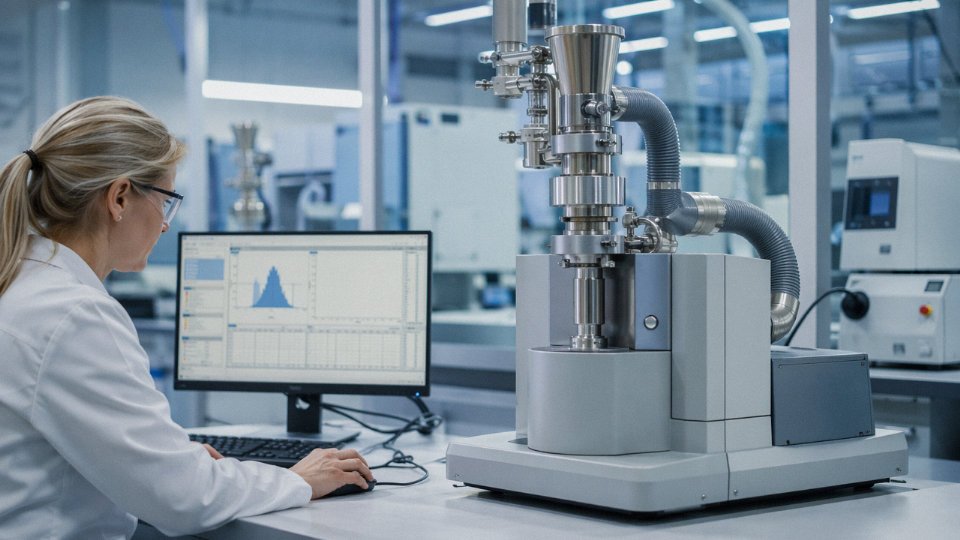
The hard part is that a certificate saying “amorphous silicon dioxide, E 551” may not tell you enough. For a low-risk dry seasoning application at around 0.5% to 2.0%, subject to the permitted food category and any quantum satis allowance, a standard food-grade specification and certificate of analysis may be adequate. For supplements, infant-related formulations, novel delivery systems, high-dosage products, or cosmetic applications where particle claims appear in marketing, I would ask for more: particle size distribution method, surface area, loss on drying, heavy metals, crystalline silica statement, and whether any nanoscale fraction has been characterized.
An EFSA opinion is the same as a product approval certificate for a supplier's specific silicon dioxide grade.False
EFSA opinions inform EU risk management, additive specifications, and authorization decisions. They do not replace supplier qualification, EU listing checks, purity verification, labeling review, or application-specific compliance work.
What EFSA review tends to focus on
EFSA may examine toxicological studies, genotoxicity findings, absorption and distribution data, and exposure estimates from proposed or existing uses. With silicon dioxide, the discussion has also included whether analytical methods properly describe the material being consumed. Older specifications were often written for bulk chemistry: assay, loss on drying, ignition residue, soluble salts, lead or arsenic limits. Modern review is less forgiving. If a material contains a meaningful nanoscale fraction, regulators want to know how it was measured and whether the toxicology data actually match that material.
This is where purchasing shortcuts cause trouble. I have seen buyers approve a second-source anti-caking agent because the price was lower and the label still said “E 551.” Then production complains that a spice premix flows differently, tablet compression changes, or dust loading at the bag dump station goes up. Regulatory impact may not be the first symptom; process behavior often shows the change first.
Documents manufacturers should line up
| Document or check | What it proves | Practical comment |
|---|---|---|
| EFSA opinion relevance | Shows the scientific basis behind EU risk assessment for silicon dioxide as a food additive | Useful background, but not supplier-specific approval |
| EU additive listing | Confirms E 551 is authorized for the intended food category and use condition | Check the actual category, not just the additive name |
| Purity specification | Sets required chemical purity and impurity limits | Ask whether the grade complies with current EU food additive specifications |
| Supplier certificate of analysis | Confirms batch-level test results | Should match the grade being delivered, not a generic sales sheet |
| Safety data sheet | Supports workplace handling, dust control, storage, and transport classification | Food compliance is not the same as occupational dust safety |
| Particle characterization data | Describes particle size distribution, surface area, aggregation, or agglomeration where relevant | Especially useful for supplements, fine powders, cosmetics, and novel applications |
| Labeling review | Confirms correct declaration, such as silicon dioxide or E 551 where required | Label rules depend on product type and market route |
Why updates need watching
European additive specifications and guidance do not stay frozen. Analytical methods improve. Toxicology expectations shift. EFSA may request better characterization where older dossiers relied on limited particle data. A grade that looked well documented ten years ago may now feel thin during a customer audit, particularly if the product is exported across several EU member states or sold through large retailers with their own compliance questionnaires.
My practical advice is simple: treat E 551 as approved for permitted uses, not as a blanket pass for any silica powder in any product. Lock the grade, record the intended application, keep current specifications on file, and re-check supplier documents when the manufacturing site, process route, or particle data changes. The wrong assumption usually does not fail neatly on paper. It shows up as held inventory, relabeling work, reformulation, or an uncomfortable call from a customer’s regulatory team.
Food supplements, tablets, and capsules: when silicon dioxide can be used and how to document it
Silicon dioxide is very common in European food supplements, especially where a powder has to move through equipment without turning into a damp, sticky mess. In this setting it is normally used as E 551, with functions such as anti-caking agent, flow aid, carrier, moisture-management aid, or general processing support. You see it in capsule blends, tablet premixes, sachet powders, effervescent-style dry blends, mineral mixes, botanical extracts, and vitamin premixes.
The trap is assuming “supplement grade” sits in its own relaxed regulatory box. It does not. In Europe, food supplements are regulated as foods, with extra supplement-specific rules layered on top. That means additive permissions, food category conditions, labeling rules, contaminant expectations, and sometimes national notification procedures all need to be checked before the product goes on sale.
Why formulators use it in real supplement production
On the plant floor, silicon dioxide is usually added because something is not behaving well enough to run at target speed.
A botanical extract may bridge in the hopper of a capsule filler. Magnesium salts can drag moisture from the air during a long blending shift. Fine vitamin powders may segregate if the particle size spread is ugly. A tablet blend can feed unevenly into the die, giving weight variation and compression complaints. In those cases, a small amount of silicon dioxide can make the difference between a clean batch record and two hours of operators tapping stainless steel with a rubber mallet.
Typical technical reasons include:
- improving powder flow into capsule fillers and tablet presses;
- reducing caking in hygroscopic blends, especially during humid months;
- helping keep low-dose actives distributed more evenly in a premix;
- reducing sticking or picking tendencies indirectly by drying the blend surface;
- supporting more consistent fill weight, tablet hardness, and disintegration behavior, depending on the full formulation.
Use levels vary by blend, particle size, moisture load, equipment, and target dosage form. Many supplement formulations use silicon dioxide at low percentages, often somewhere below a few percent of the finished blend. In dry powders and seasonings, broader food-use examples often sit around 0.5% to 2.0%, but that should not be copied into a supplement formula as if it were a universal legal limit. The right level is the lowest technically effective amount that fits the applicable EU food additive rules and the relevant food category. If “quantum satis” applies in a given case, it still means “no more than needed,” not “as much as purchasing found cheap.”
A silicon dioxide ingredient that is permitted as E 551 does not automatically make every finished supplement legal to sell in every European country.True
The additive may be permitted, but the finished supplement still has to meet EU food rules, labeling requirements, composition rules, and any national notification or supplement-specific requirements in the target market.
Documentation a serious buyer should expect
For contract manufacturers and brand owners, the paperwork is not a clerical afterthought. It is what keeps a routine audit from turning into a product hold.
At minimum, I would expect the supplier file to include confirmation that the material is suitable for food supplement use as E 551, not only an industrial silicon dioxide sold for coatings, rubber, or chemical processing. A current certificate of analysis should match the supplied lot and show the specification items the buyer has agreed with the supplier. Depending on the company’s quality system and target markets, the file may also need a GMO statement, allergen statement, vegan declaration, halal or kosher certificate, country-of-origin information, residual solvent or contaminant statements, and a safety data sheet.
For European supplement projects, I also like to see a technical data sheet that gives bulk density, tapped density, particle size information, loss on drying, and handling guidance. Those figures matter in production. A very light grade can improve flow but dust badly during charging. A denser grade may be easier to handle but less effective in a stubborn herbal blend. If the capsule room has weak dust extraction, the “best” excipient on paper can become a housekeeping headache.
Particle characterization deserves attention, especially after EFSA’s re-evaluation work on silicon dioxide and its focus on specifications and potential nanoscale fractions. A supplement brand does not need to become a particle physics lab, but it should not buy blind either. Ask the supplier what grade is being supplied, whether it is food additive grade, what particle information is available, and whether the specification aligns with current European expectations.
Labeling and market access are where mistakes show up
Labels should not hide silicon dioxide under vague wording such as “flow agent” with no proper additive identification. The correct additive name or E-number, plus the functional class where required, should be checked against EU labeling rules and the expectations of the specific country where the product is sold. A practical label review should cover the ingredient list, additive declaration, nutrition and supplement facts presentation, dosage instructions, warnings, claims, language requirements, and any mandatory national wording.
A common scenario: a brand develops one capsule formula and wants to sell it across several European markets from the same warehouse. The silicon dioxide specification is fine. The capsule runs well. The mistake is assuming that ingredient compliance equals finished-product clearance. Several European countries require food supplement notification before sale, and national authorities may look at vitamins, minerals, botanicals, claims, warning statements, and label language differently.
Right route: confirm E 551 suitability, document the grade, validate the technical need, review the label country by country, and complete any notifications before launch. Wrong route: copy a non-EU label, call silicon dioxide a “processing aid” without checking whether it remains in the finished supplement, and ship first. That path can lead to relabeling, blocked listings, distributor returns, or a batch sitting in a 3PL warehouse while sales asks why compliance is “suddenly” involved.
For supplement manufacturers, silicon dioxide is a useful, normal excipient. Treat it that way: controlled, justified, documented, and labeled correctly.
Cosmetics and personal care: approved uses are handled differently from food additive approval
A common mistake in purchasing files is writing “approved as E 551” beside a silica raw material that is going into face powder or toothpaste. That does not prove cosmetic compliance in Europe. E 551 is the food additive route. Cosmetics sit under the EU cosmetics framework, mainly Regulation (EC) No 1223/2009, and the legal logic is different: the finished cosmetic product must be safe for human health under normal and reasonably foreseeable use, and a responsible person must hold the evidence.
That sounds like paperwork language, but it has real consequences. A buyer can source a technically clean silicon dioxide powder that is acceptable for a dry seasoning blend, then find out it lacks an INCI confirmation, cosmetic-grade declaration, particle-size characterization, or microbiological controls expected by the cosmetic safety assessor. The material may be chemically similar. The dossier is not.
Ingredient names and why they matter
Cosmetic labels use INCI names, not food additive numbers. You will usually see ingredients such as:
- Silica, often used as an absorbent, anti-caking agent, opacifier, slip modifier, or oil-control ingredient.
- Hydrated Silica, common in toothpaste as an abrasive and thickening aid, depending on grade and particle morphology.
- Silica Silylate, used heavily where oil absorption, gel structure, or a dry sensory finish is needed.
- Related surface-treated or structured forms, selected for flow, transparency, matting, or viscosity control.
The same word “silica” can hide very different behavior on the plant floor. A fluffy high-surface-area grade may bridge in a hopper, dust badly during charging, and thicken a gel fast. A denser precipitated grade may feed more predictably but give a different skin feel or abrasive profile. In toothpaste, the wrong hydrated silica can shift Relative Dentin Abrasivity outside the target band. In pressed powder, a grade that looked fine in lab blending can create poor pan strength or dusty payoff after scale-up.
Typical applications include toothpaste, loose and pressed face powders, foundation, dry shampoo, deodorant sticks and aerosols, creams, gels, primers, mattifying lotions, and oil-control products. Use levels vary widely. In a face powder or dry shampoo, silica-based ingredients may be present at a few percent up to much higher levels, depending on absorbency and sensory target. In toothpaste, abrasive systems can sit in a broad range, often tens of percent, depending on the full formulation and cleaning claim. In creams and gels, the level may be much lower, sometimes under a few percent, because the job is rheology, suspension, or skin feel rather than bulk powder performance.
A silicon dioxide grade approved as food additive E 551 is automatically approved for cosmetic use in Europe.False
Cosmetic use is assessed under EU cosmetic rules, including product safety assessment, responsible person obligations, product notification, labeling, and any applicable restrictions. Food additive authorization does not replace cosmetic compliance documentation.
What market access actually requires
For a cosmetic product sold in the EU, the responsible person must make sure the product has a cosmetic product safety report, a product information file, proper ingredient labeling, and notification through the Cosmetic Products Notification Portal before placing it on the market. The safety assessor will look at exposure route, use area, frequency, user group, impurities, particle characteristics, microbiological quality where relevant, and toxicological profile.
This is where procurement can either save the launch or quietly damage it. Ask suppliers for the right documents before the first pilot batch, not after artwork is approved.
A practical silica supplier pack for cosmetics should include:
- Confirmed INCI name, preferably with composition details for treated grades.
- Particle size distribution, including fines content where inhalation or nano questions may arise.
- Heavy metals data, commonly including lead, arsenic, cadmium, mercury, and other elements if the assessor asks.
- Microbiological quality data for grades used in water-containing systems or sensitive applications.
- Statement of cosmetic suitability or cosmetic-grade supply, not just “industrial grade” or “food grade.”
- Residuals, loss on drying, pH, surface treatment details, and any allergen or animal-origin statements if relevant to the brand position.
Nano forms need separate attention
EU cosmetic rules treat nanomaterials as a special case. If a silica-related ingredient is intentionally used in nano form, the responsible person may need extra notification, ingredient labeling with “nano” after the INCI name, and safety data that properly characterizes the material. Particle size, shape, surface area, solubility, coating, and agglomeration behavior all matter.
Do not rely on a sales phrase like “non-nano” without data. I have seen safety teams reject raw materials because the supplier could not explain the measurement method or whether the reported particle size referred to primary particles, aggregates, or bulk powder behavior. For powders used near the face, that distinction is not academic.
Consumer safety is not the same as worker exposure
Cosmetic safety assessment focuses on the consumer using the finished product. Manufacturing exposure is a separate operational issue. Silica powders can create nuisance dust, and some grades are extremely airborne when charged into mixers, especially during winter when plant air is dry and static makes everything cling to sacks, gloves, and weigh booths.
For workers, the concern is inhalation during bag dumping, milling, transfer, rework handling, and cleanup. Use local extraction, enclosed transfer where practical, grounded equipment, sensible charging speeds, and respiratory protection based on the site risk assessment. A finished cream containing dispersed silica may present little inhalation risk to the consumer, while the same ingredient in a raw-material room can coat beams, filters, and lungs if handled casually.
Right grade, right dossier, right controls. That is the real approval path for silica in European cosmetics.
Pharmaceuticals, medical devices, and excipient-grade silicon dioxide in Europe
Food additive approval does not automatically make silicon dioxide acceptable for a tablet, capsule, inhalation product, wound dressing, diagnostic cartridge, or implantable device. That is where a lot of purchasing mistakes start. E 551 tells you something useful about food use. It does not replace pharmaceutical excipient control, device biocompatibility work, or finished-product regulatory approval.
In pharmaceutical manufacturing, silicon dioxide is usually bought for what it does on the line, not for nutrition or chemistry. Colloidal or precipitated grades are used as glidants to improve powder flow into tablet dies, anti-caking agents in powder blends, adsorbents for oily actives or flavors, moisture scavengers in sensitive formulations, and general tablet processing aids. In hard capsules, sachets, and dry powder blends, a small amount can make the difference between a feeder that runs cleanly and one that bridges every twenty minutes.
Typical use levels vary widely. A glidant in a tablet blend may sit well below 1%, depending on particle size, blender type, lubricant system, and how stubborn the active ingredient is. Adsorbent use can be higher if the material is carrying liquid or semi-solid components. The acceptable level is not just a formulation preference; it has to match the approved dossier, safety justification, process validation, and finished product performance.
Why pharmacopeial grade matters more than E 551 for medicines
For medicines in Europe, the more relevant reference point is often the European Pharmacopoeia, along with the finished product marketing authorization requirements and the company’s excipient qualification procedure. The exact expectation depends on the dosage form, route of administration, patient population, daily exposure, and whether the silicon dioxide is a standard excipient or has some unusual functionality.
A purchasing team should not treat “food grade,” “pharma grade,” and “high purity” as interchangeable labels. They are not. Pharmaceutical use normally needs a defined excipient specification, appropriate pharmacopeial compliance where applicable, batch release testing, impurity control, and evidence that the material is manufactured and handled under suitable quality systems. In practice, quality assurance will want to see the certificate of analysis, manufacturing site details, change control commitments, traceability, packaging controls, retest or expiry policy, and a clean statement on whether the grade is intended for pharmaceutical use.
Elemental impurity data matters, especially under ICH Q3D-style risk assessments. Residual solvent status may be relevant depending on the manufacturing route, surface treatment, or any downstream processing, though many inorganic silica grades will have a straightforward position here. Microbial limits also cannot be guessed. A dry inorganic powder may look low-risk, but if it is used in a vulnerable dosage form or exposed to poor repacking practice, the argument changes fast.
Silicon dioxide approved as E 551 for food use is automatically acceptable as a pharmaceutical excipient in Europe.False
Food additive authorization and pharmaceutical excipient acceptance follow different control routes. Medicines require suitable excipient specifications, risk assessment, GMP-aligned controls where applicable, and acceptance within the finished product approval framework.
Supplier qualification is where cheap material becomes expensive
A good supplier file for excipient-grade silicon dioxide is not just a price quote and a one-page specification. Procurement should expect a technical package that supports regulatory review and plant operation: certificate of analysis by batch, pharmacopeial compliance statement if applicable, elemental impurity profile, microbial specification, allergen and animal-origin statements where needed, residual solvent position, packaging description, country of manufacture, full batch traceability, and written change notification terms.
The change control clause is not paperwork theater. If a supplier changes a milling step, drying condition, surface area target, or manufacturing site, your blend flow can shift. I have seen tablet press operators blame punches, feeders, and humidity for a problem that began with a “same specification” excipient lot behaving differently. Silicon dioxide is especially sensitive because surface area, aggregate structure, moisture behavior, and electrostatic charging affect how it performs. Two materials can both pass a broad chemical specification and still run differently in a high-speed press.
Dust is another practical issue. Fine silica powders can become a housekeeping and occupational exposure problem if operators are tipping bags into an open IBC in a dry room with poor local extraction. That affects cleaning validation, containment strategy, operator PPE, and sometimes explosion-dust assessments, depending on the full powder mix. Do not leave this to the first process validation batch.
Medical devices follow the device route, not the food additive route
Medical devices can use silicon dioxide in several ways: filler in polymer systems, surface coating component, desiccant in sterile or moisture-sensitive packaging, material in diagnostics, reinforcement in elastomers, or part of a controlled surface finish. Approval depends on the device classification, intended body contact, contact duration, sterilization method, extractables and leachables profile, and biological safety assessment under the medical device regulatory pathway.
A silica-containing desiccant in secondary packaging is not the same risk as silica embedded in a catheter coating or diagnostic fluid path. For patient-contact materials, teams usually need biocompatibility justification, chemical characterization, supplier material data, and evidence that the material is controlled through the device quality system. If the device is sterilized, aged, irradiated, or exposed to aggressive reagents, the material assessment has to reflect that actual condition, not a neat supplier brochure.
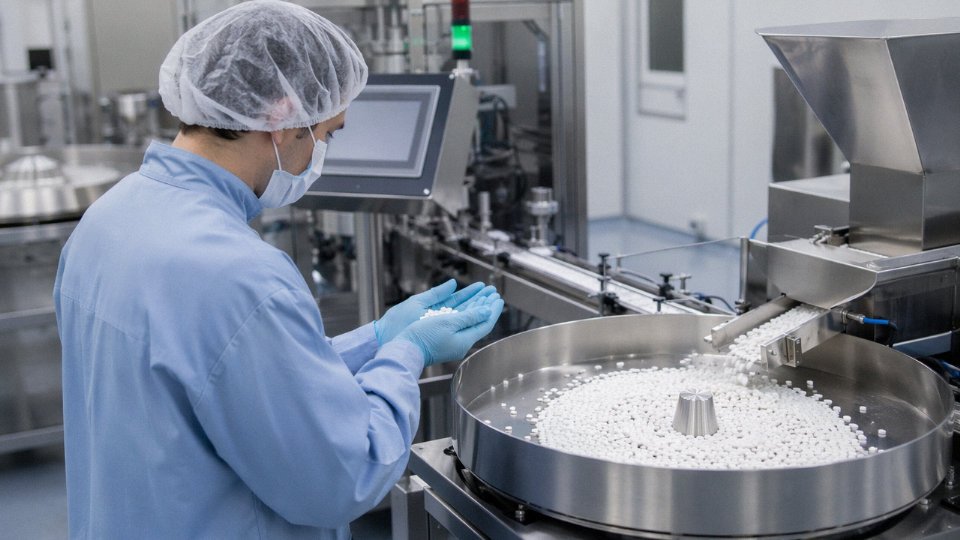
Plant-floor view: select the excipient like it can shut down the line
From an industrial engineering angle, silicon dioxide selection should be tested against the real process, not only the regulatory checklist. Look at flow through hoppers, segregation risk after blending, electrostatic behavior in winter air, dust generation during charging, impact on tablet hardness and disintegration, cleaning burden, and how tightly the supplier can hold functional properties batch to batch.
The wrong grade may still look compliant on paper. Then the line slows, blend uniformity drifts, tablets cap, capsule weights wander, or operators start making unofficial adjustments. That is where scrap and deviation reports pile up.
For drugs and devices, confirm pharmaceutical or medical suitability before buying volume. Food-grade or industrial-grade silicon dioxide may be perfectly legal for its own market and still be the wrong material for a regulated medical application.
Industrial chemicals, REACH, CLP, and workplace safety obligations
Industrial silicon dioxide is not “approved in Europe” in the same way a food additive is approved. For rubber, coatings, electronics, ceramics, glass, sealants, filtration media, desiccants, polishing slurries, or construction products, the gate is usually chemical compliance: REACH, CLP, safety data sheets, exposure controls, and national worker protection rules.
Industrial approval for silicon dioxide in Europe is not the same as food additive approval under E 551.True
For non-food uses, European market access is usually controlled through REACH registration or exemption status, CLP classification and labeling, safety data sheets, and worker exposure controls, not food additive authorization.
Where industrial silicon dioxide actually shows up
In plant terms, silicon dioxide is everywhere. Precipitated silica goes into rubber compounds, shoe soles, belts, hoses, adhesives, sealants, paints, and plastics. Fumed silica is used for rheology control in coatings, resins, greases, inks, potting compounds, and some battery or electronics materials. Silica gel is common in desiccants, chromatography, catalyst supports, and moisture-control packaging. Quartz, cristobalite, sand, and ground silica are used in ceramics, glass, foundry mixes, construction materials, fillers, and polishing compounds.
Those are not the same risk profile.
A sealed 20 kg bag of low-dust silica gel beads used in a packaging room is one thing. A bulk bag of micronized silica emptied into a mixer above shoulder height, with a tired dust collector and operators using compressed air to “clean up,” is another. I have seen that second setup turn a decent formulation into a respiratory exposure problem before the first coffee break.
REACH duties: who carries the burden
Under REACH, the first question is not “is silicon dioxide allowed?” It is: who places the substance on the EU market, in what form, at what tonnage, and for what identified use?
EU manufacturers and EU importers normally carry registration obligations unless an exemption applies. Tonnage bands matter: 1-10, 10-100, 100-1,000, and above 1,000 tonnes per year drive the depth of data and chemical safety assessment work. The exact burden depends on substance identity, annual volume, use pattern, and whether the material is already covered by a valid registration.
Downstream users are not off the hook. If you buy silica inside the EU, you still need to check whether your use is covered by the supplier’s exposure scenario where one is provided. If your plant uses the material differently — say high-temperature calcining, dry milling, spray application, or abrasive polishing — you may need to document safe-use conditions yourself or push the supplier for a covered use.
For procurement, the minimum file should include:
| Document or data point | Why it matters on the factory floor |
|---|---|
| EU-compliant safety data sheet | Confirms classification, handling controls, exposure limits, and regulatory status |
| REACH statement | Shows whether the supplier understands EU market access duties |
| Substance identity | Separates fumed silica, precipitated silica, silica gel, quartz, cristobalite, and blends |
| Impurity profile | Flags metals, salts, crystalline silica content, or process residues |
| Particle size and dustiness data | Helps engineering decide on extraction, transfer method, and PPE |
| Intended-use confirmation | Reduces the risk of using the wrong grade in coatings, rubber, electronics, or ceramics |
A one-page “REACH compliant” letter with no registration context, no legal entity, and no grade reference is weak evidence. It may pass a hurried purchasing screen. It will not help much during a customer audit or after an exposure complaint.
CLP classification is form-dependent
CLP classification and labeling depend on the substance form, hazard data, impurities, and the presence of crystalline silica. Amorphous silica, precipitated silica, fumed silica, silica gel, quartz, and cristobalite should not be lumped together without checking the classification rationale.
Dustiness matters. Particle size matters. Surface treatment can matter too, especially with hydrophobic fumed silica or coated grades used in sealants and composites. If the material contains respirable crystalline silica, the workplace health picture changes sharply.
A bag label alone is not enough. Check SDS Section 2 for classification, Section 3 for composition, Section 8 for exposure limits and controls, Section 11 for toxicology, and Section 15 for EU regulatory notes. If those sections are vague, ask questions before the first pallet arrives.
Workplace exposure: the approval you feel in your lungs
The main industrial risk is inhalation of fine dust. For respirable crystalline silica generated by a work process, the EU binding occupational exposure limit is 0.1 mg/m3 as an 8-hour time-weighted average, with some countries or customers applying lower internal limits. For amorphous silica dust, occupational limits vary by country and dust fraction; rough ranges commonly sit around 1-10 mg/m3 depending on whether the limit is respirable, inhalable, or material-specific.
Do not design to the most generous number you can find. Design to the job.
Practical controls usually beat paperwork: enclosed bag dump stations, local exhaust ventilation at the point of release, sealed screw conveyors or vacuum transfer, glovebox handling for very fine powders, proper filter maintenance, and no dry sweeping. Compressed-air cleanup is a bad habit. It moves dust from the floor to the breathing zone, then into the ductwork, bearings, switch cabinets, and lungs.
PPE is the last layer, not the plan. Depending on measured exposure, plants may need FFP2 or FFP3 respirators, fit testing, coveralls, gloves, and eye protection. Exposure monitoring should be based on personal sampling, not just a wall-mounted dust meter that looks reassuring from the office.
Do not treat amorphous and crystalline silica as interchangeable
Amorphous silica and crystalline silica are different from a workplace health standpoint. The difference becomes especially relevant in grinding, milling, mining, calcining, ceramic firing, refractory work, glass batching, and any process that can create or liberate respirable crystalline fractions.
This is where procurement and production often miss each other. Purchasing asks for “silica, same spec, cheaper.” Production receives a material with a different particle profile or crystalline content. The mixer runs, dust levels rise, housekeeping gets worse, and then quality finds a viscosity shift or surface defect. The low-price grade was not cheaper; the cost just moved into downtime, scrap, filters, and occupational hygiene work.
Before buying industrial silicon dioxide for Europe, ask for the current EU-compliant SDS, REACH status, CLP classification rationale, impurity and crystalline silica data, dustiness information where relevant, and written confirmation that the grade suits your intended industrial process. If the supplier cannot answer those points clearly, I would not approve it for plant trial without extra controls.
Supplier documentation checklist for proving silicon dioxide compliance in Europe
Supplier paperwork is not a filing exercise. It is the evidence trail that proves the silicon dioxide you bought is the same material your label, formulation, risk assessment, and European market claim are built on. If those four do not line up, an audit can turn into a quarantine decision very quickly.
In practice, I would qualify silicon dioxide by end use first, then by grade, then by batch control. A food plant buying E 551 for seasoning powder needs different proof than a tablet maker using colloidal silica as a flow aid, and both are far from an industrial user feeding silica into rubber or coatings.
Core documents to request before approval
For food use, ask for a current food-grade certificate and a clear E 551 statement that names silicon dioxide as the additive and states the intended function, usually anti-caking agent, carrier, or flow aid. The statement should not just say “complies with international standards.” That is too loose for Europe.
A proper supplier pack normally includes:
- Certificate of analysis for the delivered batch
- Technical data sheet with grade, physical form, typical particle size, bulk density, moisture, pH where relevant, and handling characteristics
- Safety data sheet in current European format
- Food-grade or application-grade declaration, depending on use
- Allergen statement and GMO statement for food, supplement, and some cosmetic customers
- Heavy metals and impurity data, ideally with limits and actual results
- Particle size data, including whether nanoscale fractions are expected or controlled
- Traceability statement covering manufacturing site, batch coding, and raw material controls
- Change notification policy, normally with a notice period in the range of 3 to 12 months, depending on the supplier and contract strength
Typical use levels in dry powdered foods and seasonings often sit around 0.5% to 2.0%, but that only helps if the category allows it and the additive function is correct. Do not let a supplier’s “typical dosage” replace your own regulatory check.
A non-EU food additive approval statement is not enough by itself to prove that silicon dioxide is compliant for use as E 551 in the European Union.True
EU food additive use depends on European authorization, permitted food categories, specifications, labeling, and the actual function in the product. Other market approvals may support a dossier, but they do not replace EU compliance evidence.
What a strong certificate of analysis should show
A certificate of analysis should be batch-specific. If it looks like a sales brochure with a test table pasted in, push back.
At minimum, the CoA should show the product name, grade, batch or lot number, manufacturing site, release date, specification limits, actual test results, test methods, and an authorized signature or controlled electronic approval. For a food or supplement grade, I also expect reference to applicable food additive specifications or internal specifications that map cleanly to EU requirements.
Heavy metals data should not be vague. Arsenic, lead, mercury, and cadmium are the usual watch points, with acceptable levels depending on grade, route of exposure, and final product use. For high-volume food or pharma supply, I prefer seeing actual batch results or a justified skip-lot program, not a permanent “conforms” with no numbers.
Particle size is another area where weak suppliers get uncomfortable. EFSA has paid attention to characterization and potential nanoscale fractions, so a responsible supplier should be able to explain the measurement method, such as laser diffraction, electron microscopy, or another validated approach. One method does not tell the whole story, but silence tells you plenty.
Safety data sheet checks that catch common problems
The SDS should be in a European 16-section format, with a revision date that is not ancient. Three to five years old may be acceptable for a stable material if reviewed, but an undated SDS is a bad sign.
Check substance identity, CAS or EC identifiers where applicable, classification under CLP, exposure controls, respiratory protection guidance, safe handling, storage, transport information, and regulatory status. Silicon dioxide dust can be treated too casually on receiving docks. Fine powder, torn bags, and dry sweeping are a poor combination; even if the material is not classified as hazardous in the way operators expect, dust exposure still needs control.
Documents by end-use sector
| End-use sector | Documents normally required before supplier approval |
|---|---|
| Food | Food-grade certificate, E 551 statement, CoA, TDS, SDS, allergen and GMO statements, heavy metals data, particle size data, traceability |
| Supplement | Food or supplement-grade declaration, CoA, excipient/function statement, allergen and GMO statements, heavy metals data, particle size data, manufacturing site details |
| Cosmetic | Cosmetic ingredient statement, CoA, SDS, TDS, impurity data, particle characterization, regulatory support for cosmetic use |
| Pharmaceutical | Pharma or excipient-grade documentation, CoA, pharmacopoeial references where applicable, GMP-related supplier data, change control, full traceability |
| Medical device | Material specification, biocompatibility support where relevant, CoA, SDS, traceability, change notification, quality system evidence |
| Feed | Feed-grade declaration, CoA, SDS, contaminant data, traceability, country of origin, regulatory-use statement |
| Industrial chemical | SDS, TDS, REACH-related information, CLP classification, exposure controls, transport data, manufacturing origin |
| Food contact material | Declaration of compliance where relevant, migration or supporting data, CoA, SDS, TDS, traceability, formulation-change controls |
Supplier questionnaire topics that matter
A good questionnaire asks how the material is made, where it is made, and how grades are kept separate. I want to know whether food-grade and industrial-grade silica share packing lines, how bags are cleaned out after maintenance, whether pallets are wrapped in dusty loading bays, and who approves a specification change.
Include questions on production process, grade segregation, cross-contamination controls, allergen exposure, GMO risk, pest control for food grades, recall process, audit availability, country of origin, subcontracted manufacturing, and regulatory support capability. Ask who will answer technical questions during a customer audit. A broker with no access to the manufacturing site can be useful commercially, but they are weak support during a nonconformance investigation.
Red flags before you issue a purchase order
Be careful with vague descriptions such as “high purity silica,” “food safe,” or “EU acceptable” without naming the applicable grade and use. Missing batch traceability is a hard stop for food, supplement, pharma, and medical applications. Outdated SDS files, absent impurity data, and refusal to discuss particle size should slow the approval process.
A typical failure mode is simple: purchasing substitutes a cheaper silica because the name looks close, production sees better flow for two weeks, then QA catches that the additive statement does not support the food category or the supplier cannot link the CoA to the delivered lot. The result is not theoretical. It can mean blocked stock, relabeling, customer notification, or scrap.
Common compliance mistakes that cause silicon dioxide products to fail in Europe
The failures I see are rarely about silicon dioxide being “banned.” They are usually about someone buying the wrong grade, carrying over a label from another market, or assuming a supplier’s one-page declaration covers every European use. That is how a low-cost anti-caking agent turns into a detained shipment, a rejected retail launch, or a batch sitting in quarantine while QA argues with procurement.
If silicon dioxide is approved for one European application, it is automatically acceptable for all food, cosmetic, supplement, pharmaceutical, and industrial uses.False
European compliance depends on the intended use, grade, specifications, labeling, exposure route, and regulatory framework. E 551 food additive status does not replace cosmetic, pharmaceutical, REACH, CLP, or workplace safety obligations.
Treating the chemical name as a universal approval
“Silicon dioxide” on a certificate is not enough. In Europe, the same broad chemical name can describe a food additive, a pharmaceutical excipient, a cosmetic ingredient, a feed material, a filler for rubber, a matting agent for coatings, or a desiccant. Those are not interchangeable supply chains.
A plant may be using E 551 legally in a spice blend at roughly 0.5% to 2.0%, depending on the food category, flow problem, and applicable EU permissions. That does not mean the same bag can be used in a capsule line, a face powder, or a tablet coating room without a grade review. The production route, residual impurities, heavy metals, microbiological controls, particle profile, allergen statements, and documentation package may all be different.
This is where procurement can accidentally create a compliance problem. A buyer sees the same CAS number, a lower price, and “white powder” on the specification. The material arrives. QA blocks it. Production misses the mixing slot.
Cheap powder gets expensive quickly.
Importing non-EU approvals and assuming they transfer
United States food additive references, Asian market registrations, “global food grade” claims, and supplier export certificates can be useful background. They are not proof of European compliance by themselves.
For the EU, you normally want documents that speak the local language of regulation: E 551 status where food use is claimed, an EU-style food additive statement, relevant purity/specification confirmation, allergen and GMO statements where required by the customer, a safety data sheet prepared in the correct EU format for chemical supply, REACH status or exemption logic for industrial uses, and CLP classification where applicable.
For consumer products, labeling needs a separate review. I have seen perfectly usable material fail commercial release because the packaging artwork was copied from a non-EU SKU and nobody checked additive declaration wording, functional class, or local language requirements before printing 80,000 pouches.
Using industrial silica in regulated consumer products
Industrial silica is not automatically dirty or unsafe. Some industrial grades are made under tight control. The problem is that the control target is different.
A silica used in coatings or sealants may be optimized for rheology, abrasion resistance, matting effect, or cost per kilogram. A food or pharmaceutical buyer needs evidence on purity, trace metals, residual processing aids, microbial quality where relevant, and change control. Cosmetic users care about ingredient identity, particle size, impurities, and safety assessment support. Pharma teams will ask about compendial status, GMP alignment, batch traceability, and often much more.
The wrong grade may flow beautifully in a blender and still be unacceptable on paper. That is a procurement failure, not a technical victory.
Label errors that get noticed late
Food labels can fail for simple reasons: E 551 not declared where required, the wrong additive function used, or silicon dioxide hidden under vague wording because marketing wanted a cleaner-looking ingredient list. “Clean label” language needs careful handling. If a product contains an authorised anti-caking agent, pretending it does not exist is not a brand strategy; it is a recall conversation waiting for a trigger.
Nano labeling is another trap. If the material falls under relevant nano disclosure requirements for the product category, the label and technical file need to match the evidence. Do not let a supplier’s casual “non-nano” email become the entire basis for the decision. Ask for particle characterization, test method, sample basis, and whether the result represents the supplied grade or just an old development batch.
Ignoring particle size until an auditor asks
EFSA’s re-evaluation work put a spotlight on characterization of silicon dioxide, including potential nanoscale fractions. Customers know this. Auditors know it. Some retailers now ask more questions than regulators during supplier approval.
Useful data may include particle size distribution, specific surface area, morphology, solubility or dispersibility context, and method notes such as whether the measurement was done on dry powder or dispersed material. Results can vary a lot based on agglomeration, sample prep, and test method. That does not make the data useless. It means the technical file should explain it like an engineer wrote it, not like a sales brochure.
Forgetting the plant-floor dust problem
Regulatory approval does not remove workplace safety duties. Fine amorphous silica dust can create nuisance dust and respiratory exposure concerns, while crystalline silica carries a much more severe hazard profile. The plant must know which material it is handling.
Bad practice is easy to spot: open bag dumping with no local extraction, powder on beams and cable trays, operators blowing dust with compressed air, no exposure monitoring, and a safety data sheet nobody has read since supplier onboarding. Seasonal humidity can make this worse or better depending on the line. In a dry winter blending room, a powder that behaved in July may suddenly float everywhere.
Typical controls include enclosed transfer where practical, local exhaust ventilation at tipping points, sealed vacuum cleanup with suitable filters, exposure assessment, housekeeping rules, PPE matched to measured risk, and training that distinguishes amorphous silica from crystalline silica instead of treating all “silica” as one hazard.
Corrective action that actually works
When a silicon dioxide issue appears, do not start with a long email chain. Start with intended use.
- Define the application: food, supplement, cosmetic, pharmaceutical, feed, device, or industrial.
- Freeze the grade specification, including particle size, impurity limits, and manufacturing route where relevant.
- Obtain missing EU-specific documents, not just generic global certificates.
- Review the finished product label and technical file against the actual use level and function.
- Assess dust exposure on the line, especially at bag tipping, sieving, and mixer charging.
- Update supplier agreements so grade changes, site changes, and specification changes require notification before shipment.
- Assign someone to monitor EU regulatory updates and customer standard changes.
A simple rule works well in practice: if the silicon dioxide touches a consumer product, a patient product, or an operator’s breathing zone, treat the paperwork and handling controls as part of the material. Not as afterthoughts.
Frequently asked questions about silicon dioxide approval in Europe
Is silicon dioxide banned in Europe?
No. Silicon dioxide is not generally banned in Europe.
That said, Europe does not approve “silicon dioxide” as one universal material for every use. A food anti-caking agent, a tablet glidant, a cosmetic absorbent, a paint matting agent, and a rubber filler can all be silicon dioxide on paper, but they sit under different rulebooks. The grade, impurity profile, particle form, intended use, and exposure route all matter.
Silicon dioxide is banned in Europe.False
Silicon dioxide is authorized or permitted in several European applications, including food use as E 551, provided the product meets the applicable category rules, specifications, labeling duties, and safety documentation requirements.
In procurement terms, do not ask only, “Is this silica approved?” Ask, “Approved for what use, in which grade, with which documentation?”
Is E 551 the same as silicon dioxide?
E 551 is the EU food additive designation for silicon dioxide when it is used under food additive rules, typically as an anti-caking agent, carrier, or related technical additive in permitted food categories.
The code matters. If a dry seasoning blend uses silicon dioxide to stop bridging in a hopper or clumping in retail packs, the label and technical file will usually refer to E 551 or silicon dioxide, depending on the labeling format and market. Typical use levels in powdered foods and seasoning systems often sit around 0.5% to 2.0%, but the acceptable level depends on the food category, the actual technical need, and whether the regulation allows use under quantum satis or sets a specific limit.
A supplier selling “silica” for coatings or rubber compounding is not automatically selling E 551 food-grade material. The certificate has to say what grade it is.
Is silicon dioxide allowed in food supplements?
Yes, it can be used in many supplement applications, commonly in tablets, capsules, sachets, and powdered blends. It is often there for a boring but valuable reason: powder flow. Anyone who has watched a sticky botanical blend hang up in a tablet press feed frame knows why formulators reach for it.
The compliance check is not only about the ingredient. You need a technical justification, correct additive declaration, suitable food or supplement grade, and records showing that the level used is appropriate for the function. Some EU member states also have notification or composition expectations for supplements, so a product that clears one internal review may still need local-market checking before launch.
Wrong assumption: “It is only 1%, nobody will care.”
Likely consequence: label correction, delayed release, customer audit finding, or a blocked listing with a distributor.
Is silicon dioxide safe?
European safety assessment supports authorized uses of silicon dioxide when the material meets specifications and is used under the allowed conditions. EFSA has reviewed silicon dioxide as a food additive, with particular attention to particle characterization, specifications, impurities, and possible nanoscale fractions.
Safety is not a single yes-or-no answer across all forms. Oral exposure to approved food additive-grade amorphous silicon dioxide is assessed differently from inhalation exposure to dusty industrial silica in a bag dump station. Route matters. Particle form matters. Dust control matters.
In a plant, I would treat fine silica powder with respect even if the end product is fully compliant. Use local extraction where bags are tipped, keep compressed-air cleanup under control, and make sure the safety data sheet matches the material actually being handled. A paper approval does not protect an operator breathing nuisance dust eight hours a day.
Is silica the same as crystalline silica?
Not always. “Silica” is a broad commercial word. It may refer to amorphous silicon dioxide used in food additives, supplements, cosmetics, and processing applications. It may also refer to crystalline silica forms such as quartz or cristobalite.
That difference is not academic. Respirable crystalline silica has distinct occupational health hazards and strict workplace exposure concerns. Amorphous silica used as an additive is a different material class, though dusty handling still needs controls. If a supplier’s documents blur these terms, slow down and ask for the mineralogical form, CAS information, safety classification, and particle size distribution.
Is nano silica automatically approved in Europe?
No. Intentionally manufactured nanomaterial forms are not automatically covered just because “silicon dioxide” or “E 551” appears somewhere in EU rules.
Particle characterization should be reviewed carefully, especially for materials sold as very fine, highly dispersed, fumed, colloidal, or engineered nanoscale silica. Depending on the use, nanomaterial status may trigger extra safety assessment, labeling, notification, or documentation duties. This is one area where relying on a one-page supplier declaration is risky.
What documents should an importer request from a silicon dioxide supplier?
At minimum, request the documents that prove both identity and fitness for the intended European use. For most commercial imports, I would ask for:
| Document | What it should confirm |
|---|---|
| Certificate of analysis | Assay, moisture or loss on drying, impurities, batch number, and tested specifications |
| Safety data sheet | Hazard classification, handling controls, dust precautions, and transport information |
| EU regulatory statement | Whether the material is suitable for the stated EU use, such as food additive, cosmetic, pharmaceutical, or industrial |
| Grade confirmation | Food grade, pharma grade, cosmetic grade, feed grade, or industrial grade; not vague “high purity” wording |
| REACH statement, where relevant | Registration or exemption position for industrial chemical supply chains |
| Particle size or morphology data | Especially useful for fine, fumed, precipitated, colloidal, or possible nanoscale materials |
| End-use compliance documents | Food additive declaration, excipient documentation, cosmetic ingredient support, or customer-specific regulatory letter |
Batch traceability matters too. If the lot in your warehouse cannot be tied back to the certificate, the paperwork is decoration.
Can a product approved in the United States be sold in Europe?
Not automatically. A U.S.-compliant product may still fail in Europe because the EU has its own additive authorizations, purity criteria, labeling rules, language requirements, supplement notification systems, cosmetic product safety files, REACH duties, and market surveillance expectations.
A common import problem is a formulation that is legal in the United States but uses a different additive declaration, a non-EU specification, or a supplier grade that was never documented for European use. Check the finished product category first, then verify the silicon dioxide grade, permitted function, use level, label wording, and required market notifications before shipping stock. Fixing this after pallets land in Rotterdam or Antwerp is usually slower and more expensive than doing the file review before purchase order release.
Final compliance pathway: how to decide if your silicon dioxide product is ready for the European market
Silicon dioxide is approved in Europe for many uses, including as food additive E 551 in permitted food categories. That is the short answer. The working answer, the one that keeps shipments from being held and reformulation projects from turning ugly, is narrower: approval must match the exact application, the grade, the particle form, the specification, the label, and the site conditions where the material is handled.
I would not release a European product on the statement “silicon dioxide is approved.” Too loose. On a plant floor, the same phrase can mean a free-flow aid in a seasoning blend, a glidant in a tablet press room, a rheology modifier in a cream, or a bulk industrial filler going through a pneumatic conveying line. Those are not the same compliance file.
Silicon dioxide is approved in Europe for many applications, but one approval does not cover every grade, particle form, or product category.True
Food additive E 551 status applies to permitted food uses, while supplements, cosmetics, pharmaceuticals, feed, industrial chemicals, and workplace exposure each have their own compliance route.
A practical readiness pathway
Use this as a gate review before first shipment, not after the customer has already printed labels.
| Readiness step | What to confirm | Evidence that usually satisfies an audit |
|---|---|---|
| Define intended use | Food additive, supplement excipient, cosmetic ingredient, pharmaceutical excipient, feed, or industrial chemical | Finished product formula, process description, target market, customer specification |
| Identify the form | Precipitated silica, fumed silica, silica gel, hydrated silica, colloidal form, surface-treated material, or another commercial grade | Technical data sheet, safety data sheet, grade declaration, particle characterization where relevant |
| Confirm legal route | E 551 food additive status, cosmetic ingredient compliance, pharmaceutical excipient requirements, REACH or CLP duties, or other sector rule | Written regulatory statement tied to European use, not a generic global compliance letter |
| Verify purity and particles | Heavy metals, loss on drying, assay, particle size distribution, nanoscale fraction where applicable | Certificate of analysis, specification sheet, test methods, supplier change history |
| Check label and claims | Correct ingredient name, additive declaration where required, no unsupported “natural,” “nano-free,” or technical claims | Approved artwork, label review record, translation control if multiple EU languages are used |
| Collect supplier documents | Traceability, allergen or contamination statements where relevant, GMO status if requested, food contact or pharma documents if applicable | Current supplier pack reviewed by QA and regulatory, with expiry or review dates |
| Assess workplace controls | Dust generation, exposure limits, ventilation, PPE, cleaning method, combustible dust review where relevant | Risk assessment, SDS review, local exhaust checks, training records, maintenance logs |
For foods, typical inclusion in dry powders and seasonings often lands somewhere around 0.5% to 2.0%, depending on the powder’s oil load, humidity exposure, particle size spread, packaging, and the legal permission for that product category. A spice blend stored in paper sacks through a humid summer behaves differently from a drink premix sealed in foil laminate. The regulation sets the boundary; the process tells you whether the material actually works inside that boundary.
What to do when the file has gaps
Do not guess your way through missing particle data or a vague supplier statement. I have seen teams lose weeks because purchasing accepted a low-cost material described only as “silica powder,” then quality discovered it was not the grade assumed during formulation trials. The price saving disappeared in one quarantine hold.
If the intended European route is unclear, bring in a qualified EU regulatory specialist. Not a sales contact. Someone who can read the current legislation, check EFSA materials where food additive safety or particle characterization is relevant, and connect the rule to your specific finished product. Ask the supplier for missing data in writing: grade identity, manufacturing route, particle specifications, impurities, food or pharma suitability, REACH status, and any nanoscale information they can legitimately support.
If they cannot answer, treat that as a commercial risk. Maybe not a rejection, but definitely a hold point.
Do not launch until the open issues are closed. This sounds conservative. It is cheaper than relabeling stock, reworking tablets that will not flow, or explaining to an importer why customs documents and the product specification disagree.
Internal controls that keep approval from drifting
Compliance is not a one-time PDF collection exercise. Materials drift. Suppliers change plants. A purchasing team swaps grades because the bag looks similar and the lead time is shorter. Maintenance adds a dust collector filter with the wrong rating. Small moves, real consequences.
A defensible internal system should include:
- An approved supplier list with the exact silicon dioxide grade, manufacturer, and permitted application.
- Locked specifications for purity, moisture, particle size, bulk density, and any application-critical performance property.
- Change control clauses requiring supplier notification before manufacturing site, raw material, surface treatment, or specification changes.
- Incoming checks matched to risk. For a high-volume food powder, that may mean identity, appearance, moisture, and periodic full specification testing. For a critical tablet excipient, the checks usually need to be tighter.
- A label approval workflow involving regulatory, QA, and packaging, not only marketing.
- Annual regulatory review, especially if the material relies on food additive permissions, EFSA specification discussions, or customer country requirements.
- A dust and exposure review tied to actual use: bag tipping, mixer charging, tablet compression, conveying, cleanup, and waste handling.
Dry silica can look harmless because it is white, clean, and familiar. Then an operator dumps 20 kg bags into a ribbon blender all morning and the room haze tells a different story. Flow aid, moisture control, dust behavior, and worker exposure are connected. Good industrial engineering treats them as one system.
The decision-maker’s test
Before approving silicon dioxide for Europe, ask five plain questions.
Can we prove the material grade is the one we intend to use?
Can we point to the legal basis for this exact application?
Do the supplier documents support the purity and particle specification?
Does the finished product label match the rule?
Are workplace exposure controls realistic for the way operators will handle it?
If the answer is yes across those gates, silicon dioxide can be both compliant and technically useful in Europe. If one answer is soft, fix that gap before the first commercial shipment. That is the difference between a controlled launch and an expensive field correction.