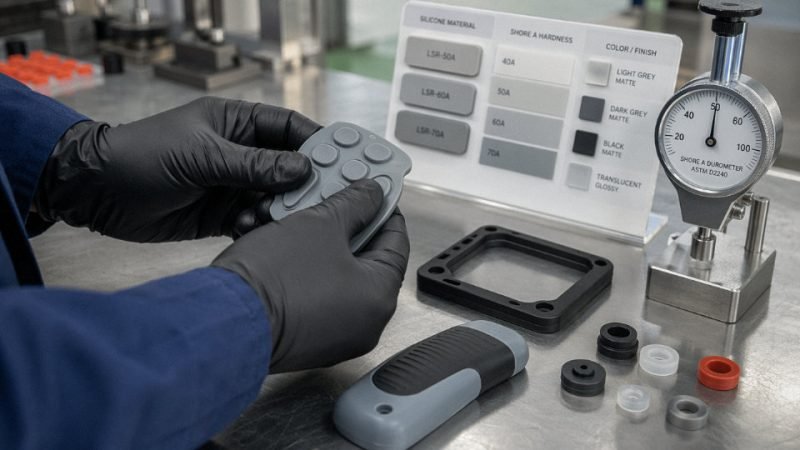
Specifying “rubber feel” on a drawing is where trouble starts. One supplier sends a silky LSR button, another sends a grabby gasket, both technically pass the print, and the line ends up sorting parts by hand while maintenance argues with quality over what “too sticky” means. That turns into missed builds, extra inspection, rejected lots, and sometimes a premium retool or emergency air shipment. The fix is to stop buying by feel alone and tie that feel to Shore A hardness, surface finish, cure condition, geometry, and the job the part has to survive.
Liquid silicone usually feels rubber-like, but not exactly like natural rubber or EPDM. Cured LSR can be silky, grippy, soft, or firm depending on Shore A hardness, surface finish, fillers, and post-cure. Most touch-grade parts sit around 20A to 60A, with the full range roughly 5A to 80A.
The interesting part is that two LSR parts with the same hardness can still feel different in the hand. A thin 40A seal, a thick 40A overmolded grip, and a 40A keypad webbing do not behave the same once you bend, squeeze, heat, wash, or oil them. That is where the material data starts to meet the real world.
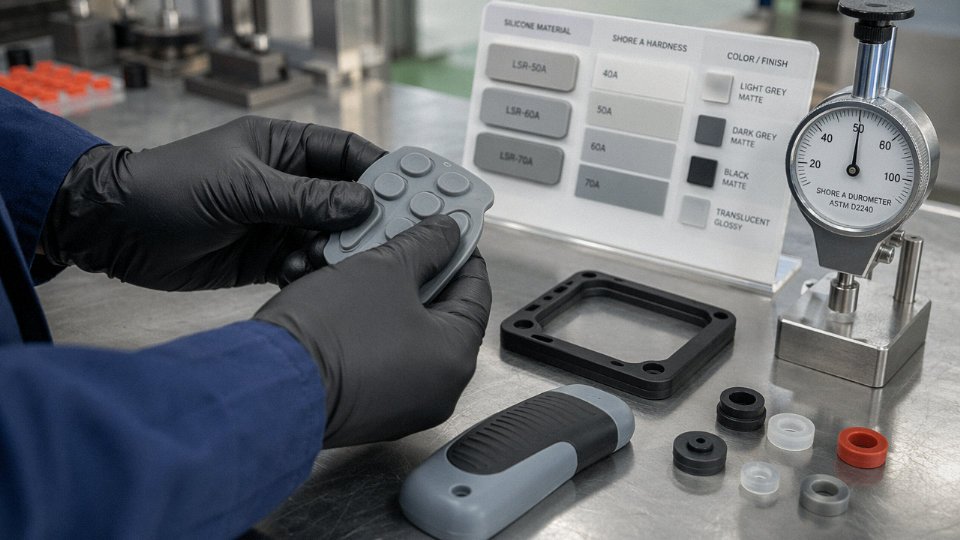
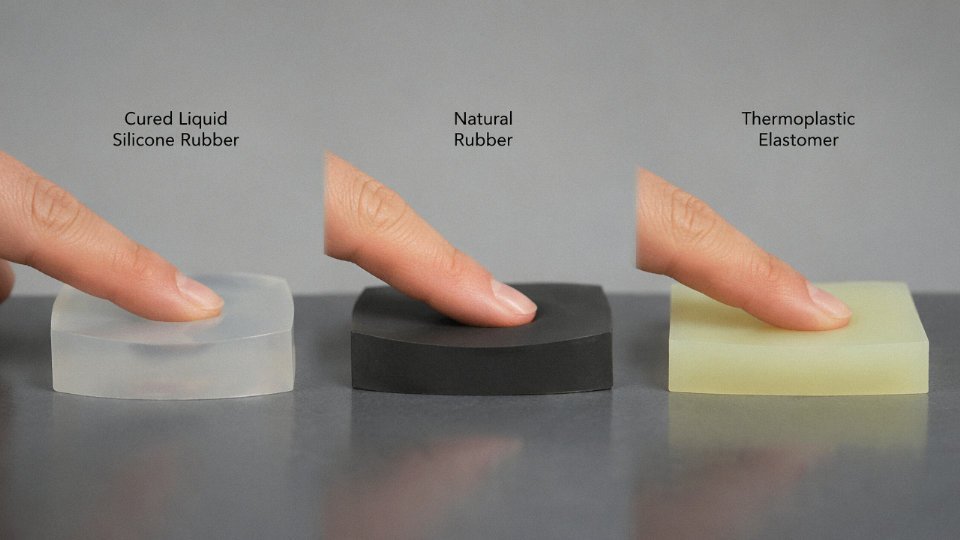
Cured liquid silicone rubber versus natural rubber, thermoplastic rubber, and plastic
Cured liquid silicone rubber is a crosslinked silicone elastomer. That sentence matters because “rubber” gets used loosely on drawings, RFQs, and shop-floor conversations.
Once LSR is cured, it is not a conventional hydrocarbon rubber like natural rubber, nitrile, or EPDM. It is also not a thermoplastic rubber that can be melted, re-ground, and molded again in the usual sense. The curing reaction ties the polymer network together. You can trim it, tear it, burn it if you abuse it, or swell it in the wrong chemical environment, but you do not just heat cured LSR back into flowable pellets.
That is one reason LSR can feel rubber-like in the hand but behave differently in service.
Cured liquid silicone rubber can feel like rubber, but it is not the same material family as natural rubber or most thermoplastic elastomers.True
Cured LSR is a crosslinked silicone elastomer. Natural rubber, nitrile, and EPDM are organic rubber systems, while TPE and TPU grades are usually melt-processable thermoplastics or block copolymers.
Why the feel is different
Natural rubber often feels grippier. Sometimes tackier. On a handle, foot pad, or gasket lip, it tends to have higher surface drag, especially when the compound is soft and freshly molded. That grip can be useful. It can also be a nuisance. I have seen natural rubber parts pick up carton dust, talc, lint from gloves, and every loose shaving near a trimming bench.
Silicone usually feels drier or silkier, especially in common consumer-touch grades around 20A to 60A Shore A. Very soft LSR, down near 5A to 20A, can feel gel-like or fleshy. Harder grades toward 70A to 80A feel closer to a firm gasket rubber, but still with that silicone surface character. Mold finish changes the result more than buyers expect. A polished tool can give silicone a slightly draggy, skin-like feel; a fine matte texture can make it feel powdery and dry without any powder at all.
Thermoplastic elastomers sit in the middle. Many TPEs are designed to feel rubber-like, and for overmolded grips they can be excellent. But they may soften in a hot truck, show oil or plasticizer migration, or rebound with a more plastic snap than a true cured rubber. TPU is tougher and more abrasion-resistant than many soft TPEs, but it often has a denser, springier feel. Flexible PVC can feel soft and cheap or surprisingly pleasant, depending on plasticizer package, but it ages in its own way. Old PVC cable jackets tell the story: stiffening, sweating, odor, and sometimes a sticky surface.
Comparison of common soft materials
| Material | Common tactile feel | Typical Shore A range | Odor tendency | Temperature behavior | Common applications |
|---|---|---|---|---|---|
| Cured liquid silicone rubber | Silky, dry, sometimes powdery; soft grades can feel skin-like | About 5A to 80A; consumer-touch grades often 20A to 60A | Usually low after proper post-cure; some peroxide systems can smell if not processed well | Roughly -50°C to 200°C, depending on formulation and exposure time | Baby products, medical parts, seals, keypads, kitchenware, electrical boots |
| Natural rubber | Grippy, elastic, sometimes tacky | Around 30A to 90A, compound-dependent | Mild rubber odor to strong sulfur smell | Good flex at low temperature; heat aging often limits use around 80°C to 100°C | Anti-vibration mounts, bands, pads, tires, general molded goods |
| Nitrile rubber | Dry to slightly oily feel; less lively than natural rubber | Around 40A to 90A | Moderate rubber odor | Better oil resistance; typical service often around -30°C to 100°C or 120°C | Oil seals, fuel-resistant gaskets, gloves, hoses |
| EPDM | Smooth, rubbery, usually less tacky than natural rubber | Around 30A to 90A | Low to moderate | Strong weather and ozone resistance; often about -45°C to 125°C, sometimes higher | Outdoor seals, automotive weatherstrip, roofing, water-system gaskets |
| TPE, general grades | Rubber-like but often more plastic in rebound | Very broad, roughly 0A gel-like to 90A+ | Can be low, but oil-rich grades may have odor | Can soften with heat; many grades live around -30°C to 80°C or 100°C | Grips, soft-touch overmolding, feet, caps, consumer goods |
| TPU | Tough, springy, dense; can feel slightly slick or draggy | Common soft grades around 60A to 98A; harder grades move into Shore D | Usually low to moderate | Good abrasion resistance; heat can reduce stiffness, often used below about 80°C to 100°C | Wheels, cable jackets, wear pads, protective cases, belts |
| Flexible PVC | Soft plastic feel; can become sticky or stiff with age | Roughly 50A to near rigid, depending on plasticizer | Can have plasticizer or vinyl odor | Cold stiffening and heat softening are common concerns | Tubing, mats, cable jackets, dip-molded grips, low-cost seals |
| Conventional plastic, such as PP or ABS | Hard, slick, not elastomeric | Usually not specified well by Shore A; often Shore D instead | Low to moderate resin smell | Holds shape until heat deflection range, then warps rather than elastically recovers | Housings, clips, covers, brackets |
Recovery, aging, and the procurement trap
A soft part that feels acceptable on a sample table may fail after three months on a machine. This is where cured silicone earns its keep. Many cured LSR grades elongate somewhere around 200% to 700% at break, depending on formulation, filler system, cure, and test method. Natural rubber can also stretch impressively and often rebounds with more snap, but heat, ozone, oils, and UV exposure can cut its life badly unless the compound is chosen carefully.
Wrong material choice shows up as ordinary plant trouble. A TPE foot pad near a warm motor softens, creeps, and the assembly starts walking. A nitrile seal is used in outdoor ozone exposure and cracks sooner than expected. A silicone keypad is specified with the wrong surface finish and operators complain it feels dusty or too slippery with gloves. None of these are exotic failures. They are Tuesday morning problems.
For buyers, the safe question is not “Does it feel like rubber?” Ask for Shore A range, surface finish, odor requirement, service temperature, fluid exposure, compression set target, and whether the part must be recyclable as a thermoplastic. If the supplier cannot answer those without hand-waving, the sample may still look good, but the production risk is sitting there waiting.
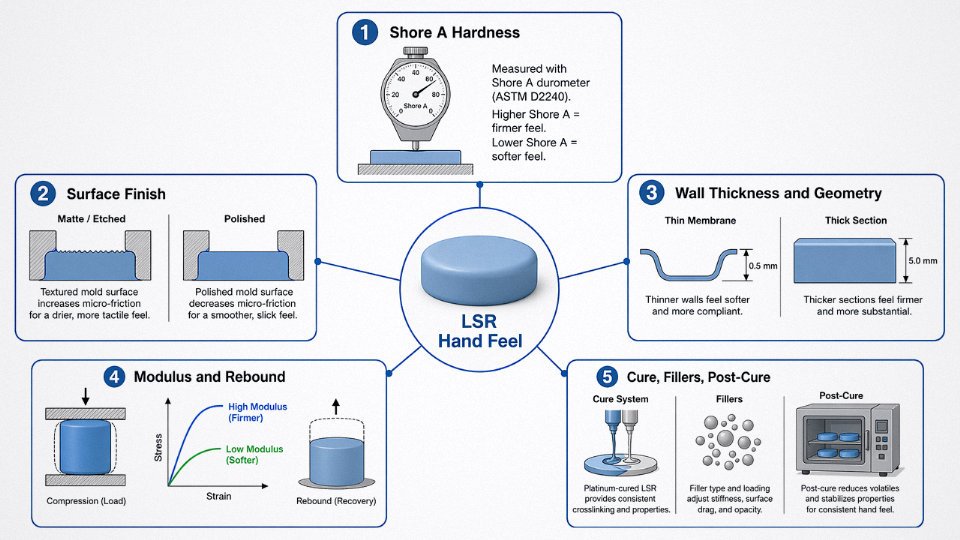
The tactile variables that control whether silicone feels soft, firm, sticky, silky, or rubbery
Shore A hardness is the first dial, not the whole control panel
Most people start with Shore A hardness because it is easy to quote and reasonably easy to test. For cured liquid silicone rubber, the practical range is often about 5A to 80A, depending on formulation and test method. Consumer-touch parts usually sit somewhere around 20A to 60A, give or take.
A 5A to 15A silicone can feel gel-like, almost fleshy, especially in a thick section. Think soft grip pads, cushioning interfaces, or medical contact features where the part needs to deform under light finger pressure. Around 20A to 40A, the feel becomes medium-soft: common for wearables, button covers, ear-contact parts, and seals that still need a pleasant touch. By 50A to 70A, silicone starts to feel firm and engineered rather than soft. That range is common for gaskets, appliance seals, valve parts, protective boots, and keypad structures that must hold shape under repeated use.
The catch: Shore A is measured with a small indenter under defined conditions. Your thumb is not a Shore durometer. Your thumb loads a larger area, slides across the surface, feels temperature, and notices whether the part springs back or drags.
Two silicone parts with the same Shore A hardness can feel noticeably different in the hand.True
Shore A measures indentation resistance under a standard test setup, but hand feel is also affected by compression modulus, rebound, surface finish, part geometry, fillers, coatings, and wall thickness.
Modulus, rebound, elongation, and tear strength change the feel under load
Compression modulus is often the missing number in early RFQs. Two 40A silicones may both pass a hardness check, yet one compresses with a smooth cushion feel while the other pushes back quickly and feels dense. That matters on parts like face seals, grips, wearable straps, and overmolded buttons. If the user presses it every day, they will notice.
Rebound resilience also changes the perception. High-rebound silicone feels lively and elastic, almost springy. Lower-rebound material feels more damped. Neither is automatically better. A keypad dome or actuator interface may need a crisp return. A vibration isolator, soft foot, or anti-rattle pad may benefit from a quieter, less bouncy response.
Elongation at break for many cured liquid silicone rubber grades lands roughly around 200% to 700%, with specialty grades outside that range. High elongation helps the part stretch without tearing, but the hand may read it as “stretchy rubber” rather than “firm silicone.” Tear strength is the practical partner to elongation. A very soft grade with poor tear resistance can feel nice in a sample plaque and then split around a sharp post, thin lip, or poorly vented mold witness line. I have seen purchasing teams approve the softer sample, then production fights edge tearing for months. Soft is not free.
Wall thickness can fool the finger
Geometry changes everything. A thin 60A keypad web may feel flexible because the section bends easily. A thick 40A block may feel firm, heavy, and resistant because there is enough material under your finger to build compression force.
That is why sample plaques are useful but dangerous. A 2 mm test slab does not tell the full story for a 9 mm grip sleeve, a 0.6 mm sealing lip, or a hollow wearable button. The same compound can feel silky and compliant in a thin membrane, then oddly dead in a thick boss.
Typical shop-floor scenario: engineering approves a 50A silicone on a flat color chip. The molded part later has thick ribs under the touch zone, so the button feels stiff and slow. Tooling asks for rib thinning or coring, procurement asks if a softer grade will fix it, and production worries about flash because the softer grade flows and vents differently. The right answer may be geometry, not material substitution.
Surface finish often decides whether it feels dry, sticky, silky, or cheap
The mold surface is a tactile tool. A high-polish cavity can produce gloss and a smoother sliding feel, but it also shows fingerprints, oil marks, and flow-related cosmetic defects more readily. Matte blasting gives a drier touch and hides handling marks better, though aggressive texture can increase drag or make the part feel dusty. Fine etched finishes can make a wearable strap feel less tacky against skin, especially in warm weather.
Post-applied coatings are another lever. A silicone part can be coated to reduce friction, improve abrasion resistance, change gloss, or create a dry-touch feel. Some coatings feel excellent on day one but become a warranty issue if adhesion is weak around flex zones, sharp corners, or areas exposed to sweat, sunscreen, hand sanitizer, or cleaning chemicals. Always test the coated part in its real bend radius, not just on a flat coupon.
A practical warning: silicone attracts dust more than many hard plastics, especially when the surface has high drag or slight oil migration. In assembly areas, cardboard dust, glove powder, and stray fibers show up fast. Cleanroom handling, ionized air, packaging film choice, and operator habits can affect perceived quality before the customer ever touches the product.
Fillers, pigments, additives, and oil bleed control shape the final skin feel
Silica fillers are central to silicone reinforcement, but filler type and loading influence stiffness, tear strength, translucency, and surface drag. Pigments can shift feel slightly too, not in a magical way, but through dispersion, loading, and interaction with the base compound. Dark matte silicone often hides scuffs better; light colors can make dust and skin oils painfully obvious.
Additives are where the formulation becomes very application-specific. Self-lubricating grades can reduce squeak, assembly force, and surface friction. That may be useful for seals sliding over plastic or metal, but it can be wrong for a grip that must not feel slippery. Oil bleed control is just as serious. Too much migration and the part feels greasy, contaminates packaging, or causes bonding and painting trouble nearby. Too little lubrication and a dynamic seal may chatter, wear, or squeak.
This is why a good silicone specification should not stop at “40A, black.” For a tactile part, call out hardness range, surface finish, texture target, coating requirement if any, key mechanical properties, and real-use exposure: skin contact, sweat, UV, dishwashing, steam, oils, or assembly lubricants. That short list prevents a lot of expensive guessing.
Why liquid silicone rubber often feels smoother and cleaner than ordinary rubber
A lot of the “clean” feel people notice in cured liquid silicone rubber comes from the chemistry, not from surface polishing alone. Ordinary rubber materials are often built around carbon-based polymer chains, with sulfur cure systems, oils, waxes, antioxidants, processing aids, and sometimes carbon black. Those ingredients are useful. They make tires, seals, grips, and vibration mounts work. But they can also bring odor, blooming, staining, and that slightly greasy or dusty hand feel you see on older rubber parts sitting in a maintenance crib.
Liquid silicone rubber is different. Its main polymer chain is based on silicon and oxygen, with organic side groups attached. In plain plant-floor language: the backbone is very flexible, and it does not stiffen as aggressively in cold conditions or break down as quickly under heat as many general-purpose rubbers. That is why cured LSR can stay rubbery across roughly -50°C to 200°C, depending heavily on formulation, post-cure, pigment package, part thickness, and the exposure environment. A thin kitchen seal, an automotive connector gasket, and a platinum-cured medical component may all be “silicone,” but they are not the same part in service.
That flexible backbone also helps explain why LSR can feel soft without feeling oily. Many consumer-touch grades land somewhere around 20A to 60A Shore A, while the broader LSR market runs from about 5A to 80A. At the low end, it can feel almost gel-like. Around the middle, it feels like a smooth elastomer button, baby-product surface, or seal lip. At the high end, it still bends, but it feels more like a firm technical rubber than a cushion.
Odor, aging, and why old rubber often loses the contest
Cured LSR usually has low odor and low taste transfer when properly formulated and processed. That matters in anything handled near food, skin, electronics, or packaging. I have seen otherwise decent rubber parts rejected at incoming inspection because the bag smelled like a tire shop after a hot truck ride. The parts measured fine, but the customer would not accept them.
Silicone is not magic, but it tends to resist hardening, cracking, and surface oxidation under heat and UV better than many ordinary elastomers. Natural rubber and some thermoplastic elastomers can age into a harder, shinier, cracked surface, especially near motors, windows, ovens, outdoor bins, or UV-curing stations. The wrong material choice here shows up later as seal leaks, customer complaints, crumbling grip surfaces, or higher replacement frequency. The right silicone grade can run longer before that aging becomes visible or tactile.
There is a cost side, of course. LSR tooling, molding process control, and raw material pricing can be less forgiving than commodity rubber. But if the part lives in heat, sees sunlight, touches skin, or sits in inventory for months before assembly, the aging behavior often pays back quietly.
Low surface energy changes the way your fingers read the surface
Silicone has low surface energy. That phrase gets thrown around, but the shop-floor effect is simple: water beads on it, many materials do not want to stick to it strongly, and it releases from a mold more easily than many elastomers. Your fingers interpret that as smoother, cleaner, and less draggy.
This same property is why silicone can be annoying in secondary operations. Printing, bonding, painting, or applying labels to silicone is not like decorating ABS plastic. You may need plasma treatment, primers, special inks, controlled surface age, or a bonding process qualified with real production parts, not just lab coupons. I have watched teams approve a beautiful sample, then fight peeling graphics three weeks later because the surface treatment window was missed during production.
Low surface energy also affects dust behavior in a slightly contradictory way. A typical cured silicone surface does not wet out dirt the way an oily rubber surface might, so dust can rinse or wipe off easily. Water beads rather than spreading. Mold release is often clean. Yet very soft silicone can still grab lint because it has high contact area and microscopic compliance. A polished mold finish can make the part look glassy but feel grabby. Under-cure, contamination from handling gloves, excess mold release, or a formulation designed for high grip can make LSR feel tacky instead of silky.
So yes, silicone often feels cleaner. Not always.
Cleaner feel is not the same as certified safe
A smooth, low-odor silicone part is automatically food-safe or medical-grade.False
Tactile feel does not prove compliance. Food-contact and medical applications depend on the exact formulation, cure system, post-cure conditions, extractables, traceability, cleanliness, packaging, and the applicable regulatory testing.
This is where procurement and engineering teams need to stay disciplined. “Platinum-cured,” “food grade,” “medical grade,” and “biocompatible” are not decorative words for a datasheet. They need supporting documentation, process controls, and change notification rules. A supplier can make two parts that feel almost identical, one suitable for a kitchen spatula or bottle valve and one completely inappropriate because of pigment, additive package, mold release practice, or uncontrolled post-processing.
For production approval, I would look beyond the first touch sample. Ask for the grade name, compliance declarations, cure and post-cure requirements, hardness tolerance, extractables data where relevant, and packaging controls. Then test parts after aging, washing, sterilization, assembly handling, or whatever abuse the real product will see. A silicone part that feels clean on day one but picks up lint on the packing bench or smells after hot storage is not a material success. It is a validation miss.
How manufacturing choices change the feel of a liquid silicone part
The same liquid silicone rubber grade can come out feeling like a soft medical seal, a dry kitchen grip, or a slightly tacky dust magnet. The difference is often not the polymer data sheet. It is the way the part was molded, cured, handled, and packed.
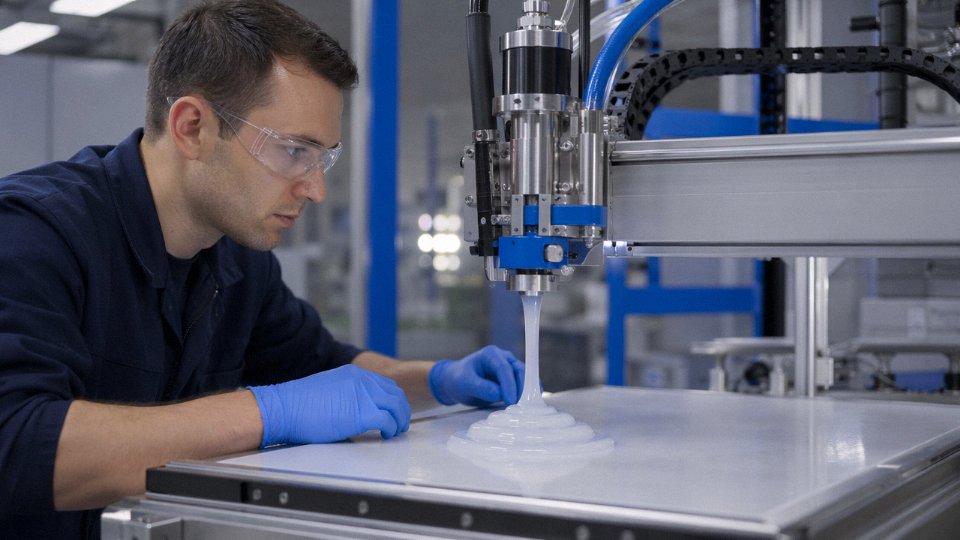
Liquid injection molding looks clean on a process diagram, but on the floor it is a chain of small decisions. Two liquid components are metered, usually at a fixed A:B ratio, pushed through a static or dynamic mixer, injected into a heated mold, cured under heat and pressure, demolded, then inspected. Some parts go through post-curing in an oven. Some get surface treatment, coating, or only a clean-room bag. Each step can leave a fingerprint on touch quality.
Process settings show up in the hand
Mold temperature is one of the first places I look when a silicone part feels inconsistent. Typical liquid silicone molds run hot, often somewhere around 150°C to 220°C, depending on the formulation, wall thickness, tool steel, and cycle-time target. Too cool, and the surface may cure slowly or unevenly. You can get a skin that feels slightly draggy, with weak areas around thick sections or far flow ends. Too hot, and thin edges may scorch, gloss can shift, and the part may feel harder than expected even when the Shore A reading still passes.
Cure time is just as touch-sensitive. A thin keypad web might cure in seconds; a bulky grommet or bottle nipple section may need much longer. If production chases cycle time too aggressively, under-cure can show up as a greasy feel, odor, poor tear strength, or a part that slowly takes a compression set after assembly. If the cure window is pushed too far the other way, some grades lose a little softness and the surface can feel drier, stiffer, or less lively. Not always bad. It depends on the product.
Injection pressure and speed affect feel less directly, but they control what the surface looks and feels like after filling. High shear through small gates can create visible flow marks or localized texture changes. Low pressure or poor fill balance can leave knit lines where two flow fronts meet. On a seal, that line may be a leak path. On a wearable product, it may be the tiny ridge the user keeps rubbing with a thumb.
Venting is a plain old tooling issue that still causes expensive scrap. Air trapped at the end of fill creates shiny burn marks, dull patches, bubbles, or soft voids under the skin. Operators may compensate by spraying more mold release. That usually makes the tactile problem worse.
Tool surface is not cosmetic only
A polished cavity gives silicone a smooth, glossy, sometimes slightly grippy surface. It is useful for parts that must release easily or be cleaned, but it can feel too sticky on broad contact areas. A bead-blasted cavity gives a fine matte texture. In practice, that often feels drier and less clingy, though it can pick up dust if the texture is too open.
Chemically etched textures are common for consumer grips and handheld products because they break up the contact patch between skin and silicone. Laser textures offer tighter control, especially for repeatable micro-patterns, logos, and zones with different tactile response on one part. They cost more upfront and need cleaner tool maintenance; a careless polish during repair can ruin the texture match.
Coating systems are the stronger medicine. A silicone part can be coated for lower friction, color, abrasion resistance, or a “velvet” soft-touch finish. Coatings solve real problems, but I treat them as an added manufacturing process, not a magic top layer. Adhesion depends on surface cleanliness, plasma or primer treatment, cure condition, and handling. A coating that feels beautiful on day one but wears through at the grip edge after a few months is worse than no coating at all.
Post-cure can change odor and perceived dryness
Post-curing usually means holding molded parts in a hot-air oven, often around 150°C to 200°C for a few hours, depending on grade, wall thickness, regulatory requirement, and supplier guidance. It can drive off low-molecular-weight volatiles, reduce odor, and stabilize certain mechanical properties. For food-contact, infant-care, or medical-adjacent products, buyers often ask about this step because the nose is an inspection tool whether engineers like it or not.
Post-curing can make some liquid silicone rubber parts feel drier and cleaner to the touch.True
Post-curing can reduce volatile residues and complete aspects of the cure system, but the effect depends on formulation, part thickness, oven airflow, time, temperature, and whether the surface was contaminated before the oven step.
The catch is oven practice. Parts stacked too deep in trays do not see the same airflow. Heavy sections lag behind thin ribs. If an oven is used for mixed materials or dirty fixtures, silicone can absorb odors and come out worse than it went in. I have seen good molded parts ruined by packaging them hot in low-grade plastic bags; the surface picked up odor and a faint film before final inspection.
Defects that make silicone feel wrong
A procurement sample may feel perfect while production parts feel patchy. That is often a defect-control issue, not a material substitution.
| Production issue | What the hand may notice | Likely consequence |
|---|---|---|
| Under-cure | Greasy, weak, rubbery in a bad way | Tear failures, odor complaints, assembly deformation |
| Over-cure or hot spots | Drier, harder, less elastic | Fit problems, reduced comfort, possible color shift |
| Contamination | Grit, fisheyes, random tacky spots | Cosmetic rejects, sealing risk, customer returns |
| Excessive mold release | Oily or waxy surface | Poor coating adhesion, dust pickup, inconsistent feel |
| Knit lines | Fine ridge or dull flow mark | Wear point, leak path, visual rejection |
| Air traps | Blisters, pits, soft pockets | Scrap, field rupture, poor tactile uniformity |
| Flash | Sharp thin edge, especially on parting lines | Trimming labor, user irritation, assembly jams |
| Texture mismatch | One area smoother or glossier | Perceived poor quality even if dimensions pass |
Part geometry ties all of this together. Thick-to-thin transitions, hidden undercuts, long flow paths, and sharp parting-line steps make tactile control harder. A 30A silicone button with even walls and good venting can feel consistent all day. The same hardness in a deep, ribbed, multi-gate part may feel different from corner to corner.
That is why a serious LSR specification should not stop at Shore A hardness and color. Call out the surface finish, post-cure requirement if needed, acceptable flash height, mold release policy, odor expectations, and packaging method. The hand will find what the drawing forgot.
Real-world feel examples: baby goods, wearables, medical parts, kitchenware, and industrial seals
A good way to understand liquid silicone rubber feel is to stop thinking about “rubber” as one touch sensation. A baby bottle nipple, a smartwatch strap, a respirator seal, and an industrial connector gasket may all be silicone, but they are not designed to feel the same. The formulation, hardness, wall thickness, surface finish, cure condition, and even how the part is washed before packing all show up in the hand.
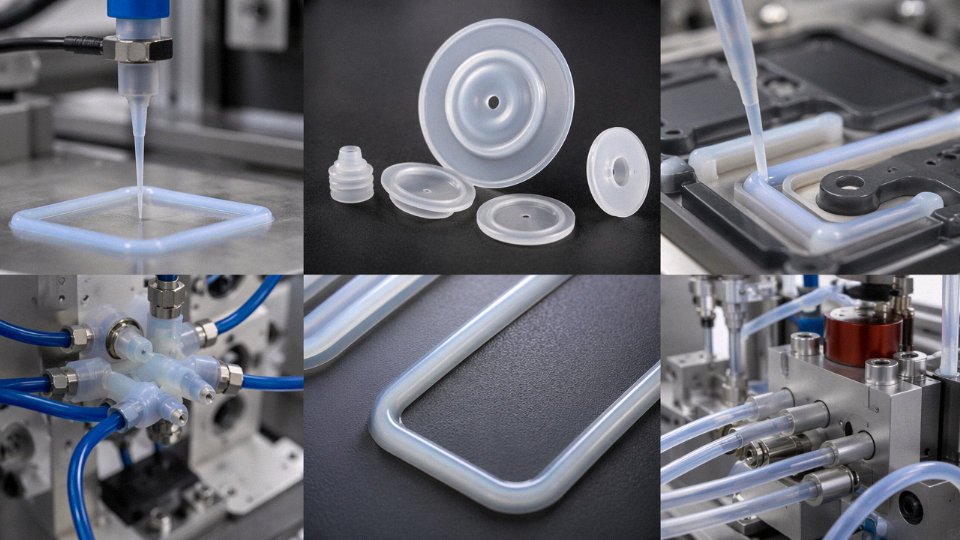
Baby goods: soft, elastic, low-odor, and repeatable
Baby bottle nipples, pacifiers, and feeding accessories are probably the clearest consumer example of silicone being selected for feel rather than just function. These parts usually need a soft elastic response, not a gummy collapse. In practice, many mouth-contact grades sit somewhere in the softer-to-mid Shore A range, often roughly 20A to 50A depending on nipple flow design, wall thickness, vent geometry, and the brand’s target feel.
The big difference from many ordinary rubbers is odor and taste perception. Cured liquid silicone rubber can be made with very low extractables and a clean surface feel, which matters when the part is warmed, sterilized, chewed, and handled by tired parents at 2 a.m. A nipple that is too soft can invert, tear early, or give inconsistent flow. Too firm and it feels unnatural, especially for newborn products.
One practical warning: molding consistency matters a lot here. A small cure variation, poor venting, or contamination from mold release can change the perceived mouthfeel even if the hardness number looks acceptable on the certificate.
Wearables: skin contact changes the target
Wearable straps, earbuds, mask seals, and watch components are judged after hours against skin, not after a quick squeeze at a trade show. Sweat, sunscreen, sebum, soap residue, and repeated flexing all affect the user’s opinion. A strap that feels pleasantly dry in the factory sample room can feel draggy in summer humidity.
For these products, silicone is usually chosen because it can be flexible without needing the same plasticizers used in many soft plastics. That helps with low irritation potential, though “skin-safe” still depends on the exact compound, pigments, post-cure, cleaning process, and regulatory testing. Earbud tips often use softer grades for seal and comfort. Watch straps may use firmer grades to resist stretching around the buckle holes. Mask seals sit in the awkward middle: soft enough to conform to the face, stable enough not to roll or leak.
Liquid silicone rubber always feels softer than natural rubber.False
Silicone can be molded from very soft to fairly firm grades. Typical liquid silicone rubber spans about 5A to 80A Shore A, with many consumer-touch parts around 20A to 60A. The actual feel also depends on wall thickness, texture, and surface treatment.
Medical components: tactile consistency is part of performance
Medical silicone parts include seals, valves, tubing, pump diaphragms, respiratory masks, syringe components, and wearable device interfaces. Here, feel is rarely only a comfort issue. It affects sealing, assembly force, tubing kink behavior, and how confidently a clinician can seat or remove a component.
Biocompatibility requirements drive material selection. Depending on the application, buyers may ask for USP Class VI, ISO 10993 data, food-contact compliance, traceability, or extractables and leachables work. Sterilization compatibility is another filter. Some silicone grades tolerate steam autoclave, ethylene oxide, or gamma exposure better than competing elastomers, but the details are formulation-dependent. Gamma can shift properties in some materials. Steam can expose weak bonding or poor cure. I have seen tubing lots that passed incoming hardness checks but behaved differently on pump rollers because recovery and surface drag were not the same.
Typical cured liquid silicone rubber elongation at break often lands around 200% to 700%, depending on grade and cure. That wide range matters for valves and masks. A face mask seal needs soft recovery. A slit valve needs repeatable opening pressure. Same family of material, very different shop-floor acceptance tests.
Kitchenware: dry touch under heat
Spatulas, bakeware, pan grips, utensil handles, and food-contact seals show another side of silicone. The user feels a dry, slightly flexible surface that does not soften like many thermoplastics near a hot pan. Cured liquid silicone rubber commonly handles service temperatures in the rough range of -50°C to 200°C, depending on formulation, exposure time, filler package, and whether the part is under load.
That temperature behavior is why silicone spatulas do not get waxy or visibly melt under normal cooking contact the way low-grade plastic tools can. The hand feel is not always luxurious, though. A heavily filled, high-temperature compound can feel firmer and less silky. Matte tooling can give grip; polished tooling can feel cleaner but slippery with oil. For bakeware, designers often balance release performance against the user’s desire for stiffness. Too floppy and the muffin tray becomes a spill risk.
Industrial seals: feel is almost beside the point
Industrial gaskets, connector seals, vibration dampers, cable boots, and protective covers may feel rubbery, but nobody competent specifies them by thumb feel alone. The buying criteria are compression set, sealing force, temperature range, chemical exposure, tolerance stack-up, and life under compression.
A soft connector seal may feel excellent during assembly, yet fail if it takes a set after months in a hot enclosure. A firmer gasket may feel less “premium” but hold sealing load better across thermal cycling. For outdoor electrical connectors, silicone is often chosen for flexibility in cold weather and stability in heat. For oil, fuel, certain solvents, or aggressive cleaning chemicals, the answer may be another elastomer entirely. Silicone is good, not magic.
Typical decision logic looks like this:
| Product type | Desired feel | Why silicone is selected | Watch-out |
|---|---|---|---|
| Baby nipple or pacifier | Soft, elastic, low odor | Clean mouthfeel and repeatable flex | Tear strength and cure consistency |
| Wearable strap or seal | Dry, flexible, skin-friendly | Sweat resistance and comfort over time | Surface tack, lint pickup, pigment compliance |
| Medical valve or tubing | Consistent recovery | Biocompatibility and sterilization options | Lot-to-lot feel and functional testing |
| Kitchen tool | Dry, heat-stable grip | Does not soften like many plastics | Floppiness, oil slip, filler effects |
| Industrial gasket | Secondary to sealing behavior | Thermal stability and compression recovery | Compression set and chemical compatibility |
How to evaluate silicone feel objectively before approving a product
“Feels right” is not a specification. It is a meeting-room opinion unless you tie it to measurable limits, reference samples, and a repeatable approval routine. I have seen good silicone projects drift badly because the first sample was judged by one buyer under office lighting, then the production parts arrived from a polished tool with a different cure profile and a slightly oily hand. Nobody had a number to point to.
Build a tactile specification before asking for samples
Start with a short tactile specification, not just a drawing note that says “soft silicone.” For cured liquid silicone rubber, Shore A hardness commonly sits anywhere from about 5A to 80A, with many consumer-touch parts in the 20A to 60A range. Pick a target and tolerance based on function: a wearable skin-contact pad might need 25A to 35A, while a sealing rib on an industrial connector may need 50A to 70A depending on squeeze, groove design, and assembly force.
A useful feel specification usually includes:
| Item to specify | Practical target or control method | Why it matters on the floor |
|---|---|---|
| Shore A hardness | Target plus tolerance, often ±3A to ±5A depending on grade and test method | Controls perceived softness and compression behavior |
| Surface finish | Tool texture reference, SPI finish, or roughness range | Changes drag, gloss, and “silky” feel |
| Coefficient of friction | Static and dynamic target range, tested against skin, glass, metal, or mating plastic as relevant | Prevents surprise stickiness or slip |
| Color | Approved masterbatch, visual standard, and acceptable delta E if measured | Pigment can change cure behavior and customer perception |
| Gloss | Visual limit sample or gloss meter target, depending on surface | High gloss often feels tackier even when chemistry is unchanged |
| Odor | Closed-container sniff test, VOC method, or agreed odor rating after cure and post-cure | Odor complaints are hard to fix after launch |
| Defects | Limits for flash, flow marks, bubbles, knit lines, contamination, gate vestige, short shots | Small defects become big arguments at incoming inspection |
Do not bury these in email threads. Put them in the control plan, purchase specification, or quality agreement.
A silicone part with the same Shore A hardness can still feel very different if the surface texture, cure condition, and friction behavior are changed.True
Hardness measures indentation resistance, not surface drag, gloss, tack, or microtexture. Those variables strongly affect hand feel in molded silicone parts.
Test the material, then test the molded part
The normal lab stack is not exotic. Use durometer hardness, usually ASTM D2240 or an ISO equivalent, with attention to specimen thickness and dwell time. Thin parts can read falsely hard if tested over a bench top, so use stacked plaques only when the standard allows it and record how it was done.
Tensile strength and elongation, commonly ASTM D412, tell you whether the part has enough stretch margin. Many cured liquid silicone rubber grades run roughly 200% to 700% elongation at break, though specialty grades can sit outside that band. Tear strength, often ASTM D624, matters for thin lips, pull tabs, cable boots, and any feature an operator may nick with a fingernail during assembly. Compression set, such as ASTM D395, is the one seal buyers forget until the field returns start. Heat aging and cold exposure should reflect the actual duty cycle; cured LSR can often serve around -50°C to 200°C, but the usable window depends on formulation, pigment, post-cure, load, and media contact.
For tactile work, add friction or tack testing. A simple sled test against stainless steel, ABS, glass, fabric, or a skin substitute is often better than no test at all, as long as load, speed, contact area, cleaning method, and humidity are fixed. In a humid coastal plant, silicone surfaces can feel different than they do in a dry winter warehouse. That is not theory. Operators notice it.
Visual inspection still earns its place. Use defined lighting, viewing distance, magnification where needed, and limit samples. A tiny flow line on an internal seal may be irrelevant; the same mark on a premium handheld product will trigger rejection.
Run a controlled hand-feel panel, not a hallway vote
Hand feel can be evaluated with discipline. Use blind comparisons with coded samples, not supplier labels. Include reference parts: one too soft, one too hard, one too tacky, one acceptable. Give the panel a controlled vocabulary: soft, firm, dry, silky, grippy, sticky, waxy, oily, draggy, powdery. Avoid “premium” and “cheap”; those words create noise.
Keep the room consistent. Temperature around normal office conditions is fine, but record it, because silicone stiffness and surface drag shift with temperature. Use the same lighting, since gloss and color bias the hand. Have participants wash and dry hands with the same unscented soap, then wait a few minutes. No hand lotion. No machine oil from the maintenance bay. If samples were cleaned with isopropyl alcohol, let them flash off fully before testing.
A typical panel of five to ten trained people is enough for early direction. For final approval, include engineering, quality, procurement, and one person who actually handles the part in assembly if the product is plant-installed. That last person often catches the real problem first.
Sample plaques help, but molded geometry decides
Supplier plaques are useful for screening hardness, color, odor, and baseline friction. They are not proof that the production part will feel the same. The final geometry changes wall thickness, cooling, knit areas, gate location, flash trimming, and surface contact. A 2 mm skin over a ribbed structure can feel firmer than a flat plaque of the same compound. A high-polish cavity can make an otherwise dry-touch silicone feel grabby. Post-cure time, mold temperature, and release practices can shift odor and surface feel as well.
Validate from the production-intent tool whenever possible. Prototype aluminum tooling can mislead if the final steel tool has a different texture, venting strategy, or parting-line condition.
Approval checklist for production release
Use this before signing the purchase order or production part approval:
- Golden sample approved by engineering, quality, procurement, and the customer-facing owner if applicable.
- Limit samples created for hardness feel, gloss, color shift, flash, bubbles, flow marks, and contamination.
- First article inspection includes dimensions, Shore A hardness, visual defects, color, gloss, odor, and friction or tack where specified.
- Mechanical test report covers tensile strength, elongation, tear strength, and compression set if the part seals or flexes.
- Aging plan agreed: heat, UV, chemical contact, cleaning agents, or sterilization cycle as relevant.
- Packaging checked, since bag liners, cardboard dust, and long storage under compression can change first-touch feel.
- Lot-to-lot controls defined, including incoming inspection frequency and what happens when a lot lands near the edge of tolerance.
The wrong approval method creates arguments later. The right one gives procurement a clear buying standard and gives the plant a part that feels the same on Tuesday night shift as it did in the conference room.
Common misconceptions about silicone feel, safety, and quality
“Liquid silicone” is not liquid after molding
The name causes trouble. Liquid silicone rubber starts as a pumpable two-part material, usually metered through a static mixer and injected into a heated mold. Once the platinum-catalyzed cure reaction crosslinks the polymer, the finished part is no longer liquid in any practical sense. It is a cured elastomer.
That distinction matters in purchasing and quality discussions. A molded silicone gasket that feels “wet,” leaves residue on packaging, or transfers oily film onto a worker’s glove is not behaving that way because “it is liquid silicone.” Something else is going on: under-cure, contamination, incompatible mold release, excess low-molecular-weight siloxanes, or a finishing step that was skipped or poorly controlled.
In a decent molding operation, the part comes out flexible, elastic, and stable. Not oily. Not leaking. Not “still curing on the shelf.”
Liquid silicone rubber remains liquid in the finished product.False
The uncured raw material is liquid or paste-like, but the finished molded part is a crosslinked elastomer after heat curing. A wet or oily surface usually points to processing, formulation, or contamination issues.
Silicone is not automatically soft, safe, or premium
People hear “silicone” and assume a soft, skin-safe, high-end material. Sometimes that is true. Sometimes it is just a word on a drawing or sales sheet.
Cured liquid silicone rubber can be made very soft or fairly firm. Typical grades run roughly from about 5A to 80A Shore A, while many consumer-touch parts sit somewhere around 20A to 60A. The final feel depends on the grade, filler package, cure system, surface texture, part thickness, and post-processing. A 70A silicone button can feel closer to a firm industrial rubber pad than a baby pacifier. Same family of material, very different hand feel.
Safety claims need the same discipline. “Medical-grade” is not a mood. “Food-grade” is not a color. “Hypoallergenic” is not guaranteed because the part feels smooth.
For procurement, the practical question is: certified to what standard, for which color, thickness, supplier site, and intended use? Food-contact claims may involve regulations such as FDA or LFGB-type testing, depending on market. Medical claims may require biocompatibility testing, extractables work, traceability, and controlled processing. A pigment change can break the assumption. So can a new subcontract molder.
A typical mistake: a buyer approves a soft black silicone sleeve based on a nice sample, then later sources a cheaper colored version for a wearable device without checking pigment compliance or skin-contact testing. The first production lot feels similar. The paperwork does not. That gap becomes a launch delay, a field complaint risk, or an awkward conversation with the customer’s compliance team.
Smell is not proof of real rubber or better quality
Old-school natural rubber and some thermoplastic rubbers often have a noticeable smell. Many people associate that odor with “real rubber.” On the plant floor, I have heard inspectors say a part “smells rubbery, so it must be good.” That is a poor test.
Properly processed silicone is usually valued because it has low odor, especially after suitable cure and, where required, post-cure. A strong chemical, sour, burnt, solvent-like, or oily smell is more often a warning sign than a badge of authenticity. It may come from poor cure, residual volatiles, incompatible additives, dirty handling bins, packaging contamination, or overheating during molding.
Odor limits are not universal. A kitchenware part, a mask seal, and an industrial cable grommet do not need the same standard. Still, if a silicone part smells stronger after a few days in a sealed bag, I would not wave it through without checking cure state, volatile content, and storage conditions.
Dust pickup does not always mean poor quality
Soft silicone can attract lint. That frustrates brand teams, especially on black parts photographed under bright inspection lights.
Dust attraction is not automatically a quality failure. Very soft or high-grip silicone surfaces tend to pick up fibers because of surface tack, surface energy, and static effects. A matte texture can hide fingerprints but still trap lint in the microtexture. A glossy high-grip surface may feel excellent in the hand and look dirty after one shift near corrugated cartons.
The right response depends on the application. For a wearable strap, a little lint pickup may be acceptable if the skin feel is right and the part washes clean. For a medical component packed in a clean pouch, the same behavior may be unacceptable. Engineers can reduce pickup by changing hardness, texture, coating, handling method, ionized air use, packaging film, or cleaning procedure. There is no free lunch: the treatments that make a surface less tacky may also make it feel less soft or reduce grip.
Cheap substitutes and weak processing show up in the hand
Bad silicone usually announces itself before the lab report arrives. It may feel greasy, overly grabby, chalky, brittle at thin edges, or oddly plastic-like. The smell may be the bigger giveaway.
Common causes are familiar: low-cost imitation elastomers sold as silicone, poorly mixed two-part material, under-cured compounds, inappropriate pigments, excessive processing aids, dirty regrind-like contamination from nearby thermoplastic work, or missing post-cure where the grade and application require it. Some failures are subtle. A seal may pass incoming visual inspection, then take a compression set in service and leak after a few heat cycles.
Wrong choice, real cost.
A silicone part expected to survive heat near 180°C should not be sourced only by color and softness. Many cured LSR grades can handle roughly -50°C to 200°C, but that range depends heavily on formulation, exposure time, load, chemicals, and air versus fluid contact. Pick the wrong grade and the first symptom may be odor, hardening, swelling, or a maintenance crew changing seals twice as often as planned.
For owners and procurement teams, the safest habit is boring but effective: lock the grade, color masterbatch, cure conditions, post-cure requirement, approved molder, and test standard in the purchase specification. A soft sample on a conference table is useful. It is not a quality system.
Buying and specification guidance: choosing the right silicone feel for your application
Specifying liquid silicone rubber by saying “soft” or “rubbery” is asking for trouble. Those words mean different things to a design engineer, a buyer, a mold maker, and the person who has to answer customer complaints six months after launch. Start with the job the part has to do, then tune the feel around that job.
Match the feel to the function
For wearables, the usual target is a silky grip: soft enough to avoid pressure marks, dry enough not to drag on skin, and stable after sweat, sunscreen, and repeated washing. Many wrist-worn or skin-contact parts land somewhere around 20A to 60A Shore A, depending on wall thickness, geometry, and how much support the internal structure provides. A 35A strap can feel floppy if it is thin and long, but quite firm if it is short, ribbed, or backed by a rigid insert.
Seals are different. Here, “nice feel” matters less than compression recovery. You want resilient softness, not a dead, gummy touch. A low-durometer seal may feel reassuring in the hand but extrude under pressure or take a set after heat exposure. For cured liquid silicone rubber, service temperature is often roughly -50°C to 200°C, depending on formulation, but that range does not mean every grade will seal well across that full span. Compression set data at the actual operating temperature is worth more than a pretty sample plaque.
Sliding contact needs a low-friction feel. Think buttons sliding against housings, medical plungers, valve interfaces, or a silicone sleeve that must move over another surface. A high-grip surface may pass the touch test and then squeak, bind, or tear in use. In practice, surface finish, lubricant compatibility, and parting line location can matter as much as hardness.
Handles need the opposite: controlled grip. Tool grips, kitchen grips, and industrial covers often benefit from a slightly matte or textured surface, sometimes with ribs or molded patterns. Too much tack feels cheap and collects lint. Too little grip becomes a safety issue when hands are wet, oily, or gloved.
Keypads usually want firm elasticity: a clean return, consistent travel, and a surface that does not polish shiny after a few thousand presses. Elongation at break for many cured liquid silicone grades sits around 200% to 700%, with specialty materials outside that band, but keypad feel is still mainly driven by web geometry, actuator design, hardness, and cure control. Material data alone will not predict snap feel.
Do not approve a catalog grade from one sample
A single supplier sample is a weak basis for a production decision. I prefer starting with three to five hardness samples and at least two surface finishes. For example, test 30A, 40A, and 50A in the intended wall thickness, then compare a polished cavity finish against a light matte texture. If the part touches skin or must be cleaned often, include the real cleaning chemical, not just tap water and a quick wipe.
Catalog plaques are useful, but they lie by omission. They are flat, evenly cured, and usually molded under tidy lab conditions. Your production part may have knit areas, thick-to-thin transitions, pigment loading, inserts, flash-sensitive edges, or a venting problem near the tactile surface. Build prototype tooling or soft tooling if the feel is business-critical. It costs less than explaining to procurement why the approved grade suddenly feels different after the first production tool is cut.
Let regulations narrow the field early
Regulatory needs can remove half the attractive options before the project really starts. Food-contact grades, medical grades, skin-contact materials, flame-resistant compounds, and electrically insulating materials are not interchangeable labels. Each requirement can affect cure chemistry, pigment choice, post-cure conditions, extractables, documentation, and supplier lead time.
A food-contact spatula, a wearable skin electrode, and an electrical insulation boot might all be “silicone,” yet the approved compound families may be very different. Flame-resistant grades can feel firmer or less silky. Medical grades may limit colorants. Electrically insulating parts may need tighter control of fillers and contamination. If procurement substitutes a cheaper “equivalent” without checking the regulatory file, the risk is not just touch variation. It can become a shipment hold, failed audit, or field recall.
Two liquid silicone rubber parts with the same Shore A hardness can feel noticeably different in hand.True
Surface finish, wall thickness, cure state, filler package, texture, and part geometry all affect perceived softness, drag, and grip, so hardness is only one selection input.
Questions worth asking the supplier
Ask what compound family they recommend and why. Is it a general-purpose LSR, self-lubricating grade, high-tear grade, optical grade, flame-retardant grade, medical grade, or something filled for electrical or thermal performance? Then ask about the cure system and whether post-cure is recommended or required for odor, volatiles, mechanical stability, or regulatory compliance.
Request actual test data, not just a brochure table. Hardness tolerance, tensile strength, tear strength, elongation, compression set, aging after heat, and color stability under UV or sterilization all matter depending on the part. If the product is white, translucent, pastel, or customer-facing, talk about yellowing early. Some pigments behave well in silicone; others drift or look different after post-cure.
The molding side deserves equal attention. Can the supplier hold the mold finish you want over production volume? Can they control flash without over-compressing the parting line? What hardness tolerance is realistic lot to lot? A range of plus or minus 3 to 5 Shore A points may be normal, depending on grade and process control, but that can be very visible on a thin grip or keypad. Ask how they inspect feel-critical surfaces. A quick visual check under poor lighting is not enough for premium touch parts.
Buy the lowest total risk, not the cheapest kilogram
The material price is only one line item. Tooling finish, cycle time, scrap rate, deflashing labor, inspection, post-cure time, packaging to avoid dust pickup, aging performance, and warranty exposure all belong in the cost model. A compound that saves a little per kilogram but increases flash, lengthens cure time, or creates a tacky surface that customers dislike is not cheaper.
Typical scenario: a buyer approves a lower-cost soft grade for a handle because the sample feels grippy. In production, the material picks up carton dust, operators start wiping parts, inspection slows down, and returns mention “sticky” or “dirty” surfaces. The right grade with a better matte tool finish may cost more at the purchase order stage and less by the time finished goods leave the dock.
That is the practical answer: specify the feel as a performance requirement, test it in the real geometry, lock down the surface, and make procurement changes go through engineering review. Silicone gives you a wide design window. It also punishes vague specifications.
Frequently asked questions
Does liquid silicone feel like rubber?
Yes, cured liquid silicone rubber can feel rubbery, especially in the common consumer-touch hardness range of about 20A to 60A Shore A. It flexes, compresses, and rebounds like an elastomer rather than behaving like a rigid plastic.
That said, it usually feels smoother, cleaner, and less odorous than many traditional rubbers. Natural rubber, EPDM, nitrile, and neoprene often carry a more “industrial rubber” smell, especially when fresh from molding or stored in bulk cartons. Silicone is usually more neutral to the hand and nose, assuming it has been cured and handled properly.
The part design matters as much as the material. A thin 50A silicone lip can feel soft. A thick 50A bumper can feel firm. Same durometer, different user experience.
Is silicone softer than rubber?
Not automatically. Silicone and conventional rubber can both be made very soft or quite firm.
Typical cured liquid silicone rubber grades run from roughly 5A to 80A Shore A, with many touch parts sitting around 20A to 60A. Many organic rubbers overlap that range. So the real answer depends on hardness grade, filler package, cure system, wall thickness, rib design, and whether the part is hollow, solid, overmolded, or backed by a rigid substrate.
A 30A silicone button over a hard plastic dome may feel firmer than a 50A rubber gasket with a thin sealing lip. Procurement teams get caught by this all the time when they compare only datasheets. Ask for molded plaques and actual geometry samples, not just a material code.
Why does some silicone feel sticky?
Several reasons, and they do not all mean the material is bad.
Very low-hardness silicone can feel naturally grabby because it conforms closely to skin and creates more contact area. Highly polished tooling can also make the surface feel tackier than a matte cavity finish. Then there are processing problems: under-cure, poor mix ratio, inadequate post-cure, mold release transfer, oil from handling, packaging residue, or migrated low-molecular-weight material.
Sometimes tack is intentional. A high-grip wearable strap, anti-slip pad, or kitchen mat may be designed to feel slightly sticky. The warning sign is uneven tack: one batch feels dry, the next feels gummy, or parts become sticky after sitting in a sealed bag for two weeks. That usually points to cure control, contamination, or formulation drift.
A sticky silicone surface is always a sign of unsafe material.False
Some silicone is intentionally formulated or textured for high grip. Persistent residue, odor, batch variation, or tack that worsens during storage should be investigated through cure checks, extractables review, and supplier process records.
Does silicone feel like plastic?
Firm silicone can feel somewhat plastic-like at the surface, especially around 70A to 80A Shore A or when molded with a smooth, glossy finish. The difference shows up when you press, bend, or warm it in your hand. Silicone usually recovers more elastically and does not have the same cold, rigid response as ABS, polypropylene, or polycarbonate.
In practice, a thick firm silicone cover may feel like “soft plastic” to a customer, while an engineer would still classify it as an elastomer. That wording gap causes specification trouble. If the appearance should be plastic-like but the function needs sealing, shock absorption, or temperature resistance, silicone may be a good fit. If the part must snap, hold threads, or carry structural load, use a plastic or a reinforced design.
How can I make silicone feel less tacky?
Start with the tool surface. Matte tooling, light bead-blast texture, or fine EDM texture often reduces perceived tack more reliably than arguing over durometer by a few points. Surface texture breaks up skin contact and hides minor handling marks.
Then check the process. Proper cure temperature, residence time, mix ratio, and post-cure can make a big difference. Post-curing is often used to drive off residual volatiles, especially for food-contact, medical, or enclosed consumer parts, though the time and temperature depend on the grade and part thickness.
Cleaning can help if the tack comes from mold release, dust, skin oil, or packaging film transfer. Coatings are another option, such as silicone-compatible low-friction or soft-touch coatings, but they add cost and another failure mode. For high-volume parts, I prefer fixing the formulation and cavity finish before approving a coating. Coatings can wear at edges and witness lines.
Is liquid silicone rubber safe to touch?
Many liquid silicone rubber grades are designed for skin contact, food contact, or medical applications. Safety is not guaranteed by the word “silicone” alone. It depends on the certified grade, pigment system, additives, cure state, post-cure practice, cleanliness, and whether the molder controls contamination.
For procurement, ask for the exact compliance package needed for the market: food-contact declarations, skin-contact data, medical-grade documentation, biocompatibility test references, or regulatory statements. Do not accept a vague “FDA silicone” label without grade traceability. On a real production floor, resin mix-ups, uncertified color masterbatch, and reused containers are more common risks than the base silicone chemistry itself.
Does silicone get hard over time?
Good-quality cured silicone usually resists hardening better than many organic rubbers. It handles heat, ozone, UV exposure, and aging fairly well, with typical service capability around -50°C to 200°C depending on formulation. That is one reason it gets chosen for seals, kitchenware, electrical parts, and medical components.
Still, it is not magic. Extreme heat, aggressive chemicals, steam exposure, poor formulation, over-post-curing, or incompatible cleaning agents can change hardness, surface feel, elongation, and tear strength. Many cured liquid silicone grades show elongation at break in the rough range of 200% to 700%, but aging can pull that down if the environment is harsh.
If a silicone part becomes stiff, chalky, swollen, or sticky in service, look at the whole system: temperature profile, oil or solvent contact, cleaning chemistry, compression set, UV exposure, and storage conditions. The wrong choice may not fail on day one. It fails after six months, usually during the busiest production week.
Final engineering verdict: silicone can feel rubbery, but it is not ordinary rubber
The short answer is yes: cured liquid silicone rubber can feel like rubber because it stretches, compresses, rebounds, and resists permanent set in the way most people associate with “rubbery” materials. Press a 40A liquid silicone keypad, flex a baby bottle nipple, or squeeze a soft silicone gasket and your hand reads it as elastic rather than plastic.
But that answer is only half useful.
In engineering terms, liquid silicone rubber is an elastomer, not natural rubber and not a typical thermoplastic rubber. Its feel can overlap with rubber, yet it often has a different personality: smoother, drier, less oily, less sulfur-like in odor, and less prone to getting tacky after heat and age. That difference matters if the part sits against skin, seals a hot appliance, gets sterilized, or ships in a container during summer.
A natural rubber grip may feel lively and grippy at first, then bloom, harden, or smell stronger depending on compounding and storage. A TPE overmold may feel pleasant and economical, but soften, creep, or pick up skin oil if the grade is not chosen carefully. A cured liquid silicone part usually holds its feel across a wider operating window, often around -50°C to 200°C depending on formulation. That number is not a blanket promise; it depends on cure system, filler package, pigment, post-cure, compression load, and what chemicals touch the part.
Cured liquid silicone rubber can feel like rubber, but it usually feels smoother and more temperature-stable than ordinary natural rubber or many thermoplastic elastomers.True
Liquid silicone rubber is an elastic crosslinked material, so it can deliver a rubber-like response. Its silicone backbone and typical compounding give it strong temperature stability and a clean, dry surface feel compared with many hydrocarbon rubbers and soft thermoplastic elastomers, although exact performance depends on grade and processing.
The feel is engineered, not guessed
If two suppliers send “soft silicone” samples, do not assume they are equivalent. I have seen parts both labeled 30A where one felt plush and slow to recover, while the other felt tight and springy. Same nominal hardness. Different modulus curve, different filler loading, different part geometry.
The big levers are familiar, but they need to be treated together:
| Variable | What it changes in the hand | Procurement or engineering risk if ignored |
|---|---|---|
| Shore A hardness | First impression of softness or firmness, typically about 5A to 80A for LSR, with many consumer-touch parts around 20A to 60A | Buyer approves “40A” and still gets a part that feels too stiff because thickness and modulus were not controlled |
| Modulus and elongation | Stretch force, snap-back, and perceived resilience; many cured LSR grades run roughly 200% to 700% elongation at break | A part passes hardness but tears during assembly or feels dead under load |
| Wall thickness and rib design | Compression feel, button travel, gasket squeeze, grip comfort | Thin silicone can feel firm; thick silicone can feel soft even at the same hardness |
| Tool surface finish | Silky, matte, glossy, dry, or draggy surface | A polished cavity can make a part feel slick; a textured cavity can make it feel warmer and less slippery |
| Cure and post-cure quality | Odor, surface dryness, rebound consistency, extractables | Under-cured parts may feel tacky, smell stronger, or drift in compression set |
| Additives and pigments | Lubricity, color stability, friction, regulatory fit | A nice-feeling additive may not suit food, skin, medical, or high-heat service |
| Field exposure | Aging after UV, sweat, oils, cleaners, steam, or heat | The approval sample feels fine, but production parts change after three months in use |
That table is where a lot of purchasing trouble starts. People specify the adjective but not the mechanism. “Rubbery” is not a spec. Neither is “premium soft touch,” unless everyone enjoys arguing over rejected cartons.
Use physical references, then put numbers around them
A better route is simple and a little old-fashioned: approve a reference plaque or molded part, then lock down the measurable items that made it feel right. Keep one master sample with engineering, one with quality, and one with the supplier. Bag them, date them, and store them away from heat and sunlight. Yes, this sounds basic. It prevents expensive arguments.
For a production drawing or purchasing spec, use language such as: target Shore A range, test method and dwell time, critical wall sections, approved texture standard, acceptable surface tack, odor requirement if relevant, post-cure condition, color tolerance, and any required compliance for skin, food, or medical contact. If the part is a seal, include compression set and squeeze targets. If it is a wearable, include sweat, lotion, and cleaning-agent exposure. If it is a button, measure actuation force, not just hardness.
A typical scenario: a kitchenware handle feels perfect in the sample room at 23°C, then feels greasy after dishwasher cycles because the wrong grade or cure package was chosen. The user calls it “cheap rubber.” The root cause is not the word rubber. It is a weak specification.
The practical takeaway
Choose liquid silicone rubber when you want a rubber-like feel and you also need the part to stay stable. That is the real value.
It is not always the cheapest elastomer. It is not automatically the grippiest. It may need careful texture work if the product must feel dry but not slippery. Still, when the required touch has to come with heat resistance, low odor, skin or food compatibility, elastic recovery, and long-term aging stability, liquid silicone rubber is often the safer engineering choice.
So, does liquid silicone feel like rubber? In the hand, often yes. In service, procurement, and failure analysis, treat it as its own material. That distinction is what keeps a pleasant sample from becoming a field complaint.