Silicone oil runs out at the worst possible time — mid-run on a packaging line, halfway through a mold-release cycle, or right before a food-processing audit when the only approved lubricant on the shelf is suddenly gone. Most plants either stall production while someone hunts for a replacement or, worse, grab whatever is closest and hope it holds. That second choice tends to show up later as accelerated seal wear, contaminated product, or a seized actuator you’re diagnosing at 2 a.m.
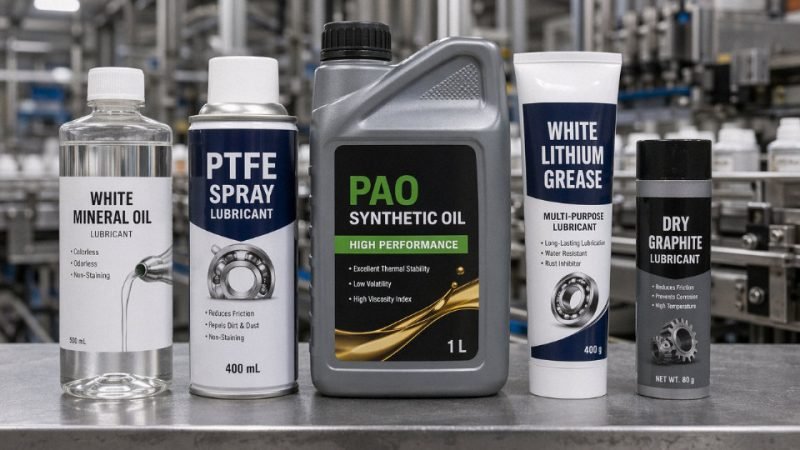
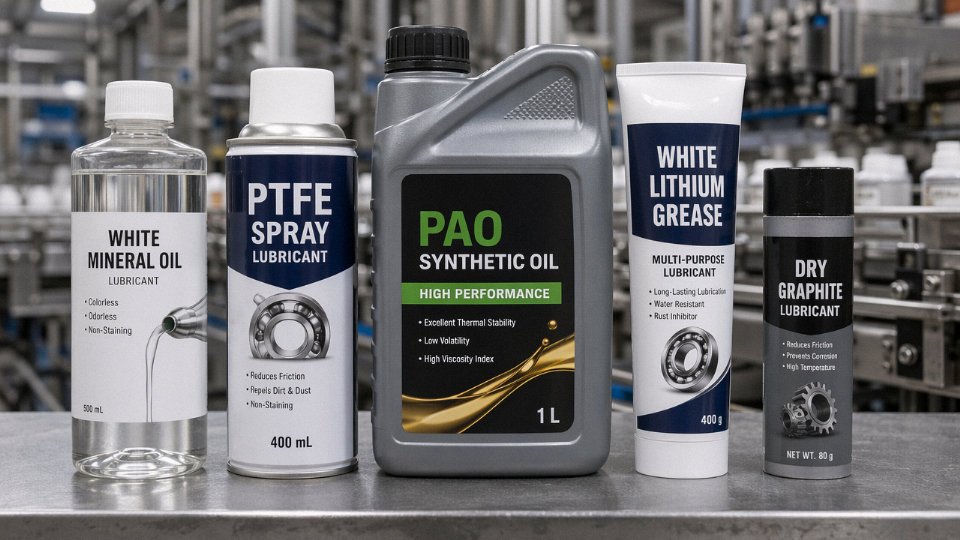
The best substitutes for silicone oil lubricant are food-grade white mineral oil, PTFE-based lubricants, PAO synthetic oil, white lithium grease, and dry graphite — depending on temperature range, load, material compatibility, and whether food or pharmaceutical contact is a factor. No single replacement covers every application silicone oil handles, so the right choice depends on matching the substitute’s viscosity profile and film strength to your specific operating conditions.
What makes this substitution genuinely tricky is that silicone oil earns its place for reasons that aren’t always obvious until you replace it with something that lacks one of them — broad thermal stability from roughly -40°C to well past 200°C, inertness toward most elastomers, and a viscosity that doesn’t swing wildly with temperature. Each substitute trades away at least one of those properties to gain something else, whether that’s higher load-bearing capacity, lower cost per application, or regulatory clearance. Understanding exactly where silicone oil is working hardest in your application is the only way to pick a substitute that won’t quietly introduce a new failure mode.
Mapping the performance profile of silicone oil so substitutes can be compared fairly
Before you can judge any substitute fairly, you need a hard number to beat — not “good thermal stability” or “wide temperature range,” but actual figures with the caveats attached. Silicone oil is deceptively easy to underestimate on paper and deceptively easy to oversell on a datasheet.
Viscosity and thermal behavior
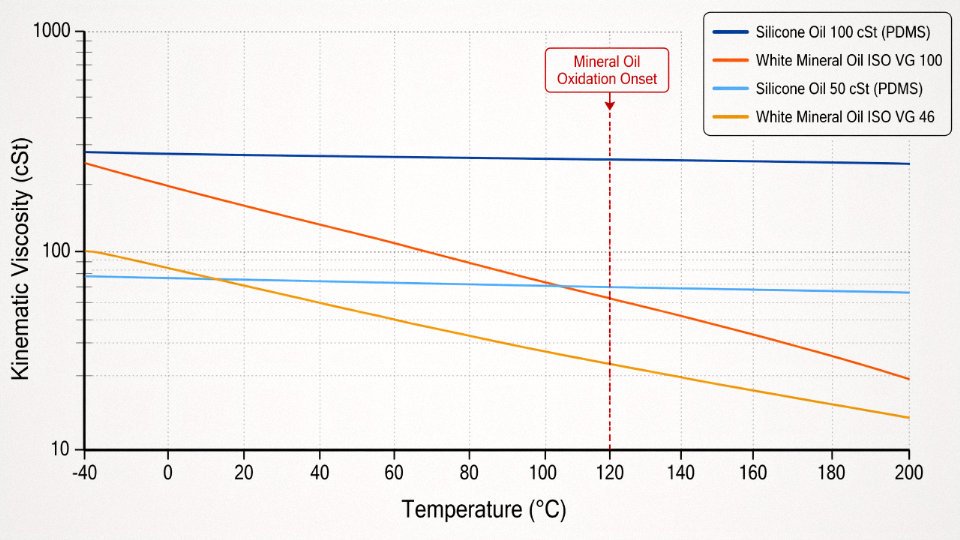
Polydimethylsiloxane (PDMS) grades — the workhorses you’ll find in most industrial settings — carry a viscosity index typically in the 300–400 range, depending on molecular weight. That’s roughly three to four times higher than a good mineral oil baseline, which means viscosity changes relatively little as temperature swings. In practice, a 100 cSt PDMS grade might be running anywhere from 50 to 150 cSt across a -40°C to 150°C operating envelope, whereas a comparably rated mineral oil would swing far more violently over that same range.
Continuous service is usually rated to 200°C. Brief excursions to around 250°C are survivable for standard PDMS, but you will start to see slow oxidative degradation above that threshold — gel formation on metal surfaces, gradual thickening in sump applications. Phenyl-modified silicone grades push that ceiling higher, but they cost more and behave differently at low temperatures, so treat them as a separate product family rather than a drop-in upgrade.
The lower end matters too. Down to roughly -50°C, most PDMS grades stay fluid and pumpable. In cold-climate outdoor applications — think ski-lift mechanisms or cold-storage conveyor bearings — that low-temperature behavior is genuinely difficult to replicate with organic alternatives without blending in pour-point depressants.
Dielectric strength
This is the property that separates silicone oil from nearly every organic substitute at a fundamental level. Dielectric strength runs 14–16 kV/mm for clean, dry silicone fluid, which is why transformer manufacturers and cable assembly engineers reach for it as a dual-purpose insulating and lubricating medium. Most ester-based or PAO synthetic oils fall in the 10–13 kV/mm range without additives; standard mineral oil sits around 10–12 kV/mm but degrades faster under electrical stress. If your application depends on electrical isolation, most direct substitutes require modification or re-engineering of the surrounding system.
Silicone oil maintains dielectric strength above 14 kV/mm in clean, dry conditionsTrue
Published values from multiple transformer fluid standards and manufacturer datasheets (Dow Corning, Shin-Etsu) consistently report 14–16 kV/mm for PDMS-based insulating fluids tested per IEC 60156.
Surface tension and the contamination problem
Surface tension around 20–21 mN/m is extremely low — lower than water, lower than most lubricating oils. That’s what gives silicone oil its legendary spreading behavior and thin-film coverage on complex geometries. It also means that the smallest airborne contamination — overspray from a spray gun across the room, a wipe-rag that touched a silicone-lubricated part — will cause catastrophic fisheye defects in paint or coating operations. Plants running automotive body assembly lines or electronics conformal coating generally need strict zoning controls around any silicone-containing lubricants. This is a real operational constraint that substitutes with higher surface tension (most PAO and ester fluids run 28–35 mN/m) don’t share nearly as severely.
Chemical inertness — and the real limits
Silicone oil resists oxidation well, shows negligible hydrolytic breakdown under normal humidity, and tolerates dilute acids that would degrade many organic oils. Concentrated alkalis are a genuine weakness — NaOH solutions above roughly 10% will attack the Si–O backbone over time. Chlorinated solvents, particularly methylene chloride and trichloroethylene, can cause swelling and fluid degradation. In cleaning-intensive environments where parts wash cycles involve chlorinated chemistry, this matters.
The seven-factor scorecard used throughout this article
Every substitute discussed in the sections that follow gets measured against the same seven criteria: viscosity stability across the operating range, load-bearing capacity, usable temperature range, chemical compatibility with process materials and seals, regulatory and food-contact status, cost per application, and environmental fate (biodegradability, aquatic toxicity, disposal classification). Silicone oil’s baseline scores on each of these — strong on viscosity stability, moderate on load capacity (~0.5–1.5 GPa film strength depending on grade and contact geometry), excellent on temperature range, mostly inert chemically, tightly regulated in food contact above certain concentrations, moderate cost at $0.10–$0.30/mL, and slow to biodegrade — give you the reference point every comparison section will come back to.
White Mineral Oil and Food-Grade Petroleum Fractions as the Closest Drop-in Alternatives
For sheer volume and accessibility, nothing comes close to white mineral oil as a silicone substitute. It sits on nearly every MRO distributor’s shelf, carries the regulatory paperwork most facilities already know how to handle, and costs a fraction of silicone fluid. Whether it’s actually adequate depends entirely on what the silicone was doing in the first place.
NSF H1 and USP-Grade White Mineral Oil: What You’re Actually Buying
NSF H1 certification means incidental food contact is acceptable — not that you can drown a bearing in it and call it a day. USP-grade white mineral oil meets purity standards for pharmaceutical and cosmetic applications. In practice, both grades cover the same base: highly refined paraffinic petroleum fractions with virtually no aromatics, low color, and low odor.
Available viscosity grades run from roughly ISO VG 15 up to ISO VG 220, which maps well against the 50–1000 cSt range silicone fluids commonly occupy. Pour points typically sit around -15°C to -18°C depending on refining depth and grade — workable for most temperate-climate production environments but not for cold storage or outdoor northern installations in winter. Continuous service temperature tops out around 115–120°C before oxidation rates become operationally significant. That ceiling is real, and suppliers who quote 130°C are usually citing flash point, not oxidation onset. Those are different things.
Where the Swap Works Without Reservation
O-ring lubrication in food-processing lines is a textbook application. If your silicone oil is just keeping a static FKM or silicone elastomer o-ring from rolling out of its groove during assembly, NSF H1 mineral oil at an appropriate viscosity does the job cleanly and stays compliant. Same story for rubber gasket conditioning on plumbing fittings operating below 90°C — the film requirement is thin, temperatures are moderate, and the cost savings are immediate.
Conveyor chain pins in dry, ambient environments are another solid fit. The load is light, the temperature is well within range, and re-lubrication intervals are typically short enough that oxidation doesn’t accumulate to problematic levels. A lot of food plants have quietly made this switch and never looked back.
Where It Falls Short — and Falls Short Badly
Above 120°C, white mineral oil oxidizes and starts depositing varnish. On a slow-moving oven conveyor running at 140°C, you’ll see that varnish building up within a few hundred hours. It gums pivot points and, in my experience, gets blamed on “contamination” until someone checks the lube specification.
Elastomer compatibility is the other real problem. White mineral oil swells NBR (nitrile butadiene rubber) noticeably faster than silicone oil does — volume swell figures for NBR in mineral oil at 70°C can reach 15–25% over extended exposure, compared to low single digits with silicone. EPDM behaves similarly. If your seals are NBR and they’re sitting in a reservoir of this stuff, you’re buying seals more often than you need to be.
Cold-start performance below about -20°C is also marginal. The pour point limitation isn’t just a flow concern; viscosity climbs steeply in that range, and if you’re lubricating a small plastic actuator in an unheated building in January, you may get stiction that trips a torque fault. Silicone’s much flatter viscosity-temperature curve is exactly what makes it useful in those situations.
Practical Viscosity Matching
For film-thickness calculations, silicone 100 cSt at 40°C maps reasonably to mineral ISO VG 100 at the same reference temperature. The substitution holds well at moderate temperatures. The catch is the viscosity index difference: silicone oils typically carry a viscosity index of 200 or higher, while white mineral oil sits in the 95–110 range. That means at elevated operating temperatures — say, 80–90°C — the mineral oil will be meaningfully thinner than the silicone it replaced, and your actual film thickness at temperature will be lower than the ISO grade matching suggests.
NSF H1 white mineral oil is a safe lubricant substitute for silicone oil in all food-contact applicationsFalse
NSF H1 status addresses incidental food contact regulatory compliance, not universal performance equivalence. White mineral oil falls short of silicone oil above 120°C, with incompatible elastomers like NBR and EPDM, and in applications below -20°C. The regulatory standing is valid; the blanket performance claim is not.
Cost and Availability in Practice
White mineral oil typically runs $0.04–$0.12/mL depending on grade, order volume, and whether you’re buying USP versus technical grade — compared to $0.10–$0.30/mL for silicone fluid. On high-consumption applications like conveyor chain lubrication systems running continuous drip feeds, that difference compounds fast. Procurement is straightforward; most regional MRO distributors stock NSF H1 grades in quantities from 1-liter bottles to 208-liter drums without lead time concerns or minimum order headaches. No special handling designations, no unusual storage requirements.
The economics make sense when the application genuinely fits. When it doesn’t fit — wrong elastomers, wrong temperature range, cold environment — the cost savings evaporate in warranty claims and unplanned maintenance.
PTFE-based dry and wet lubricants for applications where silicone oil contamination is unacceptable
PTFE lubricants occupy a specific, non-negotiable niche: anywhere silicone oil contamination would wreck downstream quality. That covers more territory than most people expect until they’ve dealt with a rejected paint run or a batch of PCBs that won’t solder because of invisible silicone migration.
How dry PTFE powder actually works on a surface
Dry PTFE — particle size typically 1–10 µm, finer grades running 0.1–1 µm for precision applications — is either bonded with a resin carrier and sprayed onto a substrate, or delivered as a paste with a fugitive solvent that flashes off after application. Once the carrier evaporates or cures, what’s left is a low-shear solid film. Static friction coefficients on steel run roughly 0.04–0.08, depending on surface finish, particle size, and how uniformly the film was applied; a poorly prepped surface will push you toward the higher end of that range. Service temperature spans from around -200°C to +260°C continuous — broader than most engineers need, but that low-temperature floor is genuinely useful in cryogenic valve packing or outdoor equipment in northern climates where silicone itself starts to migrate unpredictably.
Chemical inertness is essentially complete. PTFE shrugs off concentrated sulfuric acid, most organic solvents, hydraulic fluids, and cleaning agents. In practice, that means you can clean around a PTFE-lubricated assembly with acetone or IPA without worrying about lubricant breakdown — something you can’t say for many mineral or ester-based products.
PTFE-in-carrier suspensions for slide ways and threaded fasteners
Wet PTFE products — PTFE particles suspended in a fluorinated carrier, a light mineral oil, or sometimes a water-miscible carrier — give you the surface-coverage advantage of a liquid lubricant plus PTFE’s inherently low shear strength at the asperity level. On machine tool slide ways running moderate loads, or on stainless fasteners that would otherwise gall, a mineral-carrier PTFE suspension tends to outperform straight dry film because the liquid phase wets and fills micro-gaps the powder alone might miss.
Film-forming coverage is the key reason to choose a suspension over straight dry powder when geometry is complex: threaded holes, blind bores, anything with tight clearances where spray bonding is inconsistent.
The contamination argument — why this beats silicone in painting and electronics environments
Silicone oil spreads. It wicks across surfaces via surface-tension gradients, and even trace contamination in a spray booth will cause fish-eye defects in solvent-borne topcoats. In a composite layup room, silicone on tooling can compromise bond-line integrity in a way that doesn’t show up until a destructive test or field failure. PCB soldering fixtures that have seen silicone oil end up with dewetting and solder balling that’s maddening to diagnose because the contamination is invisible under normal inspection.
PTFE does none of that. It stays put. Zero surface-tension spreading means you can use PTFE-lubricated guide rails one meter from an active painting line and accept zero transfer risk.
PTFE dry film lubricant leaves no surface-spreading residue that causes fish-eye defects in paint or soldering dewetting, unlike silicone oilTrue
PTFE solid films have negligible vapor pressure and do not migrate via surface-tension gradients. Silicone oils, particularly low-viscosity polydimethylsiloxanes, are well-documented causes of coating adhesion failure and solder dewetting even at ppm contamination levels.
The load capacity problem you cannot ignore
PTFE film is soft — Shore D hardness around 60, give or take depending on additive content. Under high unit contact pressure, the film extrudes out of the contact zone rather than bearing load. Above roughly 80–120 MPa contact stress (the range depends on substrate roughness and film thickness), expect accelerated film removal and metal-to-metal contact. If your application involves cam followers, heavily loaded gibs, or anything with a small contact footprint and high normal force, PTFE alone is not adequate. Formulators address this with harder additive packages — molybdenum disulfide blended in, or a PTFE-bonded coating over a phosphate conversion layer — but that adds cost and complexity.
Regulatory pressure on PTFE: watch the PFAS timeline
PTFE is inert in solid form, but it falls under the broad PFAS (per- and polyfluoroalkyl substances) umbrella that EU REACH restrictions are progressively tightening. As of recent years, restriction proposals cover manufacturing process aids more than finished solid PTFE, but the regulatory trajectory is tightening. For equipment with a 15–20 year service life specified today, procurement teams and design engineers should be asking their lubricant suppliers for written regulatory tracking commitments, not just current compliance certificates. The formulation that’s acceptable today may require a qualified substitute in five years, and requalifying a lubricant on aerospace or medical tooling is not a weekend project.
Synthetic PAO and ester-based oils for high-temperature and heavy-load environments
Silicone oil earns its place in a lot of applications on thermal stability alone — it stays fluid at -40°C and doesn’t catastrophically oxidize at 180°C. But it was never designed to carry serious mechanical load. Film strength in the 0.5–1.5 GPa range (depending on viscosity grade and shear rate) is fine for lightly loaded pivots, rubber seals, and plastic-on-plastic contact. Put it in a helical gear set, a heavily preloaded angular contact bearing, or a cam follower running at speed, and it thins out under the pressure-velocity load in ways that mineral or synthetic hydrocarbon oils simply don’t. That’s the gap PAO and ester-based synthetics are built to fill.
PAO oils: what the viscosity index number actually means on the floor
Polyalphaolefin base stocks typically carry a viscosity index of 140–165, compared to 95–110 for conventional Group II mineral oil and roughly 100–130 for silicone oil depending on the grade. In practice, a higher VI means the oil loses less viscosity as temperature climbs — so a PAO 46 at 150°C still maintains a workable hydrodynamic film where a silicone oil of equivalent room-temperature viscosity has already thinned to the point where you’re relying on boundary additives.
Film strength is the more critical number for load-bearing applications. PAO with a good EP additive package reaches 1.8–2.5 GPa under elastohydrodynamic conditions, which is roughly 2–4× the film strength of silicone oil at comparable viscosities. For a gearbox or a cam-follower track that was originally filled with silicone oil for clean-room or food-proximity reasons, switching to PAO often eliminates the micro-pitting that was incorrectly blamed on contamination or misalignment.
Oxidation onset with a properly formulated antioxidant package sits above 180°C, and continuous-duty operation to 200°C is realistic — matching silicone’s thermal ceiling but with substantially better load performance above 150°C, where the VI advantage really shows up.
Polyol esters and diesters: the case for polar lubricity
Ester-based synthetics take a different route to performance. The polar ester group in polyol ester (POE) and diester (DiE) fluids adsorbs onto metal surfaces, which gives them genuinely better boundary lubrication than PAO at the same viscosity — useful in refrigeration compressors, aircraft accessory gearboxes, and any application where the fluid film occasionally breaks down under transient load spikes. Biodegradability runs 60–80% in 28 days under OECD 301B testing, which matters in environmentally sensitive manufacturing sites or anywhere spill containment is expensive.
Aerospace and refrigeration OEMs have standardized on POE almost exclusively for this reason. If you’re maintaining a system that already specifies POE, substituting silicone oil is almost always the wrong direction.
Ester fluids are competitive to about 175–180°C continuous, slightly below PAO’s ceiling, but their boundary lubrication advantage usually makes that a worthwhile trade in compressor and turbine auxiliary applications.
PAO and ester synthetics provide significantly higher film strength than silicone oil under mechanical loadTrue
Silicone oil film strength typically falls in the 0.5–1.5 GPa range, while PAO synthetics with EP packages reach 1.8–2.5 GPa. This is a material difference in load-carrying capacity and is well-documented in tribology literature and OEM bearing specifications.
The seal compatibility problem — this one catches people out
Both PAO and ester oils swell nitrile rubber (NBR) seals by roughly 2–8% under prolonged exposure, depending on the specific compound, temperature, and contact geometry. Silicone-lubricated systems often use NBR or EPDM seals because silicone oil is chemically benign to both. Converting to PAO or an ester fluid without checking the existing seal material is one of those changes that looks fine for six weeks and then leaks at an inconvenient moment.
Ester fluids are harder on polyurethane seals specifically — hydrolytic degradation of the ester linkage accelerates at elevated temperature and moisture, and polyurethane tends to swell and then harden. Verify seal compatibility before any conversion, not after.
The cost logic
PAO runs $0.20–$0.60/mL depending on viscosity grade, volume, and supplier — that’s the high end of the lubricant cost spectrum. But drain interval is the number that actually matters for TCO calculations. In continuous-duty industrial machinery, PAO typically extends drain intervals 3–5× versus Group II mineral oil, and 2–3× versus the white mineral oils covered earlier in this article. For a machine running 8,000 hours per year with a 200-liter sump, the labor cost of oil changes alone can justify the premium on PAO within the first year. The math is harder to defend in intermittent-duty or seasonal equipment where the oxidation protection is never really stressed.
White lithium grease and calcium sulfonate greases as silicone oil substitutes in slow-moving and static contact zones
Silicone oil has a frustrating habit of migrating. Apply it to a sliding door track or a pivot pin, and within a few weeks — faster in dusty or warm environments — it’s either been flung off, wicked away by surrounding material, or contaminated with enough grit to become mildly abrasive. For slow-moving and essentially static contact zones, a semi-solid grease almost always outperforms a low-viscosity oil, and the two greases most worth knowing in this context are white lithium and calcium sulfonate complex.
White lithium grease on plastic guides, drawer runners, and nylon gears
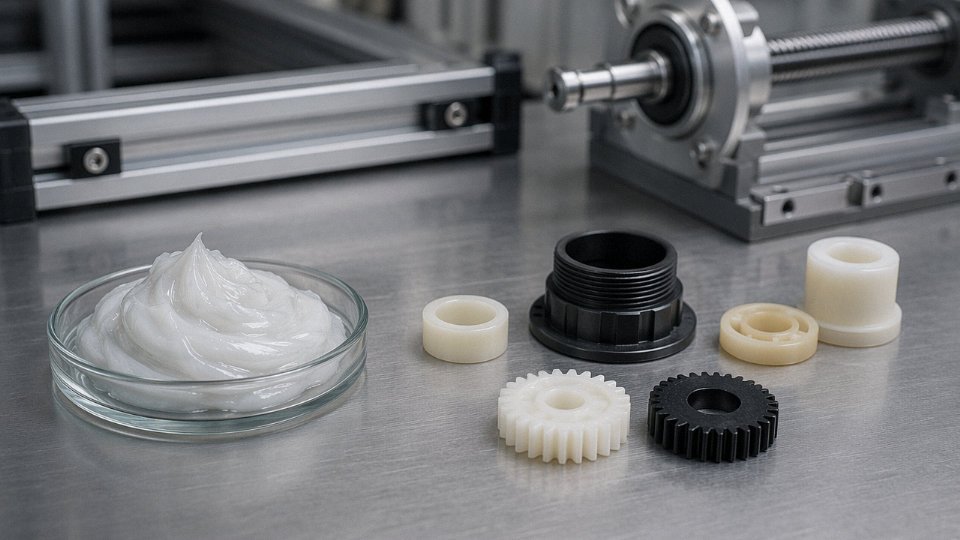
NLGI Grade 1–2 white lithium grease has a dropping point in the 180–200°C range, which comfortably covers most indoor mechanical applications without thermal breakdown. Its water resistance is genuinely good — rated Class 3 under standard wash-out testing — and it adheres to vertical surfaces in a way that silicone oil simply does not. That adhesion property is the whole argument: on a plastic drawer runner or an extruded nylon gear rack, a film of white lithium stays where you put it for months, whereas silicone oil at comparable viscosity will have migrated or evaporated its carrier phase within a few weeks, especially if the assembly sees any vibration.
Reapplication interval on a typical indoor slider track: silicone oil spray every 1–3 months in a dusty plant environment versus white lithium grease every 6–18 months, depending on load and cycle rate. That difference translates to a 40–60% reduction in maintenance labor cost for the lubrication task itself — not dramatic in isolation, but real when you’re tracking it across 200 drawer assemblies on a production line.
White lithium grease maintains an effective lubricating film 3–6× longer than silicone oil spray on dusty indoor plastic slider tracksTrue
The thickener matrix in lithium grease physically retains the base oil at the contact surface and resists particle contamination displacement; silicone oil lacks this retention mechanism and relies on surface tension and viscosity alone, both of which are compromised quickly by particulate accumulation and wicking into porous surfaces.
Plastic compatibility matters here, and it’s a place where mistakes get made. White lithium grease is safe on polypropylene, ABS, and acetal — those are your most common engineering plastics in guides and housings. Avoid it on polycarbonate and acrylic. The hydrocarbon carrier causes stress cracking in those materials, sometimes within hours of application under load. Same restriction applies to mineral oil, for the same reason.
Calcium sulfonate complex grease for outdoor pivots and open gears
Calcium sulfonate complex is in a different performance tier. Dropping point exceeds 300°C, so thermal breakdown is rarely the limiting factor. More relevant: it passes the ASTM D2596 four-ball weld load test at above 350 kgf, which gives it genuine extreme-pressure capability that silicone oil — with film strength around 0.5–1.5 GPa — cannot match. White lithium grease’s load-bearing capacity sits at roughly 2.0–3.0 GPa; calcium sulfonate complex is comparable or slightly better, and its corrosion inhibition is substantially superior.
For outdoor pivot hardware, marine-environment hinges, or slow-speed open gears on agricultural or industrial equipment, this matters. Silicone oil provides essentially no rust protection on ferrous surfaces — a fact that surprises people who assume its chemical inertness implies corrosion resistance. It doesn’t. Calcium sulfonate complex fills that gap directly.
Application technique
Flood application is a mistake with either grease. A thin bead applied with a cotton swab, a precision-nozzle syringe, or a small brush covers the contact zone without building up excess material that migrates into adjacent electrical contacts or optical paths. In electronics-adjacent assemblies, even a small grease smear on a connector pin creates a maintenance problem later. Applying less than you think you need is usually closer to correct.
Dry-film solid lubricants—graphite, molybdenum disulfide, and boron nitride—for extreme conditions silicone oil cannot survive
At some point, liquid lubricants simply stop making sense. Vacuum chambers, die casting dies, high-radiation environments, and furnace mechanisms all share a common problem: any fluid—silicone oil included—either outgasses, oxidizes, carbonizes, or gets physically displaced. That’s where inorganic solid lubricants take over. These aren’t exotic materials in the laboratory sense; graphite has been used in industrial applications for over a century, and MoS₂ has been a staple of aerospace assembly since the 1950s. The engineering logic is straightforward. Solid lubricants work by transferring a thin, low-shear layer onto mating surfaces rather than maintaining a fluid film, which means they don’t flow away, don’t evaporate, and don’t react with process gases.
Graphite: the workhorse with a humidity dependency
Graphite’s laminar crystal structure is what makes it work — adjacent atomic planes slide easily over each other under shear stress. In practice, friction coefficients run roughly 0.10–0.15 in ambient air, but that performance depends on humidity above about 40% RH. Below that threshold, in dry nitrogen or in vacuum, graphite’s friction climbs significantly. That’s not a minor footnote. Technicians who use colloidal graphite suspension on conveyor chain inside a dry-room or low-humidity winter environment sometimes see unexpected wear — the graphite isn’t failing chemically, it’s just not getting the atmospheric moisture it needs to maintain its slip planes.
Service temperature in air reaches roughly 450°C before oxidation accelerates meaningfully. In inert atmosphere or vacuum, graphite is stable well above 2,000°C, which is why it appears as a mold lubricant and electrode material in arc furnaces. Application format matters: aerosol-suspended colloidal graphite deposits a thin, fairly uniform film and is practical for field application on open slideways or large pivot pins. For precision surfaces, burnishing dry powder by hand or with a cloth is more controllable. Graphite’s electrical conductivity rules it out anywhere you need insulation.
Molybdenum disulfide: the correct answer for vacuum and aerospace
MoS₂ is arguably the most capable solid lubricant for demanding mechanical contacts. Its friction coefficient in dry or vacuum conditions drops to 0.03–0.06 — lower than graphite by a meaningful margin, and critically, it doesn’t need humidity to perform. Aerospace fastener assemblies typically specify MoS₂ paste or bonded coating for exactly this reason: the fastener needs to reach torque specification consistently during installation, and it may spend decades in a low-humidity pressurized environment. Gun mechanisms and vacuum chamber linear slides are similar cases.
MoS₂ can carry contact loads up to approximately 3.0 GPa in film form, roughly 2–3× the load capacity of silicone oilTrue
MoS₂ film strength is well-documented in tribology literature at 2.5–3.0 GPa depending on substrate preparation and coating method; silicone oil hydrodynamic film strength typically ranges 0.5–1.5 GPa
One limitation to keep in mind: MoS₂ oxidizes above roughly 350°C in air, forming MoO₃, which is actually mildly abrasive. Use it within that temperature ceiling in oxidizing environments. In inert gas or vacuum, service temperature is considerably higher.
Hexagonal boron nitride: the insulating alternative
hBN occupies a specific niche that neither graphite nor MoS₂ can fill — it’s electrically insulating, white in color, and chemically inert to most molten metals up to around 900°C in air. Die casting shops use hBN-based mold release sprays on steel tooling where graphite would contaminate the part surface or interfere with post-cast coatings. High-voltage switchgear and transformer bushing contacts that previously used silicone oil for combined lubrication and dielectric isolation can sometimes transition to hBN bonded coatings when oil-free designs are required.
Bonded coatings versus loose powder: don’t skip substrate prep
Bonded solid lubricant coatings — typically 3–10 µm thick, cured at 150–200°C with a resin binder — offer the longest service life per application and the most consistent film thickness. Adhesion, though, depends almost entirely on surface preparation. A steel bore that hasn’t been grit-blasted or phosphated before coating will shed the film early. Burnished powder is faster to apply and requires less infrastructure but has a shorter service interval. Aerosol suspensions sit between the two in both effort and durability.
The fundamental limitation with every solid lubricant is non-replenishment. Once the film wears through, friction rises sharply and you may not get a warning before surface damage occurs. These materials have no place in recirculating oil systems, automatic lubrication circuits, or any application that relies on fluid to carry heat away from the contact zone. Reapplication intervals need to be built into the maintenance schedule from the start, not discovered after a seized mechanism.
Bio-based and vegetable-derived lubricants as environmentally compliant silicone oil replacements
Regulatory pressure around lubricant disposal has been building for years, and it’s not slowing down. Near-water machinery, food-processing lines, and forestry equipment now face increasingly specific requirements around biodegradability—and silicone oil, despite its chemical inertness and good toxicity profile, doesn’t always satisfy the documentation trail that auditors want. That’s where bio-derived lubricants have carved out a real, practical niche.
Castor oil: the highest-viscosity natural lubricant most engineers ignore
Castor oil is genuinely unusual among vegetable-derived fluids. Its natural viscosity sits around 220–260 cSt at 40°C—without any thickener additives—and its viscosity index of roughly 84 means it doesn’t thin out dramatically at elevated temperatures the way lighter vegetable oils do. Pour point is typically around -18°C, which is adequate for most indoor industrial environments but will cause problems in unheated outdoor sumps in northern climates during winter.
Where castor oil earns its place is in slow-speed bearings, rubber seal lubrication, and textile machinery, particularly ring-spinning frames where it’s been used for well over a century. It’s compatible with most elastomers, it’s genuinely biodegradable (>90% in 28 days under OECD 301B testing), and it carries no food-contact anxiety on a processing floor. It’s also the base for a significant share of DOT 3 and DOT 4 brake fluid formulations, which tells you something about its film stability under thermal cycling.
The limitation is oxidative stability. Without an antioxidant package, castor oil in a circulating system will start to polymerize and form varnish deposits above roughly 70–80°C. It’s not a drop-in for any application with sustained elevated temperatures.
Epoxidized and esterified vegetable oils for near-water and regulated food environments
High-oleic sunflower esters and epoxidized soybean oil (ESBO) represent a more engineered tier of bio-based lubrication. Formulated grades are available across ISO VG 46 through 100, and with a proper antioxidant package the oxidative stability can reach 1,500–2,000 hours in RPVOT testing—which is competitive with many Group II mineral oils, though still short of a well-formulated PAO.
These products meet EU Ecolabel criteria and qualify under the US EPA Vessel General Permit (VGP) program as Environmentally Acceptable Lubricants (EALs), which is the certification that matters for anything operating on or near US navigable waters. Several refined vegetable ester grades carry NSF H1 listing, making them usable in food-processing machinery where incidental contact is possible. The relevant classification framework is ISO 15380 Type E—look for that designation on the product data sheet, not just a vague “biodegradable” marketing claim.

NSF H1 listing is available for select refined vegetable ester lubricants, making them acceptable for incidental food contact in processing environments.True
NSF H1 is a recognized certification for lubricants with potential incidental food contact, and several high-oleic and synthetic ester formulations have obtained this listing. Always verify the specific product's NSF registration number before use.
The real limitations—and why maintenance intervals matter more here than with silicone
Bio-based lubricants hydrolyze when exposed to water continuously above roughly 60°C. In a warm wash-down environment or a steam-adjacent application, ester bonds break down, viscosity drops, and acidity climbs. Silicone oil simply doesn’t have this vulnerability.
Microbial growth in sumps is a genuine operational concern, not a theoretical one. Without a biocide additive, vegetable ester sumps can develop bacterial contamination within weeks in warm, humid conditions—affecting both fluid integrity and component surfaces. Maintenance intervals that would be acceptable for mineral oil or silicone need to be cut by 30–50% in these environments, and oil analysis for acidity (TAN) and microbial count should be on a regular schedule rather than left to visual inspection.
The cost picture, honestly
Bio-based lubricants typically run 20–50% above conventional mineral oil on a per-liter basis, depending on grade and order volume. Set against that is the potential elimination of hazardous-waste disposal costs, which in regulated jurisdictions can run $3–8 per liter of collected waste fluid depending on local rates and the classification of the used product. For a facility that changes out several hundred liters per year and is already managing a compliance documentation burden, the arithmetic can genuinely favor the bio-based option—even before accounting for audit simplification.
For silicone oil applications specifically, the switch only makes sense where the performance gaps (primarily hydrolytic stability and upper temperature range) are not in play. Slow-speed, ambient-temperature, near-water or food-adjacent applications are the realistic targets. Anywhere silicone oil is being used precisely because it won’t react with water or won’t degrade at 150°C is probably not a candidate.
Decision Matrix: Matching the Right Silicone Oil Substitute to Your Specific Operating Conditions
All the previous sections give you the chemistry and performance data. This one gives you the shortcut — a structured way to pick a substitute without re-reading everything, plus the five scenarios that cover the majority of real conversion decisions.
The Comparison Matrix
| Substitute | Viscosity Stability (-40 to 200°C) | Max Continuous Temp | Load Capacity | Plastic-Safe? | Regulatory Status | Relative Cost (per application) | Reapplication Interval |
|---|---|---|---|---|---|---|---|
| White mineral oil (food-grade) | Moderate — VI roughly 95–110, narrows above 120°C | ~120°C continuous | Low–moderate | Yes (most thermoplastics) | NSF H1 available | Low: $0.04–0.12/mL | Frequent — weeks to months depending on wash-down cycles |
| PTFE dry/wet film | Stable across range; carrier evaporates, leaving solid | ~260°C (dry film) | Low–moderate (~0.8–1.2 GPa) | Yes | Generally acceptable food-zone with NSF-certified grades | Moderate: $0.15–0.40/mL spray | Medium — re-coat when film wears through visually |
| PAO synthetic oil | Excellent — VI typically 140–160+, stays fluid at -40°C | ~180°C with suitable additive package | High (~1.8–2.5 GPa) | Caution with soft elastomers | NSF H1 grades exist; check formulation | Moderate–high: $0.20–0.60/mL | Long — quarterly to annual in sealed systems |
| Calcium sulfonate grease | Good; NLGI 2 grades resist washout better than lithium | ~160–180°C dropping point | High (~2.0–3.0 GPa) | Generally yes; verify with soft rubbers | NLGI/ISO compliant; food-grade versions available | Moderate | Long in static or slow-moving joints — 6 months to 2 years |
| MoS₂ bonded solid film | Excellent; no viscosity change — it’s a solid | ~400°C in inert atmosphere; oxidizes above ~350°C in air | Very high | Not applicable — no fluid contact | Standard industrial; avoid food zones | Low per gram: $0.02–0.08/g equivalent | Very long in vacuum or dry conditions; shorter where abrasion is continuous |
| hBN (hexagonal boron nitride) coating | Excellent; thermally inert | ~900°C in oxidizing atmosphere | Moderate | Generally inert | No known food approval; research-grade for most plants | High — coating process cost dominates | Very long if properly bonded |
| Bio-based ester (castor/sunflower) | Moderate — VI varies by base stock, typically 90–130 | ~150°C before oxidation accelerates | Moderate | Usually yes; confirm with manufacturer | Meets OECD 301B biodegradability in certified grades | Moderate: roughly comparable to PAO | Medium — oxidation shortens intervals in hot systems |
Five Use-Case Pathways
Food-contact plastic conveyor. Use NSF H1 white mineral oil, full stop. Incidental contact is covered, cost is low, and it won’t stress polypropylene or acetal chain links. Reapply based on wash-down frequency — daily washdown lines typically need weekly reapplication.
Electronics assembly slide or rail. Dry PTFE spray. Apply, let the carrier flash off completely before powering the line, and you eliminate silicone contamination risk on connectors and optical surfaces. Don’t use a wet carrier version if there’s any chance of pooling near PCB pads.
Industrial gearbox running above 150°C. PAO ISO VG 220 with a thermal-stable antioxidant package. Silicone oil simply doesn’t carry the load in a gearbox; a PAO at this viscosity grade gives you the film strength that prevents micropitting on gear flanks.
Outdoor pivot pin exposed to rain. Calcium sulfonate NLGI 2 grease. It resists water washout in ways that lithium grease doesn’t, tolerates the temperature swings between a cold night and a sun-baked afternoon, and won’t migrate out of the joint the way an oil would over a season.
Vacuum chamber actuator. MoS₂ bonded film, applied before assembly. In hard vacuum, outgassing from any liquid lubricant contaminates the chamber and the process. A properly bonded MoS₂ coating on the sliding surfaces gives you thousands of dry cycles with negligible mass loss.
Red-Flag Compatibility Checklist
Polycarbonate parts: avoid all hydrocarbon oils and most greases — stress cracking can appear within days of contact, often with no visible warning until the part fractures under load.
EPDM seals: test swell at operating temperature before committing to any petroleum-based substitute. Target less than 5% volume swell; anything above that shortens seal life unpredictably.
Aluminum with anodized surface in sliding contact: be cautious with MoS₂ — the sulfide chemistry can create a galvanic pair in humid conditions, and some anodizing specifications explicitly prohibit it.
Near-water discharge (drainage to a waterway, wetland operations, marine environments): you need OECD 301B biodegradability data in hand before selecting any substitute. A bio-based ester or certified white mineral oil is usually the right direction; MoS₂ and some PAO formulations will not meet those requirements.
Qualification Protocol Before Fleet Conversion
First, document your current system fully: ISO VG grade in use, operating temperature range, seal materials, any food-zone or regulatory constraints, and current reapplication interval. Don’t guess — pull the MSDS and the original equipment specification.
Second, select two or three candidates from the matrix above, not just one. Having a fallback matters when bench testing reveals a surprise.
Third, run a 500-hour material compatibility bench test with every contact material in the assembly — seals, housing polymer, bearing cage material, any coatings. This is non-negotiable. Skipping it and going straight to a machine trial has caused full seal replacements on lines I’ve seen converted too quickly.
Fourth, pilot on a single machine for a full maintenance cycle before touching the fleet. Track temperature, vibration baseline, and leakage or migration.
Fifth, update the MSDS files, the lubrication schedule, and the maintenance card at the machine. Technicians following the old silicone-oil interval on a new grease will either over-lubricate or miss the reapplication window entirely — both cause problems.
A 500-hour bench compatibility test before fleet lubricant conversion is standard practice in ISO 55001-aligned maintenance programsTrue
ISO 55001 (asset management) and OEM lubrication qualification guidelines consistently recommend material compatibility testing prior to lubricant changeover; 500 hours is a commonly cited minimum for establishing seal swell and surface degradation data under representative conditions.
Frequently asked questions about silicone oil substitutes
Can I use WD-40 as a silicone oil substitute?
Short answer: no, not really. WD-40 is marketed as a multi-use product, but its primary function is water displacement — the “WD” is literally in the name. The petroleum carrier is thin, somewhere around 1–3 cSt at room temperature depending on the formulation, and it flashes off within a few hours under normal shop conditions. What’s left behind is a thin, tacky film that attracts dust and provides almost no lasting lubrication.
The bigger problem in practice is material compatibility. WD-40 attacks polycarbonate (stress crazing appears fast, sometimes within minutes under load) and it swells certain rubber compounds, particularly EPDM and neoprene seals. I’ve seen technicians spray it into pneumatic actuators as a “quick fix,” and the seal damage that followed was an expensive lesson. Use it to break corrosion loose or displace water from a connector — fine. As a silicone oil substitute? It doesn’t perform the same role at all.
Is baby oil (mineral oil) safe as a silicone lubricant replacement for rubber O-rings?
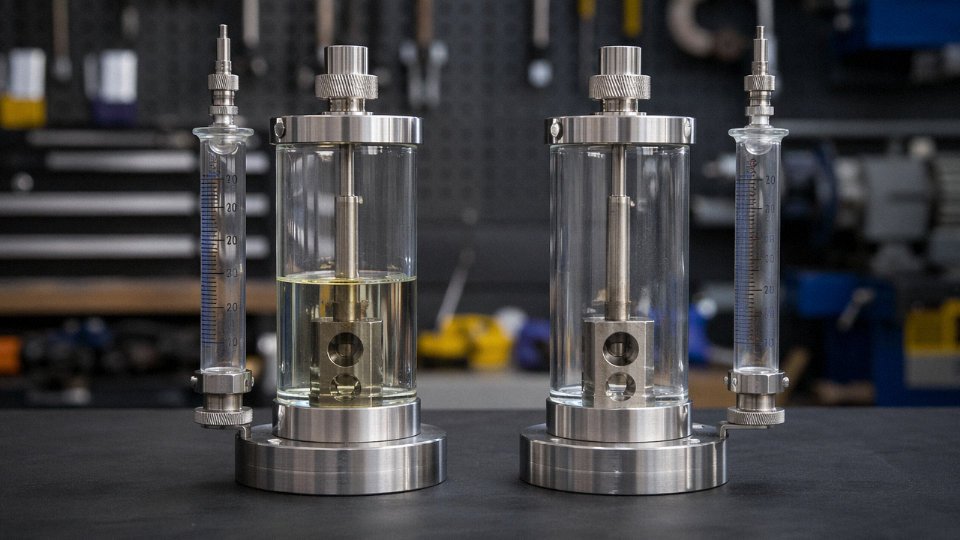
USP-grade mineral oil — which is essentially what unscented baby oil is — is reasonably safe for EPDM and silicone rubber O-rings in low-temperature water service, generally below 60°C. At that range, swell rates stay manageable and the oil doesn’t degrade enough to cause problems over short intervals.
The serious caveat is NBR (Buna-N). Mineral oil swells NBR significantly, often 15–30% volumetric increase depending on the oil’s aromatic content and exposure time, which will cause the O-ring to extrude past its groove and leak or tear. Most hydraulic and pneumatic seals in industrial equipment are NBR. Check the O-ring material stamp or the equipment BOM before you reach for the baby oil. Above 90°C, even EPDM compatibility gets questionable with mineral oil. This is a low-pressure, cool, short-service workaround — not a long-term maintenance strategy.
USP-grade mineral oil is compatible with silicone rubber O-rings in low-temperature water service below 60°CTrue
Silicone rubber has good resistance to non-aromatic mineral oils at moderate temperatures; swelling is minimal below 60°C in water-service applications, though verification against the specific compound is always recommended.
What is the best silicone-free lubricant for plastic gears?
White lithium grease in NLGI 0 or 1 consistency is usually the practical first choice — it clings, it doesn’t fling off at moderate speeds, and it’s compatible with most engineering plastics including acetal and nylon. Food-grade white mineral oil at low-to-medium viscosity (roughly 68–150 cSt) works well for slower, lightly loaded plastic gears where you need something that won’t stain or degrade the polymer over time.
When contamination of adjacent optical or electrical components is the concern — think printer mechanisms or medical instrument geartrains — PTFE dry film is the cleaner answer. It leaves no liquid residue once the carrier evaporates. The trade-off is reapplication frequency; dry film wears off faster in high-cycle applications than a grease will.
Can vegetable oil replace silicone oil in a medical device context?
No. Full stop. Medical devices require lubricants that have been validated under ISO 10993 biocompatibility testing. Vegetable oils — even food-grade, highly refined versions — introduce oxidation byproducts and biological degradation risks that are simply not acceptable in patient-contact or implant-adjacent applications. The regulatory exposure alone makes this a non-starter. Use only purpose-formulated lubricants with documented ISO 10993 test data, whether that’s a certified silicone alternative or a validated PAO grade from a supplier who can provide the full biocompatibility dossier.
How do I remove silicone oil residue before applying a substitute?
On metal surfaces: wipe with isopropyl alcohol (IPA), then follow with an acetone wipe. Silicone oil is notoriously difficult to clean completely — it spreads easily at low concentrations and even trace amounts will prevent paint adhesion or cause fisheye defects in coatings. In finishing environments, technicians often do two IPA passes, check with a water-break test, then acetone. For plastics, skip the acetone entirely and use IPA only. Acetone crazes acrylic and polystyrene almost immediately and softens polycarbonate. Let the surface dry fully — at least a few minutes, longer in humid conditions — before applying the substitute lubricant. Rushing this step defeats the purpose.
Does PTFE lubricant work at the same temperatures as silicone oil?
PTFE dry film actually exceeds most silicone oil grades on the upper end. Silicone oil is typically rated to around 180–200°C continuous service depending on the viscosity grade and oxygen exposure, whereas PTFE solid film handles up to roughly 260°C. That makes dry PTFE a legitimate upgrade in oven conveyor links, heat-sealing jaws, and similar applications.
The nuance worth watching: many commercial “PTFE lubricants” are PTFE particles suspended in a carrier fluid — sometimes a light mineral oil or alcohol. That carrier has its own temperature ceiling, usually far below 260°C, and if you’re relying on the product at elevated temperatures without letting the carrier fully evaporate and cure first, you’re not actually running on PTFE film. Read the full product TDS, not just the headline temperature number on the label.