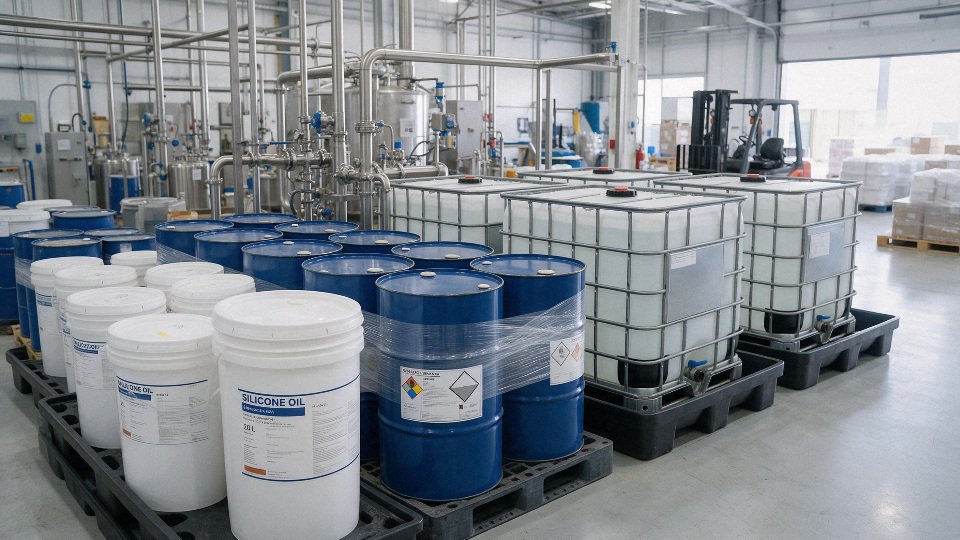
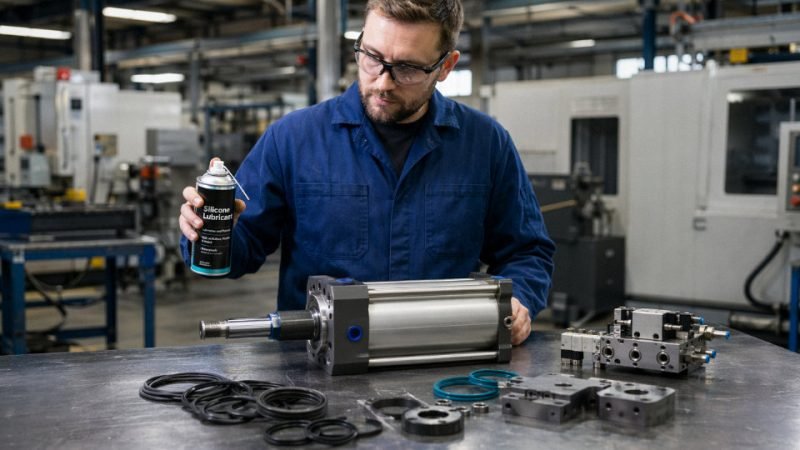
Grab a can of silicone spray off the shelf in almost any maintenance room and the label makes it sound like a universal fix — slick, clean, safe on plastics, works from -40°C to well above 200°C. That last part is true. What the label quietly skips is the short list of applications where silicone lubricant will actively cause failures: swollen seals, delaminating paint, contaminated welds, gummed-up pneumatic valves. Those failures don’t announce themselves immediately, which is the real trap. A technician sprays a sticking cylinder rod on a Friday, the line runs fine through the weekend, and by Tuesday there’s a blown O-ring and four hours of unplanned downtime that nobody connects back to the lubricant choice.
Silicone lubricant should not be used on painted surfaces due to fish-eye contamination risk, on natural rubber or EPDM seals where swelling causes premature failure, near weld prep areas or surfaces requiring adhesion, inside most pneumatic control valves, on plastic gears under load, or anywhere downstream equipment will be repainted or bonded — these incompatibilities are not edge cases but documented, recurring causes of scrap, seal failure, and rework costs in production environments.
What makes this genuinely tricky is that silicone lubricant is excellent in a surprising number of situations, so the default assumption in a lot of plants is “when in doubt, silicone.” That instinct is wrong in just enough contexts to be expensive. The chemistry behind why silicone migrates, why it resists displacement, and why it’s nearly impossible to fully remove from a contaminated surface explains both the product’s strengths and the specific damage patterns it leaves behind.
Painted and Finished Surfaces: How Silicone Lubricant Causes Fish-Eye Defects and Adhesion Failure
Silicone’s low surface energy — the same property that makes it slippery and water-repellent — is precisely what makes it catastrophic near any surface that will be painted, stained, varnished, or powder-coated. The molecules are small enough to migrate into micropores in bare metal, wood grain, and cured primer, and once they’re in there, you cannot get them out with a single wipe. Most painters learn this the hard way, usually on a panel they’d already spent two hours blocking.
The Fish-Eye Mechanism
Fish-eyes are not a paint defect, strictly speaking. They’re the paint doing exactly what physics tells it to do. Silicone contamination locally reduces surface tension to somewhere around 20–24 mN/m — well below the 35–45 mN/m range that most solventborne and waterborne topcoats need to wet out and flow continuously. The wet paint literally retracts from the contaminated spots, leaving craters with raised edges, anywhere from 1 mm to 10 mm across depending on contamination density and paint viscosity. A light aerosol mist from a silicone spray used three bench-spaces away in the same shop can be enough to seed dozens of fish-eyes across a freshly sprayed panel. That’s not an exaggeration — it’s a well-known body shop problem, and the reason serious refinish operations ban silicone products from the building entirely.
Automotive Bodywork: The Overspray Problem Is Real
In automotive refinishing, the contamination path is rarely “someone sprayed lubricant directly on the panel.” More often it’s door hinge lubrication, rubber seal treatment, or a detail spray used on a neighboring car, and the silicone travels as aerosol or migrates through shared rags and buffing pads. Proper degreasing before paint — typically a solvent wipe with a dedicated pre-cleaner like a wax and grease remover (naphtha- or IPA-based products are common) — will remove surface contamination, but only if it’s done correctly: panel wiped in one direction, clean cloth each pass, no circular scrubbing that just redistributes the material. If silicone has been applied repeatedly over months, a single degreasing pass usually isn’t enough. Many refinish technicians run two or three solvent wash cycles and still shoot a test panel before committing to the full repair.
A single wipe with a standard degreaser will fully remove silicone contamination before repainting.False
Silicone molecules penetrate into surface micropores and are not fully removed by a single solvent wipe. Multiple wash cycles and test panels are standard practice in professional refinishing to confirm the surface is clean before production painting.
Powder Coat and Industrial Coating Adhesion
Powder coating complicates things further because the substrate goes through a curing oven at roughly 160–200°C. Silicone is thermally stable well past those temperatures — its useful range extends to +200°C and higher-grade formulations to +260°C — so the contamination doesn’t burn off. It survives the cure cycle, sits at the interface between the coating and substrate, and shows up as adhesion failure in a cross-cut tape test (ASTM D3359). A result that should be 4B or 5B comes back at 1B or 0B, meaning whole squares of coating lift on the tape. That’s a full strip-and-recoat, not a touch-up. In a production line context, that’s costly downtime and waste, not a minor quality note.
Woodworking: The Problem You Can’t Undo
Wood is porous by nature. Silicone penetrates along the grain and into cell structure, and unlike metal where aggressive abrasion can sometimes help, you cannot sand deeply enough across a large surface to eliminate the contamination uniformly. Stain sits on top and looks blotchy. Varnish and oil finishes bead instead of soaking in. In practice, a piece of furniture that’s had silicone polish applied repeatedly is often unfinishable without stripping the surface back significantly — and even then, testing on a hidden section first is essential.
Safer Alternatives
For situations where you need lubrication near surfaces that will eventually be finished, dry PTFE spray is the first option to consider. It leaves no oily residue and doesn’t migrate the way silicone does. Paste wax (carnauba-based) works well for protecting cured finishes without contaminating surrounding areas. Dedicated panel lubricants formulated specifically for bodywork — most major refinish supply brands make them — are designed to be compatible with pre-cleaning solvents. If you’re lubricating hinges, tracks, or hardware in an environment where paint or coating work happens, the product selection matters as much as application technique.
Decontamination Protocol
If silicone has already been applied and you need to proceed with painting or coating, the sequence matters: first, mechanical cleaning to remove bulk contamination; second, multiple solvent washes with a proper wax and grease remover, using the single-pass technique described above; third — and this step gets skipped too often — shoot a small test panel with the actual topcoat system you’ll be using and inspect for fish-eyes before running full production. Some shops add a fish-eye eliminator additive as a last resort, but that’s a band-aid. It can reduce the visual defect without actually fixing the adhesion problem underneath.
Oxygen-Service and High-Pressure Gas Systems: A Potentially Lethal Incompatibility
This is the incompatibility that moves the conversation from “ruined paint job” to “fatality investigation.” Using silicone lubricant — or virtually any hydrocarbon-based product — in oxygen-enriched or high-pressure gas service is not a gray area. It is prohibited by every major industrial gas safety standard, and the failure modes are violent.
Why Lubricants Ignite in Oxygen Service
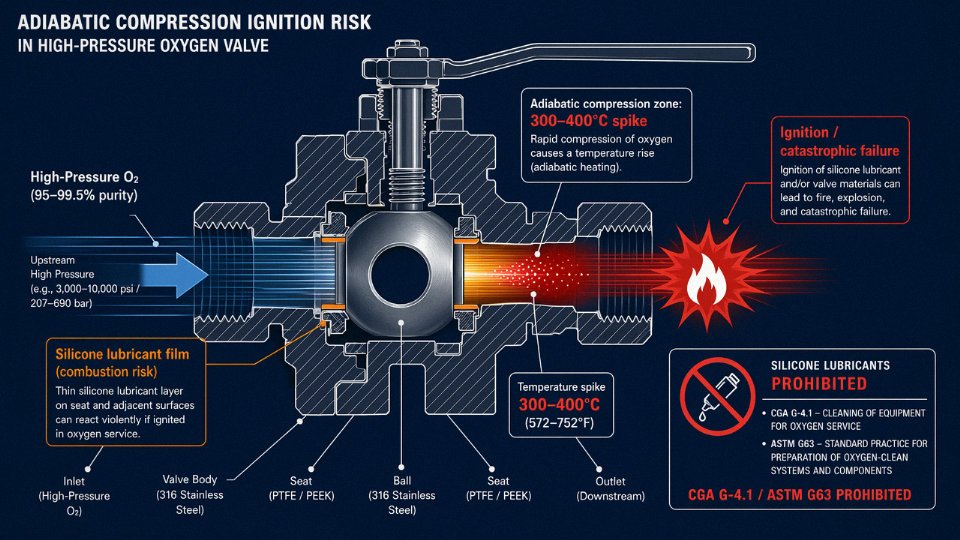
The core problem is thermodynamic and chemical simultaneously. When a gas valve opens rapidly against a high-pressure oxygen supply, the gas ahead of the flow front compresses near-instantaneously. That’s adiabatic compression. Temperature spikes can reach 300–400°C in the trapped gas column in a matter of milliseconds — enough to ignite any combustible residue on the valve seat, stem, or downstream regulator. This is sometimes called the “diesel effect” because the mechanism mirrors what happens in a diesel cylinder, though the results here are far less controlled.
Silicone-based lubricants, despite their generally excellent thermal stability in air (operating range is typically –40°C to around +200°C for standard grades), react differently when oxygen partial pressure rises sharply. At elevated oxygen concentrations — think medical-grade or industrial oxygen at 95–99.5% purity — oxidation kinetics change completely. Silicone oil‘s flashpoint in air might seem reassuring; in high-purity oxygen it means almost nothing. The oxidation threshold drops dramatically, and even a thin film left on a valve body can be enough.
What the Standards Actually Require
CGA G-4.1 (Commodity Specification for Oxygen, published by the Compressed Gas Association) and ASTM G63 (standard guide for evaluating materials compatibility with liquid oxygen) are the two documents most US-based procurement and maintenance teams will encounter. EIGA’s IGC Doc 13 covers the same ground for European operations. All three take the same position: lubricants in oxygen service must be selected specifically for oxygen compatibility, tested under relevant pressure and temperature conditions, and documented. None of them give silicone a pass.
ASTM G63 in particular requires promoted-ignition testing and reaction-rate data for any candidate material. Silicone oils and greases — polydimethylsiloxane-based products — have not passed this bar for oxygen service. That’s not a technicality; it reflects real ignition data.
Silicone lubricants are safe for use in medical oxygen equipment as long as they are food-grade or pharmaceutical-grade.False
Grade classification (food-grade, pharma-grade) refers to purity and regulatory status for incidental food or human contact, not oxygen compatibility. In oxygen-enriched service, even the purest silicone oil carries ignition risk under adiabatic compression. Medical oxygen equipment requires PFPE lubricants specified and tested for oxygen service, regardless of silicone purity.
Medical Oxygen Equipment Is Not an Exception
Ventilators, anesthesia machines, and oxygen concentrators all have lubricated valve components, and the temptation to reach for whatever spray lubricant is in the maintenance cabinet is real — especially in resource-constrained clinical or field settings. Manufacturers of this equipment universally specify PFPE (perfluoropolyether) greases like Krytox 240 series or Fluorolube products for any surfaces that may contact oxygen flow. Silicone is explicitly excluded. The reasoning is identical: adiabatic compression risk, elevated oxidation susceptibility, and the fact that PFPE compounds are essentially non-combustible even in pure oxygen at pressure.
Industrial Compressed Air: A Lower-Stakes but Real Problem
Pure compressed air (roughly 21% oxygen) doesn’t carry the same ignition risk as oxygen service. That said, silicone contamination in compressed air systems creates persistent downstream problems. Silicone vapors migrate through pneumatic lines and deposit as thin films on air bearing surfaces, where they polymerize under heat and abrasion into a tenacious varnish. Downstream coalescing filters — Parker Zander, Donaldson, others — can get fouled faster than expected, often without a clear root cause until someone traces it back to a technician who sprayed silicone on a fitting two maintenance cycles ago. Pneumatic actuator seals, particularly those made from polyurethane, can swell or degrade on prolonged silicone exposure.
Operational warning: In plants running both oxygen lines and general compressed air, segregate your lubricant inventory physically. Mislabeling or cross-grabbing a silicone spray in an oxygen-service area is the kind of mistake that happens once.
Correct Lubricants for Oxygen Service
PFPE greases and oils are the right answer, full stop. Krytox (now Chemours), Fomblin (Solvay), and Halocarbon products are the main brands you’ll encounter in procurement. They are expensive — expect to pay roughly 10–30× the cost per gram compared to a standard silicone grease, depending on grade and packaging size — but the quantities used in valve and regulator service are small enough that material cost is rarely the real objection. Sourcing through industrial gas equipment distributors or directly from the manufacturer is preferable to general MRO catalogs, where counterfeit or misrepresented products do appear.
The cost justification writes itself: one regulator fire, one ventilator failure, one pressure-relief valve seizure, and the conversation about $40 worth of Krytox becomes irrelevant.
Plastic and Rubber Compatibility Pitfalls: Which Polymers Silicone Lubricant Attacks
The assumption that silicone is “rubber-safe” is one of the more stubborn misconceptions in maintenance engineering. It gets repeated in product marketing, on forums, and occasionally even in MRO catalogues. The reality is more complicated — and in the wrong application, the consequences show up as a leaking hydraulic seal at 3 a.m., a scrapped batch of injection-molded parts, or a pneumatic actuator that’s lost 40% of its clamping force six weeks after a “routine” relubrication.
Silicone lubricant is safe to use on all rubber and plastic materialsFalse
Silicone lubricants cause measurable swell in natural rubber, polyisoprene, and some EPDM grades, and carrier solvents in aerosol formulations can initiate stress cracking in polycarbonate and polystyrene under load. Compatibility depends on the specific polymer compound, the silicone viscosity grade, and operating conditions.
Natural Rubber and Polyisoprene: Swelling Is the Core Problem
Natural rubber (NR) and synthetic polyisoprene (IR) absorb polydimethylsiloxane (PDMS) oils readily. Controlled immersion tests per ISO 1817 at 70°C over 24 hours typically show volume swell in the range of 5–15%, depending on the specific compound’s cross-link density and filler loading. That number matters because a seal that has swollen 10% by volume no longer fits its groove the way the designer intended — initial sealing force spikes, then relaxes as the material softens and loses tensile strength. You don’t always see a dramatic failure. What you see instead is a seal that leaks intermittently, or one that tears when you try to remove it during the next scheduled teardown.
These polymers still show up in older hydraulic systems, automotive door seals, and low-cost O-rings sourced from non-specialist suppliers. If you don’t know what compound you’re working with, assume NR is in the mix and choose a different lubricant.
EPDM: More Nuanced Than Most Charts Suggest
EPDM has a decent reputation with silicone lubricants, and for many formulations that reputation is earned. But “EPDM” is not a single material — it’s a family of compounds with varying ethylene-propylene ratios, curing systems (peroxide versus sulfur), and plasticizer packages. Some grades, particularly those with higher plasticizer content or sulfur cure, show moderate swell — roughly 3–8% in similar soak conditions — with low-viscosity PDMS oils (think 50–100 cSt grades). High-viscosity grades above 500 cSt tend to be less aggressive, probably because diffusion into the polymer matrix is slower.
The practical takeaway: always pull the seal compound’s specific datasheet and cross-reference it against the lubricant’s PDMS viscosity grade before you sign off on a preventive maintenance procedure. “EPDM-compatible silicone” on the aerosol can is not a sufficient qualification.
Polycarbonate and Polystyrene: The Carrier Solvent Problem
This one catches people off guard. The PDMS itself is usually inert toward polycarbonate (PC) and polystyrene (PS). The problem is the carrier. Aerosol silicone spray formulations commonly use naphtha, isopropanol, or acetone-adjacent solvents to keep the product sprayable and to aid spreading. Those solvents are capable of initiating environmental stress cracking (ESC) in PC and PS, particularly in parts that are already under residual stress from molding or mechanical assembly.
A classic scenario: someone uses silicone spray to lubricate a polycarbonate lens housing or a PS electrical enclosure latch. The part looks fine initially. Four to eight weeks later, under normal operating load, a crack propagates from what turns out to be a stress concentration that was always there — the solvent just lowered the critical stress threshold enough to trigger it.
Silicone-on-Silicone: The Counterintuitive Failure Mode
Silicone rubber seals absorbing PDMS oil — it sounds like it shouldn’t be an issue, but it is. Silicone elastomers (VMQ, PVMQ, and related grades) are non-polar and have significant affinity for low-molecular-weight PDMS fractions. Prolonged exposure causes dimensional growth that can run 2–6% in volume, enough to cause interference fit problems in precision assemblies. The material also softens measurably, which reduces the contact stress that makes a face seal or radial seal function. This shows up in food-processing and pharmaceutical equipment, where silicone components are common and where someone has reasonably but incorrectly assumed that lubricating a silicone gasket with silicone spray is a neutral act.
How to Actually Qualify a Lubricant for a Seal
ISO 1817 and ASTM D471 are the two test standards worth knowing. Both cover immersion testing of elastomers in fluids — measuring volume change, hardness change, and tensile property retention after defined soak conditions. The key variables are temperature, duration, and the specific test fluid (in this case, the actual lubricant or its base oil, not a generic reference fluid). If you’re qualifying a lubricant for a new seal application, run the test at your worst-case operating temperature, not room temperature. A compound that shows 3% swell at 23°C might show 11% at 80°C.
| Polymer | Silicone PDMS Compatibility | Primary Risk | Notes |
|---|---|---|---|
| Natural rubber (NR) | Poor | Volume swell, strength loss | Avoid |
| Polyisoprene (IR) | Poor | Volume swell | Same mechanism as NR |
| EPDM | Variable | Moderate swell in some grades | Verify specific compound datasheet |
| Viton / FKM | Generally good | Minimal swell | Confirm with ISO 1817 test |
| PTFE | Good | Negligible | Safe in most configurations |
| Nylon (PA6, PA66) | Generally good | Low absorption | Watch for solvent in aerosol grades |
| Polycarbonate (PC) | Caution | ESC from carrier solvent | Avoid aerosol formulations especially |
| Polystyrene (PS) | Caution | ESC from carrier solvent | High risk under residual stress |
| Silicone rubber (VMQ) | Caution | Dimensional growth, softening | Counterintuitive — verify before use |
The table above is a starting framework, not a substitute for material-specific testing. Filler systems, plasticizers, and processing history all shift where a real compound lands on this scale. If procurement is switching seal suppliers, that counts as a material change — requalify.
Electrical Contacts, Connectors, and Switch Mechanisms: Conductivity and Contamination Risks
Silicone’s electrical properties are precisely what make it useful in some applications — and catastrophic in others. PDMS-based silicone lubricants carry a dielectric strength of roughly 15–20 kV/mm, depending on viscosity grade and formulation. That’s a feature when you’re insulating a high-voltage cable jacket. It’s a serious failure mechanism when you’ve just sprayed it across a relay contact or potentiometer track.
Silicone lubricant is safe to use on any electrical connector to prevent corrosion.False
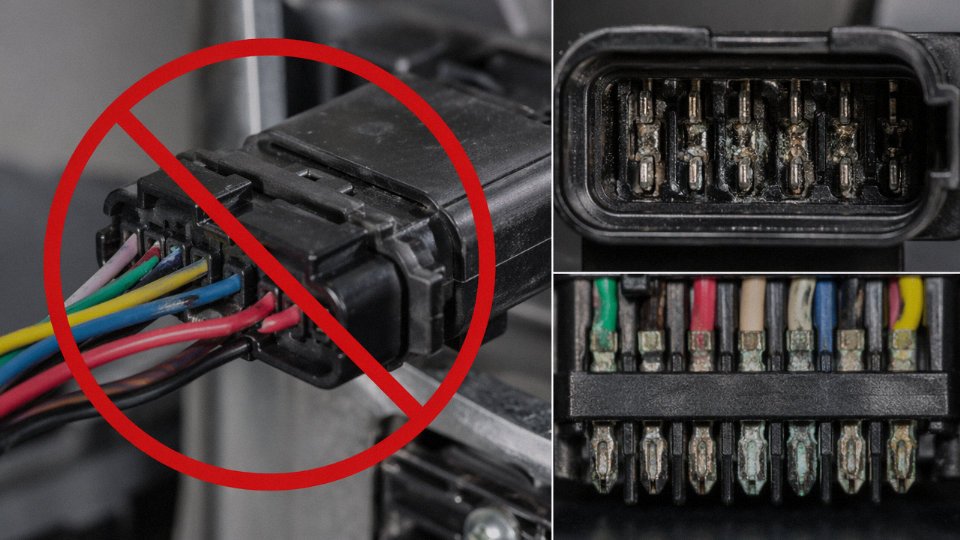
Silicone grease is appropriate on connector body seals and O-ring surfaces, but applying it inside the connector to pin contact areas deposits an insulating PDMS film on conductive surfaces, raising contact resistance and causing intermittent or permanent open-circuit failures.
Relay and Switch Contacts: The Invisible Film Problem
This is where silicone causes damage that’s genuinely hard to diagnose. Gold and silver contact surfaces — used in relays, microswitches, and automotive BCM relays specifically because of their low and stable contact resistance — are highly susceptible to silicone vapor deposition. You don’t even need to spray directly on the contact. Silicone migrates as vapor at ambient temperature, and in an enclosed electrical enclosure it settles on every surface.
The result is a thin insulating film, sometimes only nanometers thick, that raises contact resistance enough to cause intermittent opens. IPC failure analysis documentation and various mil-spec investigation reports have flagged this exact mechanism for years. The frustrating part in practice: the circuit tests fine under probe pressure (which mechanically disrupts the film) but fails under normal switching loads. Technicians chase the fault for hours before anyone thinks to ask what lubricant was used in the cabinet.
Automotive Connectors: Getting the Boundary Right
Here’s a distinction worth burning into your maintenance procedures. Silicone dielectric grease absolutely has a correct role in automotive electrical work — on the rubber boot seals, the connector body O-rings, the grommet faces where moisture ingress is the actual threat. Spread a thin film there and you’ve done the right thing.
The boundary is the pin contact zone. Apply grease inside the connector cavity, anywhere near the actual pin-to-socket interface, and you’ve replaced a corrosion problem with a resistance problem. On multi-pin connectors in engine management circuits — MAP sensors, injector harnesses, that sort of thing — this can cause misfires and fault codes that mimic failed sensors. A thin smear in the wrong place can cost hours of diagnostic time and an unnecessary parts replacement.
PCB and Assembly Environments: Treat It Like a Banned Substance
Any facility assembling or reworking PCBs should have a hard rule: no aerosol silicone products in the production area. Full stop. Silicone overspray settles invisibly on board surfaces and is a well-documented adhesion inhibitor for conformal coatings — acrylic, polyurethane, and epoxy types all have reduced adhesion over silicone-contaminated substrates. You may not see delamination immediately; you’ll see it after the assembly has been in a humid field environment for six months.
Potentiometers and Variable Resistors
Silicone on a resistive track doesn’t just contaminate it — it acts as a binder for whatever debris is already present, accelerating wear and creating dead spots. Volume pots, trim pots on industrial control boards, position sensors with resistive elements — these need dedicated contact treatments. DeoxIT or similar contact-cleaning products are the right tool, formulated specifically not to leave insulating residue.
Where Silicone Actually Belongs in Electrical Work
To be clear about the legitimate uses: silicone grease on high-voltage cable jacket terminations, on battery terminal surfaces to slow oxidation buildup, and on the external sealing faces of waterproof connectors. These are applications where you want an insulating, moisture-excluding film and you’re nowhere near a conductive contact interface. The material hasn’t changed — only the location.
Firearms, Precision Optics, and Mechanisms Requiring Tight Dimensional Tolerances
Silicone spray has a seductive quality in a gun shop or workshop: it comes out clean, smells inoffensive, and leaves surfaces feeling slick. That’s exactly the problem. The same properties that make it pleasant to handle make it a poor choice anywhere load, precision, or contamination margins are tight.
Why Silicone Fails on Firearm Bolt Carriers and Action Components
A semi-automatic bolt carrier group operates under momentary contact pressures that can exceed several thousand PSI at the cam surfaces during cycling. Purpose-made CLP compounds and dedicated firearm greases — think Sentry Solutions TUF-GLIDE or plain lithium-grease applied to the bolt rails — are formulated to stay put under that kind of load. Silicone lubricant, even the thicker 1000 cSt grade, migrates. It doesn’t film-bond to ferrous metal surfaces the way a petroleum or synthetic hydrocarbon grease does, and under repeated impact and pressure it simply gets pushed out of the bearing interface.
What fills the void is carbon. Powder combustion deposits are unavoidable, and in a properly lubricated action they stay suspended in the lubricant film and get wiped out during cleaning. With silicone, the displaced residue mixes with carbon fouling and forms a gritty, abrasive paste — essentially a lapping compound running back and forth on your bolt carrier key and carrier body. Expect accelerated wear on the carrier rails, increased cyclic failure rates in the 500–1,500 round range (depending on round count between cleanings and gas pressure tuning), and extraction failures when the paste builds up on the chamber face. A rifle that cycles fine with CLP at 300 rounds dirty will sometimes start short-stroking at under 150 rounds if silicone spray was used liberally.
Silicone lubricant is safe for use on firearm bolt carriers and internal action components.False
Silicone's low viscosity, poor film strength on ferrous metals, and tendency to migrate under contact pressure make it unsuitable for high-load metal-to-metal bearing surfaces inside firearms. It mixes with carbon fouling to form an abrasive paste, accelerating wear and increasing failure rates compared to purpose-formulated CLP or grease.
Optical Instruments: The Haze Problem Is Almost Irreversible
Silicone oil creep is well-documented in precision instrument engineering — it moves across surfaces with almost no driving force required, which is why it shows up on lens elements after even a single careless spray application near an optical assembly. Once it deposits on coated glass, it doesn’t sit on top like dust. It partially bonds to the anti-reflection coating and diffuses into any micro-pores present. The result is a fogging or haze that reduces contrast noticeably, and attempting to clean it with standard optical tissue and isopropyl alcohol typically smears it further rather than removing it. Full disassembly and re-cleaning of individual elements by someone who knows what they’re doing is usually the only real fix — and on an expensive spotting scope or rangefinder, that’s a repair bill, not a wipe-down.
Aperture blades in photographic or instrument lenses are worse, because silicone contamination causes them to stick mid-stroke and throw off exposure or measurement.
Precision Clockwork, Instrument Bearings, and the Creep Problem
Clock and watch escapements run on pivot jewels with clearances measured in microns, and the oils used — typically synthetic clock oil in the 10–30 cSt range at ambient temperature — are chosen to stay exactly where the watchmaker places them for years. Silicone oil creep is a known disqualifier here. It spreads across the jewel and cock surface, wicks into areas where no lubrication should exist, and in escapements it can alter the impulse and recoil behavior enough to throw timekeeping off by minutes per day. Horology conservators flag silicone contamination as one of the harder cleaning problems they encounter, because it requires ultrasonic cleaning with specific solvents rather than a simple rinse.
Threaded Fasteners Under High Torque
This one comes up regularly in maintenance on stainless-steel flanges and exhaust hardware. Someone grabs the silicone spray because it’s on the bench. Stainless-on-stainless threading — or stainless into aluminum — needs a real anti-seize compound: molybdenum disulfide paste, nickel-based anti-seize for high-temperature applications above roughly 760°C, or copper-based for the 400–760°C range. Silicone provides essentially no anti-galling protection under the axial loads generated during torquing. You get galling, you get seized fasteners, and on a stainless exhaust manifold stud that means heat, an extractor, and occasionally a helicoil — none of which appear in the budget.
Where Silicone Actually Belongs on a Firearm
To be fair: silicone is entirely appropriate on the wooden or synthetic stock and grip surfaces where it conditions and protects without penetrating the action. Rubber recoil pads benefit from a light silicone wipe to prevent cracking and surface tackiness. External metal surfaces going into long-term storage can get a thin film as a corrosion barrier. Those are all surface-protection tasks, not lubrication under load. Keep it there, and keep it away from anything that moves under pressure or needs to stay precisely where you put it.
Bicycle Chains, Drive Trains, and Load-Bearing Metal-on-Metal Contacts
Silicone spray is probably the most misapplied lubricant in any workshop, amateur or professional. It looks like it works — things move smoothly right after you apply it — and that short-term feel convinces people it’s doing the job. It isn’t, not once real load comes into the picture.
Why Silicone Oil Has No Business Under Pressure
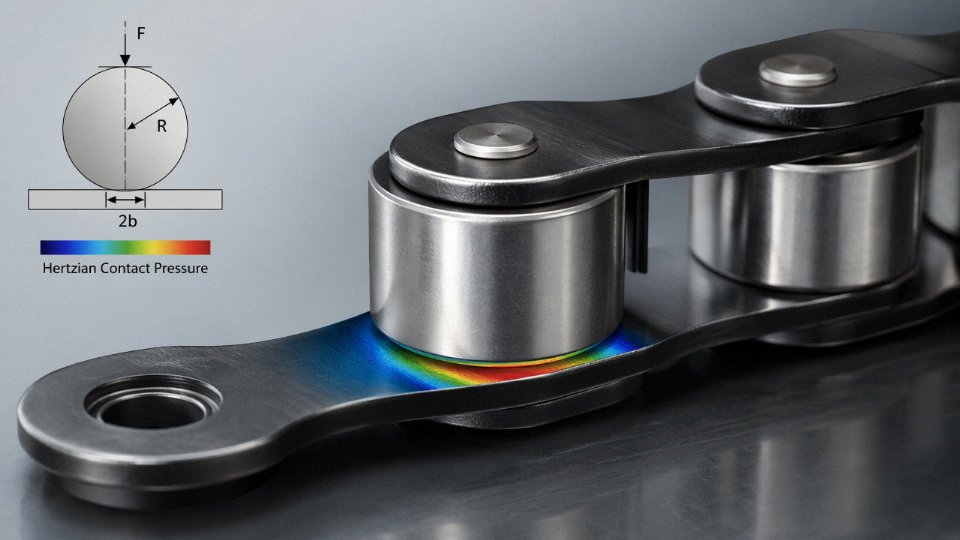
The core problem is that silicone oil (polydimethylsiloxane, whatever the viscosity grade) has virtually no polar affinity for metal surfaces. Mineral oil and synthetic hydrocarbon lubricants adhere to steel through weak but real polar interactions; purpose-built extreme-pressure lubricants go further with sulfur-phosphorus or borate additive packages that react with the metal surface under high load to form a sacrificial boundary film. Silicone has none of that. It sits on metal the way water sits on a waxed surface — present until displaced, then gone. Under Hertzian contact pressures, the film simply squeezes out and doesn’t reconstitute fast enough to prevent metal-to-metal contact.
The Bicycle Chain: A Clear, Measurable Failure
A bicycle chain roller-to-plate interface sees Hertzian contact pressures roughly in the 50–200 MPa range depending on rider weight, gear ratio, and cadence — the higher end on a loaded cargo bike grinding up a grade in a low gear. That’s not an exotic industrial condition; it’s a commuter on a Tuesday morning.
Apply a silicone spray and the chain feels quiet for the first 20–30 km. Then you start to hear it. By 50–100 km, depending on conditions and how often the bike is ridden through wet grit, the rollers are running essentially dry and wear rates accelerate measurably. Chains lubricated this way typically show elongation (the standard proxy for wear) well ahead of the 0.5–0.75% stretch threshold that signals replacement time. You’re buying chains more often, and if you run it long enough, you’re replacing cassettes too — a much more expensive consequence.
Wet conditions make it worse. Silicone spray has no film strength to resist washout, and grit sticks to whatever thin residue remains, turning the interface into mild lapping compound.
Silicone spray lubricant provides adequate long-term lubrication for bicycle chains under normal riding conditionsFalse
Silicone oil lacks the polar adhesion and extreme-pressure additives needed to maintain a protective film under the 50–200 MPa Hertzian contact pressures typical at chain roller-to-plate interfaces. It washes out rapidly and leads to accelerated wear, typically within 50–100 km of use.
Industrial Chain and Conveyor Applications: A More Nuanced Picture
Food-processing plants are where this gets genuinely complicated. NSF H1-rated silicone lubricants are legally acceptable for incidental food contact, and that approval sometimes gets interpreted as “use silicone everywhere in the food zone.” That’s wrong.
For light-duty guide rails, sliders, and low-load conveyor side guides — components where the lubricant is managing friction on sliding contact with minimal normal force — silicone is a reasonable choice and the food-safety argument is valid. But roller chains running a conveyor loaded with full product cases, or the chain drives on a continuous oven, are a different situation entirely. Those applications need an H1-rated chain oil with at least some film-strength chemistry, not a silicone spray. The approval category tells you about food safety. It says nothing about load-carrying capacity.
Gear Meshes: Where the Physics Are Unforgiving
Spur, helical, and worm gear contacts develop elastohydrodynamic (EHD) film pressures that, particularly at low-to-moderate pitch-line velocities, can exceed what silicone’s viscosity and film-forming behavior can sustain. Worm gears are especially punishing — the sliding-dominant contact and high frictional heat generated in the mesh will degrade a silicone lubricant faster than almost any other gear geometry. In practice, worm gears need either a compounded mineral oil or a synthetic with genuine EP performance. Silicone in a worm gearbox is a route to pitting, scoring, and an unexpectedly short service interval.
Where Silicone Actually Earns Its Place
Drawer slides. Wardrobe rail runners. Window tracks. Tool-cabinet slides. Open linear guides with negligible load and long travel. These are the applications where silicone spray genuinely delivers: the contact pressures are trivial, dust and dirt don’t embed and cause secondary abrasion the way they do under heavy load, and the non-staining, non-migrating character of silicone is a real advantage in a finished-goods environment. Use it freely there.
Matching Lubricant to Load Class
The decision isn’t complicated once you frame it by contact pressure rather than by “where is it moving.”
| Contact Type | Typical Load Level | Right Lubricant |
|---|---|---|
| Drawer slides, guide rails, window tracks | Very low | Silicone spray or PTFE dry film |
| Bicycle chains, light conveyor chains | Low–medium | Wet chain oil (mineral or PAO-based), dedicated chain lube |
| Roller bearings, loaded conveyor chains | Medium | Lithium grease NLGI 2, or H1 chain oil for food zones |
| Spur and helical gear meshes | Medium–high | EP lithium complex grease or PAO gear oil with EP package |
| Worm gears, high-load roller chains, cam followers | High | Moly-fortified EP grease, compounded gear oil, or sulfur-phosphorus gear oil |
The general rule: if the components are transmitting torque, handling impact loads, or running under anything resembling continuous bearing load, silicone is the wrong answer regardless of what the spray can says about being a “multi-purpose lubricant.”
Adhesive Bonding, Gasket Seating, and Surfaces Scheduled for Joining Processes
Silicone lubricant’s tendency to migrate is, in my experience, one of the most underestimated contamination risks on a production floor. A single aerosol spray near an assembly station can condemn dozens of parts that look perfectly clean to the naked eye — and the failure won’t show up until a bond line peels in service or a gasketed flange weeps under pressure.
Why Surface Energy Is the Root Cause
The physics here aren’t complicated, but they’re easy to ignore. Silicone compounds — polydimethylsiloxane being the usual culprit — reduce substrate surface energy to roughly 20–24 mN/m. Most structural adhesives need the substrate to be above 36–38 mN/m to wet out properly; below that threshold, the adhesive beads up rather than spreading into intimate molecular contact. You can see this happen in real time with a water droplet test: on a clean steel coupon, water spreads flat; on a silicone-contaminated coupon, it sits up in a near-perfect hemisphere. That’s a bond waiting to fail.
Silicone lubricant reduces substrate surface energy to approximately 20–24 mN/m, below the minimum threshold for most structural adhesives to achieve proper wetting.True
Polydimethylsiloxane (PDMS)-based lubricants are well-documented in adhesion science literature as surface energy depressants; published values for PDMS-contaminated metal surfaces typically fall in the 20–24 mN/m range, compared to clean steel at 40–50 mN/m.
Structural Adhesive Bond Strength — the Numbers Are Damning
Lap-shear testing on silicone-contaminated substrates consistently shows strength reductions of 60–80% versus clean controls, depending on adhesive chemistry, contamination level, and substrate material. Epoxies tend to suffer the most catastrophically because their cure mechanism depends on tight substrate contact. Acrylic and polyurethane adhesives are somewhat more forgiving, but “somewhat” is not a margin you want to rely on in a structural joint. In practice, even a thin, nearly invisible film — the kind left by overspray that drifted across a room — is enough to cause cohesive-to-adhesive failure mode shifts that will confuse your QA team until someone thinks to ask what lubricants are used nearby.
The RTV Silicone Paradox
Here’s one that catches people off guard: RTV silicone sealant itself will not bond reliably to a surface contaminated with silicone oil. The low-molecular-weight silicone fluid interferes with the moisture-driven condensation cure mechanism that RTV depends on, leaving a layer that’s cured at the surface but poorly adhered underneath. Technicians sometimes apply fresh RTV over old, oil-contaminated gasket faces thinking silicone-on-silicone should be fine. It isn’t. The resulting joint may hold briefly and then release under thermal cycling — which is typically when you find out, not during bench testing.
Gasket Seating on Flange Joints
Spiral-wound gaskets and compressed sheet gaskets rely on controlled compressive stress — driven by precise torque values — to achieve seating stress against the flange face. Apply silicone spray to that face (often done with good intentions, to help a stuck gasket release during disassembly) and you’ve introduced a lubricating layer that changes the friction coefficient under the bolt head and between flange faces. The bolt stretches, the gasket appears fully compressed, but the actual seating stress may be 20–35% lower than design, depending on flange surface finish and gasket type. That’s the difference between a joint that holds 50 bar and one that seeps at 30.
Welding and Thermal Joining Processes
Silicone contamination ahead of a weld is a code violation, not just a quality nuisance. At welding temperatures, PDMS oxidizes to silicon dioxide (SiO₂), which has a melting point around 1,700°C — well above the solidification temperature of most structural weld metals. The result is hard, non-metallic inclusions trapped in the weld pool, along with hydrogen-driven porosity from the decomposition byproducts. AWS D1.1 (structural steel welding) and similar codes explicitly require clean, dry, contaminant-free joint surfaces. A weld that passes visual inspection can still carry subsurface SiO₂ inclusions that only show up in radiographic or ultrasonic testing — or in fatigue failure years later.
Contamination Control on the Manufacturing Floor
The tricky part isn’t knowing that silicone and bonding don’t mix. It’s keeping them separated when both exist in the same facility. Useful protocols: designate silicone-free zones with physical barriers and posted signage, not just a line on a floor plan; use a dedicated tool set — brushes, rags, dispensing guns — that never crosses into bonding or welding areas; and store silicone aerosols in a separate cabinet, because the propellant carrier in aerosol cans can drift far beyond the target surface. Personnel training matters too; a maintenance tech who grabs a silicone spray to free a sticky door hinge near a lamination line has no reason to know about surface energy unless someone told them.
| Joining Process | Risk from Silicone Contamination | Typical Consequence | Detection Point |
|---|---|---|---|
| Structural epoxy bonding | Very high | >60% lap-shear strength loss | Often only in service failure |
| RTV silicone sealing | High | Poor cure adhesion, early joint release | Thermal cycling test |
| Spiral-wound gasket seating | High | Insufficient seating stress, process leak | Hydrostatic/leak test or plant incident |
| MIG/TIG welding | High | SiO₂ inclusions, porosity, code failure | RT/UT inspection, or fatigue fracture |
| Polyurethane adhesive bonding | Moderate–high | Adhesive failure at interface | Peel or pull-off testing |
One practical habit worth building: before any bonding, sealing, or welding operation, solvent-wipe with an approved cleaner (isopropyl alcohol at minimum, often MEK or acetone for critical joints) and then do the water-break test. If the surface passes, proceed. If it doesn’t, wipe again. It takes thirty seconds and it’s the cheapest insurance in the assembly process.
Frequently Asked Questions About Silicone Lubricant Incompatibilities
Can I use silicone lubricant on rubber seals?
It depends entirely on the rubber compound — and that answer frustrates people, but there’s no honest shortcut. Viton (FKM) and PTFE-encapsulated seals handle silicone lubricant without issue in most service conditions. Natural rubber is a different story: silicone oil causes swelling and softening that progressively degrades the seal’s dimensional integrity, usually over weeks rather than hours, which makes the failure mode deceptively slow to diagnose. EPDM is inconsistent — some grades tolerate silicone well, others don’t, and the difference often comes down to the specific plasticizer package the compounder used. Always pull the seal manufacturer’s datasheet before committing. If you can’t find one, a 72-hour soak test in the actual lubricant at service temperature will tell you more than any general compatibility chart.
Silicone lubricant is safe for all rubber sealsFalse
Compatibility varies significantly by rubber type. Natural rubber and some EPDM grades swell and degrade when exposed to silicone oils, while Viton and PTFE-encapsulated seals are generally unaffected. Always verify against the seal manufacturer's datasheet.
Is silicone spray safe for plastic parts?
Generally yes for polyethylene, polypropylene, and nylon — these aren’t particularly sensitive to the carrier solvents used in most aerosol formulations. Polycarbonate and polystyrene are the problem cases. The fast-evaporating solvents (typically naphtha or acetone blends) in aerosol silicone sprays can initiate stress cracking in polycarbonate, especially on parts already carrying mechanical load or residual molding stress. A PC lens cover or clear guard panel that looks fine right after application can develop crazing within a few days. If you’re working with polycarbonate components, use a pure silicone oil applied with a cloth rather than an aerosol — or switch to a dry PTFE spray entirely.
Why can’t I use silicone lubricant before painting?
Silicone molecules are small, mobile, and they migrate into surface pores aggressively. When paint is applied over even trace silicone contamination, the low surface energy of the silicone disrupts the wet paint film’s ability to spread uniformly, and you get fish-eye craters — circular depressions where the paint has literally been repelled. What makes this particularly damaging in a production environment is that silicone contamination spreads through overspray and airborne mist. One technician using a silicone spray on the other side of an open paint booth can ruin panels they never touched. The contamination is also easy to miss visually on a bare substrate.
Is silicone lubricant safe for bike chains?
No. Silicone lacks the film strength to survive the contact pressures generated at roller-to-side-plate interfaces — roughly 50,000 to 100,000 psi depending on chain tension and sprocket geometry. It washes out under load, attracts grit, and leaves you with metal-on-metal contact faster than leaving the chain dry. Wet chain oil or a wax-based dry lubricant are the appropriate choices depending on riding conditions.
Can silicone lubricant damage electrical contacts?
Yes, and the failure mode is insidious. PDMS deposits a thin insulating film on metal contact surfaces. The resistance increase is often intermittent — the connection works under firm mating pressure, fails under vibration or thermal cycling — which makes it extremely difficult to trace on a live system. Restrict silicone to connector body seals, environmental boots, and similar non-contact surfaces only.
What lubricant should I use instead of silicone in oxygen service?
Only PFPE-based lubricants — Krytox and Fomblin are the two you’ll encounter most in industrial procurement — that carry explicit certification for oxygen service per CGA G-4.1 and ASTM G63. These are not cheap, running roughly $80–$300 per 100g depending on grade and supplier, but there is no acceptable substitute. Silicone in oxygen service is a fire and explosion risk, not a marginal performance trade-off.
Does silicone lubricant go bad or expire?
Pure PDMS silicone oils in sealed containers are chemically stable for five years or more. The weak link in aerosol products is the carrier solvent and propellant. Propellants can lose pressure, carrier solvents can partially evaporate through valve seals, and what comes out of a three-year-old can sitting in a hot storage cabinet may be significantly more viscous and poorly atomized compared to fresh product. In practice, check aerosol spray quality before use on critical applications — if the pattern is uneven or the output looks wet and heavy, don’t trust it for precision work.
Can I remove silicone contamination before bonding or painting?
Partially. An IPA wipe-down removes surface-level contamination on non-porous metals reasonably well, and a dedicated wax-and-grease remover does better still. On porous substrates — cast iron, rough-ground weld areas, wood, concrete — silicone that has had time to wick into the pores may be genuinely irreversible. The practical rule in a paint shop or bonding operation: if a surface has been silicone-contaminated and you’re not certain of full removal, treat it as contaminated for bonding and painting purposes. Re-cleaning twice and testing adhesion on a sample coupon is a far cheaper decision than a delamination failure in service.