Blending silane coupling agents into multi-additive formulations goes wrong quietly — a pH mismatch here, a premature condensation reaction there — and by the time the problem shows up as delamination, poor tensile retention, or filler agglomeration on the line, you’ve already run bad parts. Rework costs climb fast, and if the root cause isn’t identified before the next batch, the scrap compounds. The fix isn’t exotic; it’s sequencing, pH control, and knowing which co-additives will compete with your silane before they ever touch the same vessel.
Yes, silane coupling agents can be mixed with other additives — including plasticizers, curatives, fillers, and dispersants — but compatibility depends on pH, hydrolysis state, and addition sequence. Pre-hydrolyzing the silane in dilute acetic acid at pH 3.5–4.5 before combining it with other components is the standard approach that prevents premature condensation and preserves coupling efficiency across most industrial formulations.
What makes this topic genuinely tricky is that silanes don’t behave like passive additives. They react with water, with surfaces, and with each other, often faster than formulators expect. The window between useful pre-hydrolysis and destructive self-condensation can be measured in minutes for short-chain trimethoxysilanes, and understanding that window is what separates a clean blend from a gelled waste batch.
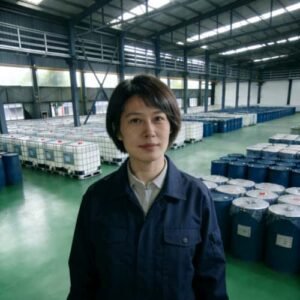
 to a multi-additive mixing vessel in a chemical plant](https://siliconchemicals.com/wp-content/uploads/2026/06/silane-coupling-agent-mixing-additives-01-hero.jpg)
Silane Reactivity Map: Matching Functional Groups to Compatible Additive Classes
Understanding which silane functional group you’re working with is the single most important step before any blending decision. The organic functionality on the non-hydrolyzable end of the silane molecule drives reactivity with other formulation components — sometimes beneficially, sometimes catastrophically. This framework lets you screen compatibility on paper before you commit lab time or production material.
Aminosilanes (APTES, AMEO, and Related Diaminosilanes)
The primary amine group is a strong nucleophile. That’s exactly what makes aminosilanes useful as adhesion promoters in epoxy and polyurethane systems — they react readily with epoxy rings and isocyanate groups, forming covalent bonds that reinforce the interface. In practice, aminosilanes are often pre-reacted with epoxy resins at 40–60 °C before introduction to the larger formulation, giving you a defined adduct rather than uncontrolled in-situ reaction during processing.
The same nucleophilicity creates problems when aminosilanes meet acid-functional additives at mixing temperatures. Fatty acid lubricants, maleic anhydride-grafted coupling agents, and acidic surface-treated fillers can protonate the amine and render it unavailable for interfacial bonding — you get poor adhesion without any visible sign of failure until mechanical testing. Aminosilanes are broadly compatible with inorganic pigments, titanium dioxide included, but keep them away from strong electrophilic crosslinkers such as melamine-formaldehyde resins unless the sequence is controlled: add the silane to the filler first, let it react, then introduce the crosslinker.
Epoxysilanes (GPS / A-187 and Analogues)
Glycidoxypropyltrimethoxysilane is among the most forgiving silanes in multi-component systems because the epoxide ring is relatively stable at ambient temperature and neutral pH. It tolerates mineral fillers, most plasticizers, and standard processing temperatures up to roughly 100–120 °C without premature ring-opening. Reactivity kicks in with amines, anhydrides, and carboxylic acid-functional polymers — which is the intended chemistry in epoxy coating and fiber-sizing applications.
The operational warning: Lewis acid catalysts (boron trifluoride complexes, certain metal triflates) accelerate epoxide ring-opening dramatically. If your formulation uses a Lewis acid as a cure accelerator and you blend GPS at elevated temperature, you can trigger premature gelation in the mixer. Add the silane at the lowest practical temperature, and if Lewis acid catalysts are essential, consider a blocked or slow-release variant.
Vinylsilanes and Methacryloxysilanes
These are the radical-cure silanes. In peroxide-crosslinked polyolefins, moisture-cure cable insulation, and UV-curable coatings, their compatibility with radical initiators and photoinitiators is the whole point. The incompatibility to watch is with hindered amine light stabilizers (HALS). HALS function as radical scavengers — they will suppress the same radical mechanism that drives crosslinking, leading to undercure that looks like a processing defect rather than a formulation conflict. In outdoor coating formulations where both UV cure and long-term UV stabilization are desired, the HALS must be added post-cure or replaced with a UV absorber that doesn’t interfere with the radical process.
Mercaptosilanes
Mercaptosilanes are a known poison for platinum-based addition-cure catalysts even at parts-per-million contamination levels.True
Sulfur compounds, including thiols, deactivate platinum hydrosilylation catalysts through strong coordination to the platinum center. This is well-documented in silicone addition-cure chemistry and is the reason mercaptosilane-containing rubber compounds cannot share equipment with platinum-cure silicone RTV without thorough decontamination.
That consequence is not theoretical. In a sulfur-contaminated mixing line, platinum-cure silicone will simply fail to cure — no exotherm, no gel, full batch loss. Mercaptosilanes are, however, highly compatible with sulfur-donor curatives and thiuram accelerators in carbon black-filled tire tread compounds, where the silane-sulfur interaction is mechanistically productive.
Chlorosilanes and Hydridosilanes
Both classes react violently with moisture. Chlorosilanes release hydrochloric acid on contact with water or hydroxyl-containing additives; hydridosilanes evolve hydrogen gas. Neither can be pre-blended into waterborne systems or combined with polyols, glycols, or hydroxyl-functional surfactants without strict anhydrous protocols — dry nitrogen blanket, moisture-scavenged solvents, and equipment pre-dried to below 50 ppm water content.
Compatibility Reference Matrix
| Silane Functional Group | Peroxide / Radical Initiator | Amine / Polyamine | Carboxylic Acid / Anhydride | Isocyanate | Pt Catalyst (addition cure) | Sulfur Donor / Thiuram | UV Photoinitiator |
|---|---|---|---|---|---|---|---|
| Aminosilane | Conditionally compatible (avoid elevated temp with peroxide) | Incompatible — amine–amine no useful reaction; competing basicity | Incompatible — protonation deactivates amine | Compatible — forms urea linkage; controlled reaction | Compatible | Conditionally compatible | Compatible |
| Epoxysilane | Compatible | Compatible — intended ring-opening cure | Compatible — ring-opening | Compatible at low temp; monitor gel time | Compatible | Compatible | Compatible |
| Vinylsilane / Methacryloxysilane | Compatible — intended crosslink chemistry | Compatible | Compatible | Compatible | Compatible | Incompatible — HALS suppresses radical cure | Compatible — check wavelength match |
| Mercaptosilane | Conditionally compatible (thiol-ene reaction possible) | Compatible | Compatible | Compatible | Incompatible — Pt catalyst poison | Compatible — sulfur co-cure | Compatible |
| Chlorosilane / Hydridosilane | Incompatible — exothermic under radical conditions | Incompatible — moisture from amine solution | Incompatible — moisture; HCl release | Incompatible without anhydrous conditions | Compatible in anhydrous hydrosilylation | Conditionally compatible (anhydrous only) | Incompatible — moisture in photoinitiator blends |
Use this matrix as a first-pass screen, not a final answer. Loading level matters: at the low end of the 0.1–2.0 wt% range typical for filler-surface treatment, even a conditionally compatible combination often presents no practical problem. At the high end, or under elevated temperature processing, the reactivity gaps in the table become real defects.
Mixing Silane Coupling Agents into Rubber and Elastomer Compounds
Silica-filled tire compounds represent the single largest industrial consumption of silane coupling agents globally, and the formulation decisions made inside the internal mixer determine whether a tread compound delivers on its promised performance or produces scrap, processing headaches, and warranty returns. Getting the chemistry right requires understanding not just what silane does, but precisely when and at what temperature it does it.
TESPT and TESPD: What Actually Happens in the Mixer
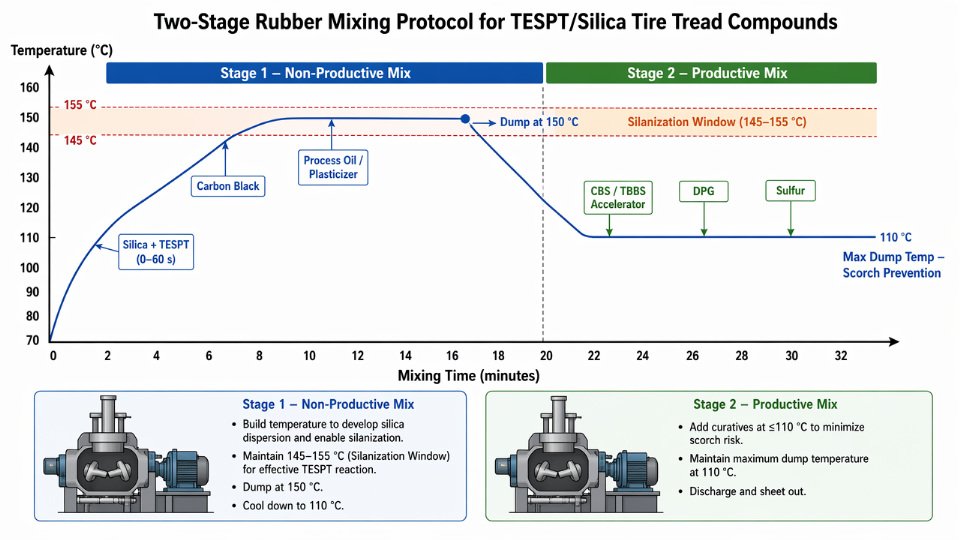
TESPT (bis[3-(triethoxysilyl)propyl] tetrasulfide, commonly called Si-69) and TESPD (the disulfide variant, Si-75) function through a two-step mechanism. First, during the high-temperature mixing stage, the triethoxysilyl groups hydrolyze and condense onto silica surface silanols — this silanization reaction runs efficiently between 140 °C and 155 °C. Below 130 °C the reaction is sluggish and leaves unreacted silane that will leach or volatilize later. Above 160 °C the polysulfide rank of TESPT begins breaking down prematurely, releasing reactive sulfur that can cause early crosslinking.
A direct consequence of silanization is ethanol release — roughly 3 moles of ethanol per silane molecule reacting. In a 300-liter production mixer processing a 200 kg batch, this is a measurable vapor load. Inadequate ram pressure or poor venting during this stage causes ethanol to become trapped, producing porosity in the compound and creating a flash fire hazard at the mixer discharge. Standard practice in tire plants is to maintain a controlled vent cycle at the peak mixing temperature and avoid sealing the mixer cavity completely during the silanization window.
Two-Stage Protocol: Sequencing to Prevent Scorch
The two-stage mixing protocol exists for one reason: sulfur and accelerators must never see silanization temperatures. In the first productive stage (the “non-productive” or NP mix in tire plant terminology), silane and silica go into the mixer together — ideally added as a combined package or with silica first, then silane within the first 30–60 seconds of rotor rotation. Carbon black, if present, follows. Processing aids and oils come in after the silica-silane package has had at least 60–90 seconds of distributive mixing. The dump temperature target is 145–155 °C; the batch then cools to below 110 °C before the second stage.
The final mix stage, sometimes called the productive pass, is where CBS, TBBS, and DPG accelerators enter alongside sulfur. DPG deserves specific attention: it acts as a secondary activator for silanization and improves silica dispersion, but adding it in the first stage at high temperature risks pre-reacting it with silanization byproducts. Keep it in the final pass.
Properly sequenced TESPT/silica compounds achieve 15–25% lower rolling resistance (tan delta at 60 °C) and 20–30% higher wet grip index compared with improperly blended controls.True
These ranges are consistent with published tire industry data from SAE, Rubber Chemistry and Technology, and internal formulation studies at major compounders. The actual delta depends on silica loading (typically 60–80 phr in high-performance tire treads), silane dose, mixing equipment, and dump temperature consistency.
Carbon Black Hybrid Systems and the Dose Adjustment Reality
When carbon black is used alongside silica, silane efficiency drops because carbon black adsorbs silane physically at its surface — it is not reactive with the silanol-condensation mechanism, but it competes for silane molecules in the melt phase. In practice, compounders running hybrid filler systems (silica plus 10–25 phr carbon black) typically increase silane loading by 10–20% relative to the all-silica baseline dose to compensate. The exact adjustment depends on the carbon black surface area (N2SA) and its proportion of total filler. High-structure blacks at elevated loadings require the higher end of that correction; a low-loading reinforcing black may need only 10%.
Processing Oils and Plasticizers: Adsorption Competition
Aromatic and naphthenic oils are generally benign in this system — they do not compete meaningfully for silica surface sites and do not interfere with silane condensation chemistry. Highly polar ester plasticizers are a different story. Ester carbonyls can hydrogen-bond to residual silica silanols and physically block silane access to the surface, especially at lower mixing temperatures or in laboratory-scale open-mill work where the mixing intensity is lower. If you are developing a formulation on a lab mill that includes both a polar plasticizer and silane, pre-treat the silica with silane as a dry blend or aqueous pre-hydrolysis step (0.5–2.0 wt% silane in dilute acetic acid at pH 3.5–4.5) before introducing the plasticizer. This is less critical in high-shear internal mixers where thermal energy and shear drive silanization before oil can fully coat the surface, but it eliminates a variable during formulation development.
Peroxide Systems: Vinylsilane Works, Mercaptosilane Does Not
In peroxide-cured EPDM, vinyltriethoxysilane and methacryloxypropyltrimethoxysilane both function effectively as co-agents alongside DCP (dicumyl peroxide) and DBPH (2,5-dimethyl-2,5-di(tert-butylperoxy)hexane). They participate in the radical crosslinking network while simultaneously bonding mineral fillers. Dose the silane at 0.1–1.0 wt% of filler weight; higher loadings with methacryloxy silane can over-crosslink and embrittle the matrix.
Mercaptosilane is a hard exclusion in platinum-catalyzed liquid silicone rubber (LSR). Sulfur compounds — including mercaptans — poison platinum catalysts at concentrations well below 100 ppm. Even trace contamination from equipment that previously processed a mercaptosilane-containing compound can kill cure in an LSR system. If your facility runs both chemistries, maintain strict equipment segregation and document cleaning protocols. This is not a theoretical risk; it is a recurring source of failed LSR batches in plants that also run conventional rubber compounding.
Incorporating Silane Coupling Agents into Epoxy, Polyurethane, and Thermoset Adhesive Systems
Adhesive and sealant formulators work with tighter reaction windows than most other silane users. The same functional groups that make silanes effective adhesion promoters — epoxy, amino, mercapto, isocyanate — are precisely the groups that react with hardeners, chain extenders, and moisture if they end up in the wrong component at the wrong time. Getting the sequence right is not a refinement; it is the difference between a one-year shelf-stable product and a gelled Part B drum.
Epoxysilane in Two-Part Epoxy Adhesives
Gamma-glycidoxypropyltrimethoxysilane (GPS, also labeled A-187 or KH-560 depending on supplier) belongs in Part A — the resin side. The reasoning is straightforward: Part A is predominantly bisphenol-A or bisphenol-F epoxy resin, and GPS’s epoxide ring is chemically stable in that environment at room temperature. Moisture exclusion is the controlling variable for shelf life; in a properly sealed, dry Part A, GPS remains reactive for 12 months or longer without measurable degradation.
Place GPS in Part B instead and you create a problem immediately. Part B contains amine hardener. Amines open epoxide rings at room temperature, consuming both the silane and a fraction of the epoxy resin stoichiometry. The adhesive may appear normal at mixing, then show reduced pot life, soft spots, and poor peel strength on glass or aluminum — symptoms that are easy to misdiagnose as a substrate surface problem rather than a formulation error.
Aminosilane as Co-Hardener in the Amine Component
The logic inverts when you are using an aminosilane such as 3-aminopropyltriethoxysilane (APTES, KH-550). Here the amine functionality is the active group, so it belongs in Part B alongside the other amine hardener. At loadings of 0.5–1.5 phr relative to the total adhesive weight, aminosilane serves two roles simultaneously: it promotes adhesion to glass, mineral, and metal substrates through siloxane bond formation, and it participates in the epoxy cure cycle as a chain extender.
Stoichiometry adjustment is non-negotiable at this point. Every primary amine group on the aminosilane consumes two epoxide equivalents. APTES has one primary amine per molecule (molecular weight approximately 221 g/mol, amine hydrogen equivalent weight approximately 110 g/mol). If you are adding 1 phr aminosilane to a 100-phr epoxy resin system, recalculate your amine-to-epoxide ratio to account for the additional active hydrogen. Skipping this step raises the effective amine-to-epoxy ratio slightly, leading to reduced crosslink density and lower Tg — typically small but measurable on heat-resistant structural bonds.
Polyurethane Adhesives and Sealants: Component Segregation Is Absolute
In two-part polyurethane systems, the rule is categorical: isocyanate-reactive silanes never touch the isocyanate component. Aminosilanes and mercaptosilanes react with isocyanates at room temperature, within minutes. For the isocyanate side (Part A in most PU conventions), acceptable silane choices are isocyanate-functional silanes such as 3-isocyanatopropyltriethoxysilane (IPTS) or epoxysilanes like GPS. Both are stable in the isocyanate component because neither carries a group that reacts with NCO at ambient temperature without a catalyst.
Aminosilanes and mercaptosilanes go into the polyol side only. Even there, verify that the polyol blend has low moisture content before adding the silane. Residual water in the polyol side will begin hydrolyzing the trialkoxysilane end groups, which can cause premature condensation and viscosity drift before the product ever leaves the mixing line.
Aminosilanes and mercaptosilanes react with isocyanates at room temperature and must never be added to the isocyanate component in polyurethane formulations.True
Primary and secondary amines react rapidly with isocyanates via urea formation; thiols form thiourethanes. Both reactions proceed without a catalyst at ambient temperature, causing gelation or chain-stopping side products in the isocyanate component within minutes to hours.
One-Component Moisture-Cure Systems
Silane-terminated polyurethane (STPU) and silane-modified polymer (SMP) systems function because the silane end groups are stable in the absence of moisture and cure only when exposed to atmospheric humidity after application. The principal risk in formulating these systems is inadvertent silane deactivation during compounding. Anhydrous but hygroscopic fillers — certain calcined clays, some molecular sieve grades, and incompletely dried precipitated calcium carbonate — can strip enough trace moisture from the polymer to trigger premature siloxane condensation, shortening shelf life from 12–18 months to as little as 3–6 months.
Dry all fillers to below 0.1–0.2 wt% moisture before incorporation, and seal the finished product under dry nitrogen. This is standard practice in any competent one-component adhesive operation, but the consequences of skipping it are severe enough to warrant repeating.
Catalyst Compatibility and Addition Order
Organotin catalysts (DBTDL), tertiary amine catalysts (DABCO), and titanate catalysts are all compatible with silane coupling agents in cured thermoset and polyurethane systems. The issue is not chemical incompatibility in the final product — it is timing. If the bulk cure catalyst activates the resin matrix before the silane has time to migrate to and react with the substrate interface, the adhesion-promotion benefit is largely lost. The silane gets locked into the bulk rather than concentrated at the bondline.
The practical solution: pre-dissolve the silane at 1–3 wt% in the liquid resin component with mild mechanical stirring for 30–60 minutes at room temperature before introducing fillers or catalysts. This homogenizes the silane into the matrix and ensures it is present at every interface when the system is applied, not clustered around undispersed agglomerates. Add the catalyst last, or as part of the separate reactive component, so it does not accelerate the cure before the silane has distributed evenly.
Silane Coupling Agents in Water-Borne and Solvent-Borne Coating Formulations
Coating formulators face a challenge that rubber and adhesive engineers largely avoid: water. The moment a trialkoxysilane contacts an aqueous phase, hydrolysis begins — and whether that reaction works for you or against you depends entirely on pH, concentration, and timing.
Hydrolysis and Condensation Kinetics
Trialkoxysilanes must hydrolyze to silanols before they can form covalent bonds with hydroxylated substrates like glass, metal oxide, or cured concrete. The reaction is straightforward in principle: alkoxy groups exchange with water to release alcohol and leave reactive Si–OH groups on the molecule. In practice, pH controls everything.
At pH 3.5–4.5, hydrolysis outpaces condensation. Silanol concentration builds, the solution stays monomeric and active, and you have a usable window. Shift toward neutral or alkaline conditions — pH 6 and above — and condensation to siloxane oligomers accelerates sharply. Those oligomers still wet surfaces, but they no longer bond covalently with the efficiency a well-hydrolyzed silane delivers. In a high-pH latex system or an alkaline cementitious primer, an aminosilane added without pH management can polymerize into a colloidal siloxane dispersion within minutes. The coating film looks normal. Adhesion in wet or cyclic humidity testing fails early.
Hydrolysis half-life varies substantially with structure. Methyltrimethoxysilane can hydrolyze in under five minutes at pH 4 and room temperature. A long-chain alkyltriethoxysilane — say, octyltriethoxysilane used in concrete water repellents — may take two to four hours under the same conditions. This matters when scheduling production: a fast-hydrolyzing silane added to a batch that sits for two hours before application has already condensed into oligomers, losing a significant fraction of its reactive surface.
Pre-Hydrolysis Protocol for Aqueous Systems
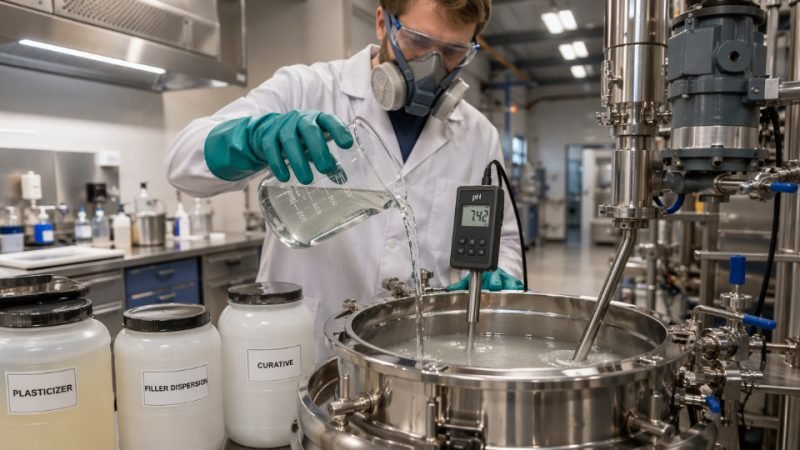
The industry-standard approach is a simple pre-hydrolysis step that takes under an hour and costs almost nothing in labor. Dissolve the silane in a 95:5 water/ethanol blend at 1–5 wt% silane concentration — the ethanol improves initial miscibility with water before the hydrolysis products become fully water-soluble. Adjust pH to 4.0 with dilute acetic acid. Stir at room temperature for 30–60 minutes. The resulting silanol solution is then added to the coating batch.
Pot life of that hydrolyzed solution ranges from roughly 4 hours for aminosilane formulations up to 48 hours for vinylsilane solutions, depending on silane type, temperature, and whether the pH drifts during storage. Label the container with time and discard if it develops visible turbidity — that haze indicates siloxane condensate formation.
Aqueous Emulsion Paints and Latex Coatings
For latex-based architectural or industrial coatings, the cleanest approach is post-add: introduce the hydrolyzed silane into the finished latex after all other components are dispersed, at 0.5–2.0 wt% on dry polymer weight. Vinylsilane and epoxysilane tolerate this well. Aminosilane is the exception — latex pH typically runs 8–10, and even a buffered aminosilane addition at that pH condenses faster than it can migrate to the substrate interface. If an aminosilane is genuinely necessary for adhesion chemistry, drop the latex pH to 7 or below before addition, then re-adjust after blending. That window is narrow and needs tight process control.
Aminosilane coupling agents added directly to high-pH latex without pH adjustment lose most of their adhesion-promoting activity before the coating dries.True
At pH above 9, condensation of aminosilane silanols to siloxane oligomers proceeds far faster than substrate adsorption, effectively removing the reactive monomer from solution before the coating film forms on the substrate.
Compatibility with Dispersants, Thickeners, and Coalescents
Non-ionic surfactants — the ethoxylated alcohol and alkylphenol ethoxylate types common in latex formulations — do not compete meaningfully with silane for surface sites. Anionic sulfonate dispersants are a different matter. Sulfonates adsorb competitively onto TiO2 and silica pigment surfaces through the same hydroxyl sites the silane targets. When both are present, the silane’s effectiveness as an adhesion promoter at those pigment interfaces drops.
A practical screening method: measure zeta potential of your pigment slurry before and after silane addition, with and without the dispersant present. A large reduction in zeta potential shift after silane addition signals competitive adsorption. The fix is typically sequencing — allow silane to adsorb onto the pigment dispersion for at least 15–20 minutes before introducing the anionic dispersant, or reformulate toward a non-ionic dispersant package.
Associative thickeners (HEUR type) and alkali-swellable thickeners (HASE/ASE) are generally silane-compatible, though high-concentration HASE systems push pH up. Coalescents such as Texanol or diethylene glycol monobutyl ether have no reactivity with silane chemistry; treat them as inert.
Silane Adhesion Promoter Primers on Glass, Metal, and Concrete
A dilute aqueous wash — 0.5–1.0 wt% hydrolyzed silane in deionized water, pH 4.0–4.5 — is the standard surface preparation before applying polyurethane, epoxy, acrylic, or alkyd topcoats over glass or metal substrates. Application is straightforward: wipe or spray, allow 5–15 minutes of open time for water evaporation and initial condensation with the substrate hydroxyl groups, then apply the topcoat wet-on-dry.
The choice of functional group follows the topcoat chemistry. Aminosilane for epoxy topcoats, methacrylsilane for UV-cure acrylics, glycidoxysilane for two-component polyurethanes. Applying the wrong silane primer — aminosilane before an alkyd topcoat, for instance — does not create a bond-incompatible situation chemically, but it underutilizes the coupling mechanism. You get physical adsorption where you could have covalent bridging.
On concrete, the porous alkaline surface presents a stability challenge for the primer bath itself. Prepare fresh solution daily and monitor pH; concrete dust contamination raises pH rapidly and can precipitate siloxane flocculant in the wash tank.
Solvent-Borne Systems
In solvent-borne primers and coatings — xylene, MEK, ethanol, acetone, and similar organic carriers — silane is fully co-soluble with the resin and requires no pre-hydrolysis step. Hydrolysis only occurs when the applied film contacts atmospheric moisture or the substrate surface hydroxyls directly. This is an advantage for shelf life: a properly formulated solvent-borne silane primer stored in a sealed container remains active for months rather than hours.
The single serious risk is residual moisture in the solvent. Even 0.1–0.3% water in a bulk solvent drum is enough to initiate slow hydrolysis and condensation over weeks, producing hazy solution and reduced activity. Specify anhydrous-grade solvents for any formulation where silane is added to the bulk. For high-volume production, include a Karl Fischer moisture check as part of incoming QC on solvent lots. It takes under ten minutes per sample and prevents an entire batch loss.
Blending Silanes with Inorganic Fillers, Pigments, and Nanoparticles: Surface Treatment Protocols
Surface treatment is where silane chemistry either earns its cost or wastes it. The filler surface is not passive — it carries hydroxyl density, residual moisture, competing coatings, and pH buffering capacity that all influence how much silane actually bonds versus how much simply evaporates or hydrolyzes into oligomers and washes away. Two primary routes exist: dry integral blending and wet slurry treatment. Choosing the wrong one for your filler type is a reliable path to inconsistent mechanical properties and unexplained batch-to-batch scatter.
Dry Integral Blending: Sequence and Temperature Matter
For coarser fillers — ground calcium carbonate (GCC), wollastonite, precipitated silica, and chopped glass fiber — dry treatment in a high-intensity mixer is the standard production route. The silane is added either neat or as a 10–30 wt% solution in ethanol, introduced dropwise or through a spray nozzle while the mixer runs at tip speeds sufficient to prevent pooling. Addition rate matters: dump the silane too fast and you get localized oligomerization on the filler surface rather than monolayer coverage.
After addition, heating the mixer jacket or discharging to a paddle dryer at 100–120 °C drives condensation between the silane’s silanol groups and the filler’s surface hydroxyls. Residence time at temperature typically runs 15–45 minutes depending on filler surface area and silane chain length — longer for high-surface-area precipitated silica, shorter for dense GCC. Loading levels generally run 0.1–2.0 wt% on filler weight, with the upper end reserved for high-surface-area fillers where monolayer coverage demands more silane. Under-treating leaves bonding sites unreacted; over-treating leaves excess silane that acts as a plasticizer and reduces modulus.
Wet Slurry Treatment: The Right Route for Nanoparticles
Fumed silica, nano-TiO₂, and nano-ZnO present surface areas in the 50–400 m²/g range. Getting uniform silane coverage on those surfaces through dry blending is nearly impossible — agglomerates shield interior surface from treatment. Wet slurry treatment solves this. Disperse the filler in water at 5–20 wt% solids, adjust to pH 4–5 with dilute acetic acid, then add pre-hydrolyzed silane (prepared at 0.5–2.0 wt% in the same acidic water, stirred 15–30 minutes prior). Stir the combined slurry for 30–60 minutes, then filter and dry at 110–130 °C. The acidic pH keeps silane hydrolysis products as reactive silanols without driving rapid self-condensation, giving them time to diffuse into the particle agglomerate and react with surface hydroxyls.
Competing Surface Treatments on GCC and Kaolin
Stearic acid and other fatty acid coatings are already present on most commercial GCC and many kaolin grades. These coatings reduce surface hydroxyl density by occupying active sites, which directly limits silane bonding. Contact angle measurement on treated versus untreated filler, and dispersibility testing in the target polymer, will tell you quickly whether silane is actually anchoring or just sitting on top of the fatty acid layer. In cases where hydroxyl availability is genuinely too low, a mild acid wash or plasma treatment upstream restores enough surface activity to make silane treatment viable.
Stearic acid pre-coating on GCC reduces available surface hydroxyl sites and can significantly limit silane bonding efficiency without pre-treatment or surface preparation.True
Fatty acid coatings react with and consume surface hydroxyls on calcium carbonate, leaving fewer reactive sites for silane condensation. This is well-established in filler surface chemistry literature and confirmed by contact angle and TGA characterization of treated fillers.
Silane and [Silicone Oil](https://siliconchemicals.com/silicone-oil/) Co-Treatment on Fumed Silica
Hydrophobic fumed silica production routinely combines hexamethyldisilazane (HMDS) or a triethoxysilane with polydimethylsiloxane (PDMS) fluid. These two agents occupy chemically distinct surface sites — HMDS caps isolated silanols while PDMS physically adsorbs and condenses across siloxane bridge sites. The result is synergistic rather than competitive: combined treatment achieves lower surface energy and better dispersion in silicone rubber than either agent alone. This is the basis for commercial hydrophobic fumed silica grades used in silicone sealants and encapsulants.
Carbon Nanotube and Graphene Functionalization
Oxidized CNT surfaces carry carboxyl and hydroxyl groups that react with aminosilane or epoxysilane at 60–80 °C in aqueous or ethanol/water solvent over 2–6 hours. Keep pH between 4 and 8 during treatment. Above pH 10, silane hydrolysis accelerates uncontrollably into oligomers and the CNT surface chemistry can degrade — silane deposition becomes thick, non-uniform, and mechanically weak rather than a functional coupling layer. After treatment, these functionalized CNTs disperse readily into epoxy matrices and show measurably improved fracture toughness compared to untreated material.
Quality Control for Treated Fillers
Three tests belong in every treated-filler acceptance protocol. Methanol wettability (the methanol value) gives a fast pass/fail on hydrophobicity that correlates directly with silane coverage. TGA weight loss between 200 and 600 °C isolates the organic silane layer from residual moisture and carbonate decomposition — typical silane layer contribution runs 0.3–2.0 wt% depending on loading and surface area. Dispersibility index in the target polymer matrix is the final functional test; a filler that passes TGA but still agglomerates in the compound points to silane chemistry mismatch rather than insufficient loading. Run all three — no single test catches every failure mode.
Common Formulation Mistakes and Troubleshooting Guide for Silane Incompatibility
Every experienced formulator has a story about a batch that looked fine on paper and failed on the floor. Silane coupling agents are forgiving within a narrow operating window — outside it, the failures are fast, often irreversible, and expensive to diagnose if you don’t know what to look for.
Mistake 1: Adding Silane Directly to Neutral or Basic Aqueous Systems
Trialkoxysilanes hydrolyze and then condense. In water at pH 6–8, that condensation is rapid enough that you can watch viscosity climb within minutes. What you end up with is a siloxane oligomer suspension with minimal reactive silanol available to bond to your substrate. Adhesion values on glass or mineral-filled systems can drop 40–70% compared to properly acidified controls, depending on silane chain length and surface area of the substrate.
The fix is straightforward: acidify the aqueous phase to pH 3.5–4.5 using dilute acetic acid before silane addition. At that pH range, hydrolysis proceeds but condensation is suppressed, keeping reactive silanols available. Prepare the silane at 0.5–2.0 wt% in the acidified water, allow 15–30 minutes for pre-hydrolysis at room temperature, then introduce to the broader formulation. If your system chemistry makes acidification impractical, switch to a monoalkoxysilane — single alkoxy groups hydrolyze to give a silanol that cannot self-condense.
Mistake 2: Blending Aminosilane Directly with Acid-Functional Copolymers
Aminosilanes and maleic anhydride grafted polymers or acrylic acid copolymers will form ionic salt pairs almost instantaneously on contact. The amine is neutralized, the organofunctional reactivity toward your matrix is blocked, and you have reduced a functional coupling agent to an inert plasticizer at the interface. This shows up as reduced tensile strength and poor wet adhesion, but the root cause is easily missed because the mix looks homogeneous.
Sequence is everything. Disperse the filler first, introduce the aminosilane and allow surface bonding to occur, then add the acid-functional polymer in a separate stage. Keeping the two reactive components from meeting in free solution prevents salt formation without requiring any chemistry change.
Mistake 3: Mercaptosilane in Platinum-Catalyzed Systems
Sulfur-containing compounds are well-known platinum catalyst poisons. Even at ppm-level contamination, thiol groups from mercaptosilanes will coordinate to the Pt center and halt hydrosilylation. The result is a permanently uncured elastomer — there is no recovery once the catalyst is deactivated.
Substitute vinylsilane where the application chemistry permits. Where mercapto functionality is genuinely required, some blocked mercaptosilane grades (where the thiol is temporarily protected) can reduce catalyst contact during processing, though compatibility should be verified with your specific Pt catalyst system before scale-up.
Mercaptosilanes irreversibly poison platinum hydrosilylation catalysts even at trace concentrations.True
Sulfur compounds coordinate strongly to platinum metal centers, permanently deactivating the catalyst; this is a well-documented incompatibility in addition-cure silicone chemistry.
Mistake 4: Over-Dosing Silane on High-Surface-Area Fillers
More silane is not better. Once monolayer coverage is exceeded, excess silane forms a loosely bonded polysiloxane multilayer. That layer is rubbery and weak — it plasticizes the interface rather than reinforcing it, and you will see tensile and flexural strength decline rather than improve. With fumed silica at 200 m²/g, the difference between correct dosing and a 3× overdose is measurable in mechanical testing within hours.
Calculate monolayer dose: silane molecular footprint is approximately 0.4 nm² per molecule. From filler BET surface area and silane molecular weight, the theoretical monolayer loading typically lands between 0.1 and 2.0 wt% of filler weight — lower end for coarser fillers, upper end for nanoparticles. Treat that calculated value as your ceiling, not your starting point.
Mistake 5: Storing Silane-Additive Premixes Without Moisture Control
Pre-blended formulations containing silane will slowly lose activity over time even at ambient conditions if moisture ingress is not controlled. Partially hydrolyzed silane condenses during storage, reducing the reactive silanol population available at application. A premix that tested well at week one can underperform significantly by week eight.
Specify moisture-proof packaging with desiccant, maintain a nitrogen blanket on bulk containers, and set a maximum shelf life of 6–12 months for premixed systems — the actual limit depending on silane type, formulation pH, and storage temperature. Re-test adhesion performance at regular intervals; don’t rely solely on visual inspection.
24-Hour Diagnostic Checklist
When a silane-containing formulation underperforms, five quick tests locate the root cause without waiting for full mechanical data:
| Test | What It Detects | Time Required |
|---|---|---|
| pH measurement of aqueous phase | Hydrolysis environment issue (Mistakes 1, 2) | Under 5 minutes |
| FTIR of treated filler (Si–O–C vs. Si–O–Si bands) | Degree of hydrolysis; multilayer condensation (Mistake 4) | 1–2 hours |
| Gel time monitoring of fresh mix vs. aged mix | Storage stability degradation (Mistake 5) | Same day |
| Pull-off adhesion test on substrate coupon | Overall coupling effectiveness; catches most failures | 4–8 hours with primer cure |
| Tensile elongation comparison vs. unfunctionalized control | Interface plasticization from overdose or salt formation | Same day if samples are already mixed |
Running all five in sequence within a single shift gives you enough information to assign the failure to one of the root causes above and select the corrective action before the next production batch.
Frequently Asked Questions About Mixing Silane Coupling Agents with Other Additives
Can I mix silane coupling agent with HALS in UV-cure coating formulations?
Not without first checking your cure mechanism. Vinylsilane and methacryloxysilane rely on free-radical crosslinking to build their organic network, and hindered amine light stabilizers are specifically engineered to quench radicals — meaning they directly compete with the cure you need. In practice, formulators who simply add HALS to a vinylsilane-loaded UV primer find that cure speed drops sharply and surface tack persists even at elevated UV dose. If UV durability is a hard requirement, switch to epoxysilane (glycidoxypropyltrimethoxysilane) or aminosilane paired with a cationic photoinitiator system. Cationic cure proceeds via acid catalysis rather than radical propagation, so HALS does not interfere. Silane loading in this configuration typically stays in the 0.5–1.2 wt% range on total formulation weight, depending on substrate porosity and film thickness.
HALS stabilizers are chemically incompatible with radical-cure vinylsilane and methacryloxysilane systems in UV coatings.True
HALS compounds scavenge the carbon-centered radicals that drive vinyl and methacryloxy crosslinking, directly inhibiting the cure mechanism required for network formation.
Is it safe to blend silane with titanate or zirconate coupling agents for glass-fiber composites?
Generally yes, and worth considering where wet aging performance is critical. Silane and titanate coupling agents occupy chemically distinct surface sites on glass fiber — silane bonds preferentially to silanol groups via siloxane linkages, while titanate and zirconate chelates coordinate with surface metal-oxide sites. Because they are not competing for the same anchoring chemistry, co-application as part of a combined sizing or finish is feasible. Wet flexural strength retention after prolonged humidity exposure often improves by roughly 10–15% compared to either agent used alone, though the actual gain depends on glass composition, fiber sizing design, and the resin system downstream. Apply the silane component first, allow partial hydrolysis to progress, then apply the titanate to avoid premature co-condensation in solution.
How long can a pre-hydrolyzed silane solution be stored before use?
Storage life depends heavily on chain length, silane structure, pH, and temperature. At pH 4.0–4.5 and between 5 and 25 °C, short-chain species such as methyltrimethoxysilane remain active for roughly 4–48 hours before condensation reduces their surface reactivity meaningfully. Longer-chain or sterically bulky triethoxysilanes condense more slowly and can remain usable for up to 5–7 days under the same conditions. Refrigerate all pre-hydrolyzed solutions, seal containers to exclude atmospheric CO₂ (which shifts pH), and re-check pH before each production use. If pH has drifted above 5.5, discard and prepare fresh — the silanol activity you paid for is largely gone.
Can silane coupling agents be mixed directly into water-borne epoxy primer without pre-hydrolysis?
This is one of the more common field errors. Most water-borne epoxy primers run at pH 7–9, which drives trialkoxysilane hydrolysis and condensation fast enough that the silane oligomerizes into inactive particles before it ever contacts the substrate. Pre-hydrolyze separately in dilute acetic acid at pH 4.0–4.5, then add as a final-stage ingredient at 1–2 wt% with gentle, low-shear mixing. Adding it last minimizes residence time at the unfavorable pH and preserves enough reactive silanol for substrate bonding.
Does adding silane to carbon-black-filled rubber require a different protocol than silica-filled systems?
Yes — the surface chemistry is fundamentally different. Carbon black carries few hydroxyl groups, so the covalent silanol-to-surface bond that works on silica simply does not form. Sulfur-functional silanes such as TESPT (bis[3-(triethoxysilyl)propyl] tetrasulfide) remain the relevant choice, but they operate through physisorption on the carbon black surface combined with a polysulfide bridge into the rubber matrix. Mixing temperature management still matters — keep Banbury drop temperature below 160 °C to limit premature polysulfide decomposition — but the bonding rationale is different from a silica system, and expecting the same reinforcement mechanism leads to under-optimized compounds.
What silane loading works when co-formulating with a wetting and dispersing agent in solvent-borne paint?
Use 0.3–0.8 wt% silane on total formulation weight, with the dispersant at 0.5–1.5 wt%. Sequence matters more than ratio: add silane to the mill-base at the grind stage so it has first contact with the pigment surface, then introduce the polymeric dispersant to stabilize the dispersion. Reversing that order lets the dispersant occupy active pigment surface sites and leaves silane with nowhere productive to anchor.
Can silane coupling agents be added to hot-melt adhesives?
Yes, but thermal stability is the gating criterion. Vinylsilane and epoxysilane grades with decomposition onset above 180 °C can be incorporated into EVA and polyolefin hot-melts at 0.5–1.5 wt%. Add at the lowest melt temperature that achieves homogeneity — typically the lower end of the processing window — to limit thermal hydrolysis of alkoxy groups before the adhesive contacts the substrate. If processing temperatures consistently exceed 200 °C, evaluate silane grades with longer-chain alkoxy groups, which hydrolyze more slowly under thermal stress.
SiliconChemicals’ Silane Coupling Agent Portfolio and Formulation Support Services
For a procurement manager evaluating silane suppliers, the gap between a technically adequate product and a genuinely reliable supply partner shows up not in the datasheet but in what happens when a batch fails a viscosity spec at 2 a.m. on a production line, or when a customer in Stuttgart needs REACH documentation before a customs release. That is where vertical integration and dedicated application support actually earn their keep.
Core Product Lines
SiliconChemicals’ standard silane coupling agent catalogue covers the functional classes that industrial formulators reach for most often.
Vinyltrimethoxysilane (A-171 / VTMO) is the primary choice for polyethylene and polypropylene crosslinking applications, wire and cable insulation, and moisture-cure systems. 3-Aminopropyltriethoxysilane (A-1100 / APTES) handles epoxy-glass laminate adhesion promotion, mineral-filled nylon, and surface activation of silica for aqueous coatings — its primary amine reacts cleanly with epoxies, isocyanates, and anhydrides, which also means it needs careful sequencing in two-component systems (discussed in earlier sections). 3-Glycidoxypropyltrimethoxysilane (A-187 / GPS) is the standard primer for glass fiber sizings, inorganic coatings, and dental composite formulations, where the epoxide ring provides a reactive bridge to both resin matrices and inorganic surfaces.
Bis-(triethoxysilylpropyl)tetrasulfide (TESPT / Si-69) is the highest-volume product in the rubber compounding line — the benchmark bifunctional silane for silica-reinforced tire treads. 3-Methacryloxypropyltrimethoxysilane (A-174 / MPS) serves unsaturated polyester, acrylic, and UV-cure systems. 3-Mercaptopropyltrimethoxysilane (A-189 / MPTS) is the preferred choice where rapid thiol-ene coupling or metal-adhesion performance is the design driver. Beyond these standard grades, SiliconChemicals produces specialty custom silane intermediates — blocked mercaptosilanes, oligomeric silanes, and amino-functional silane blends — developed to customer specification for applications where a catalogue product does not quite fit the formulation window.
Production Standards and Analytical Quality
Manufacturing runs through ISO 9001-certified plants located in the Zhejiang and Jiangsu organosilicon industrial clusters, where proximity to chlorosilane feedstock producers and a dense subcontractor network keeps raw material lead times tight and quality consistency high. Standard commercial grades are produced to a purity specification of ≥97% GC assay, moisture content below 200 ppm, and color at or below 10 APHA. Each production batch ships with a certificate of analysis covering those parameters plus refractive index, density, and flash point. For customers running validated production processes — particularly in automotive Tier 1 supply chains or electronics bonding applications — retention samples are held for a defined period, which matters if a downstream traceability question arises months after delivery.
SiliconChemicals' ex-works pricing on standard silane coupling agents runs 15–30% below equivalent-purity European spot-market pricesTrue
This range reflects the cost structure advantage of vertically integrated chlorosilane-to-silane production in China's Zhejiang and Jiangsu clusters, where feedstock costs, energy, and labor combine to produce a structural cost gap versus Western merchant producers. Actual savings depend on grade, volume tier, and freight terms.
Supply Chain Architecture
Vertical integration from chlorosilane intermediates through finished coupling agents is the structural reason that raw material quality stays consistent across lots. A European toll-blender buying merchant chlorosilane on the spot market absorbs feedstock variability that shows up as batch-to-batch GC assay drift. SiliconChemicals controls that input, which tightens the finished-product specification window and reduces the incoming inspection burden on the customer’s receiving lab.
Technical Support for Formulation Projects
Application engineers work directly with customers on formulation compatibility screening, concentration optimization within the 0.1–2.0 wt% loading range typical of filled composite systems, and pre-hydrolysis protocol setup for aqueous carrier applications. That last service is practical: getting the acetic acid dilution to pH 3.5–4.5 and the silane concentration to the right working range before it enters a waterborne coating line is not complicated chemistry, but it is easy to get wrong under production pressure, and a one-hour consultation up front prevents a batch loss. On-site trials support is available for customers in automotive, construction, electronics, and industrial coatings sectors across more than 30 countries.
Regulatory and Documentation Package
EU customers receive REACH pre-registration compliance documentation. North American customers receive TSCA inventory compliance confirmation. Safety data sheets are available in 10 languages. Food-contact and RoHS compliance documentation can be provided on request for the grades where it is relevant — GPS and some amino-functional silanes appear in food-packaging adhesive and medical-device applications where that paperwork is non-negotiable for market entry.
To request a technical data package and sample set, contact SiliconChemicals through the website. Application engineers respond to formulation-specific inquiries within 24 hours and can arrange virtual or in-person consultations for high-volume qualification projects.