Silane coupling agents fail quietly — not with an obvious bang, but through adhesion that degrades weeks after lamination, filler that agglomerates despite surface treatment, or composite parts that pass incoming inspection and crack in service. The root cause is almost never the silane chemistry itself. It’s hydrolysis pH drifting into the dead zone, concentration stacked two or three times above what the substrate can actually bond, or cure schedules that drive off reactive silanols before condensation with the surface completes. Each of those process errors translates directly: delamination scrap runs, warranty returns, and the particular frustration of a failure mode that’s nearly invisible until it’s expensive.
The most common silane coupling agent application mistakes are incorrect hydrolysis pH (most trialkoxysilanes hydrolyze effectively at pH 3.5–5.5 or 7.5–10.5, but lose activity near neutral pH 6–7), excess silane concentration that creates a weak multilayer instead of a functional monolayer, insufficient substrate moisture or surface hydroxyl density, and incorrect drying or cure temperature sequences. Correcting these process variables — not reformulating the silane — resolves the majority of bonding failures.
What makes this frustrating for experienced formulators is that silane chemistry looks forgiving on paper: wide recommended ranges, simple aqueous application, decades of industrial use. In practice, the tolerance stack between “adequate surface coverage” and “weak boundary layer that fails under shear or humidity” is narrower than most process sheets acknowledge. The sections below work through each failure mode with the process logic that explains why it happens and what the corrective action actually looks like on the plant floor.
Mistake 1 — Selecting the Wrong Functional Group for the Polymer Matrix
The organic end of a silane coupling agent is not decorative. It is a reactive functional group that must participate in covalent or strong coordinative bonding with the polymer matrix during cure. When that end group is chemically incompatible with the resin system, the silane deposits a well-hydrolyzed, well-condensed inorganic layer on the substrate surface — and then stops. The polymer cures over the top of it without forming a meaningful bond. You end up paying for chemistry that does nothing except add an interface contaminant.
This is the most upstream error in silane application, and it is surprisingly common because silane coupling agents are often treated as interchangeable commodities in procurement. A requisition comes back with “coupling agent — silane-based,” and whoever fills it reaches for whatever is in stock.
The Organic-End Chemistry Logic
Each silane functional group targets a specific cure mechanism or resin chemistry. Aminosilanes (A-1100 / KH-550 being the widely used benchmark) react with epoxy resins through amine-epoxide ring opening, and they also condense with phenolic resins under heat. Methacryloxy silanes (KH-570 / A-174) participate in free-radical polymerization, making them the right choice for unsaturated polyester laminates and acrylic coatings. Vinyl silanes belong in peroxide-cured polyethylene, EVA, and similar polyolefin systems where the vinyl group co-reacts with polymer chains through radical addition. Mercapto silanes and polysulfidic silanes couple into sulfur-cured rubber networks — the sulfur functionality either co-vulcanizes directly or contributes sulfur to the network through dynamic exchange. Glycidoxy silanes (KH-560 / A-187) carry an epoxide group and work across both epoxy and polyurethane systems where the epoxide can react with amines, hydroxyl groups, or isocyanates depending on system design.
None of this is interchangeable. The reactivity is chemistry-specific, not generic surface wetting.
What Cross-Category Mismatches Actually Look Like in Practice
One recurring mismatch on production floors involves aminosilane (KH-550) being applied to silica or carbon black filler destined for a peroxide-cured EPDM compound. The engineer reasoning is roughly: “silane is silane, the filler is better wetted, and we have KH-550 in stock.” The amino group has no route to react with EPDM under peroxide cure. Lap shear or peel testing on the resulting compound typically shows bond strength reductions of 40–70% compared to a correctly matched vinylsilane treatment — the range depends on filler loading, cure conditions, and whether any mechanical interlocking partially compensates.
The reverse error is equally damaging. Applying vinylsilane to an epoxy adhesive system produces surface adsorption with minimal covalent contribution. The vinyl group under ambient or thermal epoxy cure conditions is essentially inert to the amine-epoxide reaction. The silane sits at the interface, and the bonded assembly behaves as though untreated — worse, in some cases, because the deposited silane layer can act as a weak boundary layer at high coverage.
Using an aminosilane in a peroxide-cured EPDM compound produces bond strength equivalent to a correctly matched vinylsilaneFalse
Aminosilanes lack the radical-reactive vinyl group needed to co-react with polymer chains during peroxide cure. They do not participate in the crosslinking network and leave the interface functionally unbonded despite good inorganic condensation to the substrate surface.
Reading Cure Chemistry Before Ordering Silane
The practical discipline here is to identify the dominant cure mechanism first — radical, ionic, condensation, isocyanate addition — and then consult a functional-group reactivity table against that mechanism. Resin technical data sheets almost always list cure chemistry. Hardener type, peroxide type, and crosslinker identity all point directly toward which silane end group belongs in that system.
A simple decision table covering the five major silane functional groups, matched against eight common resin/elastomer families, reduces substitution errors dramatically. That table should exist as a controlled engineering document with a revision history and a required sign-off before any silane substitution is approved in a validated formulation. Production formulators should not have discretionary authority to swap silane grades without that review — the downstream scrap and adhesion failure costs from one bad batch consistently outrun any short-term procurement savings.
Mistake 2 — Incorrect Hydrolysis Conditions During Aqueous Solution Preparation
Of all the ways silane coupling agents fail in production, bad solution preparation is the one that kills performance before the substrate is ever touched. The chemistry looks deceptively simple — dissolve silane in water, apply, cure — but each stage of the reaction has its own demands, and ignoring any one of them collapses the whole mechanism.
The Three-Stage Reaction and Why Sequence Matters
Silane coupling agent activity depends on three consecutive reactions. First, the alkoxy groups (typically methoxy or ethoxy) hydrolyze in water to form reactive silanols. Second, those silanols partially condense with each other to form low-molecular-weight oligomers — manageable at controlled concentrations, destructive at high ones. Third, the silanols chemisorb onto the substrate surface via hydrogen bonding and then form covalent siloxane bonds (Si–O–substrate) during the drying or curing step.
Each stage has a rate-limiting variable. Hydrolysis rate is controlled by pH and temperature. Condensation rate is controlled by concentration, pH, and time. Chemisorption efficiency is controlled by surface hydroxyl density and moisture content at the substrate. Plant operators who treat “mix silane in water” as a single step are effectively ignoring two of the three reactions entirely.
pH Is the Master Variable — and the Most Ignored One
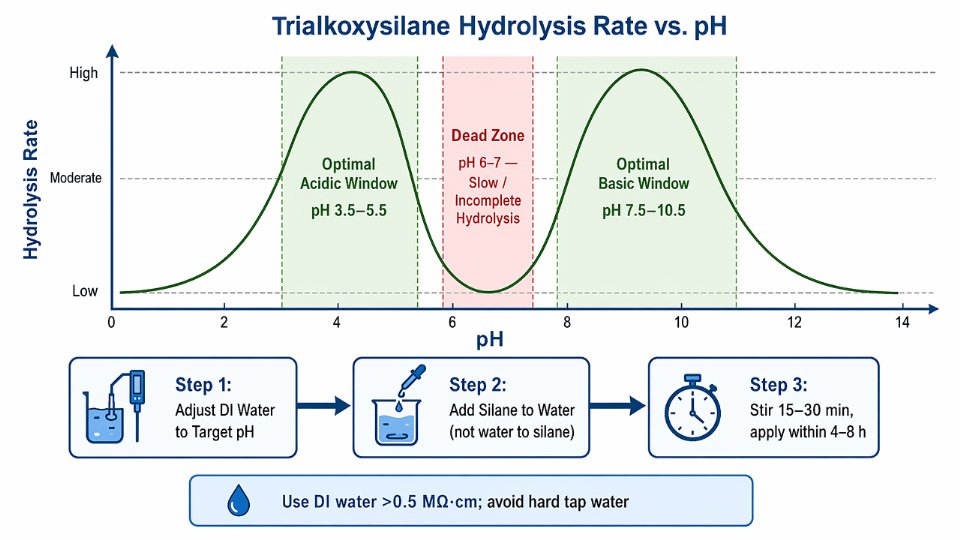
Most trialkoxysilanes hydrolyze effectively in one of two pH windows: acidic, pH 3.5–5.5, or basic, pH 7.5–10.5. Dilute acetic acid (glacial acetic acid dropped into water to target roughly pH 4–5) works well for epoxy, methacryloxy, and vinyl functional silanes. Amino silanes are self-buffering — their amine group raises solution pH to roughly 9–10.5 on its own — which is exactly where they perform best.
Operating at neutral pH 6–7 is the most common mistake made when operators skip pH measurement entirely and simply mix silane into tap water. At neutral pH, hydrolysis is genuinely sluggish and incomplete. You get a solution that looks ready but contains mostly un-hydrolyzed alkoxy silane — the organic end may bond to the polymer matrix eventually, but the silanol end never forms properly, so chemisorption onto the inorganic substrate is weak. The result is adhesion that passes initial pull testing and fails under humidity cycling or mechanical fatigue six weeks into service.
Operating a trialkoxysilane aqueous solution at pH 6–7 produces significantly slower and less complete hydrolysis compared to either the acidic (pH 3.5–5.5) or basic (pH 7.5–10.5) windows.True
Hydrolysis of alkoxysilanes follows a bimodal rate-pH curve. Both acid-catalyzed and base-catalyzed mechanisms accelerate the reaction; near-neutral pH lacks both catalytic pathways, resulting in incomplete silanol formation within practical working times.
Water Quality Traps
Hard tap water — common in many manufacturing regions — contains Ca²⁺ and Mg²⁺ ions at concentrations that can precipitate silane-salt complexes, particularly with amino-functional silanes. These precipitates appear as cloudiness or white floc in the bath. Operators often interpret cloudy solution as “it’s working” rather than as evidence of salt formation and wasted silane. Use deionized or softened water with resistivity above 0.5 MΩ·cm. This is not a laboratory luxury; it is standard practice in any glass fiber sizing line or mineral filler treatment circuit.
Concentration Discipline and the Weak Boundary Layer Problem
Working solution concentration for glass fiber sizing and mineral filler surface treatment typically falls in the range of 0.1–2.0 wt%, where the lower end suits high-surface-area fumed silica and the upper end suits coarser ground calcium carbonate with lower specific surface area. Exceeding this range does not improve adhesion — it makes it worse. Excess silane undergoes uncontrolled self-condensation, building up a thick, poorly crosslinked polysiloxane layer. That layer is mechanically weak. Under shear or peel loading, failure occurs cohesively within the polysiloxane film itself rather than at the interface, which is exactly where a coupling agent should prevent failure. Surface coverage benchmarks are roughly 2–4 µmol/m² of substrate; beyond that threshold, you are building a weak boundary layer, not a coupling layer.
Pot-Life Is Real, and Reusing Aged Baths Is a Documented Failure Mode
Hydrolyzed silane solutions have a working life of roughly 4–8 hours at room temperature, with the range depending on concentration, pH, and ambient temperature — a high-pH amino silane bath in a warm plant can exhaust in under three hours. As condensation advances, the solution shifts from monomeric silanols toward higher oligomers and eventually insoluble polysiloxane particles. A bath that was prepared at 6 AM and is still being applied at 3 PM in a warm facility is likely delivering inconsistent — and possibly negligible — coupling performance.
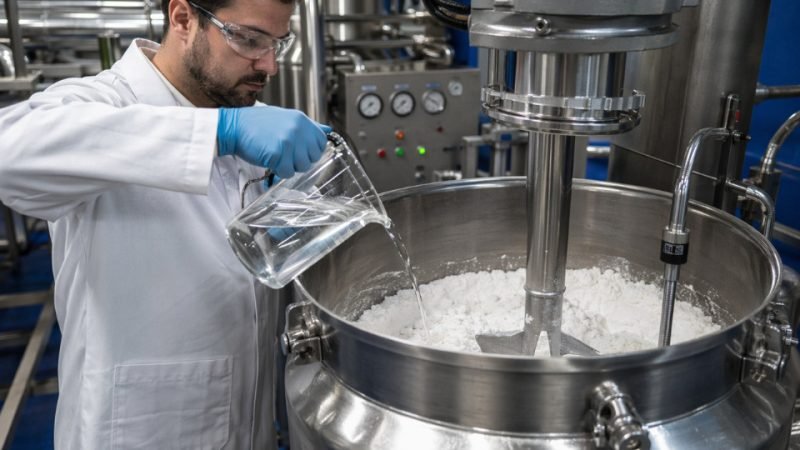
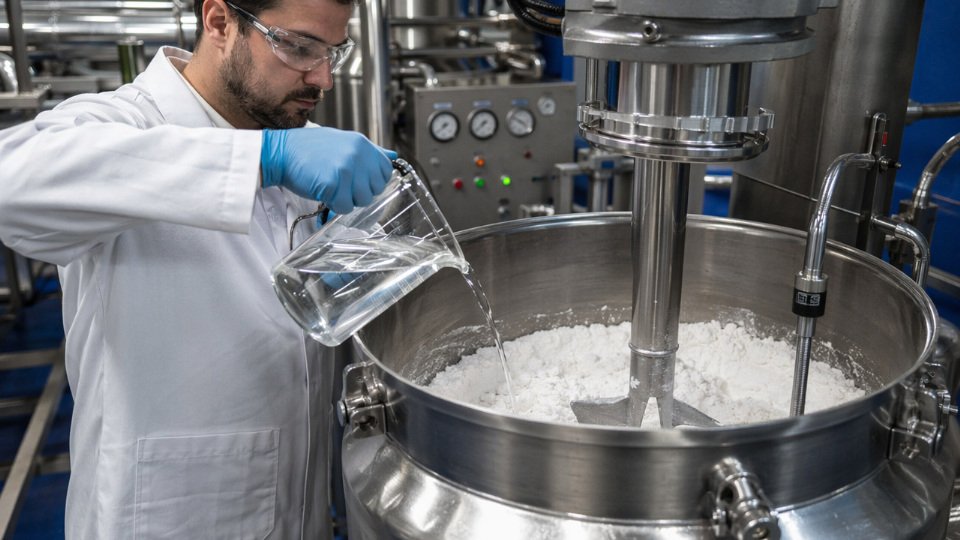
The practical protocol is straightforward: always add silane to water rather than water to silane (to control the dilution sequence and avoid localized high-concentration hydrolysis), adjust pH before adding silane, measure with a calibrated meter rather than broad-range indicator paper, and log batch preparation time on the container. Prepare in quantities sized for the shift, not the week.
Mistake 3 — Over-Treatment and Under-Treatment of Substrate Surfaces
Silane dosing is not intuitive. Plant teams accustomed to “more is better” thinking — the logic that works fine for lubricants or release agents — will systematically over-treat fillers and substrates, and the result is a composite that performs worse than the untreated baseline. Understanding why requires a brief but non-negotiable look at what a functional silane layer actually is.
The Monolayer Concept and Why Excess Silane Backfires
Effective silane coupling depends on forming a chemisorbed monolayer on the inorganic surface. For most trialkoxysilanes on inorganic substrates — precipitated silica, glass fiber, calcium carbonate, kaolin — that target loading sits in the range of 2–4 µmol/m², roughly 0.1–0.5 mg/m² depending on the silane’s molecular weight and the substrate’s surface hydroxyl density.
Within that range, silane molecules bond through their silanol groups to surface silanols, leaving the organic-functional end oriented outward toward the polymer matrix. The coupling is real and load-bearing.
Exceed that threshold and the chemistry changes character. Unreacted silanol groups from excess silane condense with each other rather than with the substrate, building up a thick, lightly cross-linked polysiloxane interphase that is physically soft, hygroscopic, and poorly anchored. Under mechanical stress or humidity aging, this layer shears cohesively — the so-called weak boundary layer failure. Adhesion test results look acceptable when dry and fresh, then collapse after 72-hour water soak or thermal cycling. By that point the formulator is usually blaming the resin, not the silane dosing.
Excess silane loading creates a polysiloxane weak boundary layer that can cause worse adhesion than no treatment at all.True
When silane deposition exceeds monolayer coverage, multilayer condensation produces a poorly anchored polysiloxane mass. This layer has low cohesive strength and absorbs moisture readily, making the interface weaker under load or humidity than a clean, untreated inorganic surface would be.
Under-Treatment Is Equally Damaging, Just More Slowly
Sparse coverage leaves bare inorganic sites — reactive silanols on silica, exposed metal oxide on glass — that preferentially adsorb moisture from the environment. Those sites become stress concentration points. Under cyclic loading or prolonged humidity exposure, water displaces the polymer interface at these unprotected zones and delamination propagates laterally. You may not see it in initial tensile tests; you see it in 1,000-hour aging data or in field returns after a wet season.
Calculating the Correct Silane Loading
The required silane mass per gram of filler is straightforward once you treat BET surface area as a real process input rather than a data-sheet footnote.
Formula:
Silane loading (mg/g filler) = [BET surface area (m²/g) × target coverage (µmol/m²) × molecular weight of silane (g/mol)] ÷ 1,000
Worked example — precipitated silica, 40 µm median particle size, BET = 180 m²/g, silane MW = 220 g/mol (e.g., a typical aminopropyltriethoxysilane), target coverage = 3 µmol/m²:
Loading = (180 × 3 × 220) ÷ 1,000 = 118.8 mg per gram of filler, or roughly 11.9 wt% on filler.
That number is specific to that silica grade. Switch to a higher-surface-area fumed silica at 380 m²/g and the required loading nearly doubles. This is exactly where plant-floor errors concentrate.
How Over-Treatment Happens in Practice
The most common cause is volume-habit dosing: a technician adds “the usual 2% silane” regardless of whether the filler lot has the same surface area as last month’s delivery. Filler manufacturers change grinding parameters, switch precipitate reactor conditions, or ship blended particle-size distributions — BET surface area can shift ±30–50% between lots without triggering any flag in a standard CoA that only reports particle size and bulk density.
A second common failure: treating pre-treated filler. Some precipitated silicas arrive surface-modified from the supplier. Adding a second silane treatment without stripping or analytically verifying the existing coating stacks layers unpredictably and almost always results in over-treatment.
Verification Methods Worth Building Into Your QC Routine
TGA is the most direct bench method. A properly treated silica shows a characteristic organic decomposition step between roughly 250–550 °C; surface carbon content derived from mass loss correlates to silane loading and can be benchmarked against your monolayer target.
DRIFTS (diffuse reflectance infrared Fourier transform spectroscopy) lets you monitor the ratio of residual Si-OH stretch (~3740 cm⁻¹) against Si-C and N-H or C-H peaks from the organic function. A well-treated surface shows near-complete Si-OH suppression without spectral evidence of thick polysiloxane buildup.
For plant-floor use where lab instruments aren’t cycle-time feasible, a solvent-extraction weight-loss test — Soxhlet extraction in toluene or ethanol for 6–8 hours, followed by weight comparison — gives a reasonable proxy for loosely bound (excess) versus chemisorbed silane. It does not replace TGA but it catches gross over-treatment quickly.
Operational warning: Never rely on color, viscosity, or smell of the treated filler as a loading proxy. These parameters are insensitive to the ±40% loading variation that will meaningfully affect composite performance.
Recommended Practice
Treat BET surface area as a required incoming inspection parameter for any filler destined for silane treatment. Write a silane loading specification — in mg/g filler, derived from the monolayer calculation — directly into your filler receiving QC procedure. When a new filler lot arrives with a BET value outside your baseline range, recalculate the silane dose before it reaches the mixer. This takes minutes and eliminates the single largest source of silane treatment variability on most production floors.
Mistake 4 — Inadequate Substrate Surface Preparation Before Silane Application
Surface preparation is where silane chemistry meets plant-floor reality — and where the gap between laboratory results and production outcomes is widest. A perfectly selected, correctly hydrolyzed silane solution applied to an inadequately prepared surface will bond to contamination instead of substrate, producing adhesion values that look acceptable in incoming QC and fail catastrophically under service stress or moisture exposure.
Why Free Surface Hydroxyls Are Non-Negotiable
Silane chemisorption depends on condensation between the silane’s hydrolyzed silanol groups (Si-OH) and surface hydroxyl groups on the substrate — Si-OH on glass, Al-OH on aluminum oxide, Fe-OH on steel, Ti-OH on titanium dioxide filler. These reactive sites exist naturally on most inorganic surfaces, but they are easily blocked. A thin film of mineral oil, mold-release wax, or drawing lubricant from metal forming operations can suppress silane uptake almost completely. Residual moisture condensation that has partially polymerized surface contamination creates a physical barrier that silane cannot penetrate chemically. The coupling agent bonds to what it finds first — and if that layer is not mechanically robust, the interface fails regardless of silane chemistry.
Substrate-Specific Preparation Protocols
Glass fiber arriving with commercial sizing must be stripped before re-treatment. Heat cleaning at 350–450 °C (duration depends on fiber tex and sizing load) burns off organic size without damaging fiber integrity; solvent washing with acetone or isopropyl alcohol works for light contamination but rarely eliminates heavy epoxy-compatible sizings fully. After cleaning, fibers should be silane-treated within 2–4 hours to prevent recontamination from handling.
Aluminum and steel need surface oxide conditioning, not just degreasing. Solvent or alkaline degreasing removes oil, but the passive oxide layer chemistry matters. Alkaline etch (typically 50–80 g/L sodium hydroxide, 40–60 °C, 30–120 seconds depending on alloy) opens the oxide and exposes reactive Al-OH sites. Rinse thoroughly — residual alkali will push local pH out of the silane’s effective hydrolysis window. Chromate-free conversion coatings (zirconium- or titanium-based) are now standard for aerospace and automotive parts; these actually increase hydroxyl site density and improve silane bond durability compared to bare etched metal in humidity cycling.
Mineral fillers — precipitated silica, calcium carbonate, kaolin, wollastonite — can carry 1–3 wt% adsorbed water and organic process aids from wet processing. For heavily contaminated grades, calcination at 200–400 °C (2–4 hours, depending on filler particle size and contamination level) removes adsorbed moisture and burns off organics before silane treatment in a dry compounding process. Skipping this step with calcium carbonate, for example, leads to silane reacting with surface carbonate species rather than hydroxyl groups, producing a weak, poorly defined interface.
The Moisture Paradox
Surface hydroxyls require some water to be accessible, but liquid-phase water on the substrate drives homocondensation — silane molecules react with each other in solution rather than with the substrate surface. The practical target is 0.1–0.5 monolayers of surface moisture, achievable by drying substrates at 80–120 °C and allowing them to cool in a humidity-controlled environment (relative humidity below 60 %) before silane contact. At this moisture level, hydrolysis at the interface is supported without competitive condensation in solution.
A substrate dried at 80–120 °C and exposed to ambient humidity below 60 % RH for under 30 minutes before silane application achieves near-optimal surface moisture for chemisorption.True
Mild thermal drying removes bulk adsorbed water while leaving surface-bound hydroxyl groups intact; brief ambient re-exposure at controlled RH restores the monolayer moisture needed to facilitate silane hydrolysis at the interface without promoting homocondensation in the liquid phase.
Concrete and Masonry: A Special Case
Fresh concrete carries surface pH above 12. This accelerates hydrolysis of aminosilanes and other base-sensitive silane types but can also cause oligomeric silane species to precipitate before penetrating the pore structure. Equally important: applying silane sealer to green concrete (under 28 days cure in most mix designs) means reacting with a surface that is still evolving chemically. Carbonation of the surface layer — where calcium hydroxide converts to calcium carbonate, dropping surface pH toward 8–10 — typically takes 2–6 weeks depending on environment. Waiting for this carbonation is not optional; it is the difference between a sealer that bonds to the matrix and one that sits on top until the first freeze-thaw cycle.
Six-Step Pre-Treatment Verification Checklist
| Step | Check | Acceptance Criterion |
|---|---|---|
| 1. Contamination inspection | Visual + solvent wipe test | Wipe shows no color transfer, no oily residue |
| 2. Cleaning method confirmed | Match cleaning chemistry to contamination type | Documented procedure, not improvised |
| 3. Drying protocol | Temperature and duration logged | 80–120 °C; substrate temperature verified, not oven setpoint |
| 4. Surface pH measurement | pH paper or meter on wetted surface | Within silane’s effective hydrolysis range (3.5–5.5 or 7.5–10.5) |
| 5. Timing window | Time from drying completion to silane application | Under 30–60 minutes in humid environments; under 2–4 hours with RH 0.5 units |
| Structural adhesive primer | Above + titration or refractometry | Each shift | Active content <85% of spec |
| Aerospace / high-reliability composite | Above + GC or HPLC monomer quantification | Each tank fill | Active monomer below qualified threshold |
These are not bureaucratic requirements — they are the difference between catching a degraded solution before it coats 200 kg of glass fiber, and discovering the problem during interlaminar shear testing three weeks later.
Mistake 7 — Skipping Performance Validation and Relying on Visual Inspection Alone
Here is where plants lose money quietly. A correctly applied silane monolayer is optically transparent, has no detectable texture, and smells of nothing once the alcohol carrier has flashed off. A completely untreated surface looks identical. Visual inspection, the default QC step in most production environments, cannot distinguish between a chemically bonded silane monolayer and bare substrate — so passing a visual check proves exactly nothing about whether coupling has occurred.
This is not a minor oversight. When a batch of treated mineral filler or primed metal assembly moves downstream without real validation, any bonding failure will be discovered at the worst possible point: during composite mechanical testing, during customer incoming inspection, or in the field.
Why Invisible Chemistry Demands Measurable Surrogates
The benchmark monolayer loading of roughly 2–4 µmol/m² deposits somewhere between 0.1 and 0.5 mg of silane per square meter of substrate. That is a film thickness on the order of one nanometer. No camera, no light source, and no finger test will detect it. The only honest response is a tiered testing protocol matched to the application risk level and the available infrastructure.
Tier-1 Tests: Plant Floor, No Specialist Equipment
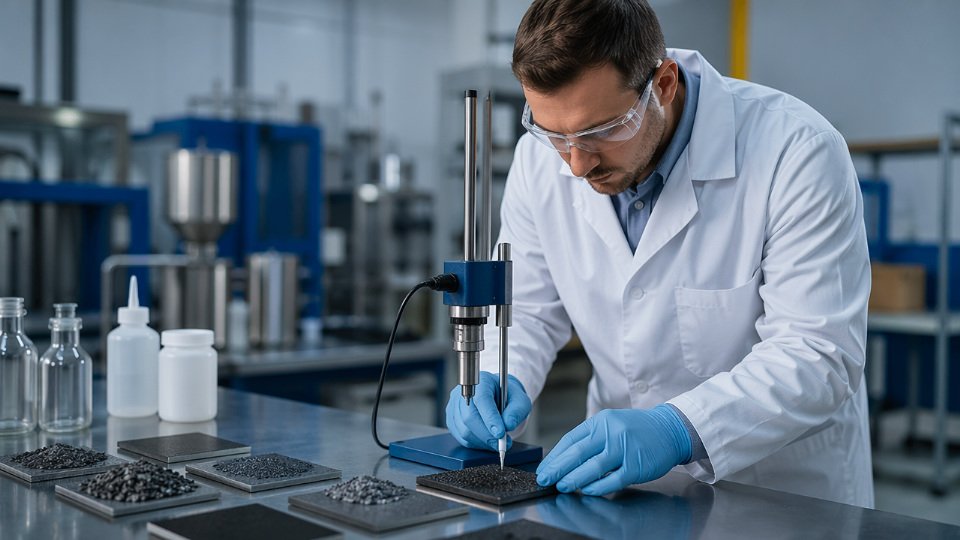
Water contact angle is the fastest meaningful check. A treated surface changes wetting behavior in a direction that depends on silane chemistry. Methylsilane waterproofing treatments should push contact angle above 70°; amino silane treatments should pull it below 40°, confirming the hydrophilicity reversal that enables downstream epoxy bonding. A simple goniometer or even a calibrated smartphone image with an open-source angle plugin gives a repeatable reading in under two minutes per sample. If the contact angle sits near that of the untreated control, something in application has failed.
Cross-cut adhesion tape test (ASTM D3359) on coated metal panels takes roughly five minutes per panel. Classification below 4B on a primer-over-silane system is an immediate rejection signal and a prompt to investigate whether silane was applied, whether it cured at the correct temperature, or whether substrate cleaning was skipped.
Rubber-to-metal pull-off force for bonded assemblies is the most direct functional check for that product family. Even a simple bench fixture with a calibrated load cell gives pass/fail data that a visual scan never can.
Tier-2 Laboratory QC: The Water-Soak Lap Shear Test
A 7-day water soak at 40°C followed by lap-shear testing (ASTM D1002 or ISO 4587) is the single most diagnostic silane performance test available at moderate laboratory costTrue
Hydrolytic stability under warm water challenge is the primary failure mode for inadequate silane coupling; bond retention above 70% of dry-state strength is the standard acceptance benchmark used across adhesive and composite qualification programs
Dry-state lap shear alone flatters a weak treatment. The wet-soak challenge exposes the real interfacial stability. Bond retention above 70% of the dry-state value after seven days at 40°C is the threshold that distinguishes effective coupling from marginal or failed treatment. Below that, the interface will degrade in humid service regardless of initial appearance.
Peel strength testing for flexible laminates and DMA tan-delta shift for filled rubber compounds are Tier-2 additions that require modest equipment but give quantitative filler-matrix interaction data unavailable from any surface test.
Tier-3 Analytical Confirmation for New Grades or Critical Specifications
When qualifying a new silane grade, a new supplier lot, or a substrate not previously characterized: XPS surface elemental analysis confirms Si presence and the Si/C ratio that indicates whether chemisorbed silane or loose oligomer dominates; ATR-FTIR or DRIFTS identifies functional group integrity; TGA carbon content quantifies filler surface loading directly. These are not routine production tests — they belong in the qualification stage and in root-cause investigations after a field failure.
Building a One-Page Validation Protocol
A practical silane validation document needs only these fields: substrate identity and lot, silane grade and supplier lot number, solution preparation record (pH, concentration, pot life start time), application method and cure parameters, test methods applied with acceptance criteria, and a signatory field. One page. One responsible name. Without it, process drift is invisible until a customer calls.
The economics are straightforward. Tier-1 testing adds well under 0.5% to a silane treatment cycle’s total time. The cost of a composite rejection event, a delamination warranty return, or a production line shutdown to investigate adhesion failures routinely runs to multiples of an entire month’s silane procurement spend. Validation is not a quality department luxury — it is the minimum responsible practice for anyone applying silane chemistry to a load-bearing or sealing application.
Frequently Asked Questions About Silane Coupling Agent Application
These questions come up repeatedly from formulators, compounders, and procurement managers before they commit to a treatment process — or after something has already gone wrong.
Can I use a single universal silane coupling agent across all my polymer systems?
No. Functional group specificity is not a preference — it is a hard chemical requirement. An aminosilane like KH-550 reacts readily with epoxy resins and polyurethanes but contributes nothing useful in a peroxide-cured EPDM compound. A methacrylsilane like KH-570 is designed for free-radical polymerizable matrices; put it in a phenolic system and you have an inert additive consuming cost with no return. The practical tool here is a primer compatibility chart that maps reactive functional groups against curing chemistries. If you are running three or four different resin systems on the same line, you likely need three or four different silane grades. SiliconChemicals’ technical team routinely works through this mapping exercise with customers before a grade is specified, which is a faster path than discovering incompatibility at the composite qualification stage.
What is the shelf life of an opened container of KH-550 or KH-570?
Sealed, in a cool and dry store below 25 °C, most trialkoxysilanes hold 12–24 months. Once opened, the clock accelerates sharply — atmospheric moisture begins hydrolysis at the surface, and absorbed CO₂ can salt out aminosilanes. Re-seal opened drums under a dry nitrogen blanket and plan to consume the material within 3–6 months. Any turbidity, visible gel, or unexpected viscosity rise is a disposal trigger, not a quality deviation to negotiate around. Using degraded silane is one of the more common causes of batch-to-batch adhesion scatter that gets blamed on the substrate or the press conditions.
How do I treat carbon black-filled rubber systems where silane seems less effective?
Silane coupling agents bond through silanols reacting with surface hydroxyl groups. Carbon black surfaces are largely graphitic and hydroxyl-poor, so silane has minimal chemical affinity there.
Silane coupling agents provide the same reinforcement benefit on carbon black as on precipitated silica.False
Carbon black lacks the surface silanol groups required for siloxane bond formation; silane loading should be calculated exclusively on the silica fraction's BET surface area in hybrid systems.
In hybrid silica–carbon black systems, calculate your silane dose against the silica BET area alone. A common error is dividing silane uniformly across total filler weight — this under-treats the silica fraction and wastes silane on carbon black.
Can I pre-treat a mineral filler and store it before compounding?
Yes, and this is actually a sound production-planning strategy. Surface-treated fillers — properly dried, packaged below 50% relative humidity, and stored below 30 °C — remain processable for 3–12 months. The range depends on silane type, filler porosity, and packaging integrity. For critical structural applications, run a TGA carbon analysis on stored treated filler before compounding to confirm the organic loading has not degraded. Skipping that check on old stock is a quiet route to scrap.
What is the difference between pre-hydrolyzed oligomeric silane and neat monomer silane?
Pre-hydrolyzed aqueous oligomeric silanes have already been partially condensed in controlled conditions. They offer longer bath life in sizing tanks, more consistent film deposition on glass fiber, lower alcohol flash-off at the application point, and reduced risk of operator-side hydrolysis errors. Neat monomers give you more formulation freedom — concentration, solvent system, and timing are all in your hands — which is why they dominate dry-blend rubber applications where aqueous baths are impractical.
How do I manage the alcohol released during hydrolysis from a safety and compliance standpoint?
Ethanol from triethoxysilanes and methanol from trimethoxysilanes both require ventilation at the application station, but methanol carries meaningfully higher toxicity risk — skin absorption, optic nerve exposure thresholds, and stricter TLV limits. In enclosed processing environments or high-volume operations, quantify your total VOC generation before selecting a silane grade. Switching from a trimethoxy to a triethoxy variant of the same functional group often resolves a compliance issue without changing any other process parameter.
Why does my silane-treated composite perform well dry but fail under humidity aging?
Three mechanisms produce this pattern, and they require different corrections. Incomplete condensation — not enough post-treatment bake temperature or dwell time — leaves Si–O–C bonds that hydrolyze readily. Wrong functional group for the resin means the organic end never formed a durable covalent bond in the first place. Sub-monolayer silane loading (below roughly 2 µmol/m²) means coverage is patchy and water finds unprotected substrate easily. Run a 7-day water-soak lap-shear retention test comparing treated versus untreated specimens — the retention ratio and the failure mode together will point clearly at which mechanism is responsible.
Procurement and Quality Assurance Checklist When Sourcing Silane Coupling Agents
Every mistake covered in the preceding sections — wrong hydrolysis pH, excess surface loading, inadequate cure — becomes unfixable if the silane arriving at your dock is already off-specification. Procurement discipline is the last defense before chemistry meets substrate, and it is routinely treated as a paperwork exercise rather than a technical gate.
Certificate of Analysis Parameters That Actually Matter
Demand a full CoA with every lot, and know which parameters carry real operational weight.
GC purity is the primary identity and quality marker. For standard industrial-grade trialkoxysilanes used in rubber compounding, mineral filler treatment, and adhesive primers, 97% minimum is the working threshold. Specialty coupling agents going into glass fiber sizing, electronics encapsulants, or medical-adjacent composites warrant 99%+. Anything below 95% introduces unknown oligomeric byproducts that disrupt monolayer formation in ways that are nearly impossible to diagnose downstream.
Water content by Karl Fischer titration is the single parameter most frequently falsified or simply not measured by lower-tier traders. The operational limits depend on alkoxy group reactivity: trimethoxysilanes hydrolyze so readily that water content should sit below 0.05 wt%; triethoxysilanes tolerate slightly more, but 0.1 wt% is still a firm ceiling. A drum of trimethoxy-functional silane with 0.3 wt% water has already begun self-condensing in the container — you are buying a partially polymerized product that will behave erratically in hydrolysis bath management and produce inconsistent surface coverage.
Refractive index and specific gravity serve as fast identity checks against known literature values for each silane type. They do not confirm purity on their own, but a deviation of more than ±0.003 in refractive index or ±0.005 g/cm³ in density is enough reason to hold the lot pending GC confirmation. Color by APHA scale matters for white and light-colored finished goods — an APHA above 20–30 in a silane that specification calls for water-white indicates thermal degradation or contamination during distillation.
Red Flags That Should Stop a Purchase Order
Turbid product in a freshly opened drum is condensation or hydrolysis already in progress — do not use it, do not reformulate around it. Lot-to-lot GC purity variation exceeding 1.5–2 percentage points across three consecutive deliveries indicates distillation column instability at the manufacturer. That kind of process variability in feedstock quality will cascade directly into your composite rejection rate or coating adhesion scatter. A supplier who cannot provide Karl Fischer data within 48 hours of a request is almost certainly not running it as routine incoming QC.
Excess water content is the most common off-specification finding in commodity silane supply, and it causes pre-hydrolysis and self-condensation before the product is ever opened on the plant floor.True
Trialkoxysilanes react readily with trace moisture; water content above the specified threshold initiates Si-OR hydrolysis and subsequent Si-O-Si condensation in storage, degrading reactive functionality before application.
Why Integrated Chinese Manufacture Changes the Risk Profile
The cost advantage of Chinese-origin silane is real, but the quality argument is equally grounded in supply chain structure rather than price-cutting. Jilin, Zhejiang, and Shandong host the world’s densest organosilicon industrial clusters — chlorosilane and trichlorosilane feedstocks are produced within the same industrial parks where finished silanes are synthesized. That geographic vertical integration from SiCl₄ through methoxysilane eliminates the intermediary repackaging and storage steps where moisture ingress most commonly occurs in fragmented supply chains.
SiliconChemicals operates within this integrated model, which means raw material purity is controlled upstream rather than corrected with spec adjustments at the final distillation stage. ISO 9001 quality management systems combined with REACH and TSCA documentation packages make the product line export-ready to EU and North American markets without the buyer needing to commission independent registration work — a non-trivial cost saving for procurement teams managing compliance obligations across multiple jurisdictions.
Technical Support as a Procurement Criterion
A silane supplier who cannot provide application engineering support is selling a commodity; a qualified partner provides functional group selection guidance specific to your resin system, written hydrolysis protocol recommendations for your process conditions, and troubleshooting response within 24 hours when a production run goes wrong. Safety data sheets must be available in the destination-country language before first shipment — not after a customs flag. Small-quantity sample qualification before committing to drum or IBC volume is standard practice among serious suppliers and should be a contractual requirement, not a favor.
Packaging and Logistics Markers
Nitrogen blanketing of HDPE or stainless steel drums is non-negotiable for trimethoxysilanes. Verify inner-liner integrity on delivery — a compromised liner in a moisture-sensitive grade can ruin an entire 200-liter drum within days of arrival in a humid warehouse. Certain reactive silanes with low flash points require cold-chain transport recommendations; confirm these are specified in the logistics documentation rather than discovered at freight audit. UN hazardous goods classification and full IMDG compliance for sea freight should be verified before any international order is placed. A supplier who ships non-compliant dangerous goods exposes the buyer to customs holds, port detention costs, and liability.
Building a Long-Term Supply Partnership
Spot-buying silane saves nothing if a single off-spec lot shuts down a coating line for two days. Long-term partnership criteria worth formalizing: a supplier audit option — either on-site or via third-party analytical verification — on a defined cycle; an annual quality review mechanism that examines CoA trend data across all lots received; and a price-stability framework indexed to silicon metal and methanol feedstock pricing rather than arbitrary spot fluctuation. These structures distinguish a strategic silane partner from a catalog trader, and they are the criteria that prevent the procurement team from undoing everything the process engineering team has optimized.