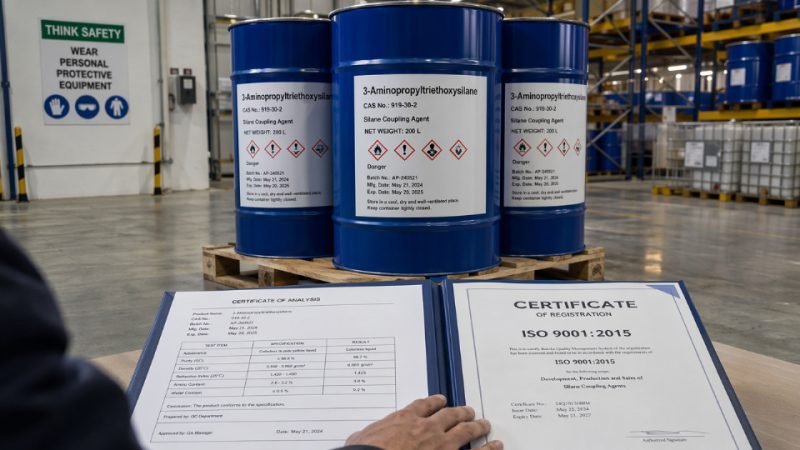
Shipments of silane coupling agents get held at customs, rejected by quality audits, or refused by downstream processors far more often than most procurement managers expect — and almost always for documentation gaps rather than actual chemistry failures. A missing REACH registration number, an expired Safety Data Sheet revision, or a Certificate of Analysis that lists fewer parameters than a customer specification requires can freeze a container at a European port for weeks. That delay translates directly into line stoppages, emergency spot purchases at 20–40% premium, and customer penalty clauses that quietly erode margins on what looked like a straightforward reorder.
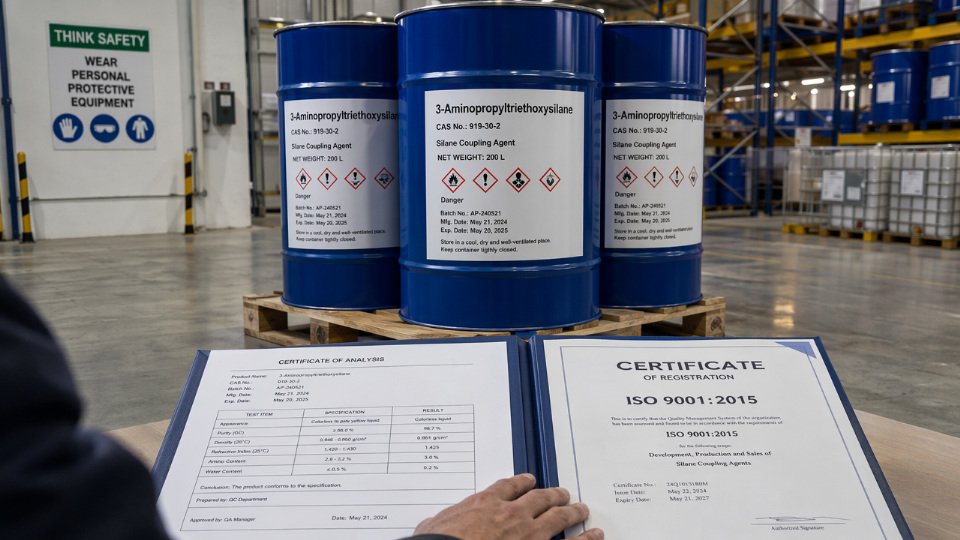
The core documentation package for a silane coupling agent shipment typically includes a Certificate of Analysis, a compliant Safety Data Sheet, a REACH or equivalent regulatory registration confirmation, an ISO 9001:2015 quality system certificate, and where applicable, a Dangerous Goods declaration. Each document serves a distinct gatekeeper function — regulatory, commercial, or safety — and a shipment missing any single one can be stopped at customs, rejected on goods receipt, or trigger a supplier qualification failure.
What makes this harder in practice is that the required document set is not fixed — it shifts depending on destination market, import tonnage, end-use industry, and even the specific silane chemistry involved. A gamma-methacryloxypropyltrimethoxysilane going into an automotive glass-fiber compound faces a very different compliance burden than the same molecule sold into a construction sealant application in a lower-regulatory market. Understanding which documents are legally mandatory versus commercially expected versus merely best practice is where experienced procurement teams separate themselves from those who learn the rules through costly rejections.
Core Quality Management System Certifications: ISO 9001, IATF 16949, and ISO 14001
When you receive a Certificate of Analysis from a silane supplier, the numbers on that document are only as reliable as the quality management system producing them. QMS certifications are the structural audit trail behind every CoA, every batch record, and every corrective action. Understanding what each certificate actually audits — and how to confirm it hasn’t been fabricated or allowed to lapse — is non-negotiable procurement practice.
ISO 9001:2015: The Baseline You Cannot Waive
ISO 9001:2015 certification means an accredited third-party auditor has verified that the manufacturer operates documented controls across raw material sourcing, in-process parameters, final batch testing, non-conformance handling, and corrective and preventive action (CAPA) cycles. For silane coupling agents, those controls span incoming quality checks on chlorosilane or alkoxysilane feedstocks, reaction temperature and pressure windows, methoxy or ethoxy content verification, and hydrolysis stability testing before batch release.
The audit cycle runs roughly every three years for full recertification, with annual surveillance audits in between. Site costs for those surveillance audits typically range from USD 2,000 to 8,000 per facility, depending on site size, scope complexity, and the certification body’s fee schedule. A supplier claiming ISO 9001 registration but unable to provide the certificate body name, accreditation number, and current expiry date should be treated as unverified.
When you request the certificate, verify it carries the accreditation symbol of a recognized national accreditation body — CNAS in China, UKAS in the UK, DAkkS in Germany — not merely the certification body’s own logo. Those are different things.
IATF 16949:2016: Non-Negotiable for Automotive-Grade Silane
If your silane coupling agent enters an automotive supply chain — tire cord adhesion promotion, glass-fiber-reinforced nylon composites, rubber-to-metal bonding in engine mounts or brake components — your supplier must hold IATF 16949:2016 certification. This standard layers automotive-specific requirements onto ISO 9001: contingency planning, product safety records, control plan documentation, and MSA (measurement system analysis) for analytical equipment.
The critical detail most procurement teams miss: the certificate must list the specific manufacturing site address, not just the corporate headquarters. A parent company holding IATF certification at an administrative office provides zero audit coverage of the actual production plant. Request the certificate scope section explicitly and confirm the site address matches the facility shipping your product.
IATF 16949 certification can be verified against the public IATF database at www.iatfglobaloversight.orgTrue
The IATF maintains a publicly searchable global database of certified sites. Procurement teams can input a supplier name or certificate number to confirm active status, scope, and issuing certification body — a practical defense against fraudulent documents circulating in spot-market silane procurement.
Fraudulent or photocopied IATF certificates have appeared in spot-market silane transactions often enough that Tier 1 automotive procurement teams now routinely cross-check supplier credentials against this registry before approving new sources. A 30-second database search is a reasonable safeguard against a potentially costly qualification mistake.
ISO 14001:2015: ESG Pressure Is Now a Procurement Reality
European and North American procurement departments increasingly embed ISO 14001:2015 environmental management certification into supplier scorecards as part of formal ESG evaluation frameworks. This certification audits whether the manufacturer has documented environmental aspects and impacts — wastewater from silane hydrolysis byproducts, VOC emissions from alkoxysilane processing, hazardous waste disposal — and maintains targets for continual improvement.
For buyers operating under corporate Scope 3 emissions commitments or subject to customer sustainability questionnaires, a supplier without ISO 14001 coverage can create reporting gaps that escalate to procurement policy violations.
Multi-Site Scope: A Common Gap Worth Checking
Manufacturers operating more than one production facility must hold separate scope extensions for each site. A single certificate issued to a company’s registered address, covering only head-office quality functions, is insufficient when a buyer is auditing actual plant operations. During supplier qualification, request the certificate’s full scope statement and confirm it explicitly names the facility — building number, industrial park, city — where your product will be manufactured.
Surveillance audit records and recent CAPA closure documentation are also reasonable to request from any Tier 1 customer relationship. Certificate possession proves a system existed at the last audit date. Surveillance records and closed corrective actions demonstrate the system is functioning between audits — a meaningfully different level of assurance.
Certificate of Analysis (CoA): Mandatory Parameters, Format Standards, and Red Flags
A Certificate of Analysis is not a formality — it is the primary technical handshake between a silane supplier and every downstream process that depends on consistent coupling agent chemistry. Get it wrong, and you are looking at adhesion failures in composite layups, delamination in wire and cable jacketing, or rejected incoming inspection that stalls your production line for days while a replacement shipment clears customs.
What Every Compliant CoA Must Carry
Before you read a single test result, confirm the document header contains: full product name (IUPAC and trade designation), CAS number, batch or lot number, production date, expiry or retest date, and storage conditions. These six fields are non-negotiable. The storage condition entry matters more than it looks — aminosilanes and epoxysilanes have meaningfully different humidity sensitivity, and a CoA that omits storage conditions shifts liability onto the buyer if shelf-life disputes arise later.
The testing laboratory’s name and accreditation status must appear explicitly. An in-house QC lab is acceptable for routine release testing, but the CoA should state the lab’s ISO/IEC 17025 accreditation scope or, at minimum, identify the validated internal methods referenced. If the document just says “internal laboratory” with no further qualification, that is a transparency gap worth questioning before you commit to a large contract volume.
Analytical Parameters by Product Family
For aminosilanes — APTES (3-aminopropyltriethoxysilane), AMEO, and related structures — a credible CoA covers at minimum: purity by GC (expect ≥97.0–99.5% depending on grade; the exact floor depends on application tier, with electronics and optical fiber coatings demanding the higher end), refractive index at 20 °C, density, color by APHA (≤20 for high-purity commercial grades, though some industrial grades allow up to 30–40 APHA), and moisture content by Karl Fischer titration. Moisture limits typically run 200–500 ppm; the tighter end applies when the silane feeds a moisture-sensitive polyurethane or epoxy system where even 400 ppm water can trigger premature gelation in the mixed resin.
Vinylsilanes such as vinyltrimethoxysilane carry the same core parameters, but density specification tightens because small deviations here correlate with methoxy content variation — directly relevant to crosslink density in polyethylene wire insulation.
Methacryloxy and epoxysilanes require additional parameters. Hydrolysis stability matters because these grades are often prediluted into aqueous sizing or primer systems where premature hydrolysis causes turbidity and loss of coupling efficiency. Methanol content deserves attention for VOC compliance reasons, particularly for shipments into the EU or California — methanol released during hydrolysis is regulated, and the CoA figure gives formulators the data they need for solvent accounting. Residual chloride ion concentration is critical for electronics-grade epoxysilanes used in underfill, encapsulant, or PCB surface treatment; specifications of ≤5 ppm chloride are common in semiconductor packaging supply chains, and exceeding that threshold can drive corrosion of bond wires on timescales of months under humid service conditions.
A CoA listing test results without referencing the specific analytical method used cannot be independently verified or audited.True
Analytical results are only reproducible and disputable when the method — whether ASTM D1045, ISO 4326, EN ISO 3839, or a validated in-house procedure — is explicitly cited. Without the method reference, a receiving lab has no basis for a pass/fail determination during incoming QC, and a supplier cannot be held to the result under any contractual dispute.
Every result line should cite its method. ASTM D1045 for solubility and chloride, ISO 4326 for refractive index, Karl Fischer per ASTM E1064 or equivalent — whatever was used, it belongs on the document.
Red Flags That Indicate a Low-Credibility CoA
Experienced incoming QC teams develop pattern recognition for suspect documents. Watch for these:
| Red Flag | What It Often Signals |
|---|---|
| All results land exactly at the specification limit | Manual entry or copy-paste rather than real instrument output |
| No instrument ID or method reference on any parameter | Results are unverifiable; lab capability is unknown |
| Batch number inconsistent with production date format | Administrative error at best; document fabrication at worst |
| Identical numerical results across multiple batches | Prior batch data reused; no actual testing performed |
| Color reported as “conforms” rather than a numeric APHA value | Specification is being evaded, not met |
The copy-paste scenario is more common than buyers expect with smaller traders who hold inventory but lack in-house analytical capability. A simple check: request CoAs for three consecutive batch numbers and compare moisture values and GC purity figures. Genuine production variation produces a spread. Perfectly identical results across batches from a reactive silane stored under normal warehouse conditions should prompt a third-party verification request before payment.
Third-Party CoA Verification
For new supplier qualification or contract volumes above roughly 20 tonnes per year, arranging third-party CoA issuance or counter-testing through an accredited laboratory — SGS, Intertek, Bureau Veritas, or a regional ISO/IEC 17025-certified lab — is standard practice in automotive and electronics supply chains. Cost runs USD 300–900 per sample depending on parameter count and turnaround time; the lower end covers a five- to seven-parameter basic package, while a full electronics-grade profile with chloride, residual methanol, and hydrolysis stability pushes toward the higher end. That cost is trivial against the risk of processing a full production batch with an off-spec coupling agent that only manifests as adhesion failure during finished-product testing.

Safety Data Sheet (SDS) Compliance: GHS Versions, Regional Variations, and Common Errors
A Safety Data Sheet is not a formality — it is the document that determines whether your shipment clears customs, sits in a bonded warehouse, or gets returned at port. For silane coupling agents, which carry real flammability, moisture reactivity, and irritancy hazards, getting the SDS right across every trade lane you serve is non-negotiable.
GHS Revision Fragmentation: Why One Document Is Never Enough
The Globally Harmonized System has been revised nine times since its first publication, with GHS Rev. 9 issued in 2021. The problem is that individual jurisdictions adopt different revisions at different times, and they stay there. The EU’s CLP Regulation (EC) No 1272/2008 aligns to GHS Rev. 8. OSHA HazCom 2012 — still the governing standard in the United States — aligns to GHS Rev. 3. China operates under its own GB standards. A single “universal” SDS satisfies none of these simultaneously in a strict compliance sense. Classification criteria, signal word thresholds, and pictogram assignments can differ between revisions in ways that matter during customs inspection.
Practical consequence: an exporter using one generic SDS for an alkoxysilane shipment going simultaneously to Rotterdam, Houston, and Guangzhou is almost certainly carrying at least one non-compliant document. The EU or US importer absorbs that liability exposure, not the exporter.
EU Requirements: REACH Annex II and the 2023 Mandatory Update
EU Regulation 2020/878 amended REACH Annex II and became mandatory for all new SDS issued after January 1, 2023. The 16-section SDS structure itself is unchanged, but several fields gained new mandatory content. UFI (Unique Formula Identifier) codes are now required for hazardous mixtures placed on the EU market. For substances registered above 10 tonnes per year, an Extended SDS including exposure scenario annexes must accompany the document — those annexes describe safe use conditions for each identified use category and can run 10–30 pages for a widely used silane.
EU Regulation 2020/878 made updated SDS format mandatory for all new Safety Data Sheets issued after January 1, 2023True
EU Regulation 2020/878 amended REACH Annex II and explicitly set January 1, 2023 as the date after which all newly issued or revised SDS must comply with the updated requirements, including UFI codes for mixtures.
Missing a UFI on an EU shipment of a formulated silane product is grounds for customs hold and can trigger a corrective action request from the downstream REACH-responsible importer.
China: GB/T 16483 and GB/T 17519
For import into China, the SDS must comply with GB/T 16483 (content requirements) and GB/T 17519 (preparation guidance). A Chinese-language SDS is mandatory for import clearance — an English-only document, regardless of technical quality, will not satisfy Chinese customs or the receiving factory’s hazardous chemical registration obligations. SiliconChemicals provides both English and Chinese SDS versions as standard for all product shipments, which eliminates one of the most common delay points for buyers importing into Chinese manufacturing facilities or free-trade zones.
Hazard Classifications Specific to Silane Coupling Agents
Several hazard categories appear repeatedly across silane coupling agent families and must be correctly declared:
- Flammable Liquid Category 2 or 3 — flash point for most alkoxysilanes falls in the 21–61°C range, though exact values depend on alkoxy chain length and molecular weight. Misclassifying a Cat. 2 material as Cat. 3 changes storage segregation requirements and UN packing group.
- Acute Toxicity Category 4 (oral/dermal) — certain aminosilanes carry this classification. The threshold is LD50 300–2,000 mg/kg oral; values outside this range shift the category entirely.
- Skin Corrosion/Irritation and Serious Eye Damage — common across both aminosilanes and epoxysilanes. These drive PPE requirements on the SDS label.
Vapor pressure and water reactivity must be stated accurately. Customs agents and freight forwarders use these figures to assign storage location — ambient warehouse versus segregated flammable store, or moisture-controlled container. Underreporting moisture sensitivity has caused real warehouse incidents when silane drums were stored alongside wet goods or in high-humidity environments without precaution.
Common Errors That Cause Compliance Failures
Outdated SDS is the single most frequent finding in EU supplier audits. Using an SDS dated more than three years old is a recognized compliance risk — the EU expects SDS to be updated whenever new hazard data become available, and an importer relying on a stale document loses its liability protection under REACH Article 31. If the supplier cannot provide a revision date and the name of the qualified person responsible for the SDS, treat that as a red flag.
Other frequent errors include: wrong GHS revision applied to the destination market; missing or incorrect UN number and packing group in Section 14; vapor pressure listed at 20°C instead of the standard 20°C or 25°C without specifying the temperature; and exposure limits populated with generic placeholders rather than substance-specific OELs from the destination country’s regulatory database.
A practical pre-shipment SDS checklist for procurement teams: confirm the SDS language matches the destination country requirement; verify the revision date is within three years; check that Section 14 transport information matches the actual UN number on the shipping declaration; confirm a Chinese-language version exists for any China-bound shipment; and for EU orders above 10 t/yr, verify exposure scenario annexes are attached.
Dangerous Goods Declarations and Transport Certifications: IMDG, IATA, and ADR/RID
Silane coupling agents are not benign specialty chemicals when it comes to logistics. Most alkoxysilanes — methoxysilanes, ethoxysilanes, and their functional variants — are flammable liquids, and the transport document stack required to move them legally across a single trade lane runs to five or more distinct certifications and declarations. Get one wrong and you are looking at port holds, aircraft offloads, or fines that exceed the value of the shipment itself.
UN Number Selection Starts With a Real Flash Point Result
The first decision point is UN number assignment, and it must be grounded in an actual closed-cup flash point measurement from the batch CoA, not a literature value copied from a generic SDS. Most alkoxysilane coupling agents — APTES, VTMS, GPTMS, and related products — fall under UN 1993 (Flammable liquid, n.o.s.) because they lack a specific UN entry. Chlorosilane intermediates and certain reactive silanes carry their own entries, such as UN 2985 (chlorosilanes, flammable, corrosive, n.o.s.) or UN 1250 for methyltrichlorosilane, and misclassification between these entries at customs has triggered hazmat re-inspection fees in the USD 1,500–4,000 range per container, depending on port and jurisdiction.
Packing Group assignment flows directly from flash point and initial boiling point. A flash point below 23 °C combined with an initial boiling point at or below 35 °C puts a product at PG I; flash point below 23 °C with higher boiling point moves it to PG II; flash point between 23 °C and 60 °C typically lands at PG III. This distinction is not academic — PG I product requires UN-certified packaging rated to a higher performance standard, 1A1 steel drums or equivalent, while PG III may permit 4G fibreboard cartons for smaller quantities. The packaging manufacturer’s UN certification document, showing the test standard, maximum gross mass, and permitted filling product types, must travel with the shipment as supporting documentation. Many freight forwarders overlook this and present only the DGD, which is insufficient under a port state control inspection.
Sea Freight: IMDG Code Amendment 42-24 Requirements
Under the current IMDG Code (Amendment 42-24, in force from January 2025), the shipper — not the freight forwarder — bears legal responsibility for the accuracy of the Dangerous Goods Declaration (DGD). The DGD must follow the IMO-recommended format, be signed by a person certified as a Dangerous Goods Safety Adviser (DGSA), and state the correct proper shipping name, UN number, class, packing group, marine pollutant status, and total net quantity. For silane coupling agents shipped in 200-litre drums on a full container, the net quantity declaration is straightforward. For mixed-product FCLs with multiple UN numbers, each line item requires its own declaration block, and any omission triggers a “held for amendment” notice from the carrier that delays vessel loading by 24–96 hours depending on port cut-off timing.

Air Freight: IATA DGR 67th Edition and the Passenger Aircraft Restriction
The 67th Edition of the IATA Dangerous Goods Regulations (effective January 2026) maintains the passenger aircraft prohibition for most silane coupling agents with flash point below 60 °C. These products are restricted to cargo aircraft only (CAO), which immediately limits carrier options and increases freight cost relative to general cargo, typically by 30–80% depending on origin-destination pair and capacity. The Shipper’s Declaration for Dangerous Goods must be completed on the IATA two-copy format, and the shipper’s signatory must hold current IATA DGR training certification — most national aviation authorities require recertification every two years.
Net quantity per package limits under IATA are significantly tighter than IMDG. PG II liquids are generally limited to 1 litre per inner packaging and 1 litre net per package on cargo aircraft under certain packing instructions; PG III allows up to 60 litres per package under PI366. Exceeding these limits, even by packaging product in an oversized drum that nominally complies with road transport rules, is a rejected shipment at the cargo acceptance desk.
Most silane coupling agents with flash point below 60 °C are prohibited on passenger aircraft under IATA DGR.True
IATA DGR classifies these materials as flammable liquids and restricts them to cargo aircraft only (CAO), consistent with the 67th Edition and prior editions; this applies regardless of packing group for the quantities typical in commercial silane shipments.
European Road and Rail: ADR 2025 and Written Instructions
ADR 2025 governs road transport of dangerous goods across most of Europe, and RID applies to rail. For silane coupling agents moved in bulk by tank truck or IBC, the transport vehicle must carry an ADR vehicle approval certificate, and the driver must hold a valid ADR driver training card for Classes 3 (flammable liquids). These cards are renewed every five years; a driver card expired by even one day is a valid grounds for roadside enforcement action, with fines in the EUR 500–3,000 range in most EU member states.
ADR Section 5.4.3 requires written emergency instructions to be present in the cab, in the language of each country of transit, covering fire, spill, and first aid response specific to the product class. For a cross-border shipment from Germany through Austria to Italy, this means three language versions in the cab. It is a small document, but its absence is among the ten most cited ADR violations at roadside checks.
Multimodal Document Reconciliation
The most frequently overlooked compliance risk on international silane shipments is document consistency across transport modes. A container that moves from a Chinese port under an IMDG DGD, then transfers to road haulage in Europe, requires that the inland transport declaration mirrors the sea declaration exactly — same proper shipping name, same UN number, same packing group. Discrepancies arise when a freight forwarder issues a local road consignment note using a slightly different proper shipping name or a rounded net quantity figure. Port health and customs officers at Rotterdam and Hamburg specifically cross-check DGD versus inland CMR for hazmat containers. When figures diverge, the shipment enters a secondary inspection queue that routinely adds two to five working days to clearance time, with associated demurrage charges.
Establishing a single document controller — either in-house or at the logistics provider — who reconciles all transport documents before the shipment departs origin is the most practical mitigation. The cost of that coordination step is negligible compared to a single port hold on a 20-tonne silane shipment.
REACH, RoHS, TSCA, and Chemical Inventory Registration Documents for Key Markets
Chemical substance registration is where procurement mistakes get expensive fast. A shipment of silane coupling agent that clears port but later triggers a REACH violation notice or an EPA enforcement inquiry costs far more than the original order — in fines, product recalls, and customer relationship damage. Knowing exactly which registration documents to request, and how to verify them, is not bureaucratic box-ticking; it is basic supply chain risk management.
EU REACH Registration: What to Verify Before the First Shipment
If you are importing silane coupling agents into the EU from a non-EU supplier, REACH Regulation (EC) No. 1907/2006 places the legal obligation squarely on the importer or their appointed Only Representative (OR). The OR must be a legal entity established in the EU and formally registered with ECHA before the substance crosses the border. Ask any prospective supplier to name their OR and provide the OR’s ECHA registration number — then check it yourself in ECHA’s public substance database.
REACH registration numbers follow the format 01-XXXXXXXXXX-XX-XXXX. This number should appear in Section 1 of the SDS. If it is absent, that is a hard stop: either the substance is unregistered, or the supplier cannot confirm registration status. Neither situation is acceptable for routine commercial volumes.
The registration tonnage tier matters operationally. Under REACH, the data requirements escalate at 1–10 t/yr, 10–100 t/yr, 100–1,000 t/yr, and above 1,000 t/yr bands. A supplier shipping low volumes to EU customers under a 1–10 t/yr registration cannot legally supply at 50 t/yr without upgrading the dossier. Get written confirmation of the registered tonnage band relative to your actual order volume.
REACH registration numbers can be independently verified by any buyer through ECHA's free public substance registry at echa.europa.eu.True
ECHA maintains a publicly searchable C&L Inventory and registered substance database where registration numbers and registrant details are accessible without login or fee.
TSCA (USA): Inventory Confirmation and Importer Liability
Under the Toxic Substances Control Act, silane coupling agents must appear on the TSCA Chemical Substance Inventory maintained by the EPA. The importer — not the foreign supplier — bears primary legal responsibility for ensuring TSCA compliance before importation. This is a critical asymmetry. Your supplier in China has no direct EPA exposure; you do.
Request a written TSCA Inventory confirmation letter from the supplier, specifying the exact CAS number and confirming the substance is listed as an existing chemical. For any substance introduced after the TSCA inventory cutoff date or formulated as a new chemical not previously manufactured in the US, a Pre-Manufacture Notice (PMN) must be submitted to the EPA, with a 90-day review period before manufacture or import can begin. Silane coupling agents with novel functional groups or newly synthesized structures can fall into this category. Never assume — confirm in writing before placing a purchase order.
China MEE Chemical Inventory: Post-2021 Registration Requirements
China’s New Chemicals Environmental Management Regulation (Order No. 12, 2021), enforced by the Ministry of Ecology and Environment, significantly tightened requirements. Substances not listed on the China Existing Chemical Inventory (CECI) require MEE registration before they can be manufactured or imported into China. For buyers sourcing domestically within China, ask suppliers to confirm CECI listing status for each product and provide MEE registration certificates for any substance introduced or modified after 2021. A supplier who cannot produce this documentation for newer silane grades is either non-compliant or unaware — both are supplier qualification failures.
RoHS 2 Compliance Declarations for Electronics Applications
RoHS 2 (EU Directive 2011/65/EU, updated by 2015/863/EU) restricts 10 substances in electrical and electronic equipment. Silane coupling agents used as adhesion promoters in electronics manufacturing — printed circuit board laminates, encapsulants, and wire and cable insulation — sit close enough to the final EEE product that major OEM customers will require RoHS compliance declarations. The declaration should specifically address all 10 restricted substances, not just the original six, and should be backed by third-party analytical test reports rather than self-certification alone. A declaration without supporting analytical data is an opinion, not evidence.
Regional Inventories: K-REACH, Japan CSCL, and Taiwan TCSCA
Korea’s Act on Registration and Evaluation of Chemical Substances (K-REACH), Japan’s Chemical Substances Control Law (CSCL), and Taiwan’s Toxic Chemical Substances Control Act (TCSCA) each maintain separate substance inventories with their own notification timelines and data requirements. Managing these individually for every market is operationally burdensome. A qualified supplier should maintain a live regulatory compliance matrix — market by market, CAS number by CAS number — and make it available during the qualification process. If a supplier cannot produce this during onboarding, budget for the gap: either they will need time to build it, or you will need to commission independent regulatory counsel.
Conflict Minerals Reporting: Low Risk, but Not Zero Paperwork
Silane coupling agents do not contain tin, tantalum, tungsten, or gold — the 3TG minerals regulated under the Dodd-Frank Act and OECD due diligence frameworks. However, large automotive and electronics OEMs increasingly require all direct material suppliers to submit a Conflict Minerals Reporting Template (CMRT) as standard onboarding practice, regardless of material type. A supplier who has completed the CMRT process — even with an expected “not applicable” outcome — signals organizational maturity. Ask for it during qualification; the request itself is useful as a supplier screening filter.
Export and Import Clearance Documents: Packing List, Commercial Invoice, and Country-of-Origin Certification
Getting the chemistry right is the easier half of a cross-border silane shipment. The commercial and customs document set is where many otherwise competent suppliers stumble — and where buyers absorb the cost through detention charges, duty penalties, and production-line stoppages while a container sits at the port awaiting release.
Commercial Invoice: Precision Is Not Optional
Every field on the commercial invoice interacts with downstream customs systems. The HS code is the starting point. Most organosilicon silane coupling agents classify under 2931.90, the catch-all for other organo-inorganic compounds, but this is not universal. Chlorosilanes with a dominant aliphatic halide character may land under 2904, and certain amino-functional silanes have been challenged under different headings by EU customs authorities depending on how the functional group is interpreted. Mis-classification triggers reclassification assessments with back-duties and interest — on a 20-tonne shipment, that gap can run from a few hundred to several thousand USD depending on the applicable rate differential.
The trade term (Incoterms 2020) must appear explicitly: FOB Shanghai, CIF Hamburg, DAP Rotterdam — whatever was agreed. A mismatch between the Incoterms stated on the invoice and those on the letter of credit is a common cause of bank document rejection that then holds the entire release process.
Chemical description quality matters enormously. EU and US customs both reject generic entries like “chemical product” or “silane.” A compliant description reads closer to: 3-(Trimethoxysilylpropyl)amine, CAS 13822-56-5, technical grade, minimum 97% purity. That level of specificity ties directly to the CoA and the SDS, creating a coherent document chain that customs officers can validate quickly.

Packing List: One Drum Off Is Enough to Trigger an Inspection Hold
The packing list must reconcile exactly with the bill of lading — drum count, individual net weights, gross weights, and UN packaging markings (e.g., UN1760 for corrosive liquids, Packing Group II or III depending on the specific silane). Experienced customs examiners cross-reference these three documents as a unit. A discrepancy of a single drum, or a weight variance that exceeds normal tolerance, flags the shipment for physical examination. Examination fees at major ports typically run USD 500–2,000 per container and add 3–7 working days to clearance, enough to disrupt a just-in-time compounding schedule.
Certificate of Origin: Wrong Format Costs Real Tariff Money
For shipments from China to EU buyers, the CoO format depends on the applicable preference scheme. A Form A under the Generalised Scheme of Preferences (GSP) — now transitioning under the EU’s revised GSP regulation — can reduce or eliminate import duties on qualifying chemical products. Using a standard Chamber of Commerce CoO when a preferential certificate is available is a direct, avoidable cost. The duty differential on silane coupling agents entering the EU can range from 0% (preferential) to 5.5–6.5% (MFN rate), applied to total CIF value.
For US Customs, the country of manufacture — not country of export — must appear on CBP Form 7501True
CBP regulations require that the actual country where the goods were produced or substantially transformed is declared. A Chinese-manufactured silane re-exported through a third country must still declare China as country of origin. Anti-dumping duty orders on certain Chinese chemical categories make any inaccuracy here a legal compliance issue, not merely an administrative one.
Fumigation and Pre-Shipment Inspection Certificates
Wooden pallets require an ISPM 15 fumigation certificate for most destinations. The practical fix — and the standard practice among experienced export packers — is heat-treated (HT) marked pallets, which satisfy ISPM 15 and eliminate the certificate requirement entirely.
Certain markets including several African and Middle Eastern countries mandate a pre-shipment inspection (PSI) certificate issued by an approved body such as SGS, Bureau Veritas, or CCIC. This requirement must be confirmed at order placement, not at shipping instruction stage. Scheduling a factory inspection in China requires lead time of 5–15 working days depending on the inspecting body’s local workload and the site location. Discovering this requirement after goods are packed adds cost and almost certainly delays vessel booking.
| Document | Common Error | Consequence |
|---|---|---|
| Commercial invoice | Generic chemical description; wrong HS code | Customs query, reclassification, back-duty |
| Packing list | Drum count or weight mismatch with B/L | Physical inspection hold, USD 500–2,000 fee |
| Certificate of Origin | Non-preferential CoO used when GSP Form A applies | Unnecessary import duty paid |
| CBP Form 7501 (US) | Country of export stated instead of country of manufacture | Anti-dumping duty exposure, CBP penalty |
| Fumigation certificate | Missing for wooden pallets | Entry refusal, re-fumigation cost at destination |
| PSI certificate | Not arranged before shipment | Vessel missed, re-inspection or clearance refusal |
Product Stewardship and Sustainability Documentation: TDS, Halal, Kosher, and EPD
Regulatory compliance gets a shipment through customs. Product stewardship documentation is what gets a silane coupling agent specified, approved, and reordered by the technical and procurement teams that actually run production. These documents are not legally mandated in most jurisdictions, yet their absence can stall a qualification project by months or disqualify a supplier entirely from certain market segments.
Technical Data Sheet: The Application Engineering Baseline
The Technical Data Sheet is the primary product stewardship document, and a weak one creates a real cost burden — it transfers application development work from the supplier’s process chemists to the buyer’s R&D team, which may lack silane-specific expertise and will bill that time internally.
A credible TDS for a silane coupling agent should specify: the coupling mechanism (hydrolysis and condensation chemistry at the inorganic surface, plus the organic functional group reactivity with the target resin), compatible resin systems with explicit examples (epoxy, polyurethane, EPDM rubber, unsaturated polyester, nylon 6/66), recommended loading levels on filler surface — typically 0.1–1.5 wt% depending on filler BET surface area and silane molecular weight — and processing temperature windows including both the hydrolysis pre-treatment step and the compounding or lamination temperature. A TDS that lists only physical properties (appearance, purity, boiling point) without application guidance is essentially a partial CoA with a different header.
Recommended loading level depends on filler surface area (m²/g), silane coverage factor, and target coupling efficiency — a single fixed number on a TDS without this dependency stated should raise a flag with any experienced formulator.
Halal Certification: Market Access in Muslim-Majority Regions
Halal certification for silane coupling agents is relevant wherever the end product enters food-contact rubber, pharmaceutical packaging, cosmetic compounding, or any consumer goods supply chain in Malaysia, Indonesia, Turkey, or GCC countries. The relevant certification bodies include JAKIM (Malaysia), MUI (Indonesia), and ESMA (UAE). The audit scope extends beyond the silane molecule itself — cleaning agents used on reactor vessels, processing aids, and even packaging materials must be free of prohibited substances. A supplier who holds ISO 9001 but has never been audited for Halal compliance cannot simply issue a self-declaration; the certification body conducts on-site plant inspection, and the certificate must be renewed annually. Buyers sourcing rubber compounding ingredients for the Indonesian or Malaysian automotive seals market should verify certificate validity dates directly on the issuing body’s online registry.
Kosher Certification: Food-Contact and Pharmaceutical Packaging
Some North American and Israeli buyers in pharmaceutical packaging and food-contact rubber applications request Kosher certification, typically from the Union of Orthodox Rabbis (OU) or an equivalent recognized body. The inspection cycle is annual and includes raw material traceability. This is a niche requirement by volume, but disqualifying to a supplier that lacks it when the buyer’s customer requires it downstream.
Environmental Product Declaration: Hard Numbers for Green Procurement
ISO 14025-compliant Environmental Product Declarations quantify cradle-to-gate greenhouse gas emissions, primary energy consumption, and water use per kilogram of silane coupling agent produced. European construction and composites customers are increasingly writing EPD requirements into procurement contracts under EU Green Deal and Corporate Sustainability Reporting Directive frameworks. An EPD is not a marketing claim — it is a third-party verified lifecycle assessment result, and buyers should ask which LCA program operator verified the declaration. SiliconChemicals is developing lifecycle assessment data across its silane coupling agent portfolio to support customers whose own CSRD or SEC climate disclosure obligations require Scope 3 emissions data at the product level.
A supplier's self-declared carbon footprint figure without third-party LCA verification cannot be used in CSRD-compliant Scope 3 reportingTrue
CSRD and GHG Protocol Scope 3 guidance require supplier-reported emissions data to be based on verifiable primary data or third-party verified LCA; unverified self-declarations expose the buyer to audit findings
SVHC Reach-Down Declarations
Even when a silane coupling agent is not itself a Substance of Very High Concern, automotive and electronics supply chains routinely require a written supplier declaration confirming no SVHC is present above 0.1 wt% in the delivered article. This threshold matches the REACH Article 33 communication requirement. The declaration should reference the current ECHA SVHC candidate list date — a declaration checked against a list from two years ago may already be outdated, since ECHA updates the list twice annually. Procurement teams should build list-date verification into their annual supplier review process rather than treating a one-time declaration as permanently valid.
Frequently Asked Questions

How long does it take to receive a full documentation package after placing an order?
For in-stock grades, the timeline breaks into clear tiers. CoA issues within 24 hours of batch release — sometimes faster when the batch was pre-released against a standing order. SDS and TDS are available immediately upon order confirmation; there is no legitimate reason a supplier should make you wait for these. Transport documents — dangerous goods declaration, packing list, certificate of origin — follow within two business days of a confirmed shipment date, because the freight forwarder needs vessel or flight booking details before the DGD can be finalized.
Custom documentation takes longer. Third-party CoA from an accredited external lab, EPD, and Halal certificates typically require 5–15 business days depending on the certifying body’s queue and whether the product has been certified before. If you are sourcing a silane grade for the first time and your application requires an EPD or religious-compliance certificate, factor this into your project timeline — not as an afterthought when the goods are already at the port.
Can one SDS be used for all global destinations?
No, and this is one of the most persistent misconceptions among procurement teams managing multi-region distribution. A single English-language GHS SDS satisfies many English-speaking markets in practical terms, but it does not comply with EU Regulation 2020/878 (which replaced the earlier Annex II format and added specific new section requirements), Chinese GB/T 16483 and GB/T 17519 standards, or Korean K-REACH SDS formatting rules without market-specific versions. Language is only part of the issue — section structure, hazard classification criteria, and required exposure limit references differ by jurisdiction. Submitting the wrong SDS version to customs or a downstream customer in a regulated market is grounds for shipment hold or product delisting.
A single English GHS SDS is sufficient for all global shipments of silane coupling agentsFalse
SDS documents must meet the language, format, and regulatory content requirements of each destination market. EU Regulation 2020/878, Chinese GB standards, and Korean K-REACH each impose jurisdiction-specific requirements that a generic English SDS does not satisfy.
What happens if the CoA shows a result outside specification?
The batch must be formally rejected. Notify the supplier in writing and open a non-conformance report (NCR) immediately — do not allow the goods to enter your production line while the NCR is open, because traceability becomes nearly impossible once an out-of-spec silane is dispersed into a formulation. The supplier should respond with a root cause analysis; automotive customers specifically expect 8D format, and there is good reason for that — it forces corrective action verification, not just explanation. Any replacement shipment documentation must reference the original NCR number on the new CoA so the full chain of custody is auditable. Suppliers who resist this process or offer informal verbal assurances instead of documented corrective action are signaling a quality system problem worth taking seriously.
Is REACH registration the supplier’s or the buyer’s responsibility for EU imports?
For goods imported into the EU from China, the EU-based importer holds the registrant role under REACH by default. However, a non-EU manufacturer can appoint an Only Representative (OR) — a legal entity established in the EU — who then assumes the registration obligations and allows EU importers to import without individually registering. This arrangement must be confirmed contractually before the first shipment. Do not assume it is in place; ask for the OR’s name, the ECHA registration number, and the tonnage band covered. A mismatch between registered tonnage and your actual import volume creates compliance exposure that customs rarely catches immediately but that audit cycles will surface.
Which HS code applies to silane coupling agents?
Most organosilicon silane coupling agents classify under HS 2931.90, covering other organo-inorganic compounds. Chlorosilane intermediates may fall under 2931.10 or 2931.20 depending on the specific compound, and certain siloxane-functional materials can shift into Chapter 39. Incorrect HS classification is the single most common customs error in silane shipments — it can trigger duty underpayment penalties, delayed clearance, or seizure during random audit cycles. Verify the classification with your customs broker before the first shipment of any new grade, and confirm it matches what appears on the supplier’s commercial invoice.
How often must certifications be renewed?
ISO 9001 and IATF 16949 certificates run on a three-year cycle with annual surveillance audits costing roughly USD 2,000–8,000 per site depending on site complexity and certification body. SDS must be reviewed whenever new hazard information becomes available; in the absence of new data, three years is a practical maximum interval before a formal review should be documented. CoA is batch-specific — it has no renewal cycle because it describes a specific lot, not a perpetual product state. REACH registration carries no expiry date but requires updating when annual import tonnage crosses into a higher band or when new hazard data emerge from downstream monitoring.
What is the minimum documentation set for a routine repeat shipment?
Seven documents form the irreducible minimum: CoA for the specific batch, current SDS confirmed still valid for the destination market, dangerous goods declaration, commercial invoice with correct HS code, packing list, bill of lading, and certificate of origin. Dropping any one of these creates legal or customs exposure for at least one party. Some buyers operating under long-term quality agreements may accept a reduced frequency of TDS resubmission, but the seven-document core does not compress further without accepting real risk.